


How to take notes in A-level Biology
Notes are really important. There’s a lot of chatter online about the best methods for taking notes, but there are also a lot of harmful myths.
Notes are really important.
There’s a lot of chatter online about the best methods for taking notes, what type of notes are most useful, and whether to use other people’s notes.
There are also a lot of harmful myths about this topic, so let’s step back and first think about why we take notes at all. It’s “what students do”, but why?
Why do A-level students take notes

This is a big question all by itself and worth taking a moment to think about.
❌ “Your notes remind you what you need to know for the exam”
Ok, yes they can. But wait, don’t you have a textbook that does that too? Are your notes as comprehensive and correct as your textbook? Would you buy a textbook written by a current A-level student, and if not, why not?
Notes are important at University because the courses are not as established as A-level; there are no text books that specify what should be covered, and the specification changes from year to year. This isn’t true for A level, where the course rarely changes.
❌ “Your notes show that you have done the work”
Many students think that if they turn up to every class and copy down notes from the board then they will get a good grade. Unfortunately it isn’t so easy.
You can’t take your notes into the exam with you, and they won’t be marked.
Every year, diligent students who got an A at GCSE by carefully copying down notes and memorising them get a nasty shock at A level. This strategy isn’t going to win you a top grade in an exam which is specifically designed to test your deep understanding.
🤔 “Your notes show you understand the topic”
Your notes won’t be marked, so does this matter? But - understanding the topic is your goal as an A-level biology student, so this sounds good.
Do they show this? Well, it depends.
If the notes were copied directly from the board without you thinking about them, then no, sadly they don’t. I could go into a quantum physics class and copy equations off a board but it wouldn’t mean I understood anything.
But - if the notes were written from your own personal viewpoint after having fully understood the concept, then yes, they can. I’ll write more in a minute about how this happens and why it’s worthwhile to make notes like that even if you then throw them straight in the bin.
But first, there’s a BIG problem that nobody talks about:
When to take notes
🏫 Taking notes in class

The first time you encounter a topic will probably be in class. This will be the first time that you grapple with the new vocabulary and concepts and try to make sense of them in your mind.
The teacher will (or at least should) take you on a mental journey that leads you to understanding. This is really important as textbooks don’t explain/teach things, they just .. say them. It’s different. You need to listen to and think along all the steps of the explanation to make sense of things.
The question people don’t ask is: do you have enough mental processing power to build understanding from the explanation at the same time as writing notes?
Can you write notes quickly enough that you don’t miss anything? Or are you overwhelmed, so you end up just focusing on copying from the board rather than actually thinking about the content and following the explanation?
A-level biology has a LOT of content (too much, tbh), so teachers don’t have the luxury of taking their time going through it properly. They have to go fast, and that can quickly become overwhelming.
If you just copy off the board, you’ll end up with nothing more than a worse version of what you already have in your textbook. It’s more important to listen and think.
💻 Taking notes during tutorial sessions
Tutorials are recorded, which is fantastic because it frees you up.
You can fully listen during the live session, concentrating on making sense ofthe concepts. Then watch the video back later, going through more carefully and taking notes. I’ve had some fantastic feedback from students using this technique. It turns out that learning biology is a lot easier when you’re not trying to write a textbook at the same time.
🖊️Making notes when studying at home
The best time to make notes is when you’re not in a rush, and can take your time to go through things properly.
Don’t worry about spending ages making them beautiful, but do worry about making sure you understand everything you’re writing. Beautiful notes that include errors, gaps, and bits just copied out of textbooks are much worse than ugly notes written by someone who has thought about the topics in depth. Nobody will be marking your notes.
Why students should take notes
I’ve written a lot of negative-sounding stuff. But actually, writing notes is great!! Just not for the reasons you might think.
✅ Writing notes is fantastic and great
❌ The notes have very little value
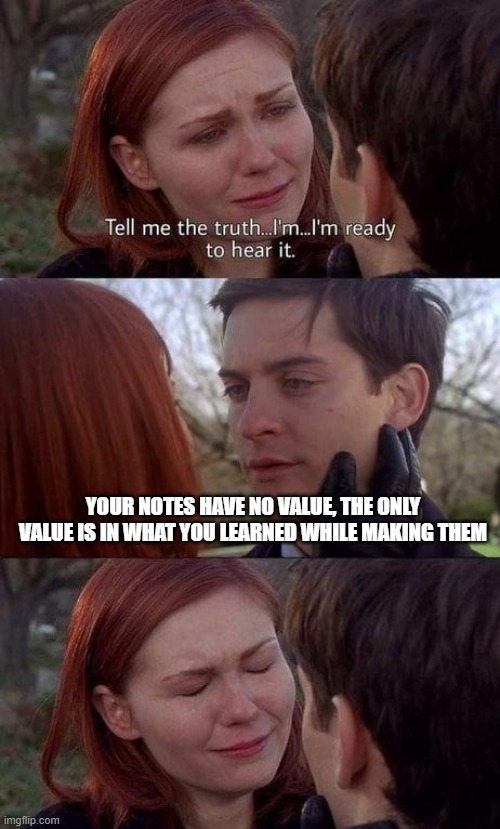
Wait, what?
So here’s the big secret that students never fully understand (maybe you can be the first): the important thing about notes is the process of making them. And I don’t mean just copying things from the board.
Think about it. You want to pass the exam with a good grade, right? To do that, you need to have an understanding of the topics in your brain. So, the question is, how do you get things into your brain.
If it was as simple as listening to a lecture and copying notes from a board, life would be easy. But it’s not. Science tells us that the only way to get A-level Biology understanding into your brain for later recall is to process the concepts in your conscious mind. You have to make the effort to really think about them.
Unfortunately brains are pretty lazy and will outright lie to you to avoid having to do that: “yeah honest we’re learning this, 100% trust, we’re good to go”. But it’s lies.
Forcing stuff through your brain
If you just read something, your brain will lie and tell you that you understand it fine. It’s only when you try to use the concept in a new way or write it in your own words that you realise you don’t understand at all. This is a really frustrating feeling but it’s better to find out now rather than in the exam.
Writing information down in your own way (not copying) forces your brain to process that information. It can’t fake it’s way around it. You can’t write something in your own words without, at some point, having understood it.
So, writing notes in your own words is really useful. Learn the topic, make sense of it, then organise that information on the page in a way that best makes sense to you. Make links to other topics (I can’t overstate how important this is) and use the new knowledge to make more sense of the old topic. Also make links to your personal experience (biology is great for this).
The difficulty you feel when writing high quality notes - that is the feeling of learning happening. And remember: the learning is the goal, not the physical notes themselves. Trust me, the world has more A-level notes than it could possibly need.
Now here’s the problem - in class, everything is in such a rush that you don’t have time to do that properly. But the system encourages everyone to try, while all that does is to make it impossible for most students to listen properly to the teacher.
Ok so I know this is upsetting but it’s important
Humans love to have proof of value, in physical form. We love getting medals for our achievement - for most people the achievement itself is not enough, we need some physical representation of it. And notes are held up as a physical representation of learning. But the problem is that often they are not. You can have beautiful, comprehensive notes, but not have learned a thing.
You need to focus on the process, to value the actual learning, which will not be seen or appreciated by anyone other than the examiner through the lens of your answers in the exam. And that’s how you get a bit of paper with your final grade on it that you can proudly show people as a physical representation of your achievement.
What to Write Down
Taking notes in class
In class, I would suggest you don’t distract yourself by writing down all the things that will obviously also be in your textbook.
Do write topic headings, so you know where you are. And then record useful study tips for your future self to use for when you are revising the topic - what misunderstandings did you have this time that you could avoid in future? What useful examples did your teacher use? What did they say that gave you a lightbulb moment? What links did they make to other parts of the specification?
And if you’re naturally a doodler who needs to doodle/draw while you’re mentally processing then that can be fine - just don’t let the doodling stop you listening. This is biology class, not art/design.
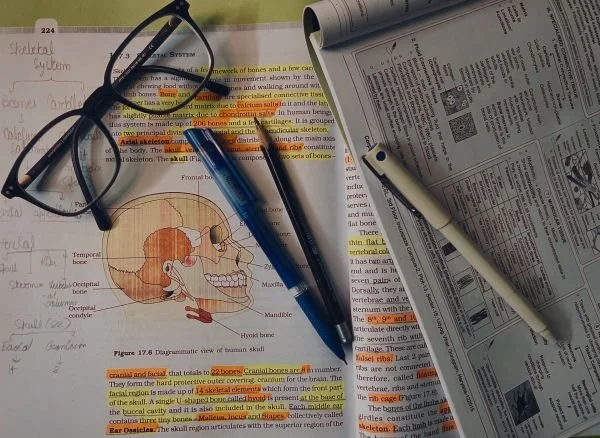
Highlighting printed text is a waste of time - close that book and start writing from your own brain
Making notes at home
Making notest at home is a great to way think your way through the information and concepts that you need to learn.
Don’t just copy stuff out - that’s pointless - you need to learn it. Then write it down from a position of understanding. Explaining something on paper is a great way to ensure you really do understand it and that your brain isn’t lying to you about that. If you can’t write it in a coherent, organised way, then it’s not available in your brain in a coherent, organised way either.
When you’re writing stuff out and you get stuck, that is brilliant - it’s a strategy for finding out where your understanding is weaker, so that you can focus your efforts on the right things.
And don’t worry about having a perfect notebook or making everything beautiful - that’s going to make it harder to actually study. Focus on the biology. Scribble stuff out if it’s wrong. Rewrite things more clearly. Draw that diagram again. Redrawing and redrafting information is a good way to get it going through your mind over and over again, so long as you’re thinking about how to make the concepts clear rather than just making it pretty.
Borrowing notes from your friends
Wow did you really get this far?
Ok so what do you think, given everything I said above?
If you borrow your friend’s notes and copy them down, are you learning anything? What is the quality of what you’re learning?
Yeah, it’s a waste of time. It will make you feel better, but feeling confident beyond your actual knowledge is a really really good way to get disappointed when the exams come. If you miss a topic, you do need to learn it, but your friend’s attempt at creating a textbook during class isn’t going to help you with that. Check out your textbook to see what you need to learn, find good quality explanations online, learn the content, and write your own notes.
Then throw your notes away, whatever, it doesn’t matter. The important bit is safely stored in your brain - take care of it with a bit of ongoing revision and you’ll be all set to get a top grade.

Preparing for A level Biology: what can I do in the summer
What can you best do over the summer to help transition to A level Biology? (It's probably not what you're thinking.)
Tips and information to help with the transition from GCSE to A level.

Aiming for Success
Pressure on students seem to grow every year, with more and more students looking to do work over the summer to prepare for starting A level Biology in the autumn term. It’s true that A level Biology is a challenge, and there are certainly things you can do that will help your studies. This article gives advice on what you can best do to hit the ground running when you start your A level course.
One thing I don’t recommend is to ask a tutor to teach you A level content before you start. All this will do is interfere with your teacher’s work and make the classroom less interesting as there will be no surprises. That’s not a great way to build motivation for the long term. It’s much better to encounter new topics in the classroom, and use tutoring to check/deepen understanding and correct misconceptions.
The best things you can do over the summer are things that will (1) help consolidate your prior knowledge and understanding, and (2) create anchor points for you to learn/remember new knowledge.
You’re not going to like the first, but the second might be just what you need right now.
Consolidate Prior Knowledge
How did you do at GCSE?
A level biology builds upon concepts that you studied for GCSE. Having these solid in your mind will help massively when you are introduced to new materials. If you know you are a bit wobbly on some topics, watch out because that will make it difficult for you to understand the A level material - you’ll effectively need to learn both levels of content at the same time. And that’s a real challenge. Mastering the GCSE material will mean you can use it with little mental effort while grappling with the more-complex A level concepts.
Ok so it might feel weird to back go over GCSE content when the exams are done and dusted, but you’re going to need all that stuff again in your A level course. Maybe go back through it in August in the run-up to starting your A-level studies, and drill down into any areas where you feel like you’ve just memorised it without any real understanding.
Look at this comparison of the spec for GCSE and A level Cell Structure:
AQA A level Cell Structure
The structure of eukaryotic cells, restricted to the structure and function of:
cell-surface membrane
nucleus (containing chromosomes, consisting of protein-bound, linear DNA, and one or more nucleoli)
mitochondria
chloroplasts (in plants and algae)
Golgi apparatus and Golgi vesicles
lysosomes (a membrane-bound organelle that releases hydrolytic enzymes)
ribosomes
rough endoplasmic reticulum and smooth endoplasmic reticulum
cell wall (in plants, algae and fungi)
cell vacuole (in plants).
In complex multicellular organisms, eukaryotic cells become specialised for specific functions. Specialised cells are organised into tissues, tissues into organs and organs into systems.
Students should be able to apply their knowledge of these features in explaining adaptations of eukaryotic cells.
AQA GCSE Cell Structure
Students should be able to explain how the main sub-cellular structures, including the nucleus, cell membranes, mitochondria, chloroplasts in plant cells and plasmids in bacterial cells are related to their functions.
Most animal cells have the following parts:
a nucleus
cytoplasm
a cell membrane
mitochondria
ribosomes.
In addition to the parts found in animal cells, plant cells often have:
chloroplasts
a permanent vacuole filled with cell sap.
Plant and algal cells also have a cell wall made of cellulose, which strengthens the cell.
Recognise, draw and interpret images of cells.
Students should be able to use estimations and explain what they should be used to judge the relative size or area of sub-cellular structures.
You can see that there is a lot of overlap - the GCSE content is used as a foundation for learning more. Because you already know something about organelles and their general functions, you can build additional understanding by adding to this prior knowledge. Learning everything from scratch would be really hard! That’s why you need GCSE qualifications to enter the course - your GCSE knowledge will act as a springboard. But how good that springboard is might vary across topics.
You’ll also need to know how to calculate areas and volumes, and to read graphs and understand how averages can be used to understand data. How did you do at GCSE maths?
A person with strong GCSE Biology and Maths will find it much easier to learn A level Biology than someone with a poor grade in combined science. Not because they’re cleverer (whatever that means), but simply because they’re starting from a better place.
What to do: if you know you’re weak on some parts of GCSE, take a look back over those areas and make sure you have a strong foundation for learning more. You’re going to have it re-learn it at some point, and it’s easier to do it while you’re not also grappling with higher-level concepts that won’t make sense without that prior knowledge.
Stretch your Literacy

A level Biology involves a lot of complex vocabulary and comprehension of texts. Written language is very different from spoken language, so if you usually consume informal, spoken media it may be more difficult for you to follow biology texts.
Reading any long-form, professionally written texts will help stretch your literacy and get you used to the vocabulary and sentence structures used in formal writing. It would be ideal to read a pop-sci biology book on a subject that interests you, but reading any books with formal-stye writing, on just about any topic, would be a great boost.
Literacy is a huge factor in student success, and especially anyone with lower grades in GCSE English would benefit from getting more used to reading long-form written-language texts. If you’re struggling to understand the language before you even start to grapple with the biological concepts, the course will be extra-difficult for you.
What to do: find a well-written blog, or book, or other long-form media that interest you and get used to reading in an engaged, thoughtful way. Put your phone aside and practice focusing on the text and its meaning, thinking about how it links to your own interests and life.
Enrich your mind
The human brain is unable to remember facts in isolation. This is why memory experts need to use mnemonic tricks. It’s much, MUCH easier to remember things if they relate to things we already value, our life experiences, our self-image, our emotions, or our prior knowledge.
This makes A level Biology more difficult for students who been unable to travel, or have perhaps focused purely on classroom study. In biology you will encounter many examples of animals and environments that are well-known to some students, but new to others.
A student who has visited a rainforest will find it easier to learn and remember new information about rainforests not only because they might already know some things, but also because they can link new information to their prior experience.
Students with little experience may also get tripped up by organisms that are used as ‘well known’ examples to illustrate points. Some students don’t know what cows eat, or that dolphins are not fish, or that bats are mammals. Well-meaning teachers can confuse students with less-broad life experience by assuming knowledge that just isn’t there.
I’m not suggesting you don’t know what cows eat, or that you visit a rainforest (although do if you can - they’re awesome). But you absolutely can enrich your mind with different experiences and stories and images that will serve you well as anchors for future learning.

Visit different environments
If you can visit a zoo, or an aquarium - perfect! Take your time to really observe the animals. Build strong memories by taking notice of the smells and sounds around you. Read the labels. Talk to your friends about what you see, relating your observations to other things you already know about. Then, later in the course, when your teacher talks about the neck-bones in a giraffe, you can stick that information on to your memory of the giraffe in the zoo. It sounds silly but seriously, it’s like a cheat code for learning.
Maybe you can find a volunteer opportunity in the summer helping with conservation work. This can give you a real connection to the environment you’re working in, and an understanding of what it’s like to work in the field that will help you better imagine, and remember, the field studies described in your course.
Or, just visit the park. Go for a walk by a river. Notice the small organisms around you. The weeds in the cracks. Stop to observe insects. What can you smell? Notice how different animals are hanging out in different environments. In what ways do these environments vary? Stick your hand in a river, feel the texture of the leaves of a tree and notice how the top and bottom surfaces are different. Listen to the wind and birdsong, talk, build emotional and sensory memories that will provide strong anchors for future learning. Touch grass.
What to do: visit different environments, exploring with all your senses while observing and discussing the organisms you discover.

Go on a virtual adventure
Documentaries and films can take you to a vast variety of environments that you wouldn’t be able to visit in person.
Check out BBC Nature documentaries and fall into the emotional stories they tell of individual animals. Imagine how the animal feels, its challenges, abilities and basic drives. Get a really broad view of the diversity of environments and organisms on Earth and the delicate interactions. When you later learn about some A level concept, you will suddenly think “oh, wait, it’s like that thing I saw!” and suddenly it’ll all make sense and be easy to remember.
If you don’t live in the UK, especially if your local environment is very different, how about watching some programmes about, or set in, British farmland. Find out what cows eat! Examples from farming and agriculture are found throughout the course and will be less accessible to you if they are unfamiliar.
What to do: immerse yourself in rich visuals, music and stories of environment and organisations from around the planet.

The best part about building these rich memories is that it won’t burn you out. You can enjoy the experience without having to do difficult analytic thinking, trying to force information into your brain, or recalling complex information.
Let’s face it, if you’ve just finished your exams then more academic study might not be what you need right now.

So in summary …
Broaden your mind and lay the foundational knowledge that you will need to engage with A level Biology concepts. In this way you can set yourself up for an easier time in the classroom in September - and throughout the whole course.
Article by Jenny Shipway. If you liked it, click ❤️Like below to help others find useful articles.

How to Revise A Level Biology: A Simple Trick - Use Your Words
A simple but effective trick to boost your learning and revision. You just need a little buddy.

A guest blog from Dr Jenny Shipway, who studied biochemistry at university and now works in science communication and education training.
Find the full set of “How to Revise” articles here
The Lazy Brain
Brains are great at taking sneaky short-cuts to avoid thinking too hard, especially when they’re feeling tired. If you get stuck on something while revising, it might be for this reason.
Words are Powerful
Words not only help us communicate, but also help us organise our thoughts. By forcing things into words, we can prevent our brains from taking short cuts, and force them to think things through properly.
Many problems can be solved simply by stating the problem out loud. How many times have you asked someone for help but, as you are describing the problem you realise what the answer is? By describing the problem step by step, it’s suddenly obvious where you were going wrong.
As a bonus, when you take the effort to put things into your own words this forces the thoughts through your brain in a way that means you are more likely to remember it in future.
Your best study buddy is already in the room

Can you explain Mitosis to Mr Pokey?
Research shows that much of what people learn in schools comes from talking with their teachers and classmates. But what if you’re alone? Don’t despair, your study buddy does not have to be human, or even alive.
As you study, you could explain concepts out loud to:
Your pet
A beloved soft toy
A smiley face drawn on your finger
A picture of someone you love or respect
Pretty much anything with two googly eyes stuck onto it
I don’t know what the research says about giving your buddy a name, but I would imagine this would help too.
Keep Your Language On Track
For best effect:
Speak in complete sentences rather than letting your thoughts jump around. If you need to repeat yourself to do this, then do so (your study buddy won’t mind). Making yourself repeat the same idea again but more clearly is really helpful.
Keep your language scientific and appropriate to the level of study where possible.
Don’t let your brain take short-cuts by using unprecise language or skipping through ideas. Speak slowly and deliberately, like you really are trying to explain something to someone who doesn’t already know it.
By repetitively speaking biology jargon words out loud, you will be much more likely to remember them in future. And by using them in complete, meaningful sentences, you will be telling your brain that they are useful things to recall and flagging them up as things worth remembering in future.
It’s important that you’re not just repeating sentences you read elsewhere, the key is to produce new sentences that serve a purpose in explaining something to your study buddy.
If this post has been helpful, please like ❤️ below and share with your friends.

Key Concept: Averages, Range, and Standard Deviation, with A level Biology Past-Paper Questions
You need to know some maths for A level Biology. This includes knowing how to interpret averages (mean, median and mode), ranges, and standard deviations to work out whether an experiment can be said to have shown an effect or not. Master this early on and it will not help you with exam questions, but also make it easier for you to learn the bits of the course that are explained using these statistical methods.
You need to know some maths for A level Biology. This includes knowing how to interpret averages (mean, median and mode), ranges, and standard deviations to work out whether an experiment can be said to have shown an effect or not. Master this early on and it will not help you with exam questions, but also make it easier for you to learn the bits of the course that are explained using these statistical methods.

Why does Biology need so much data?

Maybe the guy at the back is just big for his age?
Researchers often want to compare two or more things. Which species of frog is heavier? Which type of soil grows taller plants? At what temperature do these bacteria divide fastest? At which pH are fish most active?
The biological world is complicated, so multiple, repeated measurements are usually required.
There are three main reasons for taking multiple measurements:
Measurement errors. It’s hard to take measurements in the real world. Even if you re-measure the exact same thing, and even if you use a well-calibrated tool, you might get a slightly different result each time. Maybe you can’t hold the tool still enough, or you can’t read it clearly, or the thing you’re measuring moves. These are precision errors.
Individual variation. If you want to ask a general question about a whole population, eg “do robins sing more than blackbirds” then you need to measure data from more than two individuals. If you only use two, you might randomly pick outliers; maybe you get a particularly perky robin, or a lazy/sick blackbird. Similarly, if you sample a small area of a larger region, you may not pick a representative area.
Uncontrolled variables.There will nearly always be variable-influencing factors that you’re not aware of, or unable to control. Maybe there are changing sounds or smells in the environment, subtle changes in light, or in the birds’ blood-sugar levels. These can affect individual measurements in unpredictable ways.
All of these things can affect the value you record, making any one single measurement unreliable. So researchers normally end up collecting large sets of measurements. In this way they can get a much better idea of what’s really going on.

Why does Biology need Statistical techniques?
Plotting lots of repeated measurements for different datasets on the same graph can create a confusing mess. Also, “the data look different to me” isn’t good enough for science.
Reducing each dataset to just two or three values makes it much easier to compare. In fact, it’s so simple that such data can be understood even without a graph, so values are often presented very simply in a table.
Calculating Averages in Biology
There are three types of average: mean, median, and mode. They all reduce the data set to one single number.
This is useful for comparisons. For example, if you let a frog jump ten times, measuring the length of every jump, you can calculate their average jump length. You can then compare that single number to the average jump length from another frog to find out which jumps further.
Calculating the Mean
The most important type of average for A level Biology is the mean. It’s also what most people are talking about when they say “average” in everyday life.
To find the mean, add up all the numbers, then divide by how many numbers there were. You end up with just one number.
Here’s an example dataset:
| Set 1 | 3 | 4 | 5 | 5 | 5 | 6 | 6 | 6 | 7 | 8 | total = 55 / n = 10 / mean = 5.5 |
| Set 1 | 3 | 4 | 5 | 5 | 5 | 6 | 6 | 6 | 7 | 48 | total = 95 / n = 10 / mean = 9.5 |
| Set 1 | 3 | 4 | 5 | 5 | 5 | 6 | 6 | 6 | 7 | 48 | central number(s) = 5 and 6 / median = 5.5 |
| Set 1 | 1 | 3 | 5 | 5 | 5 | 5 | 6 | 6 | 7 | 48 | mode = 5 |
| Set 1 | 50 | 50 | 50 | 50 | 50 | 50 | 50 | 50 | 50 | 50 | mean = 50 / median = 50 / mode = 50 | ||
| Set 2 | 25 | 30 | 35 | 40 | 50 | 50 | 60 | 65 | 70 | 75 | mean = 50 / median = 50 / mode = 50 | ||
| Set 3 | 1 | 2 | 3 | 4 | 50 | 50 | 96 | 97 | 98 | 99 | mean = 50 / median = 50 / mode = 50 |
The averages are the same! By themselves, averages only tell you one small part of the story.
What is Range / why is it useful
One of the big differences betwen the datasets above is the range of numbers that appear.
The range is the range-of-values that appear, from the lowest to the highest.
| Set 1 | 50 | 50 | 50 | 50 | 50 | 50 | 50 | 50 | 50 | 50 | lowest value = 50 / highest value = 50 / range = 50 to 50 | ||
| Set 2 | 25 | 30 | 35 | 40 | 45 | 55 | 60 | 65 | 70 | 75 | lowest value = 25 / highest value = 75 / range = 25 to 75 | ||
| Set 3 | 1 | 2 | 3 | 4 | 50 | 50 | 96 | 97 | 98 | 99 | lowest value = 1 / highest value = 99 / range = 1 to 99 |
Set 1 has a range of 50 to 50. So you can reasonably predict that the next measurement would likely be 50 too
Set 2 and Set 3 have wider ranges. There are a wider range of possible values that might be measured, so it’s harder to predict what the next measurement might be.
A wide range might indicate that your measurement technique is very unprecise, or that there is a wide natural variation in the thing you are measuring, or that there is another factor affecting your measurements.
But a wide range might also just mean there were one and two weird outliers in the data. So you need to be careful when using this value. Here is a set with one odd measurement, which might be due to a measurement error.
| Set 4 | 50 | 50 | 50 | 50 | 50 | 50 | 50 | 50 | 50 | 90 | lowest value = 50 / highest value = 90 / range = 50 to 90 |
| Set 1 | 25 | 42 | 48 | 50 | 50 | 50 | 50 | 52 | 58 | 75 | values clustered around mean = low standard deviation | ||
| Set 2 | 25 | 30 | 35 | 40 | 45 | 55 | 60 | 65 | 70 | 75 | values spread out away from mean = high standard deviation |
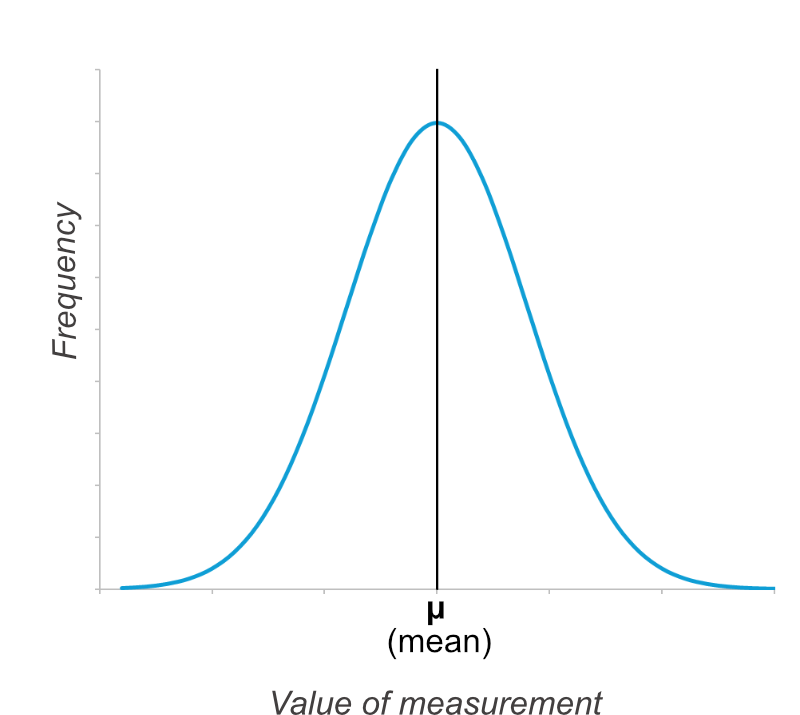
To understand Standard Deviation, think about a situation where you have made very many measurements, so that you have multiple measurements at each possible value. Now plot these on a graph (see below). In biology, you usually see that the graph forms a bell shape. This is called a “Normal distribution”.
Normal distributions are symmetrical, so the mean, mode, and median are all the same, appearing at the centre of the graph (mean, median, and mode = 16 in this example). In normal distributions, most measurements are near the average, so there is a peak in the middle of the graph.
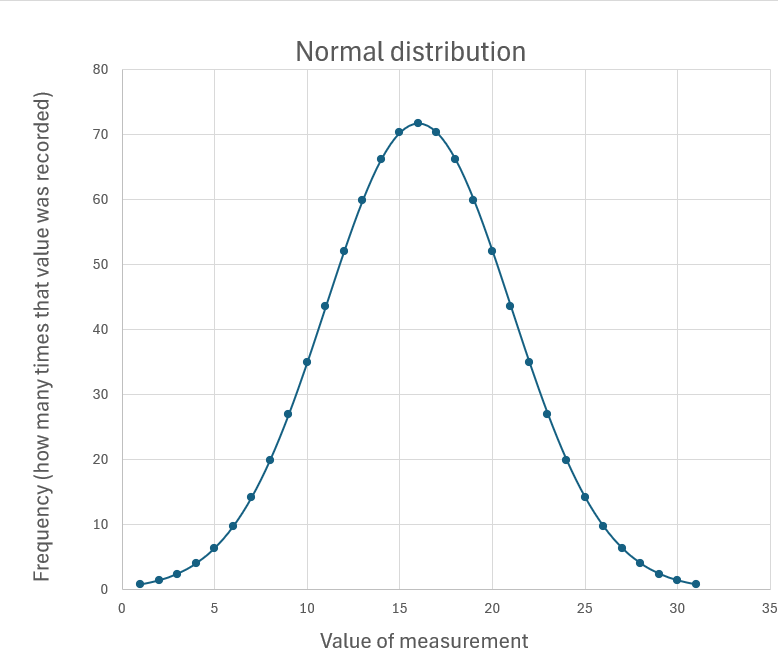
(Sometimes, you’ll find a curve is skewed a bit to one side. This separates out the mode, median and mean values. But for our purposes, I’m going to stick to thinking about the symmetrical graph.)
How wide the curve is matters a lot, because it affects how much two sets of data overlap. Compare these two examples below. Both have one set of data where the mean is 14 (plotted in orange), and another set where the mean is 20 (plotted in blue).
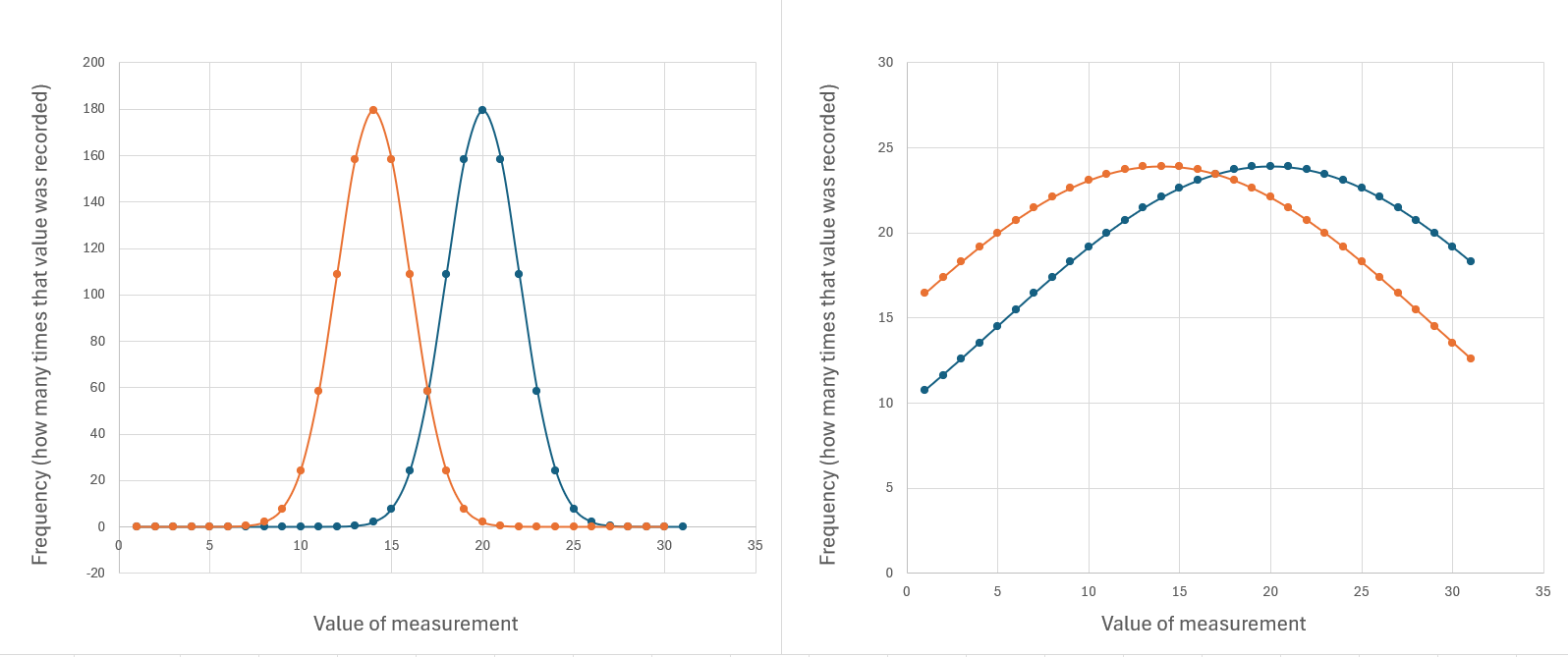
There is the same amount of data in both graphs, and the averages haven’t changed. But there is a lot less overlap between the two datasets in the example to the left. The data on the right is a lot more spread out away from the average values.
When datasets overlap a lot, you need to be very careful that you definitely have enough data to be sure their means really are different. If you have a small data set with a lot of variation, then adding extra measurements can make a big difference to the mean.
What is Standard Deviation
Standard Deviation tells you how widely the data is spread out in a normal distribution. Its symbol is sigma, “σ”.
You’re very unlikely to be asked to calculate standard deviation in an exam, and it takes a while to explain so I’m not going to go through it here (don’t worry they’d give you the equation if you did have to do this).
But you do need to know what it tells you.
Here is the basic normal distribution graph again. The graph is symmetrical and the mean (μ) is in the centre.
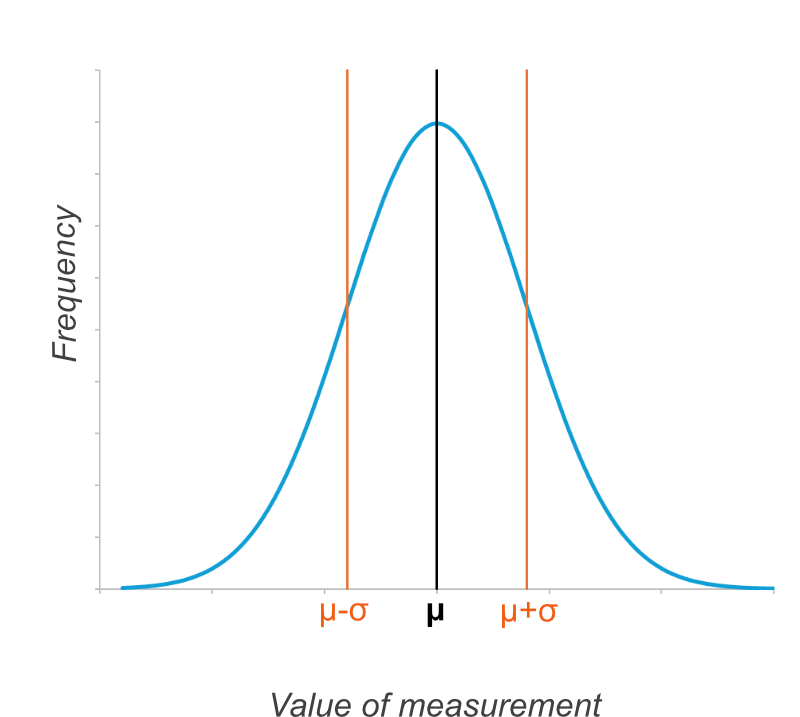
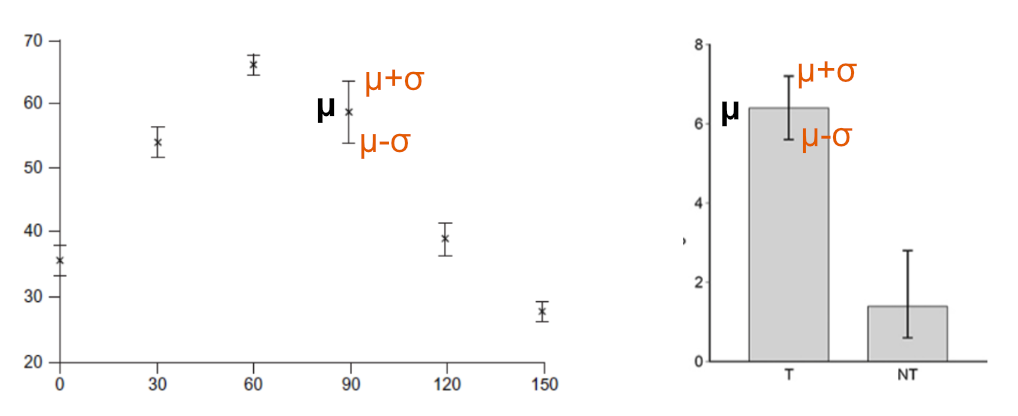
Now here is the same graph, but two more values are marked on the x-axis, shown by orange lines. These are the value of the mean minus one standard deviation (μ-σ), and the value of the mean plus one standard deviation (μ+σ).
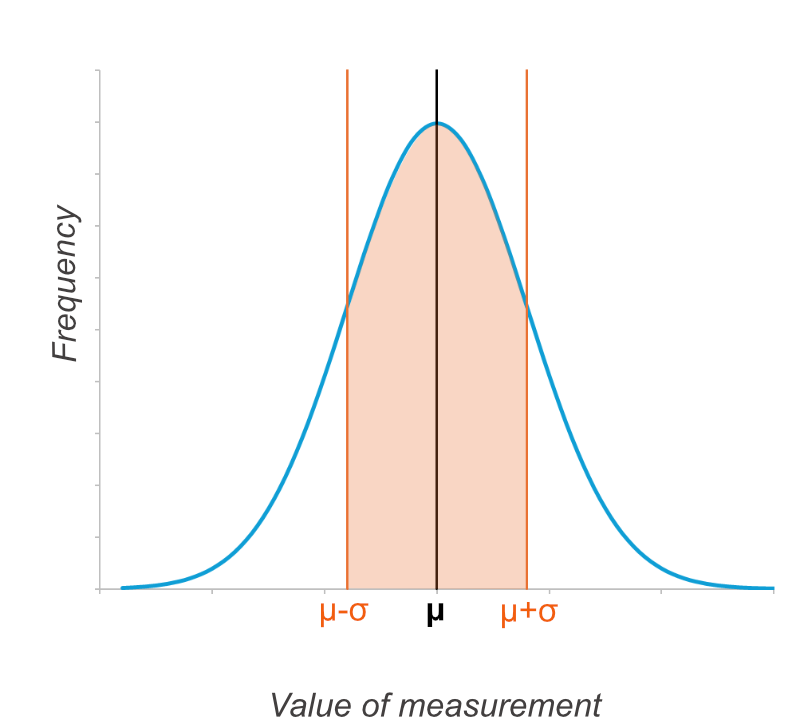
If you colour in the bit of the graph that is within one standard deviation of the mean (from μ-σ to μ+σ), then on any normal distribution, 68.27% of the data points will lie within this area. You don’t need to remember that percentage, but remember it is always the same.
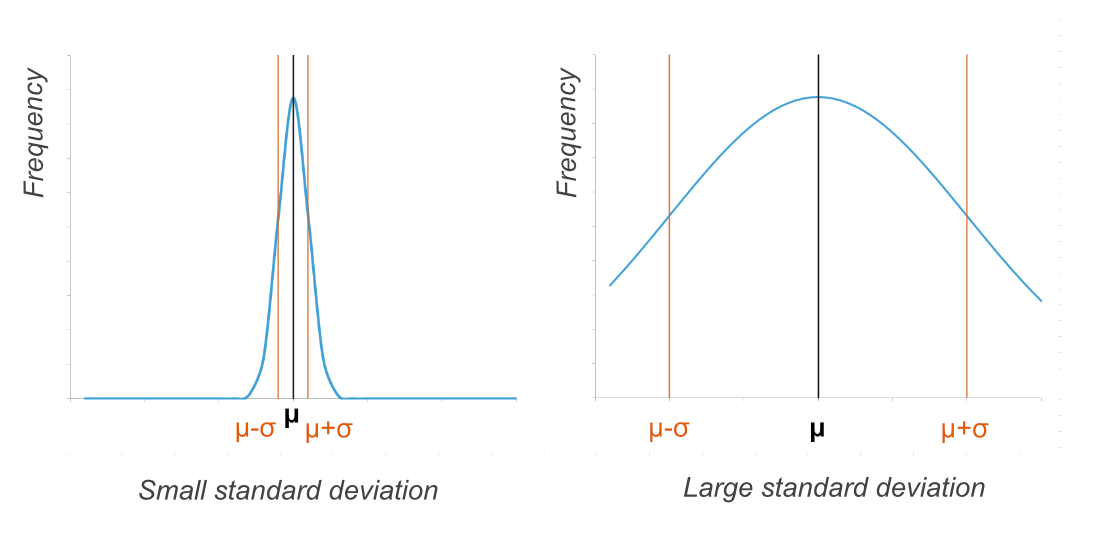
This means that if the standard deviation is a small number, you know most of the data points are close to the mean. This gives you more confidence that the mean is a useful value for comparison.
The graphs below have the same X-axis. Both are normal distributions with the same mean. But the one on the left has a small standard deviation, and the one on the right has a high standard deviation. (Some of the data from the right-hand graph falls outside the values shown on the graph.)
How to tell if there is a significant difference between values using the mean and standard deviation
!! Ok so this is the important bit we’ve been building up to !!
In a normal distribution, most of the data (68.27%) falls within one standard deviation of the mean. This is the area between μ-σ and μ+σ.
To work out whether it’s just chance that the means are different, or whether it’s a real effect, you need to check whether this area overlaps bewteen the two sets of data.
If the areas between μ-σ and μ+σ overlap, the difference is not considered significant.
There are different ways of presenting the data.
Standard Deviations Using Numbers - example
An example:
Set 1: mean (μ) = 50, standard deviation (σ) = 8
Set 2: mean (μ) = 40, standard deviation (σ) = 3
Are these sets of data significantly different? Look at the areas between μ-σ and μ+σ
Set 1: μ-σ = 42 and μ+σ = 58
Set 2: μ-σ = 37 and μ+σ = 43
Do these areas overlap? Yes they do (both include 42-43). So you can not consider the two data sets significantly different.
(Also worth knowing: nearly all the data (95.45%) falls within two standard deviations (between μ-2σ and μ+2σ) - so if these two areas don’t overlap you can be even more sure the two sets of data really are different.)
Standard Deviations Plotted on Graphs - example
On graphs, the mean is plotted as usual, with a dot or column. Extra lines extend out to show the area from μ-σ to μ+σ. This can make it more obvious whether areas overlap or not (unless they are super close in which case numbers are more useful).
Standard Deviation Exam Past Papers
Example Exam Question 5
Question 5 answers found at the bottom of this web page
Understanding Standard Deviations from Graphs
Example Exam Question 6
Question 6 answers found at the bottom of this web page
Example Exam Question 7
Question 7 answers found at the bottom of this web page
Graphs and Tables in A level Biology
If you’re not confident with questions that include graphs and tables, see the recent blog post “How to Approach A level Biology Graph and Table Questions: Tips and Exam Question Pack”, which offers more useful tips for navigating them during exams, and more exam questions to practice with.
Answers to example exam questions
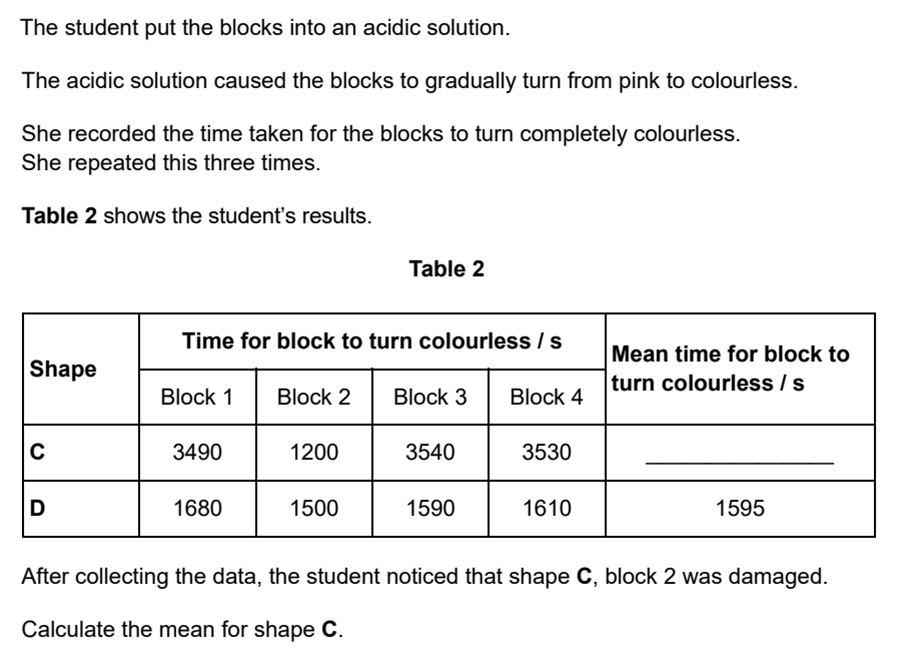
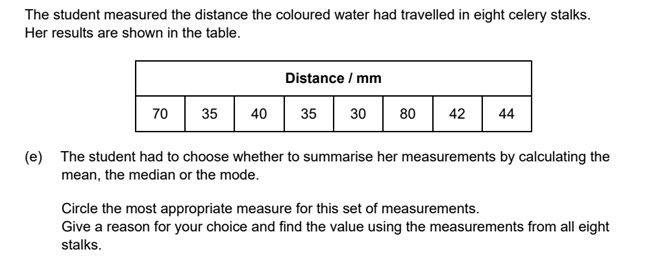
The data for the damaged block should be ignored. The mean for shape C is 3520 seconds
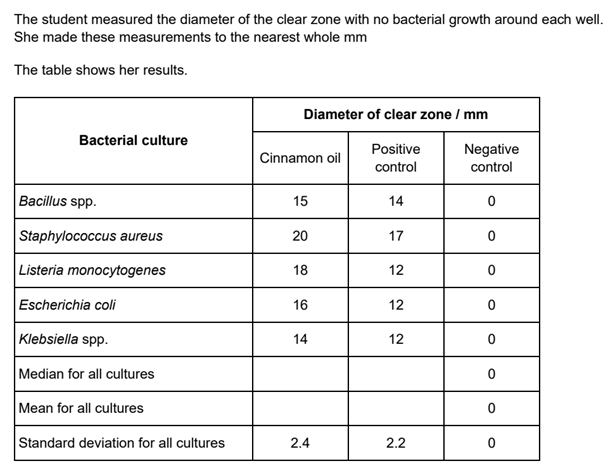
Cinnamon Oil median = 16, mean = 17 ….. and ….. Postive Control median = 12, median = 13
Median = 41. This avoids the outliers affecting the value as would happen if you used the mean. And the sample size is too small to use the mode (there are no repeated values)
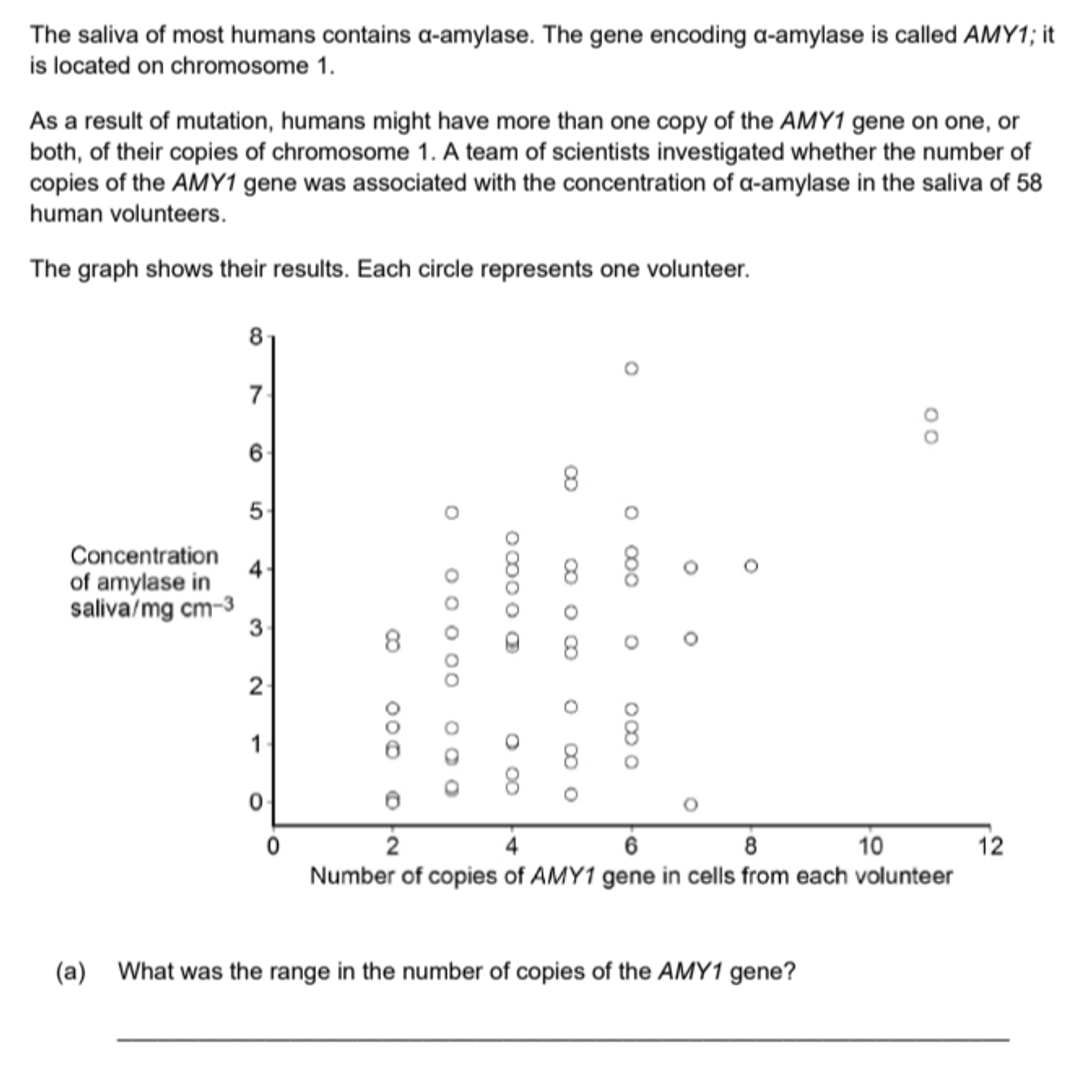
The range is 2 to 11
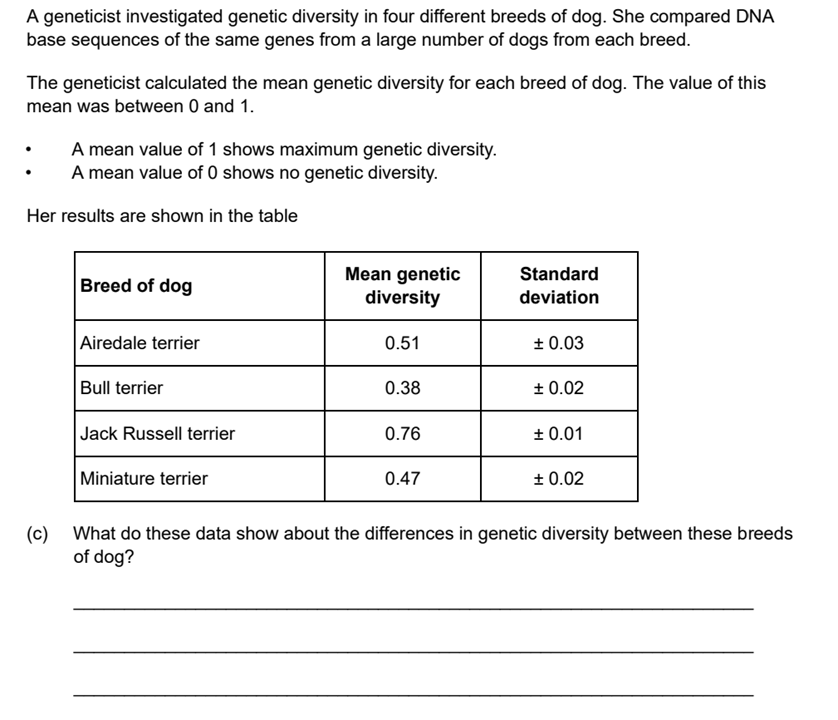
Bull terrier genetic diversity is significantly the smallest of the breeds shown, meaning it the most inbred. Jack Russell genetic diversity is significantly the greatest. The genetic diversity of Miniature terrier and Airedale terriers are similar with no significant difference between the two.
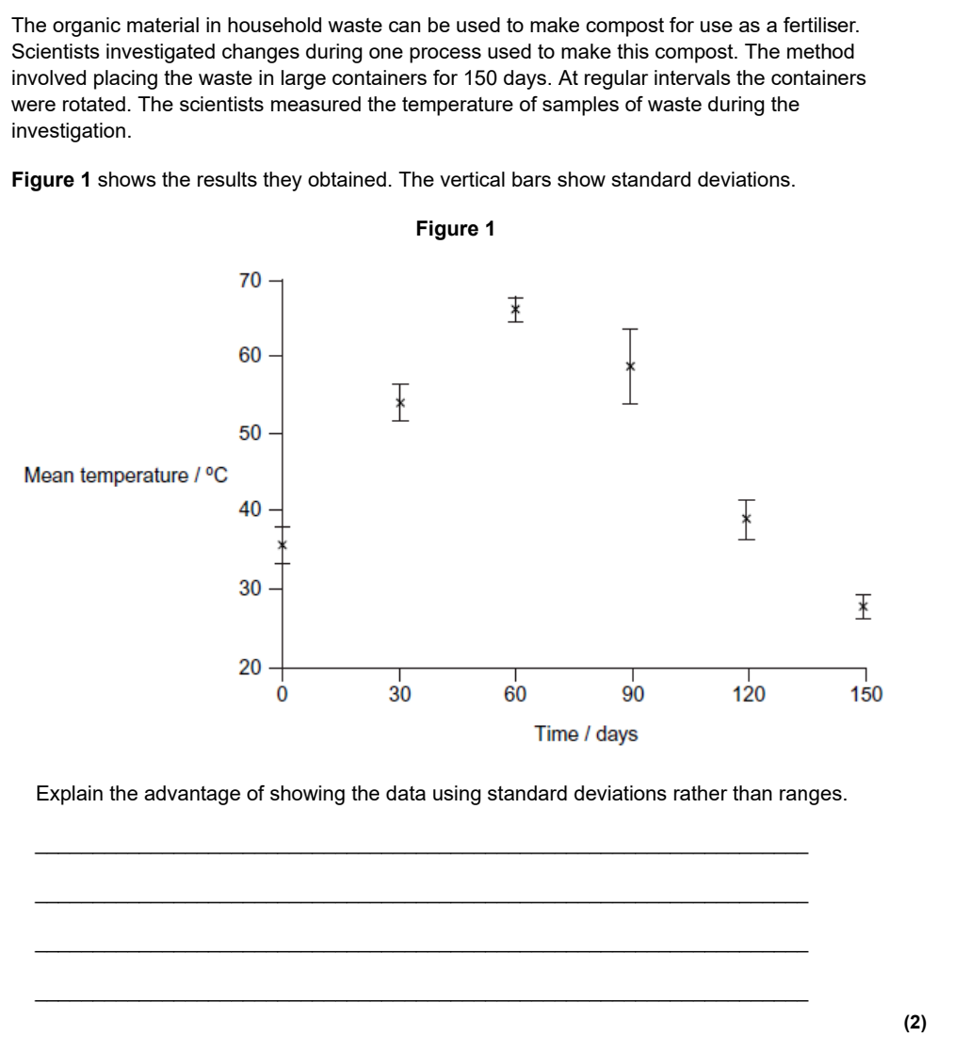
Standard deviation is spread of data around the mean; using standard deviation reduces effect of anomalies/ outliers; standard deviationcan be used to determine if (the difference in results is) significant/not significant/due to chance /not due to chance
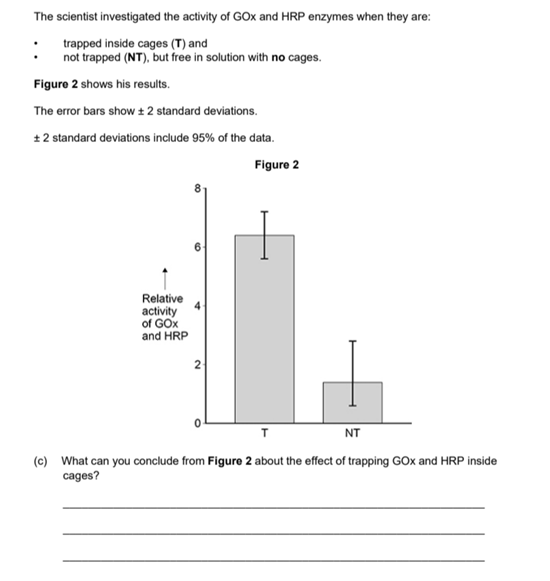
Trapping increases enzyme/GOx/HRP activity; the difference/increase is significant (it is unlikely to be due to chance as the standard deviations do not overlap)
Key Concept: Surface Area to Volume ratio (SA:V)
Some concepts turn up again and again in A-level biology. Taking a little time to ensure you really understand these key concepts from the start can save a lot of effort overall.
Surface area to volume ratio (SA:V) is vital for understanding a wide range of topics including transport across cell membranes, gas exchange, digestion, heat exchange, and mass transport. SA:V explains why the inner membrane of a mitochondrion is folded, why elephants have big ears, and why jellyfish don’t need blood vessels.
Some concepts turn up again and again in A-level biology. Taking a little time to ensure you really understand these key concepts from the start can save a lot of effort overall.
Surface area to volume ratio (SA:V) is vital for understanding a wide range of topics including transport across cell membranes, gas exchange, digestion, heat exchange, and mass transport. SA:V explains why the inner membrane of a mitochondrion is folded, why elephants have big ears, and why jellyfish don’t need blood vessels.
How confident are you in calculating this value and understanding its significance?
What are surface-area-to-volume ratios?

"Microvilli-Duodenum" by Wbensmith is licensed under CC BY-SA 3.0.
The ratio tells you about how changing the shape or volume of something affects its surface area. It’s not as simple as many people think: doubling the volume of ice-cream in a choc-ice doesn’t double the area of chocolate needed to cover it.
Surface areas are really important in biology. And so the shapes and volumes of things including organelles, cells, and organs are often optimised with respect to surface area. Whenever you see a weirdly folded or worm-shaped structure, think about SA:V.
Surface area to volume ratio (SA:V) is a value calculated by dividing a thing’s surface area by its volume. It is a single number that tells you about the relationship between the two input values.
To be precise: SA:V tells you how much surface area there is per unit of volume.
How to calculate SA:V (it’s not difficult, you just divide)
Quick maths refresher
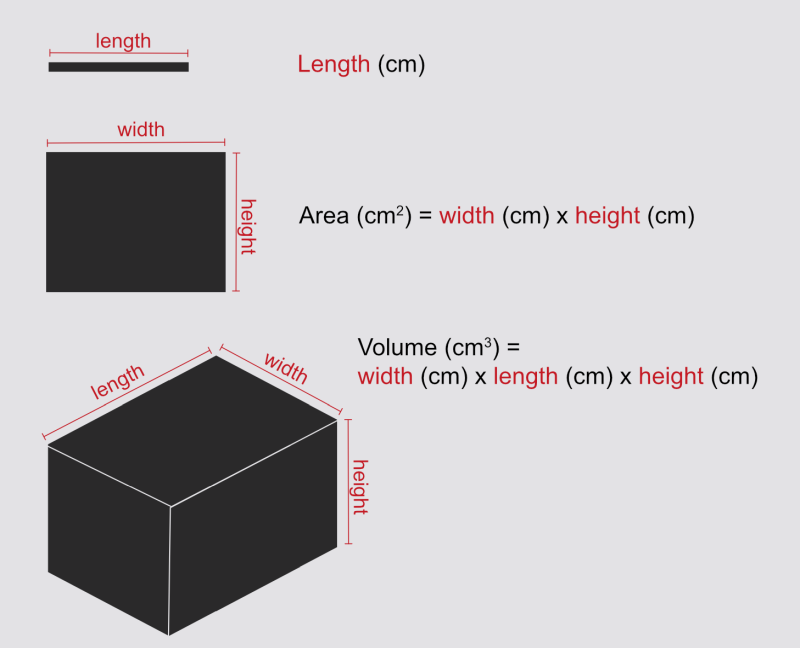
You will need to think about length, area, and volume and understand their units. Here’s a reminder for cuboids:
Simple example
Imagine a cube where every edge is 1 cm long. (Note: this blog doesn’t let me write little superscript numbers so I’ll use ^ to indicate that the following number should be written superscript, so 1^2 would mean 1-squared.)
Each square face of the cube has a surface area of 1 cm x 1 cm = 1 cm^2
Cubes have six faces, so the total surface area is 6 x 1 cm^2 = 6 cm^2
The volume of the cube is 1 cm x 1 cm x 1 cm = 1 cm^3
SA:V = surface area / volume. In this example that’s 6 cm^2 / 1 cm^3 = 6 cm^-1
Notice the funny unit there. You’ve divided cm^2 by cm^3 so they don’t cancel out perfectly.
But does it matter what this unit is? Let’s try it using the same cube but measuring it in millimetres.
Each square face of the 1 cm cube has a surface area of 10 mm x 10 mm = 100 mm^2
Cubes have six faces, so the total surface area is 6 x 100 mm^2 = 600 mm^2
The volume of the cube is 10 mm x 10 mm x 10 mm = 1000 mm^3
SA:V = surface area / volume. Using millimetres that’s 600 mm^2 / 1000 mm^3 = 0.6 mm^-1
1 mm is 1/10 of 1 cm and the SA:V calculated in mm is 1/10 that of the value calculated in cm. If you are comparing SA:V values, make sure they have the same unit.
Of course you don’t find a lot of cubes in nature. In exams they might simplify cells or other bodies to be imagined as spheres of a known radius, and give you equations for you to calculate the surface area and volume. And there are much weirder shapes to think about too. But before we get to all that …
How does SA:V change as things increase in scale?

We know the 1 cm cube has a SA:V of 6 cm^-1.
So, what if we get a handful of these 1 cm cubes and stick them together to make a scaled-up cube where every edge is 2 cm long? (See picture). How will the SA:V of this new structure compare? It’s still a cube, after all; it’s just a bit bigger.
2-cm cube:
Each square face of the assembled cube has a surface area of 2 cm x 2 cm = 4 cm^2
Cubes have six faces, so the total surface area is 6 x 4 cm^2 = 24 cm^2
The volume of the assembled cube is 2 cm x 2 cm x 2 cm = 8 cm^3
SA:V = surface area / volume. In this example that’s 24 cm^2 / 8 cm^3 = 3 cm^-1
The larger cube’s SA:V is only half that of the unit cube!
SA:V is surface area divided by volume. Higher values of SA:V mean there is more surface area for each unit of volume, and lower values of SA:V mean there is less surface area for each unit of volume.
So our 2 cm cube has less surface area per unit volume than the 1 cm cube did.
The larger cube has a lower SA:V. And if you work out the numbers for an even bigger one, you’ll get an even lower SA:V.
This makes sense. To build the 2 cm cube, you stack eight 1 cm cubes together. By doing this, you bury some of their faces within the structure. You end up with the same volume as eight individual 1-cm cubes, but you have reduced the surface area that is exposed to the outside world.
Also, if you look carefully at the picture, you’ll see that each cube in the assembled structure has half of its faces buried. So there’s only half the surface area per unit volume compared to the single cube. And so it makes sense that the SA:V is half what it was for the single cube.
Each small cube is only showing three of its six faces. So for each 1 cm^3 volume (ie for each small cube) there is 3 cm^2 surface area exposed, giving us an overall SA:V of 3 cm^-1.
Key concept: as size increases, SA:V decreases. This is a good thing to explicitly state in any question about SA:V and size, where the shape stays the same.
Try it: calculate SA:V for a 3 cm x 3 cm cube. What value do you guess you might get? And what is the actual value?
Why size matters

"Zygote" by Nina Sesina is licensed under CC BY-SA 4.0.
Imagine you are a single cell (well, you were once, don’t you remember?).
Your cell membrane is your connection with the outside world. Through it you take in nutrients, water and other necessary things. And you expel your waste through it.
This membrane is your surface; you have as much surface area as you have cell membrane.
Meanwhile, inside the cell membrane you have cytoplasm, organelles, etc. In this region you are busily metabolising molecules. You can measure this region as your volume.
Question: can you take in enough nutrients, and expel enough waste, to keep up with your metabolism?
More-important question: if you grow bigger, will this still be true?
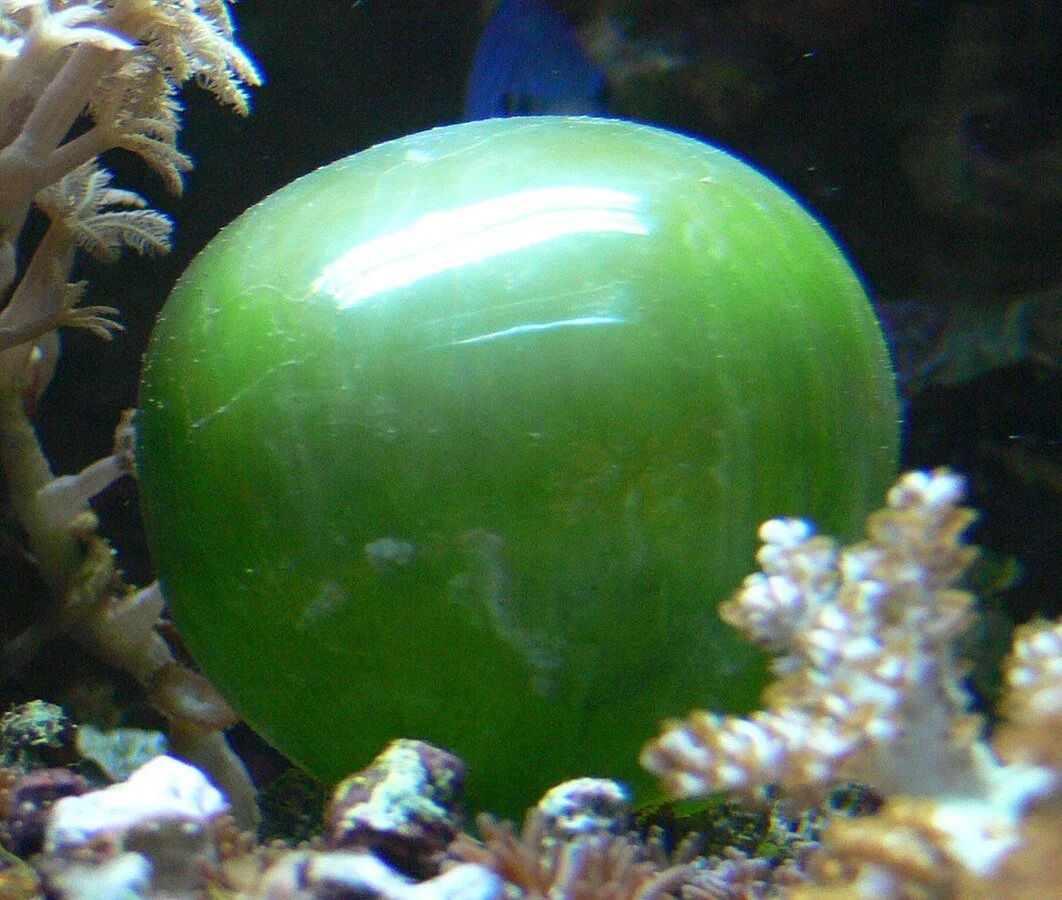
Valonia ventricosa aka Sailors eyeball - a single cell that can grow up to 5 cm in diameter. But … how???
As a cell grows larger its SA:V falls. This is just like we saw with scaling up the cubes above. The growth of the cell’s surface area (cell membrane) just can’t keep up with the growth of its volume (where the metabolism is). This means there will be a point at which there just isn’t enough cell membrane (surface area) to transport everything that needs to be transported, limiting the cells ability to function.
This is one reason why cells tend to be pretty small!
But … wait a minute, what about the freakish cell in this next photo? A shiny, bright green, single-celled alga that can get up to 5 cm in diameter. A single cell! Charmingly known as ‘sailors’ eyeballs’.
But how can one cell possibly be so large? Isn’t its SA:V ridiculously low? (Spoiler: yes it is). How can it transport everything it needs with such a low SA:V? Well, it has a trick …
Shape matters
This giant cell is cheating. Inside, all the metabolic activity is limited to an area very close to its cell membrane. Nearly all of the cell’s interior is filled up by one giant vacuole that pushes all the interesting stuff out to the region next to the membrane. So there isn’t nearly as much metabolism going on in there as you might imagine from its total volume. If you re-calculated its SA:V ignoring the volume inside its vacuole, you’d get a much more sensible number. (It also has multiple nuclei spread throughout its cytoplasm.)
In exams, questions are usually about solid spheres or cuboids. We’ve looked at cuboids, so let’s look at spheres.
Spheres
If you have to calculate for spheres, they will give you the equations you need to calculate volume and surface area. So don’t worry about remembering these.
Volume of a sphere = 4/3 x π x r^3
Surface area of a sphere = 4 x π x r^2
So, if you have a sphere of radius 1 cm (remember this is just the distance from the centre to the outside, so the whole thing is 2 cm across):
The surface area is 4 x π x r^2. If r = 1, r^2 = 1. So the surface area is 4 x 3.14 x 1 = 12.6 cm^2
The volume is 4/3 x π x r^3. If r = 1, r^3 = 1. So the volume is 4/3 x 3.14 x 1 = 4.19 cm^3
SA:V = surface area / volume. In this example that’s 12.6 cm^2 / 4.19 cm^3 = 3 cm^-1
This is the same SA:V as the 2-cm cube!
That important phrase “as size increases, SA:V decreases”, is talking about increasing the size of something while keeping the same shape overall. Shape is also really important!
Spheres have the lowest possible surface area for their volume. This is one of the reasons that nature likes them. For example, bubbles are spheres because surface tension pulls their surface in to minimise its area.
Stretching out
If a cell needs to grow to large dimensions but also needs to keep a high SA:V, it needs to avoid being a sphere. More-complex shapes will always have higher SA:V.
Consider neurons. You have a single neuron that reaches from your big toe to your spine. A single cell over a metre long! But these neurons are definitely not spheres. They are very skinny.
Question: what happens to SA:V when you make long/thin shapes?
Let’s go back to the 1 cm cubes. The 1 cm cube had a SA:V of 6. And the 2 cm cube had a SA:V of 3.

The 2 cm cube had a volume of 8 cm^3 : it was made out of eight small cubes. Let’s take those eight small cubes and rearrange them into the shape of a flatworm: a rectangular block of 2 cm x 4 cm x 1 cm (see picture above).
The upper and lower faces of this shape each have a surface area of 8 cm^2
The two long sides of this shape each have a surface area of 4 cm^2
The two ends of this shape each have a surface area of 2 cm^2
The total surface area is (2 x 8 cm^2) + (2 x 4 cm^2) + (2 x 2 cm^2) = 28 cm^2 (the 2 cm cube had 24 cm^2)
The volume of the assembled cube is 2 cm x 4 cm x 1 cm = 8 cm^3 (ok that isn’t a surprise)
SA:V = surface area / volume. In this example that’s 28 cm^2 / 8 cm^3 = 3.5 cm^-1 (the 2 cm cube was 3 cm^-1)
Rearranging it from a 2 cm cube to a flatworm of the same volume has increased its SA:V.
Ok so let’s push it even further and turn it into a long worm.

The upper and lower faces of this shape each have a surface area of 8 cm^2
The two long sides of this shape each have a surface area of 8 cm^2
The two ends of this shape each have a surface area of 1 cm^2
The total surface area is (2 x 8 cm^2) + (2 x 8 cm^2) + (2 x 1 cm^2) = 34 cm^2
The volume of the assembled cube is 1 cm x 8 cm x 1 cm = 8 cm^3 (no surprise)
SA:V = surface area / volume. In this example that’s 28 cm^2 / 8 cm^3 = 4.25 cm^-1 (the 2 cm cube was 3 cm^-1)
Your neurons can be really, really long because they’re also skinny, because that means they still have a really high SA:V.
And of course this works for whole animals too. Many small animals lack blood vessels and rely on molecules simply diffusing through their bodies. They need high surface area for transport and they also need every part of their interior to be not-to-far from that surface. This is (one of) the reasons we don’t have truly-giant insects: they are limited by their ability fo transport things to/from the outside world. Sponges and jellyfish also lack blood vessels and rely on diffusion.

Nemotode by Bob Goldstein, UNC Chapel Hill http://bio.unc.edu/people/faculty/goldstein/ Licenced under a Creative Commons Attribution-Share Alike 3.0 Unported licene

Tardigrade by Alexander Klepnev licenced under CC BY-SA 4.0.
Humans, alongside other larger animals, have much lower SA:V and suffer from low diffusion rates. So we need specialised structures to aid exchange and transport.
Maximising SA:V
Structures that are involved in transport and exchange rely upon having very high surface areas of membrane across which transport can take place. To maximise exposed surface area, structures are folded, or shaped into fingers, or branches.
In the human body, you find extremely high SA:V ratio in specialised structures including:
Gut - the gut wall has microvilli, finger-like structures that extend into the lumen. These increase surface area for absorption of water and nutrients
Lungs - the lungs have many branches terminating in tiny alveoli offering a very high surface area for gas exchange.
Capillaries - capillaries have much higher SA:V than arteries or veins. This offers a higher surface area for transporting things between the blood and tissue fluids. It also increases fluid resistance, which is important to keep the blood moving forward.
Red blood cells have a biconcave shape that increases their SA:V allowing better gas exchange with the blood plasma.
In other organisms, the shapes of structures like leaves, chloroplasts, gills, root hairs, and fungal hyphae, among many other examples, are similarly optimised to maximise surface area to volume ratios.
Folded membranes
You also find folded membranes used as a way to squeeze a load of membrane into a small space. Eg:
Mitochondria have a highly folded inner membrane that offers more surface area to embed the enzymes and proteins involved in oxidative phosphorylation, so that more ATP can be produced.
Golgi apparatus and endoplasmic reticulum are similarly folded to maximise their surface area.
Thermoregulation

Who is is feeling cold, and who is feeling hot?
Body surfaces also exchange heat with the environment.
We naturally change our SA:V when we get hot or cold by changing the position of our limbs and body. Which of the people in the image has the highest SA:V? Which person is feeling cold, and which is feeling hot?
Dogs increase their surface area by opening their mouths when hot and panting (passing air over their wet surfaces to lose heat through evaporation). Cats form neat loafs when cold but sprawl dramatically across the floor when hot.
Organisms’ entire body shape will also be related to their thermoregulatory needs.
Animals that need to lose heat from their bodies usually have a higher SA:V, and animals that need to conserve heat usually have a lower SA:V. This is why elephants have such huge ears (more surface area from which to lose heat) and why animals from cold environments tend to be more spherical than those from hot climates.

"Emperor Penguins" by Christopher.Michel is licensed under CC BY 2.0.

"Black Necked Stork" by AntoGros is licensed under CC BY 2.0.
Keep it in mind
If you can get an intuitive feeling for Surface Area to Volume ratios, and keep them in mind whenever you see a question about folded structures, or about similar shapes of different sizes, then this will help you understand what questions are really asking. A level Biology is about the why and how much more than it is about remembering facts, and SA:V goes a long way to help you understand things on this deeper level.
This article was written by Dr Jenny Shipway with guidance from Tom Whitburn

Key Concept: Independent and Dependent Variables
A variable is any value that does/might change during an experiment. Variables can include things like pH, temperature, colour, or the concentration of substances. The amount of time that has passed is a variable, as are rates of reaction.
A guest blog from Dr Jenny Shipway, who studied biochemistry at university and now works in science communication and education training.
To understand experimental design and graphs in exam questions, you will need to confidently recognise the difference between different types of variables. Master this now and it will also make it easier to learn content that is taught using graphs.

What is a Variable
A variable is any value that does/might change during an experiment.
Variables can include things like pH, temperature, colour, or the concentration of substances. The amount of time that has passed is a variable, as are rates of reaction.
Some variables’ values are fixed deliberately by the scientist.
Some variables’ values are changed deliberately by the scientist. These changes are planned in advance so the measured values are usually known before the experiment starts.
Other variables’ values are allowed to change naturally as the experiment progresses. These values can be measured to provide useful data.
Simplify Your Exam Approach
During exams it’s very easy to get overwhelmed with information. When this happens, your brain makes guesses and jumps, often without you being aware. This is why students so often mis-read graphs and/or make ‘silly’ mistakes.
Excellent Exam Tip: work out what the experiment was and how the graph is presented BEFORE looking at the exam question.
This will …
Reduce the number of things you’re thinking about at one time
Reduce the risk of you jumping to (incorrect) conclusions
Help you focus on understanding the experiment
You might feel an urge to rush forward to look at the question, but trust me that won’t save time. You will not be able to answer the questions unless you understand the graph, and rushing forward will make that more difficult, not less.
Identifying Variables
Variables described in the experiment and named on the graph axes may include:
Independent Variable – this is the thing that is changed deliberately by the scientist in a planned way. This is the thing that we expect to cause a measurable effect.
Dependent Variable- this is the thing that is measured by the scientist. The value is not known until it is measured, and the value will depend upon the value of the independent variable.
Control Variables – these variables are fixed to one unchanging value throughout. For example, all experiments might be carried out at 20°C, in which case temperature is a control variable. (Important: this is a different thing from ‘a control’).
The purpose of the experiment is to answer the question: how does the independent variable affect the dependent variable?
There are usually many factors that could be affecting the dependent variable, so it’s important to control as many variables as possile. The idea is that if only one thing has changed (ie the independent variable), then you can be more confident the affect is due to that one thing.
An Example 🍅🍅🍅

If you wanted to work out what temperature was best for growing tomatoes, you could try growing plants at different temperatures to see which plant produced the most fruit. Everything except temperature should be kept the same so that you’re sure that any difference in fruit yield is due to temperature.
The question is: how does temperature affect fruit yield?
You will deliberately be changing the temperature to pre-chosen values, so temperature is the independent variable.
You will need to measure the weight of tomatoes produced to find out this value. So this is the dependent variable. The weight of fruit will depend upon the temperature.
Check your Understanding
Can you identify the independent and dependent variables in the following examples? Which variable was independently fixed by the scientist? And which was measured/recorded during the experiment?
(Ignore the positions of the data points, you only need to look at the axis labels.)

Usually, you will find the independent variable along the x-axis, and the dependent variable up the y-axis. But that’s not always the case (as you hopefully spotted in some of these examples). Do not let your brain jump to an assumption! You must always check this.
You need to be 100% confident of your variables before you move forward to look at the actual question, or everything else will get really confusing. It’s a good tip to write on the exam paper which variable is which (eg label the graph axes “I.V.” and “D.V.”)
Multiple Independent Variables
It’s possible to have more than one independent variable.
For example, some experiments are run twice under different conditions. See this graph:

First, look at the axes. The independent variable here is the amount of time that has passed (on the x-axis): the scientist decided before the experiment at what times they would count the fruit. The dependent variable is the number of ripe fruit (on the y-axis): the number of ripe fruit is the thing the scientist is measuring, and this depends on how much time has passed when the measurement is taken. We’ve seen this before.
Now look at the data. There are two sets of data plotted on the graph. One experiment has been run with fertiliser, and one without. So the presence of fertiliser is another independent variable – it’s something else that affects the value of the dependent variable.
Example A-level Exam Questions
Can you identify the independent and dependent variables in the following A level Biology exam questions?


If this post has been helpful, please like ❤️ below and share with your friends.
For more general information about graphs, see the post about how best to approach A level biology graph questions.

How to Revise A Level Biology: Constructing Meaning
Your teachers will take you through the course material. Hopefully you’ll be able to follow what they’re saying, and maybe you’ll copy down notes in class and then make flashcards to help you remember these things. But that’s not enough to get a good grade. There are some things you need that teachers don’t tell you – because … well, they can’t. Some things can’t be told.

A guest blog from Dr Jenny Shipway, who studied biochemistry at university and now works in science communication and education training.
Find the full set of “How to Revise” articles here
What teachers don’t tell you about A level Biology
Your teachers will take you through the course material. Hopefully you’ll be able to follow what they’re saying, and maybe you’ll copy down notes in class and then make flashcards to help you remember these things.
But that’s not enough to get a good grade. There are some things you need that teachers don’t tell you – because … well, they can’t. Some things can’t be told.
Into the Brain
The only way for a teacher to get things into your brain is to try to squeeze information in via your senses, and that’s pretty limited in what it can achieve even when you’re doing your best to pay attention.
The simple facts and concepts that you are served by teachers and books are just ingredients that you’re going to need to use to construct your own understanding of the topic.
This next step happens inside your own brain. Nobody can help you with this and it takes active mental effort. It’s not (just) about ‘memorising’ things, this is about constructing deeper meaning from the simple bits of information that you have taken in.
You know that ‘oh NOW I get it’ feeling - when you suddenly understand something that was just a list of information before? And suddenly it all makes sense? That’s what you need to be aiming for throughout your studies.
Too many facts
Your brain can memorise seemingly limitless facts and information for later recall. Things that could be put on a flashcard, like “RNA is single stranded”, or “water is polar”.
Some people think this will be enough. After all, surely everything in the textbook is there? Well, in a way yes. But there’s a big problem in that there are just so many of them. Although your brain can remember as much as it wants, there is a hard limit to how many bits of information your brain can juggle at one time when working new things out.
To answer the more-complex exam questions you would need to recall many many individual words, facts and concepts, and make sense of how these interact with each other, all at the same time as working out what the question is actually asking, and then processing the information it presents to produce your answer.
This isn’t possible because you have a limited working memory – the bit of your brain capacity that consciously processes things. You will feel completely overwhelmed.
A Deeper Understanding
The way the brain gets around this this problem is by its (amazing!) ability to process information to create a deeper understanding of a topic. This deeper understanding is not a list of facts and cannot easily be defined. You can think of it like a capacity of the brain to process new information on that topic. (Psychologists call it a “schema”.)
If I say: “Imagine a fluffy dog” … you just do it. Effortlessly. You don’t have to struggle to recall every fact you’ve ever heard about what a dog is, and what fluffy is, and pull all of these things together on the fly. Instead, the only things you need in your working memory are “fluffy” and “dog”. Because both of these come with an inbuilt deep understanding.
Contructing Meaning
So how do you go from a group of facts to a deeper understanding?
It takes mental effort. You need to slow down and avoid skipping over things that are uncomfortable. To check that all those different facts and concepts fit together properly, that they make sense in how they interact with each other. You need time just thinking about the topic, looking at it from different angles, testing your understanding, checking that everything about the topic links together properly and makes sense at every scale (and also in relation to other topics you have learned).
Ask yourself: do you have a real understanding of this topic? Or do you just have a list of facts that you are sticking together?
The really good news is that when you do get it (“Oh NOW I understand!”) everything will suddenly become so much easier and less overwhelming. It’ll also make it easier to remember the associated facts and jargon, because they’ll be anchored by something really strong.
Test yourself
You know when teachers say “explain in your own words”? That’s because they don’t want you to repeat a set definition you’ve memorised from the text book, but rather they want you to demonstrate your own understanding of the topic.
If you really understand something, you’ll have a thousand different ways you could explain it. If I asked you what a dog is, you’d never give me the same explanation twice – there are so many different ways to approach that question. And you can answer it in different ways because you’d be processing a deep understanding rather than just repeating back something you memorised.
How many different ways, from how many different directions, could you explain the biology topic you’re currently studying?
Success in Exams
So many students lament that “I know the content, I just have trouble answering exam questions”. They are hoping for some quick-fix ‘exam technique’ but in nearly all cases the issue is that they simply lack the deeper understanding the questions demand.
Without an understanding of the topic, you’ll be drowning in facts at best. And just coughing up a pile of facts related to the topic won’t be enough to get you through.
With a deeper understanding, you’ll be able to confidently recognise what exam questions are about. You will have the spare mental capacity to process the required information to produce high quality answers. And as a bonus, you are less likely to make ‘silly’ mistakes.
If this post has been helpful, please like ❤️ below and share with your friends.

Key Concept: Polar and Charged Molecules
The similarites and differences between non-polar, polar and charged molecules (or parts of molecules) are really important. You must understand the difference between polar and charged molecules if you are going to make sense of molecular structure, and of the ways in which molecules interact.
If you’re unsure if water is a polar molecule or are wondering whether ions are polar, this article is for you.
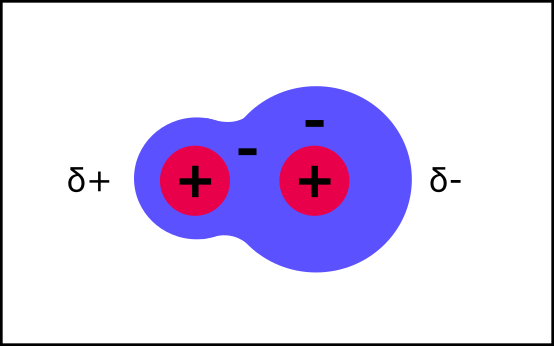
This molecule is polar, but not charged. All is explained below.
Getting this topic straight in your mind will make it much, much easier to grasp key concepts like why glucose dissolves in water, why other things don’t, and how neurons and mitrochondria use membranes to create ion gradients for their function. And you’ll need to understand hydrogen bonding of polar groups to understand how DNA and proteins adopt defined structures.
The fact the molecules are called ‘polar’ and ‘charged’ is part of the problem - this can be pretty confusing! So don’t rely on their names to understand what’s going on.
Let’s start from scratch:
How are Polar and Charged Molecules different from Non-Polar, Uncharged Molecules?
All molecules contain atoms. And all atoms contain positively-charged nuclei and negatively-charged electrons.
In a non-polar, non-charged molecule, these positive and negative charges all neatly cancel each other out. As far as other nearby molecules are concerned, a non-polar molecule behaves as though it has no charges at all.
In both polar and charged molecules, the molecule has regions of positive and/or negative charges that can affect nearby molecules (or even other parts of the same molecule - as happens in proteins and DNA).
What’s the difference between Polar and Charged Molecules?
Polar molecules are charged-balanced overall but have unevenly distributed electrons. This gives them a little bit of a charge in certain places.
Charged molecules do have an overall charge. They have at leat one full unit of charge on at least one atom. (A unit of charge being equal to the magnitude of one electron).
You will also hear about polar and charged groups, which are a part of a larger molecule, where that part (group of atoms) has these properties.
Now, you might read that and think yes! I’ve got it! But to really understand it - and more importantly to remember it - you are going to need to linger a while and spend a bit of time thinking about this. It’s worth going through it all carefully step by step - this will also check your understanding. Have a good think about where those electrons are. Too many students trip up on this topic.
So let’s look at what it means to be non-polar, polar or charged. And then how that affects the behaviour of these molecules.
First step: What’s the difference between Unpolar and Polar Molecules

Atom
The atoms that make up molecules each have a postively-charged nucleus and a cloud of negatively-charged electrons.
Different types of atoms have different numbers of charges.
This means that even non-charged, non-polar molecules contain charges! They just cancel each other out so you don’t notice them.

Non-polar
When you make a molecule out of atoms, electrons are shared between neighbouring atoms. The electrons become one big shared cloud. This makes a covalent bond.
The diagram shows a non-polar molecule with two atoms. In a non-polar molecule, all the charges are balanced, cancelling each other out.
Because the charges are distributed evenly, and cancel out overall, the molecule behaves as though there are no charges (in terms of its electrostatic interactions with other nearby molecules).
So why are they called “non-polar”? To understand that, you need to understand what polar means.

Polar
It turns out that some types of atomic nuclei just LOVE electrons. Like, they are particularly greedy for them. Oxygen, for example.
These greedy atoms yank the electron cloud over towards their nucleus, away from the nucleus of the other atom.

The other atom no longer has enough negative charge to cancel out its positively-charged nucleus. While the greedy one has more negatively charged electrons than it needs.
The charges no longer cancel each other out. The other atom now has just a little bit of a positive charge, and the greedy one has just a little bit of a negative charge.
This is a polar molecule. Its atoms still share one electron cloud, so they are still covalently bonded. But the small charge in charge distribution mean it will now interact differently with its environment.
Overall, the charges still cancel out. They are just unbalanced so that there are places with just a little bit of charge.
Saying "just a little bit” of charge is a pain, so instead the delta symbol is used to show this.
δ+ = just a little bit of positive charge
δ- = just a little bit of negative charge

This can also happen to just one part of a molecule. A good example is a hydroxyl group (OH). The oxygen pulls the electrons toward it, so that there is just a little bit (δ) of charge on the oxygen and hydrogen atoms.
Molecules with hydroxyl groups are polar. Look at glucose - it has loads of hydroxyl groups; this is what makes it a polar molecule. This is important for how it behaves in water, but before we get to that, let’s look at how charged atoms/molecules are different:
Second step: What’s the Difference between Polar and Charged Molecules?
Polar
A polar molecule has no overall charge. The charge of its positive nuclei exactly cancel out the charge of its negative electrons.
The charges are just unevenly distributed, giving a little bit (δ) of positive charge to one atom, and slight negative charge to another atom.
In biology, you’ll normally find it’s a hydrogen atom that has had its electrons yanked away and is now carrying a little bit of positive charge.

Charged
Now look at this. These atoms are not sharing a cloud of electrons - the big one has gone all-in and taken the whole lot for itself.
No shared electron cloud means there is no covalent bond.
No covalent bond means they are no longer a single molecule, but rather two separate atoms … well, except that they’re not even atoms any more …

The atoms no longer just have just a little bit (δ) of charge. The one on the left has lost an entire electron’s worth of charge. Losing negative charge means that overall it is now (properly, not just a little bit) positively charged.
The one on the right has a whole electron’s worth of negative charge more than it needs to cancel out its positive nuclues. It is now (properly) negatively charged.
Because they are (properly!) charged, we no longer call them atoms. Instead they are ions.

Water experiences this sort of electron-theft.
Sometimes it exists as the polar H20 molecule, but sometimes its oxygen gets even more greedy and the molecule dissociates into H+ (a hydrogen ion, aka proton), and OH- (a hydroxyl ion).
This dissociation, and the reforming of H20, is happening all the time in normal liquid water.
Note that the ions each have an overall charge, unlike the polar water molecule where the small charges cancel out.
Bigger Molecules
Atoms that are negatively charged due to having extra electrons, or that are positively charged because they lack electrons, often occur in large molecules too.
Where positive charges are found, it helps to think about this as a positively-charged H+ having been added to the molcule.

Here’s an amine group. It’s just part of a larger molecule, which goes off the edge of the image.
It can exist either as —NH2, or it can add on a proton (H+) to become —NH3+.
In living organisms, there are plenty of available protons (remember how water dissociates?). So amine groups like this usually exist as the charged version.
This is not a polar group, it is charged. (Ignore the shape of the electron cloud for this one, the important thing is that there is an overall charge of +1 because of that extra proton).
Electrostatic Interactions
So. Polar molecules are uncharged overall but have just a little bit (δ) of charge in various places. While charged molecules have a big whack of charge due to having lost an electron or having gained a proton. Why is this difference so important?
It’s to do with how polar and charged molecules interact with their environments. It’s not the same.

Hydrogen bonds
Some polar molecules, like DNA, proteins and water, can form hydrogen bonds between the atoms that have the unevenly distributed charges. These are a special type of weak bond.
Water LOVES making hydrogen bonds - this is why it can hold itself together into a droplet.
Notice in the picture that the water molecules remain separate and can still move around. It doesn’t take much to pull a single hydrogen bond apart. Which is why water can still be poured and stirred around with no trouble.
Water is a polar, hydrogen-bonding molecule, and this explains its properties as a solvent. Molecules like glucose can dissolve in water because they are similarly polar and able to make hydrogen bonds.

Hydrogen bonds are also really important in understanding DNA and protein structures.
These molecules hydrogen-bond to themselves. Each individual bond is weak, but multiple repeating bonds work together to hold the structure into shape.
Protein secondary structures are held together by hydrogen bonds.
The image here shows hydrogen bonds between Guanine (G) and Cytosine (C) in DNA. The hydrogen bonds are shown as dotted lines.
To get a feeling for the strength of hydrogen bonds, think about what happens if you spill water on a book, close it, and let it dry. You know how the pages stick together? This is because hydrogen bonds have formed between the pressed-together pages. When you peel them apart, you are pulling these hydrogen bonds apart.

Dissolving ions
Charged ions like Cl-, Na+ and K+ can’t form hydrogen bonds, but they can still dissolve in water because they can form favourable electrostatic interactions with the water molecules.
This diagram shows salt (NaCl) dissolved in water.
Hydrogen bonds are in yellow. And electrostatic interactions between the charged ions and the polar water molecules are shown in green.
See how the water molecules organise around the ions to provide the opposite charge to that presented by the ion.
Non-polar molecules like lipids cannot form electrostatic interactions with water molecules. And so for this reason, non-polar molecules do not dissolve in water. If you could somehow spread a bunch of non-polar molecule through a glass of water, this would cause all sorts of problems because the water molecules next to the non-polar molecules would be unable to satisfy their charges. Water prefers to hydrogen bond to itself, and it would do so, squeezing the the non-polar molecules out to cluster together in undissolved lumps.
Whisk up a teaspoon of oil in a glass of water and watch - you can see this happening. The oil ends up as a separate layer on the surface. Or get a small glass of oil and carefully put a drop of water on top; the water will ball itself up, hydrogen-bonding to itself and minimising the amount of contact it needs to make with the oil.
This is why membranes don’t dissolve in the cytoplasm. The water molecules would much rather hang out with other water molecules where they can make all those lovely hydrogen bonds. Non-polar molecules are called hydrophobic, or “water-hating”, but to be honest that’s a bit unfair because really it’s the water is excluding them, rather than the other way around.
This also means that non-polar molecules can’t act as solvents for polar molecules or charged ions. The reason being the same: they can’t offer any way to satisfy the polar/charged molecules’ hankering for favourable electrostatic interactions. This is why ions (Na+, K+, H+ etc) cannot dissolve into, and move through, membranes. Which is absolutely vital to understand if you want to make sense of how neurons, mitochondria, and chloroplasts function (and many other things in biology besides).

Ionic bonds
Charged molecules have ‘proper’ charges. They interact more strongly through electrostatic interactions to form ionic bonds.
Here is a positively charged amine group (NH3+) forming an ionic bond with a negatively charged hydroxyl group (OH-).
They are not sharing an electron cloud, so this is not a covalent bond.
Maybe these charged groups are both parts of the same protein (ie from different R groups). If so, this interaction may be important in defining the protein’s tertiary structure.
Or maybe it’s an interaction between an enzyme and its substrate?
Ionic bonds are really important for controlling what binds with what - and what doesn’t. Negatively charged groups will repel other negative charges. And positive will repel positive. This prevents incorrect structures forming.
In summary:
Polar molecules are charge-balanced overall but have unevenly distributed electrons. This gives them a little bit ( δ ) of a negative charge on one atom, and a little bit ( δ ) of positive charge on another. In biology, these weak charges often form hydrogen bonds, or favourable electrostatic interactions with ions.
Charged molecules have an overall charge. They have at leat one full unit of charge on at least one atom. (A unit of charge being equal to the magnitude of one electron). These stronger charges can form ionic bonds with each other.
This article was written by Dr Jenny Shipway
If this post has been helpful, please like ❤️ below and share with your friends.

How to Revise A Level Biology: Keep Forgetting Things? Don't Despair!
A guest blog from Dr Jenny Shipway, who studied biochemistry at university and now works in science communication and education training.
Find the full set of “How to Revise” articles here
The Art of Forgetting
Your brain is amazing
It’s frustrating when we forget things we want to remember, but this isn’t a failure of our brains - it’s an important feature. Remembering everything would cause all sorts of problems, so our brain spends a lot of time forgetting things. What colour coat was the first person to pass you on the street today wearing? How many bites did you take during lunch? What is the first thing your Year 5 teacher said to you on your third day?
Unfortunately perhaps, we can’t consciously tell our brains what to remember. So sometimes it forgets things we want to recall, like the internal structure of the kidney, or how oxygen dissociation curves work. We can’t tell it to remember these things, but we can encourage it to remember by giving it sigals that this stuff is important.
So how does the brain choose what to remember? There are a variety of signals that can flag things up as worth remembering, including:
1. Information that links nicely to prior knowledge
2. Information that connects to things the brain has already decided are important
Pay attention to the links between a new topic and things you’ve learned before. And make sure they agree - if there is a conflict your brain is more likely to forget (also it means there is something you don’t understand which needs re-studying!). If you previously learned that every human cell has a nucleus, but then read that red blood cells do not have a nucleus, take the time to work out how that can be, or you’re likely to forget the new information.
Information that connects to yourself - like a topic you had to present to the class, a question you answered during a lesson, or something that you can relate to your own body - is particularly likely to be remembered.
3. Information that has proven itself to be useful
Test your recall - if you remember the information successfully and this feels like an achievement, your brain will take note. Brains love feelings of success and are always eager for more. Even better, use the information to successfully solve a problem. Brains LOVE that.
In biology you have the added benefit of having stories about health. The brain is always keen to remember information from stories that could help you avoid future harm. Emotional/personal stories of people with medical problems that were (or could have been) overcome with a little biological knowledge are high priority for the brain.

Putting on your auntie’s hat and trying to ride your next door neighbour’s unicycle is a valid study strategy
4. Information gained during/after novel experiences
In a study, children remembered a lesson better if they had an unexpected music lesson just beforehand. (If the music lesson was expected, they did not remember so much.) How much novelty is required to get this memory boost is sadly unknown, but you could try studying in different places, or wearing something unusual, or trying a new activity beforehand? At least it gives you the excuse to take a break from your desk.
5. Information that satisfies your curiosity
In a study using Trivial Pursuit questions, people better remembered the facts they’d been more curious to know the answers to. Ask yourself questions as you go through a topic, get a step ahead of your learning and try to develop a curiosity for what comes next. If you don’t care, it’s going to be harder to remember. (If you lose all interest, take a break and try to ride a unicycle.)
6. Information that it receives on multiple occasions over a period of time
This one is really important. We generally forget things - even important things - bit by bit unless we think about them again. My memory of childhood holidays is largely centred around photographs, as they have reminded me of specific events over the years.
It’s totally normal to forget things the first time you learn them. And the second time. It can be frustrating to relearn things that you thought you knew, but this is just how learning works. You might feel you have made no progress after re-learning something for the third time, but that’s not true - every time you re-learn it, you will slow the rate of forgetting. Until, with enough recapping, you will fix the information in your long-term memory.
So, when you learn something, try to come back and recap it after about a week. And then again after maybe another couple of weeks. Then again after another month or so. This is called ‘spaced learning’ and it’s one of the most powerful and efficient techniques for getting stuff into your long-term memory.
Luckily for biology students, the topics are really interconnected. This means you will naturally get the chance to recall past topics when new ones relate to them, while you are thinking about all the connections.

Her brain’s still doing good stuff, so I reckon this counts as studying
Be kind to your brain
All of this learning is pretty hard work, and your brain will need some downtime to process everything behind the scenes.
Having a nap can be great for learning, but at the very least make sure you get a decent night’s sleep.
This is why last minute studying, staying up all night studying before an exam, is not recommended. Spreading your learning out over a longer period is much more efficient.
In a nutshell:
Don’t despair when you forget something you did previously, you’ve still made progress. Trust the process!
Every time you re-learn something, celebrate that you have moved the information one step closer to long term memory
Taking a break to do fun, novel activities - or to have a nap - can be good for your studying
Dr Jenny Shipway
www.jennyshipway.com

How to Revise A Level Biology: Work Your Brain
Have you ever listened to a talk where the lecturer explained everything so clearly that following their train of thought was effortless - everything made such perfect sense, and flowed together so well that it was a pleasure to listen to? I’ve been to talks like that, and loved them. I’ve gone home rhapsodising about how I learned so much. And then someone asks “What did you learn”? And - I realise there’s no residue of the talk in my mind. I can remember the experience, but not the information.
A guest blog from Dr Jenny Shipway, who studied biochemistry at university and now works in science communication and education training.
Find the full set of “How to Revise” articles here
Memory Is The Residue Of Thought
Think About It
Daniel Willingham, an influential educational psychologist, said it first: “Memory is the residue of thought”. Whatever tricks we might use to help our memories - linking concepts to prior knowledge or practicing recall - we will never remember things we don’t think about.
It’s the classic ‘in one ear, out the other’ problem. But it doesn’t only happen when the information is boring; it can also be witnessed after superb lectures given by talented speakers.
Have you ever listened to a talk where the lecturer explained everything so clearly that following their train of thought was effortless - everything made such perfect sense, and flowed together so well that it was a pleasure to listen to? I’ve been to talks like that, and loved them. I’ve gone home rhapsodising about how I learned so much. And then someone asks “What did you learn”? And - I realise there’s no residue of the talk in my mind. I can remember the experience, but not the information.
They say people remember how you make them feel, not what you say. Students and teachers have to fight against this default. That speaker would be a terrible teacher.

You can’t leave a mark without taking an action
Effortful Thought
When we’re young, we seem to pick up information without trying. New vocabulary, the names of dinosuars - our brains just sponge it up. Psychologist Frank Geary calls this ‘Biologically Primary’ learning. It happens with things our brains are primed to absorb, like how to communicate, what is good to eat, and dangerous things in our environment.
The academic learning we do in colleges, in contrast, would be called ‘Biologically Secondary’. It’s not necessary for survival to know how muscle contractions move the skeleton, and so - although we all have skeletons and muscles - we have to make effort to learn this. This type of learning isn’t joyously soaked-up; it requires effortful thought. Writing, too, is biologically secondary - it has to be consciously learned with effort, rather than being effortlessly acquired just from living in a society with labels, notices and signs everywhere.
How to Revise
Biology A Level is definitely biologically secondary in this categorisation. Understanding the concepts requires a lot of effortful thought. Reading around the subject for fun is great, but you need to stop and really think about the ideas if you want the concepts to stick. You need to process them in relation to other knowledge you have, and practice using them in different ways.
This is one of the reasons why taking notes is good: you are forced to process the information to turn it into writing.
And one of the reasons taking notes during lessons/lectures can be bad: you have less time to think about the topic.
Are you paying attention?
It’s also why using someone else’s notes is pretty pointless. It’s the action of making the notes that has value, not the notes themselves.
If you carefully go through a topic, working it out, making sense of it in your own way, and then prove you have it tidily organised in your mind by demonstrating this on paper (usually realising in the process that there’s something you haven’t quite got right, so that you go back and fill that knowledge gap) … Then you have thought about the subject for sure. Creating notes gives motivation to think, and also provides a test of the quality of that thought.
Someone else’s notes? They are no different from a text book. They will have meaning to the person who made them - imbued with the memory of the thought that developed them, and referenced with their own memories and prior knowledge in ways that are unique to them. But all they can give you are surface facts. Not the deeper understanding that you need. There are no short cuts, sadly.
I’m so confused
The good news is that the feelings of confusion and difficulty you might experience while learning can actually be good signs (not always, but often!). Good teachers will make you feel this way, because these are feelings we get when we’re really thinking about something, trying to make sense of it. Our brains are actively turning over the new information and trying to fit it with our prior knowledge. Sometimes we come to realise our prior knowledge is wrong, and have to change the way we think about things on a wider scale. This is mentally uncomfortable because brains don’t like being wrong so they’ll fight against this. Feelings are discomfort are necessary to this process.
All this means that if something is too easy to understand, it can actually be a problem. If you don’t need to think about something to understand it, then you will not leave traces of it in your memory. In this case, it can be useful to purposefully make it somehow more difficult, just to give your brain something to chew on.
In a nutshell:
We remember what we think about - you will need to make mental effort
Feeling a topic is difficult or confusing is part of effective learning
Don’t borrow a friend’s notes, make your own (at home)!
Dr Jenny Shipway
www.jennyshipway.com

How to Revise A Level Biology: Making Connections
A guest blog from Dr Jenny Shipway, who studied biochemistry at university and now works in science communication and education training.
Find the full set of “How to Revise” articles here
Everything’s Connected
Memory Palaces
Some people specialise in memorising long strings of boring information. One trick they use is to imagine the information located along a walking route. Imagine if you had to remember a list of household appliances. You might imagine a kettle outside your front door, and a dishwasher at the end of your garden path. There could be a toaster on the road outside, and a microwave on the corner down the road. As you mentally rewalked the route, you would ‘look’ in each location and see the objects, which would be remembered in the right order.
The reason why such tricks are necessary is that your brain can’t remember unrelated information. Every new tidbit must be linked to something that you already know. Linking it to something you know well, like the route from your house, helps pin it in place.
One of the great challenges of A level biology is that you need to really understand things, rather than just memorising facts and figures. It’s about deeper concepts rather than surface facts. But the good news is that this actually makes it easier to remember the associated facts - each piece of information is related to others, and the more interlinked it is, the easier it will be to recall.

Toto I don’t think we’re in GCSE any more
Synoptic Thinking
Some of the most challenging exam questions are those that require you to think between topics. Rather than drawing on your memory of one specific part of the course, they demand you reach into your understanding of multiple areas to solve a single problem. This is similar to the type of thinking you would need as a researcher, where bringing in knowledge from other disciplines can help solve problems in novel ways.
Although the A-level specification is split into sections, biology itself is a intricately interlinked tangle of concepts with uncountable interdependencies. Pity the teacher who has to decide in which order to tackle the topics given how everything seems to underpin everything else in some way or another.
How to Revise
Don’t avoid the complexities of how the topics interrelate. By noticing and thinking about these, you can make it easier to both understand and remember concepts. And make it easier for you to jump between different areas for those synoptic questions.
To really understand a complex concept, it’s necessary to look at it from different angles, on different days, considering multiple different examples. Brains are incredible things: when they are fed enough examples and surface facts, and allowed to really think, they can magic up a deep understanding beyond anything that is easily written down. It’s not possible to simply read this type of deep understanding in (brains are nothing like computers); the understanding has to be created in the context of your own mind. Looking at topics from the angle of intersecting topics is a great way to feed your brain with new information to help it build understanding.
When you spot a link to a previous topic, give yourself a bit of time to recall what you previously learned, to think about the new topic from that angle and consider how they intersect. As well as helping your brain build understanding, making these links will make it easier to recall information. The more interlinked information is, the easier it is to recall.
What did your kettle look like?
Use Your Self
Every brain is different. Everyone who imagines walking past a kettle on their front step has a different image in mind. Do they imagine tripping over it if the step is narrow? Or is it sat on a plant pot? What colour is the kettle? Everything will be drawn from prior experience, and this is one of the reasons it works well as a memory trick - it’s linking to things your brain already know about.
If you can link anything in your course to strong memories, or especially to yourself, this will help you recall it later. When you learn about parts of the body, link it in your mind to your own experience of having a body. If you learn about a disease, think about someone you know with that disease while you study. Or imagine what it’d be like if you were a doctor treating it, or if you had it yourself - how you would feel, what you would do? Linking new information to our sense of self is possibly the strongest way to flag up information for later recall.
In a nutshell:
Identify and explore connections / interdependencies between biology topics
Think about concepts in the context of your own life
If you find something hard to remember, try finding more links between it and things you already know well
Dr Jenny Shipway
www.jennyshipway.com

How to Revise A Level Biology: Chunking Complex Concepts
Understanding and remembering all the information required for A Level Biology is a real challenge. So anything that reduces the workload and overall effort required must be a good thing.

A guest blog from Dr Jenny Shipway, who studied biochemistry at university and now works in science communication and education training.
Find the full set of “How to Revise” articles here
Breaking It Down
Step by Step
Understanding and remembering all the information required for A Level Biology is a real challenge. So anything that reduces the workload and overall effort required must be a good thing.
One of the problems is that there is so much to take in, including complicated concepts that require understanding of multiple other complex ideas. There is a bottleneck in our ability to process information for learning which can get jammed if you try to think about too much at once; it’s called Working Memory.
Working memory isn’t a particular part of the brain (the brain’s function is highly distributed) but rather a capacity of the brain. It’s where new information is held while it is consciously thought through and processed to create new understandings and definitions. The products of this thinking can then be moved into your long term memory (memory is the residue of thought).
You can get a feel for the limitations of your working memory by trying to process a list of items. Try this:
Starting with the list of three digits, read the numbers then shut your eyes and mentally add them up. Don’t use any tricks, just do it straight. If you can do it, move on to the next, longer, list.
How many numbers can you process like this? How does it feel when you lose track of things?
Three 2 8 3
Four 3 1 7 9
Five 7 4 8 2 6
Six 4 9 3 1 8 2
Seven 5 2 7 3 4 6 9
Because Working Memory prevents us thinking of more than a small number of things at once, as humans we need ideas to be broken down into manageable chunks for learning. This is why we have step-by-step guides, bullet points, and why this sentence only has three items.
Educators call this ‘chunking’.

But is the bottom layer stable?
Shaky Ground
The complex concepts of A level Biology are carefully broken down by teachers and educators into manageable chunks for you to mentally chew upon. They are then presented (you hope) in a sensible order that allows you to build up your understanding.
It’s like making a huge, complex LEGO model - you make small sections first, then join them together to create larger structures.
The problem comes when you make an error at the beginning. You might not realise until you have already built a large - but, you now realise, unstable mental structure. If your learning is based on an early false premise, you could have been wasting time and mental effort thinking about things in all the wrong ways.
You’ll need to go back and start from scratch. But worse, you can’t dissassemble what you’ve built. All that misguided thinking has left its indelible mark in your brain, and when you call upon the topic in the exam, which version will your brain give you?
How to Revise
Frustrating as it may be not to romp through a topic and meet all your studying objectives, it’s best to progress with care.
Check your understanding of each chunk before you move on. If you’re not sure, go back through the materials and think some more. If you don’t understand a foundational premise, then moving on will waste your energy building a misconceived and confusing mental model. You remember what you think about, and if you’re thinking about something wrong, it’s hard not to remember it wrong.
In a nutshell:
Break things down into manageable chunks for mental processing
Check you understand each chunk before using it to build bigger concepts
If you think might you have something wrong, stop and check rather than trying to push on

How to Revise A Level Biology: The Familiarity Trap
A guest blog from Dr Jenny Shipway, who studied biochemistry at university and now works in science communication and education training.
Find the full set of “How to Revise” articles here
Tricks of the Mind
The lazy brain
There's a dangerous trick your brain can play, which can fool you into using ineffective study techniques and lead to to exam-day confusion and disappointment. But you can overcome it if you know how.
You are sitting in the exam hall. The bell sounds to start the exam. You turn over the paper, read the question and smile. You confidently pick up your pen but … somehow you can’t pull up the knowledge you need. What was that word? You know you learned it, but your mind is blank.
After the exam, you talk to a friend. They tell you the word. “Aaah I knew that!!” you say. But no you didn’t; not when it mattered.

Did it really go in?
Your brain tricked you. Going through your notes before the exam, your brain seemed to be telling you that you knew all the content. However, really it was just telling you that your notes were familiar. You never asked if it could actually recall the information.
Human brains by nature like to minimise mental effort and to feel successful (it should be noted that these are features, not bugs). As a study technique, re-reading notes doesn’t strain your brain or make you feel like you’re failing in any way. You feel like you’re learning. But are you really? Is it possible to learn without making mental effort?
How to revise
In 2006, a study [1] was published comparing two groups of students, who studied some new information in two different ways. First they all had a look through the materials. Next, one set of students were asked to re-read everything, while the other set were asked to put the materials aside and write down everything they could remember. Some time later, both sets of students took an exam to see how much had stuck.
Going into the exam, the students who had had more time studying the information were more confident. They had been able to go through it a few times, so were more familiar with it. In contast, the students who had spent the second part of their time writing down what they had recalled were not so confident. They were aware that there were parts they had forgotten, and that they had been unable to recall it perfectly.
You can probably guess the exam results. Familiarity is not the same as learning, and the first set of students’ confidence was misplaced. The students who had practiced retriving the information from their memory during study time were better able to recall the same information in the exam.
Since then, many other studies have confirmed that practicing retrieval is a particularly effective way to study. It’s called the “Test Effect”. Recalling information flags it up in your brain as being worthwhile remembering for future use. Testing what you can recall even out-performs open-book mind-mapping; in a 2021 study [2] of biology studying techniques, mind-mapping wasn’t found to add anything to the boost students got from retrieval practice.
Keep the faith

Gravity will draw the knowledge down into the brain. Maybe.
Retrieval is hard work and it can be frustrating or demoralising if you can’t remember everything you expected to. But it’s a fantastic way to learn content properly. Be reassured that the brain-ache you experience during retrieval is the feeling of effective learning. And if you can’t remember as much as you expected? You’ve been tricked by familiarity. But it’s great that you discovered this now, rather than in the exam.
So give it a try: after you revise a topic, put your books aside and just write down everything you can remember. See if your expectation matches reality. And when you can’t remember everything, you can still reassure your uncomfortable brain that it’s done a great job.
In a nutshell:
Practicing recall helps you know for sure what you don’t know
Practicing recall makes the information more easily remembered again in future
When you can’t remember something, that’s not failure - you have successfully identified something for re-study
Dr Jenny Shipway
www.jennyshipway.com
References:
[1] Henry L Roediger & Jeffrey D Karpicke, Test-Enhanced Learning: Taking Memory Tests Improves Retention, Psychological Science 2006, 17(3) 249-255.
[2] Garrett M. O’Day and Jeffrey D. Karpicke, Comparing and Combining Retrieval Practice and Concept Mapping, Journal of Educational Psychology 2021, Vol. 113, No. 5, 986–997.