

Preparing for A level Biology: what can I do in the summer
Tips and information to help with the transition from GCSE to A level.

Aiming for Success
Pressure on students seem to grow every year, with more and more students looking to do work over the summer to prepare for starting A level Biology in the autumn term. It’s true that A level Biology is a challenge, and there are certainly things you can do that will help your studies. This article gives advice on what you can best do to hit the ground running when you start your A level course.
One thing I don’t recommend is to ask a tutor to teach you A level content before you start. All this will do is interfere with your teacher’s work and make the classroom less interesting as there will be no surprises. That’s not a great way to build motivation for the long term. It’s much better to encounter new topics in the classroom, and use tutoring to check/deepen understanding and correct misconceptions.
The best things you can do over the summer are things that will (1) help consolidate your prior knowledge and understanding, and (2) create anchor points for you to learn/remember new knowledge.
You’re not going to like the first, but the second might be just what you need right now.
Consolidate Prior Knowledge
How did you do at GCSE?
A level biology builds upon concepts that you studied for GCSE. Having these solid in your mind will help massively when you are introduced to new materials. If you know you are a bit wobbly on some topics, watch out because that will make it difficult for you to understand the A level material - you’ll effectively need to learn both levels of content at the same time. And that’s a real challenge. Mastering the GCSE material will mean you can use it with little mental effort while grappling with the more-complex A level concepts.
Ok so it might feel weird to back go over GCSE content when the exams are done and dusted, but you’re going to need all that stuff again in your A level course. Maybe go back through it in August in the run-up to starting your A-level studies, and drill down into any areas where you feel like you’ve just memorised it without any real understanding.
Look at this comparison of the spec for GCSE and A level Cell Structure:
AQA A level Cell Structure
The structure of eukaryotic cells, restricted to the structure and function of:
cell-surface membrane
nucleus (containing chromosomes, consisting of protein-bound, linear DNA, and one or more nucleoli)
mitochondria
chloroplasts (in plants and algae)
Golgi apparatus and Golgi vesicles
lysosomes (a membrane-bound organelle that releases hydrolytic enzymes)
ribosomes
rough endoplasmic reticulum and smooth endoplasmic reticulum
cell wall (in plants, algae and fungi)
cell vacuole (in plants).
In complex multicellular organisms, eukaryotic cells become specialised for specific functions. Specialised cells are organised into tissues, tissues into organs and organs into systems.
Students should be able to apply their knowledge of these features in explaining adaptations of eukaryotic cells.
AQA GCSE Cell Structure
Students should be able to explain how the main sub-cellular structures, including the nucleus, cell membranes, mitochondria, chloroplasts in plant cells and plasmids in bacterial cells are related to their functions.
Most animal cells have the following parts:
a nucleus
cytoplasm
a cell membrane
mitochondria
ribosomes.
In addition to the parts found in animal cells, plant cells often have:
chloroplasts
a permanent vacuole filled with cell sap.
Plant and algal cells also have a cell wall made of cellulose, which strengthens the cell.
Recognise, draw and interpret images of cells.
Students should be able to use estimations and explain what they should be used to judge the relative size or area of sub-cellular structures.
You can see that there is a lot of overlap - the GCSE content is used as a foundation for learning more. Because you already know something about organelles and their general functions, you can build additional understanding by adding to this prior knowledge. Learning everything from scratch would be really hard! That’s why you need GCSE qualifications to enter the course - your GCSE knowledge will act as a springboard. But how good that springboard is might vary across topics.
You’ll also need to know how to calculate areas and volumes, and to read graphs and understand how averages can be used to understand data. How did you do at GCSE maths?
A person with strong GCSE Biology and Maths will find it much easier to learn A level Biology than someone with a poor grade in combined science. Not because they’re cleverer (whatever that means), but simply because they’re starting from a better place.
What to do: if you know you’re weak on some parts of GCSE, take a look back over those areas and make sure you have a strong foundation for learning more. You’re going to have it re-learn it at some point, and it’s easier to do it while you’re not also grappling with higher-level concepts that won’t make sense without that prior knowledge.
Stretch your Literacy

A level Biology involves a lot of complex vocabulary and comprehension of texts. Written language is very different from spoken language, so if you usually consume informal, spoken media it may be more difficult for you to follow biology texts.
Reading any long-form, professionally written texts will help stretch your literacy and get you used to the vocabulary and sentence structures used in formal writing. It would be ideal to read a pop-sci biology book on a subject that interests you, but reading any books with formal-stye writing, on just about any topic, would be a great boost.
Literacy is a huge factor in student success, and especially anyone with lower grades in GCSE English would benefit from getting more used to reading long-form written-language texts. If you’re struggling to understand the language before you even start to grapple with the biological concepts, the course will be extra-difficult for you.
What to do: find a well-written blog, or book, or other long-form media that interest you and get used to reading in an engaged, thoughtful way. Put your phone aside and practice focusing on the text and its meaning, thinking about how it links to your own interests and life.
Enrich your mind
The human brain is unable to remember facts in isolation. This is why memory experts need to use mnemonic tricks. It’s much, MUCH easier to remember things if they relate to things we already value, our life experiences, our self-image, our emotions, or our prior knowledge.
This makes A level Biology more difficult for students who been unable to travel, or have perhaps focused purely on classroom study. In biology you will encounter many examples of animals and environments that are well-known to some students, but new to others.
A student who has visited a rainforest will find it easier to learn and remember new information about rainforests not only because they might already know some things, but also because they can link new information to their prior experience.
Students with little experience may also get tripped up by organisms that are used as ‘well known’ examples to illustrate points. Some students don’t know what cows eat, or that dolphins are not fish, or that bats are mammals. Well-meaning teachers can confuse students with less-broad life experience by assuming knowledge that just isn’t there.
I’m not suggesting you don’t know what cows eat, or that you visit a rainforest (although do if you can - they’re awesome). But you absolutely can enrich your mind with different experiences and stories and images that will serve you well as anchors for future learning.
Visit different environments
If you can visit a zoo, or an aquarium - perfect! Take your time to really observe the animals. Build strong memories by taking notice of the smells and sounds around you. Read the labels. Talk to your friends about what you see, relating your observations to other things you already know about. Then, later in the course, when your teacher talks about the neck-bones in a giraffe, you can stick that information on to your memory of the giraffe in the zoo. It sounds silly but seriously, it’s like a cheat code for learning.
Maybe you can find a volunteer opportunity in the summer helping with conservation work. This can give you a real connection to the environment you’re working in, and an understanding of what it’s like to work in the field that will help you better imagine, and remember, the field studies described in your course.
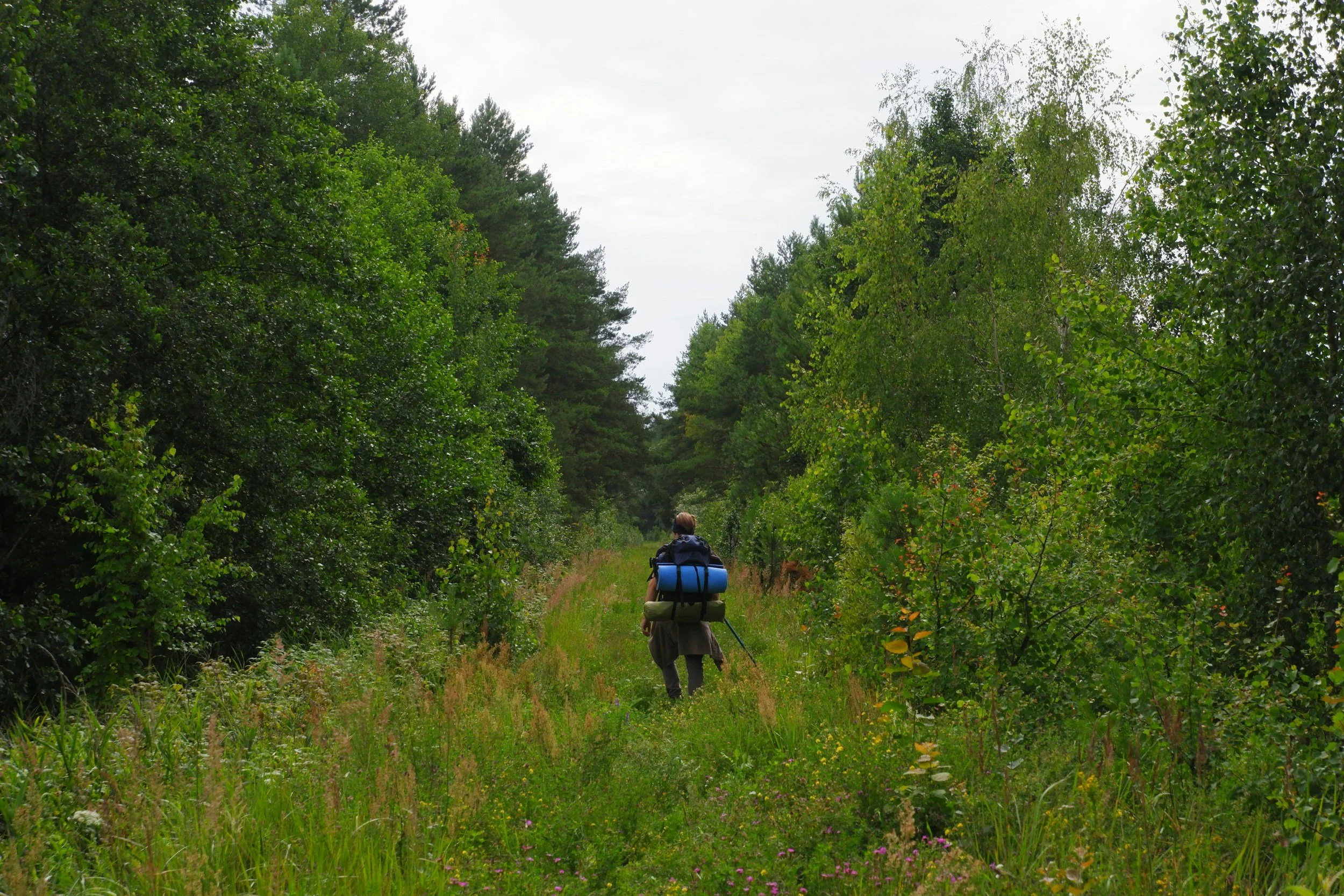
Or, just visit the park. Go for a walk by a river. Notice the small organisms around you. The weeds in the cracks. Stop to observe insects. What can you smell? Notice how different animals are hanging out in different environments. In what ways do these environments vary? Stick your hand in a river, feel the texture of the leaves of a tree and notice how the top and bottom surfaces are different. Listen to the wind and birdsong, talk, build emotional and sensory memories that will provide strong anchors for future learning. Touch grass.
What to do: visit different environments, exploring with all your senses while observing and discussing the organisms you discover.

Go on a virtual adventure
Documentaries and films can take you to a vast variety of environments that you wouldn’t be able to visit in person.
Check out BBC Nature documentaries and fall into the emotional stories they tell of individual animals. Imagine how the animal feels, its challenges, abilities and basic drives. Get a really broad view of the diversity of environments and organisms on Earth and the delicate interactions. When you later learn about some A level concept, you will suddenly think “oh, wait, it’s like that thing I saw!” and suddenly it’ll all make sense and be easy to remember.
If you don’t live in the UK, especially if your local environment is very different, how about watching some programmes about, or set in, British farmland. Find out what cows eat! Examples from farming and agriculture are found throughout the course and will be less accessible to you if they are unfamiliar.
What to do: immerse yourself in rich visuals, music and stories of environment and organisations from around the planet.

The best part about building these rich memories is that it won’t burn you out. You can enjoy the experience without having to do difficult analytic thinking, trying to force information into your brain, or recalling complex information.
Let’s face it, if you’ve just finished your exams then more academic study might not be what you need right now.

So in summary …
Broaden your mind and lay the foundational knowledge that you will need to engage with A level Biology concepts. In this way you can set yourself up for an easier time in the classroom in September - and throughout the whole course.
Article by Jenny Shipway. If you liked it, click ❤️Like below to help others find useful articles.