Key Concept: Independent and Dependent Variables

A variable is any value that does/might change during an experiment. Variables can include things like pH, temperature, colour, or the concentration of substances. The amount of time that has passed is a variable, as are rates of reaction.

A guest blog from Dr Jenny Shipway, who studied biochemistry at university and now works in science communication and education training.

To understand experimental design and graphs in exam questions, you will need to confidently recognise the difference between different types of variables. Master this now and it will also make it easier to learn content that is taught using graphs.


What is a Variable

A variable is any value that does/might change during an experiment.

Variables can include things like pH, temperature, colour, or the concentration of substances. The amount of time that has passed is a variable, as are rates of reaction.

  • Some variables’ values are fixed deliberately by the scientist.

  • Some variables’ values are changed deliberately by the scientist. These changes are planned in advance so the measured values are usually known before the experiment starts.

  • Other variables’ values are allowed to change naturally as the experiment progresses. These values can be measured to provide useful data.


Simplify Your Exam Approach

During exams it’s very easy to get overwhelmed with information. When this happens, your brain makes guesses and jumps, often without you being aware. This is why students so often mis-read graphs and/or make ‘silly’ mistakes.

Excellent Exam Tip: work out what the experiment was and how the graph is presented BEFORE looking at the exam question.

This will …

  • Reduce the number of things you’re thinking about at one time

  • Reduce the risk of you jumping to (incorrect) conclusions

  • Help you focus on understanding the experiment

You might feel an urge to rush forward to look at the question, but trust me that won’t save time. You will not be able to answer the questions unless you understand the graph, and rushing forward will make that more difficult, not less.


Identifying Variables

Variables described in the experiment and named on the graph axes may include:

  • Independent Variable – this is the thing that is changed deliberately by the scientist in a planned way. This is the thing that we expect to cause a measurable effect. 

  • Dependent Variable- this is the thing that is measured by the scientist. The value is not known until it is measured, and the value will depend upon the value of the independent variable.

  • Control Variables – these variables are fixed to one unchanging value throughout. For example, all experiments might be carried out at 20°C, in which case temperature is a control variable. (Important: this is a different thing from ‘a control’).

The purpose of the experiment is to answer the question: how does the independent variable affect the dependent variable?

There are usually many factors that could be affecting the dependent variable, so it’s important to control as many variables as possile. The idea is that if only one thing has changed (ie the independent variable), then you can be more confident the affect is due to that one thing. 


An Example 🍅🍅🍅

If you wanted to work out what temperature was best for growing tomatoes, you could try growing plants at different temperatures to see which plant produced the most fruit. Everything except temperature should be kept the same so that you’re sure that any difference in fruit yield is due to temperature.

The question is: how does temperature affect fruit yield?

You will deliberately be changing the temperature to pre-chosen values, so temperature is the independent variable.

You will need to measure the weight of tomatoes produced to find out this value. So this is the dependent variable. The weight of fruit will depend upon the temperature.


Check your Understanding

Can you identify the independent and dependent variables in the following examples? Which variable was independently fixed by the scientist? And which was measured/recorded during the experiment?

(Ignore the positions of the data points, you only need to look at the axis labels.)

Usually, you will find the independent variable along the x-axis, and the dependent variable up the y-axis. But that’s not always the case (as you hopefully spotted in some of these examples). Do not let your brain jump to an assumption! You must always check this.

You need to be 100% confident of your variables before you move forward to look at the actual question, or everything else will get really confusing. It’s a good tip to write on the exam paper which variable is which (eg label the graph axes “I.V.” and “D.V.”)


Multiple Independent Variables

It’s possible to have more than one independent variable.

For example, some experiments are run twice under different conditions. See this graph:

First, look at the axes. The independent variable here is the amount of time that has passed (on the x-axis): the scientist decided before the experiment at what times they would count the fruit. The dependent variable is the number of ripe fruit (on the y-axis): the number of ripe fruit is the thing the scientist is measuring, and this depends on how much time has passed when the measurement is taken. We’ve seen this before.

Now look at the data. There are two sets of data plotted on the graph. One experiment has been run with fertiliser, and one without. So the presence of fertiliser is another independent variable – it’s something else that affects the value of the dependent variable.


Example A-level Exam Questions

Can you identify the independent and dependent variables in the following A level Biology exam questions?


If this post has been helpful, please like ❤️ below and share with your friends. 

For more general information about graphs, see the post about how best to approach A level biology graph questions.


Read More
Cells, Misconceptions, OCR, Nuffield, Pre-U, AQA, Eduqas Jenny Shipway Cells, Misconceptions, OCR, Nuffield, Pre-U, AQA, Eduqas Jenny Shipway

Quick Cell Quiz: can you spot where these students went wrong?

Can you spot the problems with these A level Biology exam question answers? These bloopers come up a lot - check you’re not going to make the same mistakes.

A dropped ice cream cone, which landed ice-cream side first. A tragedy.

Avoid tragedy

There are some problems that come up again and again in students’ answers to A level Biology exam questions, and which lose them marks. Sometimes it’s a misconception, sometimes misuse of technical language, and sometimes just a lack of required information.

Here are some examples of problem answers that come up a lot in cell topics. Get a step ahead of other students by not including any of these in your A level Biology exam answers!

See if you can spot the problem first, then scroll down to find out if you were right.

What’s the problem with these exam answers?

❌ 1. The ion can’t pass through the hydrophobic inside of the membrane because the ion is polar ❌

❌ 2. The nucleolus contains rRNA ❌

❌ 3. Fatty acids interact with hydrophobic bonds ❌

❌ 4. Ribosomes have a single membrane ❌

❌ 5. Carrier proteins require ATP hydrolysis, and so only do active transport ❌

❌ 6. Mitochondria carry out respiration ❌

Did you spot the problems? Here’s what you should say instead:

✅ 1. The ion can’t pass through the membrane because it is charged. Ions are not polar. This trips up a lot of students but there is an important difference - see this article for a full explanation.

✅ 2. The nucleolus is where rRNA (which forms part of ribosomes) is synthesised. But the nucleolus itself is made of DNA wrapped around histones.

✅ 3. Fatty acids (and other non-polar molecules) have hydrophobic interactions. There is no such thing as a ‘hydrophobic bond’. A bond formed is when an electron is shared between two atoms/molecules. In contrast, hydrophobic interactions happen because the fatty acid molecules do not want to be exposed to water - they cluster together to minimise their exposure. They are ‘water avoiding’ because, being unpolar, they are unable to satisfy water’s hydrogen-bonding potential. (When you think about it, it’s more like the water is avoiding them - but overall it works out as the same thing.)

✅ 4. Ribosomes do NOT have membranes! They are made of protein subunits and rRNA. Ribosomes are sometimes attached to membranes (they are “membrane-bound”), and are sometimes free-floating. In eukaryotes, they are often attached to the membrane of the Rough Endoplasmic Reticulum - but this membrane does not belong to the ribosome, it’s just where it’s hanging out.

✅ 5. Carrier proteins can also be used for faciliated diffusion. This is possible because some carrier proteins can change confirmation without ATP hydrolysis. Facilitated diffusion using carrier proteins moves the carried substance in both directions, but more often away from the higher-concentration side of the membrane - this happens simply because it’s more likely that it will encounter the substance on that side.

✅ 6. Mitochondria carry out aerobic respiration. Ok yes that’s a type of respiration so the original answer wasn’t technically wrong, but you want to get maximum marks and you need to let the examiner know that you understand exactly what the mitochondria are doing. If the question was “What animal goes miaow and eats mice” you wouldn’t answer “a mammal”.

If this post has been helpful, please like ❤️ below and share with your friends. 

Read More

Improve your Exam Answers -Small changes that will get you more marks - UPDATED JAN 2023

How to change the language you use in A level Biology Answers, and get better grades

Language matters - look at these common mistakes and try not to repeat them

 
Read More
Misconceptions, OCR, Synoptic, Exam Tips Tom Whitburn Misconceptions, OCR, Synoptic, Exam Tips Tom Whitburn

OCR A and OCR B June 2019 - Summer highlights - Great tips from the board

OCR A June 2019 summer highlights

Practising recall is so important for retention and learning. Try this quiz without books first !

Try this quiz - if you found it useful then please ❤️ (at the bottom of the page) and share, you can follow me on instagram - alevelbiologytutor

Tuesday night group tutoring topics and Y13 & Y12 OCR A and AQA small group information

You can subscribe monthly to over 60 hours of recorded lessons

summer highlights OCR 2019_Page_1.jpg
summer highlights OCR 2019_Page_2.jpg
Read More

How to do Tables and Graphs - terrific guidance from Exam Boards for A-level Biology

There is plenty of excellent guidance on how to plot graphs and draw tables in the OCR practical booklet  ..... pdf

please like and share

Rather than being assessed seperately, practical skills are included in the theory paper. Like this OCR question from the sample paper

Please like and share (and click on a advert to help with the hosting costs !)

Pages from 171739-unit-h420-03-unified-biology-sample-assessment-materials-2_Page_1.png


There is plenty of excellent guidance on how to plot graphs and draw tables in the OCR practical booklet  ..... pdf here

Read More
Misconceptions, Photosynthesis Tom Whitburn Misconceptions, Photosynthesis Tom Whitburn

Find the mistakes ... Surprisingly popular Photosynthesis revision for A-level Biology

Surprisingly popular Photosynthesis revision

Please like and share

This exercise of find the errors then correct them goes down extremely well with my students as an excellent way of going over photosynthesis

PDF here

Read More
OCR, Eduqas, Misconceptions, Proteins Tom Whitburn OCR, Eduqas, Misconceptions, Proteins Tom Whitburn

No, no, no ! Quickly addressing (very) common Enzyme mistakes - A-level Biology #eduqas #OCR

Enzymes have an active site - Substrates don't.

The substrate is a complementary shape to the active site NOT the "same shape"

Enzymes reduce the activation energy for a reaction to occur

Anabolism is making, Catabolism is breaking

Please like and share
Enzymes have an active site - Substrates don't.

The substrate is a complementary shape to the active site NOT the "same shape"

Enzymes reduce the activation energy for a reaction to occur

Anabolism is making, Catabolism is breaking

Increasing temperature increases the kinetic energy of everything...substrate, enzyme, atoms that make up the enzyme.

Enzymes are proteins with a delicate tertiary structure whose shape is the resultant of all of the interactions between the amino acids. Some of the interactions are weak bonds which are broken by altering the environment  (ph/temperature)  of the amino acids.

4 variables control an enzyme experiment - Temperature of the solution, pH of the solution, Enzyme concentration, Substrate concentration. If one is the independent variable - the others MUST be controlled variables. Change one, keep the others the same.

Rate is 1/t where t is the time taken for something to happen, use seconds, never minutes.

You always plot INITIAL rate of reaction because as soon as you add the enzyme to the substrate, the substrate concentration will fall - because it is being turning into product.

pH is a logarithmic scale - pH 4 is 10x more acid than pH 5 and 100x more acid than pH 6, therefore what appears to be a small change in pH is a big change in the number of Hydrogen ions present.

"It is denatured" is not an explanation, you must explain the changes that occur in the enzyme as a result of temperature or pH and the consequences of the changes to the active site and why this prevents catalysis.

The optimum temperature for an enzyme will differ according to the environment in which the organism has evolved to live. What is optimal for an arctic fish will be very different from a bacteria in a hot spring in Yellowstone park.

When explaining enzyme graphs look at the axes, and then look at them again. Then repeat. DO NOT ASSUME YOU ARE LOOKING AT A RATE GRAPH.  When explaining graphs, refer to the changes in the dependent variable - don't just say rate.

Competitive inhibitors have part of the molecule which is complementary to part of the active site.

Non competitive inhibitors reduce the concentration of working enzymes.

Hope this has helped a little - if there are any that you would like to add then please drop me a line.


Read More
Misconceptions, Respiration Tom Whitburn Misconceptions, Respiration Tom Whitburn

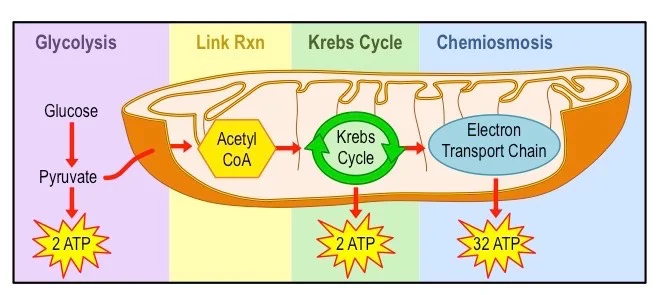
A different approach to teaching (aerobic) respiration - A-level Biology

Teaching aerobic respiration is a difficult topic, traditionally,  teachers begin with glycolysis, then link reaction and krebs cycle and then the electron transport chain, I would argue that there is a better way to teach this.

Please like and share

Teaching aerobic respiration is a difficult topic, traditionally,  teachers begin with glycolysis, then link reaction and krebs cycle and then the electron transport chain, I would argue that there is a better way to teach this.

I begin by teaching the structure of adenosine triphosphate, the need for ATP, and the concept of ATP as a currency that connects the source of the energy (which is the food) to where the energy currency is being consumed, in specific processes such as protein synthesis, DNA synthesis and the movement of ions against a concentration gradient.

I focus on the transient nature of the ATP and the disparity between the 5g in the body compared the 80kg turned over per day.

Then discuss the processes which are used to produce the ATP - substrate level phosphorylation and chemiosmosis.

After an explanation of chemiosmosis, I then lead on to the flow of electrons through the electron transport chain (and therefore the creation of the proton gradient between inter membrane space and matrix) which focuses on the electron on the last carrier and that it has to be accepted by oxygen to produce water.

Then you look at where the electron has come from.  

I start with the production of the electron from the breakdown of pyruvate to acetyl and the acceptance of the electron by NAD, (at the same time pyruvate is decarboxylated).  I repeatedly emphasize regeneration of NAD when the electron is passed from NADH to the electron transport chain.

Then you move on to the krebs cycle.

When teaching the Krebs cycle initially focus on the number of carbons and the decarboxylation and the dehydrogenation avoid discussions of the names of the intermediates and just keep the students focused on the big picture, which is the production of a reduced carriers (NAD and FAD).

Use the production of ATP/GTP directly in krebs cycle as an opportunity to recap about substrate level phosphorylation (with an eye on teaching glycolysis later)

Always keep emphasizing the fate of the reduced carriers that the electrons end up on the electron transport chain and then ultimately joining with oxygen to produce water (and this regenerates the electron carriers)

After teaching Link reaction and Krebs cycle, discuss other potential respiratory substrates - amino acids and fats - and where they might enter the Krebs cycle and Link reaction.

Finally look at glycolysis,  emphasise that only glucose enters glycolysis and that the products do not include carbon dioxide and that oxygen is not consumed.

 Emphasize the production of reduced NAD and then use that as a point to discuss as to how the NAD could be regenerated in the absence of oxygen and emphasize that anaerobic respiration is just glycolysis with an alternate way of getting rid of the reduced NAD.

Give it a go and see how you get on !

Read More
Misconceptions, AQA, OCR Tom Whitburn Misconceptions, AQA, OCR Tom Whitburn

Common Mistakes and misconceptions with Cells and Membranes

A few common mistakes with molecules and cells and membranes

Please like and share

A few common mistakes with molecules and cells and membranes 

  1. Ions are polar….. - NO - Ions are charged hence they cannot pass through the hydrophobic inside of the Cell Surface Membrane.

  2. The nucleolus contains rRNA - NO - the nucleolus synthesizes rRNA (which forms part of ribosome), but it itself is made of DNA (coiled around histones)

  3. Fatty acid/ hydrocarbon tails interact with hydrophobic bonds - NO Fatty acid/ hydrocarbon tails interact with hydrophobic interactions

  4. Ribosomes have one membrane - NO -  Ribosomes do not have membranes

  5. Facilitated diffusion uses only channel proteins. Active transport uses only carrier proteins. NO - Facilitated diffusion uses both channel proteins and carrier proteins. The carrier protein can change conformation without ATP hydrolysis. Active transport uses only carrier proteins which can change conformation only upon ATP hydrolysis

  6. Exocytosis is the same as active transport - NO.- Exocytosis is a type of bulk transport requiring vesicles (and ATP to move the vesicles) , while active transport uses carrier proteins.

  7. Mitochondria carry out respiration - NO - Mitochondria carry out aerobic respiration

Read More

A-level Biological Molecules - 11 basic points to help you learn

10 Basic points to remember for Biological Molecules

please like and share


1. 99% of life is Carbon, Hydrogen, Oxygen and Nitrogen (and a bit of Phosphate)

2. Mono is one, Di (and Bi) is two, Tri is three, oligo is a few, poly is many.

3. Anything ending in -ose is a sugar, -ol is a lipid. - ase is an enzyme and all enzymes are proteins

4. Beta glucose is only in Cellulose - everything else is Alpha glucose

5. A condensation reaction makes water and joins two monomers together - glycosidic bond is a condensation reaction

6. A hydrolysis reaction breaks a bond (lysis means split) - with the addition of water (hydro)

7. A Glycosidic bond joins 2 monosaccarides together 

8. A peptide bond joins 2 amino acids together (many-poly, by peptide bonds...=polypeptide)

9. A lipid is made from a glycerol joined by an ester bond to 3 (tri) fatty acids - hence triglyceride

10. Carbohydrates and lipids are just C,H,O. Amino acids are C,H,O,N (ok, and a bit of Sulphur with 2 of the R groups), Nucleic acids (DNA, RNA, ATP) have C,H,O,N,P. Phospholipids are C,H,O,P.

11. Large or non-polar molecules are insoluble in water hence Starch, Glycogen and Fats are osmotically inactive which means they are good energy storage molecules

Read More
Misconceptions, OCR, Heart, Resource List, AQA Tom Whitburn Misconceptions, OCR, Heart, Resource List, AQA Tom Whitburn

How to Understand the Cardiac Cycle - Now with a Quiz and Questions

How to understand the Cardiac Cycle

please like and share

There are many concepts in A level Biology where a small adjustment in thought process and understanding can lead to sudden clarity. This is certainly true of the cardiac cycle.

Start with simple concepts and build upon them.

Don’t start with looking at the human heart, four chambers, four valves and a great deal of plumbing.

Begin with drawing a single flexible tube, filled with fluid, now imagine you squeeze the middle. The volume decreases, therefore the pressure increases and the fluid will move to where the pressure is lower. Remember this principle.

Now consider how we could increase the efficiency by preventing flow in one direction?

Introduce two flaps of flesh on the inside of the pipe. These are pushed open and pushed closed by the flow of blood, we call these valves.

The valves in your circulatory system are completely passive (they are pushed open by the flow of blood).

Now let’s go back to the valve we have added to create two regions of the pipe. On one side of the valve we have a chamber called the atrium, on the other we have a chamber called the ventricle.

As blood flows into the atria from the vein (vena cava or pulmonary vein), the atria fill with blood and the pressure increases (because there is more blood !!), when the pressure is higher in the atria than in the ventricle the blood pushes open the valve and falls into the ventricle.

After the valve has been pushed open by the flow of blood from atria into ventricle, then the atria contract to push the rest of the blood through the already open valve into the ventricle

Then the muscle (cardiac) surrounding the chamber (ventricle) contracts then volume of the chamber decreases, which increases the pressure (remember the principle) and the blood moves back toward the atrium which pushes the valve between the atrium and the ventricle closed.

Blood leaving the ventricle pushes open the valve between the ventricle and the aorta. The blood flowing through the valve into the aorta increases the pressure and pushes the walls of the aorta outwards. As the ventricle relaxes, the recoil of the aortic walls pushes blood back to the ventricle, which pushes the valve closed.

Think of the four-chambered human heart as two, two-chambered hearts joined back to back, as they pump blood round two completely separate systems (the systemic and the pulmonary).

Remember, as volume decreases, pressure increases. Blood pushes valves open, and pushes them closed. Blood flows to the lowest pressure. Stick to those principles and when you understand them, apply the knowledge to the human heart.

Read More