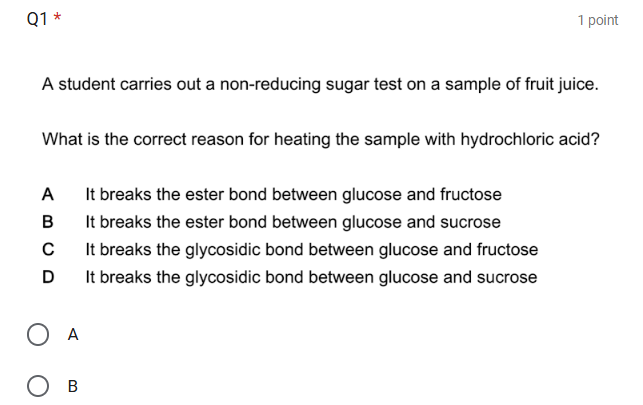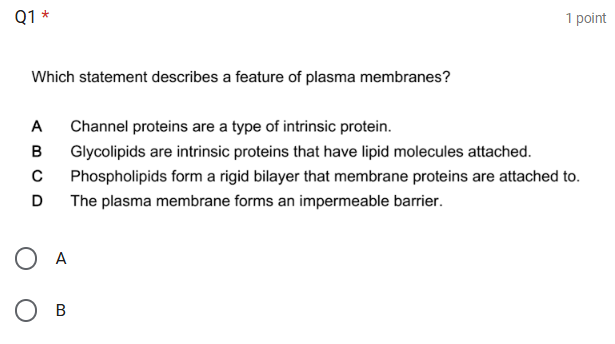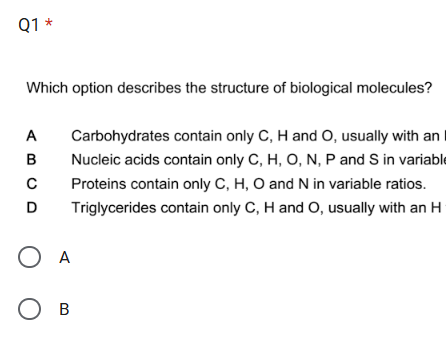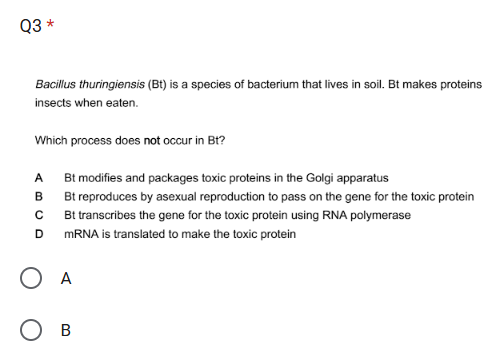
Self marking quiz for revision of OCR A Breadth in Biology - June 2024
Read moreA Level Biology OCR A H420/02 Biological Diversity - June 2024 Self Marking Quiz
Self marking quiz for revision of OCR A Level Biology A Biological Diversity H420/02 - June 2024
Read moreA Level Biology OCR A H420/01 Biological Processes - June 2024 Self Marking Quiz
Self marking quiz for revision of OCR A Level Biology A Biological Processes H420 01 - June 2024
Read moreMastering Carbohydrates: Your Complete Guide to OCR A Level Biology Specification 2.1.2 (d-g)
Mastering Carbohydrates: Your Complete Guide to OCR A Level Biology Specification 2.1.2 (d-g)
Essential Prior Knowledge to Recap
Before diving into these commonly tested topics, ensure you're confident with:
• Basic carbohydrate classification – understanding the terms monosaccharide, disaccharide and polysaccharide, and being able to distinguish between them • Condensation and hydrolysis reactions – knowing that condensation joins molecules together by removing water, whilst hydrolysis breaks bonds by adding water • The concept of monomers and polymers – recognising that large biological molecules are built from smaller repeating units • Chemical bonding basics – understanding covalent bonds and how atoms share electrons to form stable molecules • The relationship between structure and function – appreciating that the shape and properties of molecules determine their biological roles
Read moreMastering Resting Potential, Action Potential and Propagation: Common OCR A Level Biology Questions Answered
Mastering Resting Potential, Action Potential and Propagation: Common OCR A Level Biology Questions Answered
Read moreOCR A Level Biology: Mastering Biodiversity and Simpson's Index (Section 4.2.1) (a-d)
OCR A Level Biology: Mastering Biodiversity and Simpson's Index (Section 4.2.1 a-d)
Prior Knowledge to Recap
Before diving into biodiversity questions, ensure you understand these foundational concepts:
The three levels of biodiversity: genetic diversity (variation within species), species diversity (number and abundance of species), and habitat/ecosystem diversity (range of different habitats)
Species richness vs species evenness: richness is the total number of different species present, whilst evenness refers to how similar the abundance of each species is
Mastering Neuronal Communication (OCR A 5.1.3 a-c): Common OCR A Level Biology Questions Answered
Mastering Neuronal Communication: Common OCR A Level Biology Questions Answered
Prior Knowledge to Recap
Before diving into neuronal communication, make sure you're confident with these key concepts:
Read moreMastering Microscopy and Cell Structure: Common OCR A Level Biology Questions Answered
Mastering Microscopy and Cell Structure: Common OCR A Level Biology Questions Answered
Prior Knowledge to Recap
Before diving into microscopy and cell structure, make sure you're confident with these key concepts:
• Basic cell structure – understanding the difference between prokaryotic and eukaryotic cells, and being able to identify major organelles like the nucleus, mitochondria, and chloroplasts
• Units of measurement – being confident with converting between millimetres (mm), micrometres (μm), and nanometres (nm) is essential for magnification calculations (1mm = 1000μm, 1μm = 1000nm)
Read moreOCR A Level Biology: Mastering Photosynthesis - The Calvin Cycle and Limiting Factors (Section 5.2.1 e, f, g)
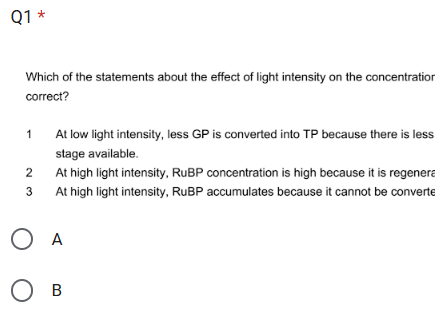
OCR A Level Biology: Mastering Photosynthesis - The Calvin Cycle and Limiting Factors (Section 5.2.1 e, f, g)
Prior Knowledge to Recap
Before diving into these photosynthesis questions, ensure you understand these foundational concepts:
The two stages of photosynthesis: the light-dependent stage (in thylakoid membranes) produces ATP and reduced NADP, whilst the light-independent stage (Calvin cycle in the stroma) uses these products to fix CO₂
The Calvin cycle pathway: CO₂ combines with RuBP (catalysed by RuBisCO) to form GP, which is reduced to TP using ATP and reduced NADP, with most TP recycled to regenerate RuBP
Mastering OCR A Level Biology Section 5.2.1 (a-d) : Photosynthesis - Common Questions & Mark Scheme Insights
Mastering OCR A Level Biology Section 5.2.1: Photosynthesis - Common Questions & Mark Scheme Insights
After analysing extensive OCR past papers for specification section 5.2.1 a-d (Photosynthesis), I've identified the question patterns that consistently challenge students. Understanding how mark schemes assess pigment knowledge, chloroplast structure, chromatography calculations, and the relationship between photosynthesis and respiration is crucial for exam success. Let me guide you through five of the most frequently tested question types with real OCR examples.
Read moreMastering OCR A Level Biology Section 2.1.1: Cell Structure and Organelles - Common Questions & Mark Scheme Insights
Mastering OCR A Level Biology Section 2.1.1: Cell Structure and Organelles (g-h) - Common Questions & Mark Scheme Insights
After extensive analysis of OCR past papers for specification section 2.1.1 (Cell Structure - g-h), I've identified the question patterns that consistently challenge students. Understanding how mark schemes assess organelle functions, protein synthesis pathways, and cytoskeleton roles is crucial for exam success. Let me guide you through five of the most frequently tested question types with real OCR examples.
Read moreMastering OCR A Level Biology Section 5.1.1: Communication, Homeostasis and Thermoregulation - Common Questions & Mark Scheme Insights
Mastering OCR A Level Biology Section 5.1.1: Communication, Homeostasis and Thermoregulation - Common Questions & Mark Scheme Insights
Having analyzed extensive OCR past papers for specification section 5.1.1 (Communication and Homeostasis), I've identified the question patterns that consistently challenge students. Understanding how mark schemes assess terminology, comparative statements, and explanation depth is essential for maximizing marks. Let me guide you through five of the most frequently tested question types with real OCR examples.
Read moreOverview: Gaining and Losing Atoms from the Human Body
Many topics in A level biology relate to how the human body gains and loses atoms. But have you ever stepped back and thought of how these processes all fit together? Having a wide overview can help make sense of individual topics.
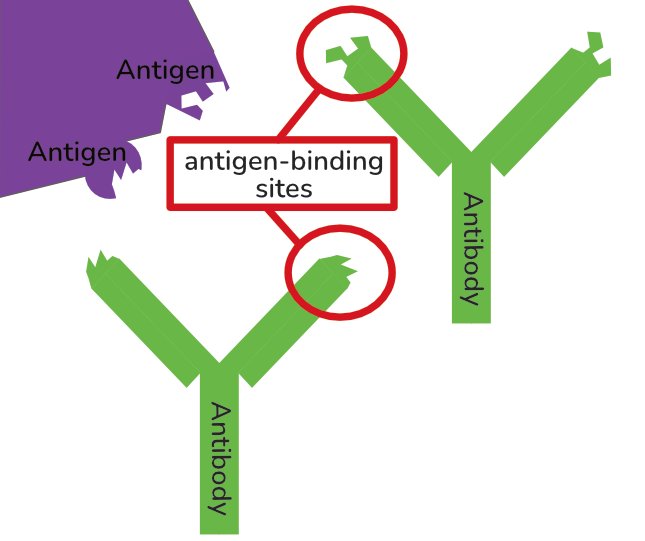
Read moreIntroduction to Immunity (What is an Antigen? What is an Antibody?)
Immunity is a complex topic. This article overviews the basic concepts and vocabulary to give you a foundation before you start looking at the details. When you are studying, break this topic up into chunks so that you’re not overwhelmed by the amount of information.
Read moreKey Concept: Independent and Dependent Variables
A variable is any value that does/might change during an experiment. Variables can include things like pH, temperature, colour, or the concentration of substances. The amount of time that has passed is a variable, as are rates of reaction.
Read moreA Level Biology OCR A H420/02 Biological Diversity - June 2023 Self Marking Quiz
Self marking quiz for revision of OCR A Level Biology A Biological Diversity H420/02 - June 2023
Read moreA Level Biology OCR A H420/01 Biological Processes - June 2024 Self Marking Quiz
Self marking quiz for revision of OCR A Level Biology A Biological Processes H420 01 - June 2023
Read moreAS Level Biology OCR A H020/01 Breadth in biology - June 2023 Self Marking Quiz
Self marking quiz for revision of OCR A Breadth in Biology - June 2023
Read moreQuick Cell Quiz: can you spot where these students went wrong?
Can you spot the problems with these A level Biology exam question answers? These bloopers come up a lot - check you’re not going to make the same mistakes.
Read moreHow to Approach A level Biology Graph and Table Questions: Tips and Exam Question Pack
Get top marks when analysing figures, tables and images by avoiding common mistakes that students make
This article contains key vocabulary, a strategy for how to approach questions for success, a multichoice quiz with answers, and a big pack of past paper exam questions
Don’t panic, it’s only a graph
The single best exam tip for graphs and tables exam questions is to start by looking at the graph or chart itself. DO NOT LOOK AT THE QUESTIONS FIRST! This single thing will help you avoid the most common mistakes that students make.
But you also need to know what you’re doing. Which means you’ll need to be confident with these terms:
Background Knowledge / Vocabulary:
Independent Variable: The variable that you purposefully set to different values during the experiment
Dependent Variable: The variable that you measure during the experiment, which is unknown until it is measured
Replicate: Experimental data is often replicated - the same data point is recorded multiple times for the same conditions
Accuracy / Precision: Accuracy is how close the replicated values are to the correct value, and precision is how close they are to each other. If there is an unknown problem with the experiment, results can be very precise but have very low accuracy.
Range / Standard Deviation: The amount of variation in the data. A large range or standard deviation means that the replicated data had a broad range of results. A small range or standard deviation means they were much more similar in value. Range / Standard deviation is therefore a measure of precision.
Trend: What is the general relationship between the dependent and independent variables? When the experimenter increased the independent variable, what happened to the dependent variable? What shape is the graph?
How to Approach the Question:
1. Look at the graph or chart first!
Too many students look at the question first, get confused or panicky about what it is asking, and form preconceptions about what data they need. This then means they are then unable to look at the data clearly, and miss the information they actually need. Looking at the graph or chart first both makes the data easier to understand, and makes it easier to work out what the question is asking.
Trust me, this is a major factor in student success. If you only take away one thing from this article, always look at the graph or chart first.
2. Don’t panic if it’s about something totally unfamiliar
Students can get very thrown if the question is about an organism or molecule that they have never heard of before (the exam boards do this a lot). This sudden panic makes it hard to think clearly.
Remember - if you have covered all the course material, even if the question is about something weird and new then all the information you need will be in the data. The things that look scary are just surface details. If the question was “Fred gave James two apples, how many apples does James have” you wouldn’t need to know who these people were to answer the question.
But don’t just dive in to the details of the data …
What’s going on here?
3. Understand the format
Don’t waste time looking at the actual dots or numbers until you understand how the data has been presented. Check every aspect methodically. It’s too easy to make assumptions based on previous graph/table formats you have seen - this one might be different!
Look at the headings / axis labels and units. What is the data showing?
Identify the independent variable and the dependent variable. If possible, it’s helpful to label them “IV” and “DV”.
What type of data is shown? Is it averages? Does it include a Range or Standard Deviation?
Graphs: Check the axis labels. Have they plotted rate or time, mass/volume or concentration? Often students assume enzyme graphs have rate on the y axis - but sometimes they don’t!
Tables: Check: is the Independent Variable in the first column? Is the data in each row consistent?
4. Look at the data
Now you understand its context, look at the actual dots or lines or numbers. Check:
Does the Range overwhelm differences in values: Do the range bars or standard deviation bars overlap? If they do, then there is significant overlap between the populations of replicated results that were used to calculated the average values.
Unspecified Ranges: If there are replicates but no range bars or standard deviation has been calculated, how broad does the range look when you compare the replicated data values to their mean?
Trends: What trends can you observe? Then think about what principle of biology is being shown by the the trends.
Now think about what it all actually means:
Values: How would you explain the highest value, the lowest value, the point at which the line crosses the x axis,
Range: How would you explain the largest range? How would you change the method to reduce the spread in the data?
5. Ok - NOW look at the actual questions
Try to see past the detail. How does this data/question relate to things you have studied?
Your working memory can easily get overloaded with details, making it hard to think. If the examiners have introduced a new organism, its name won’t be important. What might be important is the environment in which it lives, or its interactions with other organisms. You know what data you have, and what the questions are, so pick out what actually matters here. Is this a question about enyme reaction rates? Or about surface area to volume ratio?
This is why it’s useful to look at the data first - you will be able to look at it with a clear eye, making it easier to pick out how it’s relevant to the material you have studied.
6. Give the required information
Avoid the common mistakes that lose students marks:
If they say you should use the data, you must either quote it, or show how you have used in in a calculation
Refer to the axis/data labels wherever possible. Don’t say “the graph goes up”, do say “the saturation of haemoglobin increases”
A-Level Biology Past Paper Graphs and Charts Exam Questions:
Got all that? Ok! Here are some questions for you to practice.
And remember - don’t read the questions until after you have made sense of the graph or chart.
If this post has been helpful, please like ❤️ below and share with your friends.
This article was written by Dr Jenny Shipway with guidance and editing from Tom. Tom has over 26 years experience specialising in A level Biology teaching and tuition, and has helped many students achieve top grades in the subject.