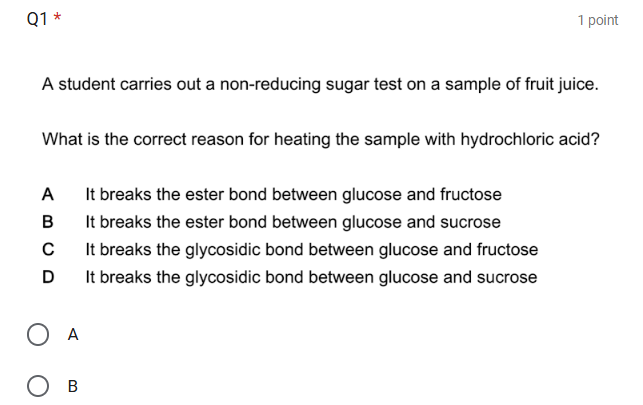
Food Tests and Chromatography- OCR A Multiple Choice Questions - Self marking Quiz

Self-marking multiple choice quiz for Food Tests and Chromatography. Using OCR A past paper exam questions.
Quizzing is really helpful for retention of knowledge

Read More

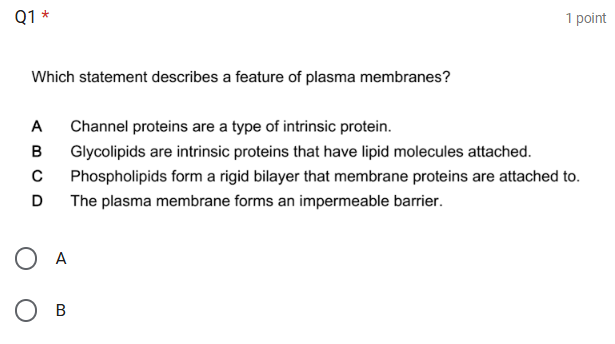
Phospholipids, Lipids and Cholesterol - OCR A Multiple Choice Questions - Self marking Quiz

Self-marking multiple choice quiz for Phospholipids, Lipids, and Cholesterol. Using OCR A past paper exam questions.

Quizzing is really helpful for retention of knowledge

Read More
OCR Tom Whitburn OCR Tom Whitburn

Booking now: OCR A Y13, Tuesdays 6:30pm from September 2026 to June 2027

Weekly Group Masterclasses for OCR A Y13

Raise your exam grade with question focused masterclasses from a highly experienced A level Biology teacher.

Every week we go through a different topic from the specification and look at how to apply the content to OCR A exam questions. I show how to understand commonly occurring questions and how to answer them.
Weekly Group Masterclasses for OCR A Y13

Raise your exam grade with question focused masterclasses from a highly experienced A level Biology teacher.

Every week we go through a different topic from the specification and look at how to apply the content to OCR A exam questions. I show how to understand commonly occurring questions and how to answer them.

“Outstanding A-level Biology tutoring! Patient, engaging, and highly personalised—even in group classes, it feels one-to-one. Recorded sessions, all questions answered, and every student involved. Our daughter jumped a grade and achieved an A and a place to study Medicine at University” - Google reviews 2025

During the lesson students use an interactive whiteboard to write answers to exam questions which (only) I can see and comment on. Students can ask questions at any time but are not required to speak on camera to the group. The classes run in focus mode on zoom - so I can see every student, but they are not visible to the rest of the class.

Students can stream a recording after their lesson for revision and note taking.

I teach using evidence-based educational theory. With decades of A level Biology class and one-to-one teaching experience, I am very aware of the misconceptions and misunderstandings that cause students to unnecessarily struggle, and of the mistakes that can lead to dropped marks in exams.

By correcting these issues, students not only do better in exams but also learn to enjoy studying Biology.

The typical class size is 6-12 students. No payment is taken in advance. The classes are £45 per lesson. The card you use to reserve your place is charged after the lesson.

OCR Biology A Y13 Schedule (2026–2027) Time: Tuesdays at 6:30 PM Notes: Closed for Christmas (Dec 22 & 29); Includes sessions during Easter.

Month Date Spec Ref Topic Focus
September 2026 15 Sep 5.2.1 (a–d) Photosynthesis – chloroplasts, pigments, light-dependent stage
22 Sep 5.2.1 (e–h) Photosynthesis – Calvin cycle and limiting factors
29 Sep 5.1.1 (a–d) Communication and Homeostasis
October 2026 06 Oct 5.2.2 (d–g) Respiration – Part 1 (Krebs cycle, oxidative phosphorylation)
13 Oct 5.2.2 (a–c) Respiration – Part 2 (Glycolysis, anaerobic, RQ)
20 Oct 5.1.4 (a–c) Hormonal Communication – Part 1
27 Oct 5.1.4 (d–e) Hormonal Communication – Part 2
November 2026 03 Nov 5.1.2 (a–b) Excretion and the liver (incl. diabetes)
10 Nov 5.1.2 (c–d) Kidneys – Part 1 (Structure and nephron function)
17 Nov 5.1.2 (d–f) Kidneys – Part 2 (Osmoregulation and dialysis)
24 Nov 5.1.3 (a–d) Nerves – Part 1 (Resting and action potentials)
December 2026 01 Dec 5.1.3 (e–g) Nerves – Part 2 (Synapses and transmission)
08 Dec 5.1.5 (a–c) Animal responses (Brain, reflexes, heart rate control)
15 Dec 5.1.5 (d) Meiosis recap, monohybrid, codominance, sex linkage
22 Dec No Lesson (Christmas)
29 Dec No Lesson (Christmas)
January 2027 05 Jan 5.1.5 (e–f) Inheritance: Dihybrid, autosomal linkage, epistasis
12 Jan 6.1.2 (c–d) Chi-squared and t-test
19 Jan 6.3.1 (a–d) Succession, distribution, and abundance
26 Jan 5.1.5 (l) Muscle contraction
February 2027 02 Feb 6.1.1 (a–c) Cellular Control – mutations and gene regulation
09 Feb Revision Revision lesson on the whole of Module 5
16 Feb 6.1.3 (a–b) Manipulating Genomes – DNA & gene sequencing
23 Feb 6.1.3 (c–e) DNA profiling, PCR, and gene analysis
March 2027 02 Mar 6.1.2 (e–f) Evolution and Hardy-Weinberg
09 Mar 6.1.2 (g–h) Speciation and artificial selection
16 Mar 6.1.3 (f–g) Gene therapy and cloning
23 Mar 6.1.3 (h) Genetic engineering
30 Mar 5.1.5 (g–j) Plant responses – Part 1 (Easter Session)
April 2027 06 Apr 6.3.2 (a–b) Populations and sustainability (Easter Session)
13 Apr 6.3.2 (c–e) Conservation, preservation, and management
20 Apr 6.3.1 (e) The nitrogen cycle
27 Apr 6.3.3 (a–b) Biotechnology – microorganisms
May 2027 04 May 5.1.5 (k) Plant responses – Part 2
11 May 6.3.1 (f–h) Ecosystems and biomass transfer
18 May Revision Revision lesson - Plant transport
25 May Final Synoptic Links and Exam Paper Practice
Read More

AS Level Biology OCR A H020/01 Breadth in biology - June 2024 Self Marking Quiz

Self marking quiz for revision of OCR A Breadth in Biology - June 2024
Practising recall is so important for retention and learning. Try this quiz without books first !

Try this quiz - if you found it useful then please ❤️ (at the bottom of the page) and share, you can follow me on instagram - alevelbiologytutor

Y13 & Y12 OCR A and AQA small group information

Read More

A Level Biology OCR A H420/02 Biological Diversity - June 2024 Self Marking Quiz

Self marking quiz for revision of OCR A Level Biology A Biological Diversity H420/02 - June 2024
Practising recall is so important for retention and learning. Try this quiz without books first !

Read More

A Level Biology OCR A H420/01 Biological Processes - June 2024 Self Marking Quiz

Self marking quiz for revision of OCR A Level Biology A Biological Processes H420 01 - June 2024

Practising recall is so important for retention and learning. Try this quiz without books first !

Read More
OCR, Insights Tom Whitburn OCR, Insights Tom Whitburn

Mastering OCR A Level Biology Section 5.2.1 (a-d) : Photosynthesis - Common Questions & Mark Scheme Insights

Mastering OCR A Level Biology Section 5.2.1: Photosynthesis - Common Questions & Mark Scheme Insights

After analysing extensive OCR past papers for specification section 5.2.1 a-d (Photosynthesis), I've identified the question patterns that consistently challenge students. Understanding how mark schemes assess pigment knowledge, chloroplast structure, chromatography calculations, and the relationship between photosynthesis and respiration is crucial for exam success. Let me guide you through five of the most frequently tested question types with real OCR examples.

Mastering OCR A Level Biology Section 5.2.1: Photosynthesis - Common Questions & Mark Scheme Insights

After analysing extensive OCR past papers for specification section 5.2.1 a-d (Photosynthesis), I've identified the question patterns that consistently challenge students. Understanding how mark schemes assess pigment knowledge, chloroplast structure, chromatography calculations, and the relationship between photosynthesis and respiration is crucial for exam success. Let me guide you through five of the most frequently tested question types with real OCR examples.

Question Type 1: Naming Photosynthetic Pigments and Their Advantages

Why this question type is common: This tests fundamental knowledge of photosynthesis machinery and the ability to explain adaptive advantages - core concepts that underpin understanding of light harvesting.

How to answer each part:

Part i - Primary pigment (1 mark): "Chlorophyll, a/A"

Mark scheme insight: The mark scheme says "Mark the first answer" and warns that if you give an additional incorrect answer, you get 0 marks. It accepts "chlorophyll 680 and chlorophyll 700" but states "(Note that both are required for this option)." The mark scheme specifically says:

  • "IGNORE P680/P700"

  • "DO NOT CREDIT chlorophyll α" (alpha symbol not accepted)

Part ii - Accessory pigment (1 mark): Any one of: "Chlorophyll b / xanthophyll(s) / carotenoid(s) / (β/beta-)carotene"

Mark scheme insight: "DO NOT CREDIT karatine (as could be confused with keratin)" - spelling matters when it creates ambiguity. The examiner's comments note "those candidates who had given chlorophyll b as their answer to (i) frequently supplied an incorrect response to this section" - you can't use the same pigment twice.

Part iii - Advantage (1 mark): "Able to, absorb/use, a range of/different/more/other, (light) wavelengths/λ"

Mark scheme insight: The mark scheme provides a helpful example: "e.g. absorb wavelength(s) not absorbed by primary pigment" and specifies:

  • "IGNORE frequency"

  • "IGNORE absorb all wavelengths"

  • "IGNORE ref to chlorophyll b"

  • "DO NOT CREDIT ref to reflection where a pigment absorbs and reflects the same wavelength"

Examiner's comments: "The most common reason for not achieving the mark was to refer only to light frequencies or to simply state that more light could be absorbed."

Common mistakes:

  • Using "alpha" symbol instead of "a" or "A"

  • Mentioning P680/P700 (ignored, not credited)

  • Using the same pigment for both primary and accessory

  • Saying "absorbs more light" without mentioning different wavelengths

Question Type 2: Rf Value Calculation in Chromatography

Why this question type is common: This tests practical skills (PAG6) and mathematical competency (M1.1, M2.2) in a biological context. It's an excellent discriminator across ability levels.

How to calculate Rf value:

Formula: Rf = distance moved by pigment ÷ distance moved by solvent

Step-by-step approach:

  1. Measure distance from origin to centre of spot

  2. Measure distance from origin to solvent front

  3. Divide: spot distance ÷ solvent front distance

  4. Express to 2 significant figures

Example from mark scheme: Rf = 0.53 / 0.52 ✓✓ Pigment = chlorophyll a ✓

Mark scheme insight: "If incorrect: ALLOW for 1 mark for correct use of Rf e.g. Rf = [shows calculation] OR inappropriate use of sig. figs e.g. 0.533 / 0.5"

The mark scheme awards marks generously for showing method even if final answer is wrong. It also "ALLOW ECF if incorrect calculation" for identifying the pigment - if you calculate Rf wrong but correctly identify which pigment matches your calculated value, you still get the pigment mark.

For predicting pigment colours: "ALLOW ECF from calculated Rf value in part (ii) (for ECF looking for a pigment next highest in value than calculated as spot 4 has travelled further from origin than spot 3)"

Common mistakes:

  • Using inappropriate significant figures (e.g., 0.533 when 0.53 required)

  • Measuring from wrong starting point

  • Dividing solvent distance by pigment distance (wrong way round)

  • Not checking answer makes biological sense (Rf values are always between 0 and 1)

Question Type 3: Explaining Accessory Pigment Function in Different Wavelengths

Why this question type is common: This tests understanding of how photosystems work as a team, requiring application of pigment knowledge to interpret absorption spectra data.

How to structure your answer (3 marks maximum from 5 possible points):

  1. "(Alga has) accessory pigments"

  2. "(Other pigments) absorb, different/other, wavelengths (of light)"

  3. "Little/not all, light (wavelengths) is absorbed by, chlorophyll a/primary pigment"

  4. "(Light) energy is transferred to reaction centre"

  5. "For use in, light-dependent reaction/LDR"

Mark scheme insight: The mark scheme provides crucial allowances and restrictions:

  • Mark point 1: "IGNORE named pigments"

  • Mark point 2: "ALLOW longer/shorter/AW for different" and "ALLOW λ for wavelength" but "IGNORE more/wider range, wavelengths"

  • Mark point 4: "ALLOW chlorophyll a/primary pigment for reaction centre/photosystem" and "ALLOW AW e.g. accessory pigments harvest (light) energy for reaction centre"

Examiner's comments reveal common errors: "Some candidates did not recognise that this question was about photosynthetic pigments and described the features of hydrophytes. Marking points 1 and 2 were the most frequently given with only the higher attaining candidates going onto achieving a third mark. Many candidates knew that other pigments would be present, but some did not name them as 'accessory pigments' for marking point 1. Terms such as special chlorophyll, secondary pigments were used in place of accessory pigments."

Critical mistakes noted: "A common error was to write about different colours or percentages of light instead of wavelength. Credit was not given for stating that a 'wider' range of wavelengths would be absorbed or for failing to mention pigments anywhere in the account. Some candidates referred to the alga absorbing light rather than its pigments."

Question Type 4: Chloroplast Structure Identification and Adaptation

Why this question type is common: This links structure to function - a fundamental biological principle. It tests detailed knowledge of chloroplast ultrastructure and understanding of why features exist.

Part i - Naming structures (3 marks):

A. "Inner membrane (of, double membrane/envelope, surrounding organelle)" B. "Stroma" C. "Granum/grana/granal stack/thylakoid stack"

Mark scheme insight - Critical restrictions:

  • Part A: "DO NOT CREDIT inter membrane" or "inner envelope membrane" or "ref to cell/surface/plasma/membrane"

  • Part B: "Correct spelling only"

  • Part C: "IGNORE thylakoid unqualified/lamellae"

The mark scheme states "Mark the first answer on each prompt line. If the answer is correct and an additional answer is given that is incorrect or contradicts the correct answer then = 0 marks."

Part ii - Adaptations (2 marks maximum from 3 possible points):

  1. "Contain, (named) pigment (molecules)/photosystems"

  2. "Contain, (named) electron carriers/ETC/ATP synth(et)ase"

  3. "Idea that has a large surface area (in a small volume) for, light absorption/light dependent reaction(s)/light dependent stage/electron transport"

Mark scheme insight: The mark scheme gives helpful combinations:

  • "Note: 'the membranes containing the pigments have a large surface area for absorbing light' = 2 marks (mps 1 & 3)"

  • "Note: 'there is a large surface area for electron transport chain' = 2 marks (mps 2 & 3)"

It also specifies:

  • Mark point 1: "IGNORE 'accessory'"

  • Mark point 2: "IGNORE enzymes unqualified"

  • Mark point 3: "IGNORE ref to different wavelengths"

Examiner's comments: "The majority of candidates were able to describe at least one way in which the structure of the granum (part C) was adapted to its function. References to the presence of pigments, chlorophyll or photosystems on the granal membranes were very frequent and many candidates also went on to add that ATP synthase or the electron carriers would also be contained within the membranes."

Question Type 5: Relationship Between Photosynthesis and Respiration

Why this question type is common: This tests understanding of the interdependence of metabolic processes and ability to apply knowledge to explain real-world observations.

Part i - Identifying molecules (2 marks):

X = water / H₂O Y = carbon dioxide / CO₂ Z = oxygen / O₂

Mark scheme insight: "All three correct for TWO marks / One or two correct for ONE mark"

The examiner's comments note a "Misconception: It is a common misconception that candidates consider that ATP produced in respiration is used directly in photosynthesis." This is wrong - ATP cannot move between these processes.

Part ii - Explaining survival in sealed containers (3 marks maximum from 6 possible points):

  1. "Idea that light (energy) is the only requirement from outside the terrarium/AW"

  2. "Respiration provides carbon dioxide and water for photosynthesis OR photosynthesis provides glucose and oxygen for respiration"

  3. "Water used for photolysis OR oxygen used as final electron acceptor (in respiration)"

  4. "Carbon dioxide used for, light independent stage/Calvin cycle"

  5. "ATP (still) produced/energy provided, for (named) cell activities"

  6. "Decomposing plant material provides (named) mineral ions"

Mark scheme insight: The mark scheme allows chemical formulae throughout: "ALLOW O₂ for oxygen, H₂O for water, CO₂ for carbon dioxide and C₆H₁₂O₆ for glucose throughout"

Specific allowances:

  • Mark point 1: "ALLOW e.g. as light (energy) can pass through glass for photosynthesis" or "plants in glass containers will have access to light"

  • Mark point 2: "IGNORE equations unqualified"

  • Mark point 5: "ALLOW e.g. active transport/protein synthesis/active uptake of mineral ions" but "IGNORE produces energy"

  • Mark point 6: "IGNORE nutrients"

Examiner's comments: "Good responses showed good application of knowledge and understanding of photosynthesis and respiration and their interaction in plants. Higher attaining candidates set out their answers in a logical sequence and gave detailed accounts of the production and use of reactants for both processes."

Common mistakes:

  • Suggesting ATP moves directly between photosynthesis and respiration

  • Writing unqualified equations without explanation

  • Saying energy is "produced" rather than "provided" or "released"

  • Using vague terms like "nutrients" instead of specific mineral ions

General Tips for Section 5.2.1 Success

1. Know your pigments precisely

Primary pigment:

  • Chlorophyll a (or chlorophyll A)

  • NOT "chlorophyll α" (alpha symbol rejected)

  • NOT just "chlorophyll" (too vague)

Accessory pigments:

  • Chlorophyll b

  • Carotenoids / β-carotene

  • Xanthophylls

  • NOT "karatine" (confused with keratin)

Why they matter:

  • Primary pigment: receives energy, loses electrons to ETC

  • Accessory pigments: absorb different wavelengths, pass energy to reaction centre

2. Master Rf calculations

Formula: Rf = distance moved by substance ÷ distance moved by solvent

Key points:

  • Always between 0 and 1

  • More polar substances have lower Rf values

  • Less polar substances travel further (higher Rf)

  • Measure to appropriate significant figures

Common polarity order (least to most polar):

  1. Carotene (most nonpolar, highest Rf ~0.90)

  2. Pheophytin (~0.65)

  3. Chlorophyll a (~0.53)

  4. Chlorophyll b (~0.49)

  5. Xanthophylls (most polar, lowest Rf ~0.32-0.44)

3. Understand chloroplast structure terminology

Be precise with naming:

  • "Inner membrane" NOT "inter membrane" or "inner envelope membrane"

  • "Stroma" - correct spelling essential

  • "Granum/grana" NOT just "thylakoid" (too vague)

Locations of processes:

  • Light-dependent reactions: thylakoid membranes (in grana)

  • Light-independent reactions (Calvin cycle): stroma

  • DNA and ribosomes: stroma

4. Link structure to function effectively

For thylakoid membranes/grana:

  • Large surface area → more light absorption

  • Contains pigments → captures light energy

  • Contains photosystems → organises pigments

  • Contains electron carriers → electron transport

  • Contains ATP synthase → ATP production

Mark schemes reward combinations:

  • "Membranes containing pigments have large surface area for light absorption" = 2 marks

  • "Large surface area for electron transport chain" = 2 marks

5. Understand wavelength vs frequency vs colour

Mark schemes are strict:

  • Must say "wavelength" or "λ"

  • "Frequency" is IGNORED (not credited)

  • "Colour" alone is insufficient

Different wavelengths = different colours:

  • ~400-500 nm: blue/violet (short wavelength)

  • ~500-600 nm: green/yellow

  • ~600-700 nm: red/orange (long wavelength)

6. Know the photosynthesis-respiration cycle

What's recycled:

  • CO₂: produced by respiration → used in Calvin cycle

  • O₂: produced by photolysis → used as final electron acceptor in respiration

  • Water: produced by respiration → used in photolysis

  • Glucose: produced by Calvin cycle → used in respiration

What's NOT recycled:

  • ATP: made separately in each process, cannot move between them

  • NADP/NAD: different coenzymes, cannot substitute for each other

7. Apply knowledge to unfamiliar contexts

Common application scenarios:

  • Deep water algae: need pigments that absorb wavelengths that penetrate water

  • Carnivorous plants: obtain minerals from insects, not soil

  • Sealed terrariums: demonstrate the cycle of photosynthesis and respiration

  • Chromatography of different species: different pigment compositions

8. Read questions carefully for constraints

Mark schemes frequently note what to IGNORE:

  • "IGNORE chlorophyll b" (when discussing primary pigment advantage)

  • "IGNORE equations unqualified" (need explanation with equations)

  • "IGNORE cilia/flagella" (in cytoskeleton questions)

Watch for "DO NOT CREDIT" warnings:

  • These are wrong answers that seem plausible

  • Examples: "karatine" for carotene, "alpha" for a, "inter membrane"

Key Concepts to Master

Light harvesting:

  • Primary pigment (chlorophyll a) at reaction centre

  • Accessory pigments capture different wavelengths

  • Energy funnelled to reaction centre

  • Primary pigment becomes oxidised (loses electrons)

Chloroplast components:

  • Outer membrane: permeable to small molecules

  • Inner membrane: selectively permeable, transport proteins

  • Stroma: contains enzymes for Calvin cycle, DNA, ribosomes

  • Thylakoid membranes: site of light-dependent reactions

  • Grana (stacks of thylakoids): increase surface area

  • Inter-granal lamellae: connect grana

Light-dependent reactions (thylakoid membranes):

  • Photolysis of water → oxygen + protons + electrons

  • Electrons pass through ETC

  • Protons pumped into thylakoid space

  • Chemiosmosis: protons flow through ATP synthase

  • Products: ATP, reduced NADP, oxygen

Light-independent reactions (stroma):

  • Carbon fixation: CO₂ + RuBP → GP (catalysed by Rubisco)

  • Reduction: GP → TP (using ATP and reduced NADP)

  • Regeneration: TP → RuBP (using ATP)

  • Products: glucose, amino acids, lipids

Limiting factors:

  • At low light: light intensity limits rate

  • At high light: temperature or CO₂ concentration becomes limiting

  • Temperature affects enzyme-controlled Calvin cycle

  • CO₂ concentration affects carbon fixation

Remember that Section 5.2.1 connects photosynthesis to respiration, energy, and ecosystems. Master the details of chloroplast structure, pigment function, and the two stages of photosynthesis, and you'll find questions on limiting factors, adaptations, and practical investigations much more manageable.

The key to success with OCR mark schemes is precision in terminology, understanding what's accepted versus ignored versus rejected, and being able to apply knowledge to interpret data and explain observations. Mark schemes reward specific biological terms used correctly in appropriate contexts.

Good luck with your studies!

Read More
OCR, Insights Tom Whitburn OCR, Insights Tom Whitburn

Mastering OCR A Level Biology Section 2.1.1: Cell Structure and Organelles - Common Questions & Mark Scheme Insights

Mastering OCR A Level Biology Section 2.1.1: Cell Structure and Organelles (g-h) - Common Questions & Mark Scheme Insights

After extensive analysis of OCR past papers for specification section 2.1.1 (Cell Structure - g-h), I've identified the question patterns that consistently challenge students. Understanding how mark schemes assess organelle functions, protein synthesis pathways, and cytoskeleton roles is crucial for exam success. Let me guide you through five of the most frequently tested question types with real OCR examples.

Mastering OCR A Level Biology Section 2.1.1: Cell Structure and Organelles (g-h) - Common Questions & Mark Scheme Insights

After extensive analysis of OCR past papers for specification section 2.1.1 (Cell Structure - g-h), I've identified the question patterns that consistently challenge students. Understanding how mark schemes assess organelle functions, protein synthesis pathways, and cytoskeleton roles is crucial for exam success. Let me guide you through five of the most frequently tested question types with real OCR examples.

Question Type 1: Protein Synthesis and Secretion Pathway

(4 marks)

Why this question type is common: The endomembrane system pathway is fundamental to understanding cell biology. This tests knowledge of organelle cooperation and the chronological sequence of protein processing - a core concept that appears repeatedly.

How to structure your answer (4 marks maximum from 7 possible points):

  1. "Proteins are synthesised/translation occurs, on the ribosomes (of RER)"

  2. "Proteins then pass into, lumen/cisternae (of RER)"

  3. "Proteins can, fold/have carbohydrate added"

  4. "(Proteins) are packaged into, transport vesicles"

  5. "(Transport) vesicles move to Golgi by microtubules"

  6. "Vesicles fuse with cis face of Golgi"

  7. "Proteins are modified in Golgi and packaged into, (secretory) vesicles"

Mark scheme insight: The mark scheme allows "RER for rough endoplasmic reticulum throughout" and "cytoskeleton for 'microtubules'." However, it specifically states "DO NOT ALLOW vesicles moving to SER from RER (then Golgi)" - this is a common misconception. The mark scheme also warns "DO NOT ALLOW proteins packaged as vesicles for 'packaged into vesicles'" - the distinction matters.

Mark point 7 allows "proteins are processed for 'proteins are modified'" as an alternative phrasing.

Examiner's comments reveal critical insight: "Most candidates achieved 1 or 2 marks, but few achieved full marks. Most candidates stated the role of ribosomes in protein synthesis, but few could follow through the exact chronology of the subsequent steps. Many answers focused on the movement of the secretory vesicle and exocytosis of the protein without appreciating the question culminated in the production of a secretory vesicle, not its fate."

Common mistakes:

  • Confusing translation with transcription

  • Focusing on exocytosis when the question asks about vesicle production

  • Incorrectly routing through smooth ER

  • Saying "proteins packaged as vesicles" instead of "into vesicles"

Question Type 2: Cytoskeleton Functions

Why this question type is common: The cytoskeleton is involved in multiple cellular processes, making it perfect for testing breadth of knowledge. It also links to cell division, transport, and structural support.

How to answer (3 marks maximum from 7 possible points):

  1. "Movement of cells"

  2. "Strengthening/supporting, cells"

  3. "Movement of (named) organelles"

  4. "Holds organelles in place"

  5. "Form (mitotic/meiotic) spindle"

  6. "Movement of, chromatids/chromosomes"

  7. "Cleavage in (some) cells/cytokinesis"

Mark scheme insight: The mark scheme says "Mark as continuous prose" and "IGNORE cilia/flagella." This is important - don't waste time describing cilia unless specifically asked.

Key allowances:

  • Mark point 1: "ALLOW change in cell shape e.g phagocytosis"

  • Mark point 2: "ALLOW maintains cell shape" but "IGNORE structure"

  • Mark point 3: "ALLOW form tracks for motor proteins"

  • Mark point 4: "ALLOW attachment of (named) organelle(s)"

  • Mark point 7: "IGNORE cleavage/cytokinesis, in plant cells"

Critical examiner's comment: "Some candidates gave two answers that were the same marking point. For example, vesicles are considered organelles, and therefore 2 marks would not be gained for stating movement of vesicles, and movement of organelles, as this is still MP3."

Common mistake: Treating "movement of vesicles" and "movement of organelles" as separate functions - they're the same mark point.

Question Type 3: Evidence for TEM vs SEM

Why this question type is common: Microscopy is a practical skill assessed throughout A-level. This tests ability to distinguish between different microscope types based on image characteristics.

How to approach it (2 marks maximum from 3 possible points):

Compared to light microscope:

  1. "Nuclear pore/nuclear envelope/vesicle/golgi apparatus, are visible"

  2. "High(er) magnification/mag is x100,000"

Compared to scanning EM: 3. "Image is 2D"

Mark scheme insight: The mark scheme specifically says:

  • "IGNORE ref to image being black and white"

  • "IGNORE ref to resolution"

  • For mark point 1: "IGNORE any other named organelle" (only the ones listed count)

  • For mark point 3: "ALLOW image is not 3D as with a SEM"

Examiner's comments: "Well answered with most candidates referring to the magnification and the visible organelles as compared to a light microscope. A large proportion of candidates also correctly compared the TEM to a scanning EM with statements about the two-dimensional nature of the figure."

Common mistakes:

  • Mentioning black and white (ignored - all EMs produce monochrome images)

  • Naming random organelles as evidence (only specific ones count)

  • Discussing resolution without mentioning specific structures visible

Question Type 4: Explaining Roles of Organelles in Specialized Cells


Why this question type is common: This tests ability to link organelle structure/quantity to cell function - a key skill in understanding specialized cells. It requires application of knowledge to unfamiliar contexts.

How to answer the mitochondria question (1 mark):

"To provide, lots of/much, energy/ATP"

Mark scheme insight: The mark scheme is very specific:

  • "DO NOT ALLOW make/produce energy"

  • "ALLOW cell, needs/uses, lots of, energy/ATP"

This distinction matters - mitochondria don't "make" or "produce" energy (which would violate thermodynamics), they provide/release it through respiration.

How to answer the Golgi apparatus question (2 marks maximum from):

  1. "Golgi apparatus" (identification)

  2. "To, modify/process/package, protein"

  3. "Ref. vesicles/secretion (of mucus)/exocytosis"

Mark scheme insight: The mark scheme allows:

  • "ALLOW smooth endoplasmic reticulum/SER" for component identification

  • "ALLOW lipid/triglyceride, synthesis (for smooth ER)" as alternative function

The key is linking the organelle to the goblet cell's function of secreting mucus, which contains proteins, carbohydrates, and lipids.

Examiner's comments: Questions linking organelle numbers to cell function are testing whether students can apply their knowledge rather than just recall facts. High-performing candidates explained why large numbers of mitochondria are needed (for energy-demanding processes like active secretion) and identified the Golgi's role in processing and packaging mucus components.

Common mistakes:

  • Saying mitochondria "produce" or "make" energy (thermodynamically incorrect)

  • Identifying the organelle but not explaining its relevance to the cell's function

  • Generic answers like "for metabolism" without linking to specific cell function

  • Not recognizing that secretory cells need extensive protein/glycoprotein processing machinery

Question Type 5: Organelle Function Table Completion

Why this question type is common: This efficiently tests knowledge of multiple organelles' properties simultaneously. It's a format that discriminates well across ability levels.

How to approach table questions:

Rough Endoplasmic Reticulum:

  • Membrane-bound: ✓

  • Found in both animal and plant: ✓

  • Lipid production: (empty)

Smooth Endoplasmic Reticulum:

  • Membrane-bound: ✓

  • Found in both animal and plant: ✓

  • Lipid production: ✓

Ribosome:

  • Membrane-bound: (empty)

  • Found in both animal and plant: ✓

  • Lipid production: (empty)

Mitochondrion:

  • Membrane-bound: ✓

  • Found in both animal and plant: ✓

  • Lipid production: (empty)

Mark scheme insight: "One mark per correct row" and "IGNORE crosses" - only ticks matter. If you put crosses in wrong places, they're ignored as long as ticks are correct.

Examiner's comments: "This proved to be a good discriminator particularly at the lower end. Many candidates demonstrated a good understanding of cell ultrastructure achieving 3 or 4 marks. The most common error was thinking that ribosomes are membrane-bound organelles."

Common mistake: Ticking that ribosomes are membrane-bound (they're not - they're made of rRNA and protein).

General Tips for Section 2.1.1 Success

1. Learn the complete protein secretion pathway

Standard pathway for secreted proteins:

  1. Synthesized on ribosomes attached to RER

  2. Enter lumen of RER

  3. Folding and initial glycosylation in RER

  4. Packaged into transport vesicles

  5. Vesicles move along microtubules to Golgi

  6. Fuse with cis face of Golgi

  7. Modified as they pass through Golgi

  8. Packaged into secretory vesicles at trans face

  9. Vesicles move to plasma membrane

  10. Exocytosis releases contents

Mark schemes penalize:

  • Routing through smooth ER (wrong pathway)

  • Saying proteins packaged "as" vesicles instead of "into" vesicles

  • Stating Golgi or organelles do actions themselves (must mention enzymes/proteins doing the work)

2. Understand what "membrane-bound" means

Membrane-bound organelles:

  • Have a phospholipid bilayer surrounding them

  • Examples: nucleus, mitochondria, chloroplasts, ER, Golgi, lysosomes, vesicles

NOT membrane-bound:

  • Ribosomes (made of rRNA and protein)

  • Centrioles (made of microtubules)

  • Cytoskeleton components

3. Master unit conversions for calculations

Volume conversions:

  • 1 dm³ = 1000 cm³

  • 1 cm³ = 1000 mm³

  • 1 mm³ = 10^9 μm³

Always check:

  • Are you dividing or multiplying?

  • Have you converted all units to match?

  • Is your final answer in the requested units?

4. Distinguish between similar-sounding organelles

Rough vs Smooth ER:

  • Rough: has ribosomes, protein synthesis and processing

  • Smooth: no ribosomes, lipid synthesis, carbohydrate metabolism, detoxification

Lysosome vs Peroxisome:

  • Lysosome: contains hydrolytic enzymes, digests materials, acidic interior

  • Peroxisome: contains oxidative enzymes like catalase, breaks down fatty acids and hydrogen peroxide

5. Know cytoskeleton components and their roles

Microtubules:

  • Made of tubulin protein

  • Form spindle fibers (mitosis/meiosis)

  • Tracks for vesicle movement (with motor proteins kinesin/dynein)

  • Form centrioles, cilia, flagella

Microfilaments:

  • Made of actin protein

  • Cell shape and movement

  • Muscle contraction

  • Cytokinesis (cleavage furrow)

Intermediate filaments:

  • Various proteins (e.g., keratin)

  • Mechanical strength

  • Maintain cell shape

6. Understand exocytosis vs endocytosis

Exocytosis:

  • Vesicle fuses with plasma membrane

  • Contents released outside cell

  • Requires ATP (active process)

  • Examples: secretion of enzymes, hormones, neurotransmitters

Endocytosis:

  • Plasma membrane engulfs material

  • Forms vesicle inside cell

  • Requires ATP (active process)

  • Types: phagocytosis (solids), pinocytosis (liquids)

7. Read questions carefully for constraints

Mark schemes frequently note questions that exclude certain information:

  • "Do not include DNA helicase or splicing"

  • "Using only the letters from Fig..."

  • "Do not include a polypeptide or protein in your answer"

If you ignore these constraints, your answer won't be credited even if it's biologically correct.

8. Use mark schemes to understand acceptable alternatives

Mark schemes list multiple accepted phrasings:

  • "Lumen/cisternae" (both accepted)

  • "Fold/have carbohydrate added" (both processes acceptable)

  • "Cytoskeleton/microtubules" (varying specificity accepted)

Learn these alternatives so you can express ideas flexibly in exams.

Key Concepts to Master

Organelle locations and functions:

  • Nucleus: Contains genetic material, site of transcription, nucleolus makes rRNA

  • RER: Protein synthesis (ribosomes), protein folding, initial glycosylation

  • SER: Lipid synthesis, carbohydrate metabolism, detoxification

  • Golgi apparatus: Protein modification (further glycosylation), packaging into vesicles

  • Lysosomes: Contain hydrolytic enzymes, digest materials, pH ~4.7

  • Mitochondria: Site of aerobic respiration, ATP production

  • Ribosomes: Site of translation, made of rRNA and protein

  • Vesicles: Transport materials between organelles or to plasma membrane

Protein destinations:

  • Cytoplasmic proteins: synthesized on free ribosomes

  • Secreted proteins: synthesized on RER ribosomes

  • Membrane proteins: synthesized on RER ribosomes

  • Nuclear proteins: synthesized on free ribosomes, imported to nucleus

Active vs passive processes:

  • Active (require ATP): exocytosis, endocytosis, vesicle movement along cytoskeleton

  • Passive (no ATP): diffusion of proteins through ER lumen

Evidence for endosymbiotic theory:

  • Mitochondria/chloroplasts have own circular DNA

  • Have ribosomes similar to bacterial ribosomes (70S, smaller than eukaryotic 80S)

  • Similar size to bacteria

  • Double membrane (inner from bacterium, outer from host cell)

Remember that Section 2.1.1 establishes the foundation for understanding how cells function. Master organelle structures and functions here, and you'll find cell signaling, transport, and specialized cell types much easier to understand.

The key to success with OCR mark schemes is precision and completeness. Don't just name organelles - explain their roles. Don't just describe processes - show you understand the sequence and purpose. Mark schemes reward detailed, accurate, chronologically-ordered explanations.

Good luck with your studies!

Read More
OCR, Insights Tom Whitburn OCR, Insights Tom Whitburn

Mastering OCR A Level Biology Section 5.1.1: Communication, Homeostasis and Thermoregulation - Common Questions & Mark Scheme Insights

Mastering OCR A Level Biology Section 5.1.1: Communication, Homeostasis and Thermoregulation - Common Questions & Mark Scheme Insights

Having analyzed extensive OCR past papers for specification section 5.1.1 (Communication and Homeostasis), I've identified the question patterns that consistently challenge students. Understanding how mark schemes assess terminology, comparative statements, and explanation depth is essential for maximizing marks. Let me guide you through five of the most frequently tested question types with real OCR examples.

Mastering OCR A Level Biology Section 5.1.1: Communication, Homeostasis and Thermoregulation - Common Questions & Mark Scheme Insights

Having analyzed extensive OCR past papers for specification section 5.1.1 (Communication and Homeostasis), I've identified the question patterns that consistently challenge students. Understanding how mark schemes assess terminology, comparative statements, and explanation depth is essential for maximizing marks. Let me guide you through five of the most frequently tested question types with real OCR examples.

Question Type 1: Defining Endotherms and Comparing with Ectotherms

Why this question type is common: Definitions are fundamental to the specification, and comparing ectotherms/endotherms tests understanding of energy budgets and thermoregulation strategies - core concepts in Module 5.

How to answer the definition (1 mark):

"(Endotherm) uses heat produced, within/internally, to maintain body temperature"

Mark scheme insight: The mark scheme allows "uses heat from metabolic processes to maintain body temperature" as an alternative. It specifically says to "IGNORE control" - so saying endotherms "control body temperature" won't earn the mark. The examiner's comments note that "Most responses only included part of the definition for an endotherm with few responses mentioning 'heat'." You must mention both the source of heat (internal/metabolic) AND that it maintains body temperature.

How to answer advantage/disadvantage (2 marks):

Advantage (choose one):

  • "Less, food/energy, used/needed"

  • "More, energy/nutrients, can be used for, growth/reproduction"

  • "Less time spent, feeding/finding food"

Disadvantage (choose one):

  • "Metabolism slows/less active, at low(er) (environmental) temperatures"

  • "Can be at risk from predators when body temperature is low"

  • "Less able/unable to, hunt for/find, food when body temperature is low"

Mark scheme insight: For the advantage, the mark scheme says "IGNORE food" for mark point 2 but allows "named nutrients e.g. glucose." Mark point 3 allows "able to survive in habitats with low availability of food." For disadvantages, the mark scheme allows "less able/unable, to live in cold climates" or "susceptible to freezing" as alternatives to mark point 4.

Common mistakes:

  • Only stating "endotherms maintain body temperature" without mentioning internal heat production

  • Vague statements about "controlling temperature" without explaining energy implications

  • Not making clear comparative statements for advantages/disadvantages

Question Type 2: Extended Response - Discussing Thermoregulation in Ectotherms vs Endotherms

Why this question type is common: This is a Level of Response question testing detailed understanding of both ectothermic and endothermic thermoregulation. It assesses ability to evaluate statements, provide examples, and construct a logical argument.

How to approach Level of Response questions:

Level 3 (5-6 marks):

  • Detailed discussion of BOTH statements

  • Uses appropriate examples for BOTH ectotherms AND endotherms

  • Clear, logical structure with relevant information

Level 2 (3-4 marks):

  • Discussion of both statements

  • Uses appropriate examples for EITHER ectotherms OR endotherms

  • Line of reasoning with some structure

Level 1 (1-2 marks):

  • Discussion of either statement

  • Uses appropriate examples

  • Attempt at logical structure

Key points to include:

Statement 1 - Ectotherms:

  • Ectotherms control body temperature less well than endotherms

  • Ectotherm temperature varies with environment

  • Ectotherms CAN control body temperature using behaviour

  • Ectotherms use mostly behavioural but some physiological methods

  • Examples: basking, moving to cooler/warmer places, lying on hot rocks

Statement 2 - Endotherms:

  • Endotherms use mostly physiological/metabolic methods, but SOME behavioural

  • Examples of physiological: sweating, vasoconstriction/vasodilation, shivering, hairs standing on end, metabolic heat

  • Examples of behavioural: hibernation, aestivation, use of burrows/shade, migration, huddling, humans wearing clothes

Mark scheme insight: The mark scheme specifically notes "Loss of mark for communication statement if incorrect science used e.g endotherms use the mainly behaviour to control body temperature or more than 50% irrelevant information." The examiner's comments praise candidates who gave "well-chosen and clearly described" examples like "lizards basking, penguins huddling, elephants splashing water."

Question Type 3: Consequences of Fever and Cell Membrane Functions

Why this question type is common: This tests application of homeostasis principles to real physiological scenarios and links thermoregulation to cell signalling - connecting multiple specification topics.

How to answer consequences of increased set point (2 marks maximum from):

  • "(Increase in set point) will result in fever"

  • "Raised body temperatures help to, kill/prevent increase in number of, pathogens"

  • "Causes an increase in antibody production/faster immune response"

  • "High body temperature can result in organ, damage/failure"

Mark scheme insight: The mark scheme allows "viruses/bacteria for pathogens" and specifically says "IGNORE affects enzyme activity." The examiner's comments note "This question proved challenging... Most candidates mentioned enzyme activity and didn't make the link between increased temperature and the body's response to pathogens."

How to answer membrane functions (2 marks):

  1. "(Membrane acts in) cell signalling"

  2. "(Membrane) controls, entry/exit, to cell"

Mark scheme insight: The mark scheme allows "cell communication" for cell signalling and accepts "is partially permeable/selectively permeable/acts as a barrier" for the second function. Good responses recognized both functions illustrated by PGE2 binding to receptors.

Question Type 4: Positive Feedback in Hypothermia

Why this question type is common: Positive feedback is less commonly discussed than negative feedback, making it an excellent discriminator. This tests understanding of feedback mechanisms and their physiological consequences.

Step-by-step approach (4 marks maximum from):

  1. "Positive feedback, is when an initial (biological) change is, increased further/exaggerated/AW"

  2. "Lower temperature reduces kinetic energy (of molecules)"

  3. "Enzyme activity, slowed/reduced"

  4. "Respiration rate/metabolism, slowed/reduced"

  5. "Less (metabolic/internal) heat generated"

  6. "(So that body) temperature drops further"

Mark scheme insight: The mark scheme provides excellent alternative phrasings:

  • For mark point 1: "it is when a change causes system to go further from, norm/optimum" OR "it is when a decrease leads to a further decrease"

  • For mark point 2: "ALLOW fewer successful collisions/fewer ESCs formed"

  • For mark point 3: "IGNORE enzymes stop working/no enzyme activity"

  • For mark point 4: "IGNORE respiration stops"

  • For mark point 5: "ALLOW less heat, produced/created"

The mark scheme also notes that if you write "change causes system to go further from, norm/optimum and so a decrease in temperature leads to further decrease" you can earn both mark points 1 AND 6 in one sentence.

Common mistakes: The examiner's comments note "Answers often described the principle of positive feedback correctly and stated that the temperature would continue to fall, but few showed correct reasoning as to why this would occur. Generally candidates suggested inappropriate physiological responses such as sweating when a mammal was getting colder."

Question Type 5: Explaining Sweating During Fever and Physiological Responses

Why this question type is common: This tests understanding of thermoregulation mechanisms in the context of homeostatic set-point changes. It requires application of water properties and understanding of how set-point shifts affect physiological responses.

How to answer the sweating question (2 marks maximum from):

  1. "Evaporation will, have a cooling effect/reduce (body) temperature"

  2. "Heat, taken from/supplied by, the body/blood/skin, is, needed/used for, evaporation"

  3. "Idea that water has a high latent heat of, vaporisation/evaporation"

Mark scheme insight: Mark point 2 requires precision - the mark scheme specifically states "ACCEPT evaporation uses latent heat" and "Look for a clear statement that body heat is being used for evaporation." The examiner's comments note that "Phrases such as 'taking with it', 'transferred' and 'absorbed' did not indicate that the body heat was used to provide the energy for evaporation." This is a critical distinction - heat must be USED for evaporation, not just moved or carried away.

Mark point 3 accepts alternative phrasings: "e.g. evaporation of water needs a lot of, energy/heat"

How to answer the shivering question (1 mark):

"Idea that to increase body temperature as it is lower than the 'new' set-point (even though body is hot)"

Mark scheme insight: The mark scheme gives a helpful example: "e.g. as the new 'normal' body temperature is higher, the body is using shivering to raise the temperature of the internal environment." The examiner's comments reveal the key issue: "Although most candidates clearly understood the principles of shivering and its role in raising body temperature, relatively few had absorbed the information given at the start of the question. Candidates were expected to relate this to the rise in the thermoregulatory set-point during a fever."

Common mistakes:

  • Saying sweat "takes heat away" or heat is "transferred" rather than heat being USED for evaporation

  • Not linking shivering to the CHANGED set-point during fever

  • Describing shivering's mechanism without explaining WHY it occurs when the body already feels hot

Extension - Why giving alcohol to hypothermia patients is dangerous (Question 12(b)):

This is another common application question worth understanding (2 marks maximum from):

  1. "Vasodilation results in more blood nearer to the skin surface"

  2. "Idea that will lose (even) more heat/further heat loss (from body)/body temperature decreases further"

  3. "(Named) organ(s) will not be able to maintain, function/metabolism"

Mark scheme precision: The mark scheme is very strict about vasodilation:

  • "Vasodilation must be in correct context (arterioles)"

  • "DO NOT CREDIT (large) arteries/capillaries/veins, relaxing/dilating/expanding"

  • "DO NOT CREDIT blood vessels moving closer to the surface"

  • "Just 'the body loses heat' is not enough" (must say MORE or FURTHER heat loss)

The examiner's comments note "Vasodilation continues to be misunderstood. Candidates often wrote that arteries/capillaries/veins dilated or that blood vessels actually moved closer to the skin surface during the process."

General Tips for Section 5.1.1 Success

1. Master comparative terminology

Questions frequently require comparisons between ectotherms/endotherms or different thermoregulation methods:

  • Use comparative terms: "more," "less," "greater," "smaller"

  • State both organisms/processes: "Ectotherms use behavioural responses, endotherms use physiological responses" ✓

  • "Ectotherms use behavioural responses" alone ✗

2. Learn complete definitions

Mark schemes penalize incomplete definitions:

  • Endotherm: Must mention BOTH internal heat production AND maintaining temperature

  • Homeostasis: Must mention maintaining internal environment AND within narrow limits

  • Cell signalling: Must mention communication between cells using chemical/electrical signals

3. Understand what mark schemes IGNORE vs REJECT

IGNORE means it won't gain credit but won't lose you marks:

  • "IGNORE control" in endotherm definitions

  • "IGNORE enzymes stop working" in hypothermia explanations

DO NOT CREDIT/REJECT means it's incorrect and may contradict correct statements:

  • "DO NOT CREDIT alpha cells are produced"

  • "DO NOT CREDIT blood vessels moving closer to skin" (for vasodilation)

4. Use technical terms correctly and spell them accurately

For QWC marks, you must:

  • Use terms in appropriate context

  • Spell them correctly

  • Use at least the specified number (usually 3)

Common technical terms in 5.1.1:

  • Thermoregulation: hypothalamus, peripheral receptors, vasoconstriction, vasodilation, shivering, piloerection

  • Homeostasis: negative feedback, positive feedback, receptor, effector, coordination centre

  • Hormones: glucagon, insulin, alpha cells, beta cells, islets of Langerhans, glycogenolysis, gluconeogenesis

5. Understand vasodilation/vasoconstriction precisely

This is commonly misunderstood. Mark schemes specifically reject:

  • Blood vessels moving closer to/further from skin

  • Capillaries dilating/constricting

  • Arteries (rather than arterioles) dilating

Correct explanation:

  • Vasodilation: arterioles near skin surface dilate, more blood flows near surface, more heat lost by radiation

  • Vasoconstriction: arterioles near skin surface constrict, less blood flows near surface, less heat lost

6. Link structure to function in explanations

Don't just describe processes - explain their consequences:

  • Shivering generates heat ✓ Why? Muscle contraction involves respiration which releases heat

  • Sweating cools the body ✓ Why? Evaporation of water requires latent heat, taken from body

  • Huddling reduces heat loss ✓ Why? Reduces exposed surface area

7. Provide relevant, specific examples

Mark schemes reward appropriate examples:

  • Ectotherm behaviour: basking, moving to shade, lying on hot rocks, changing body orientation

  • Endotherm behaviour: hibernation, aestivation, migration, huddling, wearing clothes

  • Endotherm physiology: sweating, shivering, vasodilation, vasoconstriction, piloerection

8. Understand positive vs negative feedback

Negative feedback:

  • Returns system to set point

  • Stabilizes the system

  • Most common in homeostasis

  • Example: blood glucose regulation

Positive feedback:

  • Takes system further from set point/norm

  • Amplifies the initial change

  • Less common, usually in specific situations

  • Examples: hypothermia, oxytocin in childbirth, blood clotting

Key Concepts to Master

Endotherms:

  • Generate heat internally through metabolism

  • Maintain relatively constant body temperature

  • Use mainly physiological responses (but some behavioural)

  • Require more energy/food

  • Active across wider temperature ranges

Ectotherms:

  • Rely on external heat sources

  • Body temperature varies with environment

  • Use mainly behavioural responses (but some physiological)

  • Require less energy/food

  • Activity limited at low temperatures

Thermoregulation mechanisms:

  • Peripheral thermoreceptors detect skin temperature

  • Hypothalamus detects blood/core temperature

  • Hypothalamus acts as thermoregulatory centre (NOT medulla oblongata)

  • Effectors: arterioles, sweat glands, hair erector muscles, skeletal muscles

Homeostasis principles:

  • Receptors detect changes

  • Coordination centre processes information

  • Effectors produce responses

  • Negative feedback returns to normal

  • Set point can change (e.g., fever increases thermogenic set point)

Cell signalling:

  • Communication between cells

  • Uses chemical signals (hormones, neurotransmitters)

  • Requires receptors on target cells

  • Complementary shape between signal and receptor

  • Can affect nearby cells (paracrine) or distant cells (endocrine)

Hormonal regulation:

  • Alpha cells secrete glucagon (when glucose low)

  • Beta cells secrete insulin (when glucose high)

  • Located in islets of Langerhans in pancreas

  • Glucagon promotes: glycogenolysis, gluconeogenesis, lipolysis

  • Insulin promotes: glucose uptake, glycogenesis, lipogenesis

  • Negative feedback regulates hormone secretion

Remember that Section 5.1.1 establishes foundational concepts for all homeostatic systems covered later (kidneys, immune system, etc.). Master the principles of feedback, thermoregulation, and hormonal control here, and you'll find later topics much more accessible.

The key to success with OCR mark schemes is precision - learn the specific terminology, understand what makes statements comparative, and always explain mechanisms rather than just describing outcomes. Mark schemes reward detailed understanding expressed clearly and accurately.

Good luck with your studies!

Read More

A Level Biology OCR A H420/02 Biological Diversity - June 2023 Self Marking Quiz

Self marking quiz for revision of OCR A Level Biology A Biological Diversity H420/02 - June 2023
Practising recall is so important for retention and learning. Try this quiz without books first !

Read More

A Level Biology OCR A H420/01 Biological Processes - June 2023 Self Marking Quiz

Self marking quiz for revision of OCR A Level Biology A Biological Processes H420 01 - June 2023

Practising recall is so important for retention and learning. Try this quiz without books first !

Read More

AS Level Biology OCR A H020/01 Breadth in biology - June 2023 Self Marking Quiz

Self marking quiz for revision of OCR A Breadth in Biology - June 2023

Practising recall is so important for retention and learning. Try this quiz without books first !

Try this quiz - if you found it useful then please ❤️ (at the bottom of the page) and share, you can follow me on instagram - alevelbiologytutor

Group tutoring topics and Y13 & Y12 OCR A and AQA small group information

Read More

AS Level Biology OCR A H020/01 Breadth in biology - June 2022 Self Marking Quiz

Self marking quiz for revision of OCR A Breadth in Biology - June 2022

Practising recall is so important for retention and learning. Try this quiz without books first !

Try this quiz - if you found it useful then please ❤️ (at the bottom of the page) and share, you can follow me on instagram - alevelbiologytutor

Group tutoring topics and Y13 & Y12 OCR A and AQA small group information

Read More

A Level Biology OCR A H420/01 Biological Processes - June 2022 Self Marking Quiz

Self marking quiz for revision of OCR A Level Biology A Biological Processes H420 01 - June 2022

Practising recall is so important for retention and learning. Try this quiz without books first !

Try this quiz - if you found it useful then please ❤️ (at the bottom of the page)

Read More

A Level Biology OCR A H420/02 Biological Diversity - June 2022 Self Marking Quiz

Self marking quiz for revision of OCR A Level Biology A Biological Diversity H420/02 - June 2022

Practising recall is so important for retention and learning. Try this quiz without books first !

Try this quiz - if you found it useful then please ❤️ (at the bottom of the page) and share, you can follow me on instagram - alevelbiologytutor

Group tutoring topics and Y13 & Y12 OCR A and AQA small group information

Read More

A Level Biology OCR A H420/02 Biological Diversity - November 2021 Self Marking Quiz

Self marking quiz for revision of OCR A Level Biology A Biological Diversity H420/02 - Nov 2021

Practising recall is so important for retention and learning. Try this quiz without books first !

If you found it useful then like and share.

Read More

A Level Biology OCR A H420/01 Biological Processes - November 2021 Self Marking Quiz

Self marking quiz for revision of OCR A Level Biology A Biological Processes H420 01 - Nov 2021

Practising recall is so important for retention and learning. Try this quiz without books first !

Try this quiz - if you found it useful then please ❤️ (at the bottom of the page) and share, you can follow me on instagram - alevelbiologytutor

Group tutoring topics and Y13 & Y12 OCR A and AQA small group information

You can subscribe monthly to over 60 hours of recorded lessons

Read More
OCR, Exam questions, OCR Breadth in Biology, OCR Quiz Tom Whitburn OCR, Exam questions, OCR Breadth in Biology, OCR Quiz Tom Whitburn

AS Level Biology OCR A H020/01 Breadth in biology - November 2021 Self Marking Quiz

Self marking quiz for revision of OCR A Breadth in Biology - Nov 2021

Practising recall is so important for retention and learning. Try this quiz without books first !

Try this quiz - if you found it useful then please ❤️ (at the bottom of the page) and share, you can follow me on instagram - alevelbiologytutor

Group tutoring topics and Y13 & Y12 OCR A and AQA small group information

You can subscribe monthly to over 60 hours of recorded lessons

Read More

Multiple Choice Quiz - OCR A Cell Membranes

Practising recall and doing questions is so important for long term retention of information. Try this self marked quiz. OCR A Cell Membranes

Try this quiz - if you found it useful then please ❤️ (at the bottom of the page) and share

Read More

OCR A Level Biology A H420/02 Biological diversity - Nov 2020

Practising recall is so important for retention and learning. Try this quiz without books first !

Try this quiz - if you found it useful then please ❤️ (at the bottom of the page) and share, you can follow me on instagram - alevelbiologytutor

Group tutoring topics and Y13 & Y12 OCR A and AQA small group information

You can subscribe monthly to over 60 hours of recorded lessons

Read More