OCR June 2018 AS Breadth in biology Multiple Choice Questions - Quiz and Guide
Self marking quiz for the OCR AS Biology A H020/01 Breadth in biology paper
Practising recall is so important for retention and learning. Try this quiz without books first !
Carbohydrates, lipids and Food tests - Resources to Test your understanding
Powerpoints, videos and animations, a self marking quiz on lipids and carbohydrates.
Some tips
Number the carbons and understand when and how a 1,4 glycosidic bond forms.
Why it matters that you can form a 6,1 bond in order to branch a polysaccharide.
Why does it matter that polysaccharides are insoluble and mono and di-saccharides are soluble.
What is the consequence of Beta glucose forming cellulose
Which molecules have a 5 carbon sugar in mammals ?
Can you explain why fatty acids are non-polar and what is the consequence for the formation of cell membranes
Powerpoints, videos and animations, a self marking quiz on lipids and carbohydrates.
Some tips
Number the carbons and understand when and how a 1,4 glycosidic bond forms.
Why it matters that you can form a 6,1 bond in order to branch a polysaccharide.
Why does it matter that polysaccharides are insoluble and mono and di-saccharides are soluble.
What is the consequence of Beta glucose forming cellulose
Which molecules have a 5 carbon sugar in mammals ?
Can you explain why fatty acids are non-polar and what is the consequence for the formation of cell membranes
Please like and share (and click on a advert to help with the hosting costs !)
Try the self marking quiz below - and remember to like and share
Nerves and Synapses - Resources, videos, exam questions
Please like and share (and click on a advert to help with the hosting costs !)
Immune System - Resources to help you improve and test your understanding
Resources for learning the immune system. Powerpoints, animations, videos, self marking test and some rare immune sytem questions.
Immune system resources, powerpoints, animations, exam questions and self marking quiz.
Please like and share
Organelles - Test your understanding
Multiple choice questions on cell organelles, all past paper questions, a good way to assess your understanding
Please like and share (and click on a advert to help with the hosting costs !)
Viruses and Prokaryotes - resources
Resources on viruses and prokaryotes
Please like and share (and click on a advert to help with the hosting costs !)
Photosynthesis Tips - Notes, videos, powerpoints and a pack of long questions
Powerpoints and notes, a pack of long data analysis exam questions and a test on photosynthesis
Tips for Photosynthesis
LDR - occurs on the thylakoid membranes. Limiting factor is light intensity
Phosphorylates ADP (through chemiosmosis) - creates the Hydrogen ion gradient by the flow of electrons along the ETC in the thylakoid membrane. The flow of electrons is driven by the capturing of light by a range of different pigments which channel the energy to a chl a molecule at the reaction centre of the photosystem - which then loses an electron.
Reduces NADP with an electron from splitting water (photolysis) at PSII.
Light Independent Reaction (reduction of carbon dioxide) - occurs in the stroma (the cytoplasm of the chloroplast).
Limited by speed and quantity of RUBISCO enzyme (kinetic energy - temperature) and substrate concentration (Carbon dioxide)
Needs the products of the LDR - ATP and NADPH
NADPH and ATP are used to regenerate RUBP
Each time the Calvin cycle turns, a single Carbon is reduced. 3 turns - one extra Triose Phosphate. 6 turns - 2 extra TP = 1 extra glucose.
TP is the source of all of the carbon in all plants (and hence in all heterotrophes) - Amino acids, DNA, RNA, phospholipids etc
Powerpoints and notes, a pack of long data analysis exam questions and a test on photosynthesis
Please like and share
Tips for Photosynthesis
Light Dependent Reactions - occurs on the thylakoid membranes. Limiting factor is light intensity
Phosphorylates ADP (through chemiosmosis) - creates the Hydrogen ion gradient by the flow of electrons along the ETC in the thylakoid membrane. The flow of electrons is driven by the capturing of light by a range of different pigments which channel the energy to a chl a molecule at the reaction centre of the photosystem - which then loses an electron.
Reduces NADP with an electron from splitting water (photolysis) at PSII.
Light Independent Reaction (reduction of carbon dioxide) - occurs in the stroma (the cytoplasm of the chloroplast).
Limited by speed and quantity of RUBISCO enzyme (kinetic energy - temperature) and substrate concentration (Carbon dioxide)
Needs the products of the LDR - ATP and NADPH
NADPH and ATP are used to regenerate RUBP
Each time the Calvin cycle turns, a single Carbon is reduced. 3 turns - one extra Triose Phosphate. 6 turns - 2 extra TP = 1 extra glucose.
TP is the source of all of the carbon in all plants (and hence in all heterotrophes) - Amino acids, DNA, RNA, phospholipids etc
How things cross membranes - resources and exam questions (lots of application and data analysis)
Cell membranes, osmosis, diffusion , active transport, - lots of experimental and application questions
How things cross membranes - lots of data analysis and experiment questions.
Diffusion, Active Transport, Osmosis and Facilitated Diffusion.
Please like and share (and click on a advert to help with the hosting costs !)
TIPS
Can you explain how the phospholipid bilayer stops the diffusion of water soluble compounds ?
Water potential is measured in kPA - a unit of pressure. So water moves to a lower water potential.
Can you define water potential ?
Facilitated means helped or assisted
the cellulose cell wall is permeable - but resists the expansion of the cytoplasm, therefore preventing osmotic lysis
Diffusion is moving from where there are lots to where there are few. Moving the opposite way needs energy
Protein Synthesis - Resources, Questions and a Quiz
Protein Synthesis - exam questions a quiz and powerpoints, videos and animations, please like and share
Videos, powerpoints, animation and notes for understanding protein synthesis in A level Biology. A pack of questions and an automarked quiz.
Please like and share.
Tips for Understanding Protein Synthesis
DO
Distinguish between Triplet, Codon, Anticodon
Know what RNA polymerase does
Understand how tRNA achieves translation
Mention ATP and what it is used for
remember that rRNA is made in the nucleolus
Refer to START and STOP codons
DONT
Say DNA is turned into mRNA
Say Thymine becomes Uracil
Say Amino acids are “joined together”
Here are lots of other excellent resources to help you improve
You could join other motivated U6th students in the group tutor sessions - twice a month
If you found this resource useful then please like and share with others.
OCR June 2017 AS Breadth in biology H020/01 Multiple Choice Questions - self marking quiz
AS OCR Breadth in biology H020/01 June 2017 Multiple Choice Questions as an auto-marking online quiz
Plant transport Questions - Xylem/Phloem
Plant transport guide - videos, powerpoints, questions
If you found it useful then please ❤️ (at the bottom of the page) and share, you can follow me on instagram - alevelbiologytutor
Tuesday night group tutoring topics and Y13 & Y12 OCR A and AQA small group weekly class information
OCR A June 2017 Biological diversity (H420/02) - Self Marking Quiz
OCR released the OCR A June 2017 H420 papers. I combined the Biological DIversity 420/02 paper with the markscheme to make it easier to follow and interpret.
OCR A June 2017 Unified Biology 420/03 Guide to the Paper
OCR released the OCR A June 2017 H420 papers. I combined the Unified Biology 420/03 paper with the markscheme to make it easier to follow and interpret.
I combined the OCR A June 2017 Unified Biology 420/03 paper with the markscheme to make it easier to follow and interpret.
If you use it then please like and share
Please like and share (and click on a advert to help with the hosting costs !)
Stream a video guide to all of the OCR June 2017 Papers to see how you can improve your approach
OCR A June 2017 Biological Processes 420/01 Guide to the Paper
OCR released the OCR A June 2017 H420 papers. I combined the Biological Processes 420/01 paper with the markscheme to make it easier to follow and interpret.
Practising recall is so important for retention and learning. Try this quiz without books first !
Try this quiz - if you found it useful then please ❤️ (at the bottom of the page) and share, you can follow me on instagram - alevelbiologytutor
Tuesday night group tutoring topics and Y13 & Y12 OCR A and AQA small group information
You can subscribe monthly to over 60 hours of recorded lessons
Answering Questions with lots of Maths in Biology - Data Analysis Questions in the new OCR Biology A Specification - updated Feb 2018 with the latest handbook
Which maths skills you need to practise for the new specification A-level Biology - excellent resources from OCR - also applies to AQA and Eduqas, lots of great practice questions
The quantity of maths in the 2017 specification is a challenge to many students - so I put together a summary of all of the OCR A new spec questions with some element of data analysis.
if you use then please like and share
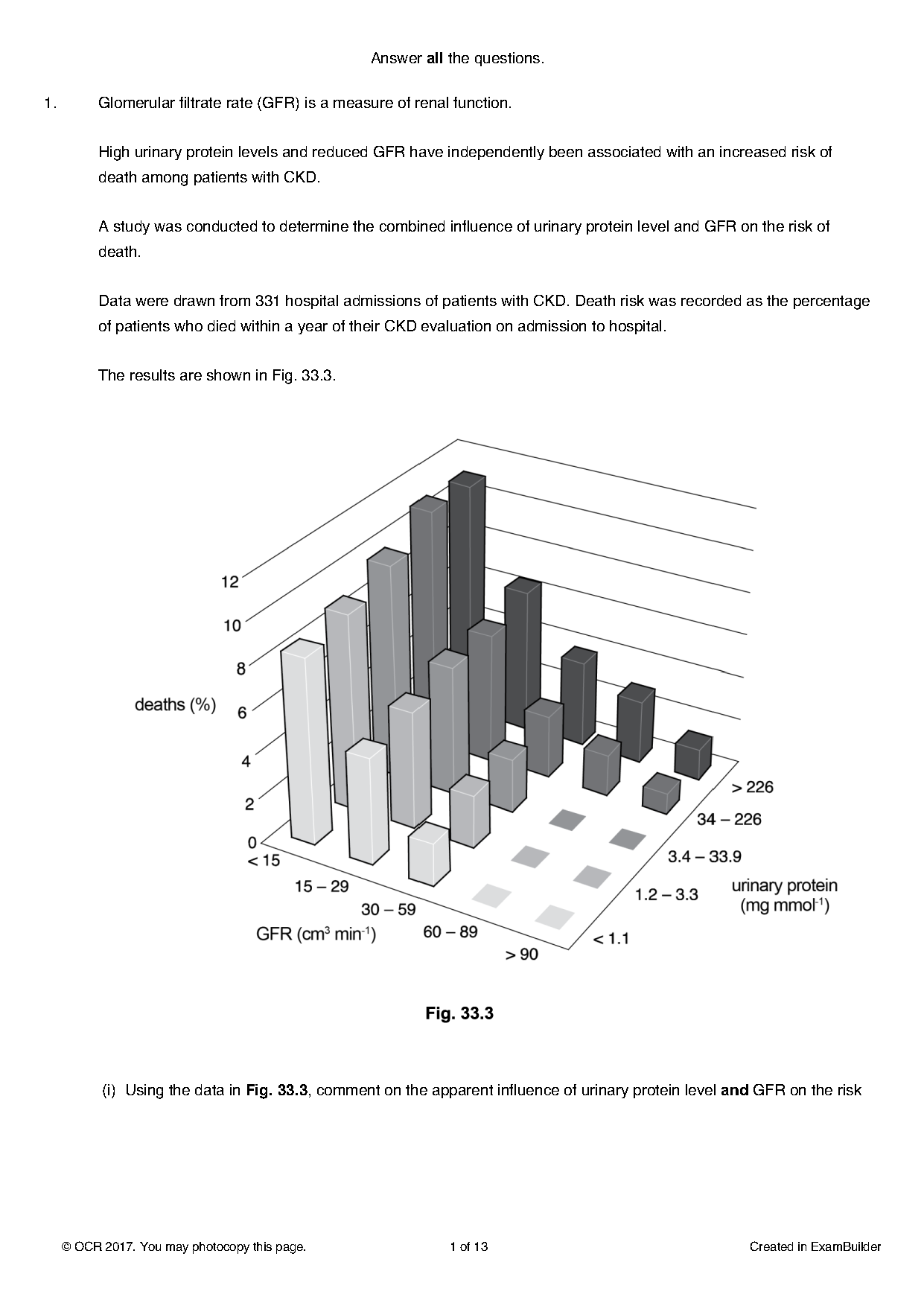
The quantity of maths in the 2017 specification is a challenge to many students - so I put together a summary of all of the OCR A new spec questions with some element of data analysis.
42 pages with markschemes - have a look at the pdf
Also have a look at this guidance on tables and graphs
And the mathematical skills for OCR guidebook
Please like and share (and click on a advert to help with the hosting costs !)
Challenging Questions with lots of Data Analysis and Application - A-level Biology past paper questions
Good practice if you are struggling with data analysis questions
Pack of challenging past paper questions with lots of Data Analysis and application - A-level Biology past paper questions - good for OCR and AQA specifications
Have a go at some of these - markschemes at the end
Please "like" and share with your friends if you find that this helped your improve your understanding
Osmosis A-level Biology Past Paper Exam Questions
Pack of past paper questions on Osmosis and Water potential - I have tried to include one question of each type
Please "like" and share with your friends if you find that this helped your improve your understanding
Please like and share (and click on a advert to help with the hosting costs !)
How to do Tables and Graphs - terrific guidance from Exam Boards for A-level Biology
There is plenty of excellent guidance on how to plot graphs and draw tables in the OCR practical booklet ..... pdf
please like and share
Rather than being assessed seperately, practical skills are included in the theory paper. Like this OCR question from the sample paper
Please like and share (and click on a advert to help with the hosting costs !)
There is plenty of excellent guidance on how to plot graphs and draw tables in the OCR practical booklet ..... pdf here
Prompting some festive recapping ? - Looking back at first year A-level Biology topics
Please like and share
Here are 20 multiple choice questions from the OCR specimen paper. Surprisingly difficult and caused a lot of debate in class. PDF - here
Splat and Flash..... ATP and Fireflies - #OCR Synoptic Biology A-level
Another from the past.
Terrific question about DNA, diffusion, ATP production and fireflies going out in a blaze of glory....
Please like and share
Another from the past.
Terrific question about DNA, diffusion, ATP production and fireflies going out in a blaze of glory....
Here is a pdf copy of the question - and of the markscheme.
Additionally, below are images with the markscheme answers edited in

