

Cystic Fibrosis, Mutation and Genetic Screening comes in Topic 2, Genes and Health, of the Edexcel A level Biology A (Salters-Nuffield) specification. You need to understand how DNA replication errors cause mutations, how cystic fibrosis results from CFTR gene mutations, and how it affects the gas exchange, digestive and reproductive systems. You also need the uses of genetic screening (PGD, amniocentesis and CVS) and its implications and ethical issues. This topic is examined on AS Paper 1 and on A level Papers 1, 2 and 3. Questions marked AS are from the AS papers (8BN0); the rest are from the A level papers (9BN0).
The examiners' reports reward precise, directional answers. Say that chloride ions move out of the cell into the mucus and water follows by osmosis, and say where sticky mucus causes harm: the bronchioles, the alveoli or the pancreatic duct. Write about digestion when asked about digestion, not absorption. Spell chorionic villus sampling correctly and use the number of weeks given. For ethical issues, explain why each matters: a false positive could lead to the termination of a healthy fetus.
Studying Edexcel SNAB and want more help? If you'd like to arrange one-to-one Edexcel tutoring, or to register your interest in an Edexcel group class, message Tom on WhatsApp using the link at the bottom of this page.
What you need from GCSE
Each question on this page assumes you're secure on these ideas. If any of them feels shaky, look it up before you start.
- DNA is made of nucleotides, and the sequence of bases codes for the sequence of amino acids in a protein.
- Cystic fibrosis is an inherited disorder caused by a recessive allele, so a person needs two copies to have it.
- Osmosis is the net movement of water from a dilute solution to a more concentrated solution through a partially permeable membrane.
- Enzymes made by the pancreas digest food in the small intestine.
Key terms
These words come up in the questions and mark schemes. Examiners expect you to use them exactly.
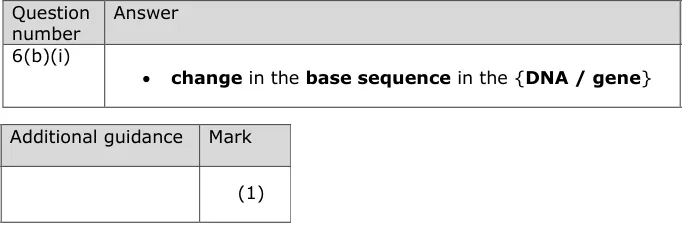
- Gene mutation: a change in the base sequence of DNA (of a gene).
- CFTR protein: a channel protein in the cell surface membrane of epithelial cells that lets chloride ions out of the cell.
- Carrier: a person who is heterozygous for a recessive allele, so has no symptoms but can pass the allele on.
- Pre-implantation genetic diagnosis (PGD): testing an embryo made by IVF before it is placed in the uterus.
- Chorionic villus sampling (CVS): a prenatal test on cells taken from the placenta (chorionic villi), carried out at 10 to 14 weeks of pregnancy.
- Amniocentesis: a prenatal test on fetal cells in the amniotic fluid, carried out later in pregnancy than CVS.
- False positive: a test result showing a condition is present when it is not.
What these questions cover (Edexcel SNAB Topic 2: Genes and Health)
The questions test these statements from Topic 2 of the Pearson Edexcel A level Biology A (Salters-Nuffield) specification (9BN0).
- 2.12 i Understand how errors in DNA replication can give rise to mutations.
- 2.12 ii Understand how cystic fibrosis results from one of a number of possible gene mutations.
- 2.14 Understand how the expression of a gene mutation in people with cystic fibrosis impairs the functioning of the gaseous exchange, digestive and reproductive systems.
- 2.15 i Understand the uses of genetic screening, including the identification of carriers, pre-implantation genetic diagnosis (PGD) and prenatal testing, including amniocentesis
- 2.15 ii Understand the implications of prenatal genetic screening.
- 2.16 Be able to identify and discuss the social and ethical issues related to genetic screening from a range of ethical viewpoints.
How to use this page
Write your answer on paper before you open the mark scheme. Allow about 1.2 minutes per mark: the 20 questions are worth 46 marks, so about 55 minutes in total. Then mark your answer strictly against the mark scheme and read the examiners' tip underneath it. If you'd rather print the questions, download the PDF pack.
Errors in DNA replication and mutation (2.12 i)
Question 1
AS Paper 1 · June 2024 · Q5(a)(ii) · 4 marks
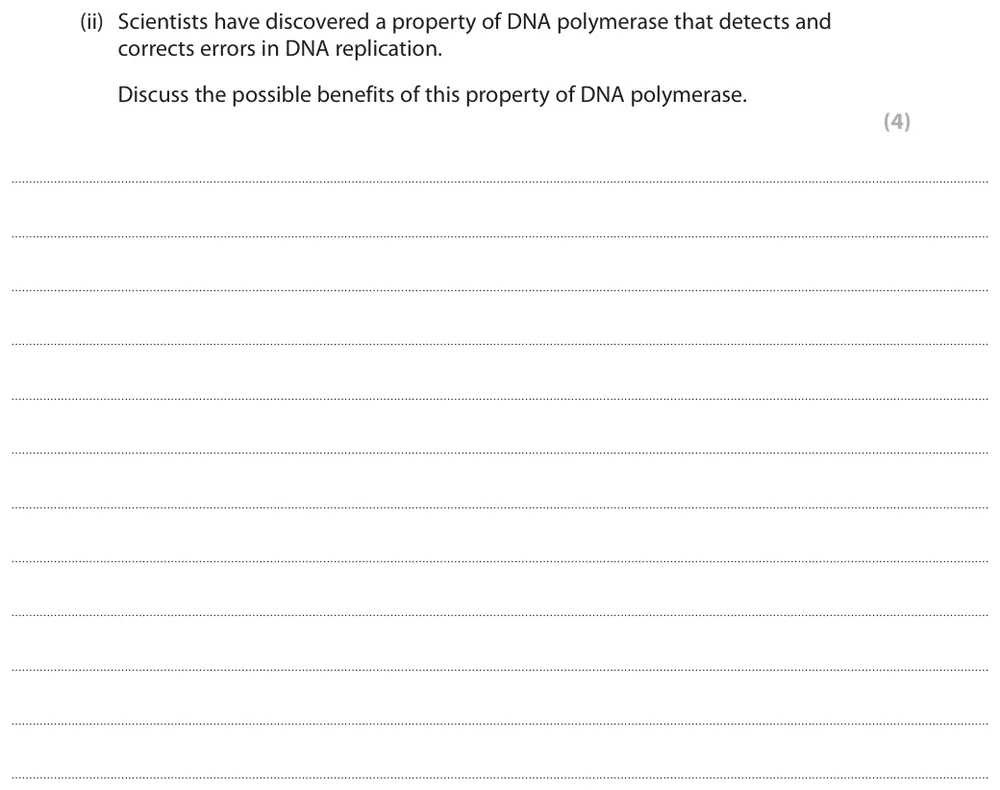
Discuss the benefits of DNA polymerase detecting and correcting errors in DNA replication.
Show the mark scheme
Tap an image to open it full size.
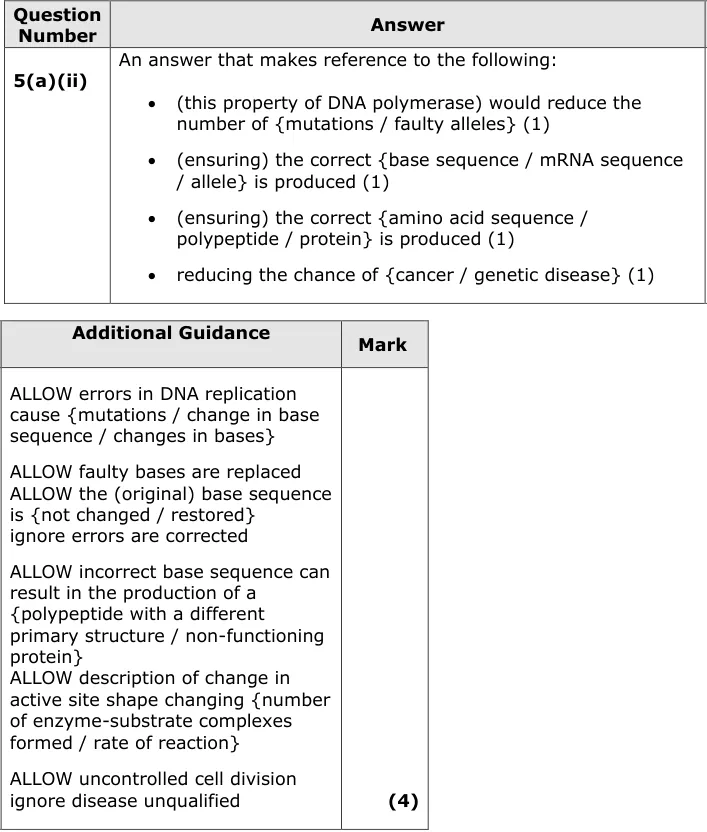
From the examiners' report: Most linked a replication error to a mutation. Follow it through: fewer changes to the base sequence mean the correct amino acid sequence and a working protein are produced, reducing the chance of cancer or genetic disease.
Question 2
A level Paper 3 · June 2023 · Q6(b)(i) · 1 mark
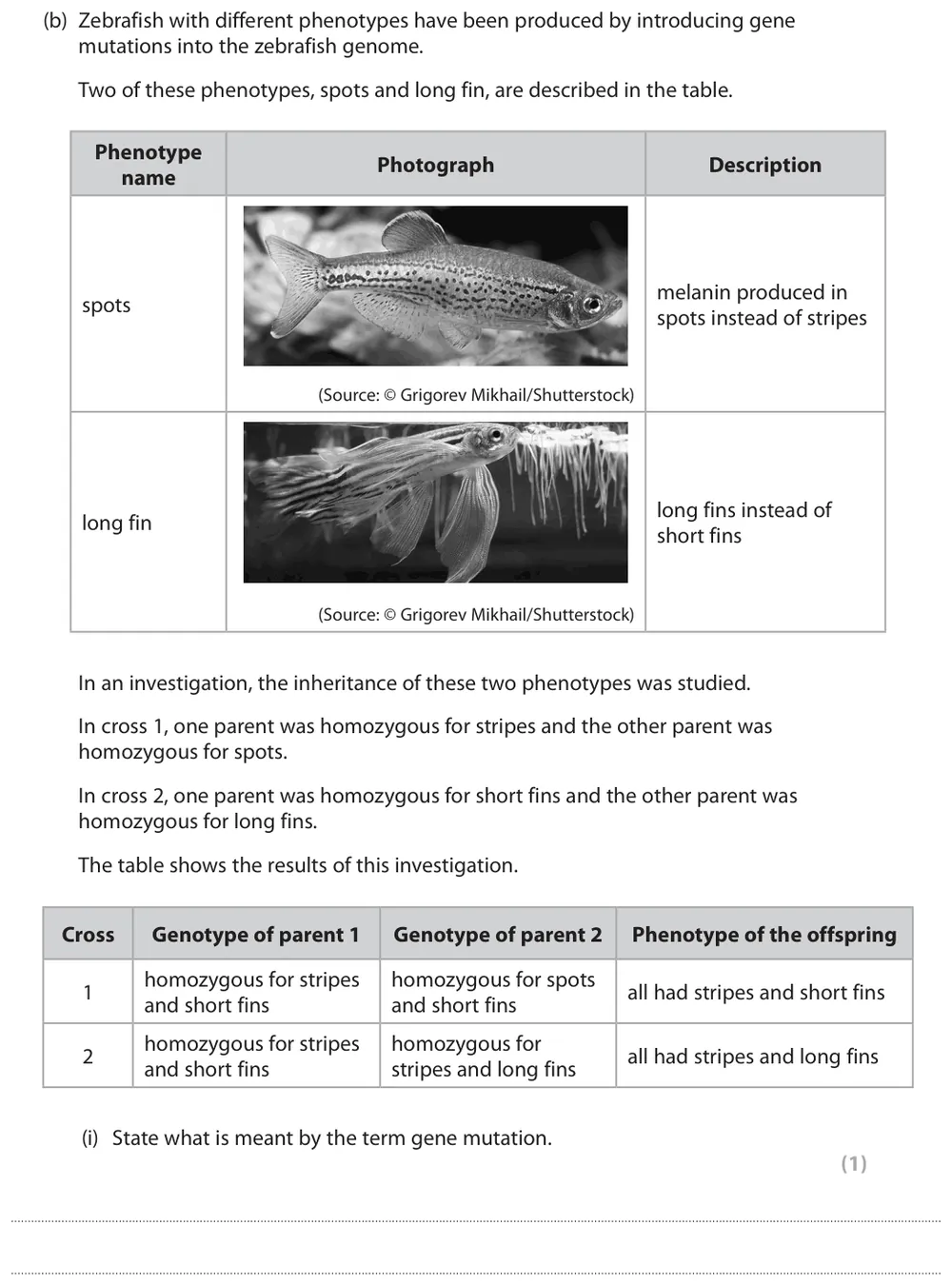
State what is meant by the term gene mutation.
Show the mark scheme
Tap an image to open it full size.
From the examiners' report: Many answers were incomplete because they left out where the change happens. A gene mutation is a change in the base sequence of DNA (or of a gene); it does not mean a new gene is produced.
Cystic fibrosis and the CFTR gene (2.12 ii)
Question 3
A level Paper 2 · June 2019 · Q3(b)(ii) · 2 marks
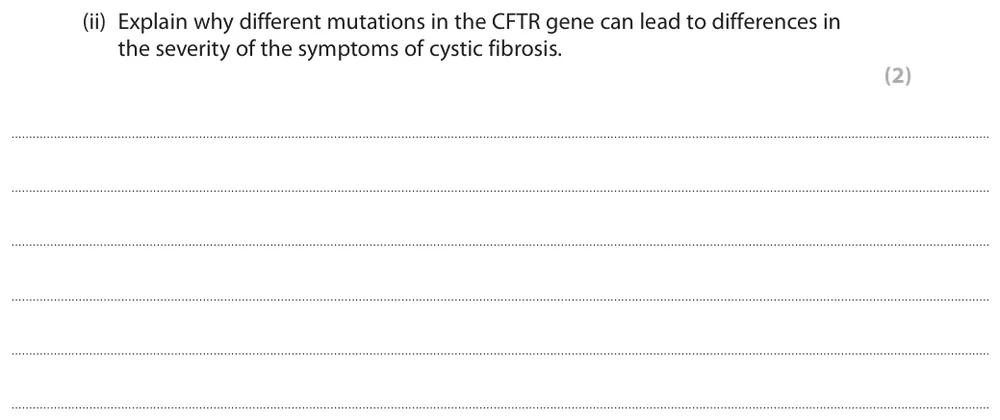
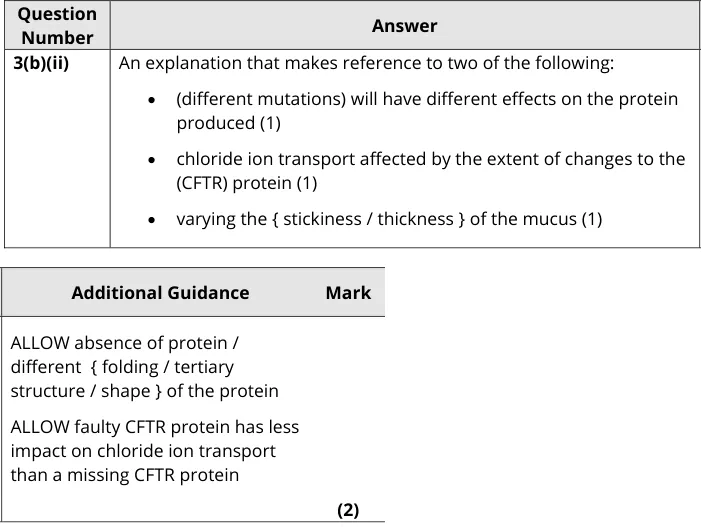
Explain why different CFTR mutations lead to cystic fibrosis of different severity.
Show the mark scheme
Tap an image to open it full size.
From the examiners' report: A minority just described how mucus becomes sticky. Link different mutations to different effects on the CFTR protein (its folding or shape, or no protein at all), and so to how much chloride ion transport is affected.
How cystic fibrosis affects body systems (2.14)
Question 4
A level Paper 1 · June 2017 · Q2(c)(i) · 3 marks · Easy
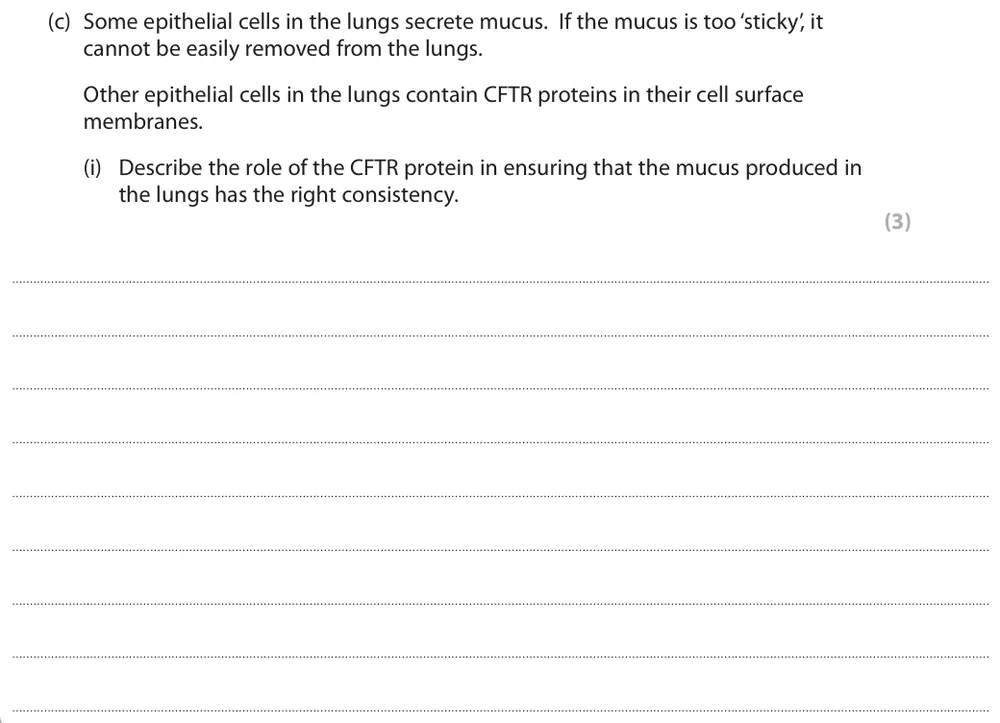
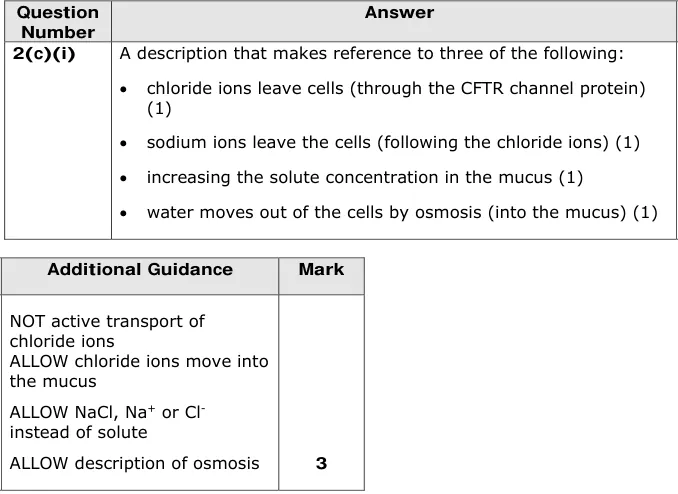
Describe the role of the CFTR protein in giving lung mucus the right consistency.
Show the mark scheme
Tap an image to open it full size.
From the examiners' report: Answer the question asked: the effects of CFTR mutations gained nothing here. Chloride ions leave the cell through the CFTR channel (they are not pumped), sodium ions follow, and water moves into the mucus by osmosis.
Question 5
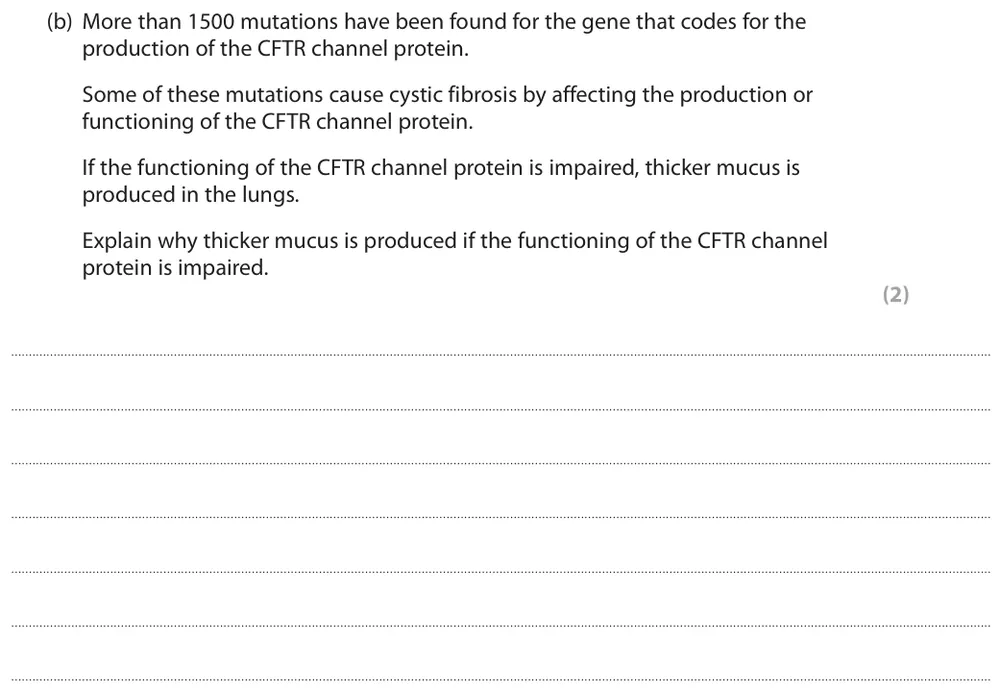
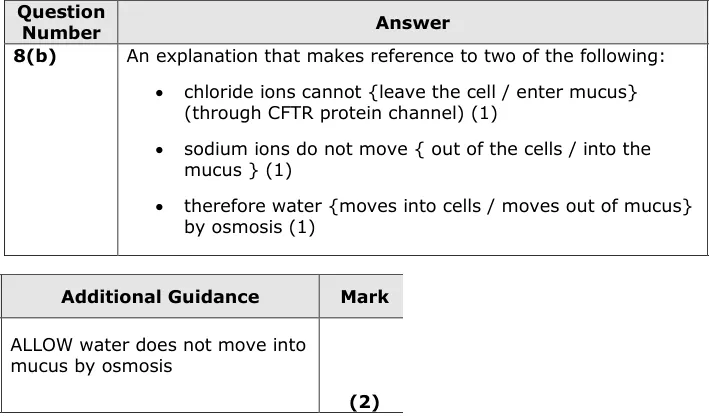
AS Paper 1 · June 2018 · Q8(b) · 2 marks
Explain why thicker mucus is produced when the CFTR channel protein does not work.
Show the mark scheme
Tap an image to open it full size.
From the examiners' report: The usual reason for losing a mark was not saying which way the chloride ions move: they cannot leave the cell and enter the mucus. Write chloride, not chlorine, and say water does not move into the mucus by osmosis.
Question 6
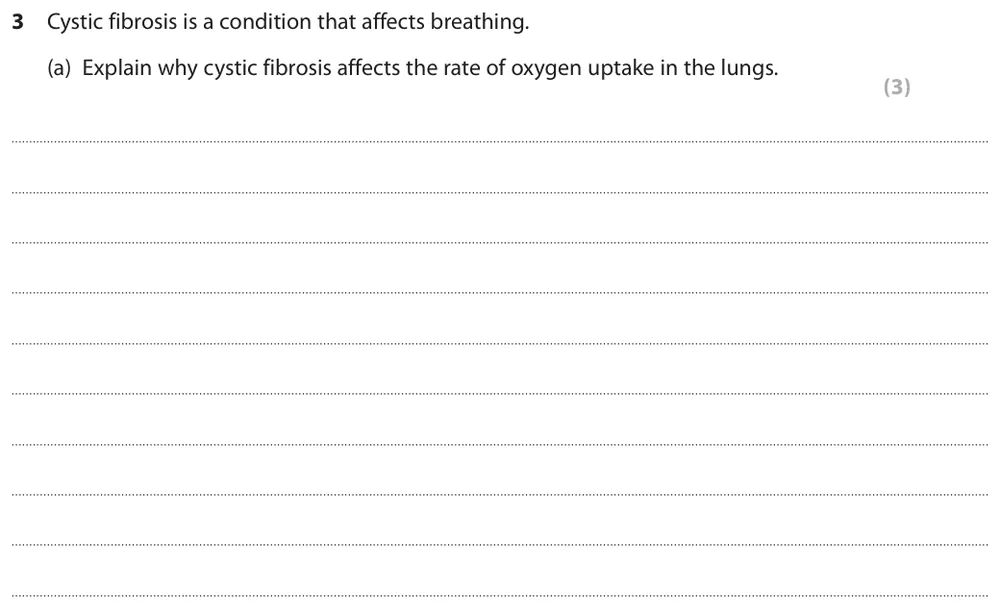
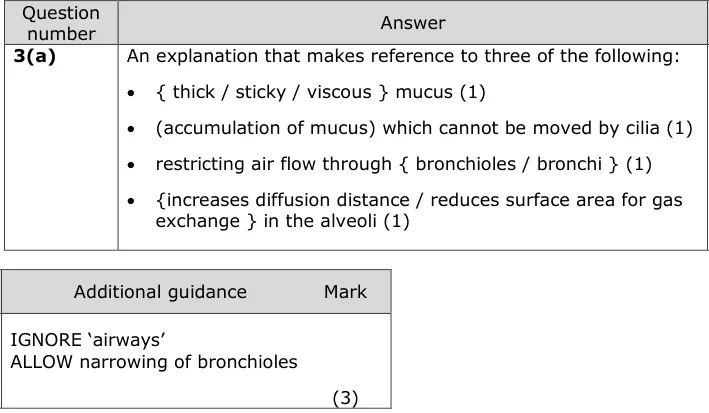
A level Paper 2 · June 2017 · Q3(a) · 3 marks
Explain why cystic fibrosis reduces the rate of oxygen uptake in the lungs.
Show the mark scheme
Tap an image to open it full size.
From the examiners' report: Say where each effect happens. Sticky mucus that cilia cannot move reduces air flow through the bronchioles ('airways' is too vague) and increases the diffusion distance, or reduces the surface area, in the alveoli.
Question 7
AS Paper 1 · June 2022 · Q5(a) · 1 mark
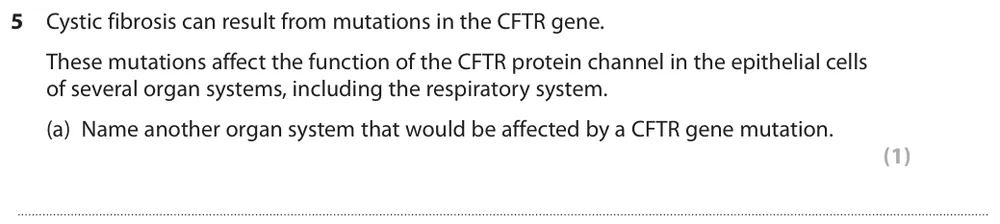
Name another organ system affected by a CFTR gene mutation.
Show the mark scheme

Tap an image to open it full size.
From the examiners' report: Most said the digestive system; the reproductive system also scored. Some lost the mark by naming the respiratory system, which was in the question, or by naming an organ instead of a system.
Question 8
A level Paper 2 · June 2023 · Q4(c) · 3 marks
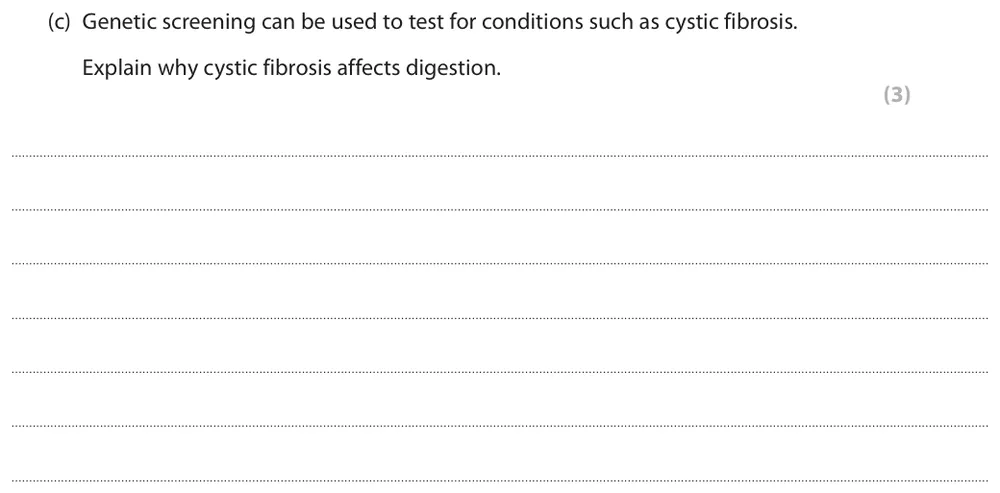
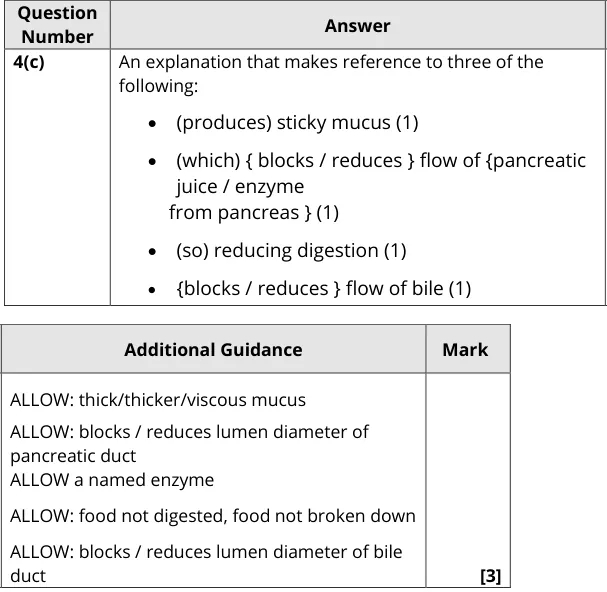
Explain why cystic fibrosis affects digestion.
Show the mark scheme
Tap an image to open it full size.
From the examiners' report: Sticky mucus blocks the pancreatic duct (or the bile duct), reducing the flow of enzymes, so less food is digested. Many wrote about absorption, which was not credited: the question asks about digestion.
Question 9
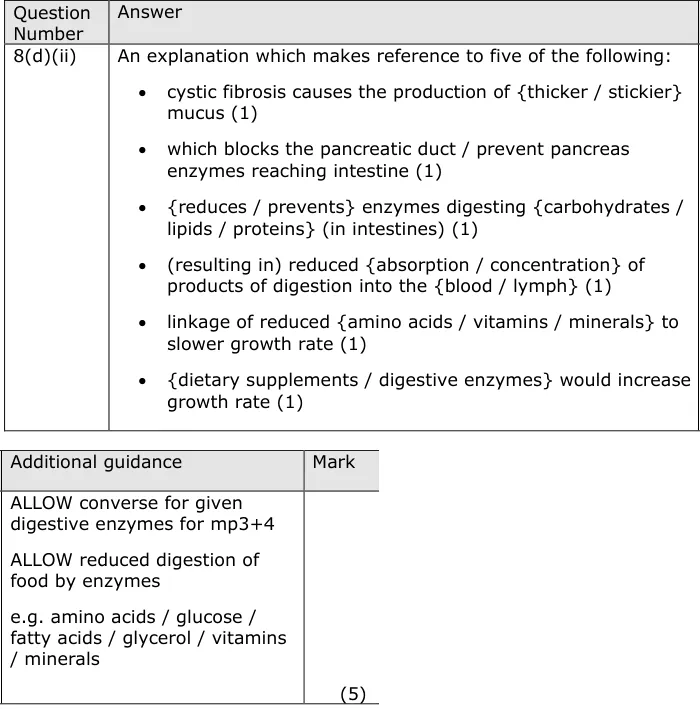
AS Paper 1 · October 2020 · Q8(d)(ii) · 5 marks
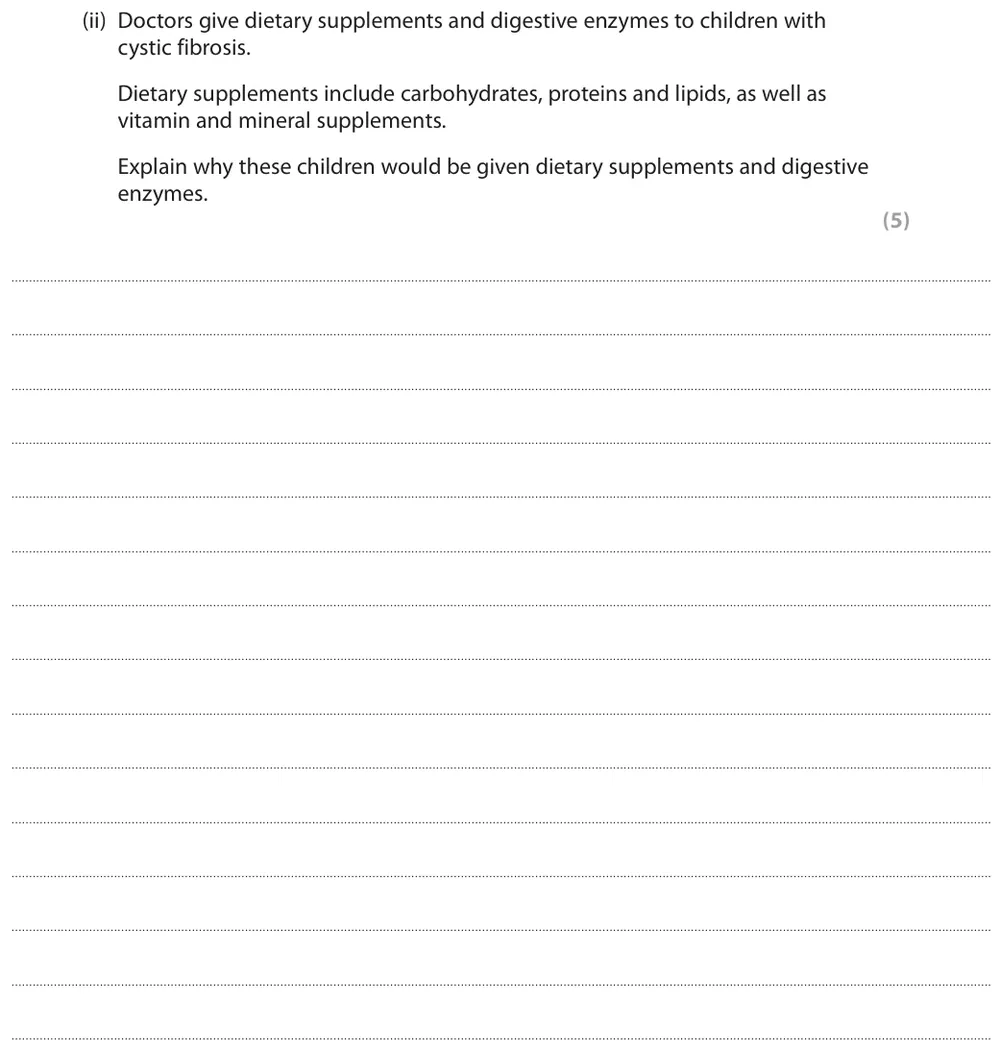
Explain why children with cystic fibrosis are given dietary supplements and digestive enzymes.
Show the mark scheme
Tap an image to open it full size.
Genetic screening: PGD, amniocentesis and CVS (2.15 i)
Question 10
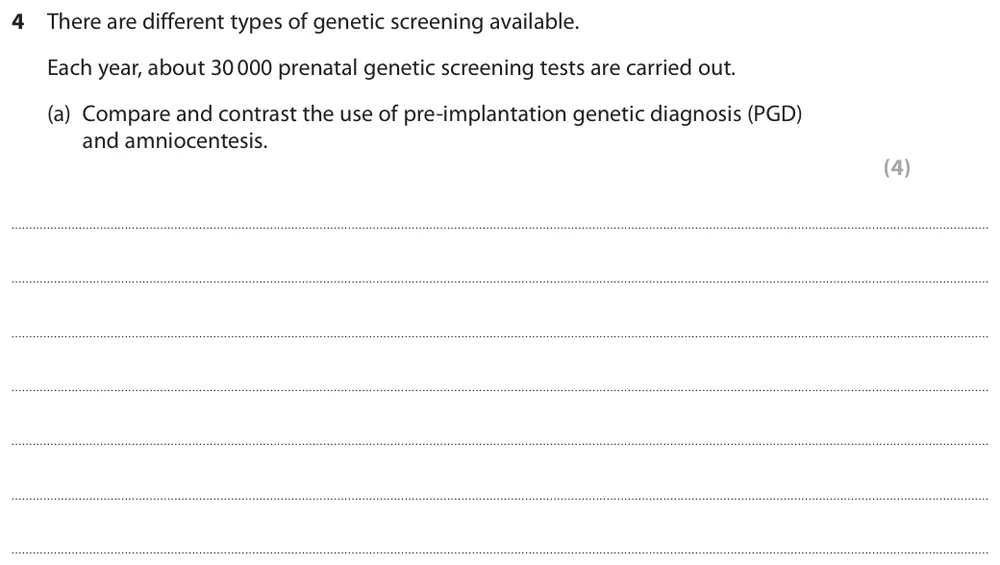
A level Paper 2 · June 2023 · Q4(a) · 4 marks
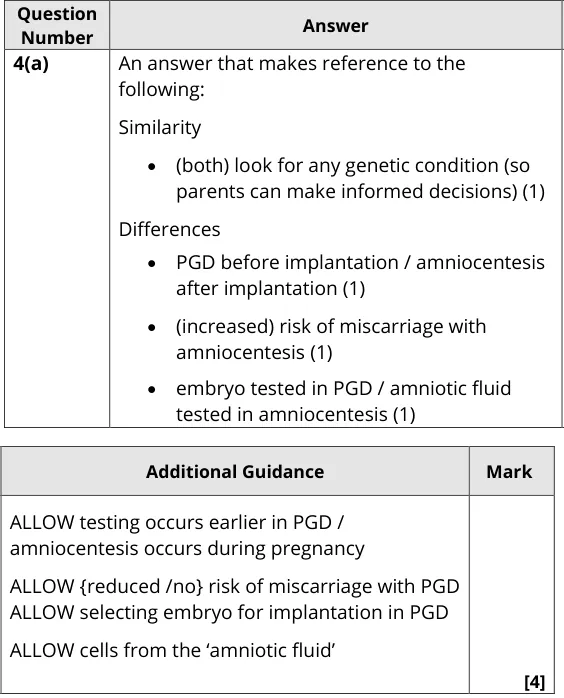
Compare and contrast pre-implantation genetic diagnosis (PGD) with amniocentesis.
Show the mark scheme
Tap an image to open it full size.
From the examiners' report: Full marks need both a similarity and differences. Some wrote about chorionic villus sampling instead of PGD. Compare when each test is done, what is tested (the embryo or the amniotic fluid) and the risk of miscarriage.
Question 11
AS Paper 1 · June 2018 · Q4(b)(iii) · 1 mark
Name the type of genetic screening done on an IVF embryo before it is placed in the uterus.

Show the mark scheme

Tap an image to open it full size.
From the examiners' report: Just over half scored nothing. The answer is pre-implantation genetic diagnosis (PGD); prenatal screening, CVS and amniocentesis happen after the embryo is in the uterus. If you abbreviate, get the letters in the right order.
Question 12
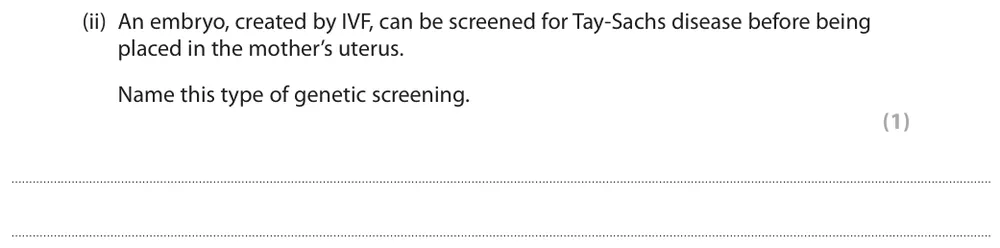
AS Paper 1 · June 2023 · Q4(b)(ii) · 1 mark
Name the screening used on an IVF embryo for Tay-Sachs disease before implantation.
Show the mark scheme

Tap an image to open it full size.
From the examiners' report: Most were correct. The most common wrong answer was chorionic villus sampling.
Question 13
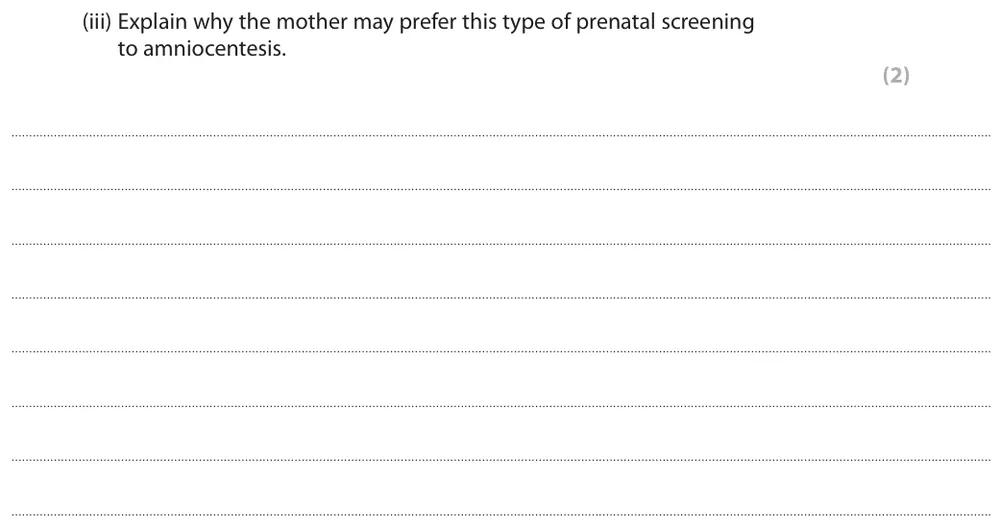
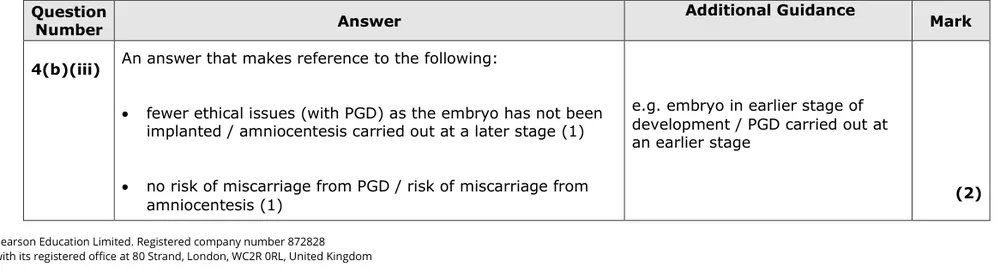
AS Paper 1 · June 2023 · Q4(b)(iii) · 2 marks
Explain why a mother may prefer this screening to amniocentesis.
Show the mark scheme
Tap an image to open it full size.
From the examiners' report: Most gained at least one mark. Give both reasons: PGD carries no risk of miscarriage, and it raises fewer ethical issues because the embryo is tested at an earlier stage, before implantation.
Question 14
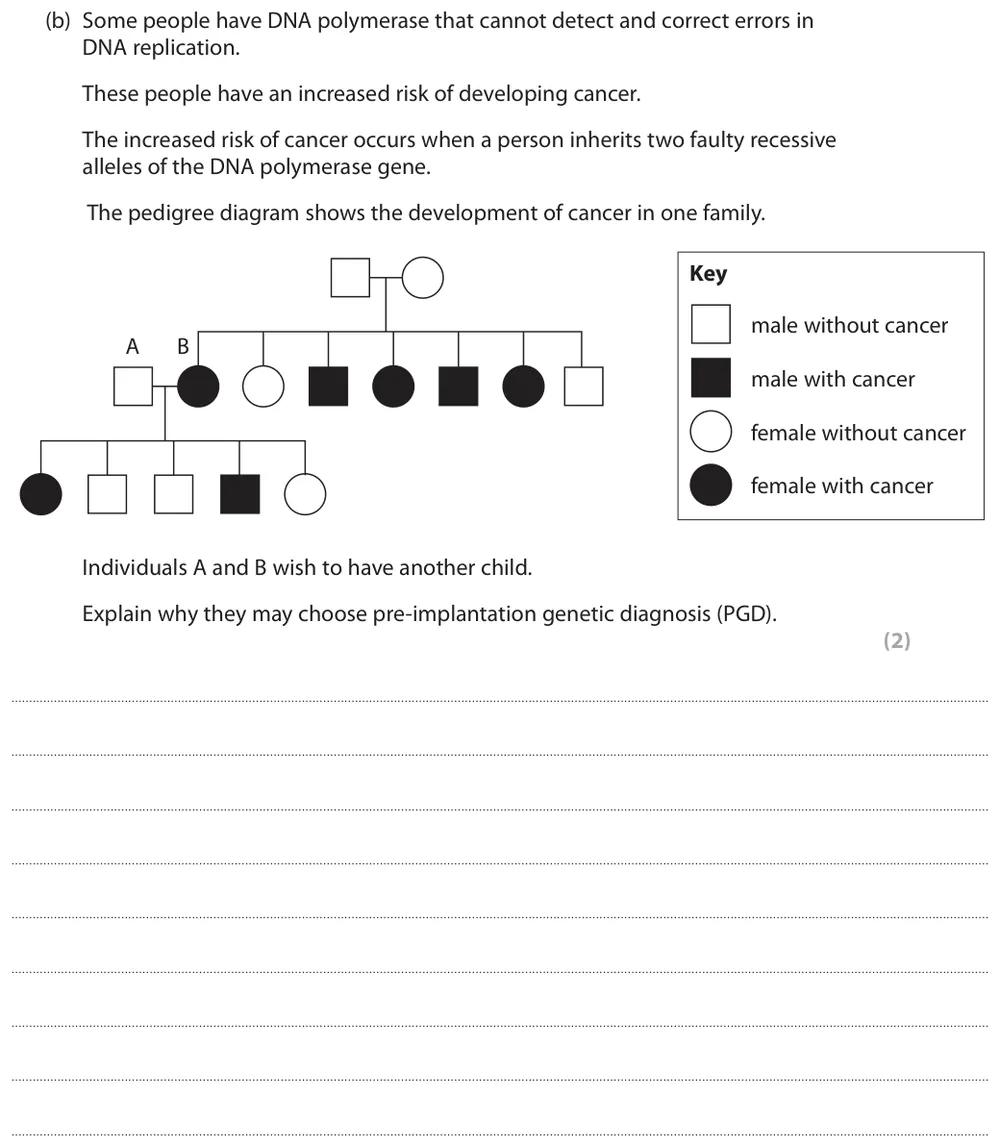
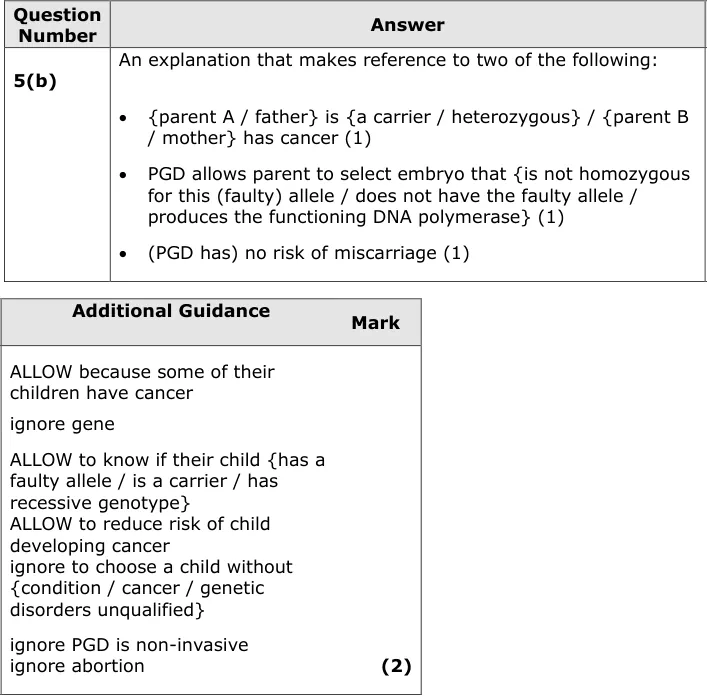
AS Paper 1 · June 2024 · Q5(b) · 2 marks
Use a pedigree diagram to explain why a couple may choose PGD.
Show the mark scheme
Tap an image to open it full size.
From the examiners' report: Most analysed the pedigree correctly. Fewer said that PGD lets the parents choose an embryo without the faulty allele (allele, not gene). 'An embryo without cancer' was wrong: the alleles only increase the risk of cancer.
Question 15
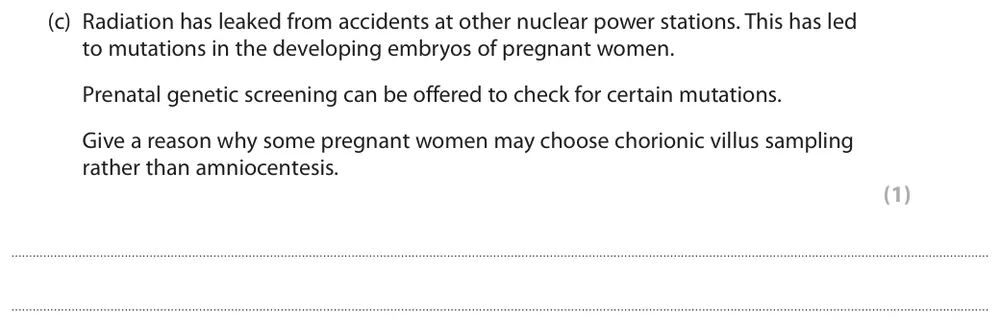
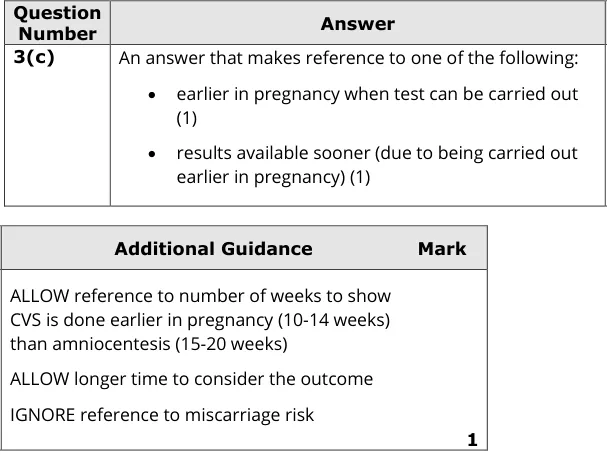
A level Paper 2 · June 2024 · Q3(c) · 1 mark
Give a reason why a pregnant woman may choose CVS rather than amniocentesis.
Show the mark scheme
Tap an image to open it full size.
From the examiners' report: Check which way round the question asks: a common wrong answer gave reasons for choosing amniocentesis. CVS is done earlier in pregnancy (10 to 14 weeks), so results come sooner. Miscarriage risk was ignored.
Question 16
AS Paper 1 · June 2016 · Q1(b) · 1 mark · Hard
Name the prenatal test used to detect Tay-Sachs disease at 11 weeks of pregnancy.

Show the mark scheme

Tap an image to open it full size.
From the examiners' report: Use the 11 weeks in the question: at that stage the test is chorionic villus sampling, not amniocentesis. 'Chronic villus sampling' was not accepted, so learn the spelling.
Implications of prenatal screening (2.15 ii)
Question 17
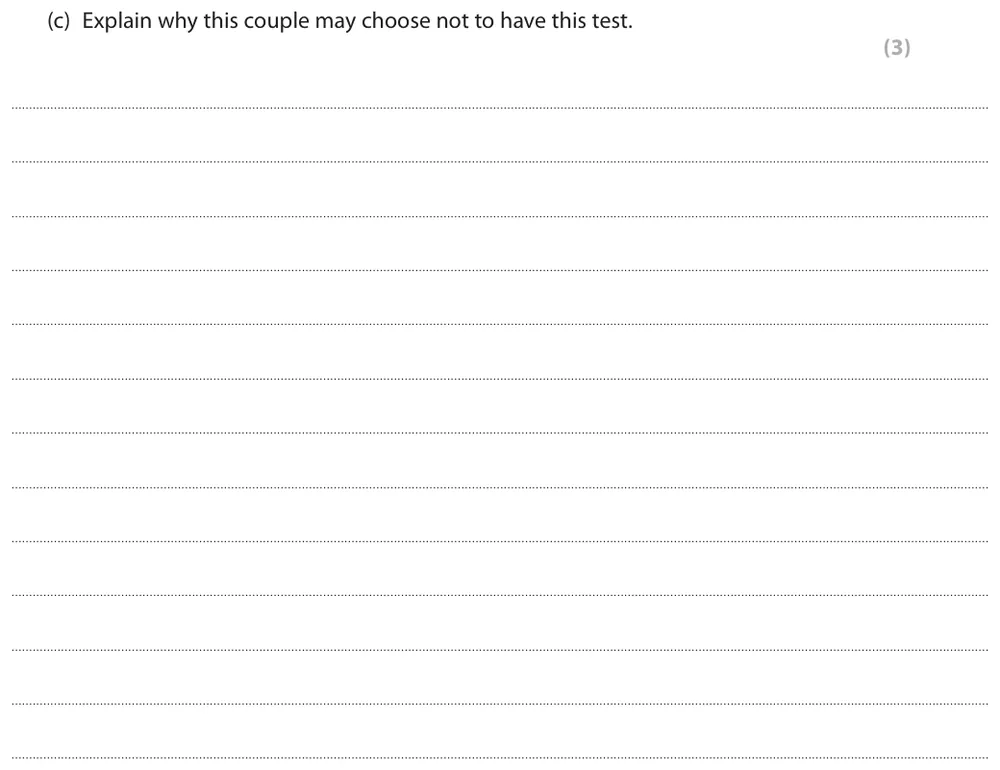
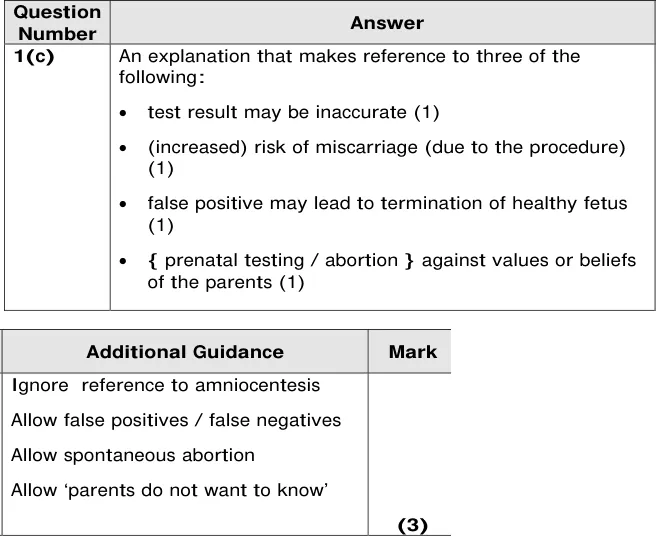
AS Paper 1 · June 2016 · Q1(c) · 3 marks
Explain why a couple may choose not to have this test.
Show the mark scheme
Tap an image to open it full size.
From the examiners' report: Almost everyone gave the risk of miscarriage. Fewer explained that a false positive could lead to a healthy fetus being terminated, and ethical points had to be about the parents' own values or beliefs, not society in general.
Social and ethical issues of genetic screening (2.16)
Question 18
AS Paper 1 · June 2018 · Q4(b)(iv) · 2 marks
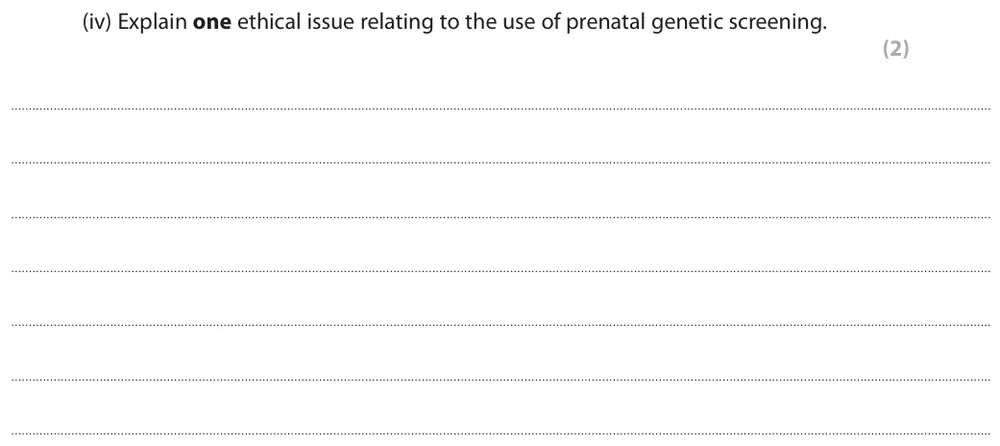
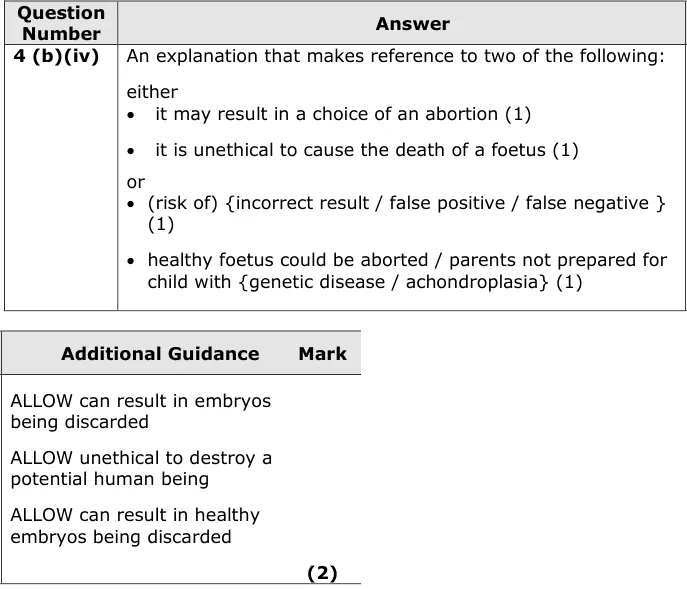
Explain one ethical issue of prenatal genetic screening.
Show the mark scheme
Tap an image to open it full size.
From the examiners' report: Explain why the issue is a problem. 'Playing God', religious beliefs and designer babies were too vague. A false positive (not a false negative) could lead to a healthy fetus being aborted.
Question 19
AS Paper 1 · June 2022 · Q5(c)(iv) · 3 marks
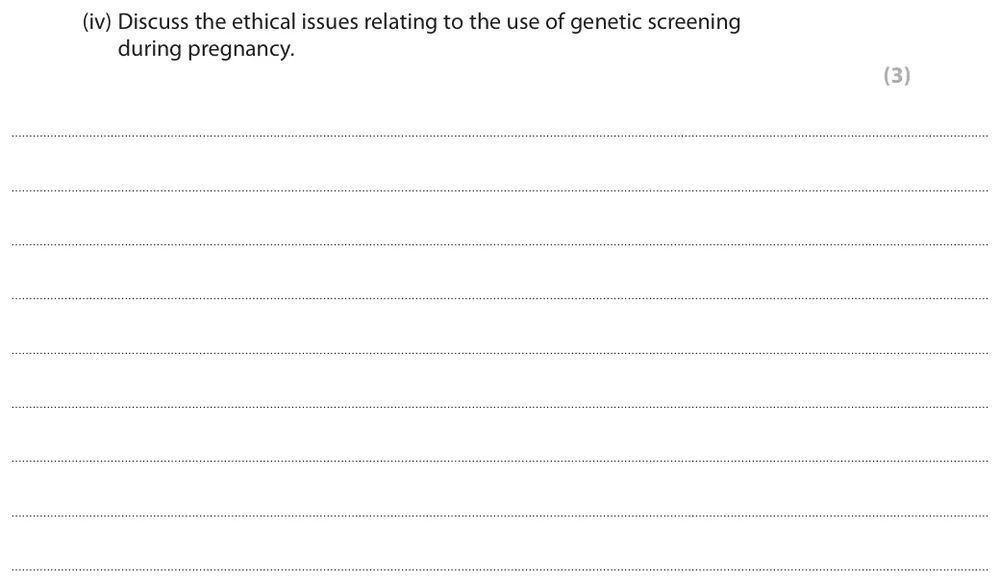
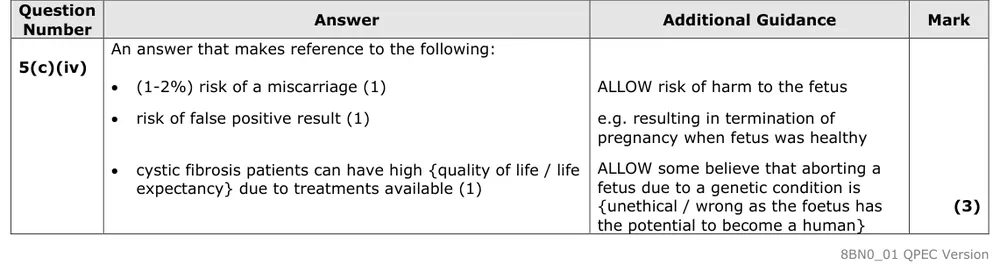
Discuss the ethical issues of genetic screening during pregnancy.
Show the mark scheme
Tap an image to open it full size.
From the examiners' report: Most gave miscarriage risk and false positives. Fewer discussed ending a pregnancy because of a genetic condition: many wrote about abortion in general, which was not what was asked. People with cystic fibrosis can have a good quality of life with treatment.
Question 20
A level Paper 2 · June 2023 · Q4(b) · 2 marks
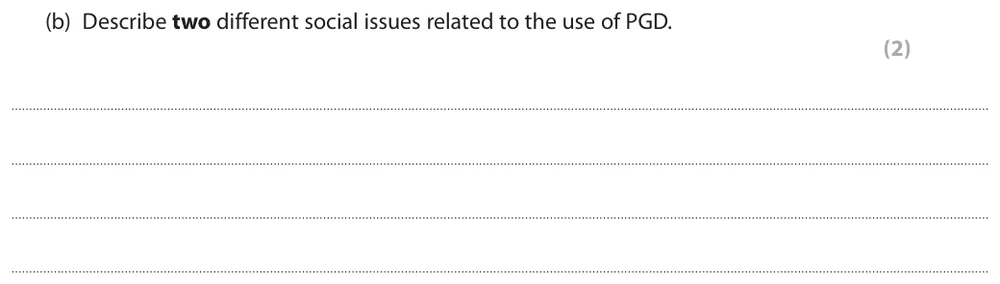
Describe two different social issues related to the use of PGD.
Show the mark scheme
Tap an image to open it full size.
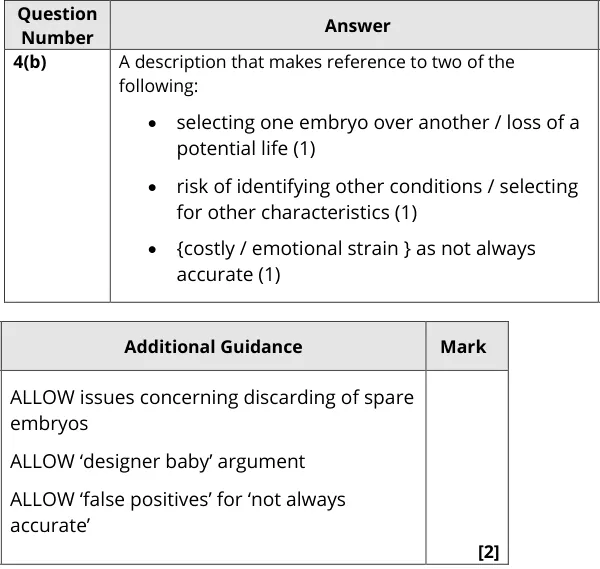
From the examiners' report: Give two different issues, not one issue from two points of view. Common creditworthy points were discarding spare embryos ('designer babies' was allowed) and selecting embryos for other characteristics.
Where students lose marks (from Pearson examiners' reports and mark schemes)
Each point below comes from the examiners' reports and mark schemes, and is followed by wording that gained marks.
A gene mutation changes the DNA base sequence. Many left out that the change is in the DNA or gene, or suggested a new gene is produced.
✔ Gains credit: 'A change in the base sequence in the DNA (gene).'
Chloride ions leave through CFTR; they are not pumped. Some described chloride ions being pumped out, or moving in and out of cells through the CFTR protein.
✔ Gains credit: 'Chloride ions leave the cells through the CFTR channel protein, sodium ions follow, and water moves out of the cells into the mucus by osmosis.'
Give the direction of chloride and water in CF mucus. Many said chloride ions cannot pass through the channel without saying which way, or left out osmosis.
✔ Gains credit: 'Chloride ions cannot leave the cell and enter the mucus, so water does not move into the mucus by osmosis.'
CF mucus blocks bronchioles, not 'airways'. Answers mentioned reduced air flow or surface area without linking them to the bronchioles or alveoli.
✔ Gains credit: 'Sticky mucus restricts air flow through the bronchioles and increases the diffusion distance in the alveoli.'
Cystic fibrosis reduces digestion, not just absorption. Many explained a change in absorption when the question asked about digestion.
✔ Gains credit: 'Sticky mucus blocks the pancreatic duct, reducing the flow of pancreatic enzymes, so reducing digestion.'
Chorionic, not chronic, villus sampling. Some missed the 11 weeks in the stem and wrote amniocentesis; others misspelt the test.
✔ Gains credit: 'Chorionic villus sampling (CVS).'
PGD screens the IVF embryo before implantation. Over half named a test done after the embryo is in the uterus, such as CVS or amniocentesis.
✔ Gains credit: 'Pre-implantation genetic diagnosis (PGD).'
A false positive could abort a healthy fetus. Some linked a false negative to aborting a healthy fetus, or gave vague ideas such as 'playing God'.
✔ Gains credit: 'A false positive result could lead to a healthy foetus being aborted.'
Download the questions
Download the PDF pack (20 questions, mark schemes at the end)
Keep practising
- Gas Exchange, Membranes and Transport (Topic 2): Edexcel SNAB exam questions by topic
- DNA, RNA and Protein Synthesis (Topic 2): Edexcel SNAB exam questions by topic
- Proteins and Enzymes (Topic 2): Edexcel SNAB exam questions by topic
- Inheritance (Topic 2): Edexcel SNAB exam questions by topic
- Topic 2 multiple-choice quiz (75 questions, marked as you tap)
- Edexcel SNAB A level Biology resources hub (every topic, practical and paper)
- Vitamin C and Membrane Permeability (Core Practicals 2 and 3): Edexcel SNAB A Level Biology Exam Questions
- Enzyme Concentration and Initial Rates (Core Practical 4): Edexcel SNAB A Level Biology Exam Questions
- Extended Response Questions (Topics 1 and 2): Edexcel SNAB A Level Biology Exam Questions
- Edexcel SNAB A level Biology past papers, mark schemes and examiners' reports
- Edexcel SNAB A level Biology grade boundaries
- Message Tom on WhatsApp about one-to-one Edexcel SNAB tutoring or an Edexcel group class
Questions, mark schemes and examiners' report extracts © Pearson Education Ltd.