

Inheritance comes in Topic 2, Genes and Health, of the Edexcel A level Biology A (Salters-Nuffield) specification. You need to know the meaning of gene, allele, genotype, phenotype, dominant, recessive, incomplete dominance, homozygote and heterozygote, and to use them to explain patterns of monohybrid inheritance, including genetic crosses and genetic pedigree diagrams. This topic is examined on AS Paper 1 and on all three A level papers. Questions marked AS are from the AS papers (8BN0); the rest are from the A level papers (9BN0).
The examiners' reports keep returning to the key terms. An allele is a version of a gene, not a type of gene, and a genotype is made of alleles. When two alleles are both expressed, say incomplete dominance, not that both alleles are dominant. Use the allele letters given in the question, and remember that a genotype is never a person's sex. For crosses, always draw a genetic diagram, give the probability of exactly the outcome asked for, and name the phenotypes beside any ratio. With a pedigree, use every piece of information given, including unknown phenotypes, and label individuals with their genotypes before you answer.
Studying Edexcel SNAB and want more help? If you'd like to arrange one-to-one Edexcel tutoring, or to register your interest in an Edexcel group class, message Tom on WhatsApp using the link at the bottom of this page.
What you need from GCSE
Each question on this page assumes you're secure on these ideas. If any of them feels shaky, look it up before you start.
- Genes are sections of DNA on chromosomes, and body cells carry two copies of each chromosome.
- Gametes carry one allele of each gene, so offspring get one allele from each parent.
- A Punnett square shows the possible offspring from a cross between two parents.
- Some disorders, such as cystic fibrosis, are caused by a recessive allele.
Key terms
These words come up in the questions and mark schemes. Examiners expect you to use them exactly.
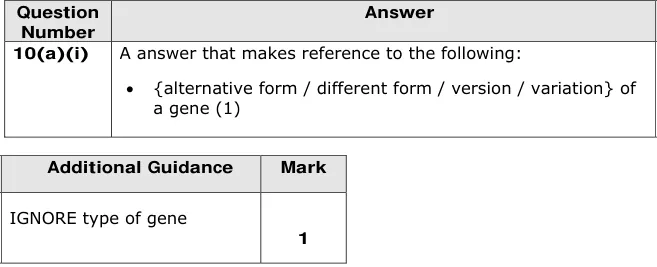
- Allele: an alternative form (version) of a gene, found at the same locus on a chromosome.
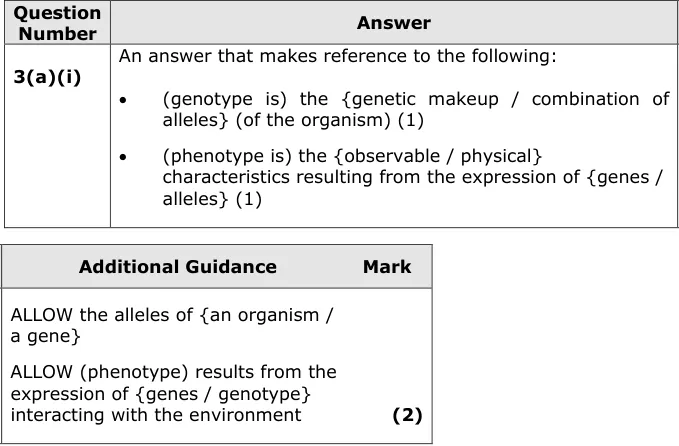
- Genotype: the combination of alleles an organism has for a gene, for example Tt.
- Phenotype: the observable characteristics that result from the expression of the genotype, interacting with the environment.
- Dominant: an allele that is expressed in the phenotype even when only one copy is present.
- Recessive: an allele that is only expressed when two copies are present (homozygous recessive).
- Incomplete dominance: both alleles in a heterozygote are expressed, giving an intermediate phenotype (the mark schemes also accept codominance).
- Homozygote and heterozygote: a homozygote has two identical alleles of a gene; a heterozygote has two different alleles.
- Genetic pedigree diagram: a family tree showing which individuals have a condition, used to work out genotypes and how the condition is inherited.
What these questions cover (Edexcel SNAB Topic 2: Genes and Health)
The questions test these statements from Topic 2 of the Pearson Edexcel A level Biology A (Salters-Nuffield) specification (9BN0).
- 2.13 i Know the meaning of the terms
- 2.13 ii Understand patterns of inheritance, including the interpretation of genetic pedigree diagrams, in the context of monohybrid inheritance.
How to use this page
Write your answer on paper before you open the mark scheme. Allow about 1.2 minutes per mark: the 20 questions are worth 44 marks, so about 53 minutes in total. Then mark your answer strictly against the mark scheme and read the examiners' tip underneath it. If you'd rather print the questions, download the PDF pack.
Alleles, genotype and phenotype (2.13 i)
Question 1
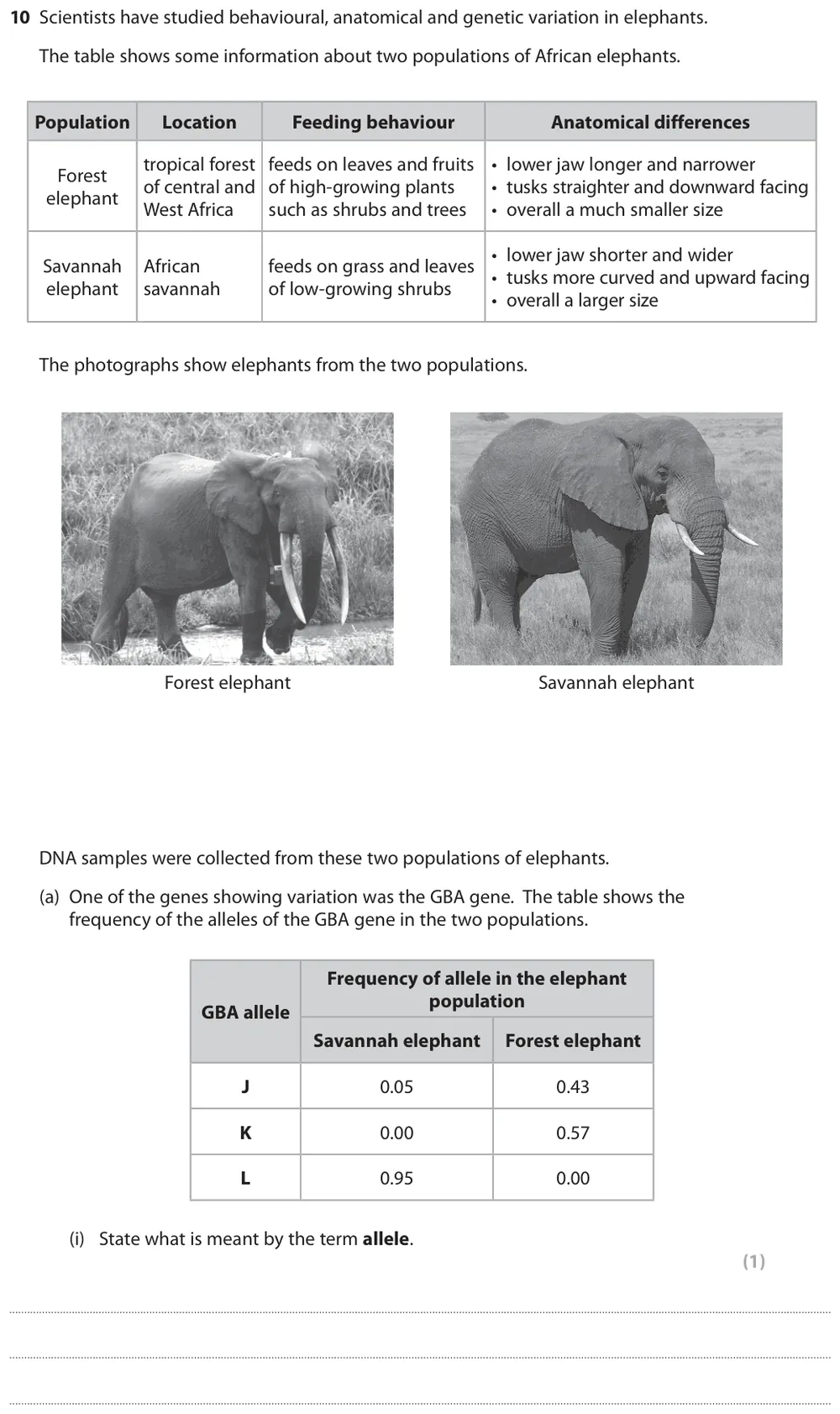
A level Paper 1 · June 2017 · Q10(a)(i) · 1 mark
State what is meant by the term allele.
Show the mark scheme
Tap an image to open it full size.
From the examiners' report: The usual reason for losing the mark was calling an allele a 'different type of gene'. Say it is a different version or form of a gene.
Question 2
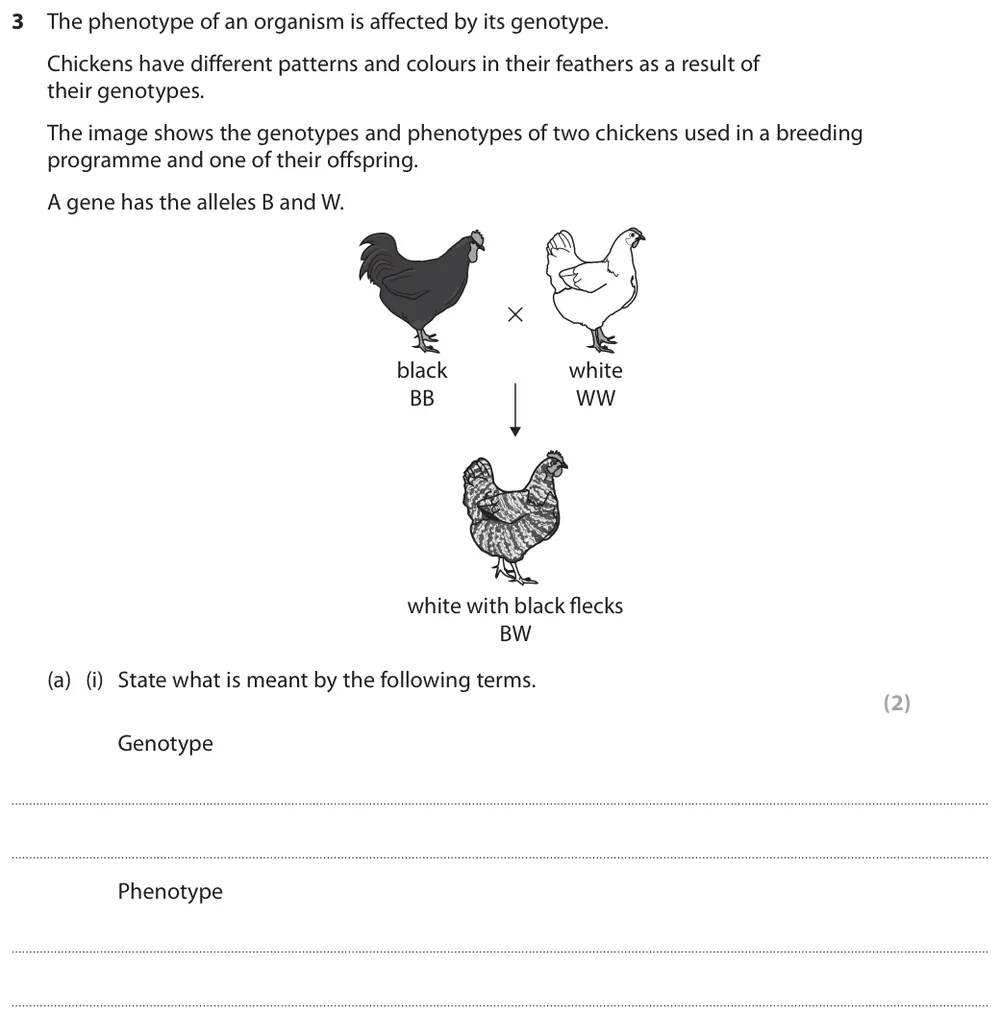
AS Paper 1 · June 2025 · Q3(a)(i) · 2 marks · Easy
State what is meant by the terms genotype and phenotype.
Show the mark scheme
Tap an image to open it full size.
From the examiners' report: Most could define phenotype, but fewer could define genotype. The most common error was using the word 'gene' where it didn't belong: genotype is the combination of alleles.
Dominant and recessive alleles (2.13 i)
Question 3
A level Paper 1 · June 2019 · Q11(a) · 2 marks
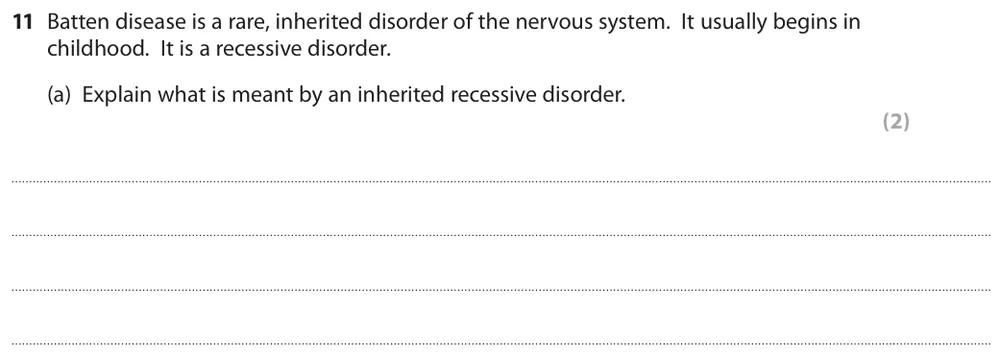
Explain what is meant by an inherited recessive disorder.
Show the mark scheme
Tap an image to open it full size.
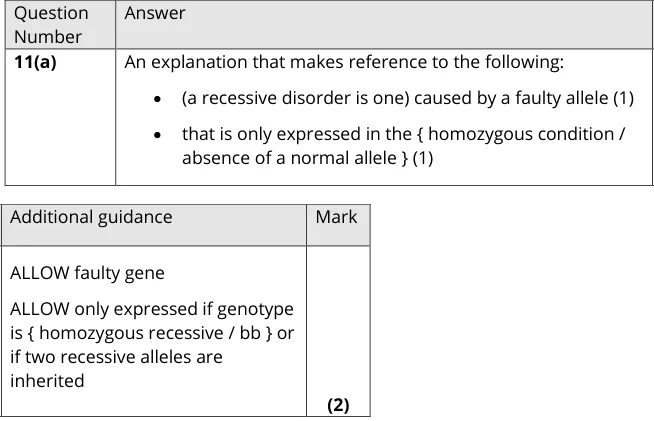
From the examiners' report: Many said the disorder is only expressed when the genotype is homozygous recessive, but some wrote 'homologous recessive'. Very few said it is caused by a faulty allele.
Question 4
AS Paper 1 · June 2018 · Q4(b)(i) · 1 mark
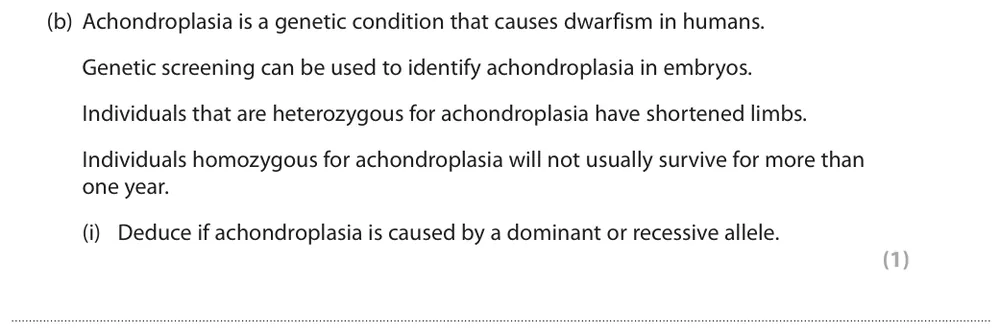
Deduce whether achondroplasia is caused by a dominant or a recessive allele.
Show the mark scheme

Tap an image to open it full size.
From the examiners' report: About a third of students said recessive. Use the information given: heterozygous people have the condition. Some wrote neither word, even though both choices were in the question.
Incomplete dominance (2.13 i)
Question 5
AS Paper 1 · June 2025 · Q3(a)(ii) · 2 marks · Easy
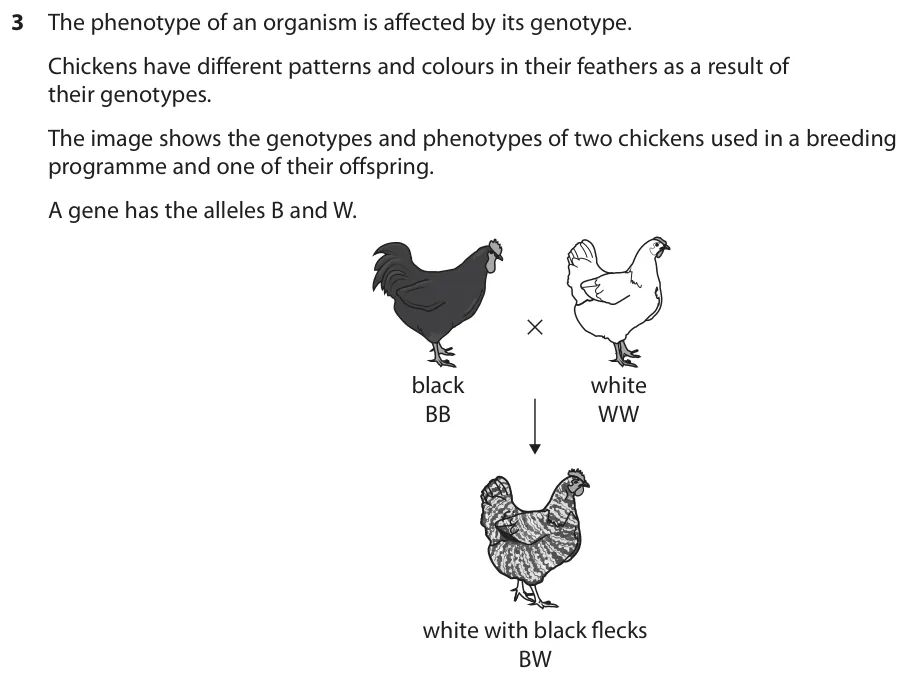
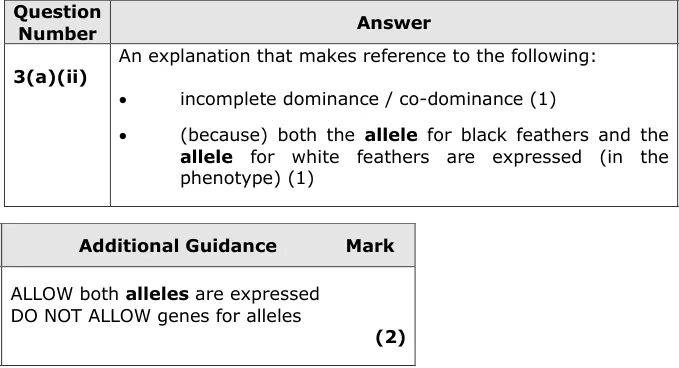
Explain the type of inheritance shown by the chicken feather colours.
Information from earlier in this question:
Show the mark scheme
Tap an image to open it full size.
From the examiners' report: Most recognised co-dominance but didn't develop it into an explanation. Add that both the allele for black feathers and the allele for white feathers are expressed.
Question 6
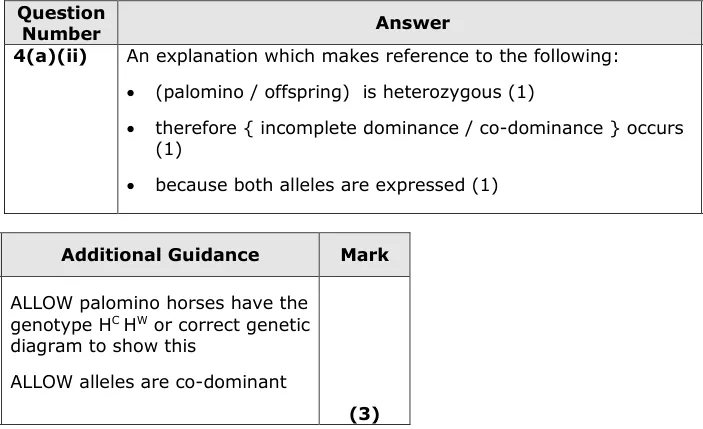
AS Paper 1 · June 2018 · Q4(a)(ii) · 3 marks
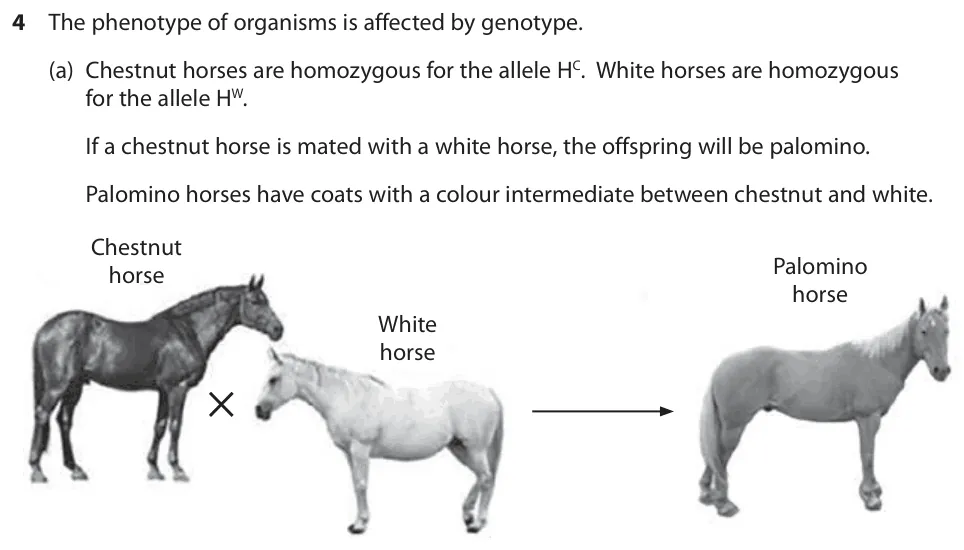
Explain why a chestnut horse crossed with a white horse gives palomino offspring.
Information from earlier in this question:
Show the mark scheme
Tap an image to open it full size.
From the examiners' report: Most said the offspring are heterozygous. The most common explanation, that both alleles are dominant, was not enough: name incomplete dominance and say both alleles are expressed.
Question 7
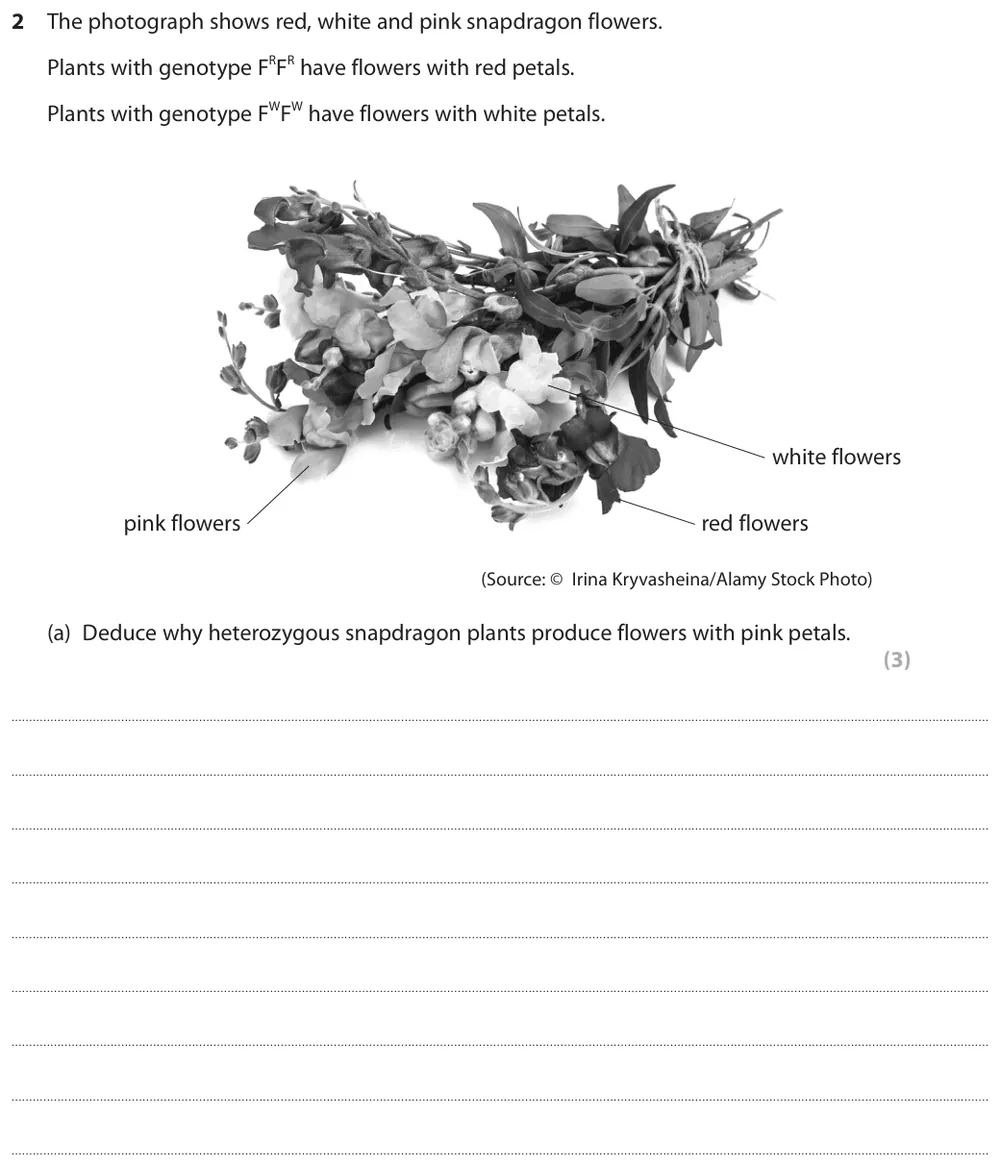
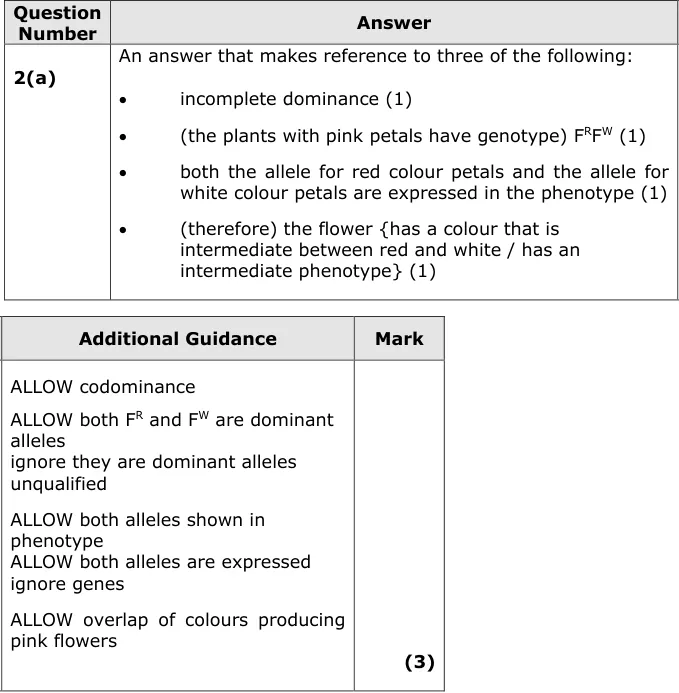
AS Paper 1 · June 2024 · Q2(a) · 3 marks
Deduce why heterozygous snapdragon plants have pink petals.
Show the mark scheme
Tap an image to open it full size.
From the examiners' report: Most deduced that both alleles are expressed in the phenotype. Some wrote about dominant and recessive alleles, which was wrong here.
Monohybrid crosses and probability (2.13 ii)
Question 8
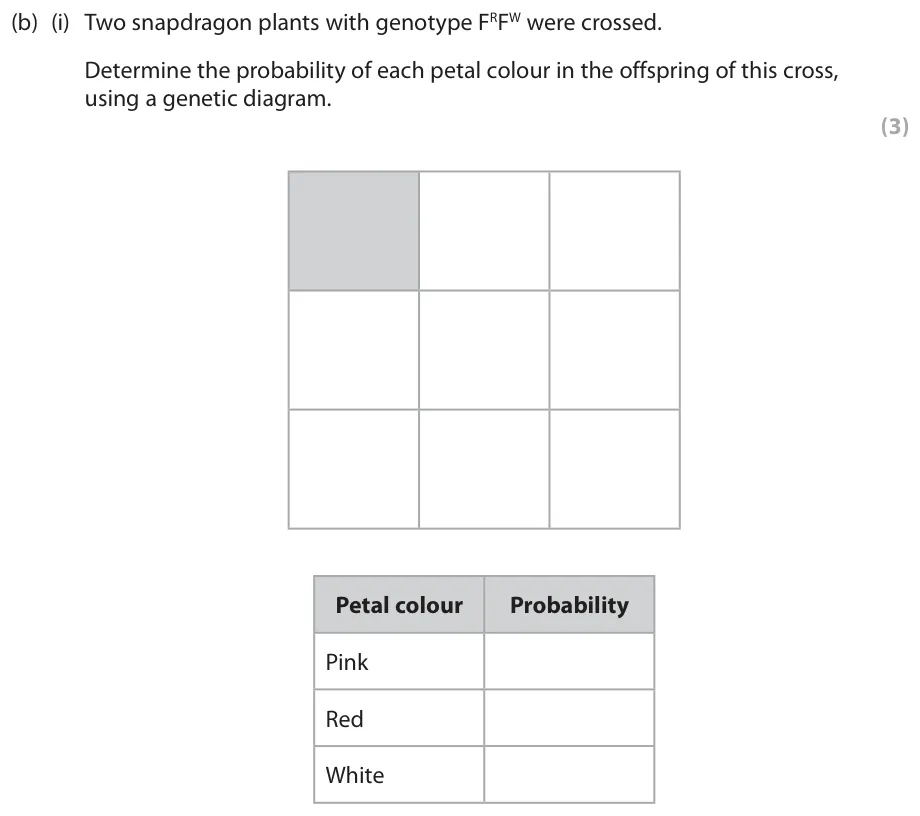
AS Paper 1 · June 2024 · Q2(b)(i) · 3 marks
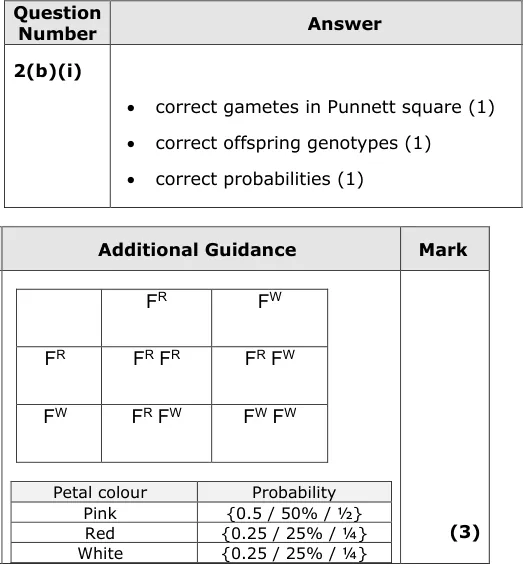
Use a genetic diagram to find the probability of each petal colour from a cross of two pink snapdragons.
Show the mark scheme
Tap an image to open it full size.
From the examiners' report: Most completed the Punnett square and gave the correct probabilities. A small number did not use the genotype given in the question.
Question 9
AS Paper 1 · June 2025 · Q3(b)(i) · 3 marks
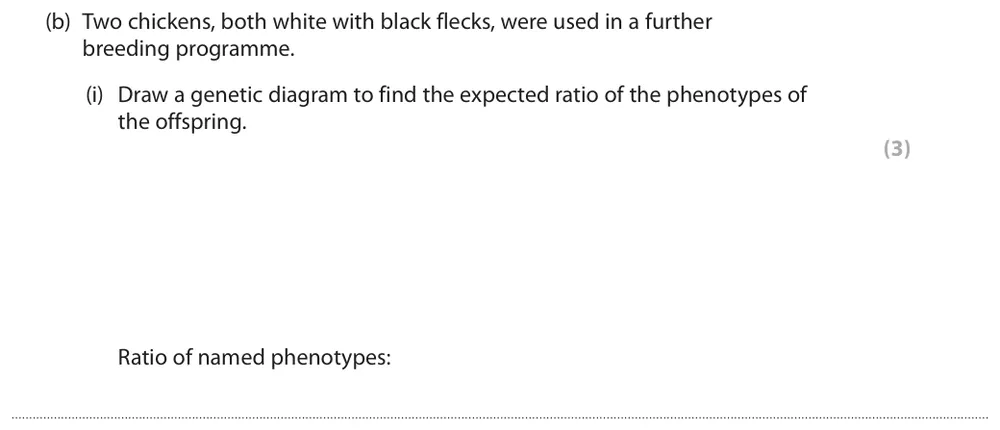
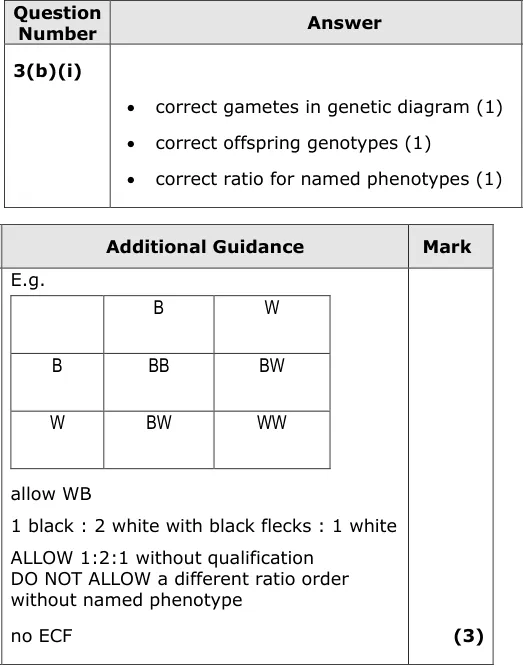
Draw a genetic diagram to find the ratio of phenotypes from two chickens that are white with black flecks.
Information from earlier in this question:
Show the mark scheme
Tap an image to open it full size.
From the examiners' report: Most drew a correct Punnett square for two marks, but many lost the third by giving a ratio without the named phenotypes.
Question 10
AS Paper 1 · June 2018 · Q4(b)(ii) · 3 marks
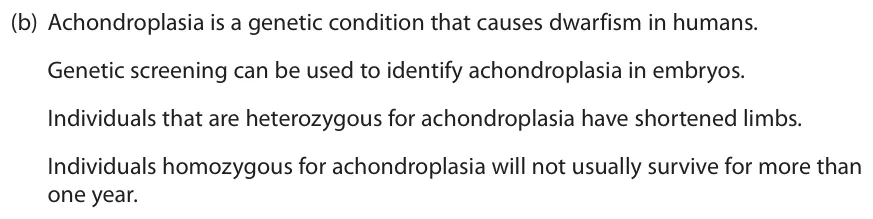
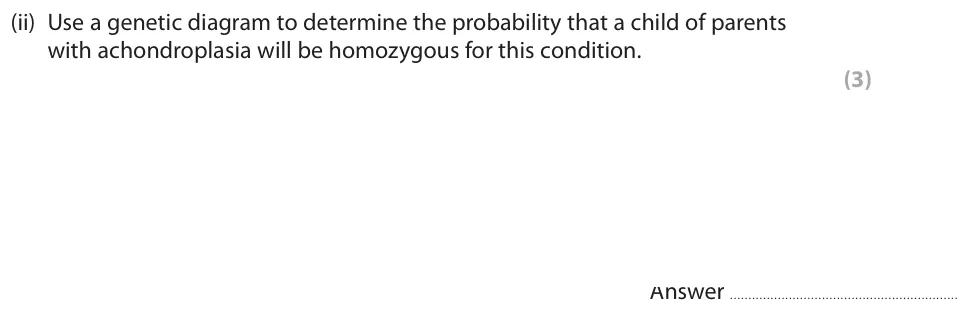
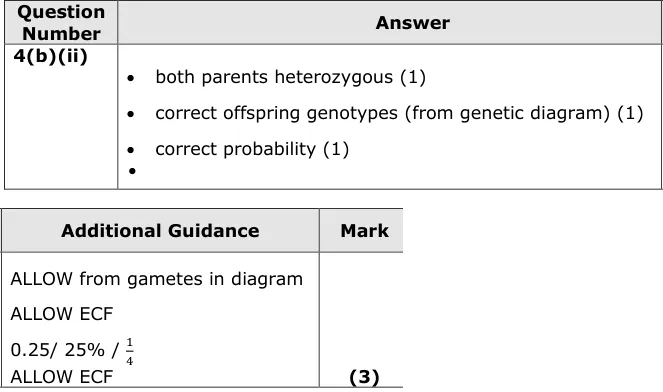
Use a genetic diagram to find the probability that a child of two parents with achondroplasia is homozygous for the condition.
Information from earlier in this question:
Show the mark scheme
Tap an image to open it full size.
From the examiners' report: A probability on its own, without a genetic diagram, could not get the first two marks. Some gave the probability of being homozygous dominant and homozygous recessive together, or of being heterozygous.
Question 11
A level Paper 1 · November 2021 · Q6(c) · 2 marks · Easy
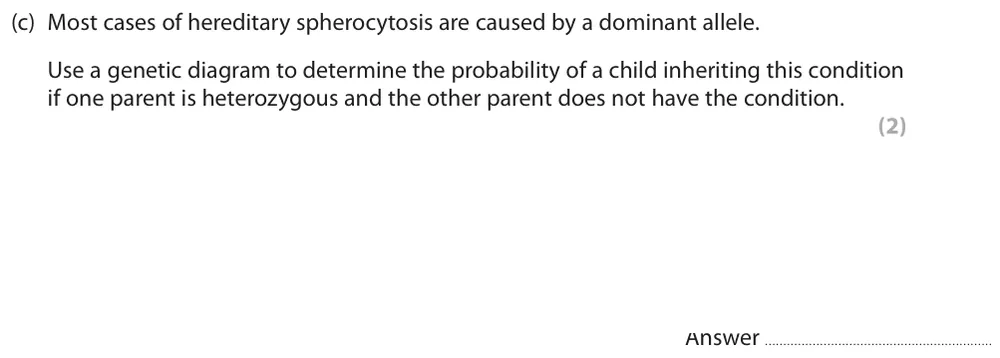
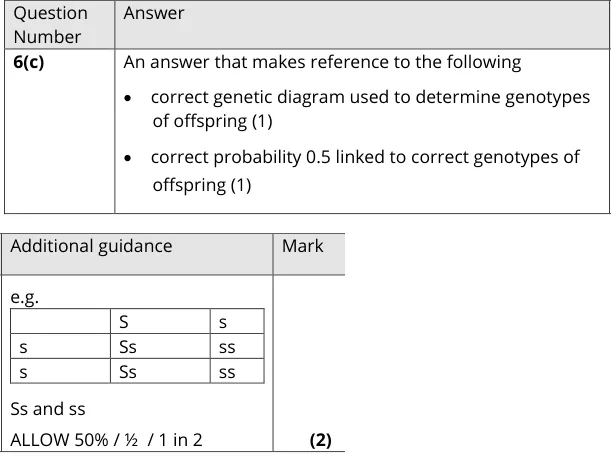
Use a genetic diagram to find the probability of a child inheriting a dominant condition from one heterozygous parent.
Show the mark scheme
Tap an image to open it full size.
From the examiners' report: Most got this right. A few assumed the answer must be 1 in 4 and tried to make the diagram fit: here it is 0.5.
Question 12
A level Paper 2 · June 2022 · Q9(a)(i) · 2 marks
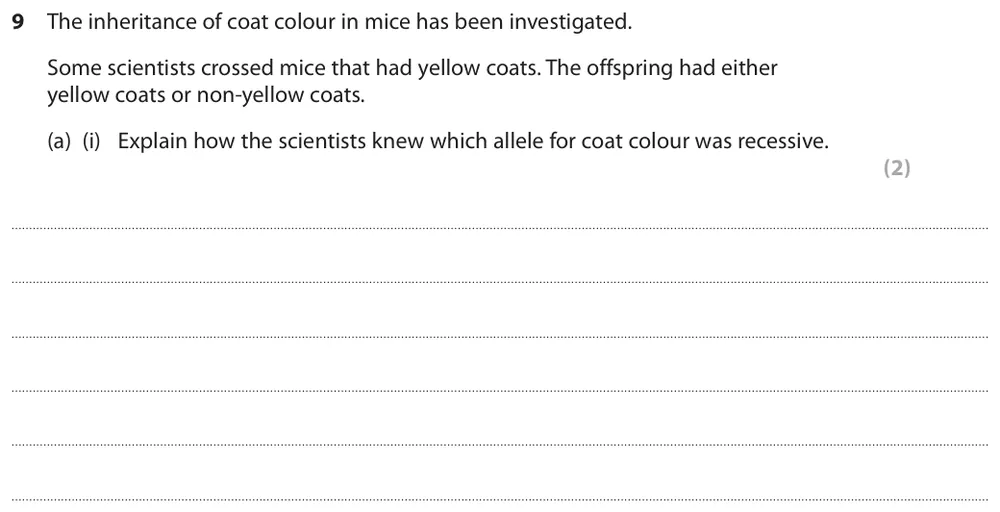
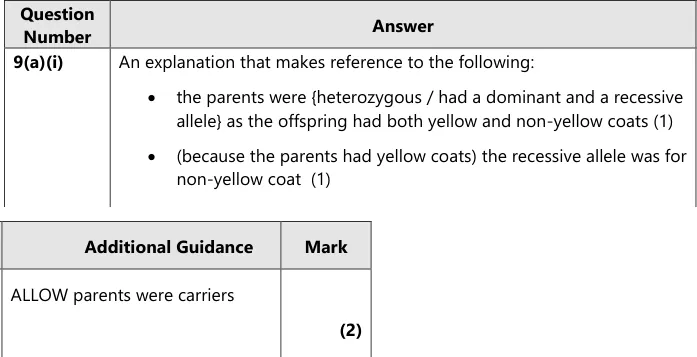
Explain how the scientists knew which coat colour allele was recessive when yellow mice produced yellow and non-yellow offspring.
Show the mark scheme
Tap an image to open it full size.
From the examiners' report: A clear answer covers both points: the yellow parents must be heterozygous because their offspring had both coat colours, so the recessive allele is the one for non-yellow coat.
Question 13
A level Paper 2 · June 2022 · Q9(a)(ii) · 2 marks
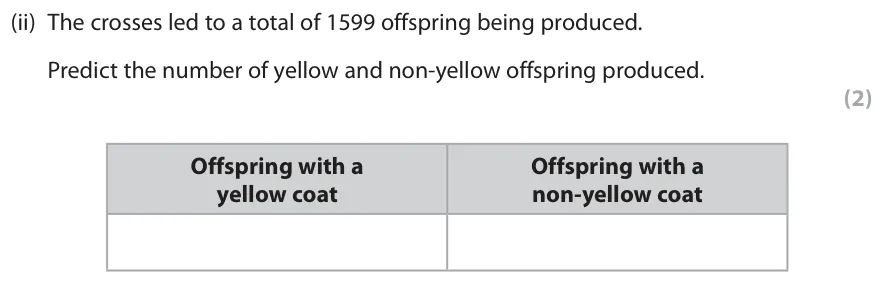
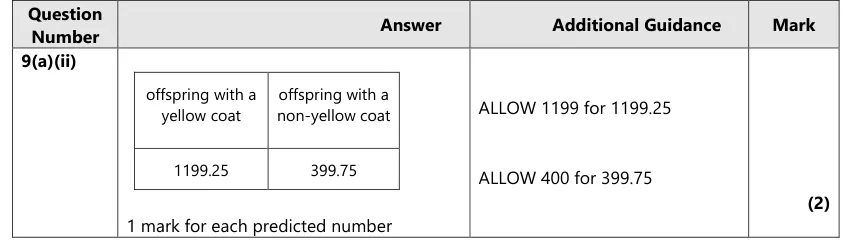
Predict the numbers of yellow and non-yellow mice from 1599 offspring of two yellow parents.
Show the mark scheme
Tap an image to open it full size.
From the examiners' report: Use a 3 : 1 ratio. Well over half got both marks; a minority wrongly used a 1 : 1 ratio.
Question 14
A level Paper 2 · June 2023 · Q7(b)(iii) · 3 marks · Hard
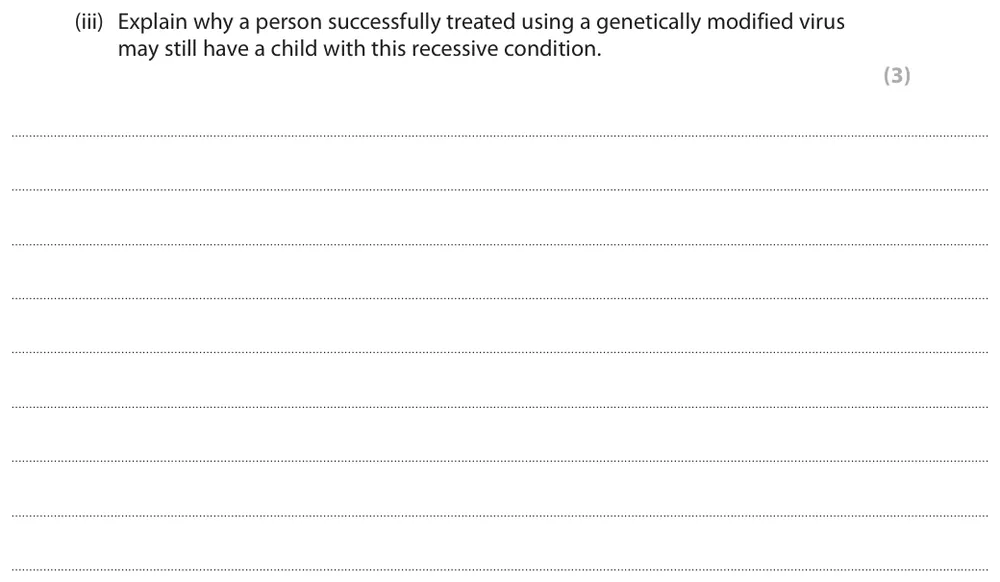
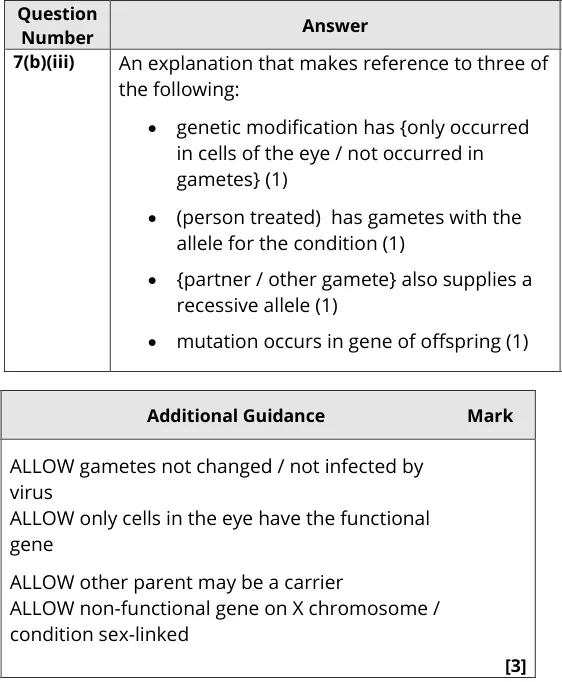
Explain why a person treated with a genetically modified virus may still have a child with the recessive condition.
Information from earlier in this question:

Show the mark scheme
Tap an image to open it full size.
From the examiners' report: Many thought modifying the eye cells changes the rest of the body, including the gametes. It doesn't: the gametes still carry the allele for the condition, and the other parent may supply a recessive allele too.
Genetic pedigree diagrams (2.13 ii)
Question 15
A level Paper 1 · June 2022 · Q5(b)(i) · 1 mark
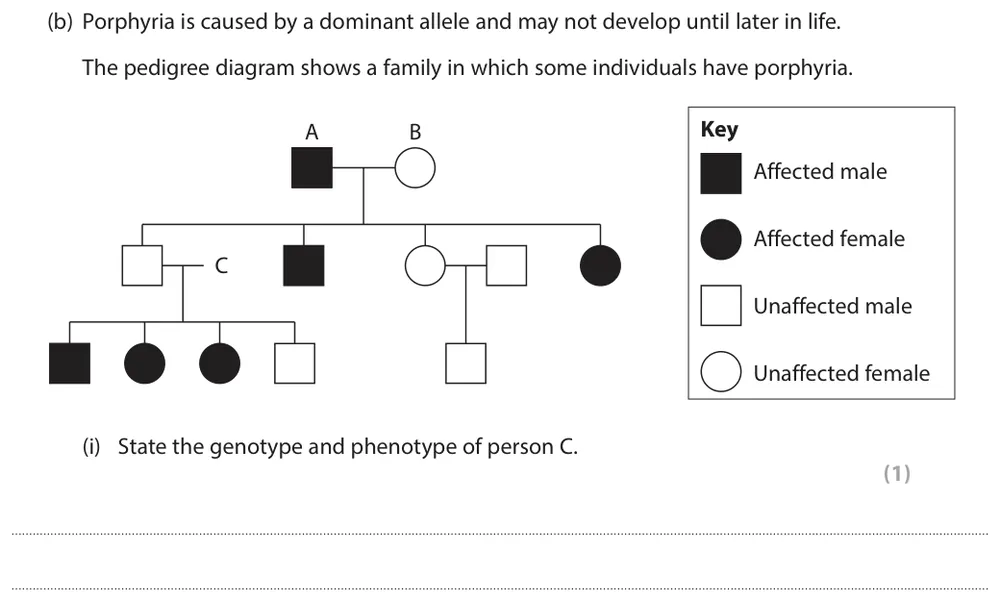
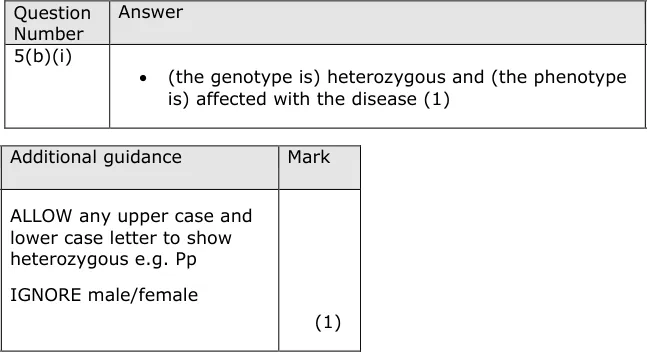
Use the pedigree to state the genotype and phenotype of person C.
Show the mark scheme
Tap an image to open it full size.
From the examiners' report: Give both the genotype and the phenotype. Some confused genotype with sex, and some gave learned answers from a different situation: work from the pedigree in front of you.
Question 16
A level Paper 2 · June 2024 · Q7(b)(ii) · 2 marks
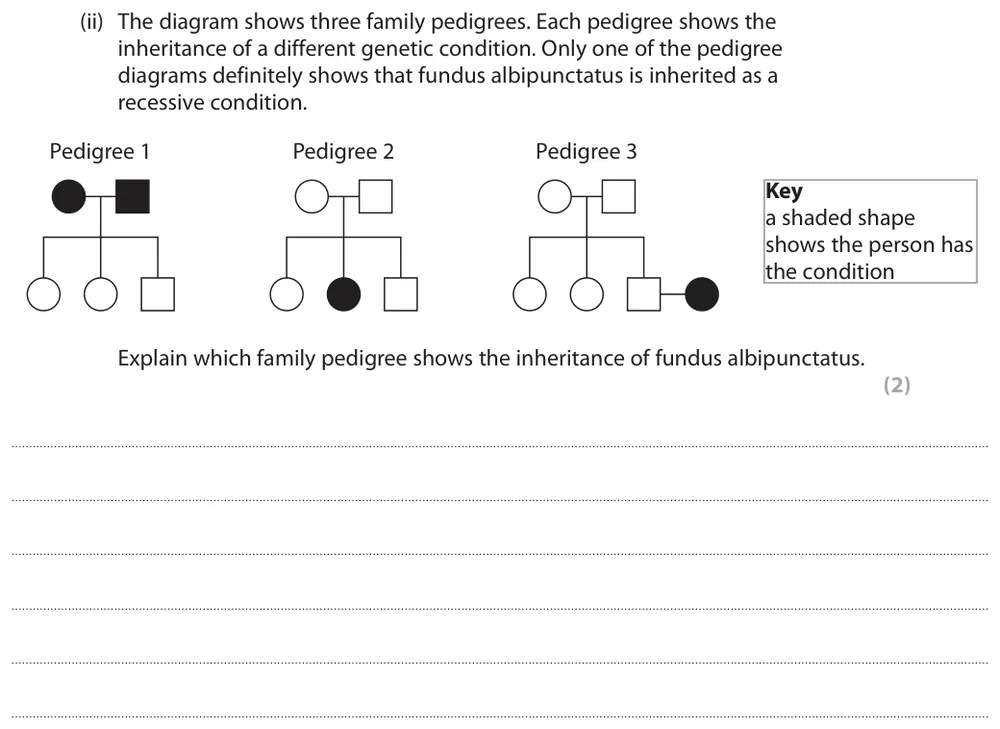
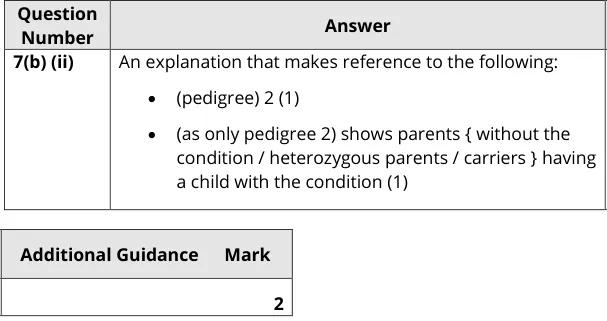
Explain which family pedigree shows that the condition is recessive.
Information from earlier in this question:

Show the mark scheme
Tap an image to open it full size.
From the examiners' report: Choose the pedigree where parents without the condition have a child with it. A common error was misreading which people in the pedigree are the offspring.
Question 17
A level Paper 3 · June 2025 · Q3(b)(i) · 1 mark
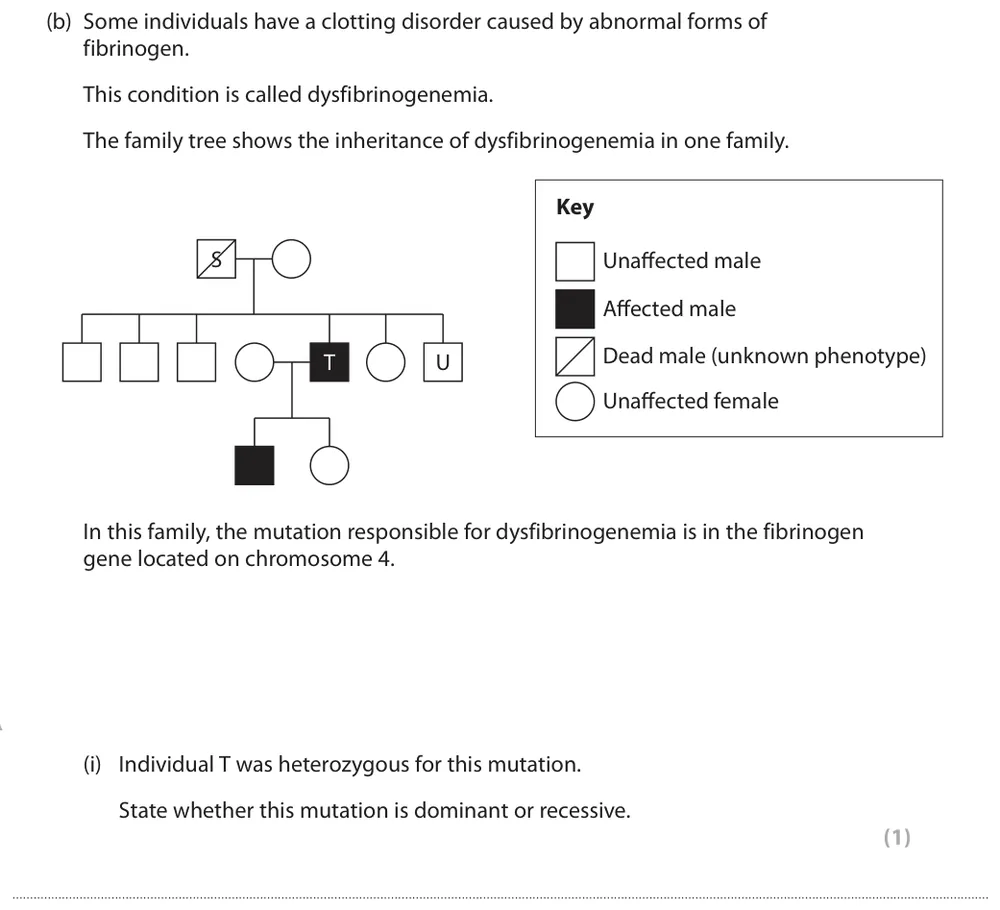
State whether the mutation in heterozygous individual T is dominant or recessive.
Show the mark scheme

Tap an image to open it full size.
From the examiners' report: Most identified the mutation as dominant. It helps to annotate the question to remind yourself that a heterozygote has two different alleles.
Question 18
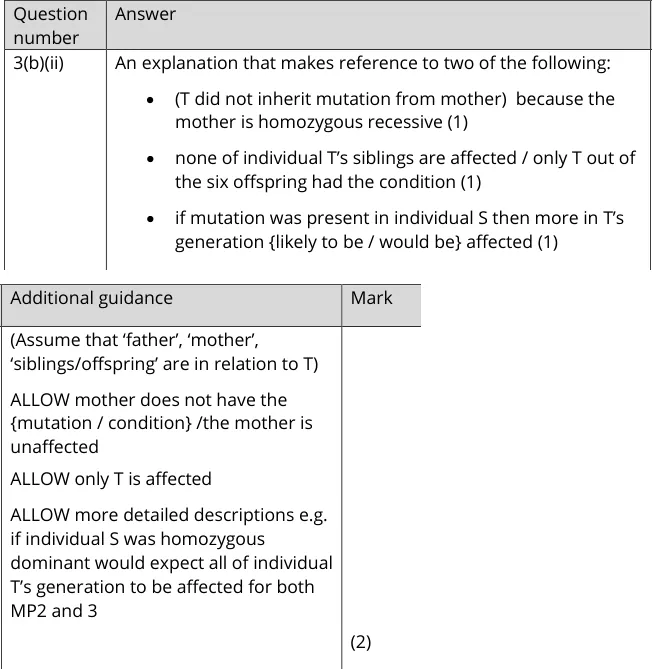
A level Paper 3 · June 2025 · Q3(b)(ii) · 2 marks · Easy
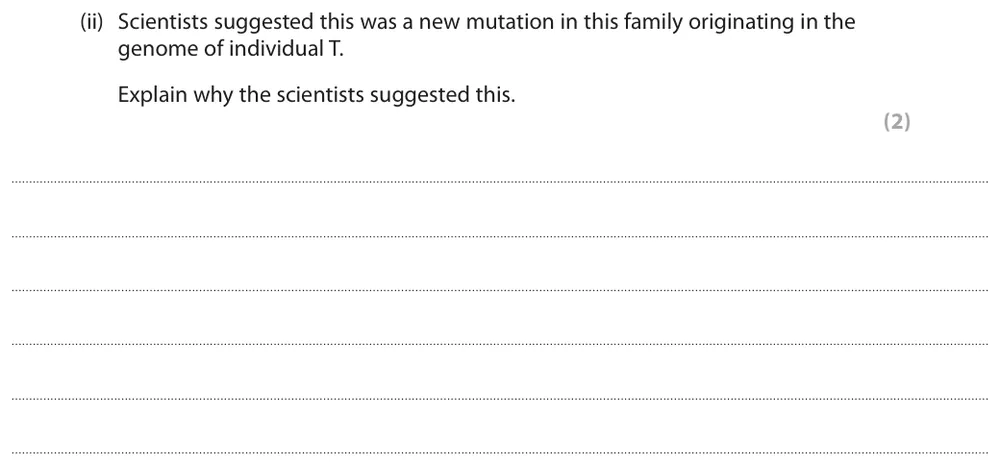
Explain why the mutation is thought to have arisen in individual T.
Show the mark scheme
Tap an image to open it full size.
From the examiners' report: Use all the information: the father's phenotype is unknown, so you can't say both parents were unaffected. Label the family tree with genotypes, for example the mother is homozygous recessive.
Question 19
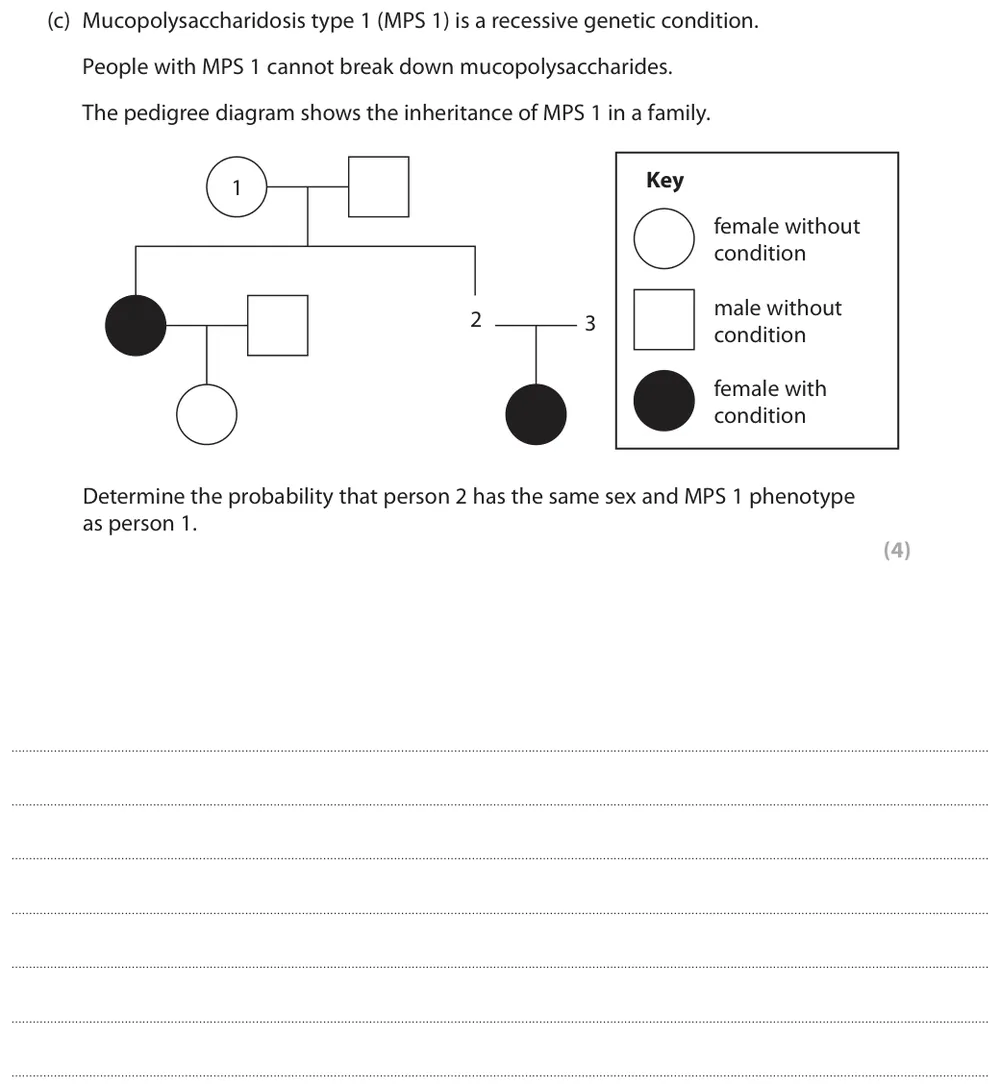
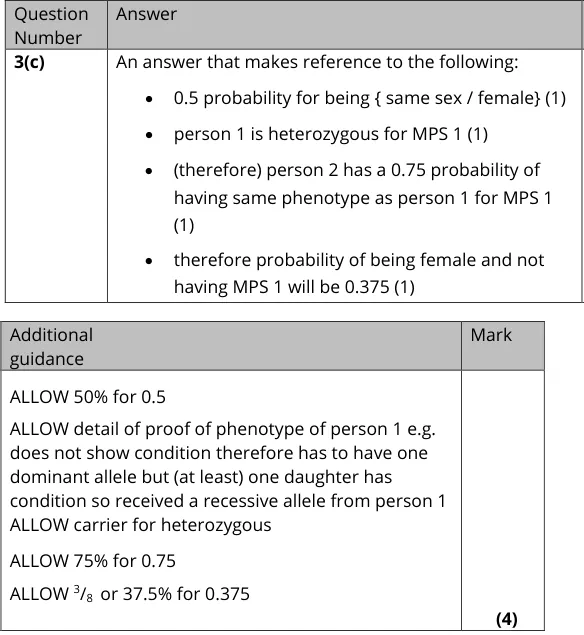
A level Paper 2 · November 2021 · Q3(c) · 4 marks
Use the pedigree to find the probability that person 2 has the same sex and MPS 1 phenotype as person 1.
Show the mark scheme
Tap an image to open it full size.
From the examiners' report: Many worked out the genotype rather than the phenotype. Person 1 must be heterozygous, so find the probability of being female (0.5) and of not having MPS 1 (0.75), and combine them.
Question 20
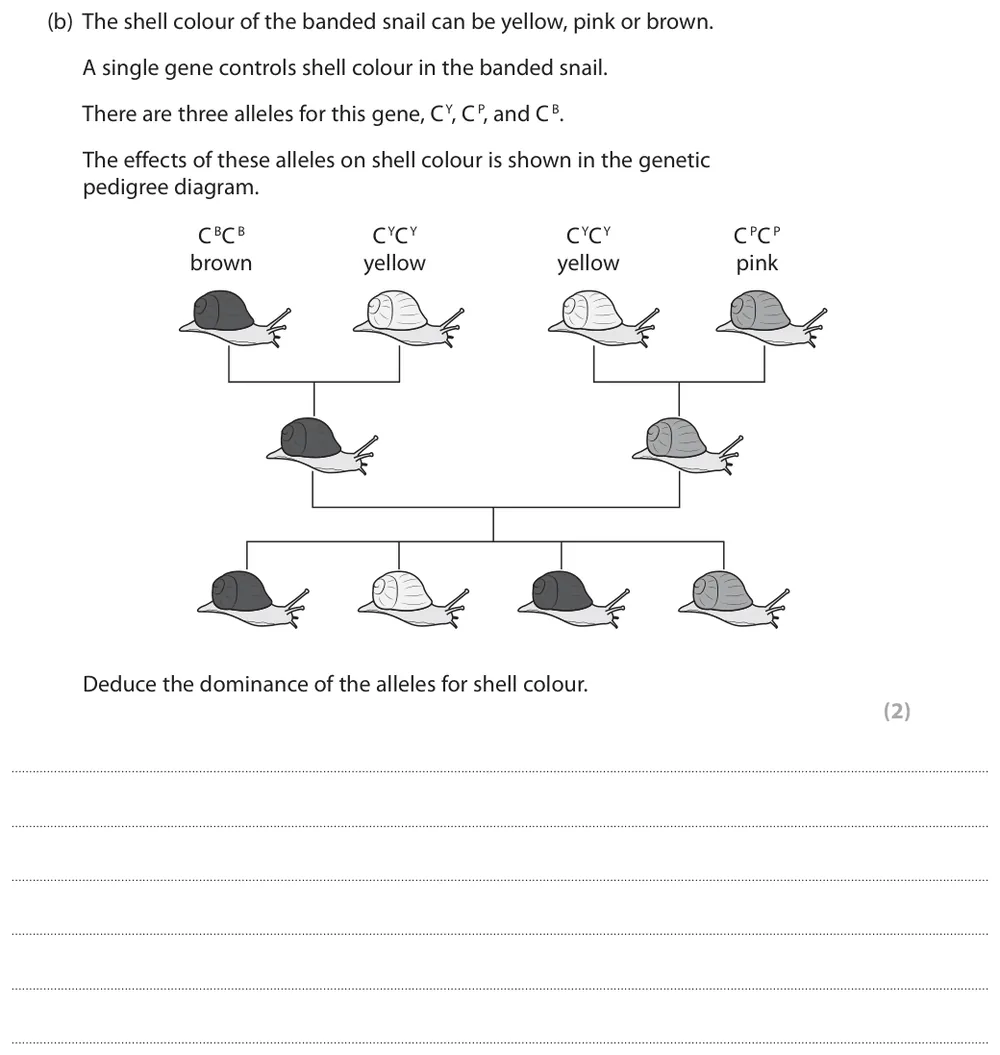
A level Paper 3 · October 2020 · Q2(b) · 2 marks
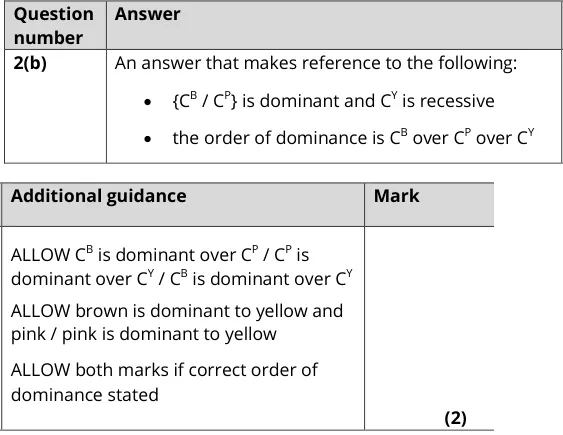
Use the pedigree of banded snails to deduce the order of dominance of three shell colour alleles.
Show the mark scheme
Tap an image to open it full size.
From the examiners' report: Many saw that CY is recessive. For the second mark compare CB and CP as well: CB is dominant to CP, which is dominant to CY.
Where students lose marks (from Pearson examiners' reports and mark schemes)
Each point below comes from the examiners' reports and mark schemes, and is followed by wording that gained marks.
A version, not a type. The most frequent reason for losing the mark was describing an allele as 'a different type of gene'.
✔ Gains credit: 'An alternative form or version of a gene.'
Genotype means alleles. Fewer students could define genotype than phenotype; the most common error was using the term 'gene' incorrectly.
✔ Gains credit: 'Genotype is the combination of alleles of an organism.'
Homozygous, not homologous. Some confused the terms and wrote 'homologous recessive'; very few said the disorder is caused by a faulty allele.
✔ Gains credit: 'A recessive disorder is caused by a faulty allele that is only expressed if the genotype is homozygous recessive.'
Both dominant is not incomplete dominance. The most common explanation was that both alleles were dominant, which was not enough.
✔ Gains credit: 'The palomino offspring are heterozygous, so incomplete dominance occurs because both alleles are expressed.'
Answer the exact probability asked. Some gave the probability of being homozygous dominant and homozygous recessive together, or of being heterozygous.
✔ Gains credit: 'Both parents are heterozygous; the probability of a child being homozygous for achondroplasia is 0.25.'
Put names on your ratio. Many gave the ratio of phenotypes without naming the phenotypes.
✔ Gains credit: '1 black : 2 white with black flecks : 1 white.'
Not every cross gives 1 in 4. A few assumed the probability would be 1 in 4 and tried to make the data fit.
✔ Gains credit: 'Offspring Ss and ss, so the probability of inheriting the condition is 0.5.'
Gene therapy doesn't reach the gametes. Many thought modifying eye cells changed the rest of the body, including the gametes.
✔ Gains credit: 'Genetic modification has only occurred in cells of the eye, so the person has gametes with the allele for the condition.'
Download the questions
Download the PDF pack (20 questions, mark schemes at the end)
Keep practising
- Gas Exchange, Membranes and Transport (Topic 2): Edexcel SNAB exam questions by topic
- DNA, RNA and Protein Synthesis (Topic 2): Edexcel SNAB exam questions by topic
- Proteins and Enzymes (Topic 2): Edexcel SNAB exam questions by topic
- Cystic Fibrosis, Mutation and Genetic Screening (Topic 2): Edexcel SNAB exam questions by topic
- Topic 2 multiple-choice quiz (75 questions, marked as you tap)
- Edexcel SNAB A level Biology resources hub (every topic, practical and paper)
- Vitamin C and Membrane Permeability (Core Practicals 2 and 3): Edexcel SNAB A Level Biology Exam Questions
- Enzyme Concentration and Initial Rates (Core Practical 4): Edexcel SNAB A Level Biology Exam Questions
- Extended Response Questions (Topics 1 and 2): Edexcel SNAB A Level Biology Exam Questions
- Edexcel SNAB A level Biology past papers, mark schemes and examiners' reports
- Edexcel SNAB A level Biology grade boundaries
- Message Tom on WhatsApp about one-to-one Edexcel SNAB tutoring or an Edexcel group class
Questions, mark schemes and examiners' report extracts © Pearson Education Ltd.