

Extended response questions are the asterisked 6- and 9-mark questions on Edexcel SNAB papers. They are not marked point by point. The mark scheme lists indicative content, which is not prescriptive, and places each answer in a level; to reach the top level an answer must show 'a well-developed and sustained line of scientific reasoning which is clear and logically structured'. Most also ask you to analyse data or information given in the question. This page has twelve of them from Topic 1 (Lifestyle, Health and Risk) and Topic 2 (Genes and Health), including two 9-mark questions from Paper 3. Questions marked AS are from the AS papers (8BN0); the rest are from the A level papers (9BN0).
The examiners' reports give the same warnings again and again. Answer the question set: analysing data without giving the advice asked for, writing about the wrong body system, or describing how the lungs are adapted instead of using the data all scored little. Use every piece of information you are given, and do something with the numbers rather than copying them out. Explain, don't just describe. Where the command word is assess, evaluate or discuss, finish with a judgement or conclusion.
Studying Edexcel SNAB and want more help? If you'd like to arrange one-to-one Edexcel tutoring, or to register your interest in an Edexcel group class, message Tom on WhatsApp using the link at the bottom of this page.
What you need first
Each question on this page assumes you're secure on these ideas. If any of them feels shaky, look it up before you start.
- Fick's law: the rate of diffusion is proportional to surface area × concentration difference ÷ diffusion distance.
- The risk factors for cardiovascular disease, and how antihypertensives, statins and anticoagulants reduce the risk.
- Protein structure from primary to tertiary, and how the CFTR channel moves chloride ions out of epithelial cells.
- How a gene is transcribed into mRNA and then translated into a polypeptide.
Key terms
These words come up in the questions and mark schemes. Examiners expect you to use them exactly.
- Indicative content: the points listed in a levels-based mark scheme; it is not prescriptive and you are not expected to include all of it.
- Level: a band of marks (1–2, 3–4, 5–6, or 1–3, 4–6, 7–9) awarded for the overall quality and linkage of the answer.
- Atherosclerosis: the build-up of fatty deposits in an artery wall, narrowing the lumen and raising the risk of a blockage.
- LDL and HDL: low-density lipoproteins deposit cholesterol in artery walls; high-density lipoproteins carry cholesterol to the liver.
- Fick's law: rate of diffusion ∝ surface area × concentration difference ÷ diffusion distance.
- CFTR protein: the chloride ion channel in epithelial cell membranes that is faulty in cystic fibrosis.
- R group: the side chain of an amino acid; its properties decide how the polypeptide folds and where the protein can be.
- Intron: a non-coding section of a gene, removed from pre-mRNA before translation.
What these questions cover
The questions test these statements of the Pearson Edexcel A level Biology A (Salters-Nuffield) specification (9BN0).
- 1.8 Be able to analyse and interpret quantitative data on illness and mortality rates to determine health risks, including distinguishing between correlation and causation an
- 1.9 Be able to evaluate the design of studies used to determine health risk factors, including sample selection and sample size used to collect data that is both valid and re
- 1.12ii Be able to relate the structures of monosaccharides, disaccharides and polysaccharides to their roles in providing and storing energy (β-glucose and cellulose are not req
- 1.15i Be able to analyse and interpret data on the possible significance for health of blood cholesterol levels and levels of high-density lipoproteins (HDLs) and low-density l
- 1.16 Understand how people use scientific knowledge about the effects of diet, including obesity indicators, body mass index and waist-to-hip ratio, exercise and smoking to re
- 1.18 Know the benefits and risks of treatments for cardiovascular disease (CVD) (antihypertensives, statins, anticoagulants and platelet inhibitors).
- 2.1ii Understand how the rate of diffusion is dependent on these properties and can be calculated using Fick’s Law of Diffusion.
- 2.5i Know the basic structure of mononucleotides (deoxyribose or ribose linked to a phosphate and a base, including thymine, uracil, cytosine, adenine or guanine) and the stru
- 2.9iii Understand the significance of a protein’s primary structure in determining its three-dimensional structure and properties (globular and fibrous proteins and the types of
- 2.10i Understand the mechanism of action and the specificity of enzymes in terms of their three-dimensional structure.
- 2.14 Understand how the expression of a gene mutation in people with cystic fibrosis impairs the functioning of the gaseous exchange, digestive and reproductive systems.
- 2.15i Understand the uses of genetic screening, including the identification of carriers, pre-implantation genetic diagnosis (PGD) and prenatal testing, including amniocentesis
How to use this page
Write your answer on paper before you open the mark scheme. Allow about 1.2 minutes per mark: the 12 questions are worth 78 marks, so about 94 minutes in total. Then mark your answer strictly against the mark scheme and read the examiners' tip underneath it. If you'd rather print the questions, download the PDF pack.
Topic 1: Lifestyle, Health and Risk
Question 1
AS Paper 1 · June 2019 · Q8(d) · 6 marks
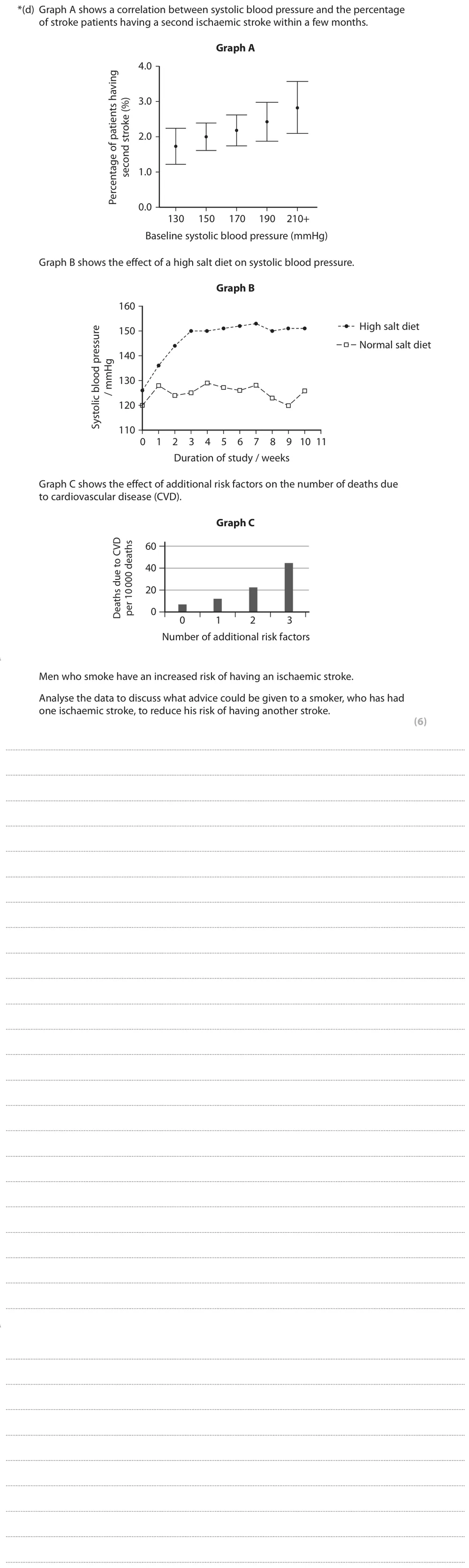
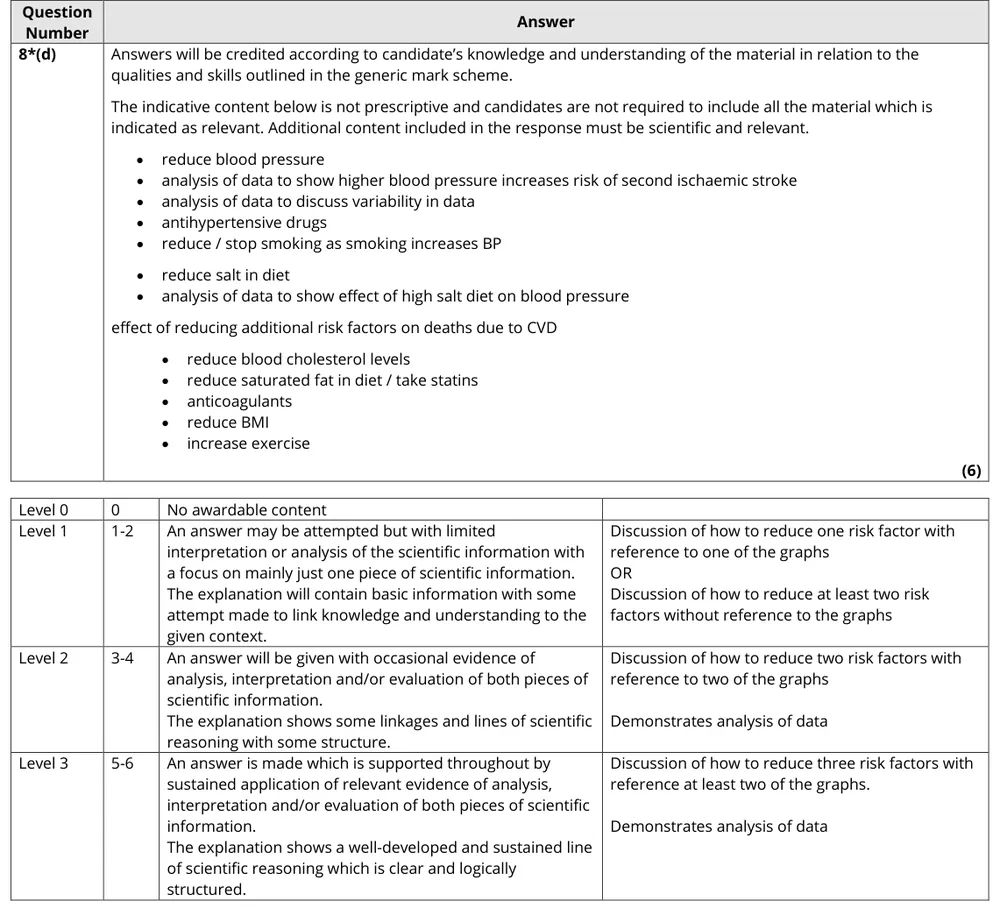
Analyse three graphs to discuss what advice could be given to a smoker who has had one ischaemic stroke.
Show the mark scheme
Tap an image to open it full size.
From the examiners' report: Give advice and support it with the data: some answers only analysed the graphs and gave no advice, which did not answer the question. The common advice was stopping smoking and cutting salt to lower blood pressure, reducing cholesterol or saturated fat, and exercising more. Level 3 needed advice related to the analysis of all three graphs.
Question 2
AS Paper 1 · June 2022 · Q8(b) · 6 marks
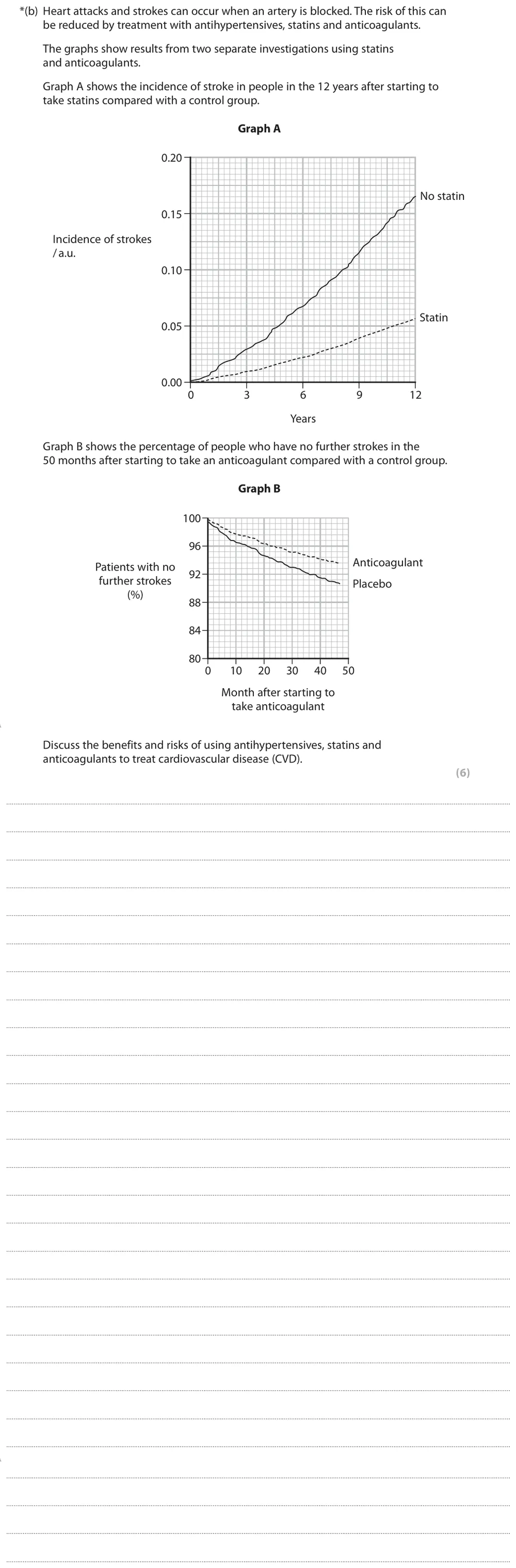
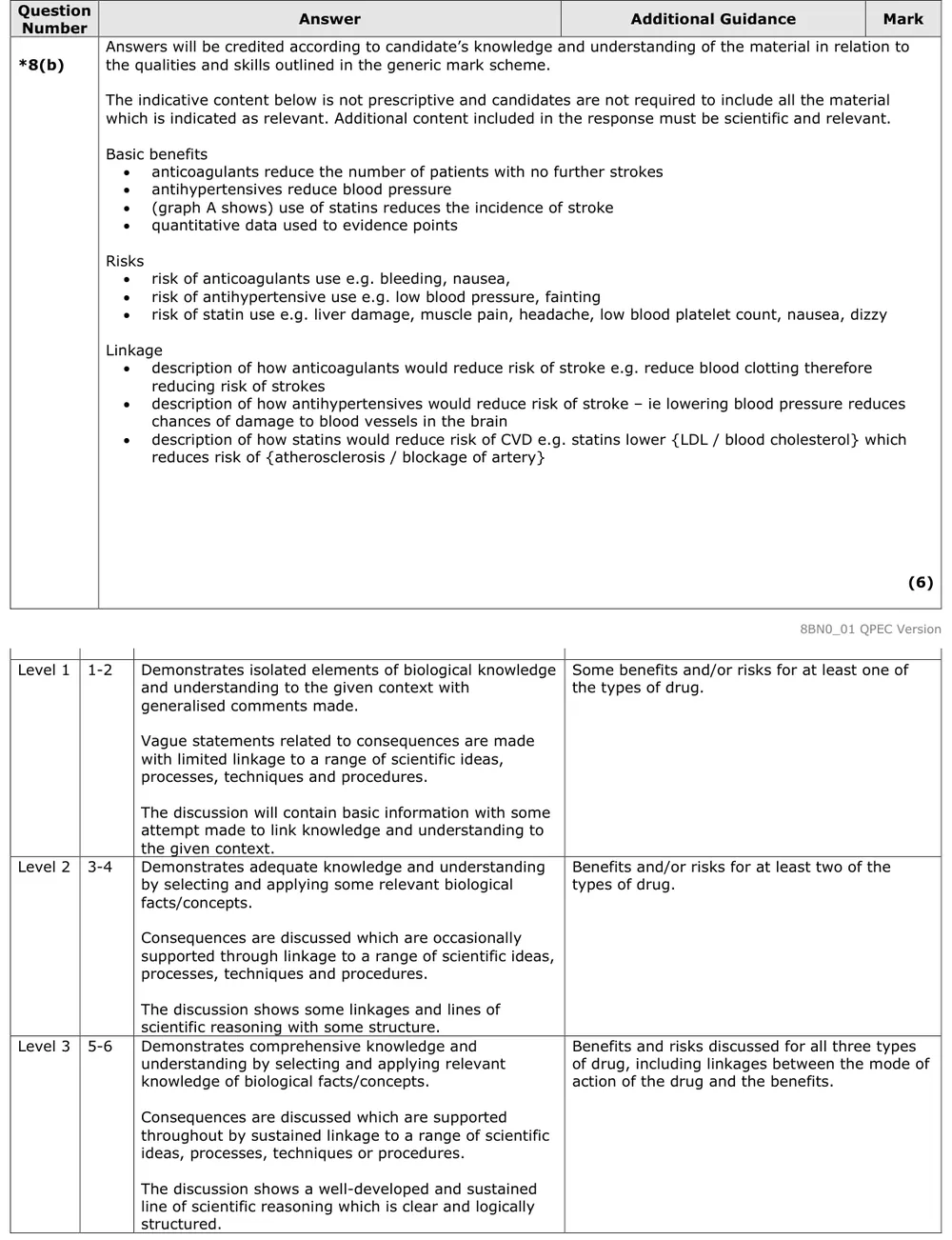
Discuss the benefits and risks of antihypertensives, statins and anticoagulants in treating CVD, using two graphs.
Show the mark scheme
Tap an image to open it full size.
From the examiners' report: Read the axis labels: some read Graph B as showing the placebo worked better than the anticoagulant. Answers giving only benefits were held at the lower end of level 2, and leaving out antihypertensives kept others out of level 3. Top answers covered benefits and risks of all three drugs and linked each drug's mode of action to its benefit.
Question 3
A level Paper 2 · June 2018 · Q6(b)(ii) · 6 marks
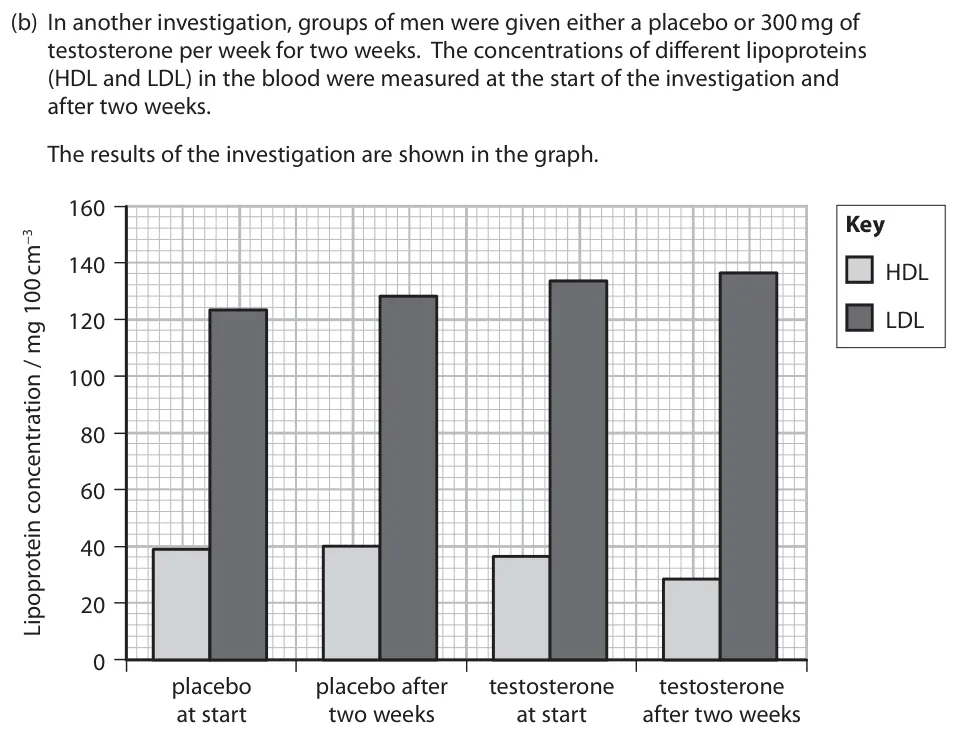
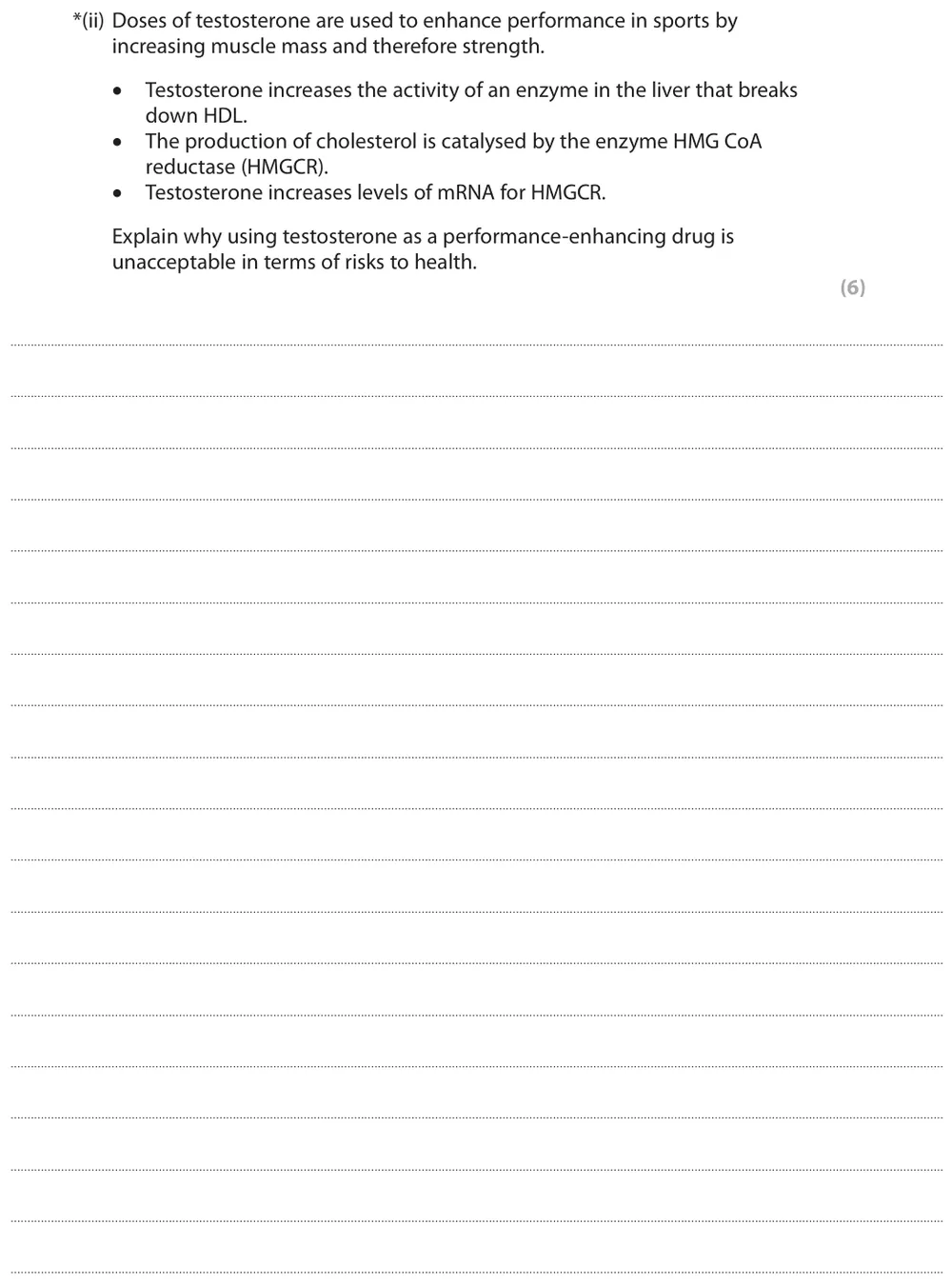
Use three pieces of information to explain why using testosterone as a performance-enhancing drug is unacceptable in terms of risks to health.
Information from earlier in this question:
Show the mark scheme
Tap an image to open it full size.
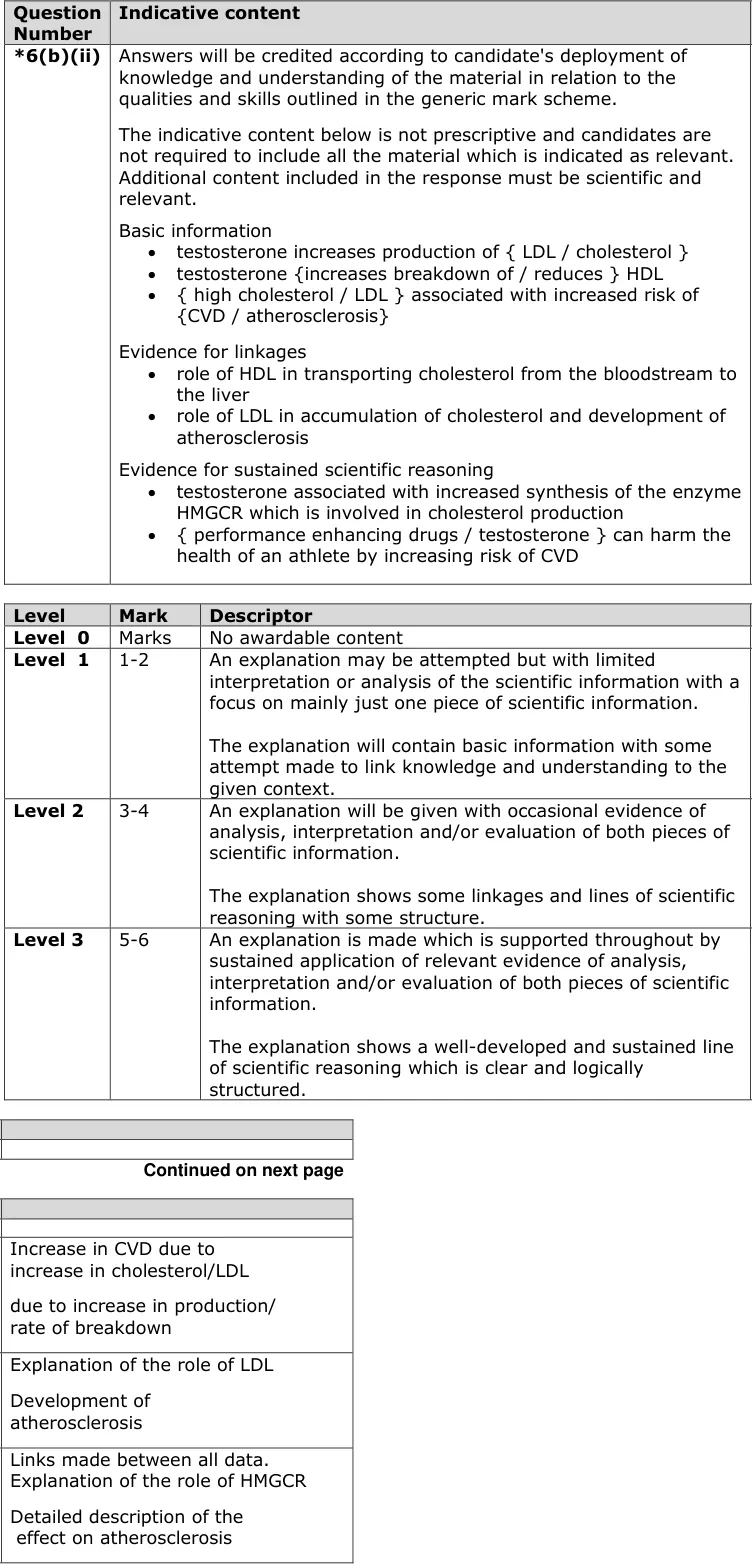
From the examiners' report: Use every piece of information: answers that developed only one in detail were held at a low level 2 at best. Level 3 answers linked the loss of HDL (which removes cholesterol to the liver), the rise in LDL and the role of HMGCR to atherosclerosis and CVD. Several covered all the content but never said the use was unacceptable, so missed full marks.
Question 4
A level Paper 2 · June 2023 · Q10(b)(ii) · 6 marks
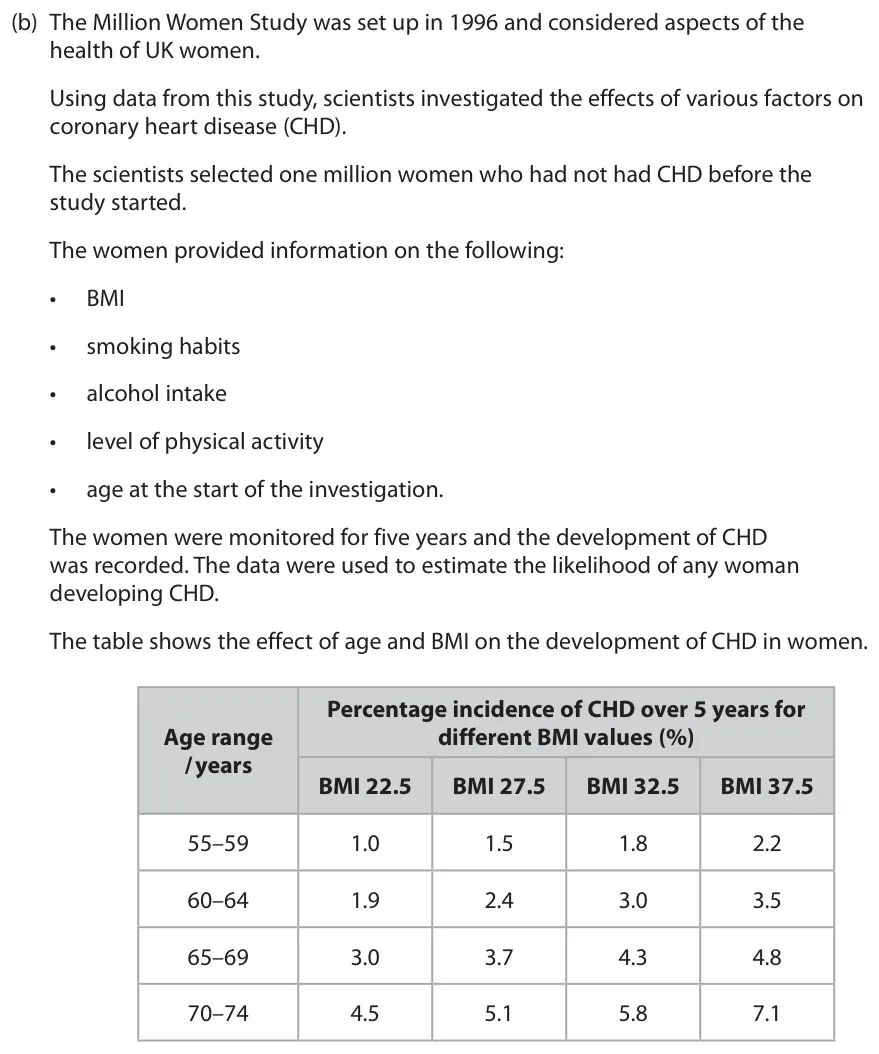
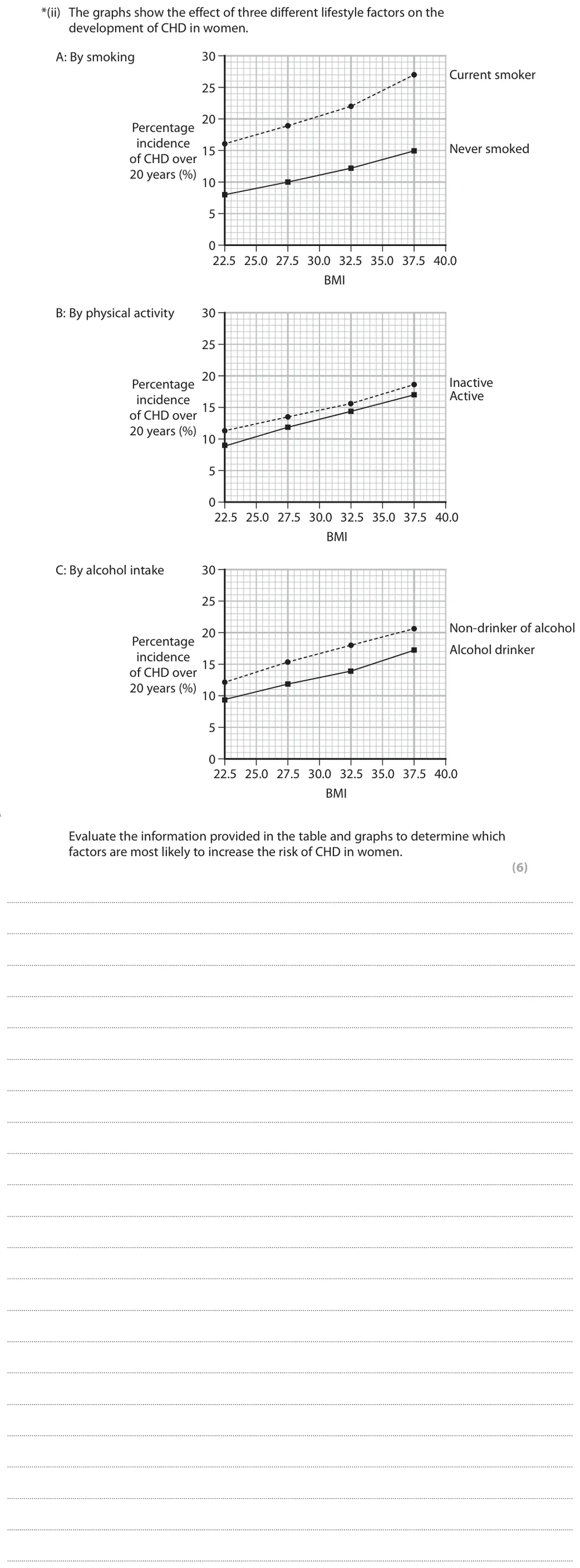
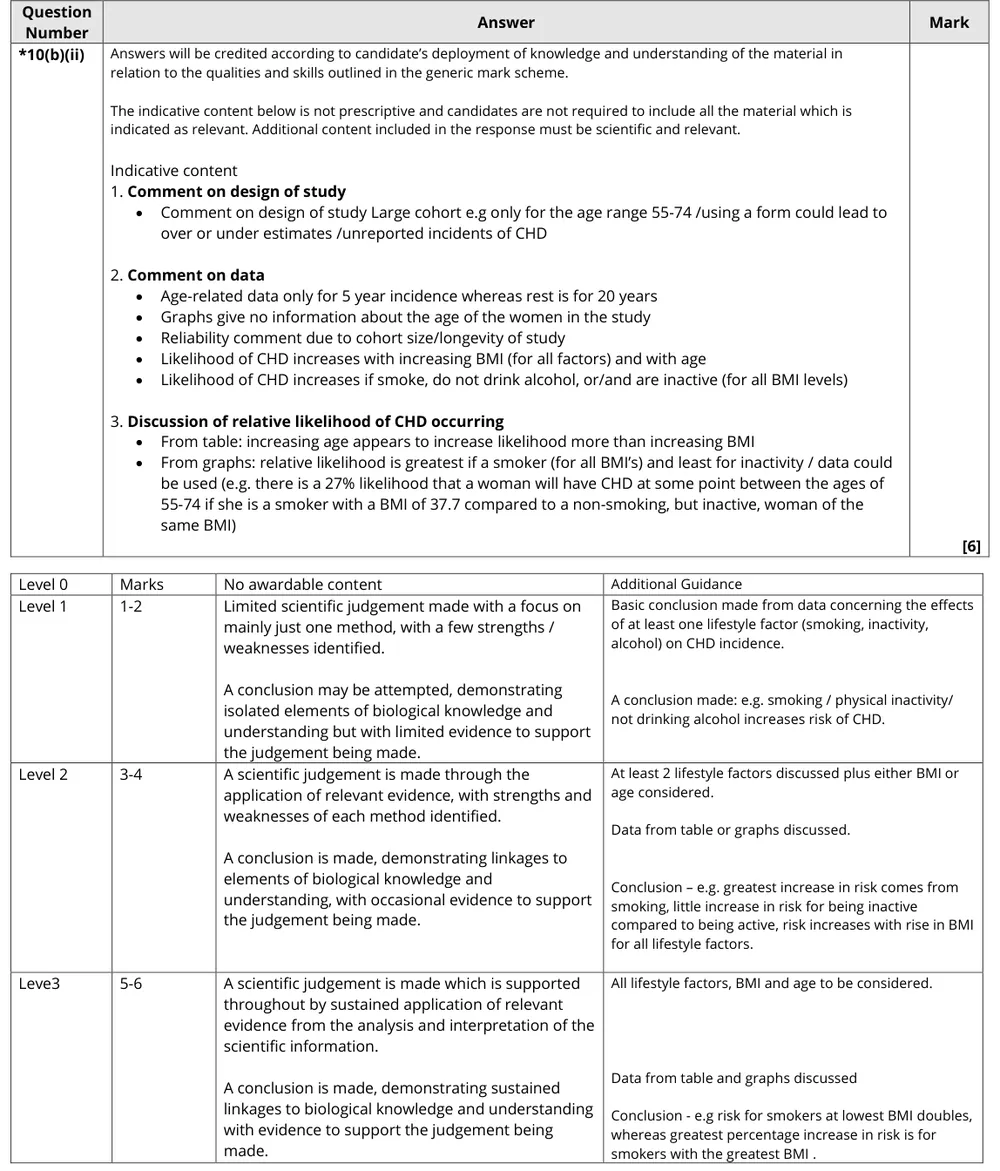
Evaluate a table and three graphs to decide which factors are most likely to increase the risk of CHD in women.
Information from earlier in this question:
Show the mark scheme
Tap an image to open it full size.
From the examiners' report: Many analysed the two lines on each graph well, but fewer also used the age and BMI data from the table. A level 3 answer evaluated all three lifestyle factors, BMI and age, manipulated the numbers and gave a detailed conclusion.
Question 5
A level Paper 2 · October 2020 · Q9(b)(iii) · 6 marks
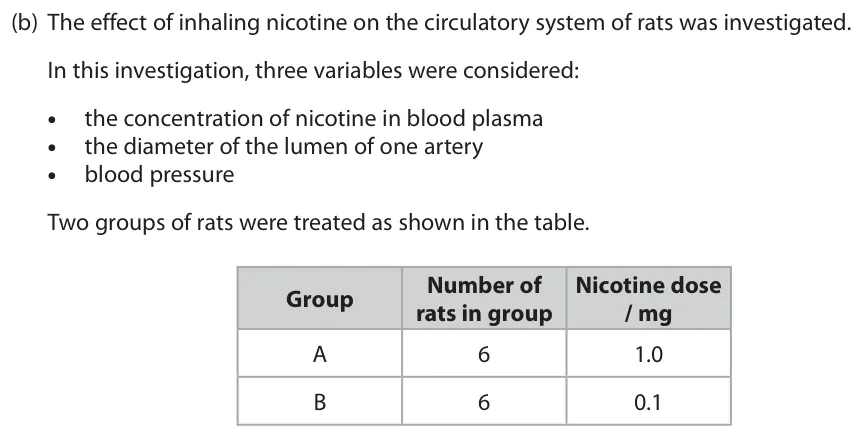
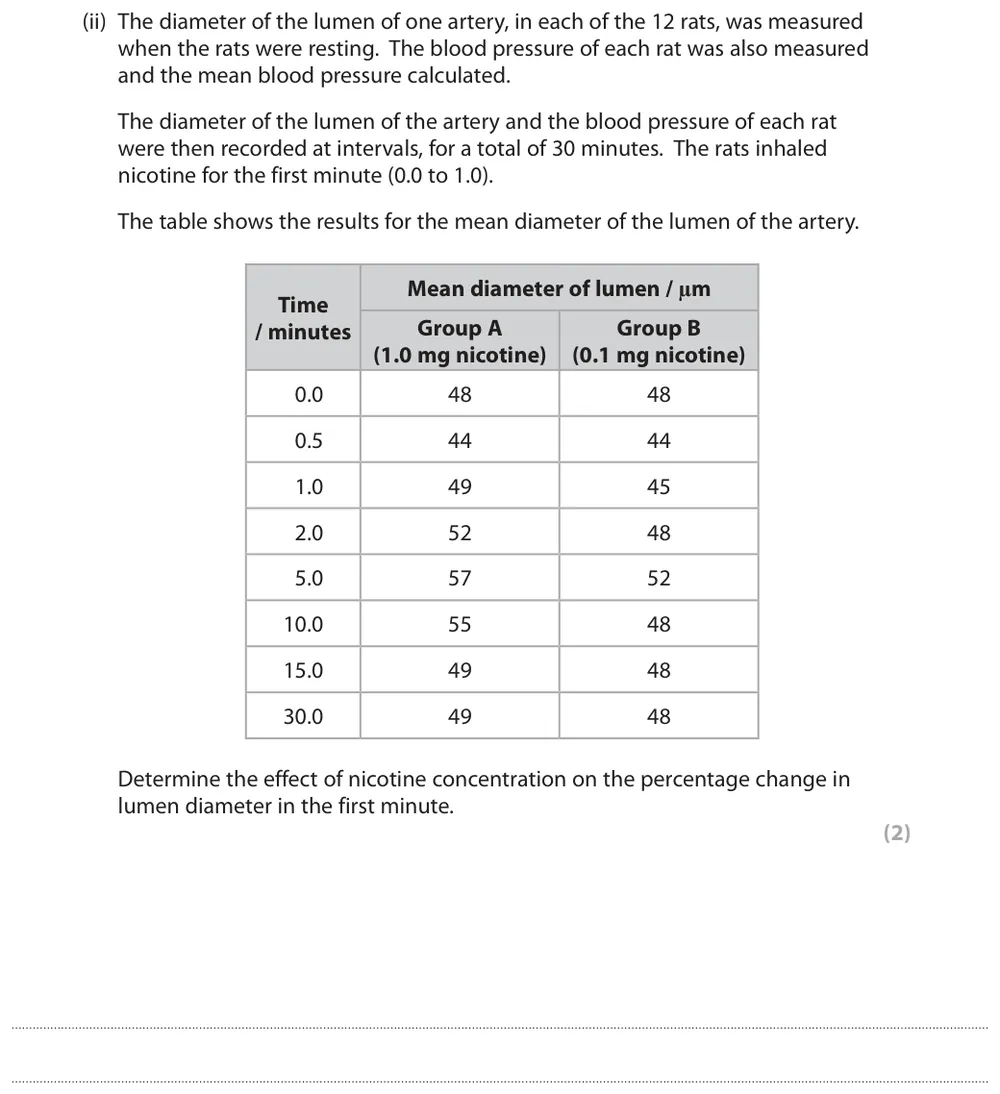
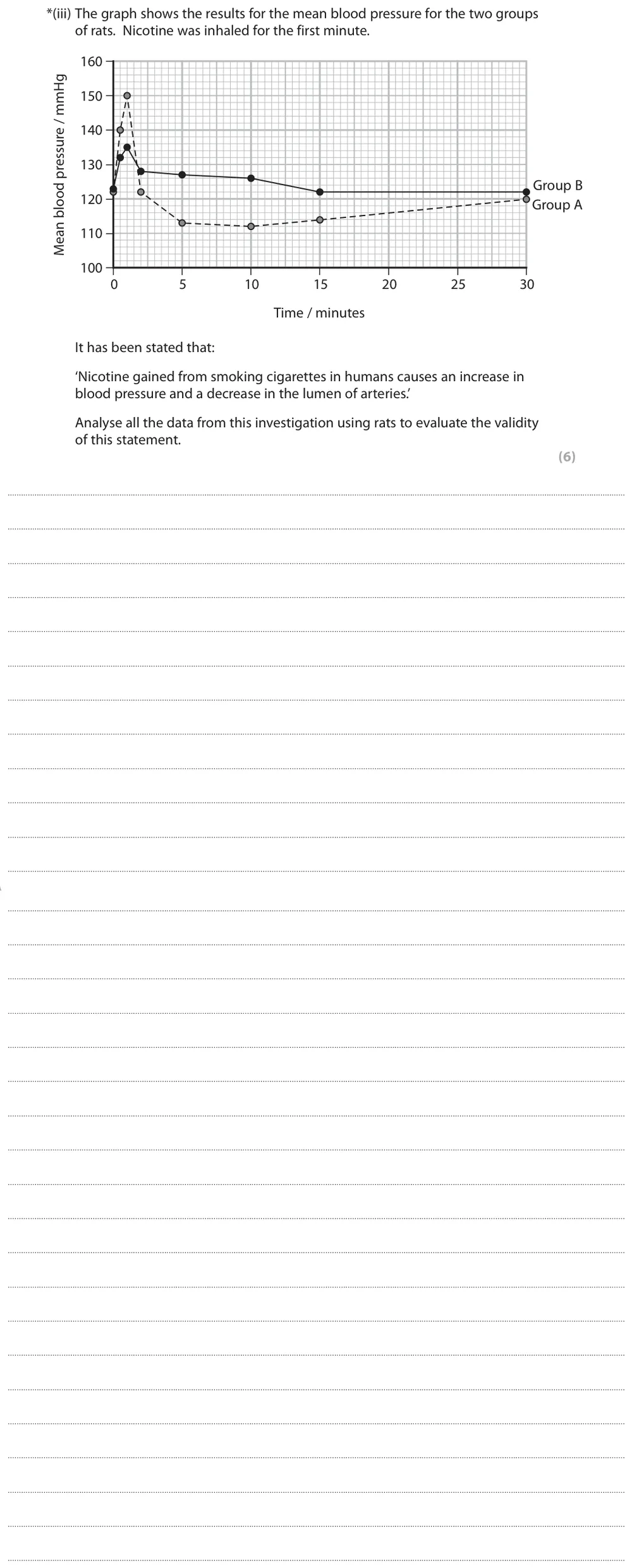
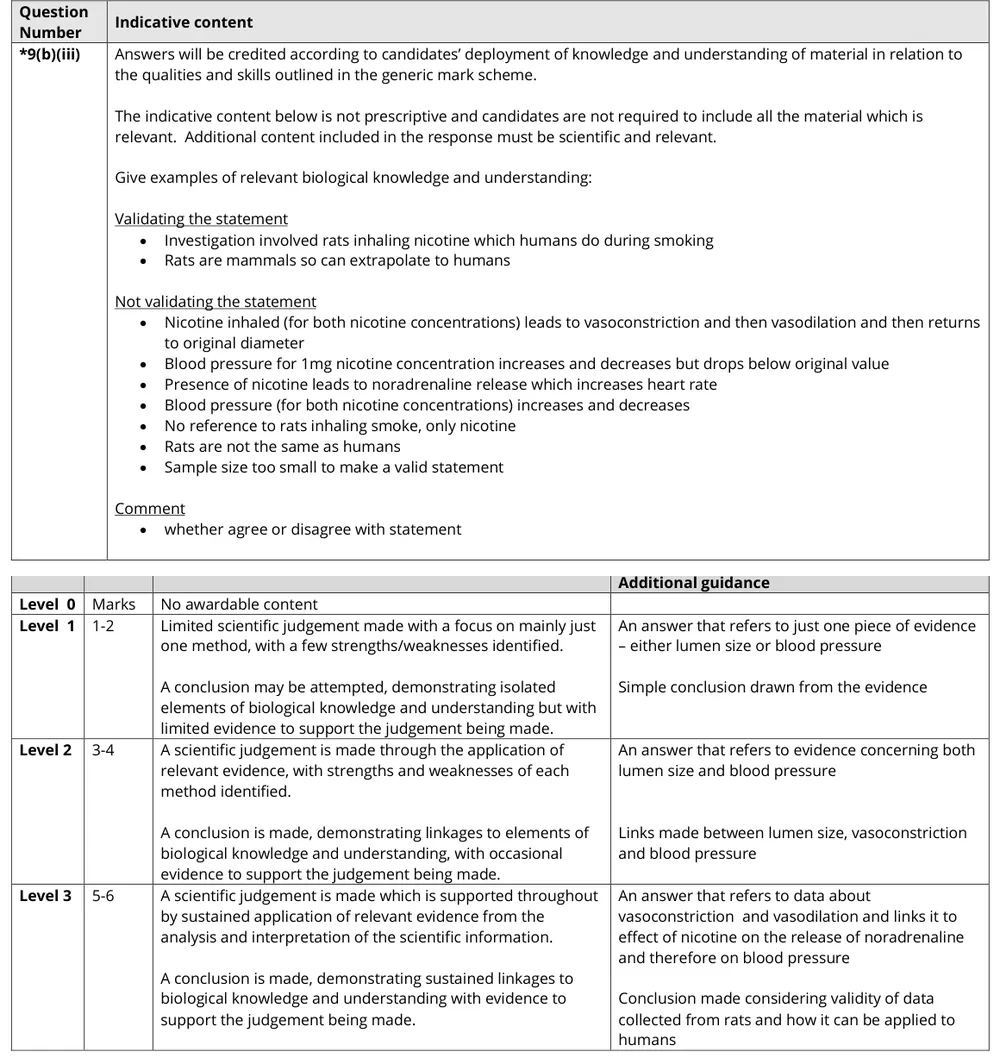
Analyse data from a study on rats to evaluate a statement about nicotine, blood pressure and artery lumen in humans.
Information from earlier in this question:
Show the mark scheme
Tap an image to open it full size.
From the examiners' report: Answers ranged from those that considered only one aspect of the investigation to detailed analyses of all of it. An answer that discussed blood pressure and lumen size separately, with no link between vasoconstriction and blood pressure, was given three marks.
Question 6
A level Paper 3 · June 2018 · Q6(b) · 9 marks
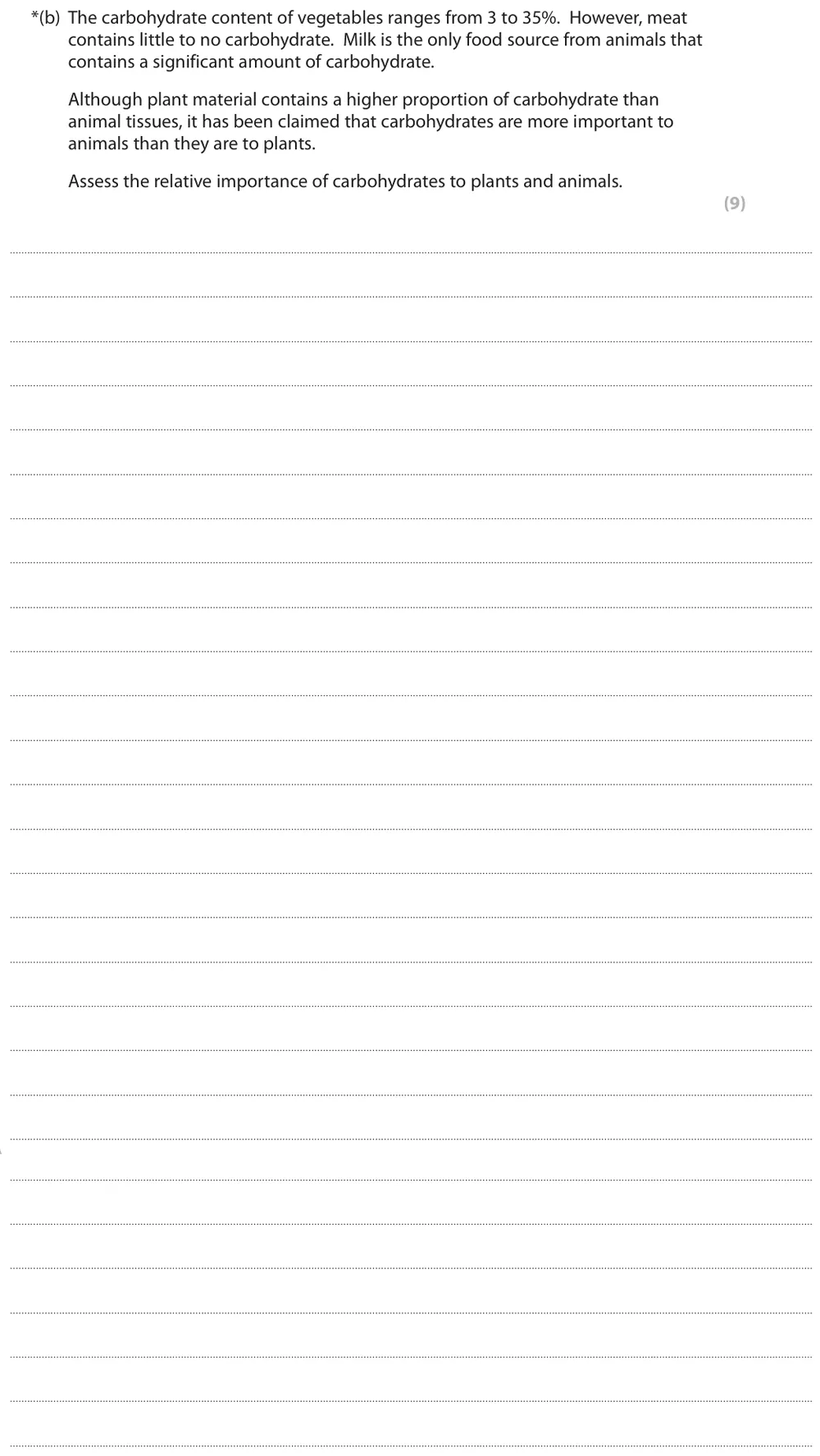
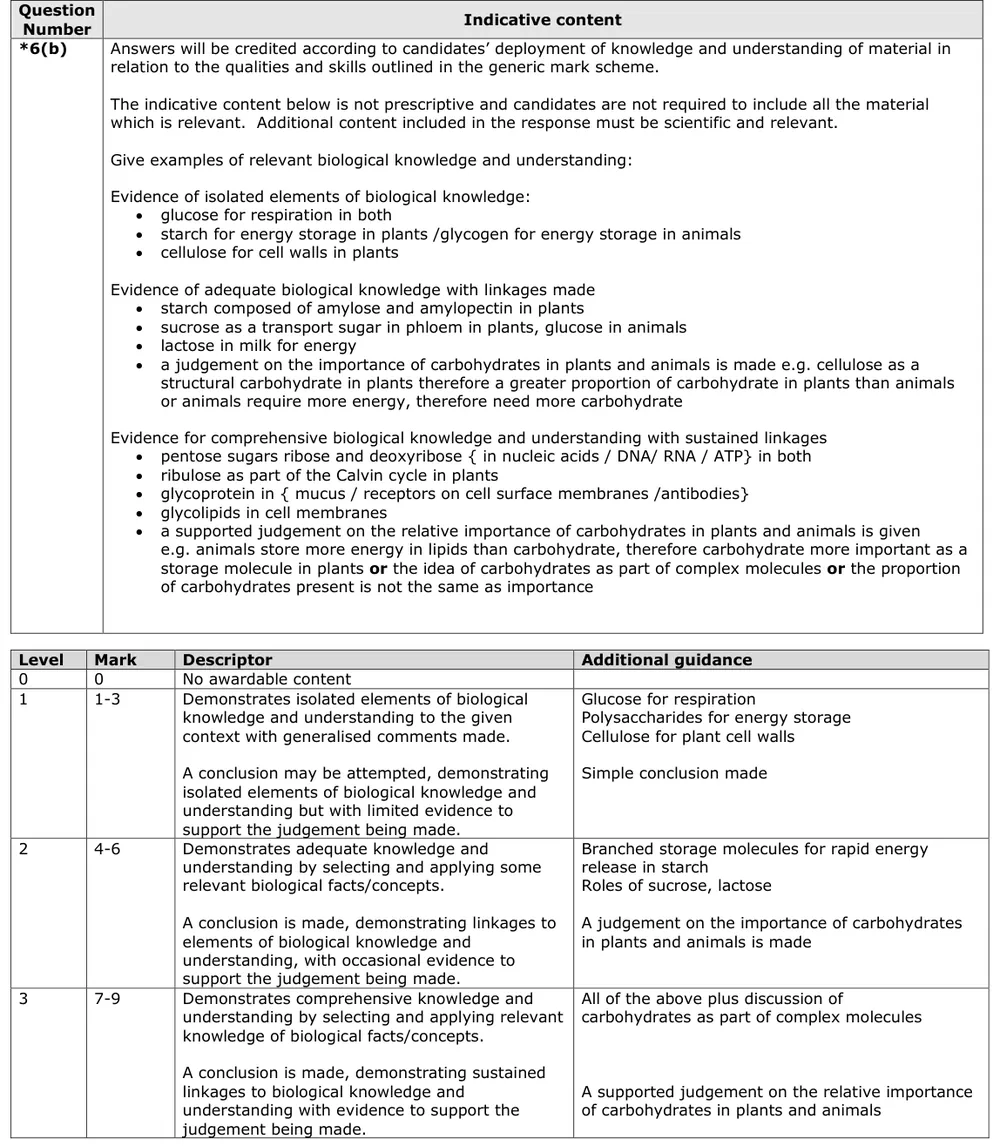
Assess the relative importance of carbohydrates to plants and animals.
Show the mark scheme
Tap an image to open it full size.
From the examiners' report: Most answers were limited by covering only one or two roles (energy storage, respiration, cellulose), by confusions such as plants needing glucose for photosynthesis rather than respiration, or by no comment, or a very simple one, on relative importance. Note the command word: you must assess relative importance.
Topic 2: Genes and Health
Question 7
AS Paper 1 · June 2016 · Q8(b)(iii) · 6 marks
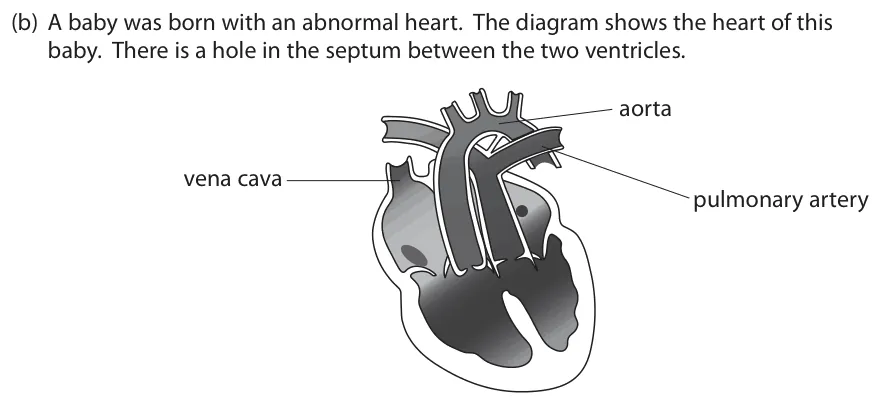
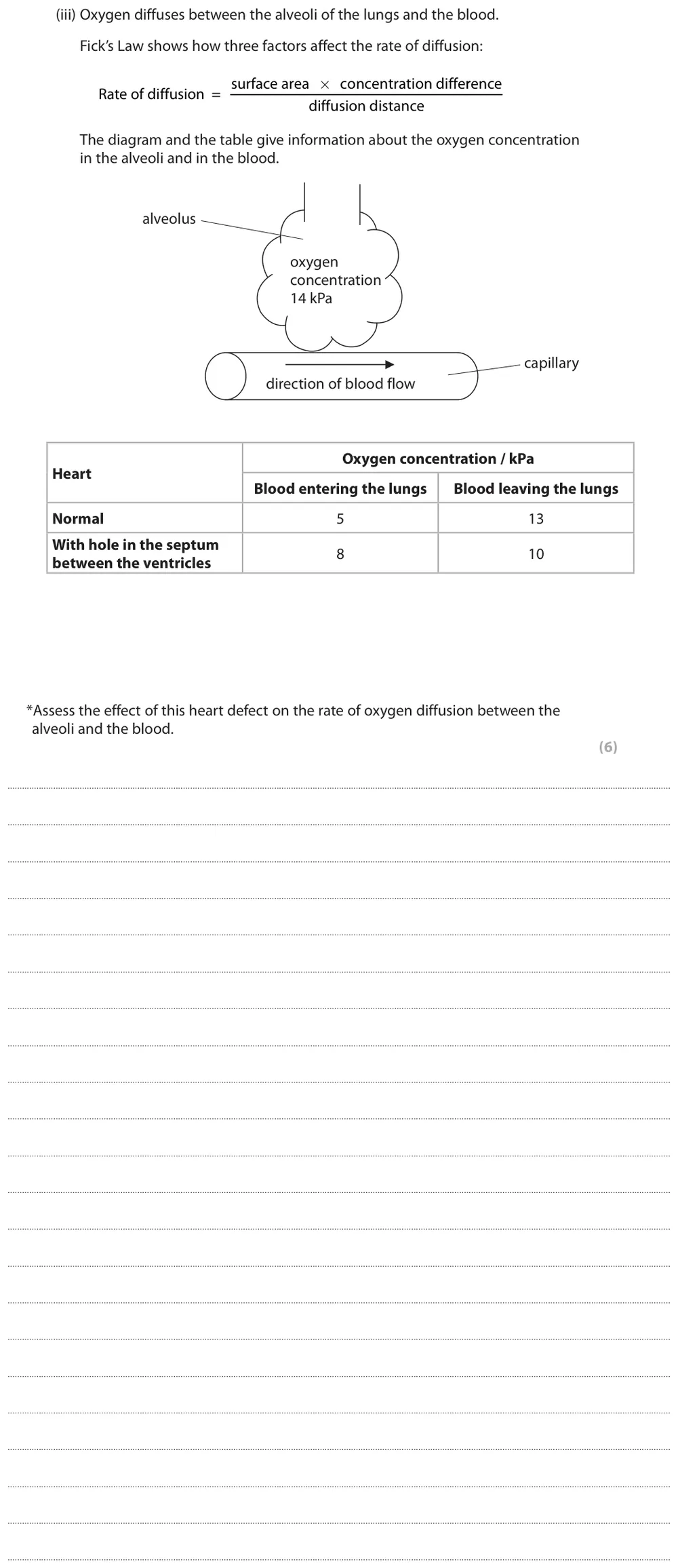
Use Fick's law and oxygen data to assess the effect of a hole in the septum on the rate of oxygen diffusion in the lungs.
Information from earlier in this question:
Show the mark scheme
Tap an image to open it full size.
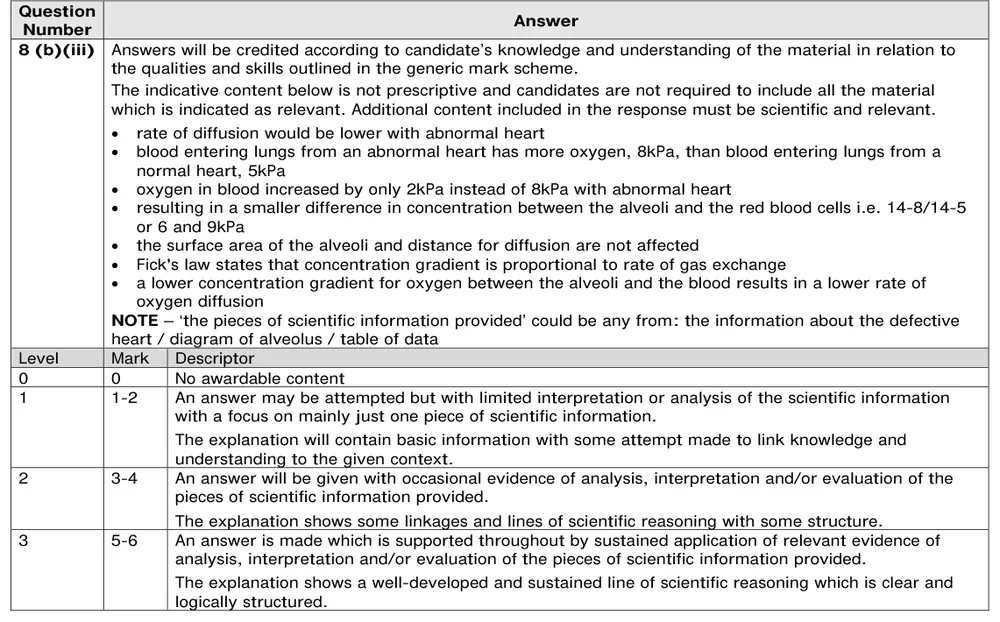
From the examiners' report: Some wrote about how the lungs are adapted for gas exchange instead of analysing the data, and a minority read the table as volumes of blood. Using the table alone limited answers to level 1; calculating the concentration differences reached level 2; using Fick's law, with surface area and diffusion distance unchanged, reached level 3.
Question 8
AS Paper 1 · June 2018 · Q8(d) · 6 marks
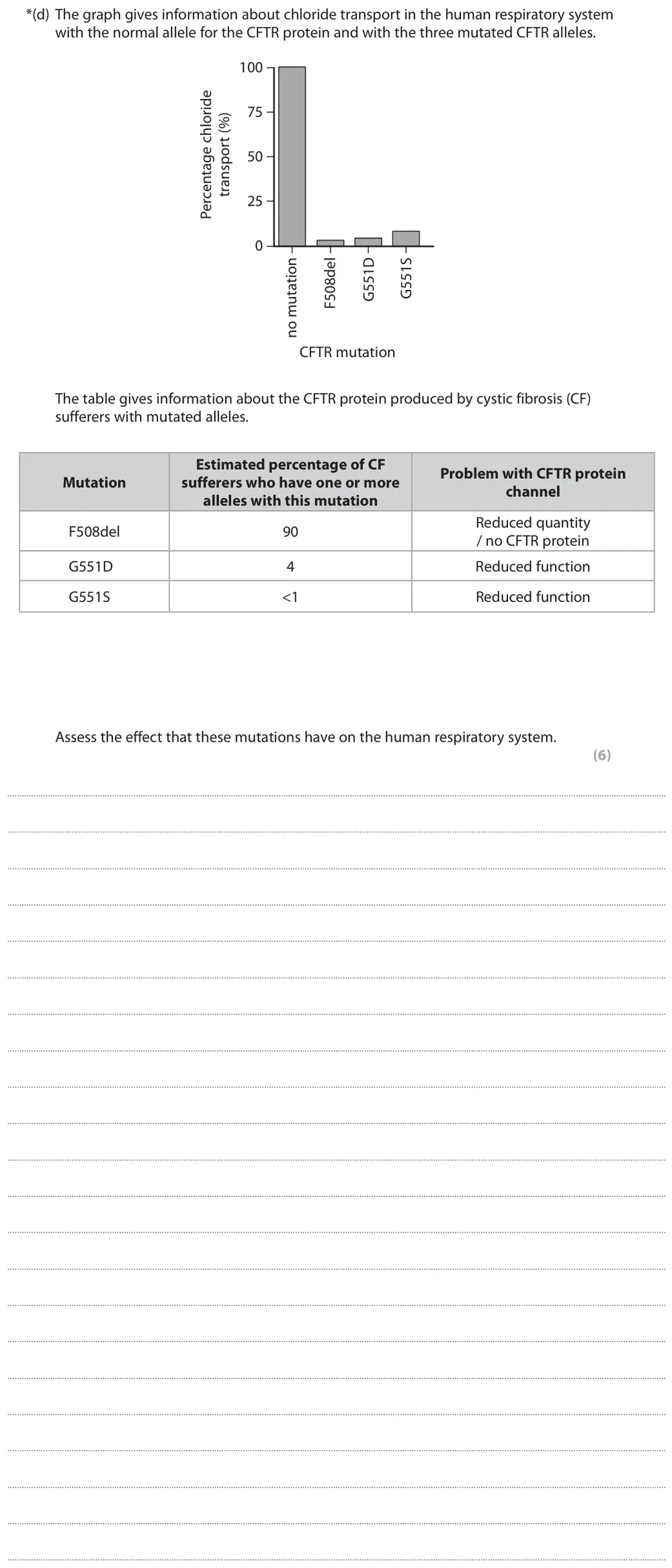
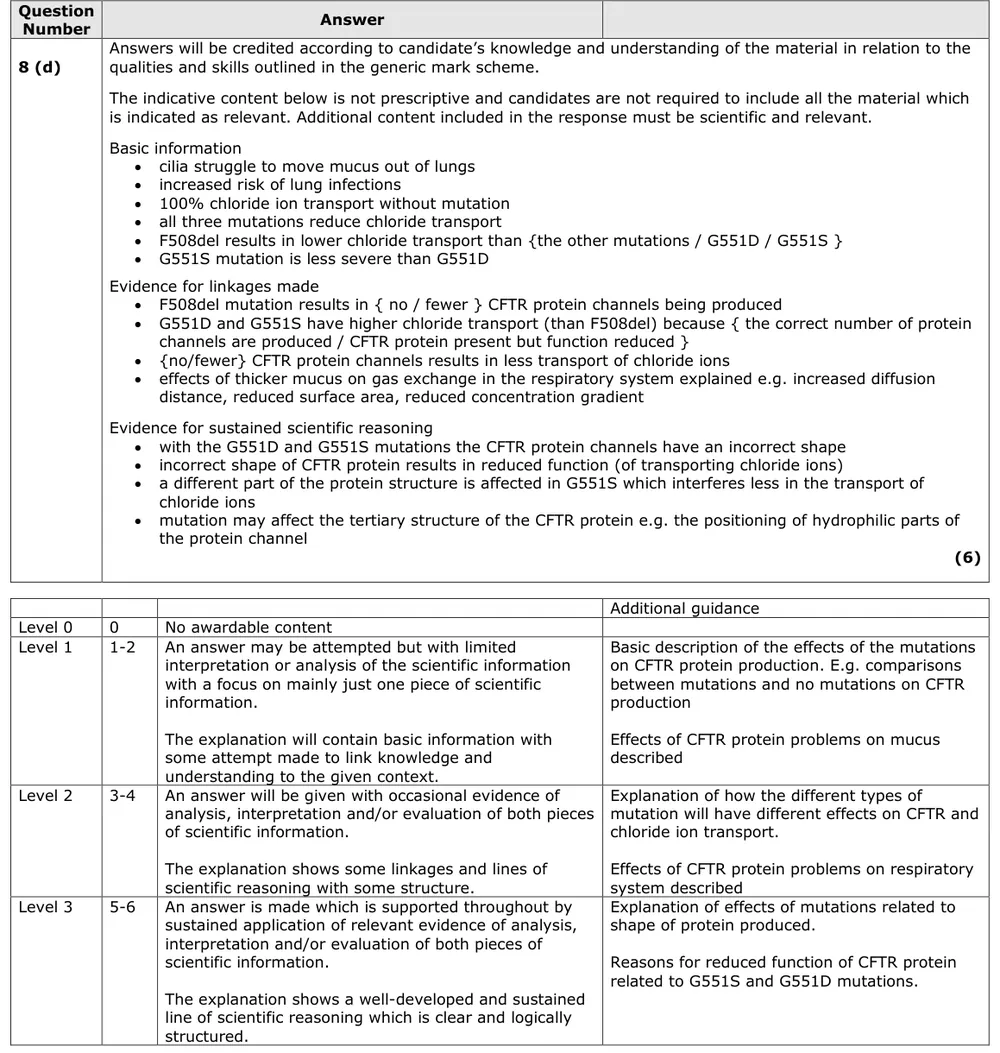
Use a graph and a table on three CFTR mutations to assess their effect on the human respiratory system.
Show the mark scheme
Tap an image to open it full size.
From the examiners' report: A simple statement that all three mutations reduce chloride transport is limited interpretation. Level 2 linked the reduced quantity of CFTR protein to reduced chloride transport, or used Fick's law. Very few reached level 3, which needed the idea that the mutations change the protein's structure and so its function. A few wrote about the reproductive or digestive systems instead.
Question 9
AS Paper 1 · June 2024 · Q6(b)(i) · 6 marks
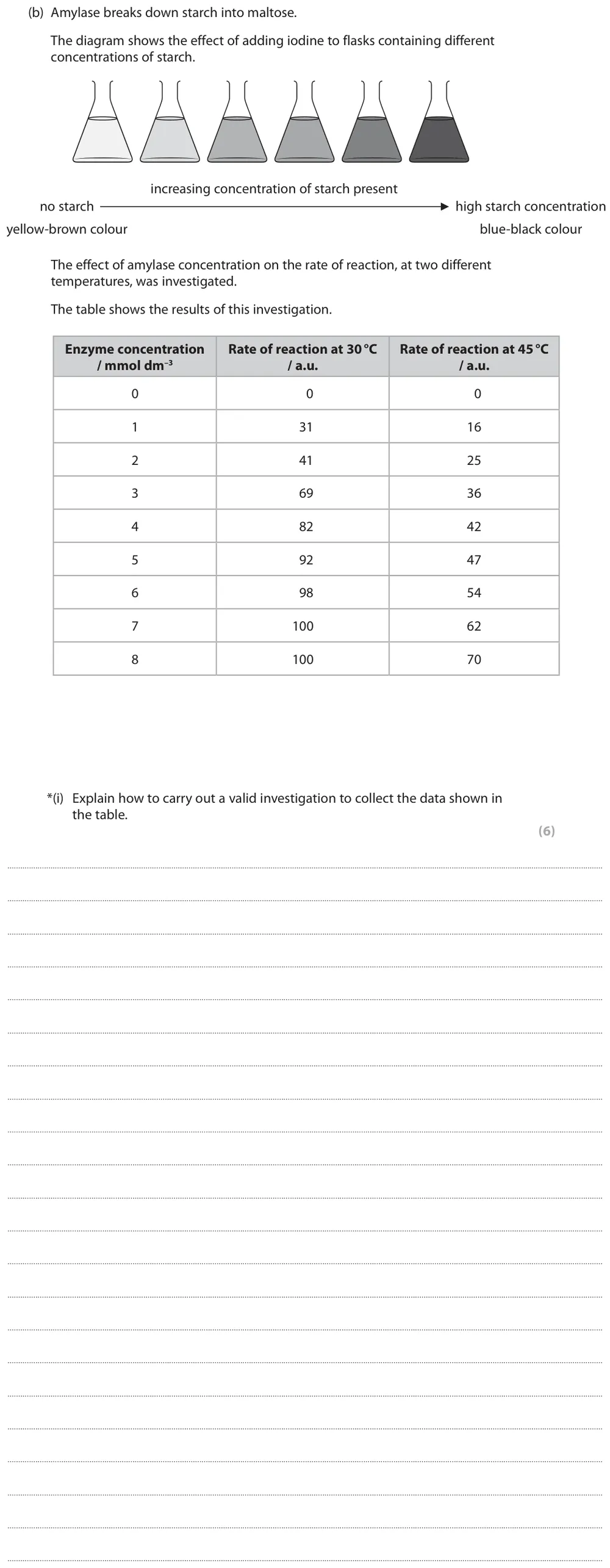
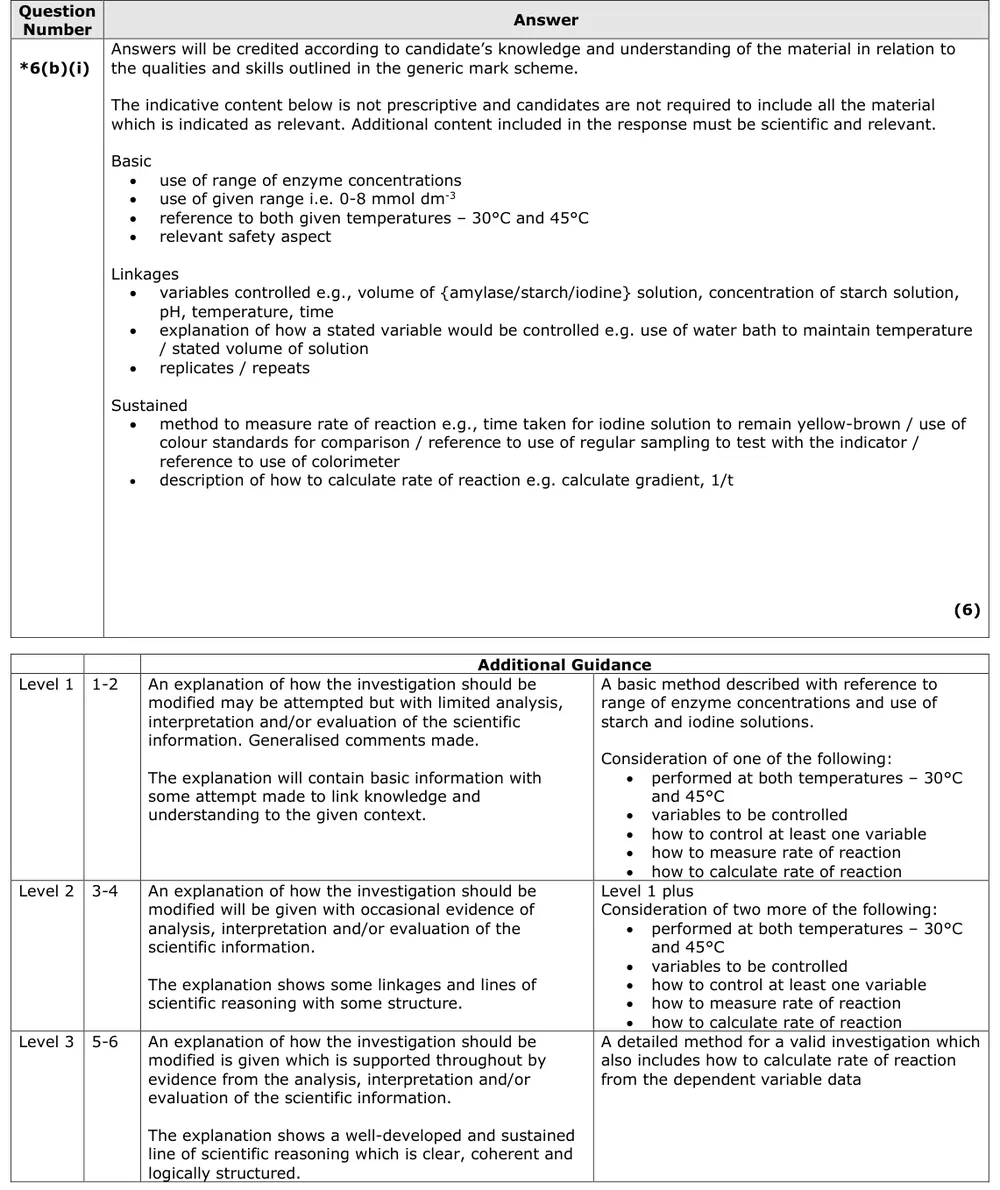
Explain how to carry out a valid investigation to collect the amylase data shown in the table.
Show the mark scheme
Tap an image to open it full size.
From the examiners' report: Use all three solutions, amylase, starch and iodine: a few did not and were held at the lower mark of level 1, and some varied the concentration of the wrong solution. Level 2 used the enzyme concentrations in the table and explained how to control a stated variable; level 3 also explained how to measure the dependent variable and calculate the rate of reaction from it.
Question 10
A level Paper 1 · June 2019 · Q11(c) · 6 marks
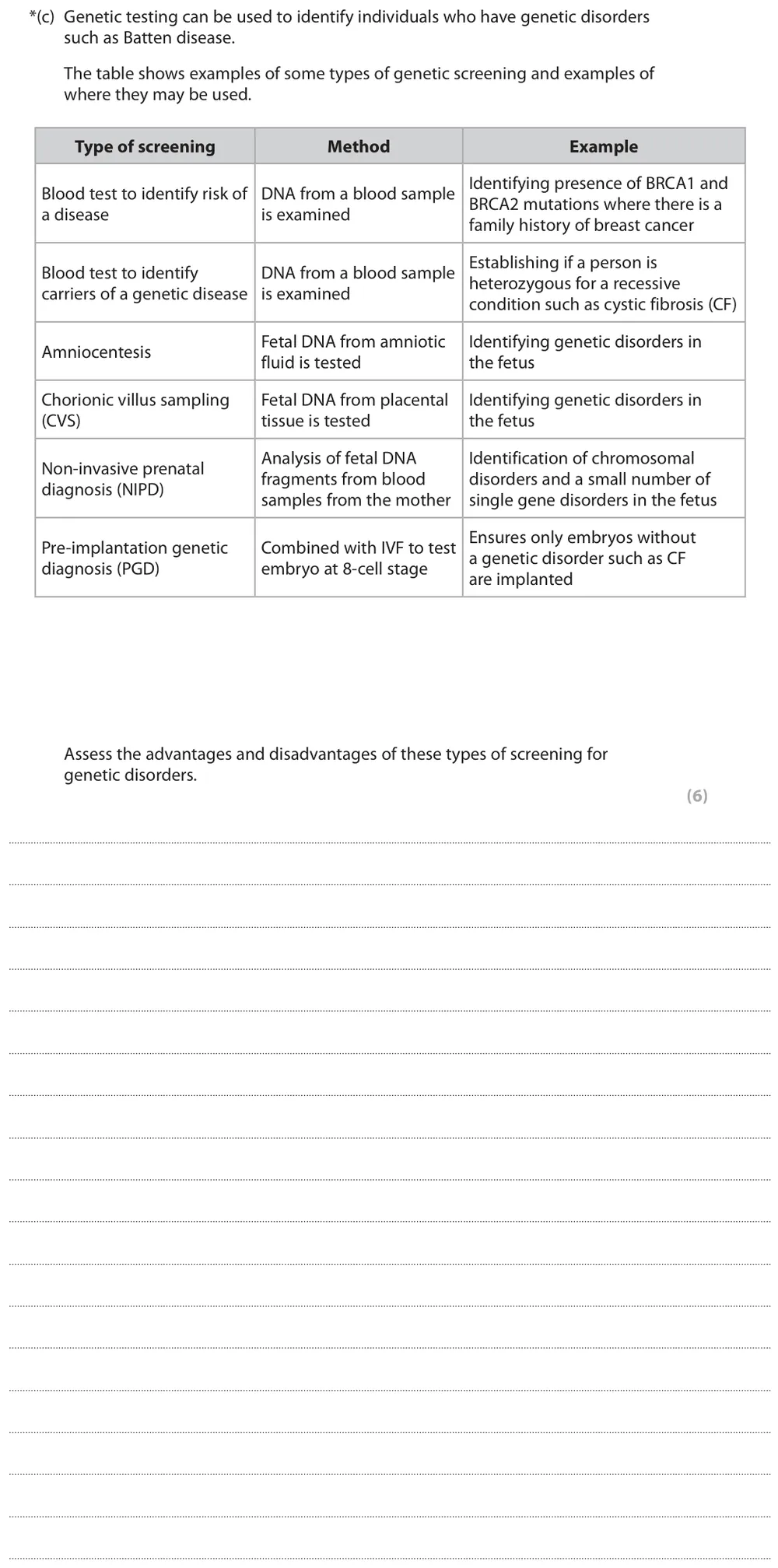
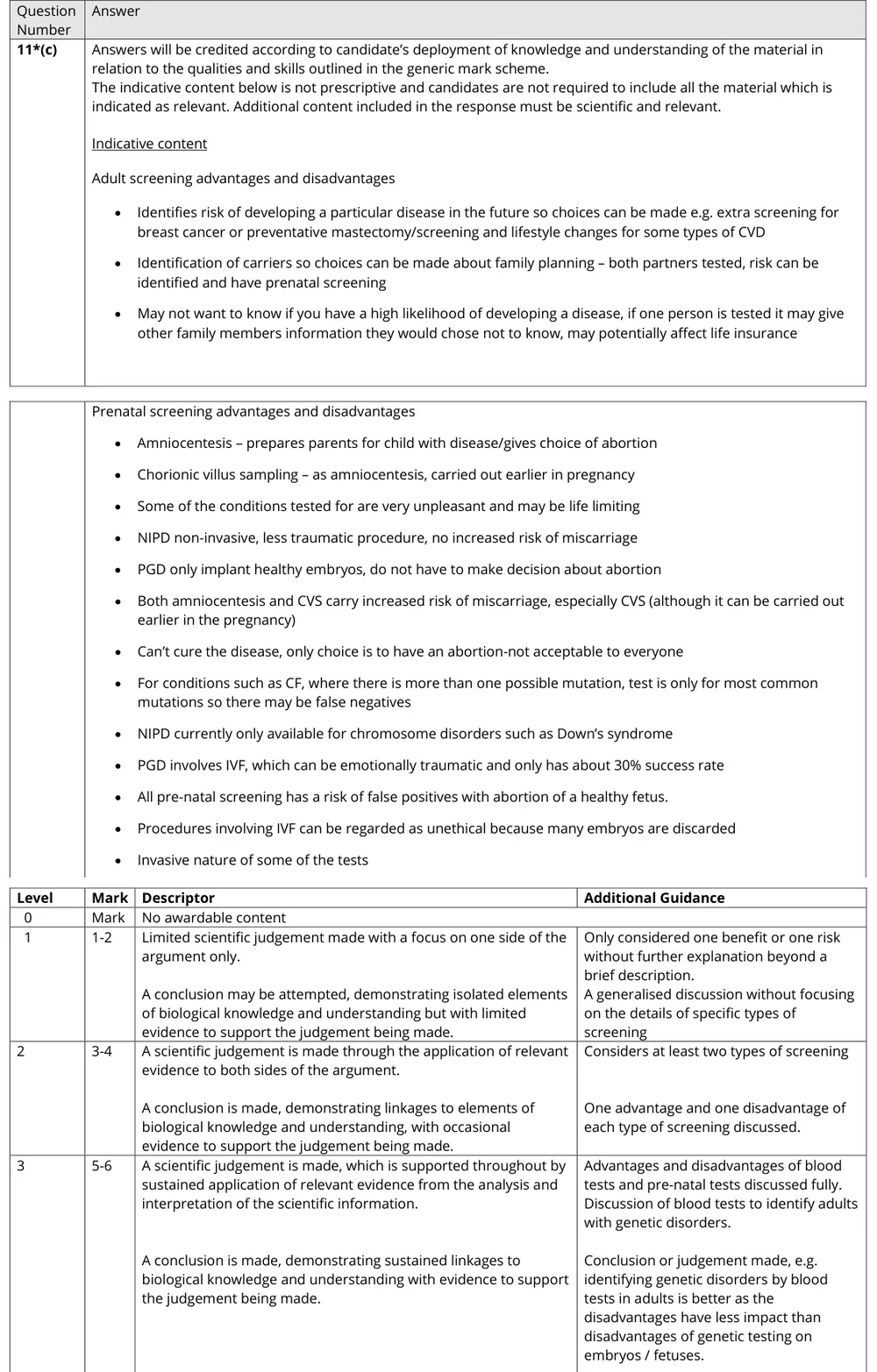
Assess the advantages and disadvantages of six types of screening for genetic disorders.
Show the mark scheme
Tap an image to open it full size.
From the examiners' report: Many discussed advantages and disadvantages of several types and reached level 2; amniocentesis and CVS were discussed in most detail. Few distinguished blood tests for carriers from blood tests for people at risk of developing a disease. Only the better answers reached level 3, which needs a conclusion or judgement.
Question 11
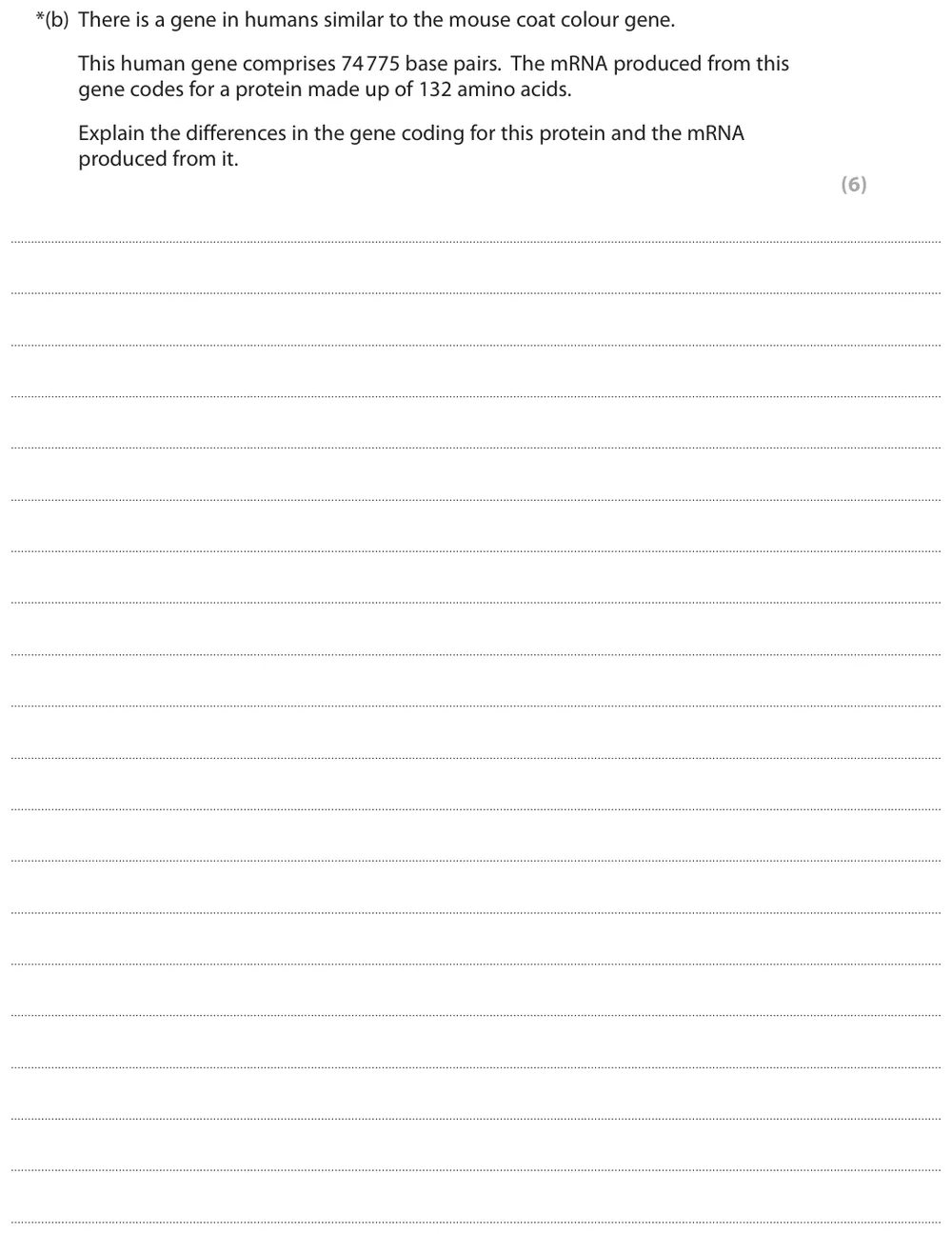
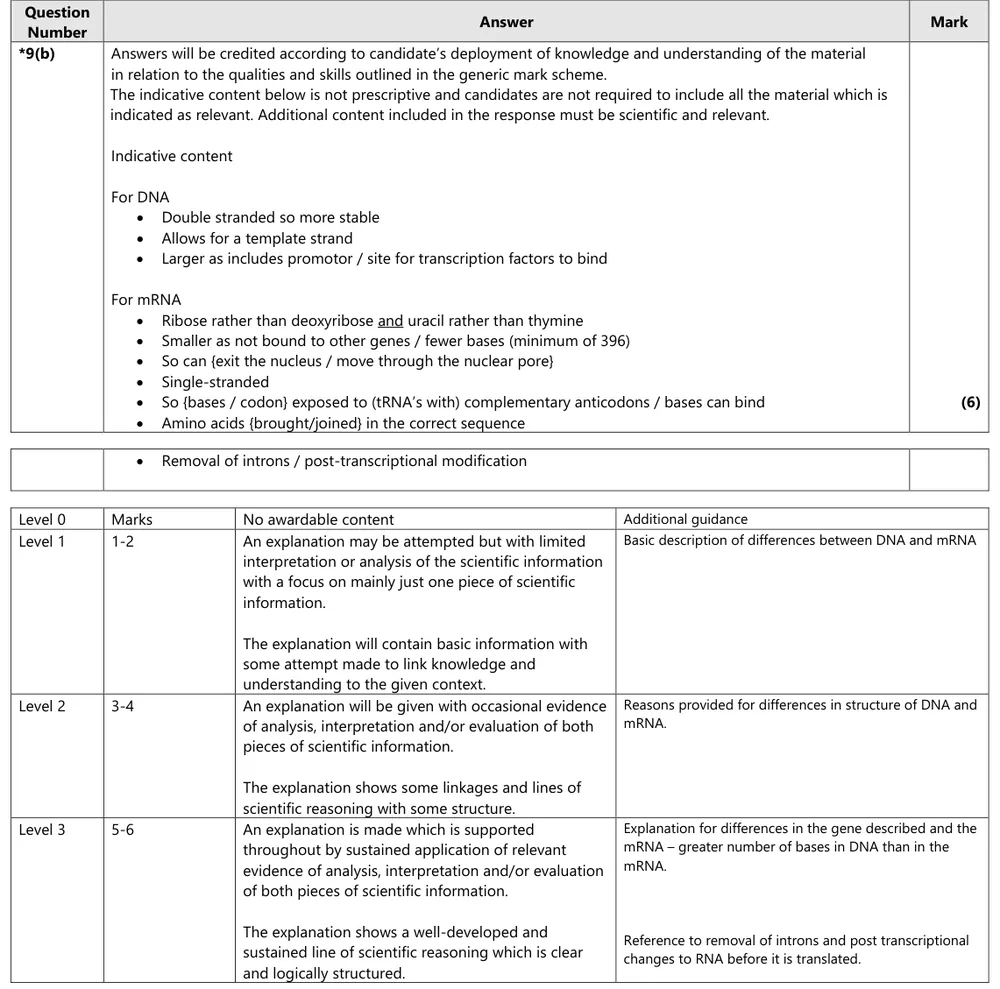
A level Paper 2 · June 2022 · Q9(b) · 6 marks
Explain the differences between a 74 775 base pair gene and the mRNA for a 132 amino acid protein.
Show the mark scheme
Tap an image to open it full size.
From the examiners' report: Many described the differences between the two nucleic acids well, but explanations for those differences were less common. A structural comparison alone is level 1; a reason, such as the smaller mRNA being able to leave the nucleus, moved answers into level 2.
Question 12
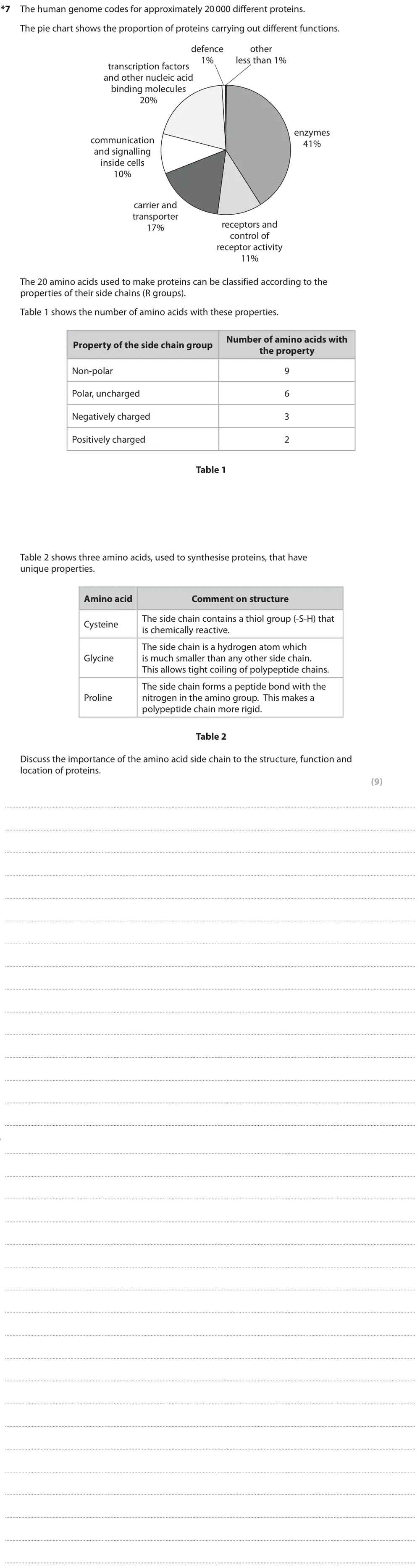
A level Paper 3 · June 2022 · Q7 · 9 marks
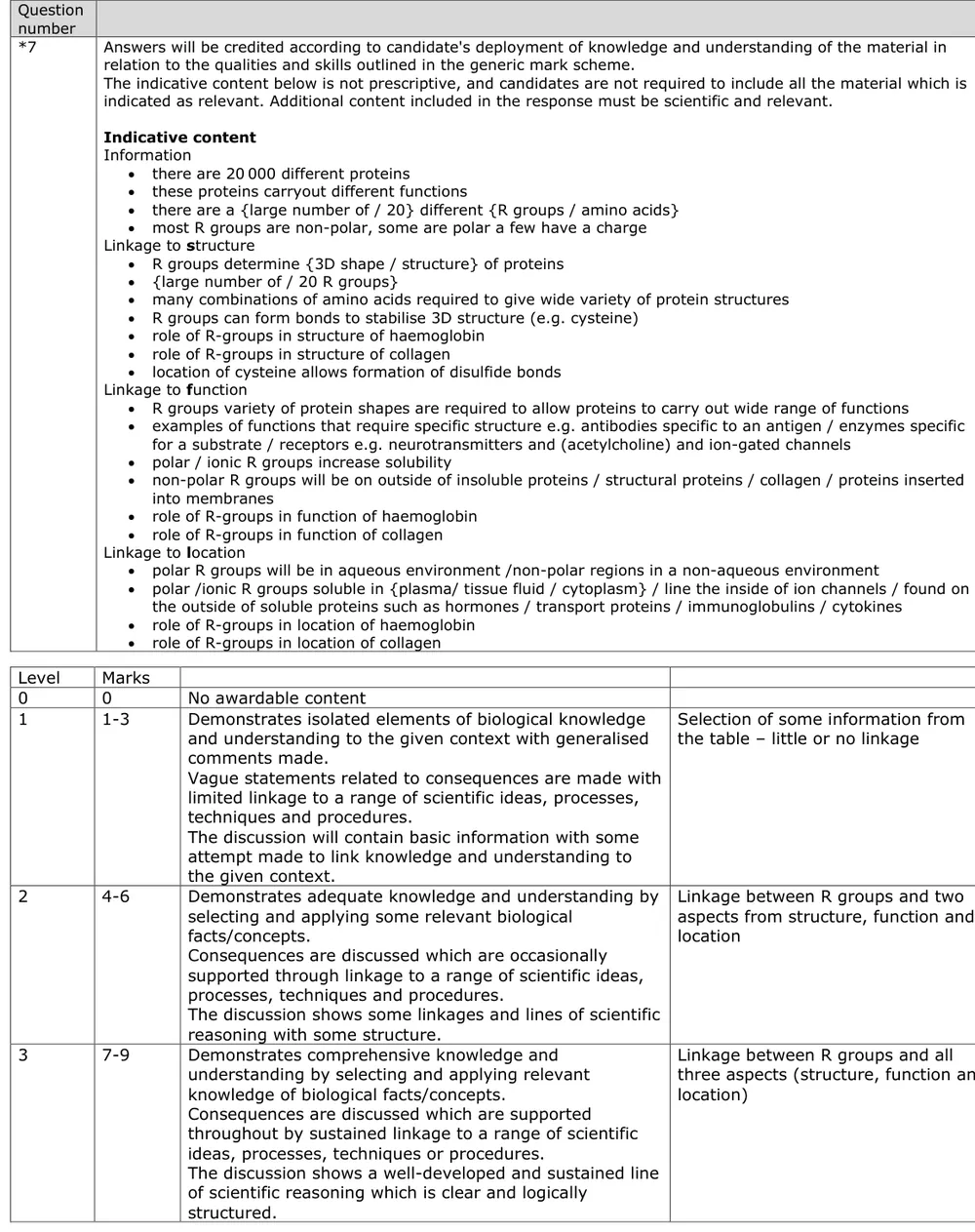
Discuss the importance of the amino acid side chain to the structure, function and location of proteins.
Show the mark scheme
Tap an image to open it full size.
From the examiners' report: Read the question carefully: it asks about structure, function and location. Level 3 needed all three aspects, with sustained linkage to the side chains in at least two. Mentioning function and location without linking them to the side chains kept one answer in level 1.
Where students lose marks (from Pearson examiners' reports and mark schemes)
Each point below comes from the examiners' reports and mark schemes, and is followed by wording that gained marks.
Advice needs data, data needs advice. Some responses analysed the graphs but gave no advice, which did not answer the question.
✔ Gains credit: 'Reduce blood pressure, as higher blood pressure increases the risk of a second ischaemic stroke: reduce salt in the diet, and reduce or stop smoking, as smoking increases blood pressure.'
Benefits and risks, for every drug. A number discussed only benefits, and some left out antihypertensives altogether.
✔ Gains credit: 'Antihypertensives lower blood pressure, which reduces the chances of damage to blood vessels in the brain; risks include low blood pressure and fainting.'
Say why it is unacceptable. Several candidates addressed all of the content but did not say the use was unacceptable.
✔ Gains credit: 'Testosterone increases synthesis of HMGCR, which is involved in cholesterol production, so it can harm the health of an athlete by increasing the risk of CVD.'
Link the lumen to the pressure. Answers discussed blood pressure and lumen size separately, with no link between vasoconstriction and blood pressure.
✔ Gains credit: 'Nicotine leads to vasoconstriction and then vasodilation; nicotine leads to noradrenaline release, which increases heart rate. Rats are not the same as humans.'
Plants respire glucose too. Some said animals need glucose for respiration but plants need it for photosynthesis.
✔ Gains credit: 'Glucose for respiration in both; starch for energy storage in plants, glycogen in animals; cellulose for cell walls in plants.'
Calculate the concentration differences. Many only used the figures in the table, which limited them to level 1.
✔ Gains credit: 'A smaller difference in concentration between the alveoli and the red blood cells, i.e. 14 − 8 / 14 − 5 or 6 and 9 kPa; the surface area of the alveoli and distance for diffusion are not affected.'
Mutations change the protein's shape. Knowledge of mutations affecting protein structure, and therefore function, was rarely seen.
✔ Gains credit: 'With the G551D and G551S mutations the CFTR protein channels have an incorrect shape, which results in reduced function (of transporting chloride ions).'
Explain the differences, don't just list them. Many described the differences between DNA and mRNA but did not explain them.
✔ Gains credit: 'mRNA is smaller, so it can exit the nucleus through the nuclear pore; introns are removed (post-transcriptional modification).'
Download the questions
Download the PDF pack (12 questions, mark schemes at the end)
Keep practising
- Edexcel SNAB A level Biology revision resources by topic
- Extended Response Questions (Topics 3 and 4): Edexcel SNAB A Level Biology Exam Questions
- Extended Response Questions (Topics 5 to 8): Edexcel SNAB A Level Biology Exam Questions
- All Edexcel SNAB exam questions by topic
- Edexcel SNAB A level Biology past papers, mark schemes and examiners' reports
- Edexcel SNAB A level Biology grade boundaries
- Message Tom on WhatsApp about one-to-one Edexcel SNAB tutoring or an Edexcel group class
Questions, mark schemes and examiners' report extracts © Pearson Education Ltd.