

Proteins and Enzymes sits in Topic 2, Genes and Health, of the Edexcel A level Biology A (Salters-Nuffield) specification. You need to know the basic structure of an amino acid, how amino acids join by peptide bonds in condensation reactions, how a protein's primary structure determines its three-dimensional shape and properties, the structures of globular and fibrous proteins such as haemoglobin and collagen, and how enzymes work as biological catalysts, including intracellular and extracellular enzymes. This topic is examined on AS Paper 1 and on A level Papers 1, 2 and 3. Questions marked AS are from the AS papers (8BN0); the rest are from the A level papers (9BN0).
The examiners' reports return to one chain of reasoning again and again: a different sequence of amino acids means different R groups in different places, which changes the bonds between R groups, the folding and the tertiary structure, and so the shape of the active site. Give every link in that chain, name the bonds, and finish by applying it to the context in the question. For compare and contrast questions, write comparative statements that cover both proteins, and for enzymes use the terms active site and enzyme-substrate complex.
Studying Edexcel SNAB and want more help? If you'd like to arrange one-to-one Edexcel tutoring, or to register your interest in an Edexcel group class, message Tom on WhatsApp using the link at the bottom of this page.
What you need from GCSE
Each question on this page assumes you're secure on these ideas. If any of them feels shaky, look it up before you start.
- Proteins are long chains of amino acids.
- Enzymes are proteins that speed up reactions and are not used up.
- Each enzyme has an active site with a shape that fits its substrate.
- High temperatures and extremes of pH can denature an enzyme by changing the shape of its active site.
Key terms
These words come up in the questions and mark schemes. Examiners expect you to use them exactly.
- R group: the variable side group of an amino acid, attached to the central carbon with the amine and carboxyl groups.
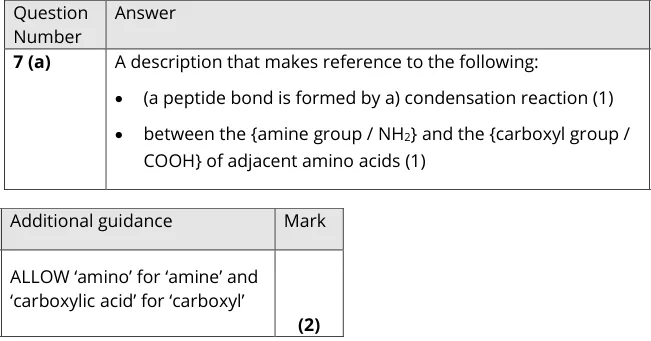
- Peptide bond: the bond formed in a condensation reaction between the amine group of one amino acid and the carboxyl group of another.
- Primary structure: the sequence of amino acids in a polypeptide, joined by peptide bonds.
- Tertiary structure: the overall three-dimensional folding of a polypeptide, held by hydrogen bonds, ionic bonds and disulfide bridges between R groups.
- Globular protein: a compact, folded protein with hydrophilic R groups on the outside, so it is soluble; haemoglobin is an example.
- Fibrous protein: a long, insoluble protein with little or no tertiary structure; collagen is three polypeptide chains in a triple helix.
- Enzyme-substrate complex: formed when a substrate binds to the complementary active site of an enzyme.
- Activation energy: the energy needed to start a reaction; enzymes lower it.
What these questions cover (Edexcel SNAB Topic 2: Genes and Health)
The questions test these statements from Topic 2 of the Pearson Edexcel A level Biology A (Salters-Nuffield) specification (9BN0).
- 2.9 i Know the basic structure of an amino acid (structures of specific amino acids are not required).
- 2.9 ii Understand the formation of polypeptides and proteins (amino acid monomers linked by peptide bonds in condensation reactions).
- 2.9 iii Understand the significance of a protein’s primary structure in determining its three-dimensional structure and properties (globular and fibrous proteins and the types of
- 2.9 iv Know the molecular structure of a globular protein and a fibrous protein and understand how their structures relate to their functions (including haemoglobin and collagen
- 2.10 i Understand the mechanism of action and the specificity of enzymes in terms of their three-dimensional structure.
- 2.10 ii Understand that enzymes are biological catalysts that reduce activation energy.
- 2.10 iii Know that there are intracellular enzymes catalysing reactions inside cells and extracellular enzymes produced by cells catalysing reactions outside of cells.
How to use this page
Write your answer on paper before you open the mark scheme. Allow about 1.2 minutes per mark: the 20 questions are worth 50 marks, so about 60 minutes in total. Then mark your answer strictly against the mark scheme and read the examiners' tip underneath it. If you'd rather print the questions, download the PDF pack.
Amino acid structure (2.9 i)
Question 1
AS Paper 1 · June 2019 · Q6(a)(i) · 1 mark
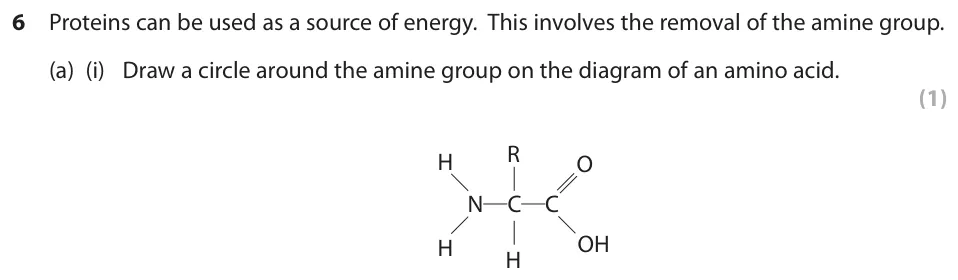
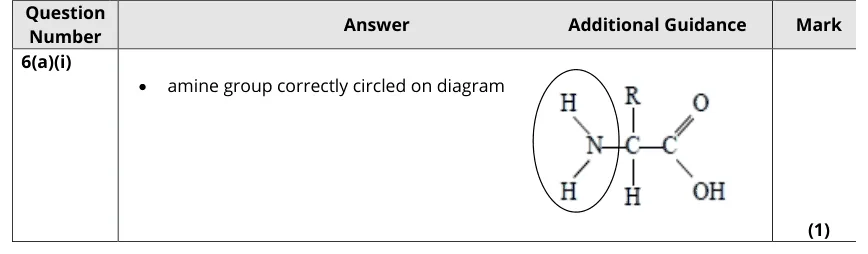
Circle the amine group on the diagram of an amino acid.
Show the mark scheme
Tap an image to open it full size.
From the examiners' report: Many did this correctly, but others circled the R group or the carboxylic acid group. The amine group is the NH2.
Question 2
AS Paper 1 · June 2022 · Q3(b)(ii) · 3 marks · Hard
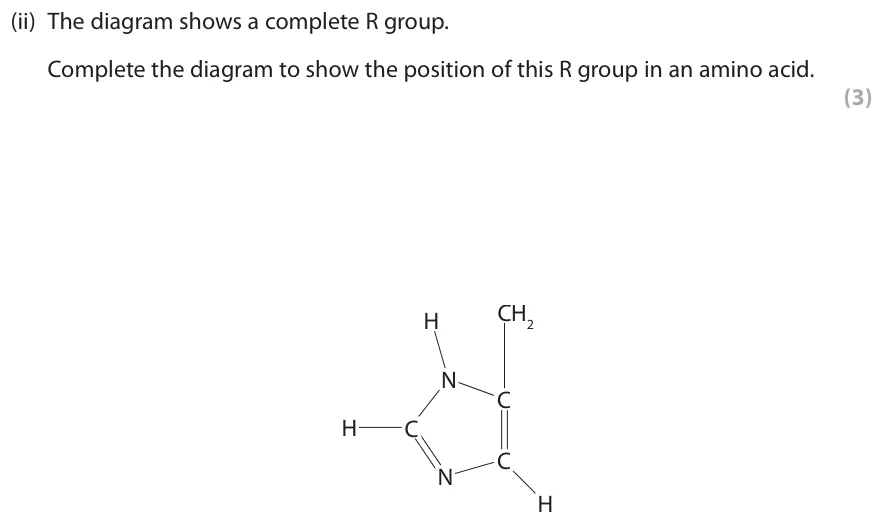
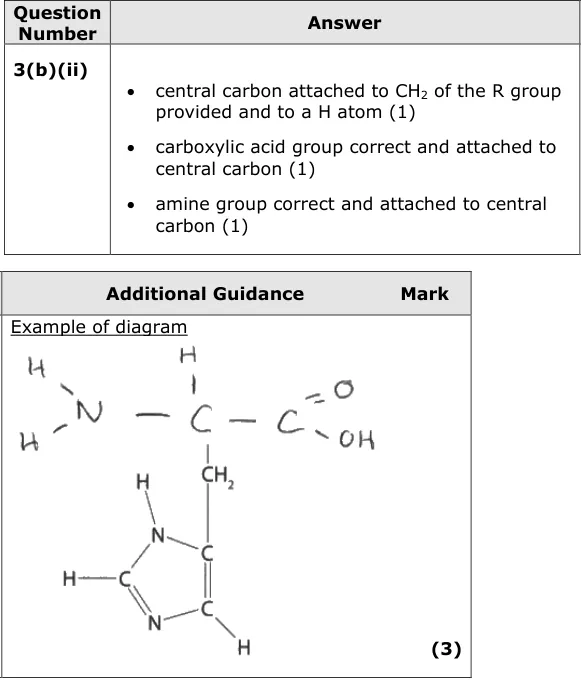
Complete the diagram to show where a given R group sits in an amino acid.
Show the mark scheme
Tap an image to open it full size.
From the examiners' report: This style of question challenged many. The full-mark answer drew out an amino acid first: a central carbon bonded to the R group, a hydrogen, an amine group and a carboxylic acid group.
Peptide bonds (2.9 ii)
Question 3
A level Paper 1 · June 2019 · Q7(a) · 2 marks
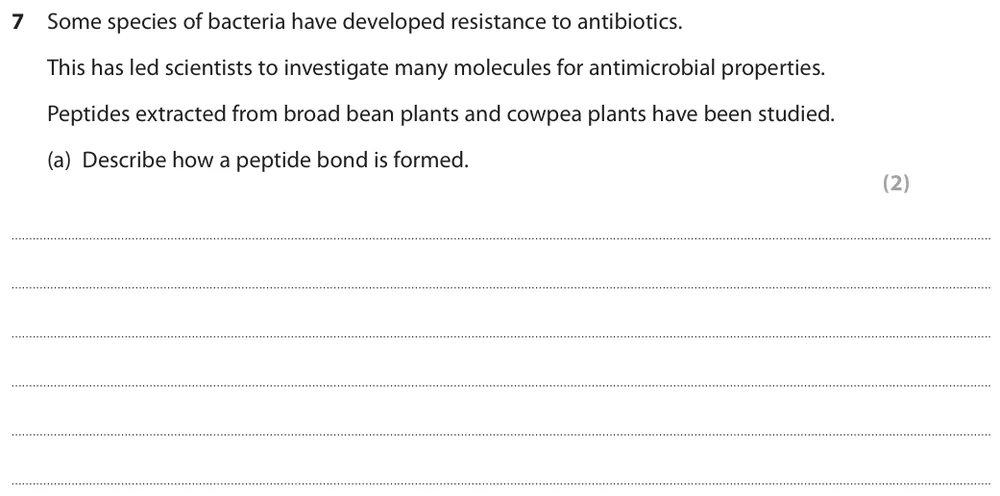
Describe how a peptide bond is formed.
Show the mark scheme
Tap an image to open it full size.
From the examiners' report: Almost everyone said condensation reaction. For full marks, say it is between the amine group of one amino acid and the carboxyl group of the next; a diagram must be clearly labelled to gain credit.
Question 4
A level Paper 2 · June 2019 · Q7(a)(iii) · 2 marks
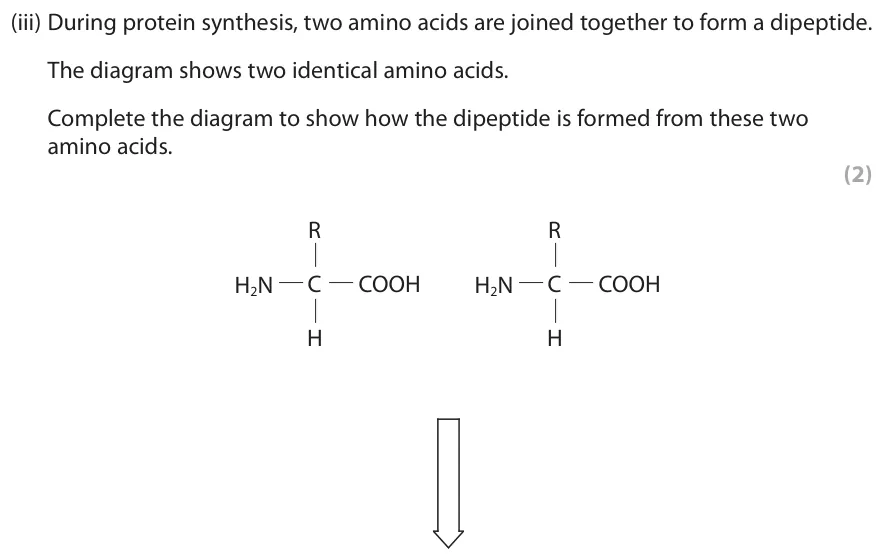
Complete the diagram to show how a dipeptide forms from two amino acids.
Show the mark scheme

Tap an image to open it full size.
From the examiners' report: Check your diagram carefully. One answer lost the first mark by leaving out an oxygen in the dipeptide; show the peptide bond and the water molecule released.
Question 5
A level Paper 3 · June 2024 · Q5(b) · 3 marks
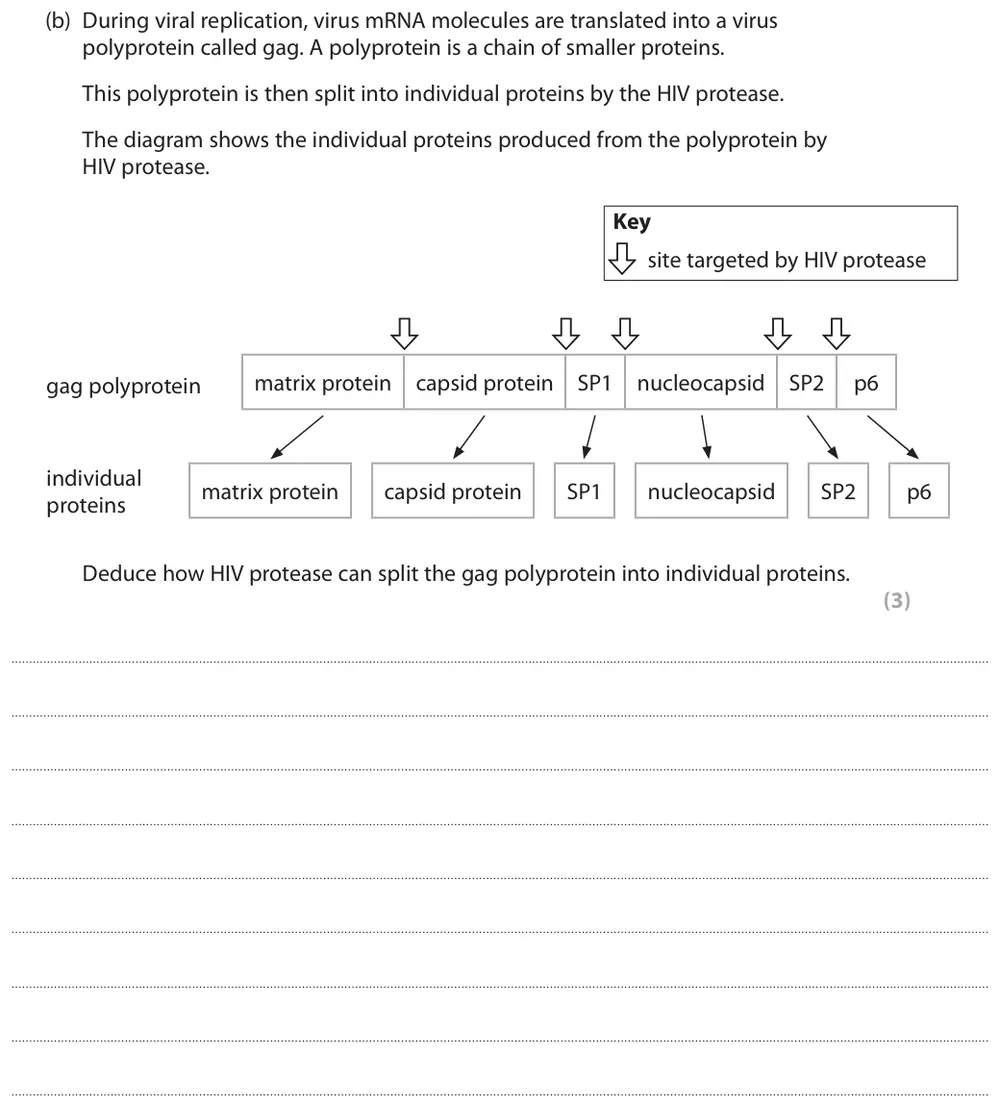
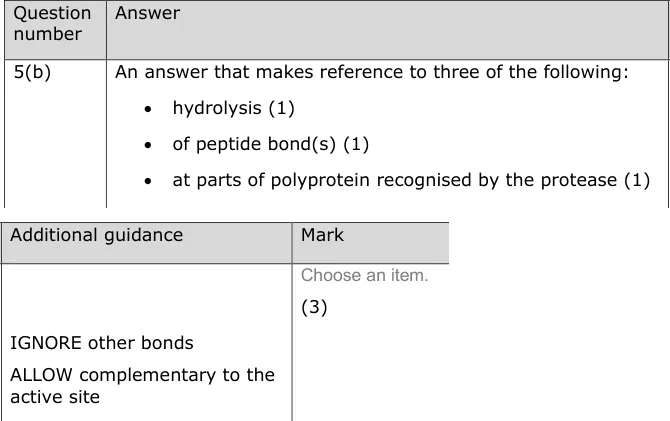
Deduce how HIV protease splits the gag polyprotein into individual proteins.
Show the mark scheme
Tap an image to open it full size.
From the examiners' report: Use the diagram: the protease hydrolyses peptide bonds at specific sites it recognises. Some answers wrongly wrote about processing of pre-mRNA.
Primary structure and 3D shape (2.9 iii)
Question 6
A level Paper 1 · June 2022 · Q4(b)(i) · 2 marks
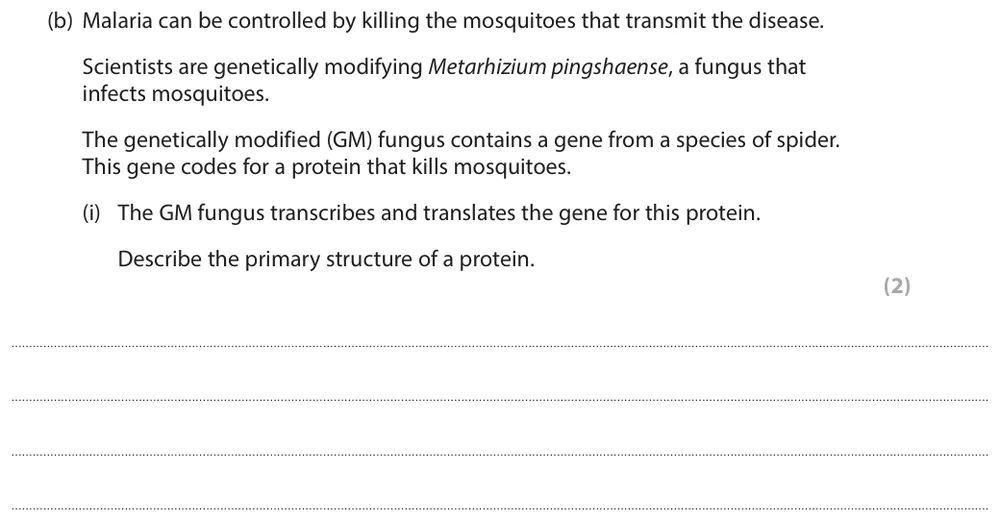
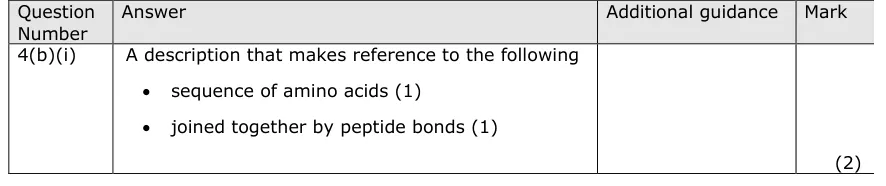
Describe the primary structure of a protein.
Show the mark scheme
Tap an image to open it full size.
From the examiners' report: 'A chain of amino acids' lost a mark because it doesn't show the order matters. Say it is the sequence of amino acids, joined by peptide bonds.
Question 7
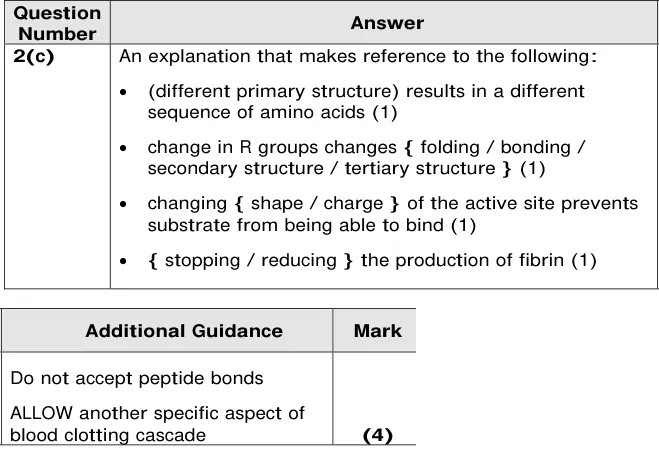
AS Paper 1 · June 2016 · Q2(c) · 4 marks
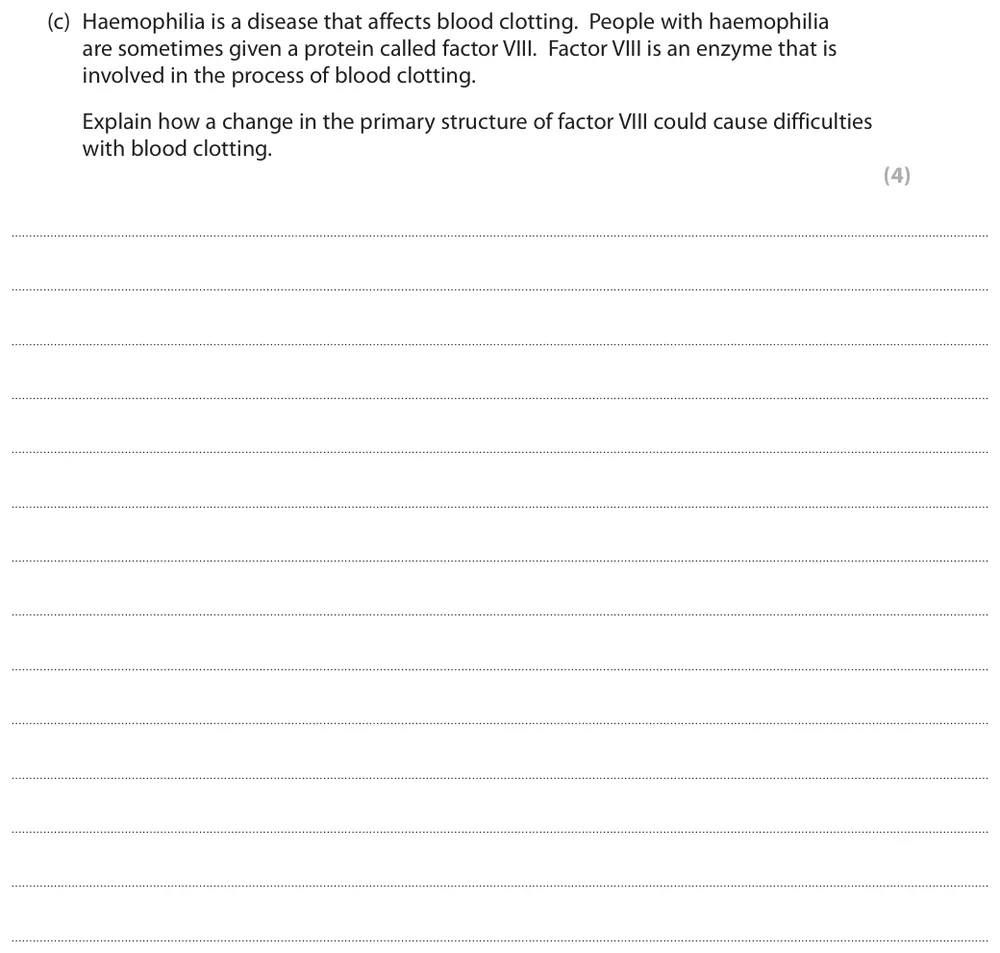
Explain how a change in the primary structure of factor VIII could cause problems with blood clotting.
Show the mark scheme
Tap an image to open it full size.
From the examiners' report: Most knew the active site would change, but few linked the new amino acid sequence to different R groups and folding, or finished by saying fewer enzyme-substrate complexes means less fibrin is made.
Question 8
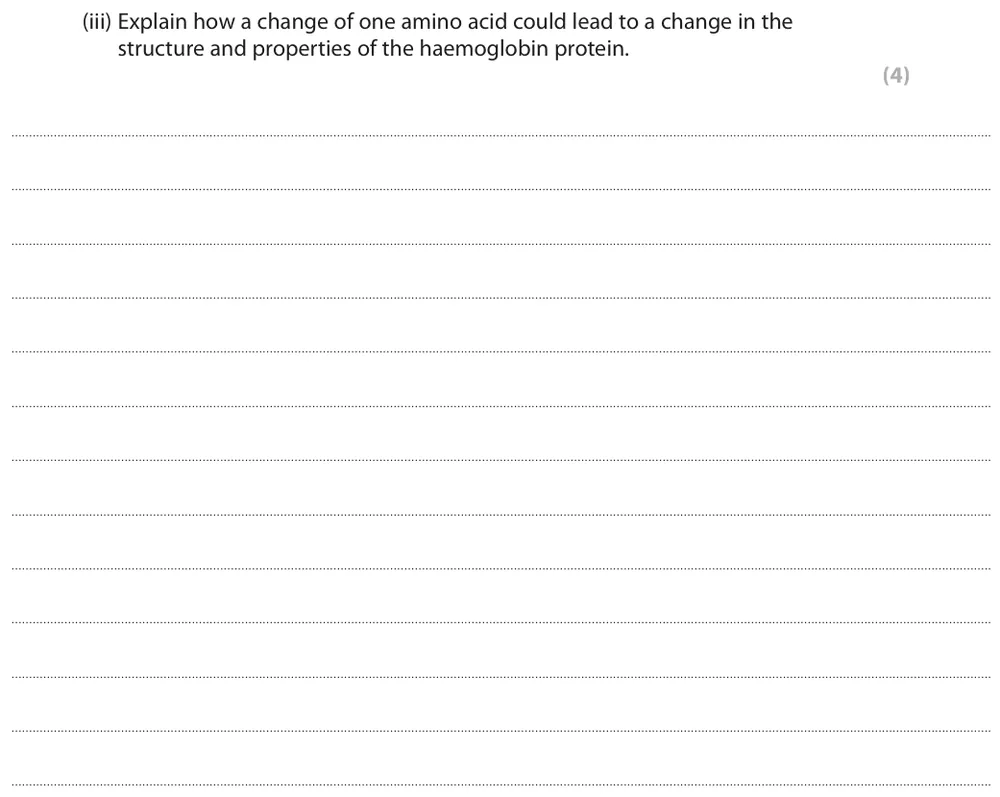
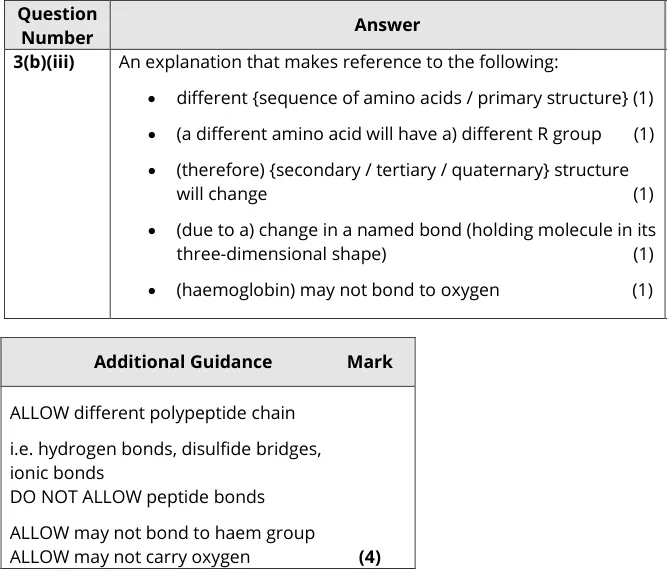
AS Paper 1 · June 2019 · Q3(b)(iii) · 4 marks
Explain how changing one amino acid could change the structure and properties of haemoglobin.
Show the mark scheme
Tap an image to open it full size.
From the examiners' report: The change in secondary, tertiary or quaternary structure and a named bond were the usual marks. Few went on to a property of haemoglobin: it may not bind to oxygen.
Question 9
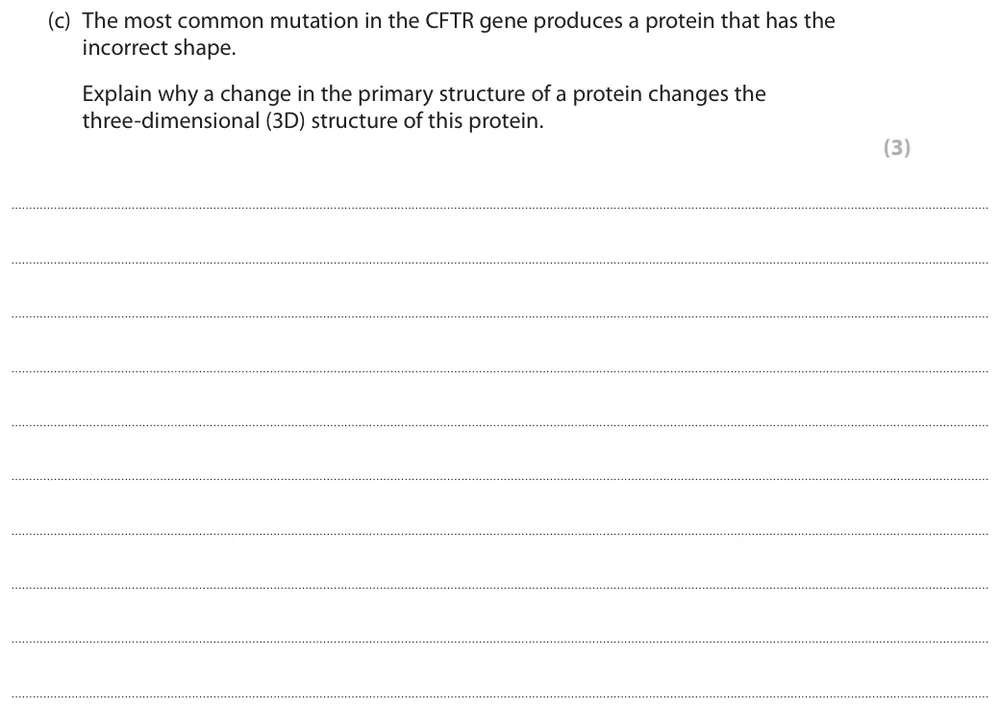
A level Paper 1 · June 2024 · Q4(c) · 3 marks
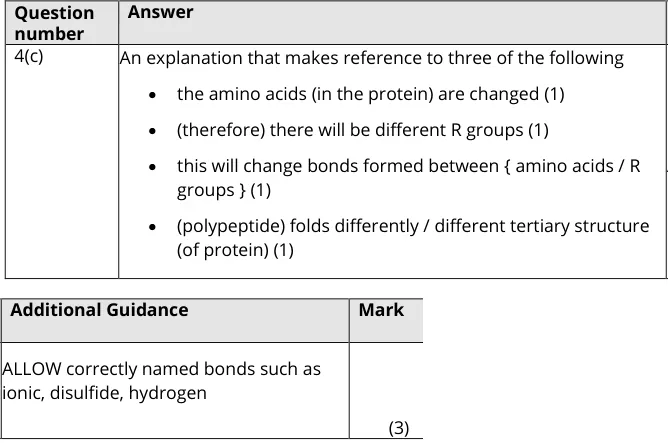
Explain why a change in primary structure changes the 3D structure of a protein.
Show the mark scheme
Tap an image to open it full size.
From the examiners' report: Don't paraphrase the stem. Different amino acids mean different R groups, which change the bonds between R groups; folding marks only counted for the tertiary structure, not the secondary structure.
Question 10
A level Paper 1 · June 2018 · Q4(a)(iii) · 3 marks · Hard
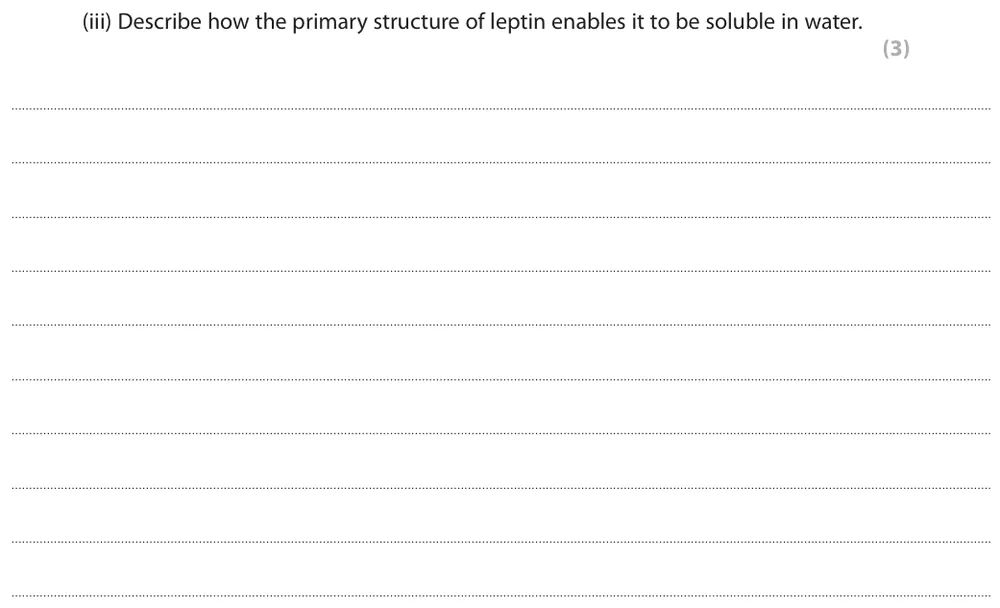
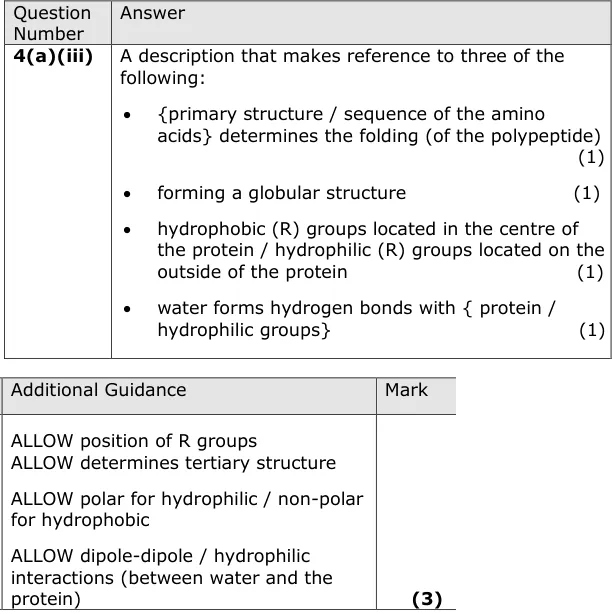
Describe how the primary structure of leptin makes it soluble in water.
Show the mark scheme
Tap an image to open it full size.
From the examiners' report: Many just said leptin is globular. Explain that the primary structure determines the folding, with hydrophilic R groups on the outside, and that water forms hydrogen bonds with these groups: few gave this last point.
Globular and fibrous proteins (2.9 iv)
Question 11
AS Paper 1 · June 2016 · Q5(a) · 4 marks · Hard
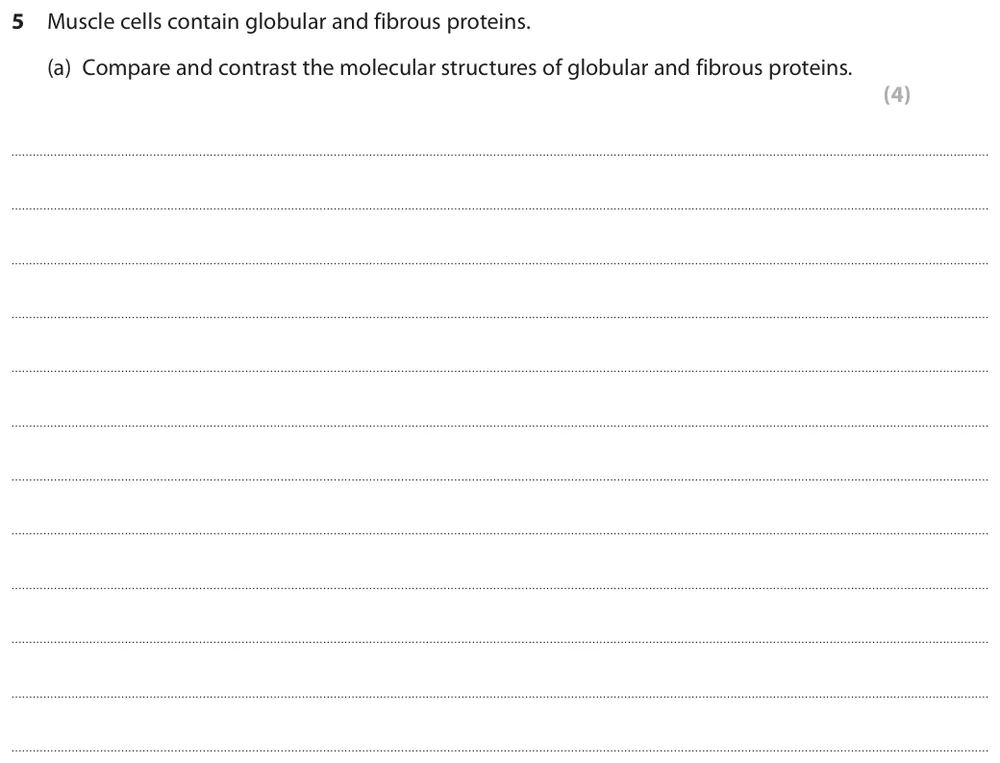
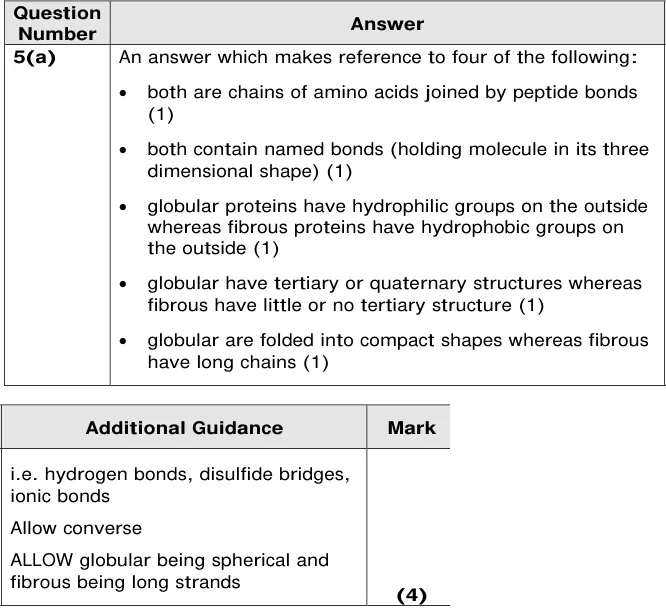
Compare and contrast the molecular structures of globular and fibrous proteins.
Show the mark scheme
Tap an image to open it full size.
From the examiners' report: Very few did this well. Write comparative statements about structure, not function, and don't just list examples: for instance, globular proteins have hydrophilic groups on the outside whereas fibrous proteins have hydrophobic groups on the outside.
Question 12
A level Paper 1 · June 2025 · Q3(c)(ii) · 2 marks
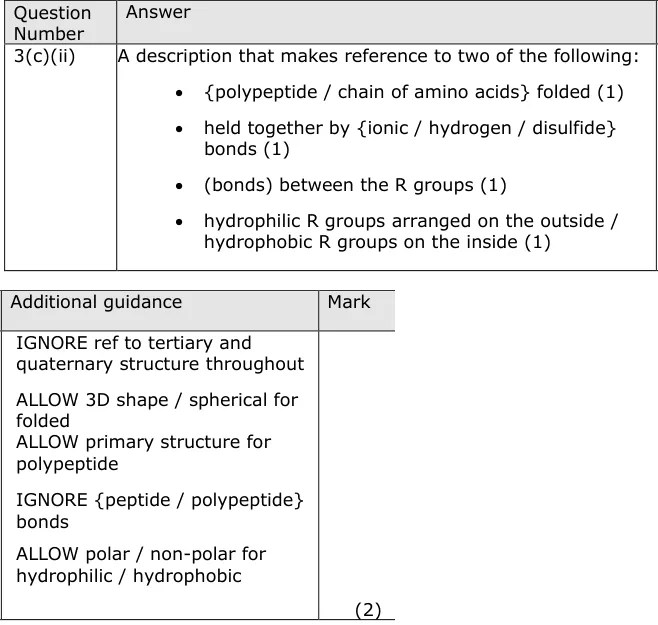
Describe the structure of a globular protein.
Show the mark scheme
Tap an image to open it full size.
From the examiners' report: 'Tertiary structure' alone gained nothing. Say the chain of amino acids is folded into a spherical shape, and talk about R groups (hydrophilic R groups on the outside), not just hydrophilic regions.
Question 13
AS Paper 1 · June 2025 · Q6(a)(ii) · 2 marks
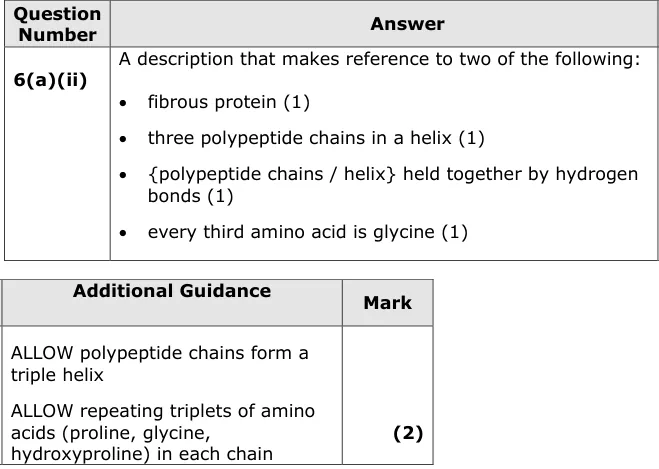
Describe the structure of collagen.
Show the mark scheme
Tap an image to open it full size.
From the examiners' report: Most said fibrous protein, but few added detail: three polypeptide chains in a triple helix held by hydrogen bonds, with glycine as every third amino acid. Describe structure, not properties.
Question 14
AS Paper 1 · June 2025 · Q6(b)(ii) · 2 marks · Easy
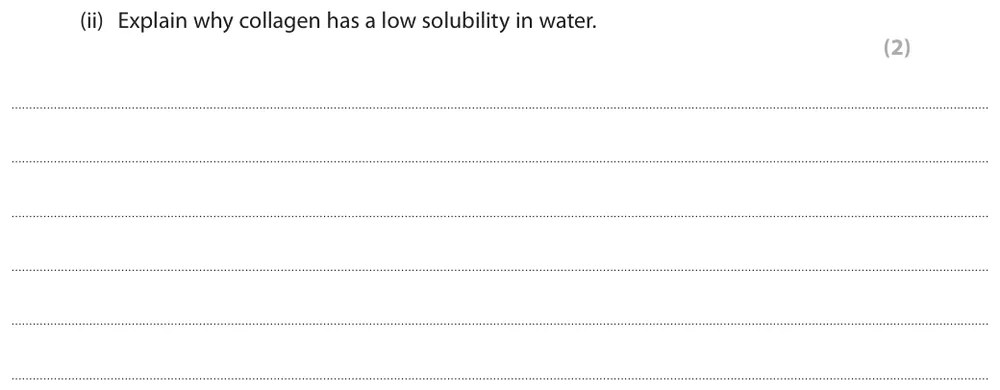
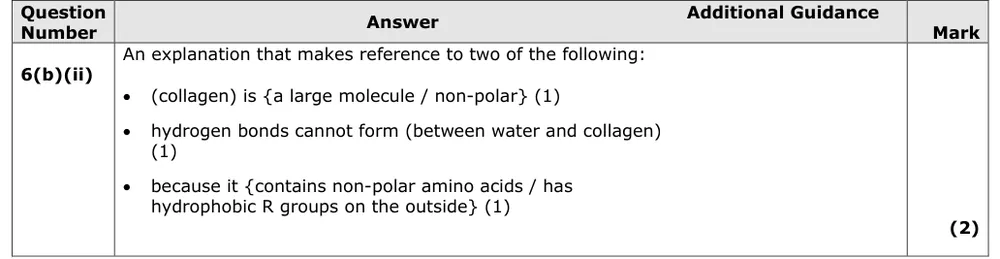
Explain why collagen has a low solubility in water.
Information from earlier in this question:

Show the mark scheme
Tap an image to open it full size.
From the examiners' report: Most said collagen has non-polar or hydrophobic regions. Better answers said this is because of hydrophobic R groups on the surface, so hydrogen bonds cannot form with water.
How enzymes work (2.10 i)
Question 15
AS Paper 1 · June 2019 · Q2(c) · 2 marks
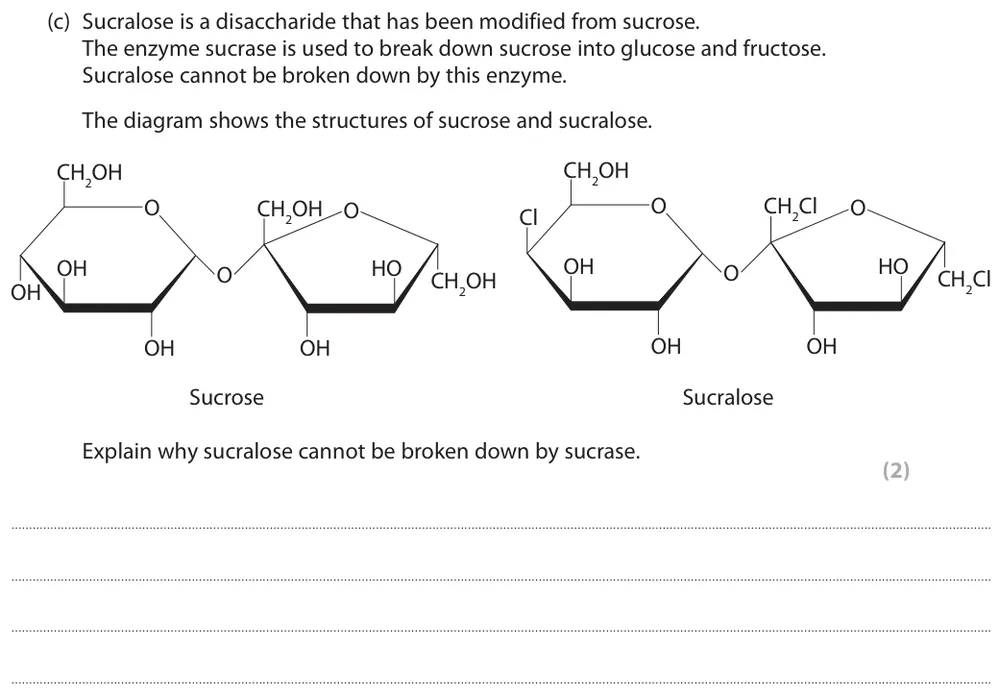
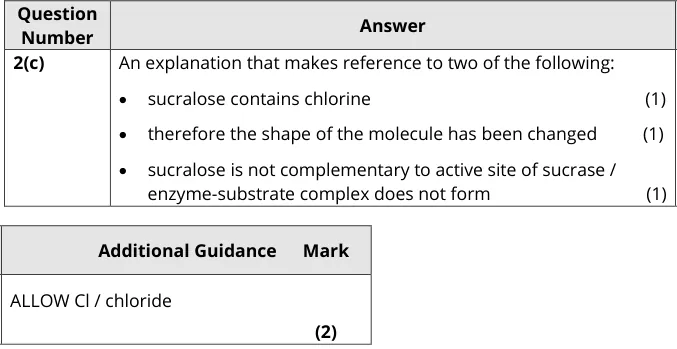
Explain why sucralose cannot be broken down by sucrase.
Show the mark scheme
Tap an image to open it full size.
From the examiners' report: Look at the diagrams for the difference (sucralose contains chlorine), then use the terms active site and enzyme-substrate complex: sucralose is not complementary to the active site.
Question 16
AS Paper 1 · June 2022 · Q7(c) · 2 marks
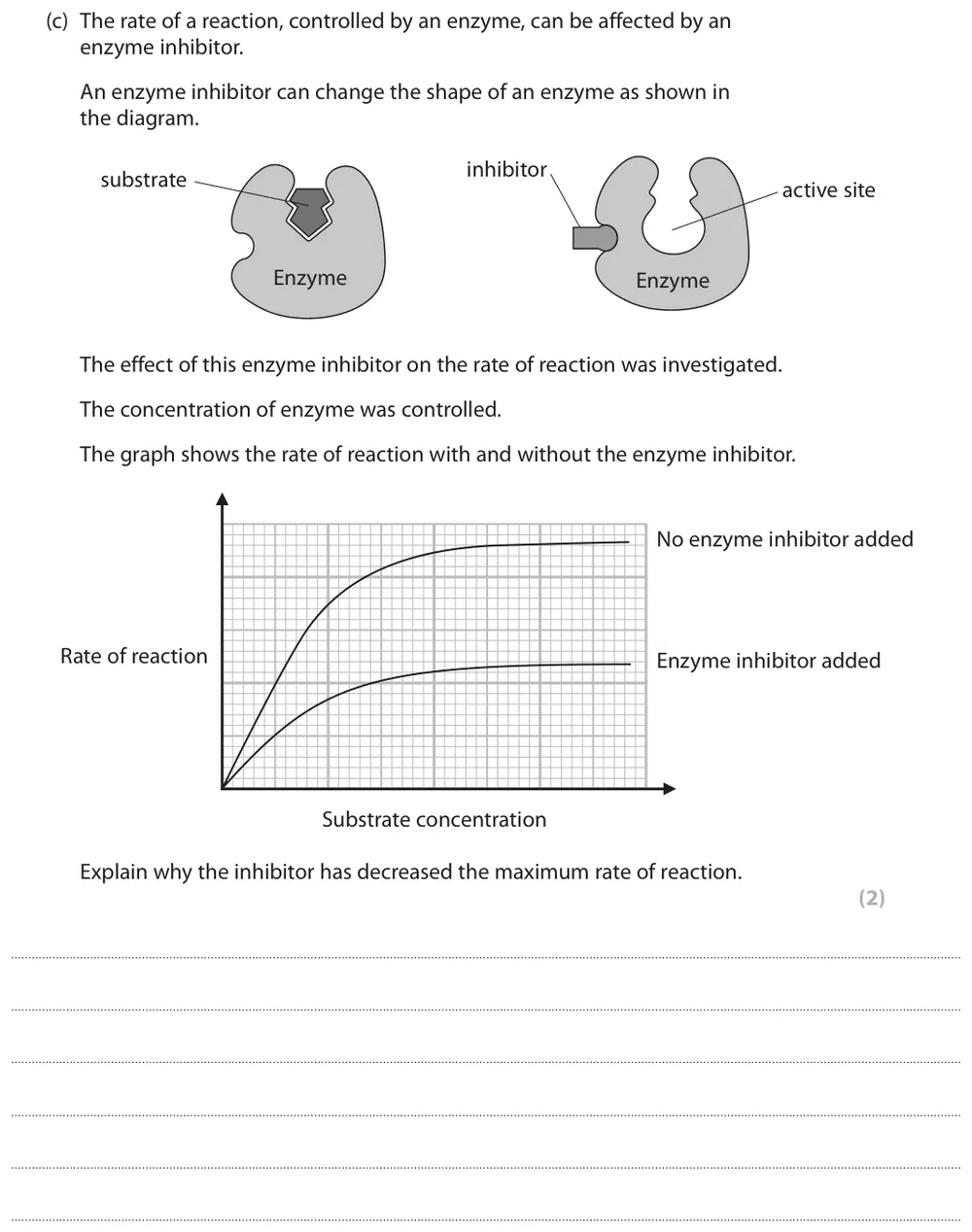
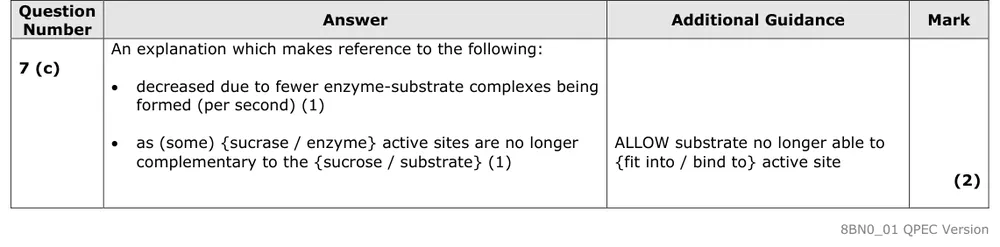
Explain why an inhibitor has decreased the maximum rate of reaction.
Show the mark scheme
Tap an image to open it full size.
From the examiners' report: Many said no enzyme-substrate complexes would form, but the graph shows the reaction still happens. Say fewer complexes form because some active sites are no longer complementary to the substrate.
Question 17
A level Paper 1 · October 2020 · Q1(b)(ii) · 3 marks
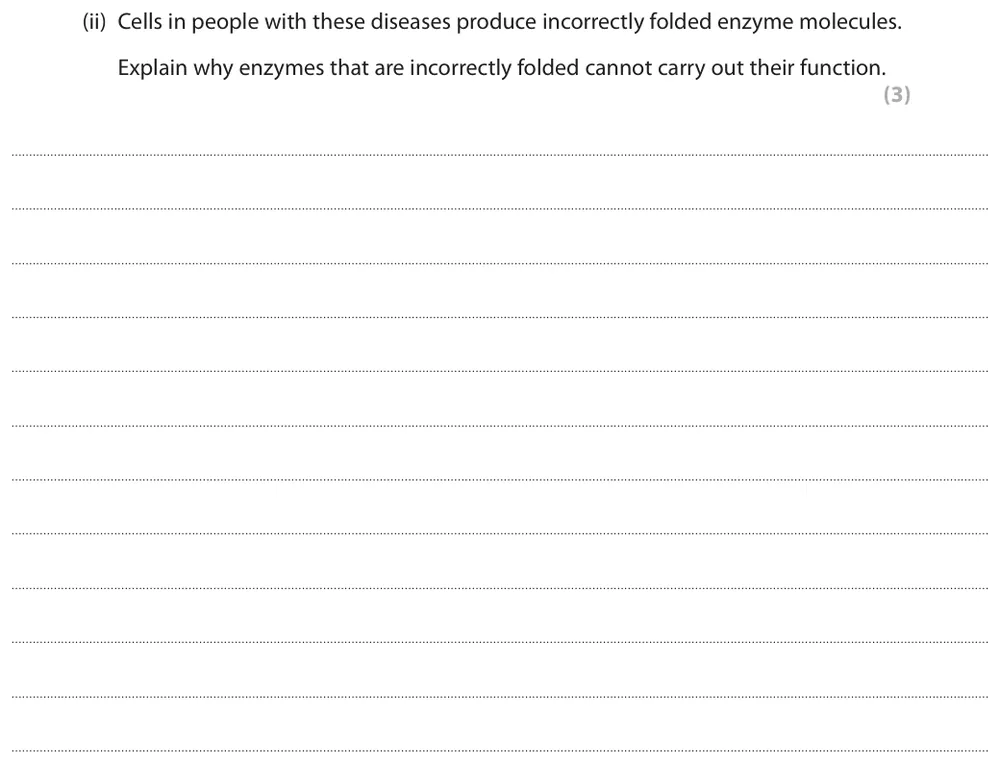
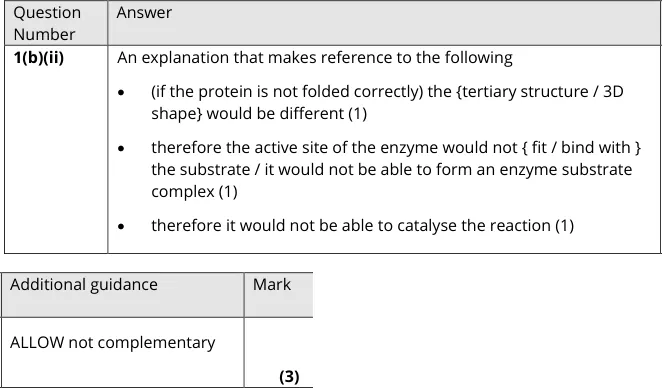
Explain why incorrectly folded enzymes cannot carry out their function.
Show the mark scheme
Tap an image to open it full size.
From the examiners' report: Link the changed active site to a different tertiary structure, then say what follows: no enzyme-substrate complex forms, so the reaction is not catalysed.
Question 18
A level Paper 2 · June 2018 · Q9(b) · 3 marks
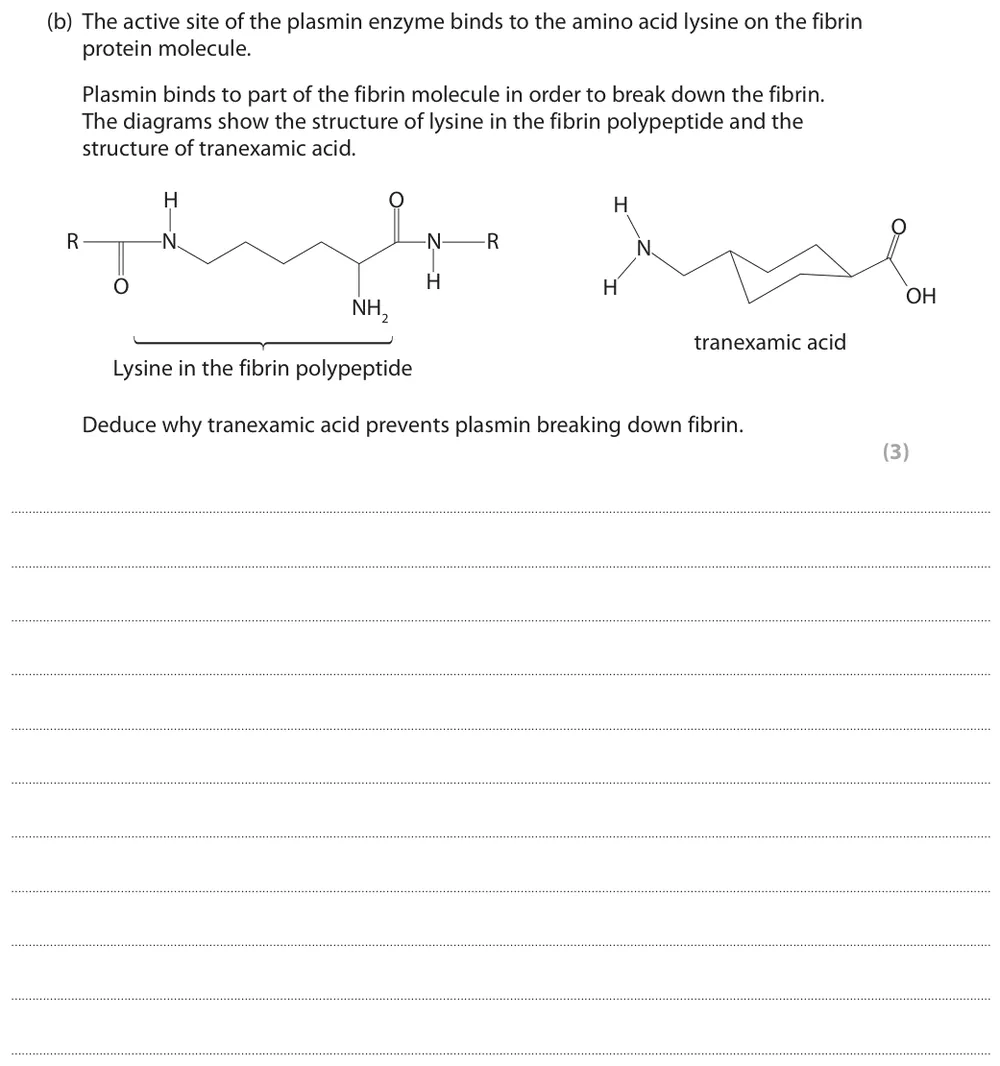
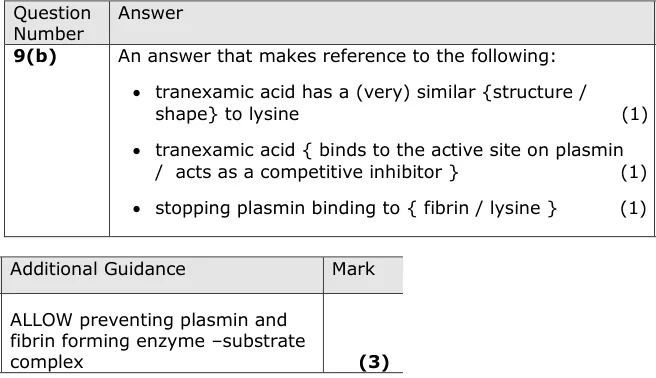
Deduce why tranexamic acid stops plasmin breaking down fibrin.
Show the mark scheme
Tap an image to open it full size.
From the examiners' report: Point out that tranexamic acid has a similar shape to lysine, then say it binds to the active site as a competitive inhibitor. It does not change the enzyme's shape.
Enzymes as biological catalysts (2.10 ii)
Question 19
AS Paper 1 · June 2017 · Q8(a) · 1 mark
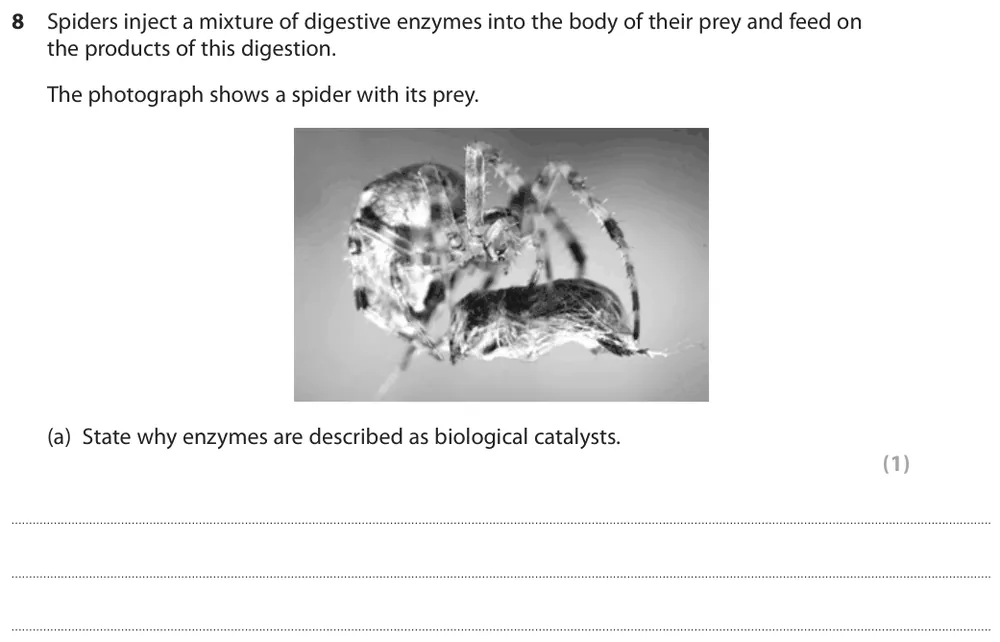
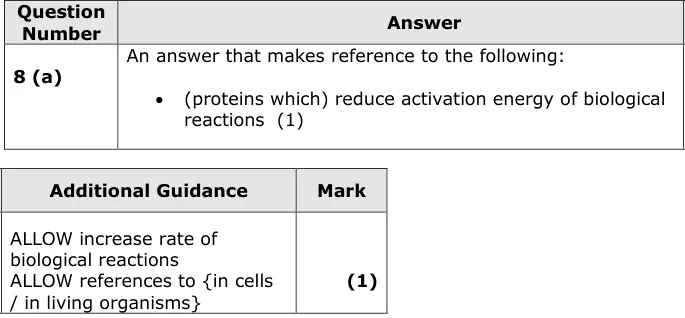
State why enzymes are described as biological catalysts.
Show the mark scheme
Tap an image to open it full size.
From the examiners' report: Most only explained what a catalyst is and ignored 'biological'. Say they speed up reactions in cells or living organisms by lowering activation energy.
Intracellular and extracellular enzymes (2.10 iii)
Question 20
AS Paper 1 · June 2025 · Q6(c) · 2 marks · Easy
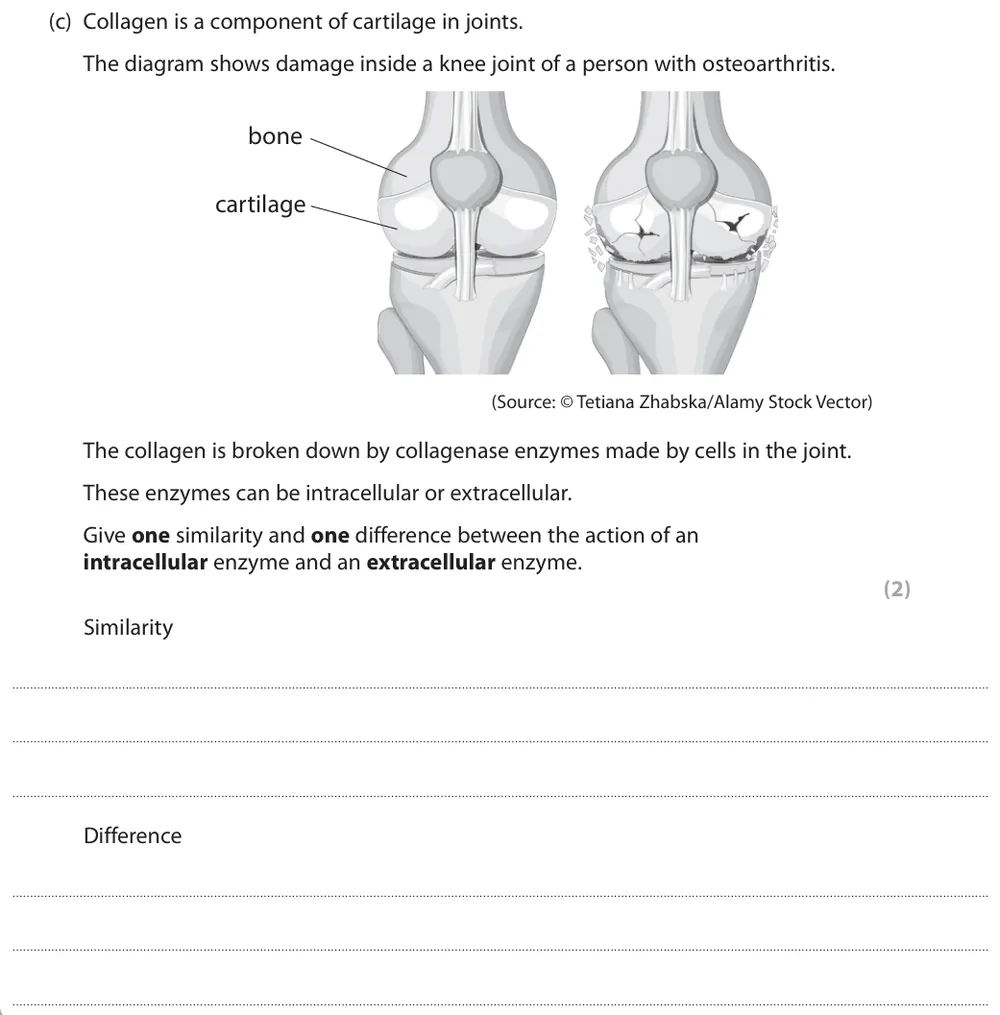
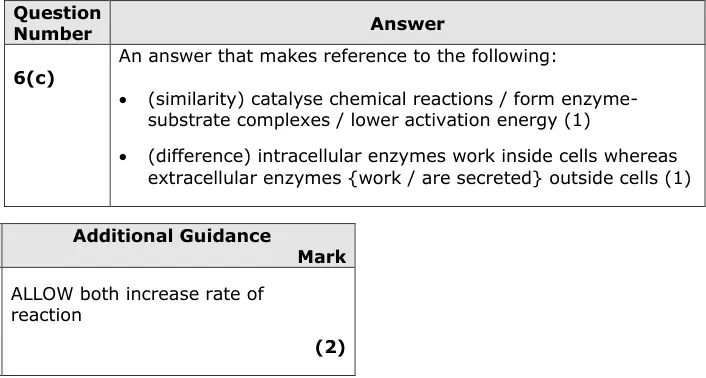
Give one similarity and one difference between intracellular and extracellular enzymes.
Show the mark scheme
Tap an image to open it full size.
From the examiners' report: Most gave the difference (inside versus outside cells). For the similarity, 'both collide with the substrate' was not enough; both form enzyme-substrate complexes.
Where students lose marks (from Pearson examiners' reports and mark schemes)
Each point below comes from the examiners' reports and mark schemes, and is followed by wording that gained marks.
Find the amine group. Some circled the R group or the carboxylic acid group instead.
✔ Gains credit: 'Amine group correctly circled' (the NH2 on the central carbon).
Order matters in primary structure. A few wrote 'a chain of amino acids', which misses the significance of the order.
✔ Gains credit: 'The sequence of amino acids, joined together by peptide bonds.'
R groups fold the tertiary structure. A number linked changes in R groups to the secondary structure, or paraphrased the stem.
✔ Gains credit: 'Different R groups change the bonds formed between R groups, so the polypeptide folds differently, giving a different tertiary structure.'
Hydrophilic groups bond with water. Few described how hydrophilic groups on the outside interact with water.
✔ Gains credit: 'Hydrophilic R groups are on the outside of the protein, so water forms hydrogen bonds with them.'
Compare structure, not function. Many described functions, listed examples, or did not make comparative statements.
✔ Gains credit: 'Globular proteins are folded into compact shapes whereas fibrous proteins have long chains.'
Collagen needs detail. Many called collagen a polypeptide without giving the number of chains or the bonds between them.
✔ Gains credit: 'Three polypeptide chains in a helix, held together by hydrogen bonds.'
Fewer complexes, not none. Many thought the inhibitor would stop all enzyme-substrate complexes forming, which the graph showed was not the case.
✔ Gains credit: 'Fewer enzyme-substrate complexes are formed per second, as some active sites are no longer complementary to the substrate.'
Biological is the key word. Most explained what a catalyst is but gave no biological reference.
✔ Gains credit: 'Proteins which reduce the activation energy of biological reactions.'
Download the questions
Download the PDF pack (20 questions, mark schemes at the end)
Keep practising
- Gas Exchange, Membranes and Transport (Topic 2): Edexcel SNAB exam questions by topic
- DNA, RNA and Protein Synthesis (Topic 2): Edexcel SNAB exam questions by topic
- Inheritance (Topic 2): Edexcel SNAB exam questions by topic
- Cystic Fibrosis, Mutation and Genetic Screening (Topic 2): Edexcel SNAB exam questions by topic
- Enzyme Concentration and Initial Rates (Core Practical 4): Edexcel SNAB core practical questions
- Topic 2 multiple-choice quiz (75 questions, marked as you tap)
- Edexcel SNAB A level Biology resources hub (every topic, practical and paper)
- Vitamin C and Membrane Permeability (Core Practicals 2 and 3): Edexcel SNAB A Level Biology Exam Questions
- Extended Response Questions (Topics 1 and 2): Edexcel SNAB A Level Biology Exam Questions
- Edexcel SNAB A level Biology past papers, mark schemes and examiners' reports
- Edexcel SNAB A level Biology grade boundaries
- Message Tom on WhatsApp about one-to-one Edexcel SNAB tutoring or an Edexcel group class
Questions, mark schemes and examiners' report extracts © Pearson Education Ltd.