

DNA, RNA and Protein Synthesis sits in Topic 2, Genes and Health, of the Edexcel A level Biology A (Salters-Nuffield) specification. You need to know the structure of mononucleotides, DNA and RNA, how complementary base pairing and hydrogen bonds hold the double helix together, how a gene is transcribed and translated into a polypeptide, the nature of the genetic code, how DNA is replicated, and how Meselson and Stahl's experiment showed that replication is semi-conservative. This topic is examined on AS Paper 1 and on A level Papers 1 and 2. Questions marked AS are from the AS papers (8BN0); the rest are from the A level papers (9BN0).
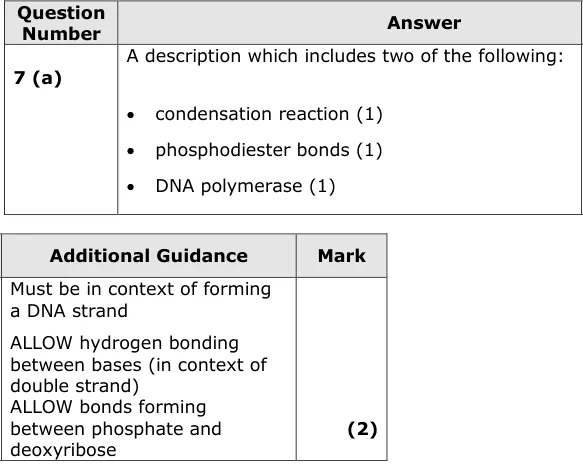
The examiners' reports keep coming back to the names of bonds and enzymes. Nucleotides in a strand are joined by phosphodiester bonds in condensation reactions; hydrogen bonds join the bases of the two strands. RNA polymerase makes mRNA, while DNA polymerase joins DNA nucleotides. When a question asks for the role of tRNA or mRNA, describe what that molecule does rather than writing out the whole of protein synthesis, and when you explain the genetic code or a replication model, use the data you are given.
Studying Edexcel SNAB and want more help? If you'd like to arrange one-to-one Edexcel tutoring, or to register your interest in an Edexcel group class, message Tom on WhatsApp using the link at the bottom of this page.
What you need from GCSE
Each question on this page assumes you're secure on these ideas. If any of them feels shaky, look it up before you start.
- DNA is a double helix made of two strands, found in the nucleus of animal and plant cells.
- A gene is a section of DNA that codes for a particular protein.
- Proteins are made of amino acids, joined together on ribosomes.
- The four DNA bases are A, T, C and G, and A pairs with T while C pairs with G.
Key terms
These words come up in the questions and mark schemes. Examiners expect you to use them exactly.
- Mononucleotide: a pentose sugar (deoxyribose or ribose) joined to a phosphate group and an organic base.
- Phosphodiester bond: the bond formed in a condensation reaction between the phosphate of one nucleotide and the sugar of the next.
- Complementary base pairing: A pairs with T (or U in RNA) by two hydrogen bonds, and C pairs with G by three.
- Template (antisense) strand: the DNA strand that RNA nucleotides pair with during transcription.
- Codon: a sequence of three bases on mRNA that codes for one amino acid, or is a start or stop signal.
- Anticodon: the three bases on a tRNA molecule that pair with a complementary codon on mRNA.
- Degenerate code: most amino acids are coded for by more than one triplet.
- Semi-conservative replication: each new DNA molecule contains one original strand and one newly made strand.
What these questions cover (Edexcel SNAB Topic 2: Genes and Health)
The questions test these statements from Topic 2 of the Pearson Edexcel A level Biology A (Salters-Nuffield) specification (9BN0).
- 2.5 i Know the basic structure of mononucleotides (deoxyribose or ribose linked to a phosphate and a base, including thymine, uracil, cytosine, adenine or guanine) and the stru
- 2.5 ii Know how complementary base pairing and the hydrogen bonding between two complementary strands are involved in the formation of the DNA double helix.
- 2.6 i Understand the process of protein synthesis (transcription) including the role of RNA polymerase, translation, messenger RNA, transfer RNA, ribosomes and the role of star
- 2.6 ii Understand the roles of the DNA template (antisense) strand in transcription, codons on messenger RNA and anticodons on transfer RNA.
- 2.7 Understand the nature of the genetic code (triplet code, non-overlapping and degenerate).
- 2.8 Know that a gene is a sequence of bases on a DNA molecule that codes for a sequence of amino acids in a polypeptide chain.
- 2.11 i Understand the process of DNA replication, including the role of DNA polymerase.
- 2.11 ii Understand how Meselson and Stahl’s classic experiment provided new data that supported the accepted theory of replication of DNA and refuted competing theories.
How to use this page
Write your answer on paper before you open the mark scheme. Allow about 1.2 minutes per mark: the 20 questions are worth 48 marks, so about 58 minutes in total. Then mark your answer strictly against the mark scheme and read the examiners' tip underneath it. If you'd rather print the questions, download the PDF pack.
Nucleotides, DNA and RNA (2.5 i)
Question 1
AS Paper 1 · June 2017 · Q7(a) · 2 marks
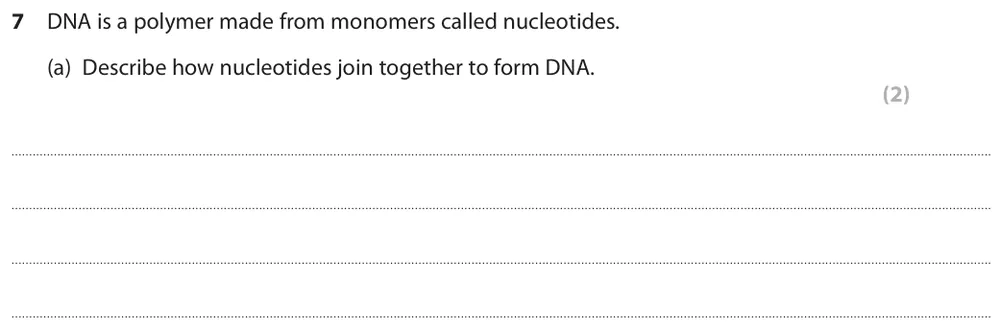
Describe how nucleotides join together to form DNA.
Show the mark scheme
Tap an image to open it full size.
From the examiners' report: About a fifth scored nothing, usually for naming the wrong bond. Say phosphodiester bonds form between the phosphate and deoxyribose (not ribose) in condensation reactions, not hydrolysis; very few mentioned DNA polymerase.
Question 2
AS Paper 1 · June 2019 · Q7(b)(ii) · 3 marks · Easy
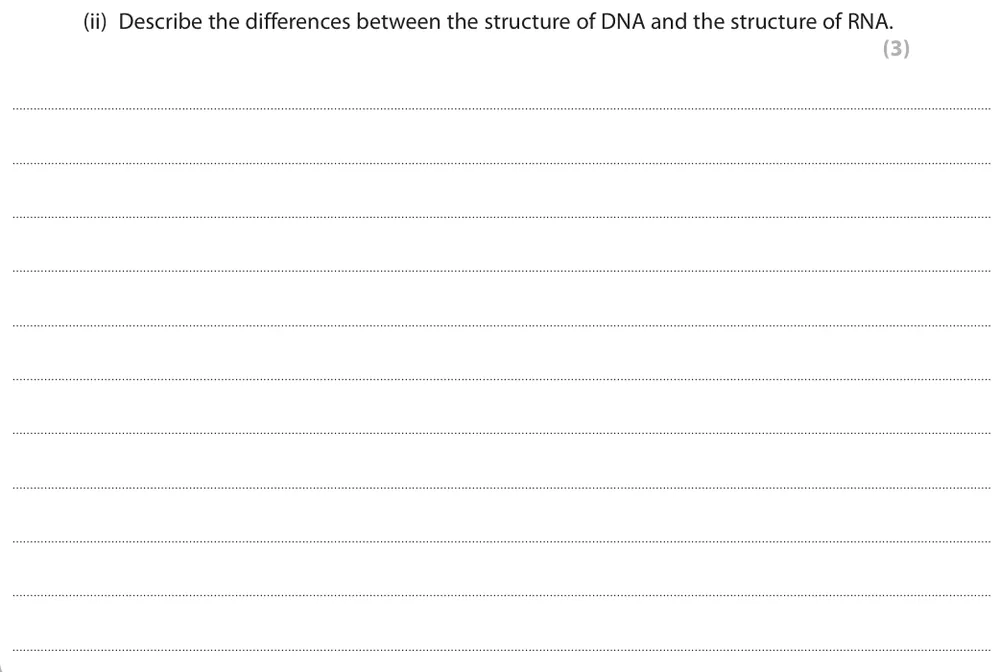
Describe the differences between the structure of DNA and the structure of RNA.
Show the mark scheme
Tap an image to open it full size.
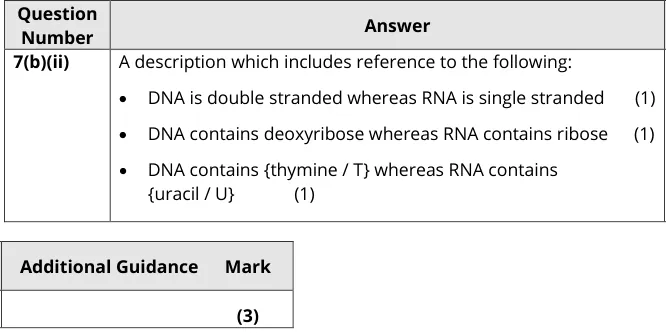
From the examiners' report: Make a comment about each molecule in every point. 'DNA has a double helix but RNA doesn't' was not enough: say DNA is double-stranded whereas RNA is single-stranded.
Question 3
A level Paper 2 · June 2025 · Q9(b)(ii) · 3 marks
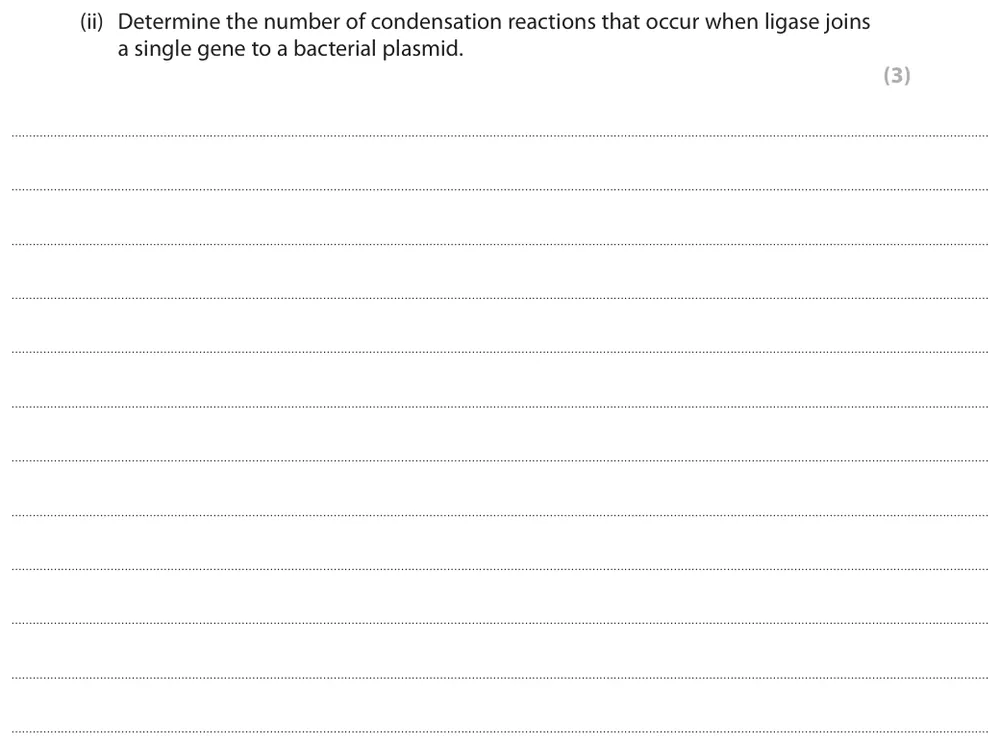
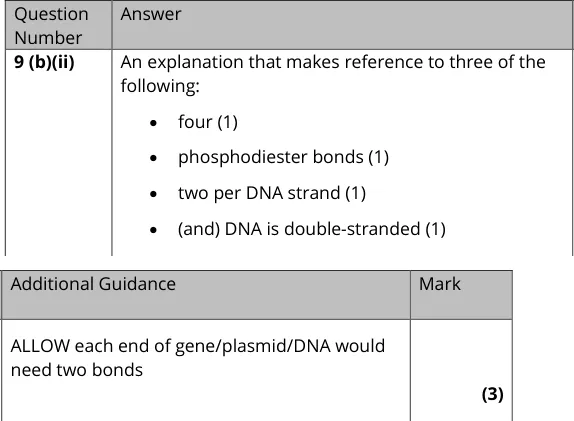
Work out how many condensation reactions occur when ligase joins a gene into a plasmid.
Information from earlier in this question:

Show the mark scheme
Tap an image to open it full size.
From the examiners' report: Justify your number. Many answers showed the misconception that plasmid DNA is single-stranded, or said there was only one condensation reaction; each end needs a phosphodiester bond on both strands, so four.
Base pairing and the double helix (2.5 ii)
Question 4
AS Paper 1 · June 2023 · Q1(a)(i) · 2 marks · Hard
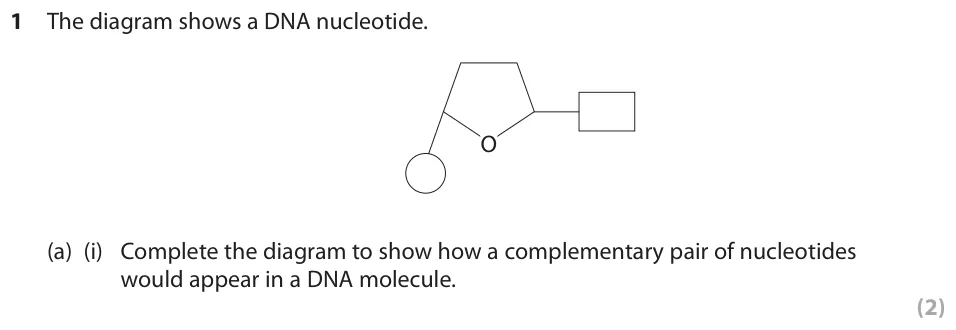
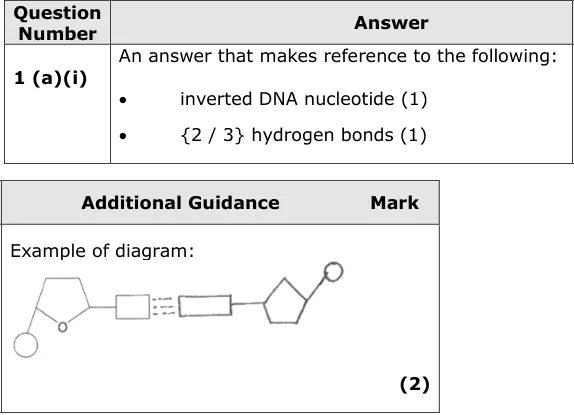
Complete a diagram to show a complementary pair of nucleotides in DNA.
Show the mark scheme
Tap an image to open it full size.
From the examiners' report: A significant minority left this blank. Many joined the nucleotides vertically, did not draw the second nucleotide inverted, or showed only one hydrogen bond between the bases.
Question 5
A level Paper 2 · June 2025 · Q5(a)(ii) · 3 marks
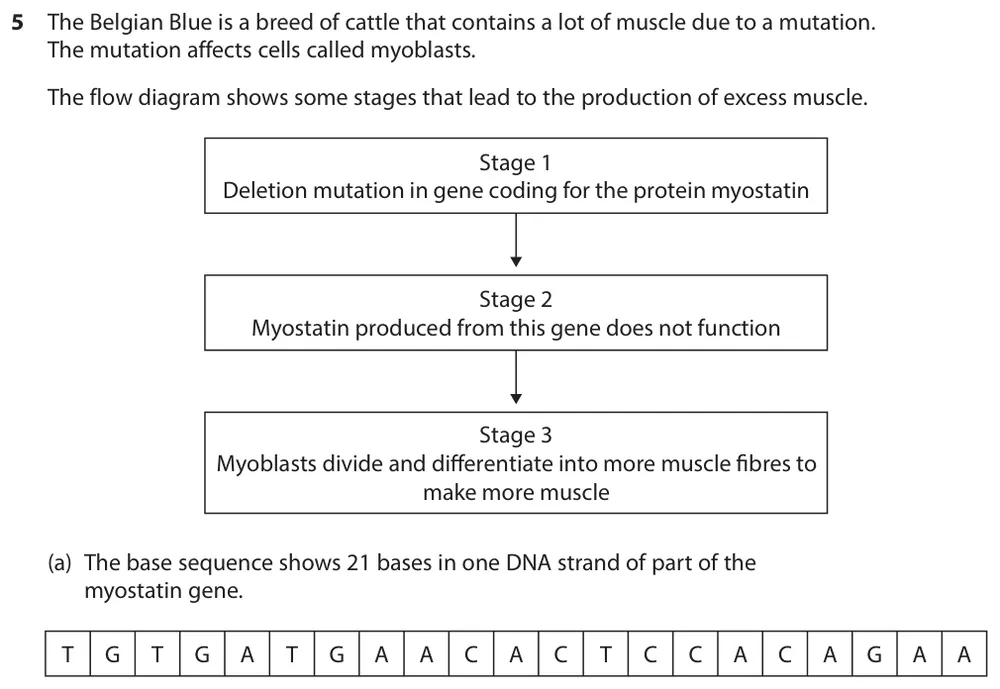
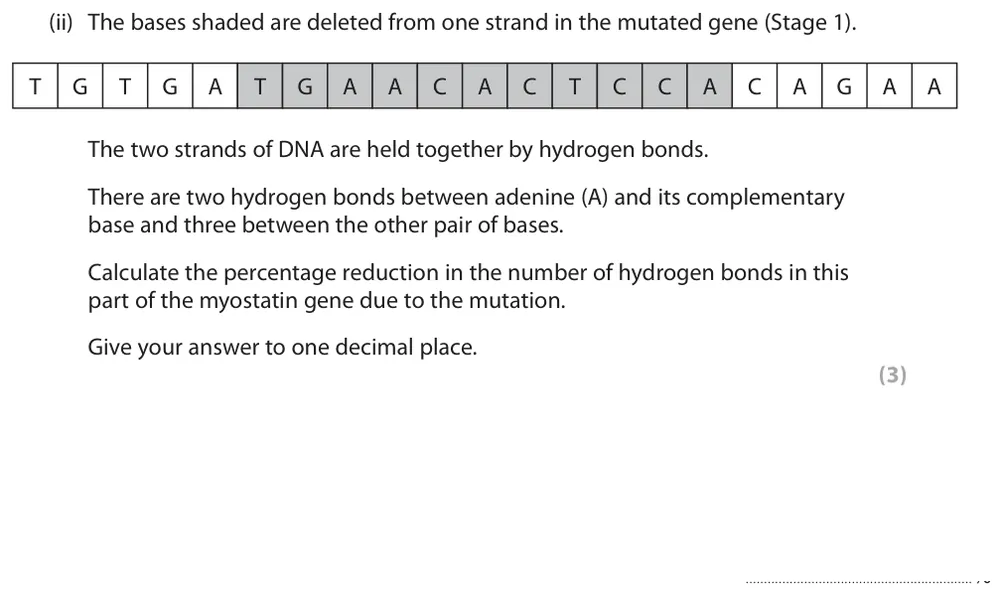
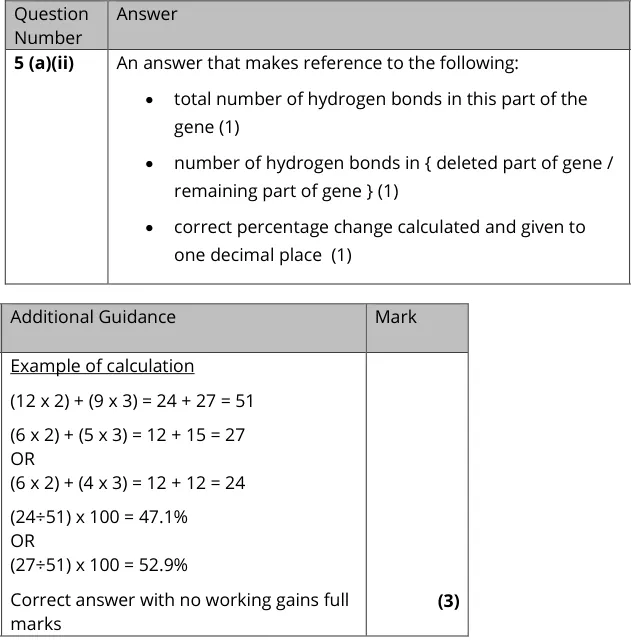
Calculate the percentage reduction in hydrogen bonds caused by a deletion.
Information from earlier in this question:
Show the mark scheme
Tap an image to open it full size.
From the examiners' report: Count two hydrogen bonds for each A–T pair and three for each C–G pair. Set out each stage of the working and check your additions: one common slip was a summing error for the deleted section.
Transcription and translation (2.6 i)
Question 6
AS Paper 1 · June 2019 · Q7(b)(i) · 2 marks
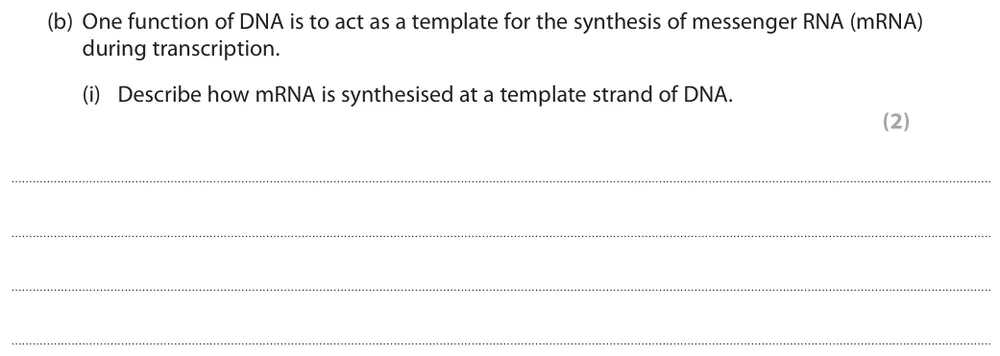
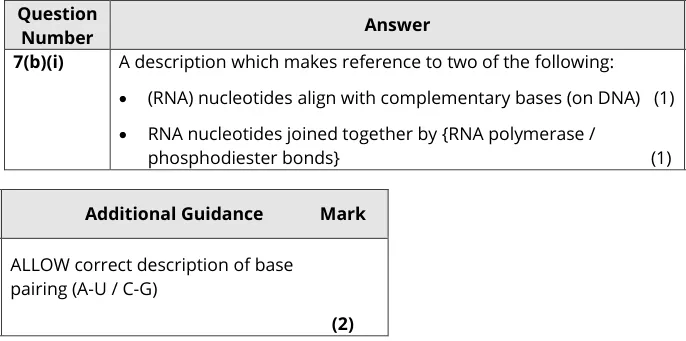
Describe how mRNA is synthesised at a template strand of DNA.
Show the mark scheme
Tap an image to open it full size.
From the examiners' report: Imprecise terms cost marks. RNA polymerase, not DNA polymerase, joins the RNA nucleotides, and they are joined by phosphodiester bonds, not hydrogen bonds.
Question 7
AS Paper 1 · June 2022 · Q1(b) · 3 marks
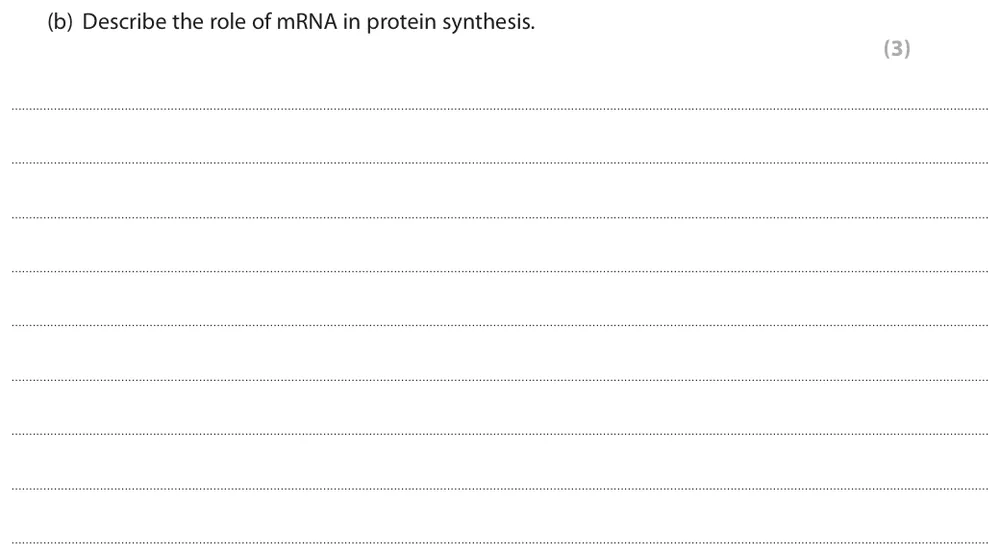
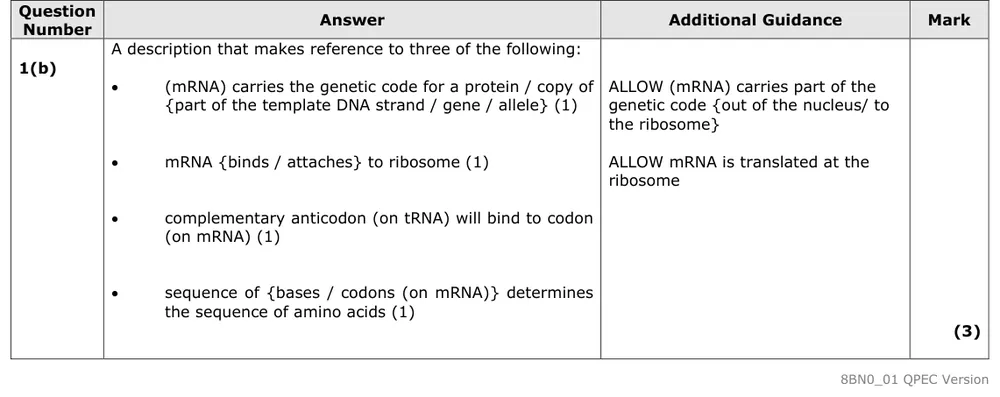
Describe the role of mRNA in protein synthesis.
Show the mark scheme
Tap an image to open it full size.
From the examiners' report: Many described transcription and translation in general terms and missed the 'role'. Say mRNA carries a copy of the genetic code to the ribosome, and that its sequence of codons determines the sequence of amino acids.
Question 8
AS Paper 1 · November 2021 · Q5(b)(iv) · 2 marks · Hard
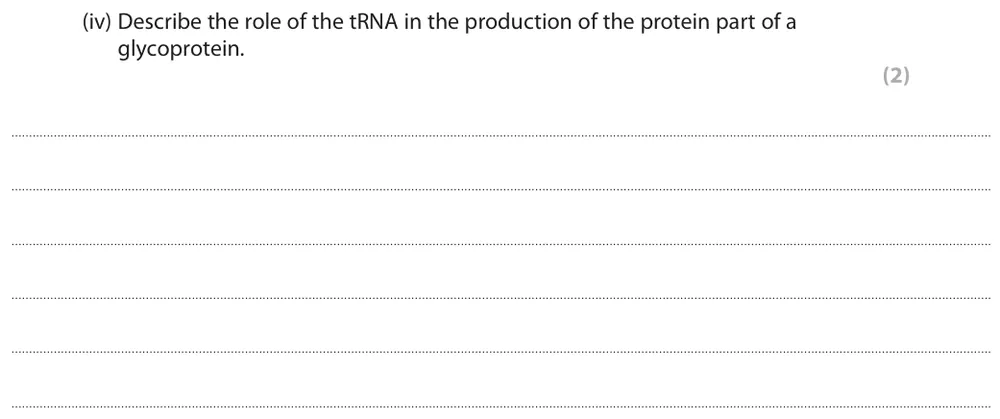
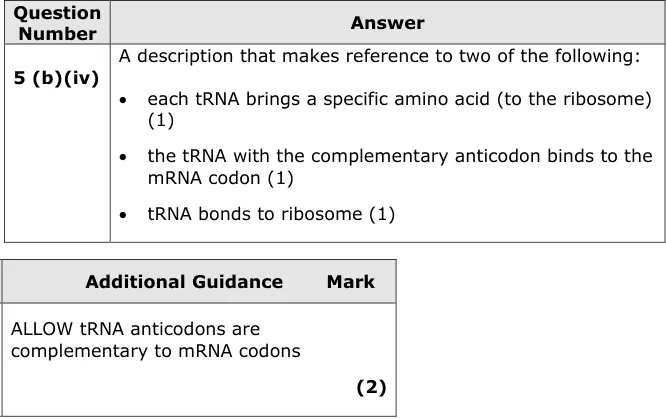
Describe the role of tRNA in producing the protein part of a glycoprotein.
Show the mark scheme
Tap an image to open it full size.
From the examiners' report: Focus on tRNA, not mRNA. Many said tRNA brings an amino acid to the ribosome but missed the specificity: each tRNA carries a specific amino acid and its anticodon is complementary to an mRNA codon.
Question 9
A level Paper 1 · June 2024 · Q8(a)(ii) · 3 marks · Easy
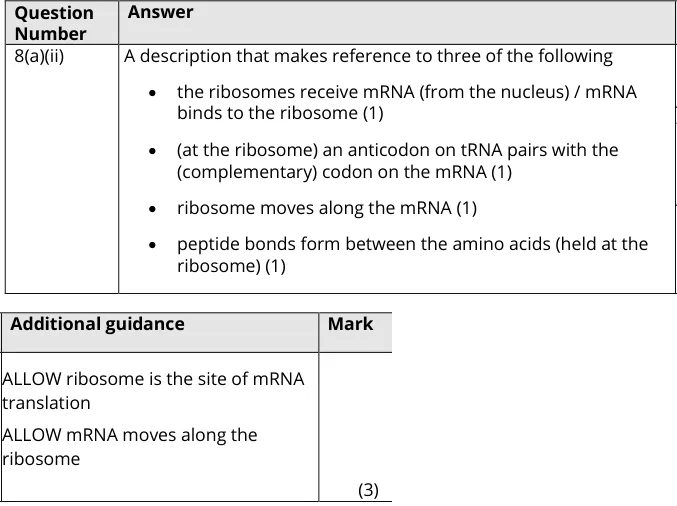
Describe the role of ribosomes in the synthesis of lactase.
Show the mark scheme
Tap an image to open it full size.
From the examiners' report: Describe the process in detail. Weaker answers did not say that tRNA anticodons pair with mRNA codons, or that peptide bonds form between the amino acids at the ribosome.
DNA template strand, codons and anticodons (2.6 ii)
Question 10
AS Paper 1 · June 2022 · Q1(a)(i) · 1 mark
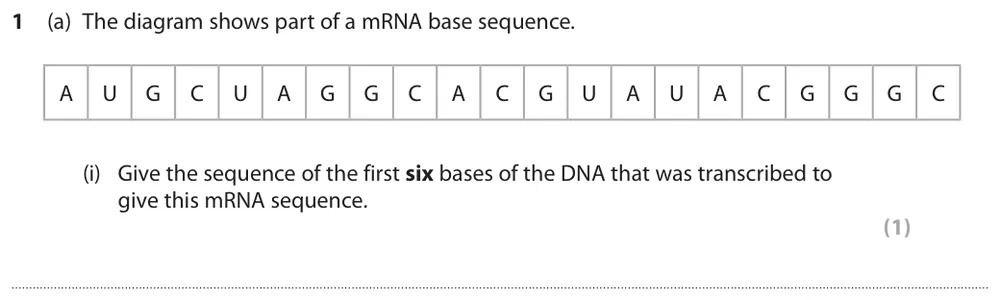
Give the first six bases of the DNA that was transcribed to give an mRNA sequence.
Show the mark scheme

Tap an image to open it full size.
From the examiners' report: Most students got this right: the template strand is complementary to the mRNA, with T in DNA where the mRNA has A.
Question 11
AS Paper 1 · June 2022 · Q1(a)(iii) · 1 mark · Hard
Give the maximum number of different tRNA molecules needed for this mRNA sequence.

Show the mark scheme

Tap an image to open it full size.
From the examiners' report: This was harder than it looked. Few students noticed that the codons ACG and GGC appear twice, so only five different tRNA molecules are needed.
Question 12
A level Paper 2 · June 2024 · Q4(b)(i) · 2 marks
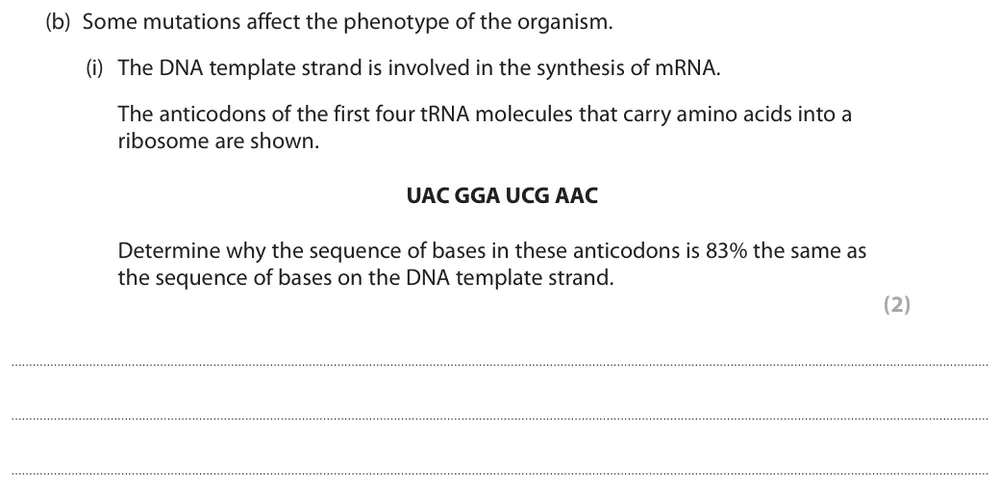
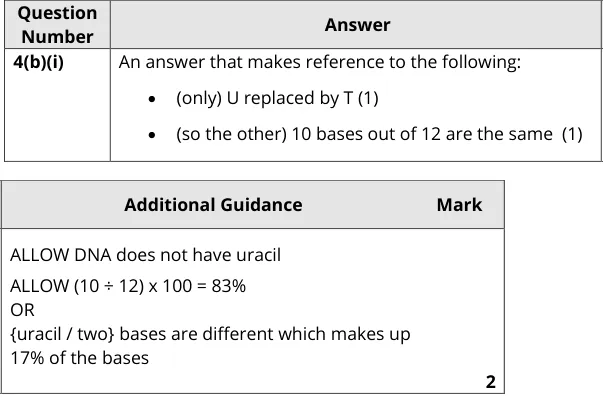
Determine why tRNA anticodons are 83% the same as the DNA template strand.
Show the mark scheme
Tap an image to open it full size.
From the examiners' report: Many said uracil replaces thymine but missed the 'determine' command, which needs a calculation: two of the twelve bases differ, so 10 ÷ 12 × 100 = 83% are the same.
The genetic code (2.7)
Question 13
AS Paper 1 · June 2016 · Q7(c) · 4 marks
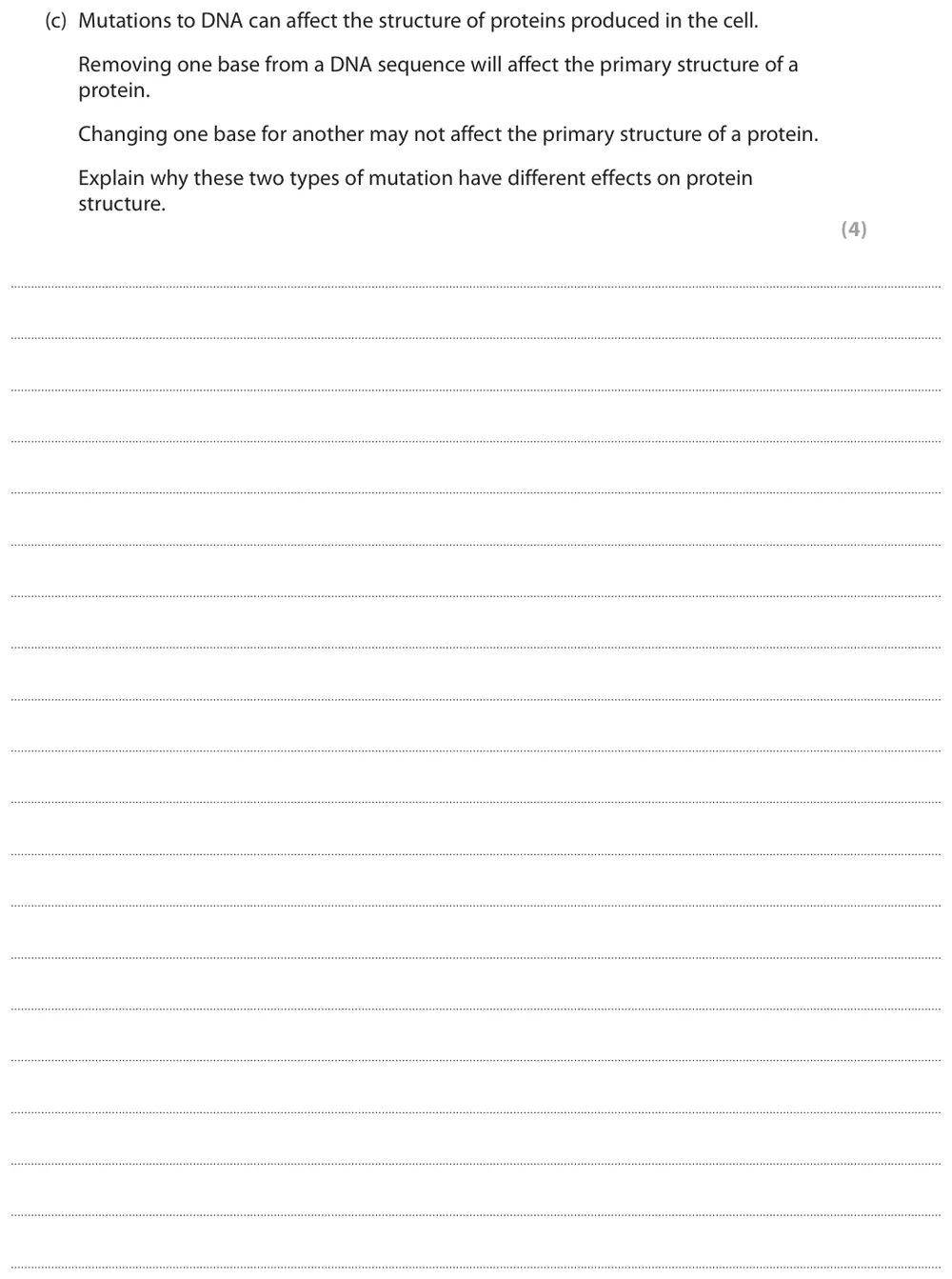
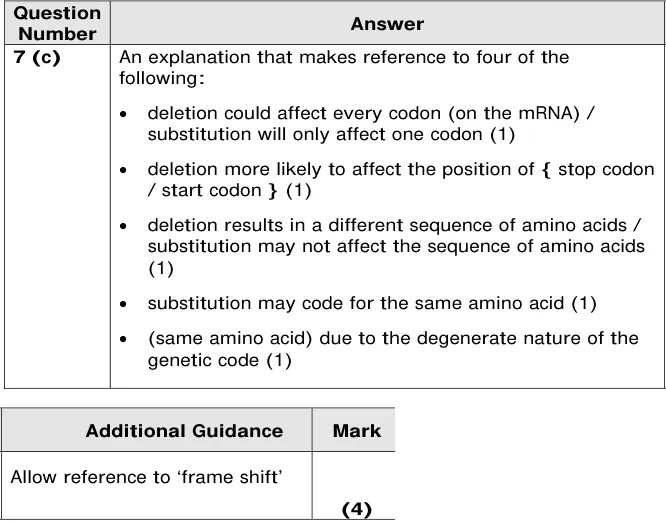
Explain why deleting a base and substituting a base have different effects on a protein.
Show the mark scheme
Tap an image to open it full size.
From the examiners' report: Eight in ten scored half marks or less. Don't just repeat the stem: explain that a deletion causes a frameshift that changes every codon after it, while a substitution may code for the same amino acid because the code is degenerate.
Question 14
A level Paper 1 · June 2017 · Q2(c)(ii) · 3 marks
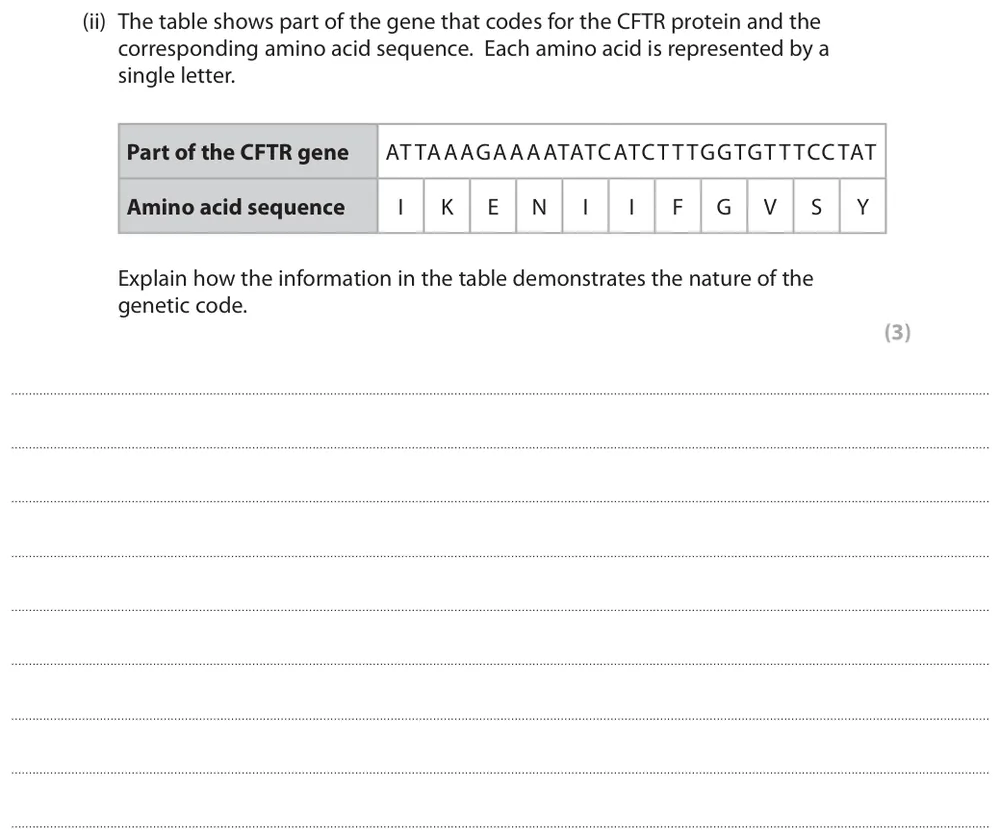
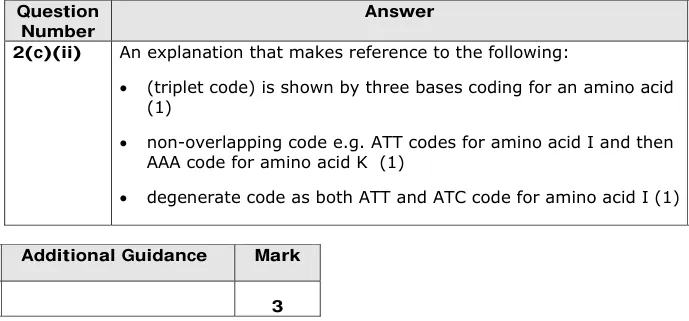
Explain how a gene sequence and amino acid sequence show the nature of the genetic code.
Show the mark scheme
Tap an image to open it full size.
From the examiners' report: Use the table. Say that three bases code for each amino acid (just 'codons' was not enough), and quote examples: ATT then AAA shows the code is non-overlapping, and ATT and ATC both coding for I shows it is degenerate.
Question 15
A level Paper 1 · June 2018 · Q4(b) · 2 marks · Hard
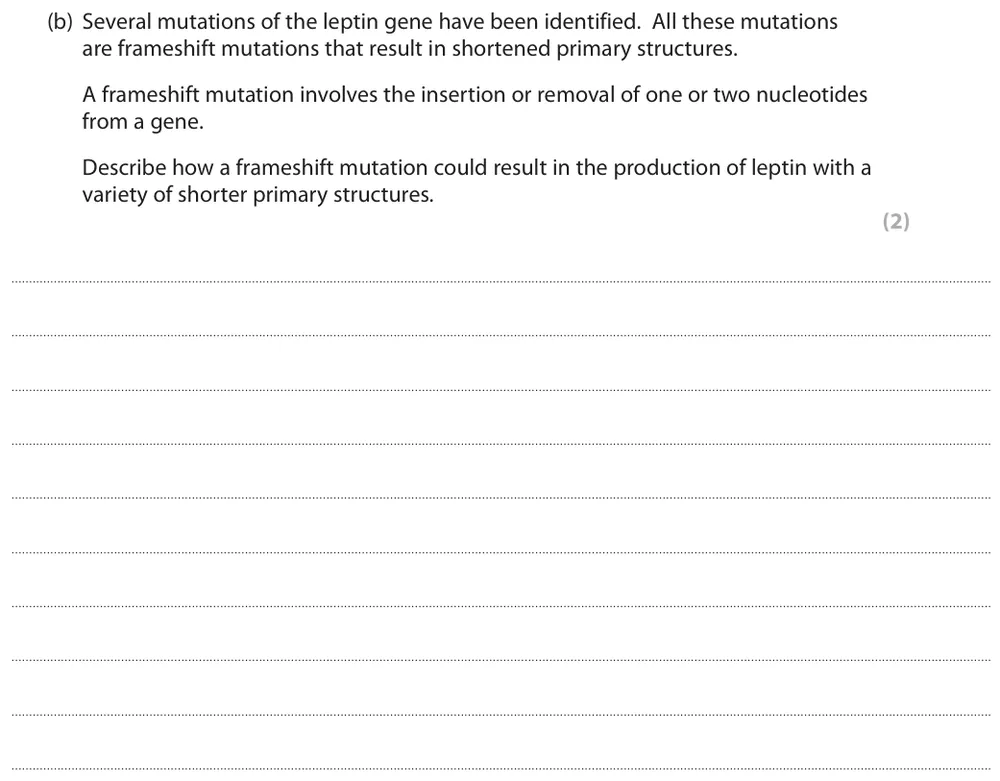
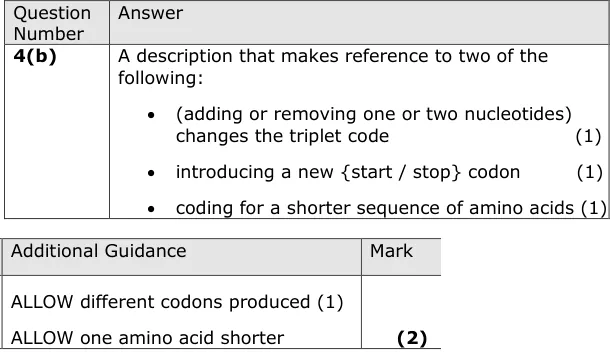
Describe how a frameshift mutation could give shorter forms of leptin.
Show the mark scheme
Tap an image to open it full size.
From the examiners' report: Most mentioned a new stop codon, but fewer explained the change to the triplet code. 'Shorter primary structure' was in the stem, so describe a shorter sequence of amino acids instead.
What a gene is (2.8)
Question 16
AS Paper 1 · June 2016 · Q7(b)(i) · 1 mark
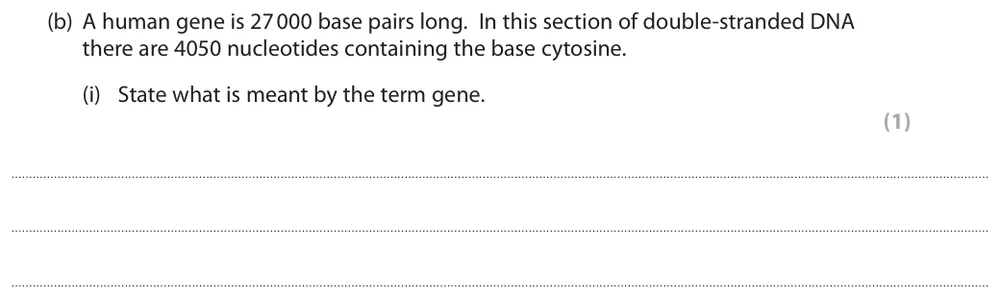
State what is meant by the term gene.
Show the mark scheme

Tap an image to open it full size.
From the examiners' report: Most students did not gain this mark. Learn the definition from the specification: a sequence of bases in DNA that codes for a polypeptide or protein. Don't confuse bases with amino acids.
DNA replication (2.11 i)
Question 17
A level Paper 1 · June 2023 · Q3(b)(ii) · 4 marks · Easy
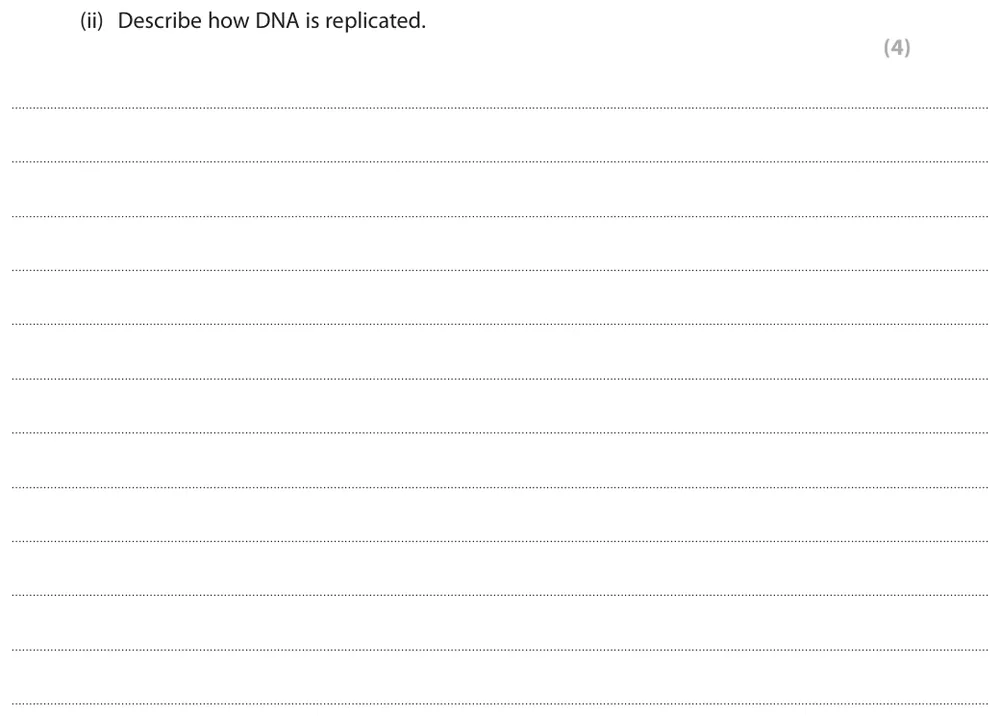
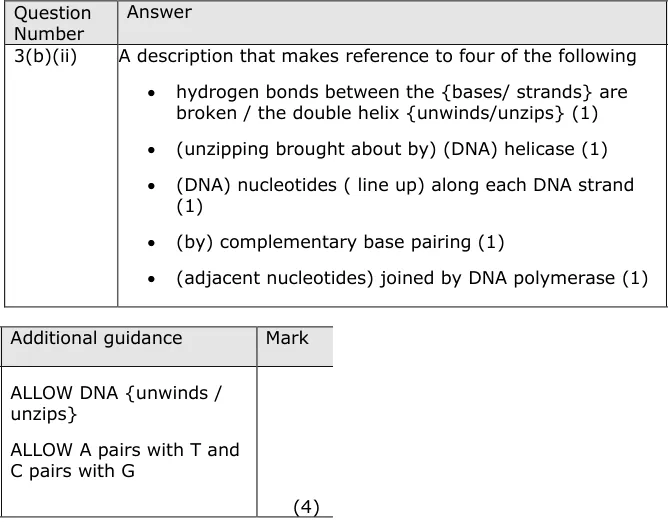
Describe how DNA is replicated.
Show the mark scheme
Tap an image to open it full size.
From the examiners' report: Show that both strands act as templates, and name each enzyme with its role: DNA helicase unzips the DNA and DNA polymerase joins the new nucleotides.
Question 18
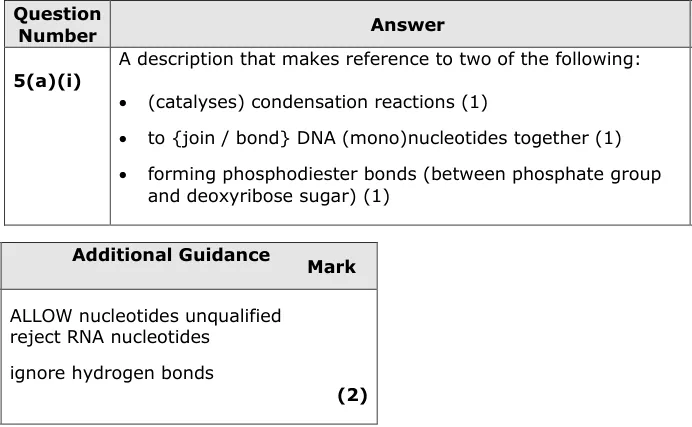
AS Paper 1 · June 2024 · Q5(a)(i) · 2 marks
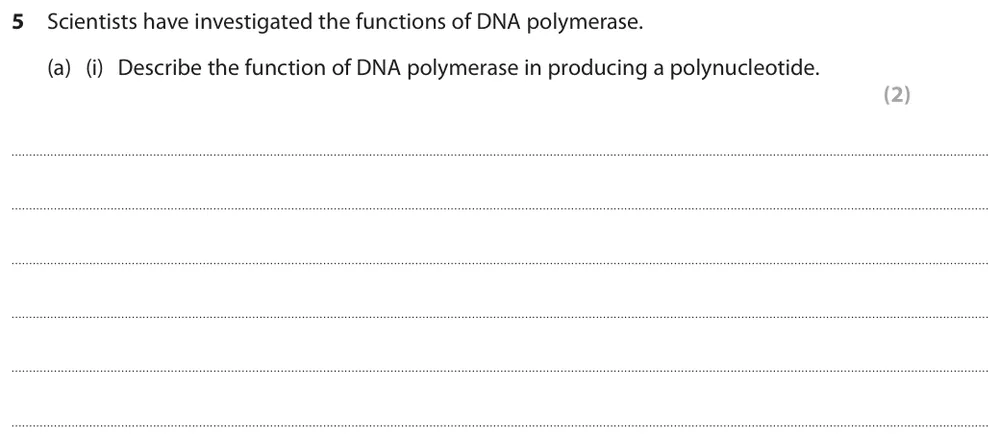
Describe the function of DNA polymerase in producing a polynucleotide.
Show the mark scheme
Tap an image to open it full size.
From the examiners' report: DNA polymerase does not form the hydrogen bonds between complementary bases. It catalyses condensation reactions that join DNA (not mRNA) nucleotides with phosphodiester bonds.
Meselson and Stahl's experiment (2.11 ii)
Question 19
A level Paper 2 · June 2023 · Q5(b)(i) · 3 marks
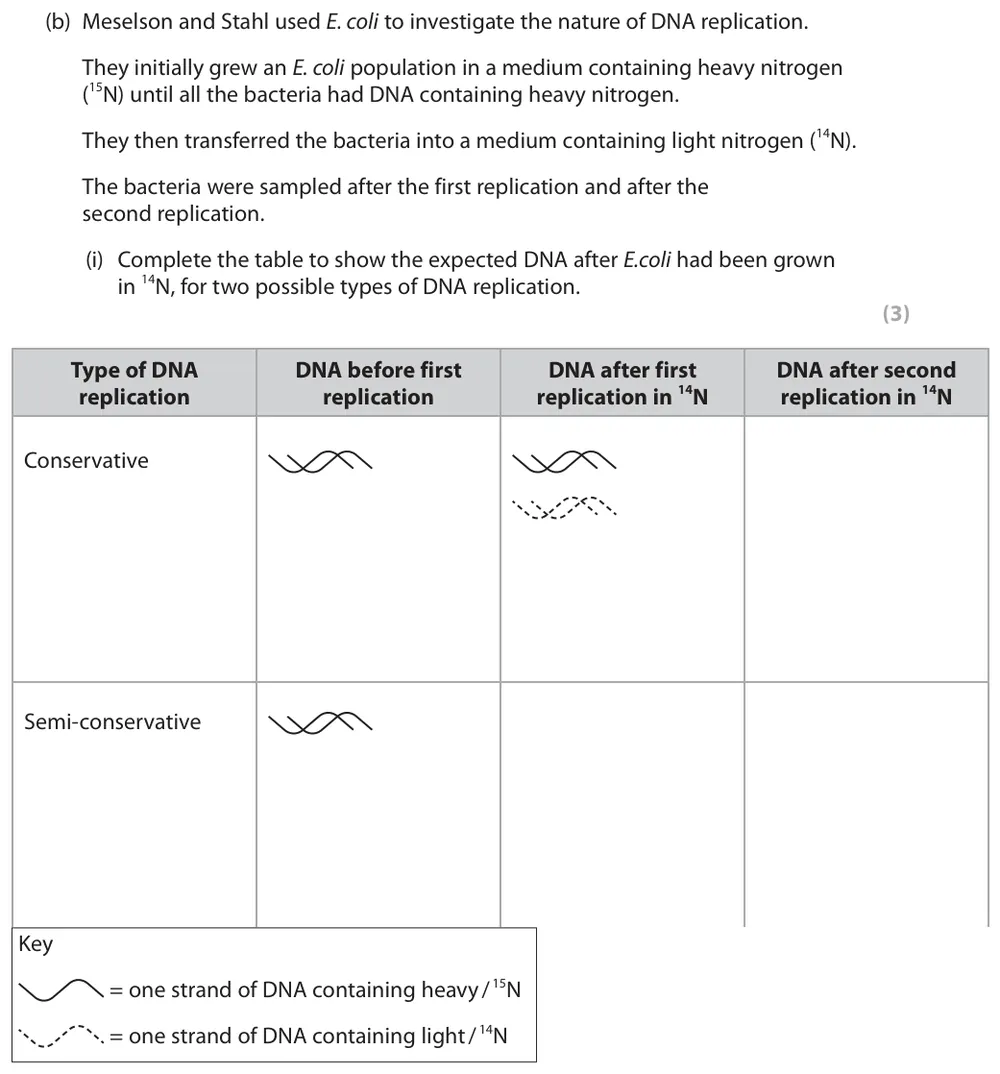
Complete a table to show the DNA expected after one and two replications in 14N for each model.
Show the mark scheme

Tap an image to open it full size.
From the examiners' report: Draw every daughter molecule: two after the first replication and four after the second. A common error was leaving one DNA molecule out.
Question 20
A level Paper 2 · June 2023 · Q5(b)(ii) · 2 marks
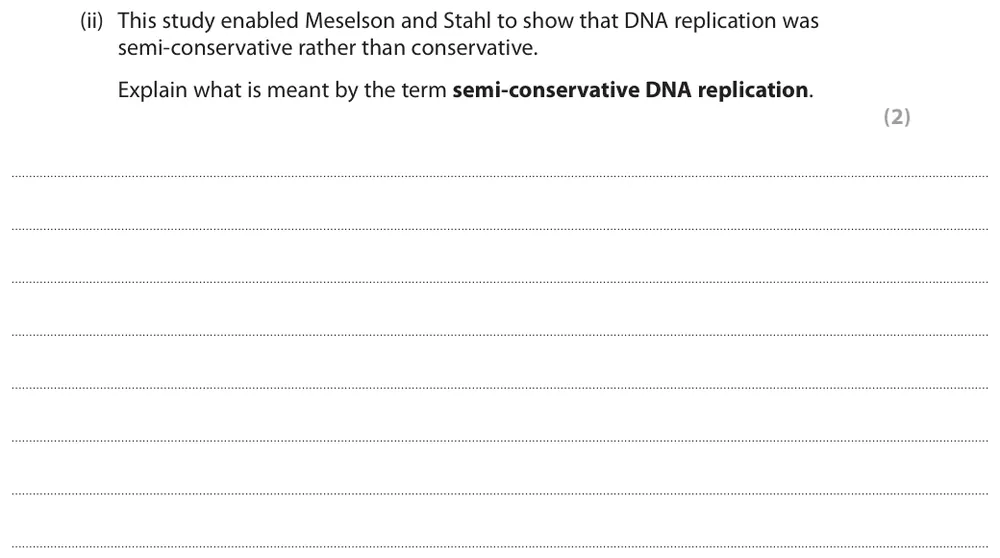
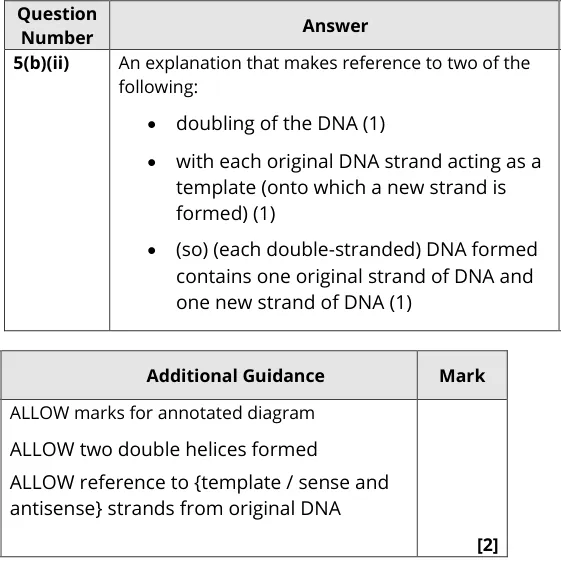
Explain what is meant by semi-conservative DNA replication.
Show the mark scheme
Tap an image to open it full size.
From the examiners' report: Many focused only on 'semi-conservative' and forgot 'replication'. Say the DNA is doubled, each original strand acts as a template, and each new molecule has one original and one new strand.
Where students lose marks (from Pearson examiners' reports and mark schemes)
Each point below comes from the examiners' reports and mark schemes, and is followed by wording that gained marks.
Condensation, not hydrolysis. A significant number said nucleotides join by hydrolysis, or named the wrong bond.
✔ Gains credit: 'Nucleotides are joined by condensation reactions, forming phosphodiester bonds between the phosphate and deoxyribose, catalysed by DNA polymerase.'
Plasmids are double-stranded too. Some answers treated plasmid DNA as single-stranded, or gave a single condensation reaction.
✔ Gains credit: 'Four phosphodiester bonds: two at each end of the gene, because DNA is double-stranded.'
RNA polymerase makes mRNA. Some wrote DNA polymerase, or said the RNA nucleotides are joined by hydrogen bonds.
✔ Gains credit: 'RNA nucleotides align with complementary bases on the DNA and are joined by RNA polymerase, forming phosphodiester bonds.'
tRNA is specific. Many said tRNA brings an amino acid to the ribosome without saying which one or how it is matched.
✔ Gains credit: 'Each tRNA brings a specific amino acid; the tRNA with the complementary anticodon binds to the mRNA codon.'
Count the repeated codons. Few recognised that ACG and GGC were repeated in the mRNA sequence.
✔ Gains credit: '5 / five' different tRNA molecules.
Explain why a substitution may not matter. Many said a substituted base may code for the same amino acid but did not say why.
✔ Gains credit: 'The substitution may code for the same amino acid, due to the degenerate nature of the genetic code; a deletion could affect every codon.'
A gene codes for a polypeptide. The majority did not gain the mark, often leaving out the polypeptide or confusing bases with amino acids.
✔ Gains credit: 'A sequence of bases in DNA coding for a polypeptide.'
Both strands are templates. Marks were lost where only one DNA strand was used as a template or the enzymes were confused.
✔ Gains credit: 'Hydrogen bonds between the bases are broken by DNA helicase; DNA nucleotides line up along each strand by complementary base pairing and are joined by DNA polymerase.'
Download the questions
Download the PDF pack (20 questions, mark schemes at the end)
Keep practising
- Gas Exchange, Membranes and Transport (Topic 2): Edexcel SNAB exam questions by topic
- Proteins and Enzymes (Topic 2): Edexcel SNAB exam questions by topic
- Inheritance (Topic 2): Edexcel SNAB exam questions by topic
- Cystic Fibrosis, Mutation and Genetic Screening (Topic 2): Edexcel SNAB exam questions by topic
- Topic 2 multiple-choice quiz (75 questions, marked as you tap)
- Edexcel SNAB A level Biology resources hub (every topic, practical and paper)
- Vitamin C and Membrane Permeability (Core Practicals 2 and 3): Edexcel SNAB A Level Biology Exam Questions
- Enzyme Concentration and Initial Rates (Core Practical 4): Edexcel SNAB A Level Biology Exam Questions
- Extended Response Questions (Topics 1 and 2): Edexcel SNAB A Level Biology Exam Questions
- Edexcel SNAB A level Biology past papers, mark schemes and examiners' reports
- Edexcel SNAB A level Biology grade boundaries
- Message Tom on WhatsApp about one-to-one Edexcel SNAB tutoring or an Edexcel group class
Questions, mark schemes and examiners' report extracts © Pearson Education Ltd.