

Core Practical 2 asks you to investigate the vitamin C content of food and drink: a set volume of blue DCPIP is titrated against the juice or extract until it turns colourless, and the volume needed is compared with a standard vitamin C solution or a calibration curve. Core Practical 3 asks you to investigate membrane structure, including the effect of alcohol concentration or temperature on membrane permeability: beetroot sections of the same size are placed in each solution and the betalain pigment that leaks out is measured with a colorimeter. These questions come from real Edexcel A level Biology A (Salters-Nuffield) papers. Core practicals can be examined on any paper, but Paper 3 at A level tests practical skills most heavily. Questions marked AS are from the AS papers (8BN0); the rest are from the A level papers (9BN0).
The examiners' reports say many students could recall the practical but did not apply it to the new context, such as cabbage leaves, breast milk or cooked broccoli. Describe a real titration, not counting drops from a pipette, know the DCPIP colour change, and explain how the volume becomes a vitamin C concentration. Include an uncooked sample when cooking is tested. For membranes, explain rather than describe: alcohol dissolves membrane lipids, so permeability rises and betalain diffuses out. Know the difference between a control and a controlled variable, and choose a suitable range for the independent variable.
Studying Edexcel SNAB and want more help? If you'd like to arrange one-to-one Edexcel tutoring, or to register your interest in an Edexcel group class, message Tom on WhatsApp using the link at the bottom of this page.
What you need first
Each question on this page assumes you're secure on these ideas. If any of them feels shaky, look it up before you start.
- Cell membranes are made of a phospholipid bilayer with proteins, as described by the fluid mosaic model.
- Vitamin C is a reducing agent that decolourises blue DCPIP.
- A titration adds one solution from a burette to a measured volume of another until an end point is reached.
- A colorimeter measures how much light a coloured solution absorbs; more pigment means higher absorbance.
Key terms
These words come up in the questions and mark schemes. Examiners expect you to use them exactly.
- DCPIP: a blue dye that turns colourless when vitamin C is added; used to measure vitamin C content.
- End point: the point in a titration when the colour change happens, such as DCPIP turning from blue to colourless.
- Calibration curve: a graph made from solutions of known vitamin C concentration, used to read off the concentration in an unknown sample.
- Betalain: the red pigment in beetroot cells; it leaks out when the membranes become more permeable.
- Membrane permeability: how easily substances can pass through a membrane; alcohol and high temperature increase it.
- Colorimeter: an instrument that measures the absorbance or transmission of light by a solution, giving quantitative data.
- Haemolysis: the bursting of red blood cells, used in one question as a measure of membrane damage.
- Control: a treatment without the factor being tested, such as saline with no alcohol, used as a baseline for comparison.
What these questions cover
Every question on this page is set on Core Practical 2 or Core Practical 3 of the Pearson Edexcel A level Biology A (Salters-Nuffield) specification (9BN0).
- Core Practical 2: Investigate the vitamin C content of food and drink.
- Core Practical 3: Investigate membrane structure, including the effect of alcohol concentration or temperature on membrane permeability.
How to use this page
Write your answer on paper before you open the mark scheme. Allow about 1.2 minutes per mark: the 15 questions are worth 48 marks, so about 58 minutes in total. Then mark your answer strictly against the mark scheme and read the examiners' tip underneath it. If you'd rather print the questions, download the PDF pack.
Core Practical 2: testing for vitamin C
Question 1
AS Paper 1 · June 2022 · Q2(b)(i) · 2 marks
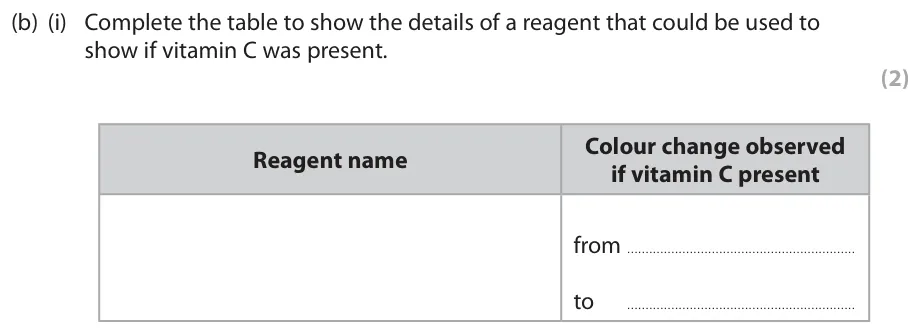
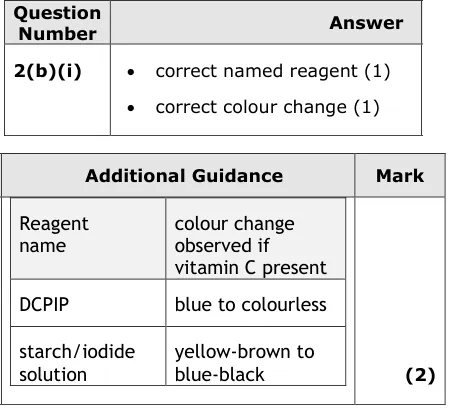
Name a reagent that shows vitamin C is present and give its colour change.
Show the mark scheme
Tap an image to open it full size.
From the examiners' report: Most students answered correctly, usually with DCPIP, although a few used starch/iodide solution. The most common incorrect reagent was phenolphthalein.
Question 2
AS Paper 1 · June 2022 · Q2(b)(ii) · 2 marks
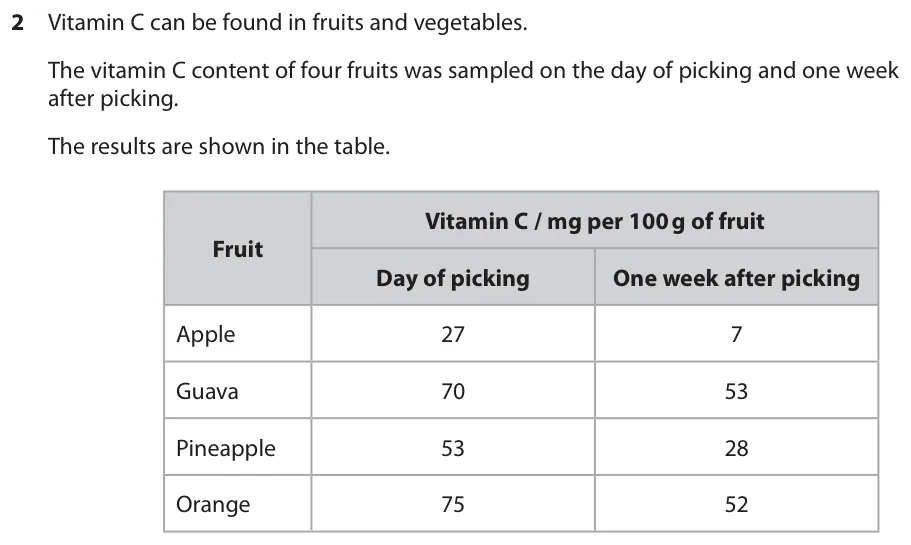
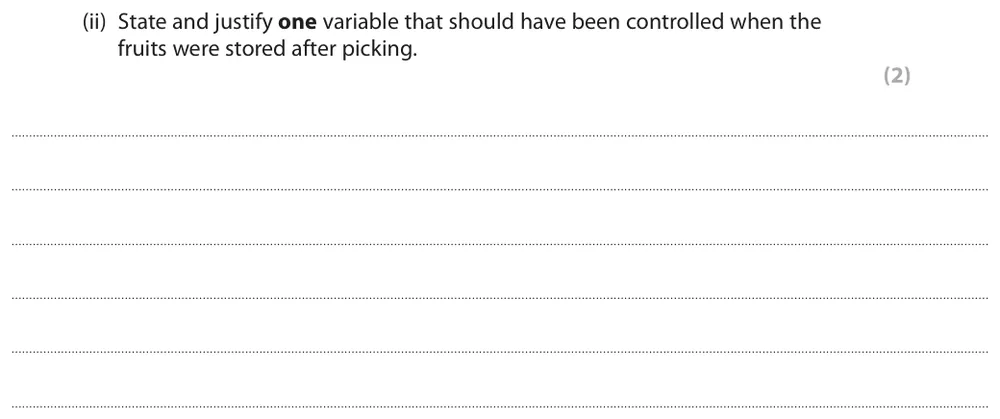
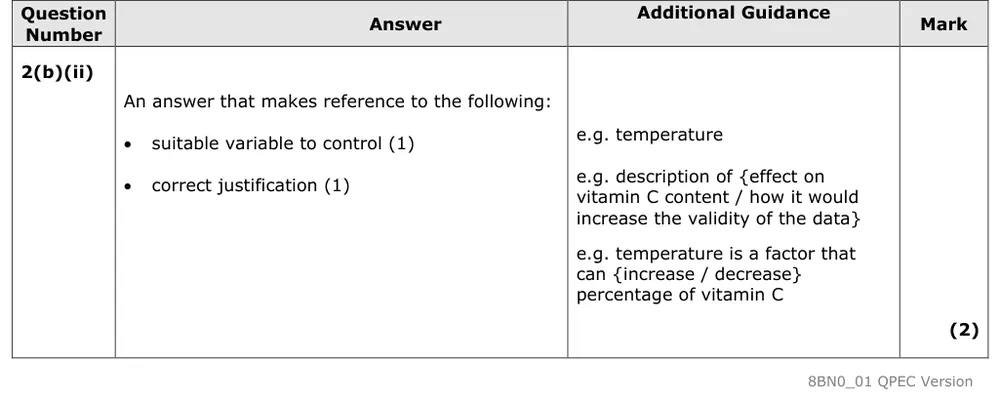
State and justify one variable to control when fruits are stored after picking.
Information from earlier in this question:
Show the mark scheme
Tap an image to open it full size.
From the examiners' report: Temperature was the most common answer; better answers explained how a different storage temperature would increase or decrease the vitamin C content. Answers about growing conditions showed the question had not been read carefully.
Core Practical 2: devising a vitamin C investigation
Question 3
AS Paper 1 · June 2018 · Q3(b) · 5 marks
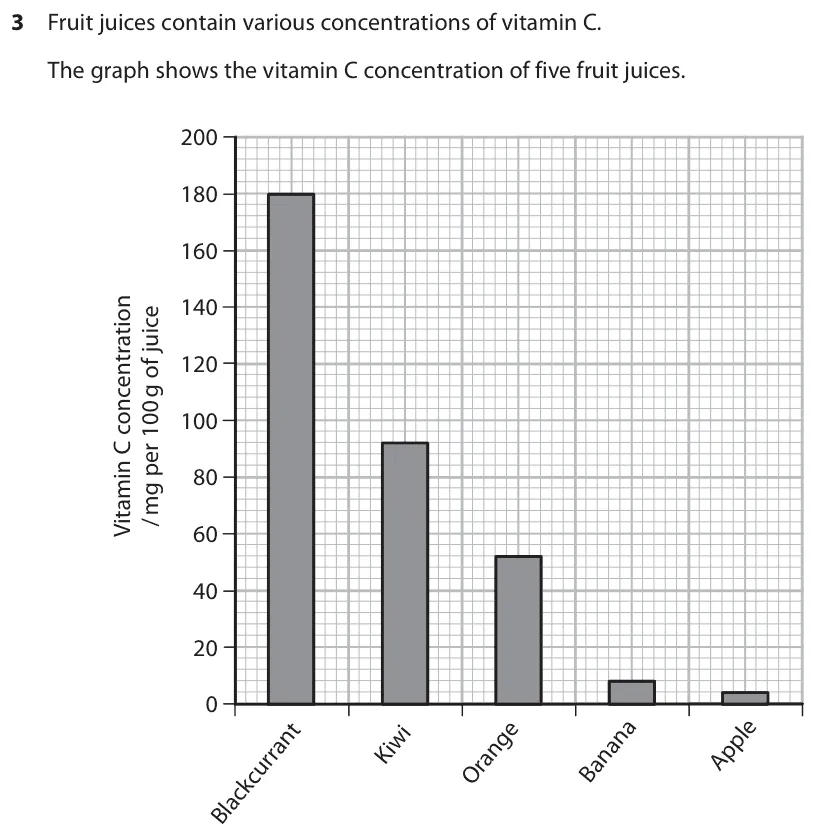
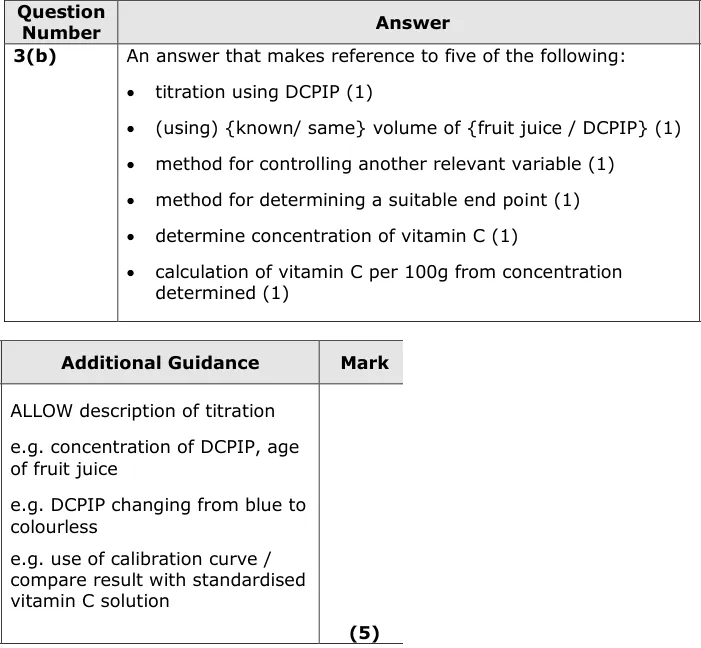
Devise an investigation to collect the vitamin C data shown in the graph.
Information from earlier in this question:

Show the mark scheme
Tap an image to open it full size.
From the examiners' report: Adding drops of juice or DCPIP from a pipette was not credited as a titration. If the volume of juice is your dependent variable you cannot also control it. Only 5% explained how to determine the vitamin C concentration from their results.
Question 4
AS Paper 1 · June 2019 · Q4(b) · 4 marks · Hard
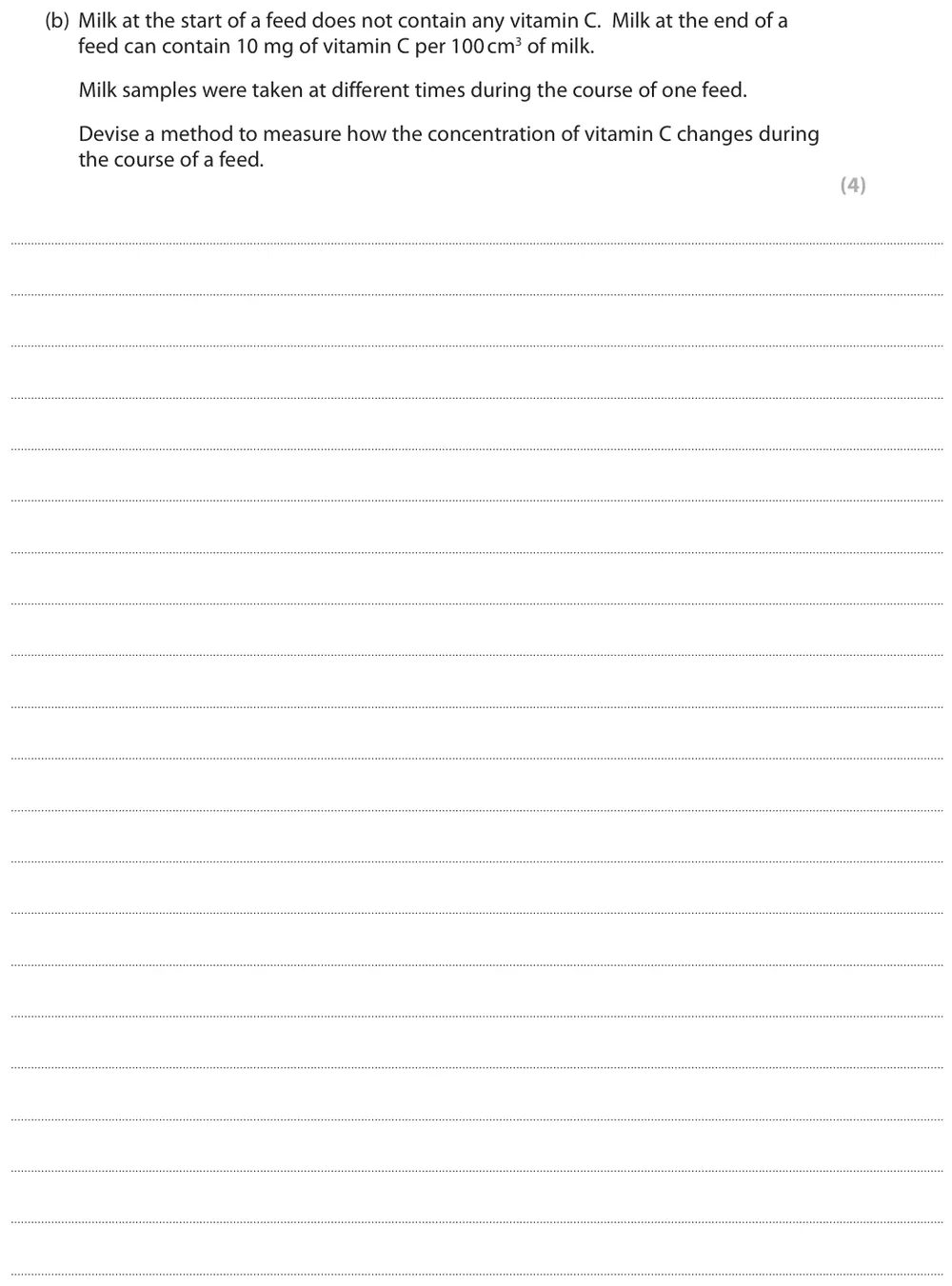
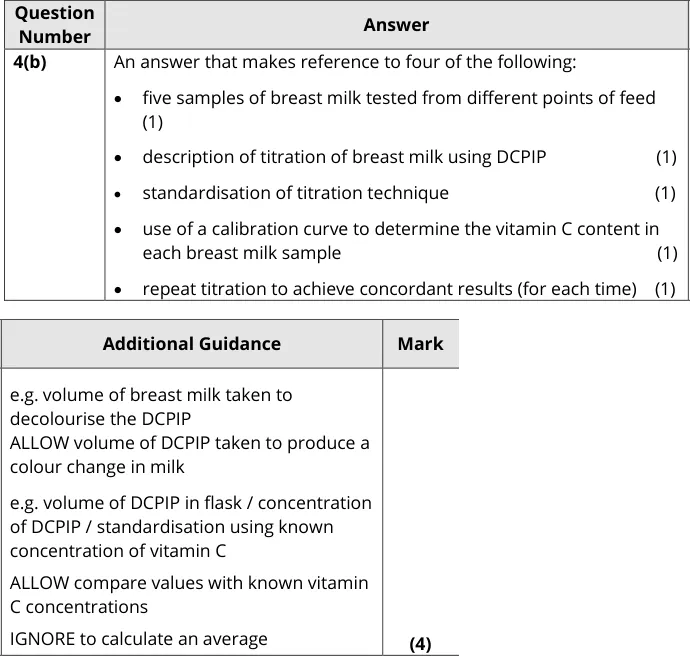
Devise a method to measure how the vitamin C concentration of breast milk changes during a feed.
Show the mark scheme
Tap an image to open it full size.
From the examiners' report: Many tested only one sample instead of at least five from different points in the feed. Counting drops from a dropping pipette was not enough for a titration. Standardising the titration technique was the most commonly awarded point.
Question 5
A level Paper 1 · June 2019 · Q4(b) · 4 marks
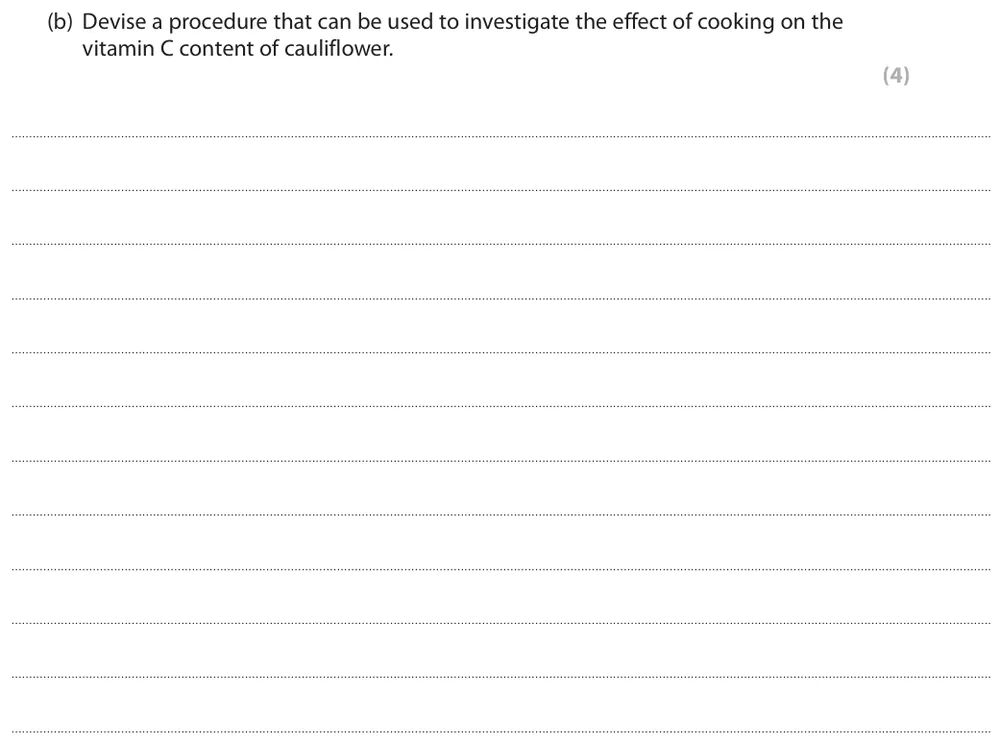
Devise a procedure to investigate the effect of cooking on the vitamin C content of cauliflower.
Show the mark scheme
Tap an image to open it full size.
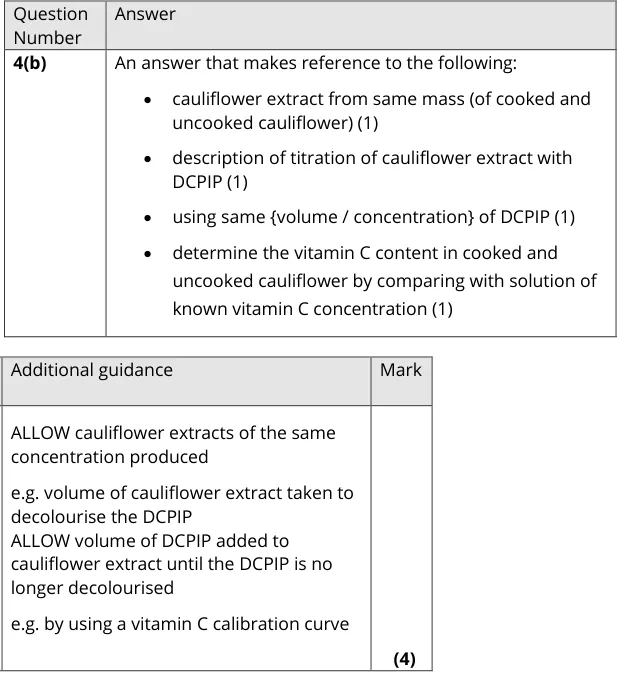
From the examiners' report: Several lost a mark by cooking the cauliflower at a range of temperatures or times without testing uncooked cauliflower. Use terms such as mass and volume, not 'amount' or 'drops'.
Question 6
AS Paper 1 · June 2025 · Q4(b) · 5 marks · Easy
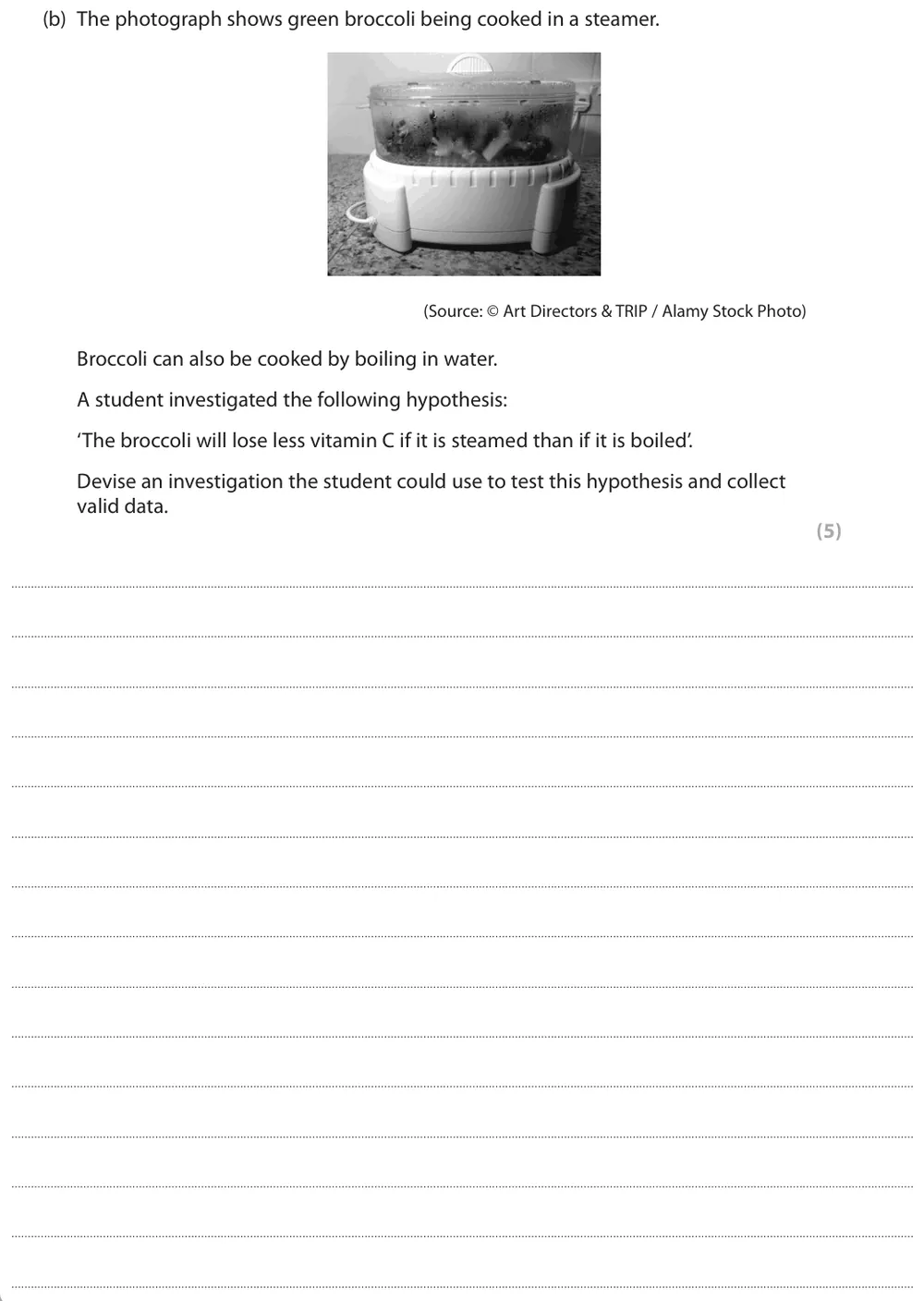
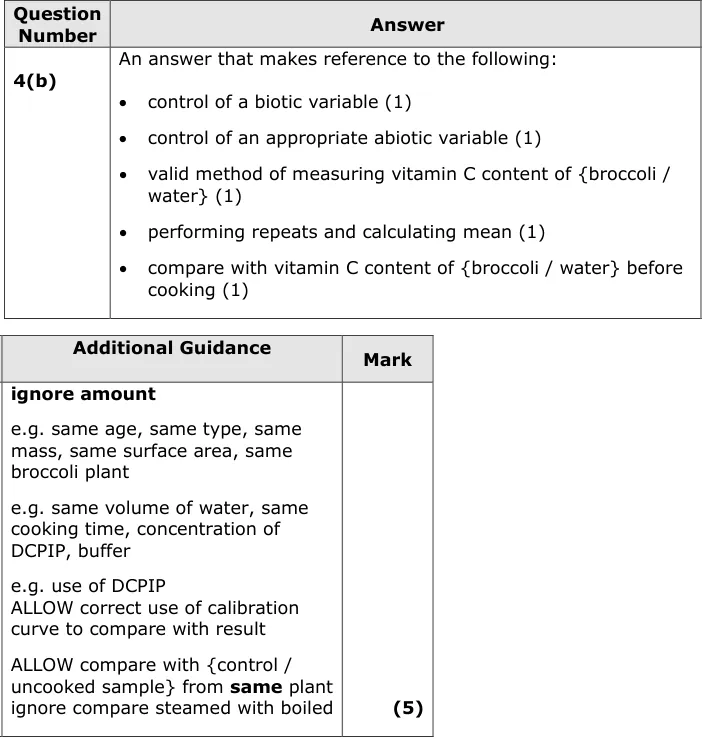
Devise an investigation to test whether broccoli loses less vitamin C when steamed than when boiled.
Show the mark scheme
Tap an image to open it full size.
From the examiners' report: Most described a DCPIP titration correctly. Higher-level answers controlled both biotic and abiotic variables and compared the vitamin C content with uncooked broccoli.
Question 7
A level Paper 2 · June 2024 · Q2(c) · 4 marks
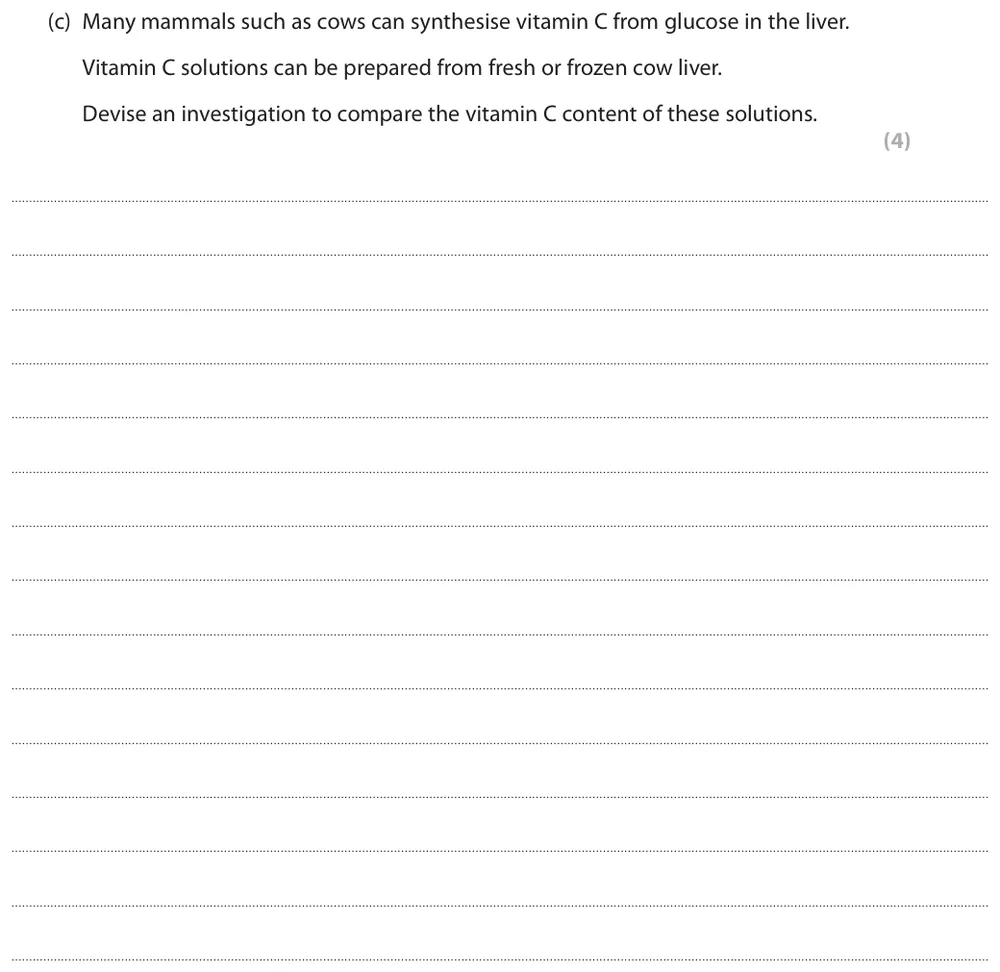
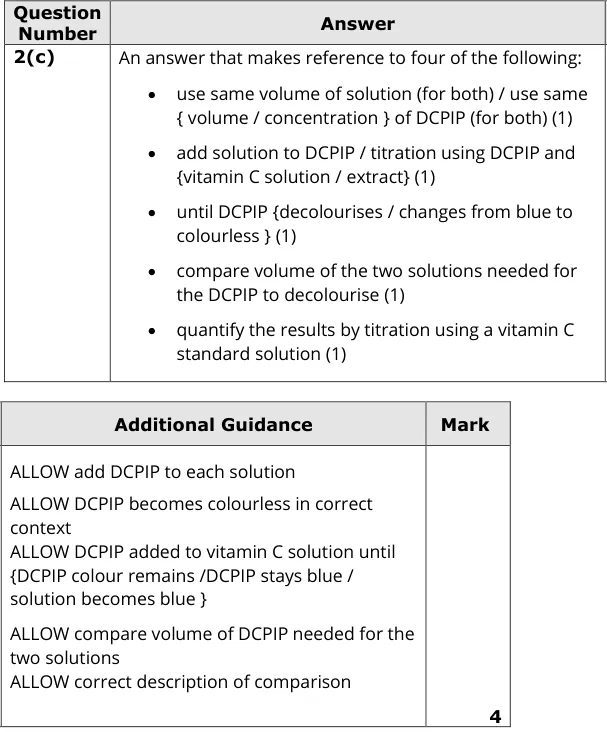
Devise an investigation to compare the vitamin C content of solutions from fresh and frozen cow liver.
Show the mark scheme
Tap an image to open it full size.
From the examiners' report: The two solutions were given, but a number of candidates described how to make them. Know the colour change: if DCPIP is added to the vitamin C solution, the end point is when the DCPIP colour no longer changes.
Core Practical 3: explaining permeability results
Question 8
A level Paper 2 · June 2022 · Q8(d) · 3 marks
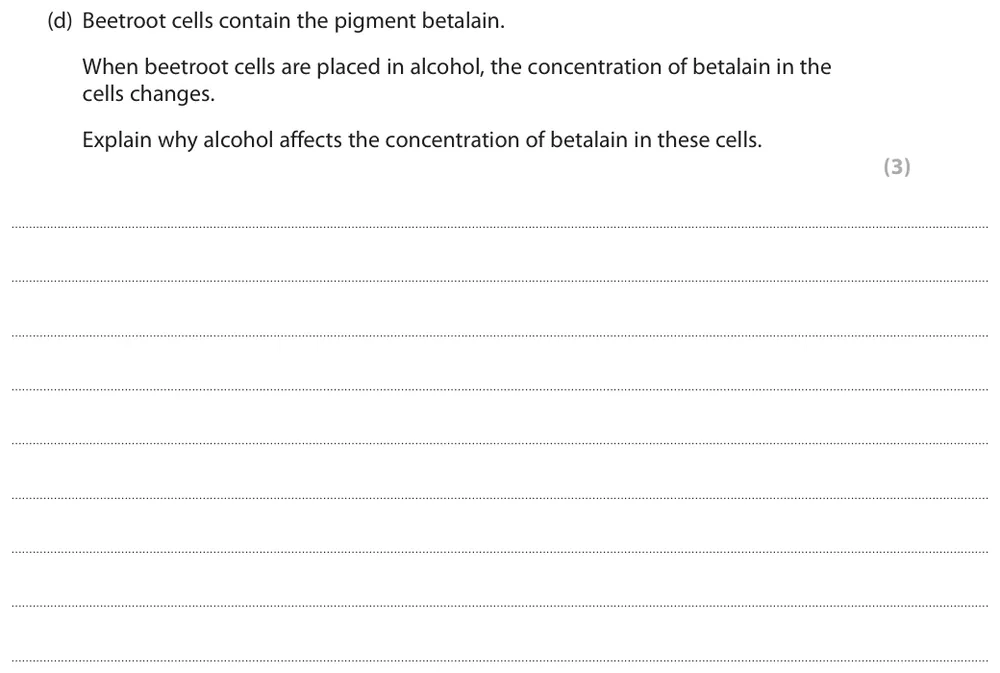
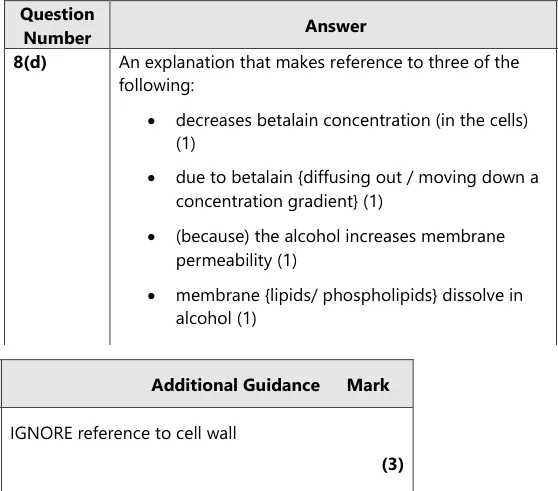
Explain why alcohol affects the concentration of betalain in beetroot cells.
Show the mark scheme
Tap an image to open it full size.
From the examiners' report: Many did not answer in the context of the pigment concentration inside the cells, and some thought betalain moved out by osmosis. Say how permeability changes, and that membrane phospholipids dissolve in alcohol.
Question 9
AS Paper 1 · June 2023 · Q8(c)(ii) · 2 marks
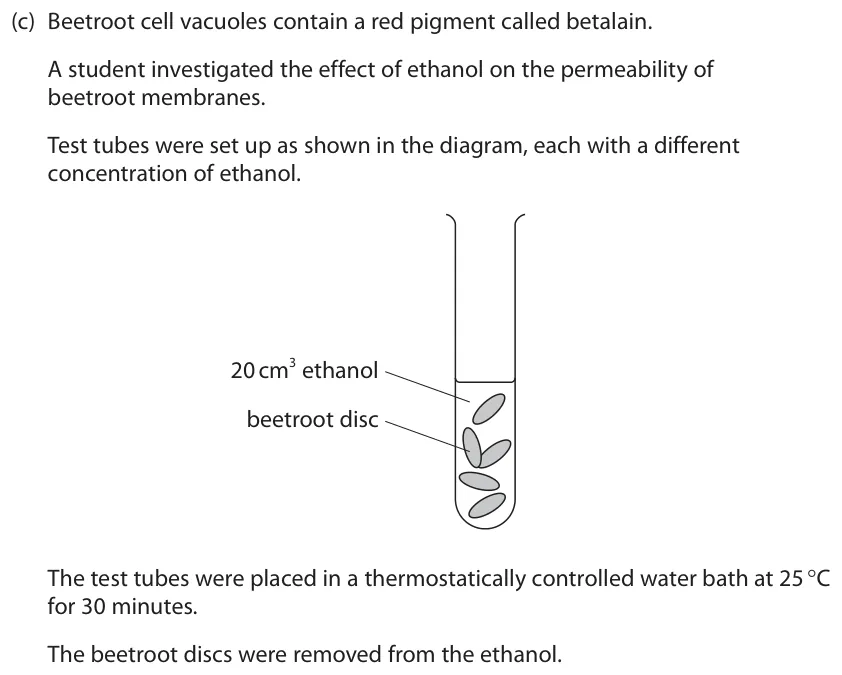
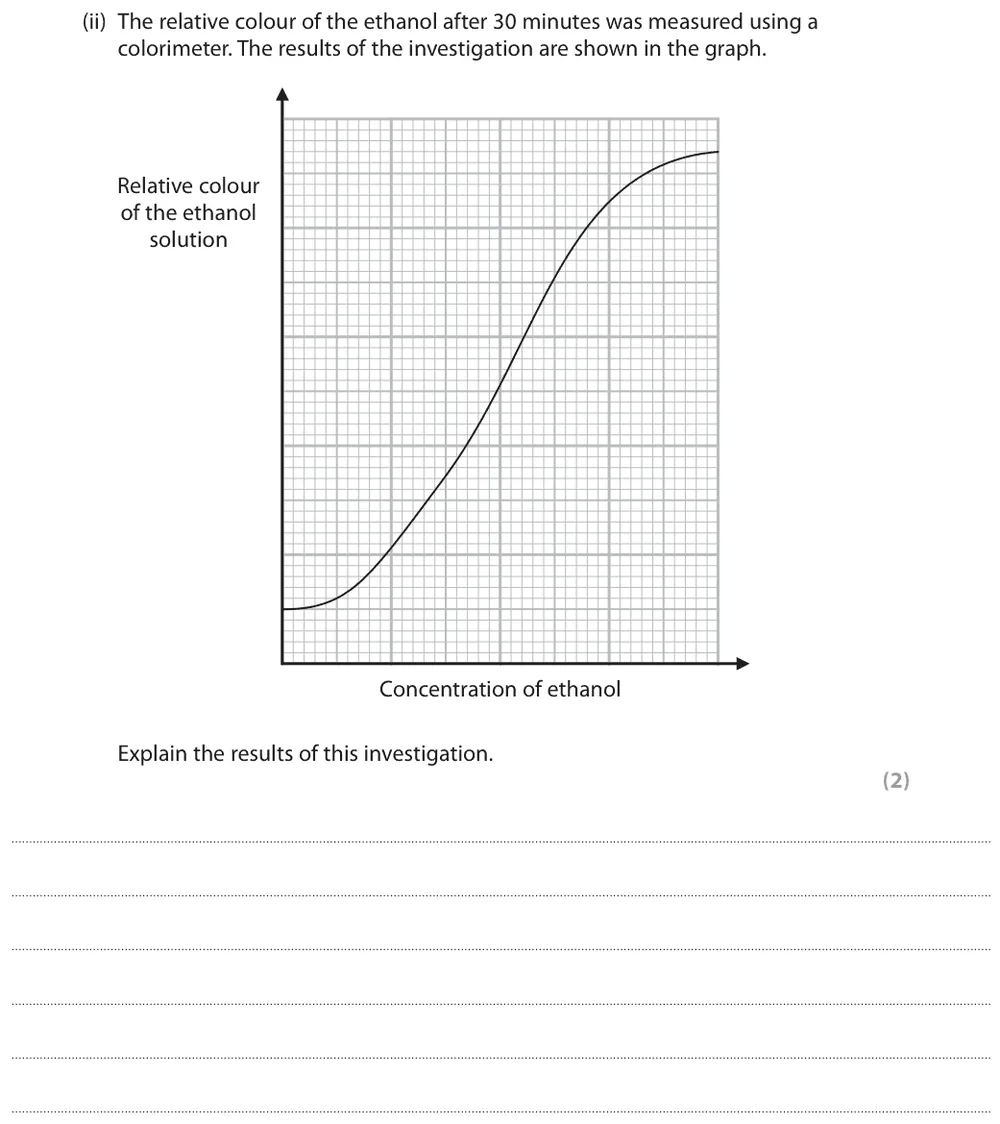
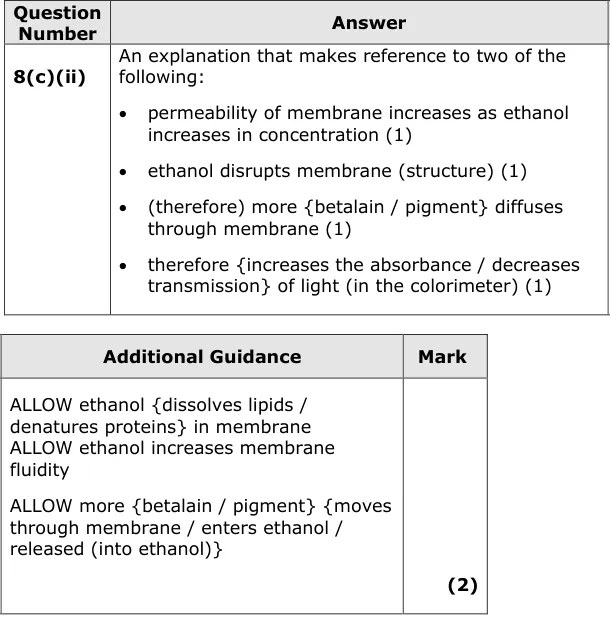
Explain the effect of ethanol concentration on the colour of the solution around beetroot.
Information from earlier in this question:
Show the mark scheme
Tap an image to open it full size.
From the examiners' report: A significant minority described the graph instead of explaining it. The most common mark was for ethanol disrupting the membrane; better answers explained that more betalain could then leave the cells.
Question 10
AS Paper 1 · November 2021 · Q6(c)(i) · 1 mark
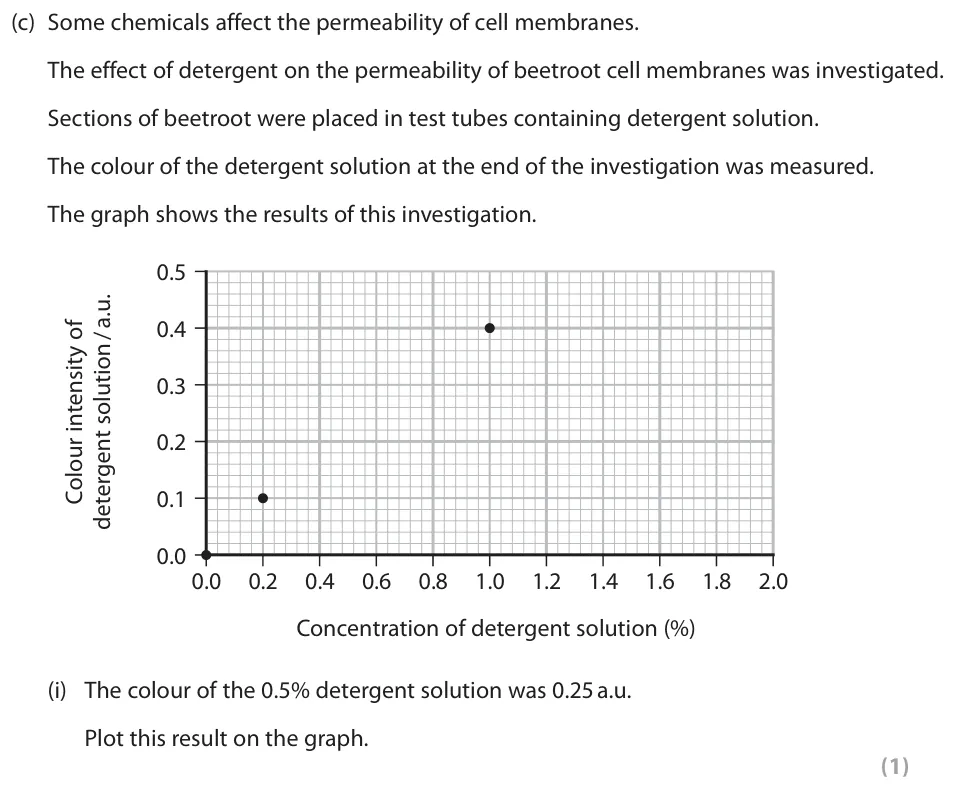
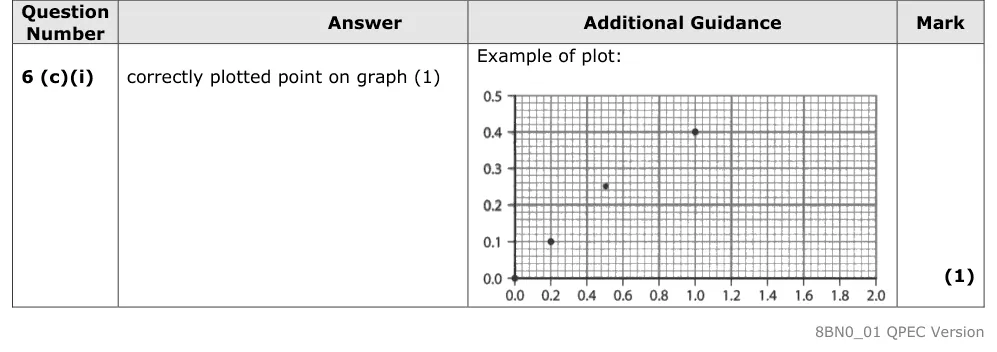
Plot a colorimeter result for 0.5% detergent on the graph.
Show the mark scheme
Tap an image to open it full size.
From the examiners' report: Most plotted the point correctly, but a significant minority plotted 0.5 a.u. at 0.25% instead. Take care not to miss out questions like this.
Core Practical 3: controls and evaluation
Question 11
AS Paper 1 · June 2024 · Q4(c)(i) · 2 marks
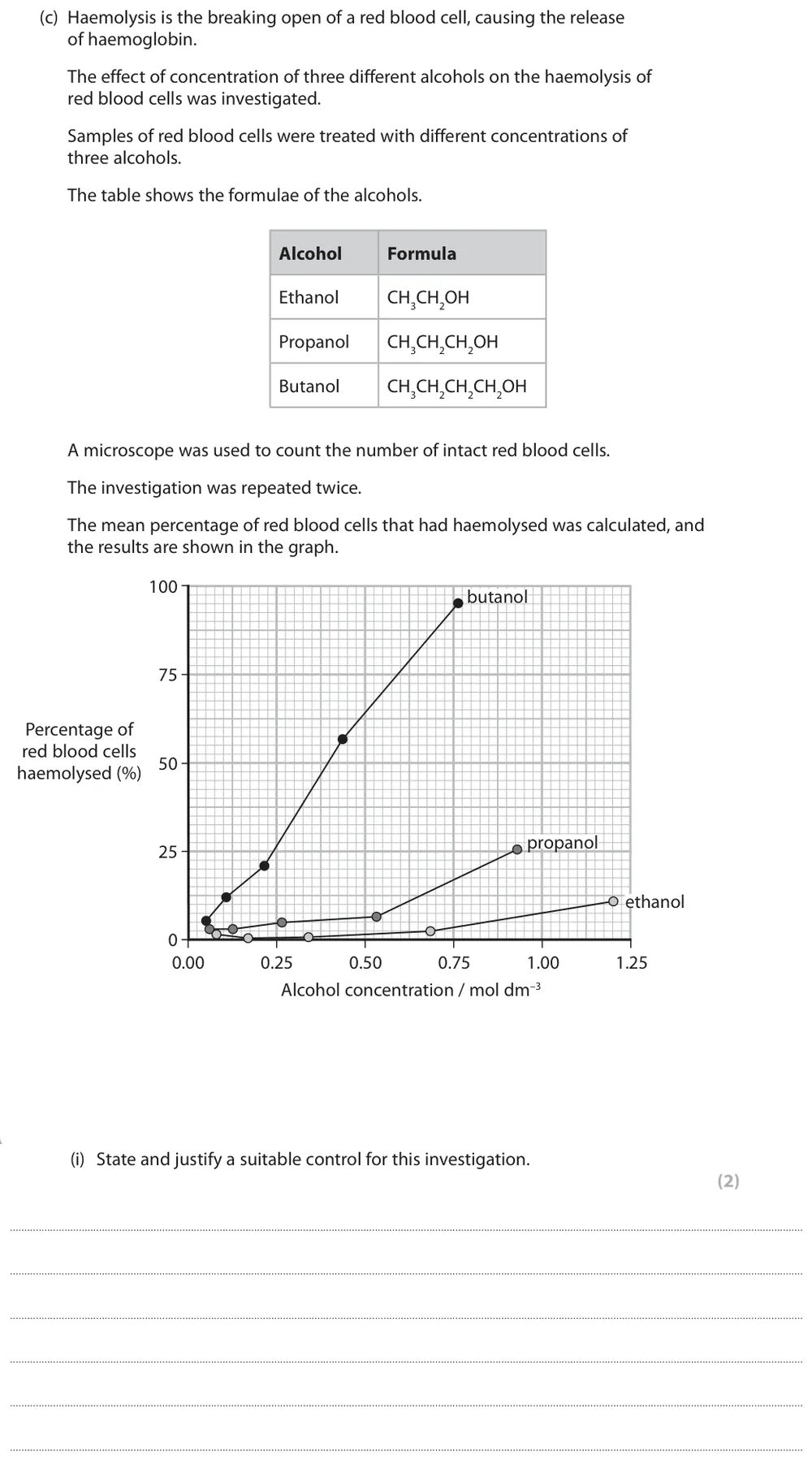
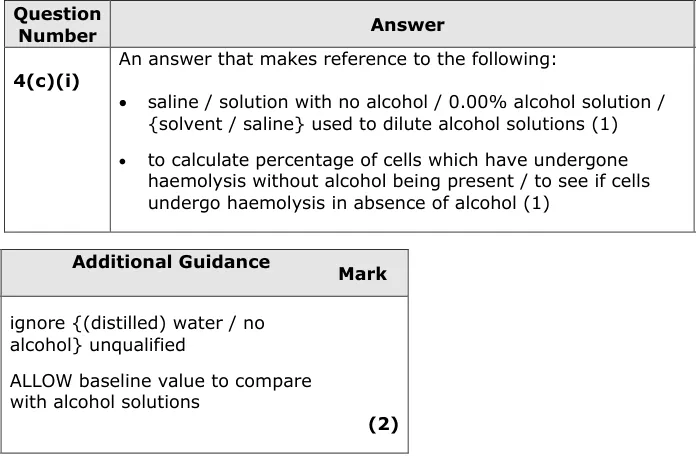
State and justify a suitable control for the alcohol and red blood cell investigation.
Show the mark scheme
Tap an image to open it full size.
From the examiners' report: Many confused a control with a controlled variable. Distilled water is unsuitable because it would also cause the red blood cells to haemolyse.
Question 12
AS Paper 1 · June 2024 · Q4(c)(ii) · 4 marks
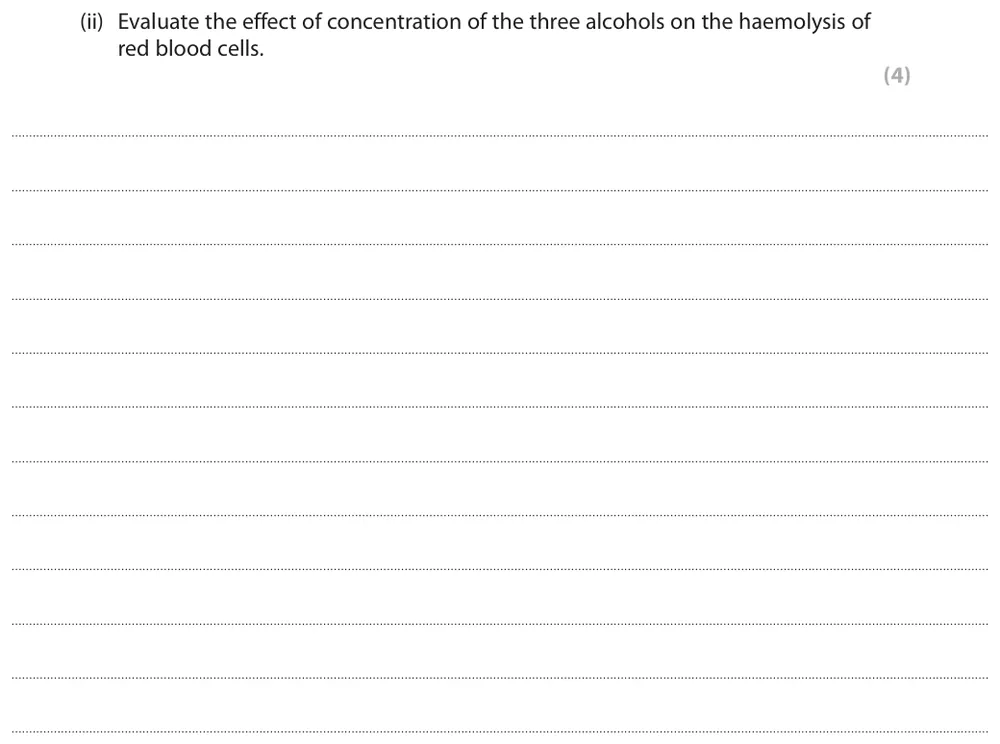
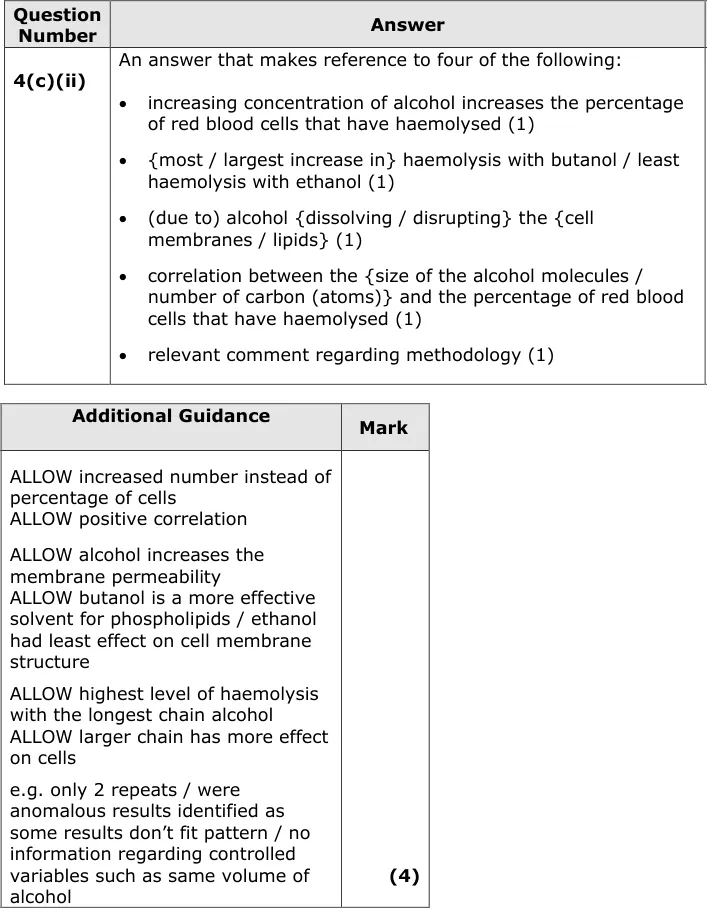
Evaluate the effect of the concentration of three alcohols on haemolysis of red blood cells.
Show the mark scheme
Tap an image to open it full size.
From the examiners' report: Use the alcohol formulae as well as the graph: many linked haemolysis to the size of the molecule. Relatively few used their knowledge of the core practical to explain the effect on membranes or commented on the method.
Question 13
AS Paper 1 · June 2017 · Q4(c) · 2 marks
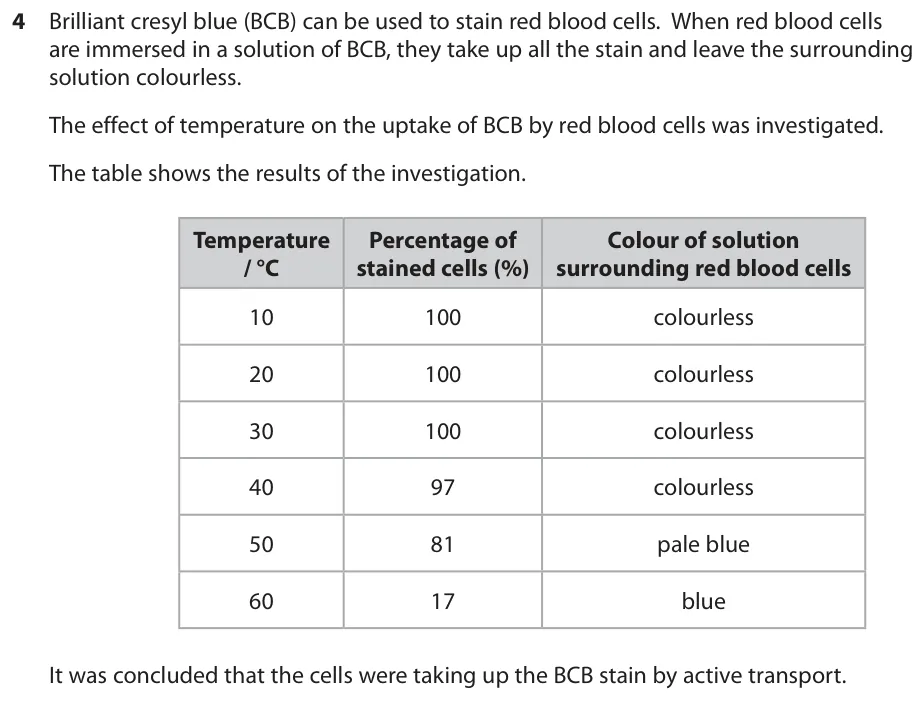
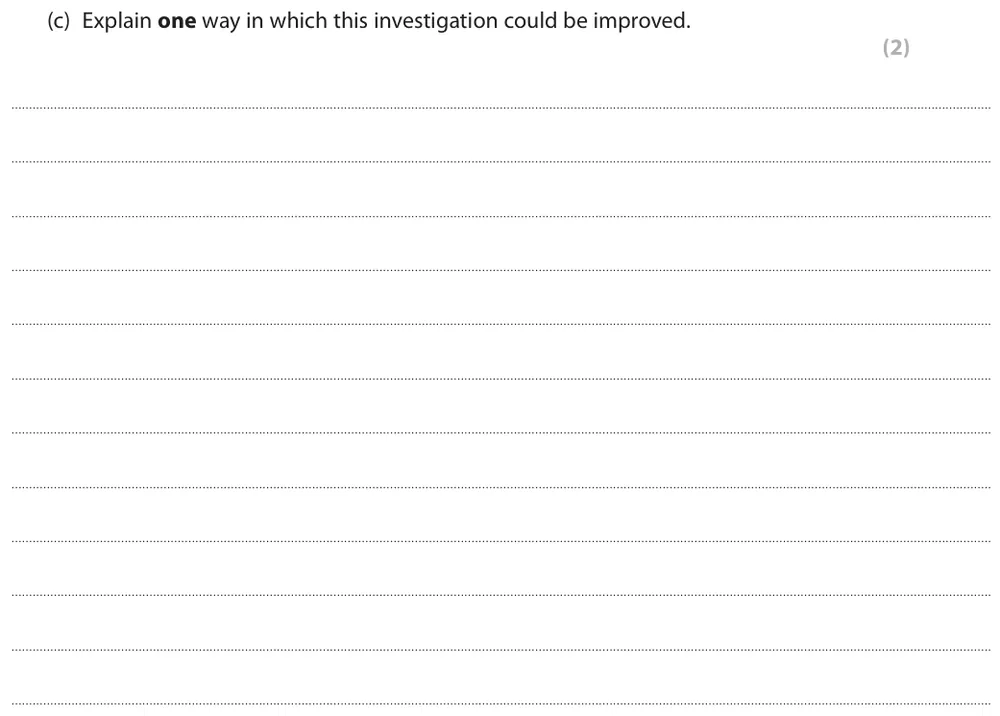
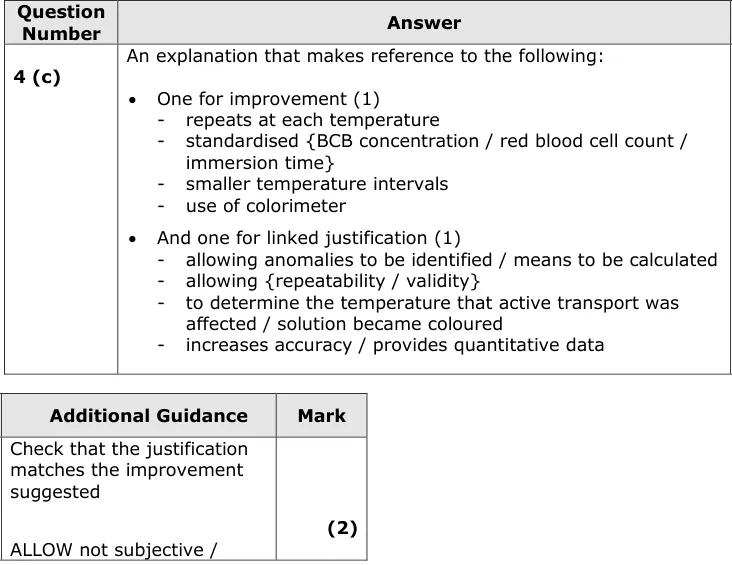
Explain one way in which the temperature investigation could be improved.
Information from earlier in this question:
Show the mark scheme
Tap an image to open it full size.
From the examiners' report: Repeats and a colorimeter were the most common improvements; justify a colorimeter by its quantitative data and spell it correctly. Extending the temperature range was not accepted, but smaller temperature intervals were.
Core Practical 3: devising a permeability investigation
Question 14
AS Paper 1 · June 2023 · Q8(c)(iii) · 4 marks
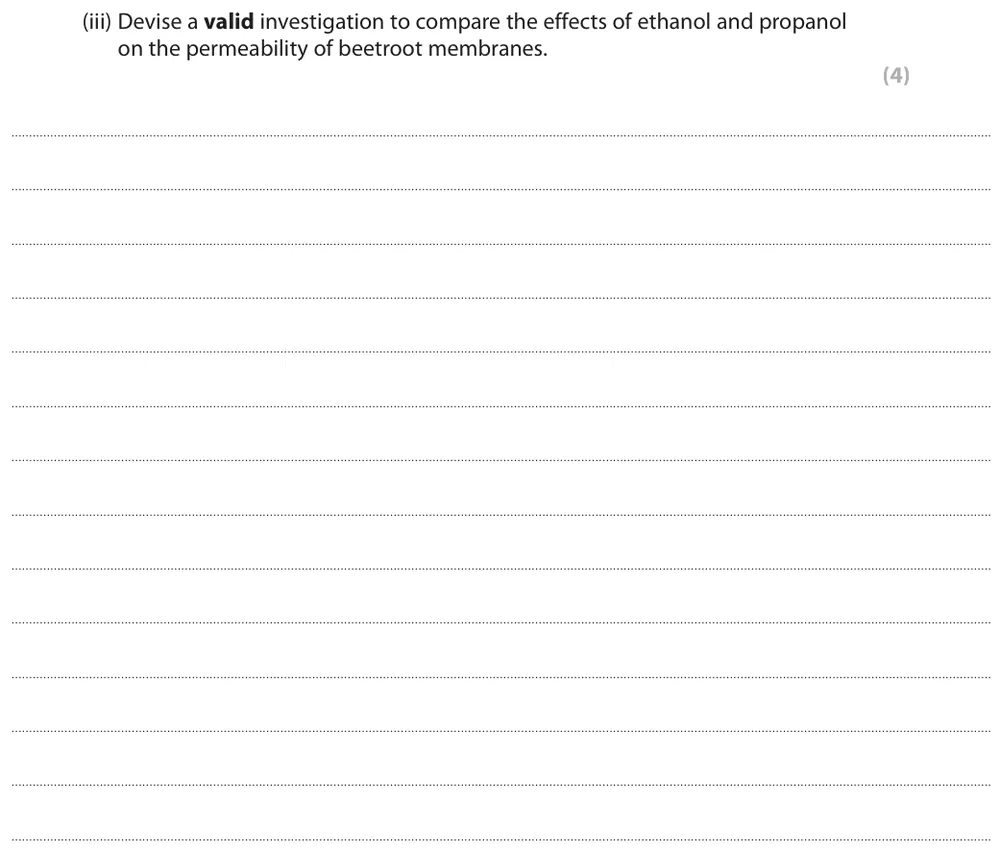
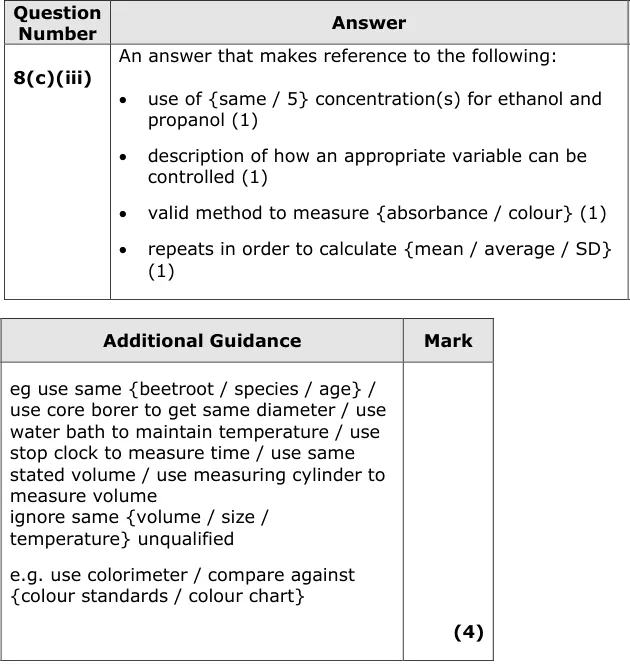
Devise a valid investigation to compare the effects of ethanol and propanol on beetroot membranes.
Information from earlier in this question:
Show the mark scheme
Tap an image to open it full size.
From the examiners' report: Most used the same concentrations of each alcohol and a valid way to measure colour. Fewer described how a variable is controlled or what to do with the raw data. Adding both alcohols to the same tube was not credited.
Question 15
AS Paper 1 · June 2016 · Q3(b) · 4 marks
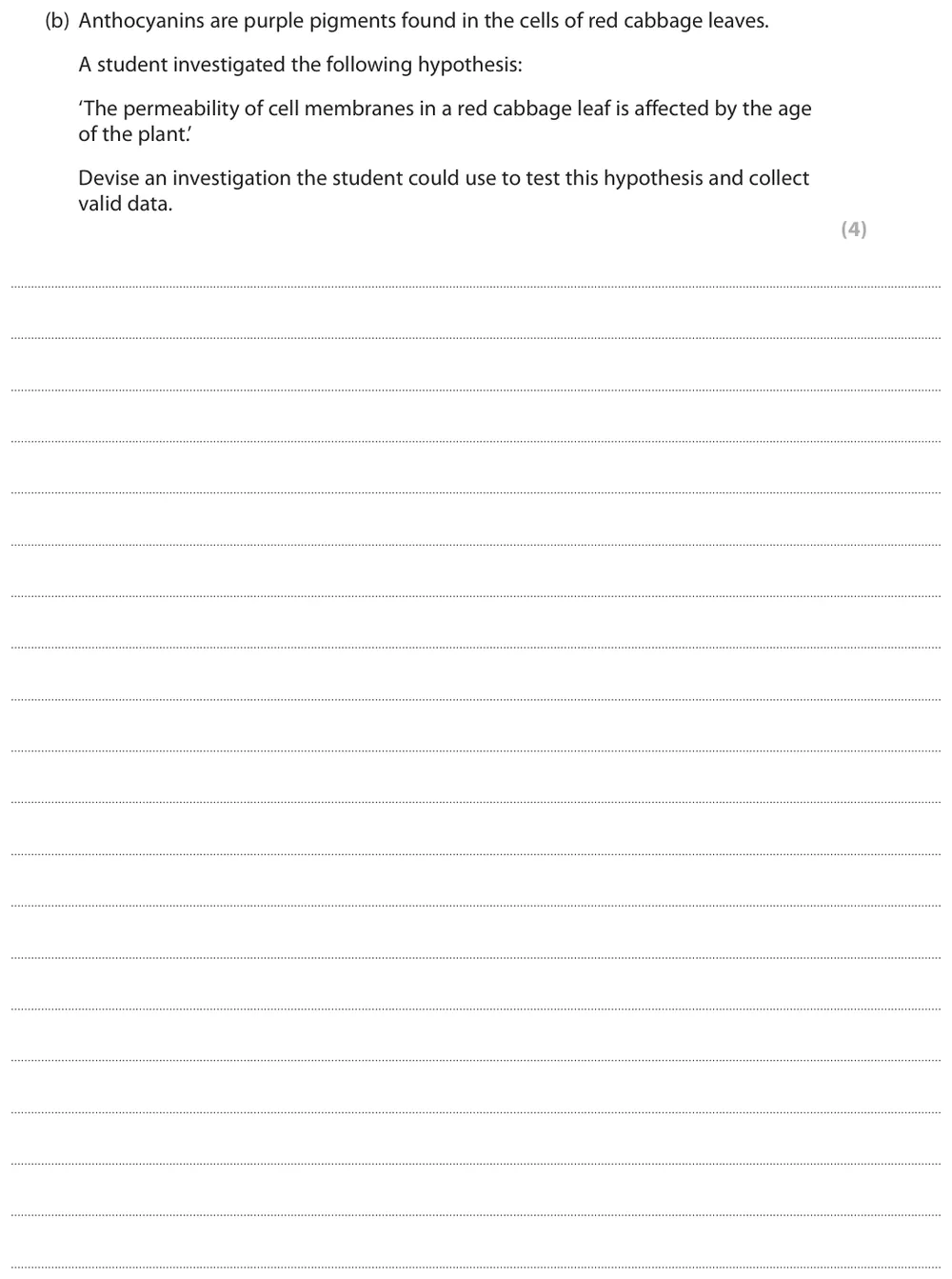
Devise an investigation into whether plant age affects membrane permeability in red cabbage leaves.
Show the mark scheme
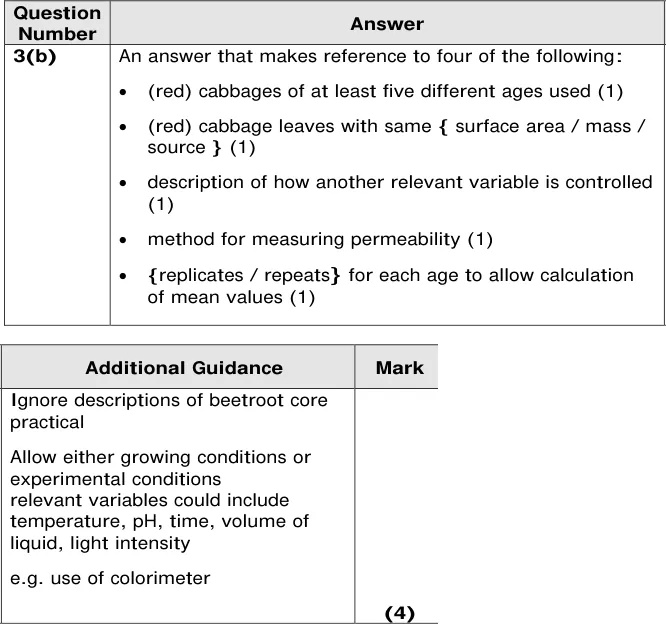
Tap an image to open it full size.
From the examiners' report: Many described the beetroot practical but did not apply it to cabbage leaves of different ages. Think about a suitable range for the independent variable and explain how other variables are controlled.
Where students lose marks (from Pearson examiners' reports and mark schemes)
Each point below comes from the examiners' reports and mark schemes, and is followed by wording that gained marks.
Phenolphthalein is not a vitamin C test. The most common incorrect reagent was phenolphthalein.
✔ Gains credit: 'DCPIP, which changes from blue to colourless if vitamin C is present.'
Storage conditions, not growing conditions. Some answers referred to growing conditions for the plants instead of storage after picking.
✔ Gains credit: 'Temperature, because temperature can increase or decrease the percentage of vitamin C.'
Counting drops is not a titration. Many just counted how many drops from a dropping pipette caused a colour change.
✔ Gains credit: 'Titration of breast milk using DCPIP, e.g. the volume of breast milk taken to decolourise the DCPIP.'
Turn the volume into a concentration. Only 5% explained how the concentration of vitamin C could be determined.
✔ Gains credit: 'Determine the concentration of vitamin C using a calibration curve, then calculate the vitamin C per 100 g.'
Test the uncooked vegetable too. Several cooked the cauliflower at a range of temperatures or times but left out uncooked cauliflower.
✔ Gains credit: 'Cauliflower extract from the same mass of cooked and uncooked cauliflower.'
Betalain diffuses out, not by osmosis. Some thought betalain moved out of the cells by osmosis.
✔ Gains credit: 'The alcohol increases membrane permeability, so betalain diffuses out down a concentration gradient.'
Distilled water haemolyses red cells too. Students who gave a control often chose distilled water, which would also cause haemolysis.
✔ Gains credit: 'Saline with no alcohol, to see if cells undergo haemolysis in the absence of alcohol.'
Narrow the intervals, don't extend the range. Extending the range of temperatures was not accepted as an improvement.
✔ Gains credit: 'Smaller temperature intervals, to determine the temperature at which active transport was affected.'
Download the questions
Download the PDF pack (15 questions, mark schemes at the end)
Keep practising
- Risk, Diet and Health Data (Topic 1): Edexcel SNAB exam questions by topic
- Gas Exchange, Membranes and Transport (Topic 2): Edexcel SNAB exam questions by topic
- Edexcel SNAB A level Biology revision resources by topic (every topic and core practical page)
- Edexcel SNAB Topic 1 Multiple-Choice Quiz: Lifestyle, Health and Risk
- Edexcel SNAB Topic 2 Multiple-Choice Quiz: Genes and Health
- Edexcel SNAB A level Biology past papers, mark schemes and examiners' reports
- Edexcel SNAB A level Biology grade boundaries
- Message Tom on WhatsApp about one-to-one Edexcel SNAB tutoring or an Edexcel group class
Questions, mark schemes and examiners' report extracts © Pearson Education Ltd.