

Gas Exchange, Membranes and Transport opens Topic 2, Genes and Health, of the Edexcel A level Biology A (Salters-Nuffield) specification. You need to know the properties of gas exchange surfaces, use Fick's law to explain how surface area, thickness and concentration difference affect the rate of diffusion, and explain how the mammalian lung is adapted for rapid gas exchange. You also need to know the structure and properties of cell membranes, osmosis, and how substances cross membranes by diffusion, facilitated diffusion, active transport, endocytosis and exocytosis, using carrier and channel proteins. This topic is examined on AS Paper 1 and on A level Papers 1, 2 and 3. Questions marked AS are from the AS papers (8BN0); the rest are from the A level papers (9BN0).
The examiners' reports keep asking for precise wording. Say oxygen rather than 'gases', 'thinner' rather than 'smaller', and that the walls of the alveoli and capillaries are one cell thick. When a disease changes the lungs, link it to surface area, diffusion distance and the rate of diffusion, then to aerobic respiration. When asked about membrane structure, describe where things are, not what carrier and channel proteins do. Explain osmosis using water or solute concentration and a partially permeable membrane, and in 'compare and contrast' questions give a similarity as well as differences.
Studying Edexcel SNAB and want more help? If you'd like to arrange one-to-one Edexcel tutoring, or to register your interest in an Edexcel group class, message Tom on WhatsApp using the link at the bottom of this page.
What you need from GCSE
Each question on this page assumes you're secure on these ideas. If any of them feels shaky, look it up before you start.
- Diffusion is the net movement of particles from a higher to a lower concentration.
- Gas exchange in the lungs happens in the alveoli, which are surrounded by capillaries.
- Osmosis is the movement of water across a partially permeable membrane.
- Active transport uses energy from respiration to move substances against a concentration gradient.
Key terms
These words come up in the questions and mark schemes. Examiners expect you to use them exactly.
- Surface area to volume ratio: the surface area of an organism or cell divided by its volume; it falls as size increases.
- Fick's law: rate of diffusion is proportional to surface area × concentration difference ÷ thickness of the surface.
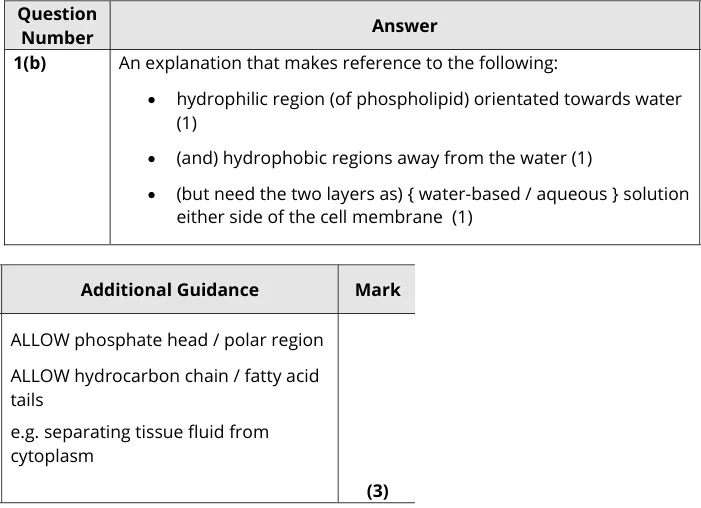
- Phospholipid bilayer: two layers of phospholipids with hydrophilic phosphate heads facing the water on each side and hydrophobic fatty acid tails inside.
- Fluid mosaic model: the model of the membrane as a phospholipid bilayer with proteins and other molecules that can move within it.
- Partially permeable: letting some molecules through but not others.
- Facilitated diffusion: passive movement down a concentration gradient through carrier or channel proteins.
- Active transport: movement against a concentration gradient through carrier proteins, using energy from ATP.
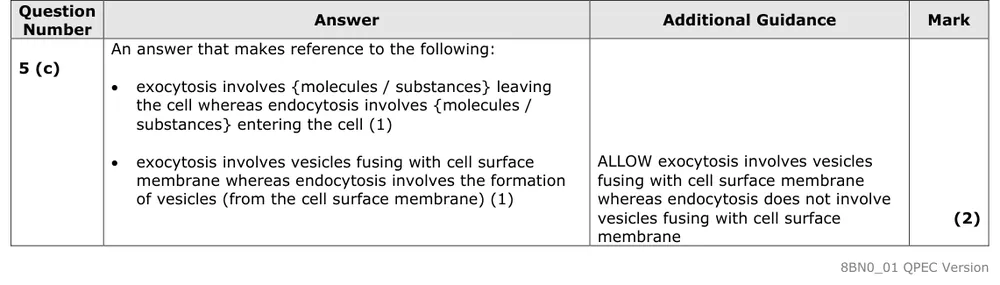
- Endocytosis and exocytosis: bulk transport in vesicles: into the cell as the membrane forms a vesicle, out of the cell as a vesicle fuses with the membrane.
What these questions cover (Edexcel SNAB Topic 2: Genes and Health)
The questions test these statements from Topic 2 of the Pearson Edexcel A level Biology A (Salters-Nuffield) specification (9BN0).
- 2.1 i Know the properties of gas exchange surfaces in living organisms (large surface area to volume ratio, thickness of surface, difference in concentration).
- 2.1 ii Understand how the rate of diffusion is dependent on these properties and can be calculated using Fick’s Law of Diffusion.
- 2.1 iii Understand how the structure of the mammalian lung is adapted for rapid gaseous exchange.
- 2.2 i Know the structure and properties of cell membranes.
- 2.3 Understand what is meant by osmosis in terms of the movement of free water molecules through a partially permeable membrane (consideration of water potential is not requi
- 2.4 i Understand what is meant by passive transport (diffusion, facilitated diffusion), active transport (including the role of ATP as an immediate source of energy), endocytos
- 2.4 ii Understand the involvement of carrier and channel proteins in membrane transport.
How to use this page
Write your answer on paper before you open the mark scheme. Allow about 1.2 minutes per mark: the 20 questions are worth 57 marks, so about 68 minutes in total. Then mark your answer strictly against the mark scheme and read the examiners' tip underneath it. If you'd rather print the questions, download the PDF pack.
Properties of gas exchange surfaces (2.1 i)
Question 1
AS Paper 1 · June 2017 · Q2(a)(ii) · 2 marks
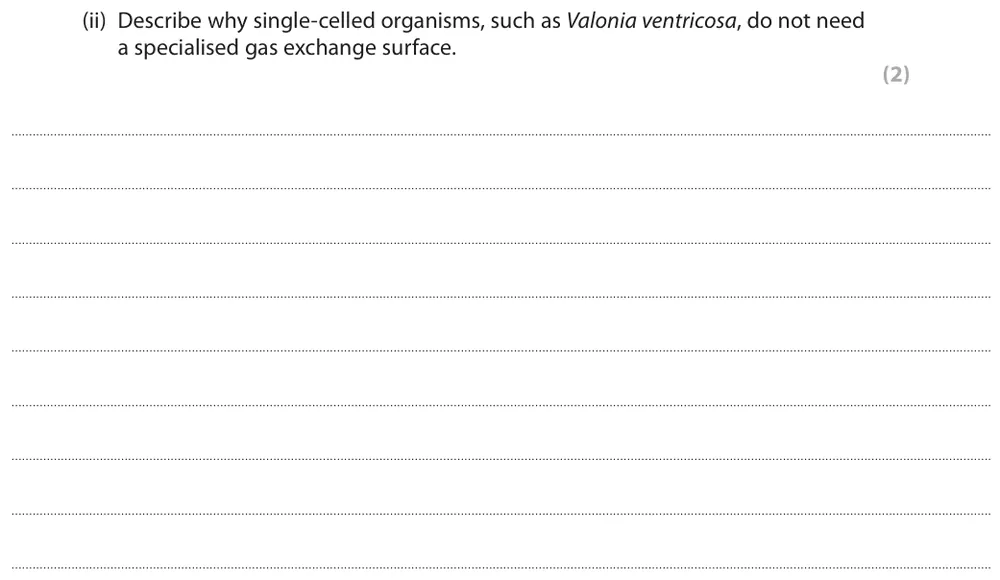
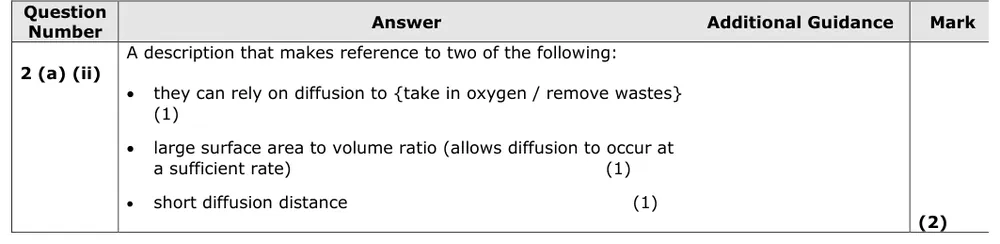
Describe why single-celled organisms do not need a specialised gas exchange surface.
Show the mark scheme
Tap an image to open it full size.
From the examiners' report: About a quarter scored nothing. The organism is single-celled, yet many said its gas exchange surface is one cell thick. 'Gases' entering by diffusion was not specific enough: say oxygen. The most common mark was for a large surface area to volume ratio.
Question 2
AS Paper 1 · June 2022 · Q6(a) · 2 marks
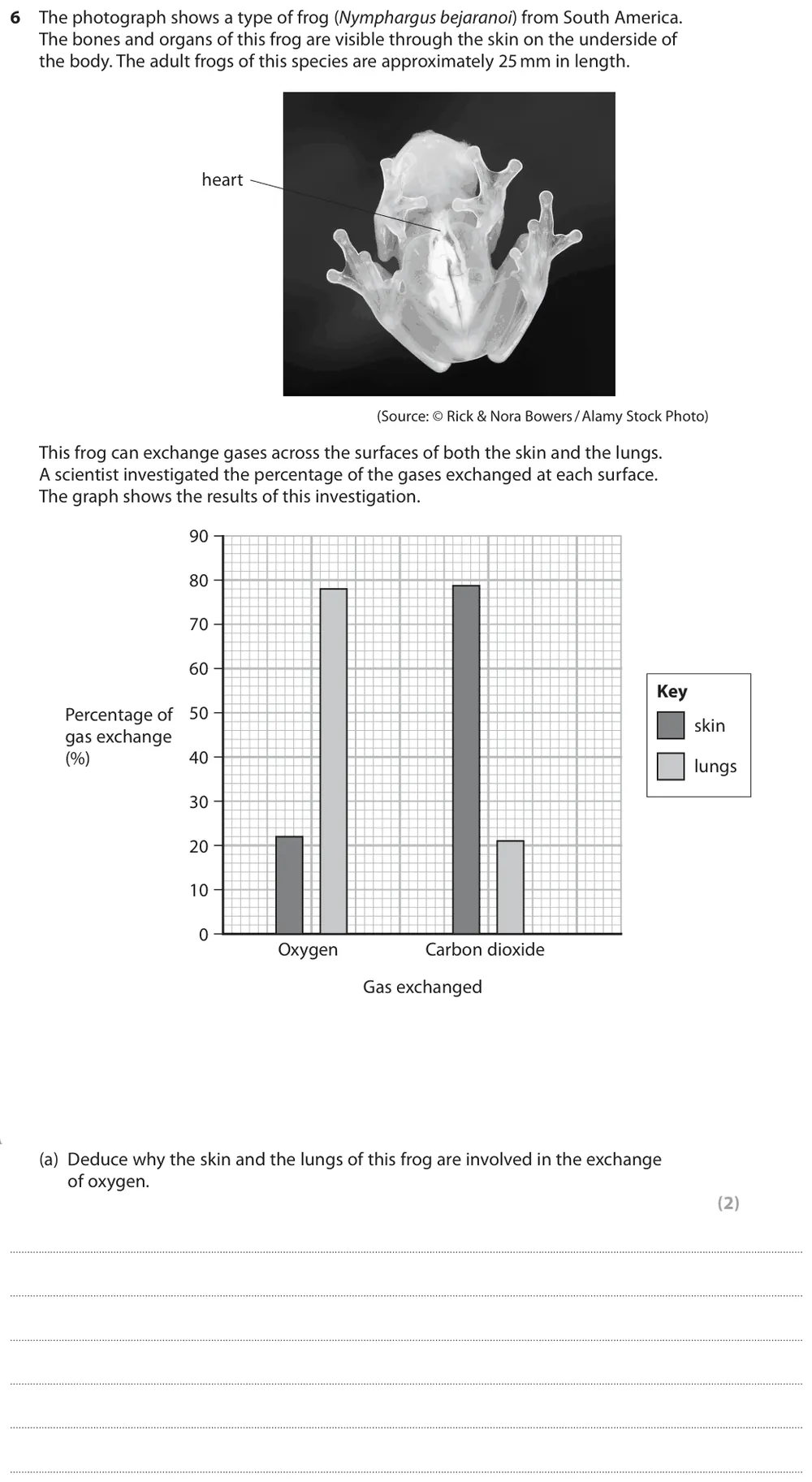
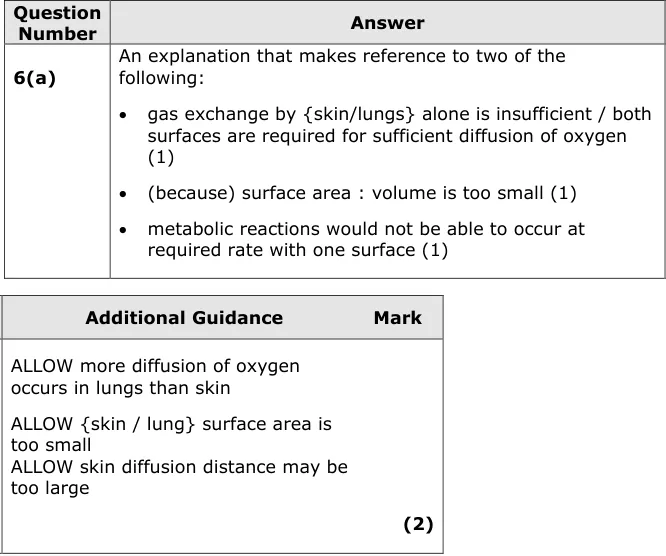
Use a graph to deduce why both the skin and the lungs of a frog take part in oxygen exchange.
Show the mark scheme
Tap an image to open it full size.
From the examiners' report: Few used the graph. Many wrongly said the frog could get all its oxygen through its skin because of a large surface area to volume ratio. Use the data (more oxygen diffuses in the lungs than the skin), then explain why the skin alone is not enough.
Question 3
A level Paper 1 · June 2017 · Q7(b) · 3 marks · Easy
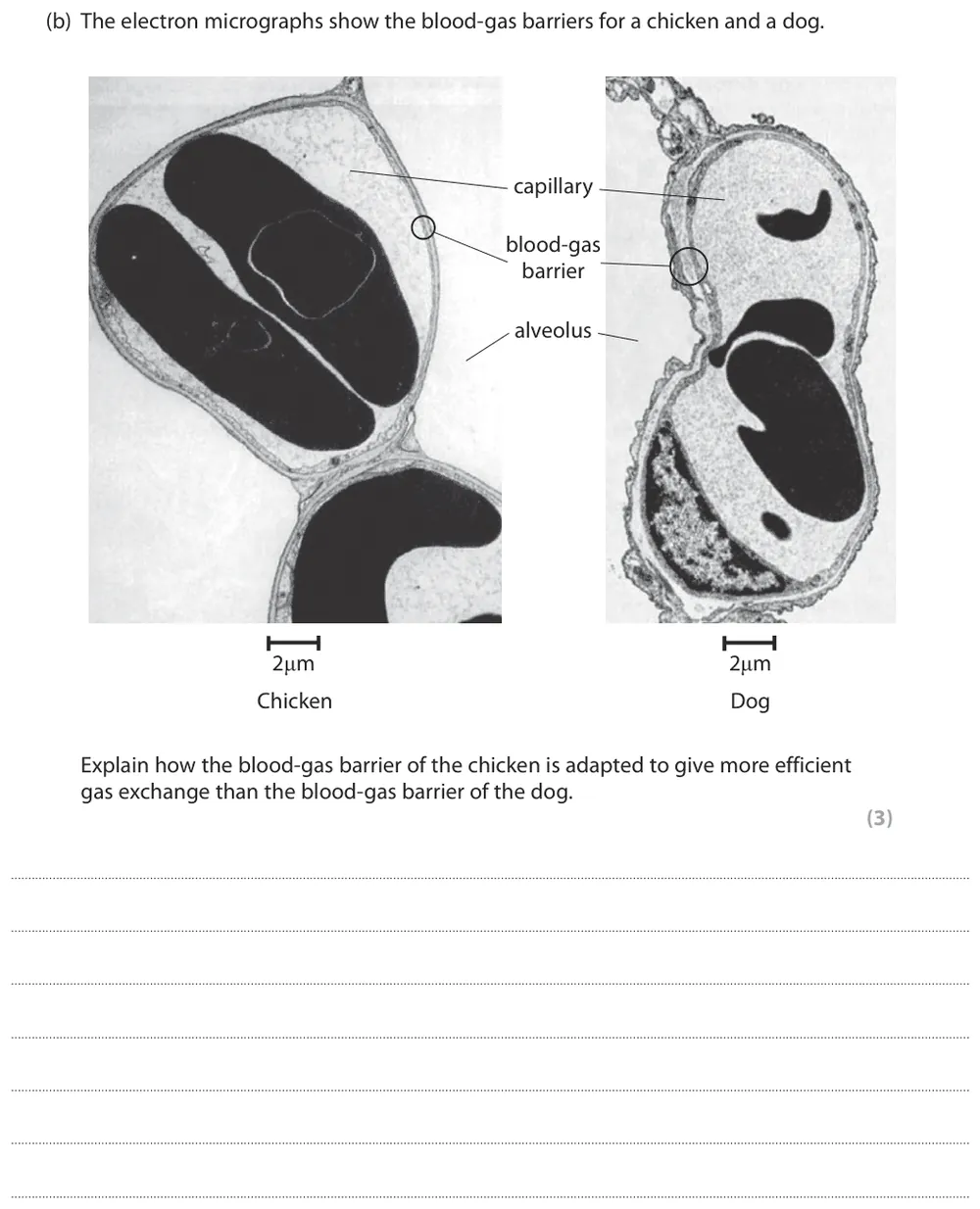
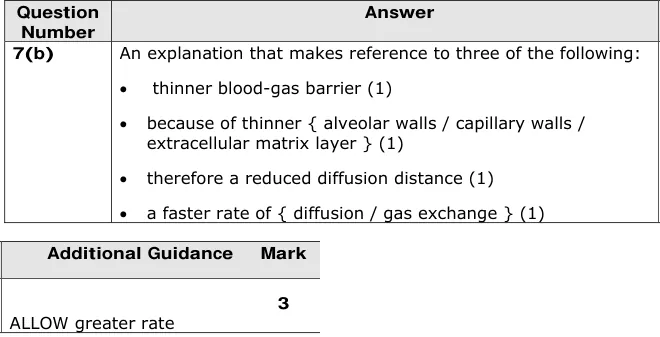
Explain how a chicken's blood-gas barrier gives more efficient gas exchange than a dog's.
Show the mark scheme
Tap an image to open it full size.
From the examiners' report: Answered well, but expression cost marks. 'Smaller blood-gas barrier' was not accepted, and 'more efficient gas exchange' only repeats the question: say a faster rate of diffusion. Fewer gave the reason the barrier is thinner.
Fick's law and the rate of diffusion (2.1 ii)
Question 4
AS Paper 1 · June 2017 · Q2(d) · 2 marks · Hard
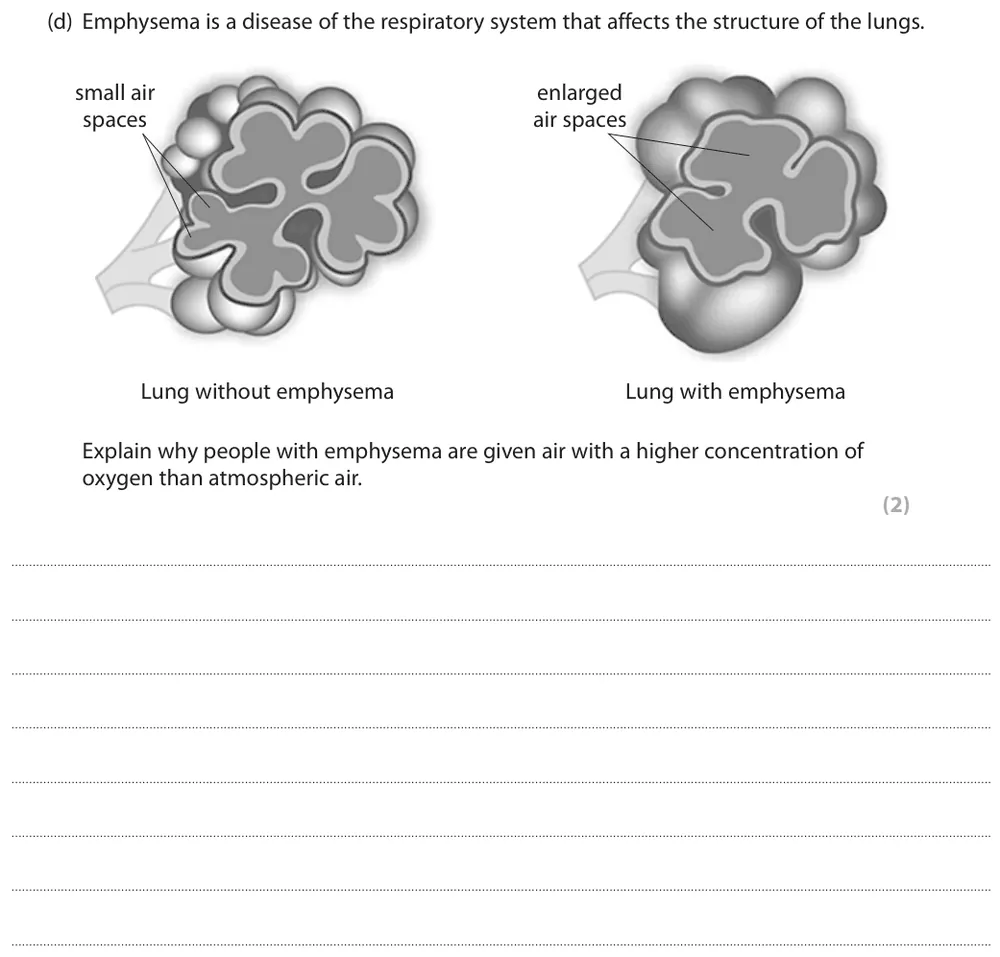
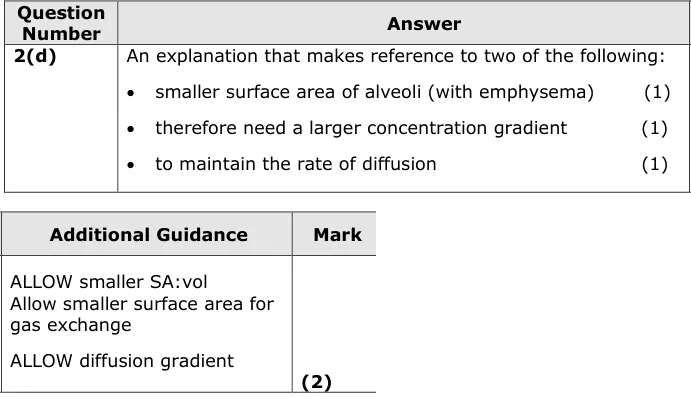
Explain why people with emphysema are given air with a higher concentration of oxygen.
Show the mark scheme
Tap an image to open it full size.
From the examiners' report: Many did not realise that the alveoli have a smaller surface area in emphysema. Most said more oxygen gives a larger concentration gradient, but few explained why that helps: it maintains the rate of diffusion.
Question 5
A level Paper 1 · November 2021 · Q6(b) · 3 marks
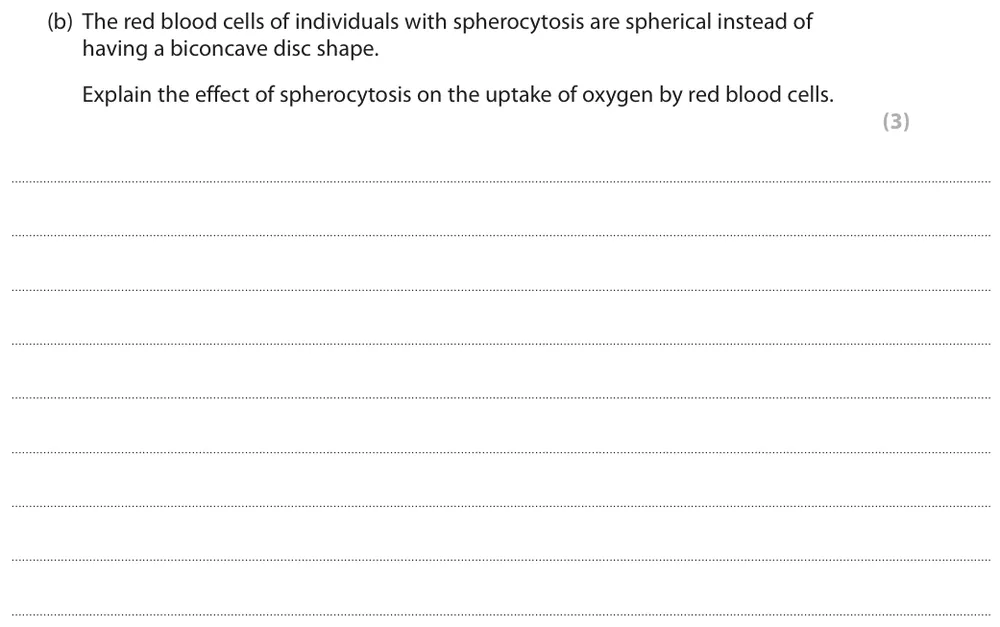
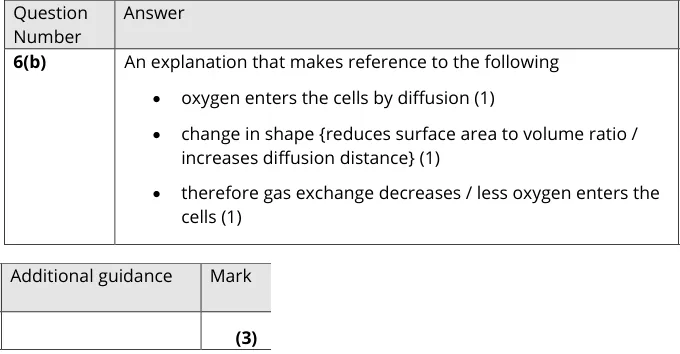
Explain the effect of spherical red blood cells on their uptake of oxygen.
Show the mark scheme
Tap an image to open it full size.
From the examiners' report: Most knew oxygen uptake would fall, and many linked this to the change in surface area, but a number did not refer to the surface area to volume ratio and lost the mark. Better answers said that oxygen enters the cells by diffusion.
Question 6
A level Paper 2 · June 2017 · Q9(c) · 3 marks
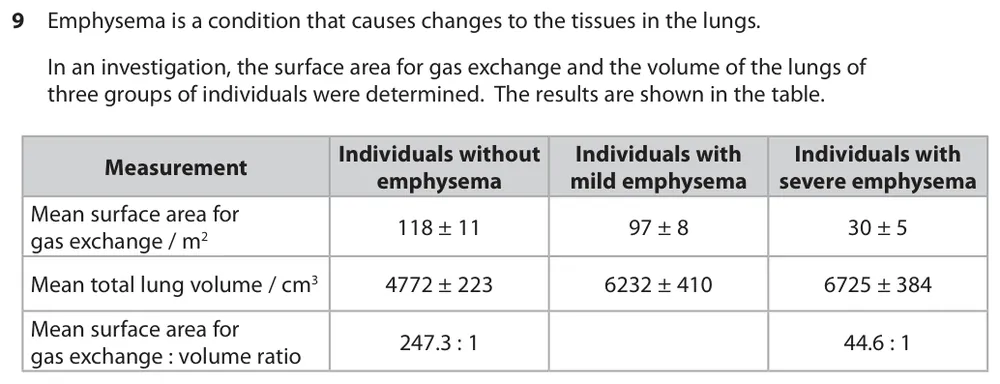
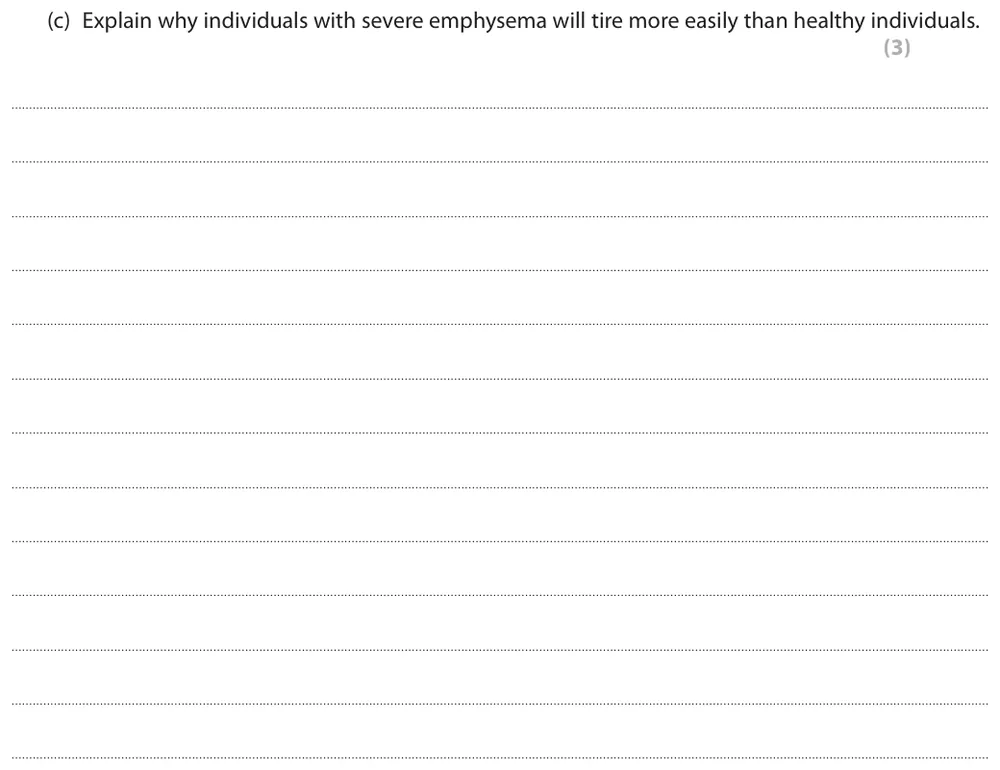
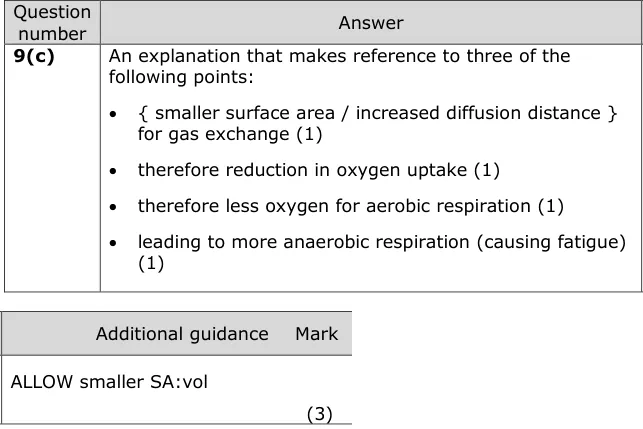
Explain why people with severe emphysema tire more easily than healthy people.
Information from earlier in this question:
Show the mark scheme
Tap an image to open it full size.
From the examiners' report: Many wrote 'reduced surface area' without mentioning the lungs or gas exchange. Leaving out the word 'respiration' after 'aerobic' or 'anaerobic' cost marks. Less oxygen for aerobic respiration means more anaerobic respiration.
Lung structure and rapid gas exchange (2.1 iii)
Question 7
AS Paper 1 · June 2017 · Q2(b) · 4 marks
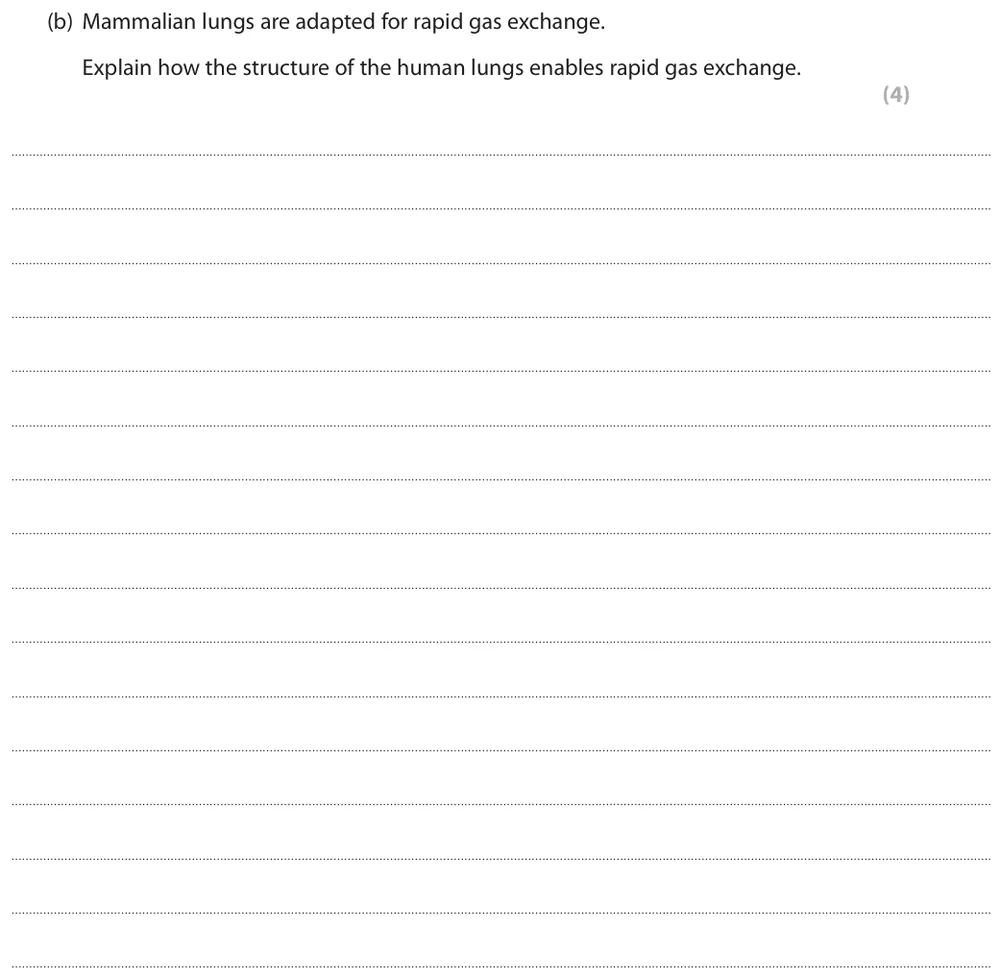
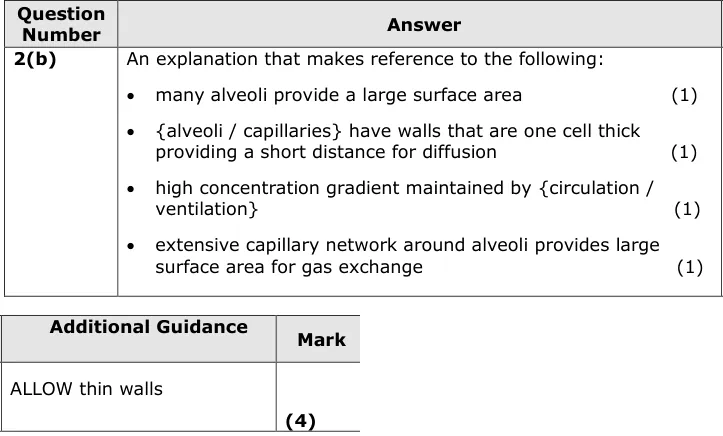
Explain how the structure of the human lungs enables rapid gas exchange.
Show the mark scheme
Tap an image to open it full size.
From the examiners' report: Relate the structure to every part of Fick's law. Many said alveoli have a large surface area but not that there are many of them. A surprising number said capillaries or alveoli are one cell thick: it is their walls that are one cell thick.
Cell membrane structure and properties (2.2 i)
Question 8
A level Paper 1 · June 2025 · Q5(a) · 3 marks
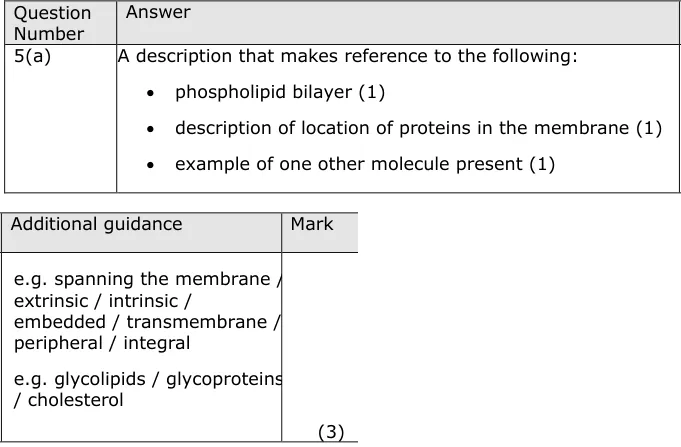
Describe the fluid mosaic structure of a cell surface membrane.
Show the mark scheme
Tap an image to open it full size.
From the examiners' report: Many explained what the fluid mosaic model means instead of describing the structure. Use the term 'phospholipid bilayer' and say where the proteins are, not what they do: carrier and channel proteins were not credited. An unlabelled diagram gains nothing.
Question 9
A level Paper 2 · June 2019 · Q1(b) · 3 marks · Easy
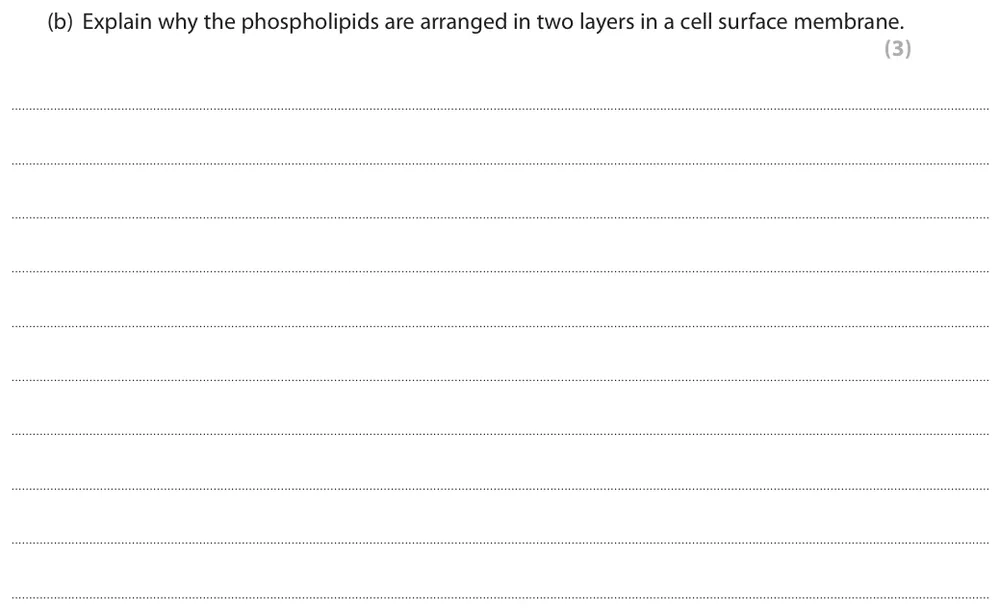
Explain why phospholipids are arranged in two layers in a cell surface membrane.
Show the mark scheme
Tap an image to open it full size.
From the examiners' report: Most linked the polar and non-polar regions of the phospholipid to water, but only a minority explained why two layers are needed: there is a water-based solution on both sides of the membrane.
Question 10
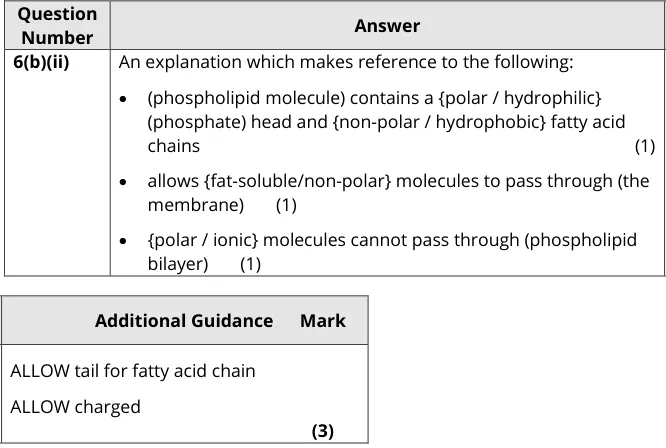
AS Paper 1 · June 2019 · Q6(b)(ii) · 3 marks
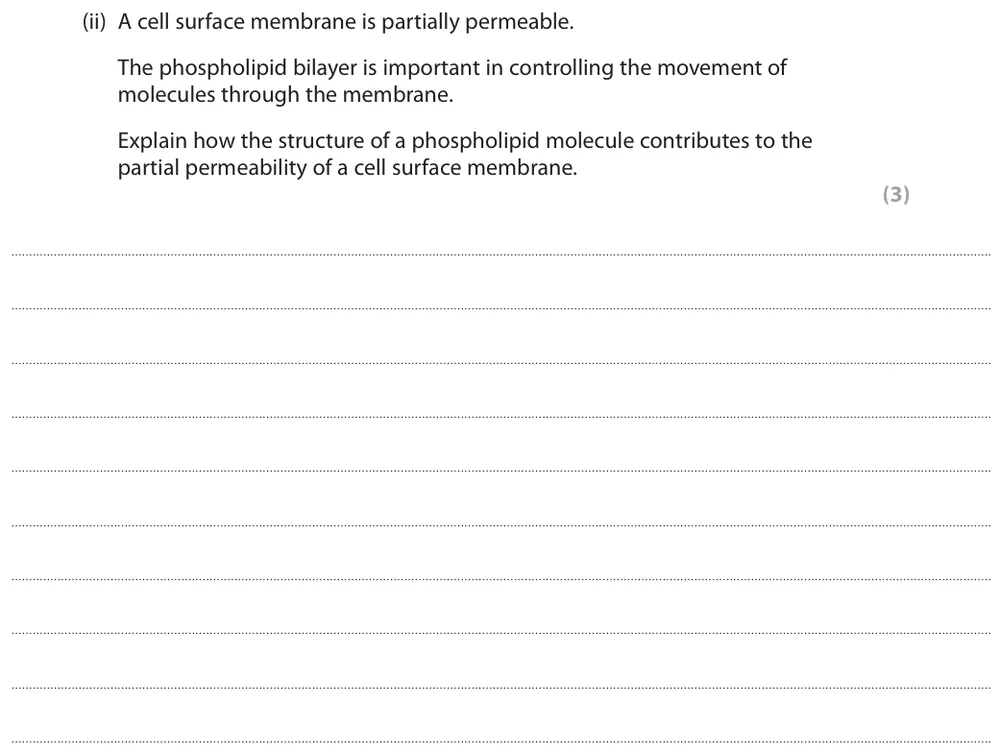
Explain how the structure of a phospholipid contributes to the partial permeability of a membrane.
Show the mark scheme
Tap an image to open it full size.
From the examiners' report: A significant minority described the fluid mosaic bilayer or the proteins instead of the phospholipid molecule. Many explained why polar molecules cannot pass through but not why non-polar ones can, and some mixed up polar and non-polar.
Question 11
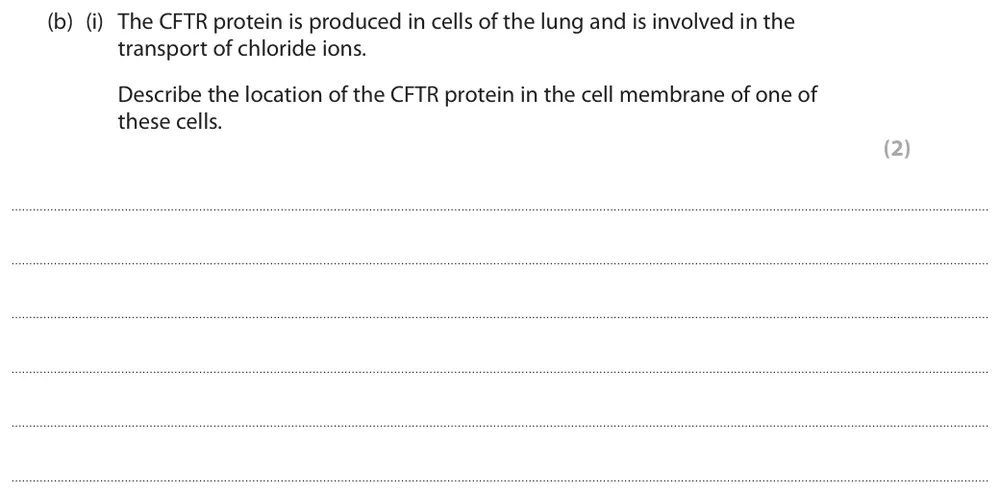
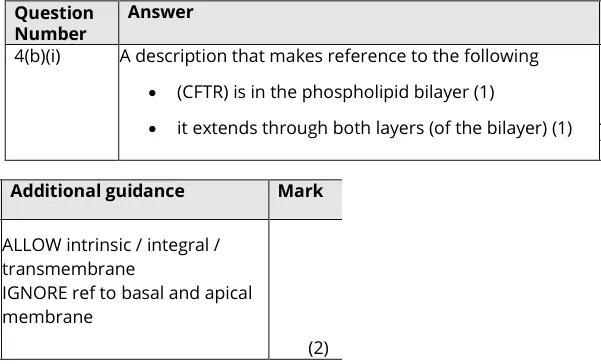
A level Paper 1 · June 2024 · Q4(b)(i) · 2 marks
Describe the location of the CFTR protein in the cell membrane.
Show the mark scheme
Tap an image to open it full size.
From the examiners' report: References to apical and basal membranes were ignored: the question asks where the protein is in the membrane. 'On the phospholipid bilayer' was not accepted, and some contradicted themselves by calling it extrinsic. A labelled diagram can help.
Osmosis (2.3)
Question 12
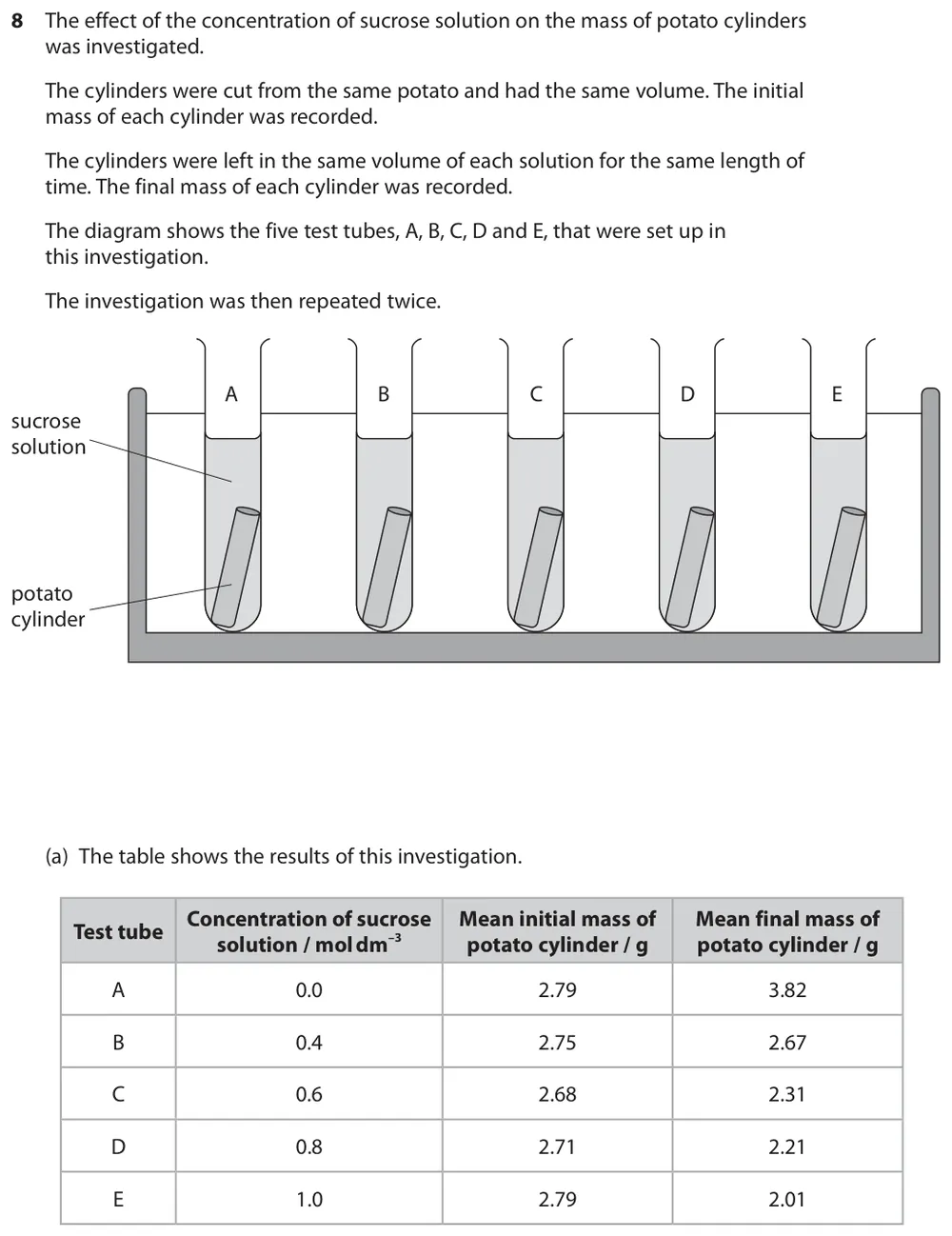
AS Paper 1 · June 2023 · Q8(a)(ii) · 2 marks
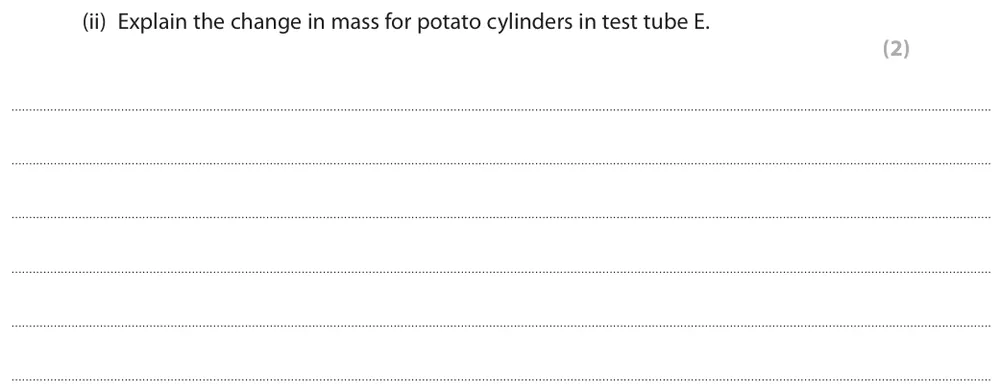
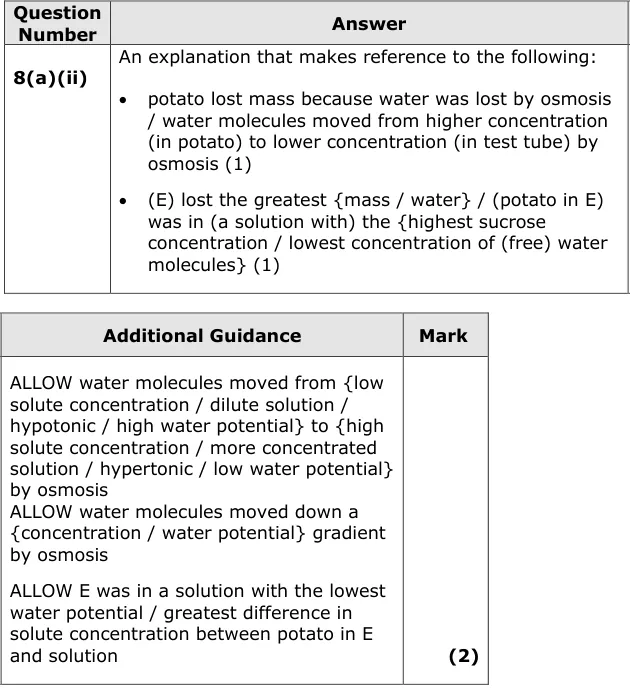
Explain the change in mass of potato cylinders in one test tube.
Information from earlier in this question:
Show the mark scheme
Tap an image to open it full size.
From the examiners' report: Most explained that the potato lost mass because water was lost by osmosis, but fewer recognised that it lost the most mass because it was in the highest sucrose concentration.
Question 13
A level Paper 1 · June 2025 · Q5(b)(i) · 2 marks
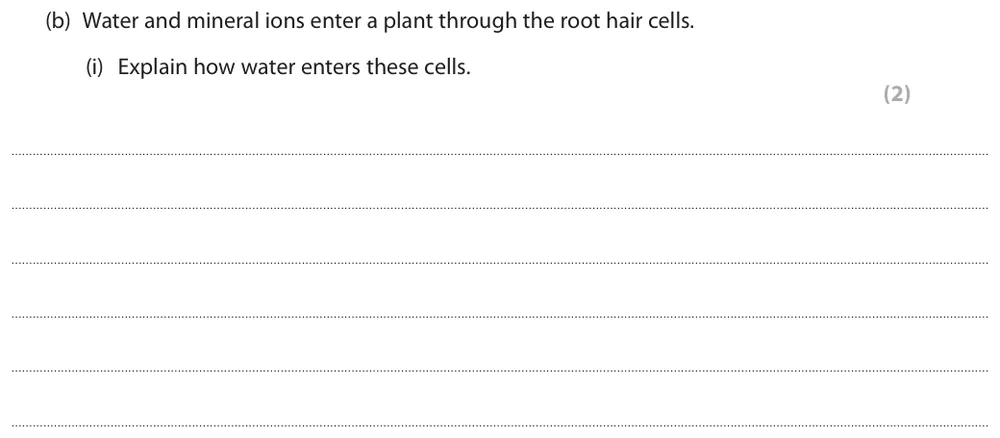
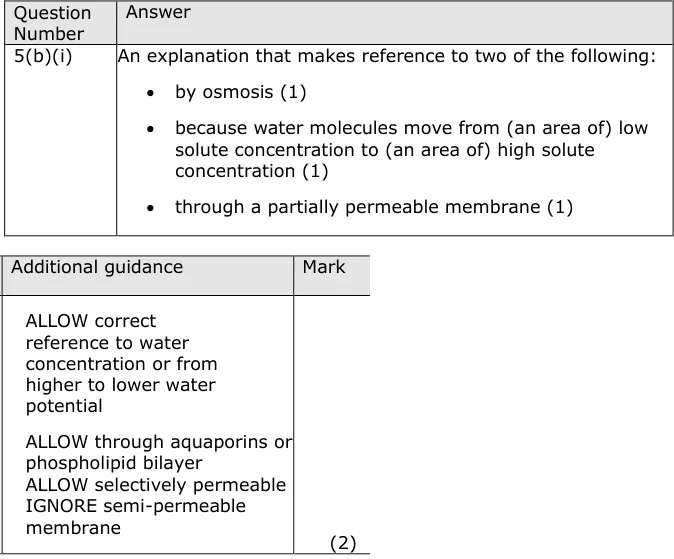
Explain how water enters root hair cells.
Show the mark scheme
Tap an image to open it full size.
From the examiners' report: A minority said active transport, or gave both active transport and osmosis; contradictory answers are not credited. Say whether you mean water or solute concentration, not just 'high to low'. 'Semi-permeable' was not credited: say partially permeable.
Question 14
A level Paper 3 · June 2024 · Q6(b)(ii) · 3 marks
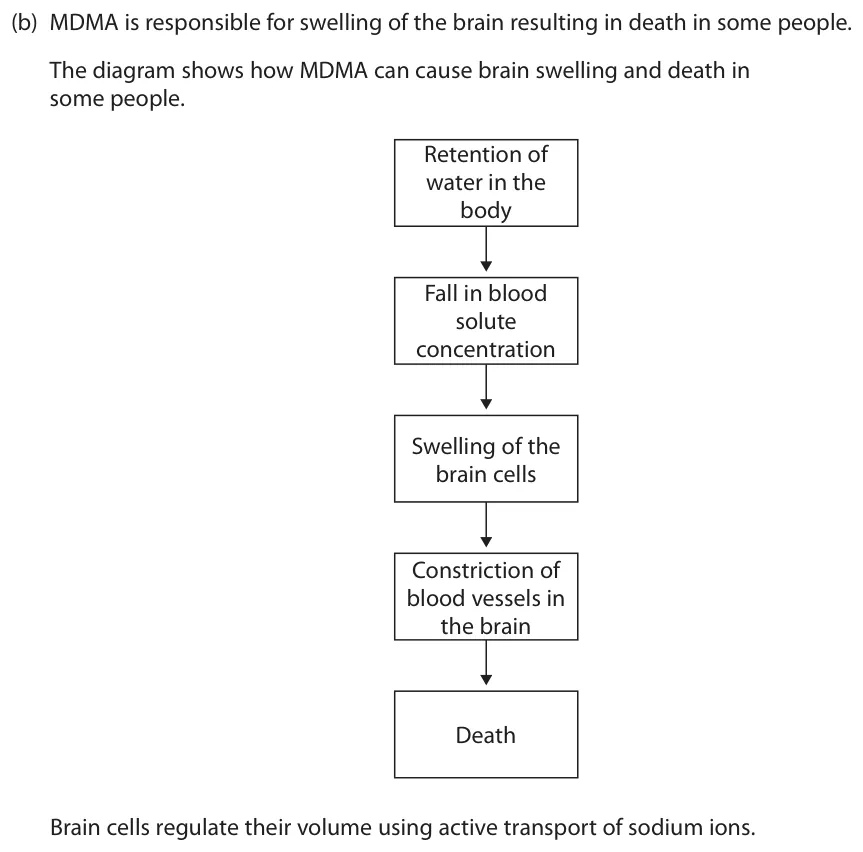
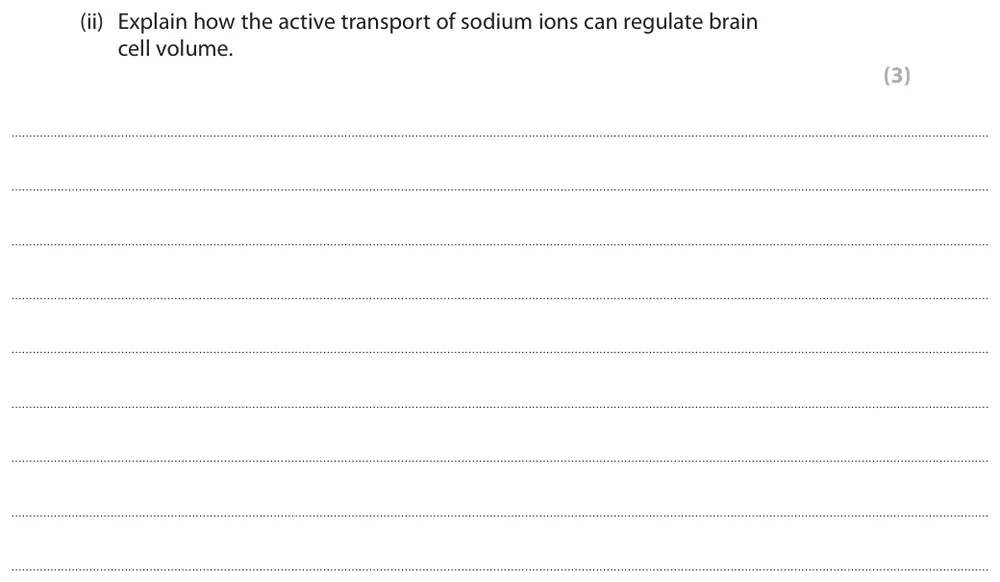
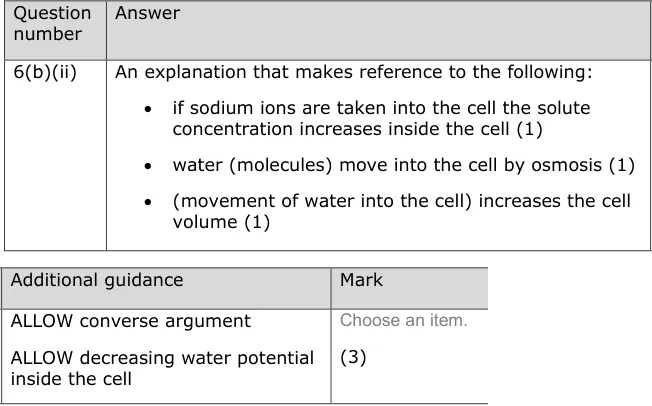
Explain how the active transport of sodium ions can regulate brain cell volume.
Information from earlier in this question:
Show the mark scheme
Tap an image to open it full size.
From the examiners' report: Make a clear link between the change in solute concentration and the direction water moves by osmosis. Answers about the sodium–potassium pump and action potentials gained no marks.
Question 15
AS Paper 1 · June 2022 · Q5(b)(i) · 4 marks
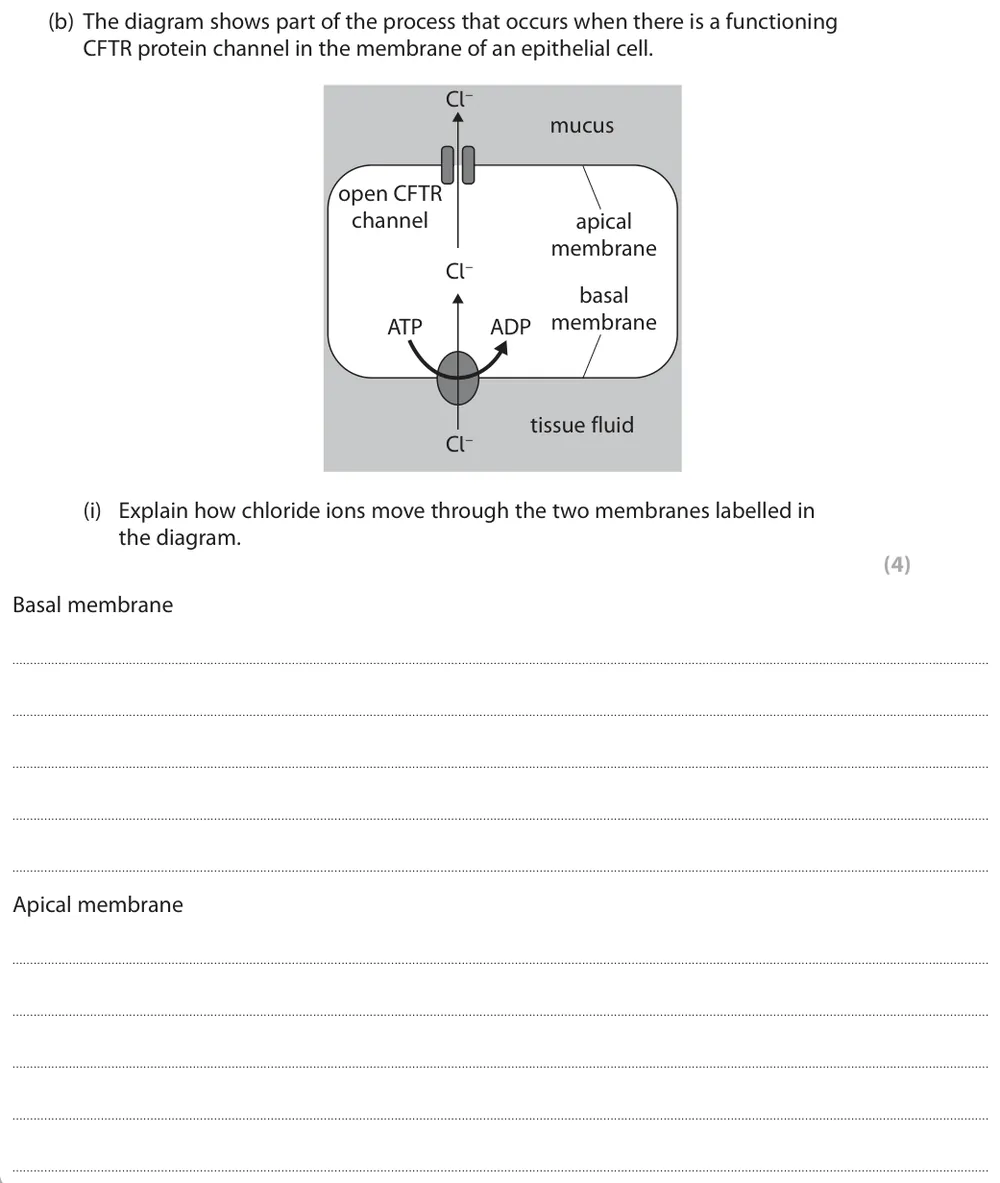
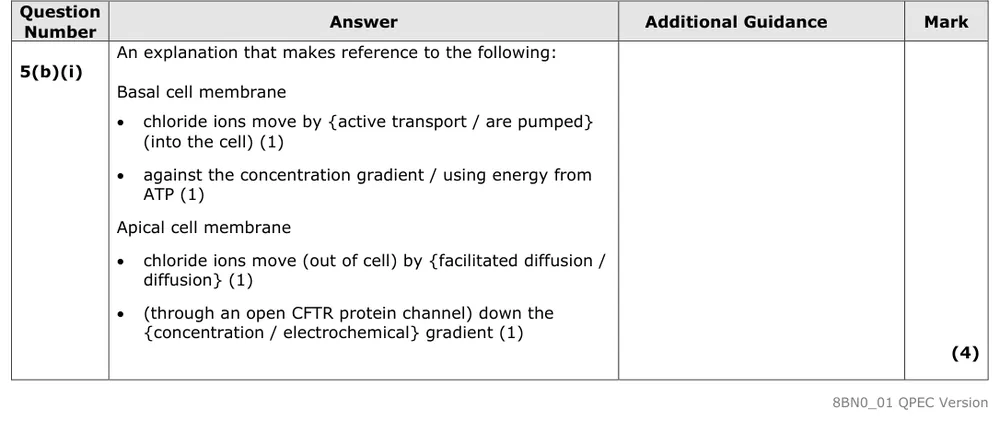
Explain how chloride ions move through the basal and apical membranes of an epithelial cell.
Show the mark scheme
Tap an image to open it full size.
From the examiners' report: Most saw that chloride ions cross the basal membrane by active transport, but weaker answers only mentioned ATP, which was on the diagram. Explain why ATP is needed. Most linked the higher chloride concentration in the cell to diffusion into the mucus.
Question 16
AS Paper 1 · June 2022 · Q5(b)(ii) · 3 marks
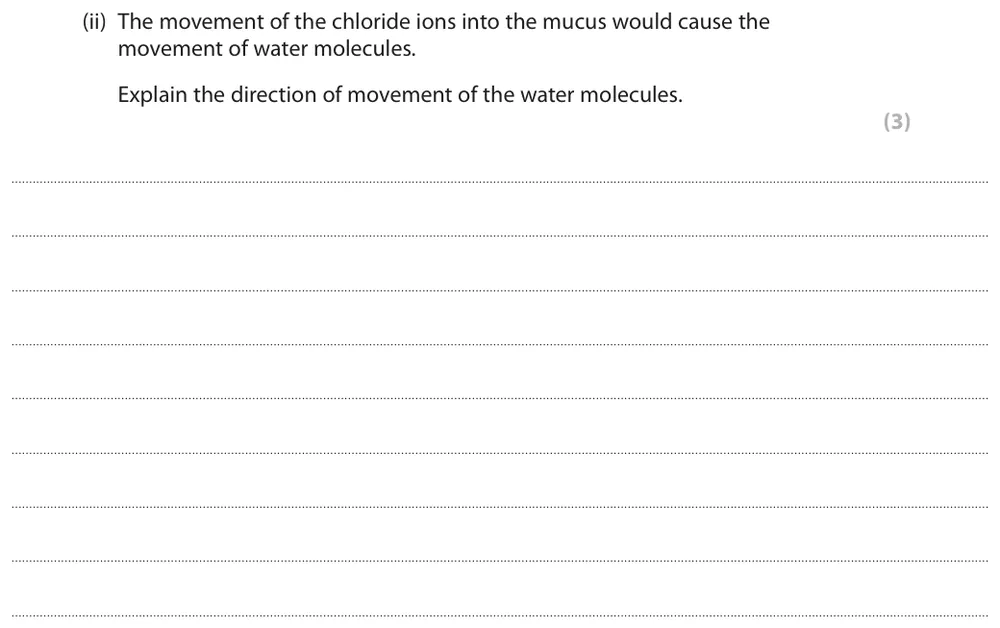
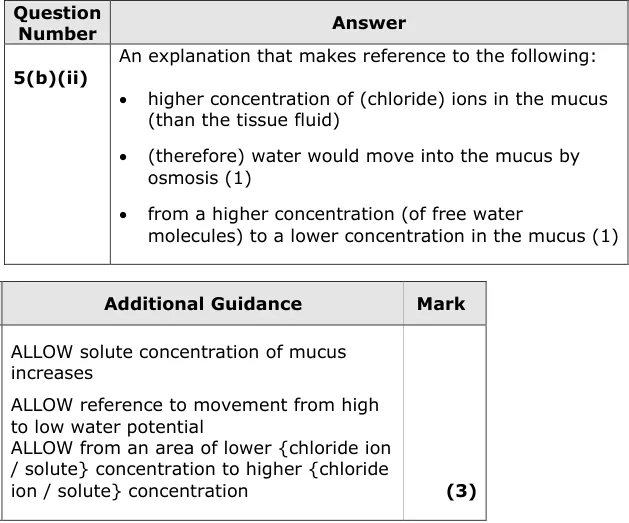
Explain the direction in which water moves when chloride ions move into the mucus.
Show the mark scheme
Tap an image to open it full size.
From the examiners' report: Most said water moves from a higher concentration in the cell to a lower concentration in the mucus by osmosis. The best answers linked this to the higher chloride ion concentration in the mucus.
Passive and active transport, endocytosis and exocytosis (2.4 i)
Question 17
AS Paper 1 · June 2018 · Q1(b) · 3 marks
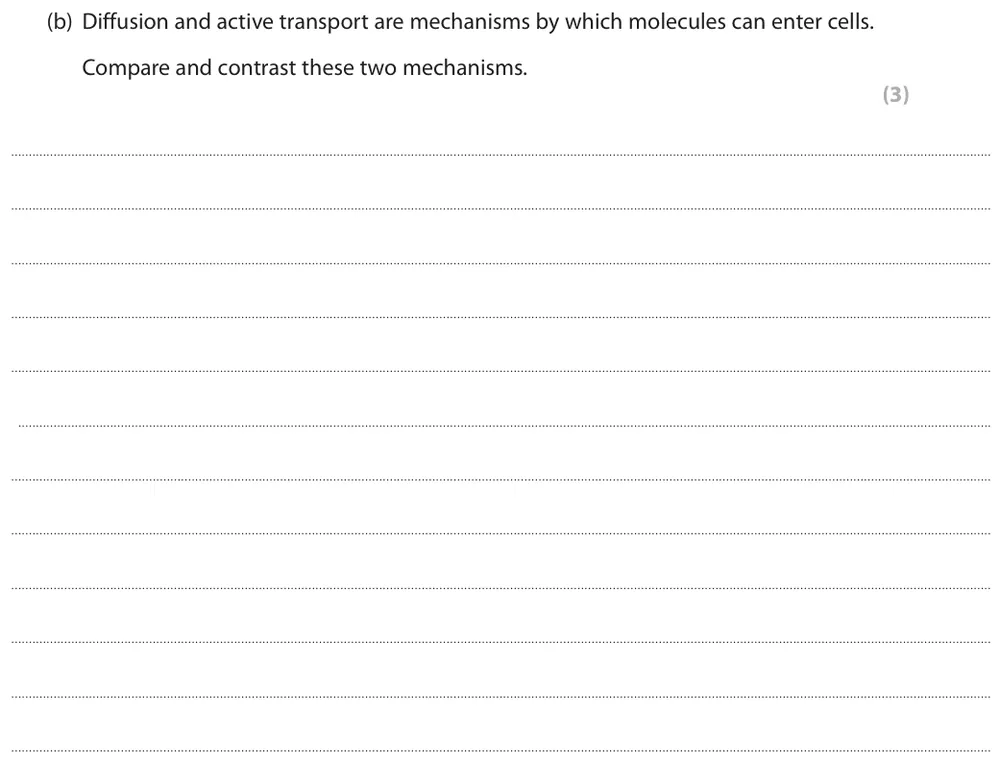
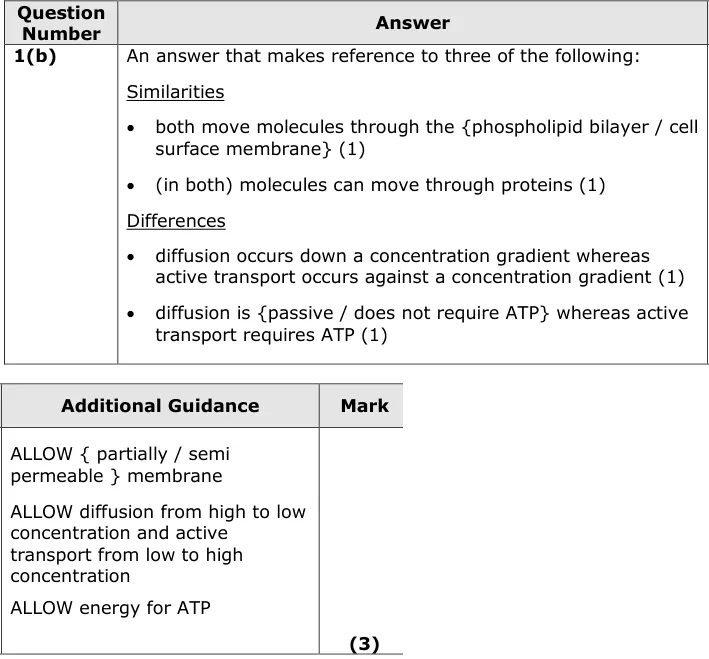
Compare and contrast diffusion and active transport.
Show the mark scheme
Tap an image to open it full size.
From the examiners' report: Most gave two differences, but many gave no similarity and so could not get full marks. Some wrote about one mechanism without contrasting it with the other. Few said both can move molecules through proteins.
Question 18
AS Paper 1 · November 2021 · Q5(c) · 2 marks
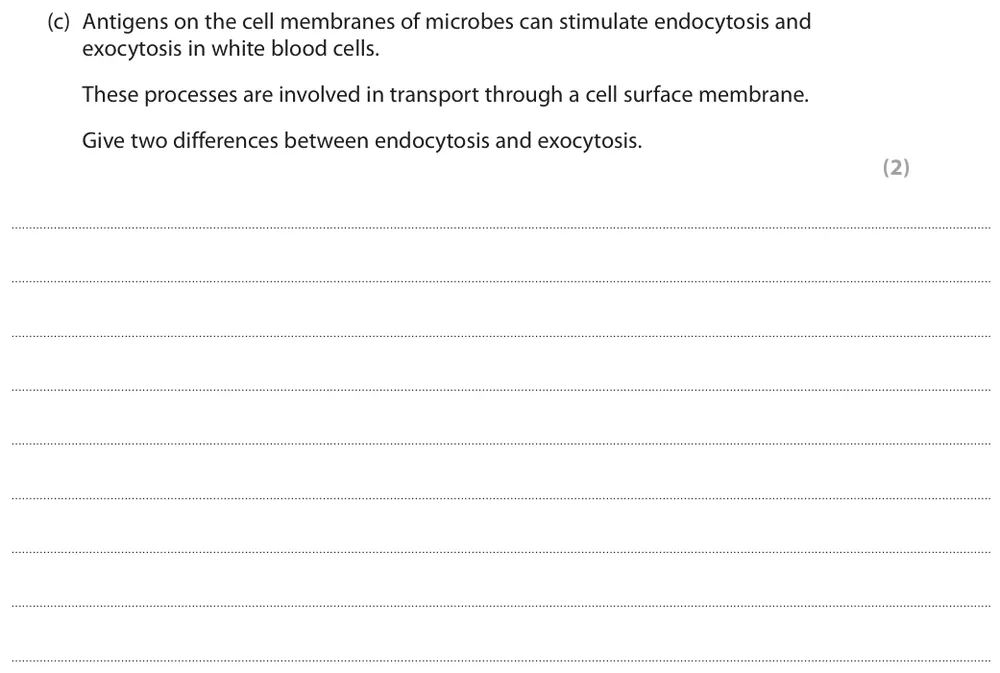
Give two differences between endocytosis and exocytosis.
Show the mark scheme
Tap an image to open it full size.
From the examiners' report: Some lost marks by describing only one process: each difference must cover both. Some thought endocytosis also involves vesicles fusing with the cell surface membrane.
Question 19
A level Paper 2 · June 2025 · Q3(b) · 4 marks
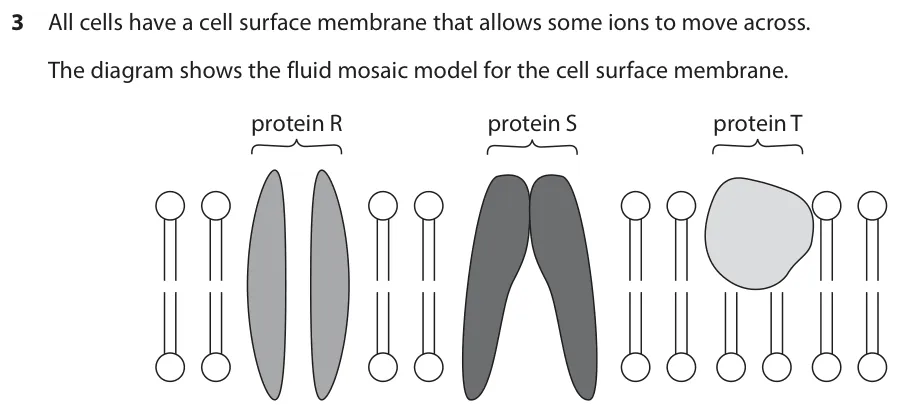
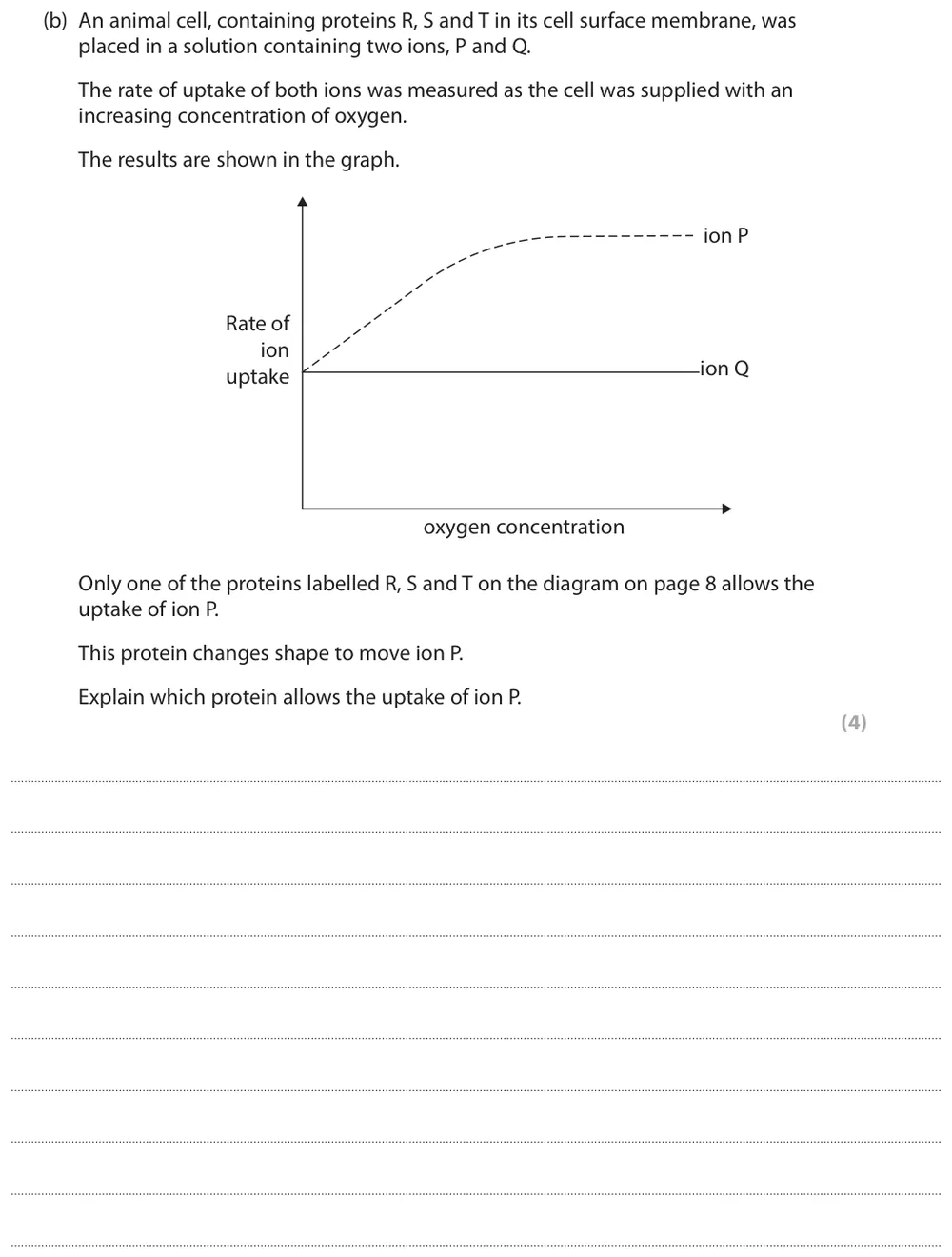
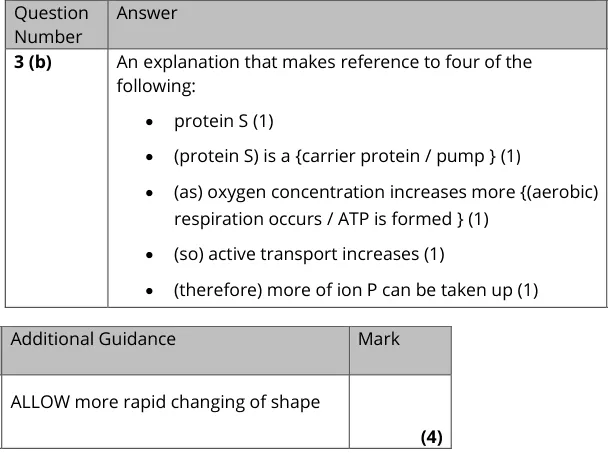
Use a membrane diagram and a graph to explain which protein takes up an ion.
Information from earlier in this question:
Show the mark scheme
Tap an image to open it full size.
From the examiners' report: You need the diagram, the text and the graph. Most managed this, but a number did not distinguish between the rate of ion uptake on the graph's axis and the amount of uptake.
Carrier and channel proteins (2.4 ii)
Question 20
AS Paper 1 · June 2016 · Q3(a)(ii) · 4 marks
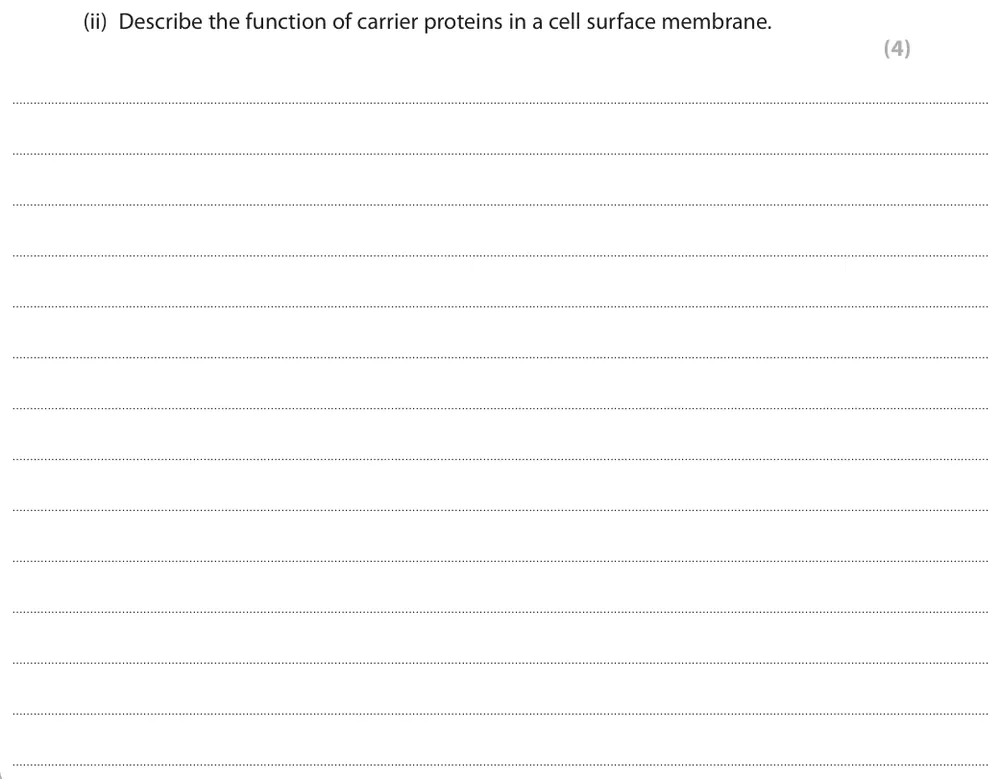
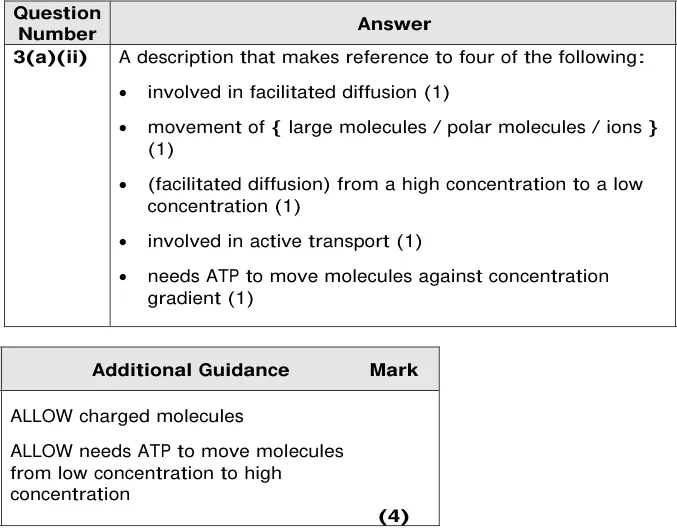
Describe the function of carrier proteins in a cell surface membrane.
Show the mark scheme
Tap an image to open it full size.
From the examiners' report: Many knew carrier proteins work in facilitated diffusion and active transport but did not explain their role in each. Say what they move (large or polar molecules, or ions): 'particles' was not enough. Don't describe channel proteins as well.
Where students lose marks (from Pearson examiners' reports and mark schemes)
Each point below comes from the examiners' reports and mark schemes, and is followed by wording that gained marks.
Say oxygen, not gases. References to 'gases' entering the cell by diffusion were not specific enough.
✔ Gains credit: 'They can rely on diffusion to take in oxygen, because of a large surface area to volume ratio and a short diffusion distance.'
Thinner, not smaller. 'Smaller blood-gas barrier' was not accepted, and 'more efficient gas exchange' only repeated the question.
✔ Gains credit: 'A thinner blood-gas barrier, so a reduced diffusion distance and a faster rate of diffusion.'
A steeper gradient keeps diffusion going. Few explained why a larger concentration gradient helps people with emphysema.
✔ Gains credit: 'Smaller surface area of the alveoli, so a larger concentration gradient is needed to maintain the rate of diffusion.'
Write aerobic respiration in full. Leaving out the word 'respiration' after 'aerobic' or 'anaerobic' cost marks.
✔ Gains credit: 'Reduced oxygen uptake, so less oxygen for aerobic respiration, leading to more anaerobic respiration.'
It's the walls that are one cell thick. A surprising number said that capillaries or alveoli are one cell thick.
✔ Gains credit: 'Alveoli and capillaries have walls that are one cell thick, providing a short distance for diffusion.'
Position, not job. Carrier and channel proteins were not credited, because they describe what proteins do rather than where they are.
✔ Gains credit: 'A phospholipid bilayer, with proteins spanning the membrane, and glycoproteins or cholesterol present.'
Partially permeable, not semi-permeable. 'Semi-permeable' was not credited, and 'from a higher to a lower concentration' did not say concentration of what.
✔ Gains credit: 'By osmosis, from a lower solute concentration to a higher solute concentration, through a partially permeable membrane.'
Diffusion and active transport share something. Many did not give a similarity, so could not reach full marks.
✔ Gains credit: 'Both move molecules through the cell surface membrane, but diffusion occurs down a concentration gradient whereas active transport occurs against it and requires ATP.'
Download the questions
Download the PDF pack (20 questions, mark schemes at the end)
Keep practising
- DNA, RNA and Protein Synthesis (Topic 2): Edexcel SNAB exam questions by topic
- Proteins and Enzymes (Topic 2): Edexcel SNAB exam questions by topic
- Inheritance (Topic 2): Edexcel SNAB exam questions by topic
- Cystic Fibrosis, Mutation and Genetic Screening (Topic 2): Edexcel SNAB exam questions by topic
- Vitamin C and Membrane Permeability (Core Practicals 2 and 3): Edexcel SNAB core practical questions
- Topic 2 multiple-choice quiz (75 questions, marked as you tap)
- Edexcel SNAB A level Biology resources hub (every topic, practical and paper)
- Enzyme Concentration and Initial Rates (Core Practical 4): Edexcel SNAB A Level Biology Exam Questions
- Extended Response Questions (Topics 1 and 2): Edexcel SNAB A Level Biology Exam Questions
- Edexcel SNAB A level Biology past papers, mark schemes and examiners' reports
- Edexcel SNAB A level Biology grade boundaries
- Message Tom on WhatsApp about one-to-one Edexcel SNAB tutoring or an Edexcel group class
Questions, mark schemes and examiners' report extracts © Pearson Education Ltd.