


Exam Technique - Last-Minute Golden Tip
The simplest, last-minute exam tip of all time
Here is the simplest Exam Technique tip ever:
Don’t fold the exam paper back on itself
Students typically fold the paper back to reduce it to A4 size, and to focus on just one page. Don’t do this!
Often, questions straddle more than one page. These will appear opposite sides of the fold. Keep the paper open, and you will be able to see all the information at once. Something from an earlier part of the question may well be vital for answering the last part. Don’t hide it from view!

More posts with exam tips:





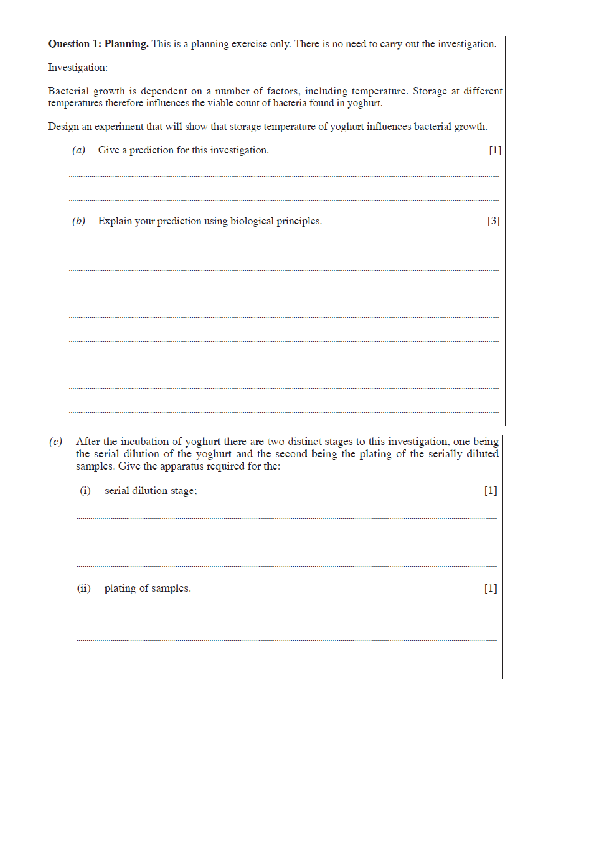
Exam Technique - Simplify the Question
Make the Question Simpler
Let’s get rid of everything that isn’t on the spec. We will need these words later when writing the answer out, but we do NOT need them while we work out what the question is really about.
To be brutally honest, most students who get stuck on exam questions do so because they don’t understand the content deeply enough. There is no magical exam technique that can make up for that.
However, there are certainly some things you can do to make exams easier.
Here’s a great exam tip for anyone who gets overwhelmed when they see a question like the one below:
Overwhelming scary question:
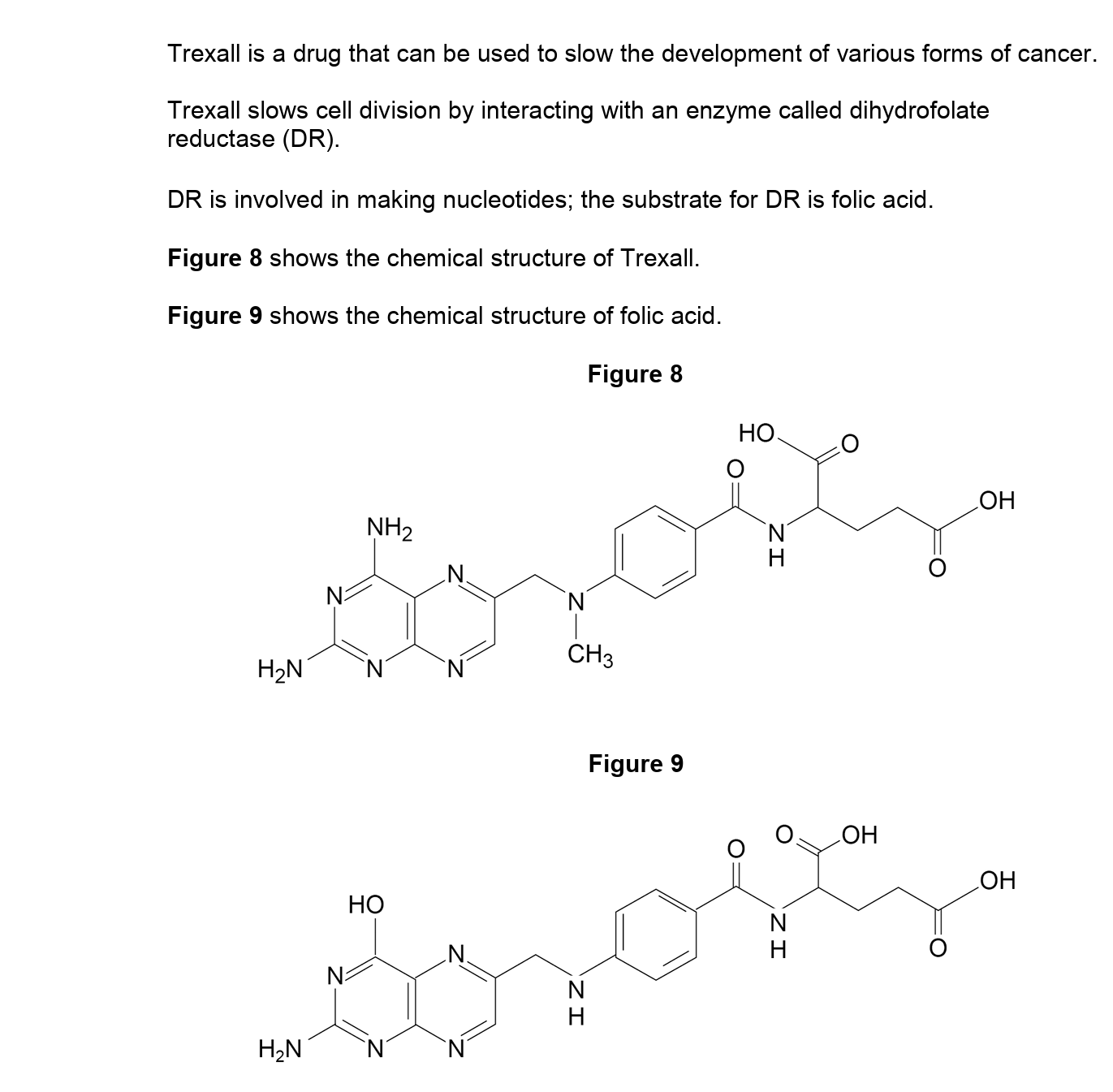

What is Dihydrofolate Reductase?? That’s not on the spec! 😩😭
Don’t panic if you don’t recognise words in a question - if it’s not on the spec, you are not being tested on your knowledge about it.
That means that this question is not about dihydrofolate reductase, nor about Trexall
So what is it about?
Look for the familiar words and concepts. Focus on those, not on the weird jargon names of the example organisms/molecules/drugs that you have never seen before. They are just examples, the important thing are the general concepts.
Make the Question Simpler
Let’s get rid of everything that isn’t on the spec. We will need these words later when writing the answer out, but we do NOT need them while we work out what the question is really about.
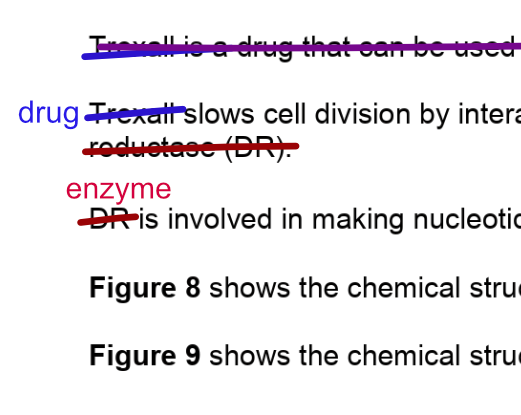
First, let’s replace “Trexall” with “Drug”. Trexall isn’t on the spec so it’s just an example of a drug. The name isn’t important.
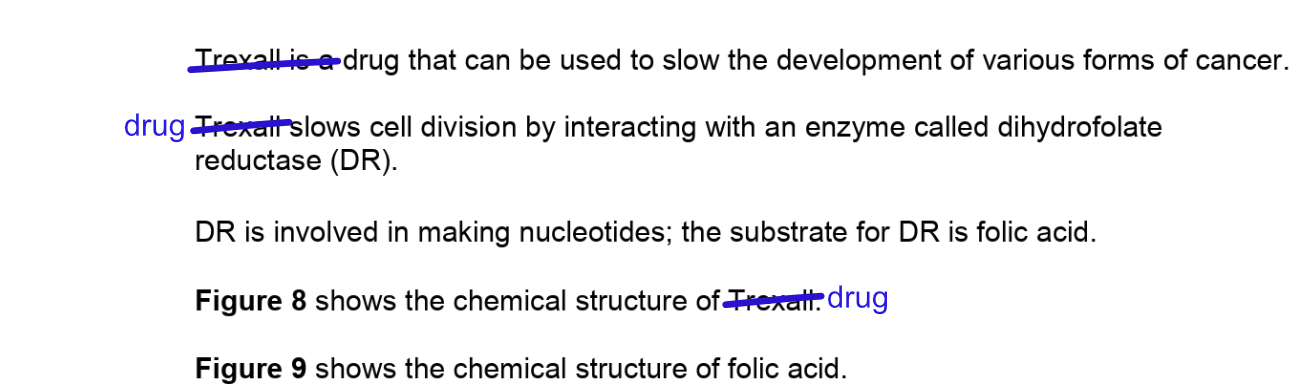
Do the same for the enzyme. You don’t need to remember that DR = dihydrofolate reductase while you’re working out the general, on-spec concept of the question. If you stick all that in your brain you’ll have less capacity for thinking about the important things.
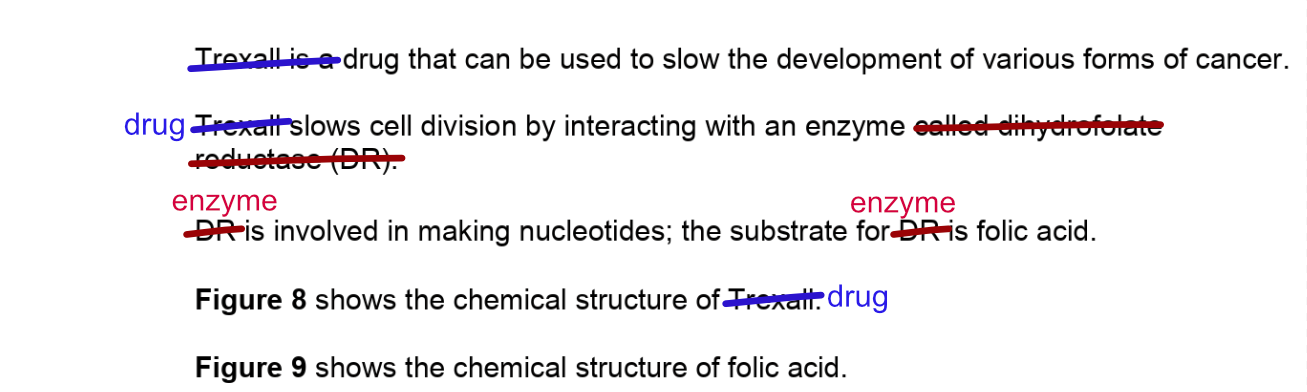
And then the same for the substrate (Folic Acid is not on the spec, the concept of substrates is).
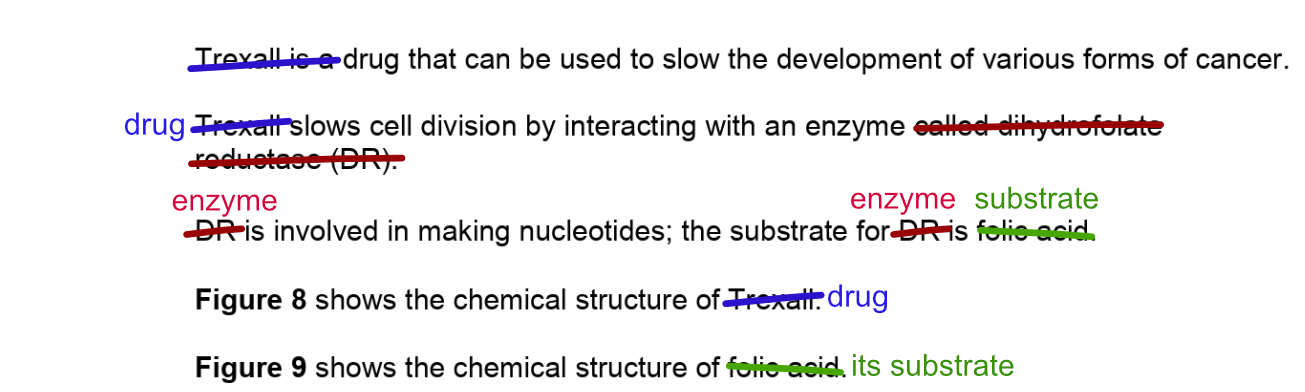
In summary: cross out the names of things that are not on the spec, and repace with generic words.
Hm, that sentence “the substrate for enzyme is substrate” is a bit pointless. So we can cut all that.
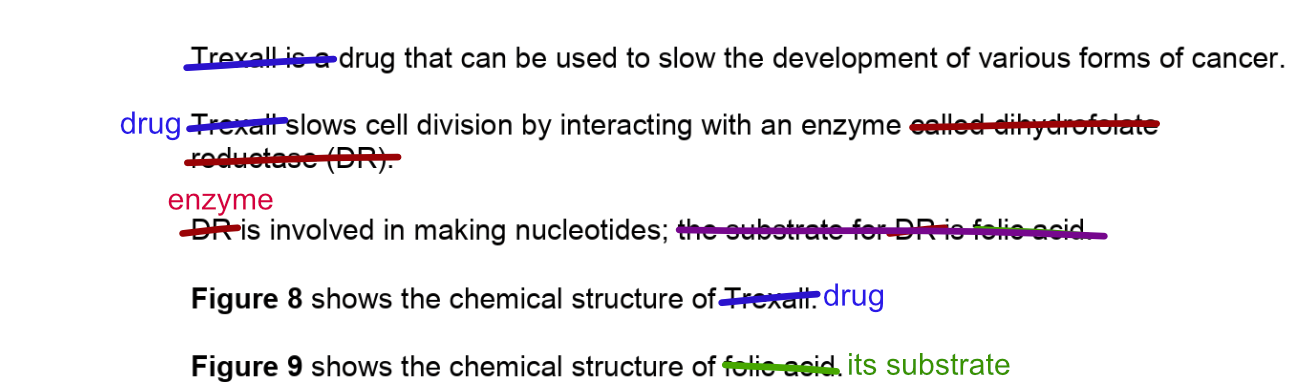
This is hopefully looking a little bit less overwhelming now.
The other thing we can do is to directly label the figures, so you don’t have to look up and down to remember which is which. This is for any type of figure - if it’s a graph, you would label the axes.
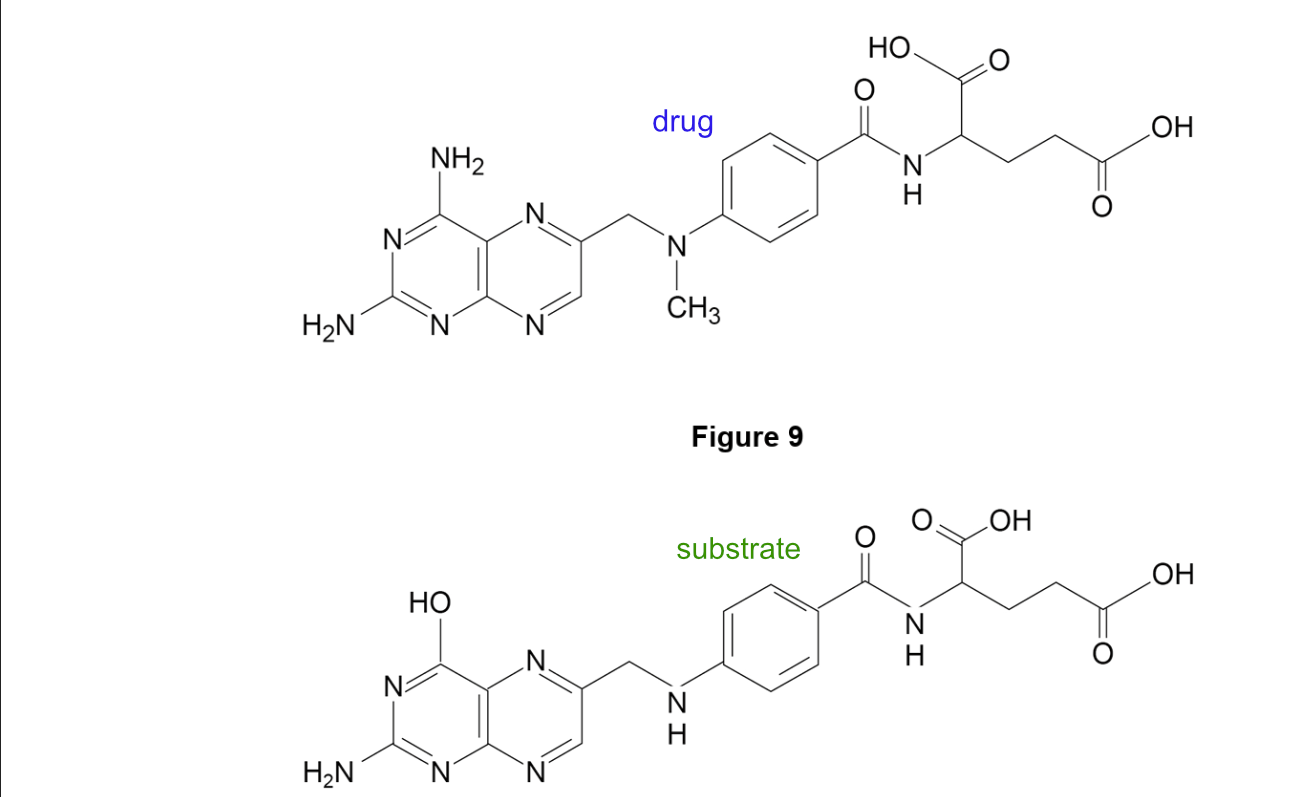
That helps a bit, but those molecular structures are still pretty scary stuff.
But remember: these molecules are not on the spec - so they are just examples. Two molecules, either of which might have had pretty much any structure.
What is the very first, most obvious and basic thing that you noticed about them when you looked at them together?
The Question Itself

Interesting, nothing about cancer in the question. We know that cancer involves fast-dividing cells, so a drug that slows cell division might help, but it doesn’t want you to talk about cancer (for this question at least). So that top sentence in the background info isn’t actually required either.
Also notice that it the question says “use the information provided” - this is a clue that everything you need is in the background information. They were never expecting you to already know anything about Trexall or dihydrofolate reductase.
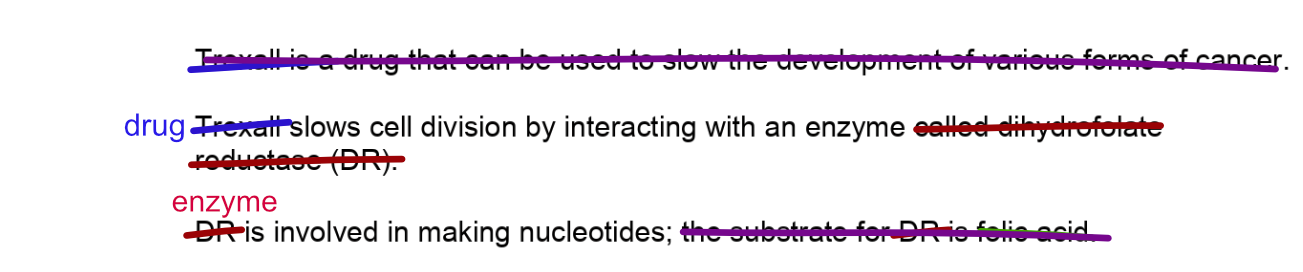
The question has been simplified down to this:
▪ A drug slows cell division by interacting with an enzyme
▪ The enzyme is involved in making nucleotides
▪ The drug and the enzyme substrate look very similar
Suggest how the drug slows cell division
Can you work out the answer now? Give it a go before reading on.
Working Out the Answer
There are two important things you need to realise - firstly the mechanism of action of the drug, and secondly why its action slows cell division. Both of these rely on you knowing concepts from the spec.
1. The Mechanism of Action of the Drug
What have you learned about different ways in which drugs might work? How might a drug interact with an enzyme? How might a drug with a structure very similar to the substrate interact with an enzyme? How might that affect the enzyme?
2. Why does this Action Slow Cell Division?
The enzyme is involved in making nucleotides. Nucleotides are on the spec. What are they used for in the cell? How is this connected to cell division?
Writing Out the Answer
When you write out your answer, it’s really important to remember to reverse the simplification process and use the correct names of the drug, enzyme, and substrate!
Give it a go now if you haven’t already - write out the answer you would give. Then scroll down to check it against the answers & markscheme. Don’t jump ahead; practicing writing answers to exam questions is really important for learning. I promise nobody will see if you mess it up.
Answer & Markscheme
There are many ways to explain the answer to get the marks, here’s just one example:
Trexall has a molecular structure very similar to folic acid, which is the substrate of the enzyme DR. This suggests that Trexall acts as a competitive inhibitor by binding the enzyme’s active site. This action prevents folic acid from binding, reducing the number of enzyme-substrate complexes. As the enzyme is involved in nucleotide synthesis, Trexall slows the rate of that process. Nucleotides are required for DNA replication, which is required for cell division. Trexall slows cell division by reducing the number that are available to a point where their availability is a limiting factor.
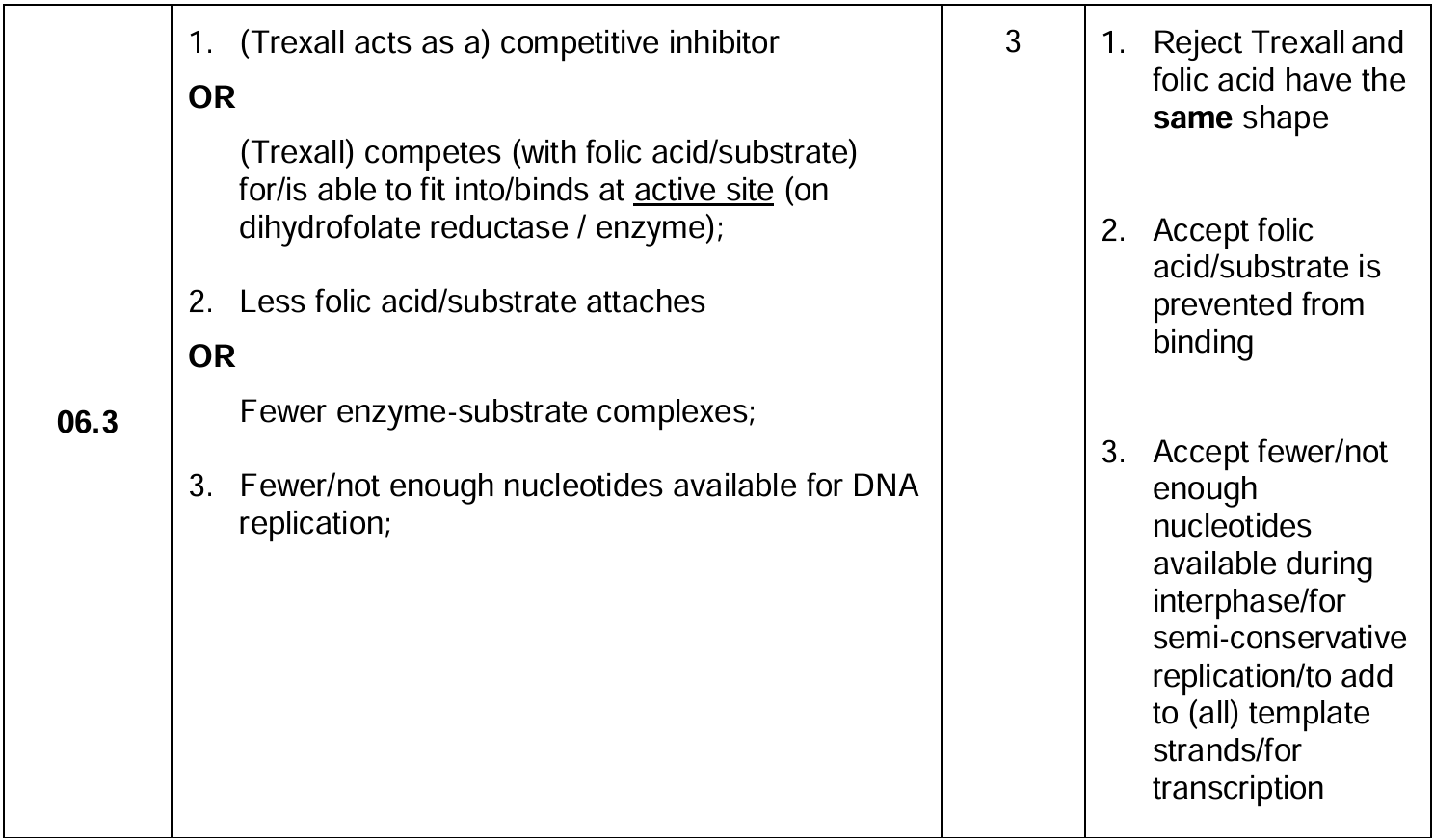
Can you see where the marks came from? And did you get all three?
Top tip: there’s no point in trying to remember answers to exam questions - the questions in your exam will be different! Instead, focus on noticing things like the level of technical language and detail that are required, and how these compared to your answer.
A Quick Recap to Finish..
If you feel overwhelmed by the amount of information in an exam question, you can simplify the question by removing specific names of things that are not on the spec - which you are not being examined on - and replacing these by the general concepts that you are being examined on. Just remember to use specific language in your actual written answer.
The full Exam Tip collection:
Give yourself a moment to think about the previous post before surging forward - maybe go make some tea. But here is more food for thought.
How to Revise A Level Biology: A Simple Trick - Use Your Words
A simple but effective trick to boost your learning and revision. You just need a little buddy.

A guest blog from Dr Jenny Shipway, who studied biochemistry at university and now works in science communication and education training.
Find the full set of “How to Revise” articles here
The Lazy Brain
Brains are great at taking sneaky short-cuts to avoid thinking too hard, especially when they’re feeling tired. If you get stuck on something while revising, it might be for this reason.
Words are Powerful
Words not only help us communicate, but also help us organise our thoughts. By forcing things into words, we can prevent our brains from taking short cuts, and force them to think things through properly.
Many problems can be solved simply by stating the problem out loud. How many times have you asked someone for help but, as you are describing the problem you realise what the answer is? By describing the problem step by step, it’s suddenly obvious where you were going wrong.
As a bonus, when you take the effort to put things into your own words this forces the thoughts through your brain in a way that means you are more likely to remember it in future.
Your best study buddy is already in the room

Can you explain Mitosis to Mr Pokey?
Research shows that much of what people learn in schools comes from talking with their teachers and classmates. But what if you’re alone? Don’t despair, your study buddy does not have to be human, or even alive.
As you study, you could explain concepts out loud to:
Your pet
A beloved soft toy
A smiley face drawn on your finger
A picture of someone you love or respect
Pretty much anything with two googly eyes stuck onto it
I don’t know what the research says about giving your buddy a name, but I would imagine this would help too.
Keep Your Language On Track
For best effect:
Speak in complete sentences rather than letting your thoughts jump around. If you need to repeat yourself to do this, then do so (your study buddy won’t mind). Making yourself repeat the same idea again but more clearly is really helpful.
Keep your language scientific and appropriate to the level of study where possible.
Don’t let your brain take short-cuts by using unprecise language or skipping through ideas. Speak slowly and deliberately, like you really are trying to explain something to someone who doesn’t already know it.
By repetitively speaking biology jargon words out loud, you will be much more likely to remember them in future. And by using them in complete, meaningful sentences, you will be telling your brain that they are useful things to recall and flagging them up as things worth remembering in future.
It’s important that you’re not just repeating sentences you read elsewhere, the key is to produce new sentences that serve a purpose in explaining something to your study buddy.
If this post has been helpful, please like ❤️ below and share with your friends.
How to answer "Suggest" questions in AQA A level Biology
Command words are important! Step by step guide to how to approach and answer “Suggest” questions for top marks in AQA A level Biology.
Article by Natalie Vlachakis (an ex-teacher who also worked for AQA) & Jenny Shipway
Command Words: What do you Suggest?
There are many ways that examiners can ask an A-level Biology question. They might ask you to describe the structure of DNA. Or to explain the importance of the xylem being kept open as a continuous tube.
In exam questions, words like ‘describe’, ‘explain’ (and ‘suggest’) are known as command words. Always pay attention to command words because they tell you what type of knowledge or skill is being tested, and how you should approach the question.
So - when you get a question that asks you to ‘suggest’ something, what exactly does it want from you?
‘Suggest’ Questions
‘Suggest’ questions are usually asking you to use your biology knowledge and understanding to make sense of, and build upon, information about an unfamiliar organism and/or experiment.
Using unfamiliar contexts is a way for examiners to check that you really understand the content; rather than just having memorised set phrases and information.
You aren’t expected to already know the answer, or even be absolutely 100% certain that you’re correct. You just need to come up with something that would make sense biologically, and is likely to be true.
Example Exam Question
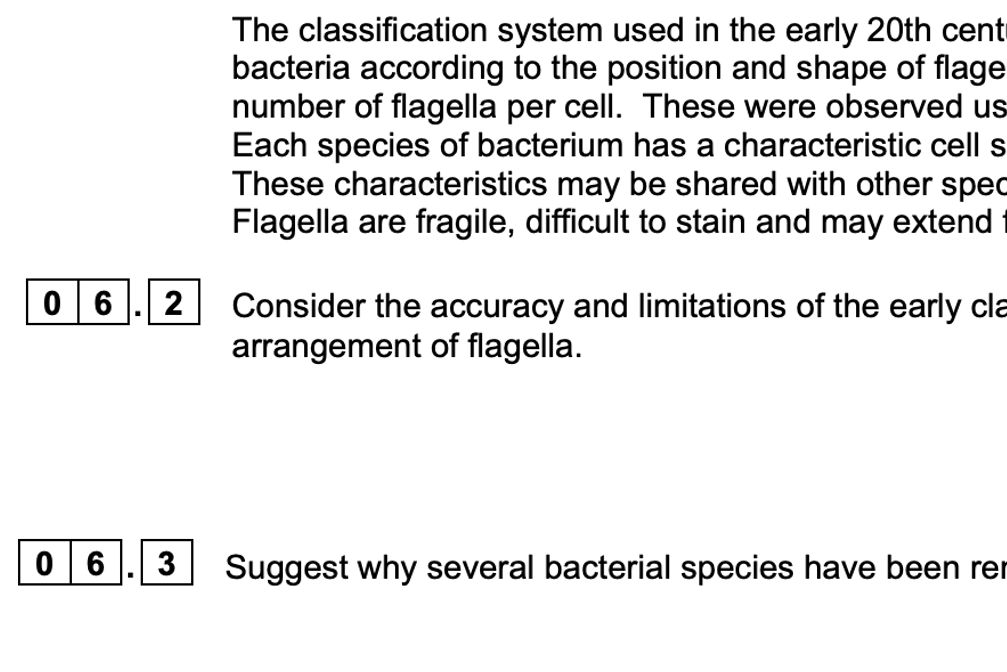
Q6 Paper 1 2023
The question:
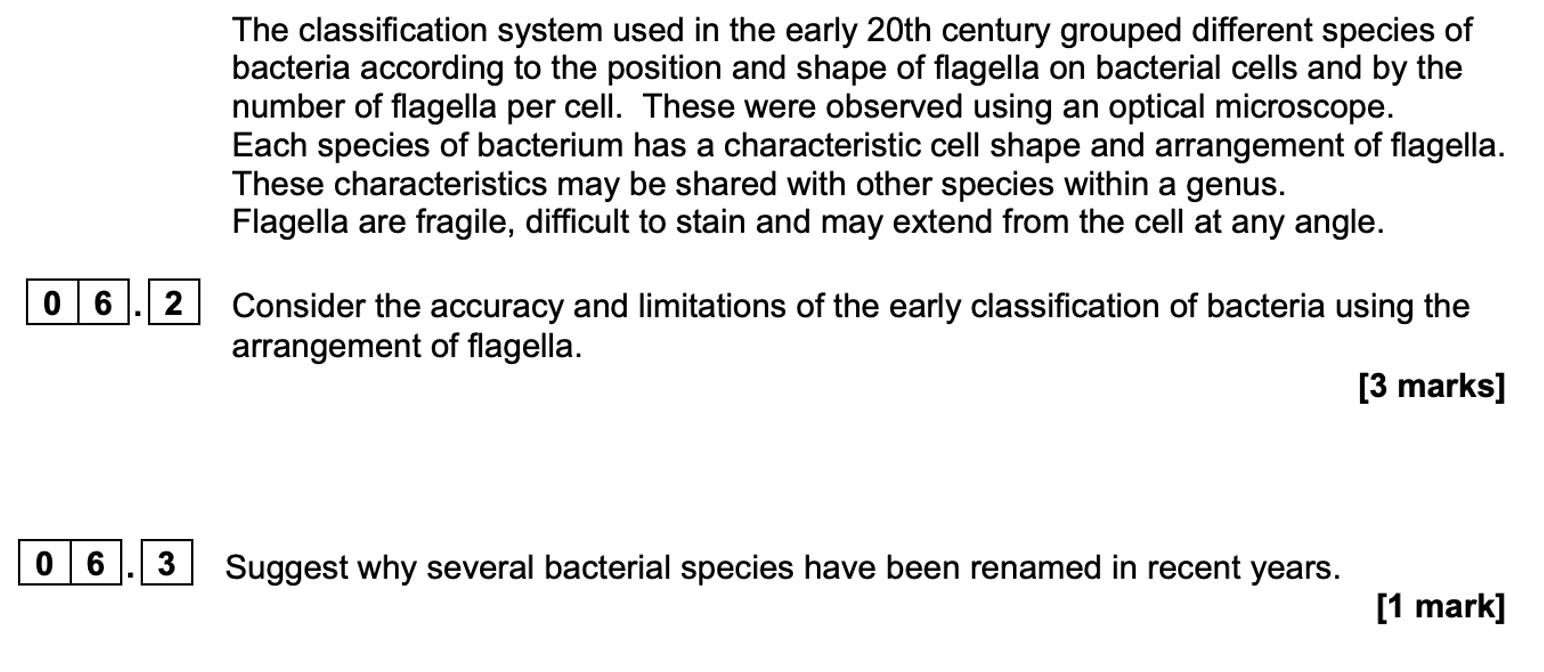
How to approach this question:
1. Don’t panic!
A question about historical classification of bacteria?! That topic is not in the spec!! Don’t panic – all the information you need about any off-spec topic will be provided in the question.
This example question is going to test your knowledge of classification, bacteria and microscopy (all from the spec), and – most crucially - your ability to apply that knowledge in an unfamiliar context.
2. Use your knowledge to make sense of the background information:
You know that bacteria are uni-cellular organisms. Your knowledge of bacterial structure will allow you to understand the description of how bacteria appear under the microscope. You know what a flagellum is. (3.2.1.2)
You know how ‘species’ and ‘genus’ are used in classification (3.4.5)
Your knowledge and experience of microscopy will allow you to understand the description of the limitations of optical microscopes. (3.2.1.3)
3. Answer questions in order
Answering question 6.2 (‘consider’ = ‘review and respond’) first will help you. This question gets you thinking in more detail about things that will help you answer 06.3.
4. Check the Command Word:
Question 6.3 asks you to ‘suggest’. So you know that you should use your existing knowledge/skills to make sense of, and build upon, the information given. You don’t need to know the exact answer for sure, but you need to give a biologically reasonable answer.
5. Understand the question:
The question asks “why” the species have been renamed.
Why might someone rename a species? – because they were misclassified before
Why might they have been misclassified before? – because of the limitations as in your answer to 6.2
Something has changed in recent years that has made it possible to classify these bacteria more accurately than before. What might this be?
6. Think about relevant information from the spec
What have you learned that is related to this question?
Phylogenetic classification (3.4.5)
Methods of studying cells (3.2.1.3)
7. How many marks are there available?
There is only one mark available – you can do this! But if possible, try to include more than one thing that might get a mark, so if one fails you are still ok.
8. So, what’s your answer?
Give it a go before looking at the markscheme below. Remember you need to use specific, technical language to win marks.
…
…
…
…
…
…
Q6 Paper 1 2023 6.3 - mark scheme
A range of answers are acceptable for this 1 mark. How did you do?
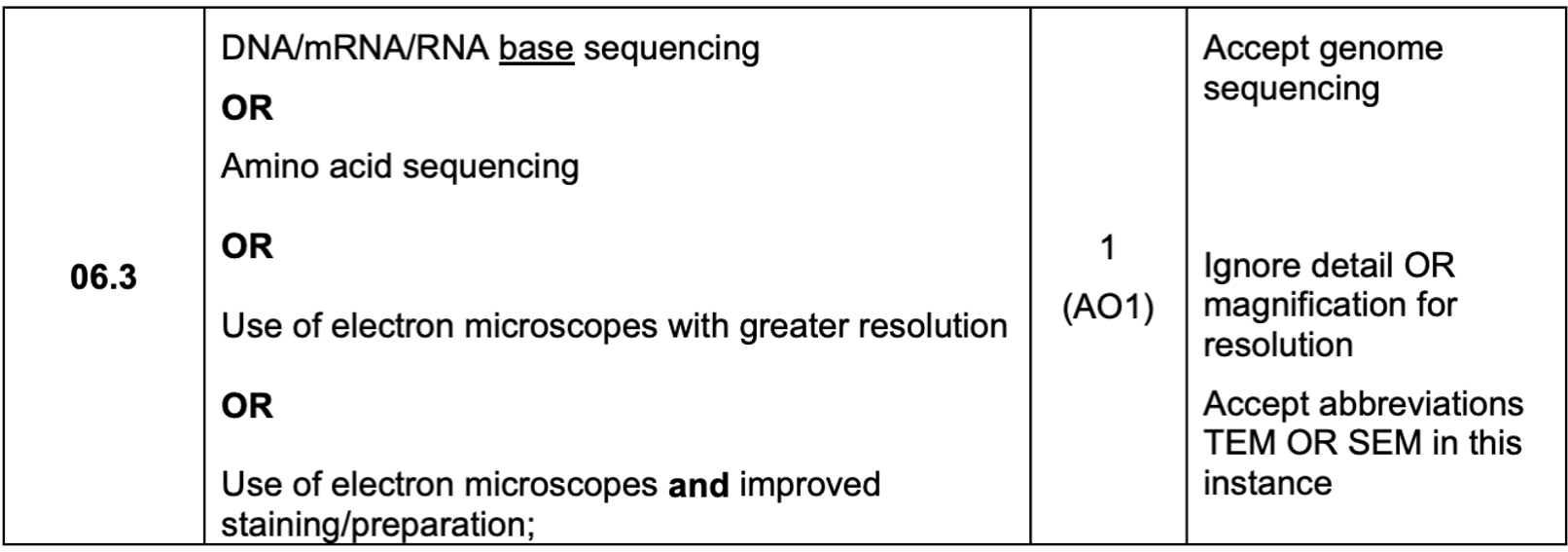
Q6 Paper 1 2023 6.3 – example answers
Successful answer that would win marks:
✅ “Different species will have different DNA sequences so by using genome sequencing they can identify different species”
✅ “Comparing the base sequences of mRNA from the different bacteria will show how similar they are to one another so whether or not they are the same species”
✅ “Electron microscopes have better resolution that optical microscopes so scientists can see the arrangement of the flagella in more detail”
Poor answers that would not get the mark – can you identify where they’ve gone wrong?
❌ “They can identify phylogeny better now, by looking at the DNA”
❌ “They can see more detail with microscopes now so there are fewer mistakes”
❌ “Advanced techniques allow more accurate determination of phylogeny“
A final thought:
The word ‘Suggest’ can be used in different types of questions (e.g. “Suggest two reasons why … ”, “Suggest how … ”) . But the word ‘Suggest’ always invites you to think about the problem in your own way - to use the information in the question with your biology knowledge to come up with your best possible answer.
Want more? Find another “Suggest” exam question walk-through here
AQA Paper 3 Extended Essay: Tips, Mark Scheme and Past Paper Titles - Updated for 2026
How to answer the AQA A-level Biology Extended Essay, including past paper essay titles
Exam Boards give feedback about students’ answers each year, to help future students do better. I have been working with some tutees, using the examiners’ guidance, to improve their approach to the AQA Paper 3 Extended Essay.
What are Extended Essays

The synoptic essay question is found at the end of AQA A-Level Biology Paper 3. You are required to write, in sentences and paragaphs of text, an essay about one of two topics. You should plan to spend about 40 minutes on the essay.
E.g.: “Write an essay on using DNA in science and technology”, or “Write an essay on the importance of membranes in the functioning of cells”.
In your essay you must write about a central theme, bringing together different ideas and concepts from the specification.
Why is there an Essay in the Paper?
Examiners want to check that you understand how different topic areas relate to bigger themes – how and why they are important in different contexts. This requires a deeper understanding of the topics.
You are tested on your ability to pick appropriate topics to write about, and your ability to present these using A-level terminology in a way that highlights their connection to the central theme.
Mark Scheme
There are 25 marks available for the essay, but remember you don’t need all of them to get a top grade. Even for an A* it’s ok to aim for 18/25.
Essays are assessed within ‘levels of response’, with each level having different marks available. See the table below, where each row is a different level. You need to meet a variety of measures to reach each level.
The qualities examiners look for are:
How well you link the topic areas to the main theme
A-level standard material with appropriate terminology, clearly explained
Avoiding factual errors
Avoiding irrelevant topics/information
Notice that because of the way the marking works, there’s no point in doing one thing incredibly well while ignoring the others. The things you do badly would hold you back from advancing through the levels.
Examiners’ Mark Scheme (marks for each level are shown in the left-hand column):
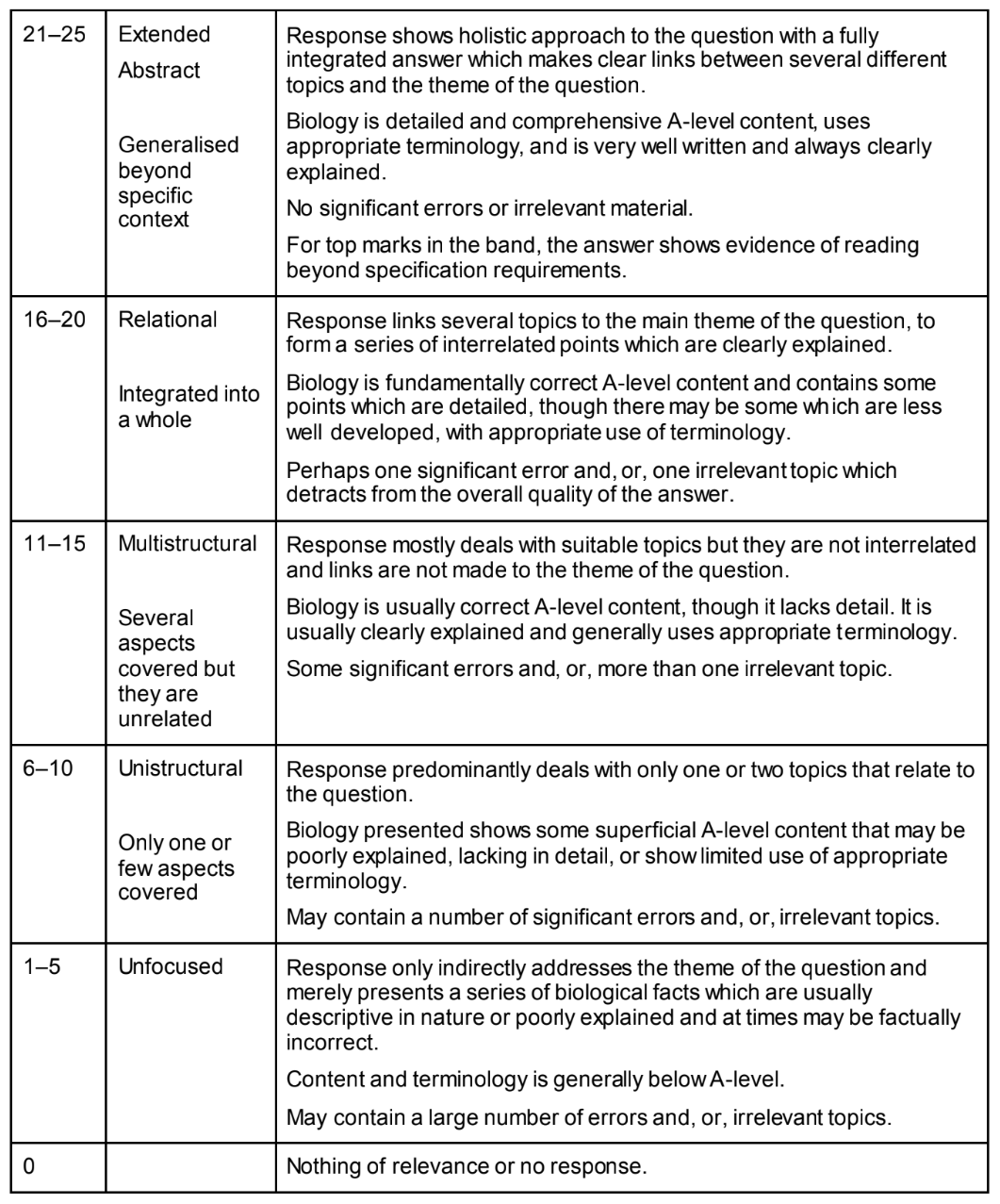
Selecting Topic Areas
You must identify an underlying theme or idea in the essay title – this must be a ‘big idea’ that you can illustrate in different ways.
You then need to choose ‘several’ topic areas that you can relate to this theme.
A ‘topic area’ is a numbered sub-section in the specification
Topic areas should be as different as possible from each other
AQA say you should have a minimum 4 topic areas.
I suggest you aim for 5 or 6 topic areas.
Picking topic areas can be a challenge. Here’s my top tip for how to approach this:
Think your way through the Kingdoms of Life. Can you think of illustrative examples from each Kingdom? (Ok, maybe not protists.)
Think your way through different scales. From single molecules → macromolecule → organelle → cells → tissue → organ → organ system → individual → populations → community → ecosystem.
Picking topic areas using this technique should give you both breadth and depth.
Want more? See this article all about picking topic areas, including a list of past-paper titles and examiners’ guidance.
A note on off-spec topics: to score 24 or 25/25, you would need to include a topic outside the A-level specification. But I always recommend students stay within spec. You don’t need 24/25 to get an A* overall (18/25 is fine), and many students attempting off-spec topics fail due to lack of depth and scientific terminology. Using something you heard in a podcast isn’t enough; you need to present it at or above A-level standard. Of course it’s great if you can! But only attempt this if extremely confident as else it could reduce your overall marks.
How to Structure your Essay
Writing an essay plan might be useful if it doesn’t take too long. But remember you will only get marks for content that is presented in sentences/paragraphs within the actual essay.
Overview:
Write in full sentences/paragraphs – you will only gets marks for things presented in this way.
No introduction or conclusion – Examiners say these are a waste of your time
Separate sections for each of your chosen topic areas – they don’t need to link to each other
Avoid diagrams – you will only get marks for things described in writing.
For each topic area, you need to:
Present information about a relevant concept/idea from the topic area, using A-level detail and terminology. You need most of your essay to reach A-level standard if you are to get more than 10 marks.
Explain how and why the chosen concept/idea relates to the central theme. Why is it relevant and/or important. Without doing this, it is impossible to get more than 15 marks.
What Topic Information to Include
Content must be of A-level standard to score well – this includes information, terminology, and the explanation of ‘importance’ to the theme.
Don’t just splurge out everything you can remember. Only include things where you can also explain how the given information relates to the theme and why it is important.
Don’t let one or two topic areas dominate the essay - share your time between them. If one of your topic areas is large, and/or one that you know in depth, just pick the more relevant/important parts.
Don’t add extra bonus bits of information just because you can! Adding irrelevant information can prevent you reaching the next level, losing you marks.
Watch your Language – style and terminology
This isn’t an English exam; there are no points for style or narrative. Just get the important information down as clearly and concisely as possible. Short sentences are best for clarity. (But no bullet points; the examiners only mark full sentences.)
Crucially, you need to use precise, very scientific, A-level language appropriate to this level of study. Say exactly what you mean at all time. State units, and give the correct scientific names of molecules, bonds, processes etc.
Avoid ambiguous and non-specific language. Never use words like level, amount, nutrient, enables, supports, signals, messages, size, breaks down, or encourages. Many students lose marks from using these words in place of correct terminology.
Examiners reported: “Appropriate terminology was often poorly used or absent. For example, many students wrote about ‘signals’ and ‘messages’ rather than impulses/action potentials. The use of ‘levels’ and ‘amounts’ for concentration was also very common.”
Example Essay
Here is an example essay that scored 18/25. That’s a good quality for most people to be aiming for. It has some annotations from the examiner showing how they responded to the work.
If you want to have a go writing your own essay on this theme first, to compare approaches, it’s “Write An Essay On The importance of nitrogen-containing substances in biological systems”. Remember there are many different ways to approach these essays, so if you pick different topic areas that isn’t anything to worry about. But how do your information and terminology and thematic links compare?
For topic areas, go to “picking topic areas, past paper titles, and examiners’ guidance” which lists topic areas suitable for these titles, and more about how to approach choosing your topics.
Phosphorus-containing substances and their importance in biological systems.
The mechanisms and importance of transport within organisms.
The importance of interactions between organisms and their environment.
The importance of shapes fitting together in cells and organisms.
How bacteria can affect the lives of humans and other organisms.
A cycle is a biological pathway or process in which the end product of one cycle becomes the starting point for the next cycle. Write an essay on cycles in biology.
Carbon dioxide may affect organisms directly or indirectly. Write an essay to describe and explain these effects.
Polymers have different structures. They also have different functions. Write an essay to describe how the structures of different polymers are related to their functions.
Using DNA in science and technology.
The importance of membranes in the functioning of cells.
More AQA Paper 3 Extended Essay Titles (older)
If you found it useful then please ❤️ (at the bottom of the page) and share
I run weekly AQA specific group classes for Y12 and Y13 students - details here
AQA Paper 3 Extended Essay: picking topic areas, past paper titles, and examiners’ guidance
Past paper essay titles and topic areas for A level Biology paper 3, with tips and guidance for how to select the best topic areas for your essay.
Just want the titles? Jump here.
It can be hard to pick which topics you want to write about in your essay. The article below provides examples and tips to help you through this process. For a full overview of the Extended Essay, go to this previous blog post.
Background
The AQA Paper 3 Extended Essay is a 25-mark synoptic essay that appears at the end of Paper 3. You need to write an essay using one of the provided titles.
E.g.: “Write an essay on using DNA in science and technology”, or “Write an essay on the importance of membranes in the functioning of cells”.
There are different ways you can approach your essay, but to win marks you need to:
Present examples from different topic areas (numbered parts) of the specification
Link these topic areas to the main theme
Present the information at A-level standard, using correct terminology
Avoid irrelevant topics, irrelevant information, or factual errors
How Many Topic Areas Do I Need?
AQA say “several”, and suggest a minimum of 4. I would suggest you choose 5 or 6 from the specification. You need to spend a similar amount of time on each one.
Off-spec topics: to score 24-25/25, you would need to include a topic outside the A-level specification. But I always recommend students stay within spec. You don’t need to score so high to get an A* overall (aiming for 18/25 is fine!), and many students attempting off-spec topics fail due to lack of depth and scientific terminology. Using something you heard on a podcast isn’t enough; you need to present it at A-level standard or above.
Example Essay Title and possible Topic Areas
The examiners give feedback after the exams explaining which topic areas they consider appropriate for each title. It’s worth looking at some examples to get an idea of how it works. Here’s one to start:
Example extended essay title:
Write an essay on the importance of membranes in the functioning of cells
Possible topic areas:
• 3.1.3 Lipids (phospholipids)
• 3.2.1.1 Structure of eukaryotic cells
• 3.2.1.2 Structure of prokaryotic cells
• 3.2.2 All cells arise from other cells (nuclear membrane breakdown in mitosis)
• 3.2.3 Transport across cell membranes
• 3.2.4 Cell recognition and the immune system
• 3.3.1 Surface area to volume ratio
• 3.3.2 Gas exchange
• 3.3.3 Digestion and absorption
• 3.4.2 DNA and protein synthesis
• 3.5.1 Photosynthesis
• 3.5.2 Respiration
• 3.6.1.2 Receptors
• 3.6.2.1 Nerve impulses
• 3.6.2.2 Synaptic transmission
• 3.6.3 Skeletal muscles are stimulated to contract by nerves and act as effectors
• 3.6.4.2 Control of blood glucose concentration
• 3.6.4.3 Control of blood water potential
• 3.8.2.2 Regulation of transcription and translation
Having a lot of choice is great as you can pick areas where you are strong. But remember to spread your choice through the whole specification - avoid picking similar/neighbouring sub-sections.
Can you work out how each of the above topics areas could relate to the theme? How are they important? It’s crucial to approach each area with the theme in mind, rather than just writing about that topic area in general. Larger topics may include irrelevant information that you need to avoid.
But you don’t need to link the topics to each other (even though it might sound like that on the marking information). You need only to link them to the main theme.
How to think of potential Topic Areas
It can be difficult to think broadly under exam pressure, so here’s a trick I suggest students try:
Think your way through the Kingdoms of Life. Can you think of illustrative examples from each Kingdom? (Ok, maybe not protists.)
Think your way through different scales. From single molecules → macromolecule → organelle → cells → tissue → organ → organ system → individual → populations → community → ecosystem.
Scribble down all the ideas you can think of for the essay titles, then see which list looks most likely and focus on picking from that.
By choosing topics with a variety of Kingdoms and Scales, you can get both breadth and depth into your selection. You want to pick topic areas that are as spread out as possible in the specification. Just make sure they will all serve the essay title!
Practice with Past Papers
Practice choosing topics! Just reading the list won’t help you - it’ll just make you think it’s easier than it is. Your titles will be different to these, so remembering doesn’t help either. You need to practice the process to acquire this skill.
Look at each title, write a list of potential topics, and then check these against the examiners’ lists shown below. Do this a few times and you will start getting a feel for how to think your way through the spec.
For each topic, think about what information would be relevant to the title, and why the topic is important to the theme. You will need to write about both of these to get the marks.
Recent Past Paper Essay topics:
Phosphorus-containing substances and their importance in biological systems.
The mechanisms and importance of transport within organisms.
The importance of interactions between organisms and their environment.
The importance of shapes fitting together in cells and organisms.
How bacteria can affect the lives of humans and other organisms.
A cycle is a biological pathway or process in which the end product of one cycle becomes the starting point for the next cycle. Write an essay on cycles in biology.
Carbon dioxide may affect organisms directly or indirectly. Write an essay to describe and explain these effects.
Polymers have different structures. They also have different functions. Write an essay to describe how the structures of different polymers are related to their functions.
Using DNA in science and technology.
The importance of membranes in the functioning of cells.
More AQA Paper 3 Extended Essay Titles here
Examiners’ expected topic areas:
Below are the same essay questions numbered in the same way. Each has a list of topic areas that examiners considered it appropriate to use. Remember your chosen topic areas should be from very different parts of the specification, not all from the same section.
Phosphorus-containing substances and their importance in biological systems.
3.1.3 Lipids
3.1.5.1 Structure of DNA and RNA
3.1.5.2 DNA replication
3.1.6 ATP
3.1.8 Inorganic ions
3.2.1.1 Structure of eukaryotic cells
3.2.2 All cells arise from other cells
3.2.3 Transport across cell membranes
3.3.3 Digestion and absorption
3.4.1 DNA, genes and chromosomes
3.4.2 DNA and protein synthesis
3.4.3 Genetic diversity can arise as a result of mutation or during meiosis
3.4.4 Genetic diversity and adaptation
3.4.7 Investigating diversity
3.5.1 Photosynthesis
3.5.2 Respiration
3.5.4 Nutrient cycles
3.6.2.1 Nerve impulses
3.6.2.2 Synaptic transmission
3.6.3 Skeletal muscles
3.6.4.2 Control of blood glucose concentration (cyclic AMP)
3.6.4.3 Control of blood water potential
3.8.1 Alteration of the sequence of bases in DNA can alter the structure of proteins
3.8.2.1 Most of a cell’s DNA is not translated
3.8.2.2 Regulation of transcription and translation
3.8.3 Using genome projects
3.8.4.1 Recombinant DNA technologyThe mechanisms and importance of transport within organisms.
3.1.3 Phospholipids
3.1.4 Proteins
3.1.6 ATP
3.1.7 Water
3.2.1.1 Structure of eukaryotic cells
3.2.2 All cells arise from other cells
3.2.3 Transport across cell membranes
3.2.4 Cell recognition and the immune system
3.3.1 Surface area to volume ratio
3.3.2 Gas exchange
3.3.3 Digestion and absorption
3.3.4.1 Mass transport in animals
3.3.4.2 Mass transport in plants
3.4.2 DNA and protein synthesis
3.4.3 Genetic diversity can arise as a result of mutation or during meiosis
3.5.1 Photosynthesis
3.5.2 Respiration
3.6.1.1 Survival and response (IAA)
3.6.1.2 Receptors
3.6.1.3 Control of heart rate
3.6.2.1 Nerve impulses
3.6.2.2 Synaptic transmission
3.6.3 Skeletal muscles
3.6.4.1 Principles of homeostasis and negative feedback
3.6.4.2 Control of blood glucose concentration
3.6.4.3 Control of blood water potential
3.8.1 Alteration of the sequence of bases in DNA can alter the structure of proteins
3.8.2.2 Regulation of transcription and translation
3.8.2.3 Gene expression and cancerThe importance of interactions between organisms and their environment.
3.1.2 Carbohydrates (the relationship of structure to function of glycogen, starch and cellulose in animal cells and plant cells)
3.1.4.2 Many proteins are enzymes (enzyme inhibitors)
3.1.7 Water
3.2.3 Transport across cell membranes
3.2.4 Cell recognition and the immune system
3.3.1 Surface area to volume ratio
3.3.2 Gas exchange
3.3.3 Digestion and absorption
3.3.4.1 Mass transport in animals
3.3.4.2 Mass transport in plants
3.4.4 Genetic diversity and adaptation
3.4.5 Species and taxonomy (courtship)
3.4.6 Biodiversity within a community
3.5.1 Photosynthesis
3.5.3 Energy and ecosystems
3.5.4 Nutrient cycles
3.6.1.1 Survival and response
3.6.1.2 Receptors
3.6.1.3 Control of heart rate
3.6.2.1 Nerve impulses
3.6.2.2 Synaptic transmission (effects of drugs)
3.6.4.1 Principles of homeostasis and negative feedback
3.6.4.2 Control of blood glucose concentration
3.6.4.3 Control of blood water potential
3.7.1 Inheritance
3.7.3 Evolution may lead to speciation
3.7.4 Populations in ecosystems
3.8.1 Alteration of the sequence of bases in DNA can alter the structure of proteins
3.8.2.1 Most of a cell’s DNA is not translated
3.8.2.2 Regulation of transcription and translation
3.8.2.3 Gene expression and cancerThe importance of shapes fitting together in cells and organisms.
Proteins & Enzymes
3.1.2 Enzyme properties and digestion
3.1.2 Protein structure
3.1.3 Plasma membrane structure and cell transport
3.1.6 Antigens, antibodies, B cells & T cells
3.1.6 VaccinesNucleic Acids
3.2.2 Structure of DNA
3.2.2 DNA Replication (not PCR)
3.5.7 Transcription & translation
3.5.8 Transcriptional factors, oestrogen, siRNA
3.5.8 Restriction enzymesPhysiology
3.2.4 Haemoglobin
3.5.2 Action potentials & synaptic transmission
3.5.3 Muscle contraction
3.5.4 Control of blood glucose concentrationHow bacteria can affect the lives of humans and other organisms.
Bacteria & Disease
3.1.1 Pathogens
3.2.10 Resistance to antibioticsEcological Importance
3.4.6 Nitrogen cycle
3.4.6 EutrophicationMaking Use of Bacteria
3.5.8 Use of bacterial enzymes e.g. restriction endonuclease, DNA polymerase for PCR
3.5.8 Use of bacterial plasmids e.g. in vivo gene cloning, genetically-modified crops, gene therapy
3.5.8 Use of bacteria to produce useful chemicalsA cycle is a biological pathway or process in which the end product of one cycle becomes the starting point for the next cycle. Write an essay on cycles in biology.
Ecological cycles
4.6 Nutrient cyclesBiochemical cycles
1.2 Enzyme action
4.2 Synthesis of ATP from ADP
4.3 Light-independent reaction
4.4 The Krebs cyclePhysiological and genetic cycles
1.4 The mechanism of breathing
1.5 The cardiac cycle
2.5 The cell cycle
5.3 Muscle contractionCarbon dioxide may affect organisms directly or indirectly. Write an essay to describe and explain these effects.
Carbon dioxide affects the physiology of organisms
1.4 Pulmonary ventilation and the mechanism of breathing
4.3 Light-independent reaction of photosynthesis. Limiting factors
5.1 Role of chemoreceptors in controlling heart rateThe direct effects of increasing carbon dioxide concentration
4.6 Respiration, photosynthesis and human activity giving rise to short-term fluctuations and long-term change. Yield of crop plantsIndirect effects of increasing carbon dioxide concentration
4.6 Distribution of animals and plants
1.2 Effect of temperature on enzymesPolymers have different structures. They also have different functions. Write an essay to describe how the structures of different polymers are related to their functions.
3.1.1 Monomers and polymers
3.1.2 Carbohydrates
3.1.4 Proteins
3.1.5 Nucleic acids
3.2.3 transport across membranes
3.2.4 Cell recognition and the immune system
3.3.3 Digestion and absorption
3.4.1 DNA, genes and chromosomesUsing DNA in science and technology.
DNA and classification
2.2 Structure of DNA
2.3 Differences in DNA lead to genetic diversity
2.9 Comparison of DNA base sequencesGenetic engineering and making useful substances
2.5 Plasmids
5.8 The use of recombinant DNA to produce transformed organisms that benefit humansOther uses of DNA
2.5 Cell cycle and treatment of cancer
5.8 Gene therapy; Medical diagnosis and the treatment of human disease; The use of DNA probes to screen patients for clinically important genes.The importance of membranes in the functioning of cells.
3.1.3 Lipids (phospholipids)
3.2.1.1 Structure of eukaryotic cells
3.2.1.2 Structure of prokaryotic cells
3.2.2 All cells arise from other cells (nuclear membrane breakdown in mitosis)
3.2.3 Transport across cell membranes
3.2.4 Cell recognition and the immune system
3.3.1 Surface area to volume ratio
3.3.2 Gas exchange
3.3.3 Digestion and absorption
3.4.2 DNA and protein synthesis
3.5.1 Photosynthesis
3.5.2 Respiration
3.6.1.2 Receptors
3.6.2.1 Nerve impulses
3.6.2.2 Synaptic transmission
3.6.3 Skeletal muscles are stimulated to contract by nerves and act as effectors
3.6.4.2 Control of blood glucose concentration
3.6.4.3 Control of blood water potential
3.8.2.2 Regulation of transcription and translation
How to approach and answer AQA A-level Biology Questions that need you to interpret Graphs- lots of AQA past paper questions
How to approach and answer A-level Biology Questions that need you to Analyse Figures, Tables and Images - lots of example past paper questions with the markschemes
Magical top tip: DO NOT LOOK at the question first - LOOK at the data first
This simple trick can transform how easily you will be able to answer graph questions

ALWAYS LOOK AT THE DATA FIRST
Look closely at the graph or table
Graphs - look very carefully at the axes - have they plotted rate or time, mass/volume or concentration ? Often students assume enzyme graphs have rate on the y axis - sometimes they don’t !
Table - is the IV in the first column ? What are the units of the DV ? Has a mean been calculated ? Is the data in each row consistent ?
are there range/SD bars on the graph ? remember this indicates the variation in the data that was used to calculate the mean
do the range bars or standard deviation bars overlap ?,
If the Standard deviations (+or- 2 SD overlap then the DIFFERENCE between the MEANS is due to chance - the differnce between the means is not statistically significant).
In a table what range is in the replicates when you compare to the mean ?
what trends can you observe ?
then think about what principle of biology is being shown by the the trends, for instance - enzymes and substrate concentration or mitosis and distance from the root tip
How would you explain the highest value, the lowest value, the point at which the line crosses the x axis, how would you explain the largest range, how would you change the method to reduce the spread in the data ?
Have a look at these 20 excellent recent graph interpretation AQA Questions
An old collection of OCR maths-heavy questions for extra practice
Y12 and Y13 AQA small group weekly class information
AQA - Possible essays - as forecast by AI.....
How I suggested some the POSSIBLE 2025 AQA A-Level Biology Essay Titles
One of the most challenging aspects of A-Level Biology Paper 3 is preparing for the 25-mark synoptic essay. With so many potential topics across the full specification, students often feel overwhelmed. That’s why I’ve taken a systematic approach to identify four high-probability essay titles that could appear in the 2025 exam.
Here’s how I did it:
1. Analysing Past Essay Titles
I reviewed a complete set of past essay questions and their mark schemes, identifying which themes have come up repeatedly and which have been underused in recent cycles. This helped rule out repeats and spot patterns in the kinds of synoptic themes the exam board favours.
2. Cross-Referencing the AQA Specification
Using the official AQA Biology specification, I matched every past title to its relevant topic codes. I then looked for specification areas that:
Are heavily weighted in content but haven't been examined recently
Offer rich synoptic potential (e.g. enzymes, feedback, biological molecules)
Align with the mark scheme’s focus on integration and application
3. Designing Original Titles
To avoid duplicating previous questions, I crafted entirely new titles that:
Require a synoptic approach using at least four topics
Encourage explanation, analysis, and application across biological scales
Are rooted in specification content but phrased in fresh and exam-appropriate language


Key Concept: Independent and Dependent Variables
A variable is any value that does/might change during an experiment. Variables can include things like pH, temperature, colour, or the concentration of substances. The amount of time that has passed is a variable, as are rates of reaction.
A guest blog from Dr Jenny Shipway, who studied biochemistry at university and now works in science communication and education training.
To understand experimental design and graphs in exam questions, you will need to confidently recognise the difference between different types of variables. Master this now and it will also make it easier to learn content that is taught using graphs.

What is a Variable
A variable is any value that does/might change during an experiment.
Variables can include things like pH, temperature, colour, or the concentration of substances. The amount of time that has passed is a variable, as are rates of reaction.
Some variables’ values are fixed deliberately by the scientist.
Some variables’ values are changed deliberately by the scientist. These changes are planned in advance so the measured values are usually known before the experiment starts.
Other variables’ values are allowed to change naturally as the experiment progresses. These values can be measured to provide useful data.
Simplify Your Exam Approach
During exams it’s very easy to get overwhelmed with information. When this happens, your brain makes guesses and jumps, often without you being aware. This is why students so often mis-read graphs and/or make ‘silly’ mistakes.
Excellent Exam Tip: work out what the experiment was and how the graph is presented BEFORE looking at the exam question.
This will …
Reduce the number of things you’re thinking about at one time
Reduce the risk of you jumping to (incorrect) conclusions
Help you focus on understanding the experiment
You might feel an urge to rush forward to look at the question, but trust me that won’t save time. You will not be able to answer the questions unless you understand the graph, and rushing forward will make that more difficult, not less.
Identifying Variables
Variables described in the experiment and named on the graph axes may include:
Independent Variable – this is the thing that is changed deliberately by the scientist in a planned way. This is the thing that we expect to cause a measurable effect.
Dependent Variable- this is the thing that is measured by the scientist. The value is not known until it is measured, and the value will depend upon the value of the independent variable.
Control Variables – these variables are fixed to one unchanging value throughout. For example, all experiments might be carried out at 20°C, in which case temperature is a control variable. (Important: this is a different thing from ‘a control’).
The purpose of the experiment is to answer the question: how does the independent variable affect the dependent variable?
There are usually many factors that could be affecting the dependent variable, so it’s important to control as many variables as possile. The idea is that if only one thing has changed (ie the independent variable), then you can be more confident the affect is due to that one thing.
An Example 🍅🍅🍅

If you wanted to work out what temperature was best for growing tomatoes, you could try growing plants at different temperatures to see which plant produced the most fruit. Everything except temperature should be kept the same so that you’re sure that any difference in fruit yield is due to temperature.
The question is: how does temperature affect fruit yield?
You will deliberately be changing the temperature to pre-chosen values, so temperature is the independent variable.
You will need to measure the weight of tomatoes produced to find out this value. So this is the dependent variable. The weight of fruit will depend upon the temperature.
Check your Understanding
Can you identify the independent and dependent variables in the following examples? Which variable was independently fixed by the scientist? And which was measured/recorded during the experiment?
(Ignore the positions of the data points, you only need to look at the axis labels.)

Usually, you will find the independent variable along the x-axis, and the dependent variable up the y-axis. But that’s not always the case (as you hopefully spotted in some of these examples). Do not let your brain jump to an assumption! You must always check this.
You need to be 100% confident of your variables before you move forward to look at the actual question, or everything else will get really confusing. It’s a good tip to write on the exam paper which variable is which (eg label the graph axes “I.V.” and “D.V.”)
Multiple Independent Variables
It’s possible to have more than one independent variable.
For example, some experiments are run twice under different conditions. See this graph:

First, look at the axes. The independent variable here is the amount of time that has passed (on the x-axis): the scientist decided before the experiment at what times they would count the fruit. The dependent variable is the number of ripe fruit (on the y-axis): the number of ripe fruit is the thing the scientist is measuring, and this depends on how much time has passed when the measurement is taken. We’ve seen this before.
Now look at the data. There are two sets of data plotted on the graph. One experiment has been run with fertiliser, and one without. So the presence of fertiliser is another independent variable – it’s something else that affects the value of the dependent variable.
Example A-level Exam Questions
Can you identify the independent and dependent variables in the following A level Biology exam questions?


If this post has been helpful, please like ❤️ below and share with your friends.
For more general information about graphs, see the post about how best to approach A level biology graph questions.
How to Revise A Level Biology: Constructing Meaning
Your teachers will take you through the course material. Hopefully you’ll be able to follow what they’re saying, and maybe you’ll copy down notes in class and then make flashcards to help you remember these things. But that’s not enough to get a good grade. There are some things you need that teachers don’t tell you – because … well, they can’t. Some things can’t be told.

A guest blog from Dr Jenny Shipway, who studied biochemistry at university and now works in science communication and education training.
Find the full set of “How to Revise” articles here
What teachers don’t tell you about A level Biology
Your teachers will take you through the course material. Hopefully you’ll be able to follow what they’re saying, and maybe you’ll copy down notes in class and then make flashcards to help you remember these things.
But that’s not enough to get a good grade. There are some things you need that teachers don’t tell you – because … well, they can’t. Some things can’t be told.
Into the Brain
The only way for a teacher to get things into your brain is to try to squeeze information in via your senses, and that’s pretty limited in what it can achieve even when you’re doing your best to pay attention.
The simple facts and concepts that you are served by teachers and books are just ingredients that you’re going to need to use to construct your own understanding of the topic.
This next step happens inside your own brain. Nobody can help you with this and it takes active mental effort. It’s not (just) about ‘memorising’ things, this is about constructing deeper meaning from the simple bits of information that you have taken in.
You know that ‘oh NOW I get it’ feeling - when you suddenly understand something that was just a list of information before? And suddenly it all makes sense? That’s what you need to be aiming for throughout your studies.

Too many facts
Your brain can memorise seemingly limitless facts and information for later recall. Things that could be put on a flashcard, like “RNA is single stranded”, or “water is polar”.
Some people think this will be enough. After all, surely everything in the textbook is there? Well, in a way yes. But there’s a big problem in that there are just so many of them. Although your brain can remember as much as it wants, there is a hard limit to how many bits of information your brain can juggle at one time when working new things out.
To answer the more-complex exam questions you would need to recall many many individual words, facts and concepts, and make sense of how these interact with each other, all at the same time as working out what the question is actually asking, and then processing the information it presents to produce your answer.
This isn’t possible because you have a limited working memory – the bit of your brain capacity that consciously processes things. You will feel completely overwhelmed.
A Deeper Understanding
The way the brain gets around this this problem is by its (amazing!) ability to process information to create a deeper understanding of a topic. This deeper understanding is not a list of facts and cannot easily be defined. You can think of it like a capacity of the brain to process new information on that topic. (Psychologists call it a “schema”.)
If I say: “Imagine a fluffy dog” … you just do it. Effortlessly. You don’t have to struggle to recall every fact you’ve ever heard about what a dog is, and what fluffy is, and pull all of these things together on the fly. Instead, the only things you need in your working memory are “fluffy” and “dog”. Because both of these come with an inbuilt deep understanding.
Contructing Meaning
So how do you go from a group of facts to a deeper understanding?
It takes mental effort. You need to slow down and avoid skipping over things that are uncomfortable. To check that all those different facts and concepts fit together properly, that they make sense in how they interact with each other. You need time just thinking about the topic, looking at it from different angles, testing your understanding, checking that everything about the topic links together properly and makes sense at every scale (and also in relation to other topics you have learned).
Ask yourself: do you have a real understanding of this topic? Or do you just have a list of facts that you are sticking together?
The really good news is that when you do get it (“Oh NOW I understand!”) everything will suddenly become so much easier and less overwhelming. It’ll also make it easier to remember the associated facts and jargon, because they’ll be anchored by something really strong.
Test yourself
You know when teachers say “explain in your own words”? That’s because they don’t want you to repeat a set definition you’ve memorised from the text book, but rather they want you to demonstrate your own understanding of the topic.
If you really understand something, you’ll have a thousand different ways you could explain it. If I asked you what a dog is, you’d never give me the same explanation twice – there are so many different ways to approach that question. And you can answer it in different ways because you’d be processing a deep understanding rather than just repeating back something you memorised.
How many different ways, from how many different directions, could you explain the biology topic you’re currently studying?
Success in Exams
So many students lament that “I know the content, I just have trouble answering exam questions”. They are hoping for some quick-fix ‘exam technique’ but in nearly all cases the issue is that they simply lack the deeper understanding the questions demand.
Without an understanding of the topic, you’ll be drowning in facts at best. And just coughing up a pile of facts related to the topic won’t be enough to get you through.
With a deeper understanding, you’ll be able to confidently recognise what exam questions are about. You will have the spare mental capacity to process the required information to produce high quality answers. And as a bonus, you are less likely to make ‘silly’ mistakes.
If this post has been helpful, please like ❤️ below and share with your friends.
How to Approach A level Biology Graph and Table Questions: Tips and Exam Question Pack
Get top marks when analysing figures, tables and images by avoiding common mistakes that students make
This article contains key vocabulary, a strategy for how to approach questions for success, a multichoice quiz with answers, and a big pack of past paper exam questions

Don’t panic, it’s only a graph
The single best exam tip for graphs and tables exam questions is to start by looking at the graph or chart itself. DO NOT LOOK AT THE QUESTIONS FIRST! This single thing will help you avoid the most common mistakes that students make.
But you also need to know what you’re doing. Which means you’ll need to be confident with these terms:
Background Knowledge / Vocabulary:
Independent Variable: The variable that you purposefully set to different values during the experiment
Dependent Variable: The variable that you measure during the experiment, which is unknown until it is measured
Replicate: Experimental data is often replicated - the same data point is recorded multiple times for the same conditions
Accuracy / Precision: Accuracy is how close the replicated values are to the correct value, and precision is how close they are to each other. If there is an unknown problem with the experiment, results can be very precise but have very low accuracy.
Range / Standard Deviation: The amount of variation in the data. A large range or standard deviation means that the replicated data had a broad range of results. A small range or standard deviation means they were much more similar in value. Range / Standard deviation is therefore a measure of precision.
Trend: What is the general relationship between the dependent and independent variables? When the experimenter increased the independent variable, what happened to the dependent variable? What shape is the graph?
How to Approach the Question:
1. Look at the graph or chart first!
Too many students look at the question first, get confused or panicky about what it is asking, and form preconceptions about what data they need. This then means they are then unable to look at the data clearly, and miss the information they actually need. Looking at the graph or chart first both makes the data easier to understand, and makes it easier to work out what the question is asking.
Trust me, this is a major factor in student success. If you only take away one thing from this article, always look at the graph or chart first.
2. Don’t panic if it’s about something totally unfamiliar
Students can get very thrown if the question is about an organism or molecule that they have never heard of before (the exam boards do this a lot). This sudden panic makes it hard to think clearly.
Remember - if you have covered all the course material, even if the question is about something weird and new then all the information you need will be in the data. The things that look scary are just surface details. If the question was “Fred gave James two apples, how many apples does James have” you wouldn’t need to know who these people were to answer the question.
But don’t just dive in to the details of the data …

What’s going on here?
3. Understand the format
Don’t waste time looking at the actual dots or numbers until you understand how the data has been presented. Check every aspect methodically. It’s too easy to make assumptions based on previous graph/table formats you have seen - this one might be different!
Look at the headings / axis labels and units. What is the data showing?
Identify the independent variable and the dependent variable. If possible, it’s helpful to label them “IV” and “DV”.
What type of data is shown? Is it averages? Does it include a Range or Standard Deviation?
Graphs: Check the axis labels. Have they plotted rate or time, mass/volume or concentration? Often students assume enzyme graphs have rate on the y axis - but sometimes they don’t!
Tables: Check: is the Independent Variable in the first column? Is the data in each row consistent?
4. Look at the data
Now you understand its context, look at the actual dots or lines or numbers. Check:
Does the Range overwhelm differences in values: Do the range bars or standard deviation bars overlap? If they do, then there is significant overlap between the populations of replicated results that were used to calculated the average values.
Unspecified Ranges: If there are replicates but no range bars or standard deviation has been calculated, how broad does the range look when you compare the replicated data values to their mean?
Trends: What trends can you observe? Then think about what principle of biology is being shown by the the trends.
Now think about what it all actually means:
Values: How would you explain the highest value, the lowest value, the point at which the line crosses the x axis,
Range: How would you explain the largest range? How would you change the method to reduce the spread in the data?
5. Ok - NOW look at the actual questions
Try to see past the detail. How does this data/question relate to things you have studied?
Your working memory can easily get overloaded with details, making it hard to think. If the examiners have introduced a new organism, its name won’t be important. What might be important is the environment in which it lives, or its interactions with other organisms. You know what data you have, and what the questions are, so pick out what actually matters here. Is this a question about enyme reaction rates? Or about surface area to volume ratio?
This is why it’s useful to look at the data first - you will be able to look at it with a clear eye, making it easier to pick out how it’s relevant to the material you have studied.
6. Give the required information
Avoid the common mistakes that lose students marks:
If they say you should use the data, you must either quote it, or show how you have used in in a calculation
Refer to the axis/data labels wherever possible. Don’t say “the graph goes up”, do say “the saturation of haemoglobin increases”
A-Level Biology Past Paper Graphs and Charts Exam Questions:
Got all that? Ok! Here are some questions for you to practice.
And remember - don’t read the questions until after you have made sense of the graph or chart.

If you’re looking for more maths-heavy questions to practice, here is an older but popular set from OCR.
If this post has been helpful, please like ❤️ below and share with your friends.
This article was written by Dr Jenny Shipway with guidance and editing from Tom. Tom has over 26 years experience specialising in A level Biology teaching and tuition, and has helped many students achieve top grades in the subject.
Improve your Exam Answers -Small changes that will get you more marks - UPDATED JAN 2023
How to change the language you use in A level Biology Answers, and get better grades
Language matters - look at these common mistakes and try not to repeat them
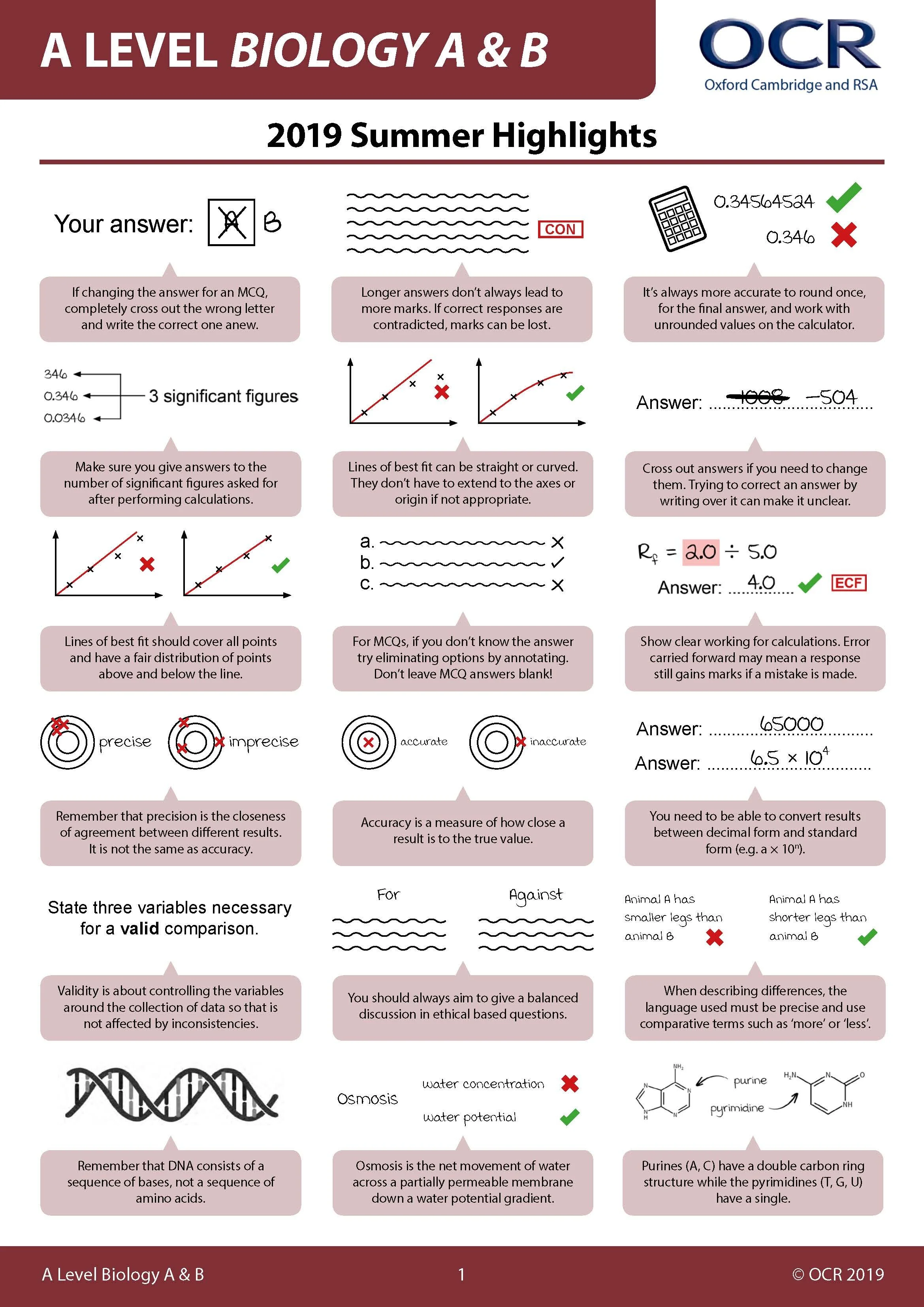
OCR A and OCR B June 2019 - Summer highlights - Great tips from the board
OCR A June 2019 summer highlights
Practising recall is so important for retention and learning. Try this quiz without books first !
Try this quiz - if you found it useful then please ❤️ (at the bottom of the page) and share, you can follow me on instagram - alevelbiologytutor
Tuesday night group tutoring topics and Y13 & Y12 OCR A and AQA small group information
You can subscribe monthly to over 60 hours of recorded lessons

Language Matters ....Command words in Exam questions
Some terrific guidance and definitions here - from AQA but applies to all exam boards
Some terrific guidance and definitions here - from AQA but applies to all exam boards
Repeatable or reproducible ? Valid or accurate ? Glossary of vocabulary
A great glossary of vocabulary that applies to Biology questions and answers.
A great glossary of terms that apply to A level Biology questions and answers. Learn them and use them !
How to Answer Hardy-Weinberg Questions - A-level Biology - with question pack
How to understand and answer Hardy-Weinberg Questions - A-level Biology. Remember to look out for questions where they give you a dominant phenotype frequency -for instance Huntingdons disease, where the frequency of the sufferers is 1 in 100000 - therefore q squared (recessive allele phenotype) is 99999 in 100000.
if you use - then like and share
Had a request for some Hardy Weinberg Questions.
Please like and share (and click on a advert to help with the hosting costs !)

Remember to look out for questions where they give you a dominant phenotype frequency -for instance Huntingdons disease, where the frequency of the sufferers is 1 in 100000 - therefore q squared (recessive allele phenotype) is 99999 in 100000.
Also if they ask you to calculate allele frequency without HW - then all individuals in a population have 2 alleles of each gene. In a population of 600 rats there are 1200 alleles in total.
If 400 are AA, 100 are Aa, and 100 are aa then the frequency of a is (100+200)/1200 = 0.25.
Remember that the HW depends on some very unlikely assumptions !
Assumption 1: No Genetic Drift
Sexual reproduction recombines genetic information in a random pattern. In a small population, it is possible that few individuals carry an allele and simple chance could make them more or less successful in passing on that allele. This is known as genetic drift, and the Hardy-Weinberg assumes that it does not happen. In practical terms, a population at Hardy-Weinberg equilibrium has to be large enough that the frequency of an allele is not impacted by random events.
Assumption 2: A Closed Population
Emigration and immigration -- that is, transfer of individuals into and out of a population -- can change the frequency of alleles. Emigrating individuals might take more of one allele out of a population, and immigrating individuals might come from a population with a different proportion of alleles. This is known as genetic flow, and it is common for most populations, with notable exceptions such as remote islands, deep caves or mountaintops. A population at Hardy-Weinberg equilibrium is assumed to have no genetic flow, or to be a completely closed population.
Assumption 3: Mutations Don’t Happen
Mutations are errors that happen when DNA is being copied. They can be nonsense or neutral, they can be harmful to the organism or they can change the organism in a way that makes them better able to survive and reproduce. Hardy-Weinberg equilibrium assumes that mutations don’t exist because they represent genetic change that is not due to the recombination of existing alleles.
Assumption 4: Random Mating Patterns
The Hardy-Weinberg principle assumes that every individual in a population has an equal chance of mating with every other individual, totally random mating. In a population at Hardy-Weinberg equilibrium, nobody gets to be picky. Random mating, also known as a panmictic population, almost never happens in real life.
Assumption 5: No Natural Selection
Natural selection is a pressure that favors one allele over another because the resulting trait, or phenotype, gives the individual an advantage. From a genetic standpoint, the only advantage that matters is one that helps the individual survive or reproduce more effectively. In a population at Hardy-Weinberg equilibrium, there are assumed to be no evolutionary pressures.
Please "like" and share with your friends if you find that this helped your improve your understanding
How to approach and answer A-level Biology Questions that need you to Analyse Figures, Tables and Images - lots of example past paper questions
How to approach and answer A-level Biology Questions that need you to Analyse Figures, Tables and Images - lots of example past paper questions with the markschemes
DO NOT LOOK at the question and then look at the data to answer the question.
Look closely at the graph or table
look very carefully at the axes - have they plotted mean or rate or time, mass/volume or concentration ?
can you see range bars ?
In a table what range is in the replicates when you compare to the mean ?
what trends can you observe ? then think about what principle of biology is being shown by the the trends.
How would you explain the highest value, the lowest value, the point at which the line crosses the x axis, how would you explain the largest range, how would you change the experiment to reduce the spread in the data ?
Once you have a coherent understanding of the trends - only then look at the question.
DO NOT LOOK at the question and then look at the data to answer the question.
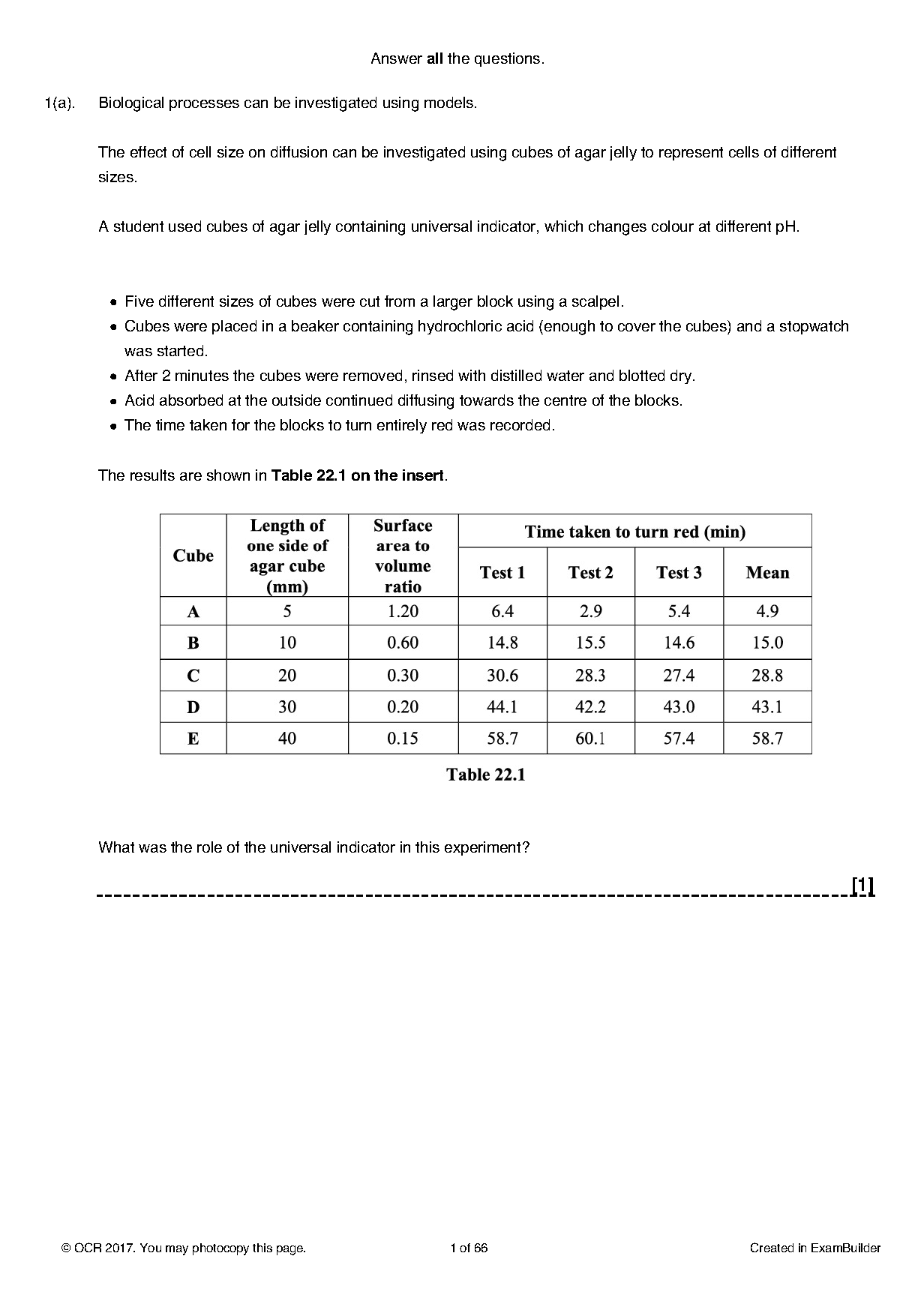
ALWAYS LOOK AT THE DATA FIRST
Look closely at the graph or table
Graph look very carefully at the axes - have they plotted rate or time, mass/volume or concentration ? Often students assume enzyme graphs have rate on the y axis - sometimes they don’t !
Table - is the IV in the first column ? What are the units of the DV ? Has a mean been calculated ? Is the data in each row consistent ?
are there range/SD bars on the graph ? remember this indicates the variation in the data that was used to calculate the mean
do the range bars or standard deviation bars overlap ?
In a table what range is in the replicates when you compare to the mean ?
what trends can you observe ? then think about what principle of biology is being shown by the the trends.
How would you explain the highest value, the lowest value, the point at which the line crosses the x axis, how would you explain the largest range, how would you change the method to reduce the spread in the data ?
Once you have a coherent understanding of the trends - only then look at the question.
try this - about 20 questions with data and analysis
If you found it useful then please ❤️ (at the bottom of the page) and share, you can follow me on instagram - alevelbiologytutor
Tuesday night group tutoring topics and Y13 & Y12 OCR A and AQA small group weekly class information
Tips and Practice Questions for the Practical component of the Theory papers - A-level Biology
How to improve your answers to questions about practicals in A-level Biology exam questions.
Please like and share

15 % of the June 2017 A-level Biology examinations will be examining practical skills. Here are some excellent practical exam questions which will challenge you to think about the nature of experimental design, independent and dependent variables.
Statistical analysis and graph plotting are also in the questions.
Remember
Never write "amount" you mean mass, volume or concentration.
Refer to "a control experiment" or "a variable that I will control (and then name the value and method of control)" but never to "a control variable"
Independent variable is what you change.
Dependent variable is what you actually measure in the experiment (not rate).
Organisms vary from each other unless they are clones !
When you suggest improvements think about improving the method rather than the equipment (e.g. control a variable that wasn't previously)
Validity means does the experiment actually test what it set out to test
Reliable is an outdated term - Repeatable or Repeatablity is now preferred
Here is some advice on tables and graphs. And here on measurement and language.
Here are 13 pages of practical based questions in pdf form.
Please "like" and share with your friends if you find that this helped your improve your understanding
I regularly post new resources and videos - be the first to hear about them if you follow me on social media or join my mailing list


