

AQA Paper 3 Extended Essay: Tips, Mark Scheme and Past Paper Titles - Updated for 2026
Exam Boards give feedback about students’ answers each year, to help future students do better. I have been working with some tutees, using the examiners’ guidance, to improve their approach to the AQA Paper 3 Extended Essay.
What are Extended Essays

The synoptic essay question is found at the end of AQA A-Level Biology Paper 3. You are required to write, in sentences and paragaphs of text, an essay about one of two topics. You should plan to spend about 40 minutes on the essay.
E.g.: “Write an essay on using DNA in science and technology”, or “Write an essay on the importance of membranes in the functioning of cells”.
In your essay you must write about a central theme, bringing together different ideas and concepts from the specification.
Why is there an Essay in the Paper?
Examiners want to check that you understand how different topic areas relate to bigger themes – how and why they are important in different contexts. This requires a deeper understanding of the topics.
You are tested on your ability to pick appropriate topics to write about, and your ability to present these using A-level terminology in a way that highlights their connection to the central theme.
Mark Scheme
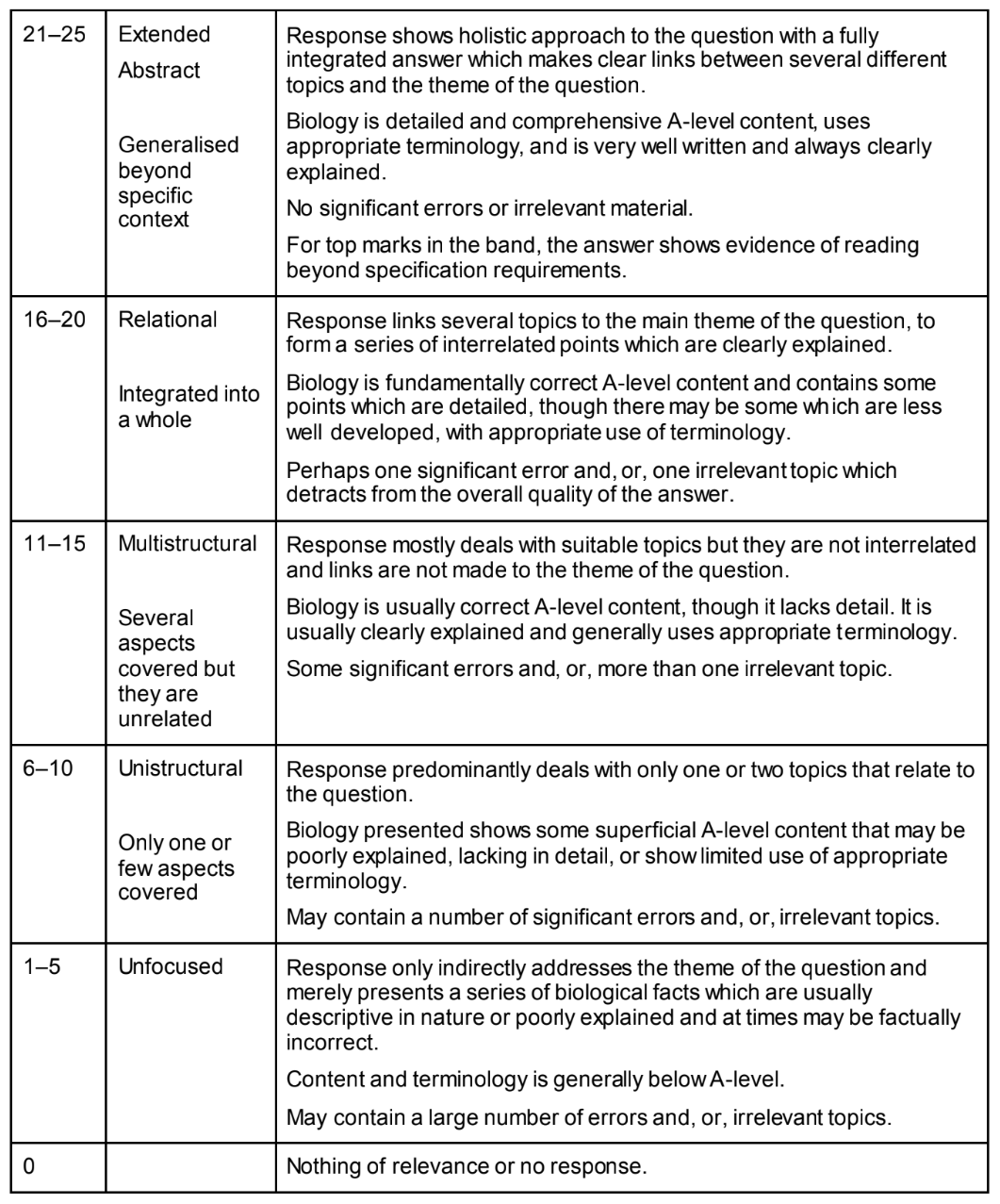
There are 25 marks available for the essay, but remember you don’t need all of them to get a top grade. Even for an A* it’s ok to aim for 18/25.
Essays are assessed within ‘levels of response’, with each level having different marks available. See the table below, where each row is a different level. You need to meet a variety of measures to reach each level.
The qualities examiners look for are:
How well you link the topic areas to the main theme
A-level standard material with appropriate terminology, clearly explained
Avoiding factual errors
Avoiding irrelevant topics/information
Notice that because of the way the marking works, there’s no point in doing one thing incredibly well while ignoring the others. The things you do badly would hold you back from advancing through the levels.
Examiners’ Mark Scheme (marks for each level are shown in the left-hand column):
Selecting Topic Areas
You must identify an underlying theme or idea in the essay title – this must be a ‘big idea’ that you can illustrate in different ways.
You then need to choose ‘several’ topic areas that you can relate to this theme.
A ‘topic area’ is a numbered sub-section in the specification
Topic areas should be as different as possible from each other
AQA say you should have a minimum 4 topic areas.
I suggest you aim for 5 or 6 topic areas.
Picking topic areas can be a challenge. Here’s my top tip for how to approach this:
Think your way through the Kingdoms of Life. Can you think of illustrative examples from each Kingdom? (Ok, maybe not protists.)
Think your way through different scales. From single molecules → macromolecule → organelle → cells → tissue → organ → organ system → individual → populations → community → ecosystem.
Picking topic areas using this technique should give you both breadth and depth.
Want more? See this article all about picking topic areas, including a list of past-paper titles and examiners’ guidance.
A note on off-spec topics: to score 24 or 25/25, you would need to include a topic outside the A-level specification. But I always recommend students stay within spec. You don’t need 24/25 to get an A* overall (18/25 is fine), and many students attempting off-spec topics fail due to lack of depth and scientific terminology. Using something you heard in a podcast isn’t enough; you need to present it at or above A-level standard. Of course it’s great if you can! But only attempt this if extremely confident as else it could reduce your overall marks.
How to Structure your Essay
Writing an essay plan might be useful if it doesn’t take too long. But remember you will only get marks for content that is presented in sentences/paragraphs within the actual essay.
Overview:
Write in full sentences/paragraphs – you will only gets marks for things presented in this way.
No introduction or conclusion – Examiners say these are a waste of your time
Separate sections for each of your chosen topic areas – they don’t need to link to each other
Avoid diagrams – you will only get marks for things described in writing.
For each topic area, you need to:
Present information about a relevant concept/idea from the topic area, using A-level detail and terminology. You need most of your essay to reach A-level standard if you are to get more than 10 marks.
Explain how and why the chosen concept/idea relates to the central theme. Why is it relevant and/or important. Without doing this, it is impossible to get more than 15 marks.
What Topic Information to Include
Content must be of A-level standard to score well – this includes information, terminology, and the explanation of ‘importance’ to the theme.
Don’t just splurge out everything you can remember. Only include things where you can also explain how the given information relates to the theme and why it is important.
Don’t let one or two topic areas dominate the essay - share your time between them. If one of your topic areas is large, and/or one that you know in depth, just pick the more relevant/important parts.
Don’t add extra bonus bits of information just because you can! Adding irrelevant information can prevent you reaching the next level, losing you marks.
Watch your Language – style and terminology
This isn’t an English exam; there are no points for style or narrative. Just get the important information down as clearly and concisely as possible. Short sentences are best for clarity. (But no bullet points; the examiners only mark full sentences.)
Crucially, you need to use precise, very scientific, A-level language appropriate to this level of study. Say exactly what you mean at all time. State units, and give the correct scientific names of molecules, bonds, processes etc.
Avoid ambiguous and non-specific language. Never use words like level, amount, nutrient, enables, supports, signals, messages, size, breaks down, or encourages. Many students lose marks from using these words in place of correct terminology.
Examiners reported: “Appropriate terminology was often poorly used or absent. For example, many students wrote about ‘signals’ and ‘messages’ rather than impulses/action potentials. The use of ‘levels’ and ‘amounts’ for concentration was also very common.”
Example Essay
Here is an example essay that scored 18/25. That’s a good quality for most people to be aiming for. It has some annotations from the examiner showing how they responded to the work.
If you want to have a go writing your own essay on this theme first, to compare approaches, it’s “Write An Essay On The importance of nitrogen-containing substances in biological systems”. Remember there are many different ways to approach these essays, so if you pick different topic areas that isn’t anything to worry about. But how do your information and terminology and thematic links compare?
For topic areas, go to “picking topic areas, past paper titles, and examiners’ guidance” which lists topic areas suitable for these titles, and more about how to approach choosing your topics.
Phosphorus-containing substances and their importance in biological systems.
The mechanisms and importance of transport within organisms.
The importance of interactions between organisms and their environment.
The importance of shapes fitting together in cells and organisms.
How bacteria can affect the lives of humans and other organisms.
A cycle is a biological pathway or process in which the end product of one cycle becomes the starting point for the next cycle. Write an essay on cycles in biology.
Carbon dioxide may affect organisms directly or indirectly. Write an essay to describe and explain these effects.
Polymers have different structures. They also have different functions. Write an essay to describe how the structures of different polymers are related to their functions.
Using DNA in science and technology.
The importance of membranes in the functioning of cells.
More AQA Paper 3 Extended Essay Titles (older)
If you found it useful then please ❤️ (at the bottom of the page) and share
I run weekly AQA specific group classes for Y12 and Y13 students - details here