

Each Eduqas Biology paper has one 9-mark question that tests the quality of extended response (QER). It is not marked point by point. The mark scheme lists indicative content, nearly always in three areas that match the three things the question asks for, and places your answer in one of three bands: 1–3, 4–6 or 7–9 marks. The top band needs detail from every area in "an articulate, integrated account" that "shows sequential reasoning", with "no irrelevant inclusions or significant omissions" and scientific vocabulary used accurately. This page has all sixteen QER questions on the Core Concepts and Component 1: proteins, cell structure, membrane transport, nucleic acids, respiration, microbiology, and populations and ecosystems. Questions marked AS are from the AS papers (B400); the rest are from the A level papers (A400).
The examiners' reports repeat the same warnings. Answer every part of the question: many compared the Krebs and Calvin cycles well and then wrote nothing on compartmentalisation. Answer the question set, not "everything you know about respiration". Use the information you are given: excellent accounts of protein structure that ignored the insulin diagrams were placed in the lowest band, and many answers on carbon dioxide never mentioned the graph. Leave out irrelevant material, which spoilt answers on deforestation and climate. Be precise: say that pH decreases, not that it changes, and don't treat egestion and excretion as the same thing.
I don't teach the Eduqas specification myself, so for one-to-one help I recommend Sam. He teaches Eduqas A level Biology at a top-rated sixth form college and is very popular with his students. You can ask about lessons with Sam on WhatsApp using the link at the bottom of this page.
What you need first
Each question on this page assumes you're secure on these ideas. If any of them feels shaky, look it up before you start.
- The four levels of protein structure and the bonds that hold each one: peptide, hydrogen, ionic and disulphide bonds, and hydrophobic interactions.
- The ultrastructure of mitochondria, chloroplasts and prokaryotic cells, and where the link reaction, Krebs cycle, electron transport chain and Calvin cycle take place.
- How DNA is replicated, transcribed and translated, and that one triplet of bases codes for one amino acid.
- The phases of a population growth curve, how energy passes between trophic levels, and the sequence of events in eutrophication.
Key terms
These words come up in the questions and mark schemes. Examiners expect you to use them exactly.
- QER: quality of extended response: the 9-mark question on each paper that is marked in bands, not point by point.
- Indicative content: the points listed in the mark scheme for a QER question, usually set out in three areas.
- Endosymbiosis: the theory that mitochondria and chloroplasts evolved from prokaryotes that were taken into other cells.
- Semi-conservative replication: each new DNA molecule has one original strand and one newly made strand.
- Induced fit: the active site changes shape slightly to fit more closely around the substrate.
- Compartmentalisation: the use of membranes to keep reactions, enzymes and products inside organelles, apart from the cytoplasm.
- Viable count: a way of finding the number of living cells in a sample by counting the colonies that grow.
- Sere: one stage in a succession, from pioneer species to the climax community.
What these questions cover
The questions are built on these statements from the Eduqas A level Biology specification (A400). Each one also draws on other parts of the same topic.
- CC1(i) the primary, secondary, tertiary and quaternary structure of proteins
- CC2(a) the structure and function of the following: mitochondria; endoplasmic reticulum (rough and smooth); ribosomes; Golgi body; lysosomes; centrioles; chloroplasts
- CC2(c) cell theory and the similarities and differences in the cell structures of eukaryotes (animal and plant), prokaryotes and viruses, including the examination of a range of
- CC3(c) the following transport mechanisms: diffusion and factors affecting the rate of diffusion; osmosis and water potential; pinocytosis; facilitated diffusion; phagocytosis; secretion (exocytosis); active transport
- CC5(h) the semi-conservative replication of DNA including the roles of DNA polymerase and helicase and be able to use evidence from the Meselson and Stahl experiments
- CC5(j) the triplet code for amino acids
- 1.3(c) the Krebs cycle as a means of liberating energy from carbon-carbon bonds to produce ATP and reduced NAD with release of carbon dioxide
- 1.4(c) the conditions necessary for bacterial growth and the principles of aseptic technique
- 1.5(c) the regulation of populations by density dependent and density independent factors
- 1.5(h) the transfer of biomass from plants to animals including trophic levels, efficiency of transfer
- 1.5(i) the principles of succession as illustrated by the colonisation of bare rock to form woodland
- 1.5(m) the effects of human activities on the carbon cycle including that climate change affects the distribution of species and is a possible cause of extinction
- 1.5(p) the process of eutrophication and algal blooms and that drainage has adverse effects on habitats
How to use this page
Write your answer on paper before you open the mark scheme. Allow about 1.2 minutes per mark: the 16 questions are worth 144 marks, so about 173 minutes in total. Then mark your answer strictly against the mark scheme and read the examiners' tip underneath it. If you'd rather print the questions, download the PDF pack.
Core Concepts: biological compounds (CC1)
Question 1
AS Component 1 · June 2017 · Q6 · 9 marks
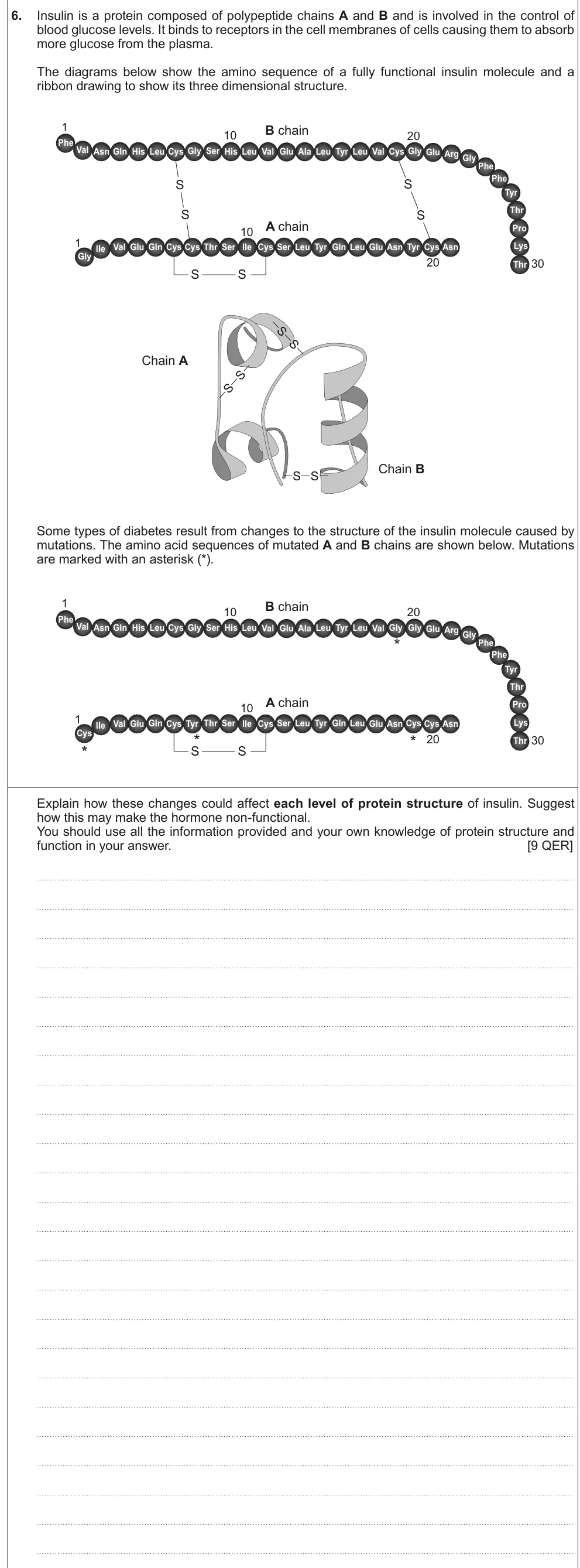
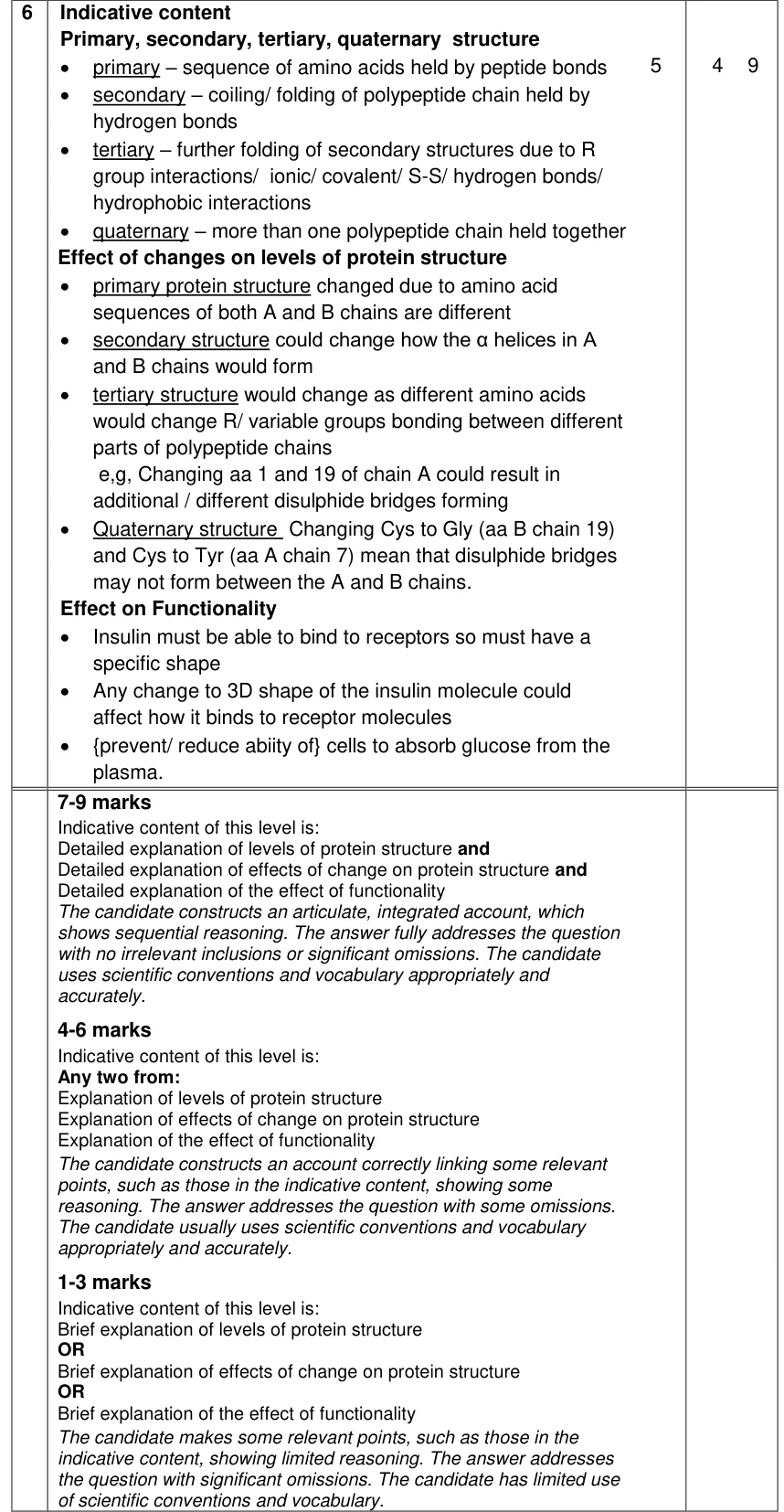
Use the amino acid sequences and ribbon drawing of normal and mutated insulin to explain how the mutations could affect each level of protein structure and stop the hormone working.
Show the mark scheme
Tap an image to open it full size.
From the examiners' report: The better answers described the four levels of protein structure, referred to the ribbon diagram and the numbered amino acids that had changed, and explained the effect on bonding, shape and function. Accounts of protein structure that made no reference to the information given were placed in the lowest band.
Question 2
AS Component 1 · June 2022 · Q6 · 9 marks
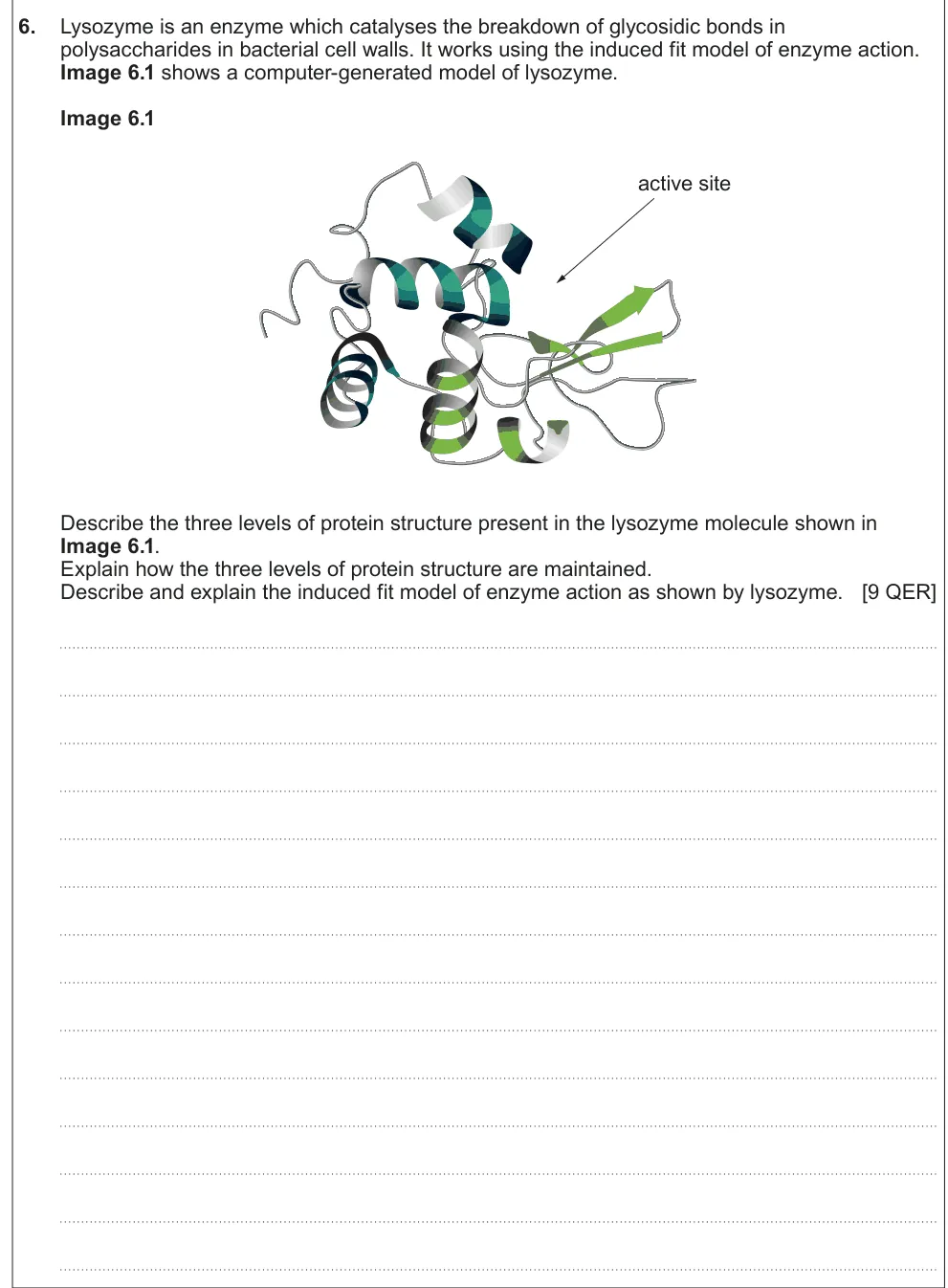
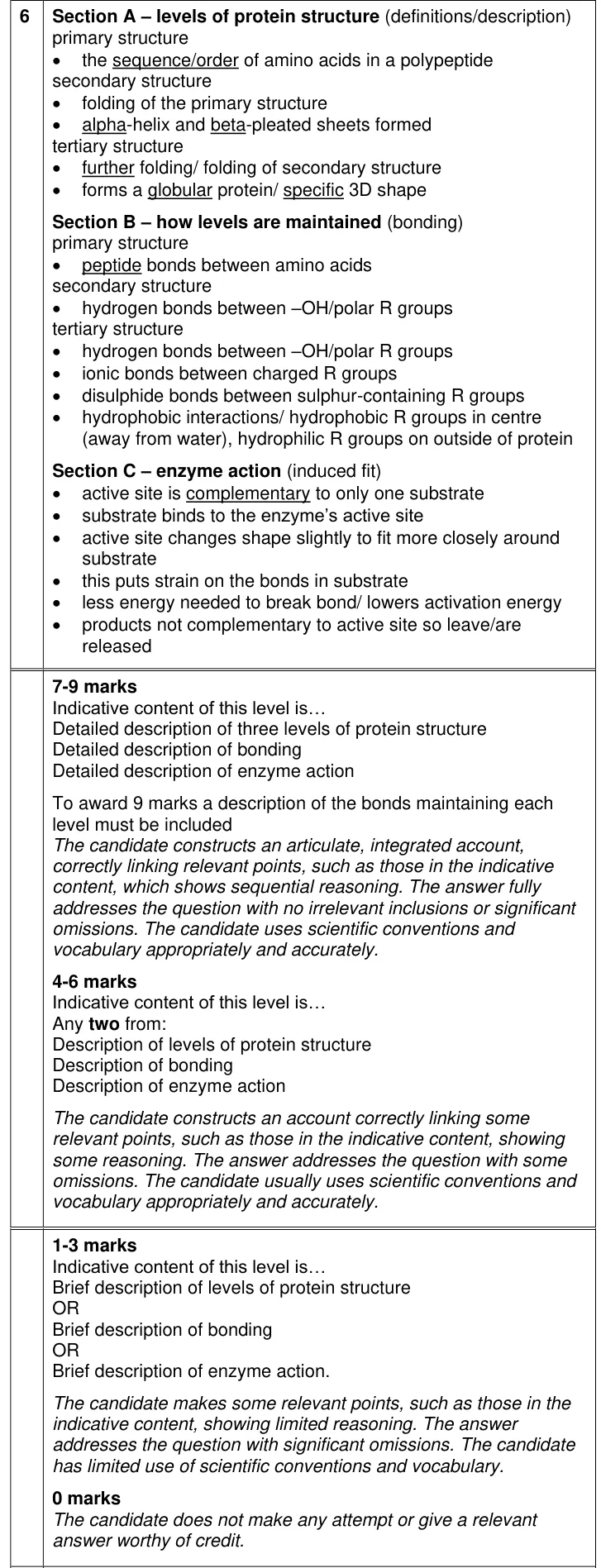
Describe the three levels of protein structure in lysozyme, explain how each is maintained, and describe and explain induced fit.
Show the mark scheme
Tap an image to open it full size.
From the examiners' report: The best answers covered all three aspects. The weakest section was how the levels are maintained: bonds were listed for each level without the functional groups involved. Induced fit was answered particularly well.
Core Concepts: cell structure and organisation (CC2)
Question 3
A level Component 1 · Autumn 2021 · Q8 · 9 marks
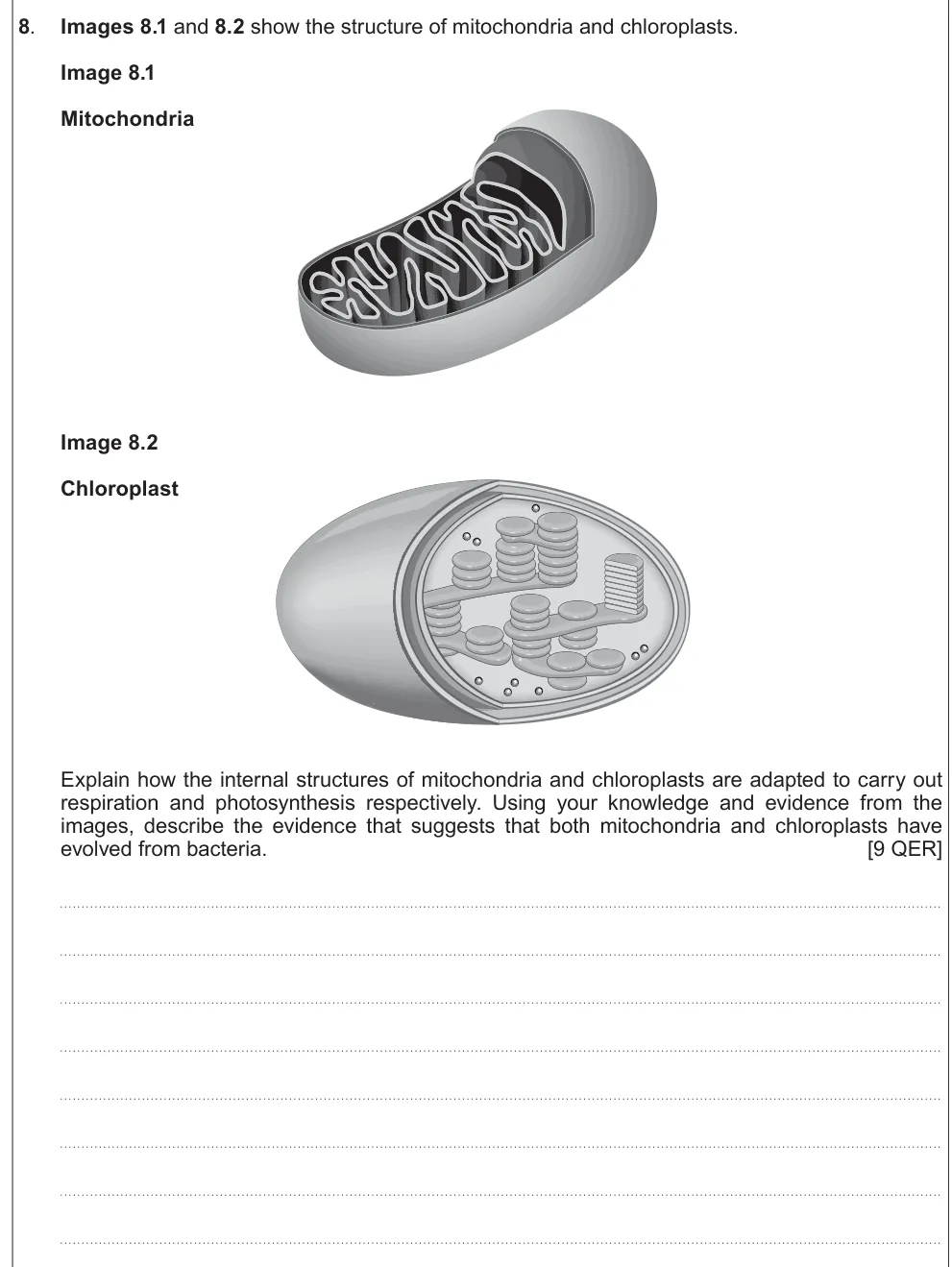
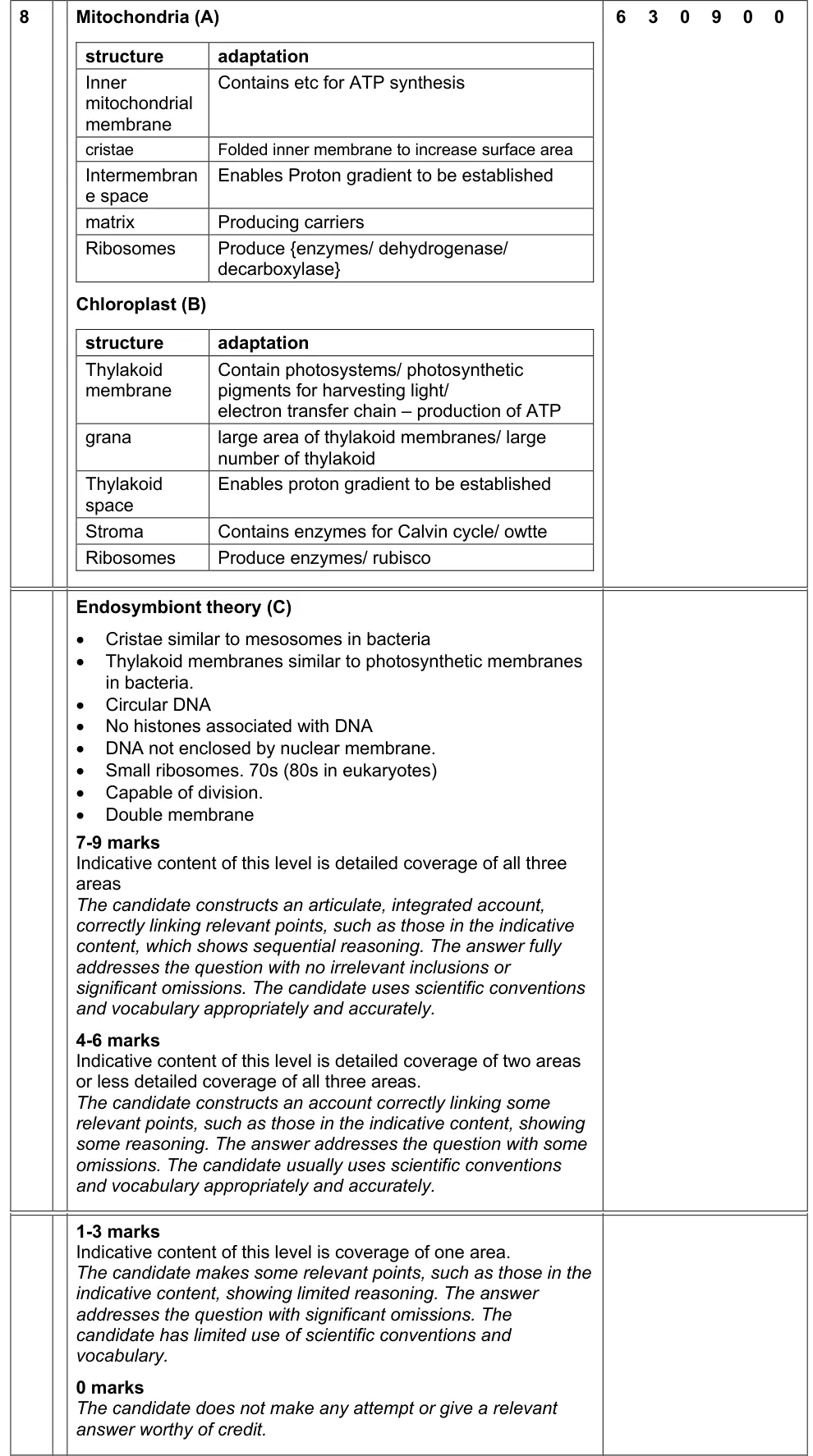
Explain how the internal structures of mitochondria and chloroplasts are adapted for respiration and photosynthesis, and describe the evidence that both evolved from bacteria.
Show the mark scheme
Tap an image to open it full size.
From the examiners' report: Answers were generally poor because they did not explain how each internal structure adapts the organelle to its function, and chloroplasts were described more clearly than mitochondria. Long accounts of the endosymbiont theory were spoilt by inaccurate evidence.
Question 4
AS Component 1 · June 2019 · Q7 · 9 marks
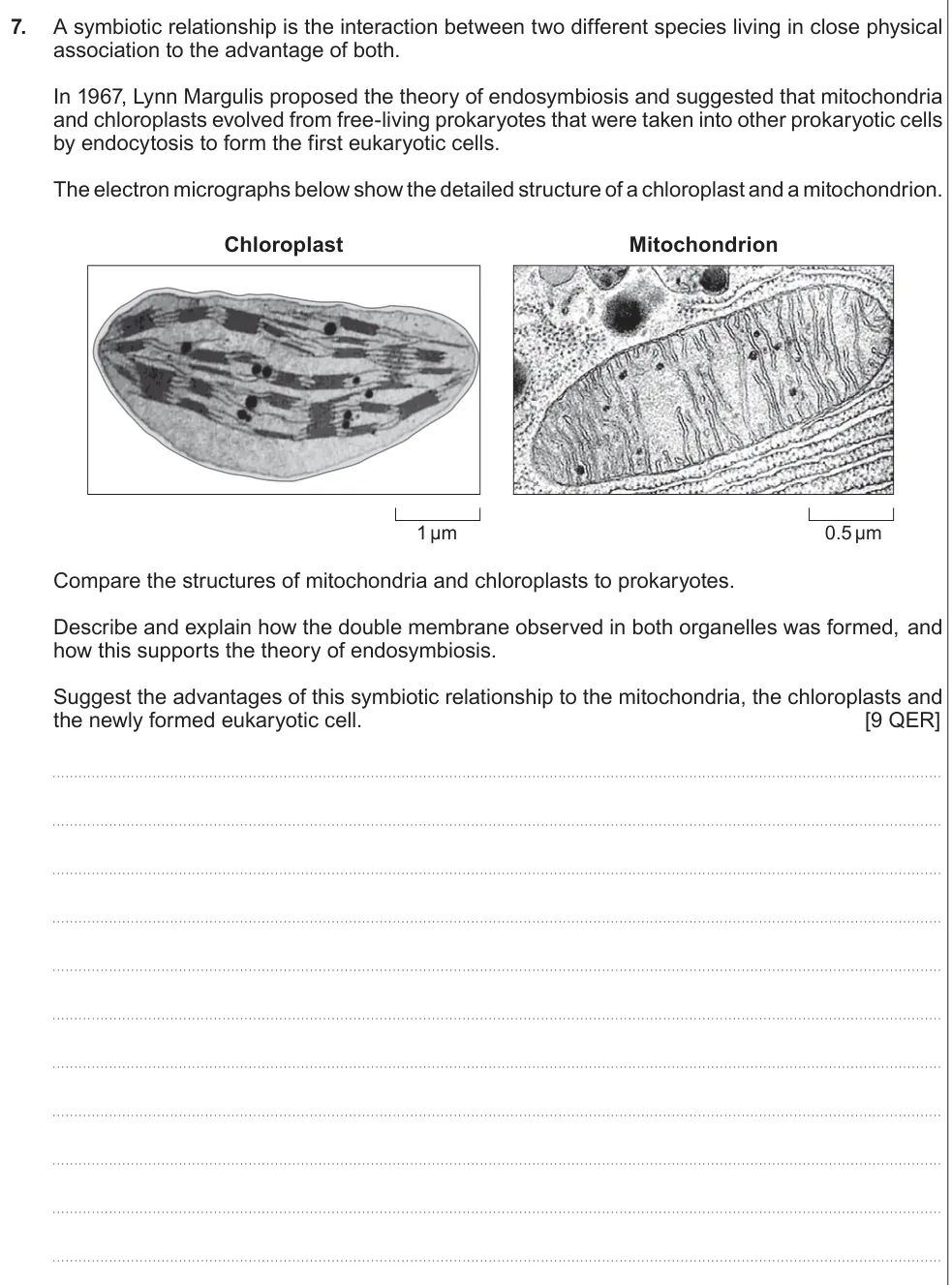
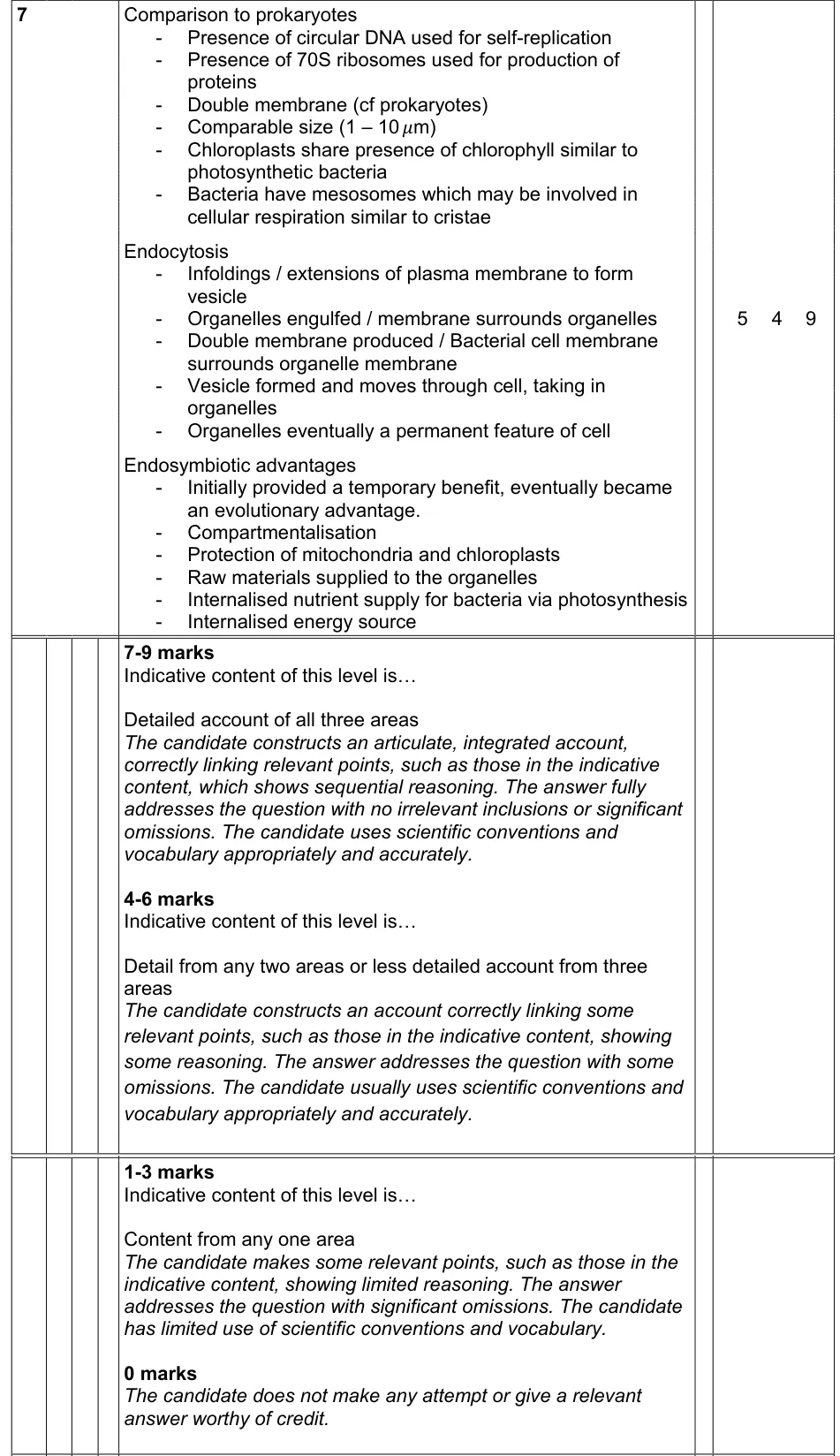
Compare mitochondria and chloroplasts with prokaryotes, explain how their double membrane formed, and suggest the advantages of the relationship to each partner.
Show the mark scheme
Tap an image to open it full size.
From the examiners' report: Comparisons of the structures present were common and detailed, but few gave the functional role of each feature. Many named endocytosis or phagocytosis; fewer described the vesicle and how the double membrane then forms. The advantages were discussed well.
Question 5
AS Component 1 · Autumn 2020 · Q6 · 9 marks
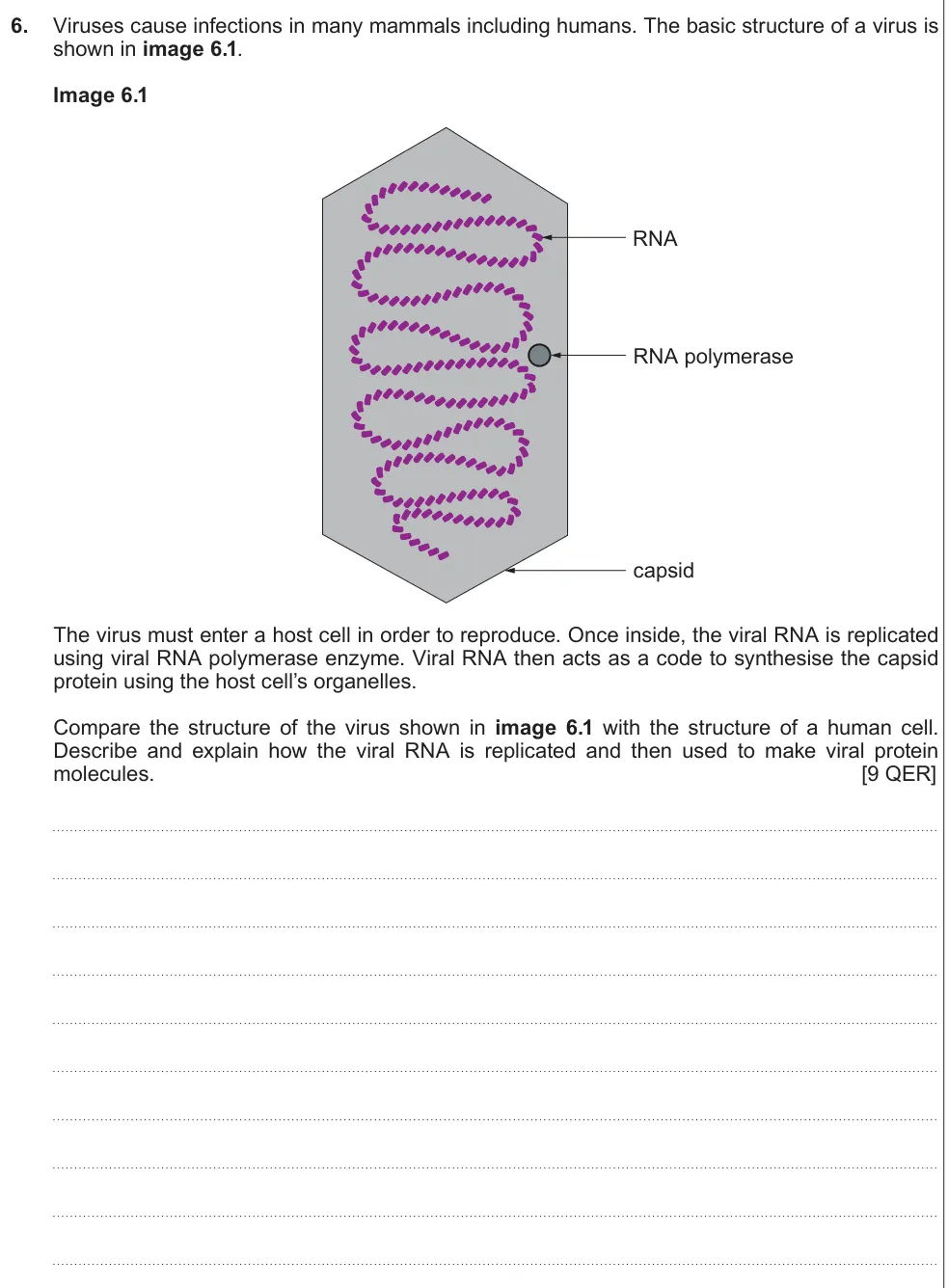
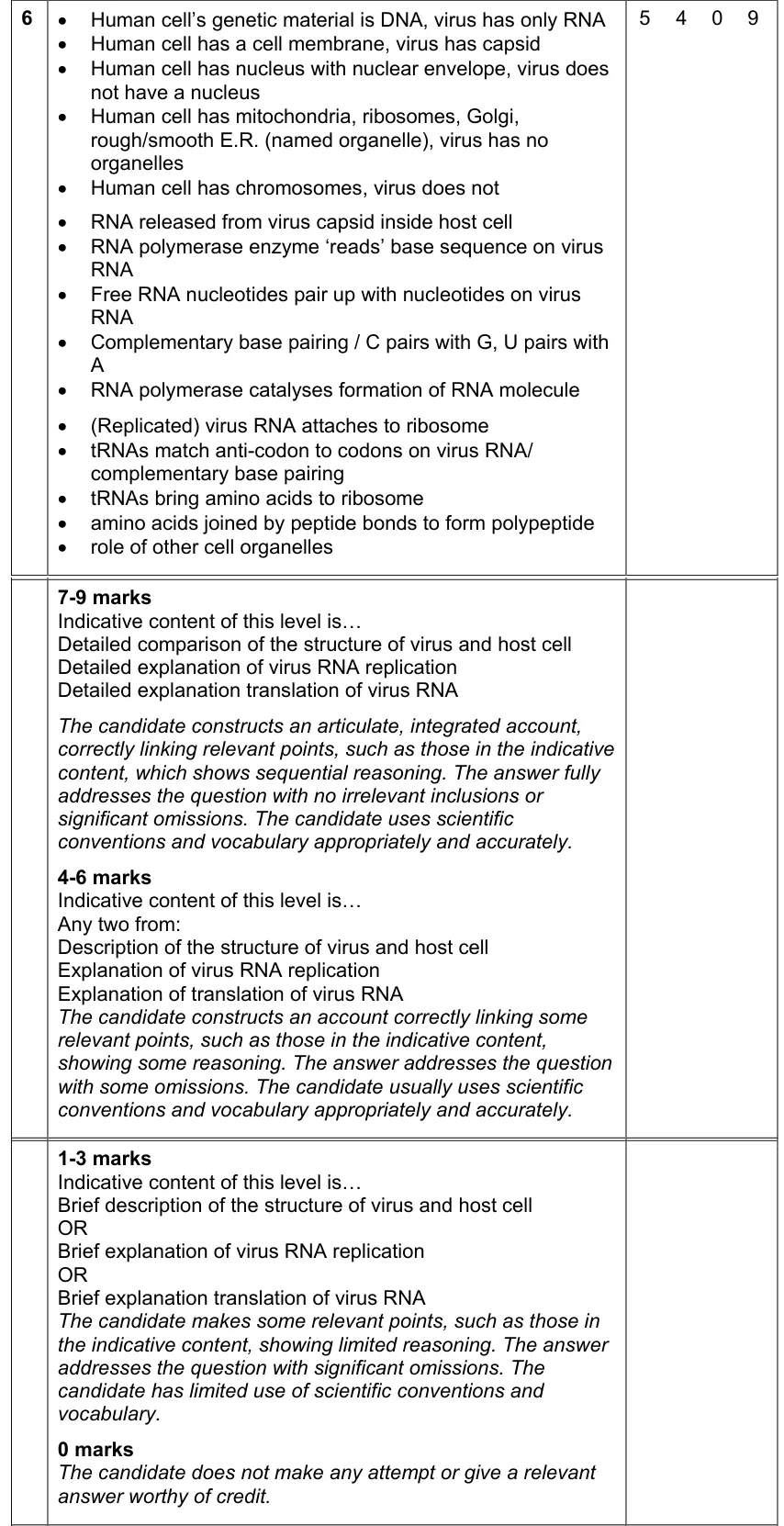
Compare the structure of an RNA virus with a human cell, then describe and explain how the viral RNA is replicated and used to make viral protein.
Show the mark scheme
Tap an image to open it full size.
Core Concepts: cell membranes and transport (CC3)
Question 6
AS Component 1 · June 2025 · Q6 · 9 marks
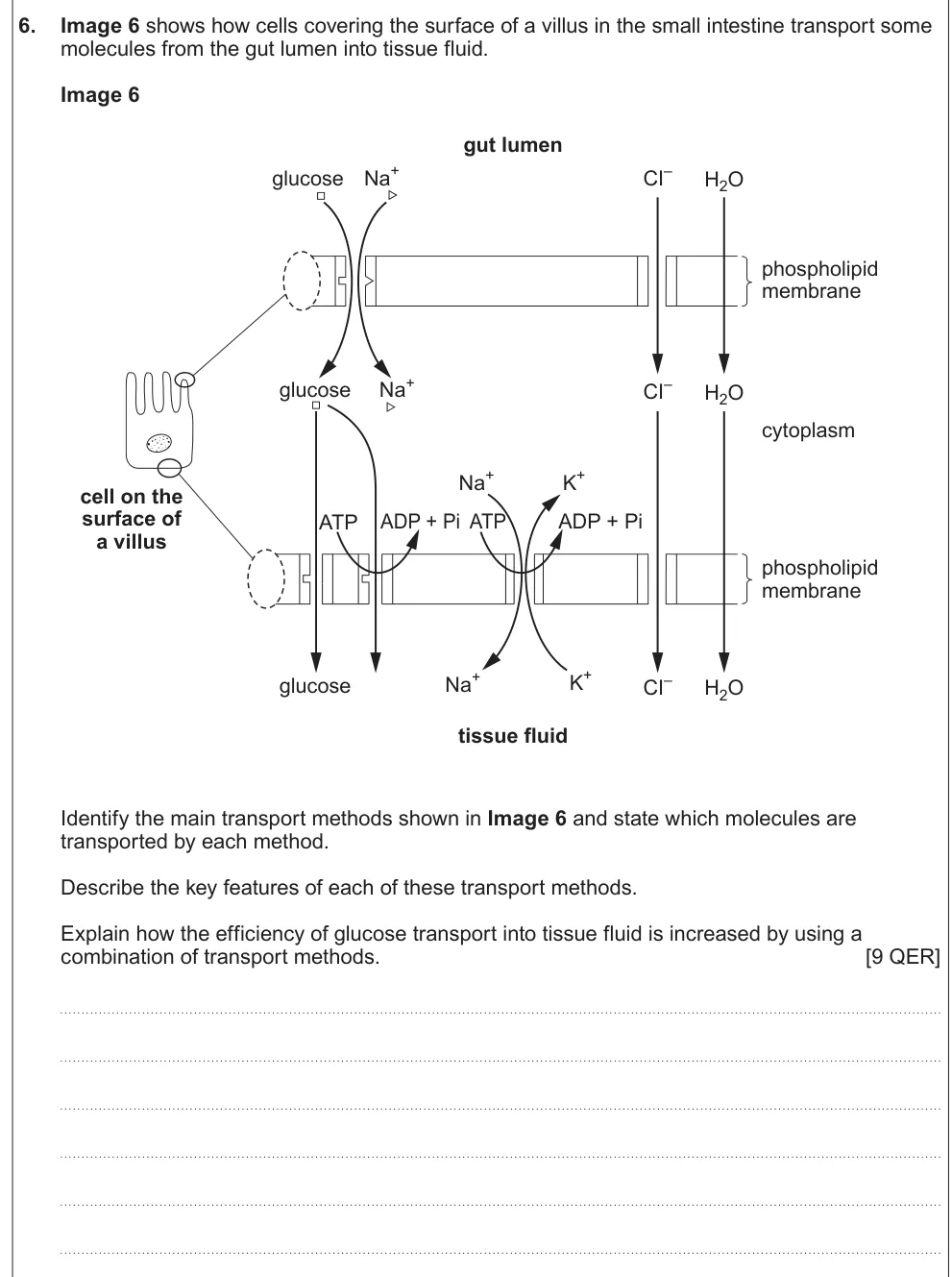
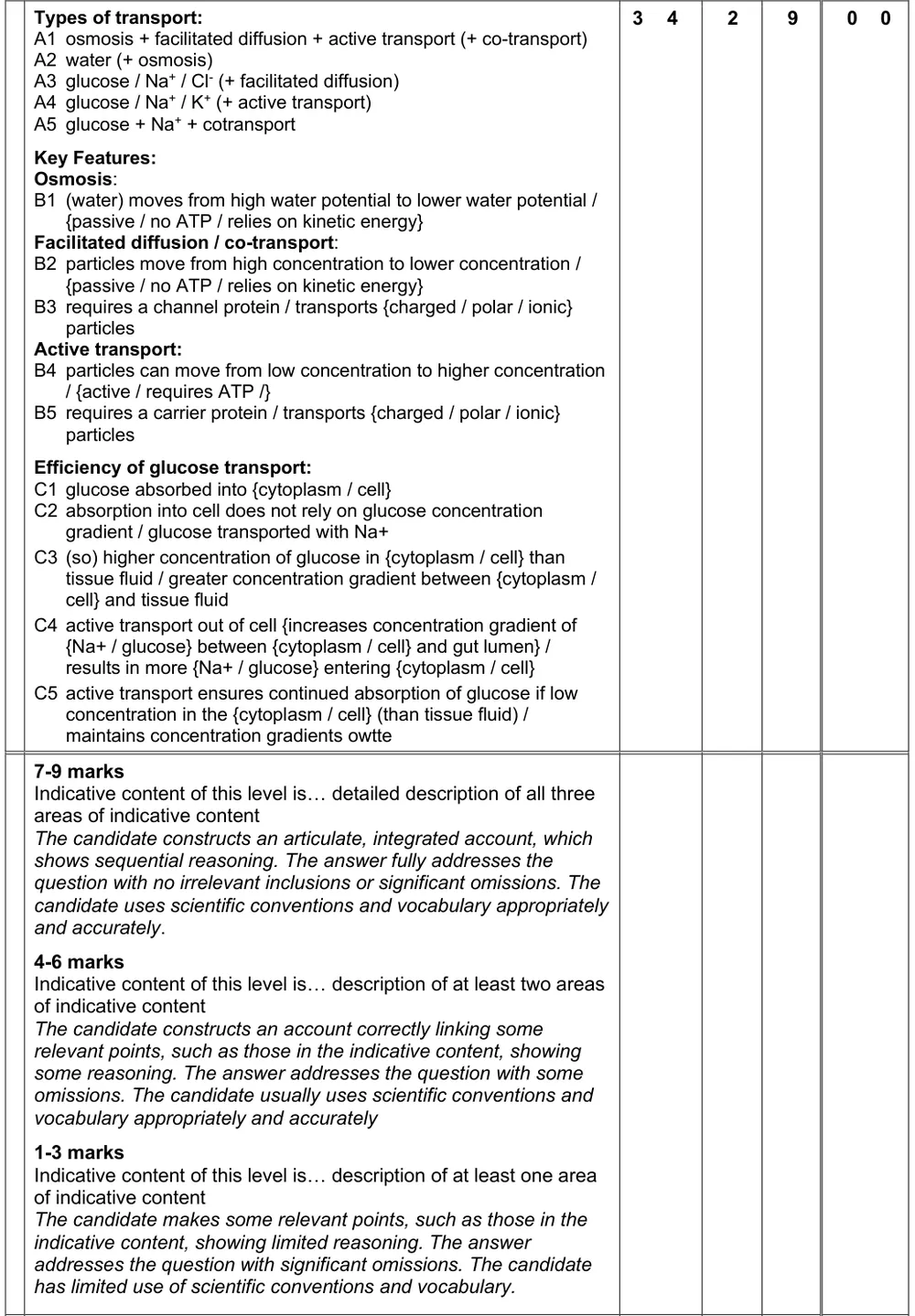
Identify the transport methods shown in a diagram of a villus cell, describe the key features of each, and explain how combining them makes glucose transport more efficient.
Show the mark scheme
Tap an image to open it full size.
Core Concepts: nucleic acids and their functions (CC5)
Question 7
AS Component 1 · June 2018 · Q6 · 9 marks
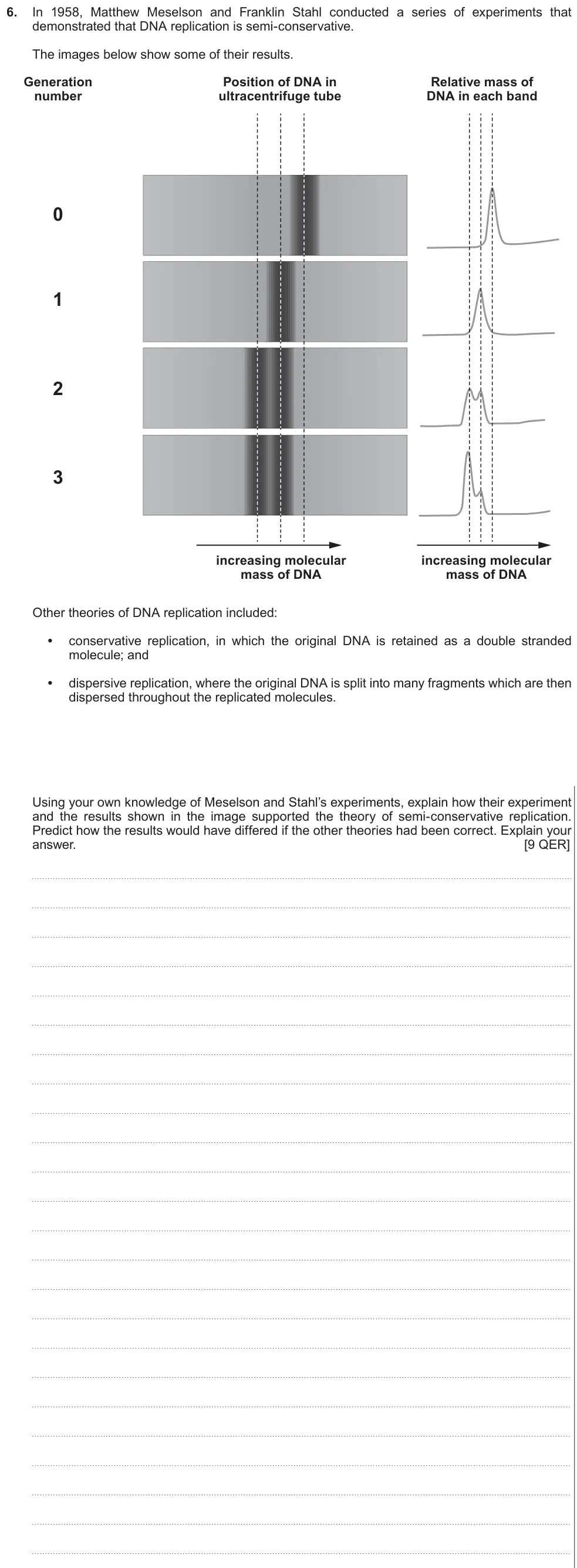
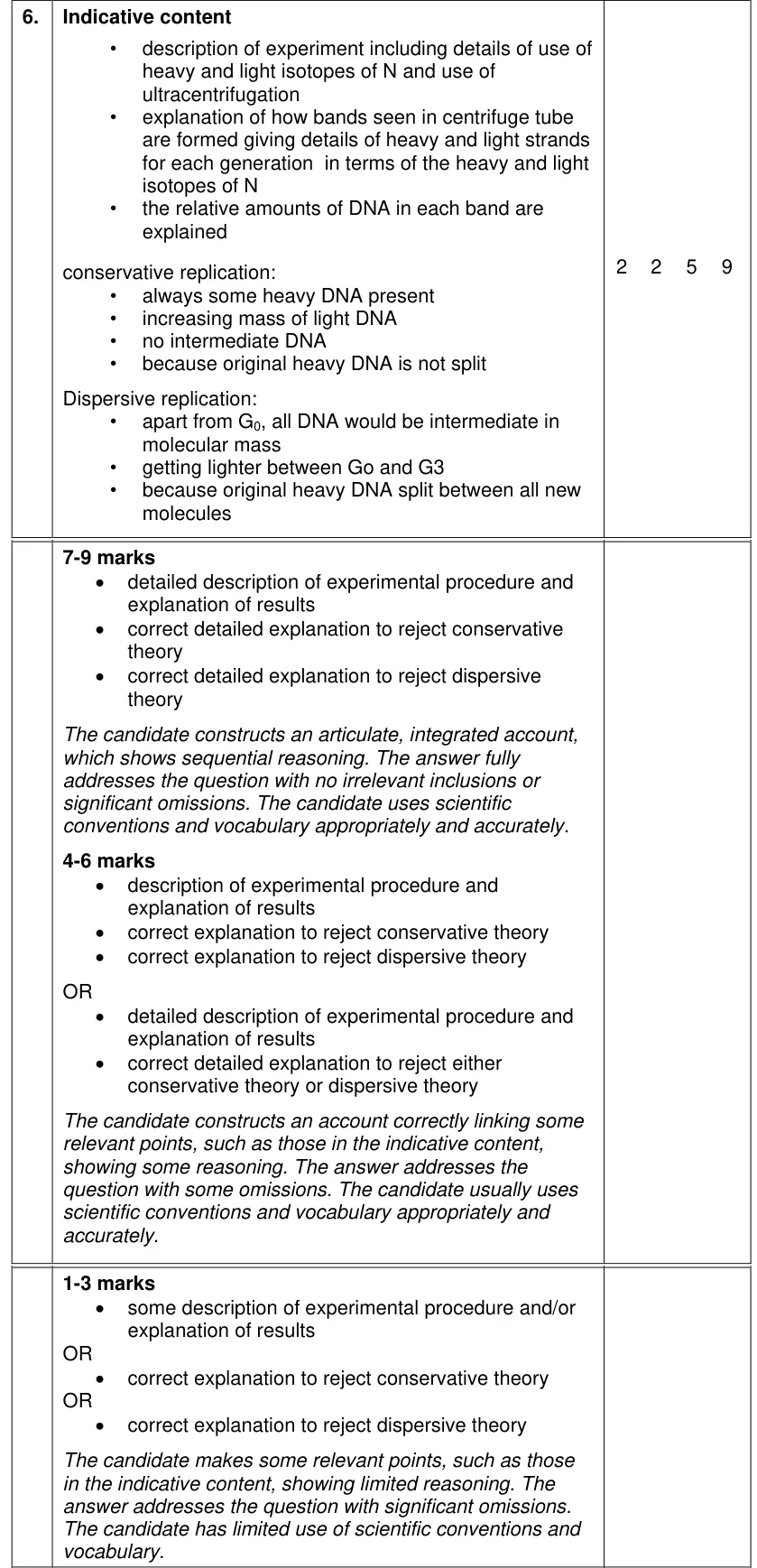
Explain how the Meselson and Stahl results support semi-conservative replication, and predict the results if DNA replication were conservative or dispersive.
Show the mark scheme
Tap an image to open it full size.
From the examiners' report: Responses were generally poor. Many left bacteria out of the method, and most of the marks came from semi-conservative replication only. Many saw that generation one disproved the conservative theory but few could explain why, and very few understood the dispersive theory.
Question 8
AS Component 1 · June 2024 · Q6 · 9 marks
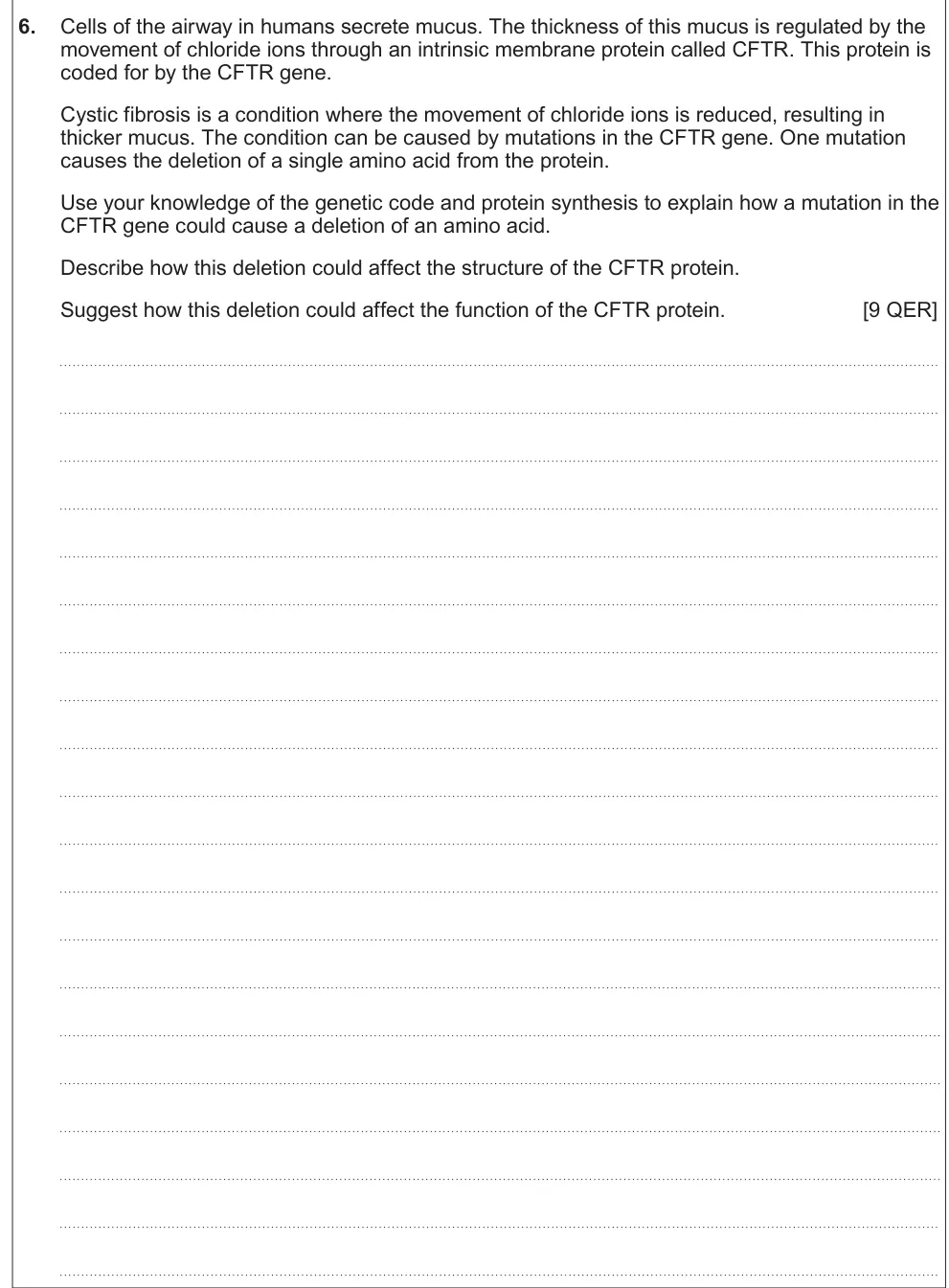
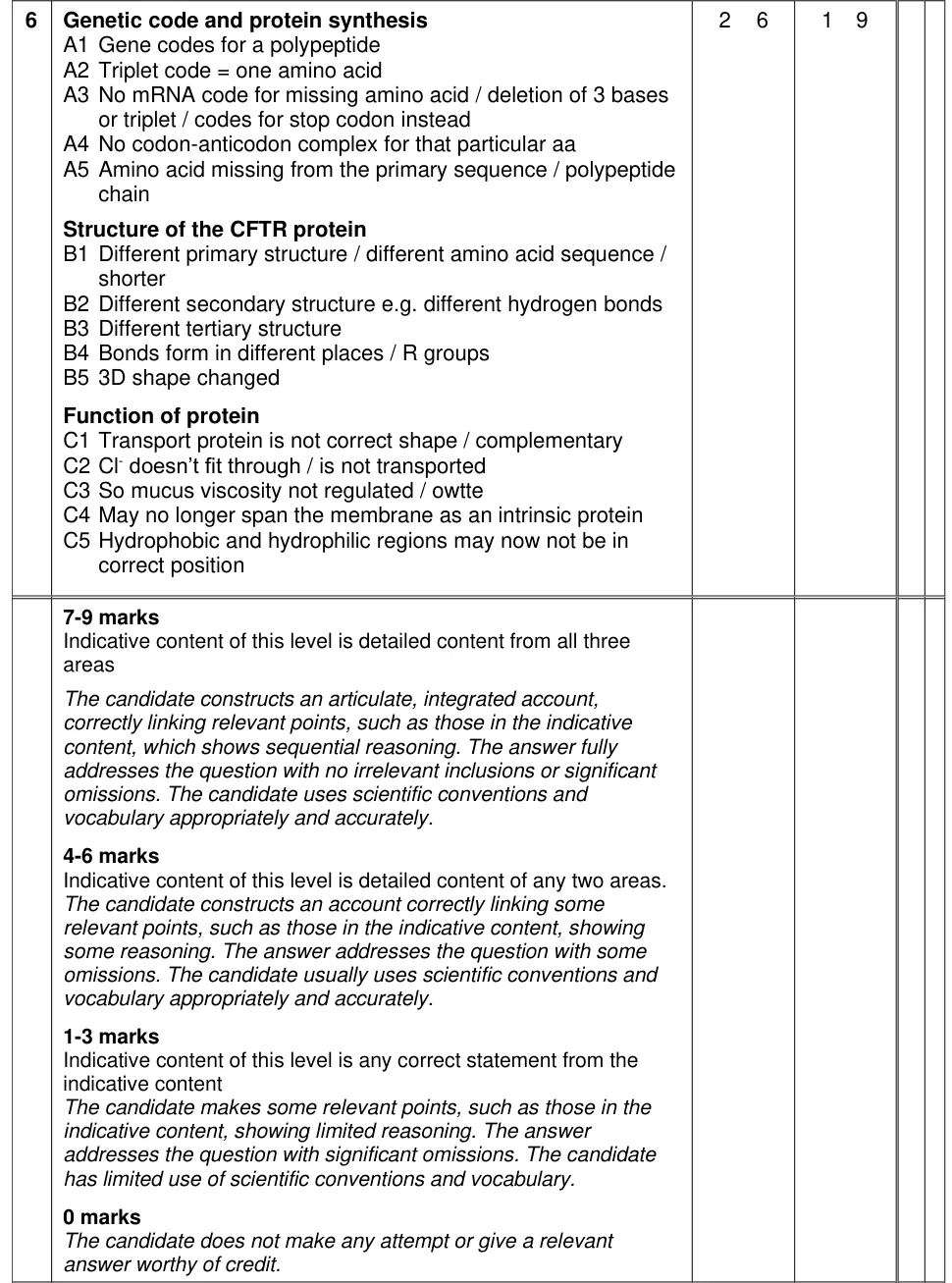
Explain how a mutation in the CFTR gene could delete one amino acid, and how the deletion could affect the structure and the function of the CFTR protein.
Show the mark scheme
Tap an image to open it full size.
From the examiners' report: Some gave a full account of protein synthesis without linking it to the question. Good answers realised that three bases must have been deleted, but many thought a different amino acid would be added. Strong answers discussed the change to the hydrophilic region of the protein.
1.3 Respiration
Question 9
A level Component 1 · June 2017 · Q9 · 9 marks
Compare the biochemistry of the Krebs cycle and the Calvin cycle in plant cells and explain why compartmentalisation matters in both.
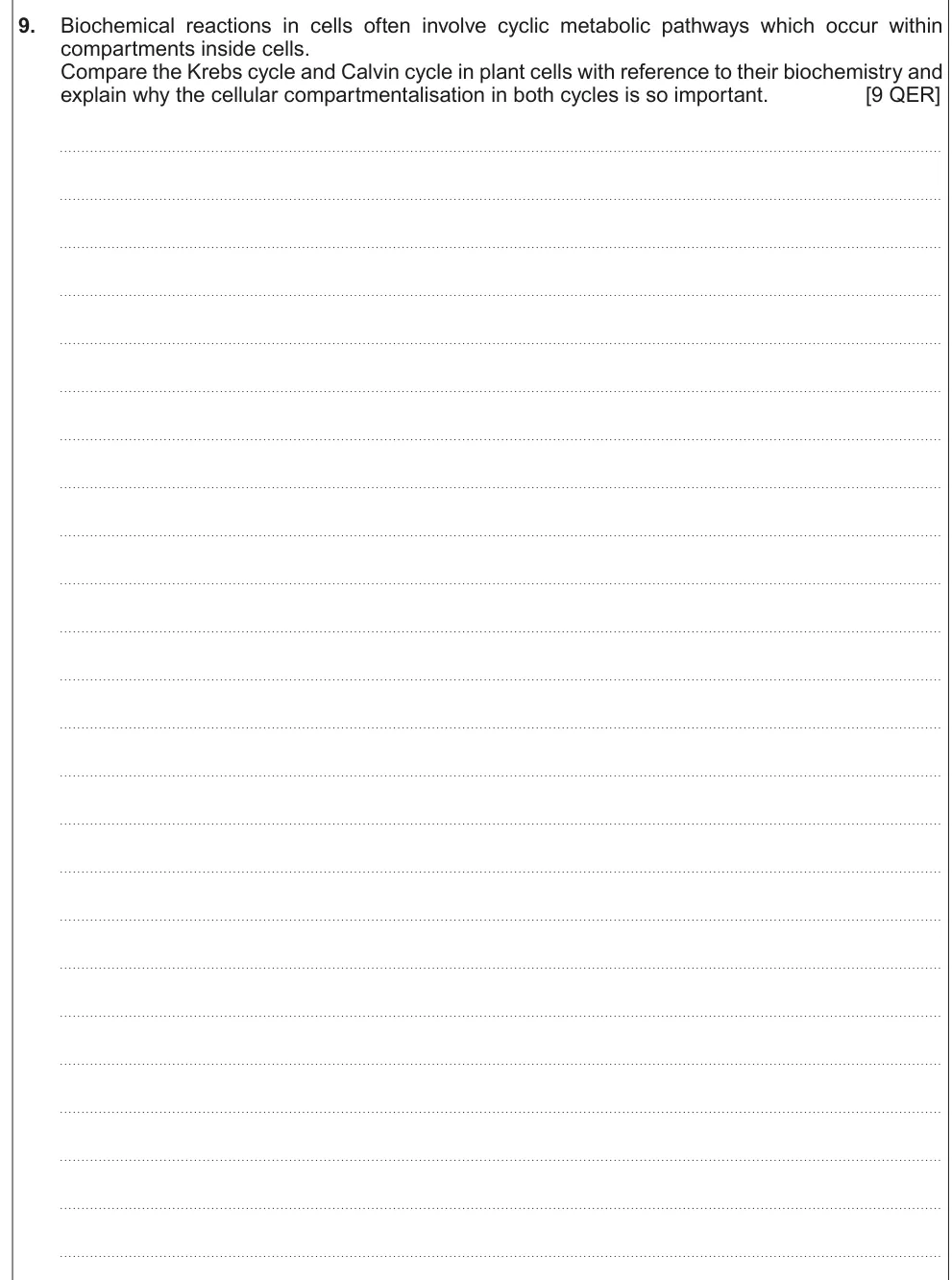
Show the mark scheme
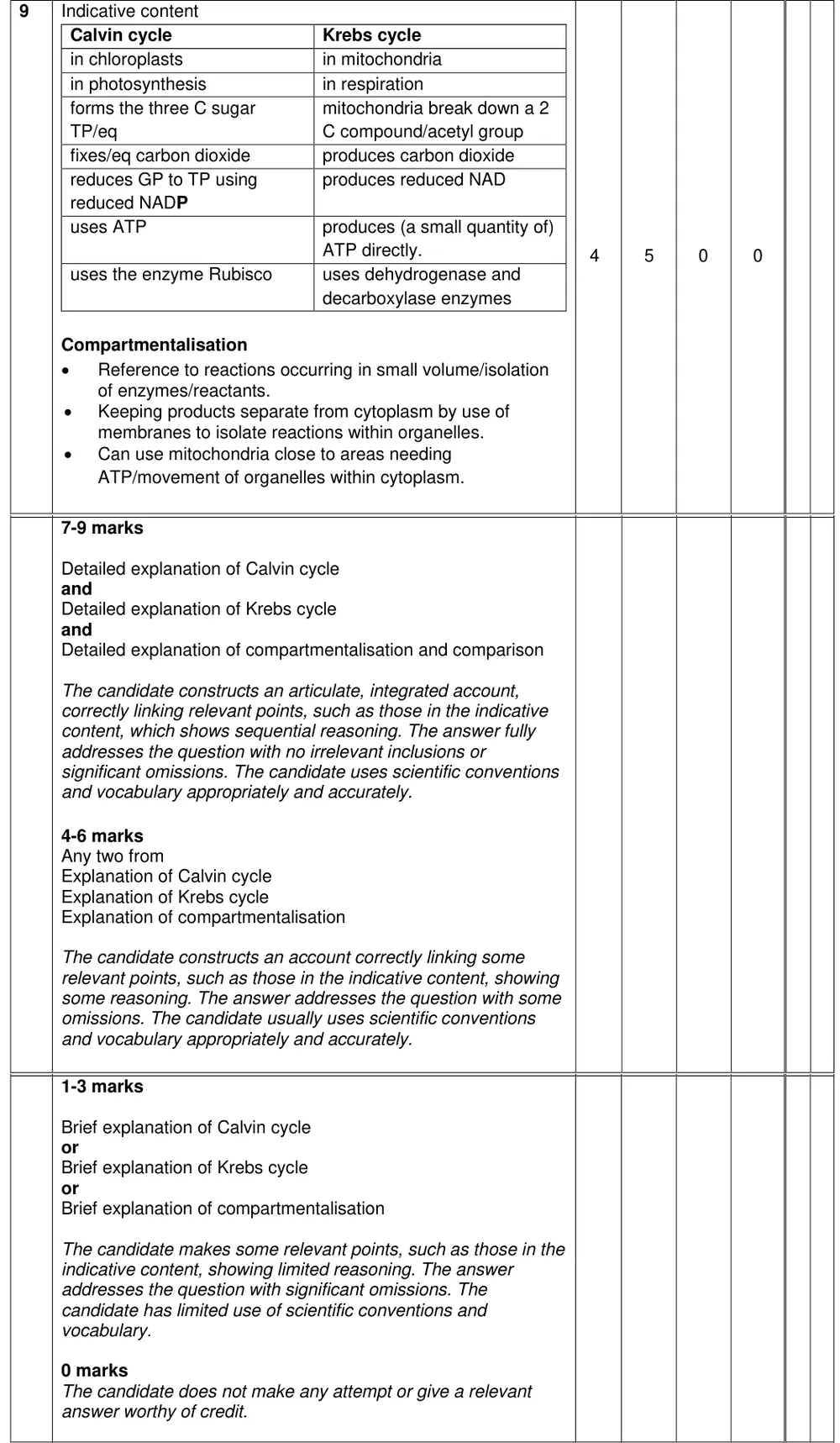
Tap an image to open it full size.
From the examiners' report: Recall of both cycles was often excellent, but full marks needed a real attempt at comparison. Too many stopped there and wrote nothing about compartmentalisation; those who explained why compartments are important routinely gained full marks.
Question 10
A level Component 1 · June 2018 · Q7 · 9 marks
Describe the role of mitochondria using your knowledge of respiratory pathways, and explain how aerobic bacteria and early eukaryotic cells each benefitted from their relationship.
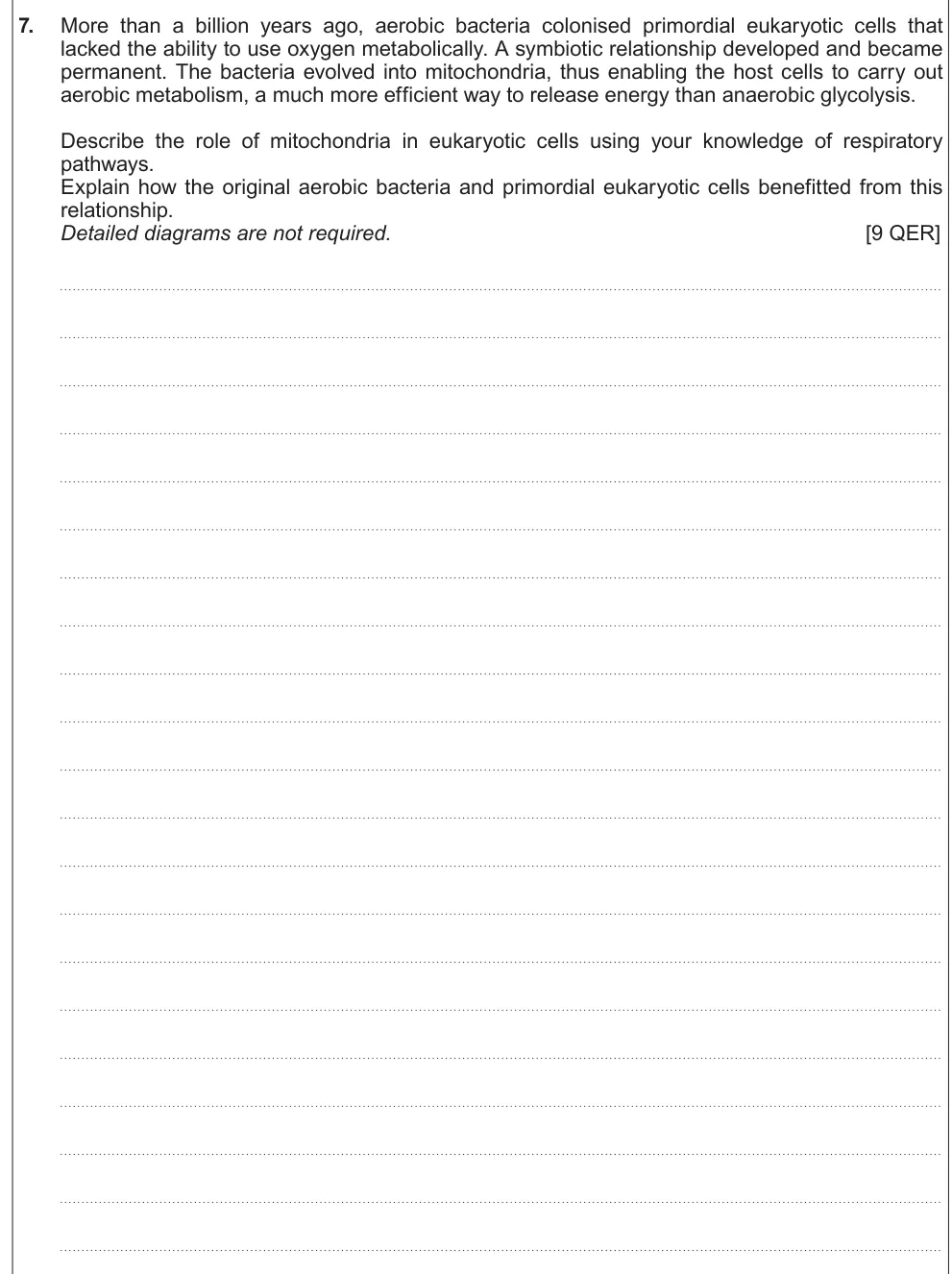
Show the mark scheme
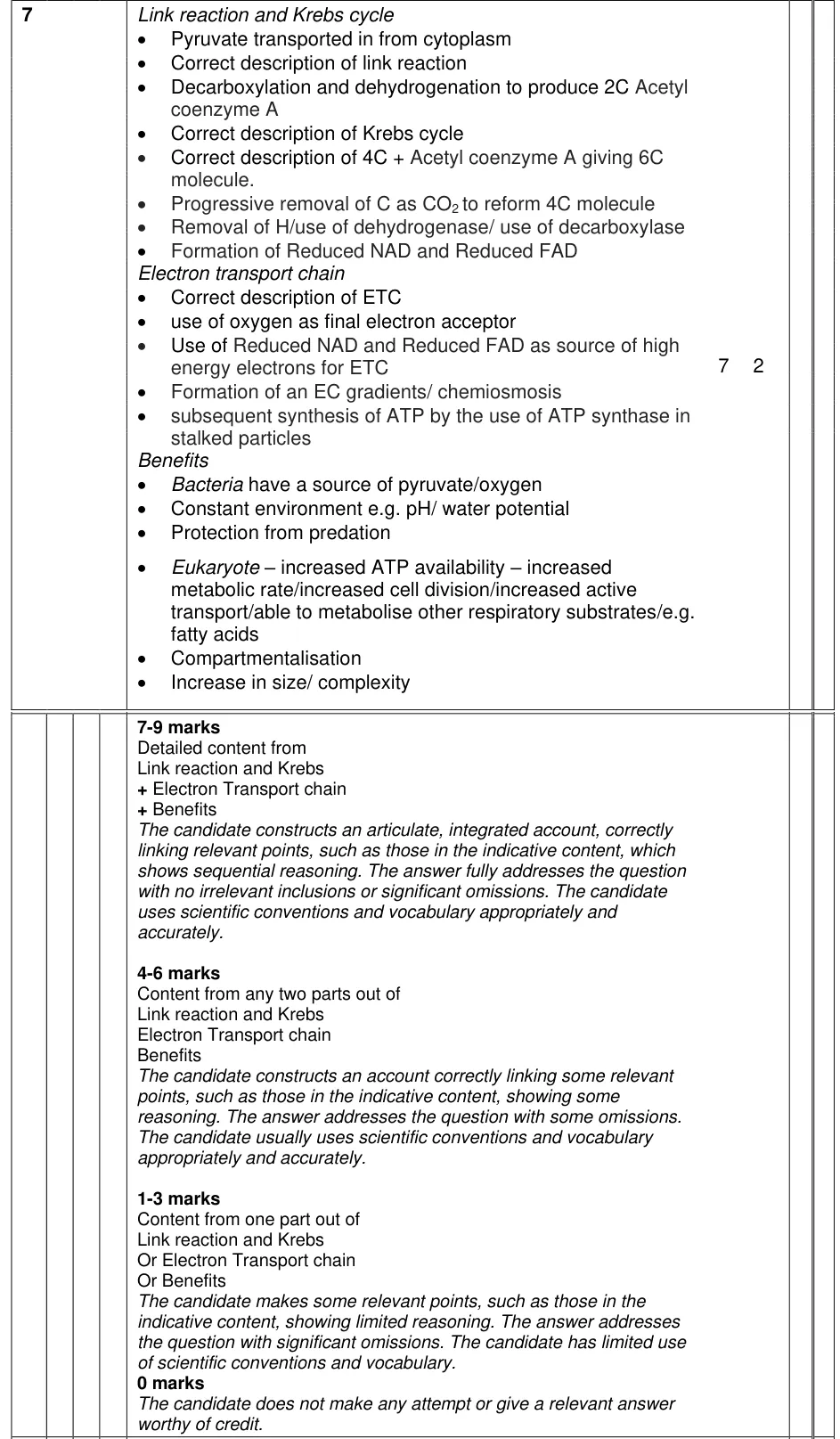
Tap an image to open it full size.
From the examiners' report: Some treated the question as a request for everything they knew about respiration. They spent a long time on glycolysis, touched only briefly on the link reaction and Krebs cycle, and some left out the electron transport chain or the relationship altogether.
1.4 Microbiology
Question 11
A level Component 1 · June 2024 · Q6 · 9 marks
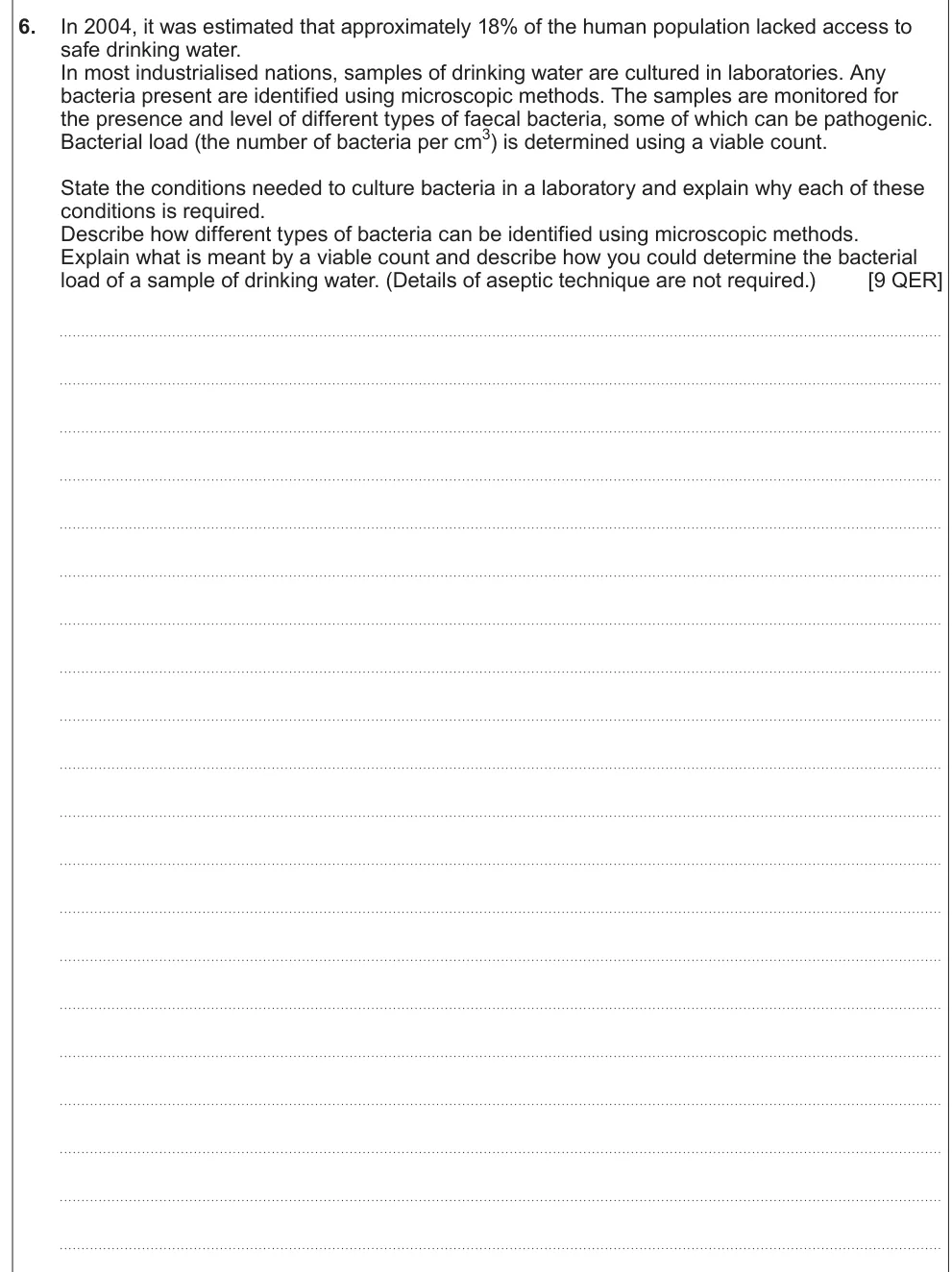
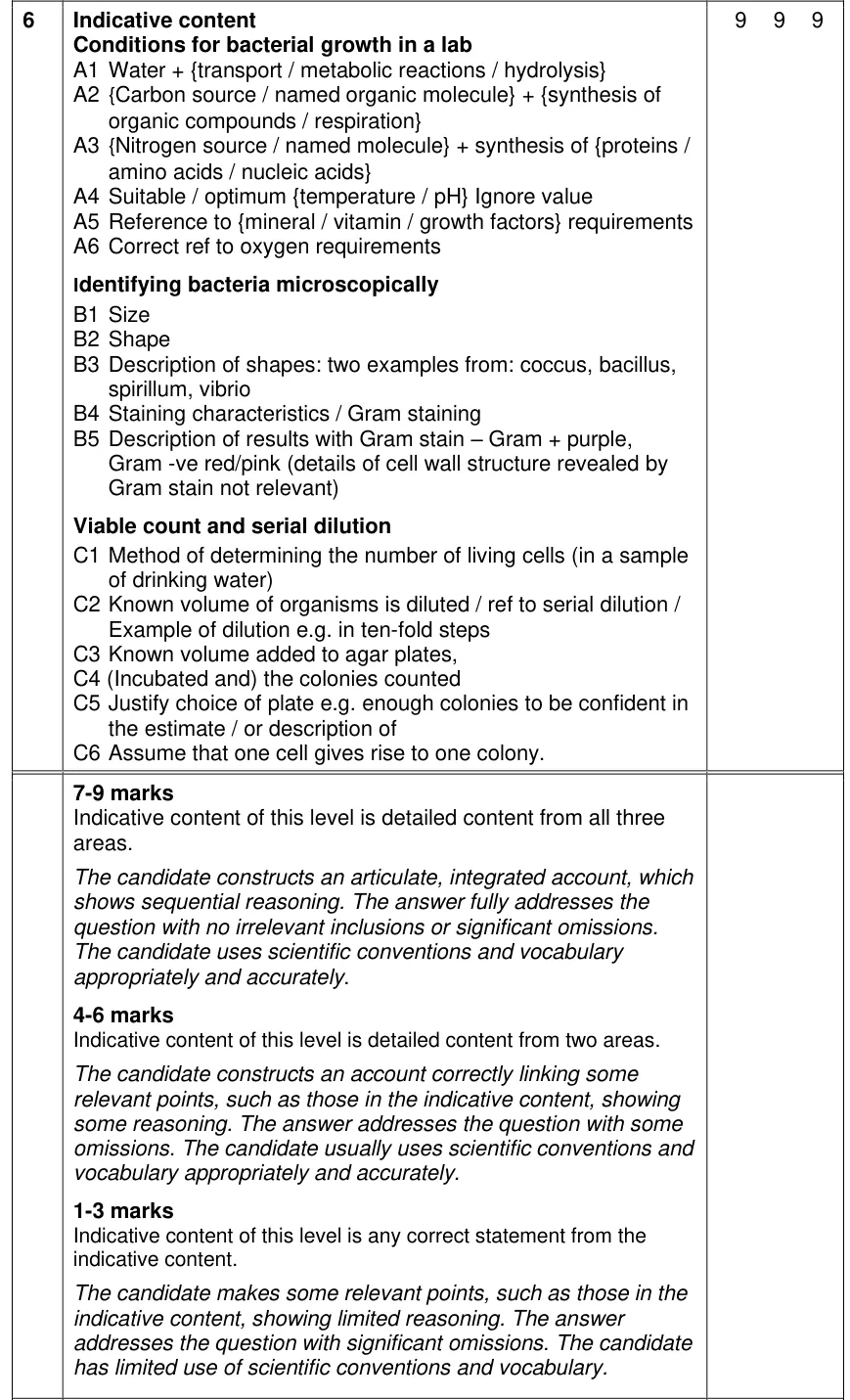
State and explain the conditions needed to culture bacteria, describe how bacteria are identified with a microscope, and explain how a viable count gives the bacterial load of drinking water.
Show the mark scheme
Tap an image to open it full size.
From the examiners' report: Many excellent answers were seen, especially on identifying and counting bacteria. Explaining why each condition for culturing bacteria is needed was answered less well.
1.5 Population size and ecosystems
Question 12
A level Component 1 · June 2023 · Q7 · 9 marks
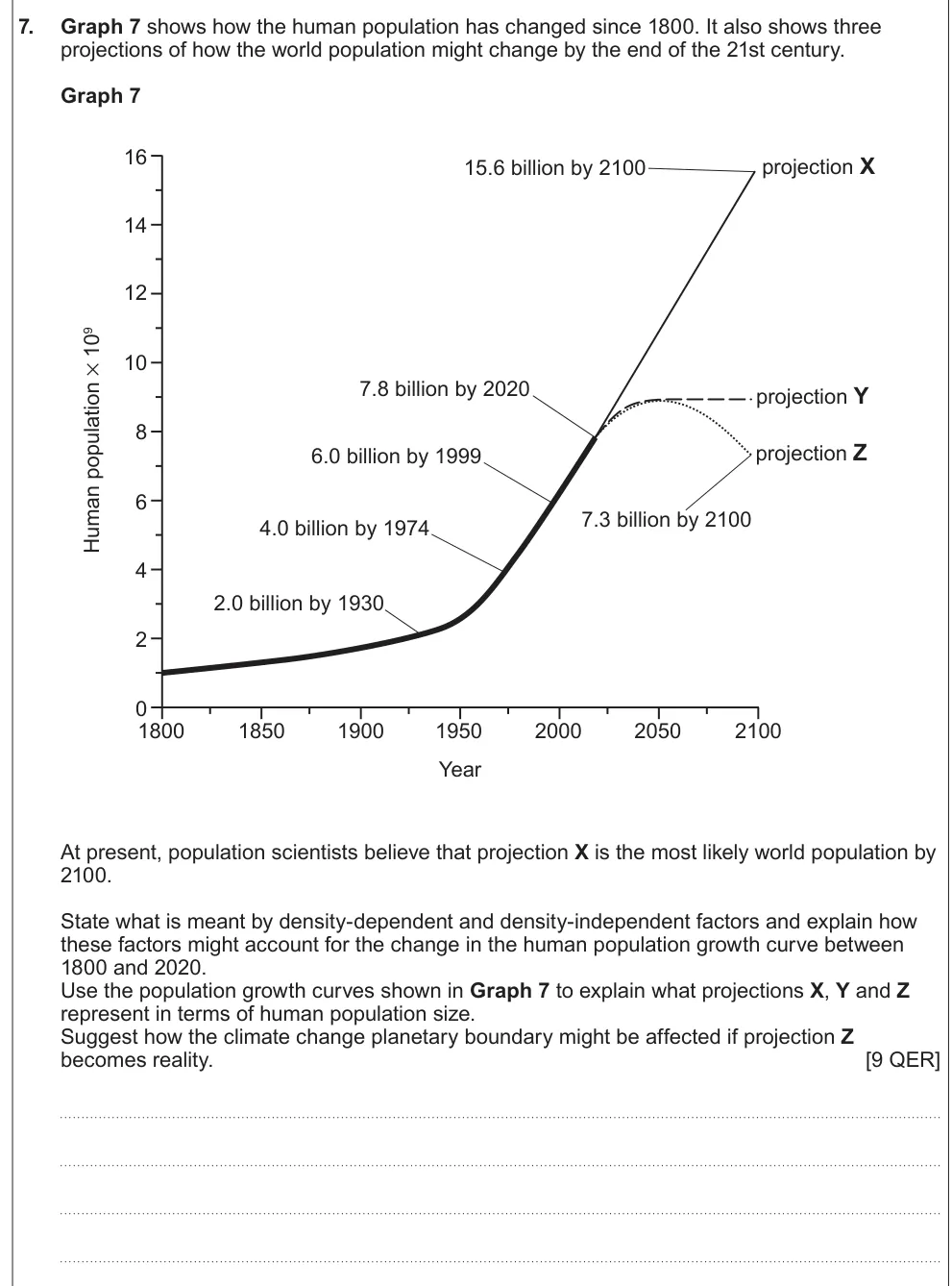
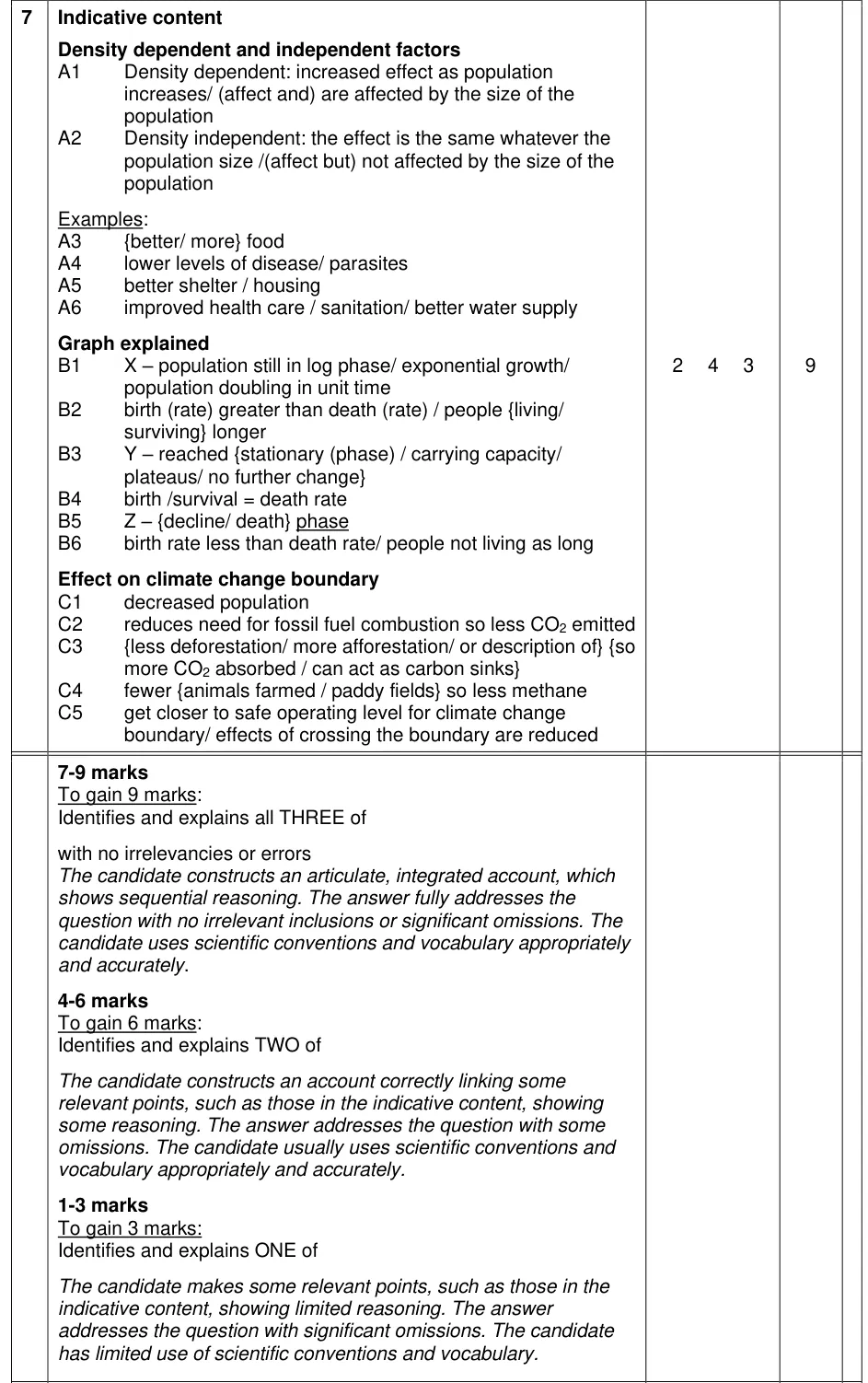
Define density-dependent and density-independent factors and use them to explain human population growth, interpret three projections on a graph, and suggest the effect of one projection on the climate change planetary boundary.
Show the mark scheme
Tap an image to open it full size.
From the examiners' report: Most gave reasonable definitions, then explained the factors in general terms without linking them to human population growth. The projections were identified well but not always in enough detail. In the last part most knew many facts about climate change but did not apply them to a falling population.
Question 13
A level Component 1 · Autumn 2020 · Q7 · 9 marks
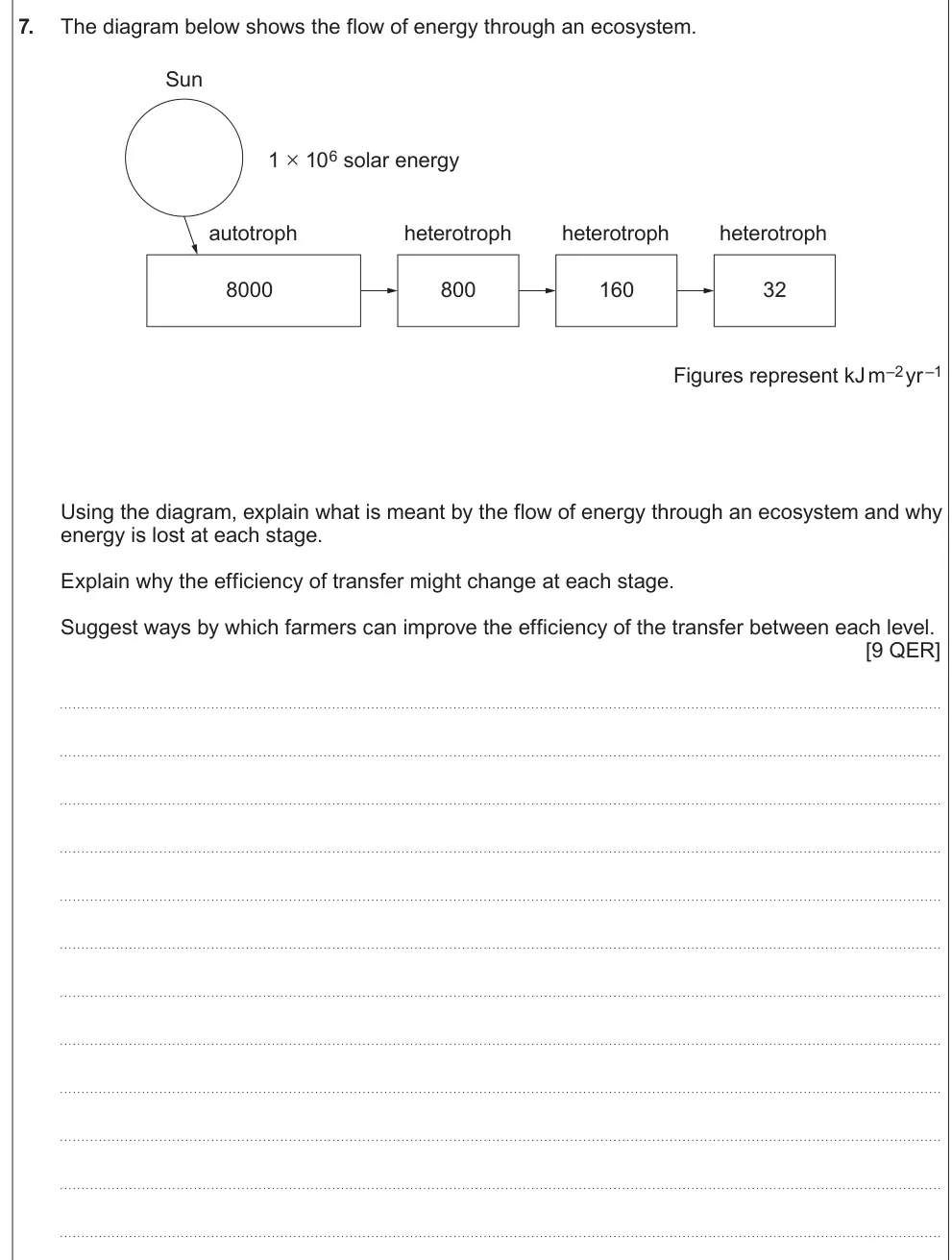
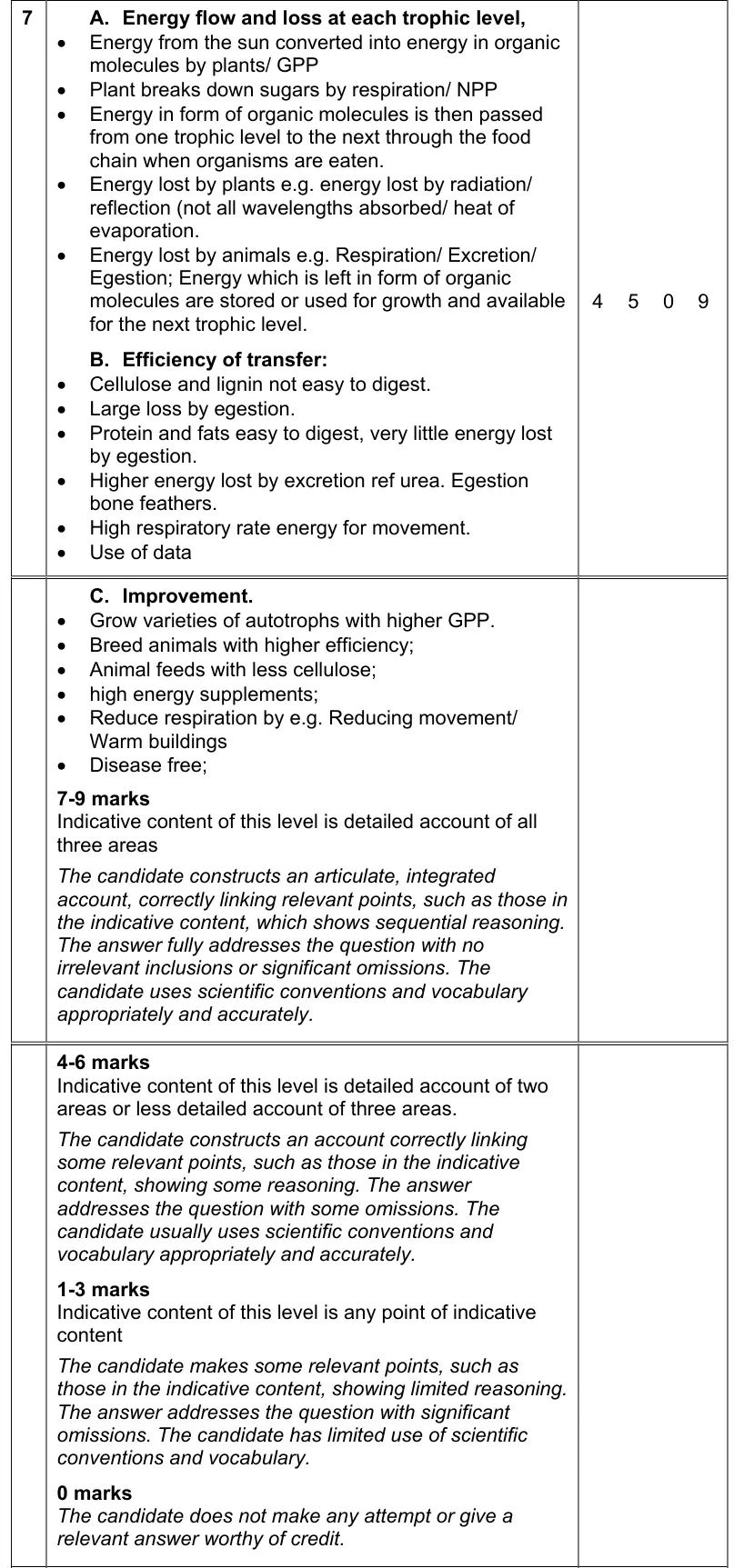
Use an energy flow diagram to explain energy flow and loss through an ecosystem, why the efficiency of transfer changes between stages, and how farmers can improve it.
Show the mark scheme
Tap an image to open it full size.
From the examiners' report: Very few explained energy flow as energy-rich organic molecules passing from one trophic level to the next when food is eaten. Many wrote about heat loss without naming respiration, mixed up egestion and excretion, and made very little use of the data. Keeping animals warm or still was often suggested, but rarely with a reason.
Question 14
A level Component 1 · June 2025 · Q7 · 9 marks
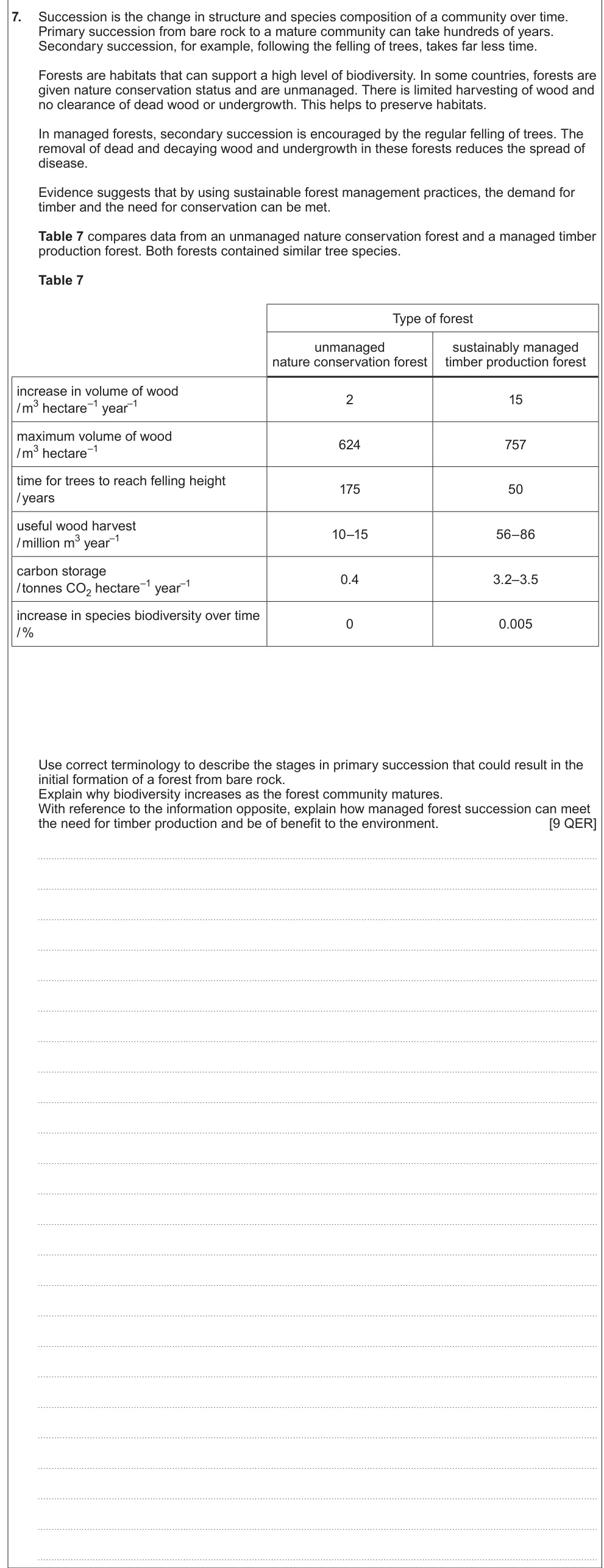
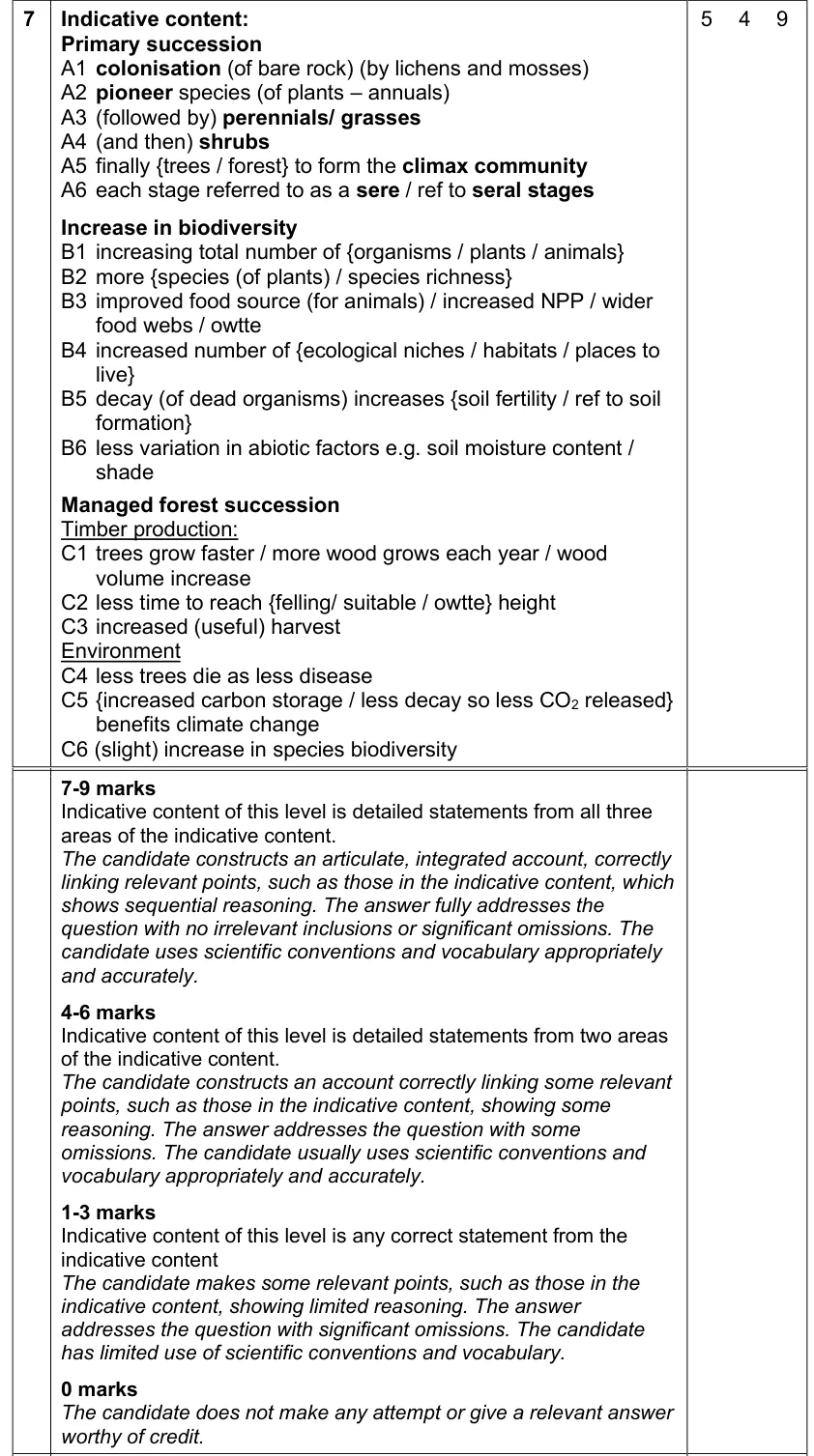
Describe the stages of primary succession from bare rock to forest, explain why biodiversity increases as the community matures, and use a table to explain how managed forests can supply timber and benefit the environment.
Show the mark scheme
Tap an image to open it full size.
From the examiners' report: The best answers used the correct terms for succession; many made general statements without them. A lack of detail lost marks on why biodiversity increases. Using the table to explain how managed forest balances timber and conservation was the best answered part.
1.5 Human effects on the carbon cycle and on water
Question 15
A level Component 1 · June 2019 · Q7 · 9 marks
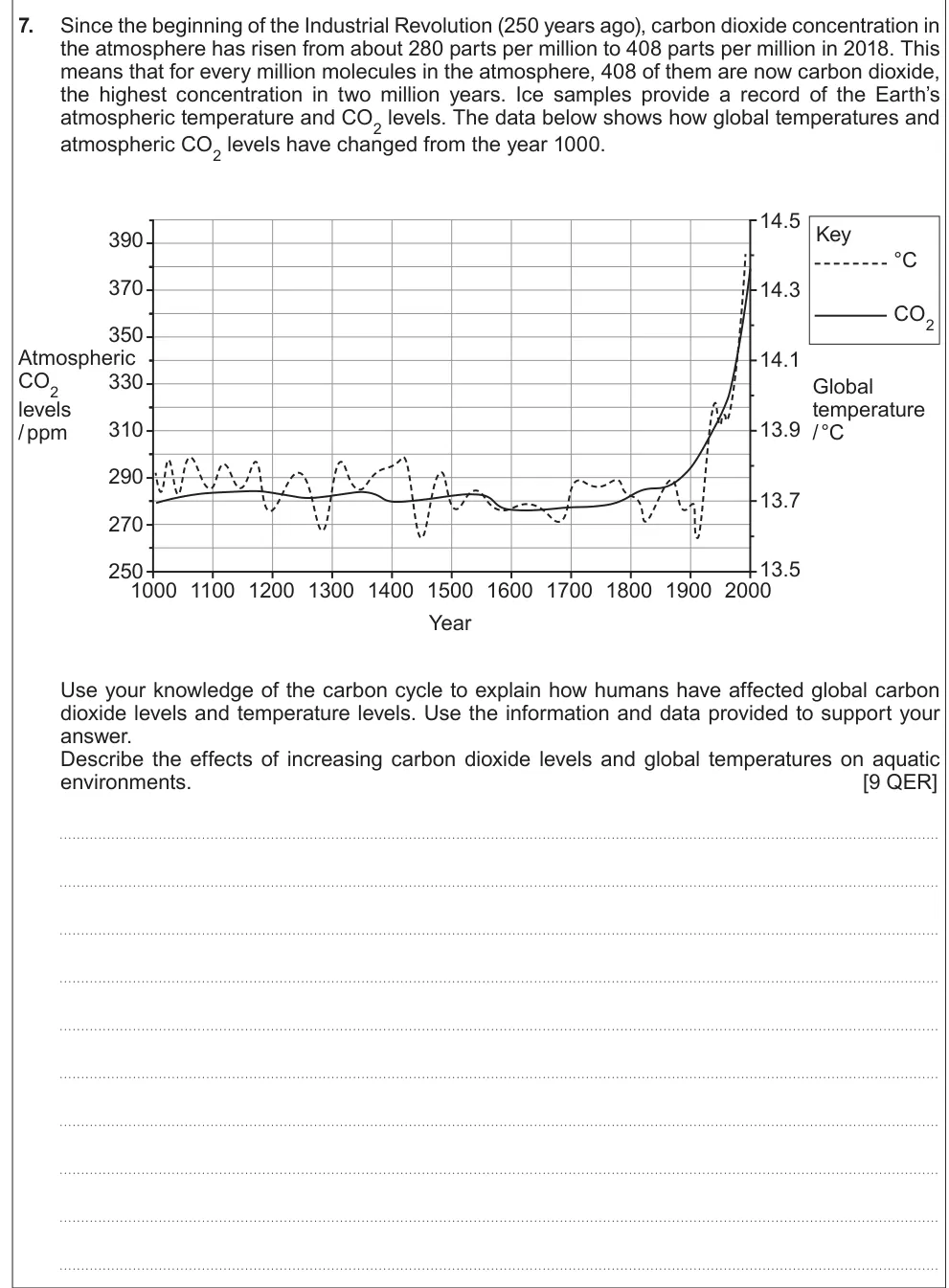
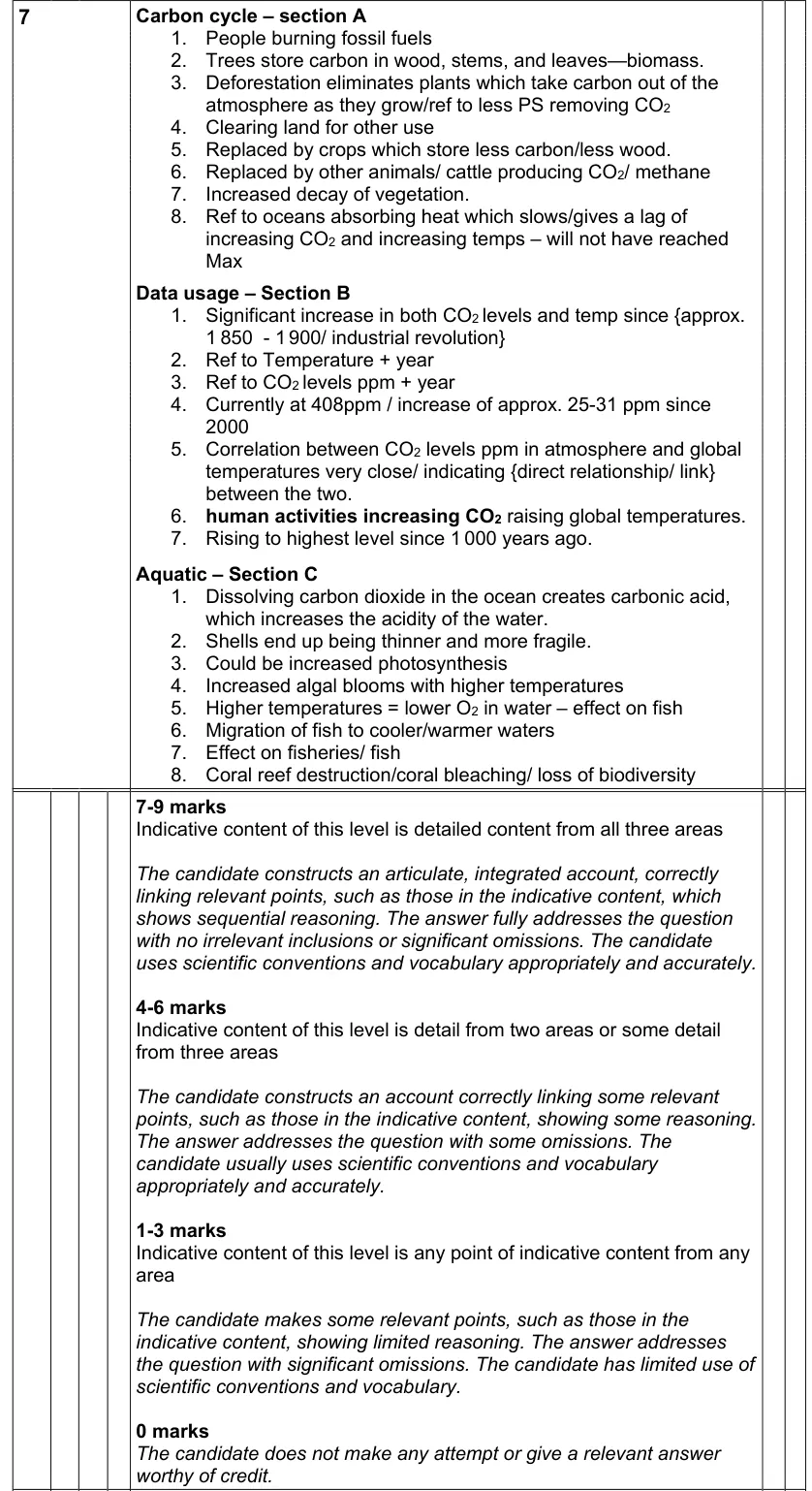
Use the carbon cycle and a graph of CO₂ and temperature since the year 1000 to explain how humans have affected both, and describe the effects on aquatic environments.
Show the mark scheme
Tap an image to open it full size.
From the examiners' report: There were few really strong answers. The human effects were often brief, many did not refer to the data at all, and few gave detail on aquatic environments. Time was wasted on polar bears, seals and penguins, and many wrongly linked CO₂ to holes in the ozone layer.
Question 16
A level Component 1 · June 2022 · Q7 · 9 marks
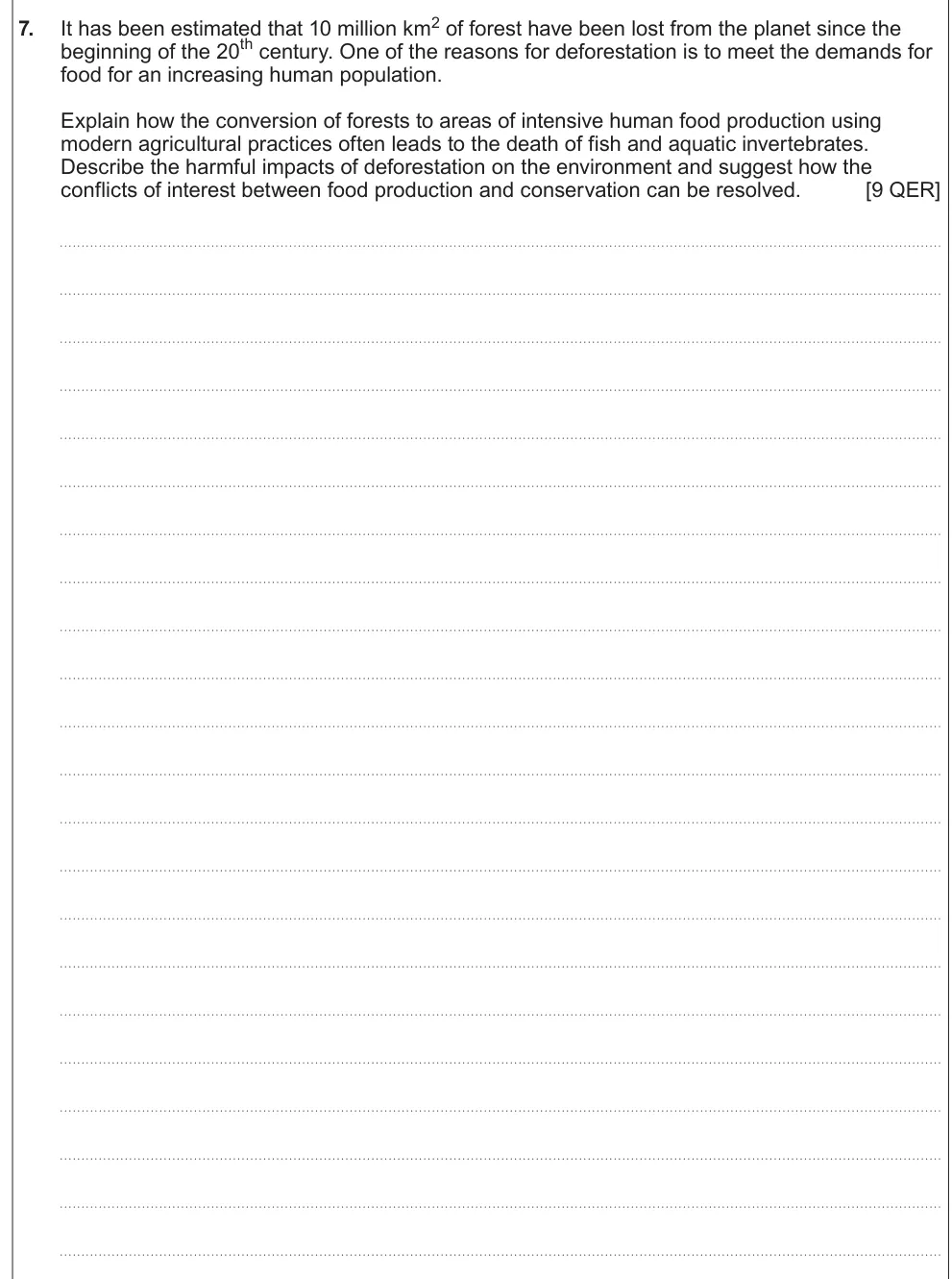
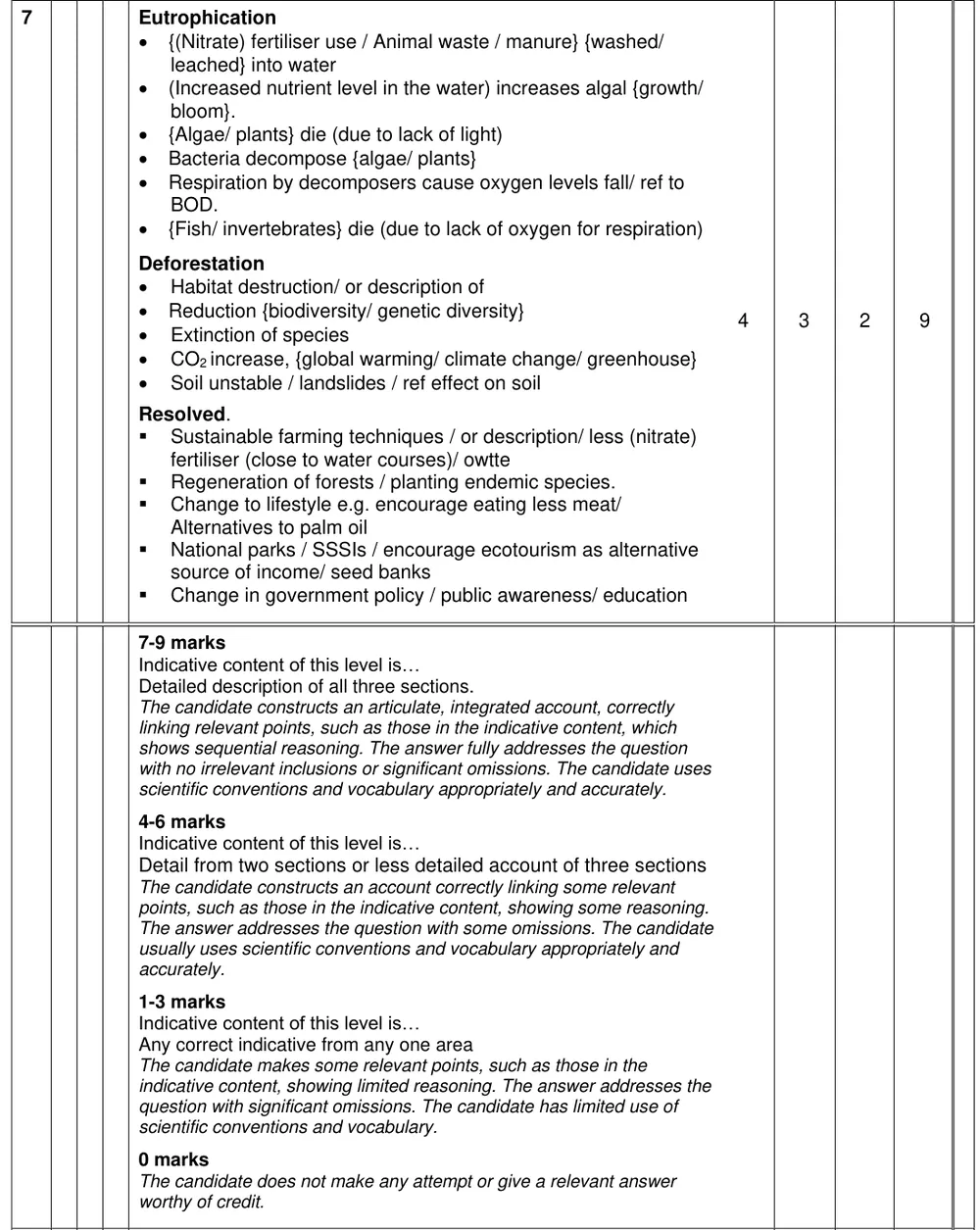
Explain how turning forest into intensively farmed land can kill fish and aquatic invertebrates, describe the harmful effects of deforestation, and suggest how food production and conservation can both be met.
Show the mark scheme
Tap an image to open it full size.
From the examiners' report: Many gave excellent accounts of how modern farming leads to eutrophication and of the effects of deforestation. Resolving the conflict of interest caused more difficulty, with some waffle and repetition. Some answers were spoilt by long accounts of global warming, planetary boundaries and overfishing.
Where students lose marks (from Eduqas examiners' reports and mark schemes)
Each point below is followed by wording that gained marks.
Theory with no reference to the insulin diagrams: Some gave excellent accounts of all four levels of protein structure without using the information provided, and were placed in the lowest band.
✔ Gains credit: "Changing Cys to Gly (aa B chain 19) and Cys to Tyr (aa A chain 7) mean that disulphide bridges may not form between the A and B chains."
Name the groups each bond forms between: Candidates listed the bonds found in each level of protein structure without the functional groups involved.
✔ Gains credit: "hydrogen bonds between –OH/polar R groups", "ionic bonds between charged R groups", "disulphide bonds between sulphur-containing R groups".
Organelles and bacteria don't share a cell wall: The evidence for the endosymbiont theory was spoilt by inaccuracy, such as mitochondria, chloroplasts and bacteria all having a cell wall.
✔ Gains credit: "Circular DNA", "No histones associated with DNA", "Small ribosomes. 70s (80s in eukaryotes)", "Double membrane".
Each DNA molecule, not each strand, is half old: Many wrote that each strand of DNA is made of an old strand and a new strand, and few could explain why generation one disproved the conservative theory.
✔ Gains credit: Conservative replication: "always some heavy DNA present", "no intermediate DNA", "because original heavy DNA is not split".
An amino acid lost, not swapped: Many thought the mutation would put a different amino acid into the polypeptide.
✔ Gains credit: "deletion of 3 bases or triplet", "Amino acid missing from the primary sequence".
Two cycles compared, compartments forgotten: Too many stopped after describing the Krebs and Calvin cycles and wrote nothing about compartmentalisation.
✔ Gains credit: "Keeping products separate from cytoplasm by use of membranes to isolate reactions within organelles."
Heat loss needs respiration named: Many referred to heat loss without stating respiration, and treated egestion and excretion as the same thing.
✔ Gains credit: "Energy lost by animals e.g. Respiration/ Excretion/ Egestion"; "Large loss by egestion" where "Cellulose and lignin not easy to digest".
The pH falls, it doesn't just change: Imprecise statements such as "pH changed" were common, and many did not refer to the data at all.
✔ Gains credit: "Dissolving carbon dioxide in the ocean creates carbonic acid, which increases the acidity of the water."
Download the questions
Download the PDF pack (16 questions, mark schemes at the end)
Keep practising
- Extended Response (Component 2): Eduqas A Level Biology Exam Questions
- Extended Response (Component 3): Eduqas A Level Biology Exam Questions
- Biological Compounds (CC1): Eduqas A Level Biology exam questions by topic
- Cell Structure and Organisation (CC2): Eduqas A Level Biology exam questions by topic
- Nucleic Acids and their Functions (CC5): Eduqas A Level Biology exam questions by topic
- Respiration (1.3): Eduqas A Level Biology exam questions by topic
- Populations and Ecosystems (1.5): Eduqas A Level Biology exam questions by topic
- Eduqas A level Biology revision resources by topic
- Eduqas A level Biology past papers, mark schemes and examiners' reports
- Eduqas A level Biology grade boundaries
- Ask about Eduqas A level Biology lessons with Sam on WhatsApp
Questions, mark schemes and examiners' report extracts © WJEC CBAC Ltd (Eduqas).