

Every Eduqas A level Biology paper has one 9-mark question marked [9 QER]: quality of extended response. It is not marked point by point. The mark scheme lists indicative content, usually in three areas that match the three things the question asks for, and places the answer in a band: 1–3, 4–6 or 7–9 marks. A top-band answer is "an articulate, integrated account, correctly linking relevant points", which "shows sequential reasoning" and has "no irrelevant inclusions or significant omissions". This page has all nineteen usable QER questions on Component 3 (Requirements for Life): gas exchange, transport in animals and plants, nutrition, the kidney and the nervous system. Questions marked AS are from the AS papers (B400); the rest are from the A level papers (A400).
The examiners' reports repeat the same warnings. Answer the question asked: writing everything you know when you recognise a key word gains little credit, and irrelevant detail can stop an answer reaching full marks. Use the images, tables and stem information you are given, because that is where much of the indicative content comes from. Cover every area of the question, and explain what each feature is for; don't just list it. Write in sentences, not bullet points. Higher-scoring scripts often began with a plan, and answers set out as one section for each area read more logically.
I don't teach the Eduqas specification myself, so for one-to-one help I recommend Sam. He teaches Eduqas A level Biology at a top-rated sixth form college and is very popular with his students. You can ask about lessons with Sam on WhatsApp using the link at the bottom of this page.
What you need first
Each question on this page assumes you're secure on these ideas. If any of them feels shaky, look it up before you start.
- Fick's law ideas: diffusion is faster with a large surface area, a short diffusion distance and a steep concentration gradient, and larger organisms have a smaller surface area to volume ratio.
- The structure of the mammalian heart and blood vessels, and the difference between open and closed, single and double circulations.
- The modes of nutrition (autotrophic, holozoic, saprotrophic, parasitic) and the regions of the human gut.
- Water potential and osmosis, and how ions crossing a membrane produce resting and action potentials.
Key terms
These words come up in the questions and mark schemes. Examiners expect you to use them exactly.
- QER: quality of extended response: the 9-mark question on each paper, marked in bands for the quality and linking of the account.
- Indicative content: the points listed in the mark scheme for a QER question, usually grouped into three areas.
- Counter-current flow: blood and water flowing in opposite directions across the gill, so a concentration gradient is kept along the whole surface.
- Buccal cavity: the mouth cavity of a fish; lowering its floor increases its volume and lowers the pressure so water enters.
- Haemolymph: the circulatory fluid of an open circulatory system, which bathes the tissues in the haemocoel (the body cavity).
- Holozoic nutrition: taking food in and digesting it internally: ingestion, digestion, absorption and egestion.
- Saprotrophic nutrition: secreting enzymes on to dead or decaying material (extracellular digestion) and absorbing the products.
- ADH: antidiuretic hormone, released from the pituitary; it makes the collecting duct more permeable to water.
What these questions cover
The questions are built on these statements from the Eduqas A level Biology specification (A400). Each one also draws on other parts of the same topic.
- 3.1(a) the adaptations for gas exchange which allow an increase in body size and metabolic rate
- 3.1(b) gas exchange in small animals across their general body surface
- 3.1(c) the comparison of gas exchange mechanisms in Amoeba, flatworm and earthworm
- 3.1(f) ventilation in bony fish and comparison of counter current flow with parallel flow
- 3.1(h) ventilation in humans and how gases are exchanged
- 3.1(k) the role of leaf structures in allowing the plant to photosynthesise effectively
- 3.2(a) the similarities and differences in the vascular systems of animal groups
- 3.2(b) the mammalian circulatory system including the structure and function of heart and blood vessels and the names of the main blood vessels associated with the human heart
- 3.2(c) the cardiac cycle and the maintenance of circulation to include graphical analysis of pressure changes, the role of sino-atrial node and Purkyne/ Purkinje fibres and the
- 3.2(p) the adaptations shown by some angiosperms
- 3.3(a) the terms autotrophic and heterotrophic and that autotrophic organisms can be photoautotrophic or chemoautotrophic
- 3.3(e) nutrition in unicellular organisms, e.g. Amoeba, food particles are absorbed and digestion is carried out intracellularly
- 3.3(i) the adaptations of herbivore guts and dentition, in particular ruminants to a high cellulose diet and the adaptations of carnivore guts and dentition to a high protein di
- 3.3(j) parasites
- 3.4(g) the role of antidiuretic hormone
- 3.5(g) the nature and transmission of the nerve impulse
How to use this page
Write your answer on paper before you open the mark scheme. Allow about 1.2 minutes per mark: the 19 questions are worth 171 marks, so about 205 minutes in total. Then mark your answer strictly against the mark scheme and read the examiners' tip underneath it. If you'd rather print the questions, download the PDF pack.
3.1 Gas exchange
Question 1
A level Component 3 · Autumn 2020 · Q7 · 9 marks
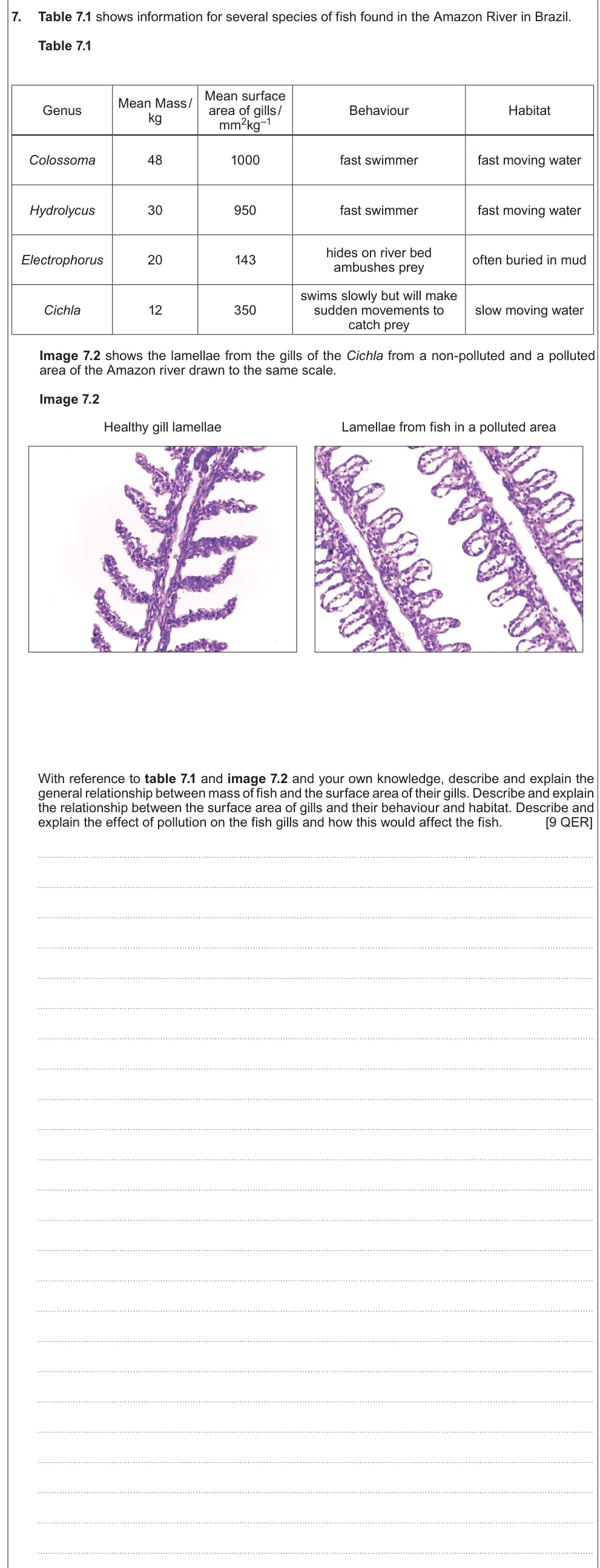
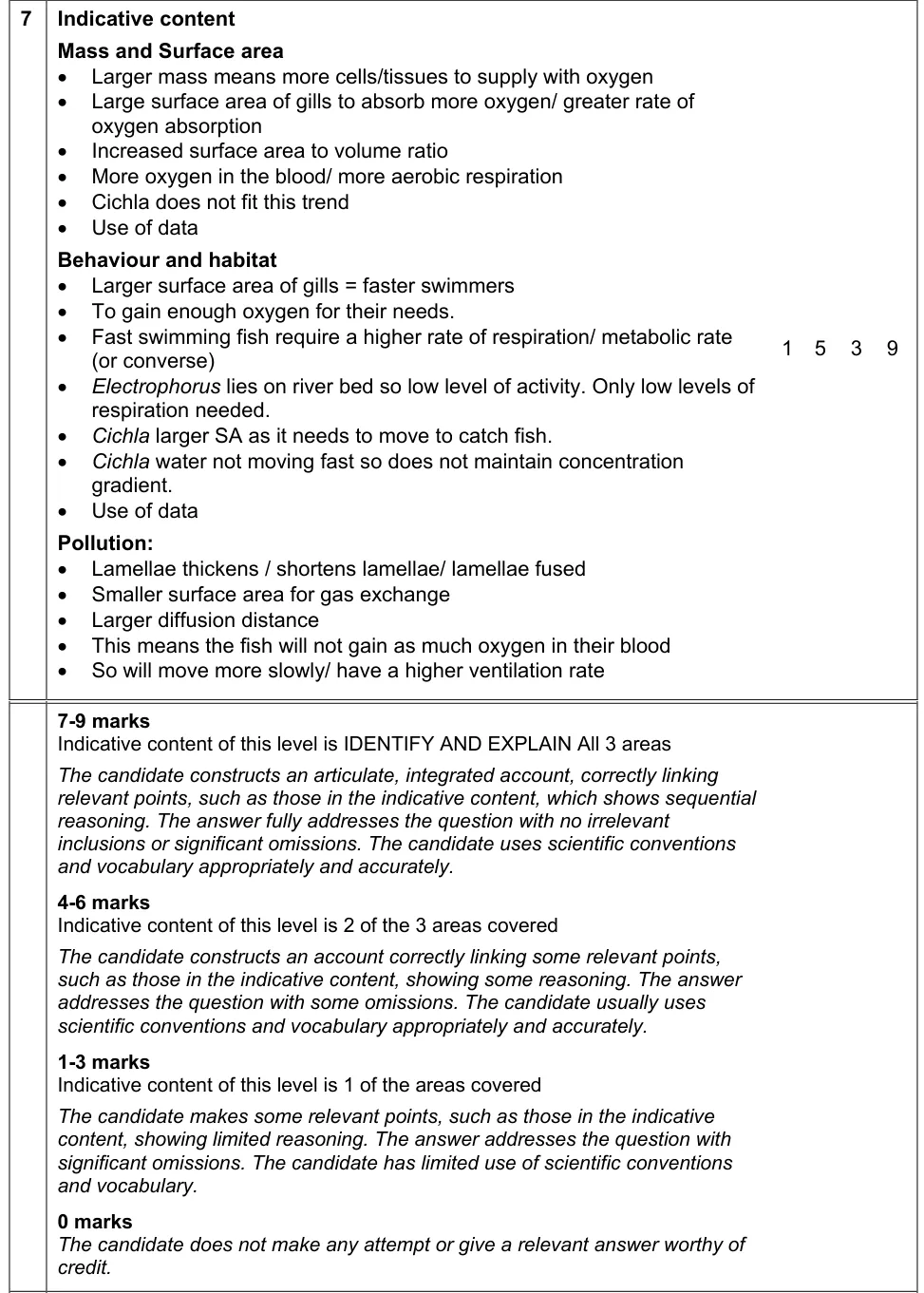
Use a table and drawings of gill lamellae to explain how gill surface area relates to a fish's mass, behaviour and habitat, and how pollution affects the gills and the fish.
Show the mark scheme
Tap an image to open it full size.
From the examiners' report: The best answers gave reasons for each relationship, for example what a larger gill surface area is for, and linked oxygen diffusing into the blood to aerobic respiration. Use the image for the pollution section: some ignored it and wrote about eutrophication or water temperature.
Question 2
AS Component 2 · June 2017 · Q6 · 9 marks
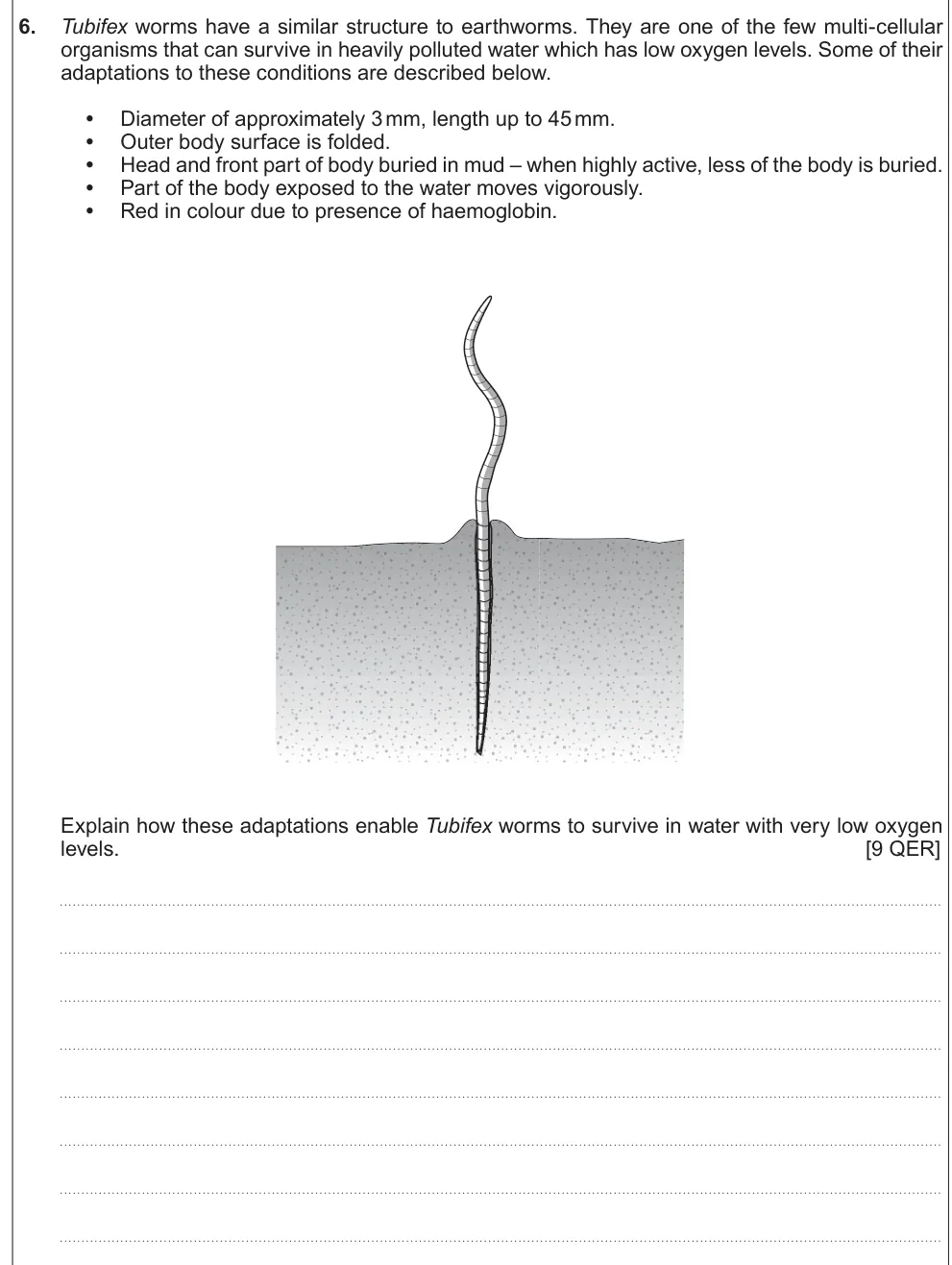
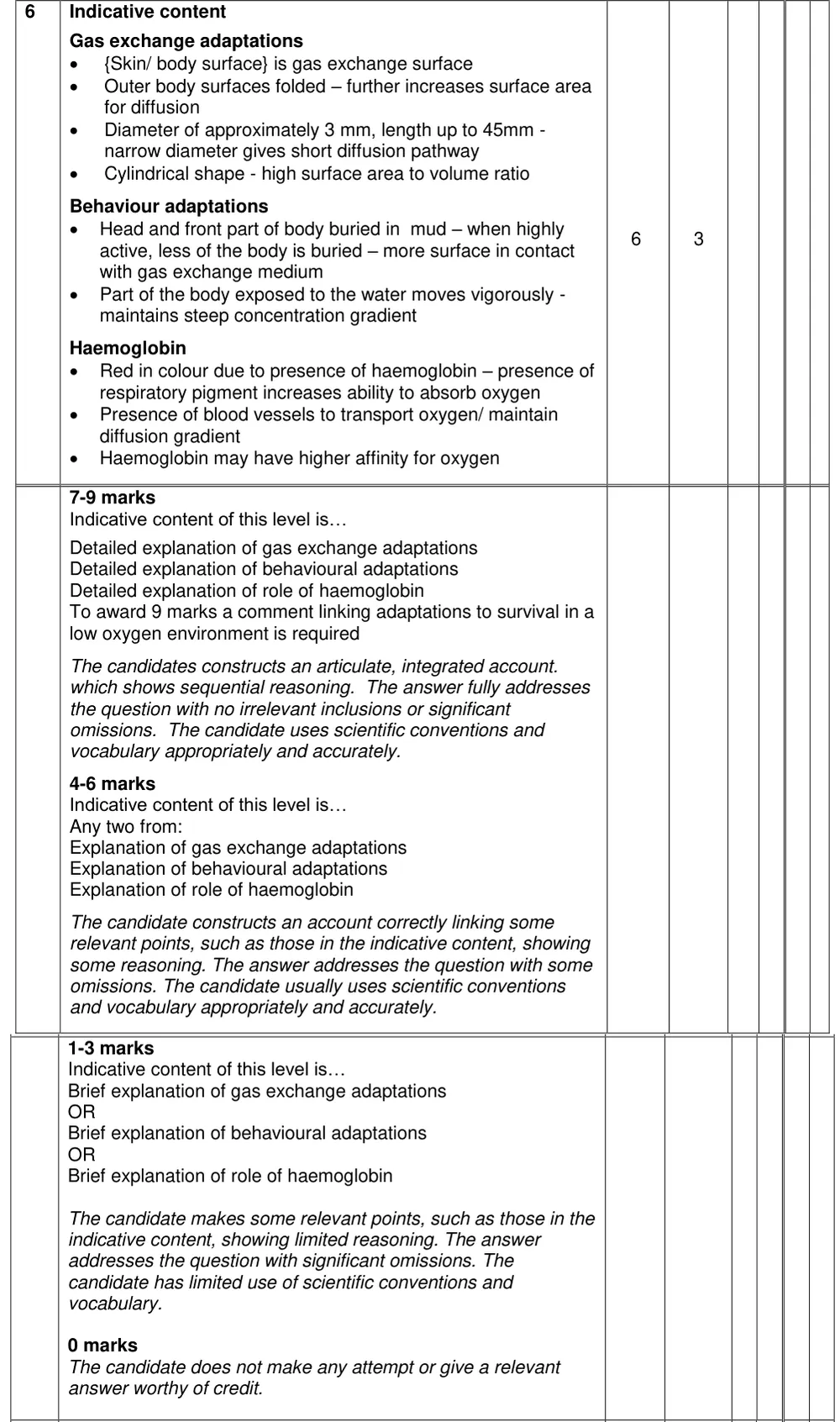
Explain how five listed adaptations allow Tubifex worms to survive in water with very low oxygen levels.
Show the mark scheme
Tap an image to open it full size.
From the examiners' report: The best answers covered structural, behavioural and physiological adaptations. Weaker answers stayed with body shape and the folded surface, were vague about behaviour, or treated the worms as living on land when the question says they live in polluted water.
Question 3
AS Component 2 · Autumn 2021 · Q6 · 9 marks
Use a table of features to explain how Paramecium is adapted for gas exchange and how a flatworm and an annelid are adapted to be larger multicellular organisms.
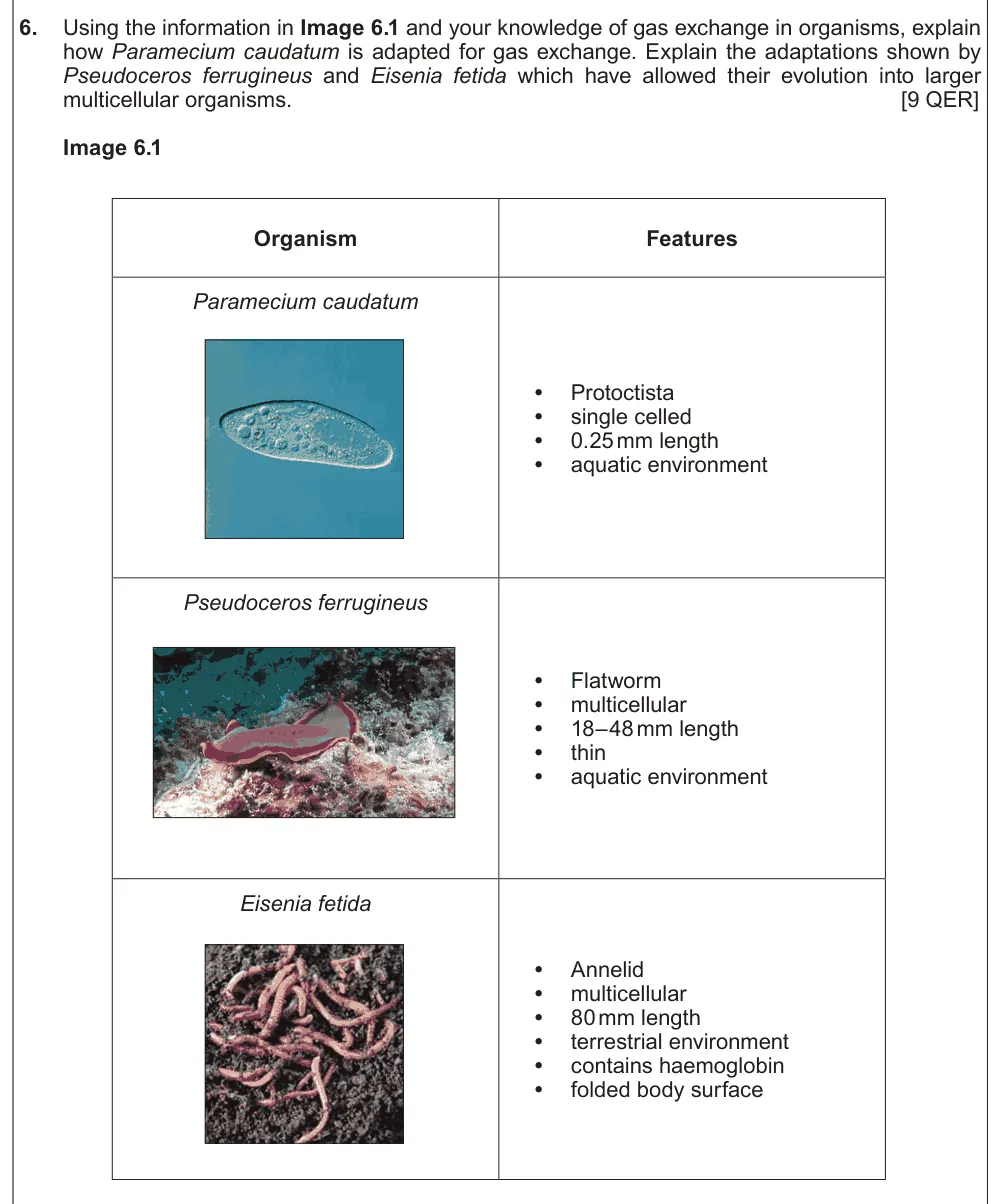
Show the mark scheme
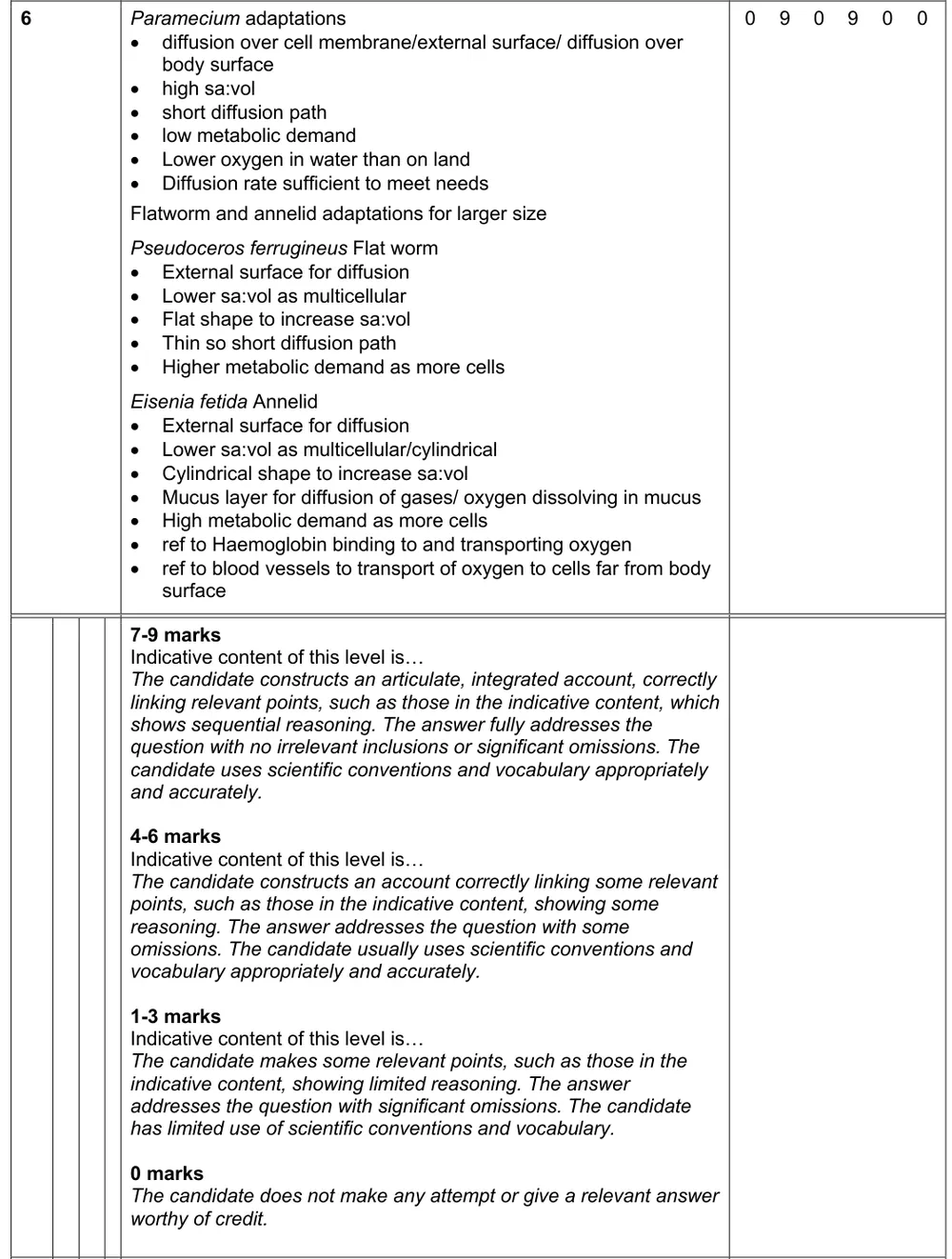
Tap an image to open it full size.
Question 4
AS Component 2 · June 2016 · Q7 · 9 marks
Describe how the gills of bony fish and axolotls are adapted for efficient gas exchange and explain why bony fish stay active at low oxygen levels when axolotls don't.
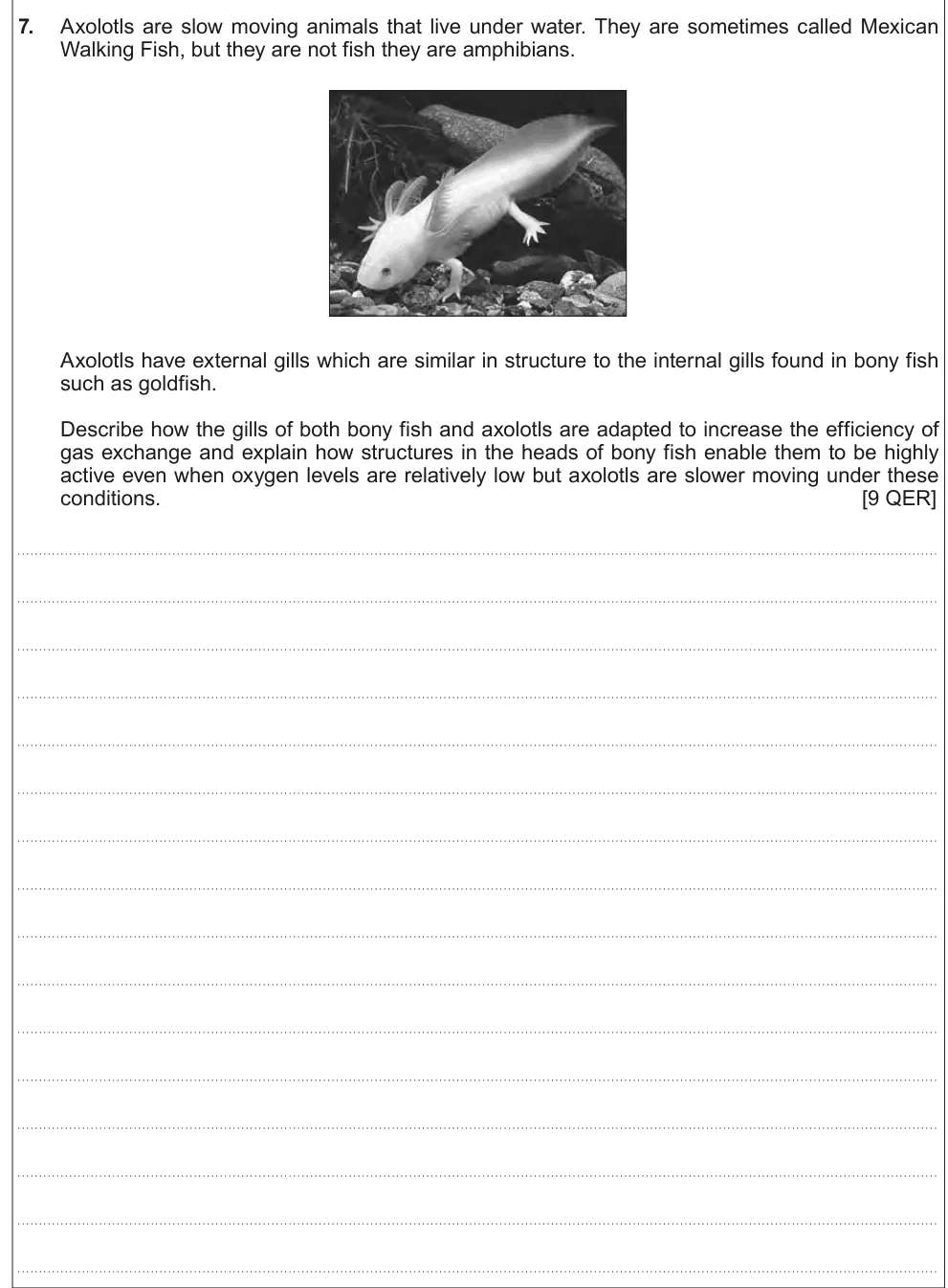
Show the mark scheme
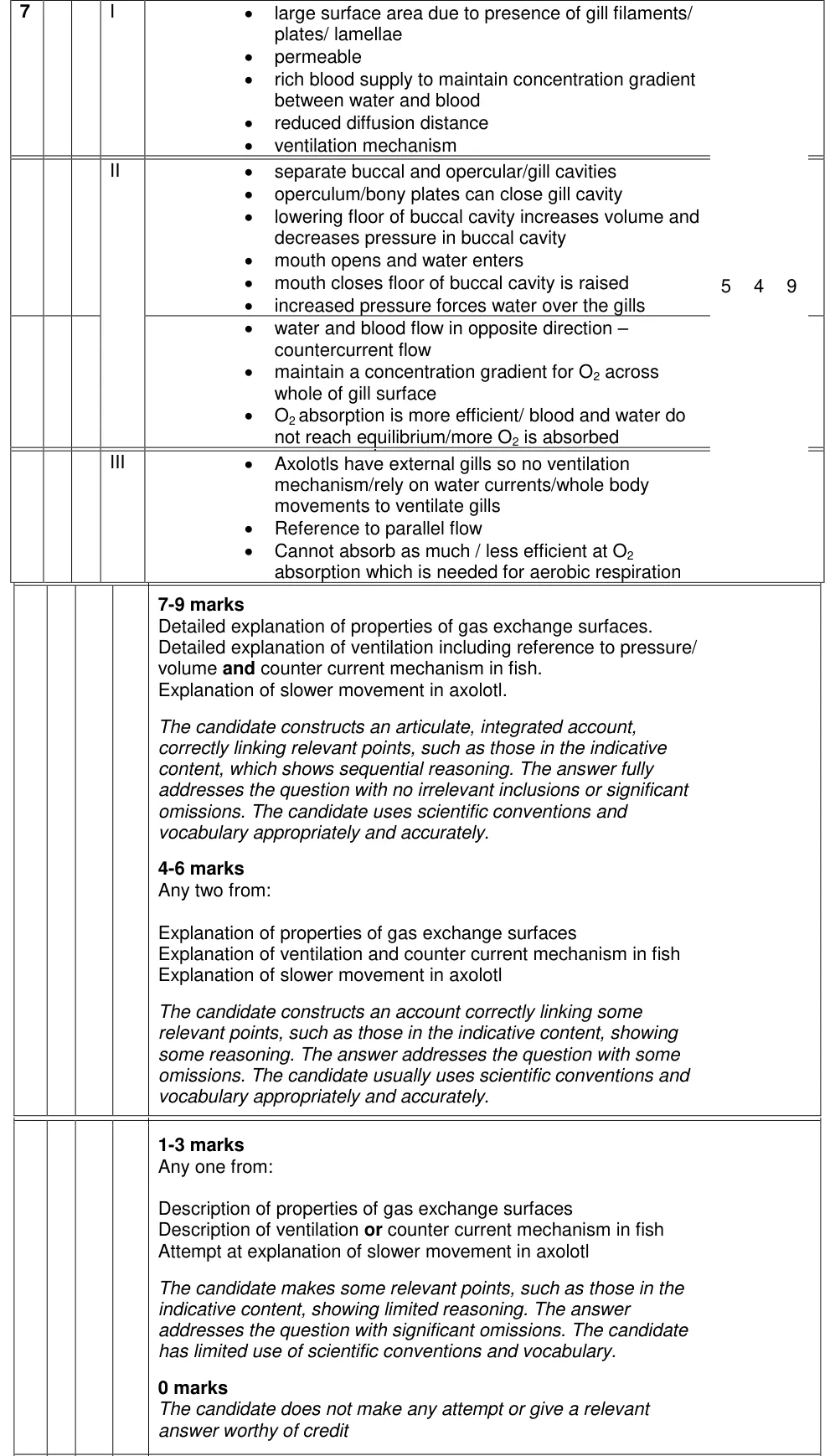
Tap an image to open it full size.
From the examiners' report: The best answers covered all three areas: the adaptations of the respiratory surface, the ventilation mechanism of bony fish with the significance of counter-current flow, and a comparison with the external gills of the axolotl.
Question 5
A level Component 3 · June 2024 · Q6 · 9 marks
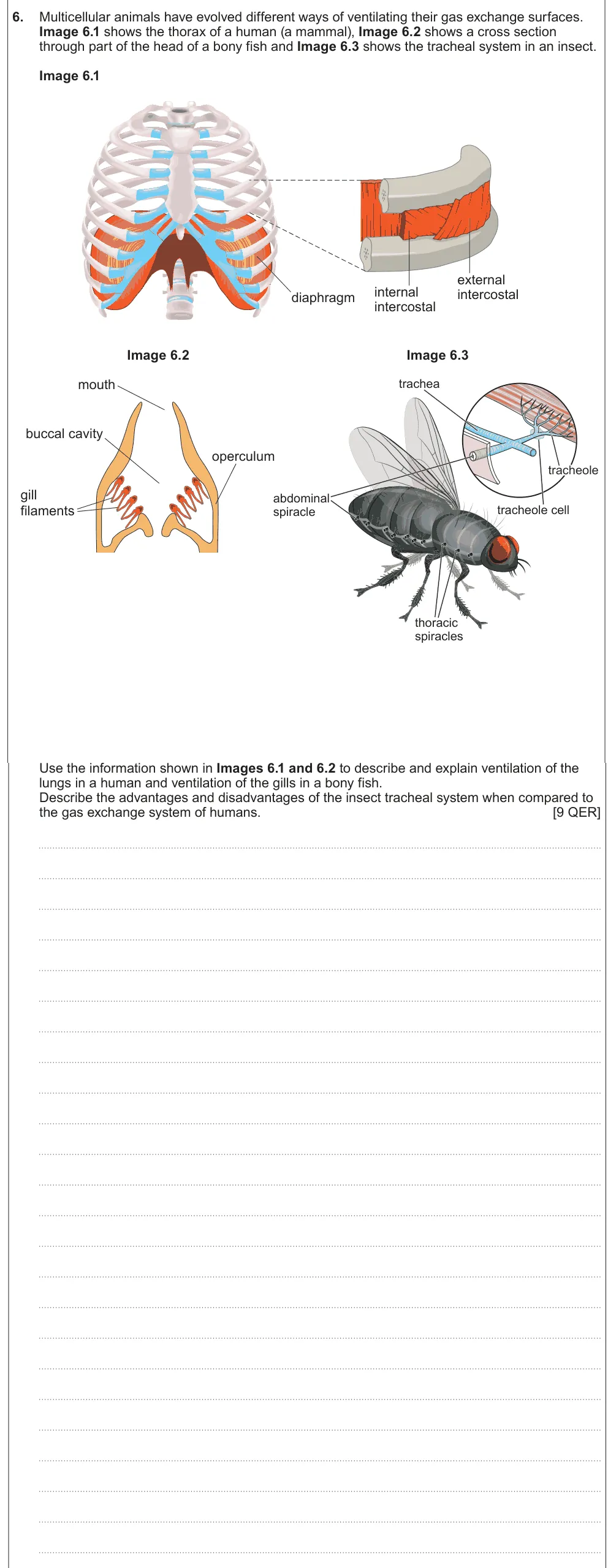
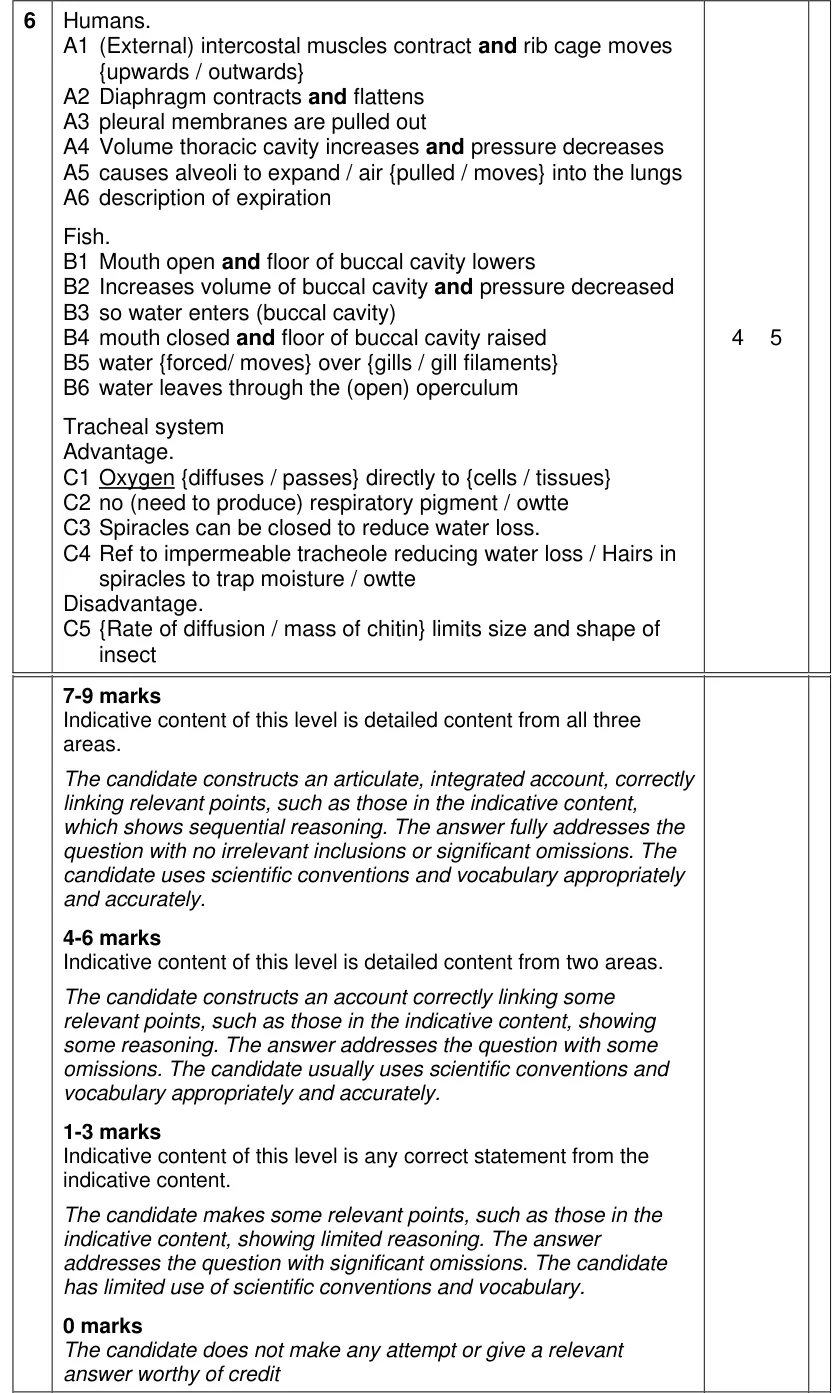
Use diagrams to describe and explain ventilation of human lungs and of the gills of a bony fish, then give the advantages and disadvantages of the insect tracheal system compared with the human system.
Show the mark scheme
Tap an image to open it full size.
From the examiners' report: It is the volume of the thoracic cavity that increases, not the volume of the lungs, and each muscle needs its own effect. The insect section was the weakest: say that oxygen passes directly to the cells ("gases" or "air" gained no credit). Very few gave a disadvantage.
Question 6
AS Component 2 · June 2019 · Q6 · 9 marks
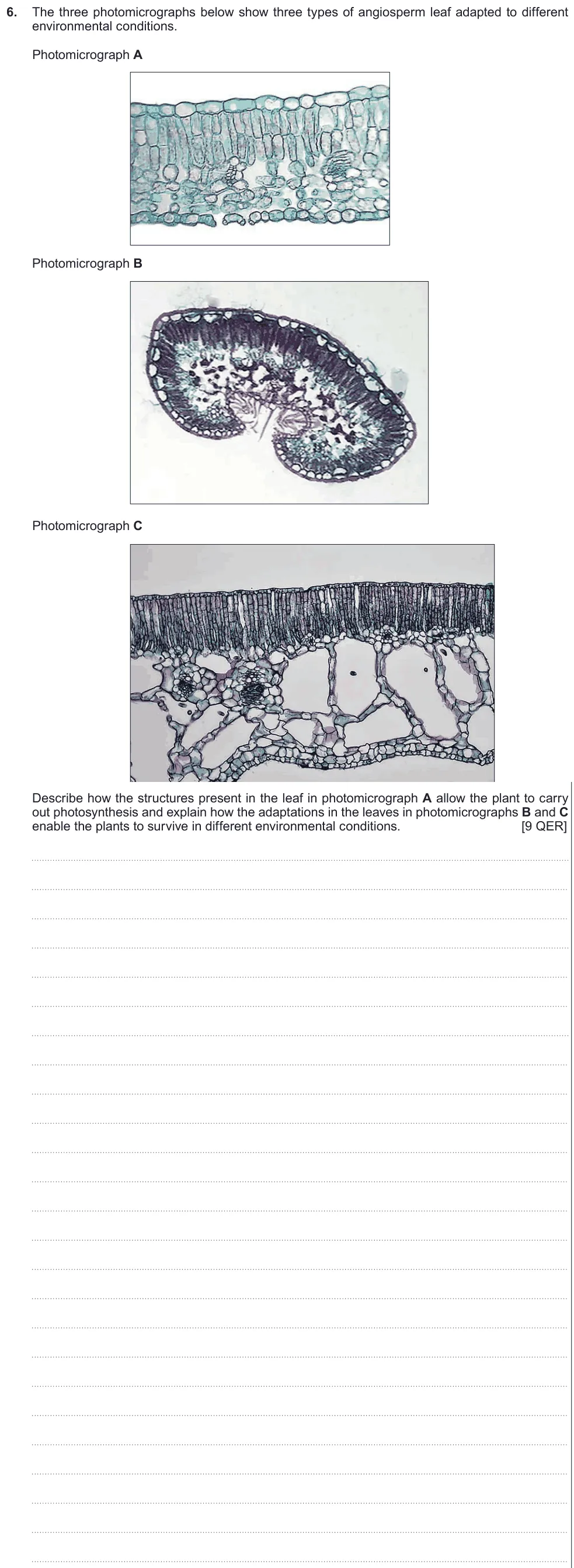
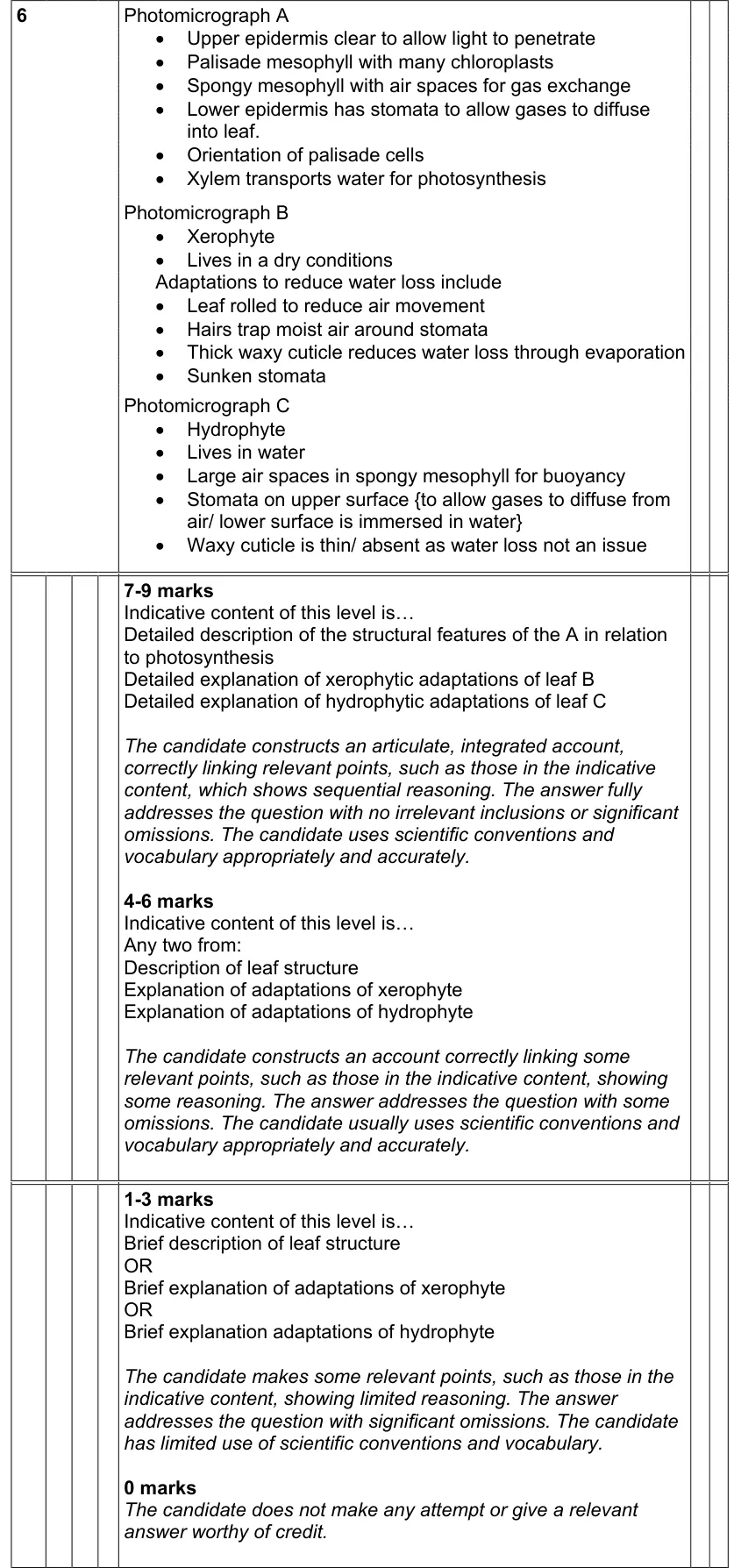
Use three photomicrographs to describe how one leaf is adapted for photosynthesis and explain how the other two leaves are adapted to their environments.
Show the mark scheme
Tap an image to open it full size.
From the examiners' report: The best answers dealt fully with the adaptations visible in each photomicrograph. Weaker answers were lists of features with no link between the adaptation and the plant's survival in its environment.
3.2 Transport in animals
Question 7
AS Component 2 · Autumn 2020 · Q5 · 9 marks
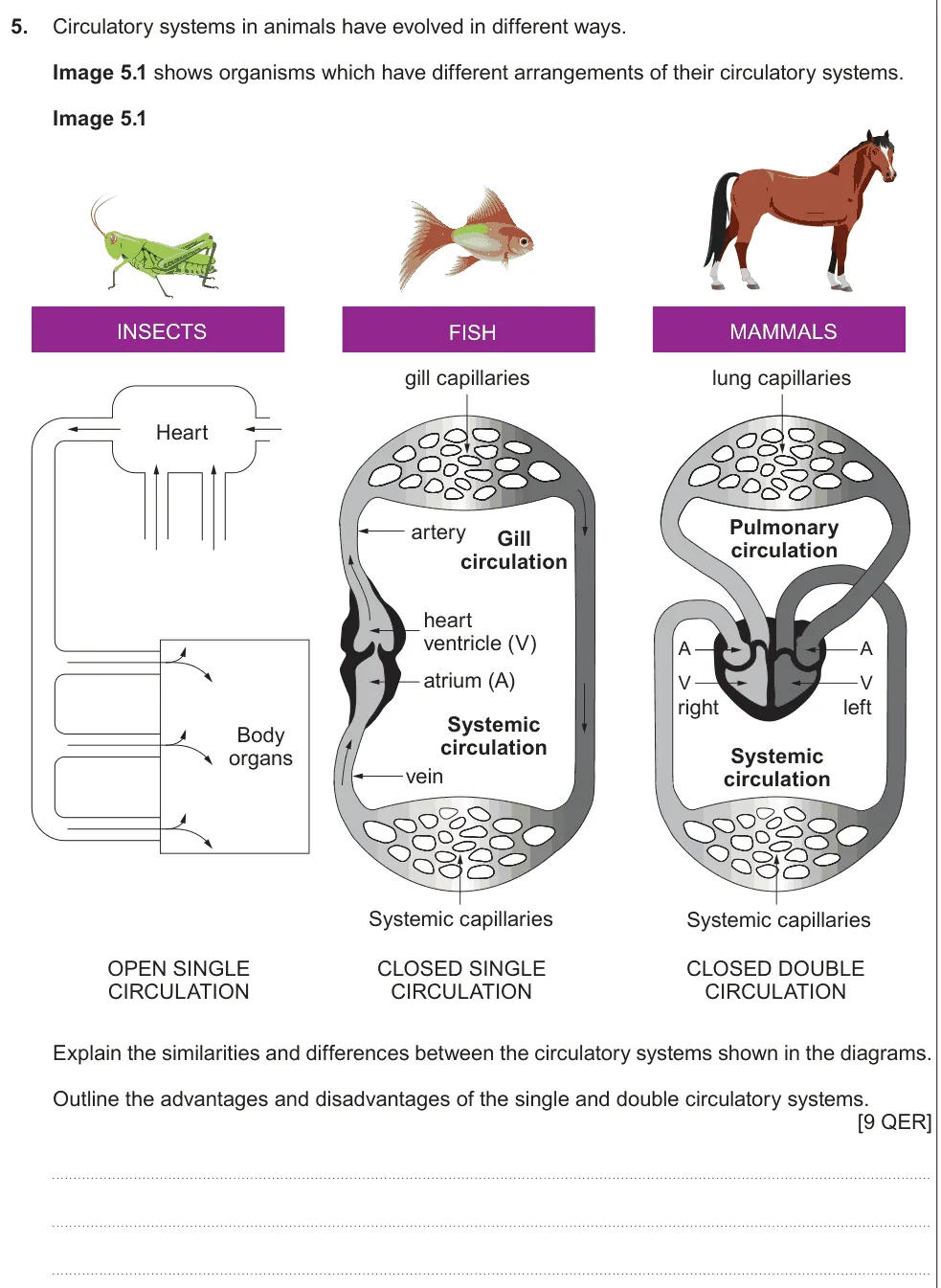
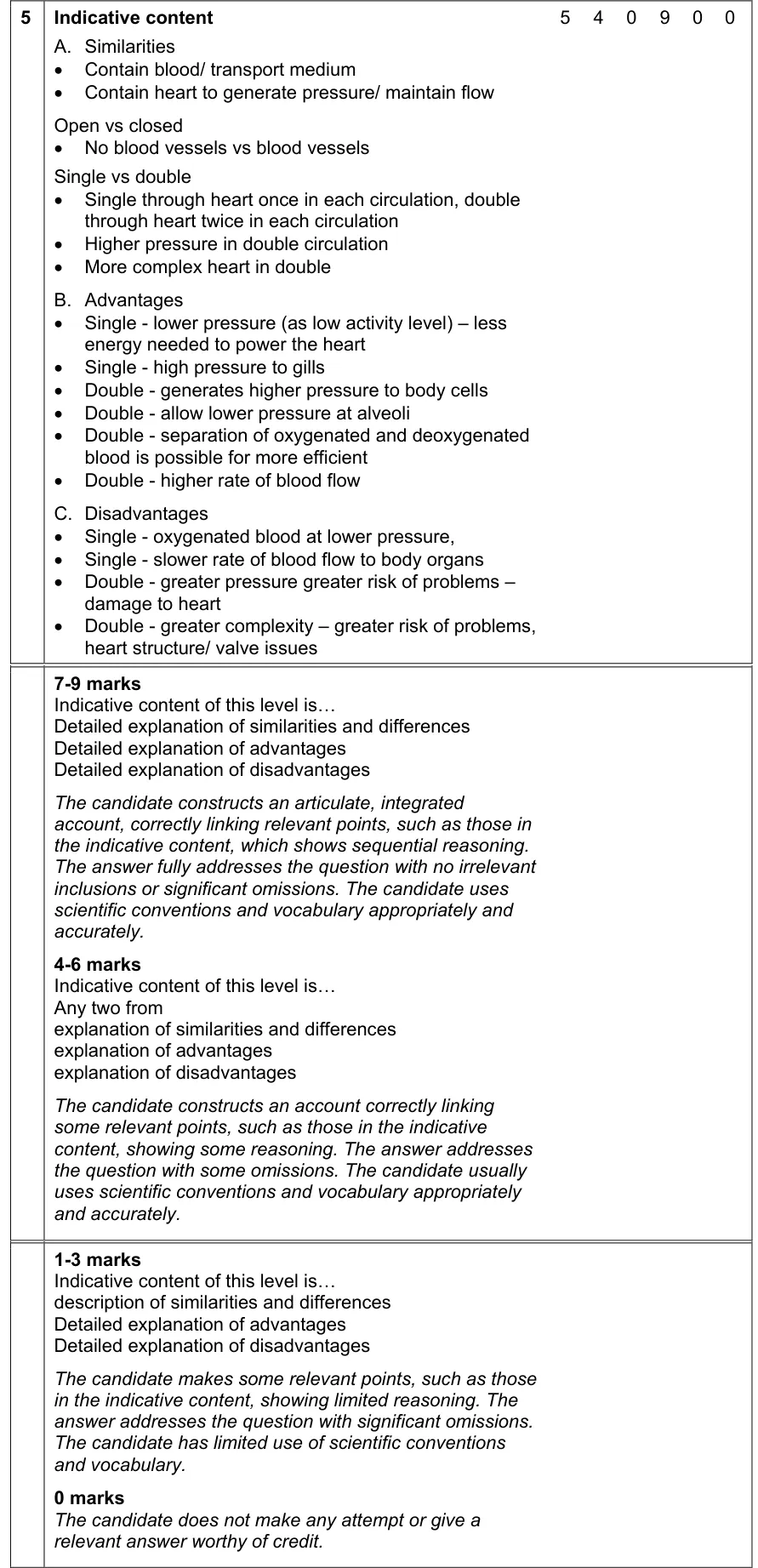
Use diagrams of insect, fish and mammal circulations to explain their similarities and differences and outline the advantages and disadvantages of single and double circulation.
Show the mark scheme
Tap an image to open it full size.
Question 8
A level Component 3 · June 2025 · Q6 · 9 marks
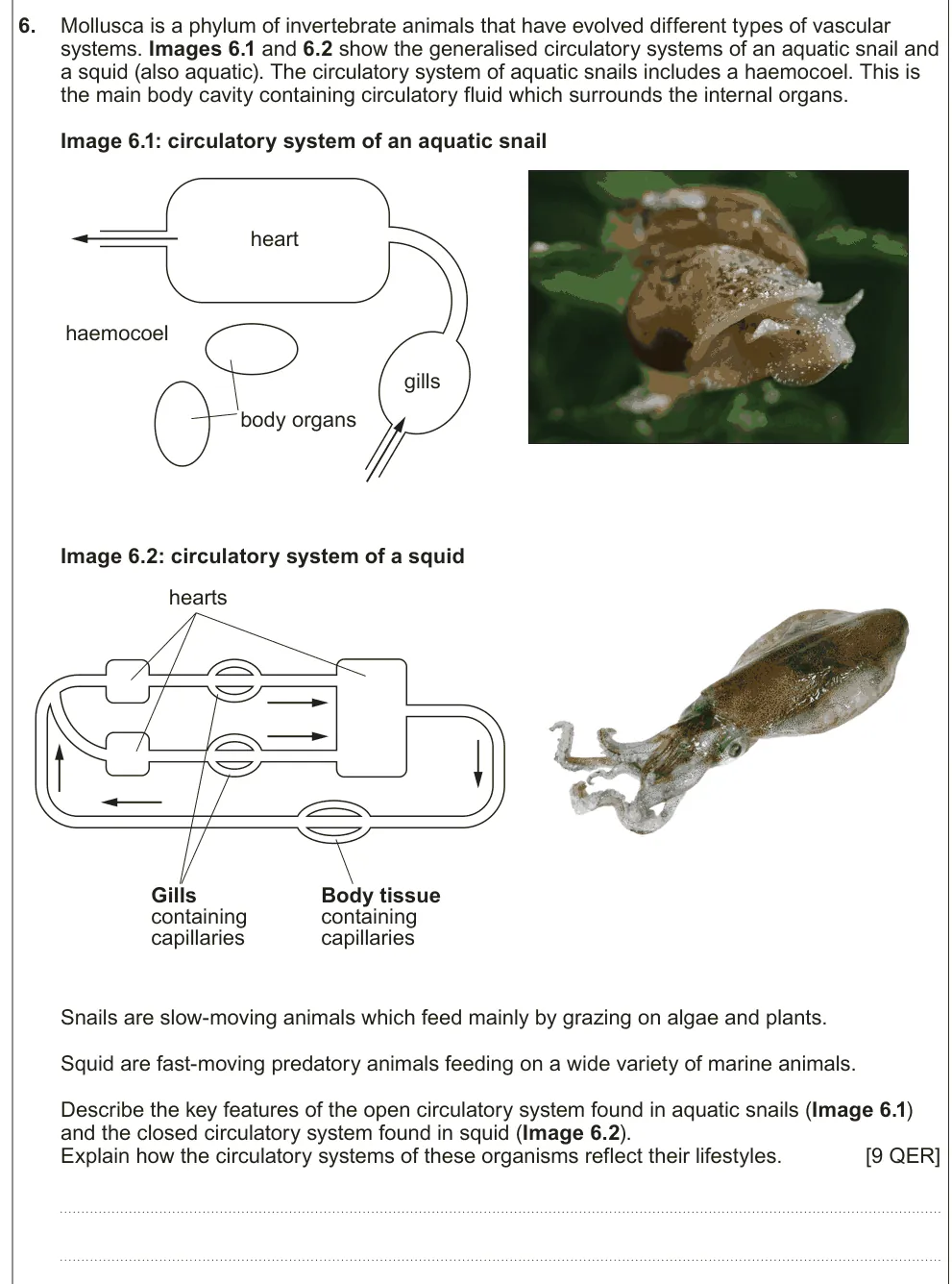
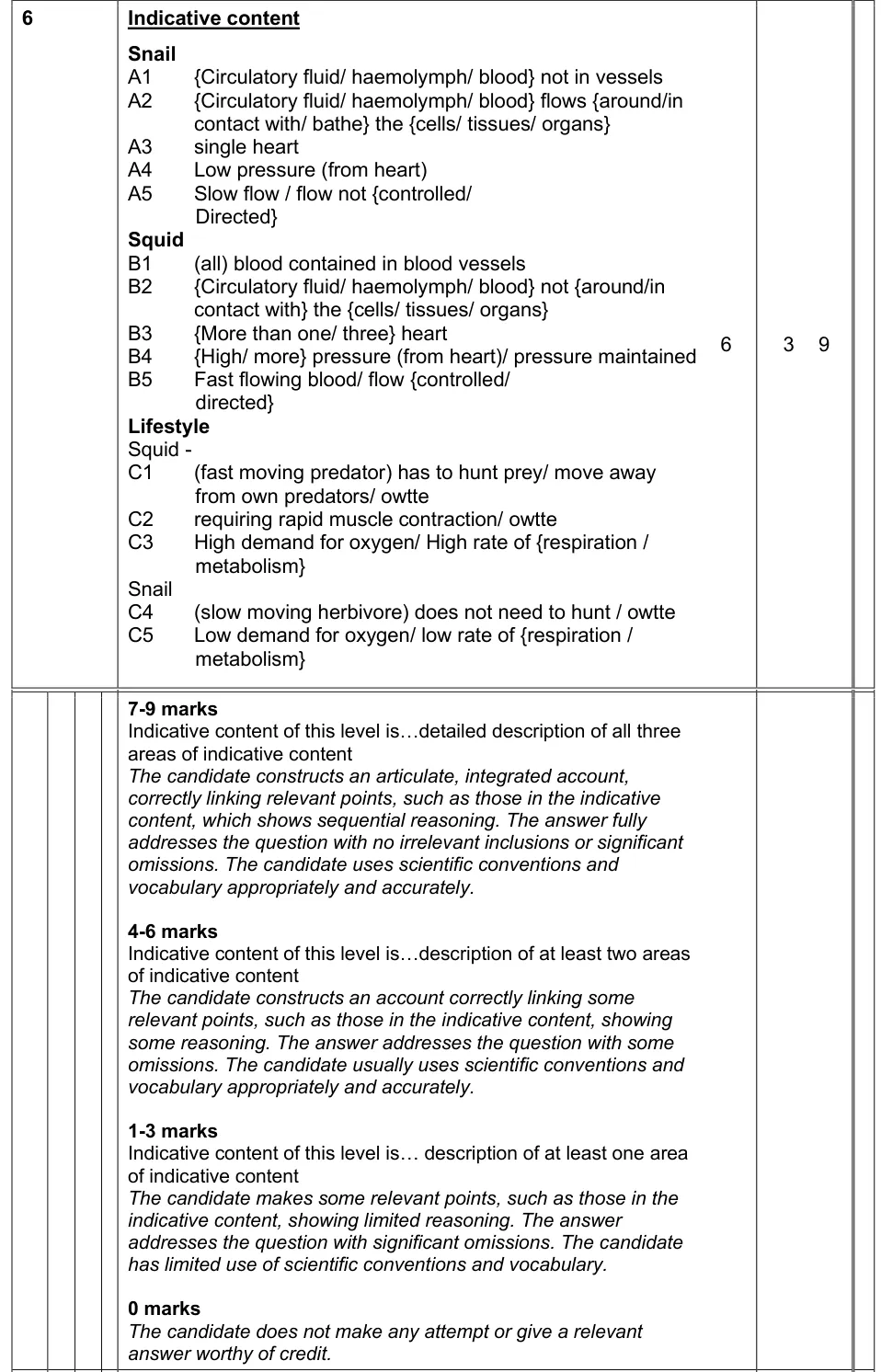
Describe the key features of the open circulation of an aquatic snail and the closed circulation of a squid, and explain how each system reflects the animal's lifestyle.
Show the mark scheme
Tap an image to open it full size.
From the examiners' report: Answers set out as three separate sections were more logical. Many confused haemocoel with haemolymph, so had the cavity bathing the tissues instead of the fluid. Weaker answers left out the oxygen demand of the two animals, and tracing the route of the squid's blood was not needed.
Question 9
A level Component 3 · June 2022 · Q6 · 9 marks
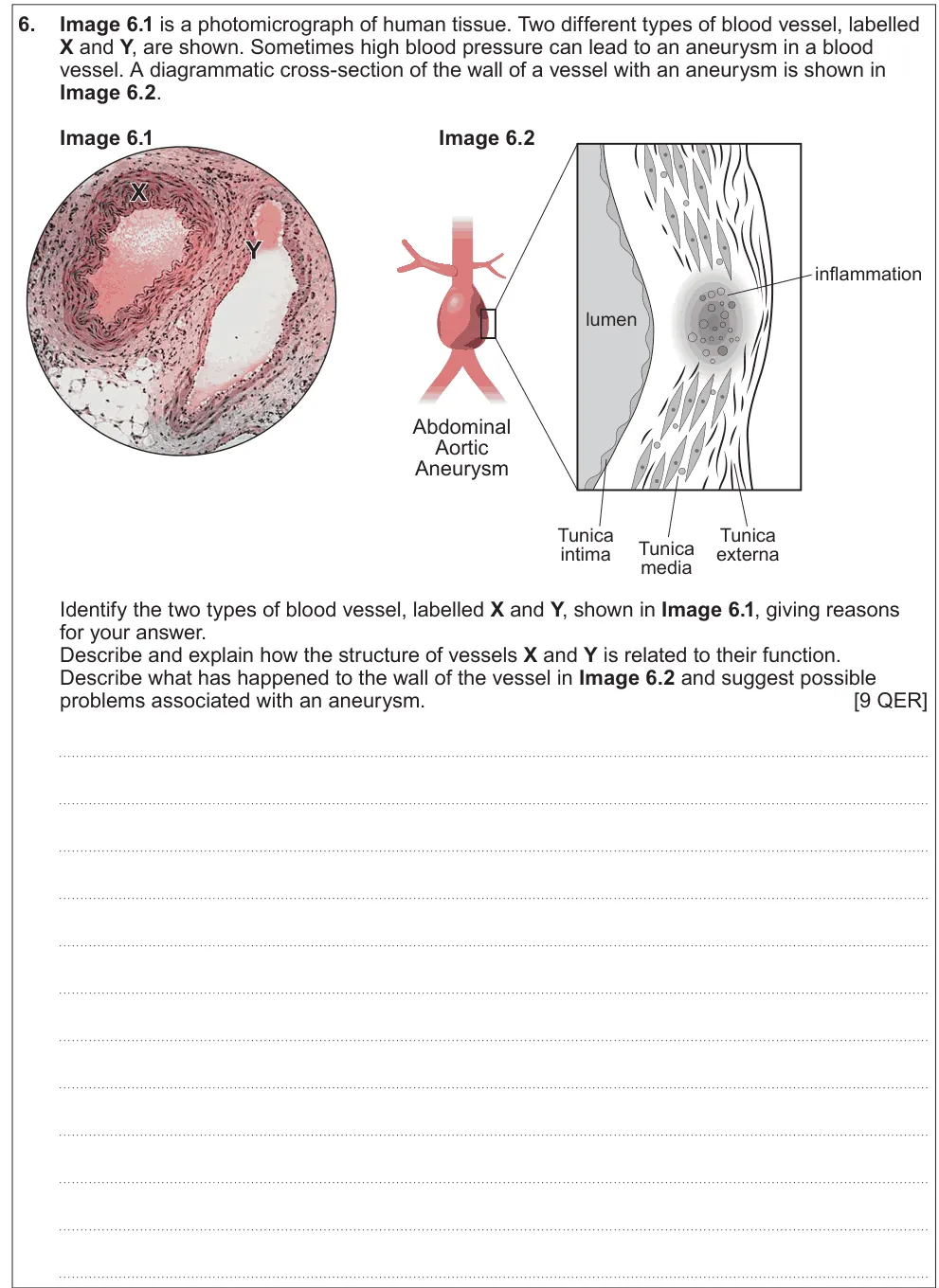
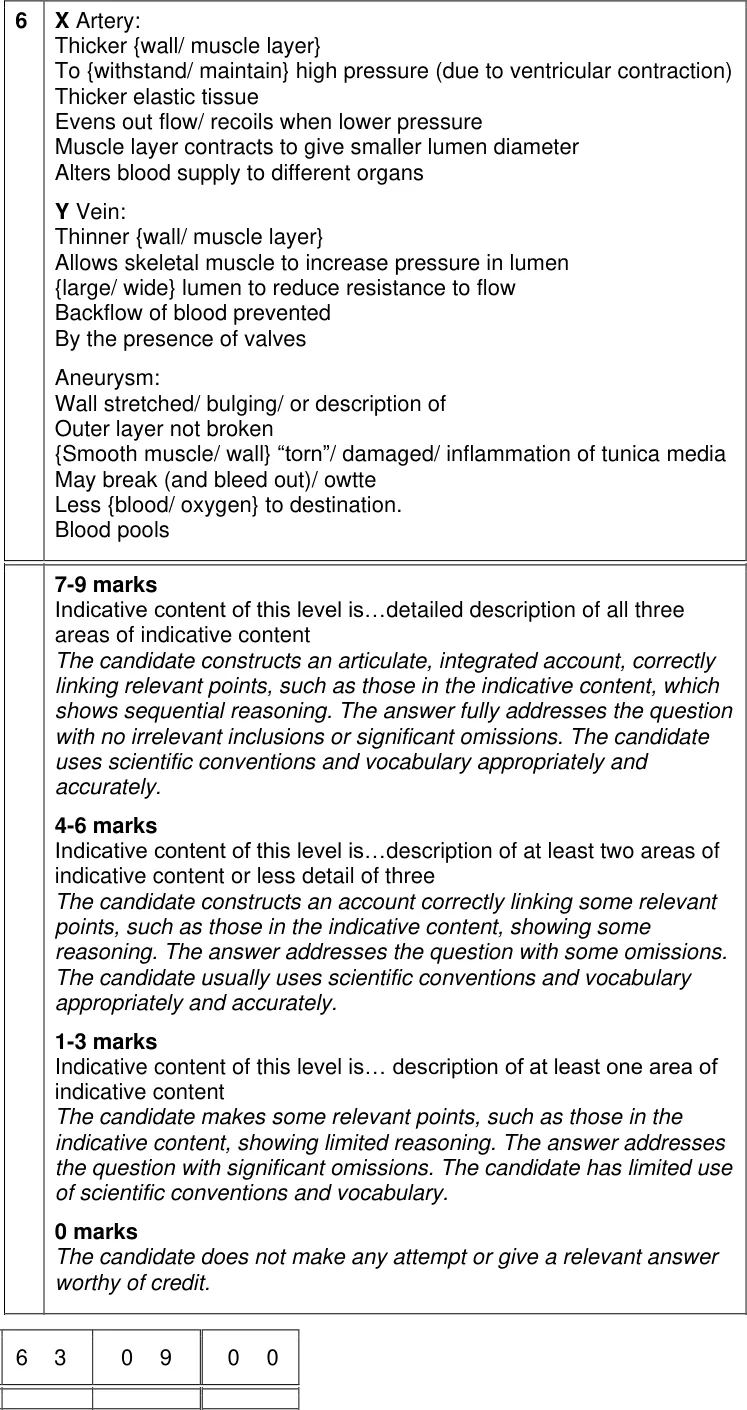
Identify two blood vessels in a photomicrograph with reasons, relate their structure to function, and describe an aneurysm and the problems it may cause.
Show the mark scheme
Tap an image to open it full size.
From the examiners' report: Higher-scoring scripts often began with a plan. Artery walls are thick mainly to withstand or maintain high pressure; elastic tissue expands and recoils (it does not contract), while muscle contracts to narrow the lumen. Only X and Y were asked for, so other vessels were not needed.
Question 10
AS Component 2 · June 2022 · Q6 · 9 marks
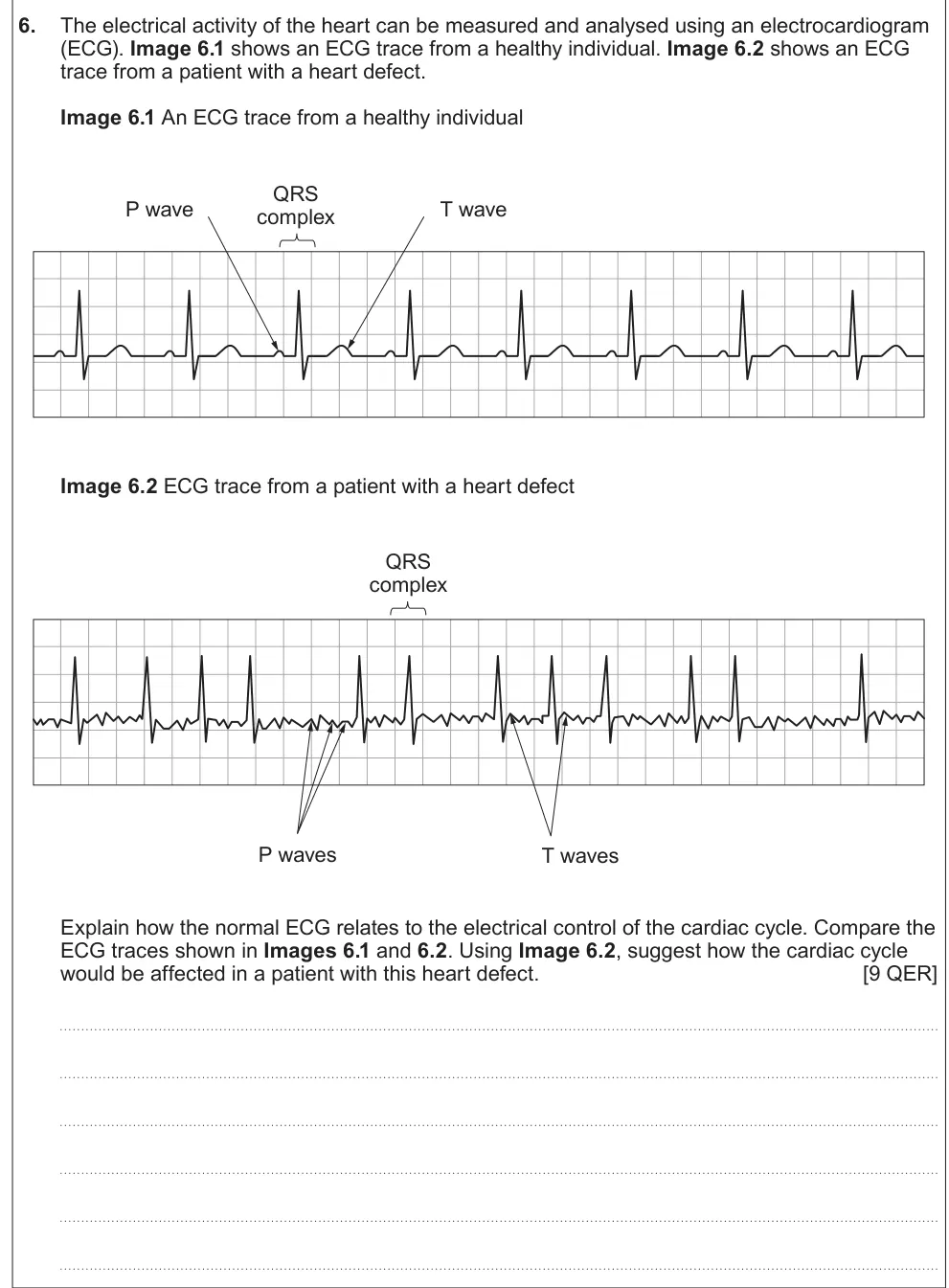
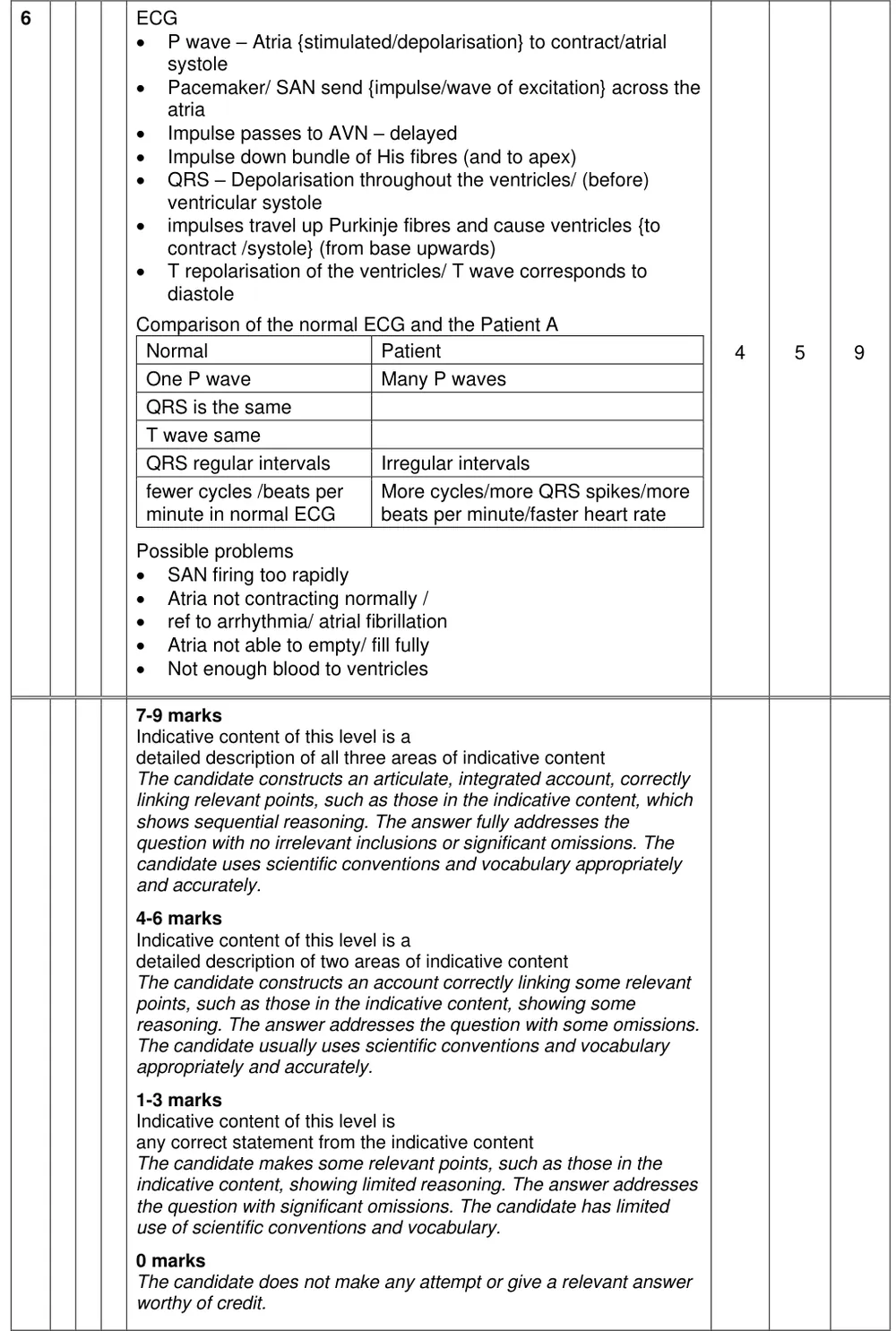
Relate a normal ECG trace to the electrical control of the cardiac cycle, compare it with a trace from a patient with a heart defect and suggest how the defect affects the cardiac cycle.
Show the mark scheme
Tap an image to open it full size.
From the examiners' report: Many gave fluent detail of the electrical control linked to the trace, but direct comparisons of the two traces were sometimes missing. The best answers linked the abnormal trace to poor filling and emptying of the atria and ventricles.
3.2 Transport in plants
Question 11
AS Component 2 · June 2024 · Q6 · 9 marks
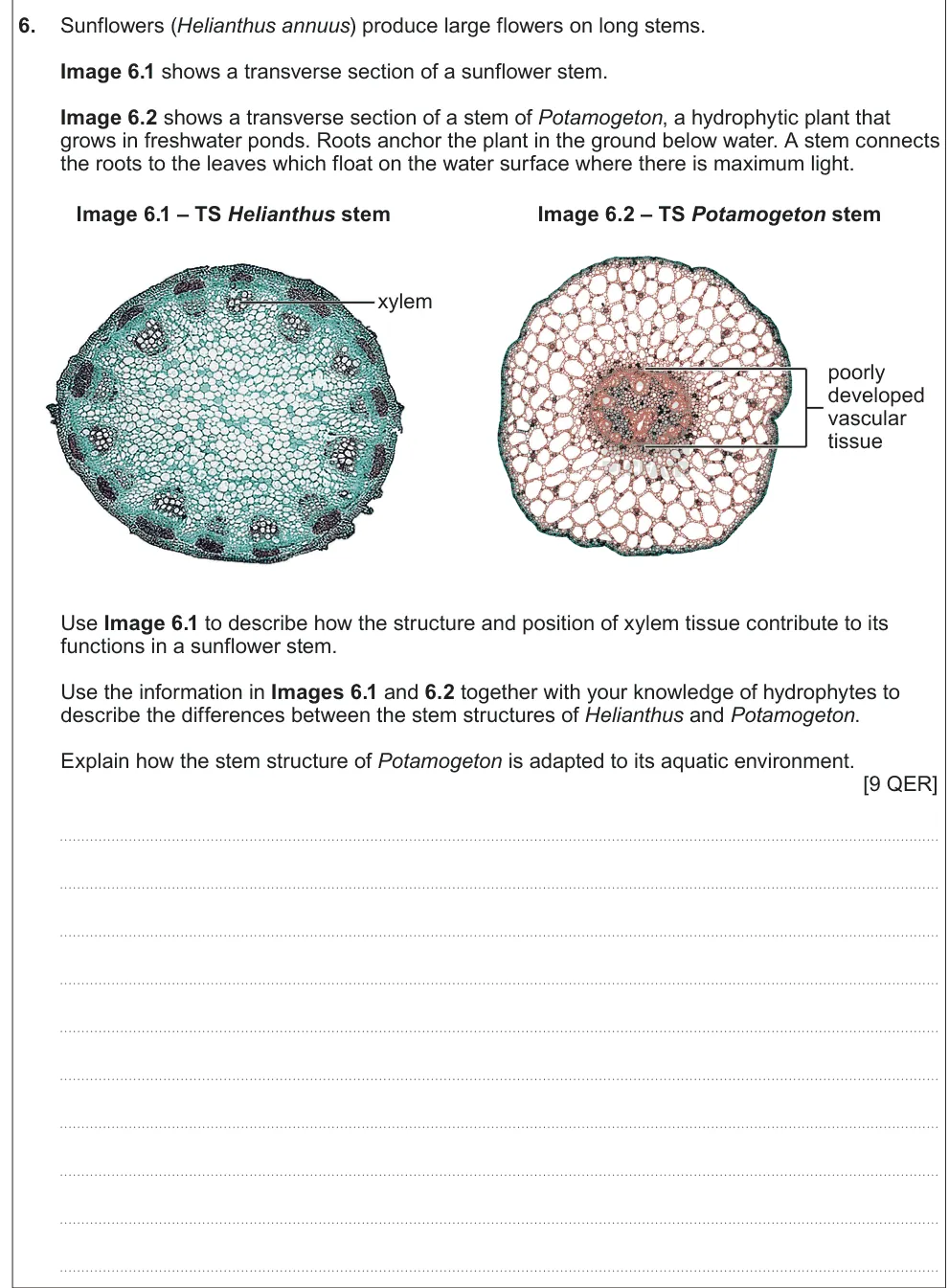
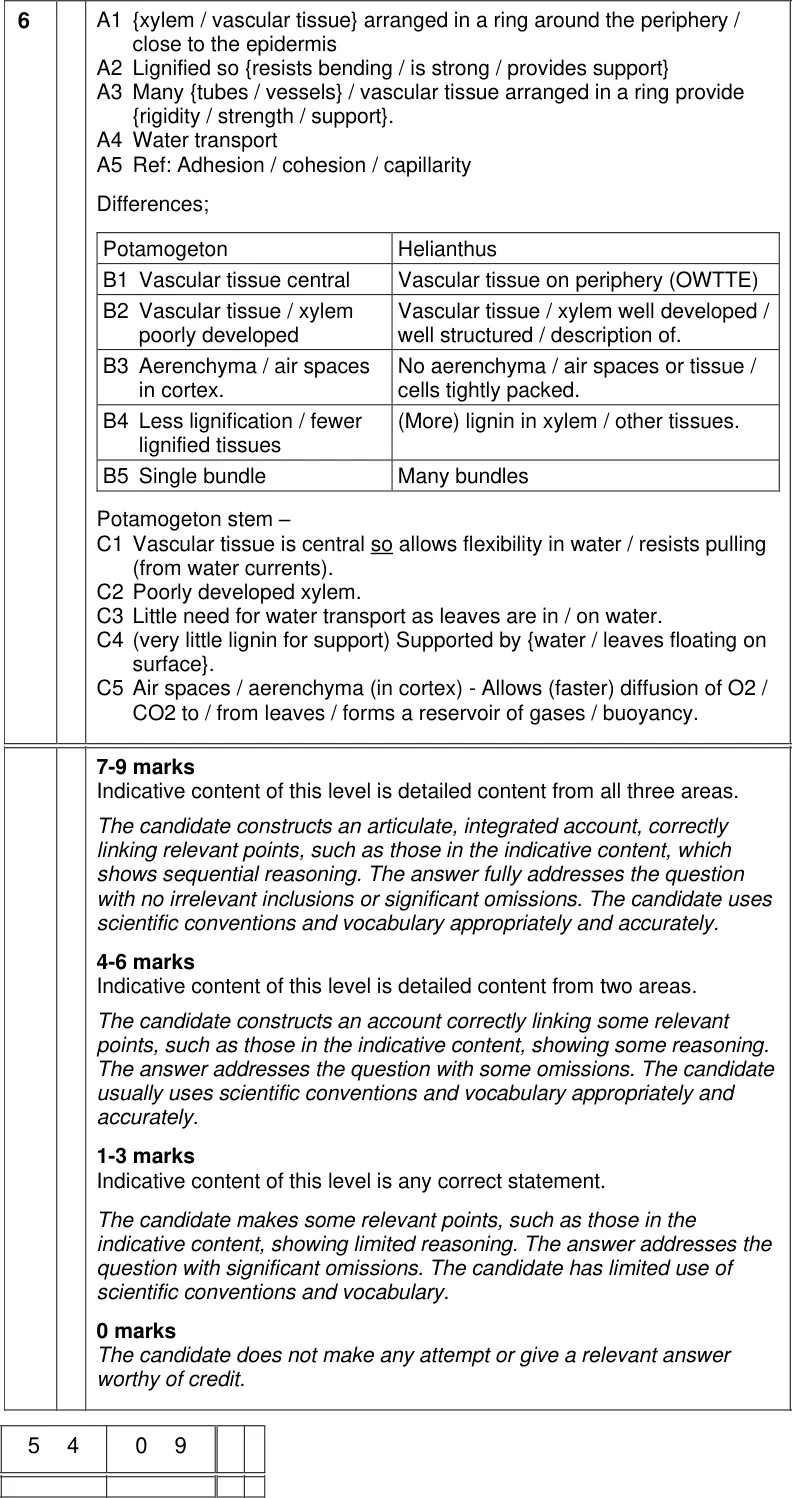
Use two stem sections to describe how xylem suits its functions in a sunflower stem, compare the stems of Helianthus and Potamogeton, and explain how the Potamogeton stem is adapted to water.
Show the mark scheme
Tap an image to open it full size.
From the examiners' report: Don't answer in bullet points or lists, and compare one feature at a time in both stems. Both sections are stems, so root and leaf detail gained nothing. Few mentioned the support given by many hollow tubes, or that gases diffuse faster through the air spaces.
3.3 Nutrition
Question 12
AS Component 2 · June 2025 · Q6 · 9 marks
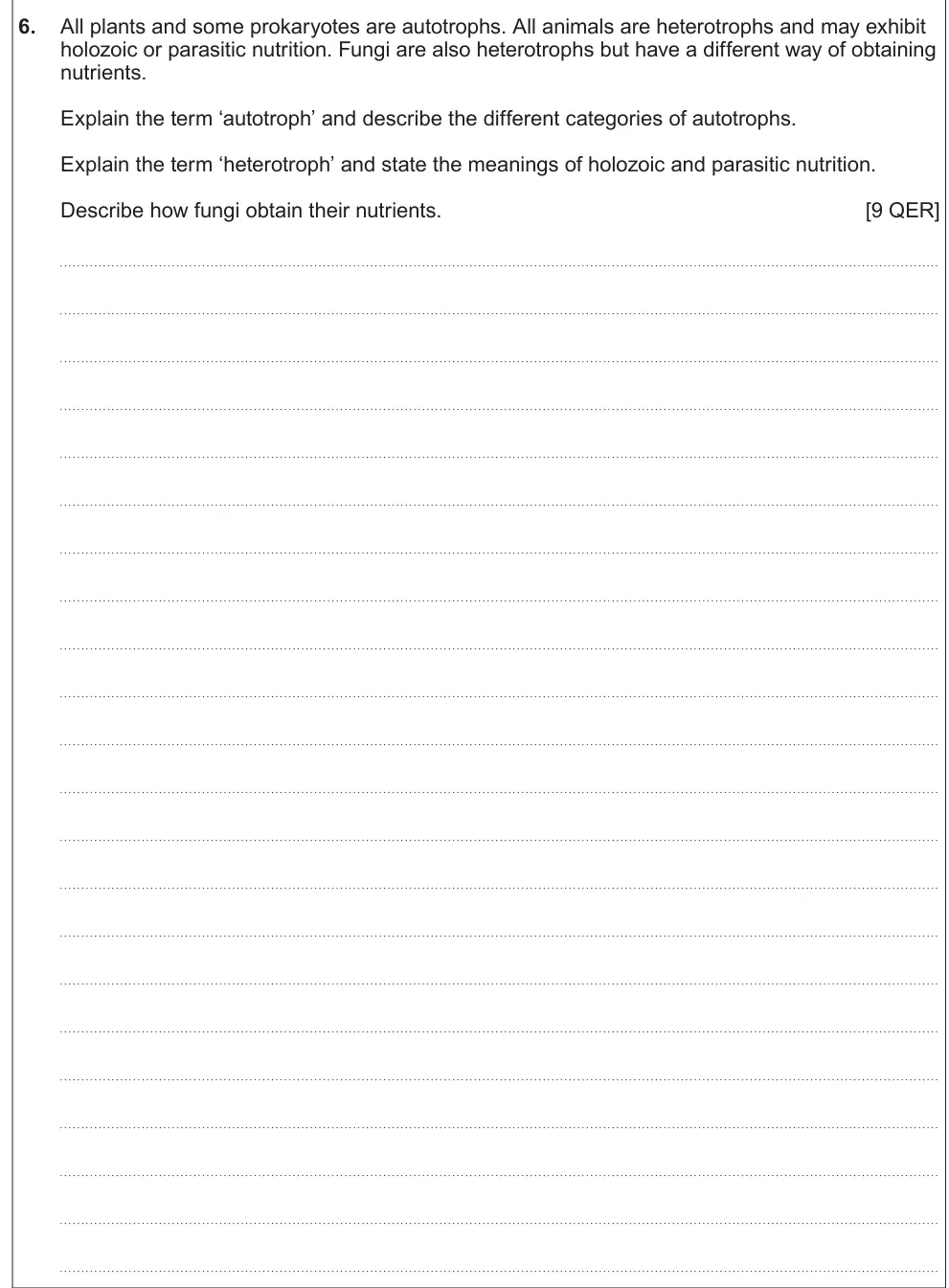
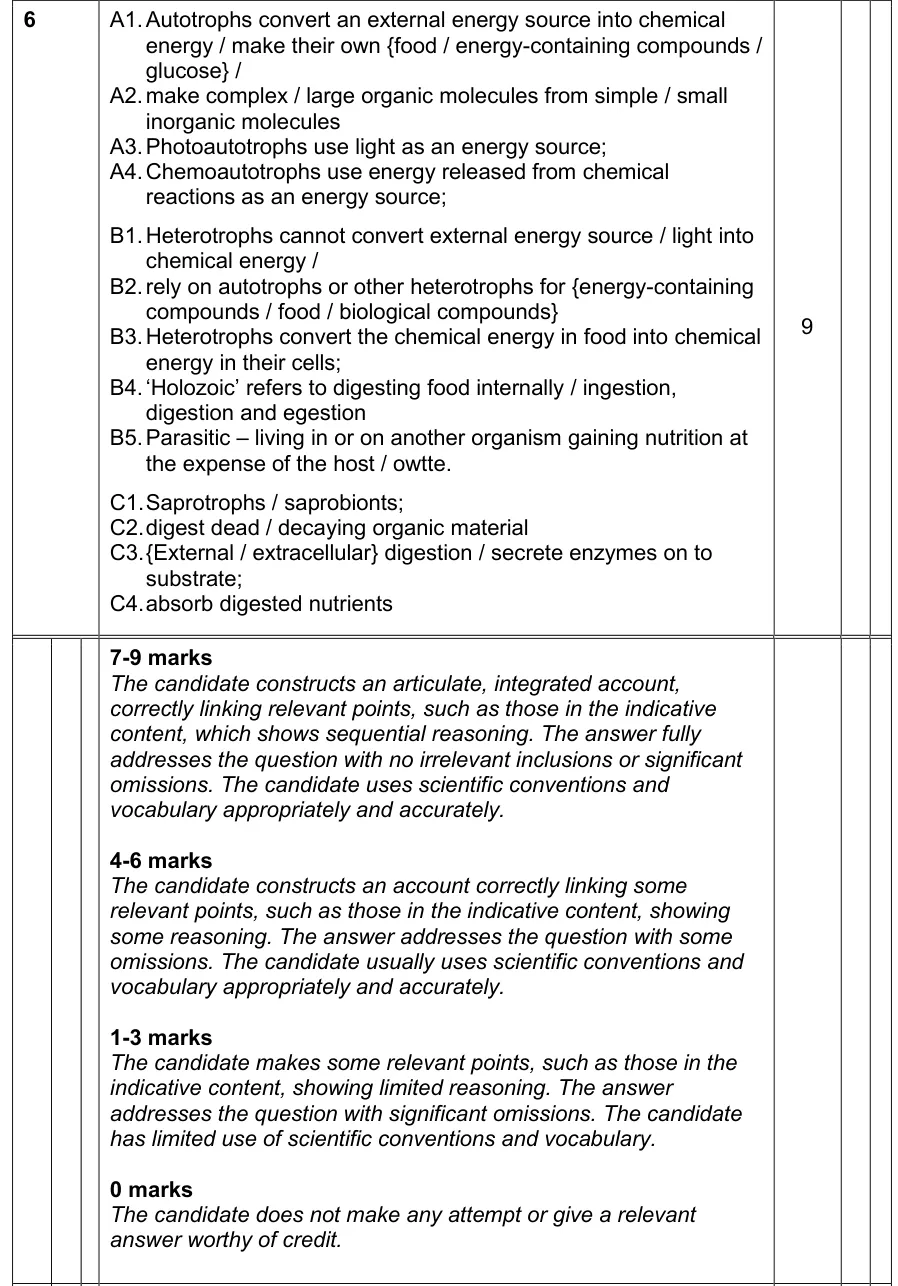
Explain the terms autotroph and heterotroph, describe the categories of autotroph, state what holozoic and parasitic nutrition mean and describe how fungi obtain nutrients.
Show the mark scheme
Tap an image to open it full size.
Question 13
A level Component 3 · June 2019 · Q7 · 9 marks
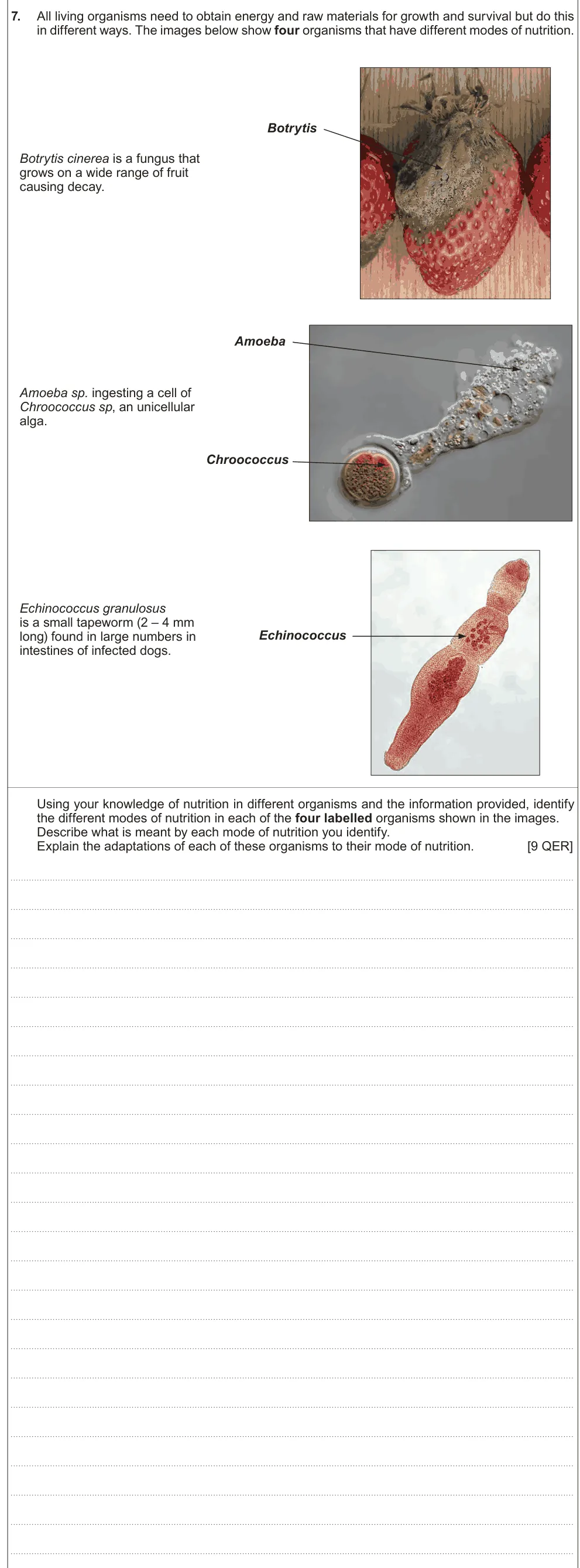
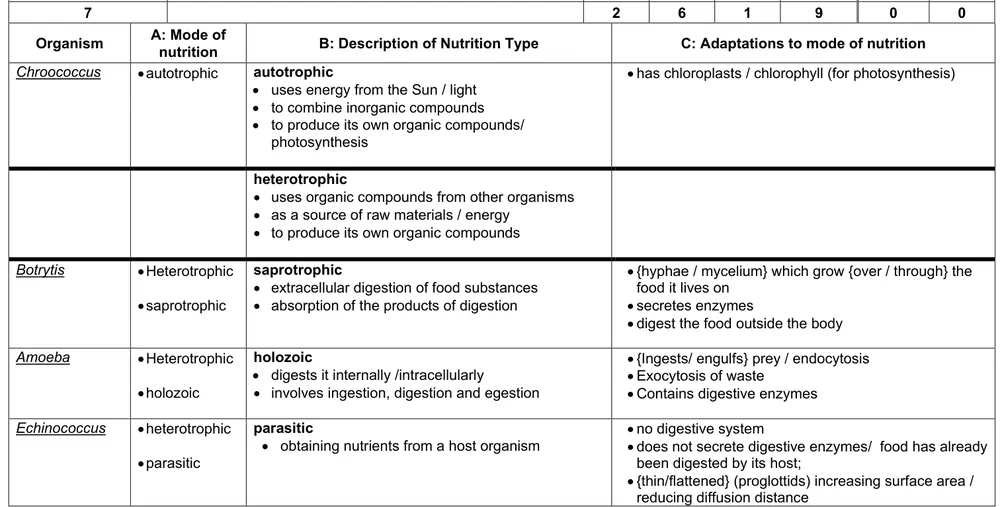
Identify the mode of nutrition of each of four organisms shown in images, describe each mode and explain how each organism is adapted to it.
Show the mark scheme
Tap an image to open it full size.
From the examiners' report: Some answers showed confused knowledge of the modes of nutrition or did not link them to the images. Irrelevant detail, such as tapeworms being hermaphrodite, stopped some gaining full marks: stick to adaptations for nutrition.
Question 14
A level Component 3 · June 2023 · Q6 · 9 marks
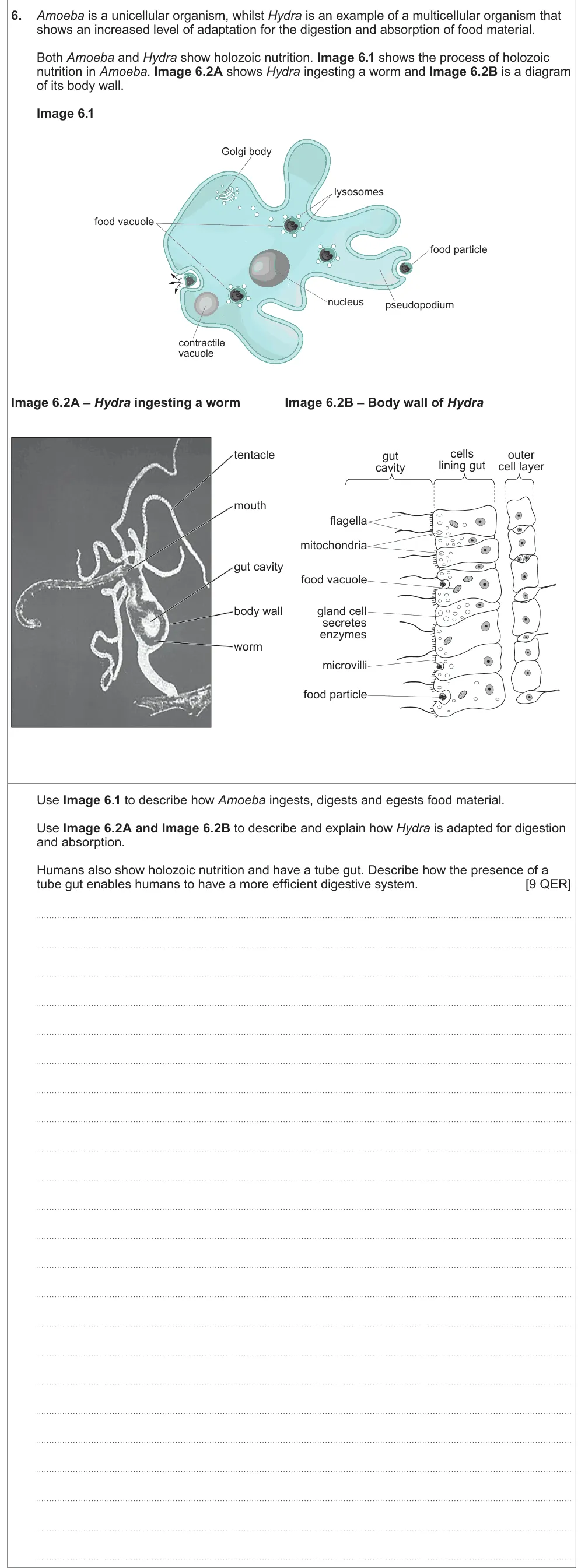
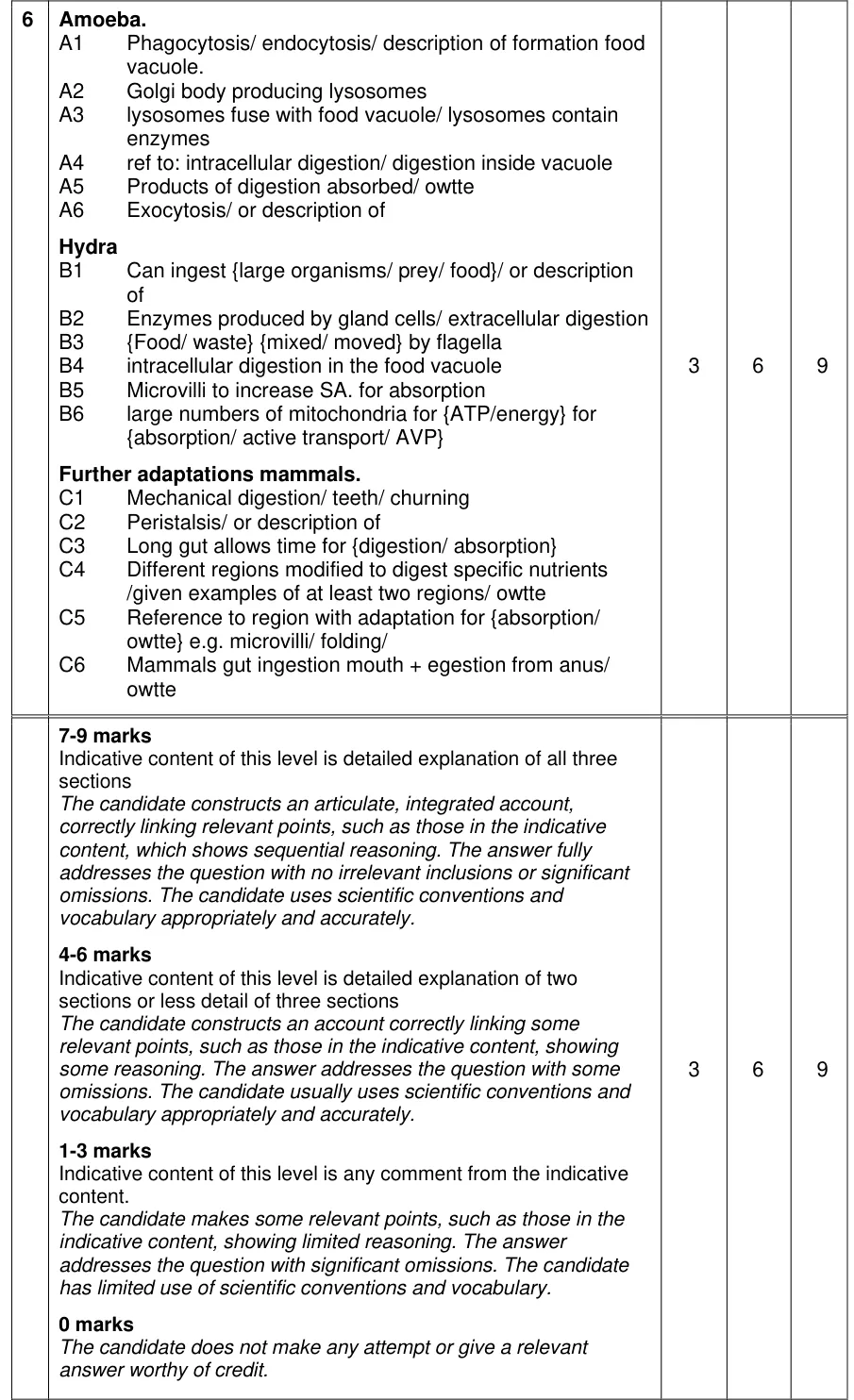
Use diagrams to describe holozoic nutrition in Amoeba, explain how Hydra is adapted for digestion and absorption, and describe how a tube gut makes human digestion more efficient.
Show the mark scheme
Tap an image to open it full size.
From the examiners' report: Fewer explained clearly that the lysosome fuses with the food vacuole and that digestion then happens inside it, and the phrase intracellular digestion was seldom seen. The human section was weakest: name the regions of the gut and say where structures such as microvilli are found.
Question 15
AS Component 2 · June 2018 · Q6 · 9 marks
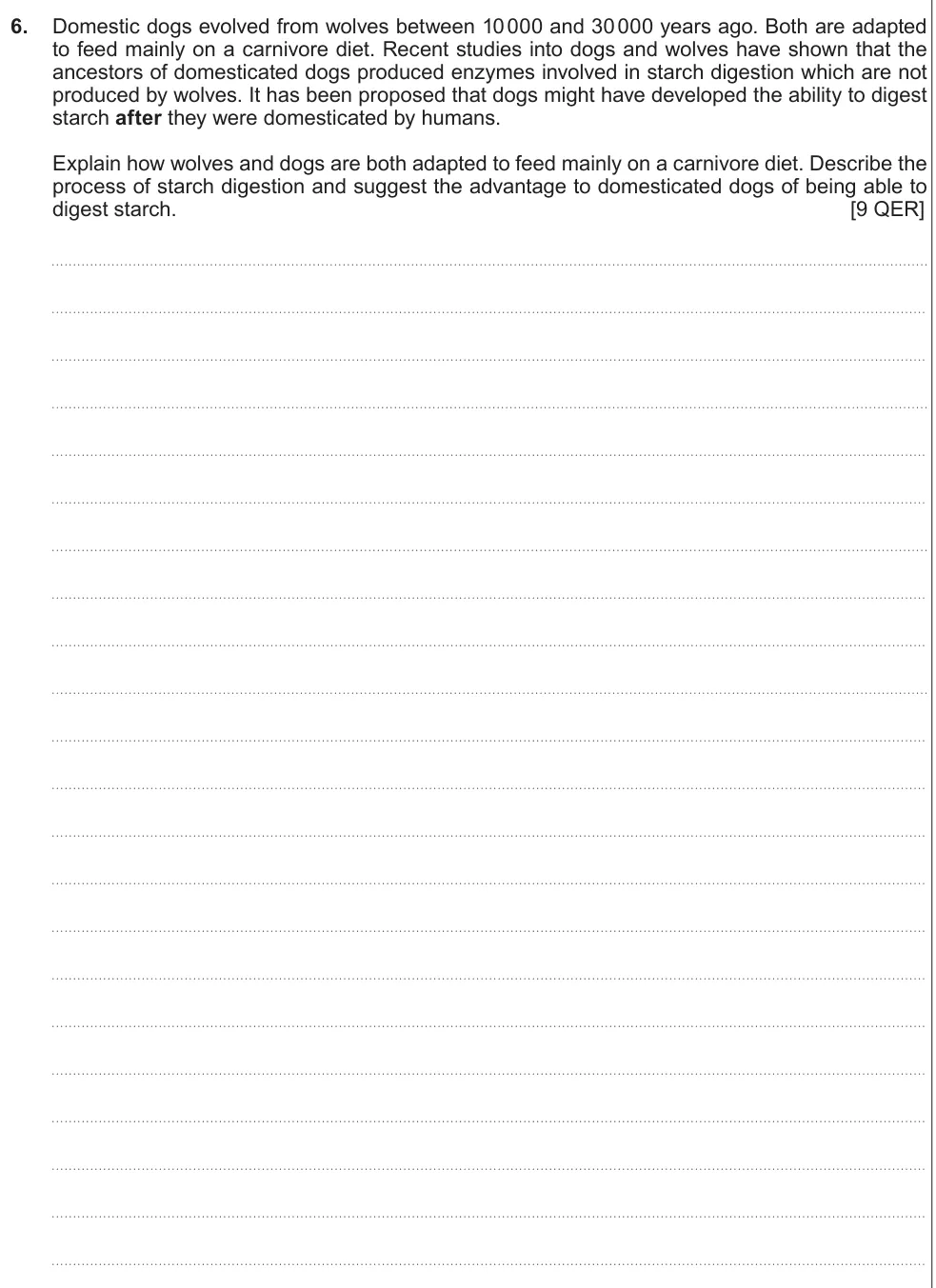
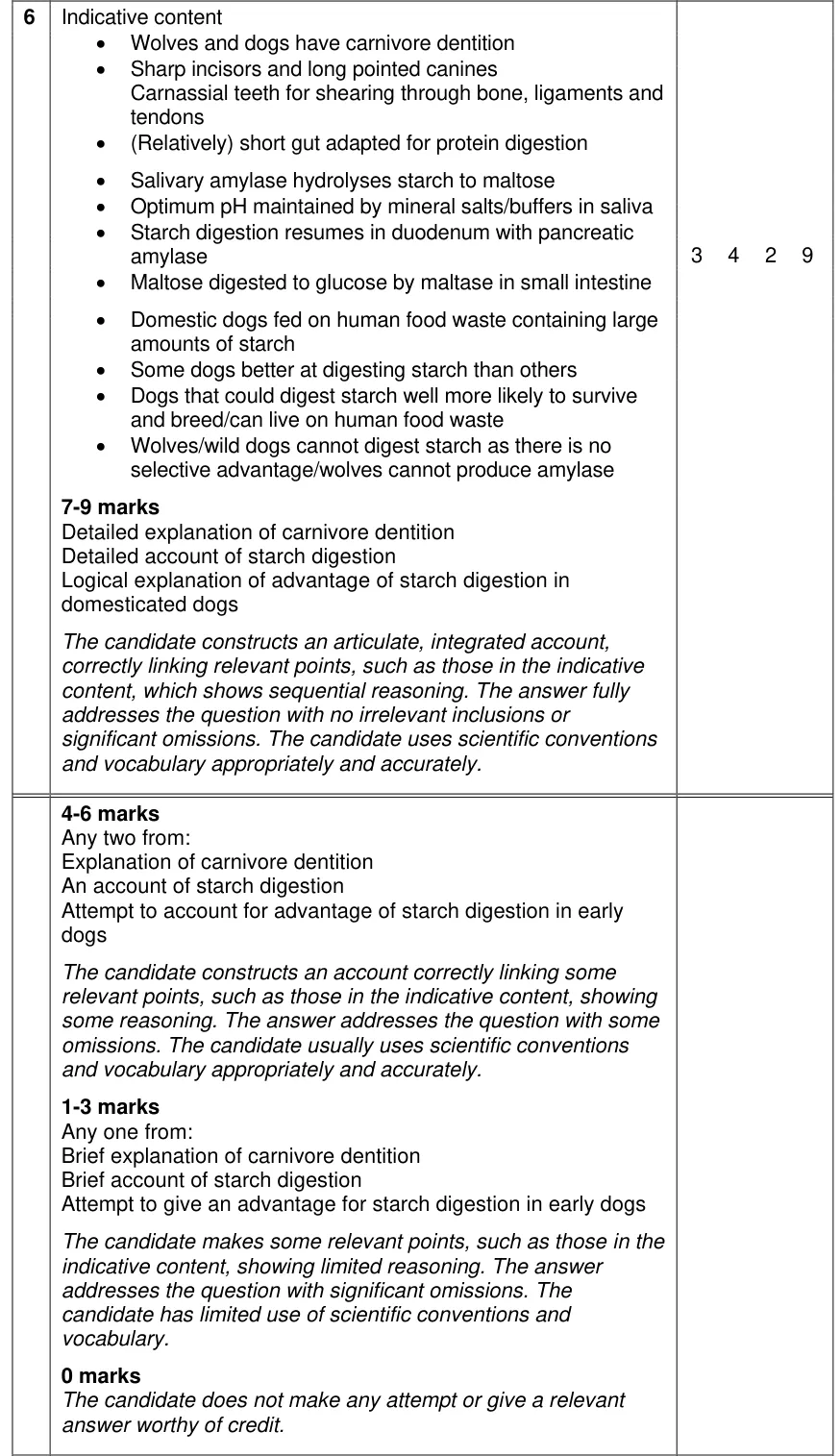
Explain how wolves and dogs are adapted to a carnivore diet, describe starch digestion and suggest the advantage to domesticated dogs of digesting starch.
Show the mark scheme
Tap an image to open it full size.
From the examiners' report: Accounts of starch digestion were often limited to the action of amylase: better answers gave the whole process, where in the gut it happens and how conditions there are maintained. The advantage was the weakest section, with many saying only that dogs could digest commercial dog food.
Question 16
AS Component 2 · June 2023 · Q6 · 9 marks
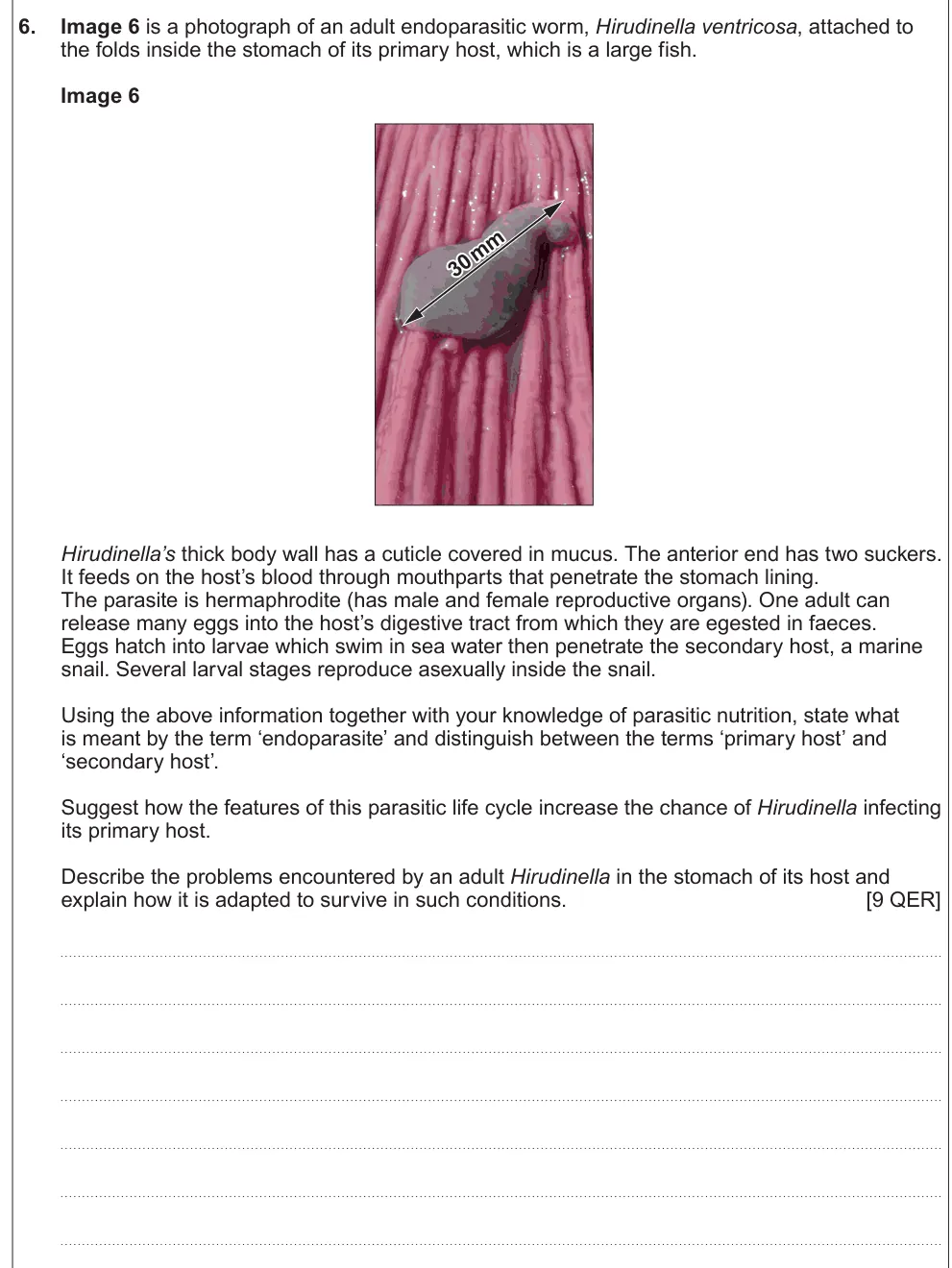
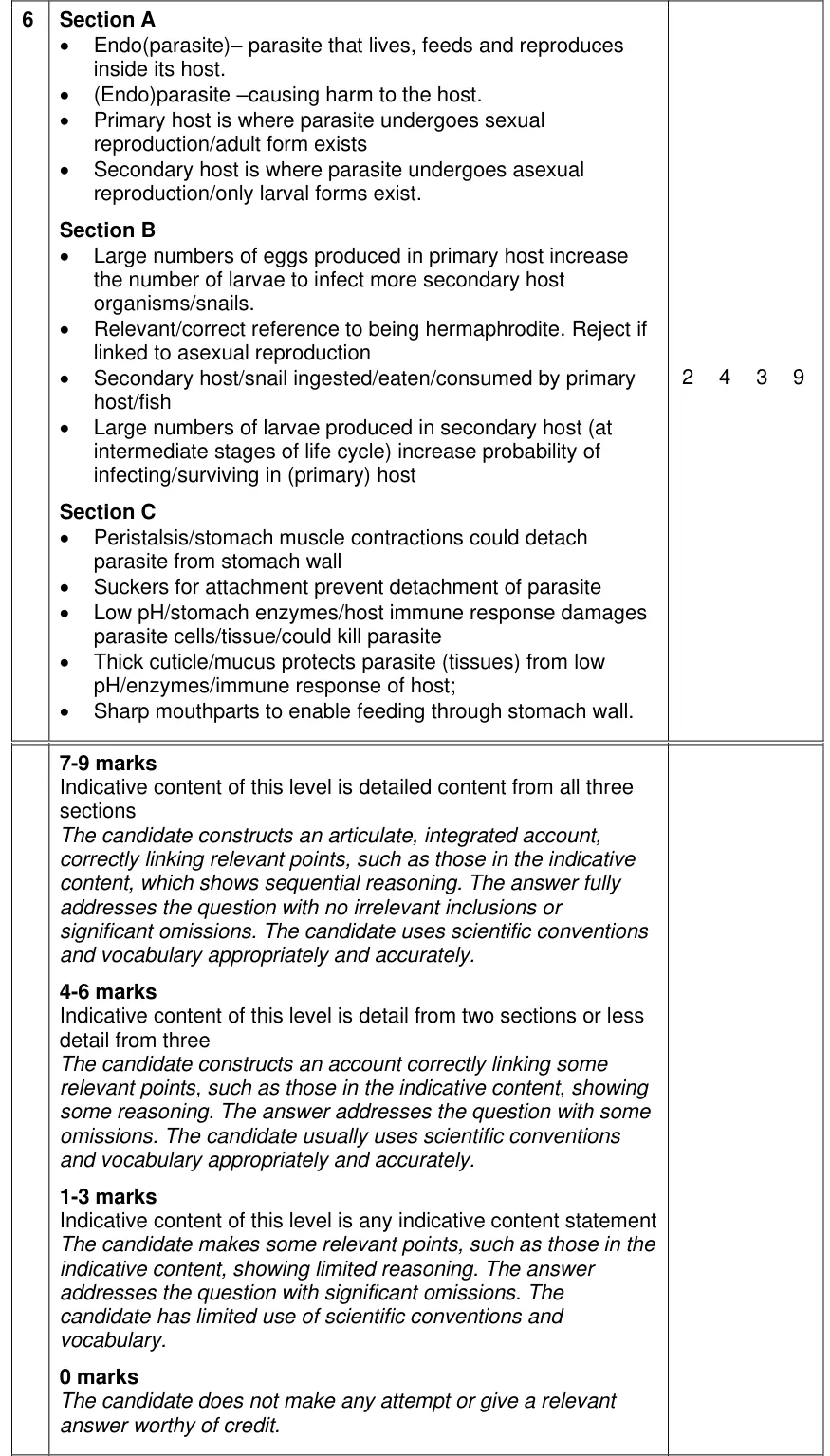
Define endoparasite, distinguish primary and secondary hosts, suggest how the life cycle of Hirudinella raises its chance of infecting a primary host, and explain how the adult survives in a fish stomach.
Show the mark scheme
Tap an image to open it full size.
From the examiners' report: More marks were gained on survival of the adult in the stomach than on the life cycle. Use the information in the stem: some answers described other parasites, made humans the host or contradicted the stem, and many were unsure what makes a host primary or secondary.
3.4 Homeostasis and the kidney
Question 17
A level Component 3 · June 2018 · Q7 · 9 marks
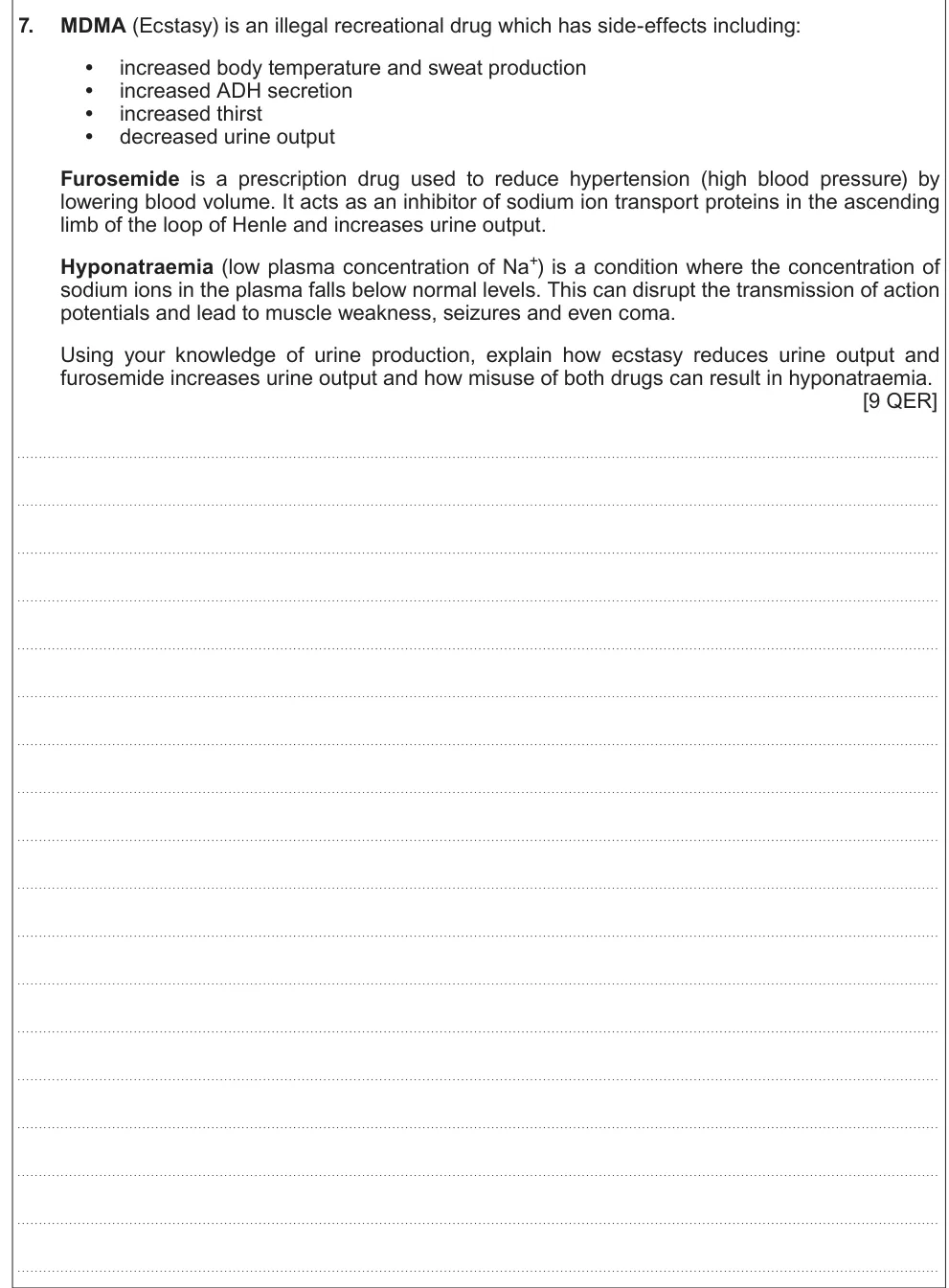
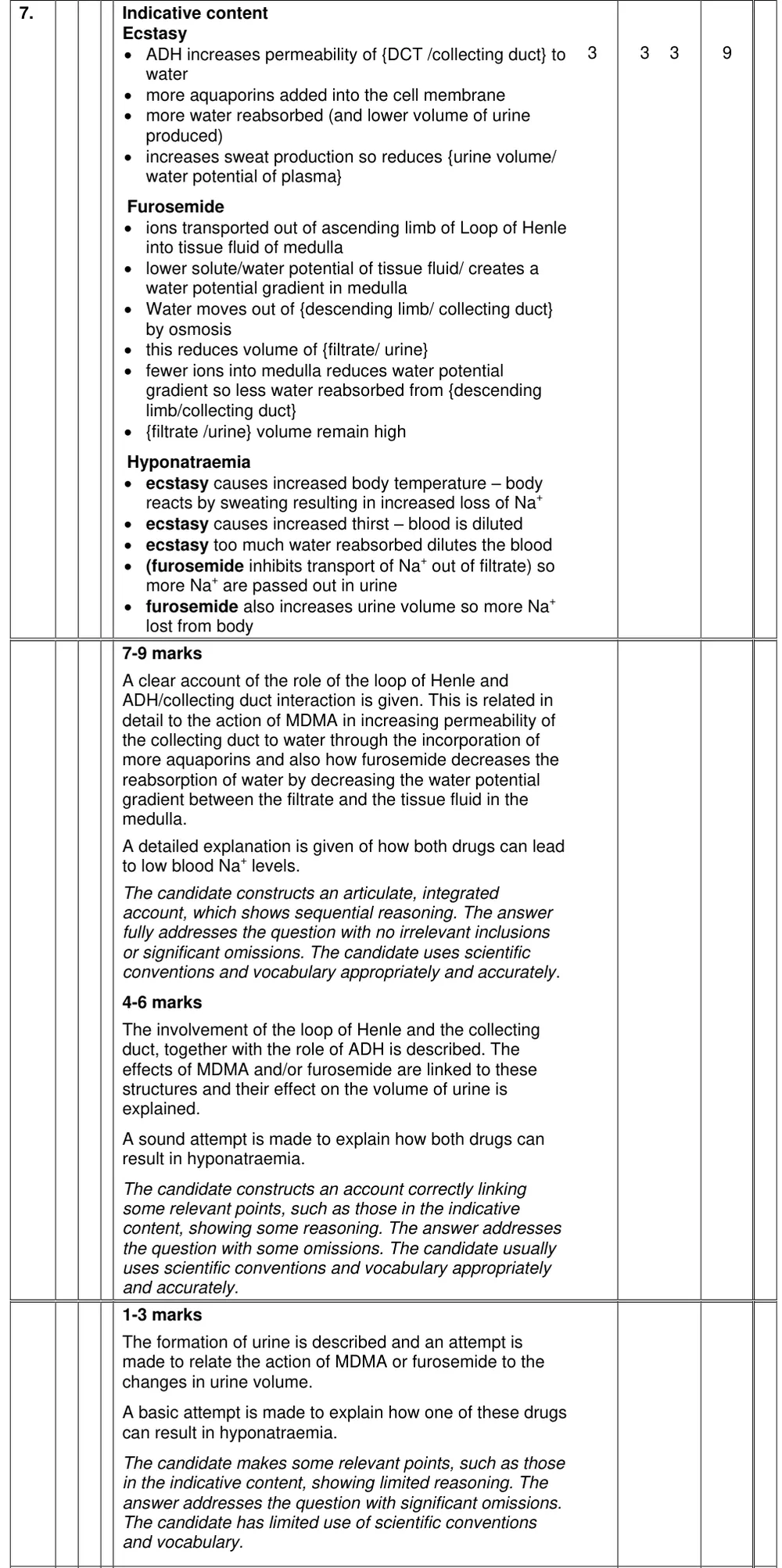
Explain how ecstasy reduces urine output, how furosemide increases it and how misuse of both drugs can lead to hyponatraemia.
Show the mark scheme
Tap an image to open it full size.
From the examiners' report: Many very good answers applied their knowledge of urine production to an unfamiliar situation. Most errors came with furosemide, in describing the role of ions and the ascending limb of the loop of Henle in urine formation.
Question 18
A level Component 3 · Autumn 2021 · Q6 · 9 marks
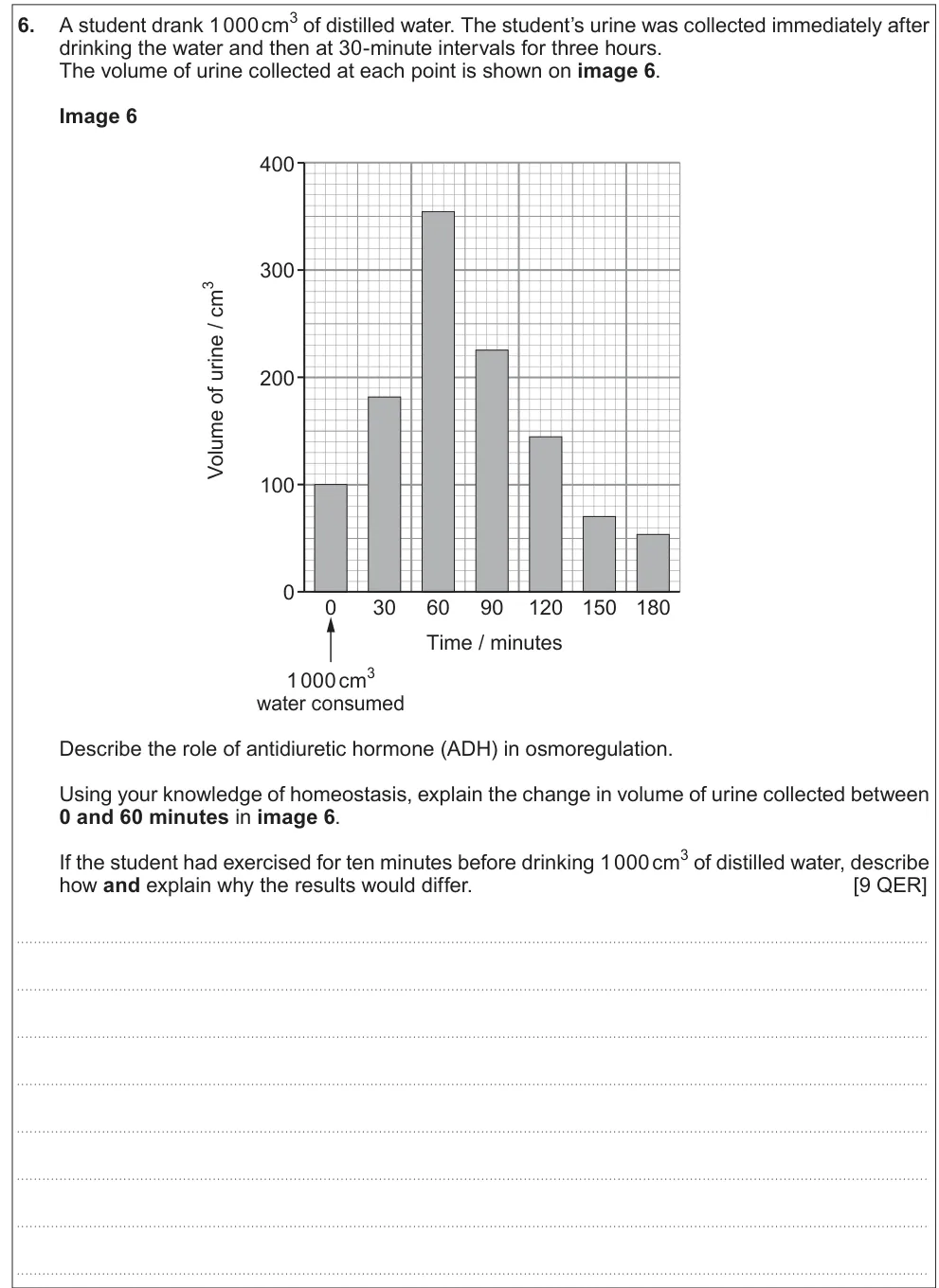
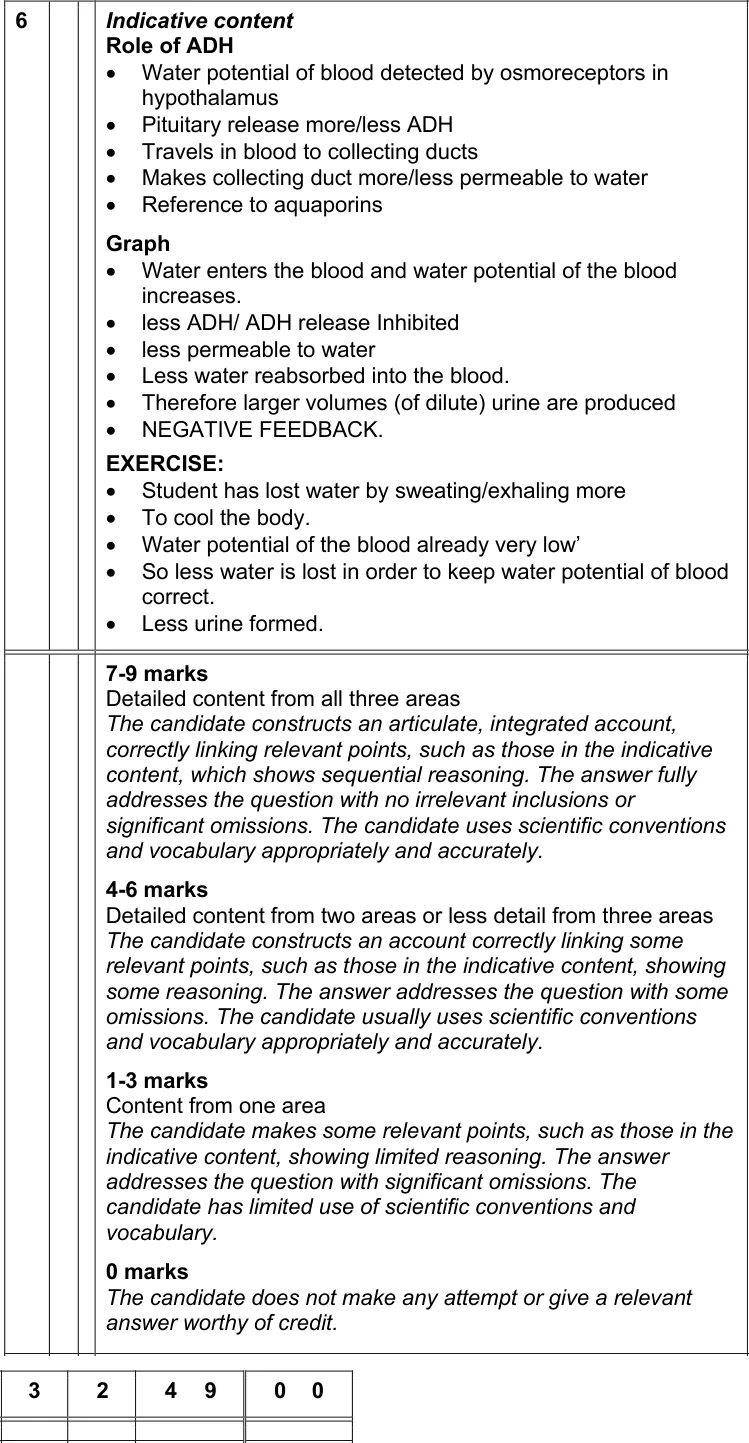
Describe the role of ADH in osmoregulation, explain the change in urine volume in the first 60 minutes after drinking water, and predict and explain the effect of exercising first.
Show the mark scheme
Tap an image to open it full size.
From the examiners' report: Write about the water potential of the blood, not "levels of water in the body". ADH makes the collecting duct more permeable to water, and it does not act on the loop of Henle, glomerulus or proximal convoluted tubule. Write out the full name of a structure before using its initials.
3.5 The nervous system
Question 19
A level Component 3 · June 2017 · Q6 · 9 marks
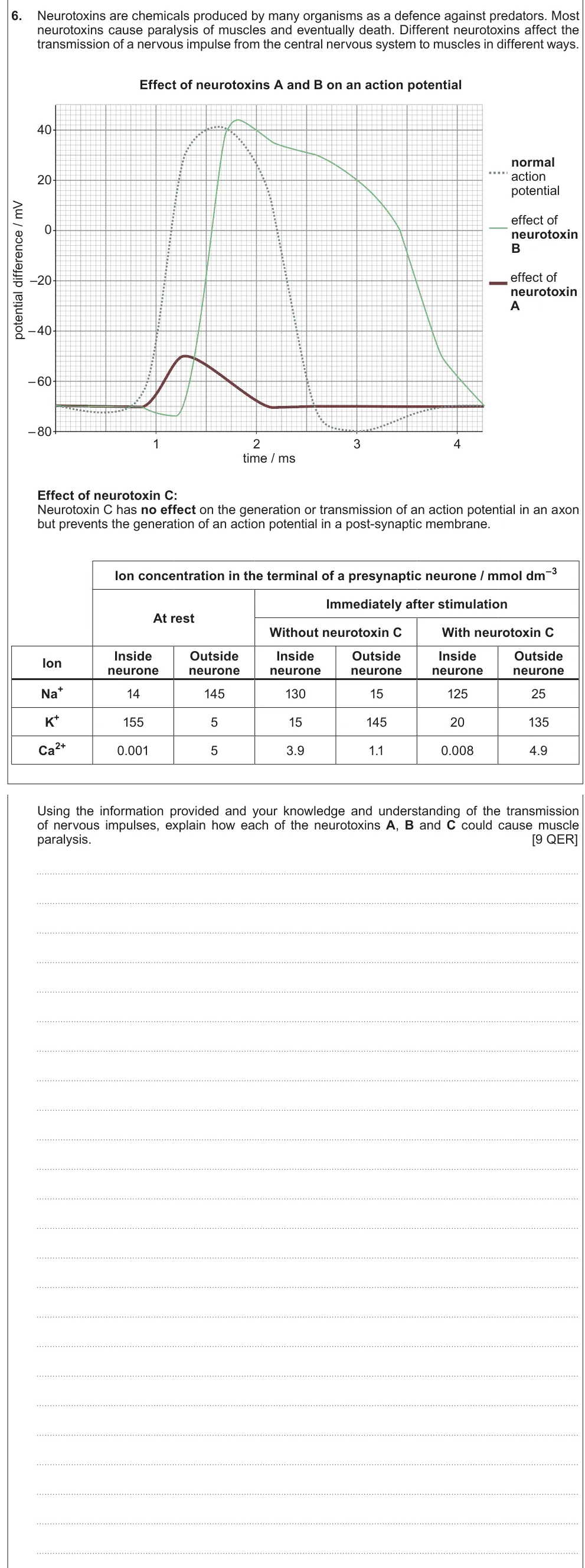
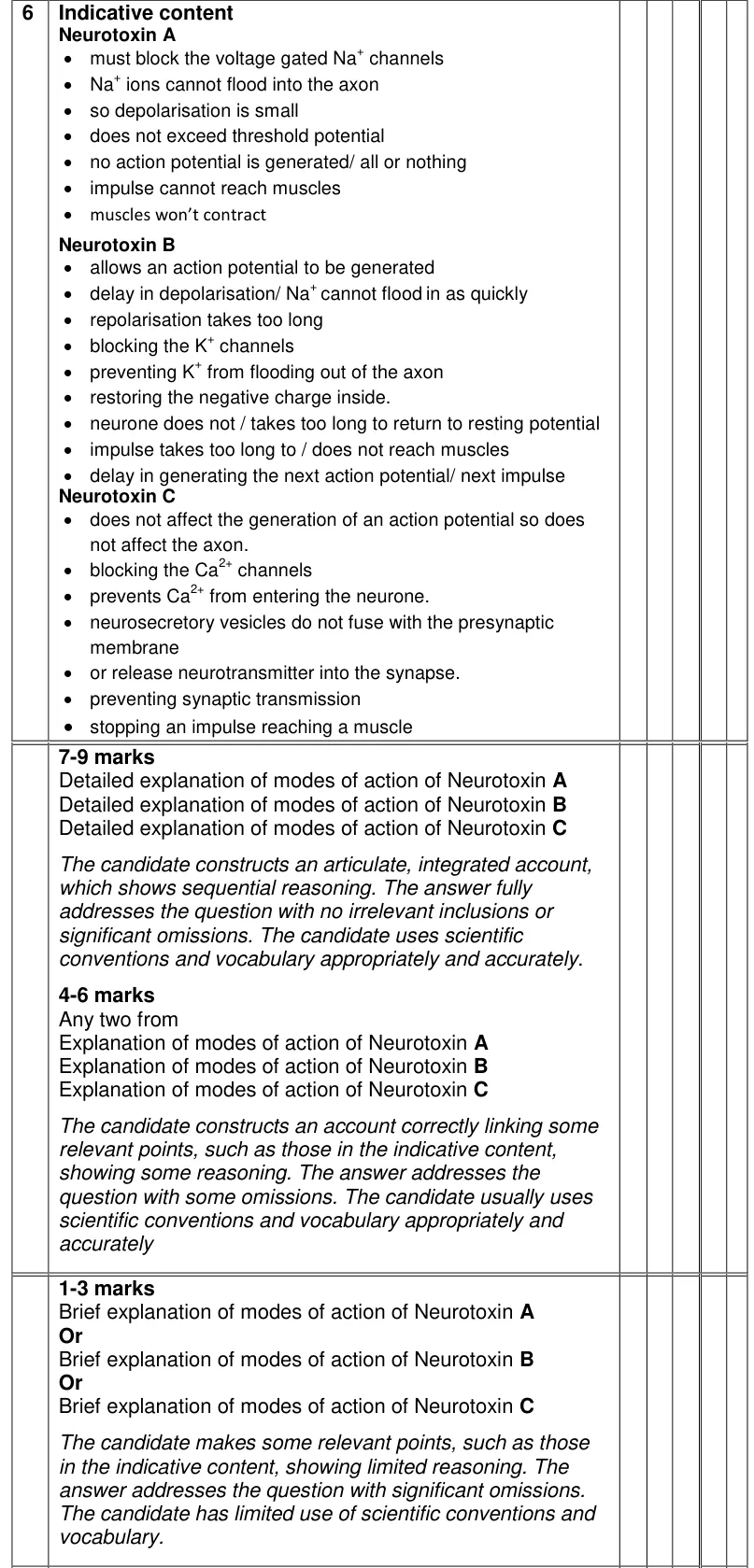
Use an action potential graph and a table of ion concentrations to explain how each of three neurotoxins could cause muscle paralysis.
Show the mark scheme
Tap an image to open it full size.
From the examiners' report: Top-band answers used the information to work out which ion channel each neurotoxin affects and explained in detail the effect on depolarisation, repolarisation or synaptic transmission. Pages on action potentials and synapses with no link to the neurotoxins gained few or no marks.
Where students lose marks (from Eduqas examiners' reports and mark schemes)
Each point below is followed by wording that gained marks.
Link it to each neurotoxin: Many wrote pages on the action potential and the synapse but made no attempt to link it to how each neurotoxin acts, so gained few or no marks.
✔ Gains credit: "Must block the voltage gated Na⁺ channels", "Na⁺ ions cannot flood into the axon", "does not exceed threshold potential".
Water potential, not water levels: Far too many wrote that drinking distilled water raises the levels of water in the body and that this is detected by the hypothalamus.
✔ Gains credit: "Water enters the blood and water potential of the blood increases", "water potential of blood detected by osmoreceptors in hypothalamus".
Draw conclusions from the gill image: Some did not use the image and wrote about eutrophication or a rise in water temperature.
✔ Gains credit: "Lamellae thickens / shortens", "smaller surface area for gas exchange", "larger diffusion distance".
Thoracic cavity, not lung volume: Weaker answers wrote about the volume of the lungs increasing during inspiration.
✔ Gains credit: "Volume thoracic cavity increases and pressure decreases", "causes alveoli to expand / air moves into the lungs".
Haemolymph bathes, haemocoel holds: Many confused haemocoel with haemolymph, so the haemocoel was bathing the tissues.
✔ Gains credit: "Circulatory fluid / haemolymph / blood not in vessels" and "flows around / in contact with / bathes the cells / tissues / organs".
Elastic tissue recoils, muscle contracts: Answers had elastic tissue contracting, or gave thick walls with no reference to the high pressure from ventricular contraction.
✔ Gains credit: "Thicker wall / muscle layer to withstand / maintain high pressure", "recoils when lower pressure", "muscle layer contracts to give smaller lumen diameter".
Fuse, then digest inside the vacuole: Fewer explained that the lysosome and food vacuole fuse, and the phrase intracellular digestion was seldom seen.
✔ Gains credit: "Lysosomes fuse with food vacuole / lysosomes contain enzymes", "intracellular digestion / digestion inside vacuole".
Dog food is not the advantage: Many reasoned that digesting starch was an advantage because dogs could then digest commercial dog foods.
✔ Gains credit: "Domestic dogs fed on human food waste containing large amounts of starch", "dogs that could digest starch well more likely to survive and breed".
Download the questions
Download the PDF pack (19 questions, mark schemes at the end)
Keep practising
- Extended Response (Core Concepts and Component 1): Eduqas A Level Biology Exam Questions
- Extended Response (Component 2): Eduqas A Level Biology Exam Questions
- Adaptations for Gas Exchange (3.1): Eduqas A Level Biology exam questions by topic
- Transport in Animals (3.2): Eduqas A Level Biology exam questions by topic
- Adaptations for Nutrition (3.3): Eduqas A Level Biology exam questions by topic
- Homeostasis and the Kidney (3.4): Eduqas A Level Biology exam questions by topic
- The Nervous System (3.5): Eduqas A Level Biology exam questions by topic
- Eduqas A level Biology revision resources by topic
- Eduqas A level Biology past papers, mark schemes and examiners' reports
- Eduqas A level Biology grade boundaries
- Ask about Eduqas A level Biology lessons with Sam on WhatsApp
Questions, mark schemes and examiners' report extracts © WJEC CBAC Ltd (Eduqas).