

Cell structure is one of the five Core Concepts at the start of the Eduqas course. You need the structure and function of each organelle, how prokaryotic cells and viruses differ from eukaryotic cells, and how cells are organised into tissues, organs and organ systems. Questions marked AS are from the AS papers (B400); the rest are from the A level papers (A400), where this topic keeps coming back in other contexts, from sperm cells to gene technology.
Many of the marks are for naming organelles on electron micrographs and then saying what they do in the cell in the question. The examiners' reports repeat a few points: learn what organelles look like on real micrographs, say "one type of cell" when you define a tissue, and give the precise feature (70S ribosomes, a peptidoglycan cell wall) rather than a vague one.
I don't teach the Eduqas specification myself, so for one-to-one help I recommend Sam. He teaches Eduqas A level Biology at a top-rated sixth form college and is very popular with his students. You can ask about lessons with Sam on WhatsApp using the link at the bottom of this page.
What you need from GCSE and Year 12
Each question on this page assumes you're secure on these ideas. If any of them feels shaky, look it up before you start.
- Animal and plant cells have a nucleus, cytoplasm and a cell surface membrane; plant cells also have a cell wall, chloroplasts and a permanent vacuole.
- Bacterial cells have no nucleus; their DNA is a loop in the cytoplasm, and they may have plasmids.
- Proteins are made on ribosomes using the code carried by mRNA.
- An electron microscope has a much higher resolution than a light microscope.
Key terms
These words come up in the questions and mark schemes. Examiners expect you to use them exactly.
- Organelle: a structure inside a cell with a particular function, such as a mitochondrion or the Golgi body.
- Lysosome: a vesicle containing hydrolytic (digestive) enzymes that break down old organelles and other material.
- Exocytosis: release of material from a cell when a vesicle fuses with the cell surface membrane.
- 70S ribosome: the smaller ribosome found in prokaryotes, mitochondria and chloroplasts (eukaryotic cytoplasm has 80S).
- Endosymbiotic theory: the idea that mitochondria and chloroplasts came from prokaryotes taken into an ancestral cell.
- Capsid: the protein coat around the nucleic acid of a virus.
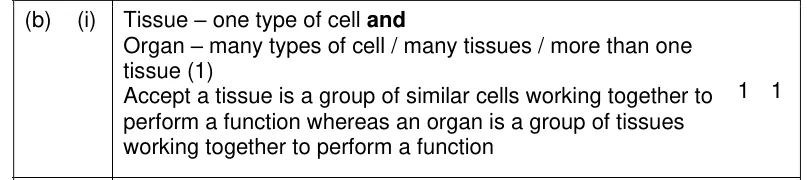
- Tissue: a group of similar cells (one type) working together to perform a function.
- Organ: a group of different tissues working together to perform a function.
What these questions cover (Eduqas CC2)
The questions test these statements from Core Concept 2 of the Eduqas A level Biology specification (A400). Core Concepts are taught in Year 12, examined in AS Component 1 and tested again in every A level paper.
- (a) the structure and function of the following
- (b) the structure of prokaryotic cells and viruses
- (c) cell theory and the similarities and differences in the cell structures of eukaryotes (animal and plant), prokaryotes and viruses, including the examination of a range of
- (d) the levels of organisation including aggregation of cells into tissues and tissues into organs and organs into organ systems and also the examination of a range of prepar
How to use this page
Write your answer on paper before you open the mark scheme. Allow about 1.2 minutes per mark: the 20 questions are worth 39 marks, so about 47 minutes in total. Then mark your answer strictly against the mark scheme and read the examiners' tip underneath it. If you'd rather print the questions, download the PDF pack.
Organelles on micrographs
Question 1
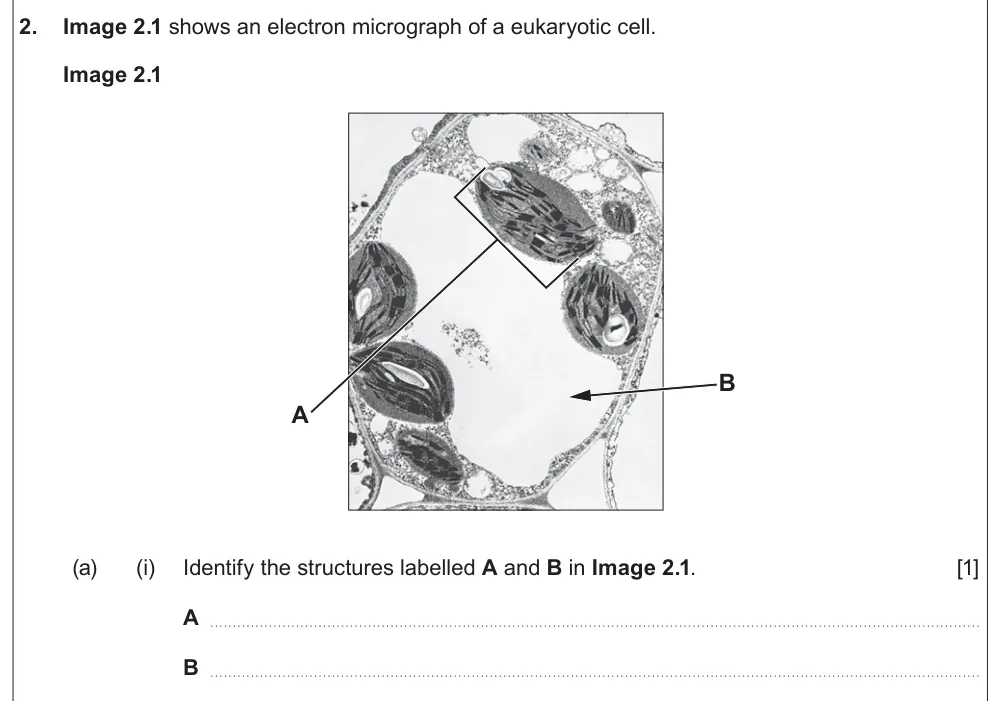
AS Component 1 · June 2024 · Q2(a)(i) · 1 mark · Easy
Identify two structures on an electron micrograph of a plant cell.
Show the mark scheme

Tap an image to open it full size.
Question 2
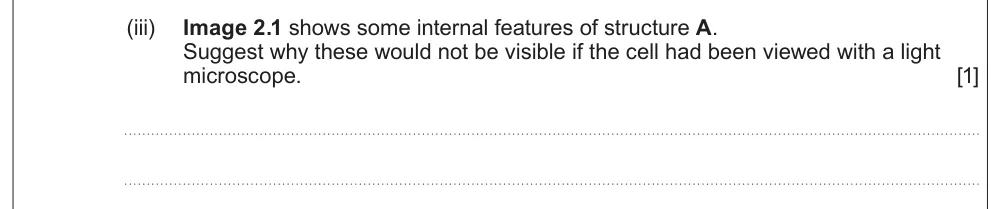
AS Component 1 · June 2024 · Q2(a)(iii) · 1 mark · Easy
Explain why internal features of a chloroplast wouldn't show under a light microscope.
Show the mark scheme

Tap an image to open it full size.
From the examiners' report: Say that the resolution (or magnification) of the light microscope is too low. "Too small to see" on its own didn't score, and the light isn't absorbed by chlorophyll.
Question 3
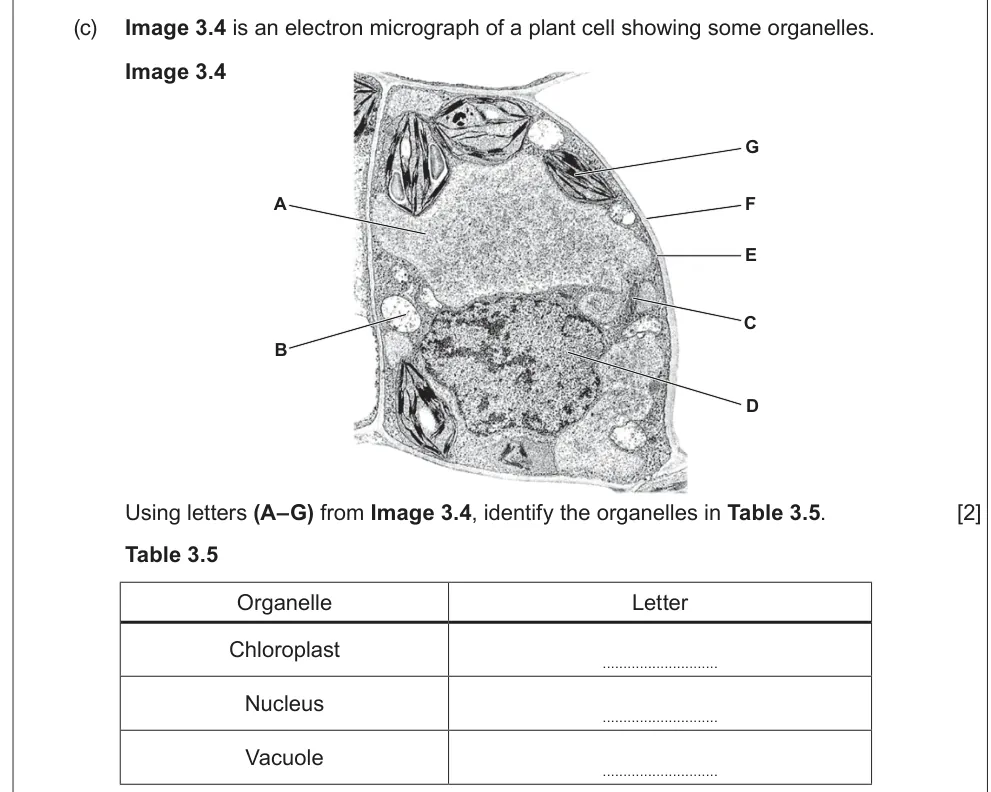
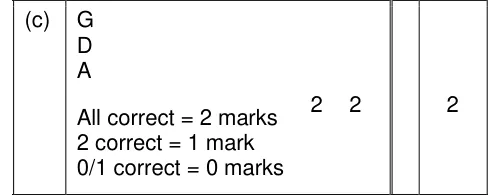
AS Component 1 · June 2023 · Q3(c) · 2 marks
Pick out the chloroplast, nucleus and vacuole on an electron micrograph.
Show the mark scheme
Tap an image to open it full size.
From the examiners' report: Some students couldn't identify the nucleus or the vacuole. Practise naming organelles on real, unlabelled electron micrographs.
Question 4
A level Component 2 · June 2018 · Q1(a) · 3 marks · Easy
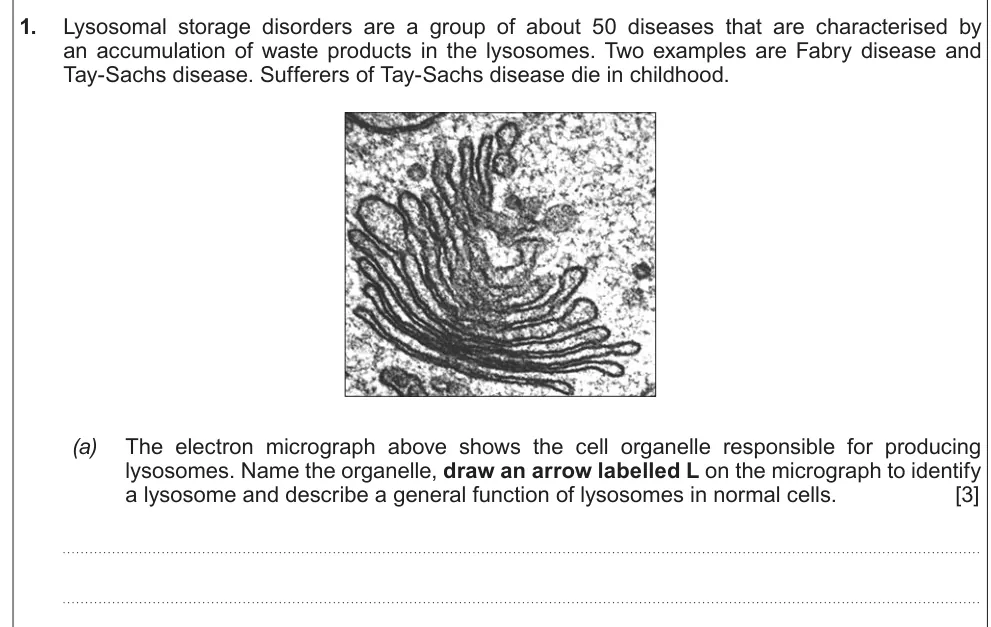
Name the organelle that makes lysosomes, label a lysosome and give its function.
Show the mark scheme

Tap an image to open it full size.
From the examiners' report: The organelle is the Golgi body, not the endoplasmic reticulum. Many students described secretory vesicles instead of lysosomes: lysosomes contain hydrolytic enzymes that break down old organelles.
Organelles and their functions
Question 5
AS Component 1 · June 2018 · Q3(a)(i) · 1 mark
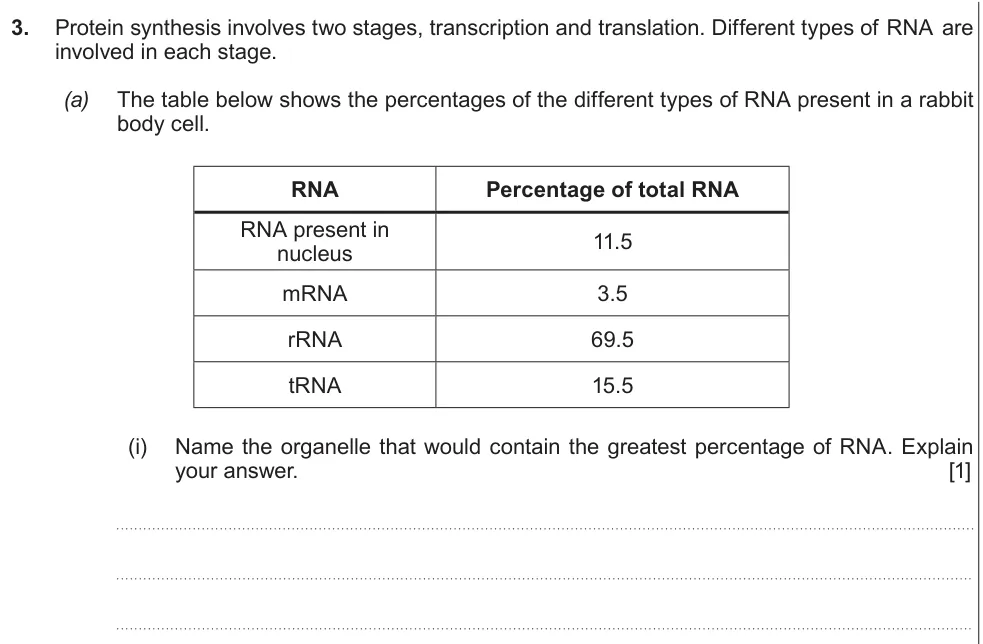
Use the percentages of each type of RNA to name the organelle with the most RNA.
Show the mark scheme

Tap an image to open it full size.
From the examiners' report: Most students named the ribosome, but the explanation needs to say rRNA is part of the ribosome's structure, not that ribosomes are where translation happens.
Question 6
AS Component 1 · June 2022 · Q3(a) · 5 marks
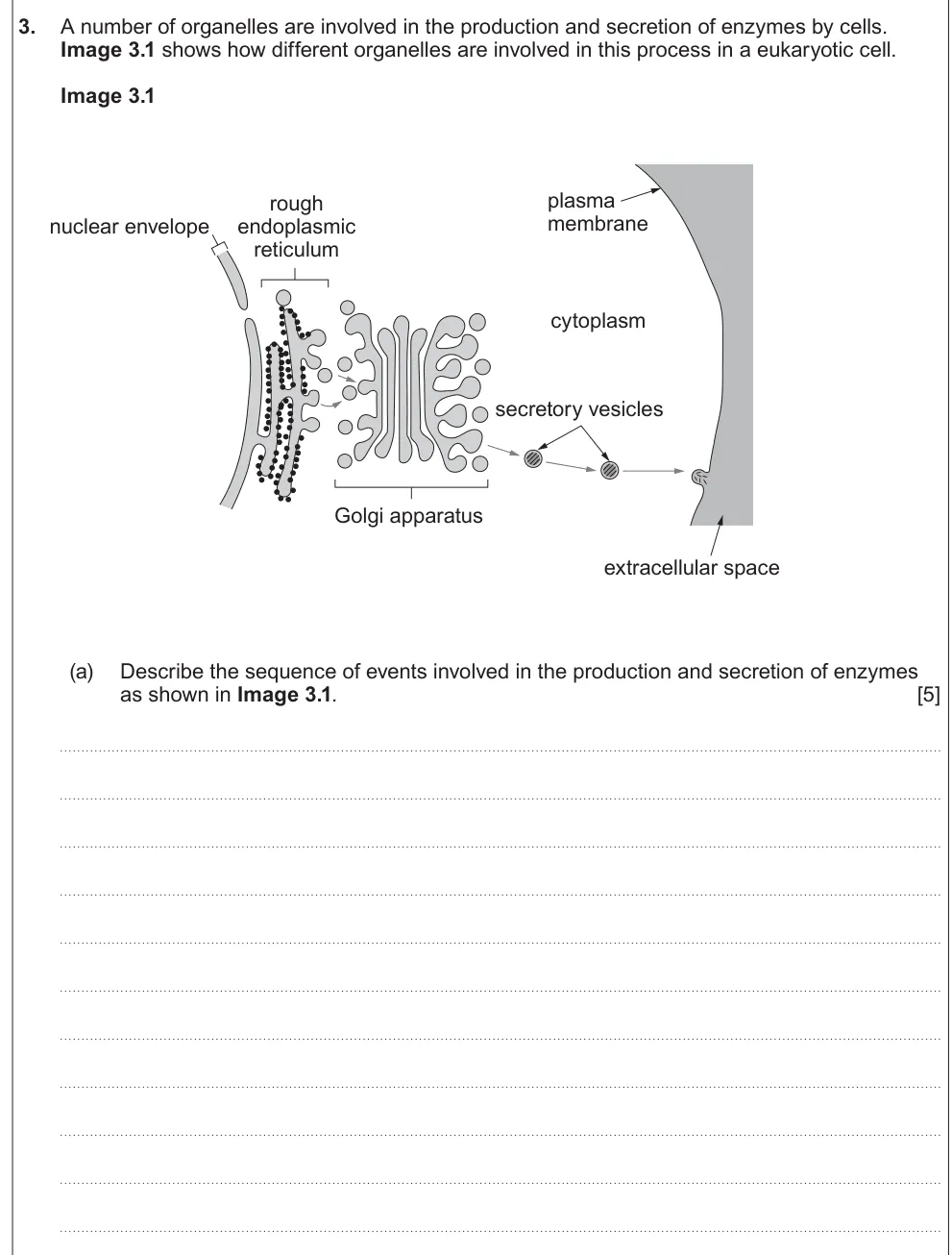
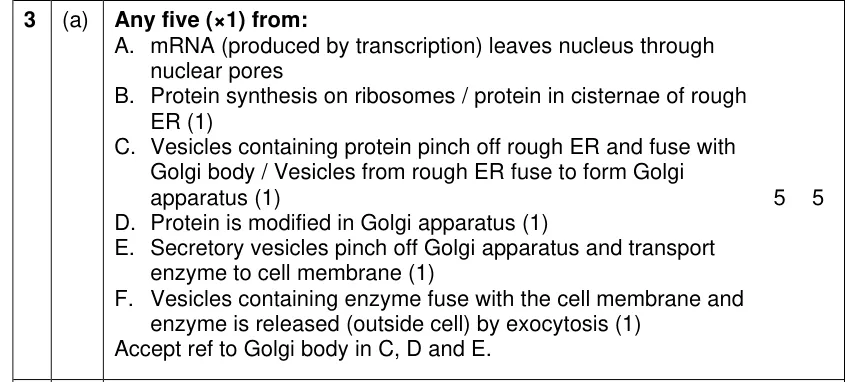
Describe the sequence of events in making and secreting an enzyme.
Show the mark scheme
Tap an image to open it full size.
From the examiners' report: Many students scored all five marks by following the route in order: mRNA leaves through a nuclear pore, protein is made on the rough ER, vesicles carry it to the Golgi body, it is modified, and a vesicle fuses with the membrane.
Question 7
AS Component 1 · June 2022 · Q3(b)(ii) · 3 marks · Easy
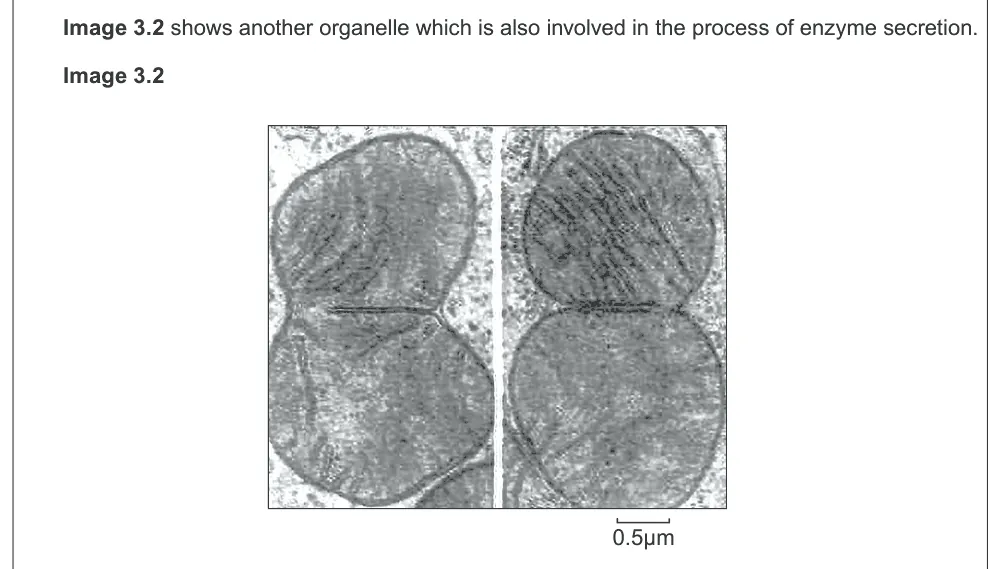
Name an organelle from an unusual micrograph and suggest its role in secretion.
Information from earlier in this question:
Show the mark scheme

Tap an image to open it full size.
From the examiners' report: Most students recognised mitochondria even though they looked unusual, because they had seen a wide range of images. Link ATP to exocytosis for the last mark.
Question 8
AS Component 1 · Autumn 2020 · Q2(b)(iii) · 2 marks
Suggest why enzyme-secreting cells have many mitochondria.
Show the mark scheme

Tap an image to open it full size.
From the examiners' report: Well answered: lots of ATP is needed, for protein synthesis and for exocytosis.
Question 9
A level Component 2 · June 2023 · Q5(b)(ii) · 1 mark
Explain why a cell contains more DNA than the length of its chromosomes.
Information from earlier in this question:


Show the mark scheme

Tap an image to open it full size.
From the examiners' report: Name the mitochondria. "DNA outside the nucleus" wasn't enough.
Question 10
A level Component 2 · June 2025 · Q2(a) · 4 marks · Hard
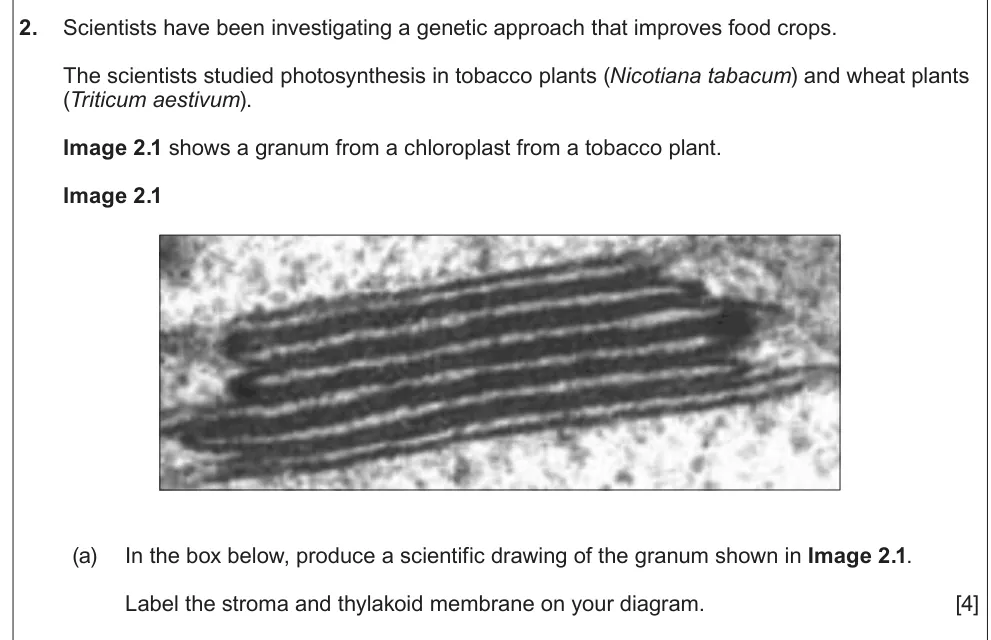
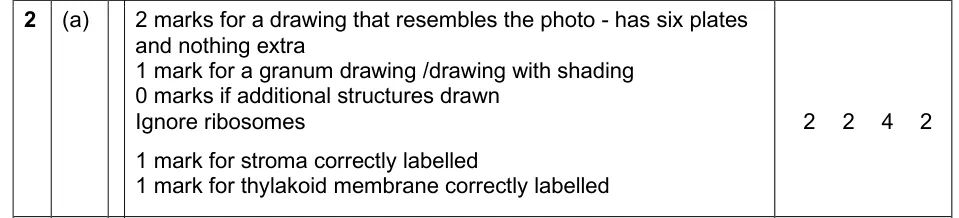
Make a scientific drawing of a granum from a micrograph and label it.
Show the mark scheme
Tap an image to open it full size.
From the examiners' report: Draw only what is in the image: six plates and nothing extra. Many students drew a whole chloroplast and scored nothing, and the stroma is outside the granum, not inside.
Prokaryotes and viruses
Question 11
A level Component 1 · June 2024 · Q1(b)(i) · 2 marks
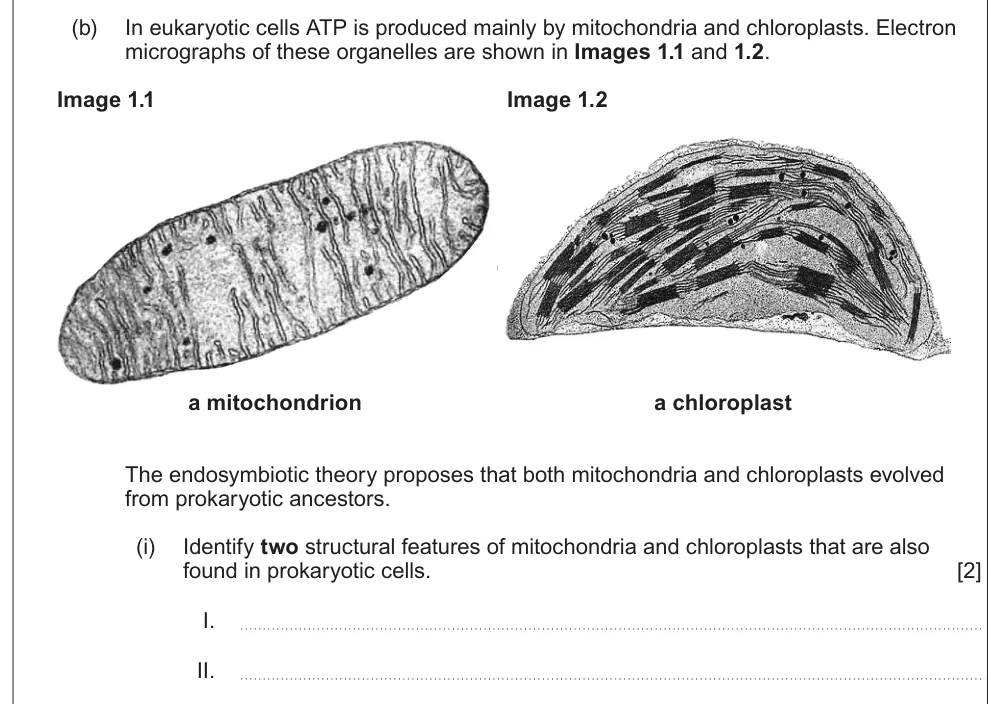
Give two features of mitochondria and chloroplasts that are also found in prokaryotes.
Show the mark scheme

Tap an image to open it full size.
From the examiners' report: Many students couldn't compare bacteria, mitochondria and chloroplasts. Learn the two shared features: 70S ribosomes and a circular loop of DNA.
Question 12
AS Component 1 · June 2018 · Q5(c)(iv) · 2 marks · Hard
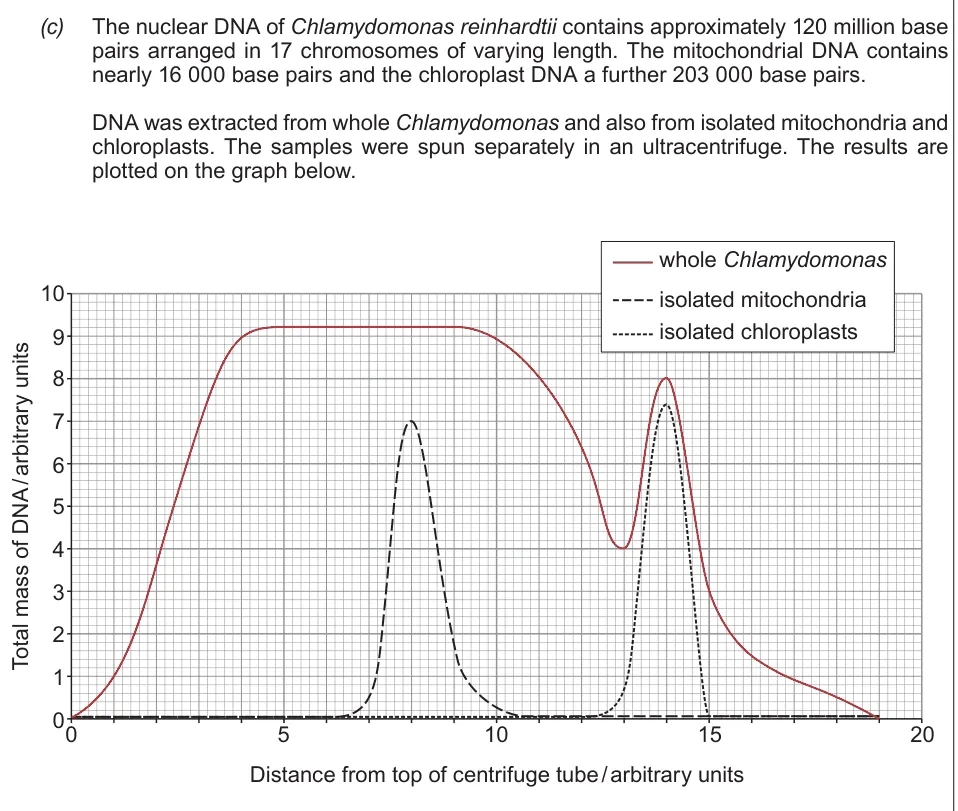
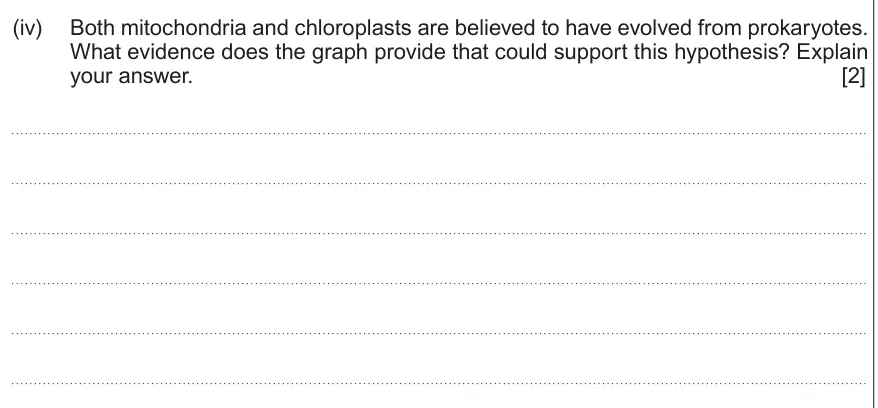
Use a graph of organelle DNA to support the idea that organelles came from prokaryotes.
Information from earlier in this question:
Show the mark scheme

Tap an image to open it full size.
From the examiners' report: Most students couldn't interpret the graph. A single peak means one type of DNA molecule, which could be circular, like bacterial DNA.
Question 13
A level Component 2 · June 2023 · Q1(b)(ii) · 1 mark
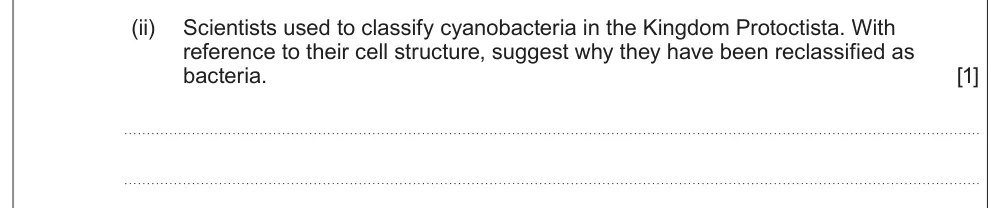
Suggest why cyanobacteria were moved from the protoctists to the bacteria.
Show the mark scheme

Tap an image to open it full size.
From the examiners' report: No nucleus or 70S ribosomes both scored. A cell wall only counts if you say murein or peptidoglycan, because protoctists can have cellulose walls.
Question 14
AS Component 1 · June 2017 · Q2(b)(i) · 2 marks
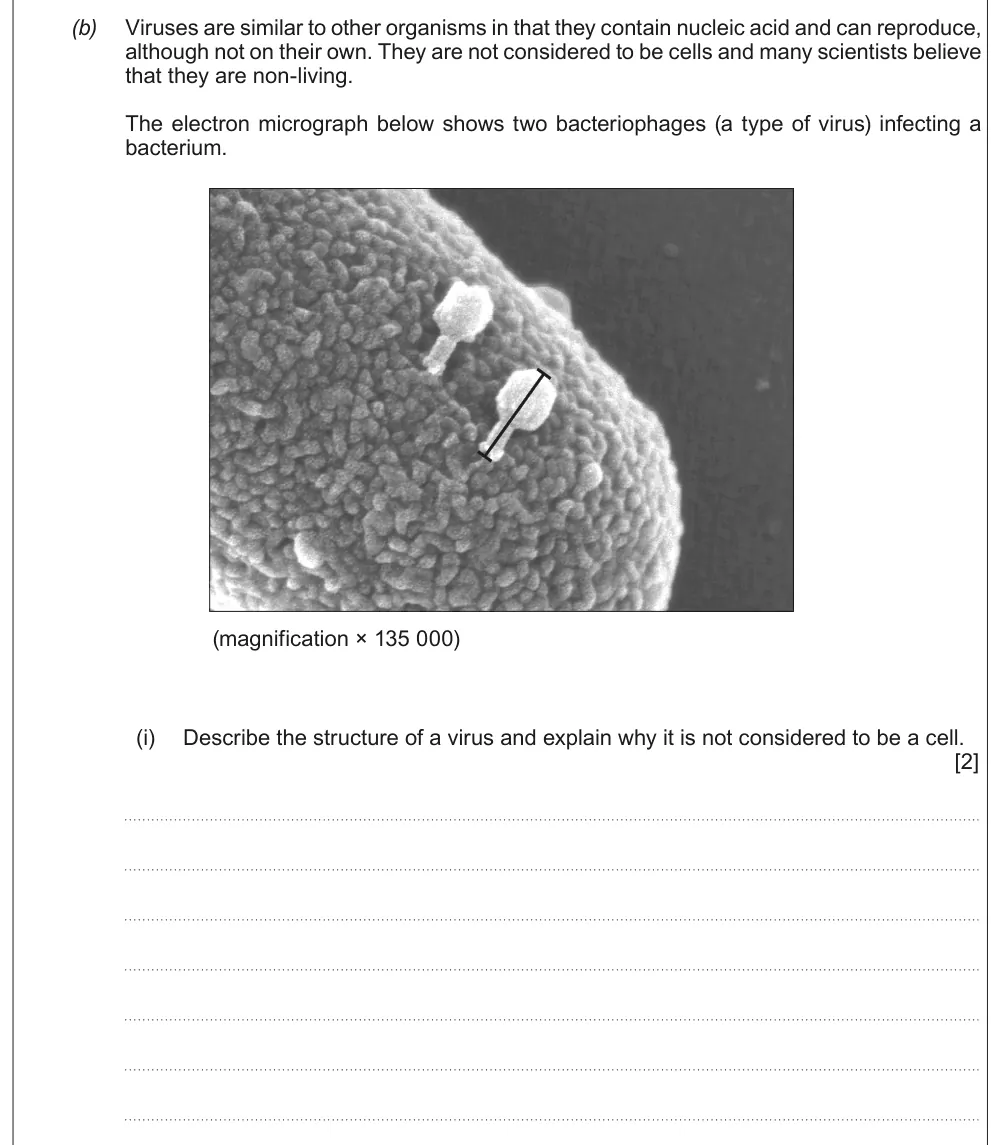
Describe the structure of a virus and explain why it isn't a cell.
Show the mark scheme

Tap an image to open it full size.
From the examiners' report: Don't confuse viruses with prokaryotic cells: a virus is nucleic acid in a protein coat, with no membranes, cytoplasm or organelles.
Comparing cells
Question 15
A level Component 1 · June 2018 · Q2(a)(i) · 1 mark
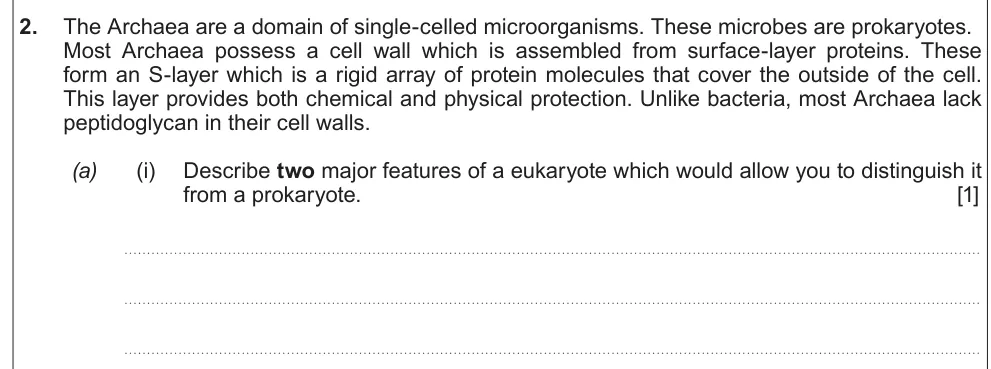
Give two features that distinguish a eukaryote from a prokaryote.
Show the mark scheme

Tap an image to open it full size.
From the examiners' report: Many students said eukaryotes don't have cell walls, which is wrong (plants and fungi do). Use a nucleus, membrane-bound organelles, 80S ribosomes or linear DNA.
Question 16
A level Component 2 · June 2024 · Q2(e) · 1 mark
Explain why cellulase isn't needed when extracting DNA from human cells.

Show the mark scheme

Tap an image to open it full size.
From the examiners' report: Human cells have no cell wall at all. Saying the human cell wall isn't made of cellulose didn't score.
Question 17
AS Component 1 · June 2022 · Q3(b)(iii) · 3 marks · Easy
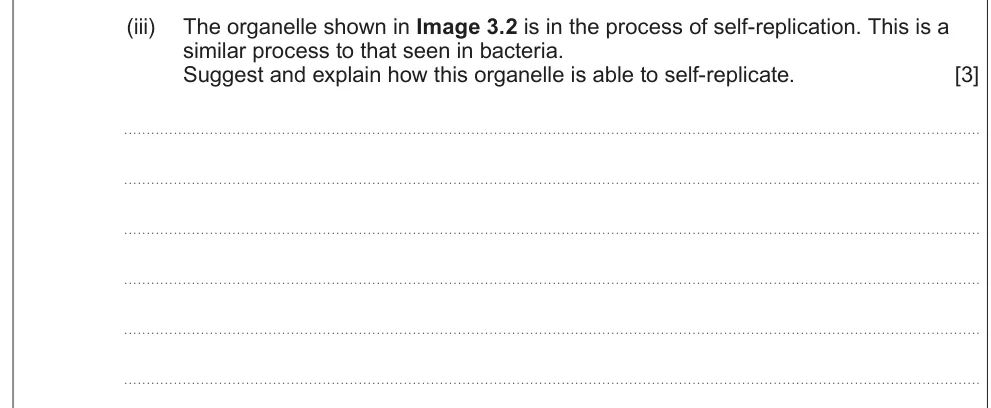
Suggest how a mitochondrion is able to replicate itself.
Information from earlier in this question:
Show the mark scheme

Tap an image to open it full size.
From the examiners' report: This was well answered: mitochondria have their own DNA and ribosomes, so they can copy their DNA and make their own proteins.
Levels of organisation
Question 18
AS Component 1 · June 2024 · Q2(b)(i) · 1 mark · Easy
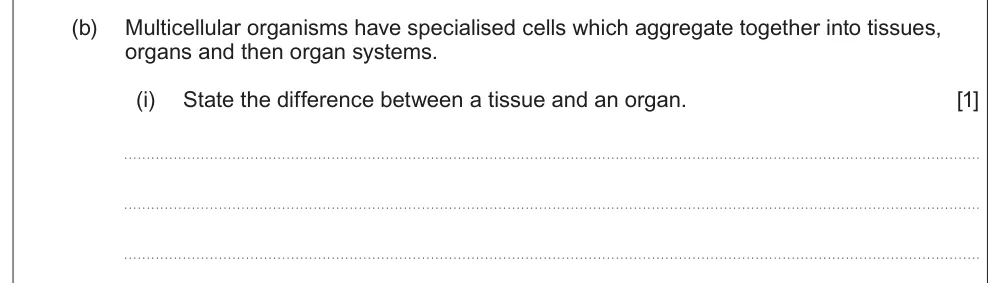
State the difference between a tissue and an organ.
Show the mark scheme
Tap an image to open it full size.
From the examiners' report: A tissue is one type of cell. A common mistake was calling a tissue a collection of different cells.
Question 19
AS Component 1 · June 2018 · Q4(a)(ii) · 2 marks
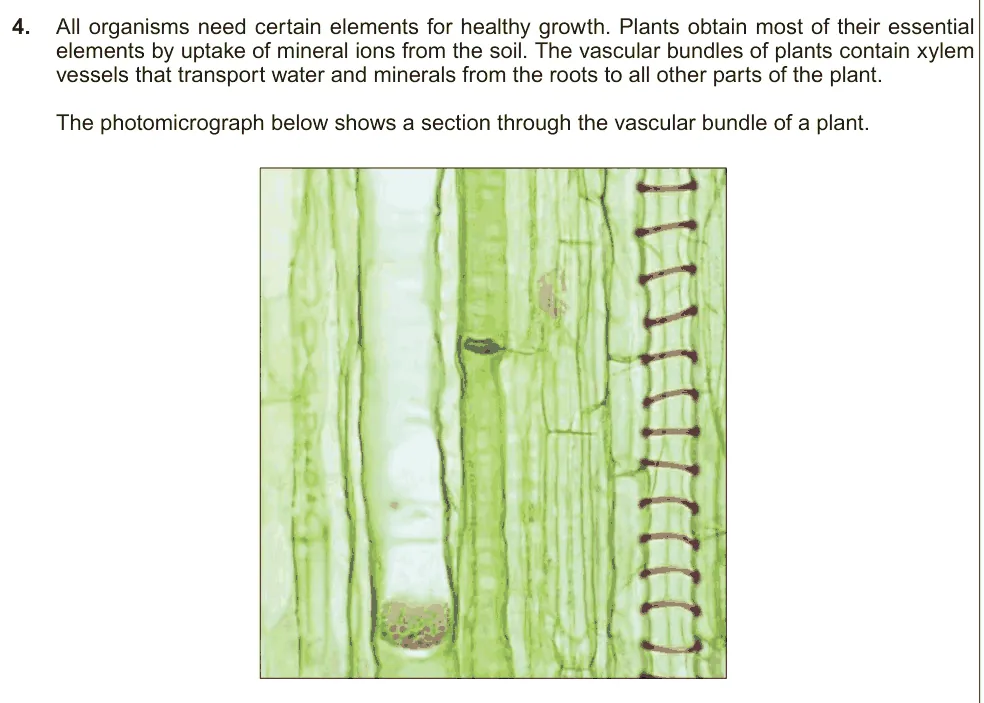
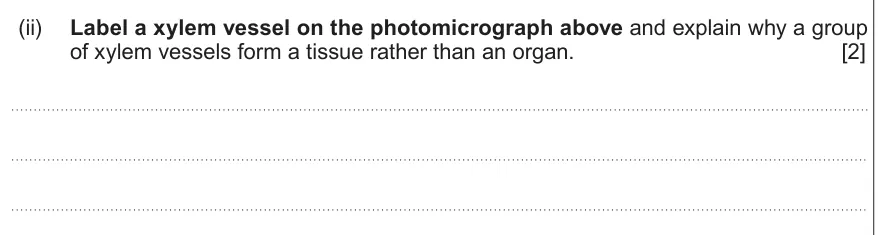
Label a xylem vessel and explain why xylem vessels form a tissue.
Information from earlier in this question:
Show the mark scheme

Tap an image to open it full size.
From the examiners' report: More than half of students labelled a sieve tube element as xylem. The explanation needs similar cells working together to perform one function; vague answers didn't score.
Question 20
A level Component 3 · Autumn 2020 · Q1(b)(i) · 1 mark
Explain why blood is considered to be a tissue.
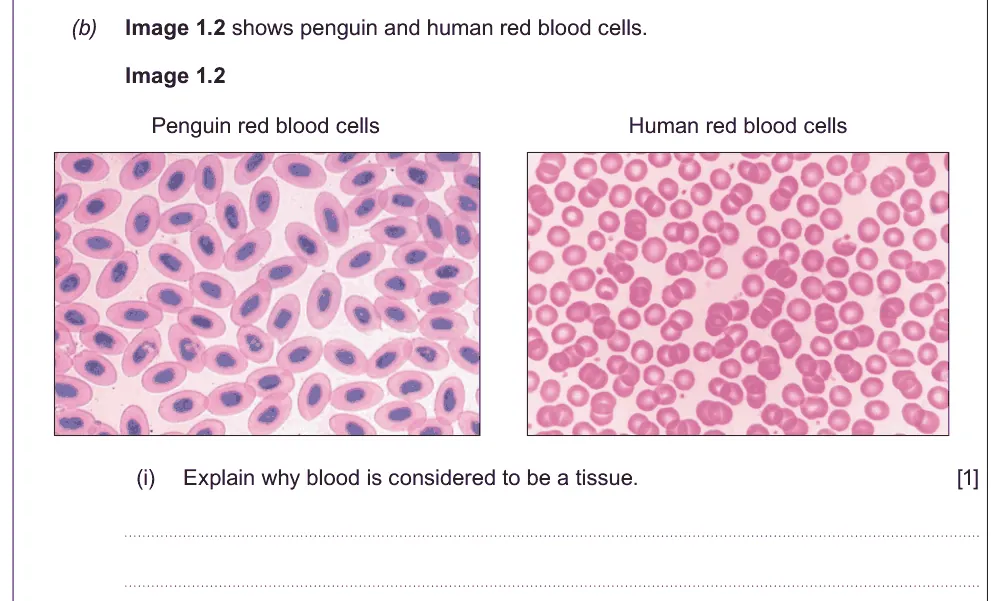
Show the mark scheme

Tap an image to open it full size.
From the examiners' report: This was the best answered part of the paper: a group of similar cells working together to perform a function.
Where students lose marks (from Eduqas examiners' reports and mark schemes)
Each point below is followed by wording that gained marks.
Golgi makes lysosomes: Some students named the endoplasmic reticulum and described secretory vesicles rather than lysosomes.
✔ Gains credit: "Golgi apparatus" and lysosomes "contain hydrolytic enzymes".
Resolution, not just size: Answers said the structures were too small to see without mentioning the microscope.
✔ Gains credit: "Resolution too low" or "not high enough magnification".
Draw what you see: Many students drew a whole chloroplast and placed the stroma inside the granum.
✔ Gains credit: A drawing with "six plates and nothing extra", with the stroma labelled outside the granum.
Qualify the cell wall: "Has a cell wall" didn't separate bacteria from protoctists.
✔ Gains credit: "Murein cell wall" or "peptidoglycan cell wall".
Viruses aren't prokaryotes: Some students mixed up viruses and prokaryotic cells.
✔ Gains credit: "Nucleic acid surrounded by a protein coat" with "no membranes or organelles".
No wall at all: Students said the human cell wall isn't made of cellulose.
✔ Gains credit: "Human cells do not have a cell wall".
A tissue is one cell type: A common error was calling a tissue a collection of different cells.
✔ Gains credit: "Tissue: one type of cell; organ: more than one tissue".
Download the questions
Download the PDF pack (20 questions, mark schemes at the end)
Keep practising
- Biological Compounds (CC1): Eduqas A Level Biology exam questions by topic
- Cell Membranes and Transport (CC3): Eduqas A Level Biology exam questions by topic
- Enzymes (CC4): Eduqas A Level Biology exam questions by topic
- Nucleic Acids and their Functions (CC5): Eduqas A Level Biology exam questions by topic
- Eduqas A level Biology past papers, mark schemes and examiners' reports
- Eduqas A level Biology grade boundaries
- Ask about Eduqas A level Biology lessons with Sam on WhatsApp
Questions, mark schemes and examiners' report extracts © WJEC CBAC Ltd (Eduqas).