

Biological compounds is the first Core Concept and the one that turns up most often across the Eduqas papers. You need the roles of four inorganic ions, the properties of water, the structure of carbohydrates, lipids and proteins, the food tests, and how condensation and hydrolysis make and break the bonds between monomers. Questions marked AS are from the AS papers (B400); the rest are from the A level papers (A400), where this content is often tested inside a question on respiration, digestion or plants.
Most of these marks are for exact wording. The examiners' reports keep coming back to the same points: give a comparable statement when you compare two molecules, say carbon to carbon double bond rather than just double bond, describe a polymer as a chain of monomers, and learn the food tests with their reagents, heating steps and colours.
I don't teach the Eduqas specification myself, so for one-to-one help I recommend Sam. He teaches Eduqas A level Biology at a top-rated sixth form college and is very popular with his students. You can ask about lessons with Sam on WhatsApp using the link at the bottom of this page.
What you need from GCSE and Year 12
Each question on this page assumes you're secure on these ideas. If any of them feels shaky, look it up before you start.
- Carbohydrates, lipids and proteins are made from smaller molecules: sugars, fatty acids and glycerol, and amino acids.
- Benedict's reagent tests for reducing sugars, iodine for starch and biuret for protein.
- Covalent bonds hold atoms together within a molecule; hydrogen bonds are weaker attractions between molecules.
- Enzymes such as amylase, protease and lipase break large food molecules into small ones.
Key terms
These words come up in the questions and mark schemes. Examiners expect you to use them exactly.
- Polar: having an uneven distribution of charge, as in water where O is slightly negative and H slightly positive.
- Structural isomers: molecules with the same molecular formula but a different arrangement of atoms.
- Condensation: a reaction that joins two molecules with the removal of water.
- Hydrolysis: a reaction that breaks a bond with the addition of water.
- Glycosidic bond: the bond between two monosaccharides.
- Ester bond: the bond between glycerol and a fatty acid in a triglyceride.
- Peptide bond: the bond between the amino group of one amino acid and the carboxyl group of another.
- Polymer: a long chain of repeating monomer units.
- Quaternary structure: more than one polypeptide chain bonded together, as in haemoglobin.
What these questions cover (Eduqas CC1)
The questions test these statements from Core Concept 1 of the Eduqas A level Biology specification (A400). Core Concepts are taught in Year 12, examined in AS Component 1 and tested again in every A level paper.
- (a) the key elements present as inorganic ions in living organisms
- (b) the importance of water in terms of its polarity, ability to form hydrogen bonds, surface tension, as a solvent, thermal properties, as a metabolite
- (c) the structure, properties and functions of carbohydrates
- (d) alpha and beta structural isomerism in glucose and its polymerisation into storage and structural carbohydrates, illustrated by starch, cellulose and chitin
- (e) the chemical and physical properties which enable the use of starch and glycogen for storage and cellulose and chitin as structural compounds
- (f) the structure, properties and functions of lipids as illustrated by triglycerides and phospholipids
- (g) the implications of saturated and unsaturated fat on human health
- (h) the structure and role of amino acids and proteins
- (i) the primary, secondary, tertiary and quaternary structure of proteins
- (j) the relationship of the fibrous and globular structure of proteins to their function
- using structural formulae to show condensation and hydrolysis Learners should be able to use given structural formulae (proteins, triglycerides and carbohydrates) to show how bonds are formed and broken by condensation and hydrolysi
How to use this page
Write your answer on paper before you open the mark scheme. Allow about 1.2 minutes per mark: the 22 questions are worth 42 marks, so about 50 minutes in total. Then mark your answer strictly against the mark scheme and read the examiners' tip underneath it. If you'd rather print the questions, download the PDF pack.
Inorganic ions and water
Question 1
AS Component 1 · June 2023 · Q1(a) · 2 marks
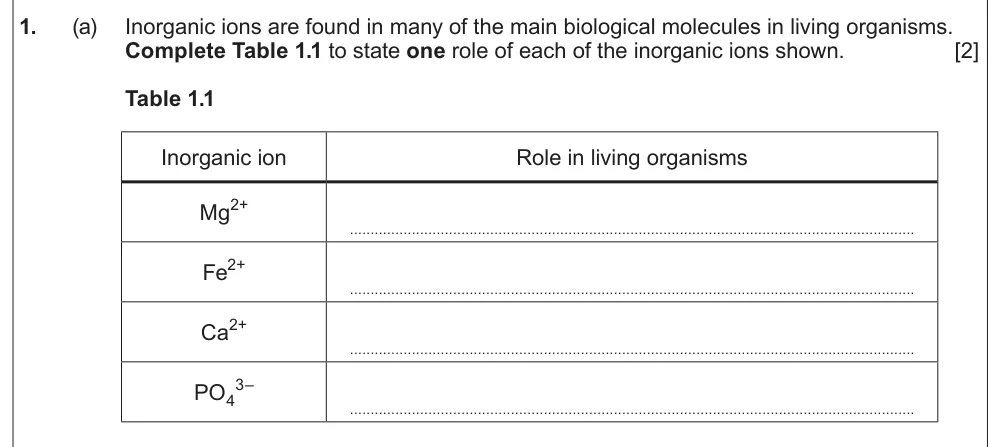
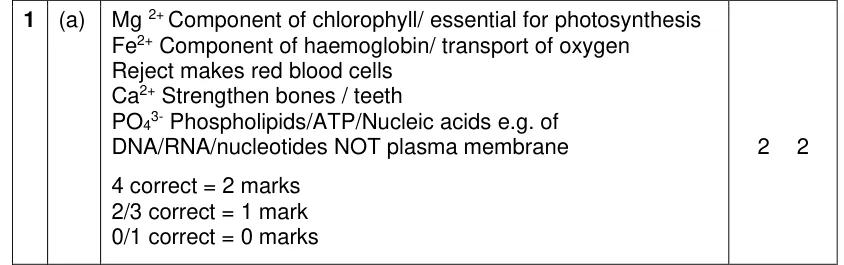
Give a role for magnesium, iron, calcium and phosphate ions.
Show the mark scheme
Tap an image to open it full size.
From the examiners' report: Most students knew the roles, but word them carefully: calcium is used to strengthen bones, not just "used in bones".
Question 2
A level Component 1 · June 2025 · Q3(a)(ii) · 2 marks
State one role of calcium and of magnesium in plants.

Show the mark scheme

Tap an image to open it full size.
From the examiners' report: The examiners found a lack of knowledge of the role of elements in plants. Calcium strengthens plant cell walls; magnesium is part of chlorophyll.
Question 3
AS Component 1 · June 2018 · Q4(b)(i) · 2 marks
Explain why water is a polar molecule.

Show the mark scheme

Tap an image to open it full size.
From the examiners' report: Only the stronger students scored both marks. You need both halves: hydrogen is slightly positive (δ+) and oxygen slightly negative (δ−).
Carbohydrates
Question 4
A level Component 1 · Autumn 2020 · Q6(e) · 2 marks · Easy
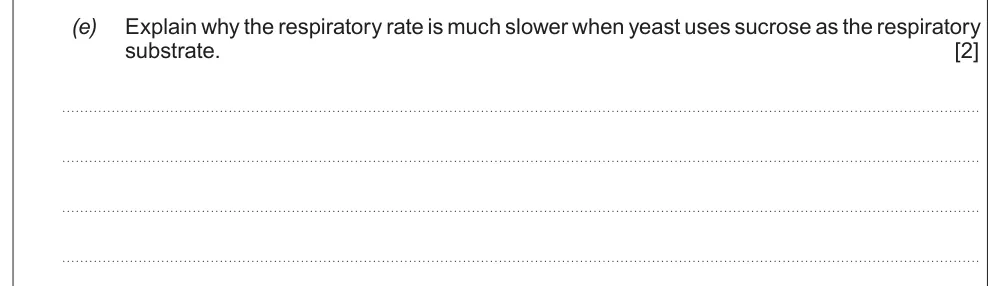
Explain why yeast respires sucrose more slowly than glucose.
Show the mark scheme

Tap an image to open it full size.
From the examiners' report: Most students scored: sucrose is a disaccharide, so it has to be hydrolysed before it can be respired.
Question 5
A level Component 3 · Autumn 2021 · Q1(b)(i) · 1 mark
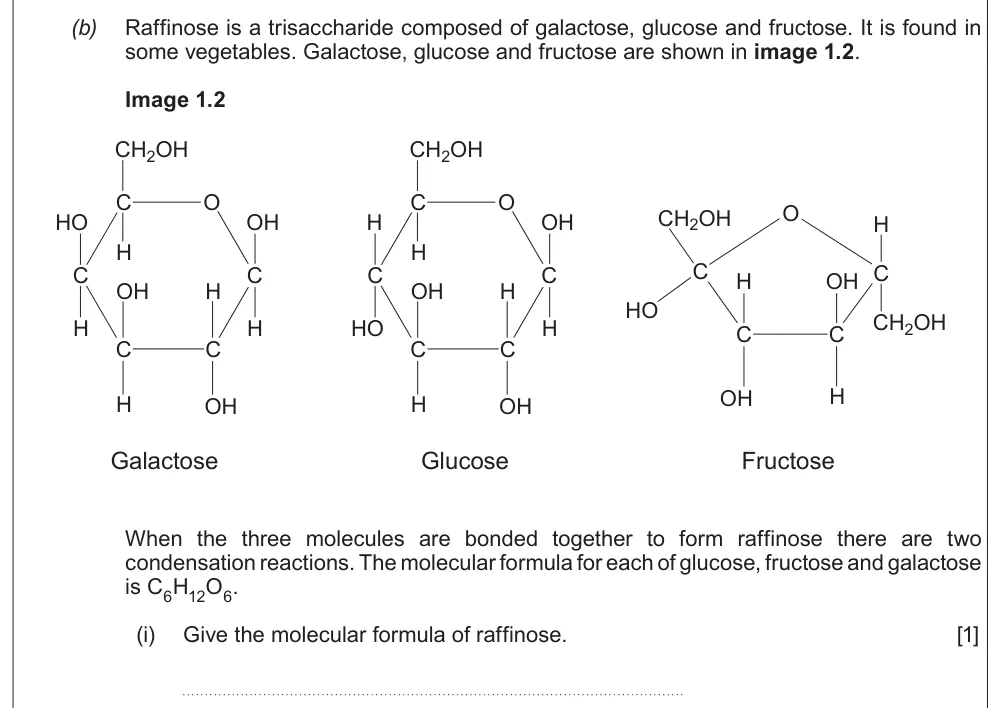
Work out the molecular formula of the trisaccharide raffinose.
Show the mark scheme

Tap an image to open it full size.
From the examiners' report: Several students lost the mark because they didn't take away two water molecules, one for each condensation reaction.
Question 6
A level Component 3 · Autumn 2021 · Q1(c)(i) · 2 marks
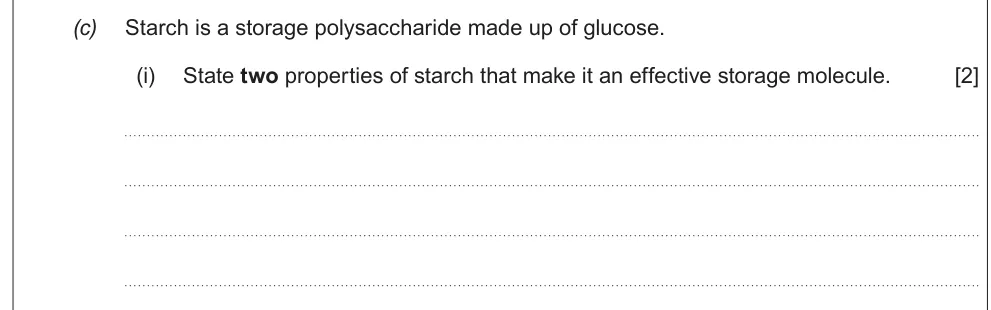
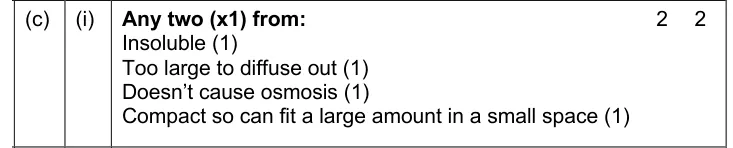
State two properties that make starch a good storage molecule.
Show the mark scheme
Tap an image to open it full size.
From the examiners' report: Many students gave "insoluble", but few added that it is a large molecule, so it can't diffuse out of the cell.
Question 7
A level Component 3 · Autumn 2021 · Q1(d) · 2 marks
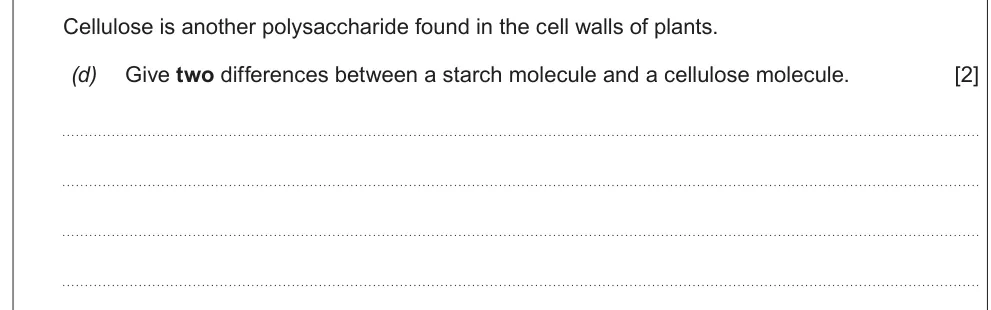
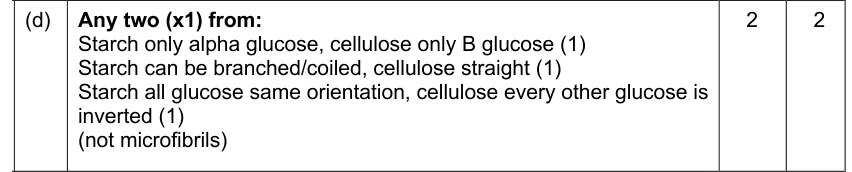
Give two differences between starch and cellulose molecules.
Show the mark scheme
Tap an image to open it full size.
From the examiners' report: Write true comparisons, and remember cellulose contains only beta glucose; some students still think it has both alpha and beta.
Question 8
AS Component 1 · June 2024 · Q3(a)(ii) · 3 marks · Easy
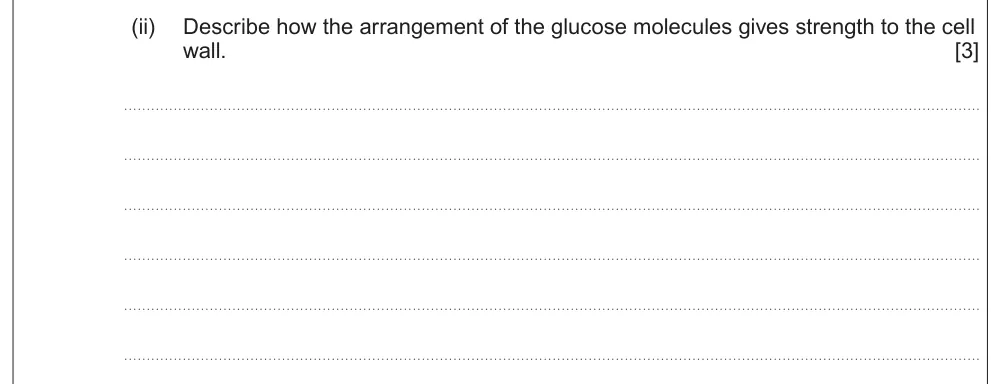
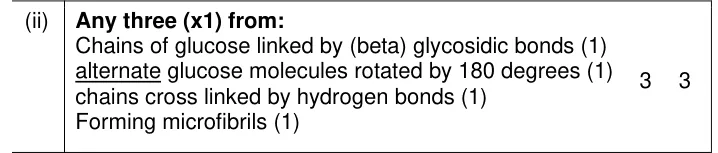
Describe how the arrangement of glucose in cellulose makes cell walls strong.
Show the mark scheme
Tap an image to open it full size.
From the examiners' report: Say that alternate glucose molecules are rotated by 180°. "The glucose is rotated" or "each glucose is rotated" wasn't precise enough.
Question 9
A level Component 3 · June 2025 · Q3(a) · 4 marks
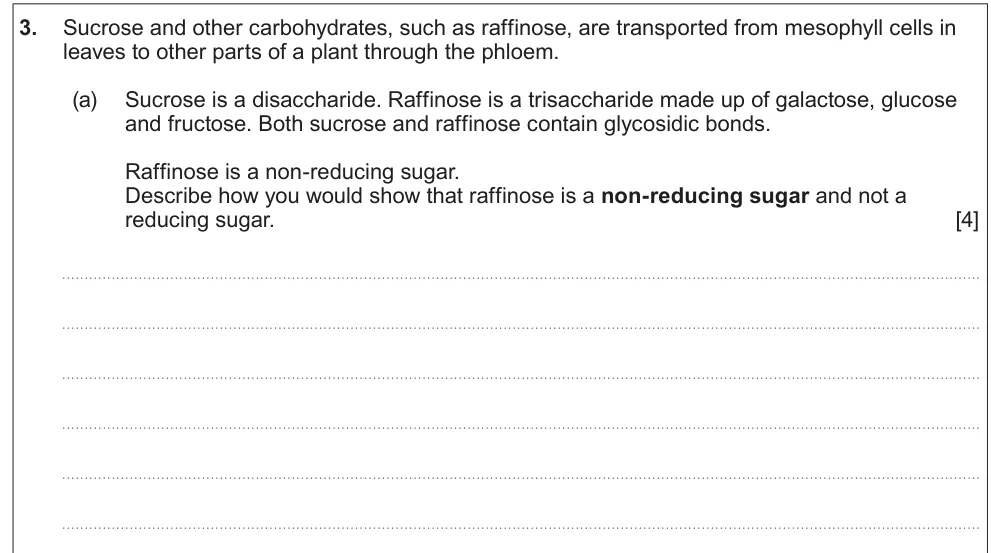
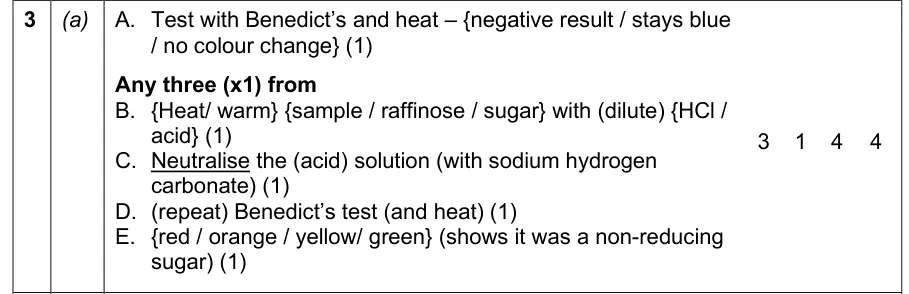
Describe how to show that raffinose is a non-reducing sugar.
Show the mark scheme
Tap an image to open it full size.
From the examiners' report: Many students described the method well. Marks were lost for wrong colours (blue-black or lilac) and for not saying heat, both with Benedict's and with the acid.
Lipids
Question 10
A level Component 2 · June 2017 · Q5(c)(i) · 2 marks
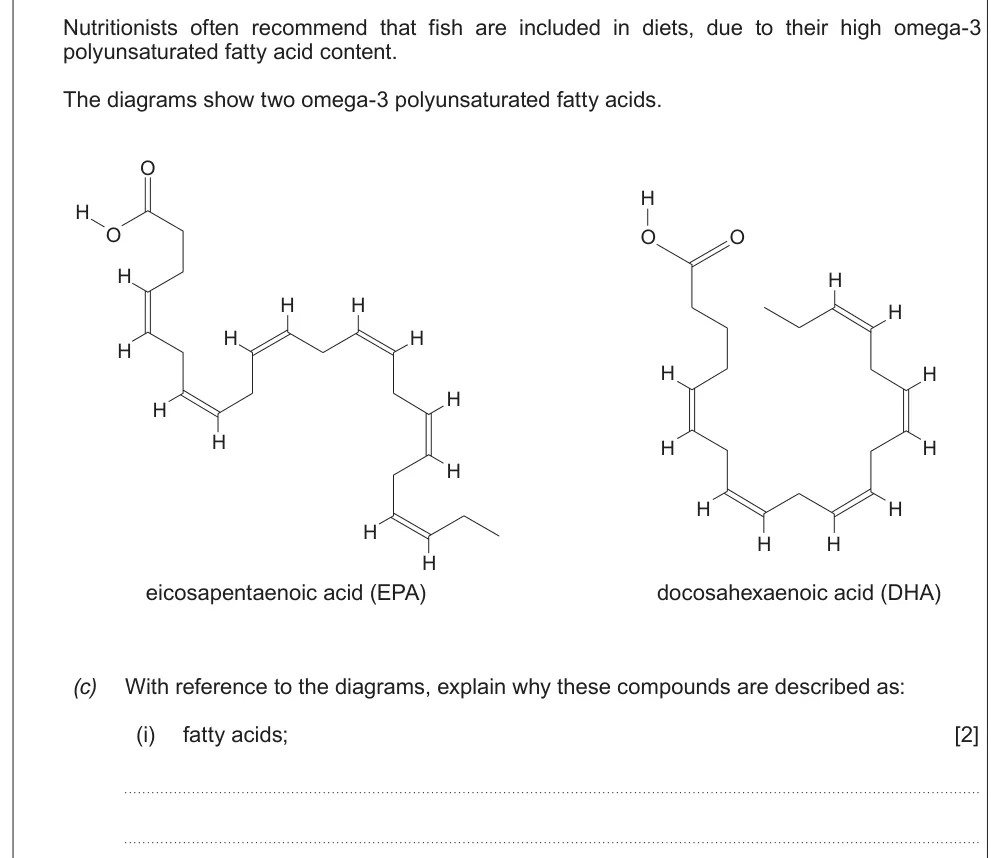
Use diagrams to explain why EPA and DHA are fatty acids.
Show the mark scheme

Tap an image to open it full size.
From the examiners' report: Careless wording cost marks: it is a long hydrocarbon chain, and many students left out "long".
Question 11
A level Component 2 · June 2024 · Q5(a)(i) · 1 mark
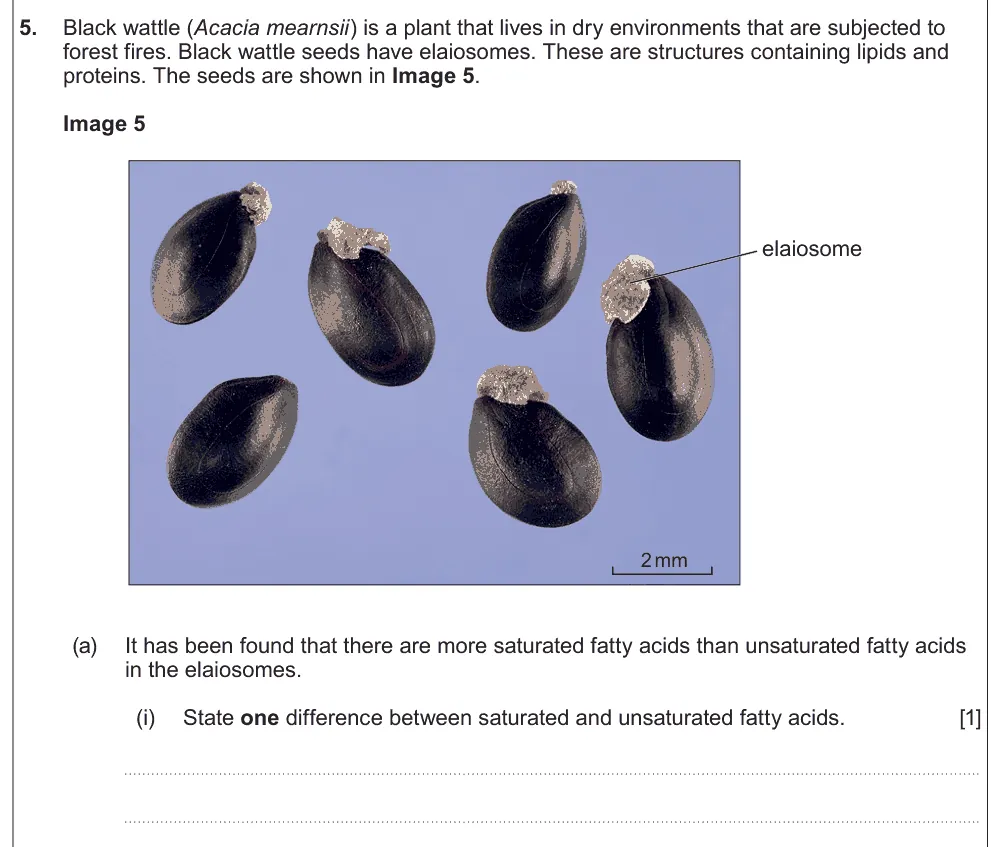
State one difference between saturated and unsaturated fatty acids.
Show the mark scheme

Tap an image to open it full size.
From the examiners' report: Give a comparable statement covering both: saturated has no C=C double bonds, unsaturated has at least one. "Double bonds" alone failed, because both have a C=O.
Question 12
AS Component 1 · Autumn 2020 · Q1(a)(iii) · 1 mark
Explain why a triglyceride isn't a polymer.
Show the mark scheme

Tap an image to open it full size.
From the examiners' report: Students found the definition of a polymer hard. Many left out that a polymer is a chain of monomers.
Question 13
AS Component 1 · Autumn 2020 · Q1(b) · 3 marks
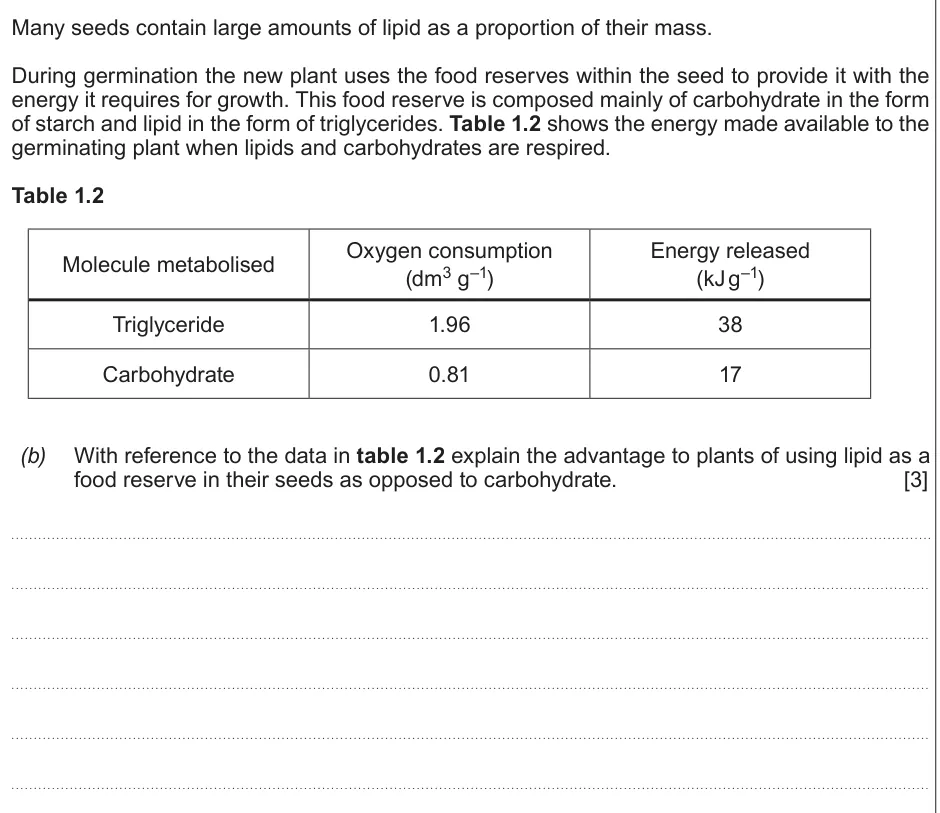
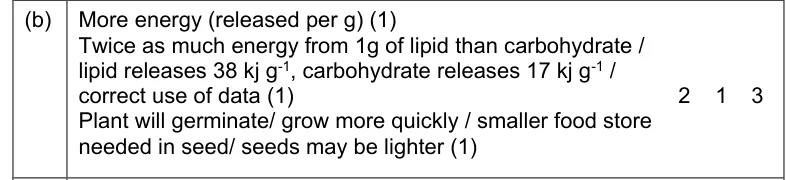
Use energy data to explain why seeds store lipid rather than carbohydrate.
Show the mark scheme
Tap an image to open it full size.
From the examiners' report: Most used the data to show lipid releases more energy per gram. Fewer gave the advantage: an energy-dense store lets seeds be smaller and lighter.
Question 14
AS Component 1 · June 2017 · Q1(b)(i) · 2 marks
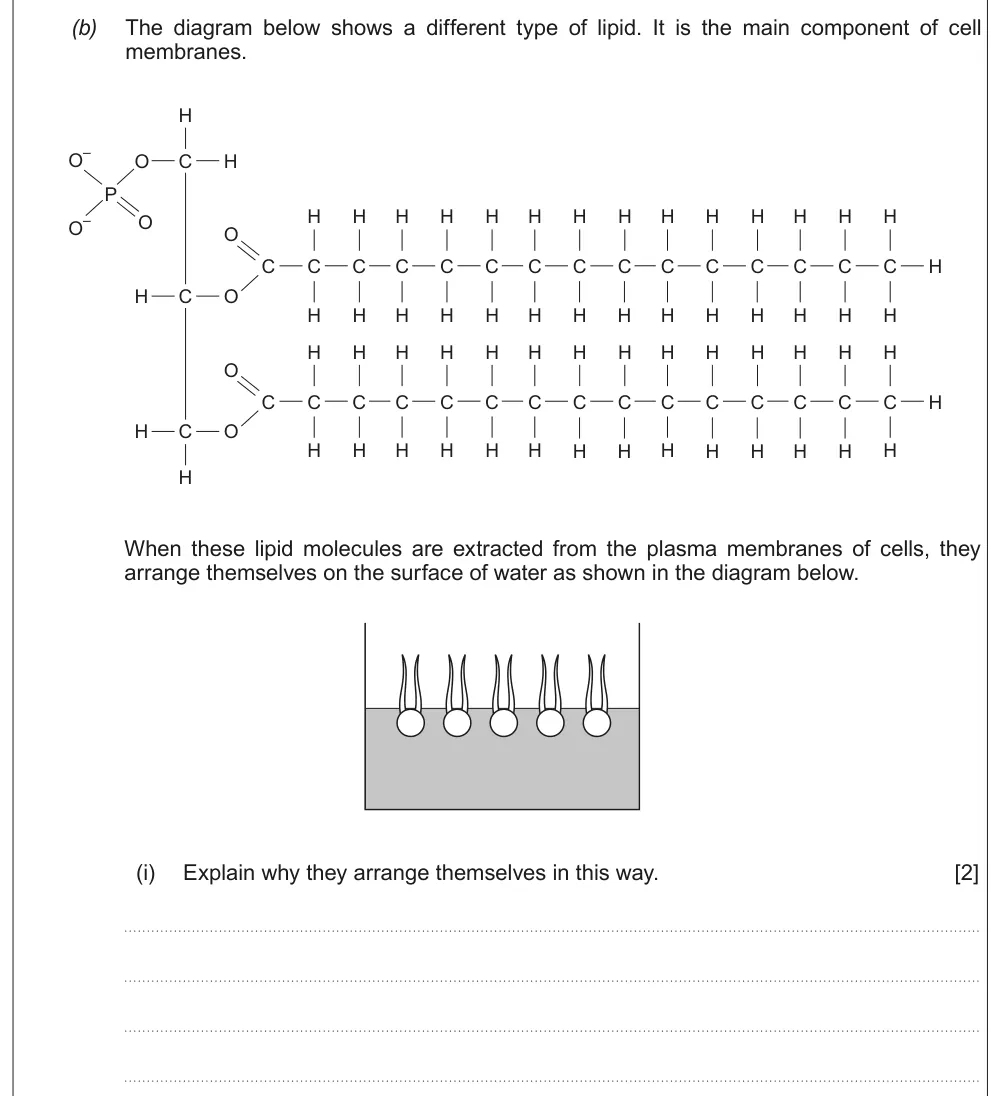
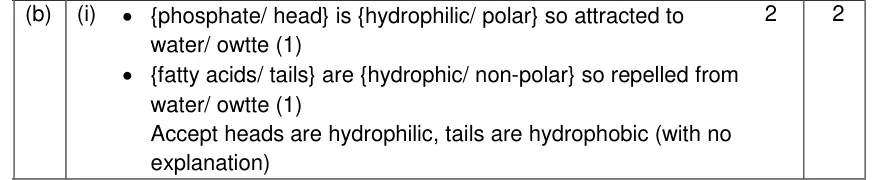
Explain why membrane lipids arrange themselves on the surface of water.
Show the mark scheme
Tap an image to open it full size.
Question 15
A level Component 3 · Autumn 2020 · Q3(a)(i) · 1 mark
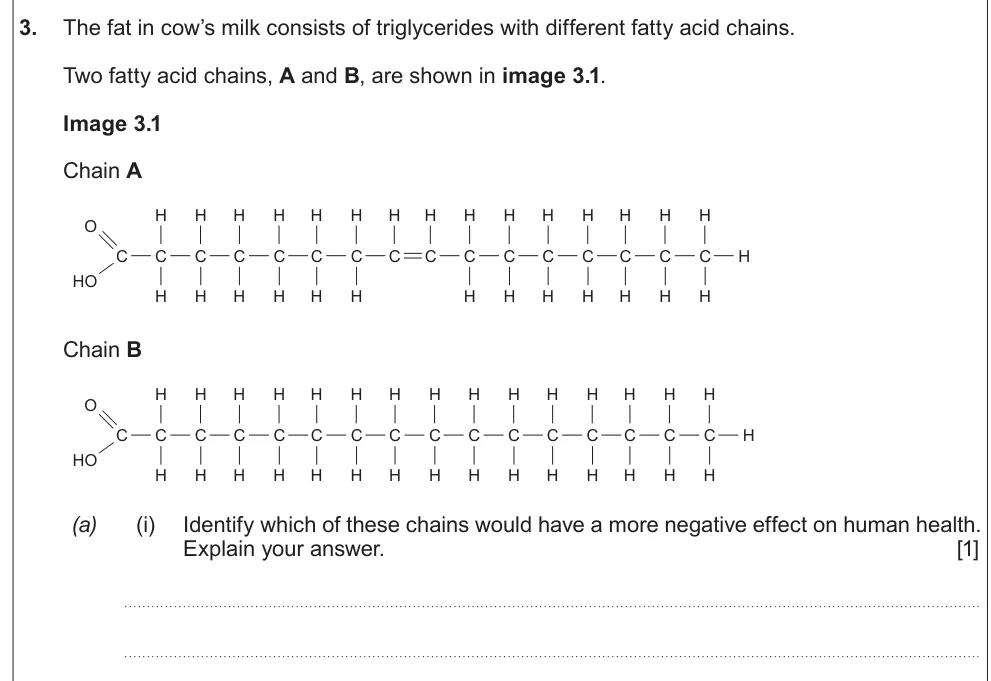
Identify which fatty acid chain is worse for human health and explain why.
Show the mark scheme

Tap an image to open it full size.
From the examiners' report: This was recall: saturated fatty acids have a more negative effect on health, so pick the chain with no C=C double bonds.
Proteins
Question 16
AS Component 1 · June 2016 · Q2(b) · 2 marks · Hard
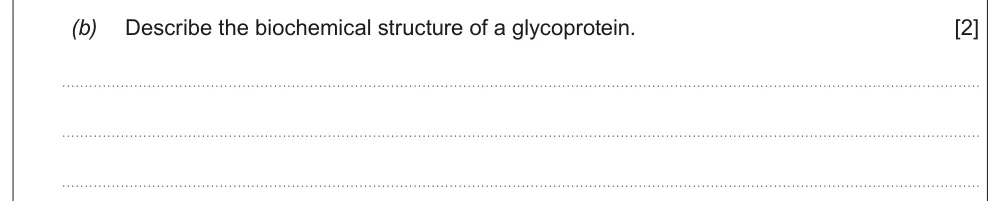
Describe the biochemical structure of a glycoprotein.
Show the mark scheme

Tap an image to open it full size.
From the examiners' report: This simple recall question was not done well. A glycoprotein is a protein with a carbohydrate chain attached.
Question 17
AS Component 1 · June 2023 · Q1(c)(i) · 2 marks · Easy
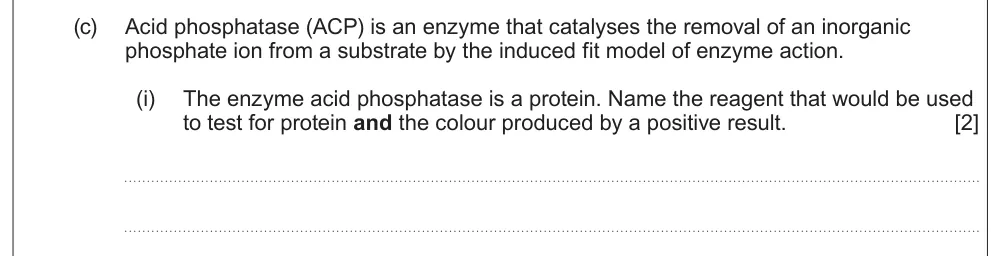
Name the reagent for the protein test and the positive colour.
Show the mark scheme

Tap an image to open it full size.
From the examiners' report: Most students knew this, but some named Benedict's. Use biuret reagent; a positive result is lilac or purple.
Question 18
AS Component 1 · June 2018 · Q3(b) · 2 marks
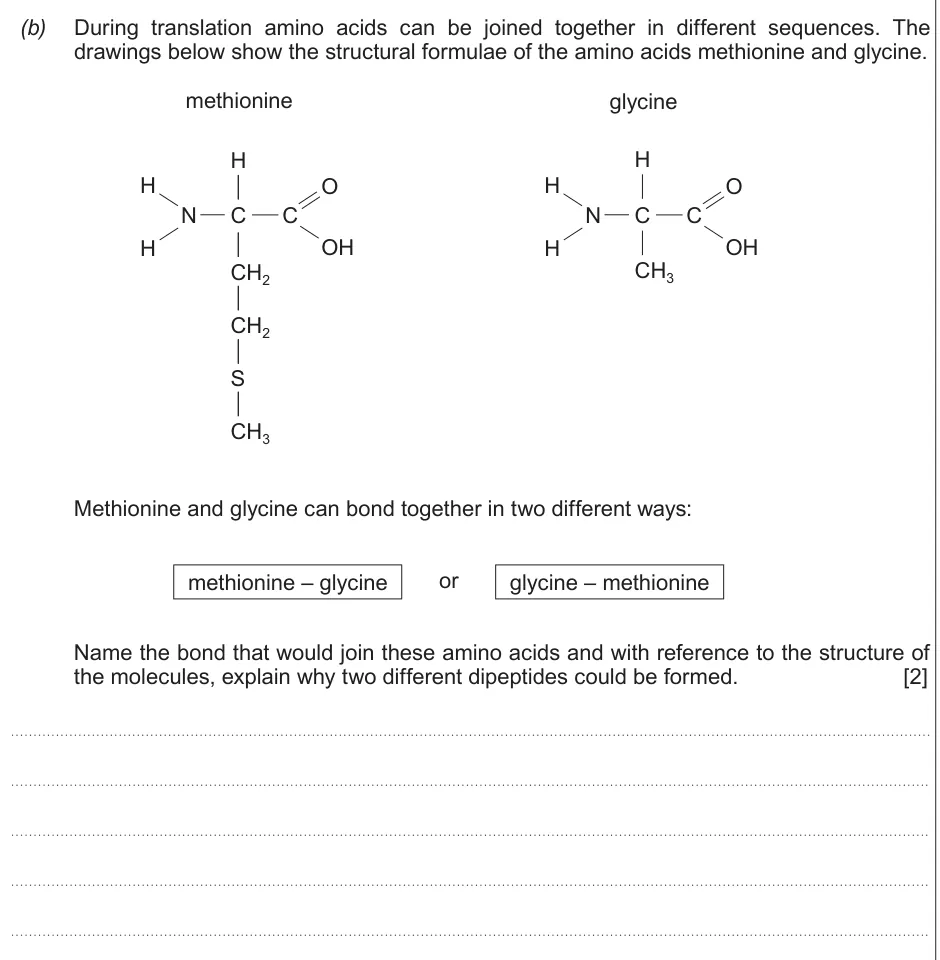
Explain why methionine and glycine can form two different dipeptides.
Show the mark scheme

Tap an image to open it full size.
From the examiners' report: Most named the peptide bond, but only the stronger students referred to the COOH group of one amino acid and the NH₂ group of the other.
Question 19
A level Component 1 · Autumn 2020 · Q2(a)(i) · 2 marks
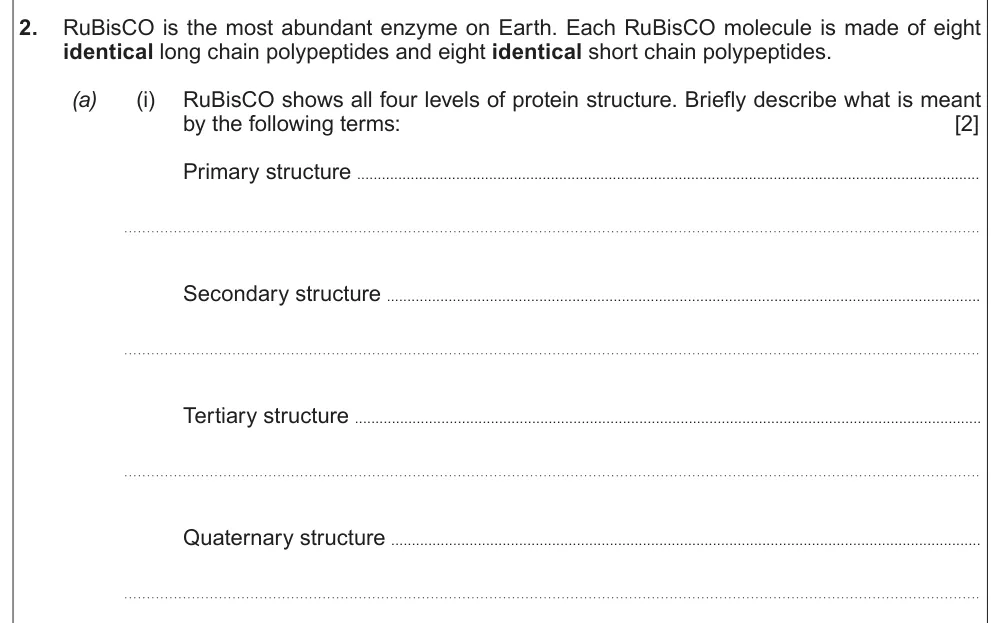
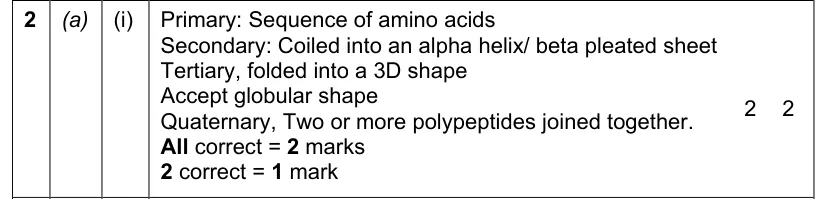
Describe the primary, secondary, tertiary and quaternary structure of a protein.
Show the mark scheme
Tap an image to open it full size.
From the examiners' report: Correct answers were rare because most students wrote about bonding. Describe what each level is: the amino acid sequence, the helix or sheet, the 3D folding, and more than one polypeptide.
Question 20
A level Component 2 · June 2024 · Q2(b)(i) · 1 mark
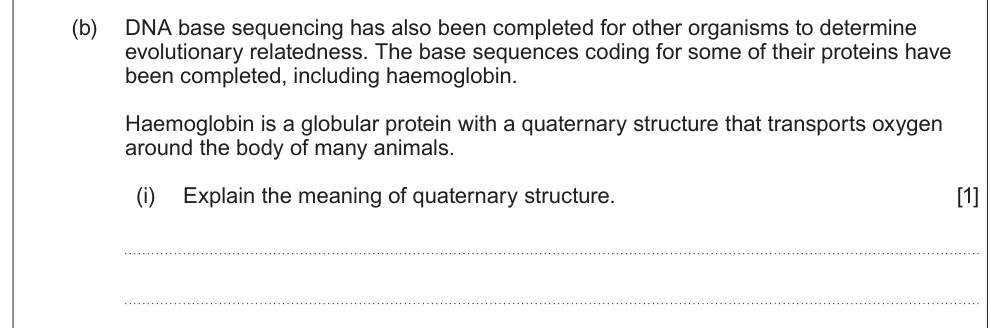
Explain the meaning of quaternary structure.
Show the mark scheme

Tap an image to open it full size.
From the examiners' report: The polypeptides must be bonded or joined together. Vague words such as "folded" or "associated" didn't score.
Question 21
AS Component 1 · June 2023 · Q1(b)(i) · 2 marks
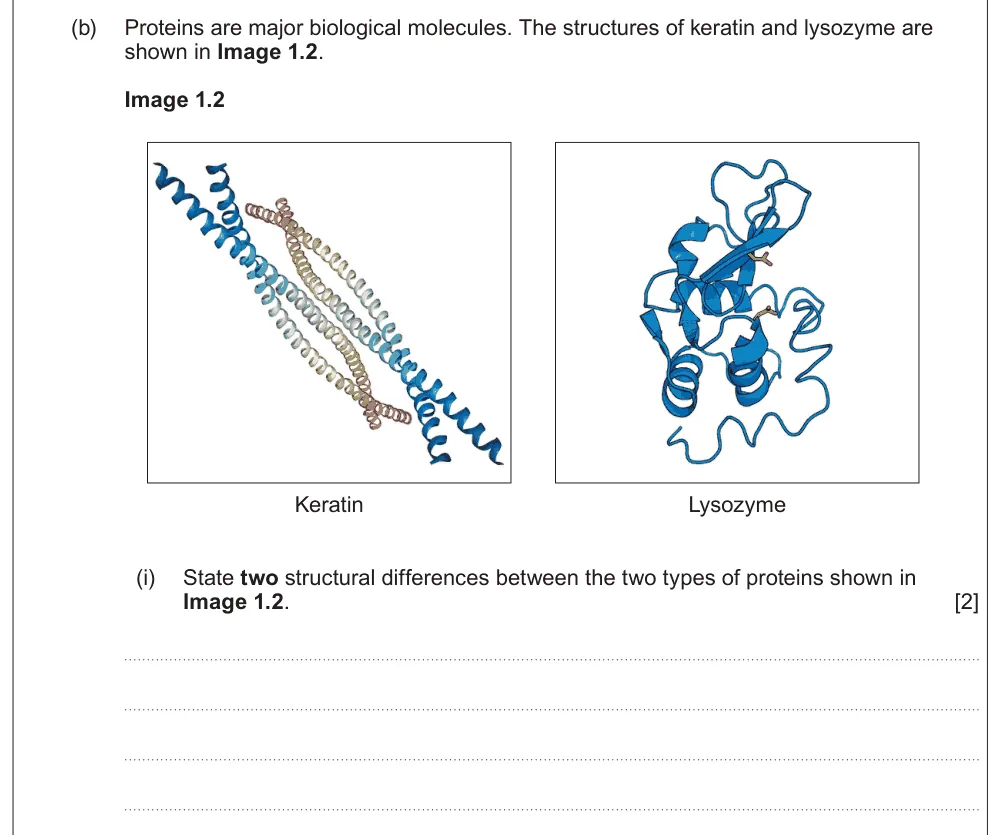
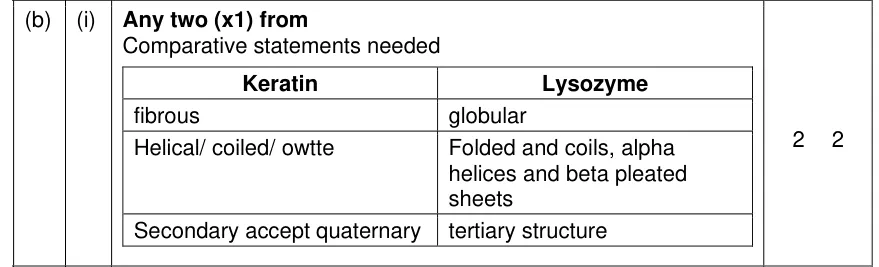
State two structural differences between keratin and lysozyme.
Show the mark scheme
Tap an image to open it full size.
From the examiners' report: Many students picked out the secondary structures and the overall level, but fewer said keratin is fibrous and lysozyme is globular.
Question 22
AS Component 1 · June 2017 · Q5(a)(i) · 1 mark
Explain what is meant by hydrolysis.
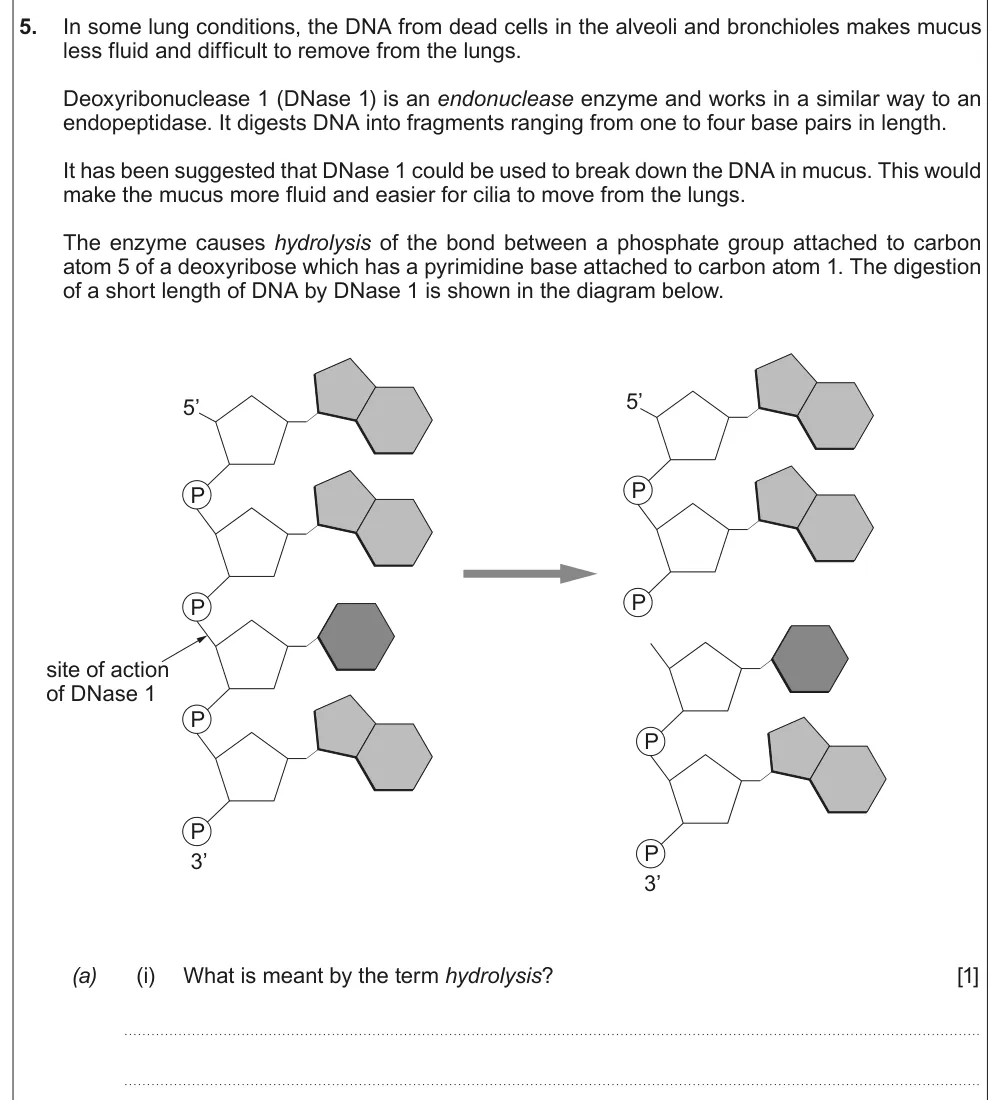
Show the mark scheme

Tap an image to open it full size.
From the examiners' report: Many students knew the idea but gave too little detail: water is added to break a bond.
Where students lose marks (from Eduqas examiners' reports and mark schemes)
Each point below is followed by wording that gained marks.
Strengthen, not just "used in": Some answers said calcium is used in bones.
✔ Gains credit: Calcium ions "strengthen bones / teeth".
Two condensations, two waters: Students didn't remove two water molecules when three sugars join.
✔ Gains credit: "C18H32O16".
Only beta in cellulose: Some students think cellulose contains both alpha and beta glucose.
✔ Gains credit: "Starch only alpha glucose, cellulose only β glucose".
Alternate molecules rotate: Answers said each glucose is rotated.
✔ Gains credit: "Alternate glucose molecules rotated by 180 degrees".
Carbon to carbon double bonds: "Double bonds" alone, with no comparison, didn't score.
✔ Gains credit: "Saturated: no C=C bonds; unsaturated: has C=C bond".
A polymer is a chain: Many students left out that a polymer is a chain of monomers.
✔ Gains credit: "A polymer is a chain of identical monomers / triglyceride is not a chain".
Biuret, not Benedict's: Some students named Benedict's solution for protein.
✔ Gains credit: "Add biuret reagent" giving a "lilac/purple colour".
Bonded, not folded: Words like folded or associated didn't gain credit.
✔ Gains credit: "Contains more than one polypeptide bonded / joined together".
Download the questions
Download the PDF pack (22 questions, mark schemes at the end)
Keep practising
- Cell Structure and Organisation (CC2): Eduqas A Level Biology exam questions by topic
- Cell Membranes and Transport (CC3): Eduqas A Level Biology exam questions by topic
- Enzymes (CC4): Eduqas A Level Biology exam questions by topic
- Nucleic Acids and their Functions (CC5): Eduqas A Level Biology exam questions by topic
- Eduqas A level Biology past papers, mark schemes and examiners' reports
- Eduqas A level Biology grade boundaries
- Ask about Eduqas A level Biology lessons with Sam on WhatsApp
Questions, mark schemes and examiners' report extracts © WJEC CBAC Ltd (Eduqas).