

Each Eduqas Biology paper has one 9-mark question that tests the quality of extended response (QER). It is not marked point by point. The mark scheme lists indicative content in three areas, which match the things the question asks for, and places your answer in one of three bands: 1–3, 4–6 or 7–9 marks. The top band needs detail from all three areas in "an articulate, integrated account" that "shows sequential reasoning", with "no irrelevant inclusions or significant omissions". This page has all eleven QER questions on Component 2 topics: classification, meiosis, human and plant reproduction, evolution, and the genome projects and gene technology. Most give you a passage, graph, map or drawing to work from. Questions marked AS are from the AS papers (B400); the rest are from the A level papers (A400).
The examiners' main warning is to use the information provided. Many answered from memory: pages on wind pollination gained few marks, and theoretical accounts of speciation could not reach full marks, when the facts needed were in the passage, map or graph. The best answers took the three parts of the question in turn and applied their knowledge to the example given. Irrelevant material, such as a detailed account of PCR, gains nothing. Use terms exactly: pollination is not fertilisation, seeds are not pollen, and a flower is not a plant. When a graph is given, link each change in it to the event that causes it.
I don't teach the Eduqas specification myself, so for one-to-one help I recommend Sam. He teaches Eduqas A level Biology at a top-rated sixth form college and is very popular with his students. You can ask about lessons with Sam on WhatsApp using the link at the bottom of this page.
What you need first
Each question on this page assumes you're secure on these ideas. If any of them feels shaky, look it up before you start.
- The stages of meiosis, when DNA is replicated, and how crossing over and independent assortment produce genetic variation.
- How FSH, LH, oestrogen and progesterone interact, including negative and positive feedback.
- The structure of an insect-pollinated flower, the difference between pollination, fertilisation and seed dispersal, and how pollen grains develop.
- Natural selection, allopatric and sympatric speciation, and how reverse transcriptase, restriction enzymes and marker genes are used in gene technology.
Key terms
These words come up in the questions and mark schemes. Examiners expect you to use them exactly.
- QER: quality of extended response: the 9-mark question on each paper that is marked in bands, not point by point.
- Indicative content: the points listed in the mark scheme for a QER question, set out in three areas.
- Phylogenetic tree: a branching diagram showing how closely related organisms are, here built from ribosomal RNA.
- Bivalent: a pair of homologous chromosomes lying together in prophase I of meiosis.
- Cross-pollination: the transfer of pollen from an anther to the stigma of a flower on a different plant of the same species.
- Allopatric speciation: the formation of new species from populations that are geographically isolated.
- Sympatric speciation: the formation of new species in the same area through reproductive isolation.
- Reverse transcriptase: the enzyme that makes a single strand of cDNA from an mRNA template.
What these questions cover
The questions are built on these statements from the Eduqas A level Biology specification (A400). Each one also draws on other parts of the same topic.
- 2.1(b) the need for classification and its tentative nature
- 2.2(d) the main stages of meiosis (names of subdivisions of prophase 1 not required) and cytokinesis
- 2.3(c) the endocrine control of reproduction in the female: including the menstrual cycle, birth and lactation
- 2.4(b) the development of pollen and ovules, including examination of prepared slides of anther and ovary
- 2.4(c) cross and self-pollination
- 2.6(k) Darwin's theory of evolution that existing species have arisen through modification of ancestral species by natural selection
- 2.7(a) the Human Genome Project and its extension to the 100K Genome Project
- 2.7(e) the formation of recombinant DNA by insertion of foreign DNA into bacterial plasmids and the cloning of the bacteria to produce useful molecules as illustrated by insulin
How to use this page
Write your answer on paper before you open the mark scheme. Allow about 1.2 minutes per mark: the 11 questions are worth 99 marks, so about 119 minutes in total. Then mark your answer strictly against the mark scheme and read the examiners' tip underneath it. If you'd rather print the questions, download the PDF pack.
2.1 Classification and biodiversity
Question 1
A level Component 2 · June 2017 · Q7 · 9 marks
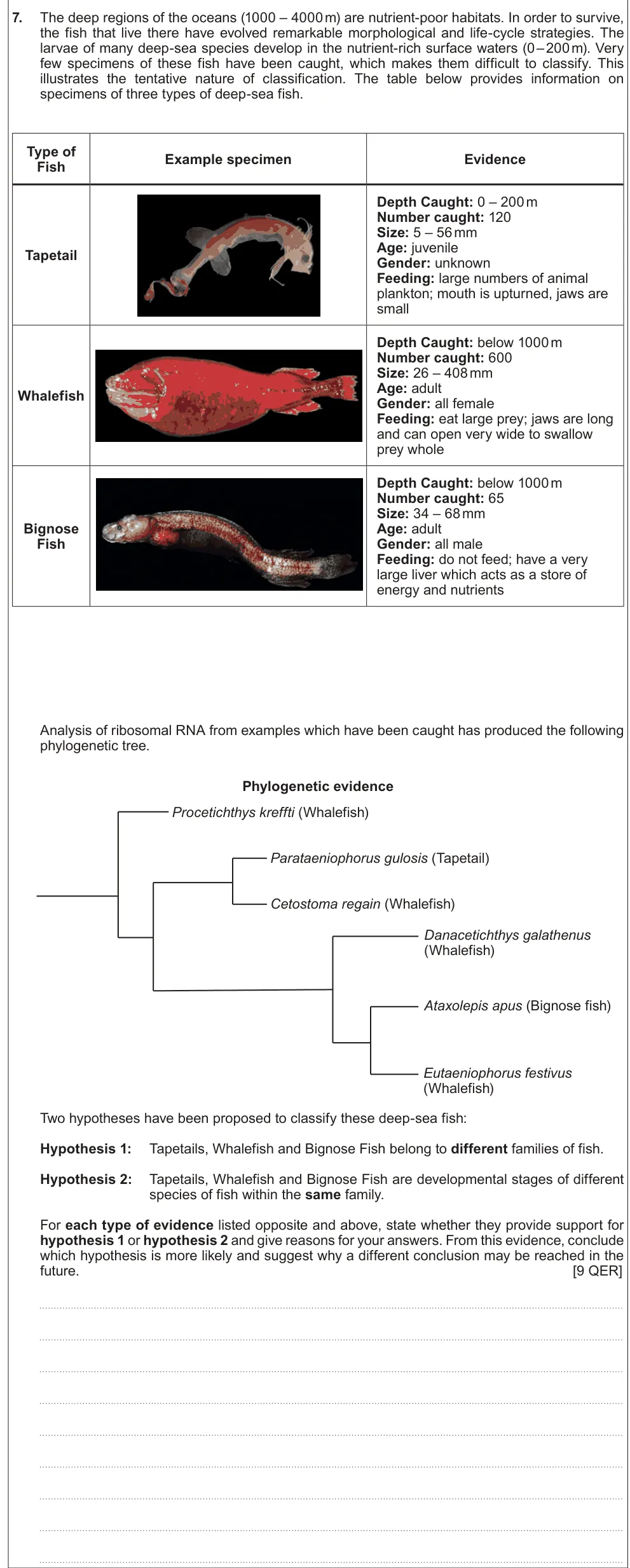
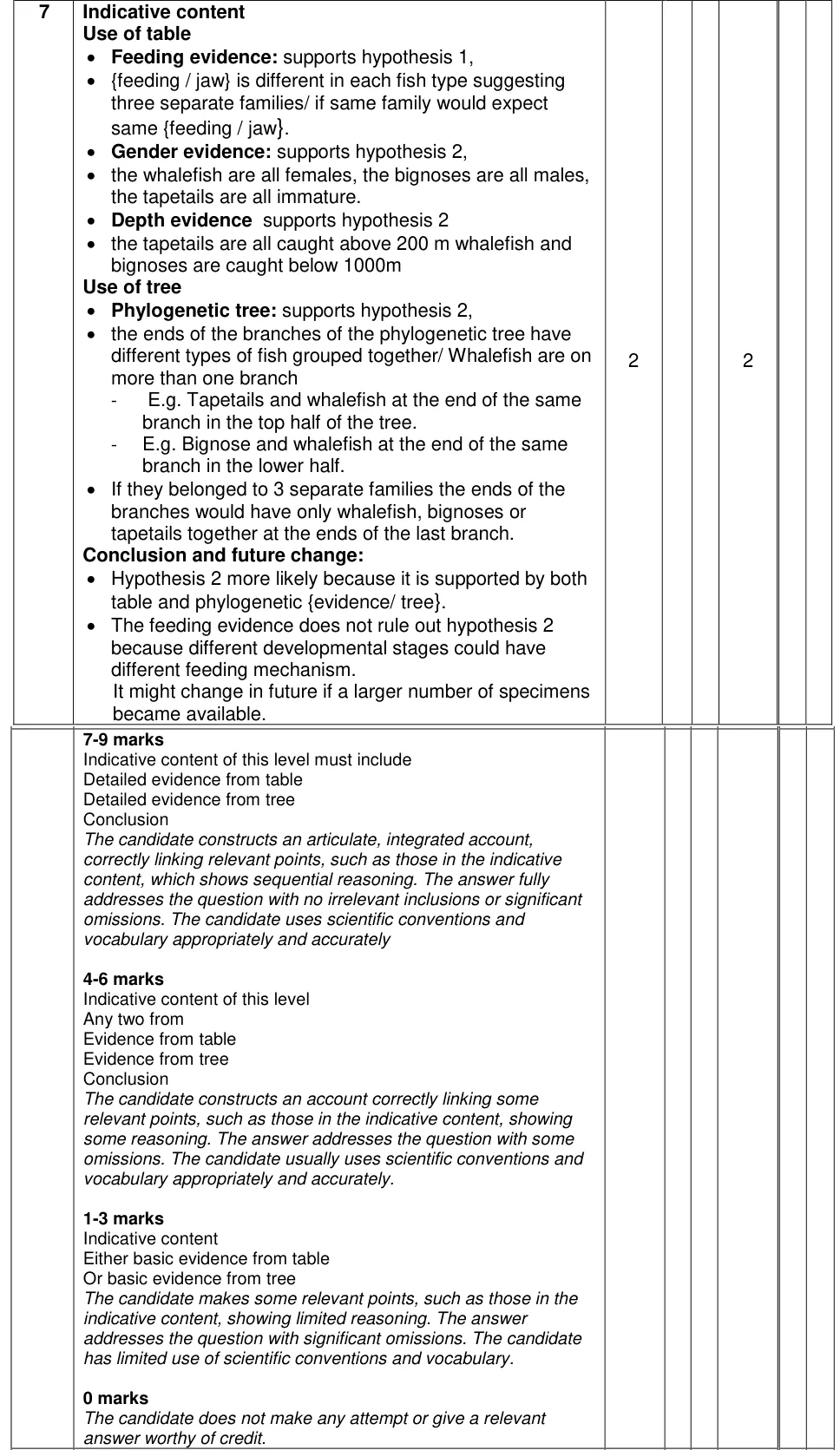
Use a table of evidence and a phylogenetic tree for three types of deep-sea fish to judge two hypotheses about their classification, and suggest why the conclusion might change.
Show the mark scheme
Tap an image to open it full size.
From the examiners' report: The best answers used all the evidence in the table, analysed the phylogenetic tree sensibly and gave a conclusion that weighed up the quality of the evidence. Too many wrote a lot of irrelevant material without saying which hypothesis each piece of evidence supported, and some read 'developmental stages' as stages of evolution.
2.2 Cell division
Question 2
AS Component 1 · Autumn 2021 · Q6 · 9 marks
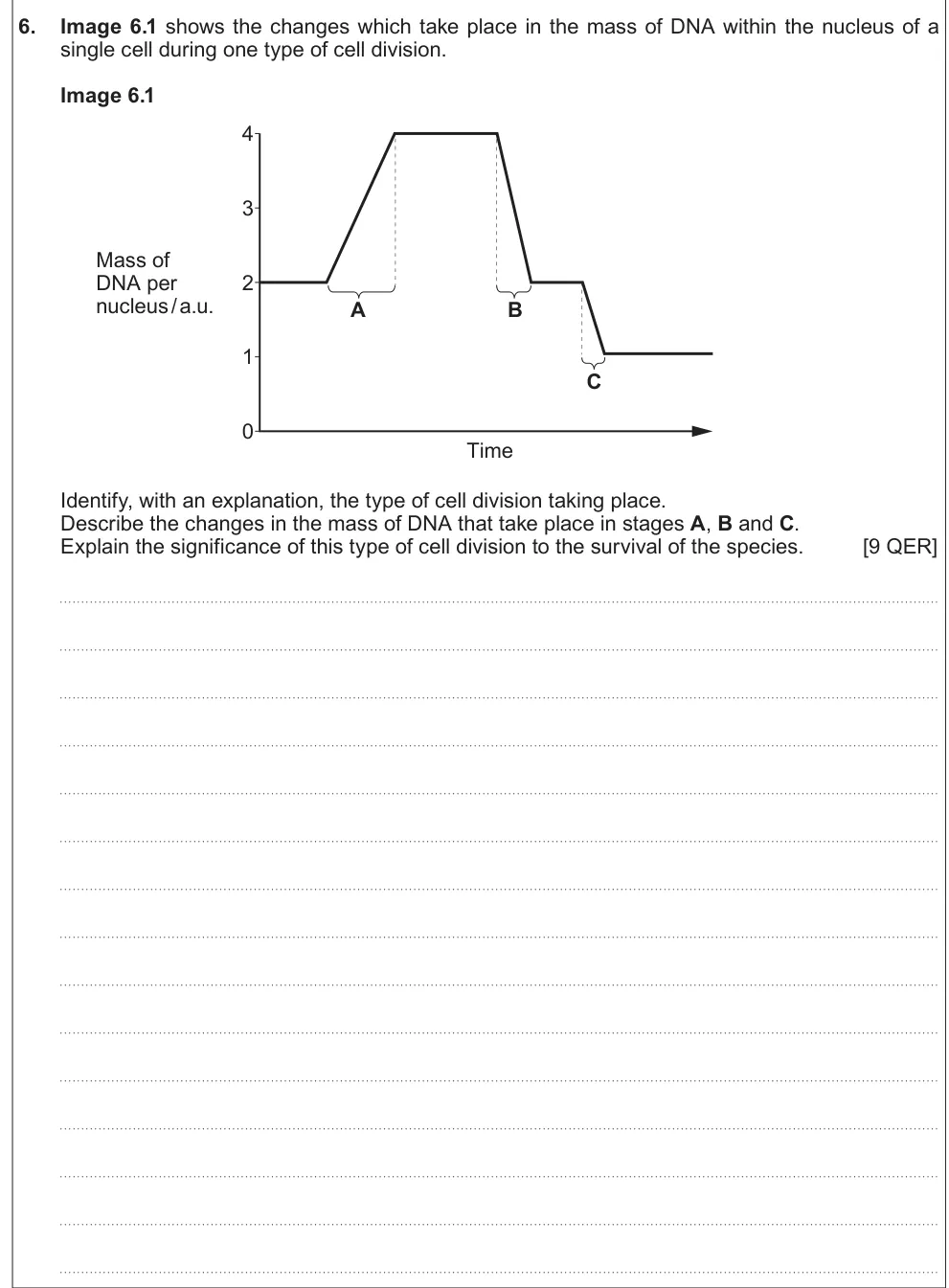
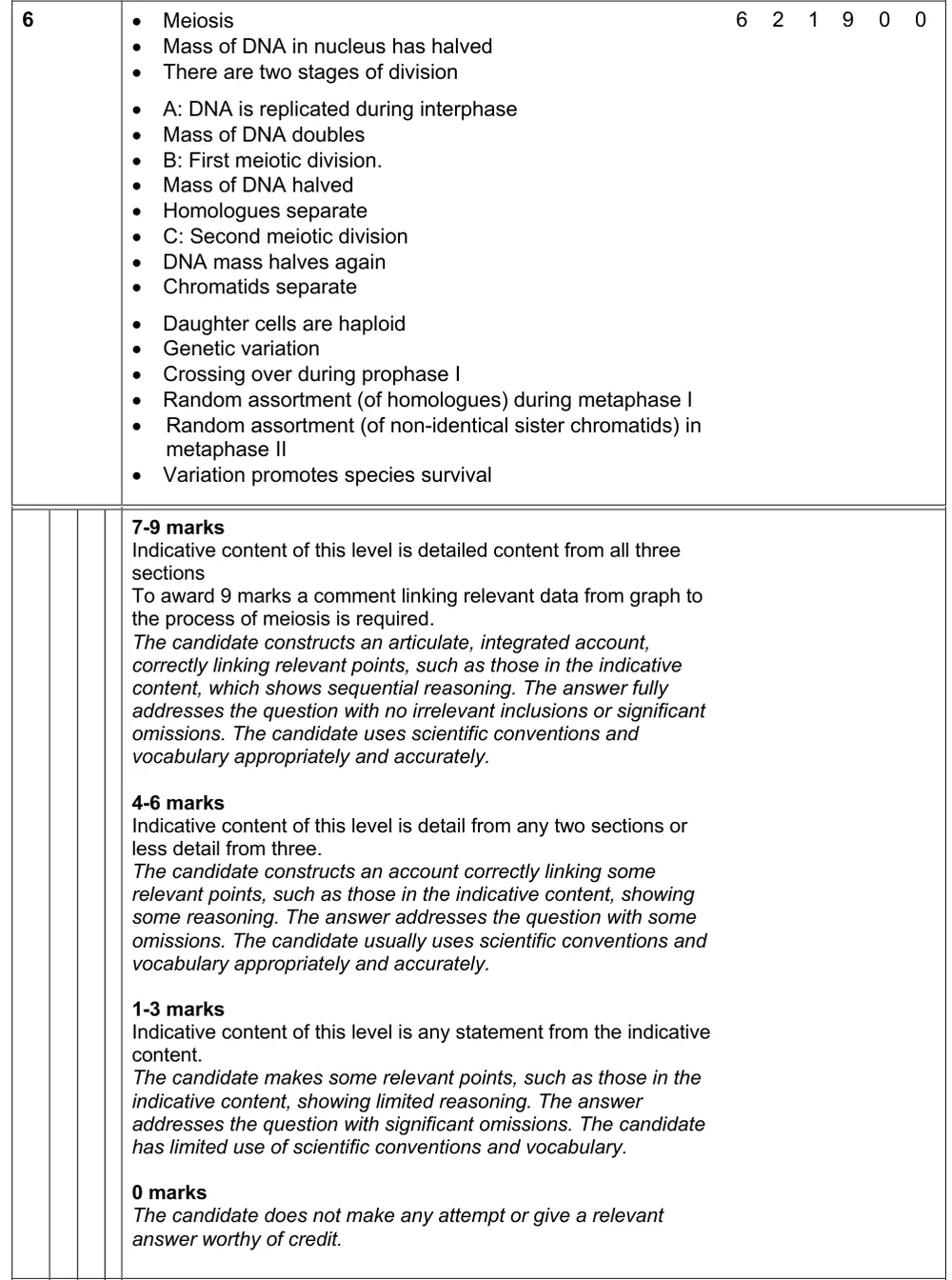
Use a graph of the mass of DNA per nucleus to identify the type of cell division, describe the changes at stages A, B and C, and explain why this division matters for the survival of the species.
Show the mark scheme
Tap an image to open it full size.
Question 3
AS Component 1 · June 2023 · Q5 · 9 marks
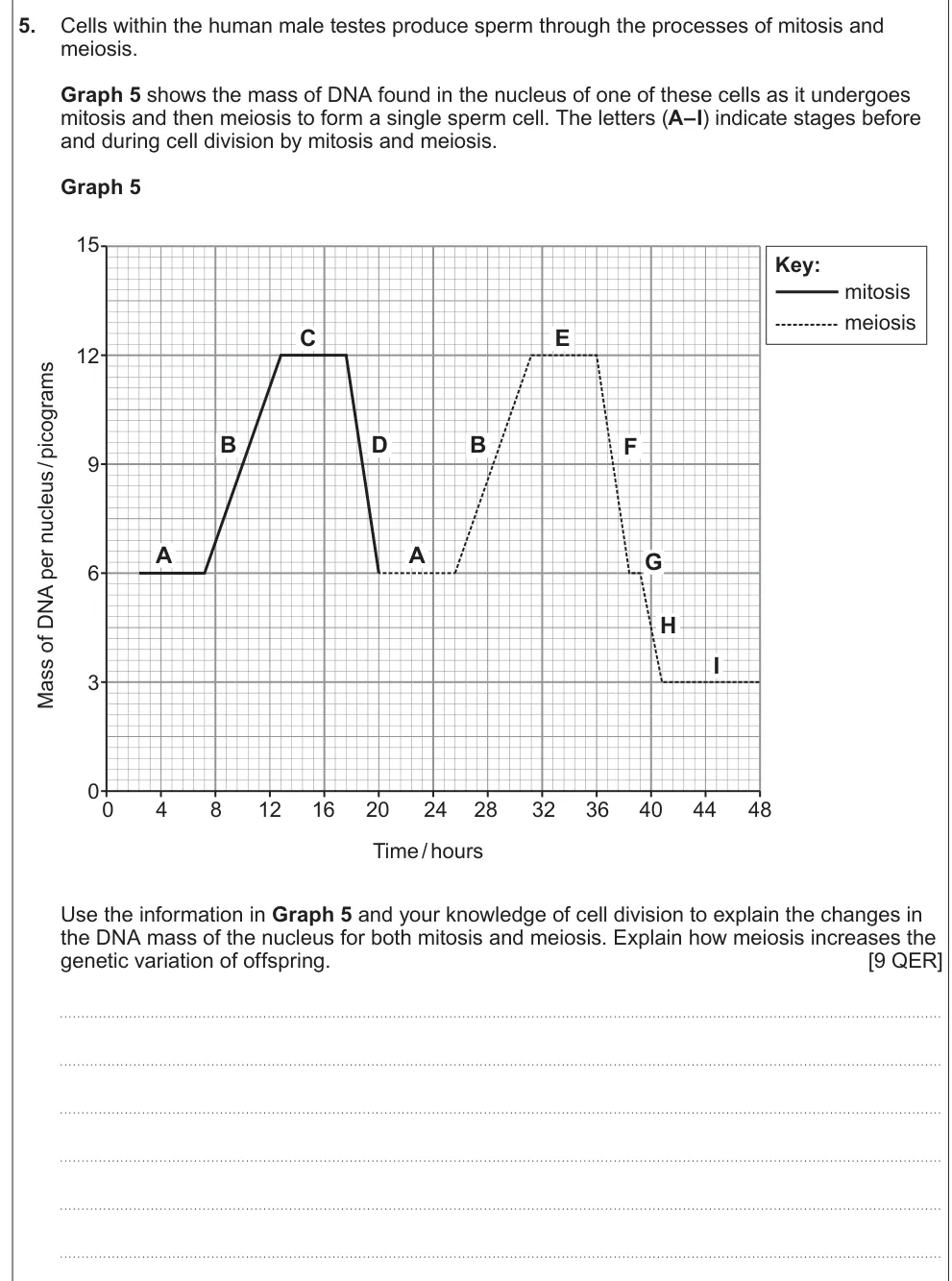
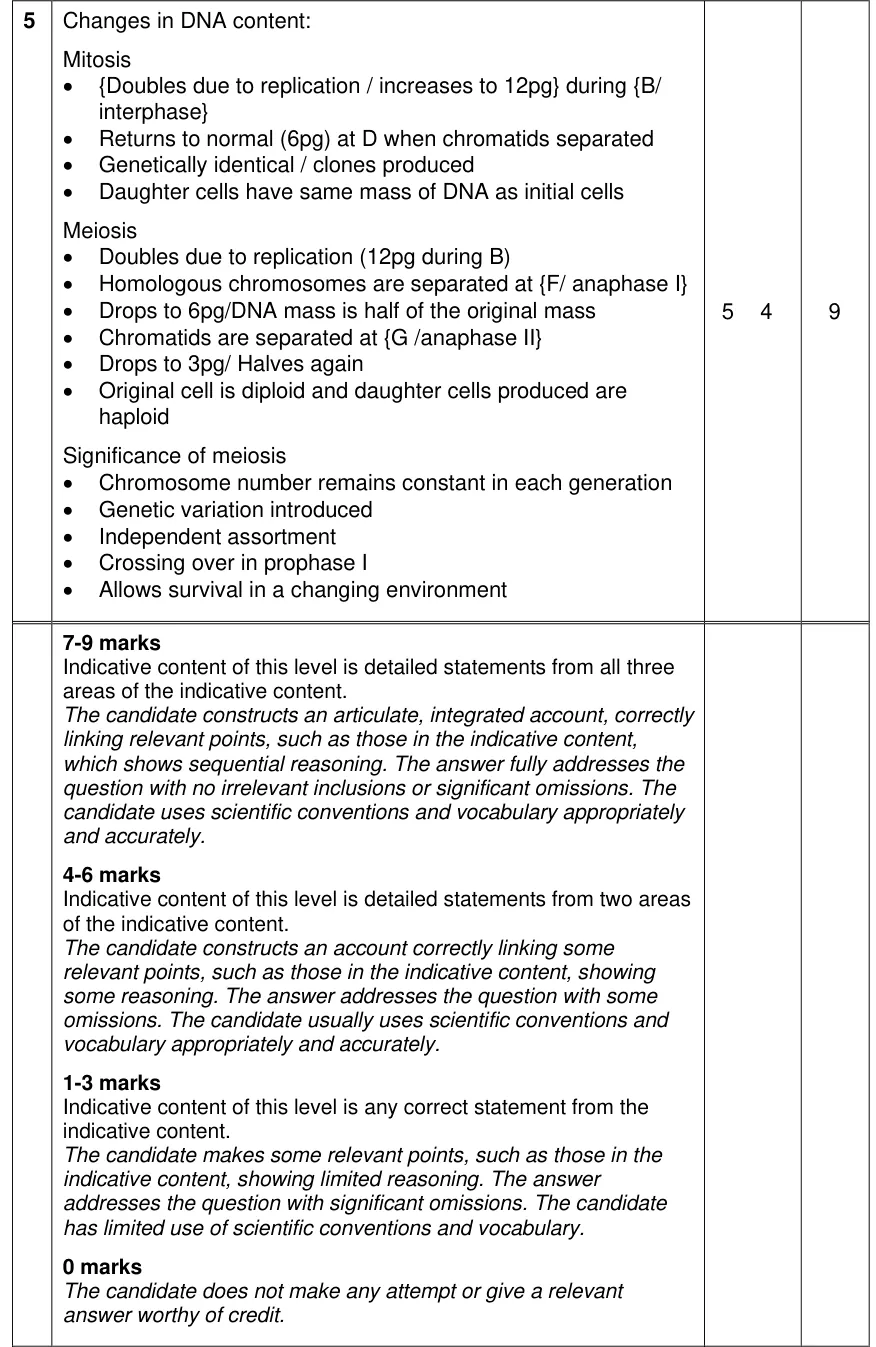
Use a graph of DNA mass in a cell forming sperm to explain the changes during mitosis and meiosis, and explain how meiosis increases genetic variation.
Show the mark scheme
Tap an image to open it full size.
From the examiners' report: Strong answers used data from the graph and linked each change in DNA content to what was happening, such as homologous chromosomes or chromatids being separated. Weaker answers listed the stages with no reason for the change, or only said that the mass rose or fell. Listing the letters and naming a stage for each was not needed.
2.3 Sexual reproduction in humans
Question 4
A level Component 2 · June 2023 · Q8 · 9 marks
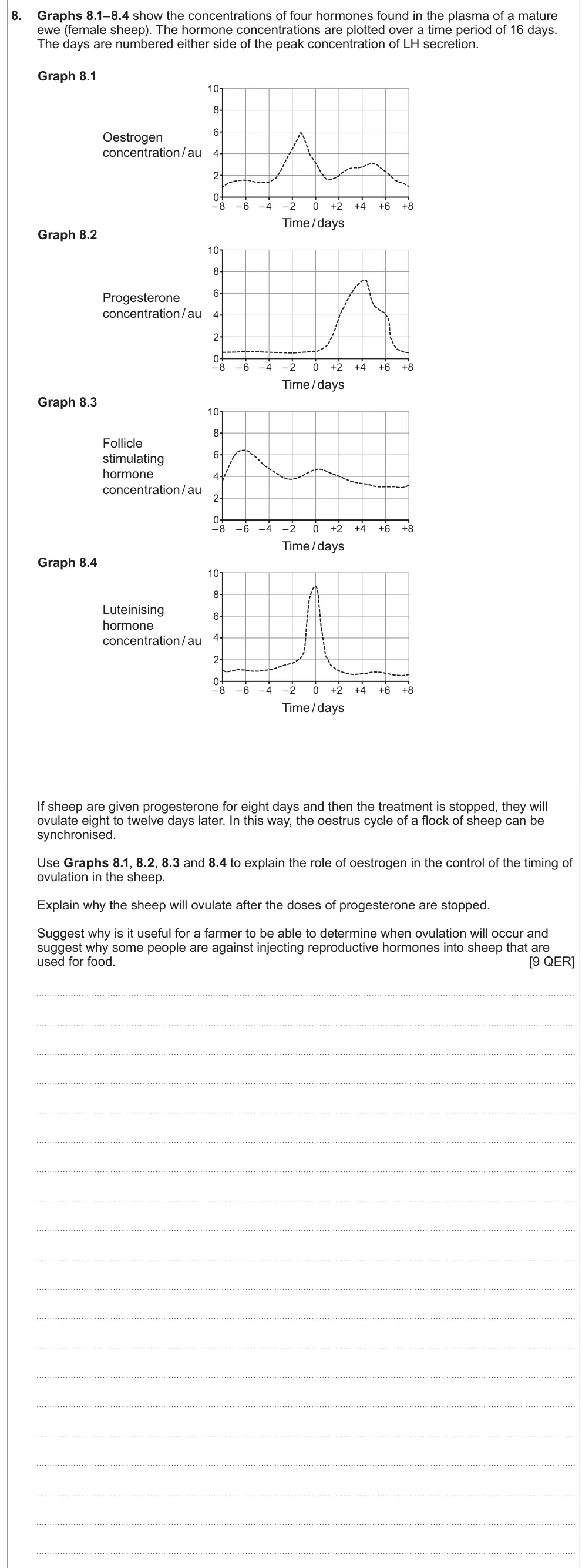
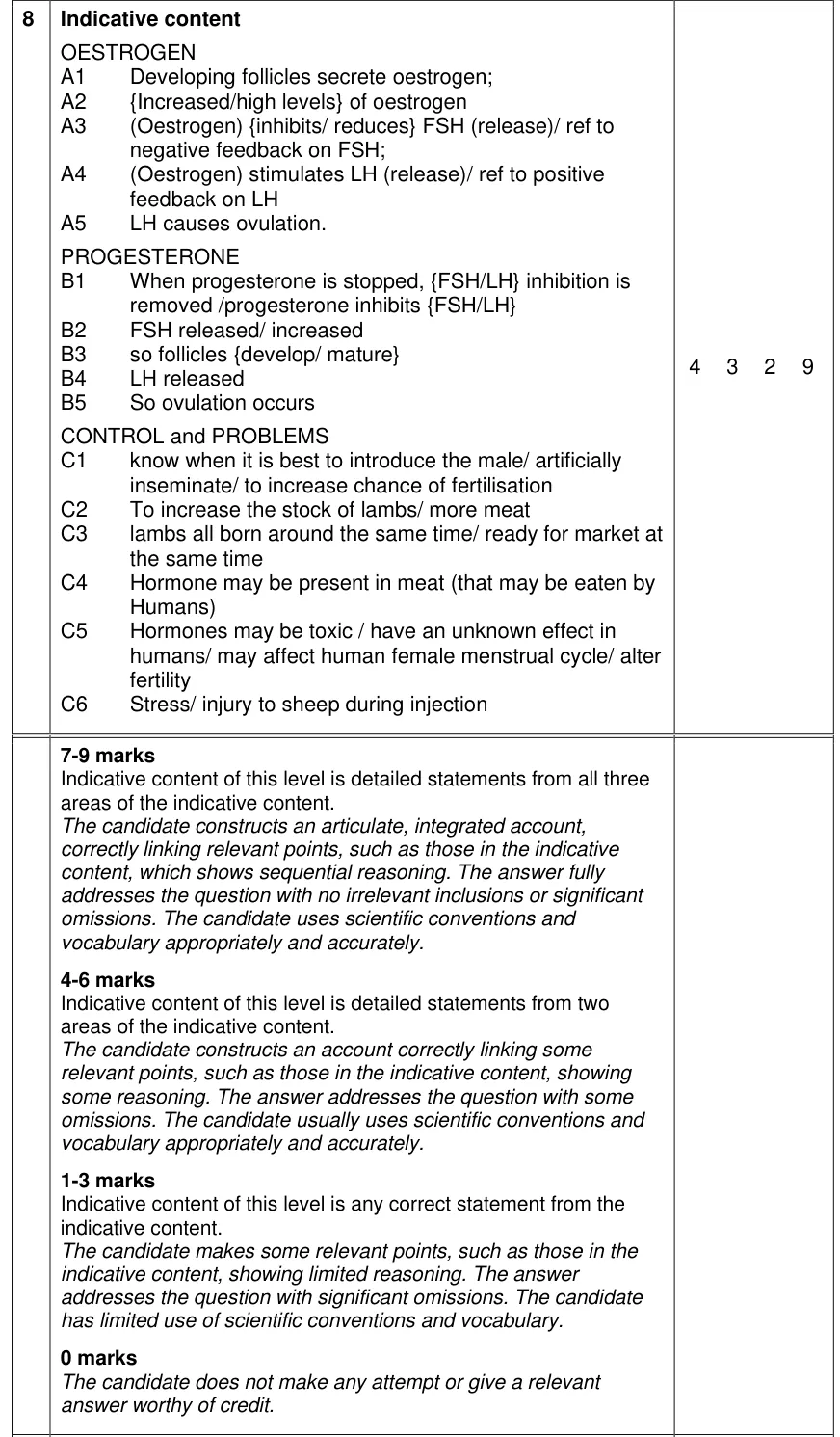
Use four hormone graphs to explain the role of oestrogen in timing ovulation in sheep, why ovulation follows the end of progesterone treatment, and the uses of and objections to this treatment.
Show the mark scheme
Tap an image to open it full size.
From the examiners' report: The best answers took the three parts in turn. The role of oestrogen was often well expressed, and there was no need to write about the endometrium. The second part asked why ovulation happens once progesterone is stopped, not for the role of progesterone. Vague objections such as 'unethical', or that sheep cannot give consent, gained nothing.
2.4 Sexual reproduction in plants
Question 5
A level Component 2 · June 2025 · Q7 · 9 marks
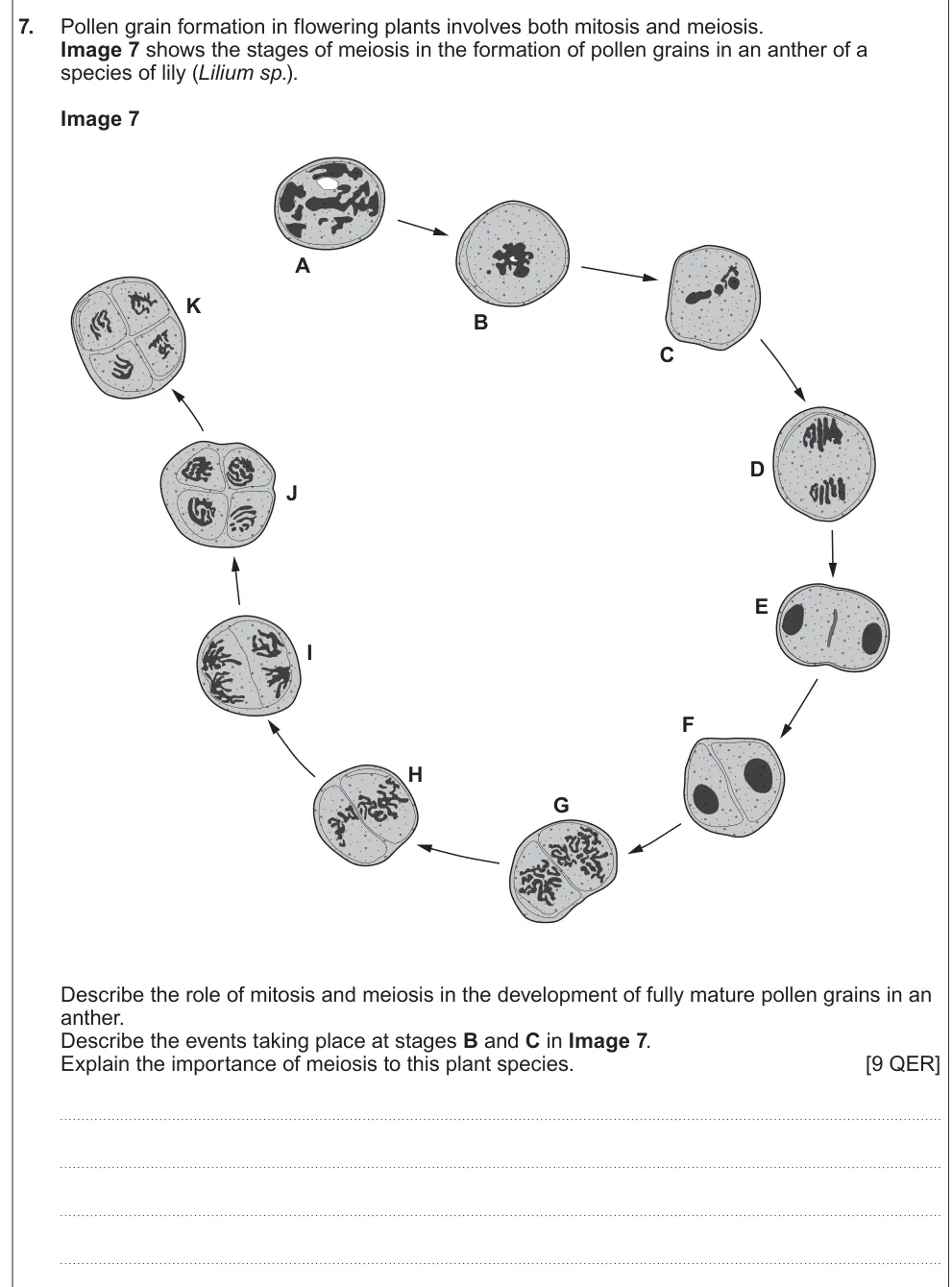
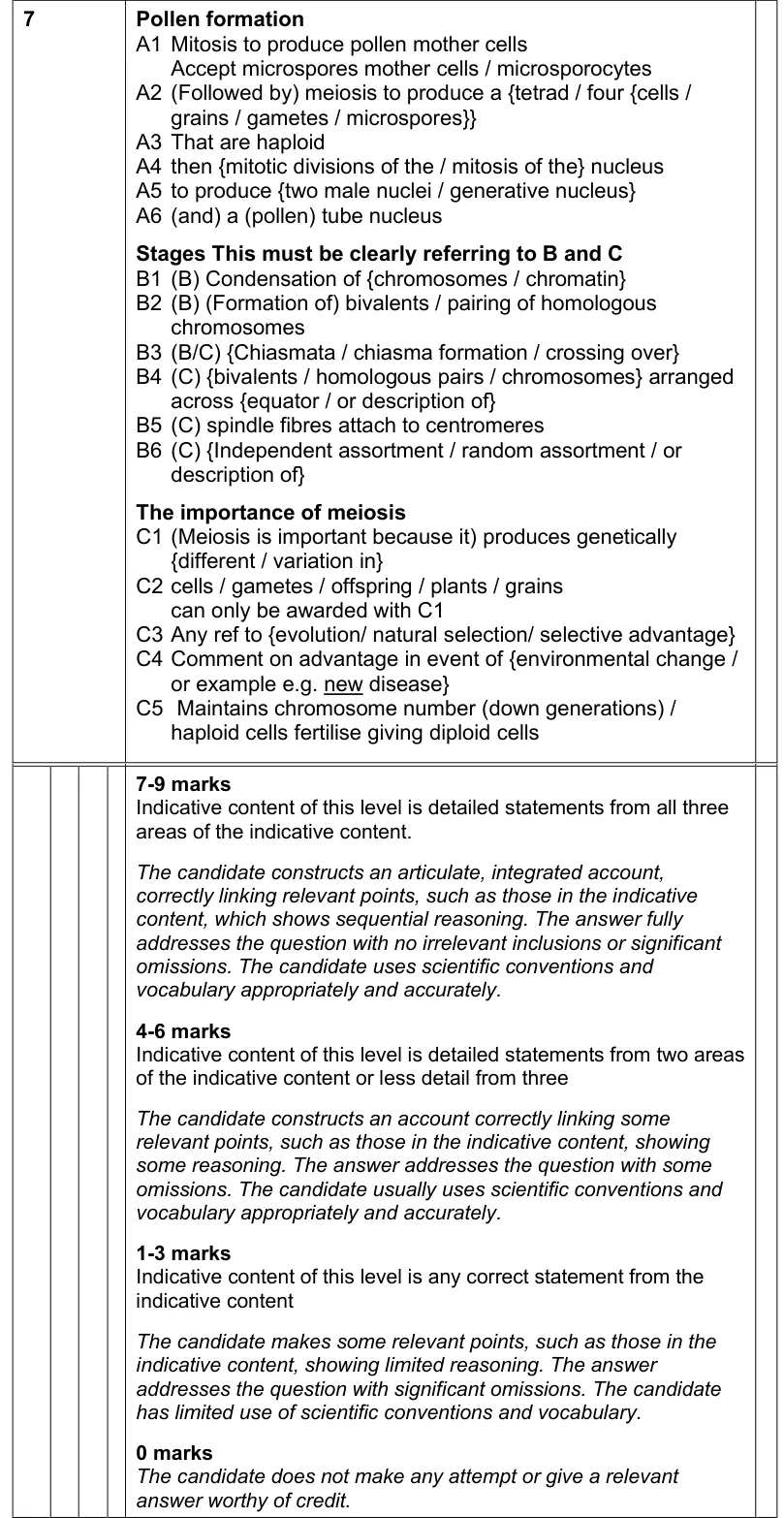
Describe the roles of mitosis and meiosis in forming mature pollen grains, describe the events at two labelled stages of meiosis in an image, and explain the importance of meiosis to the plant.
Show the mark scheme
Tap an image to open it full size.
From the examiners' report: Most answers scored in the upper two bands. Many forgot that mitosis produces the pollen mother cells. Only events clearly credited to stages B and C counted, so a general account of the whole of meiosis was not enough. In the last part genetic variation was often left unqualified, and maintaining the chromosome number was often missing.
Question 6
A level Component 2 · June 2019 · Q8 · 9 marks
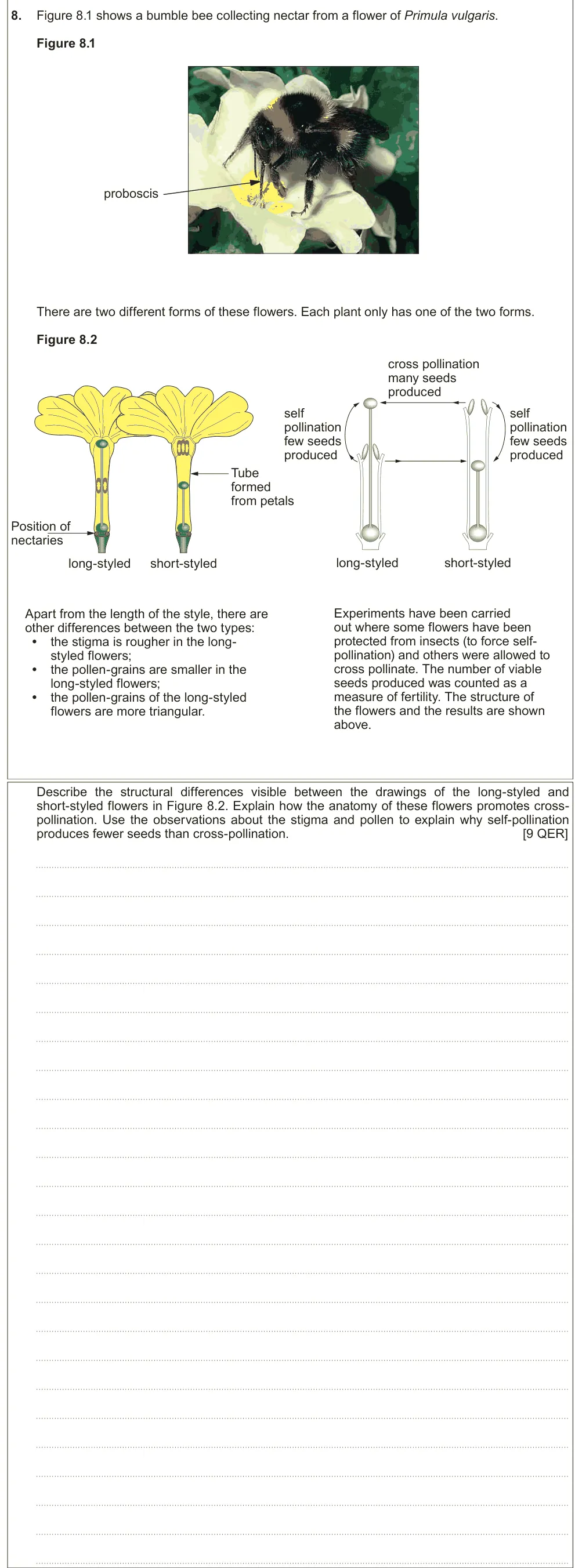
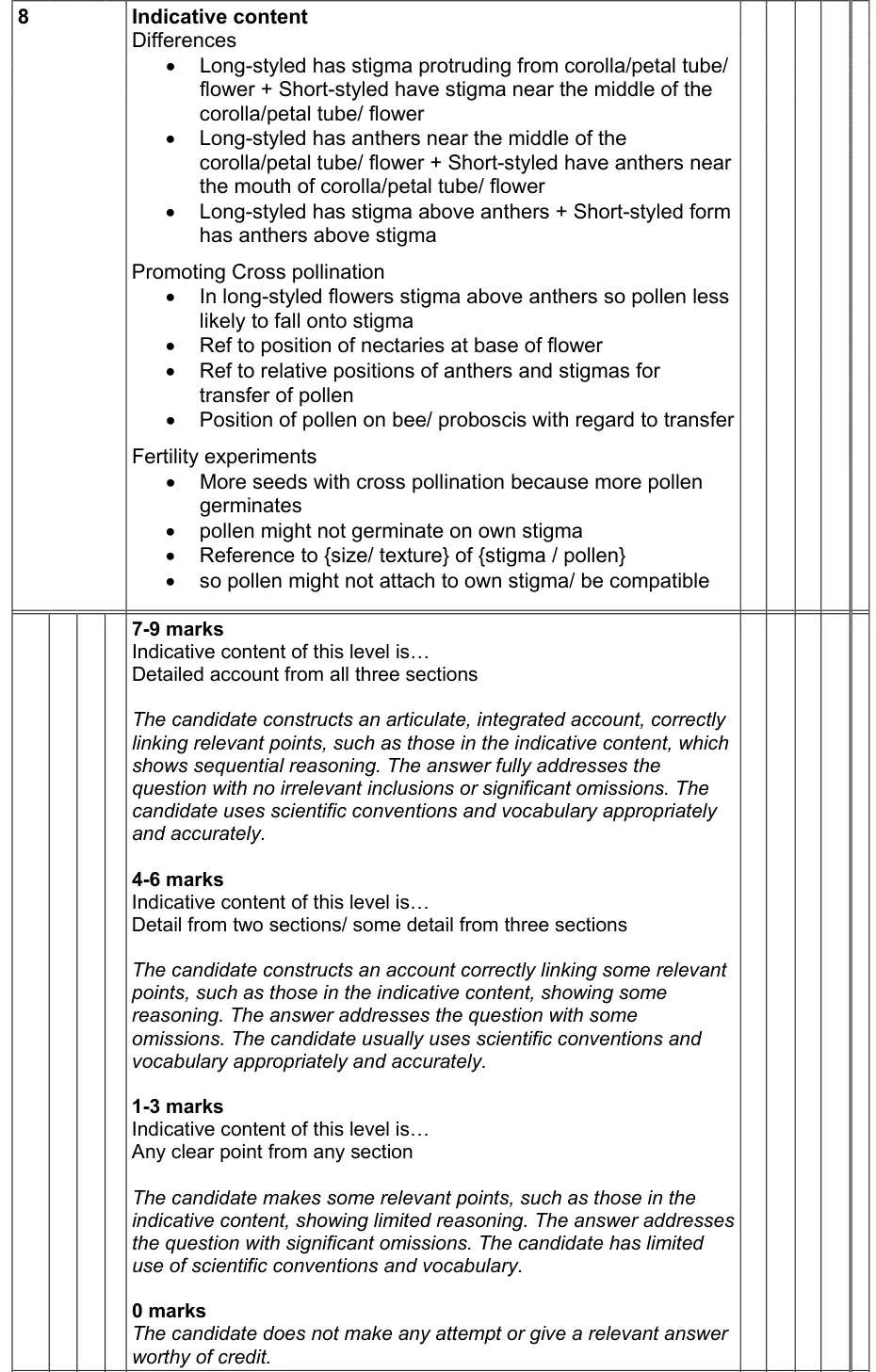
Describe the differences between drawings of long-styled and short-styled flowers, explain how their anatomy promotes cross-pollination, and use observations of stigma and pollen to explain the seed numbers.
Show the mark scheme
Tap an image to open it full size.
From the examiners' report: The best answers took the question in its three parts and used all the information provided. Many ignored the wording and described pollination in general, or compared wind- and insect-pollinated flowers. The word 'plant' was often wrongly used for 'flower'.
Question 7
A level Component 2 · June 2022 · Q7 · 9 marks
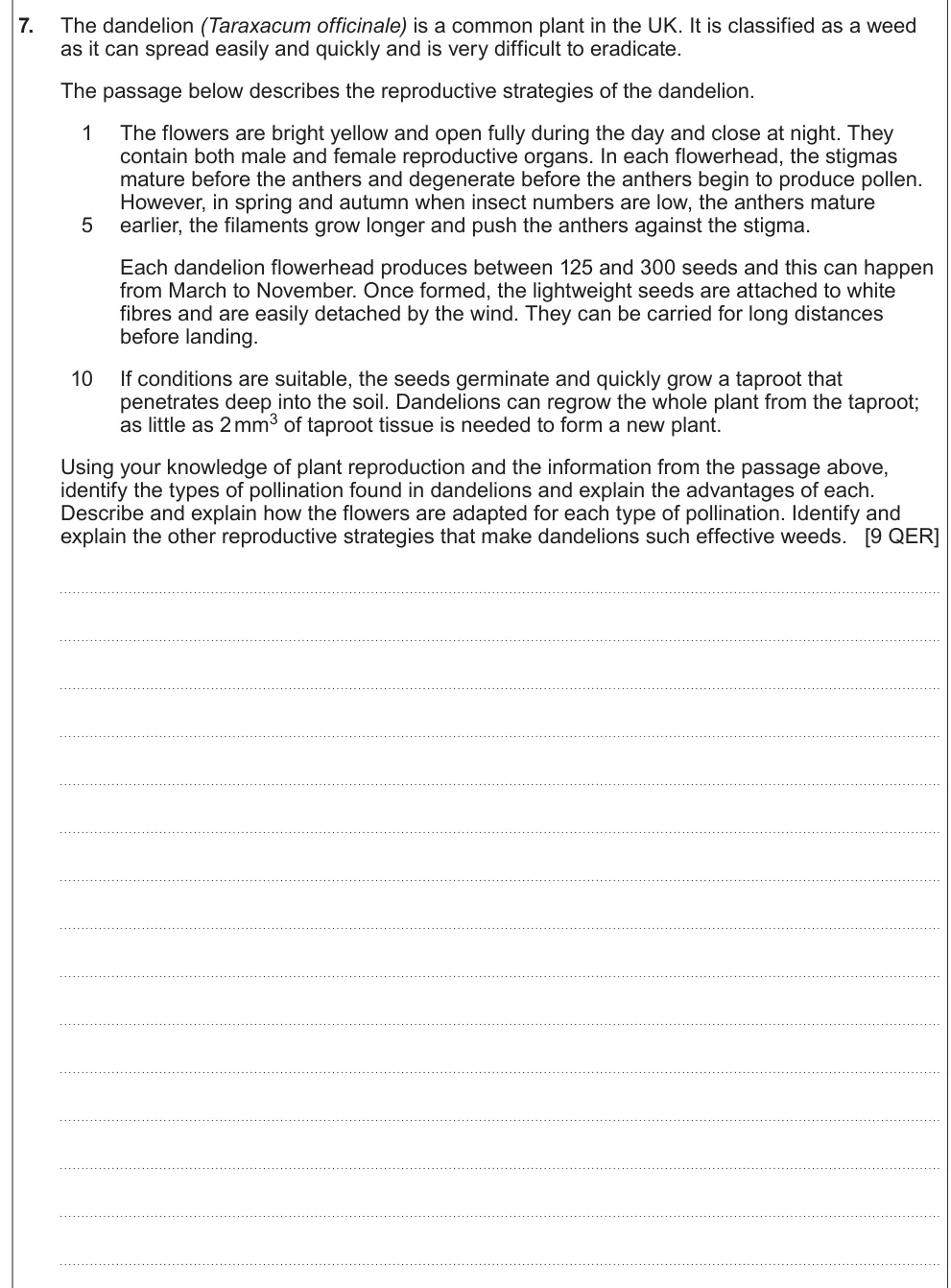
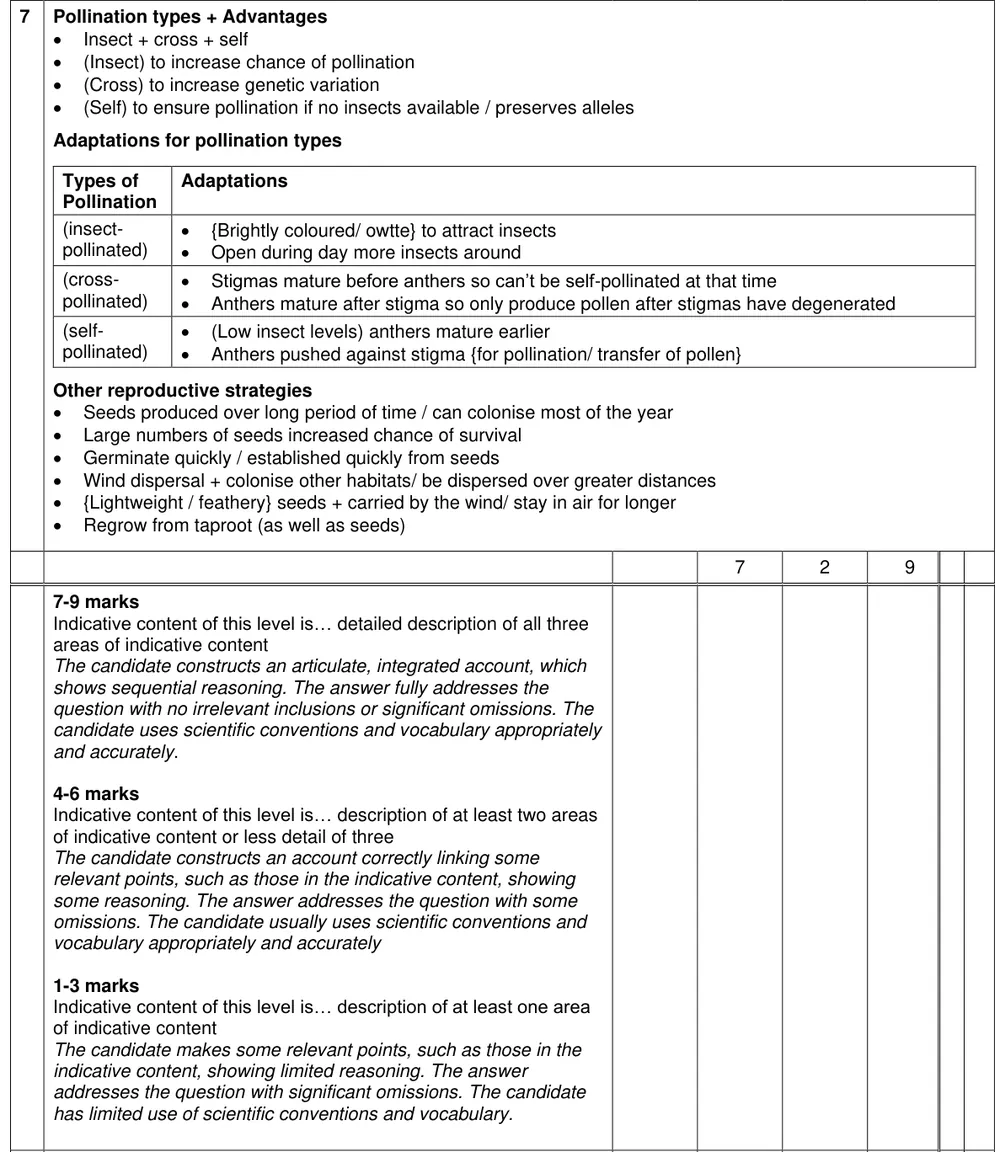
Use a passage about dandelions to identify their types of pollination and the advantages of each, explain how the flowers are adapted for each type, and explain their other reproductive strategies.
Show the mark scheme
Tap an image to open it full size.
From the examiners' report: Many answered from memory with little attention to the passage, giving long accounts of wind pollination, gamete production and double fertilisation that were not relevant. Pollination and fertilisation were used as if they meant the same, and seeds were confused with pollen. High marks went to those who picked the relevant facts from the passage and applied them.
2.6 Variation and evolution
Question 8
A level Component 2 · Autumn 2020 · Q7 · 9 marks
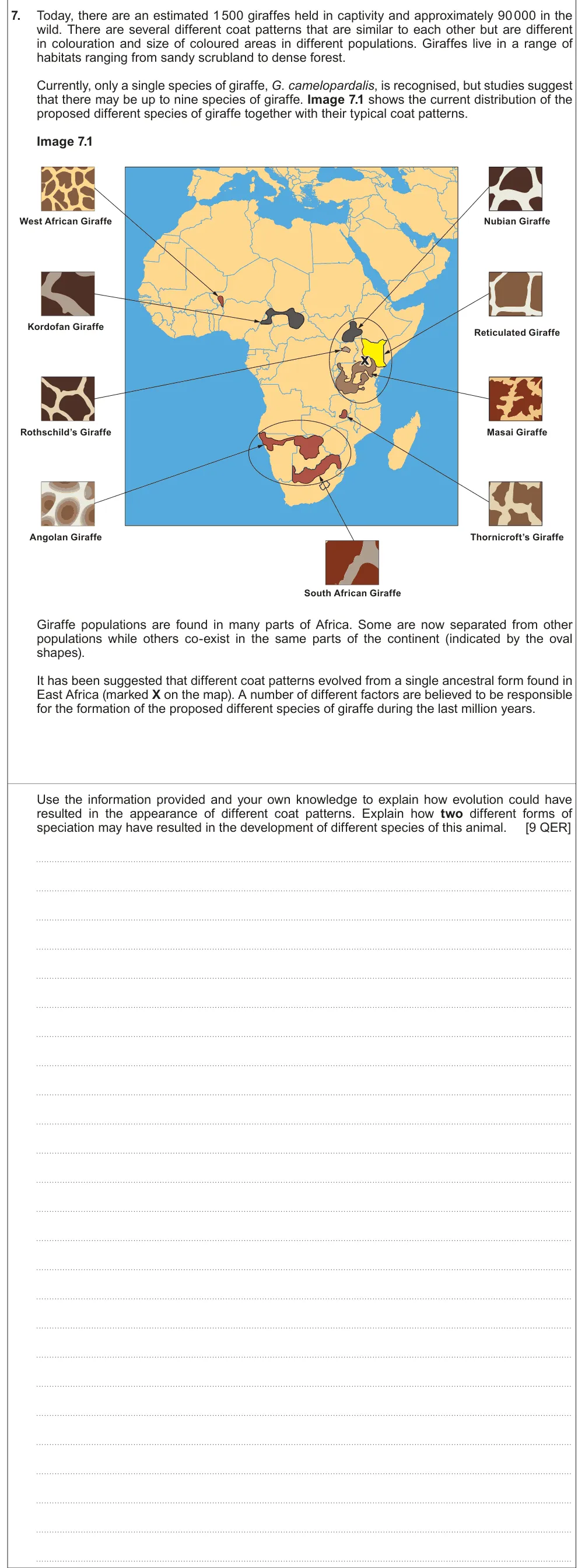
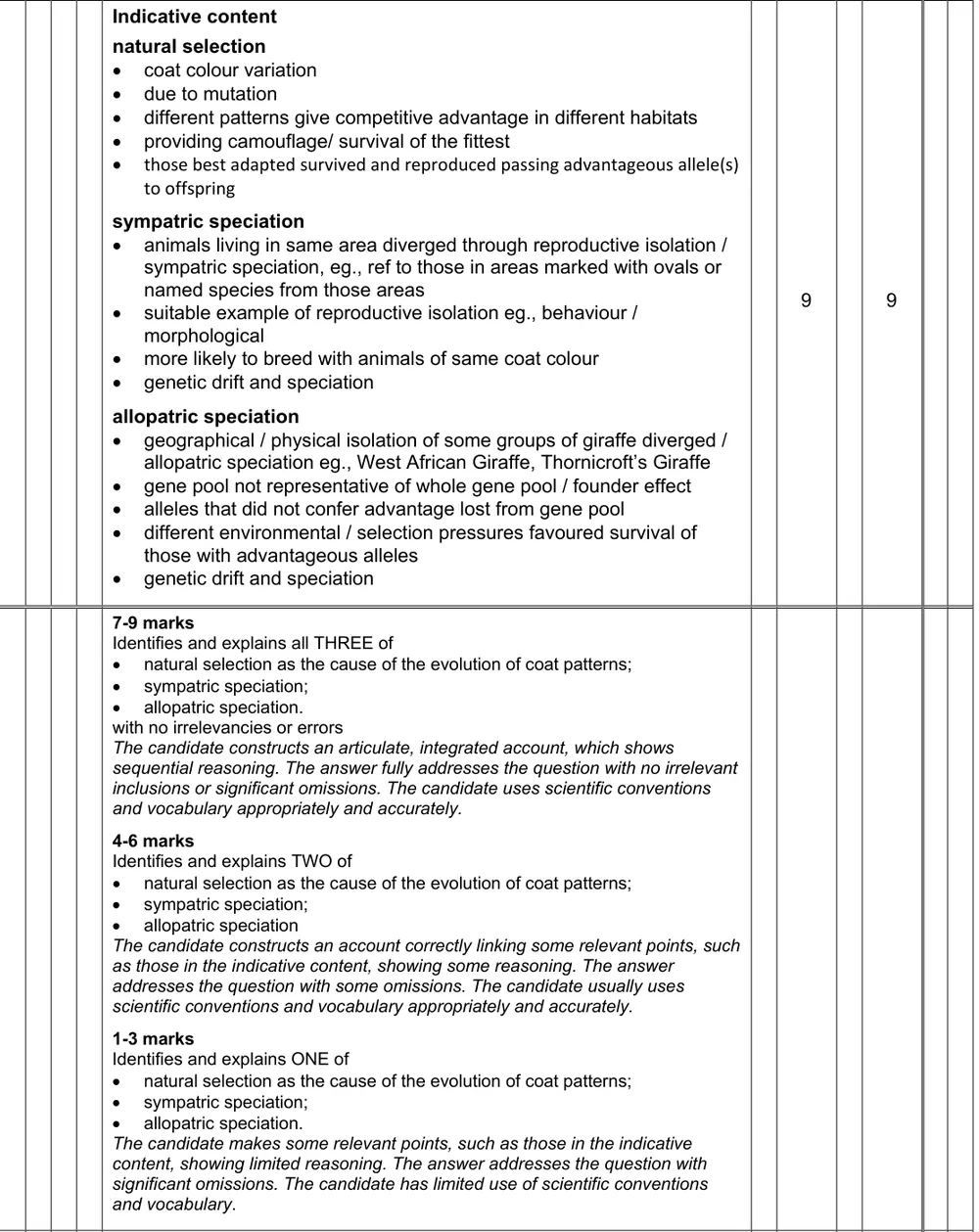
Use a map of proposed giraffe species to explain how evolution could have produced different coat patterns and how two forms of speciation could have produced different species.
Show the mark scheme
Tap an image to open it full size.
From the examiners' report: Well answered overall. The main problems were mixing up allopatric and sympatric speciation, and confusing both with natural selection. Long theoretical accounts could not gain full marks because they did not apply the ideas to the examples given.
2.7 Application of reproduction and genetics
Question 9
A level Component 2 · Autumn 2021 · Q8 · 9 marks
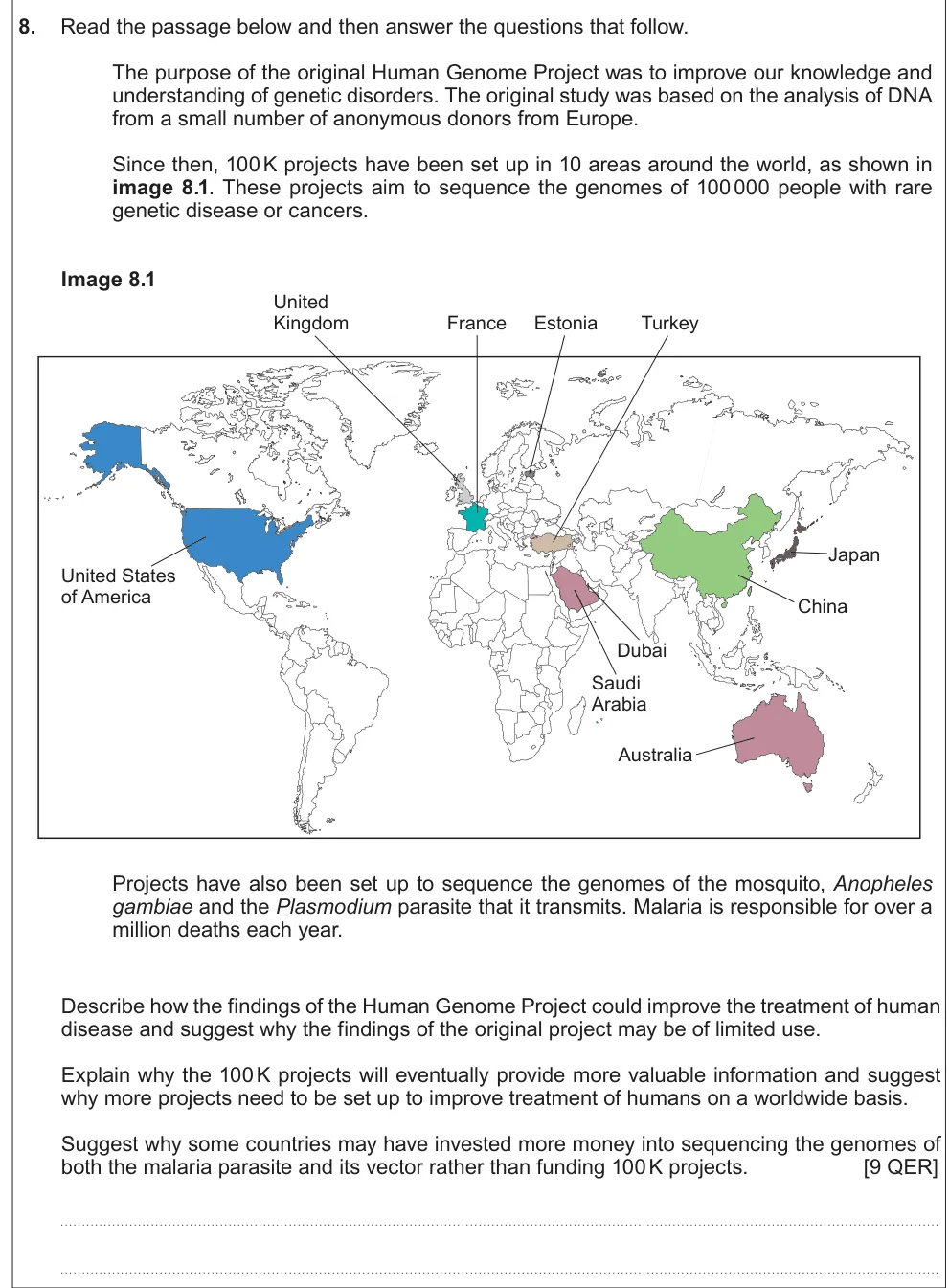
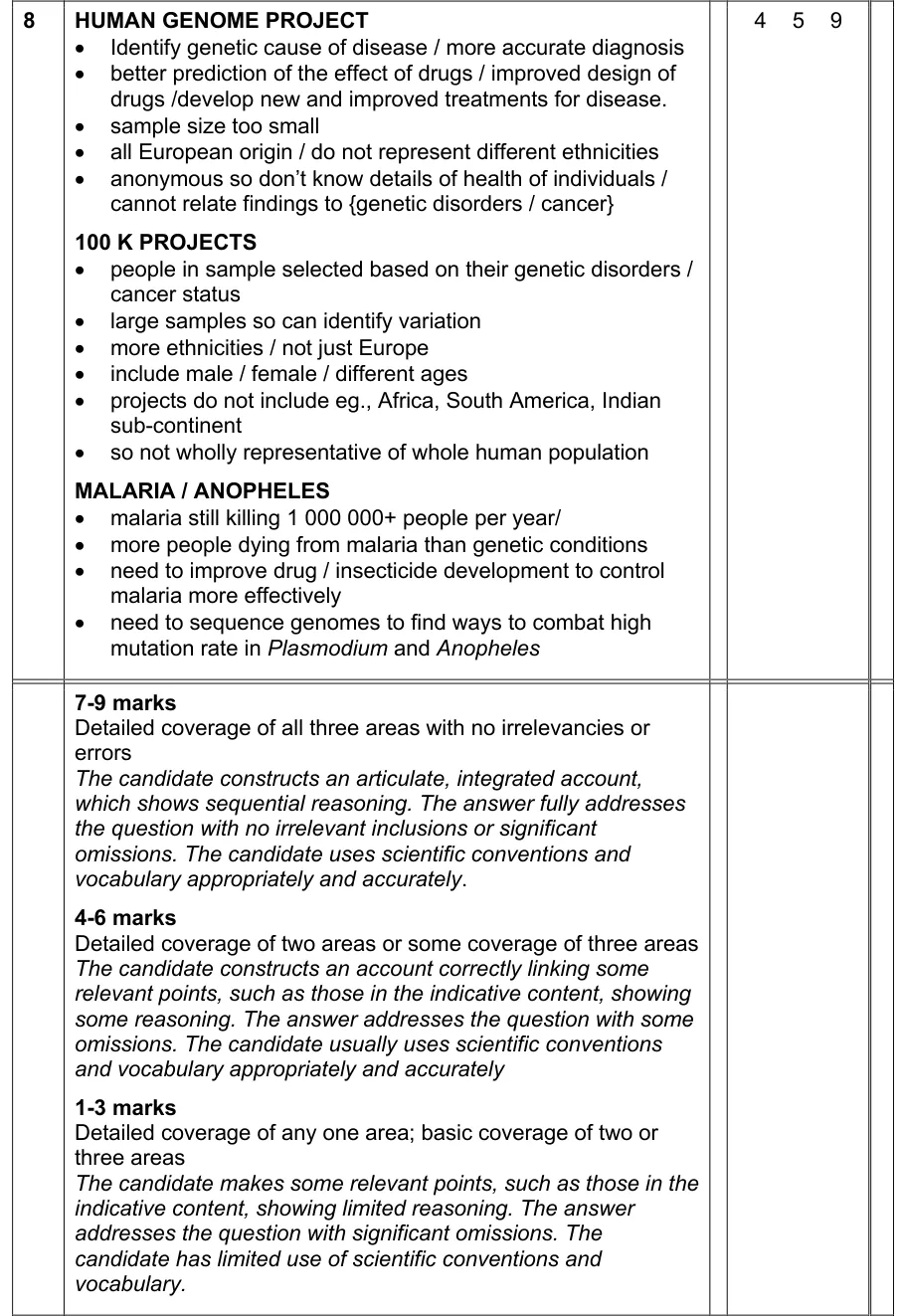
Use information and a map to explain the uses and limits of the Human Genome Project, why the 100K projects are more useful and why more are needed, and why some countries fund sequencing of the malaria parasite and its vector.
Show the mark scheme
Tap an image to open it full size.
From the examiners' report: Very few really good answers were seen. Most appeared to answer from memory, with general statements that did not use the details provided, and little use was made of the map. The best answers referred to the information and gave clear, reasoned answers to each of the three parts.
Question 10
A level Component 2 · June 2018 · Q6 · 9 marks
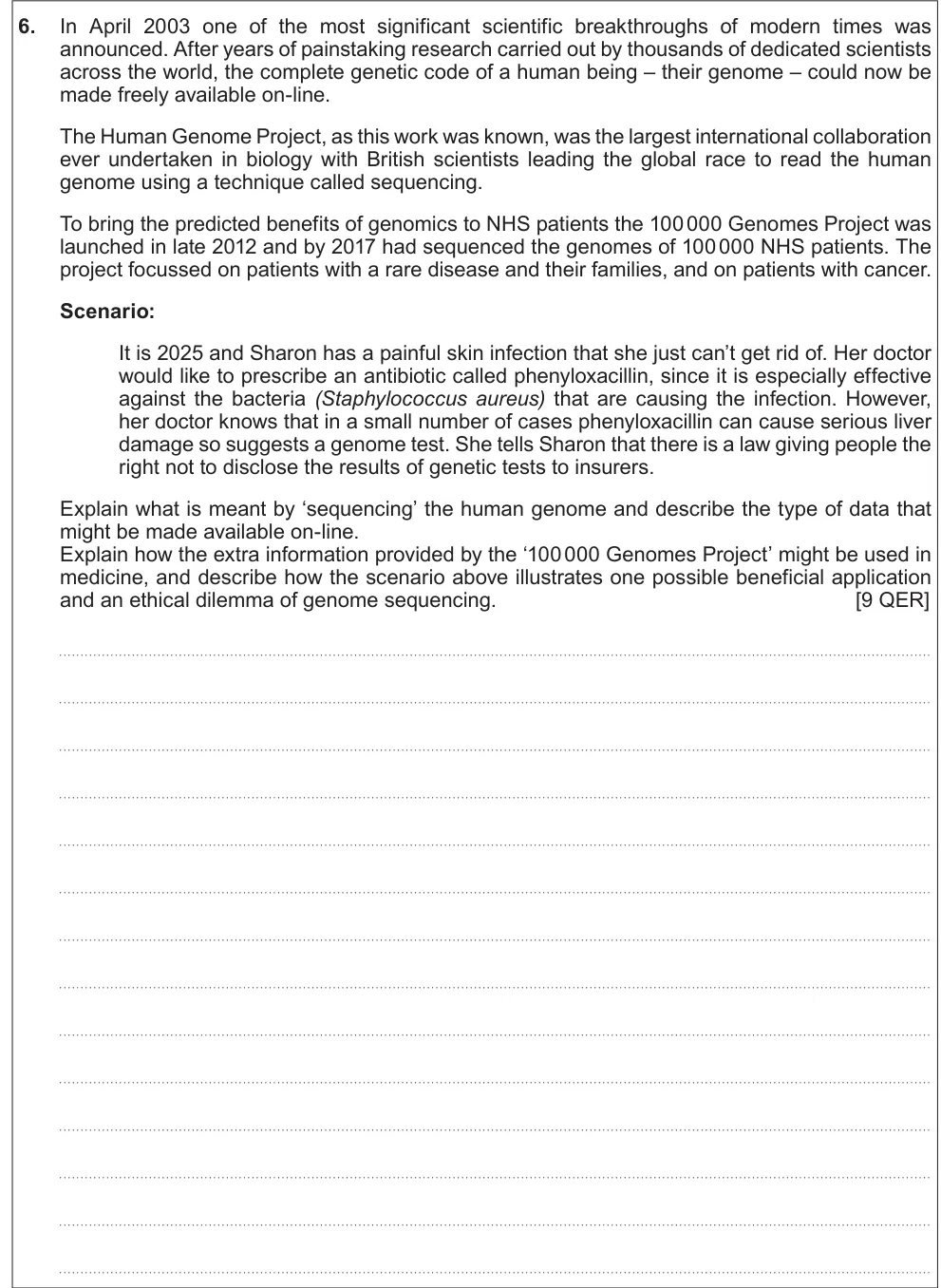
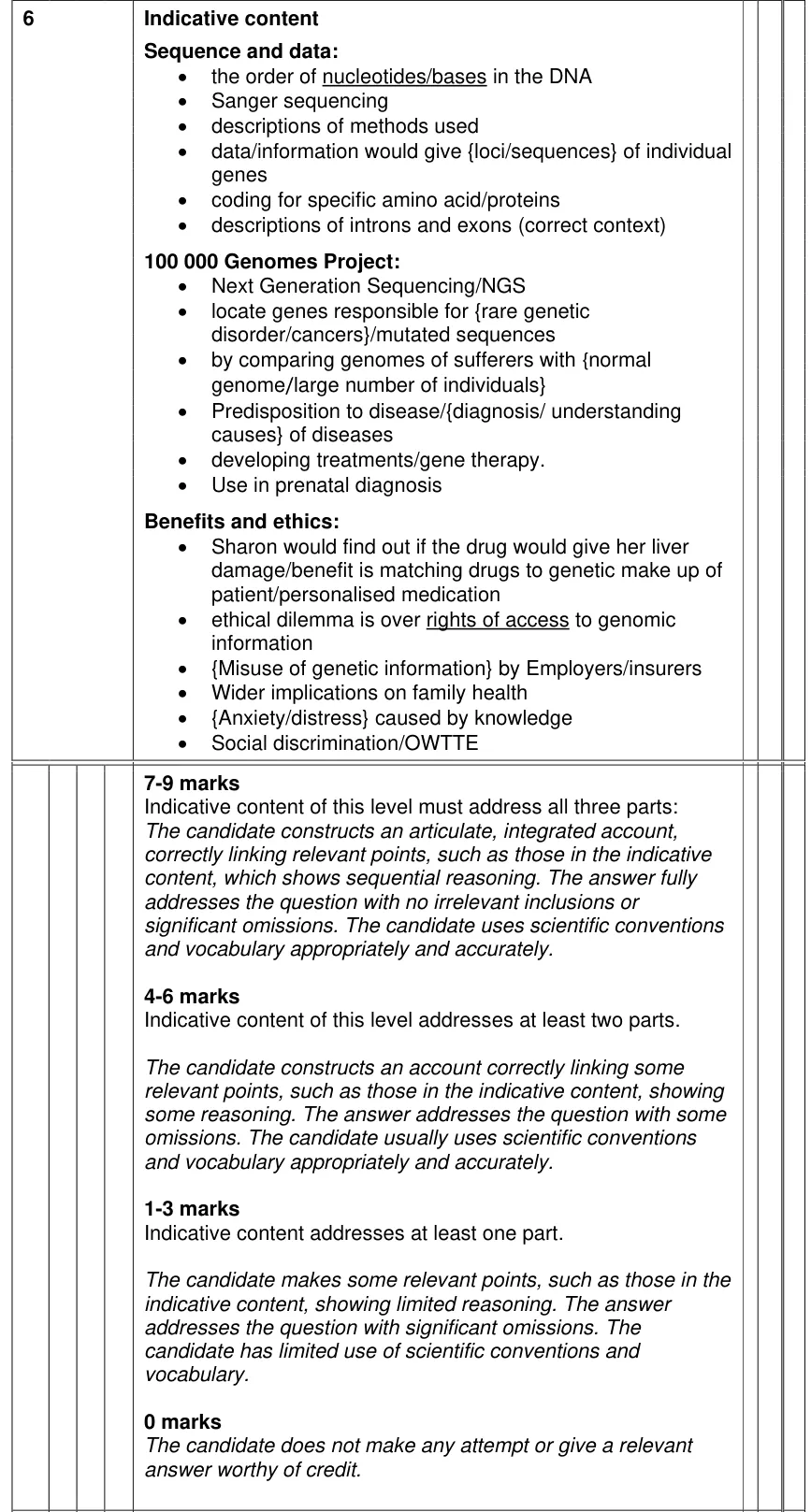
Explain what sequencing the human genome means and the data it gives, how the 100 000 Genomes Project could be used in medicine, and how a scenario shows one benefit and one ethical dilemma.
Show the mark scheme
Tap an image to open it full size.
From the examiners' report: The best answers covered all the indicative content, with an accurate account of the relevant techniques and a clear account of the ethical issues. Some gave a very detailed account of PCR or genetic profiling and little else, and many answers were brief with no scientific content.
Question 11
A level Component 2 · June 2024 · Q7 · 9 marks
Describe how mRNA from a jellyfish is used to make DNA coding for GFP, explain the problems this avoids, and suggest how a GFP marker could be used in gene therapy and why it is better than an antibiotic resistance marker.
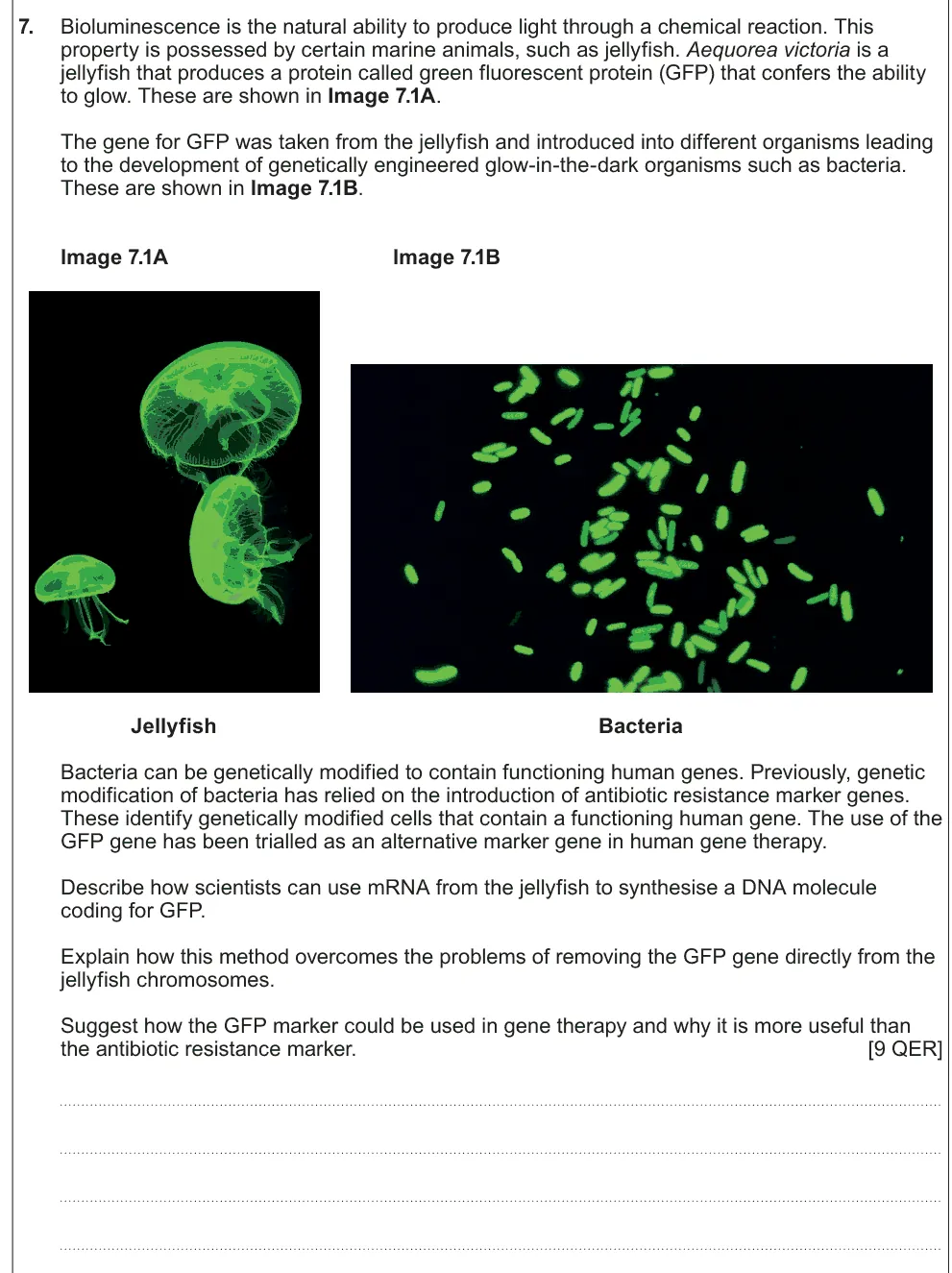
Show the mark scheme
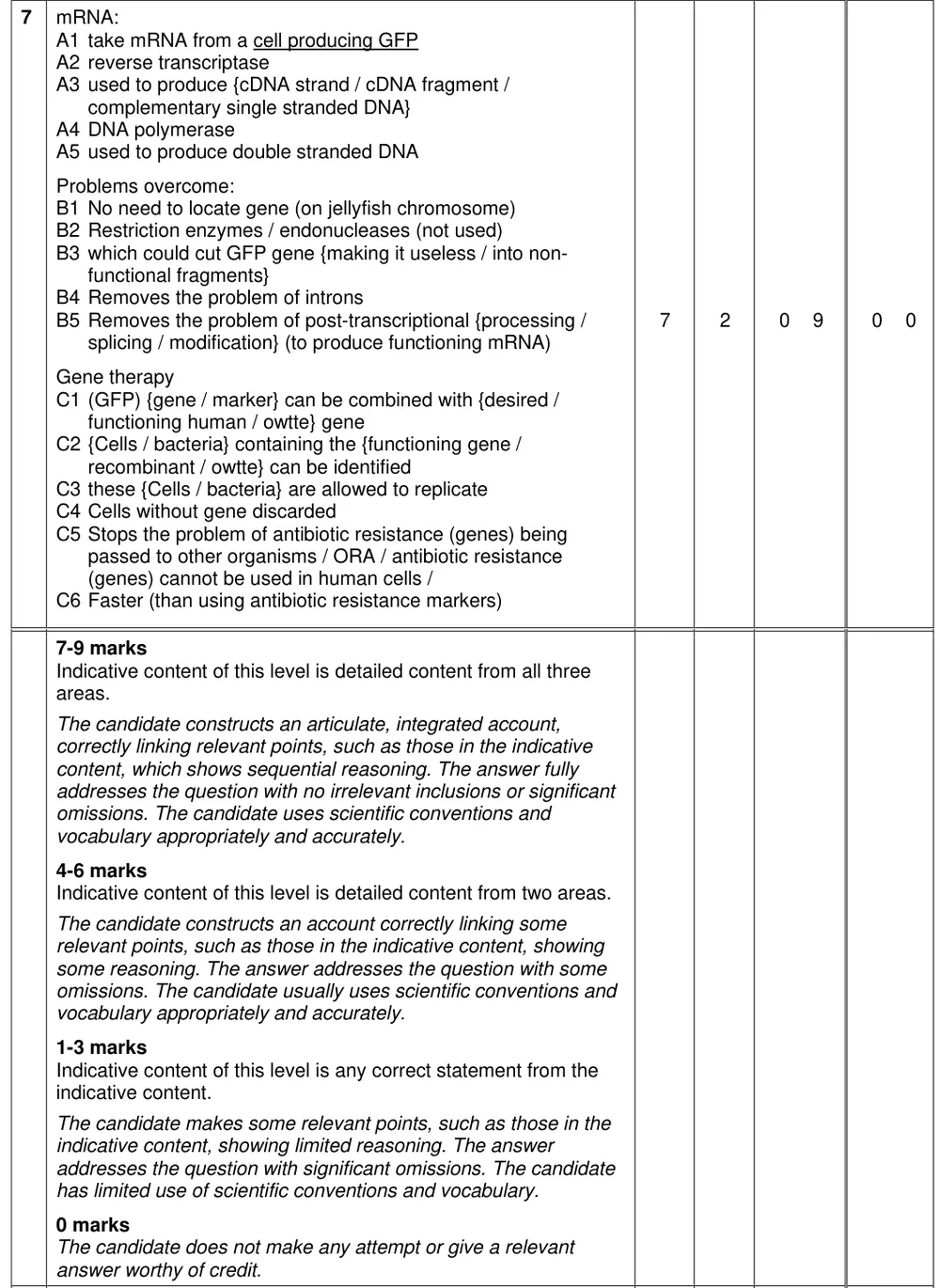
Tap an image to open it full size.
From the examiners' report: Answers in the higher band were less common here. Many ignored the mRNA and went straight to cutting the gene out of the chromosome with restriction enzymes, and PCR was irrelevant. Many wrote about the ethics of taking a gene from a jellyfish; the problems overcome are recall. Problems with antibiotic resistance markers were often the only credit in the last part.
Where students lose marks (from Eduqas examiners' reports and mark schemes)
Each point below is followed by wording that gained marks.
A shared ancestor doesn't settle the family: Candidates stated that the fish must belong to the same family because they have a common ancestor.
✔ Gains credit: "the ends of the branches of the phylogenetic tree have different types of fish grouped together", "Whalefish are on more than one branch".
A fall in DNA needs its cause: Weaker answers listed the stages of mitosis and meiosis, or just said the DNA mass went up or down, without linking the change to events.
✔ Gains credit: "Homologous chromosomes are separated at {F/ anaphase I}", "Chromatids are separated at {G /anaphase II}", "Drops to 3pg/ Halves again".
Why stopping progesterone triggers ovulation: Answers gave the role of progesterone when the question asked why ovulation occurs once the doses stop.
✔ Gains credit: "When progesterone is stopped, {FSH/LH} inhibition is removed", "FSH released/ increased", "so follicles {develop/ mature}", "LH released".
Say what is genetically varied: Genetic variation was often mentioned without saying what varies, and maintaining the chromosome number was often absent.
✔ Gains credit: "produces genetically {different / variation in}" "cells / gametes / offspring / plants / grains"; "Maintains chromosome number (down generations)".
Seeds blown to a stigma: Many used pollination and fertilisation interchangeably and did not distinguish seeds from pollen, with lightweight seeds carried by wind to land on stigmas.
✔ Gains credit: "Anthers pushed against stigma {for pollination/ transfer of pollen}"; "Wind dispersal + colonise other habitats/ be dispersed over greater distances".
Speciation theory with no giraffes: Many gave long theoretical accounts but did not apply them to the examples given, so could not gain maximum marks.
✔ Gains credit: "geographical / physical isolation of some groups of giraffe diverged / allopatric speciation eg., West African Giraffe, Thornicroft's Giraffe".
The map shows who is missing: Little use was made of the map to identify the problems with applying the 100K projects worldwide.
✔ Gains credit: "projects do not include eg., Africa, South America, Indian sub-continent", "so not wholly representative of whole human population".
Restriction enzymes on mRNA: Many skipped the mRNA and cut the gene out of the chromosome with restriction enzymes; some cut the mRNA with them.
✔ Gains credit: "reverse transcriptase" "used to produce {cDNA strand / cDNA fragment / complementary single stranded DNA}", then "DNA polymerase" "used to produce double stranded DNA".
Download the questions
Download the PDF pack (11 questions, mark schemes at the end)
Keep practising
- Extended Response (Core Concepts and Component 1): Eduqas A Level Biology Exam Questions
- Extended Response (Component 3): Eduqas A Level Biology Exam Questions
- Cell Division (2.2): Eduqas A Level Biology exam questions by topic
- Sexual Reproduction in Humans (2.3): Eduqas A Level Biology exam questions by topic
- Sexual Reproduction in Plants (2.4): Eduqas A Level Biology exam questions by topic
- Variation and Evolution (2.6): Eduqas A Level Biology exam questions by topic
- Application of Reproduction and Genetics (2.7): Eduqas A Level Biology exam questions by topic
- Eduqas A level Biology revision resources by topic
- Eduqas A level Biology past papers, mark schemes and examiners' reports
- Eduqas A level Biology grade boundaries
- Ask about Eduqas A level Biology lessons with Sam on WhatsApp
Questions, mark schemes and examiners' report extracts © WJEC CBAC Ltd (Eduqas).