

Nucleic acids and their functions is the largest Core Concept. It covers nucleotides and ATP, the structure of DNA and RNA, semi-conservative replication and the Meselson and Stahl experiment, the genetic code, exons and introns, transcription, translation and the one gene–one polypeptide hypothesis. Questions marked AS are from the AS papers (B400); the rest are from the A level papers (A400), where this content comes back in genetics, gene technology and evolution questions.
The examiners' reports say the same few things each year. Label adenine and ribose on ATP, not adenosine and pentose; never put uracil in DNA; heat breaks hydrogen bonds rather than hydrolysing them; and in transcription it is RNA polymerase that joins RNA nucleotides. Several reports also note that this Year 12 content may not have been revisited before the A level exams, so keep it fresh.
I don't teach the Eduqas specification myself, so for one-to-one help I recommend Sam. He teaches Eduqas A level Biology at a top-rated sixth form college and is very popular with his students. You can ask about lessons with Sam on WhatsApp using the link at the bottom of this page.
What you need from GCSE and Year 12
Each question on this page assumes you're secure on these ideas. If any of them feels shaky, look it up before you start.
- DNA is a double helix made of two strands of nucleotides, with bases A, T, C and G.
- A gene is a section of DNA that codes for a protein.
- Proteins are made on ribosomes from amino acids joined in a sequence set by the DNA.
- Respiration releases energy that cells use to make ATP.
Key terms
These words come up in the questions and mark schemes. Examiners expect you to use them exactly.
- Nucleotide: a pentose sugar, a phosphate group and a nitrogenous base.
- Pyrimidine: a single-ring base: cytosine, thymine and uracil (purines, adenine and guanine, have two rings).
- Endergonic: a reaction that needs an input of energy, such as making ATP from ADP and Pi.
- Semi-conservative replication: each new DNA molecule has one original strand and one new strand.
- Degenerate code: most amino acids are coded for by more than one triplet.
- Intron: a region of non-coding DNA between the exons of a gene.
- Splicing: removing introns from pre-mRNA and joining exons, sometimes in different combinations.
- Transcription: making mRNA from a DNA template, using RNA polymerase.
- Translation: using mRNA and tRNA at a ribosome to join amino acids into a polypeptide.
What these questions cover (Eduqas CC5)
The questions test these statements from Core Concept 5 of the Eduqas A level Biology specification (A400). Core Concepts are taught in Year 12, examined in AS Component 1 and tested again in every A level paper.
- (a) the structure of nucleotides (pentose sugar, phosphate, organic base)
- (b) the structure of ATP
- (d) the central role of ATP as an energy carrier and its use in the liberation of energy for cellular activity
- (e) the structure of nucleic acids
- (f) the similarities and differences in the structure of RNA and DNA
- (h) the semi-conservative replication of DNA including the roles of DNA polymerase and helicase and be able to use evidence from the Meselson and Stahl experiments
- (j) the triplet code for amino acids
- (k) exons as regions of DNA that contain the code for proteins and that between the exons are regions of non-coding DNA called introns
- (l) the transcription of DNA to produce messenger RNA
- (m) the translation of mRNA using ribosomes and the structure and function of transfer RNA, to synthesise proteins
- (n) the 'one gene - one polypeptide' hypothesis
- (o) the further modification and combination of some polypeptides
How to use this page
Write your answer on paper before you open the mark scheme. Allow about 1.2 minutes per mark: the 21 questions are worth 46 marks, so about 55 minutes in total. Then mark your answer strictly against the mark scheme and read the examiners' tip underneath it. If you'd rather print the questions, download the PDF pack.
Nucleotides and ATP
Question 1
A level Component 1 · June 2018 · Q1(a) · 2 marks
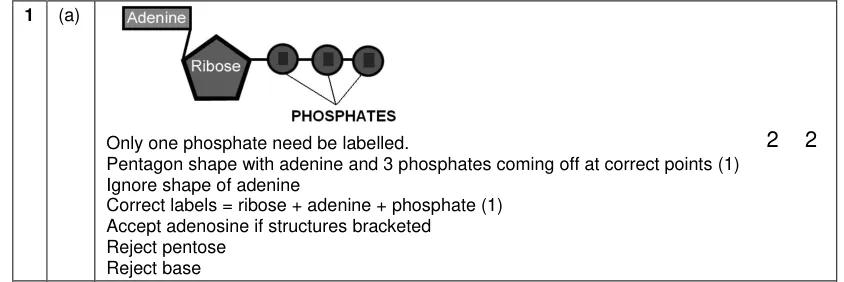
Draw a simple, fully labelled diagram of ATP.

Show the mark scheme
Tap an image to open it full size.
From the examiners' report: This simple question was poorly done in too many cases. Label adenine (not adenosine), ribose and phosphate.
Question 2
AS Component 1 · June 2024 · Q4(a)(ii) · 3 marks
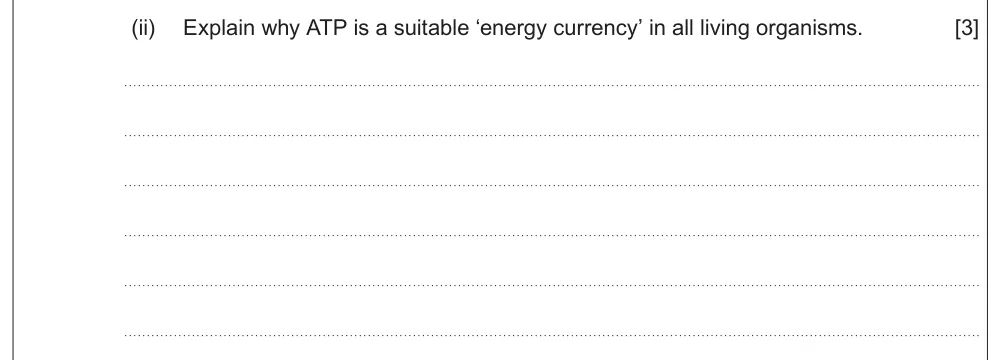
Explain why ATP is a suitable energy currency in all organisms.
Show the mark scheme

Tap an image to open it full size.
From the examiners' report: Small amounts of energy (30.6 kJ, written without a dash that reads as minus) in a single reaction with one enzyme. Few students recalled the one reaction, one enzyme point.
Question 3
AS Component 1 · June 2018 · Q2(b)(i) · 1 mark
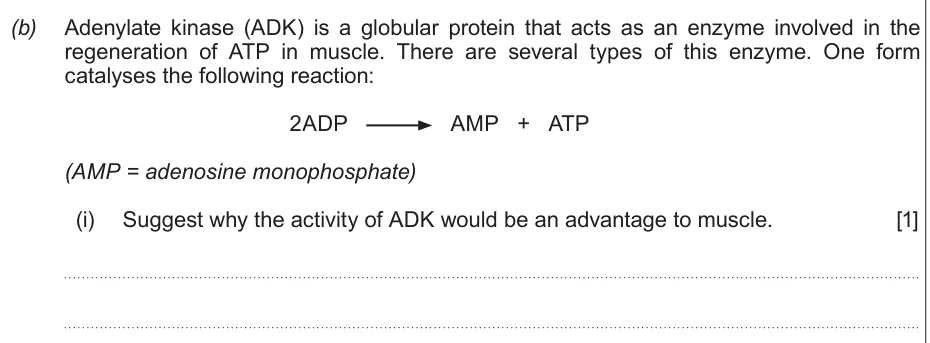
Suggest why an enzyme that regenerates ATP is an advantage to muscle.
Show the mark scheme

Tap an image to open it full size.
From the examiners' report: Most mentioned regenerating ATP but didn't say it is for muscle contraction; many wrongly linked it to aerobic respiration.
Question 4
A level Component 1 · June 2017 · Q6(b) · 2 marks
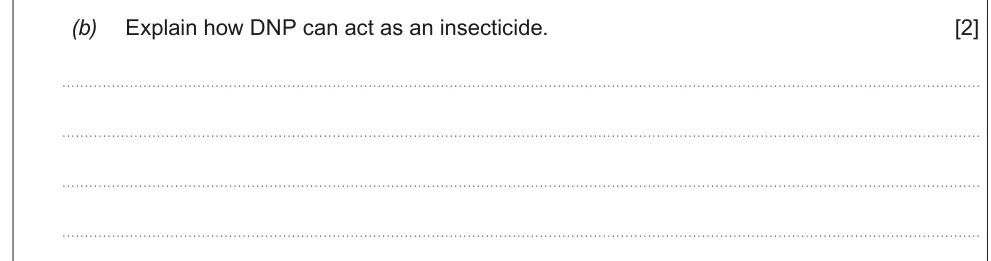
Explain how DNP can act as an insecticide.
Information from earlier in this question:

Show the mark scheme

Tap an image to open it full size.
From the examiners' report: Say which processes stop when ATP runs out, such as muscle contraction for flight or active transport. "Metabolic processes" isn't enough.
DNA and RNA structure
Question 5
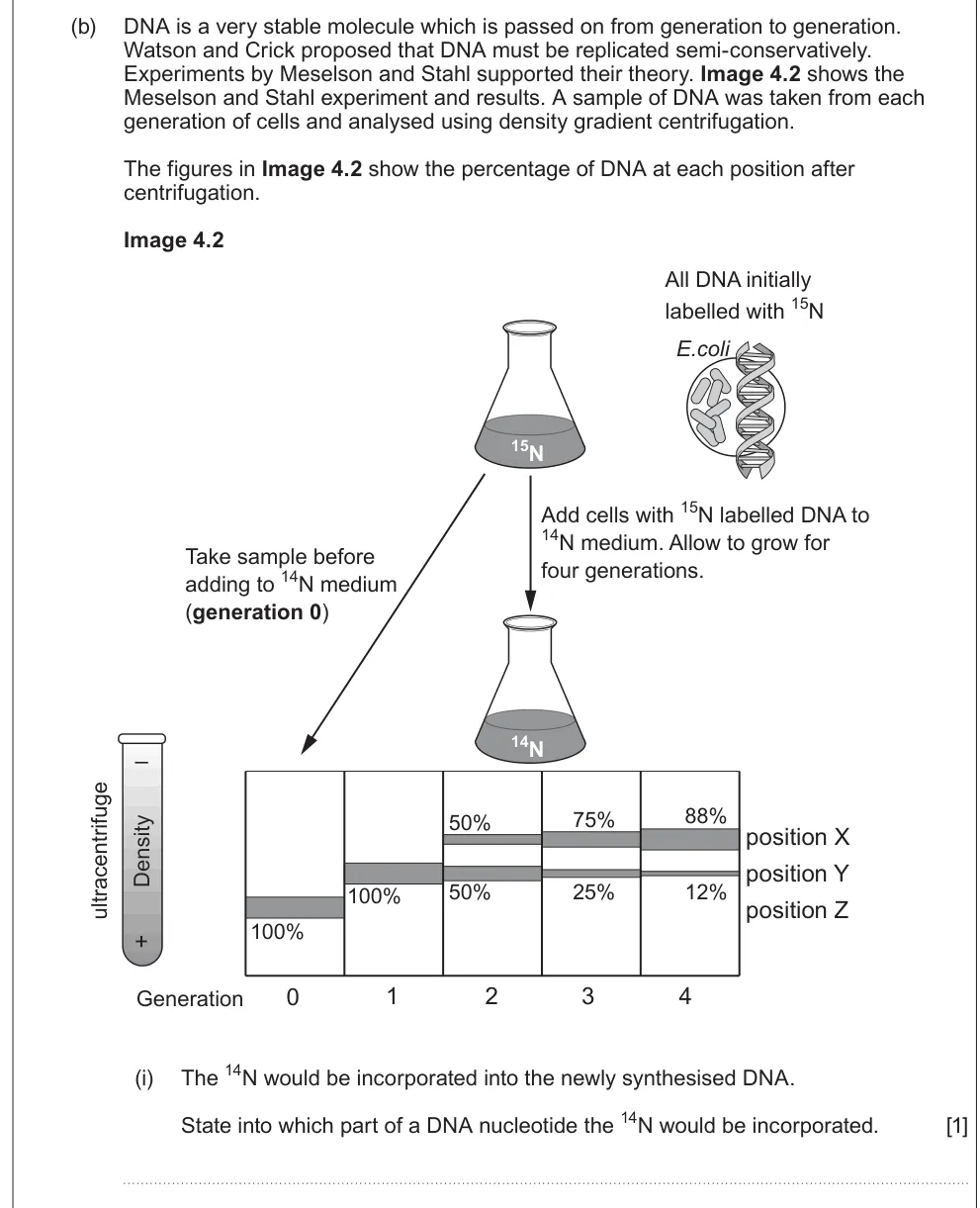
AS Component 1 · June 2024 · Q4(b)(i) · 1 mark
State which part of a DNA nucleotide 14N is built into.
Show the mark scheme

Tap an image to open it full size.
From the examiners' report: Many good answers: the nitrogenous base.
Question 6
A level Component 2 · June 2024 · Q2(d)(i) · 1 mark
Explain how heating makes DNA single-stranded.
Show the mark scheme

Tap an image to open it full size.
From the examiners' report: Heat breaks the hydrogen bonds. Saying they are hydrolysed lost the mark.
Question 7
A level Component 2 · June 2025 · Q5(d)(i) · 1 mark
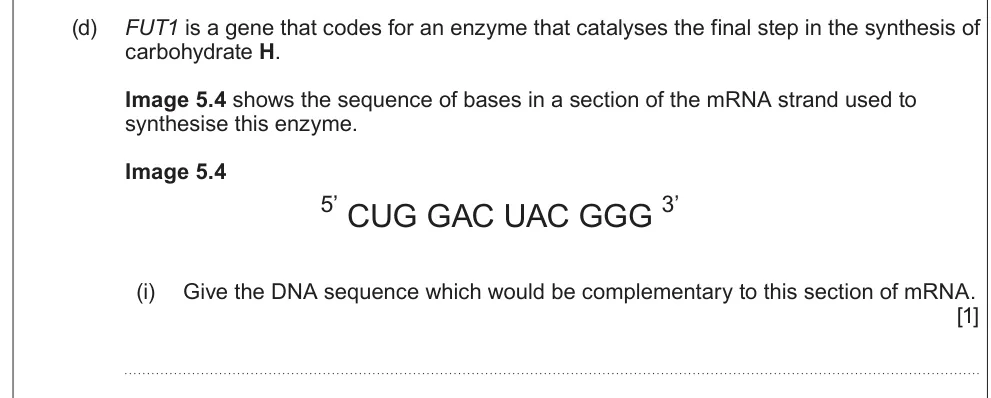
Give the DNA sequence complementary to a section of mRNA.
Show the mark scheme

Tap an image to open it full size.
From the examiners' report: A significant number of students put U in the DNA. DNA has T, never U.
Question 8
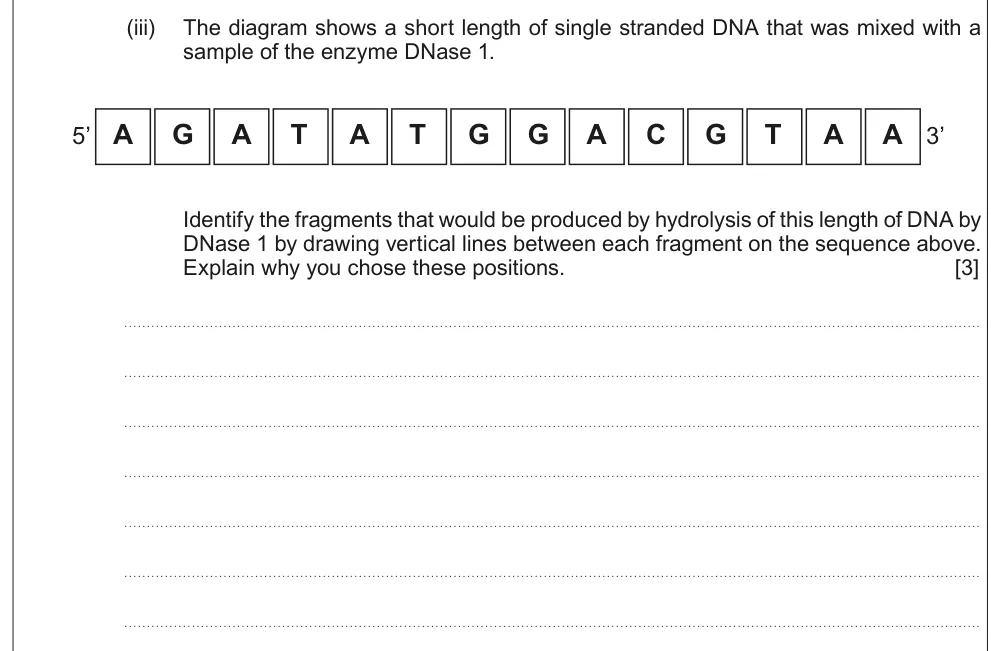
AS Component 1 · June 2017 · Q5(a)(iii) · 3 marks
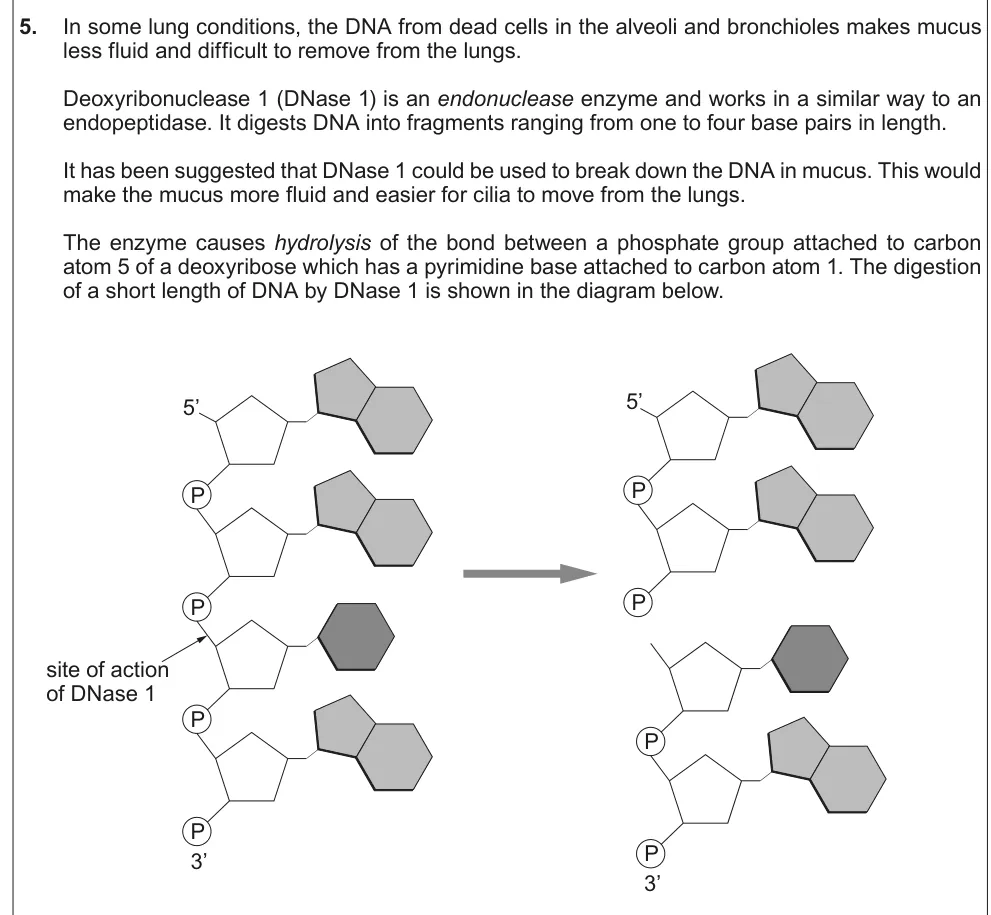
Mark where DNase 1 cuts a DNA sequence and explain your positions.
Information from earlier in this question:
Show the mark scheme

Tap an image to open it full size.
From the examiners' report: You need to know that cytosine and thymine are pyrimidines and use the information given. Many called adenine and guanine pyrimidines.
Question 9
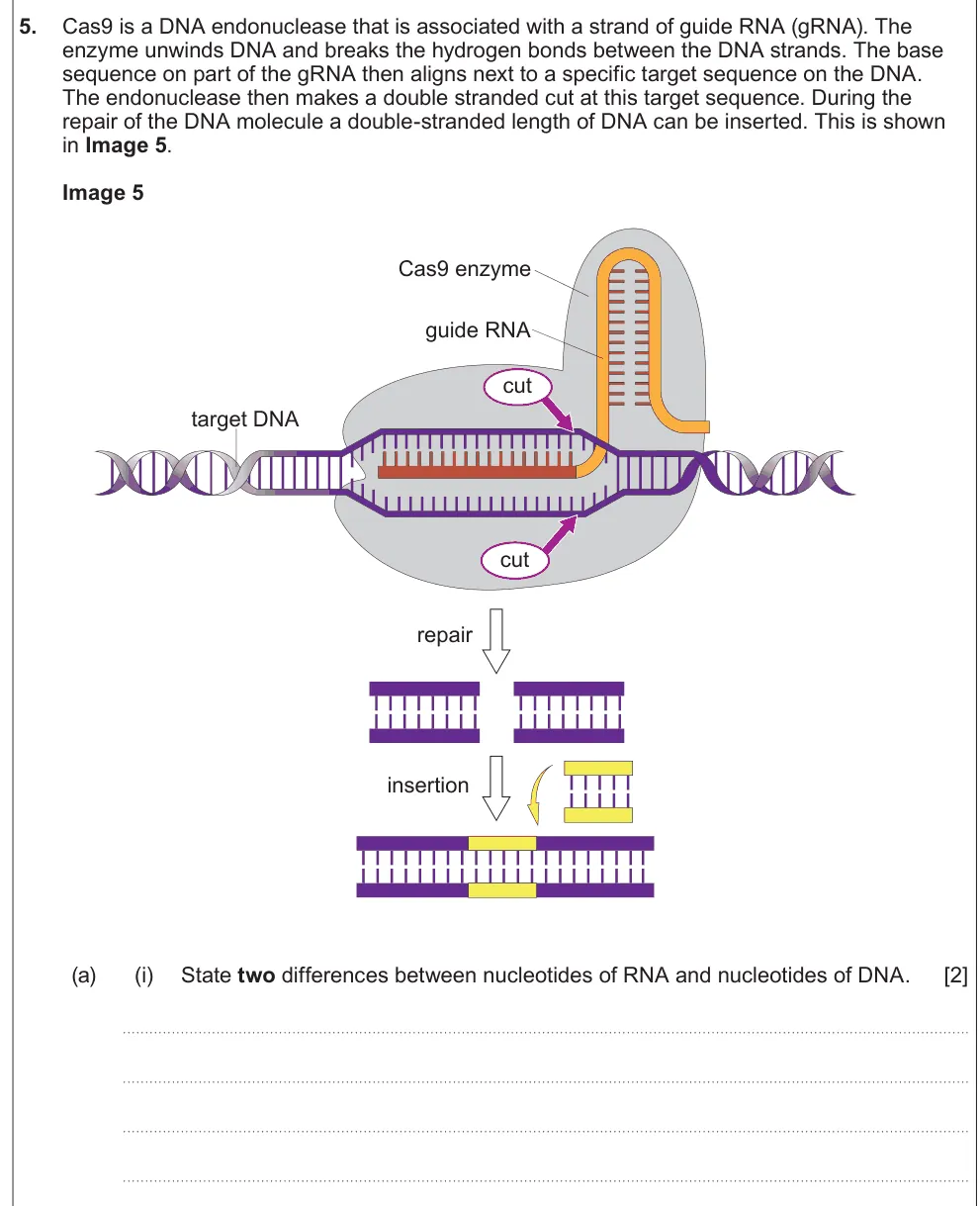
A level Component 2 · June 2023 · Q5(a)(i) · 2 marks
State two differences between RNA and DNA nucleotides.
Show the mark scheme

Tap an image to open it full size.
From the examiners' report: Compare nucleotides (ribose v deoxyribose, uracil v thymine), not whole molecules; some students compared DNA and RNA molecules and lost marks.
Question 10
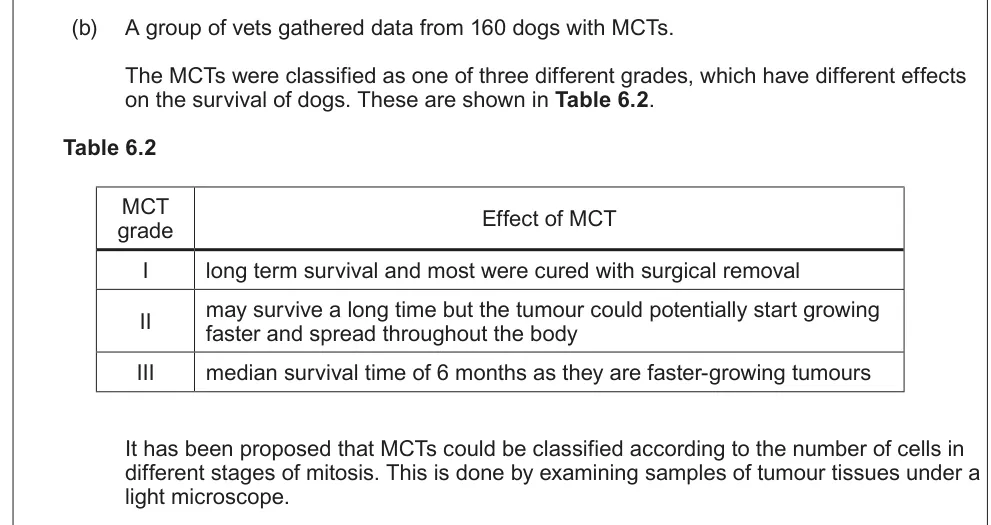
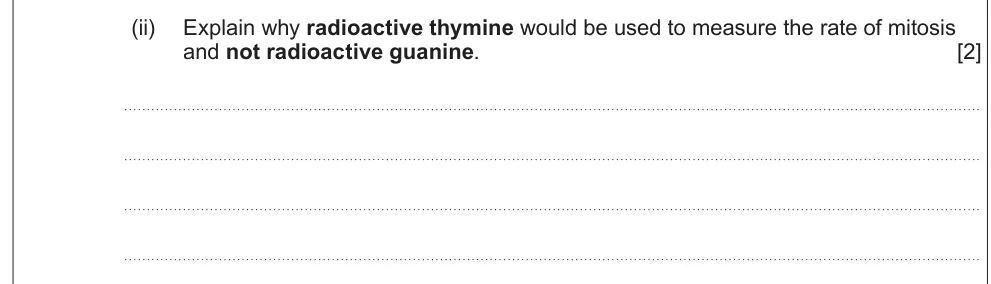
A level Component 2 · June 2024 · Q6(d)(ii) · 2 marks
Explain why radioactive thymine, not guanine, is used to measure the rate of mitosis.
Information from earlier in this question:

Show the mark scheme

Tap an image to open it full size.
From the examiners' report: Thymine is only in DNA; guanine is in RNA as well, so it wouldn't only label new DNA.
DNA replication
Question 11
A level Component 2 · Autumn 2020 · Q2(c) · 2 marks
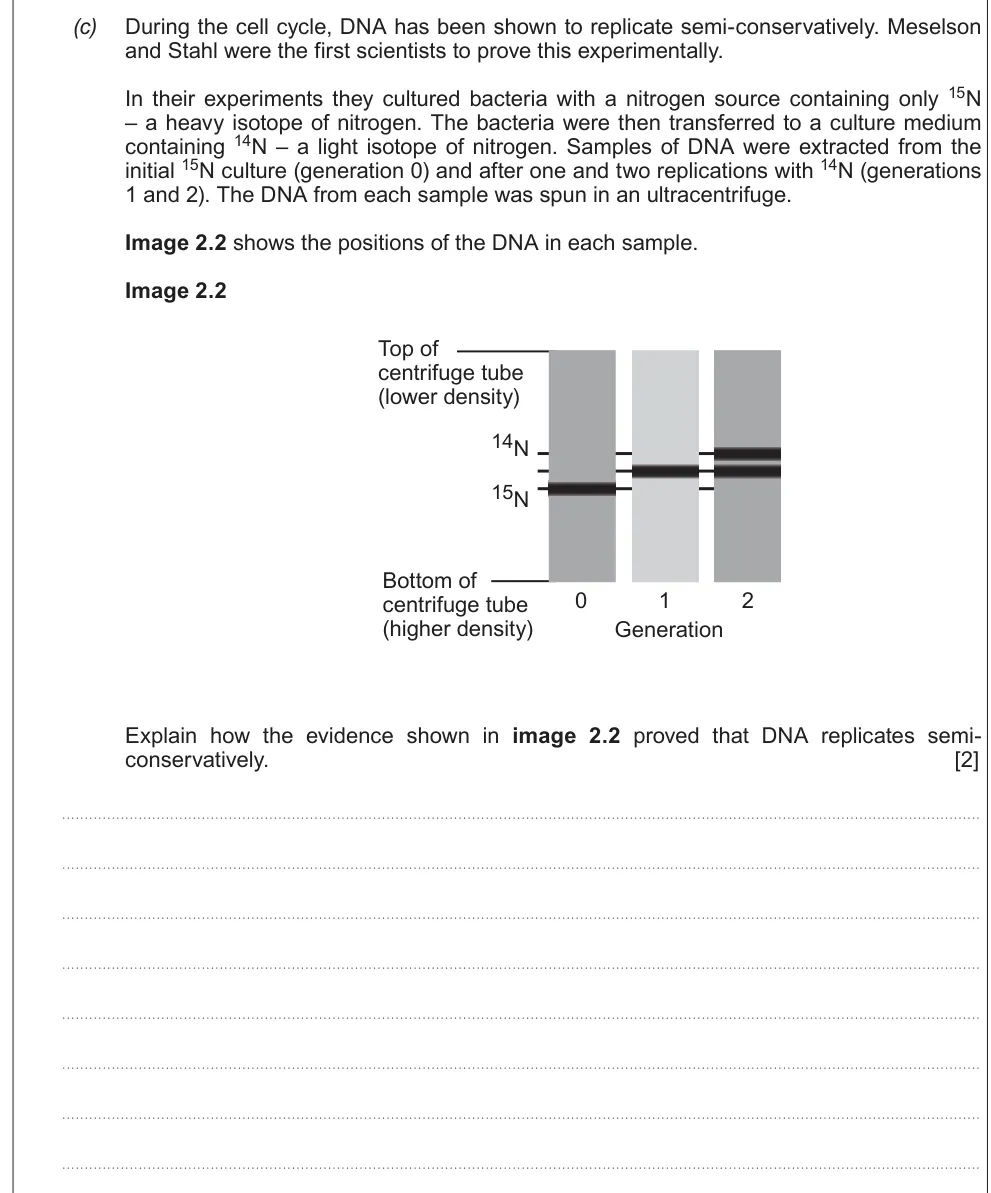
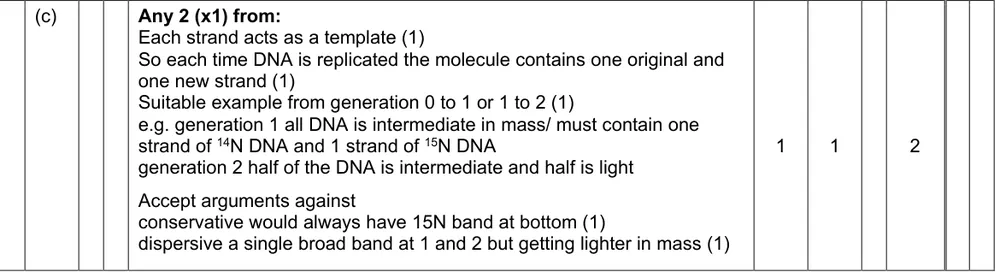
Explain how centrifuge results show DNA replicates semi-conservatively.
Show the mark scheme
Tap an image to open it full size.
From the examiners' report: Better than on earlier papers, but lack of detail still cost marks. Use a generation from the image: generation 1 is all intermediate, one 15N strand and one 14N strand.
Question 12
AS Component 1 · June 2022 · Q5(b)(ii) · 4 marks
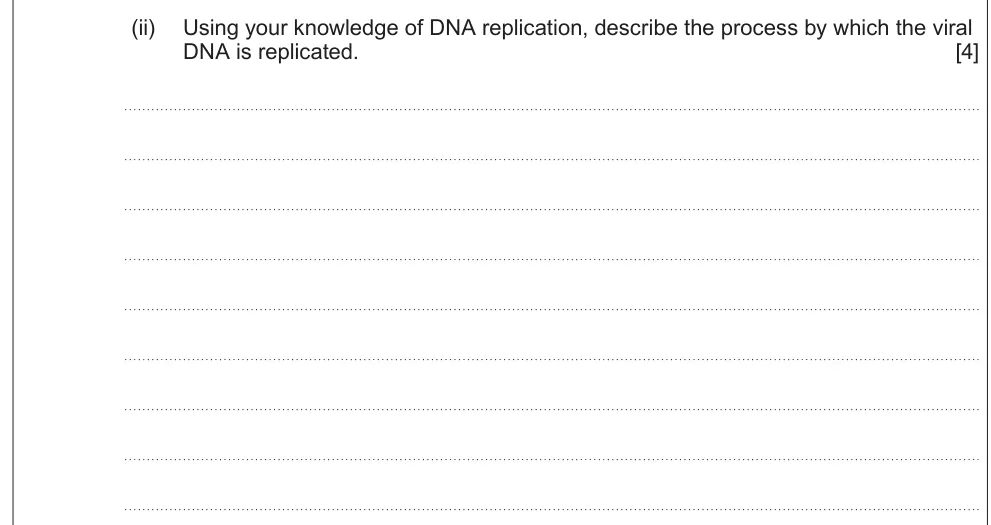
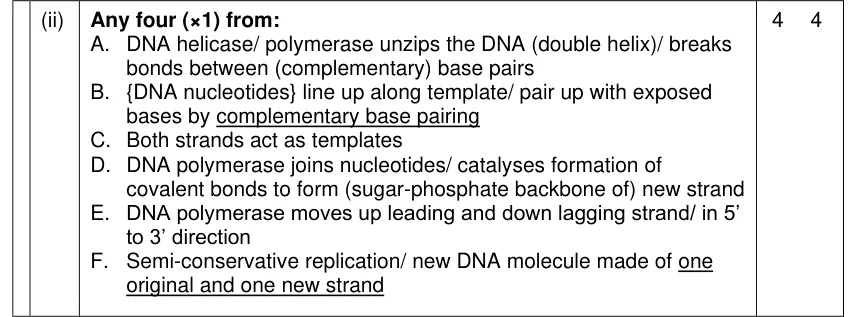
Describe how viral DNA is replicated.
Show the mark scheme
Tap an image to open it full size.
From the examiners' report: Many very good answers. The commonest error was confusing replication with transcription and naming RNA polymerase; this is a DNA virus.
The genetic code
Question 13
A level Component 1 · Autumn 2020 · Q2(a)(ii) · 2 marks
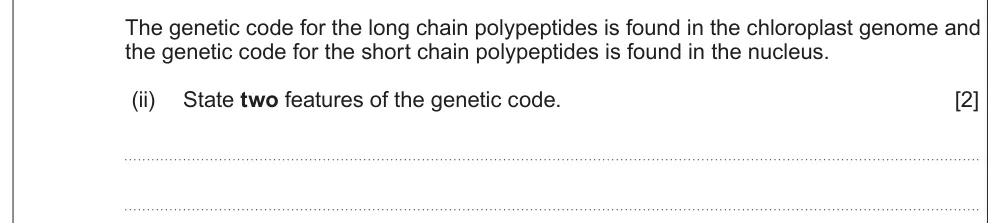
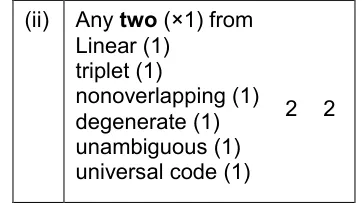
State two features of the genetic code.
Show the mark scheme
Tap an image to open it full size.
From the examiners' report: Excellent answers were in the minority. Many wrote about protein synthesis or nucleotide structure instead of features such as triplet, degenerate or universal.
Question 14
A level Component 3 · June 2022 · Q1(a) · 1 mark · Hard
State the minimum number of nucleotides coding for a 26 amino acid protein.

Show the mark scheme

Tap an image to open it full size.
From the examiners' report: The mean mark was only 0.5. Three bases per amino acid: 78 (81 or 84 were allowed if you added start or stop codons).
Question 15
AS Component 1 · June 2018 · Q3(a)(iii) · 3 marks · Hard
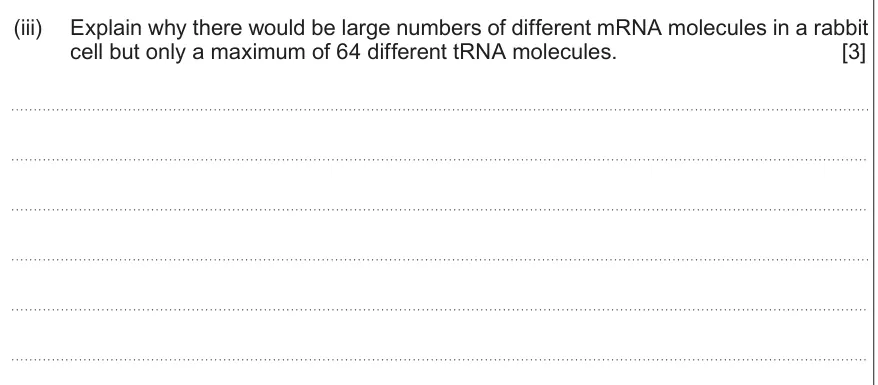
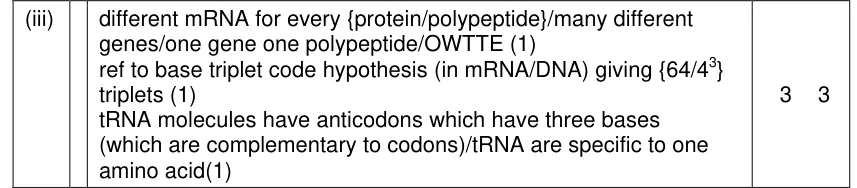
Explain why a cell has many different mRNAs but at most 64 tRNAs.
Show the mark scheme
Tap an image to open it full size.
From the examiners' report: Very few scored. One mRNA for each polypeptide, but a triplet code gives only 64 codons, and each tRNA anticodon has three bases.
Exons, introns and gene expression
Question 16
AS Component 1 · June 2016 · Q6(a) · 3 marks
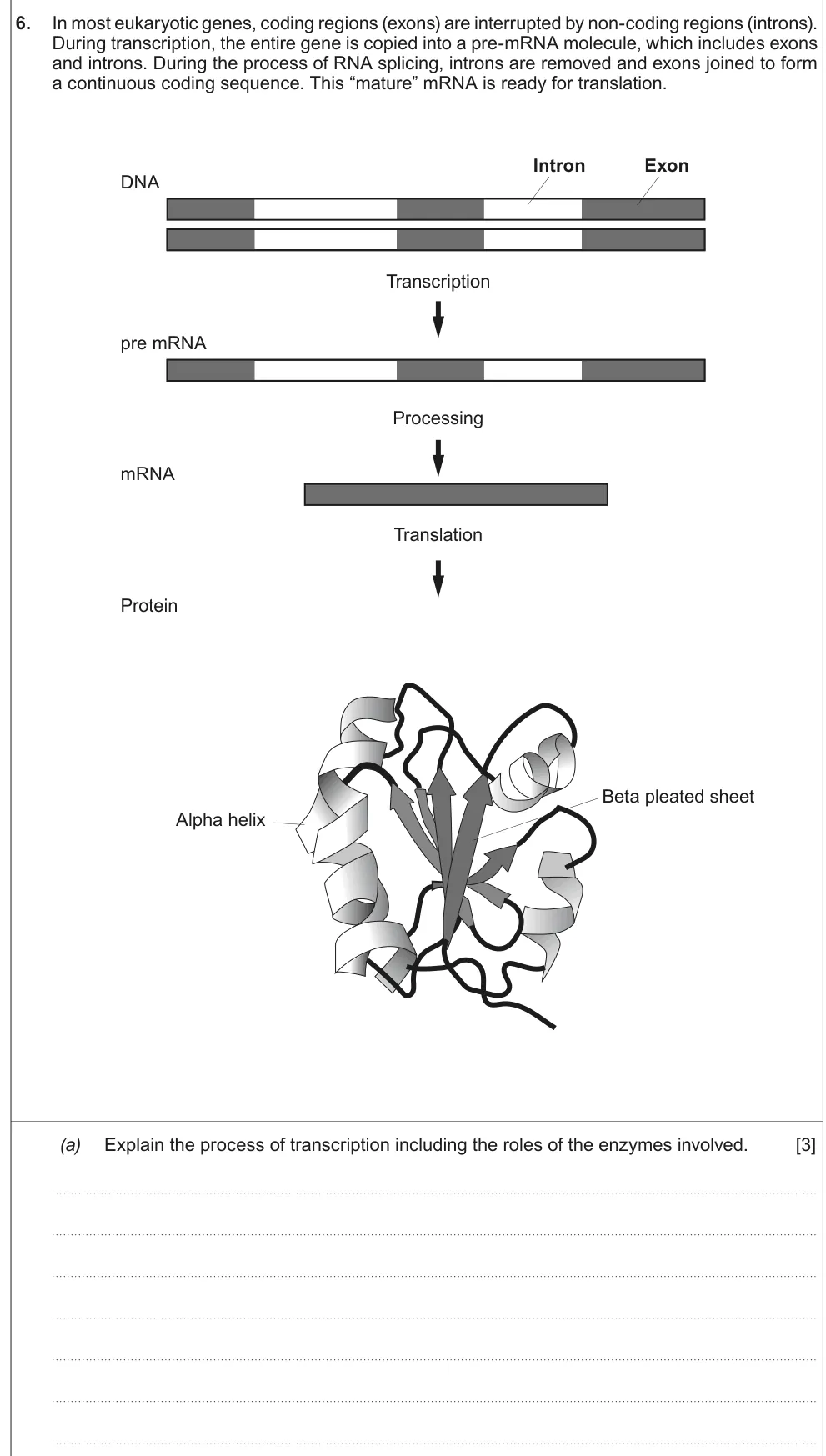
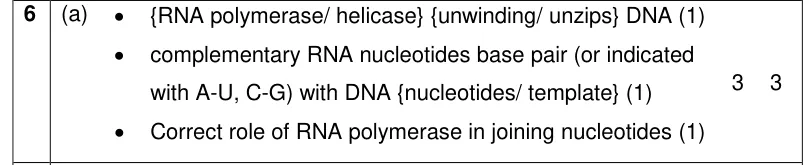
Explain transcription, including the roles of the enzymes.
Show the mark scheme
Tap an image to open it full size.
From the examiners' report: Sloppy answers lost marks: say RNA nucleotides (not just nucleotides), complementary base pairing, and that RNA polymerase joins them.
Question 17
AS Component 1 · June 2016 · Q6(b)(i) · 2 marks
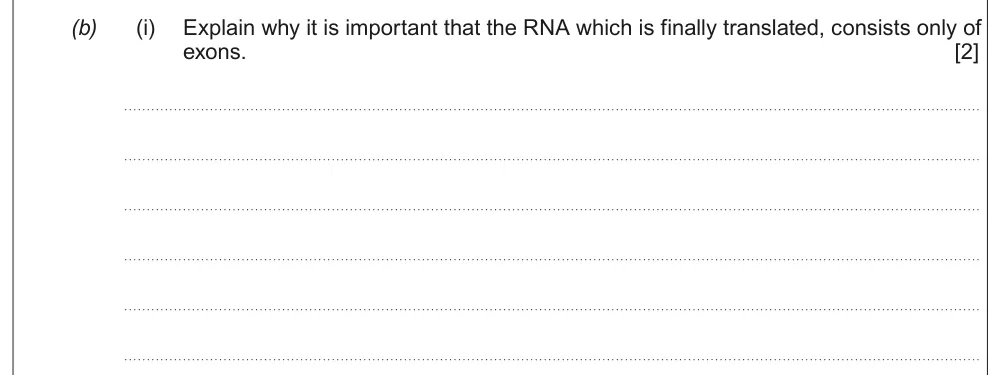
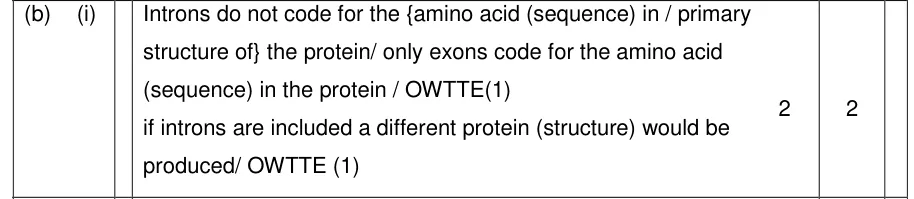
Explain why the RNA that is translated must contain only exons.
Show the mark scheme
Tap an image to open it full size.
From the examiners' report: Well done, but you must say that exons code for the amino acid sequence and introns don't.
Question 18
AS Component 1 · June 2019 · Q4(d) · 3 marks
Describe the process of transcription.
Show the mark scheme

Tap an image to open it full size.
From the examiners' report: Many good descriptions, but an alarming number said DNA polymerase joins the RNA nucleotides. It is RNA polymerase.
Question 19
AS Component 1 · June 2023 · Q4(b)(ii) · 5 marks · Easy
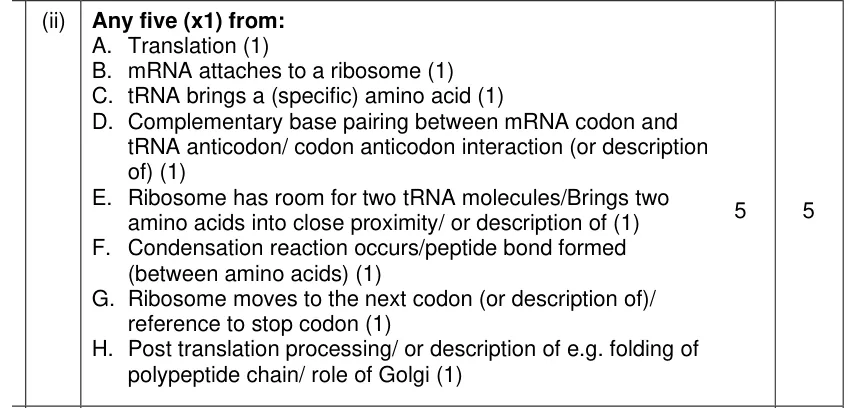
Suggest how the host cell uses viral mRNA to make a protein.
Show the mark scheme
Tap an image to open it full size.
From the examiners' report: Many scored full marks on translation. Weaker answers started with transcription, which wasn't asked. Look at past mark schemes for codon–anticodon wording.
One gene, one polypeptide
Question 20
A level Component 2 · Autumn 2020 · Q4(c)(ii) · 2 marks · Hard
Explain how splicing is evidence against the one gene–one polypeptide hypothesis.
Show the mark scheme

Tap an image to open it full size.
From the examiners' report: Poorly answered: few could explain how splicing lets one gene produce more than one polypeptide. This Year 12 content may need revisiting.
Question 21
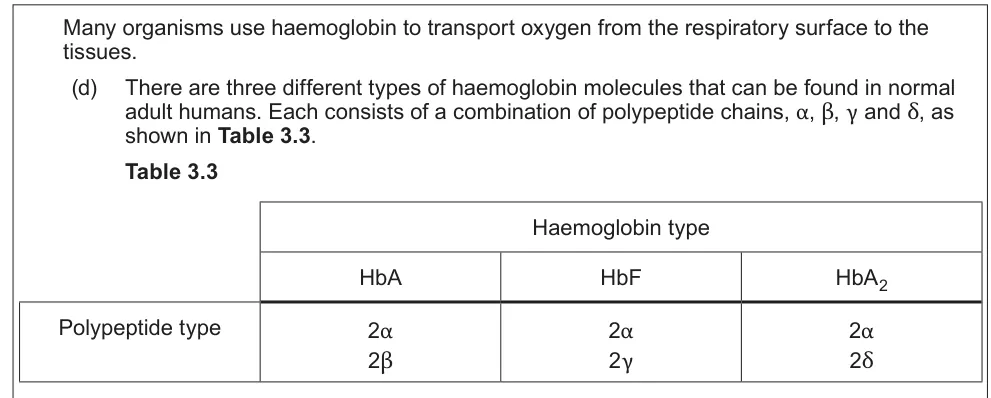
A level Component 3 · June 2023 · Q3(d)(ii) · 1 mark
Suggest the minimum number of genes needed to make haemoglobin.
Information from earlier in this question:

Show the mark scheme

Tap an image to open it full size.
From the examiners' report: Students gave a variety of numbers. The answer is four: one gene for each polypeptide chain.
Where students lose marks (from Eduqas examiners' reports and mark schemes)
Each point below is followed by wording that gained marks.
Adenine, not adenosine: ATP diagrams labelled adenine as adenosine and left ribose unlabelled.
✔ Gains credit: Labels "ribose + adenine + phosphate".
Small amounts, one reaction: Answers said ATP releases a lot of energy, or a "suitable" amount.
✔ Gains credit: "Single reaction to release energy", "only one enzyme needed" and "small amounts of energy released".
Name the process that stops: Answers said only that "metabolic processes" would stop.
✔ Gains credit: No ATP "for flight / muscle contraction / active transport".
Break, not hydrolyse: Students said heating hydrolyses the hydrogen bonds.
✔ Gains credit: "Used to break the hydrogen bonds".
No U in DNA: A significant number of students wrote U in a DNA sequence.
✔ Gains credit: "GAC CTG ATG CCC".
Compare nucleotides: Some students compared DNA and RNA molecules instead of nucleotides.
✔ Gains credit: "Ribose v deoxyribose" and "uracil v thymine".
Replication isn't transcription: RNA polymerase was commonly named for replicating a DNA virus.
✔ Gains credit: "DNA polymerase joins nucleotides".
RNA polymerase in transcription: An alarming number said DNA polymerase joins the RNA nucleotides.
✔ Gains credit: "RNA polymerase, adding complementary RNA nucleotides and forming bonds between them".
Download the questions
Download the PDF pack (21 questions, mark schemes at the end)
Keep practising
- Biological Compounds (CC1): Eduqas A Level Biology exam questions by topic
- Cell Structure and Organisation (CC2): Eduqas A Level Biology exam questions by topic
- Cell Membranes and Transport (CC3): Eduqas A Level Biology exam questions by topic
- Enzymes (CC4): Eduqas A Level Biology exam questions by topic
- Eduqas A level Biology past papers, mark schemes and examiners' reports
- Eduqas A level Biology grade boundaries
- Ask about Eduqas A level Biology lessons with Sam on WhatsApp
Questions, mark schemes and examiners' report extracts © WJEC CBAC Ltd (Eduqas).