

Gene Expression, Epigenetics and Phenotype completes Topic 3, Voice of the Genome, of the Edexcel A level Biology A (Salters-Nuffield) specification. You need to understand how cells become specialised through differential gene expression, including the lac operon, how phenotype results from the interaction of genotype and environment, how epigenetic changes such as DNA methylation and histone modification switch genes on or off, and how polygenic inheritance gives continuous variation. This sub-topic is examined on AS Paper 2 and on A level Papers 1, 2 and 3. Questions marked AS are from the AS papers (8BN0); the rest are from the A level papers (9BN0).
The examiners' reports keep asking for the full chain: a stimulus activates particular genes, those genes are transcribed, the mRNA is translated, and the proteins determine the cell's structure and function. Many students lose marks by writing about epigenetics when the question is about differentiation, or by mixing up DNA methylation and histone modification. Tailor your answer to the cell or organism in the question, read the stem carefully in data questions so you don't repeat it back, and for polygenic traits say that many genes each have a small, cumulative effect.
Studying Edexcel SNAB and want more help? If you'd like to arrange one-to-one Edexcel tutoring, or to register your interest in an Edexcel group class, message Tom on WhatsApp using the link at the bottom of this page.
What you need from GCSE
Each question on this page assumes you're secure on these ideas. If any of them feels shaky, look it up before you start.
- Genes are sections of DNA that code for proteins, which are made on ribosomes.
- Cells become specialised to carry out particular functions.
- Variation can be caused by genes, by the environment, or by both.
- Stem cells can divide and become different types of cell.
Key terms
These words come up in the questions and mark schemes. Examiners expect you to use them exactly.
- Differential gene expression: different genes are activated or deactivated in different cells, so different proteins are made.
- Transcription factor: a protein that binds to DNA and switches a gene on or off by controlling transcription.
- Operon: a group of genes controlled by a single operator and transcribed together, such as the lac operon.
- Repressor: a protein that binds to the operator and stops RNA polymerase transcribing the genes.
- Epigenetics: changes in gene activity that do not change the base sequence of the DNA.
- DNA methylation: adding methyl groups to DNA (at cytosine), which prevents transcription of the gene.
- Histone modification: changes to histones, such as acetylation, that affect how tightly DNA is wound and whether a gene can be transcribed.
- Polygenic: a characteristic controlled by many genes at different loci, showing continuous variation.
What these questions cover (Edexcel SNAB Topic 3: Voice of the Genome)
The questions test these statements from Topic 3 of the Pearson Edexcel A level Biology A (Salters-Nuffield) specification (9BN0).
- 3.12 Understand how cells become specialised through differential gene expression, producing active mRNA leading to synthesis of proteins, which in turn control cell processes
- 3.14 i Understand how phenotype is the result of an interaction between genotype and the environment.
- 3.14 ii Know how epigenetic changes, including DNA methylation and histone modification, can modify the activation of certain genes.
- 3.15 Understand how some phenotypes are affected by multiple alleles for the same gene at many loci (polygenic inheritance) as well as the environment and how this can give ri
How to use this page
Write your answer on paper before you open the mark scheme. Allow about 1.2 minutes per mark: the 20 questions are worth 62 marks, so about 74 minutes in total. Then mark your answer strictly against the mark scheme and read the examiners' tip underneath it. If you'd rather print the questions, download the PDF pack.
Differential gene expression and the lac operon (3.12)
Question 1
AS Paper 2 · June 2016 · Q7(c) · 4 marks
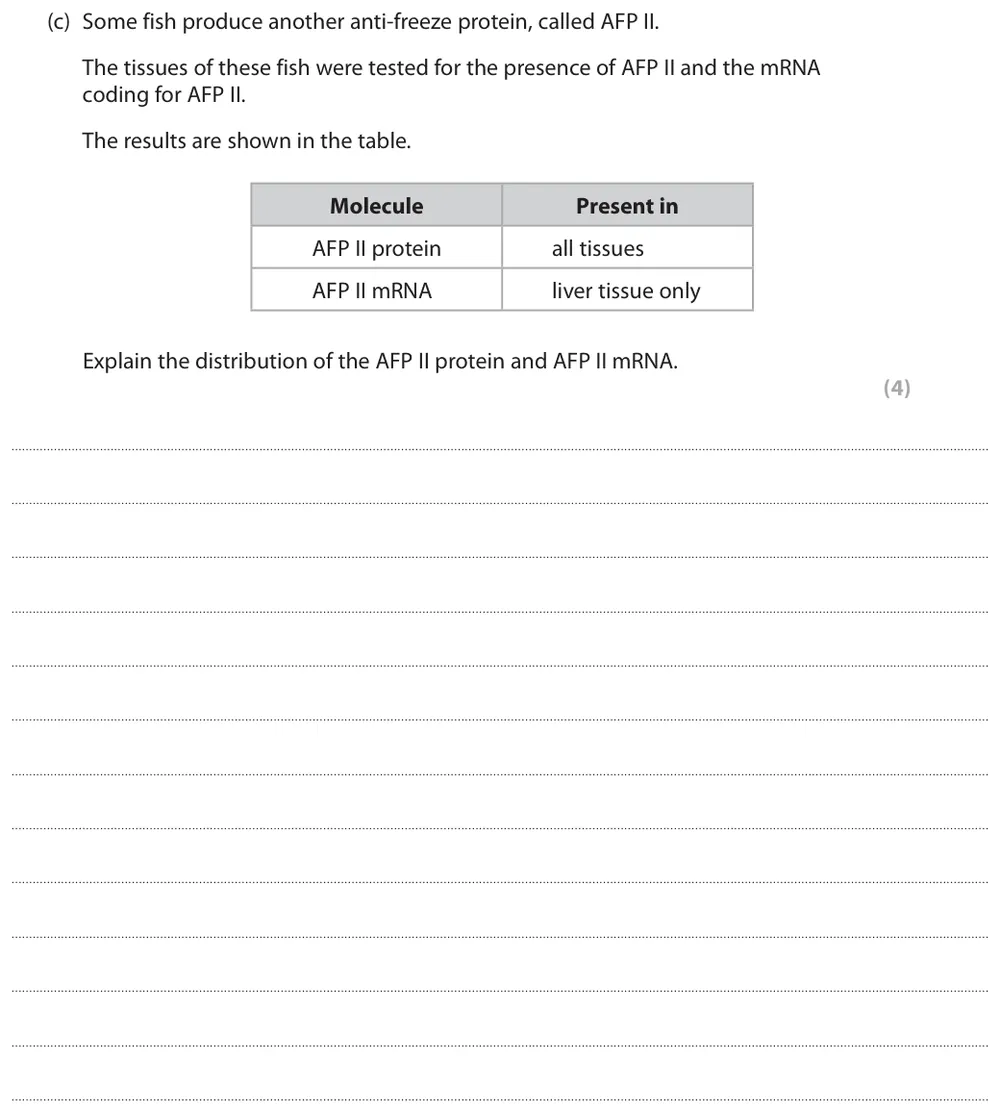
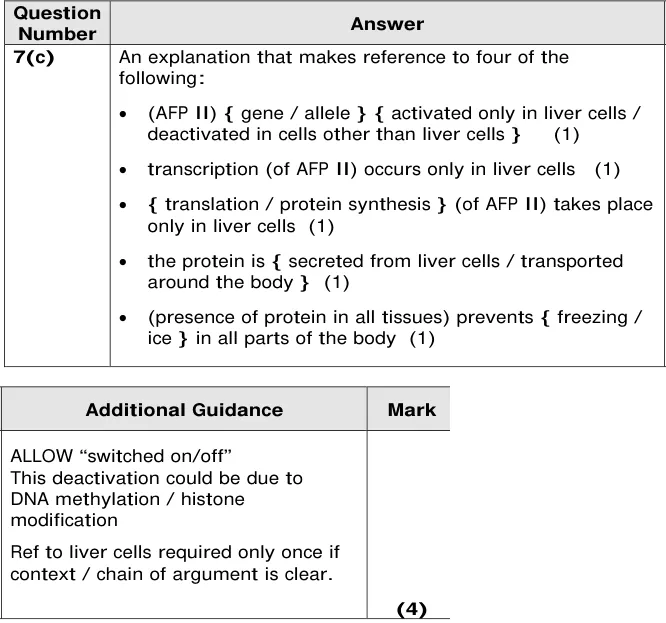
Explain why AFP II protein is found in all tissues but its mRNA only in the liver.
Show the mark scheme
Tap an image to open it full size.
From the examiners' report: Many realised the protein is made in the liver and carried round the body, gaining 1–2 marks. For full marks, explain that the AFP II gene is activated, so transcribed, only in liver cells and switched off in the others.
Question 2
AS Paper 2 · June 2017 · Q7(a)(ii) · 4 marks · Hard
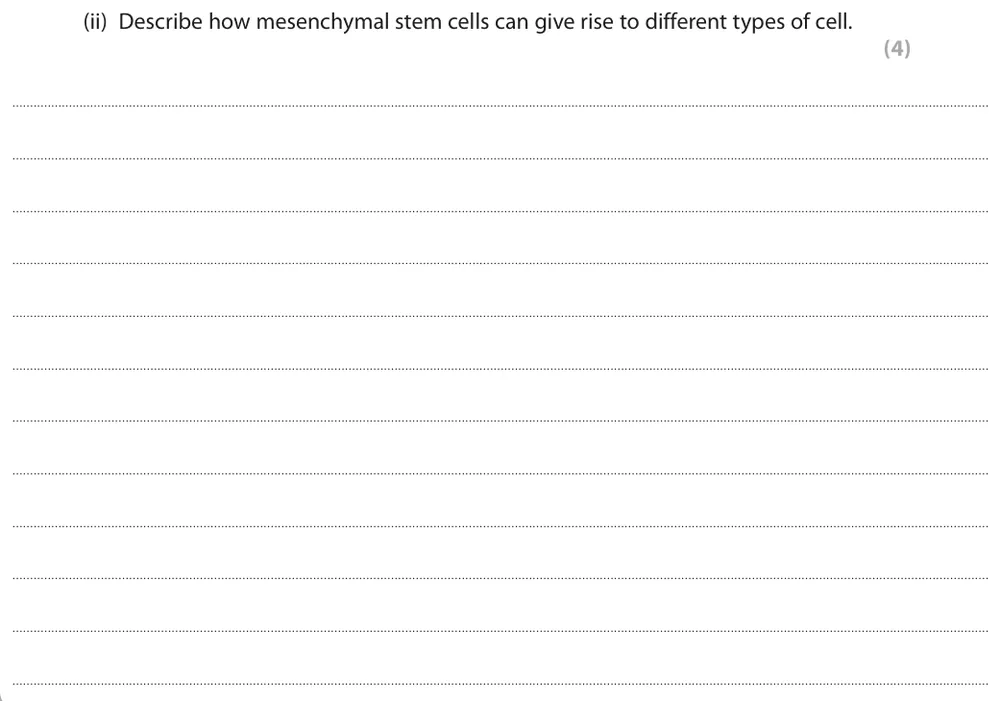
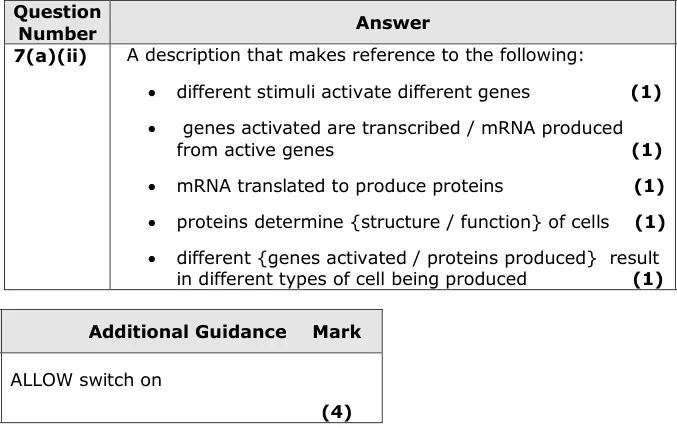
Describe how mesenchymal stem cells can give rise to different types of cell.
Show the mark scheme
Tap an image to open it full size.
From the examiners' report: Few mentioned that different stimuli activate different genes. Follow the chain through transcription and translation to proteins that determine the cell's structure or function; this is about activating genes, not methylation.
Question 3
AS Paper 2 · June 2018 · Q2(c) · 3 marks
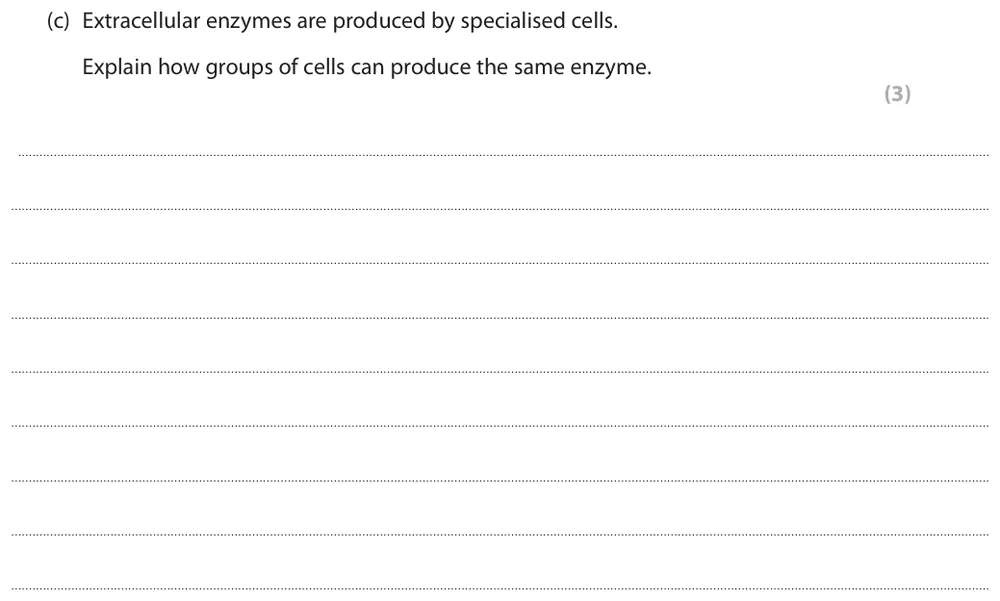
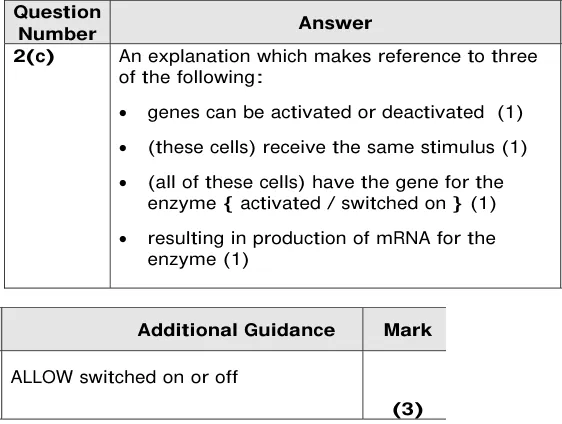
Explain how groups of cells can produce the same enzyme.
Show the mark scheme
Tap an image to open it full size.
From the examiners' report: Many gave a stock answer on differential gene expression or epigenetics. Tie your answer to the word 'same': the cells receive the same stimulus, so they all have the gene for the enzyme switched on and make its mRNA.
Question 4
AS Paper 2 · June 2023 · Q5(b)(i) · 4 marks
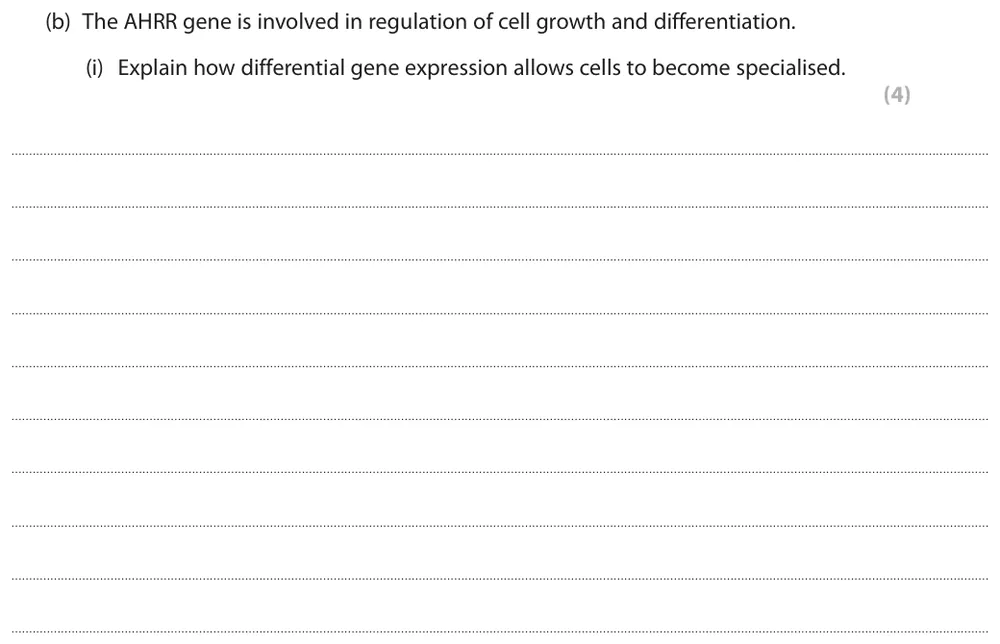
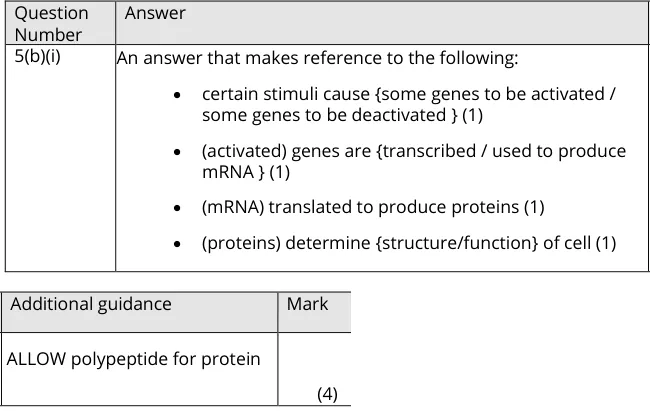
Explain how differential gene expression allows cells to become specialised.
Show the mark scheme
Tap an image to open it full size.
From the examiners' report: Many wrote about epigenetic factors instead of answering the question. Full-mark answers went: a stimulus activates a gene, the gene is transcribed, the mRNA is translated into a protein, and the protein determines the cell's structure or function.
Question 5
A level Paper 2 · June 2019 · Q6(c)(i) · 3 marks
Explain how genetically identical cells in a root can differentiate into different phloem tissues.
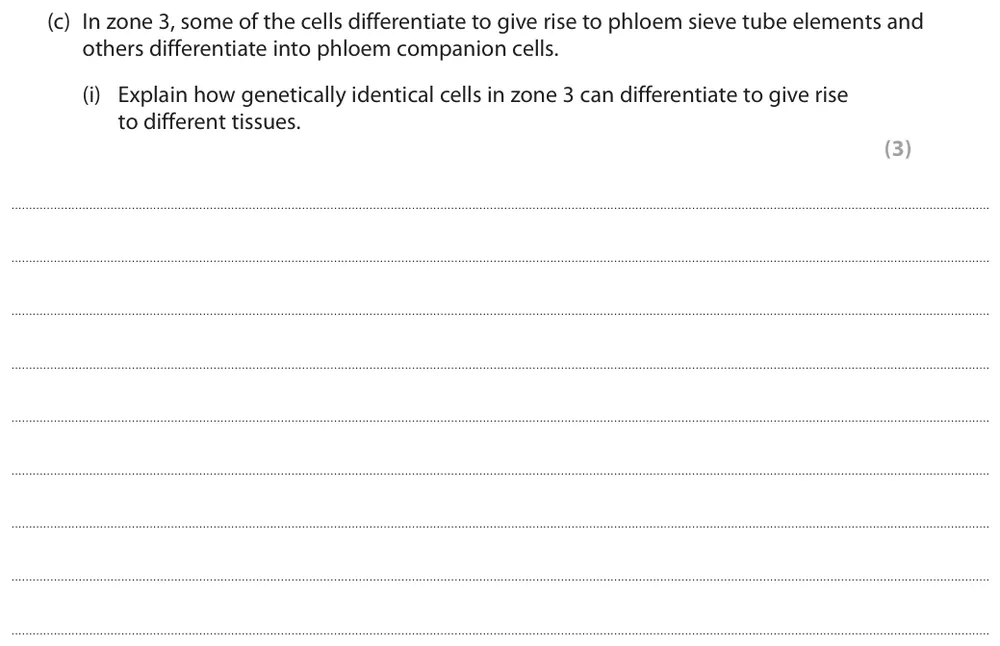
Show the mark scheme
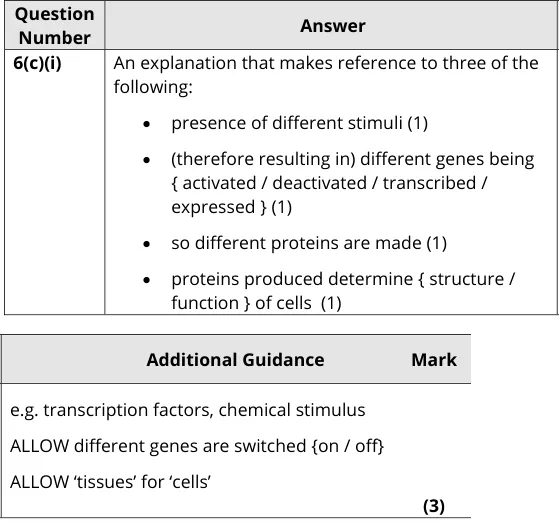
Tap an image to open it full size.
From the examiners' report: Many mentioned stem cells but did not go on to explain how different tissues arise. Say that different stimuli switch on different genes, so different proteins are made that determine the structure of each cell.
Question 6
A level Paper 2 · June 2022 · Q5(b)(ii) · 4 marks
Explain how a bone marrow stem cell can give rise to red blood cells.
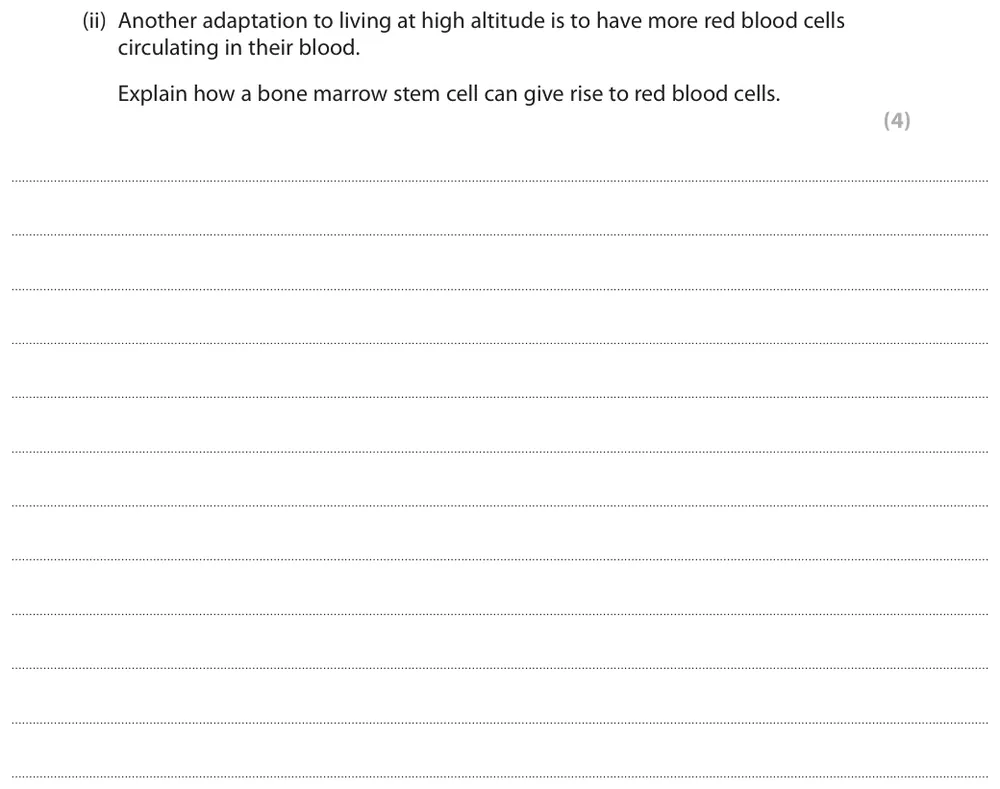
Show the mark scheme
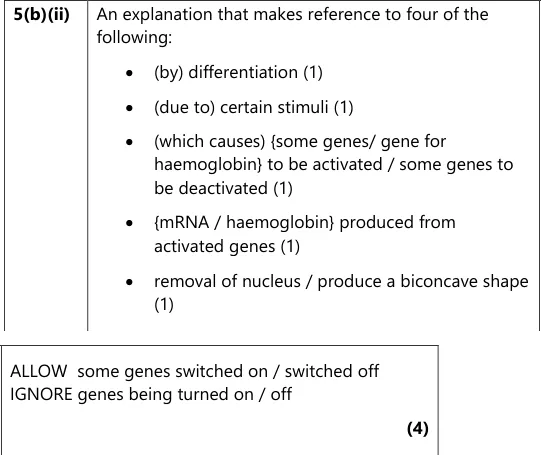
Tap an image to open it full size.
From the examiners' report: Many knew differentiation well but did not tailor it to red blood cells, and 'develop' was not accepted for differentiate. Mention the gene for haemoglobin being activated, or the loss of the nucleus.
Question 7
A level Paper 2 · June 2023 · Q2(b)(ii) · 3 marks
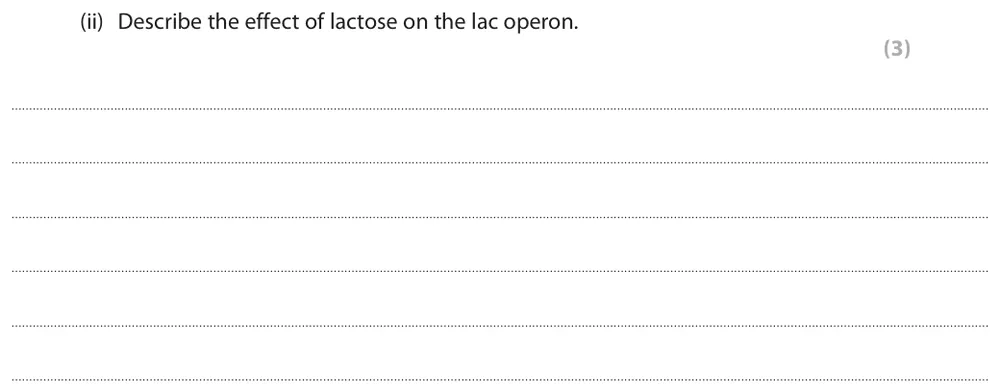
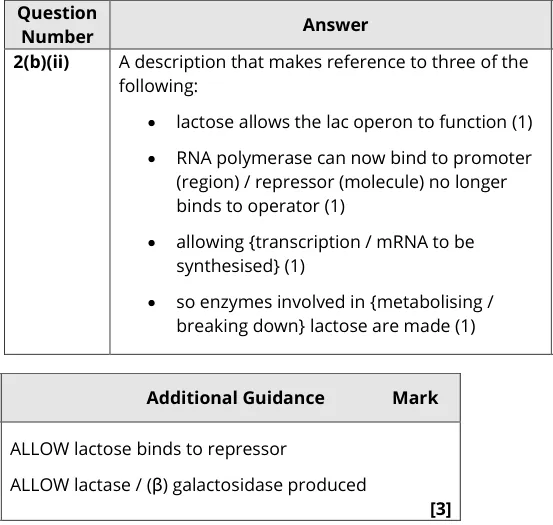
Describe the effect of lactose on the lac operon.
Show the mark scheme
Tap an image to open it full size.
From the examiners' report: Many knew that lactose allows the lac operon to function. For more marks, say the repressor no longer binds to the operator, RNA polymerase binds to the promoter, and the enzymes that break down lactose are made; 'protein synthesis' alone was not enough.
Question 8
A level Paper 3 · June 2023 · Q6(a) · 3 marks
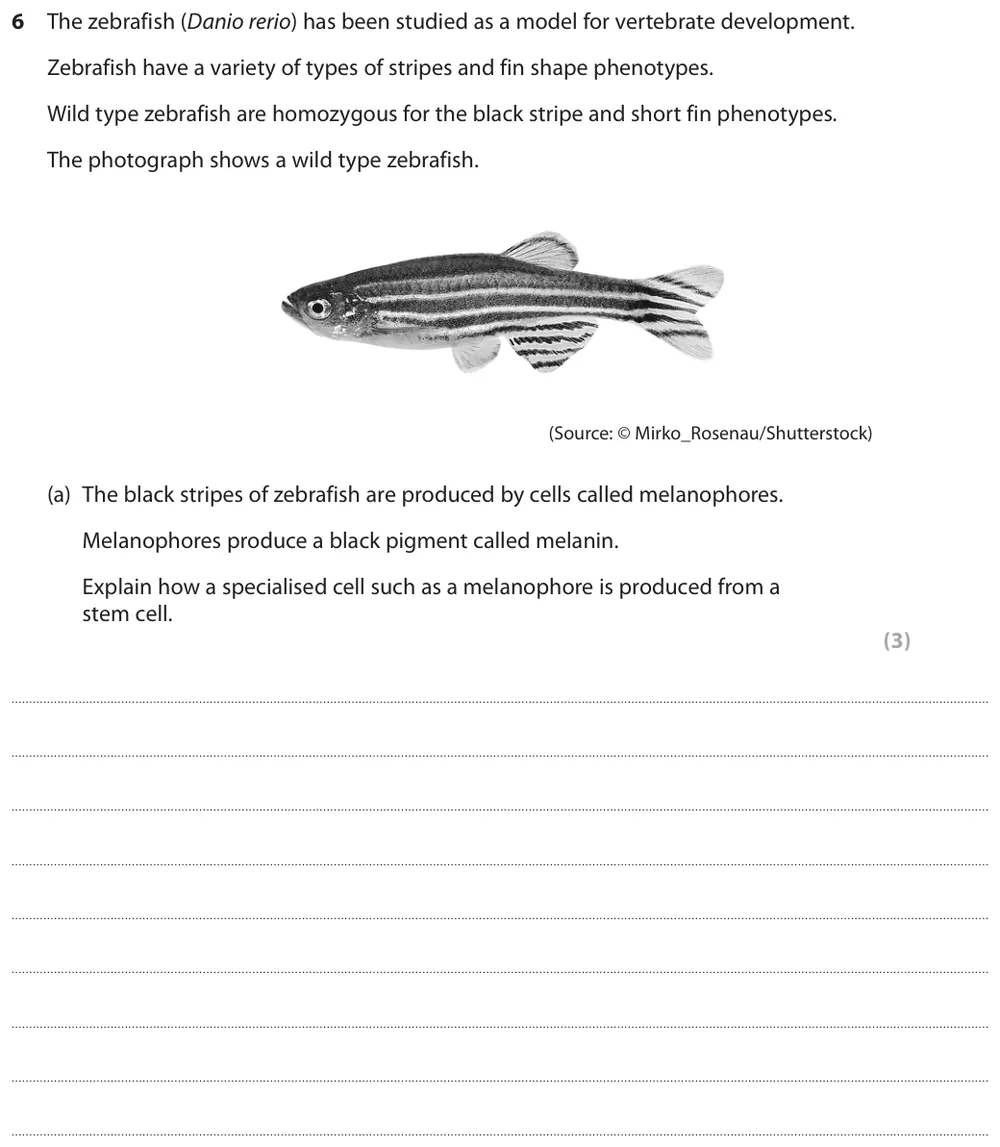
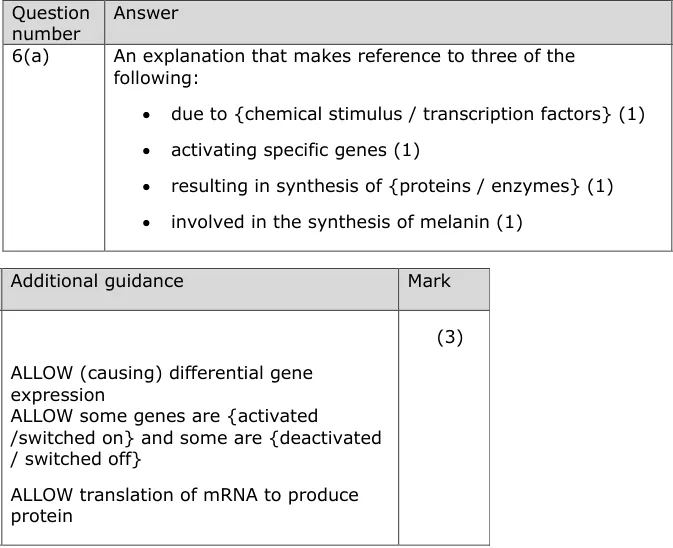
Explain how a melanophore, a cell that makes melanin, is produced from a stem cell.
Show the mark scheme
Tap an image to open it full size.
From the examiners' report: Many gained all three marks, but few made the final point. Link the proteins or enzymes made to the synthesis of melanin, not just to 'becoming a melanophore'.
Question 9
A level Paper 1 · June 2025 · Q7(a)(ii) · 2 marks · Hard
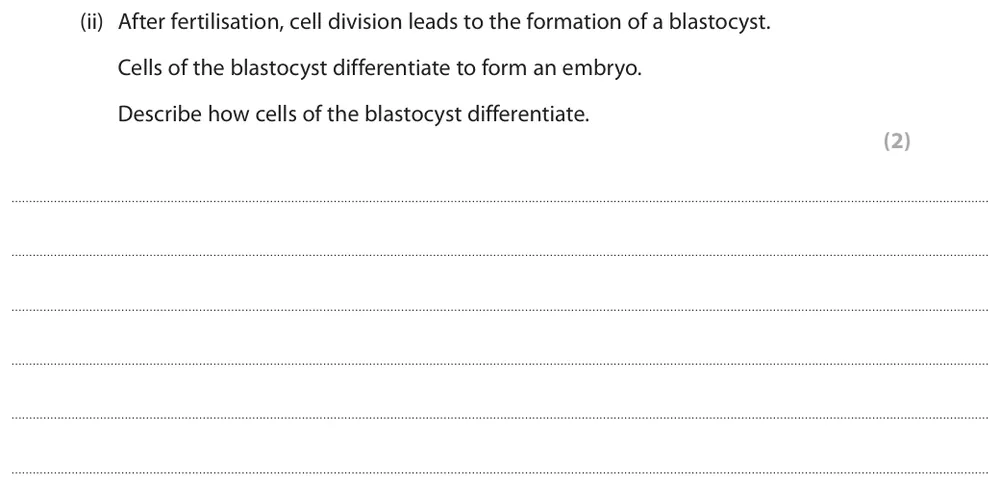
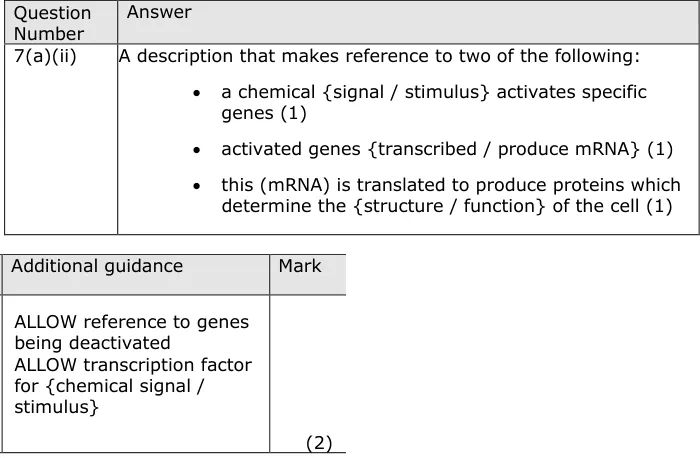
Describe how cells of the blastocyst differentiate.
Show the mark scheme
Tap an image to open it full size.
From the examiners' report: Candidates found this challenging; some wrote about meiosis or totipotency. Say what activates the genes (a chemical signal), and don't paraphrase the question: the proteins made determine the structure and function of the cell.
Genotype, environment and phenotype (3.14 i)
Question 10
A level Paper 2 · June 2018 · Q2(b) · 3 marks
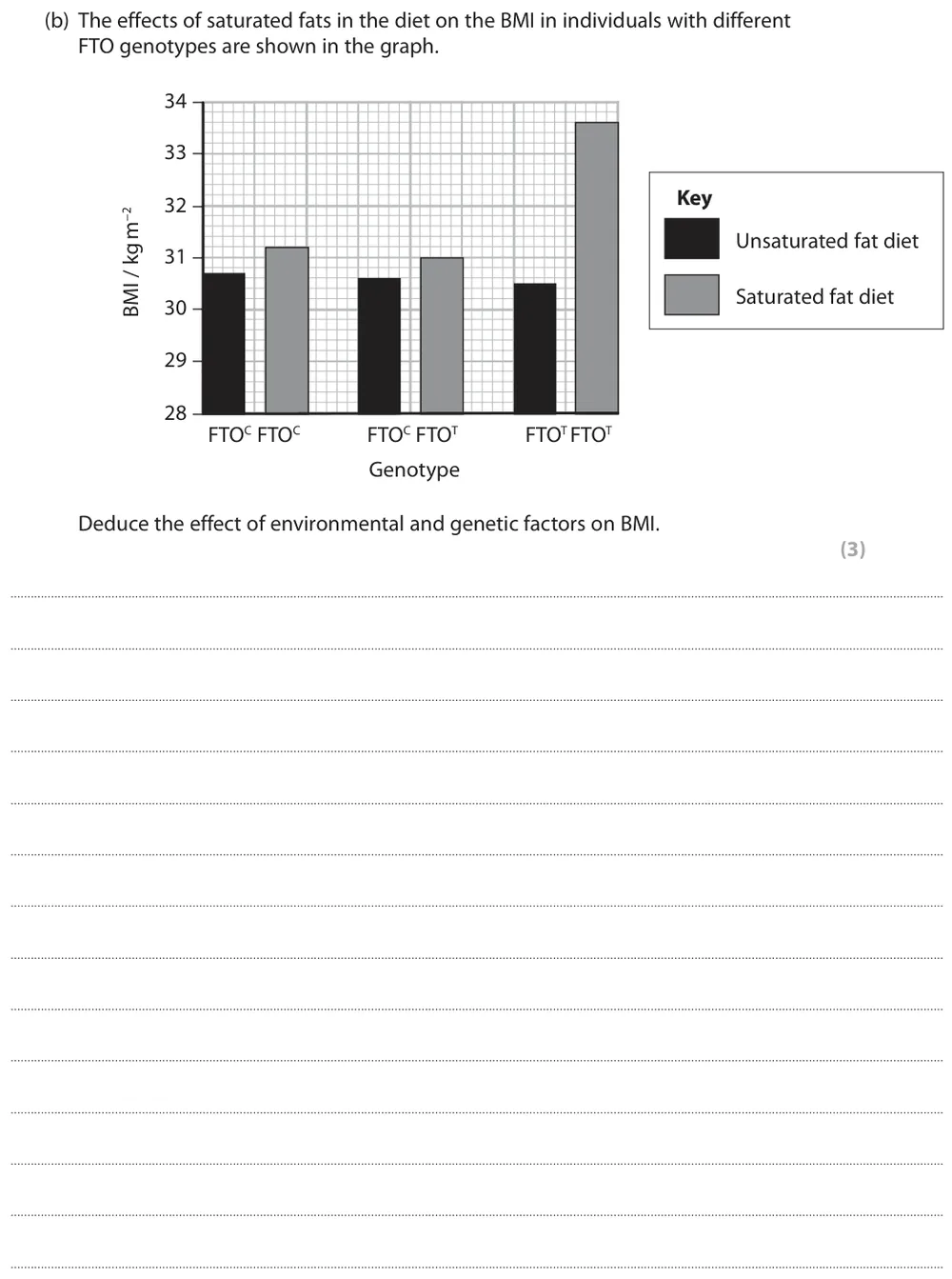
Use a graph of BMI, diet and FTO genotype to deduce the effects of environmental and genetic factors.
Show the mark scheme
Tap an image to open it full size.
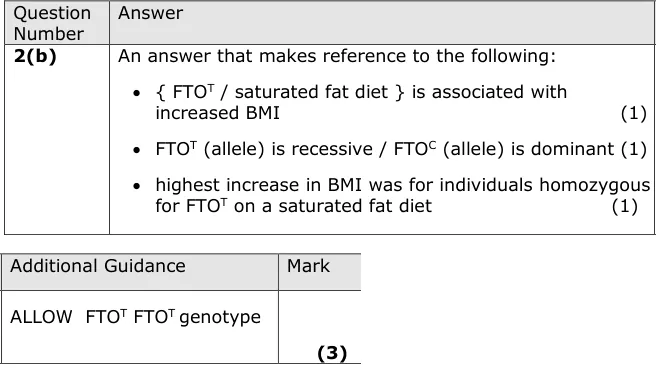
From the examiners' report: Most linked a saturated fat diet to higher BMI. Few went on to say that only the homozygous FTOT genotype showed the large effect, and very few said this means the FTOT allele is recessive.
Question 11
AS Paper 2 · June 2023 · Q4(c)(ii) · 3 marks
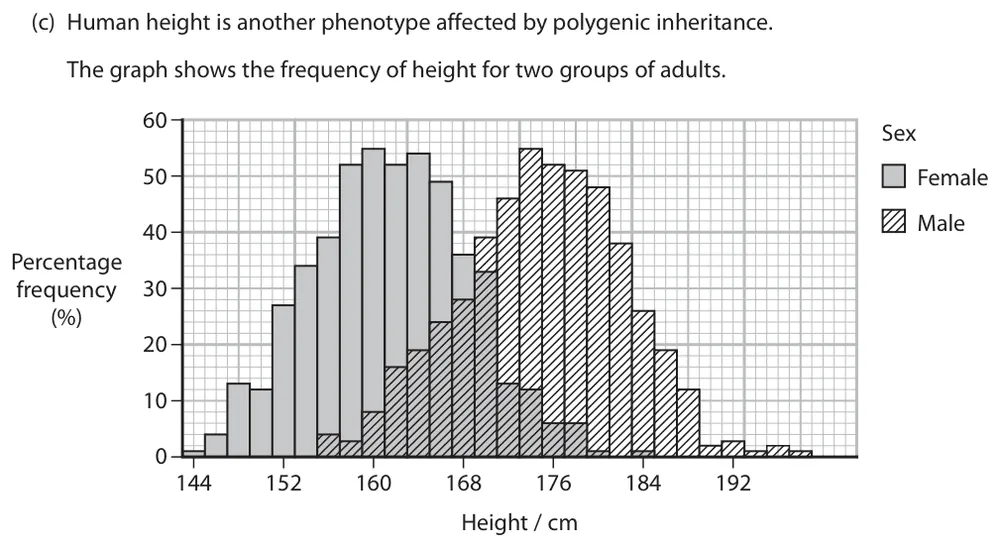
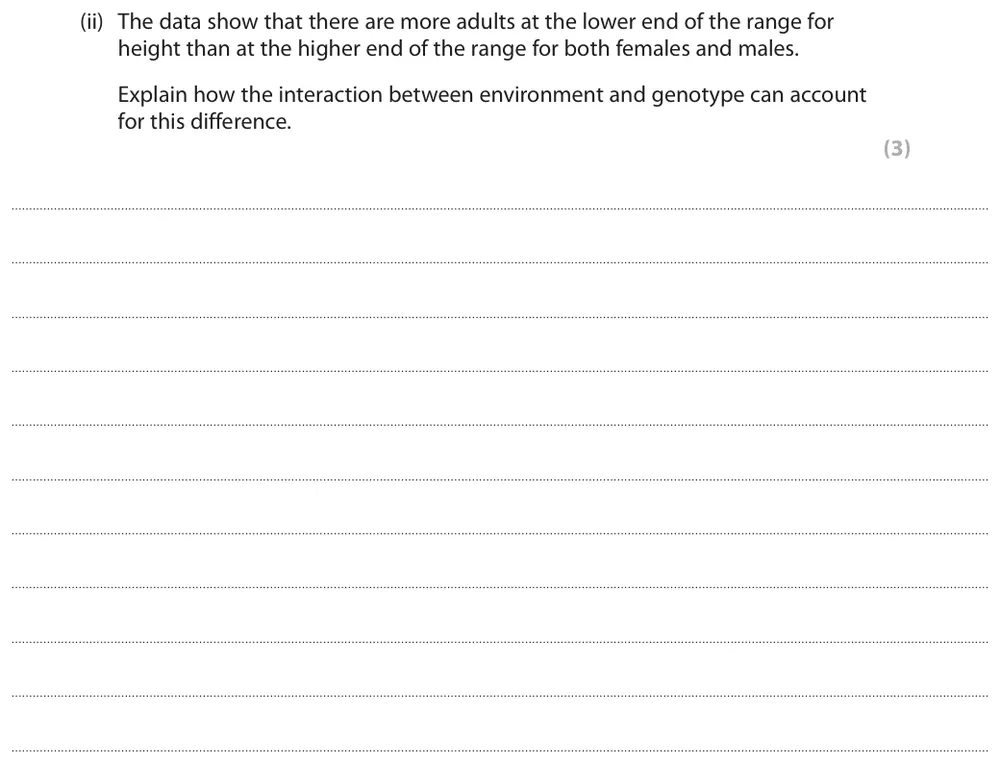
Explain how the interaction of environment and genotype accounts for more adults being at the lower end of the height range.
Information from earlier in this question:
Show the mark scheme
Tap an image to open it full size.
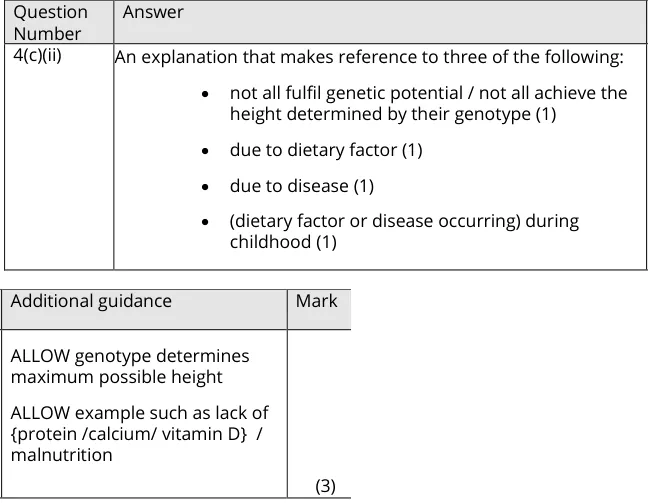
From the examiners' report: Not answered well. 'Diet' was weak: name protein or calcium, and playing sport does not make people taller. Very few said the diet or disease acts during childhood, stopping people reaching the height their genotype allows.
Question 12
AS Paper 2 · June 2025 · Q6(b)(ii) · 2 marks · Hard
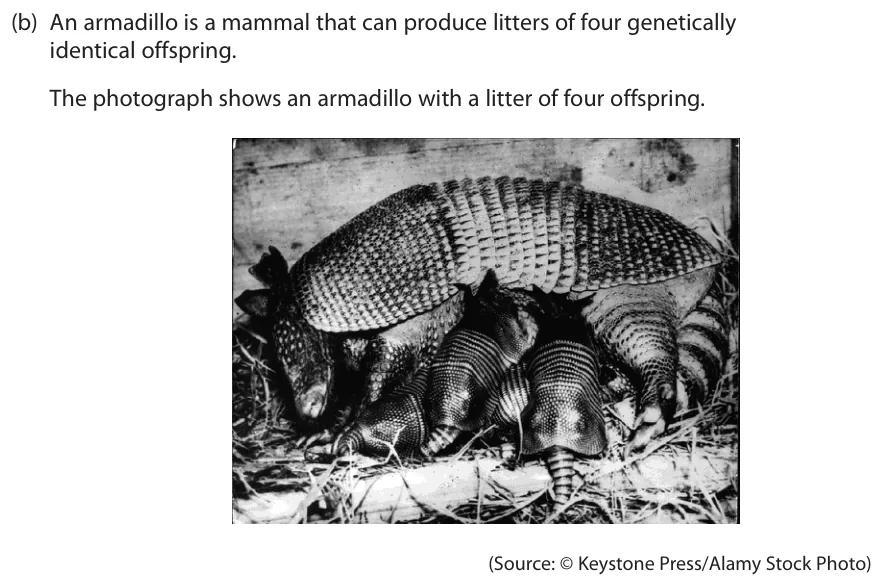
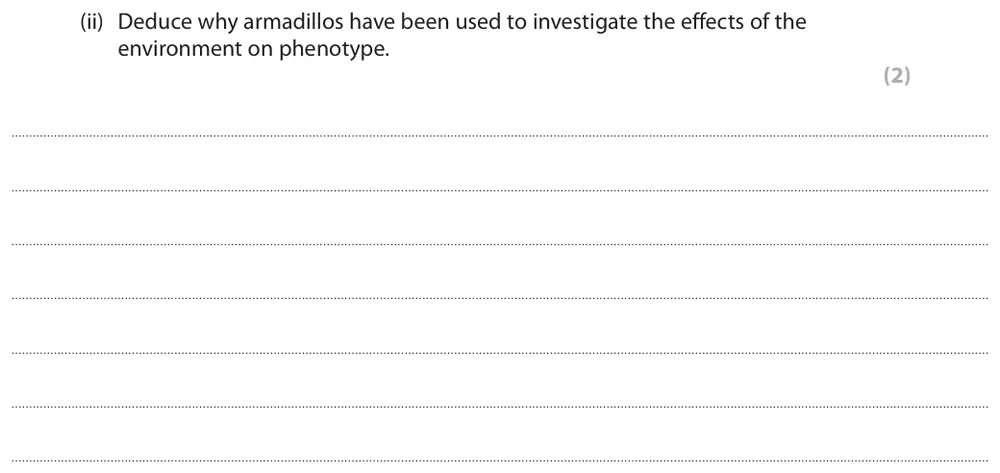
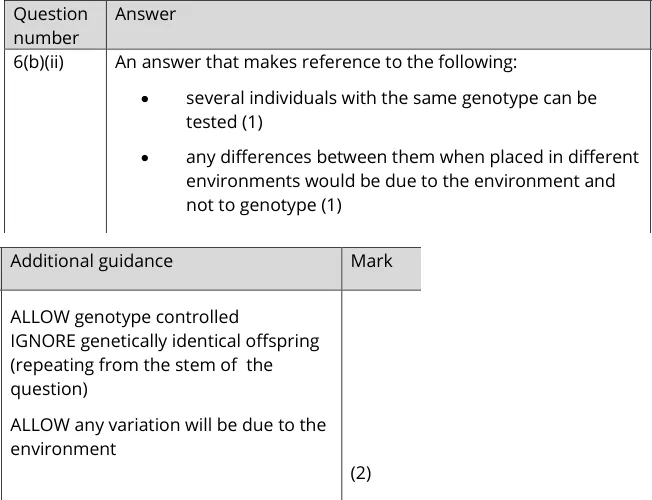
Deduce why armadillos have been used to study the effects of the environment on phenotype.
Information from earlier in this question:
Show the mark scheme
Tap an image to open it full size.
From the examiners' report: Repeating that the armadillos are genetically identical (already in the stem) gained nothing. Say several individuals with the same genotype can be tested, so differences in different environments are due to the environment, not genotype.
Epigenetics: DNA methylation and histone modification (3.14 ii)
Question 13
AS Paper 2 · June 2023 · Q5(a) · 3 marks
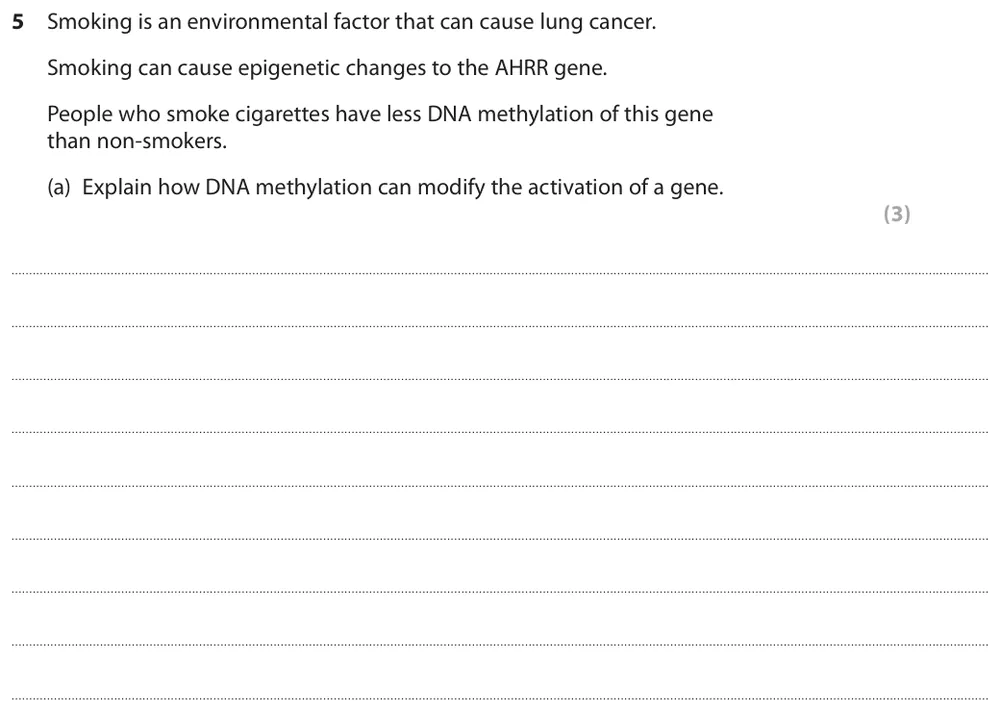
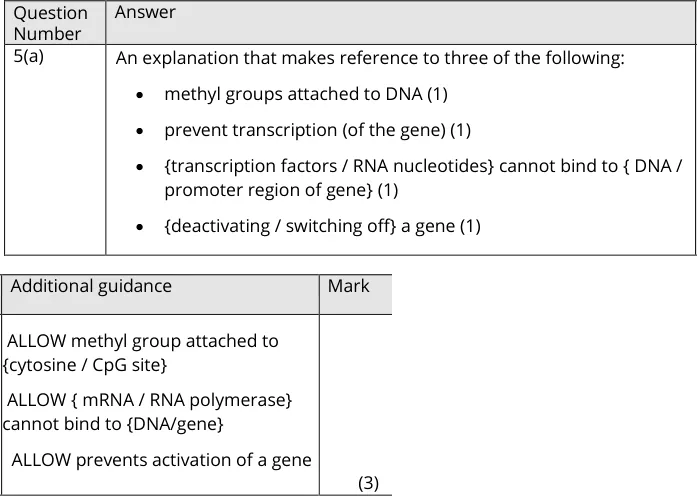
Explain how DNA methylation can modify the activation of a gene.
Show the mark scheme
Tap an image to open it full size.
From the examiners' report: Many confused DNA methylation with histone modification. Methyl groups attach to the DNA, which prevents transcription because RNA polymerase cannot bind, so the gene is switched off.
Question 14
AS Paper 2 · June 2023 · Q5(b)(ii) · 3 marks
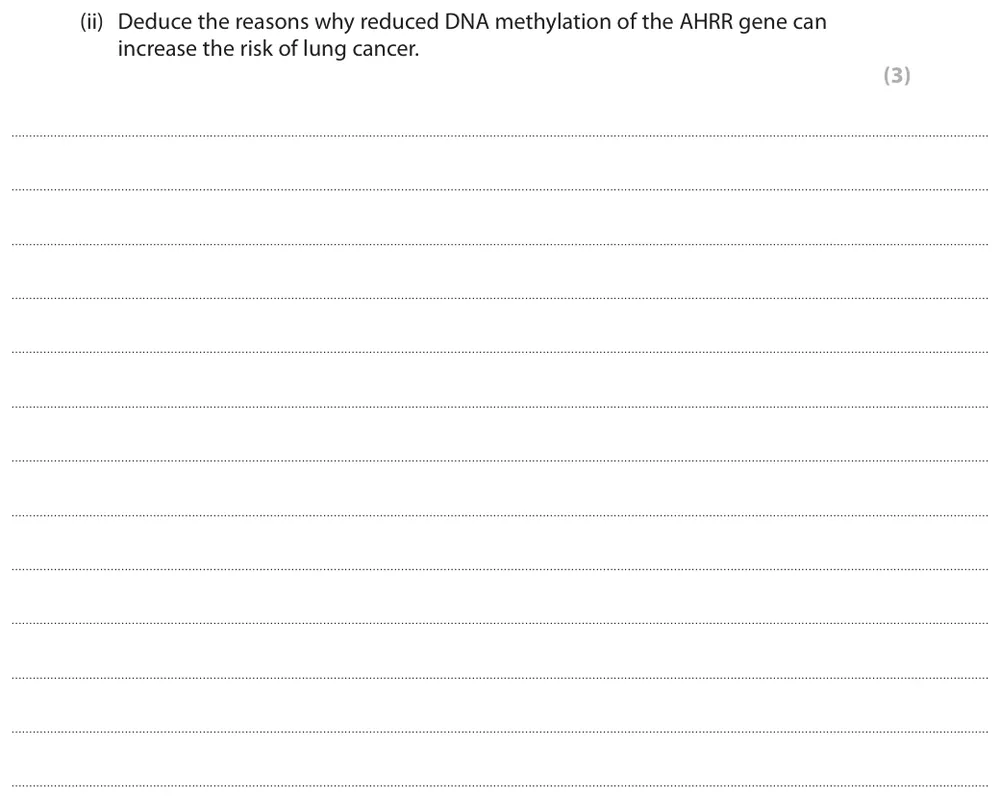
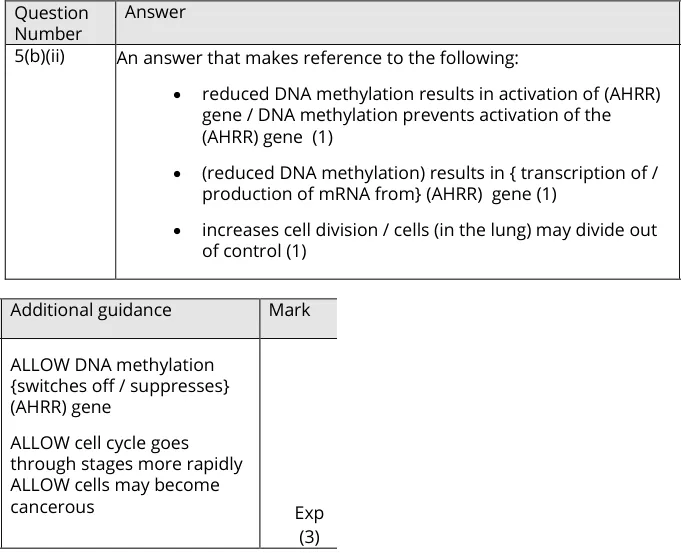
Deduce why reduced DNA methylation of the AHRR gene can increase the risk of lung cancer.
Information from earlier in this question:

Show the mark scheme
Tap an image to open it full size.
From the examiners' report: Apply your knowledge to the new context: less methylation lets the AHRR gene be activated and transcribed, so cells divide out of control. 'Increased cell growth' was not accepted.
Question 15
AS Paper 2 · June 2025 · Q6(d)(i) · 3 marks · Hard
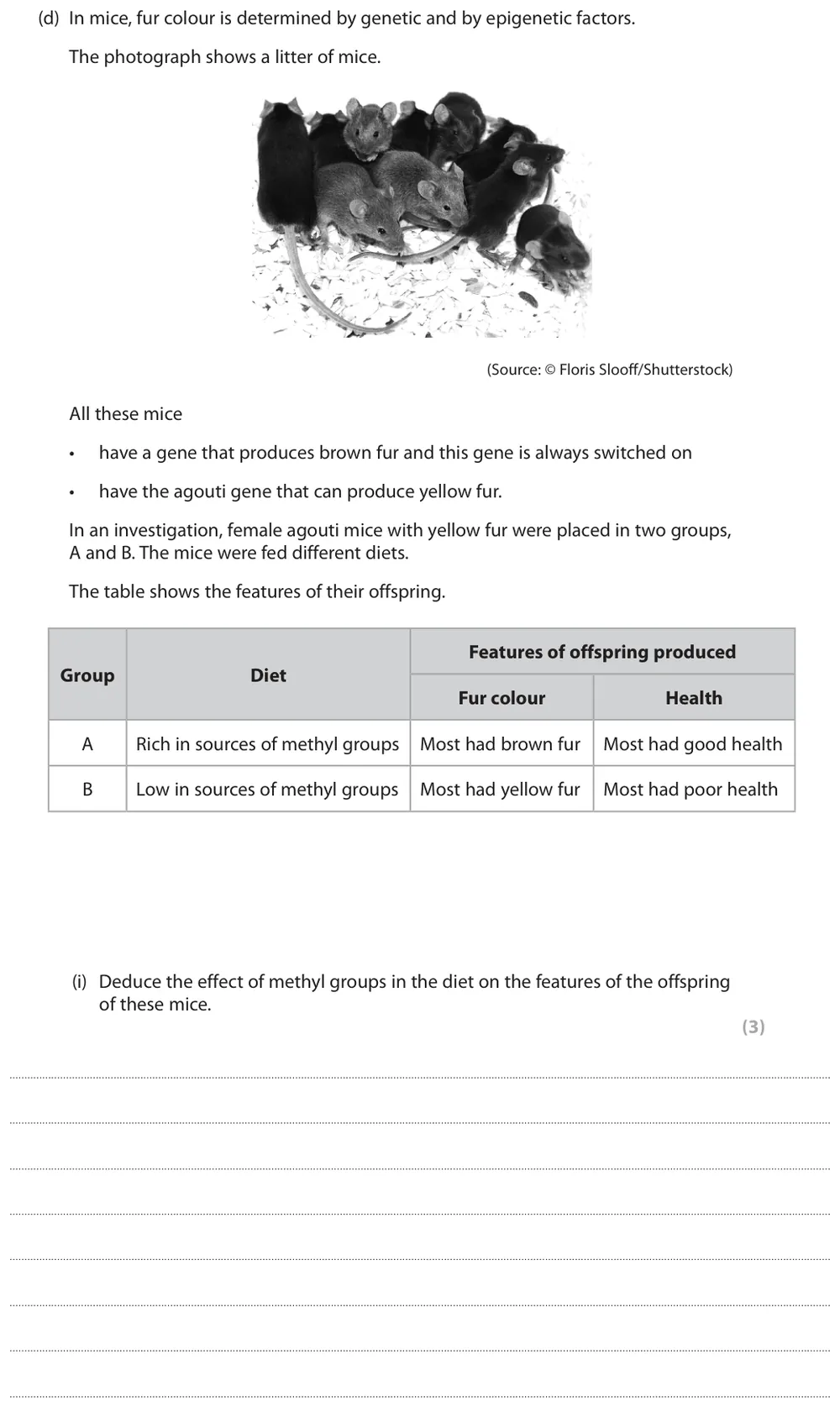
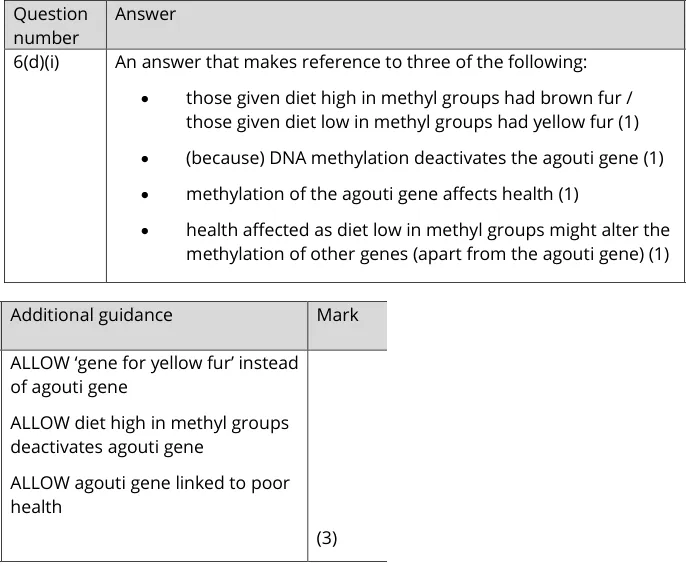
Deduce the effect of methyl groups in the mother's diet on the fur colour and health of the offspring.
Show the mark scheme
Tap an image to open it full size.
From the examiners' report: Very few gained full marks. The question says the brown gene is always switched on, so don't write about it being activated: methyl groups deactivate the agouti gene, giving brown fur, and methylation of the agouti gene affects health.
Question 16
AS Paper 2 · June 2025 · Q6(d)(ii) · 2 marks · Hard
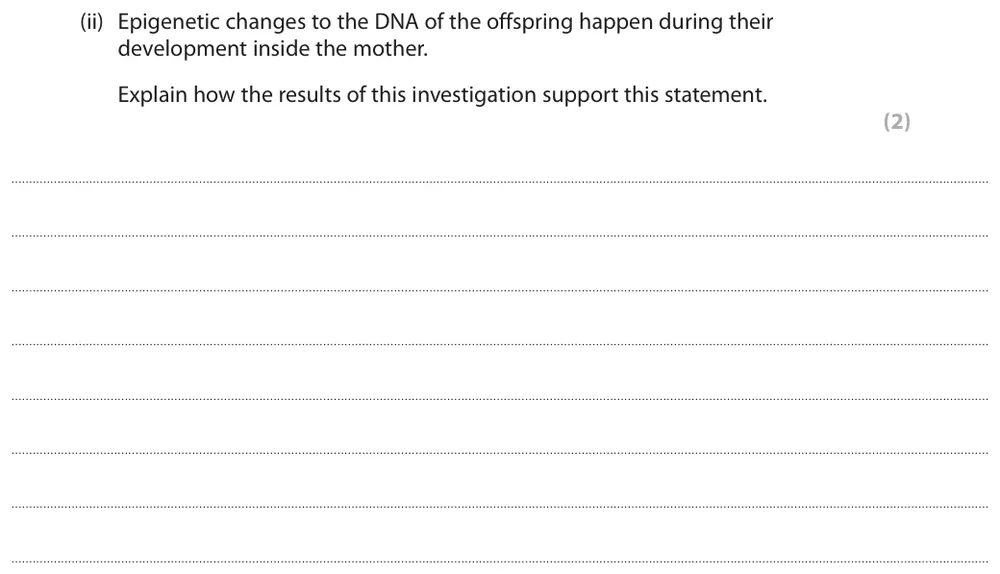
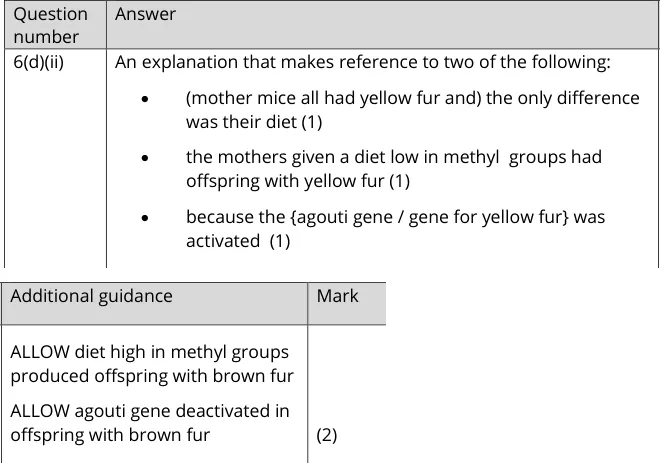
Explain how the results show that epigenetic changes happen during development inside the mother.
Show the mark scheme
Tap an image to open it full size.
From the examiners' report: Most missed that all the mothers had the same phenotype, so diet was the only difference. Then link the diet low in methyl groups to offspring with yellow fur.
Question 17
A level Paper 1 · November 2021 · Q4(c) · 3 marks · Hard
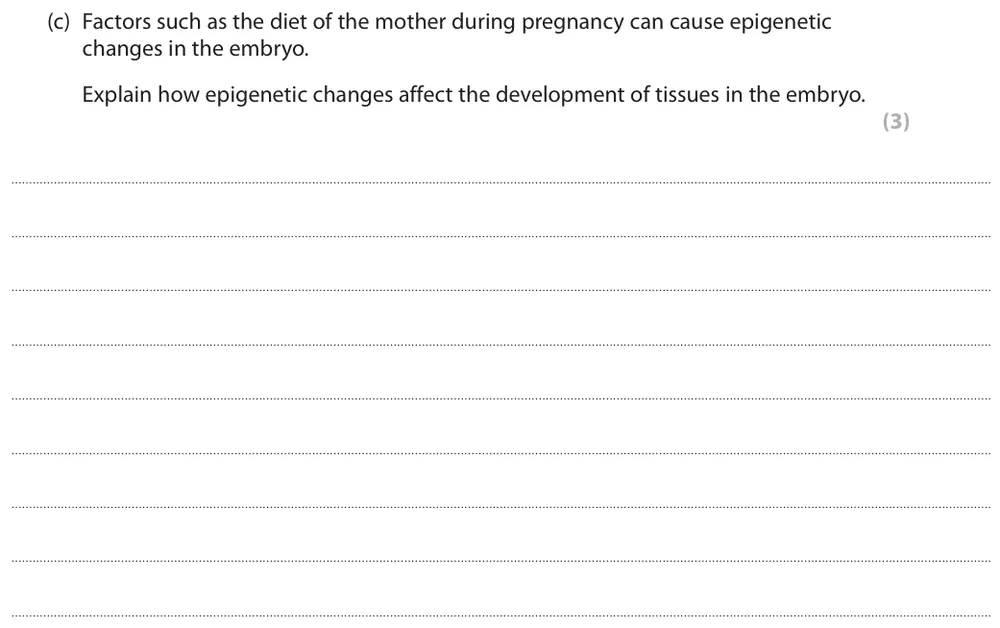
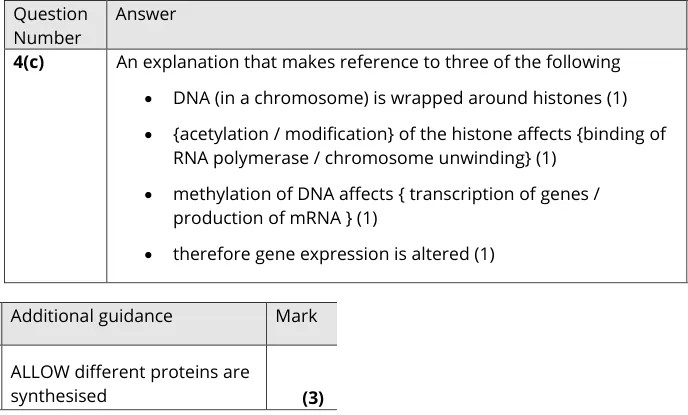
Explain how epigenetic changes affect the development of tissues in the embryo.
Show the mark scheme
Tap an image to open it full size.
From the examiners' report: Very few gained full marks. Don't blur the two mechanisms: modifying (acetylating) the histones affects how the chromosome unwinds and whether RNA polymerase binds, and methylating DNA affects transcription. Both alter gene expression.
Polygenic inheritance and continuous variation (3.15)
Question 18
AS Paper 2 · June 2019 · Q1(b) · 4 marks
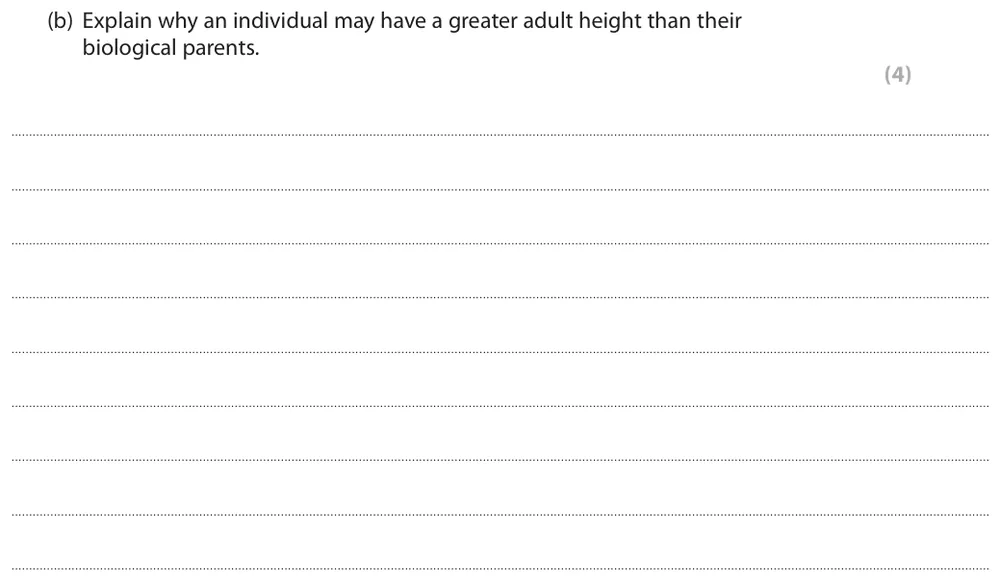
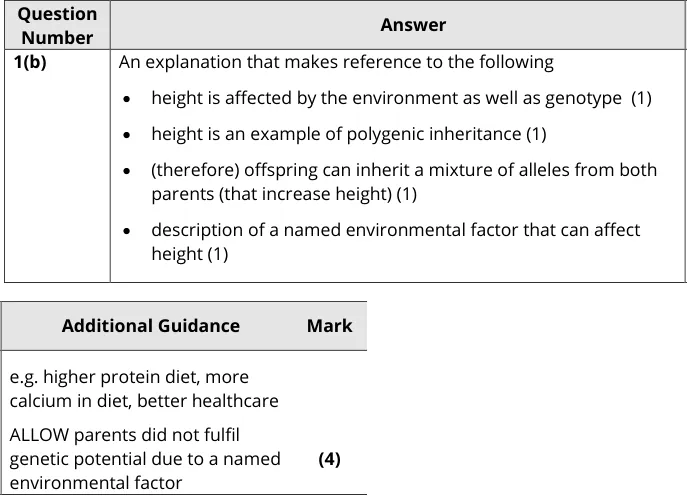
Explain why an individual may be taller as an adult than their biological parents.
Show the mark scheme
Tap an image to open it full size.
From the examiners' report: Better answers linked a specific environmental factor to its effect on height, but few linked the genetic and environmental sides. The word is polygenic, not 'polygenetic'.
Question 19
AS Paper 2 · November 2021 · Q5(b)(i) · 2 marks
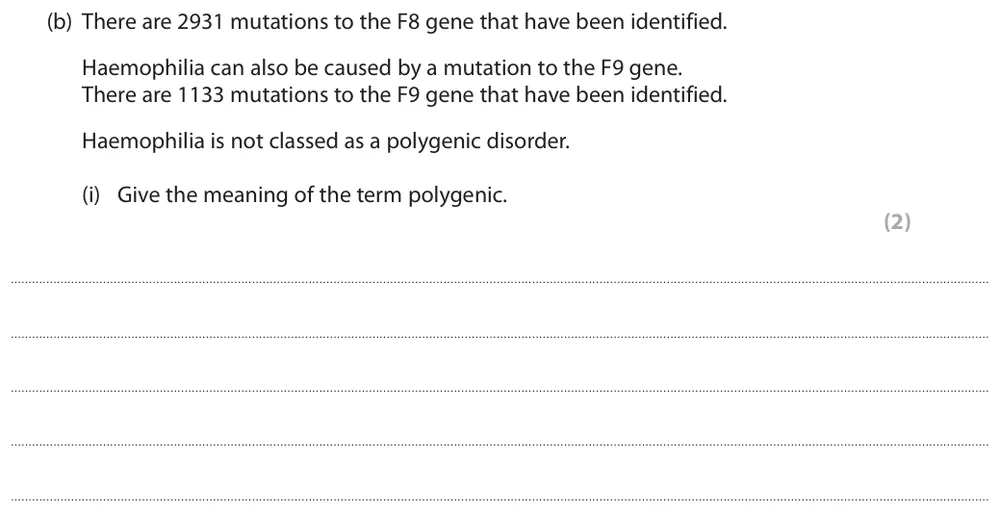
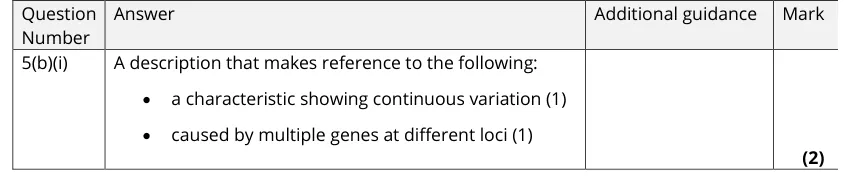
Give the meaning of the term polygenic.
Show the mark scheme
Tap an image to open it full size.
From the examiners' report: Most mentioned genes at different loci, but few added that a polygenic characteristic shows continuous variation.
Question 20
AS Paper 2 · June 2025 · Q5(a)(ii) · 4 marks · Hard
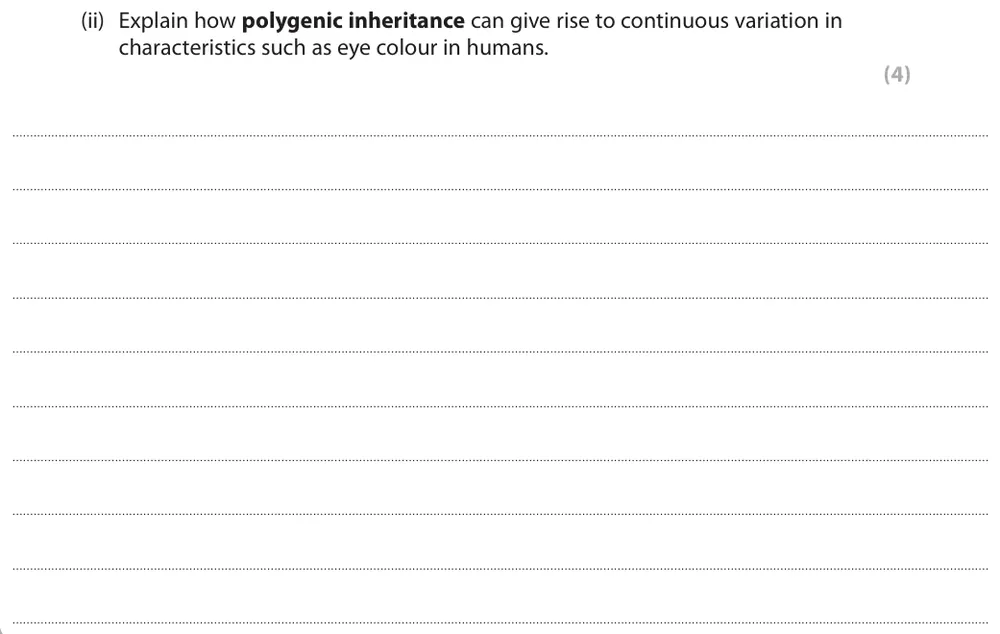
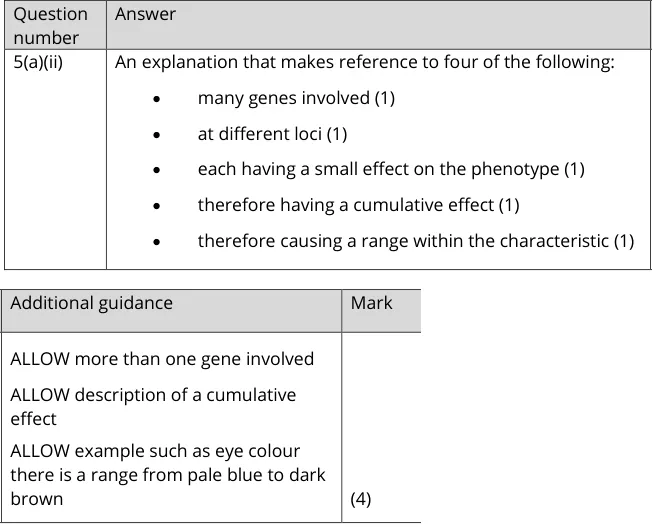
Explain how polygenic inheritance can give rise to continuous variation, such as in eye colour.
Show the mark scheme
Tap an image to open it full size.
From the examiners' report: Many gained marks for several genes at different loci, but few said each gene has a small effect and the effects are cumulative. The environment gained no credit here, and write 'genes', not 'alleles'.
Where students lose marks (from Pearson examiners' reports and mark schemes)
Each point below comes from the examiners' reports and mark schemes, and is followed by wording that gained marks.
AFP II mRNA shows where the gene is switched on. Many said the protein is made in the liver and transported, without explaining gene switching.
✔ Gains credit: 'The AFP II gene is activated only in liver cells, so transcription of AFP II occurs only in liver cells.'
Specialisation questions want gene activation, not epigenetics. Many students discussed epigenetic factors instead of answering the question.
✔ Gains credit: 'Certain stimuli cause some genes to be activated; activated genes are transcribed; the mRNA is translated to produce proteins, which determine the structure or function of the cell.'
Make it about the red blood cell. Many described differentiation in general and did not tailor the answer to red blood cells.
✔ Gains credit: 'Certain stimuli cause the gene for haemoglobin to be activated, so haemoglobin mRNA is produced; the nucleus is removed and the cell becomes biconcave.'
Blastocyst cells differentiate by switching genes on. A frequent response referred to meiosis producing genetically different cells, or to totipotency.
✔ Gains credit: 'A chemical signal activates specific genes; activated genes are transcribed to produce mRNA, which is translated into proteins that determine the structure or function of the cell.'
Only the homozygous FTOT genotype shows the big BMI rise. Many saw a link between genotype and BMI but did not say that only the homozygous individuals were affected.
✔ Gains credit: 'The highest increase in BMI was for individuals homozygous for FTOT on a saturated fat diet, so the FTOT allele is recessive.'
Name protein or calcium, not just diet. Weak answers said 'diet', and many believed playing sports such as basketball makes people taller.
✔ Gains credit: 'Not all achieve the maximum height determined by their genotype, due to a lack of protein, calcium or vitamin D during childhood.'
DNA methylation is not histone modification. Many confused DNA methylation with histone modification.
✔ Gains credit: 'Methyl groups attached to DNA prevent transcription, as RNA polymerase cannot bind to the DNA, so the gene is deactivated.'
Many genes, each with a small, cumulative effect. Few said each gene has a small effect or that the effects add up; some wrote about the environment or used 'alleles' for genes.
✔ Gains credit: 'Many genes at different loci, each having a small effect on the phenotype, therefore having a cumulative effect, causing a range within the characteristic.'
Download the questions
Download the PDF pack (20 questions, mark schemes at the end)
Keep practising
- Cell Structure and Organisation (Topic 3): Edexcel SNAB exam questions by topic
- Gametes, Fertilisation and Linkage (Topic 3): Edexcel SNAB exam questions by topic
- Meiosis, Mitosis and Stem Cells (Topic 3): Edexcel SNAB exam questions by topic
- Topic 3 multiple-choice quiz (71 questions, marked as you tap)
- Edexcel SNAB A level Biology resources hub (every topic, practical and paper)
- Root Tip Squash and Mitosis (Core Practical 5): Edexcel SNAB A Level Biology Exam Questions
- Extended Response Questions (Topics 3 and 4): Edexcel SNAB A Level Biology Exam Questions
- Edexcel SNAB A level Biology past papers, mark schemes and examiners' reports
- Edexcel SNAB A level Biology grade boundaries
- Message Tom on WhatsApp about one-to-one Edexcel SNAB tutoring or an Edexcel group class
Questions, mark schemes and examiners' report extracts © Pearson Education Ltd.