

Meiosis, Mitosis and Stem Cells sits in Topic 3, Voice of the Genome, of the Edexcel A level Biology A (Salters-Nuffield) specification. You need to understand how meiosis produces non-identical gametes through independent assortment and crossing over, how mitosis and the cell cycle produce genetically identical daughter cells for growth and asexual reproduction, what is meant by stem cell, totipotency and pluripotency, and how society makes decisions about using stem cells in medical therapies. This sub-topic is examined on AS Paper 2 and on A level Papers 1, 2 and 3. Questions marked AS are from the AS papers (8BN0); the rest are from the A level papers (9BN0).
The examiners' reports keep returning to precise vocabulary. Don't confuse centromeres with centrioles, chromatids with homologous chromosomes, or the quantity of DNA with the number of chromosomes. When a meiosis question is not about variation, don't reach for the stock answers of independent assortment and crossing over. In data and unfamiliar-context questions, such as drugs that stop spindle fibres shortening, say whether something increases or decreases and link it to the stage of mitosis affected. For stem cells, use the word differentiate and tie your answer to the cells in the question.
Studying Edexcel SNAB and want more help? If you'd like to arrange one-to-one Edexcel tutoring, or to register your interest in an Edexcel group class, message Tom on WhatsApp using the link at the bottom of this page.
What you need from GCSE
Each question on this page assumes you're secure on these ideas. If any of them feels shaky, look it up before you start.
- Body cells divide by mitosis to produce two genetically identical cells.
- Gametes are made by meiosis and contain half the number of chromosomes of a body cell.
- Chromosomes are made of DNA and carry genes; body cells contain pairs of chromosomes.
- Stem cells are unspecialised cells that can become many different types of cell.
Key terms
These words come up in the questions and mark schemes. Examiners expect you to use them exactly.
- Homologous chromosomes: a pair of chromosomes, one from each parent, with the same genes at the same loci.
- Independent assortment: the random way each pair of homologous chromosomes lines up and separates in meiosis, giving new combinations of chromosomes.
- Crossing over: the exchange of sections of DNA between non-sister chromatids of a homologous pair, producing new combinations of alleles.
- Centromere: the region that holds two sister chromatids together and attaches to the spindle fibres.
- Cell cycle: interphase (G1, S and G2), followed by mitosis and cytokinesis.
- Cytokinesis: division of the cytoplasm to form two daughter cells.
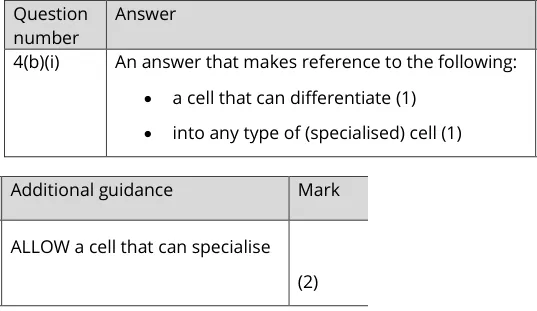
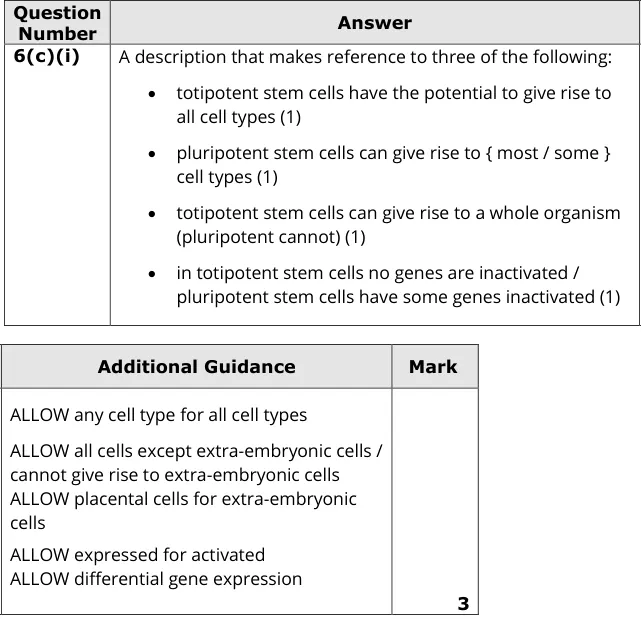
- Totipotent: a cell that can differentiate into any type of cell, including extra-embryonic cells, and form a whole organism.
- Pluripotent: a cell that can differentiate into most, but not all, types of cell.
What these questions cover (Edexcel SNAB Topic 3: Voice of the Genome)
The questions test these statements from Topic 3 of the Pearson Edexcel A level Biology A (Salters-Nuffield) specification (9BN0).
- 3.9 Understand the role of meiosis in ensuring genetic variation through the production of non-identical gametes as a consequence of independent assortment of chromosomes and
- 3.10 Understand the role of mitosis and the cell cycle in producing identical daughter cells for growth and asexual reproduction.
- 3.11 i Understand what is meant by the terms ‘stem cell, pluripotency and totipotency’.
- 3.11 ii Be able to discuss the way society uses scientific knowledge to make decisions about the use of stem cells in medical therapies.
How to use this page
Write your answer on paper before you open the mark scheme. Allow about 1.2 minutes per mark: the 20 questions are worth 54 marks, so about 65 minutes in total. Then mark your answer strictly against the mark scheme and read the examiners' tip underneath it. If you'd rather print the questions, download the PDF pack.
Meiosis and genetic variation (3.9)
Question 1
AS Paper 2 · June 2016 · Q8(b) · 2 marks
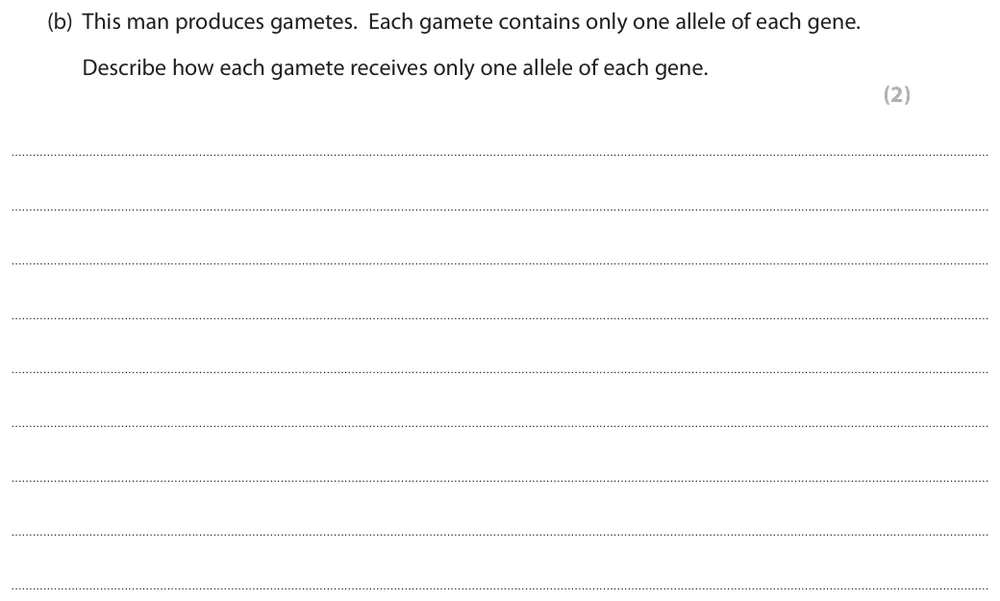
Describe how each gamete receives only one allele of each gene.
Show the mark scheme
Tap an image to open it full size.
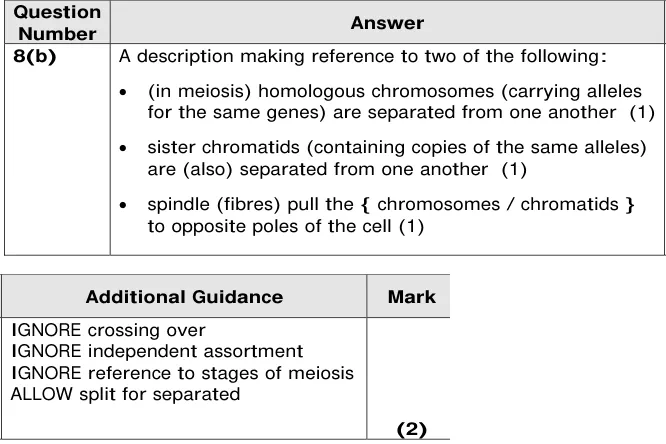
From the examiners' report: Many went straight to the stock answers of independent assortment and crossing over, which were not relevant here, or just said gametes are haploid. Describe homologous chromosomes being separated, then sister chromatids being separated.
Question 2
A level Paper 2 · November 2021 · Q2(a) · 2 marks
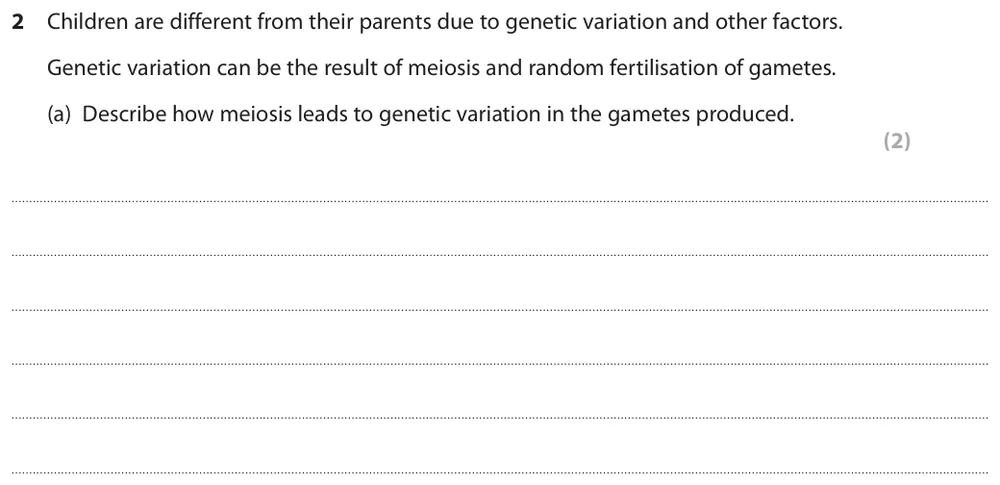
Describe how meiosis leads to genetic variation in the gametes produced.
Show the mark scheme
Tap an image to open it full size.
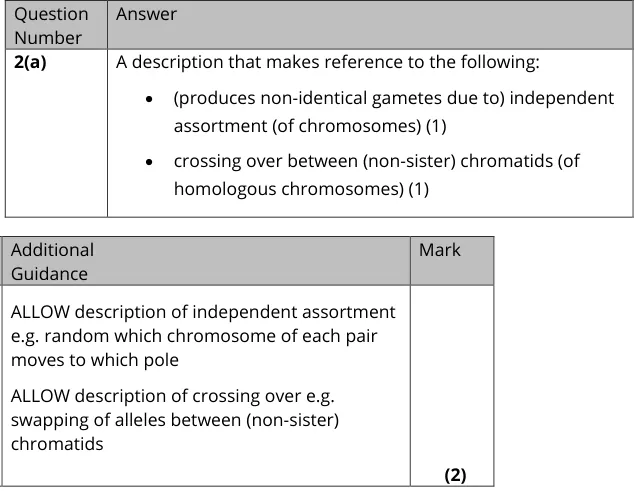
From the examiners' report: Many named independent assortment but were less secure on crossing over between non-sister chromatids. Keep to what happens when gametes form: answers about fertilisation scored nothing.
Question 3
AS Paper 2 · June 2024 · Q7(a)(ii) · 3 marks · Hard
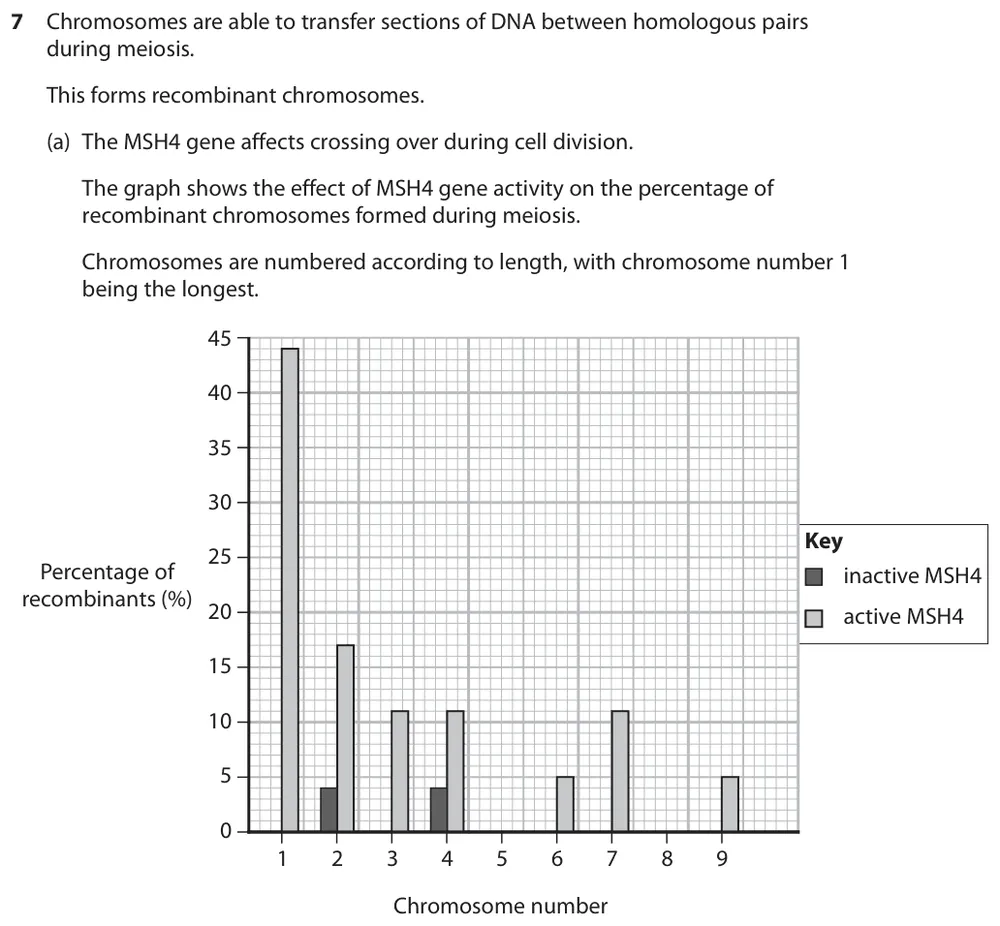
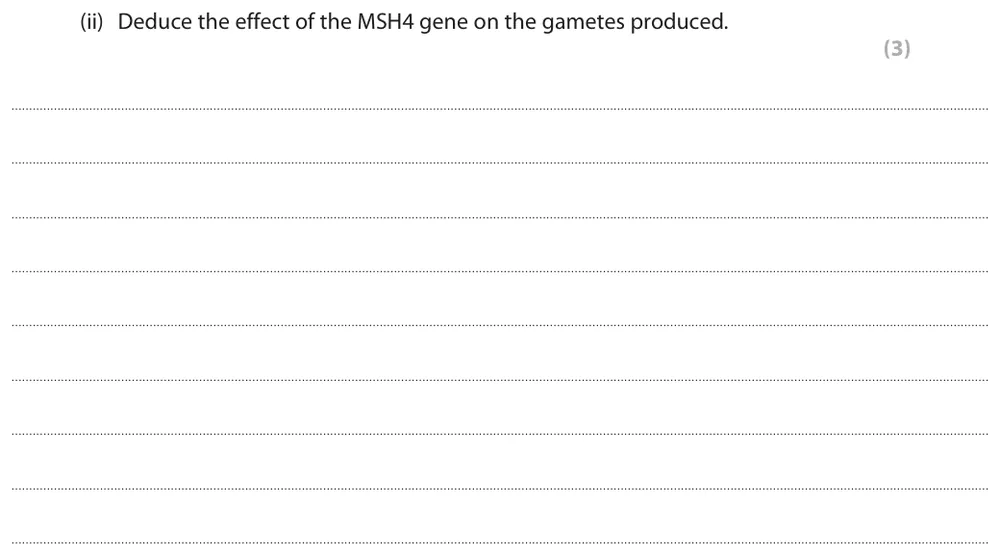
Use a bar chart to deduce the effect of the MSH4 gene on the gametes produced.
Information from earlier in this question:
Show the mark scheme
Tap an image to open it full size.
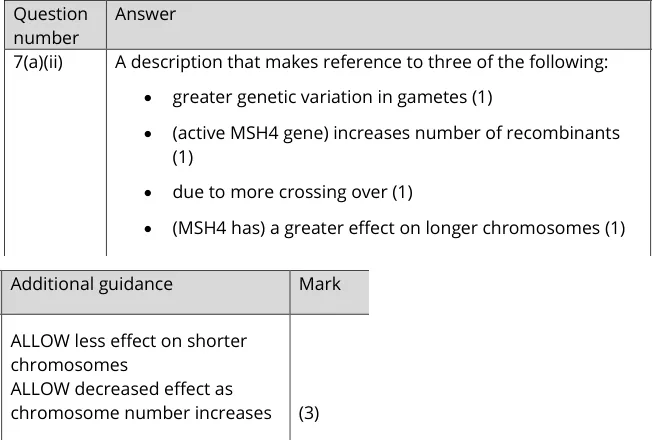
From the examiners' report: Saying the gene 'affects' crossing over gained nothing: say whether it increases or decreases it. The best answers said it increases crossing over, giving more recombinants and more genetic variation, with a bigger effect on longer chromosomes.
Question 4
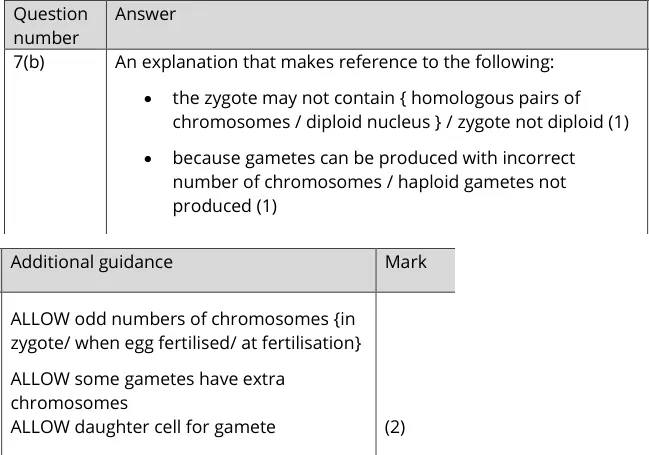
AS Paper 2 · June 2024 · Q7(b) · 2 marks · Hard
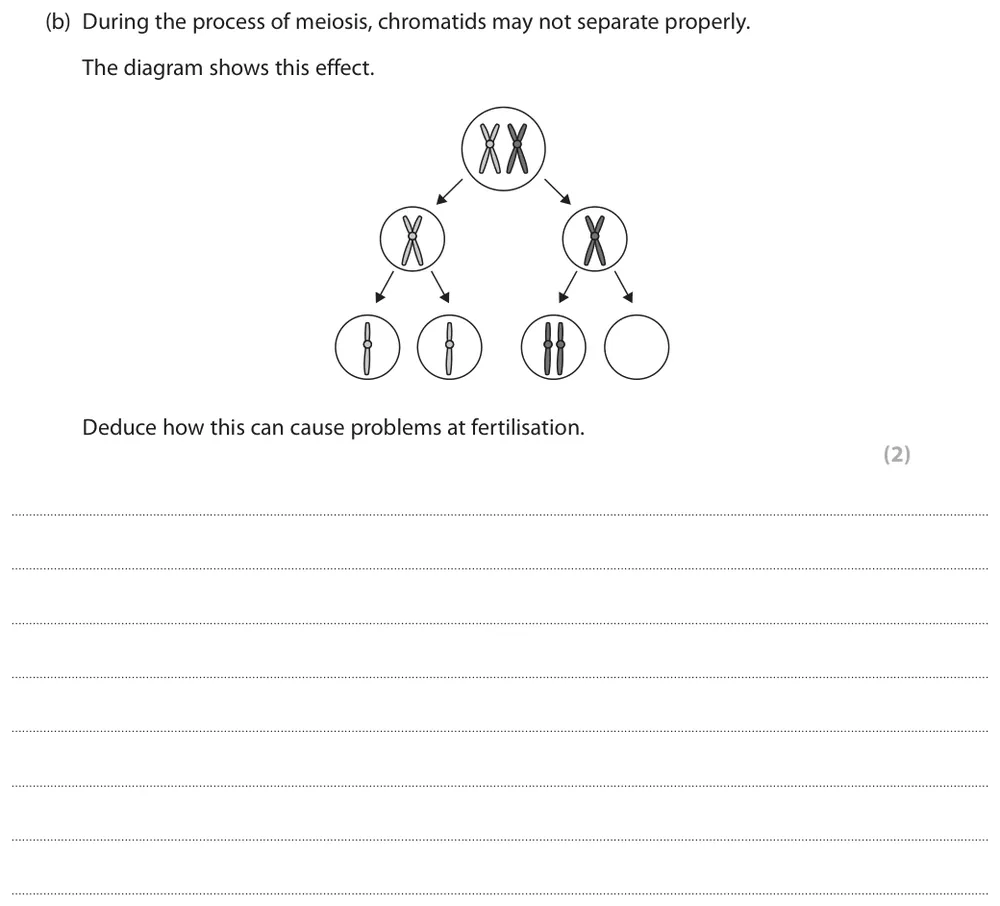
Deduce how chromatids failing to separate in meiosis can cause problems at fertilisation.
Show the mark scheme
Tap an image to open it full size.
From the examiners' report: Very poorly answered: many thought one gamete would get all the chromosomes and the other none. Gametes get the wrong number of chromosomes, so the zygote has an odd number and is not diploid.
Question 5
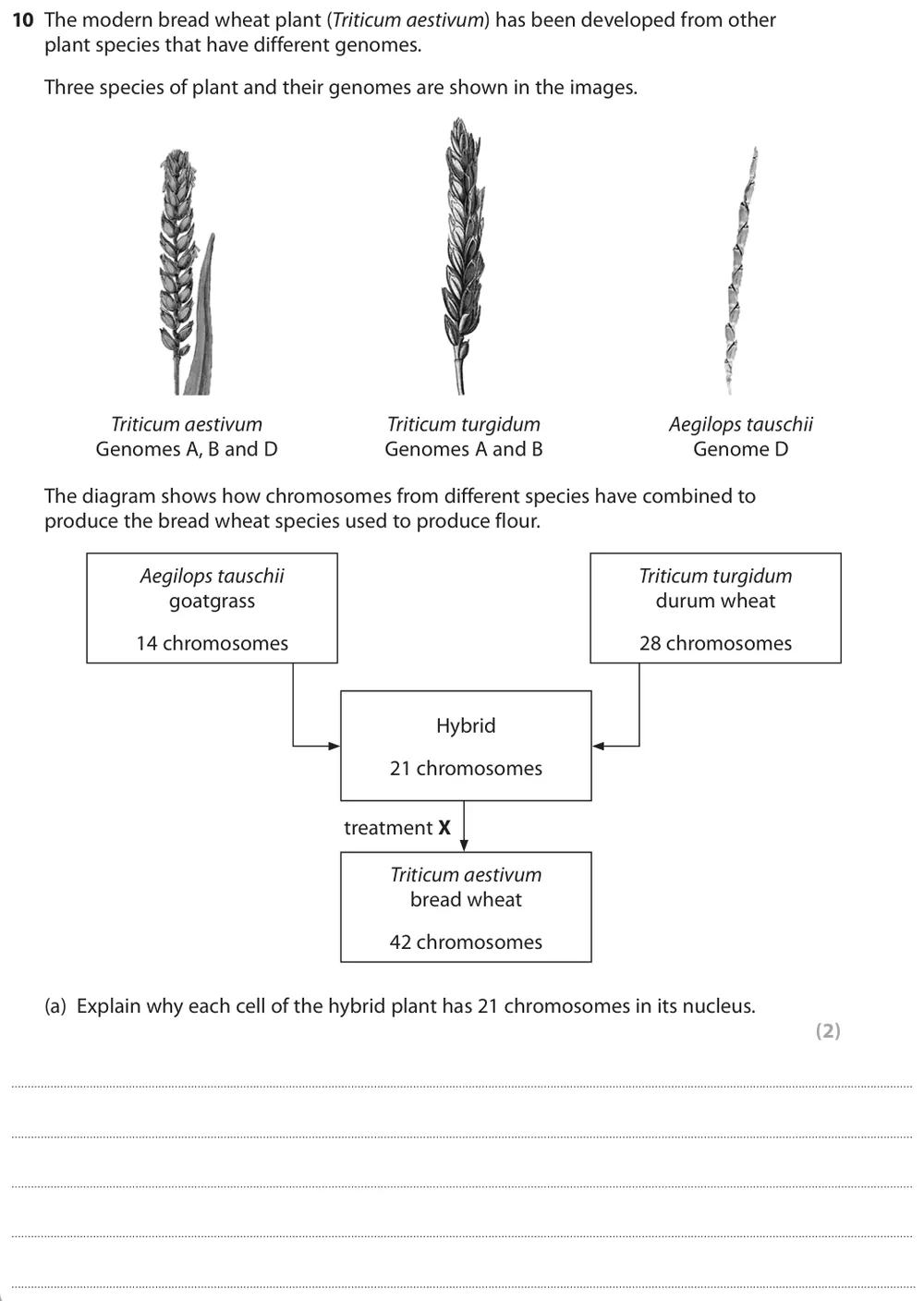
A level Paper 2 · June 2017 · Q10(a) · 2 marks
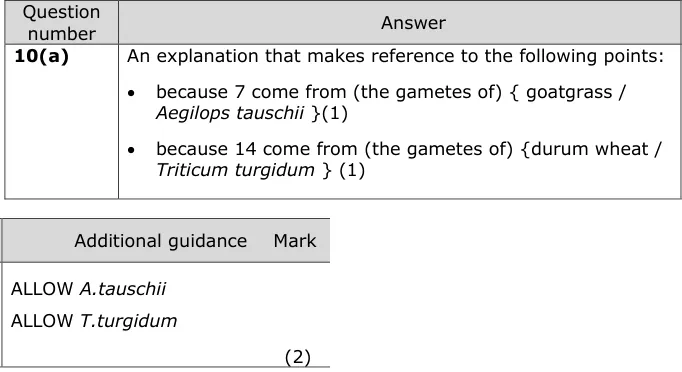
Explain why each cell of the hybrid wheat plant has 21 chromosomes.
Show the mark scheme
Tap an image to open it full size.
From the examiners' report: Two thirds scored zero, and many simply averaged 14 and 28. Say that 7 chromosomes come from the gametes of the goatgrass and 14 from the gametes of the durum wheat; 'wheat' alone was too vague.
Question 6
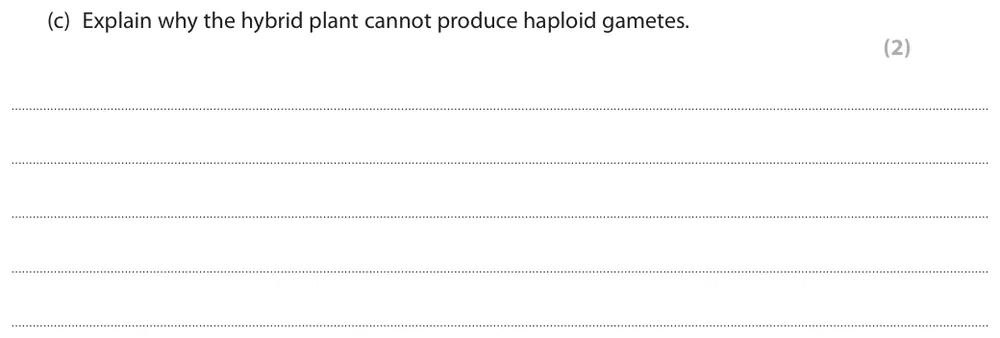
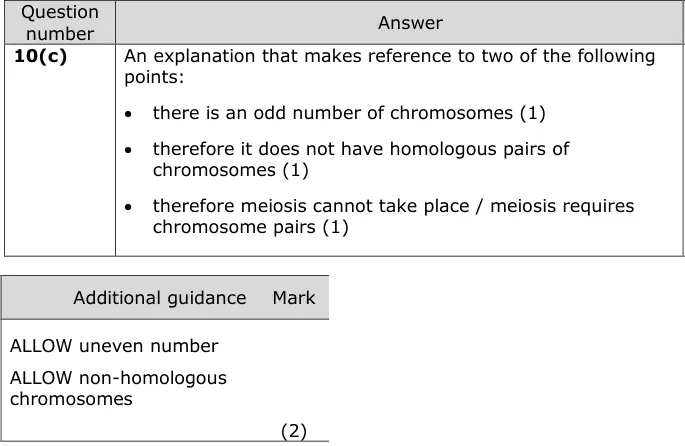
A level Paper 2 · June 2017 · Q10(c) · 2 marks
Explain why the hybrid plant cannot produce haploid gametes.
Show the mark scheme
Tap an image to open it full size.
From the examiners' report: Almost two thirds scored zero. The odd number of chromosomes is only a start: explain that there are no homologous pairs, so meiosis cannot take place.
Mitosis and the cell cycle (3.10)
Question 7
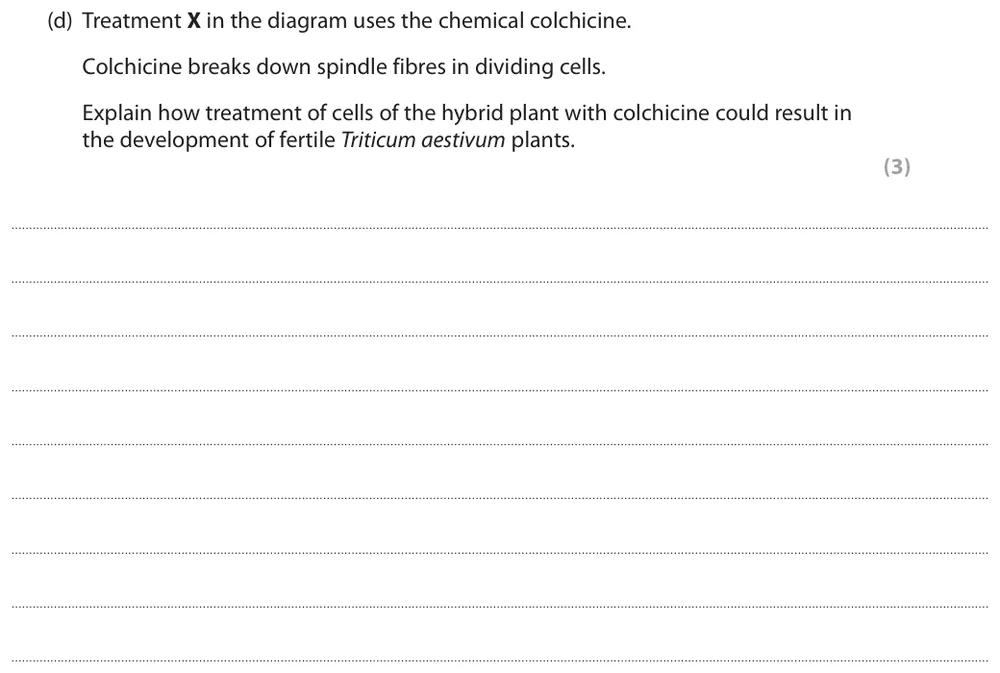
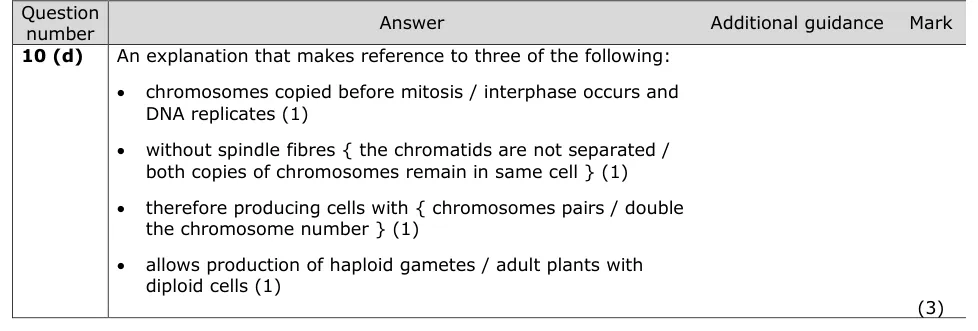
A level Paper 2 · June 2017 · Q10(d) · 3 marks · Hard
Explain how colchicine treatment could produce fertile bread wheat plants.
Show the mark scheme
Tap an image to open it full size.
From the examiners' report: Many described the normal cell cycle instead. Explain that DNA replicates, colchicine stops the chromatids being separated, so the cell ends up with double the chromosome number and can then make haploid gametes.
Question 8
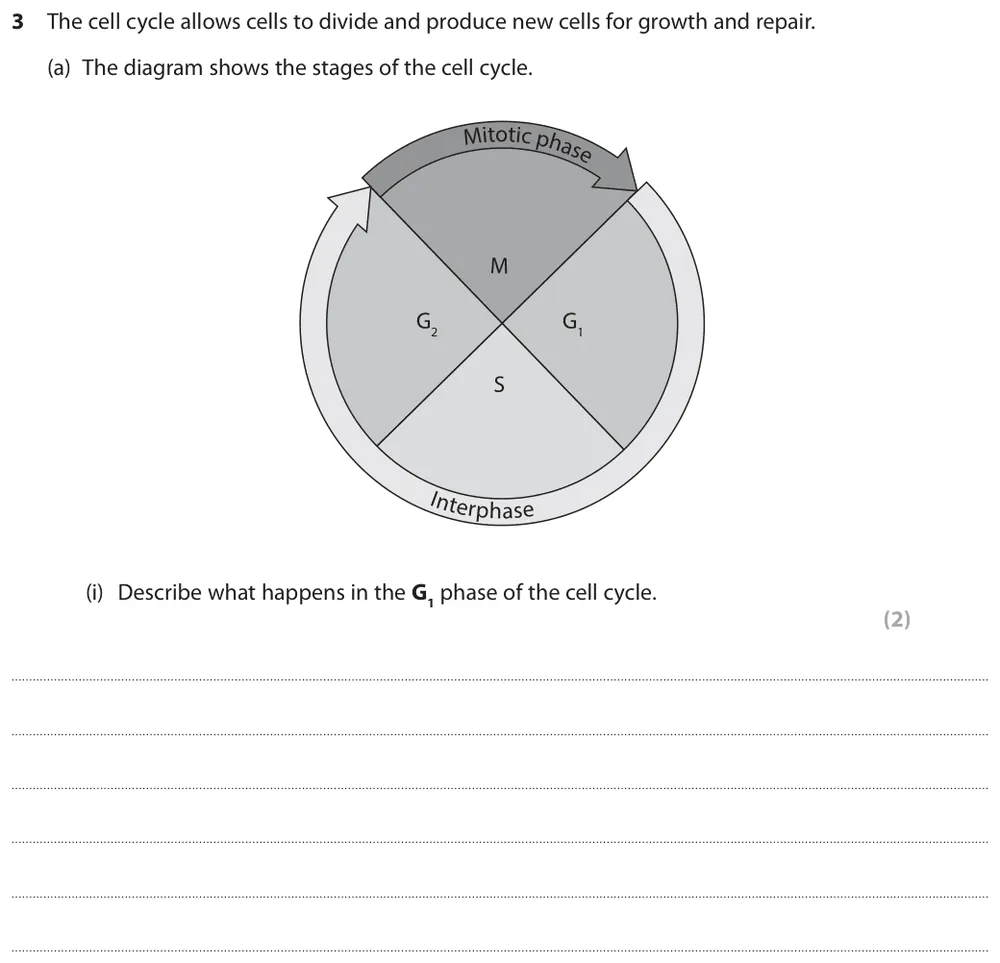
A level Paper 1 · June 2025 · Q3(a)(i) · 2 marks
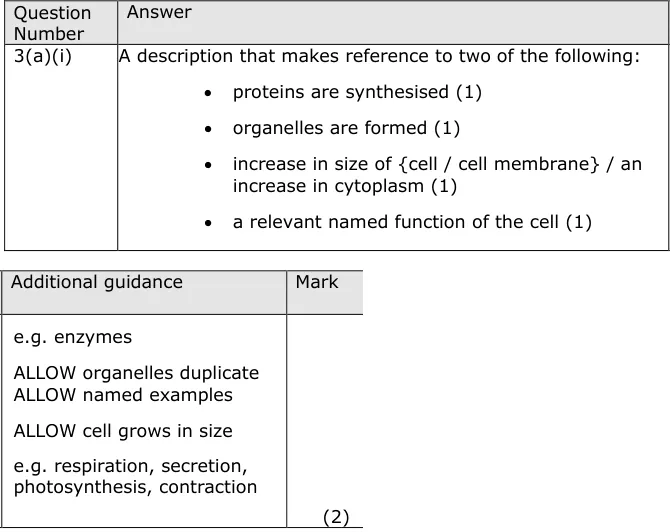
Describe what happens in the G1 phase of the cell cycle.
Show the mark scheme
Tap an image to open it full size.
From the examiners' report: Many wrote about DNA replication, which is not G1. Say the cell increases in size (not just 'grows'), synthesises proteins and makes new organelles.
Question 9
A level Paper 1 · June 2025 · Q3(a)(ii) · 3 marks
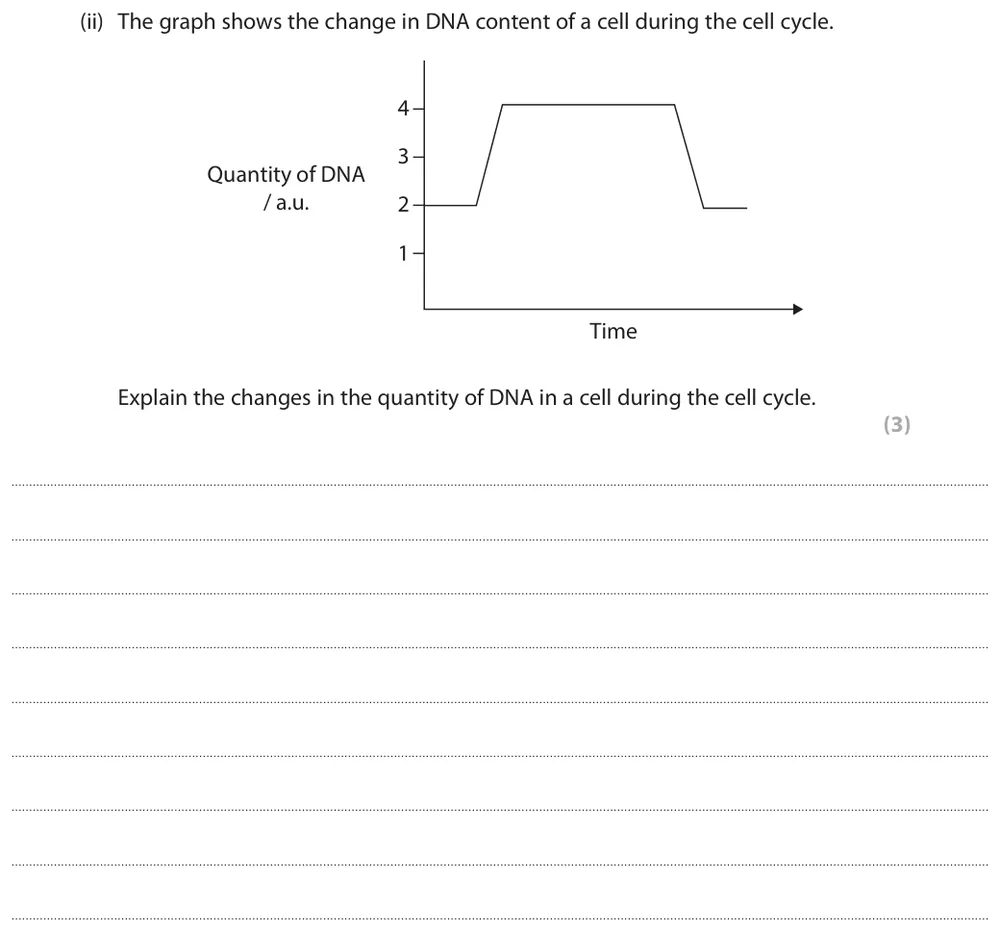
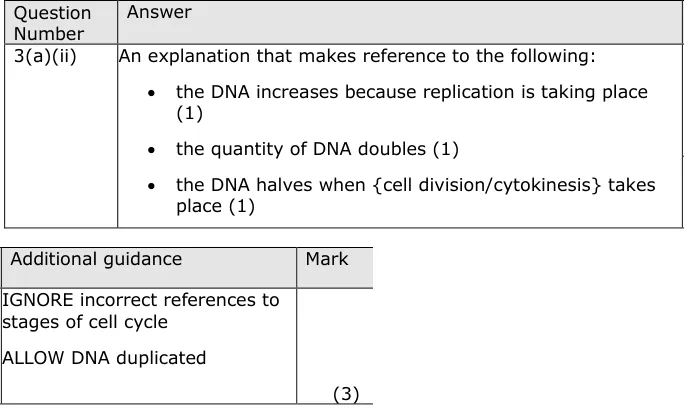
Explain the changes in the quantity of DNA in a cell during the cell cycle.
Show the mark scheme
Tap an image to open it full size.
From the examiners' report: The number of chromosomes does not double; the quantity of DNA does, because it replicates. Interpret the graph rather than quoting its values, and link the halving to cytokinesis, not telophase.
Question 10
AS Paper 2 · November 2021 · Q1(a)(iii) · 2 marks
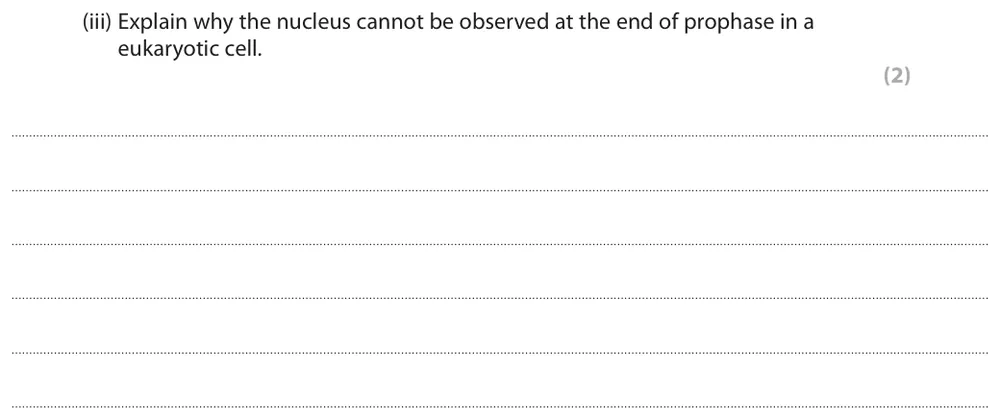
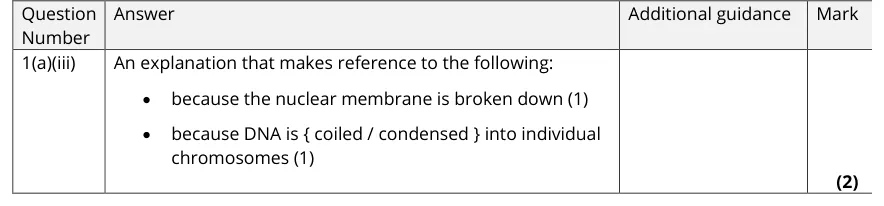
Explain why the nucleus cannot be seen at the end of prophase.
Show the mark scheme
Tap an image to open it full size.
From the examiners' report: Most said the nuclear membrane breaks down, but few added that the DNA has condensed (coiled) into individual chromosomes.
Question 11
A level Paper 3 · June 2018 · Q4(b)(i) · 3 marks
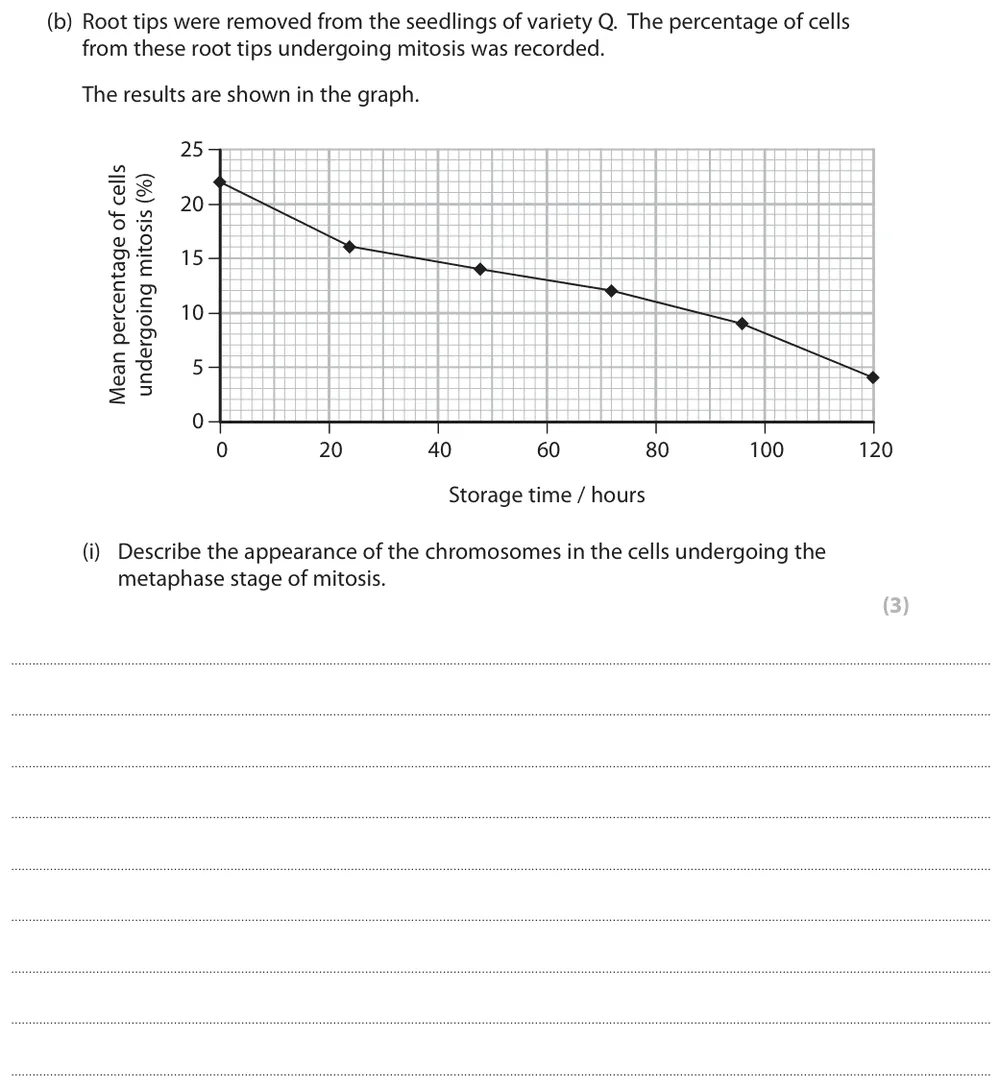
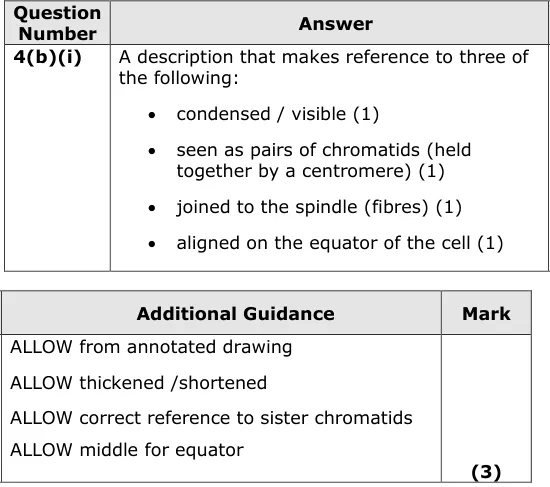
Describe the appearance of the chromosomes during metaphase.
Show the mark scheme
Tap an image to open it full size.
From the examiners' report: Some wrote centrioles instead of centromeres, or homologous pairs instead of pairs of chromatids. Describe condensed chromosomes, seen as pairs of chromatids held by a centromere, attached to the spindle on the equator.
Question 12
A level Paper 2 · June 2024 · Q6(c)(ii) · 3 marks
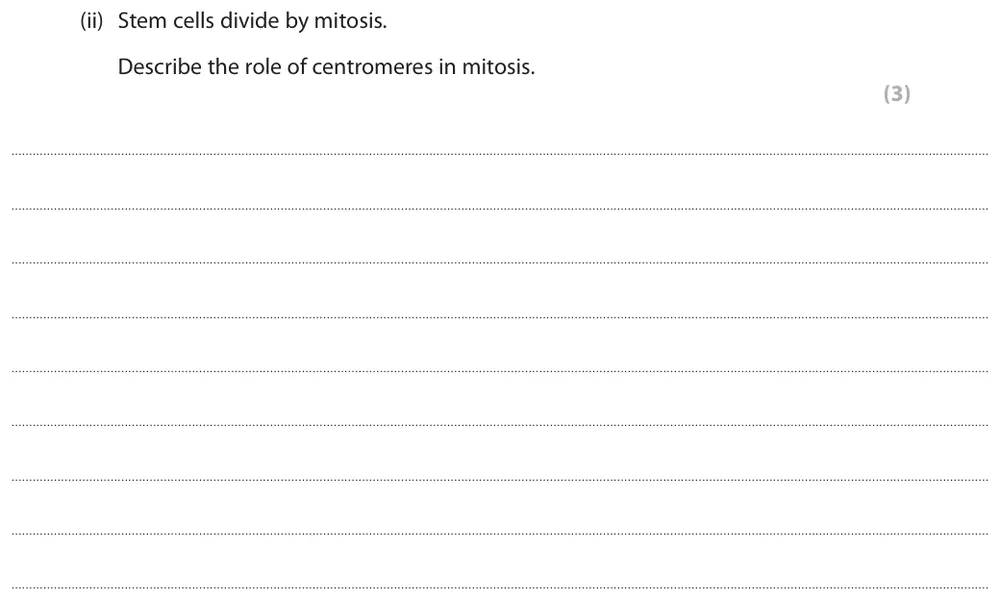
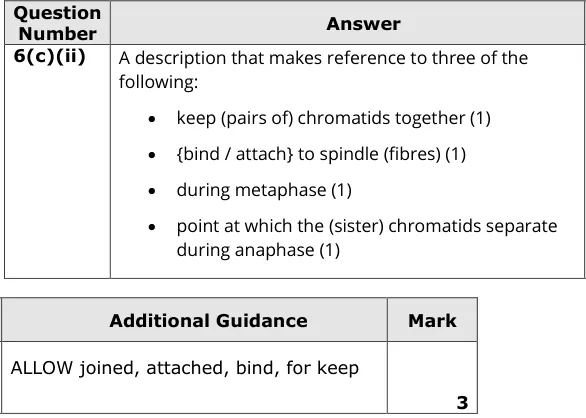
Describe the role of centromeres in mitosis.
Show the mark scheme
Tap an image to open it full size.
From the examiners' report: The common wrong answer confused centromeres with centrioles and scored nothing. The centromere holds the chromatids together, attaches to the spindle in metaphase and is where the chromatids separate in anaphase.
Question 13
AS Paper 2 · June 2023 · Q1(c)(iii) · 4 marks
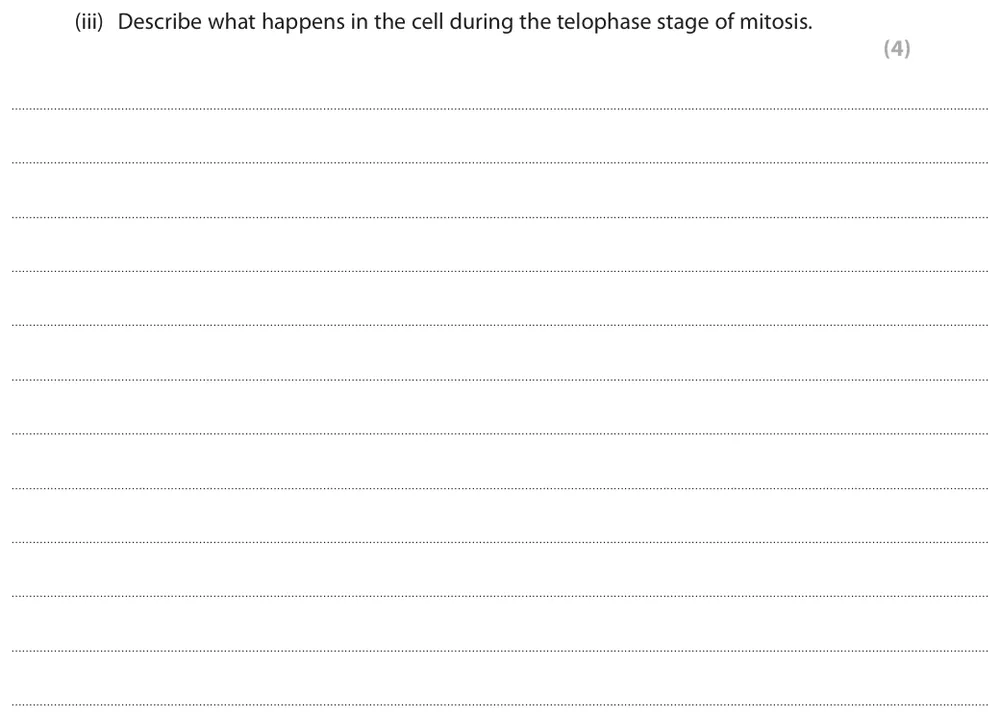
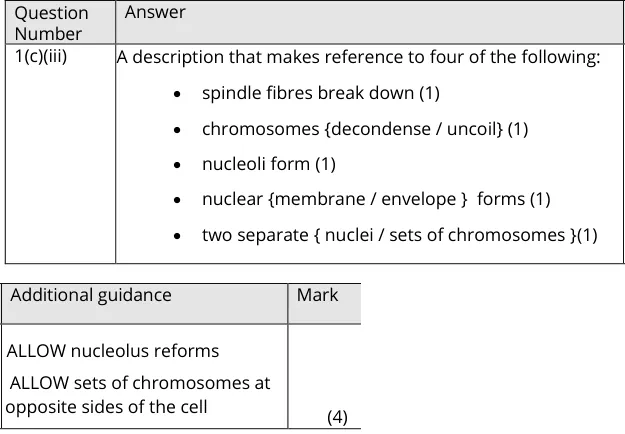
Describe what happens in the cell during telophase.
Show the mark scheme
Tap an image to open it full size.
From the examiners' report: Good answers had the nuclear membrane reforming around two sets of chromosomes, the chromosomes uncoiling, the spindle fibres breaking down and nucleoli forming. 'Become thinner' was not enough for uncoiling.
Question 14
A level Paper 1 · June 2024 · Q3(c) · 3 marks
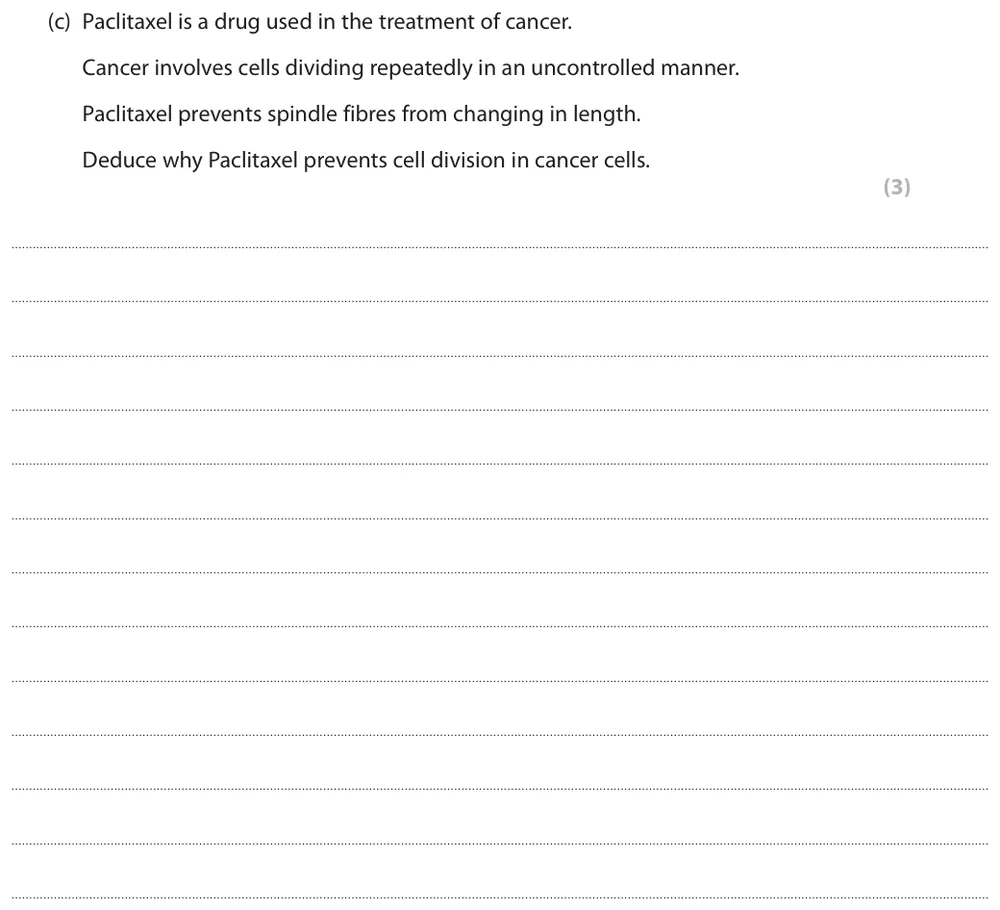
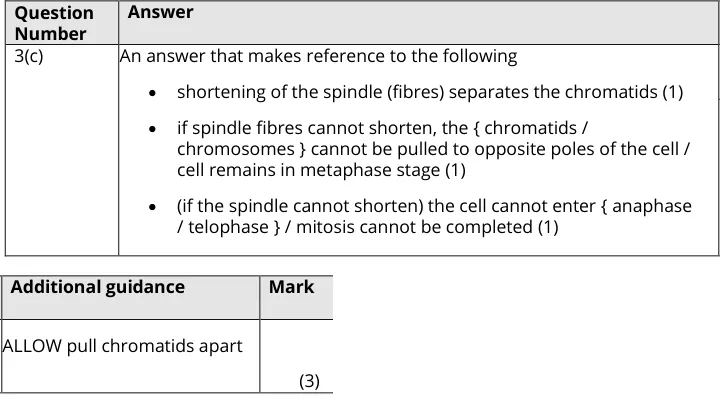
Deduce why paclitaxel, which stops spindle fibres changing length, prevents cancer cells dividing.
Show the mark scheme
Tap an image to open it full size.
From the examiners' report: Use chromosome and chromatid precisely, and leave homologous chromosomes out: they are not part of mitosis. Say the spindle fibres cannot shorten, so the chromatids are not pulled to opposite poles and the cell stays in metaphase.
Question 15
AS Paper 2 · November 2021 · Q4(b) · 4 marks · Hard
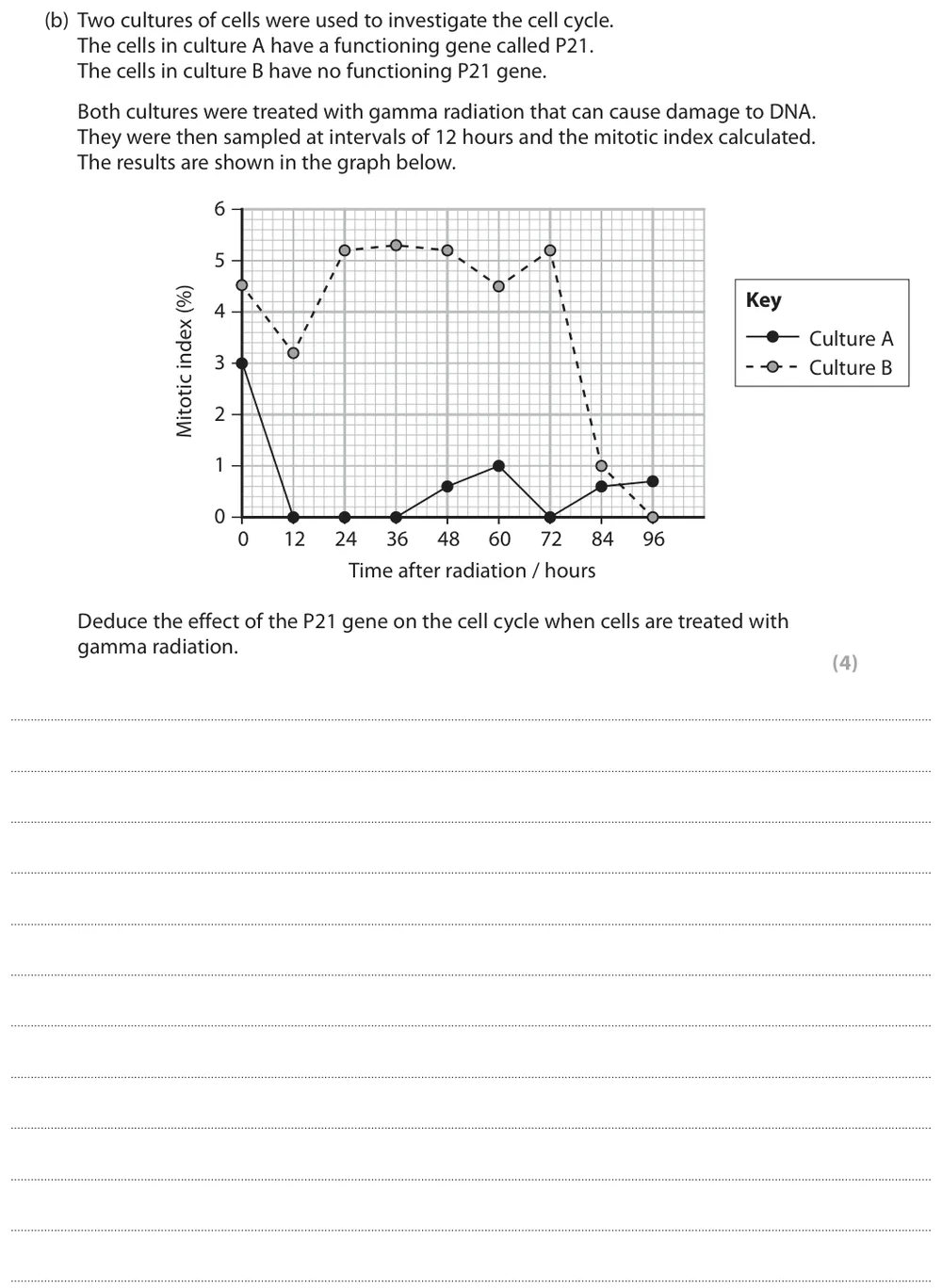
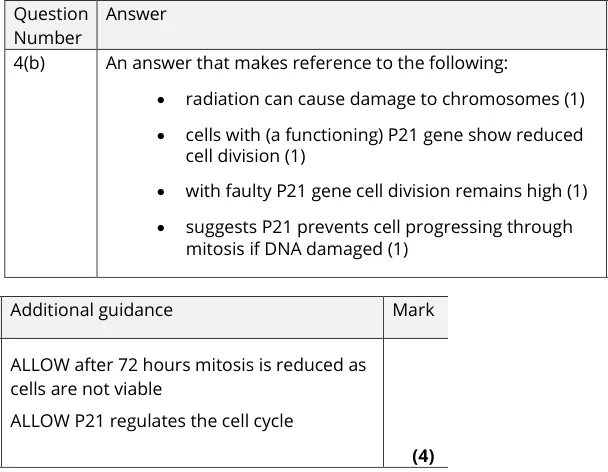
Deduce the effect of the P21 gene on the cell cycle after gamma radiation.
Show the mark scheme
Tap an image to open it full size.
From the examiners' report: The most challenging question on the paper, and few scored more than one mark. Use the stem: radiation damages chromosomes, cells with a working P21 gene show reduced cell division, so P21 stops the cycle when DNA is damaged.
Stem cells, totipotency and pluripotency (3.11 i)
Question 16
AS Paper 2 · June 2024 · Q4(b)(i) · 2 marks · Easy
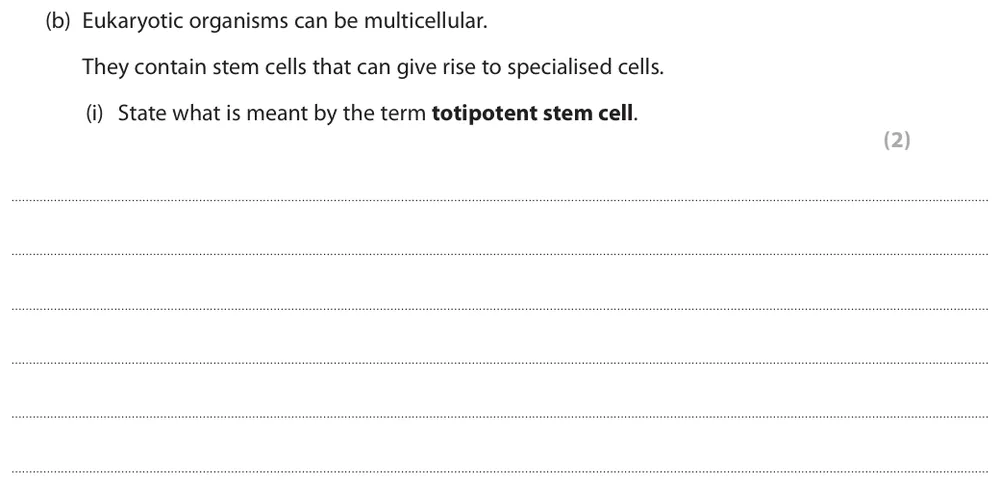
State what is meant by a totipotent stem cell.
Show the mark scheme
Tap an image to open it full size.
From the examiners' report: Well answered. Use the word 'differentiate': 'give rise to' alone lost the first mark. A totipotent cell can differentiate into any type of cell.
Question 17
A level Paper 2 · June 2024 · Q6(c)(i) · 3 marks
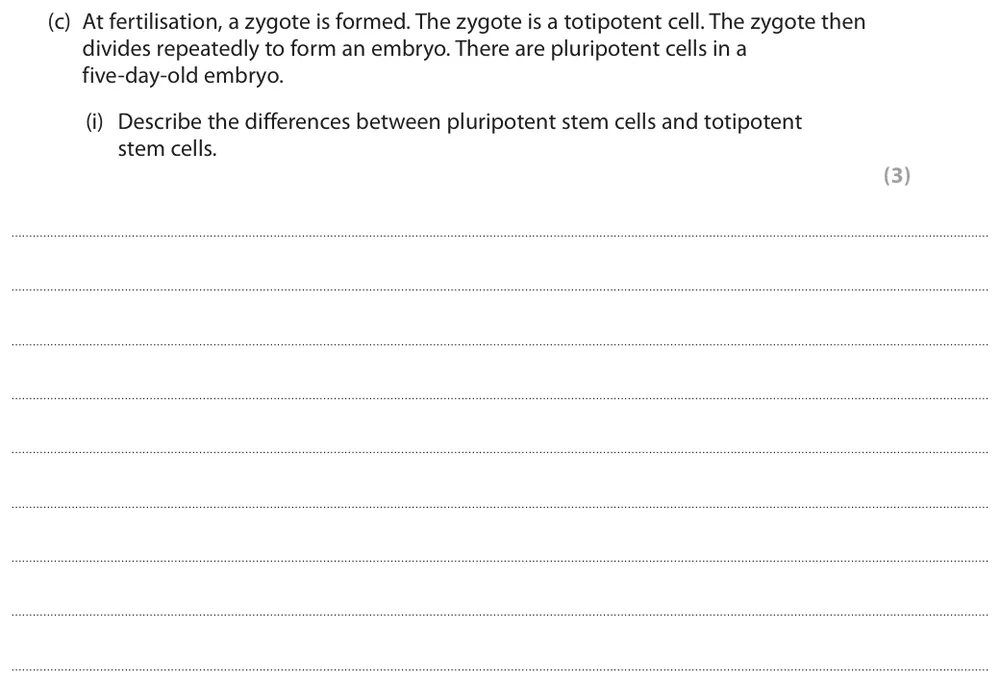
Describe the differences between pluripotent and totipotent stem cells.
Show the mark scheme
Tap an image to open it full size.
From the examiners' report: Most knew this well, but some swapped the two terms. Totipotent cells can give rise to all cell types and a whole organism; pluripotent cells give rise to most cell types but not extra-embryonic cells.
Question 18
AS Paper 2 · November 2021 · Q6(b)(i) · 3 marks · Easy
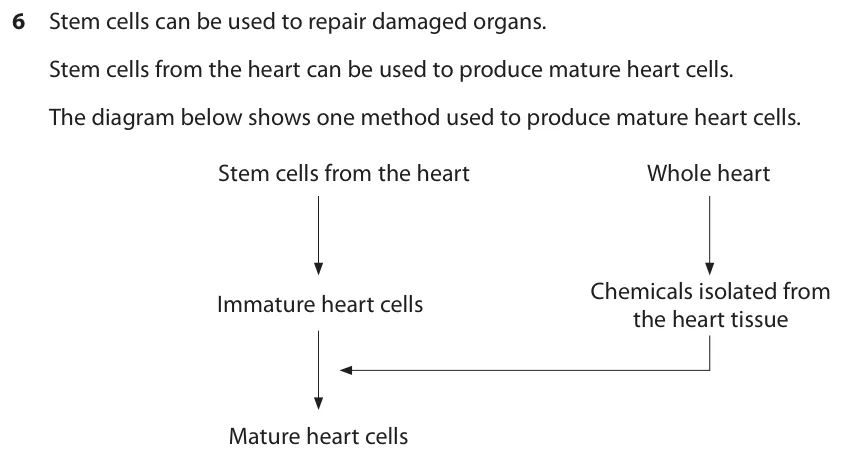
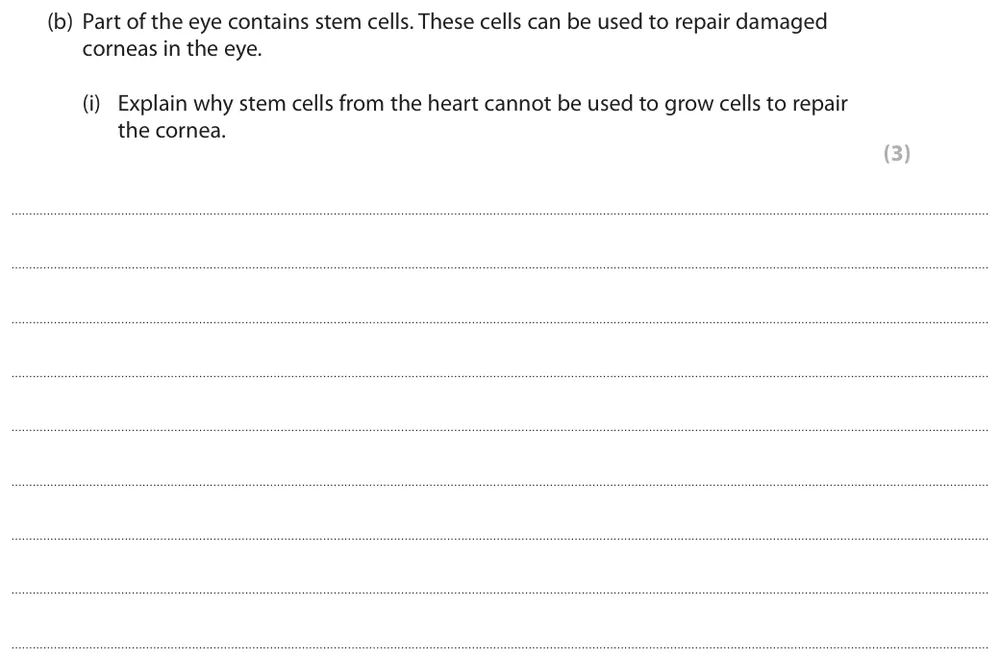
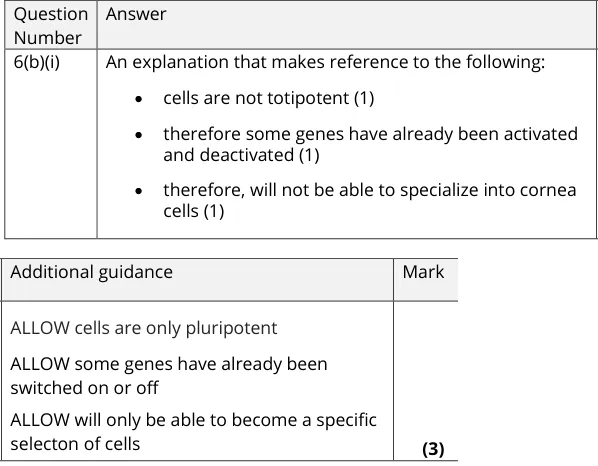
Explain why stem cells from the heart cannot be used to grow cells to repair the cornea.
Information from earlier in this question:
Show the mark scheme
Tap an image to open it full size.
From the examiners' report: The difference between totipotent and pluripotent was well understood. Link it to the scenario: some genes in the heart stem cells are already switched on or off, so they cannot specialise into corneal cells.
Question 19
AS Paper 2 · June 2019 · Q8(b)(iii) · 3 marks
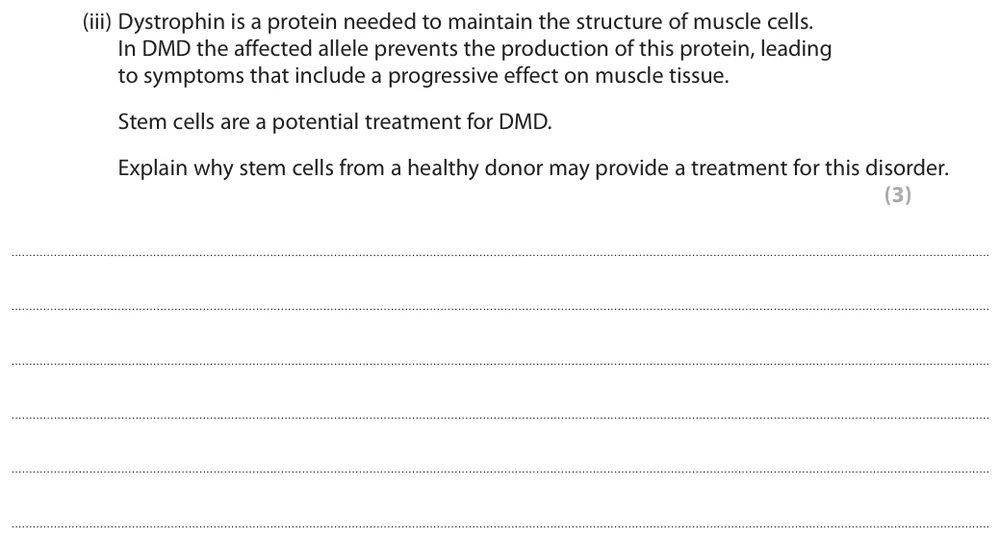
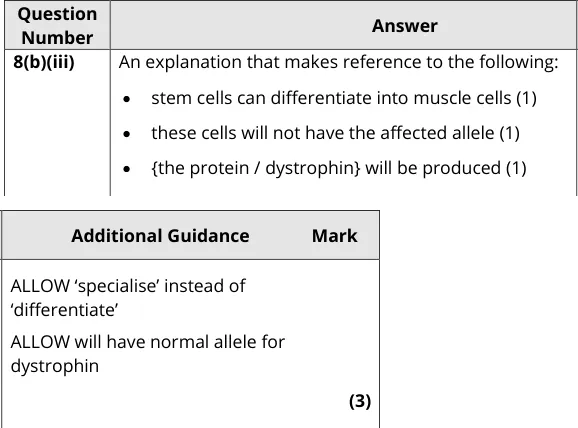
Explain why stem cells from a healthy donor may treat Duchenne muscular dystrophy.
Show the mark scheme
Tap an image to open it full size.
From the examiners' report: Most linked stem cells to new muscle cells, but many then wrote about a protein that permanently alters the cell. Say the new muscle cells have the normal allele, so dystrophin is produced.
Society and stem cell therapies (3.11 ii)
Question 20
AS Paper 2 · November 2021 · Q6(c) · 3 marks
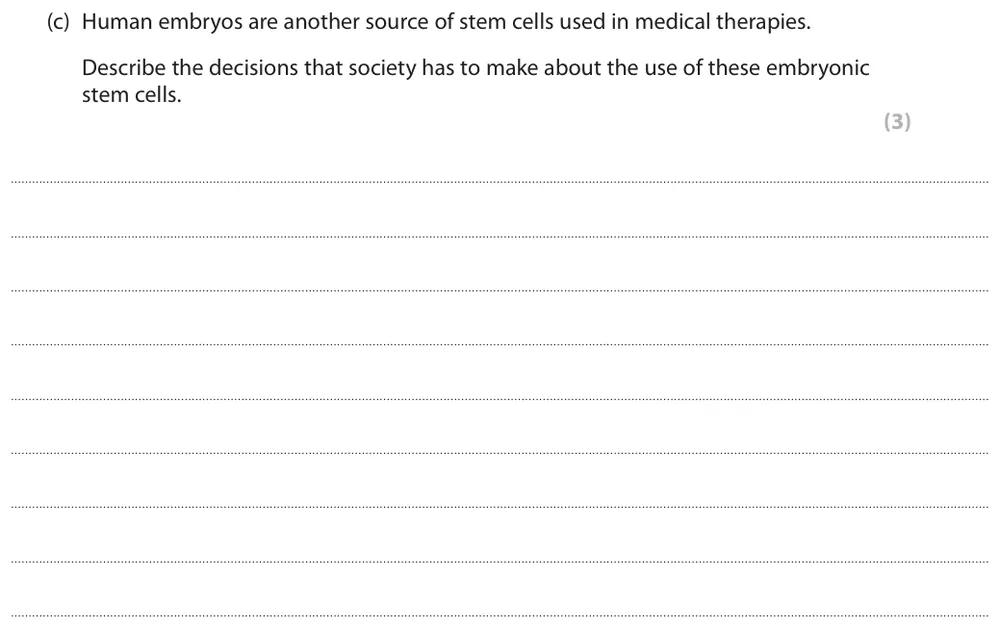
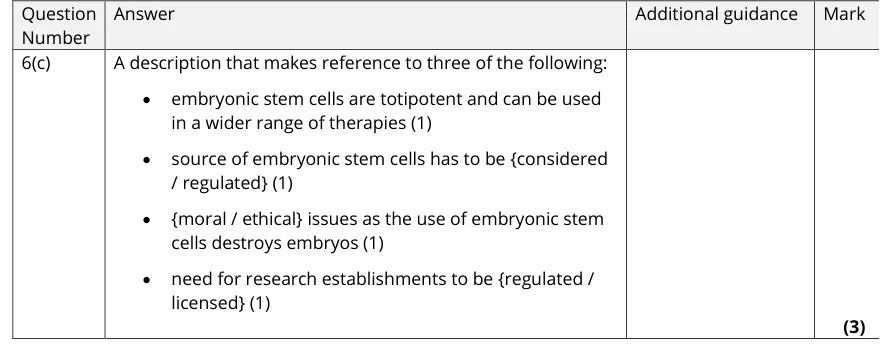
Describe the decisions society has to make about using embryonic stem cells.
Show the mark scheme
Tap an image to open it full size.
From the examiners' report: Answers were often unclear, and the most common point was the loss of a potential life. Also mention regulating the source of embryonic stem cells and licensing research establishments.
Where students lose marks (from Pearson examiners' reports and mark schemes)
Each point below comes from the examiners' reports and mark schemes, and is followed by wording that gained marks.
Separate homologues, then sister chromatids. Many answered with independent assortment and crossing over, which were not relevant, or just said gametes are haploid.
✔ Gains credit: 'In meiosis homologous chromosomes are separated from one another, then sister chromatids are separated from one another.'
Say whether MSH4 increases crossing over. Many wrote that the gene 'affects' crossing over, which does not say whether there is an increase or a decrease.
✔ Gains credit: 'The active MSH4 gene increases the number of recombinants due to more crossing over, giving greater genetic variation in gametes.'
Non-disjunction gives a zygote that is not diploid. Many inferred that one gamete would inherit all the chromosomes and the other none.
✔ Gains credit: 'Gametes can be produced with an incorrect number of chromosomes, so at fertilisation the zygote is not diploid.'
Name the species that gave each set of chromosomes. A large proportion reached 21 by averaging 14 and 28, or wrote 'wheat' without naming the species.
✔ Gains credit: '7 come from the gametes of goatgrass (Aegilops tauschii) and 14 come from the gametes of durum wheat (Triticum turgidum).'
An odd chromosome number means no homologous pairs. Most stopped at the odd number of chromosomes; some said the chromosomes could not be broken in half.
✔ Gains credit: 'There is an odd number of chromosomes, therefore it does not have homologous pairs of chromosomes, so meiosis cannot take place.'
G1 is growth, not DNA replication. Lots of answers described DNA replication, and 'the cell grows' was not credited without saying in size.
✔ Gains credit: 'Proteins are synthesised, organelles are formed and the cell increases in size.'
The DNA doubles; the chromosome number does not. There were frequent references to chromosome numbers doubling, and the fall in DNA was linked to telophase.
✔ Gains credit: 'The DNA increases because replication is taking place, so the quantity of DNA doubles; the DNA halves when cytokinesis takes place.'
Centromere, not centriole. The common incorrect answer confused centromeres with centrioles and gained no marks.
✔ Gains credit: 'Centromeres keep the pairs of chromatids together, attach to the spindle fibres during metaphase and are the point at which the sister chromatids separate during anaphase.'
Download the questions
Download the PDF pack (20 questions, mark schemes at the end)
Keep practising
- Cell Structure and Organisation (Topic 3): Edexcel SNAB exam questions by topic
- Gametes, Fertilisation and Linkage (Topic 3): Edexcel SNAB exam questions by topic
- Gene Expression, Epigenetics and Phenotype (Topic 3): Edexcel SNAB exam questions by topic
- Root Tip Squash and Mitosis (Core Practical 5): Edexcel SNAB core practical questions
- Topic 3 multiple-choice quiz (71 questions, marked as you tap)
- Edexcel SNAB A level Biology resources hub (every topic, practical and paper)
- Extended Response Questions (Topics 3 and 4): Edexcel SNAB A Level Biology Exam Questions
- Edexcel SNAB A level Biology past papers, mark schemes and examiners' reports
- Edexcel SNAB A level Biology grade boundaries
- Message Tom on WhatsApp about one-to-one Edexcel SNAB tutoring or an Edexcel group class
Questions, mark schemes and examiners' report extracts © Pearson Education Ltd.