

Biodiversity, Adaptation and Classification opens Topic 4, Biodiversity and Natural Resources, of the Edexcel A level Biology A (Salters-Nuffield) specification. You need to understand biodiversity and endemism, measure biodiversity using species richness, the heterozygosity index and an index of diversity, discuss niches and behavioural, physiological and anatomical adaptations, explain how natural selection leads to evolution, use the Hardy-Weinberg equation, and explain how reproductive isolation, the species concept and molecular phylogeny underpin classification into three domains. This sub-topic is examined on AS Paper 2 and on A level Papers 1 and 3. Questions marked AS are from the AS papers (8BN0); the rest are from the A level papers (9BN0).
The examiners' reports warn about definitions that are nearly right: endemic means found in only one location, not one habitat; the heterozygosity index is a proportion, not a number; and members of a species share similar characteristics as well as interbreeding to produce fertile offspring. In calculations, don't ignore the Σ in the diversity index, take square roots in Hardy-Weinberg questions and finish the final step. For natural selection and molecular phylogeny, relate every point to the organism in the question and say exactly what is compared.
Studying Edexcel SNAB and want more help? If you'd like to arrange one-to-one Edexcel tutoring, or to register your interest in an Edexcel group class, message Tom on WhatsApp using the link at the bottom of this page.
What you need from GCSE
Each question on this page assumes you're secure on these ideas. If any of them feels shaky, look it up before you start.
- Variation within a species can be genetic, environmental or both.
- Natural selection: individuals best suited to their environment are more likely to survive and reproduce.
- Organisms are adapted to the conditions where they live.
- Organisms are classified into groups, and a species is the smallest group.
Key terms
These words come up in the questions and mark schemes. Examiners expect you to use them exactly.
- Biodiversity: the variety of living organisms in an area, measured within a habitat or within a species.
- Endemic: a species found in only one geographical location.
- Species richness: the number of different species in a habitat.
- Heterozygosity index: the number of heterozygotes divided by the number of individuals in the population.
- Index of diversity: D = N(N − 1) ÷ Σn(n − 1), which takes into account both the number of species and the number of individuals of each species.
- Niche: the role of an organism in its habitat: how it interacts with the biotic and abiotic factors in its environment.
- Hardy-Weinberg equation: p² + 2pq + q² = 1, used to find allele and genotype frequencies and see whether allele frequency changes over time.
- Molecular phylogeny: comparing base sequences in DNA or amino acid sequences in proteins to work out how closely organisms are related.
What these questions cover (Edexcel SNAB Topic 4: Biodiversity and Natural Resources)
The questions test these statements from Topic 4 of the Pearson Edexcel A level Biology A (Salters-Nuffield) specification (9BN0).
- 4.2 i Understand the terms biodiversity and endemism.
- 4.2 ii Know how biodiversity can be measured within a habitat using species richness and within a species using genetic diversity by calculating the heterozygosity index (H)
- 4.2 iii Understand how biodiversity can be compared in different habitats using a formula to calculate an index of diversity (D)
- 4.3 Understand the concept of niche and be able to discuss examples of adaptation of organisms to their environment (behavioural, physiological and anatomical).
- 4.4 Understand how natural selection can lead to adaptation and evolution.
- 4.5 i Understand how the Hardy-Weinberg equation can be used to see whether a change in allele frequency is occurring in a population over time.
- 4.5 ii Understand that reproductive isolation can lead to accumulation of different genetic information in populations, potentially leading to the formation of new species.
- 4.6 i Understand that classification is a means of organising the variety of life based on relationships between organisms using differences and similarities in phenotypes and
- 4.6 ii Understand the process and importance of critical evaluation of new data by the scientific community, which leads to new taxonomic groupings, including the three domains
How to use this page
Write your answer on paper before you open the mark scheme. Allow about 1.2 minutes per mark: the 20 questions are worth 52 marks, so about 62 minutes in total. Then mark your answer strictly against the mark scheme and read the examiners' tip underneath it. If you'd rather print the questions, download the PDF pack.
Biodiversity and endemism (4.2 i)
Question 1
AS Paper 2 · June 2017 · Q3(a)(i) · 1 mark · Hard
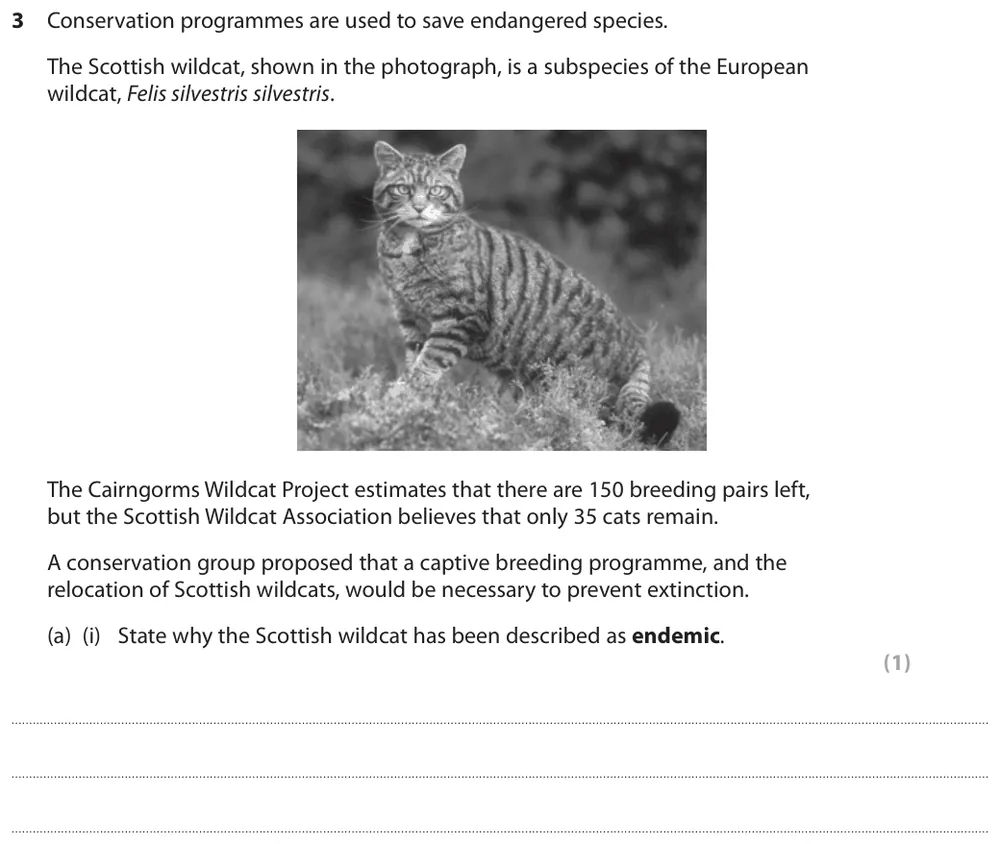
State why the Scottish wildcat has been described as endemic.
Show the mark scheme
Tap an image to open it full size.
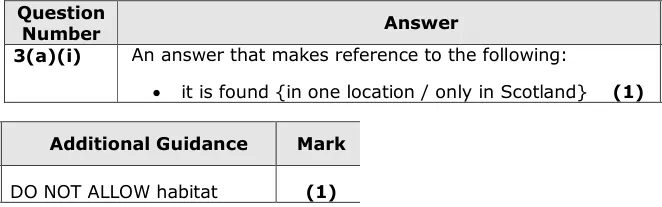
From the examiners' report: The term was widely understood. Don't link it to the risk of extinction or to adaptation to a habitat: endemic means found in only one location, here only in Scotland.
Question 2
A level Paper 1 · June 2018 · Q9(c)(ii) · 3 marks
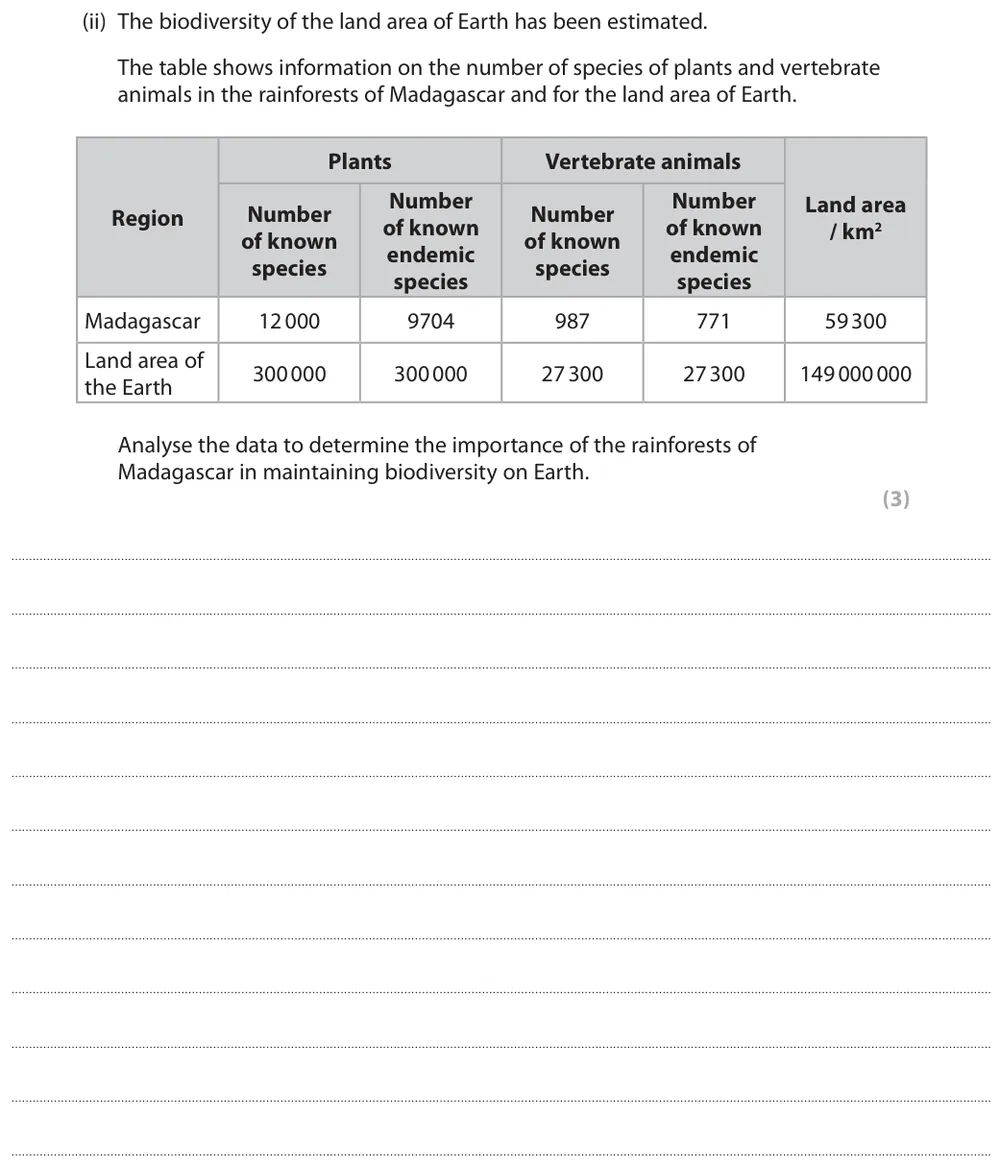
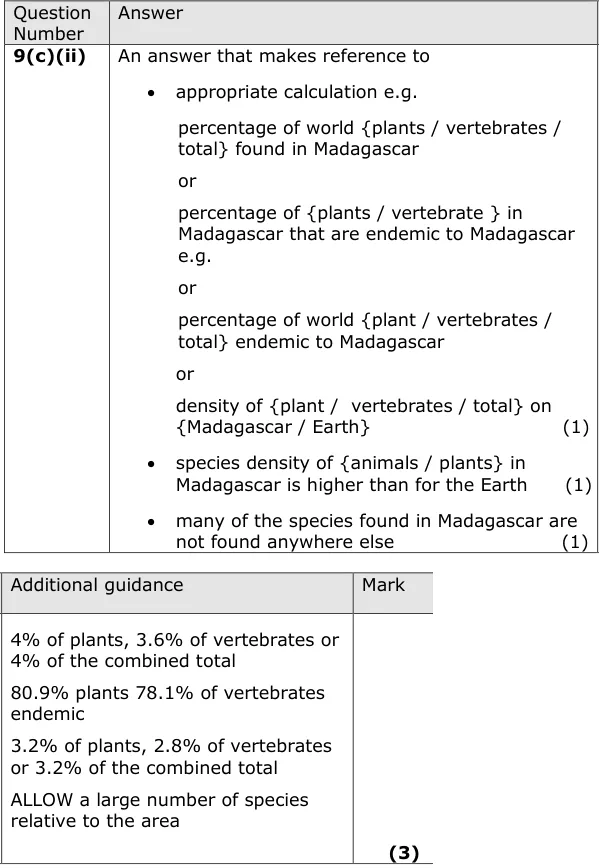
Analyse data to determine the importance of Madagascar's rainforests in maintaining biodiversity on Earth.
Show the mark scheme
Tap an image to open it full size.
From the examiners' report: 'Determine' needs a calculation, such as the percentage of the world's plant species found in Madagascar or the species density. Then compare Madagascar clearly with the world and say how many of its species are found nowhere else.
Question 3
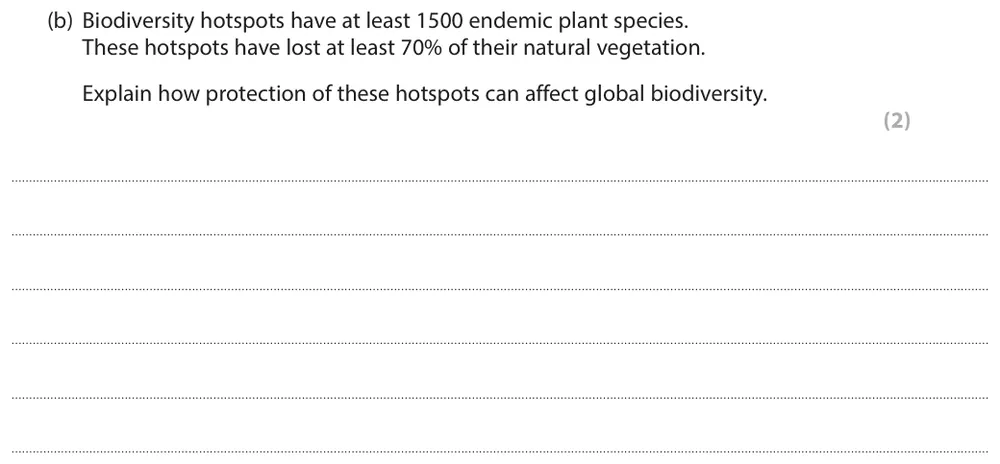
A level Paper 1 · June 2022 · Q9(b) · 2 marks · Easy
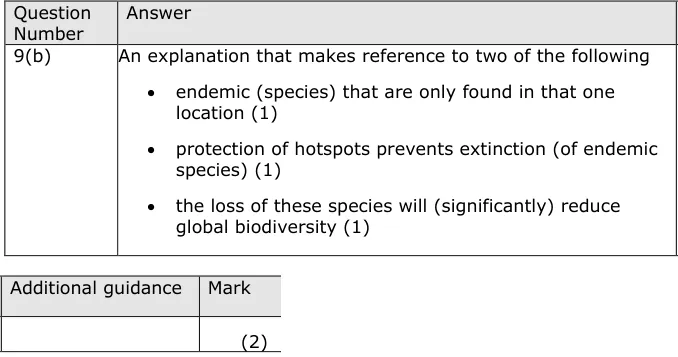
Explain how protecting biodiversity hotspots can affect global biodiversity.
Show the mark scheme
Tap an image to open it full size.
From the examiners' report: Most explained what endemic means, but not all linked it to extinction, and very few explained the effect on global biodiversity. Protection maintains biodiversity; it does not increase it.
Species richness and genetic diversity (4.2 ii)
Question 4
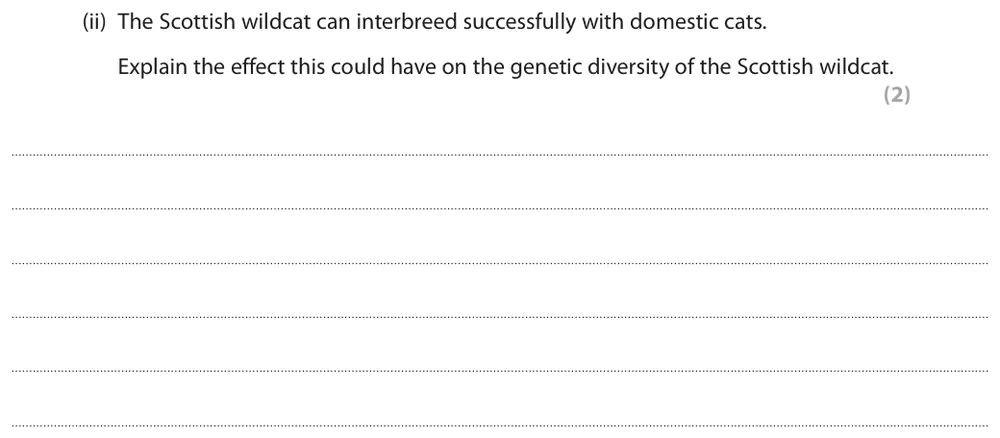
AS Paper 2 · June 2017 · Q3(a)(ii) · 2 marks
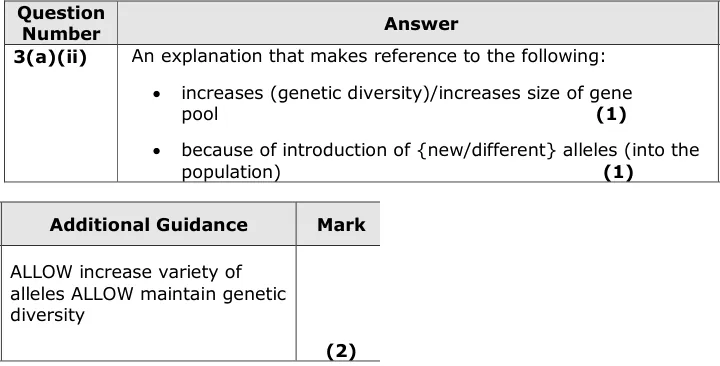
Explain the effect of interbreeding with domestic cats on the genetic diversity of the Scottish wildcat.
Show the mark scheme
Tap an image to open it full size.
From the examiners' report: Most said genetic diversity increases, then just defined genetic diversity. Explain the effect: interbreeding introduces new alleles into the population. Allele frequency and genetic drift were not what was asked.
Question 5
AS Paper 2 · June 2019 · Q4(d) · 2 marks · Easy
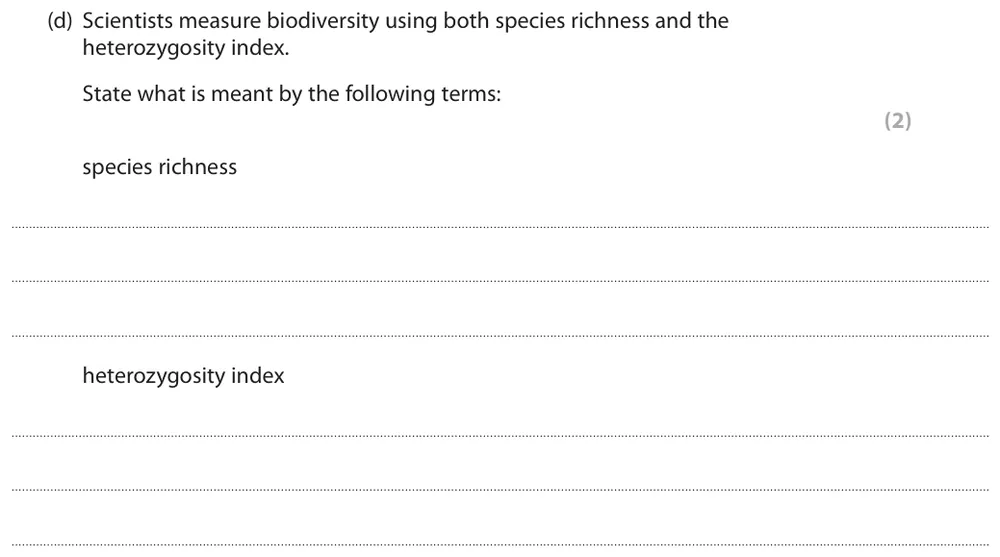
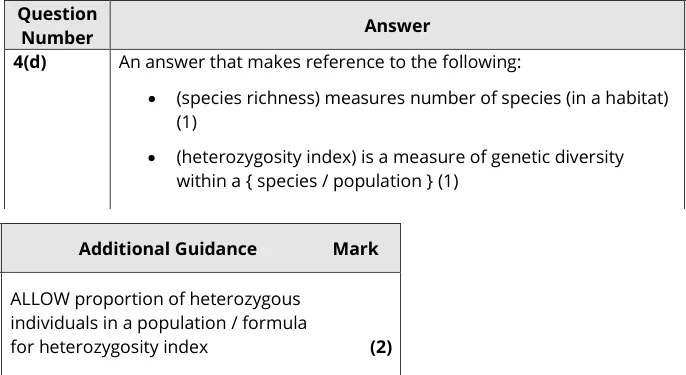
State what is meant by species richness and heterozygosity index.
Show the mark scheme
Tap an image to open it full size.
From the examiners' report: Species richness was well known. For the heterozygosity index, say it is the proportion of heterozygous individuals in a population, not the number of heterozygotes.
Question 6
A level Paper 1 · November 2021 · Q5(b)(ii) · 4 marks
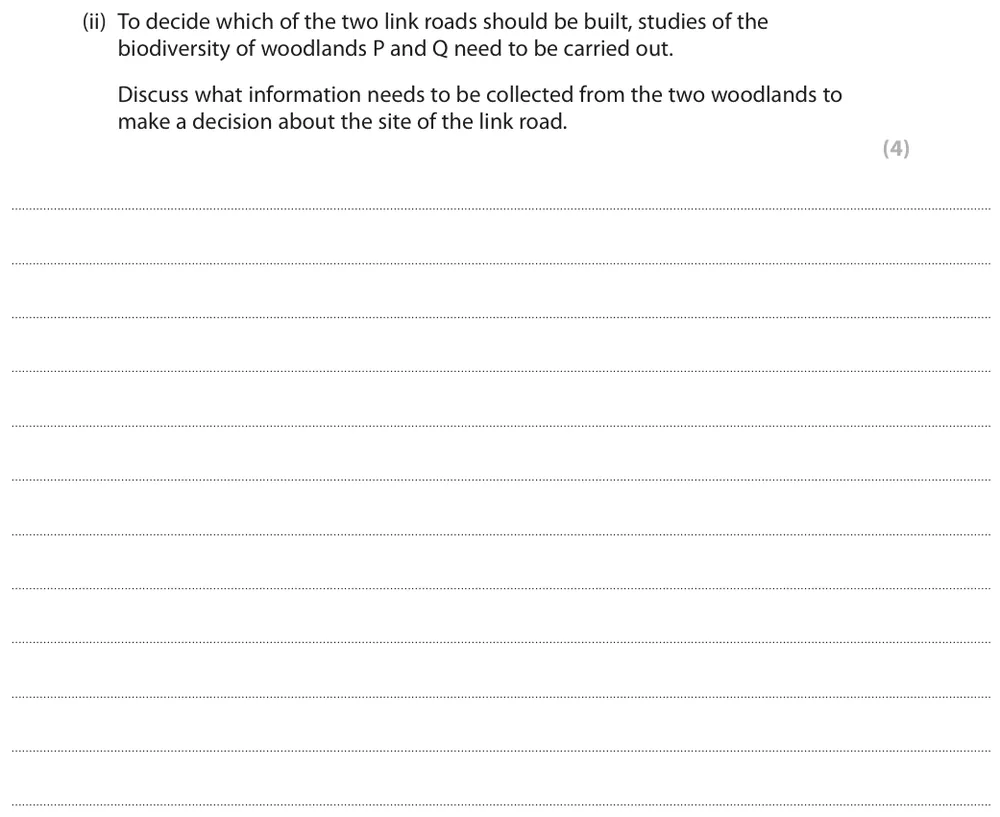
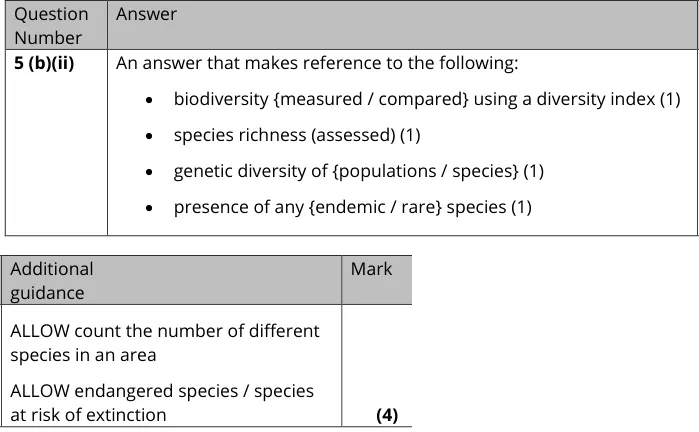
Discuss what information needs to be collected from two woodlands to decide where a road should be built.
Show the mark scheme
Tap an image to open it full size.
From the examiners' report: Not well done. Finding 'the biodiversity' just repeats the stem: name a diversity index and species richness, link genetic diversity to a species or population, and look for endemic or rare species.
Index of diversity (4.2 iii)
Question 7
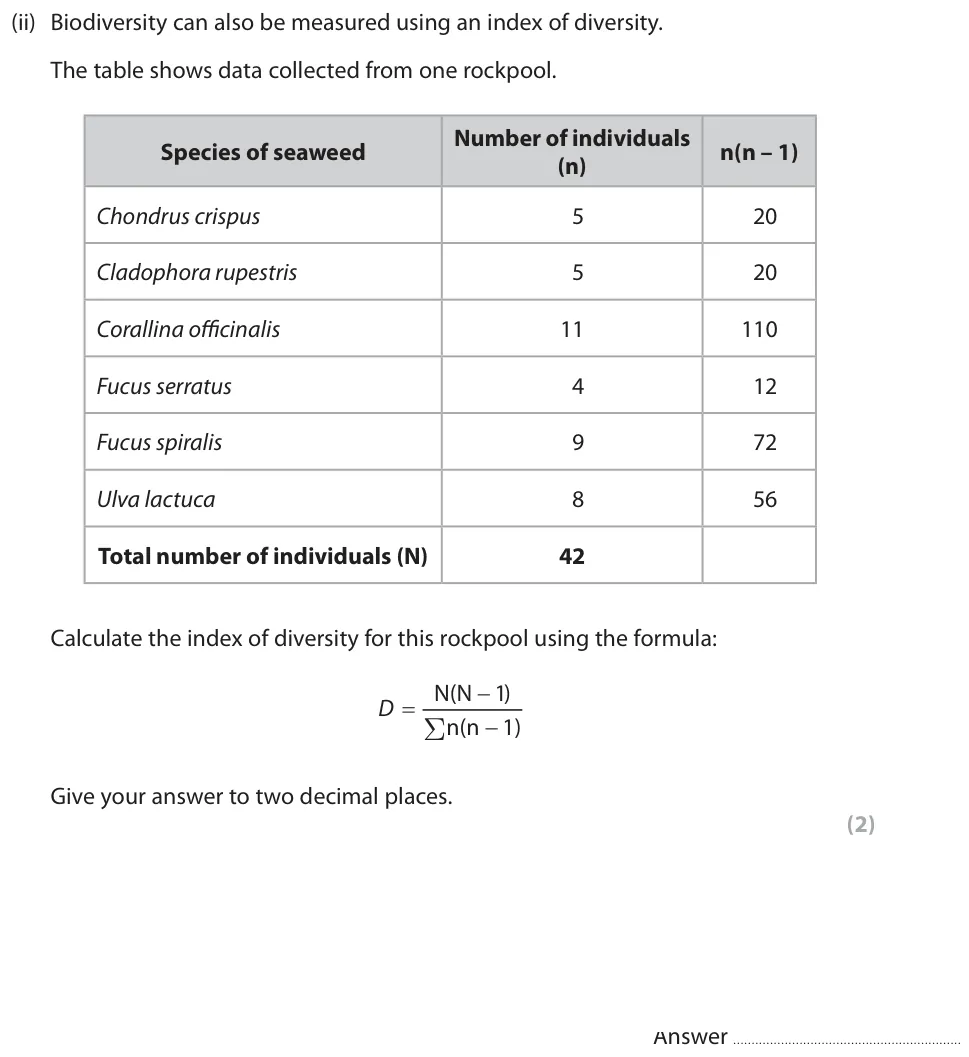
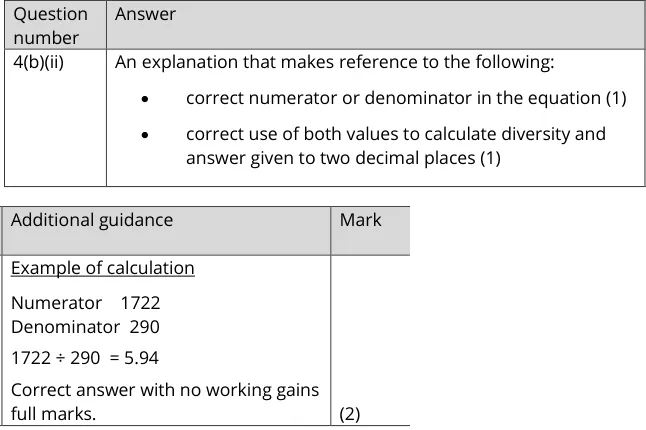
AS Paper 2 · June 2025 · Q4(b)(ii) · 2 marks
Calculate the index of diversity for a rockpool, to two decimal places.
Show the mark scheme
Tap an image to open it full size.
From the examiners' report: Most scored both marks for 5.94. The common errors were ignoring the Σ sign, so getting the wrong denominator, and not rounding to two decimal places as instructed.
Question 8
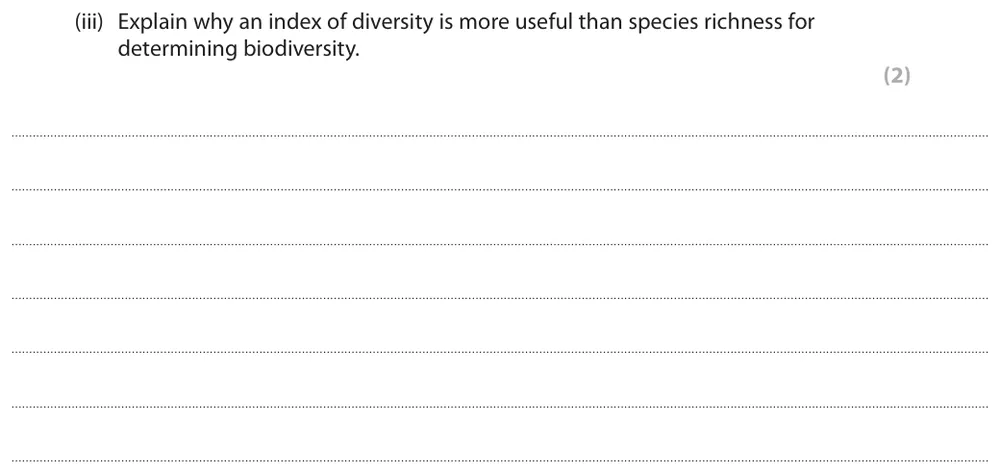
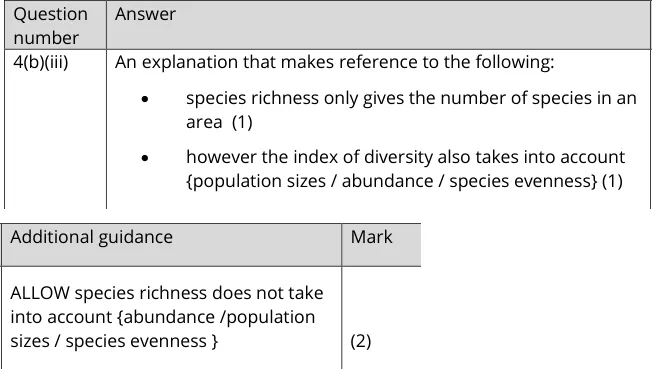
AS Paper 2 · June 2025 · Q4(b)(iii) · 2 marks
Explain why an index of diversity is more useful than species richness for determining biodiversity.
Show the mark scheme
Tap an image to open it full size.
From the examiners' report: Be specific: species richness only gives the number of species in an area, while the index of diversity also takes into account the population size (abundance) of each species.
Niche and adaptation (4.3)
Question 9
AS Paper 2 · June 2018 · Q8(a) · 3 marks · Easy
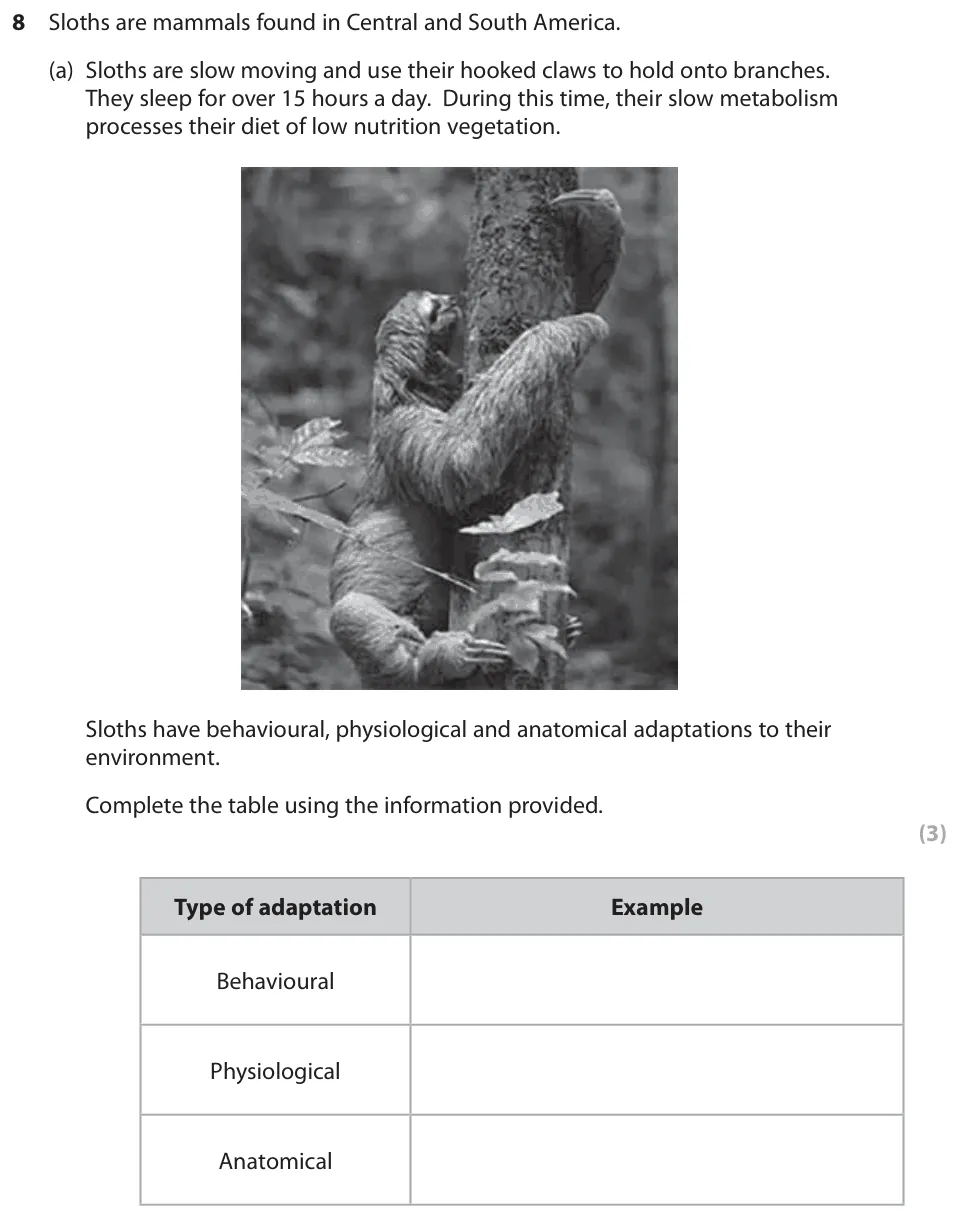
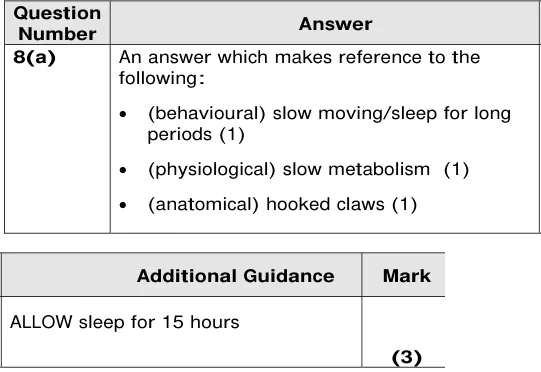
Complete a table with a behavioural, physiological and anatomical adaptation of sloths.
Show the mark scheme
Tap an image to open it full size.
From the examiners' report: Well answered. Pick out the relevant feature rather than copying the whole description. Hooked claws was the anatomical answer: long claws was not credited.
Question 10
A level Paper 3 · October 2020 · Q2(a) · 2 marks
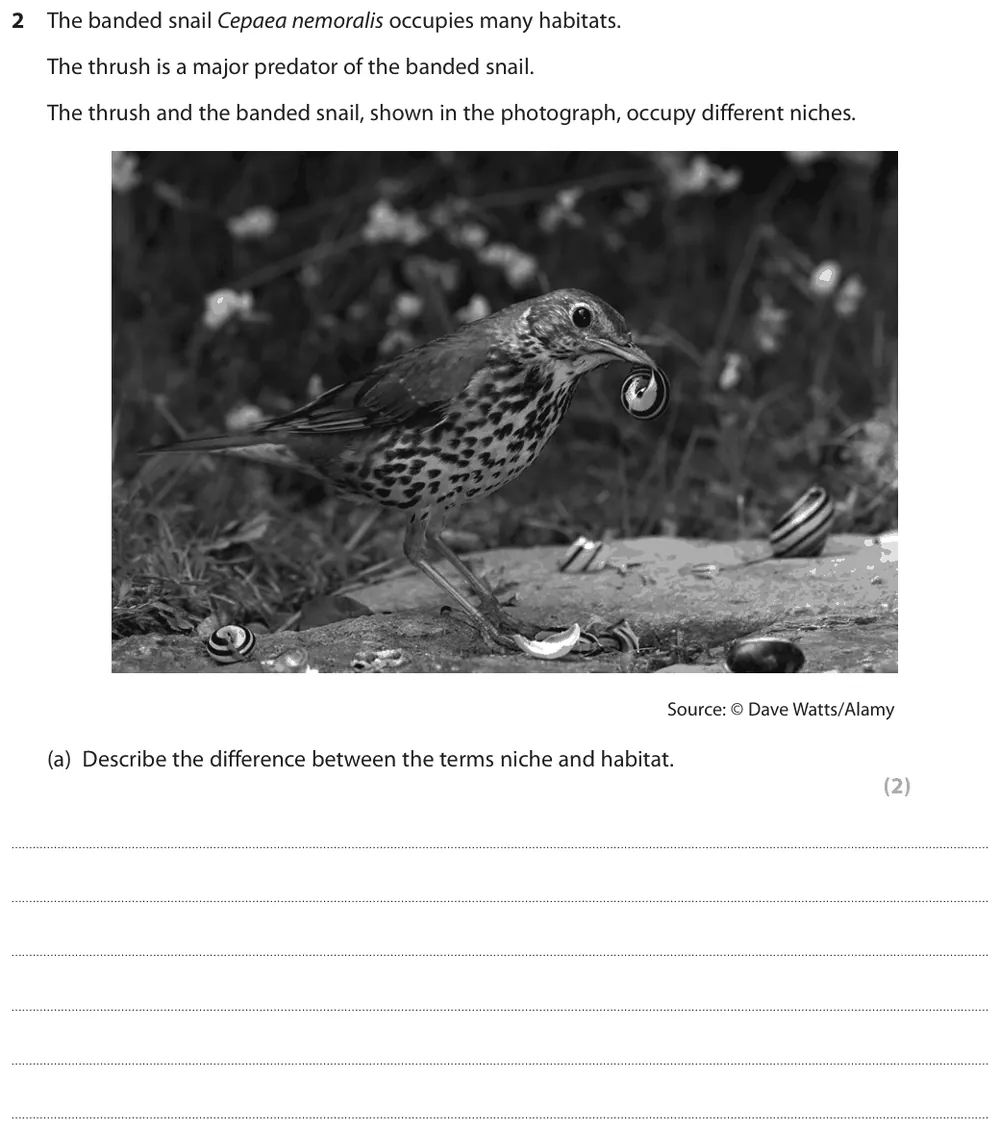
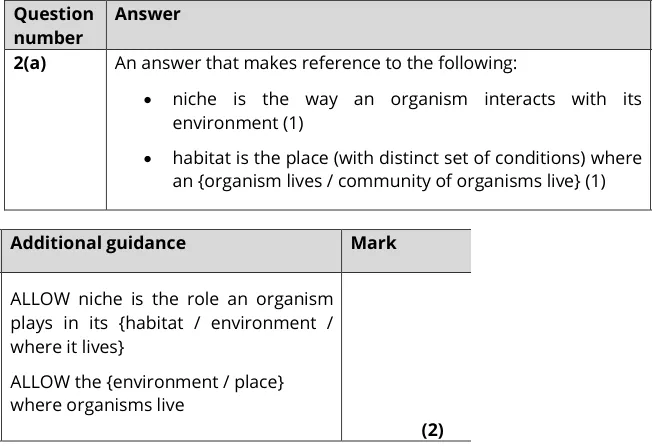
Describe the difference between the terms niche and habitat.
Show the mark scheme
Tap an image to open it full size.
From the examiners' report: Most could do this, usually by describing each term: the niche is the way an organism interacts with its environment (its role), and the habitat is the place where it lives.
Question 11
A level Paper 3 · October 2020 · Q2(c)(i) · 3 marks
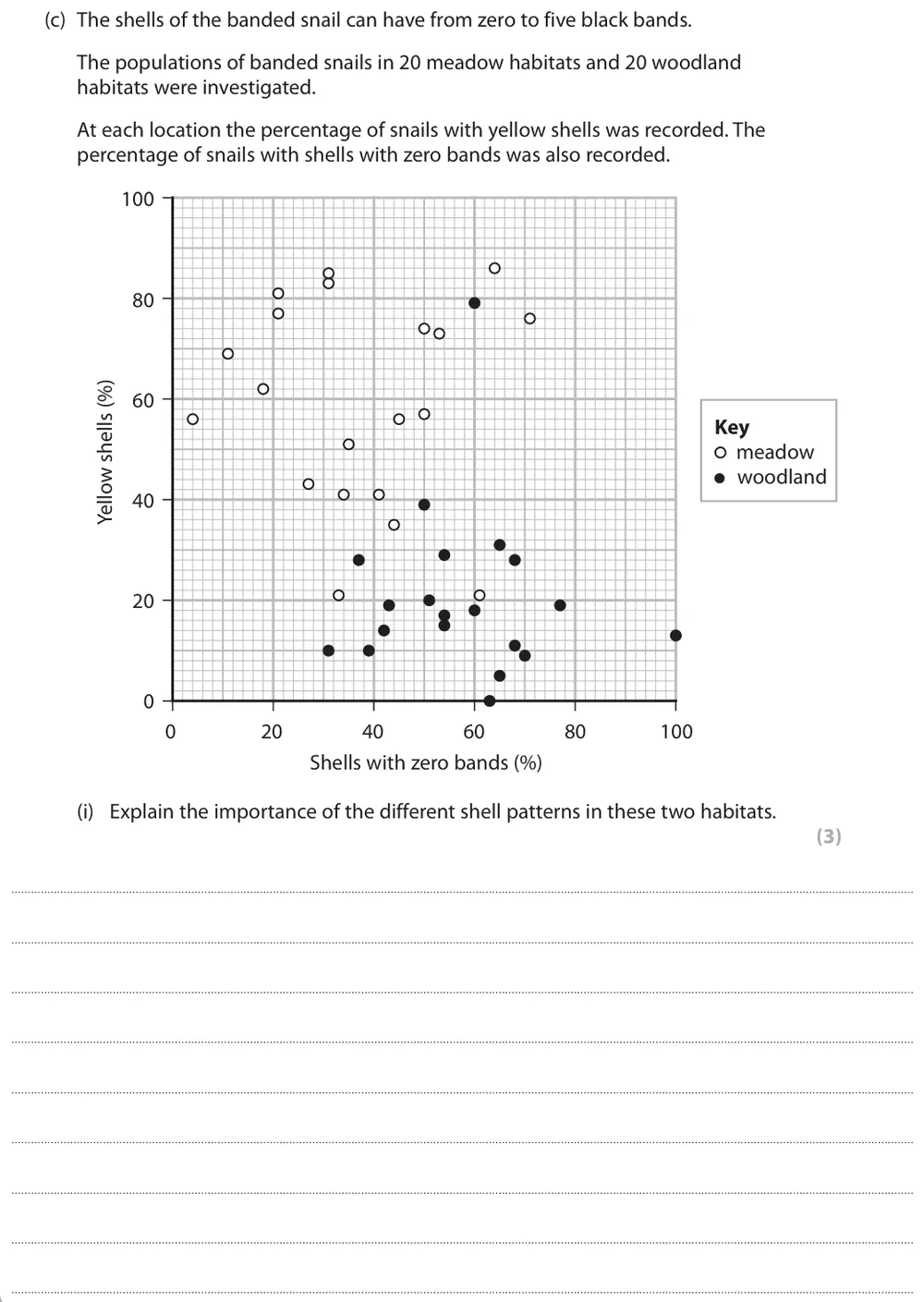
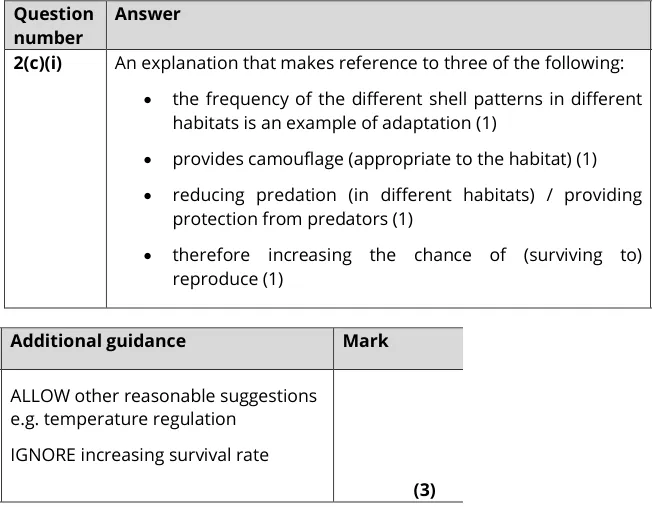
Explain the importance of the different shell patterns of banded snails in two habitats.
Show the mark scheme
Tap an image to open it full size.
From the examiners' report: Most said camouflage reduces predation. Say the snails survive to reproduce, not just survive, and very few said the pattern is an example of adaptation.
Natural selection and evolution (4.4)
Question 12
A level Paper 1 · June 2022 · Q9(d) · 4 marks
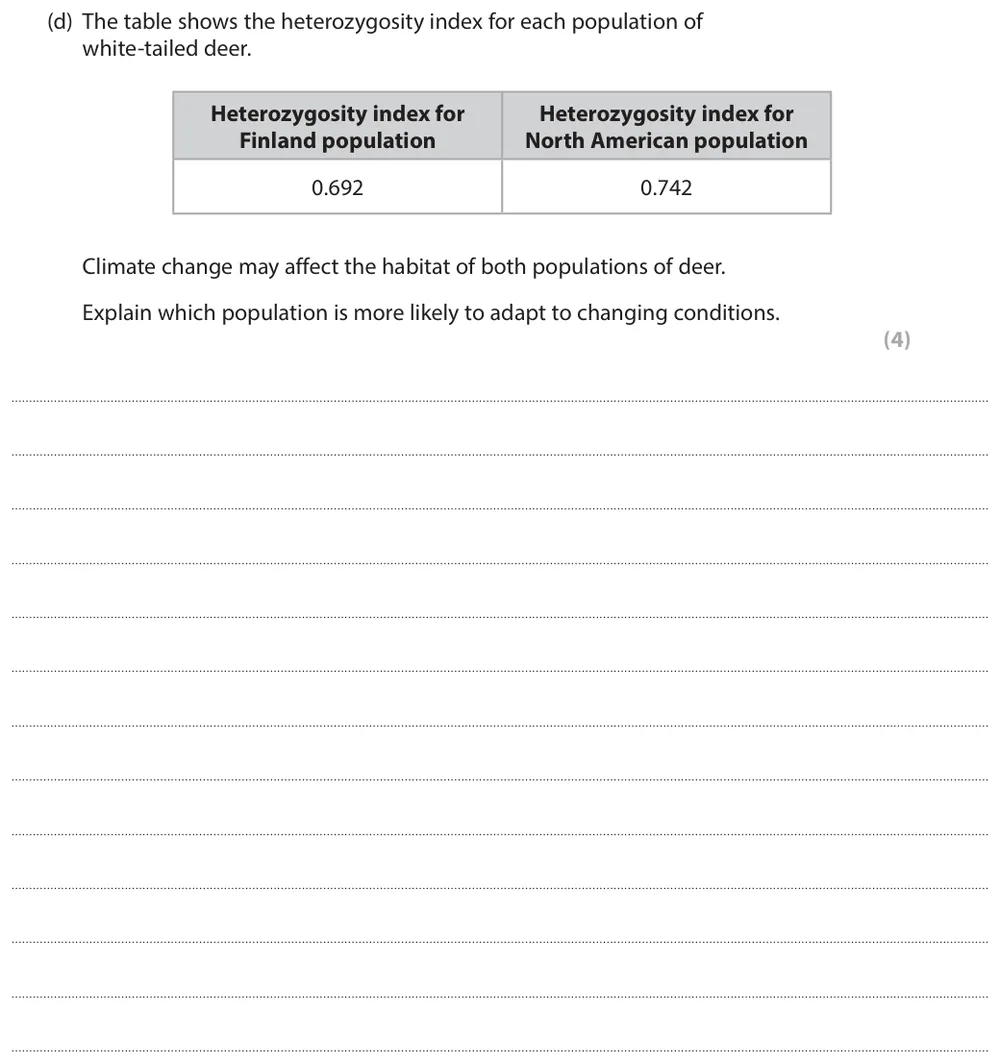
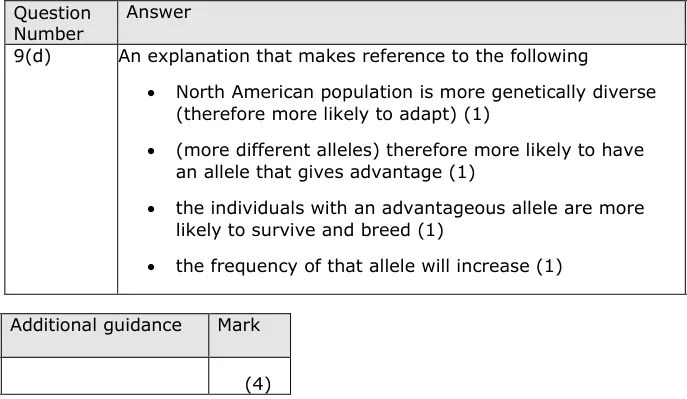
Use heterozygosity indices to explain which deer population is more likely to adapt to climate change.
Show the mark scheme
Tap an image to open it full size.
From the examiners' report: Natural selection answers must use the context. Link the higher heterozygosity index to greater genetic diversity, so the North American population is more likely to have an advantageous allele.
Question 13
AS Paper 2 · June 2025 · Q2(b)(ii) · 5 marks
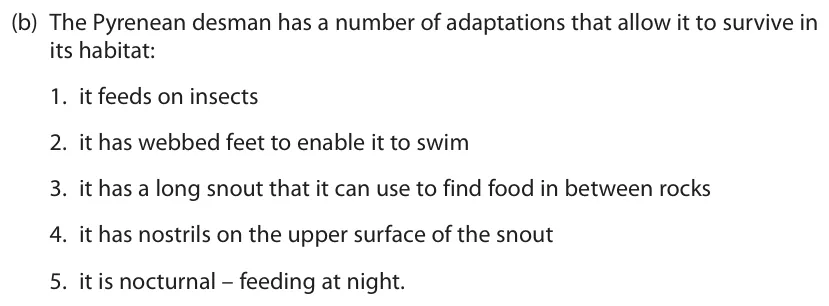
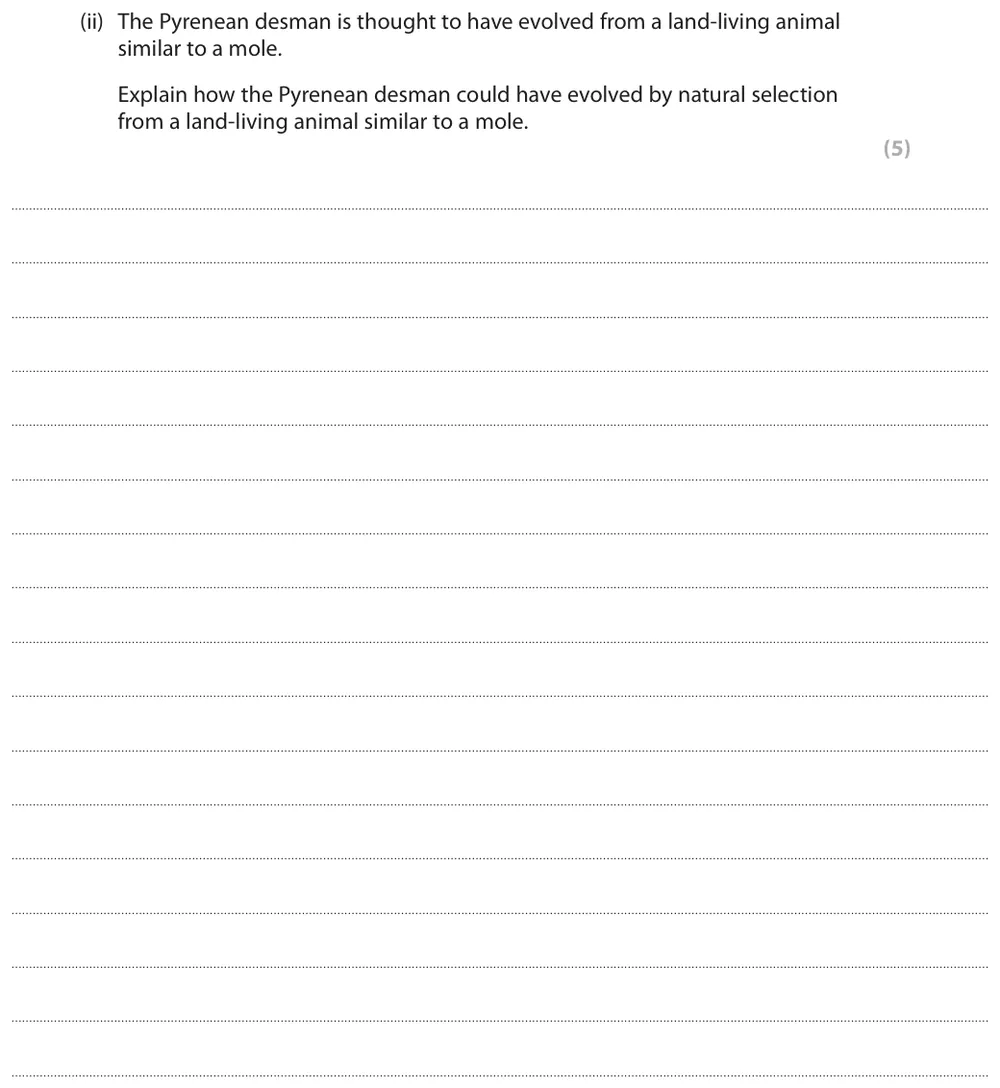
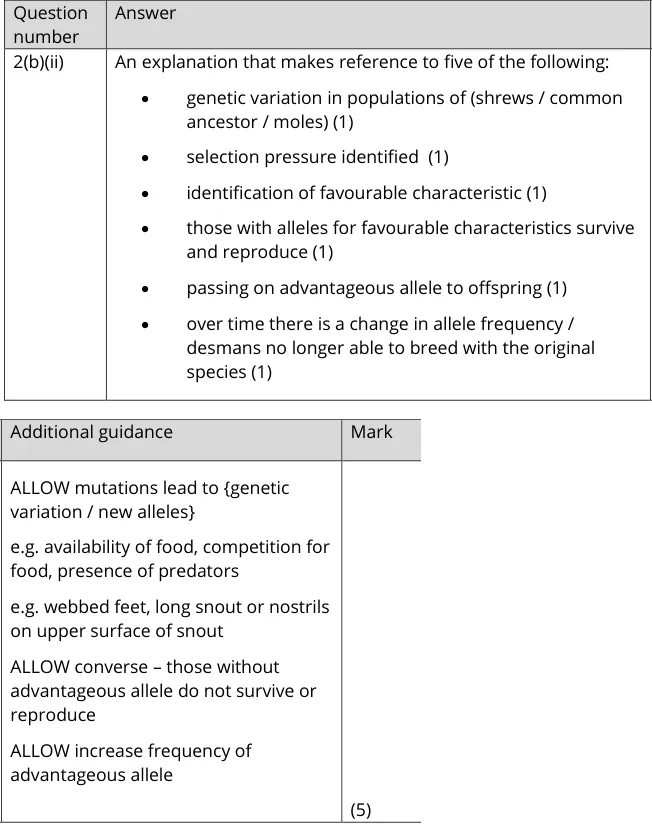
Explain how the Pyrenean desman could have evolved by natural selection from a land-living animal.
Information from earlier in this question:
Show the mark scheme
Tap an image to open it full size.
From the examiners' report: Most gained at least 3 marks. Marks were lost for writing 'variation' without 'genetic', mentioning mutations without new alleles, and not naming a selection pressure or a relevant adaptation.
The Hardy-Weinberg equation (4.5 i)
Question 14
AS Paper 2 · June 2024 · Q5(a)(i) · 3 marks
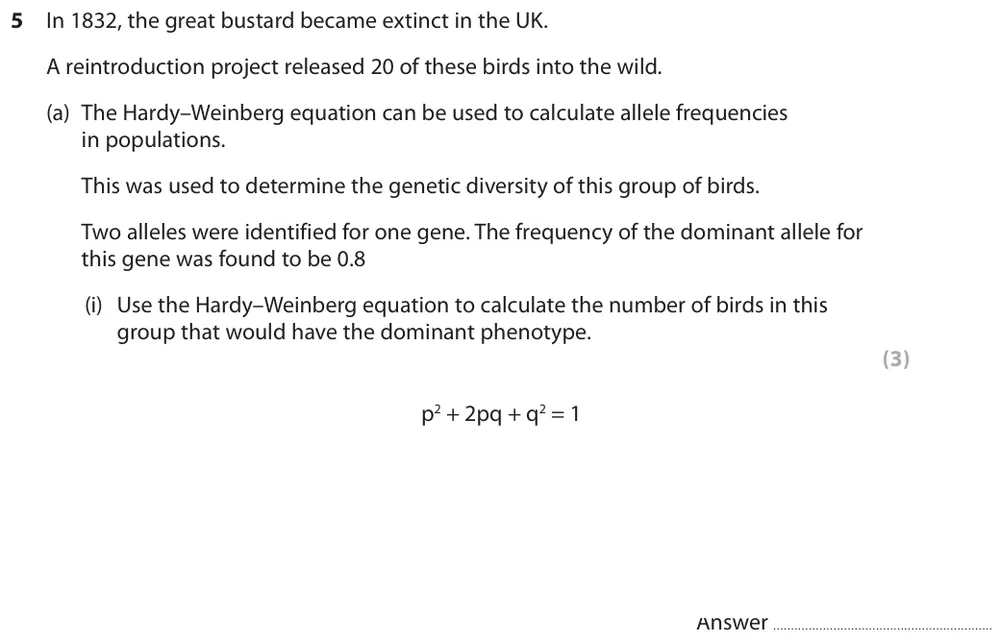
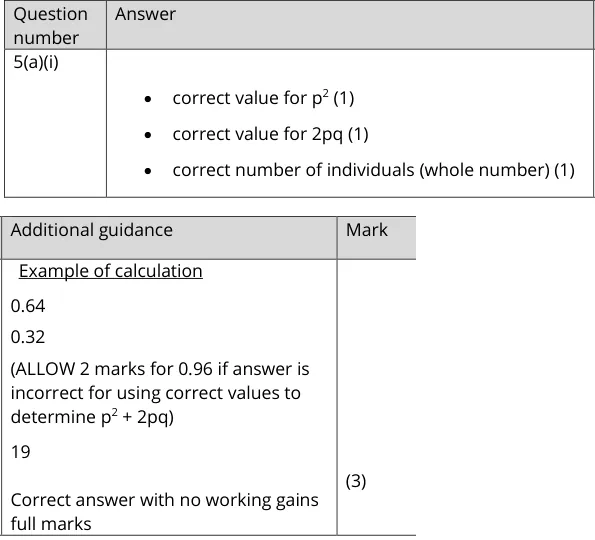
Use the Hardy-Weinberg equation to calculate the number of birds with the dominant phenotype.
Show the mark scheme
Tap an image to open it full size.
From the examiners' report: Most found p² = 0.64, but the dominant phenotype includes the heterozygotes too. Add 2pq before multiplying by the number of birds, and give a whole number.
Question 15
A level Paper 1 · June 2024 · Q7(b)(i) · 3 marks · Hard
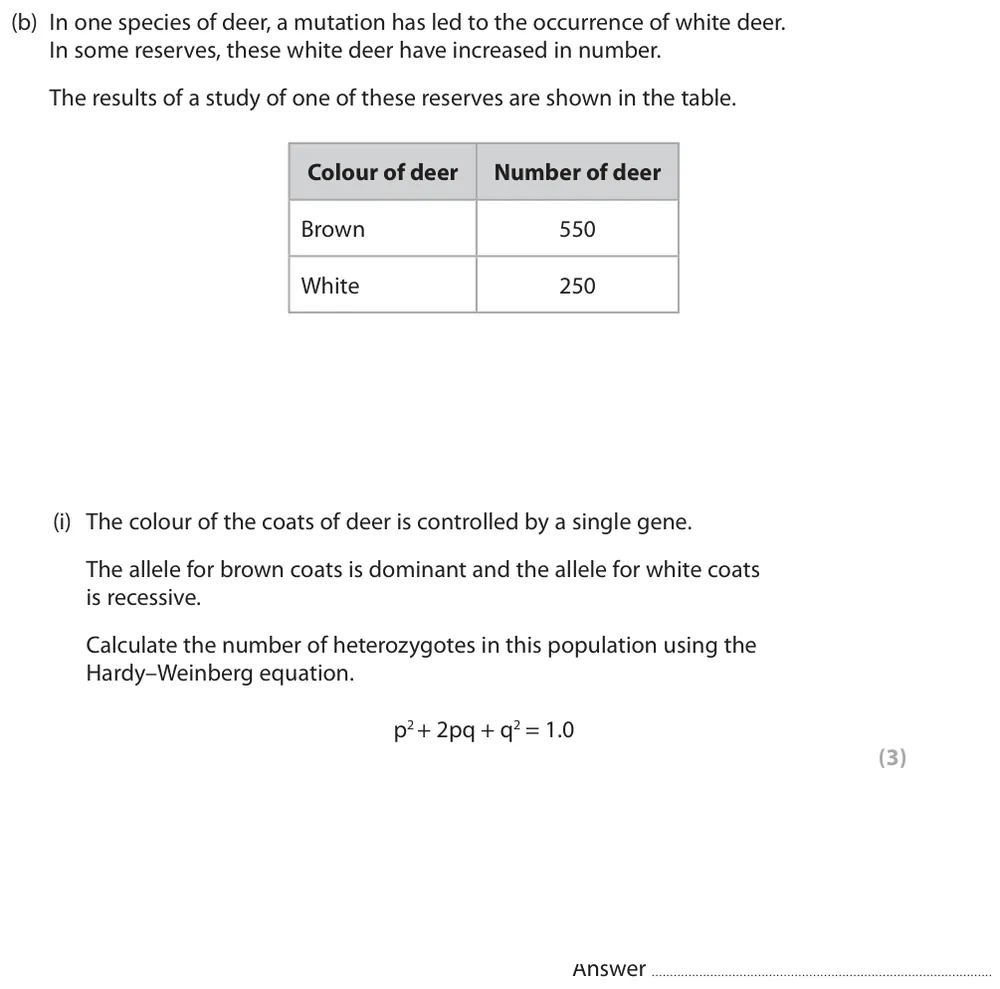
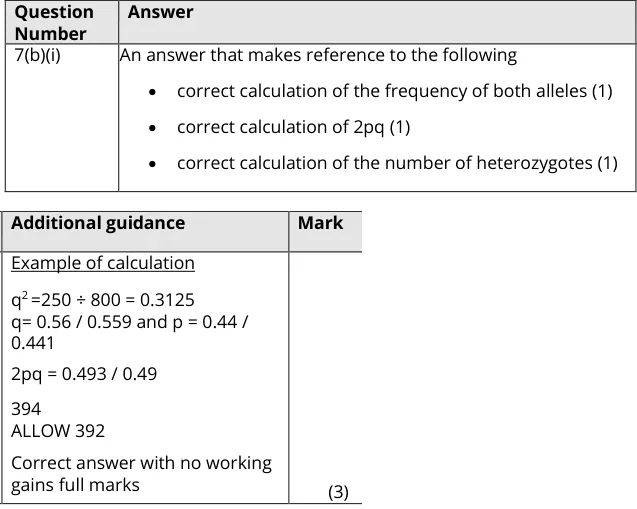
Use the Hardy-Weinberg equation to calculate the number of heterozygous deer.
Show the mark scheme
Tap an image to open it full size.
From the examiners' report: The most common errors were not taking the square root to find q and not completing the final step. Show your working: it can still earn marks if the final answer is wrong.
Question 16
A level Paper 1 · November 2021 · Q3(b)(ii) · 2 marks · Easy
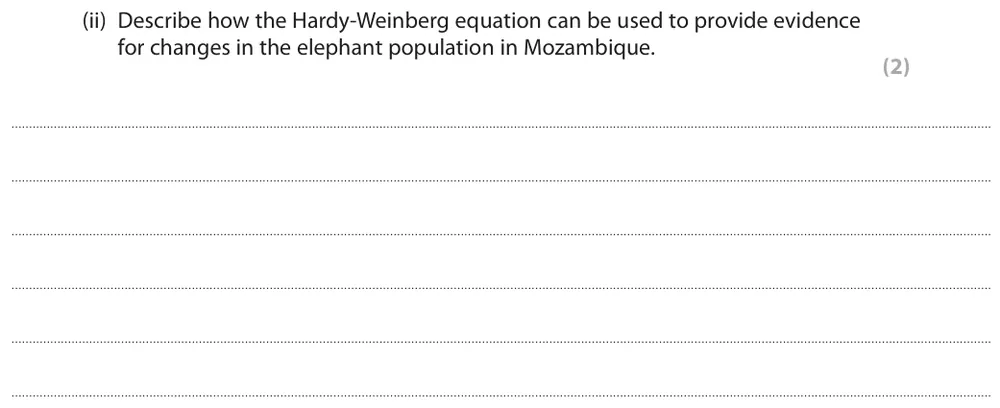
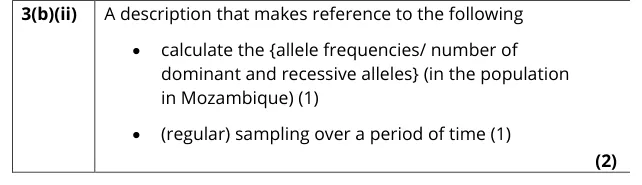
Describe how the Hardy-Weinberg equation can provide evidence for changes in an elephant population.
Show the mark scheme
Tap an image to open it full size.
From the examiners' report: Not answered well: many described what the equation shows rather than how to use it. Calculate the allele frequencies from samples taken regularly over a period of time.
Reproductive isolation and new species (4.5 ii)
Question 17
AS Paper 2 · June 2018 · Q8(b)(i) · 2 marks
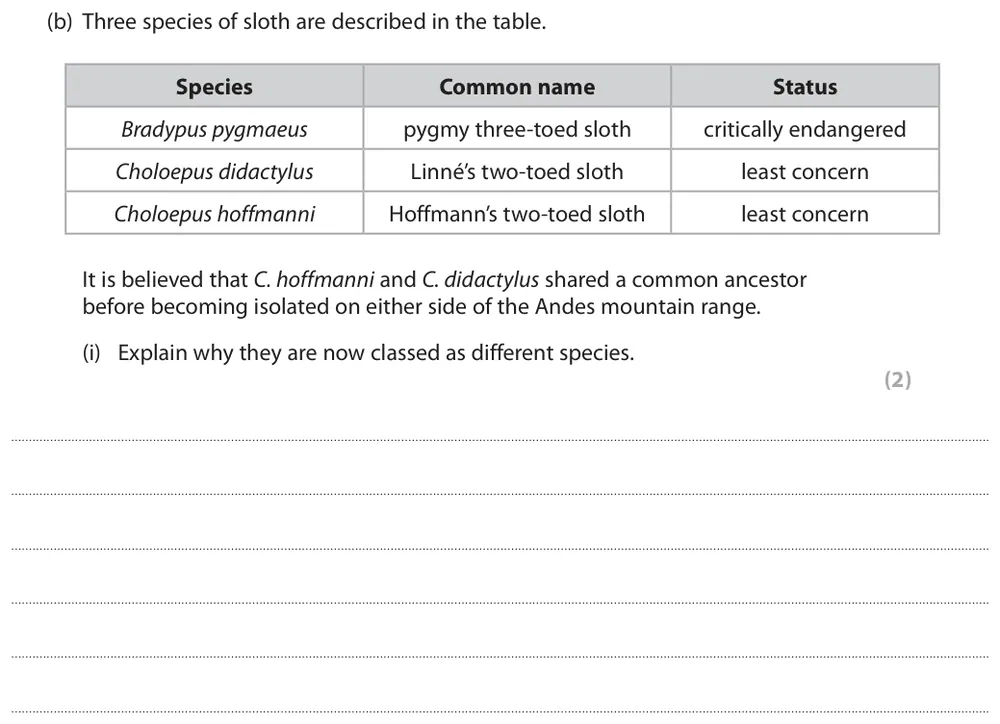
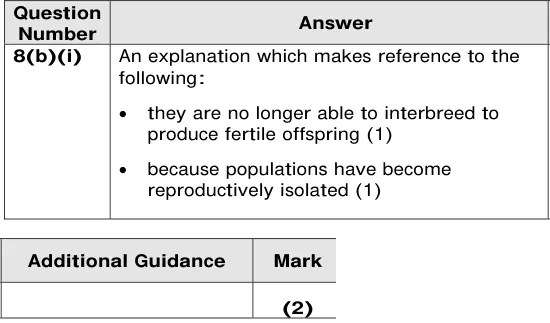
Explain why two sloths that shared a common ancestor are now classed as different species.
Show the mark scheme
Tap an image to open it full size.
From the examiners' report: Weaker answers described the process of speciation instead. They can no longer interbreed to produce fertile offspring because the populations have become reproductively isolated.
Classification and the species concept (4.6 i)
Question 18
AS Paper 2 · June 2025 · Q4(a) · 2 marks
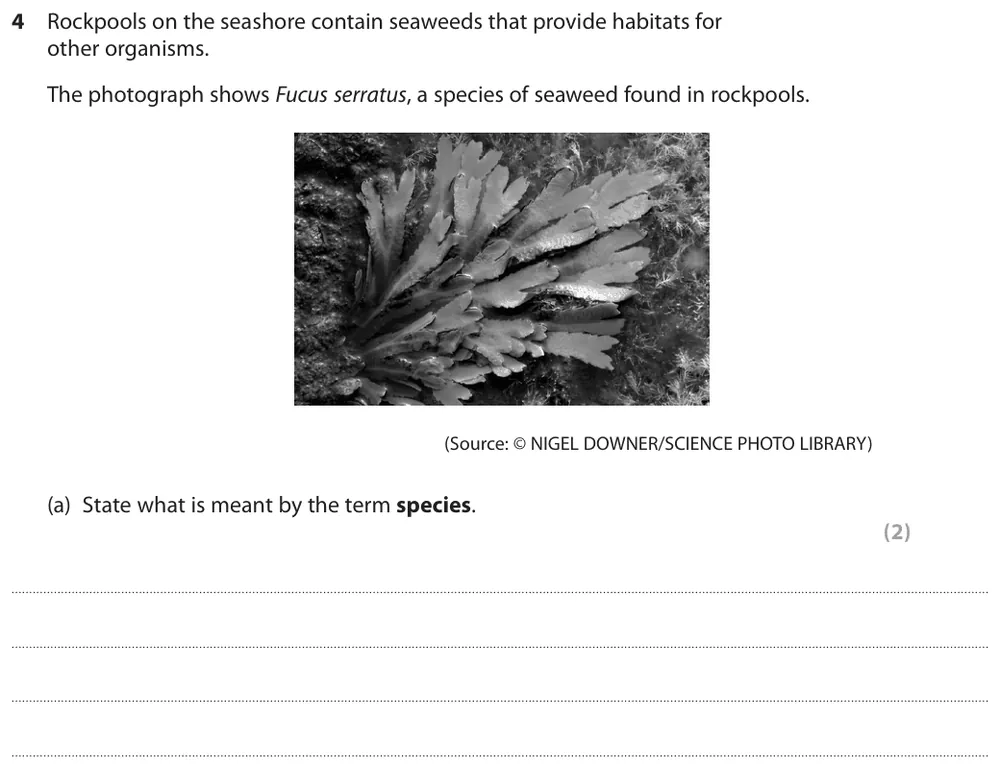
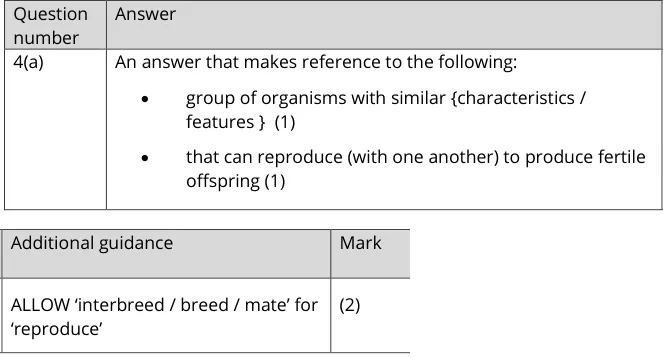
State what is meant by the term species.
Show the mark scheme
Tap an image to open it full size.
From the examiners' report: Most remembered interbreeding to produce fertile offspring, but many missed that members of a species have similar characteristics. Write interbreeding, not inbreeding.
Molecular phylogeny and the three domains (4.6 ii)
Question 19
AS Paper 2 · June 2017 · Q3(b) · 2 marks · Hard
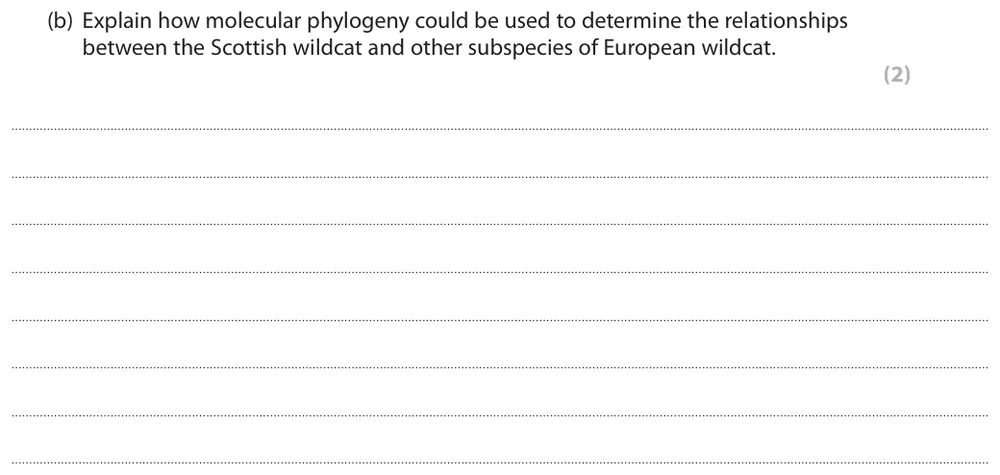
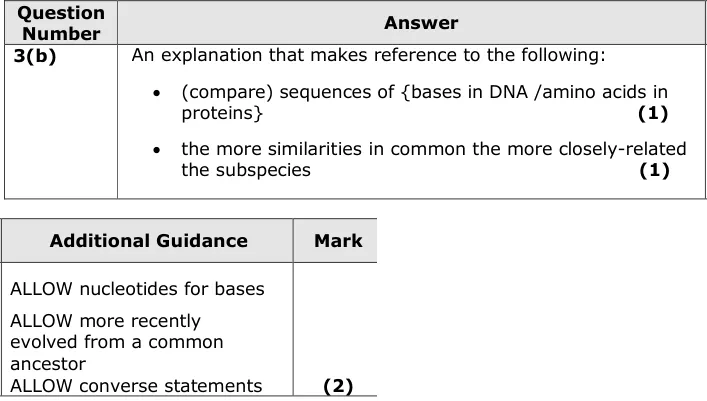
Explain how molecular phylogeny could show the relationships between subspecies of wildcat.
Show the mark scheme
Tap an image to open it full size.
From the examiners' report: Still a misunderstood idea, and vague references to DNA scored nothing. Compare the sequences of bases in DNA or amino acids in a protein; the more similarities, the more closely related.
Question 20
A level Paper 1 · June 2018 · Q8(b) · 3 marks
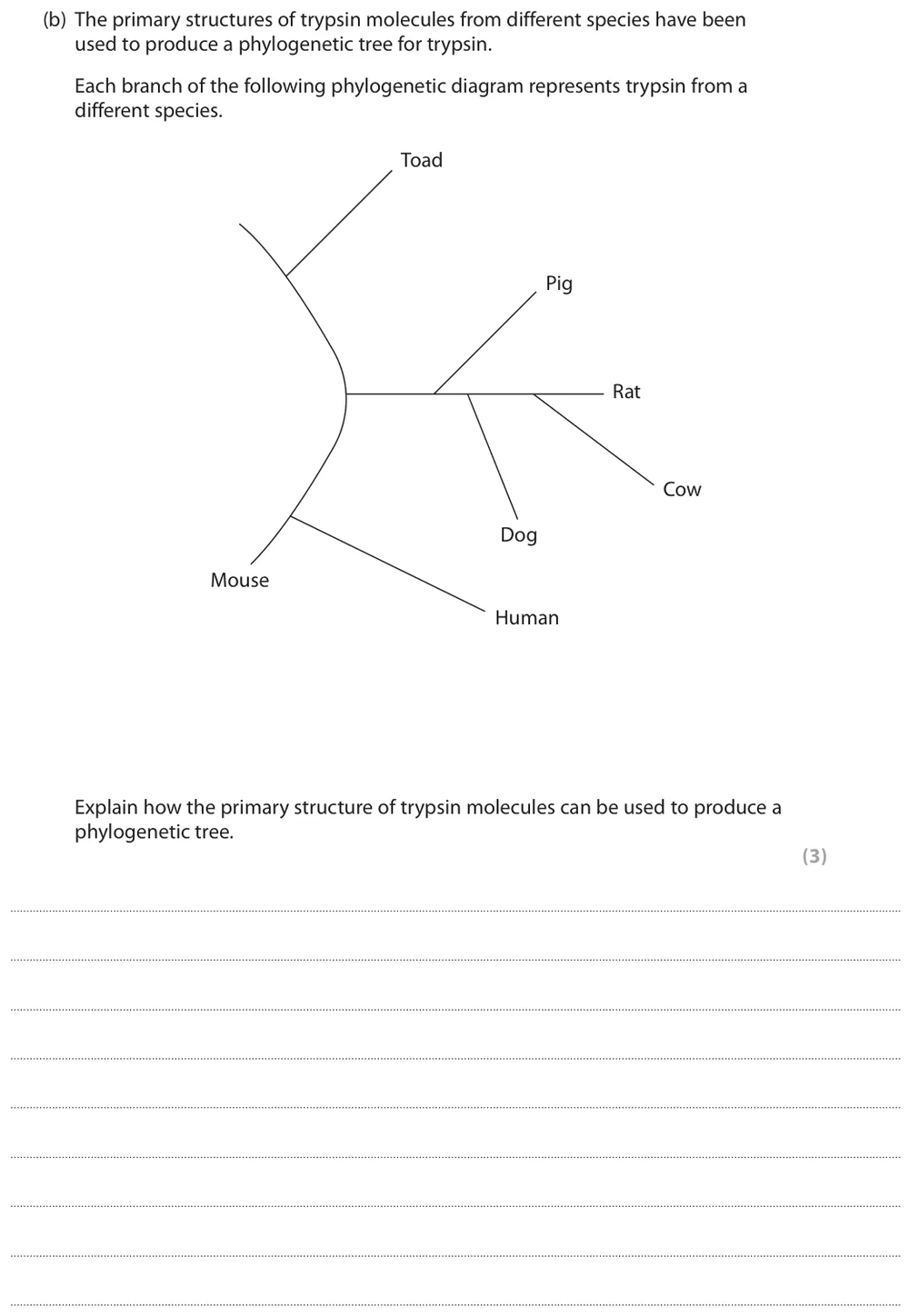
Explain how the primary structure of trypsin can be used to produce a phylogenetic tree.
Show the mark scheme
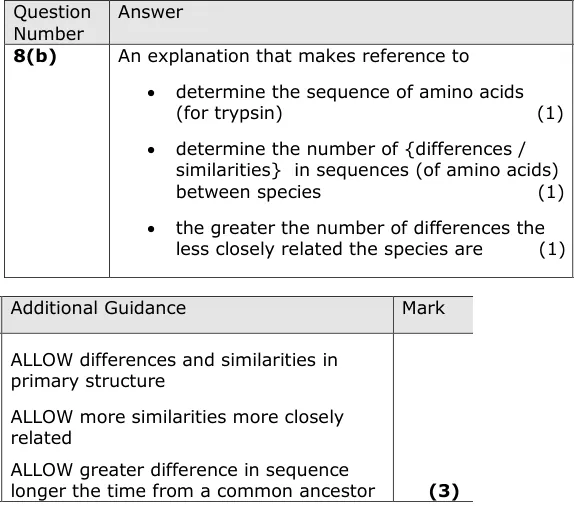
Tap an image to open it full size.
From the examiners' report: Many wrongly wrote about PCR and gel electrophoresis. Determine the amino acid sequence of trypsin in each species, count the differences, and say that more differences means less closely related.
Where students lose marks (from Pearson examiners' reports and mark schemes)
Each point below comes from the examiners' reports and mark schemes, and is followed by wording that gained marks.
Endemic means one location, not one habitat. Many referred to adaptation to a habitat, sometimes calling Scotland a habitat, or linked the term to extinction risk.
✔ Gains credit: 'It is found only in one location (only in Scotland).'
Protecting hotspots maintains biodiversity. Very few explained the effect on global biodiversity, and some thought protecting species could increase it.
✔ Gains credit: 'Protection of hotspots prevents extinction of endemic species; the loss of these species would significantly reduce global biodiversity.'
Interbreeding brings in new alleles. Many defined genetic diversity or wrote about allele frequency and genetic drift instead of explaining the effect.
✔ Gains credit: 'Genetic diversity increases because of the introduction of new alleles into the population.'
The heterozygosity index is a proportion. Many referred to the number (or amount) of heterozygotes.
✔ Gains credit: 'The heterozygosity index is a measure of genetic diversity: the proportion of heterozygous individuals in a population.'
Don't skip the Σ in the diversity index. The most common mistakes were ignoring the Σ sign, giving the wrong denominator, and not rounding to two decimal places.
✔ Gains credit: 'Numerator 1722, denominator 290; 1722 ÷ 290 = 5.94.'
Hooked claws, not long claws. Some gave long claws as the anatomical adaptation, which was not credited, or copied out the whole description.
✔ Gains credit: 'Behavioural: slow moving; physiological: slow metabolism; anatomical: hooked claws.'
The dominant phenotype includes heterozygotes. Many worked out p² and 2pq but did not add them together before multiplying by the number of birds.
✔ Gains credit: 'p² = 0.64 and 2pq = 0.32, so 0.96 of the 20 birds: 19.'
Compare base or amino acid sequences. Few understood that molecular phylogeny compares bases in a common gene or amino acids in a common protein; references to DNA were vague.
✔ Gains credit: 'Compare sequences of bases in DNA or amino acids in proteins; the more similarities, the more closely related the subspecies.'
Download the questions
Download the PDF pack (20 questions, mark schemes at the end)
Keep practising
- Plant Cells, Plant Fibres and Polysaccharides (Topic 4): Edexcel SNAB exam questions by topic
- Drug Testing, Bacterial Growth and Conservation (Topic 4): Edexcel SNAB exam questions by topic
- Topic 4 multiple-choice quiz (63 questions, marked as you tap)
- Edexcel SNAB A level Biology resources hub (every topic, practical and paper)
- Plant Stems, Mineral Deficiencies and Fibre Strength (Core Practicals 6 to 8): Edexcel SNAB A Level Biology Exam Questions
- Antimicrobial Properties of Plants (Core Practical 9): Edexcel SNAB A Level Biology Exam Questions
- Extended Response Questions (Topics 3 and 4): Edexcel SNAB A Level Biology Exam Questions
- Edexcel SNAB A level Biology past papers, mark schemes and examiners' reports
- Edexcel SNAB A level Biology grade boundaries
- Message Tom on WhatsApp about one-to-one Edexcel SNAB tutoring or an Edexcel group class
Questions, mark schemes and examiners' report extracts © Pearson Education Ltd.