

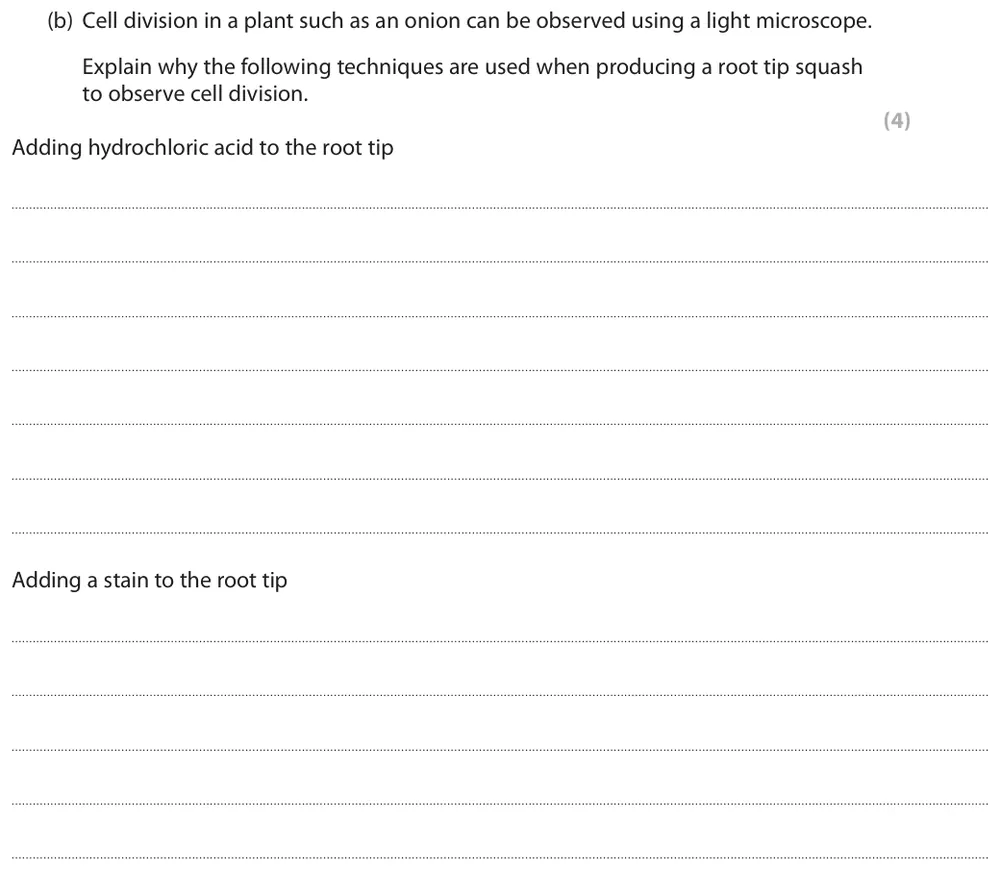
Core Practical 5 asks you to prepare and stain a root tip squash to observe the stages of mitosis. You cut the tip from a growing root, where the meristem cells are dividing, soften it in warm hydrochloric acid, add a stain such as toluidine blue or acetic orcein so the chromosomes show up, then macerate and squash the tissue under a coverslip into a single layer of cells. Under the microscope you identify the stages and count the cells in mitosis to work out the mitotic index. These questions come from real Edexcel A level Biology A (Salters-Nuffield) papers. Core practicals can be examined on any paper, but Paper 3 at A level tests practical skills most heavily. Questions marked AS are from the AS papers (8BN0); the rest are from the A level papers (9BN0).
The examiners' warnings are mostly about planning. Change the variable the question names, and for temperature or day and night that means growing the plants in those conditions, not just treating the squash. Give the squash details that are often left out: hydrochloric acid, heating and a named stain. Then say what you count: both the cells in mitosis and the total number of cells, so you can calculate the mitotic index. When you calculate it, multiply by 100 and round carefully, and when you test a hypothesis, name a statistical test.
Studying Edexcel SNAB and want more help? If you'd like to arrange one-to-one Edexcel tutoring, or to register your interest in an Edexcel group class, message Tom on WhatsApp using the link at the bottom of this page.
What you need first
Each question on this page assumes you're secure on these ideas. If any of them feels shaky, look it up before you start.
- Mitosis has four stages: prophase, metaphase, anaphase and telophase; between divisions the cell is in interphase.
- Chromosomes condense and become visible during mitosis.
- Plant cells are held together by the middle lamella between their cell walls.
- A percentage is the part divided by the whole, multiplied by 100.
Key terms
These words come up in the questions and mark schemes. Examiners expect you to use them exactly.
- Root tip squash: a slide made by softening, staining and squashing a root tip so that its cells form a single layer.
- Meristem: a region of a plant, such as the root tip, where cells divide by mitosis.
- Mitotic index: the percentage of cells in a sample that are undergoing mitosis: cells in mitosis ÷ total cells × 100.
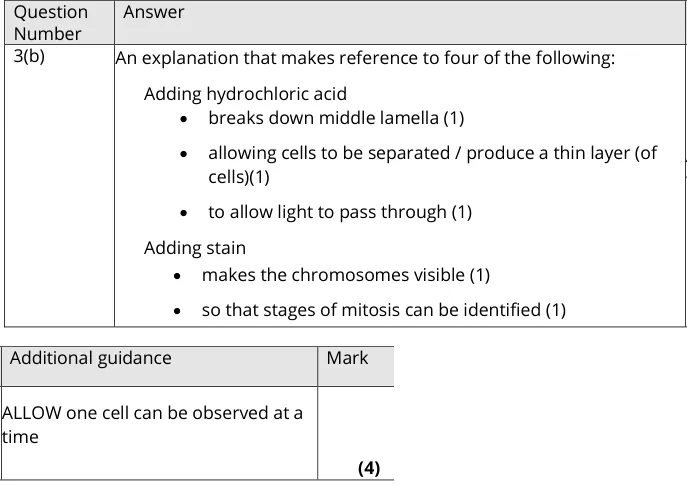
- Middle lamella: the layer between neighbouring plant cell walls that holds the cells together; hydrochloric acid breaks it down.
- Maceration: breaking up or teasing apart the tissue so that the cells separate.
- Toluidine blue / acetic orcein: stains that bind to chromosomes so the stages of mitosis can be seen.
- Statistical test: a test, such as Student's t-test, whose calculated value is compared with a critical value to accept or reject a hypothesis.
What these questions cover
Every question on this page is set on Core Practical 5 of the Pearson Edexcel A level Biology A (Salters-Nuffield) specification (9BN0).
- Core Practical 5: Prepare and stain a root tip squash to observe the stages of mitosis.
How to use this page
Write your answer on paper before you open the mark scheme. Allow about 1.2 minutes per mark: the 13 questions are worth 49 marks, so about 59 minutes in total. Then mark your answer strictly against the mark scheme and read the examiners' tip underneath it. If you'd rather print the questions, download the PDF pack.
Preparing a root tip squash (CP5)
Question 1
AS Paper 2 · October 2020 · Q3(b) · 4 marks
Explain why hydrochloric acid and a stain are added when producing a root tip squash.
Show the mark scheme
Tap an image to open it full size.
Question 2
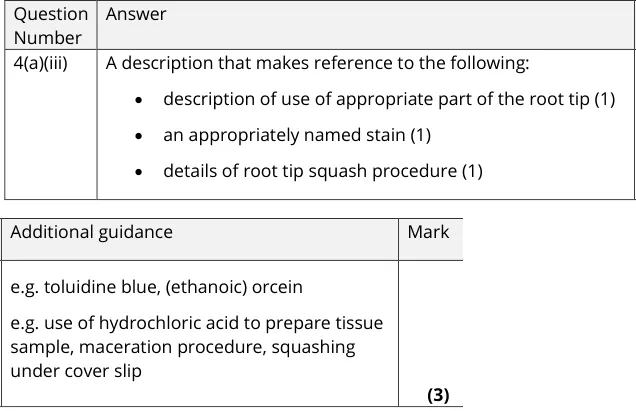
AS Paper 2 · November 2021 · Q4(a)(iii) · 3 marks
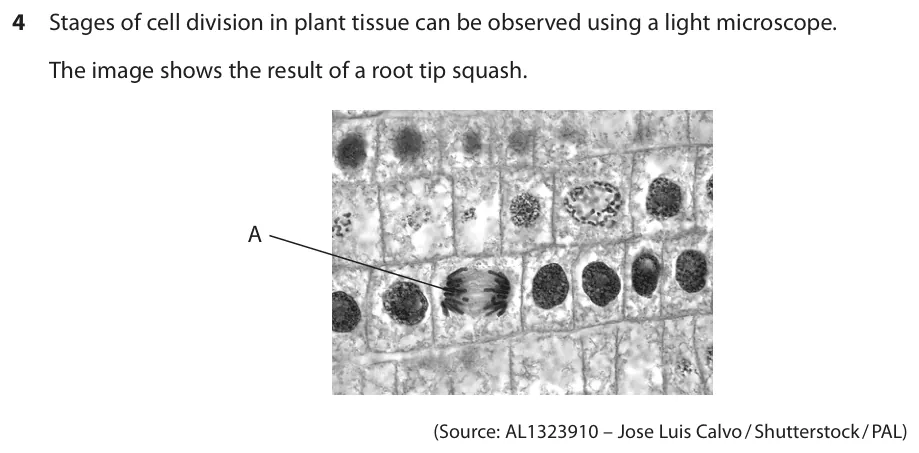
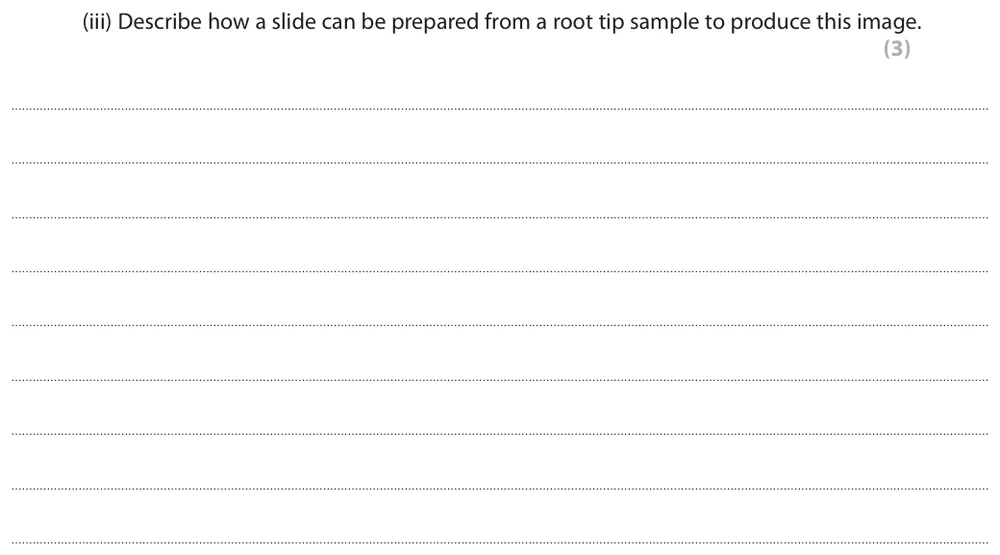
Describe how a slide can be prepared from a root tip sample to produce the image shown.
Information from earlier in this question:
Show the mark scheme
Tap an image to open it full size.
From the examiners' report: Many scored all three marks; the difficulty was naming a stain. Name one, such as toluidine blue or (ethanoic) orcein, and give the squash details: hydrochloric acid, maceration and squashing under a coverslip.
Question 3
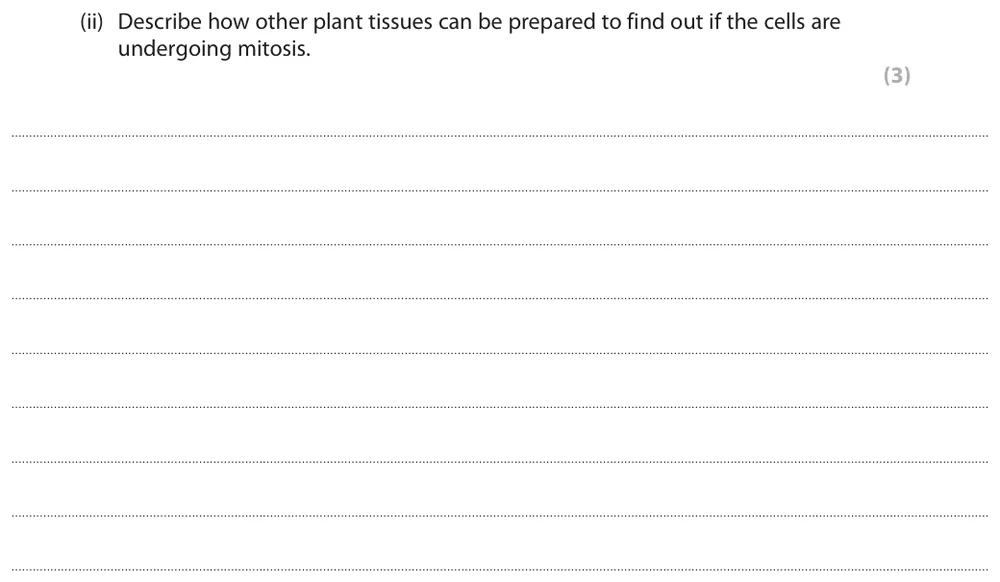
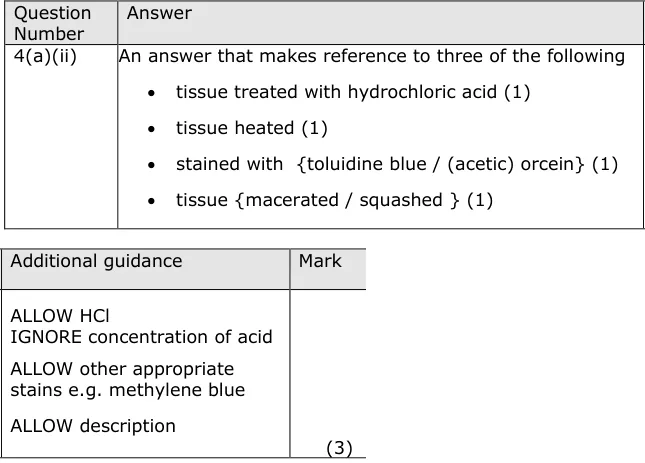
A level Paper 1 · June 2023 · Q4(a)(ii) · 3 marks · Easy
Describe how plant tissues other than the root tip in the photograph can be prepared to see if their cells are undergoing mitosis.
Show the mark scheme
Tap an image to open it full size.
From the examiners' report: Heating and the use of hydrochloric acid were often left out, and not everyone could name the stain: toluidine blue or acetic orcein.
Stages of mitosis and the mitotic index (CP5)
Question 4
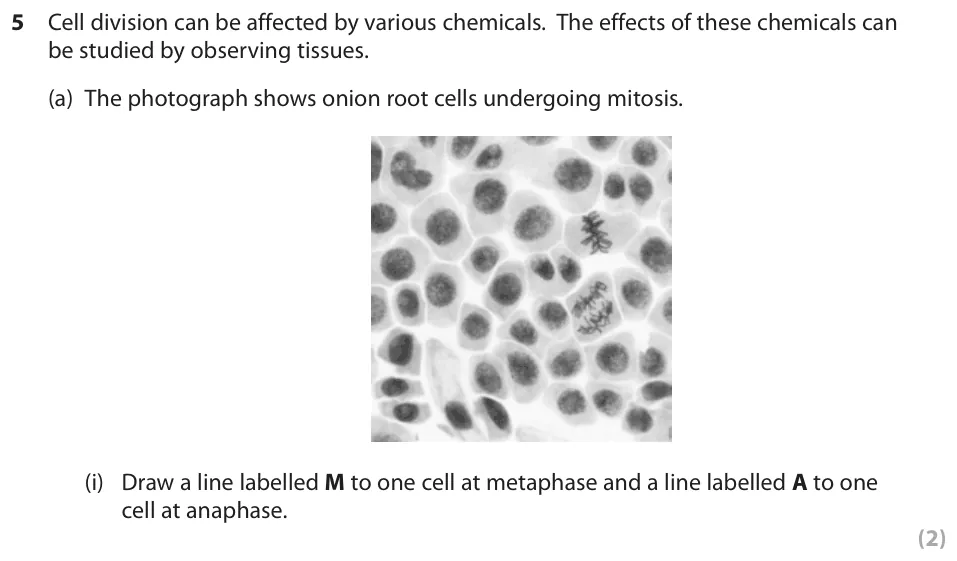
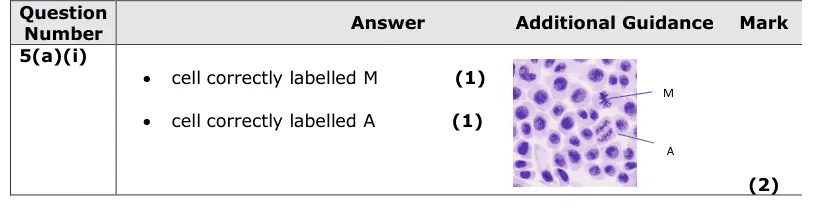
AS Paper 2 · June 2017 · Q5(a)(i) · 2 marks · Easy
Label one onion root cell at metaphase and one at anaphase on the photograph.
Show the mark scheme
Tap an image to open it full size.
From the examiners' report: The vast majority of candidates gained both marks.
Question 5
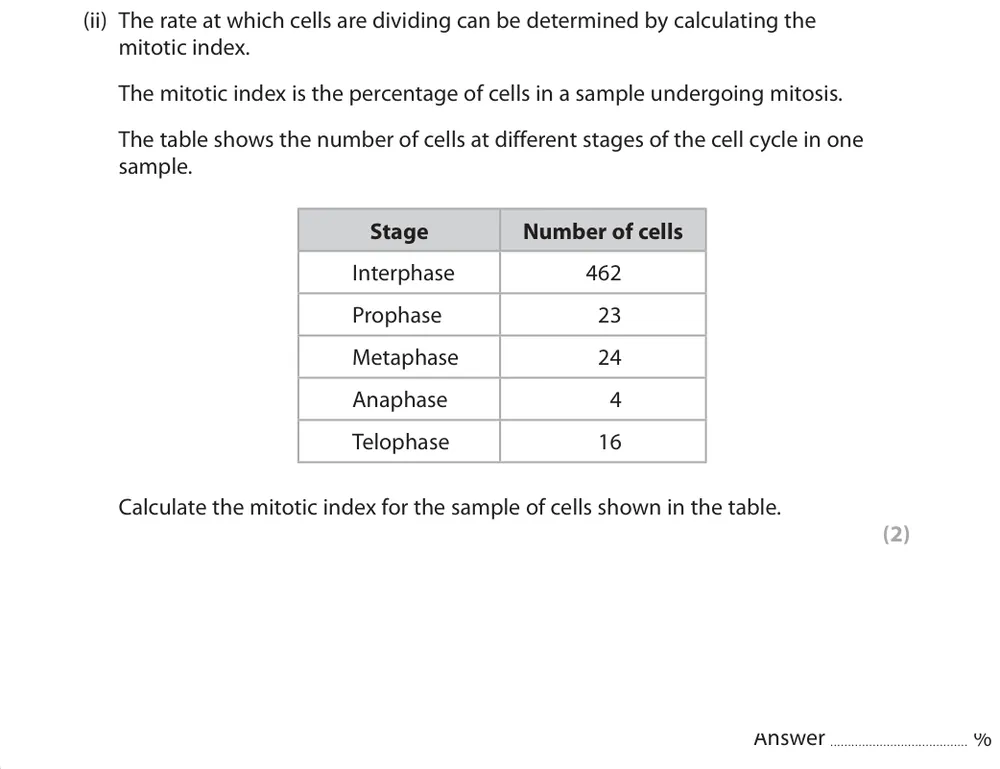
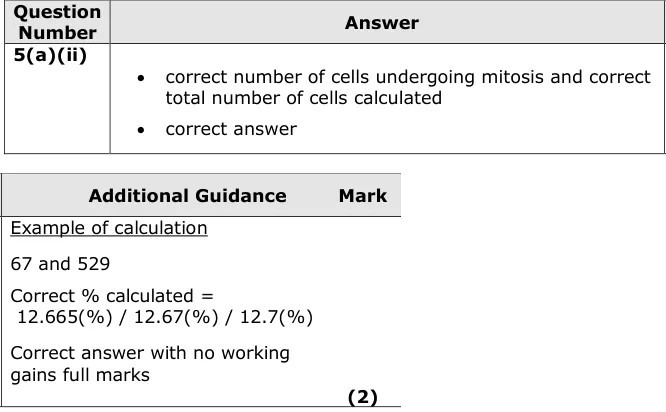
AS Paper 2 · June 2017 · Q5(a)(ii) · 2 marks
Calculate the mitotic index from a table of cell counts at each stage.
Show the mark scheme
Tap an image to open it full size.
From the examiners' report: Most identified the stages of mitosis and gained full marks. Marks were lost by rounding too far or incorrectly, or by forgetting to multiply by 100.
Question 6
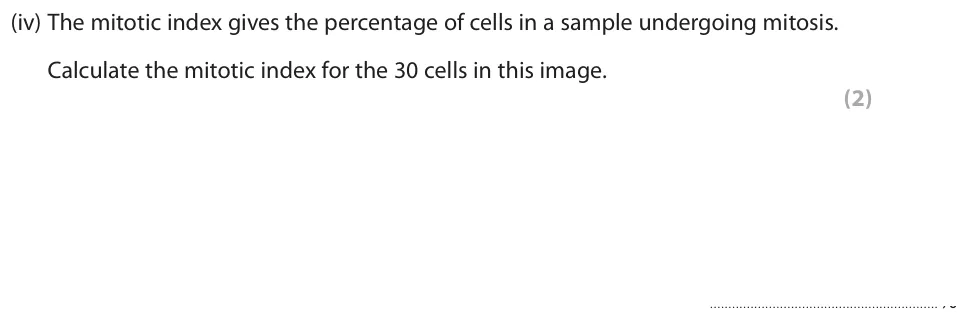
AS Paper 2 · November 2021 · Q4(a)(iv) · 2 marks
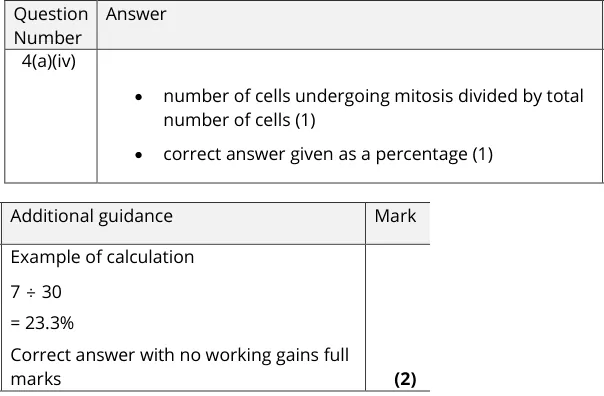
Calculate the mitotic index for the 30 cells in the image.
Information from earlier in this question:
Show the mark scheme
Tap an image to open it full size.
From the examiners' report: Many had difficulty identifying the cells in the stages of mitosis, so could not calculate the percentage. Divide the number of cells undergoing mitosis by the 30 cells and give the answer as a percentage.
Question 7
AS Paper 2 · June 2024 · Q7(c) · 2 marks
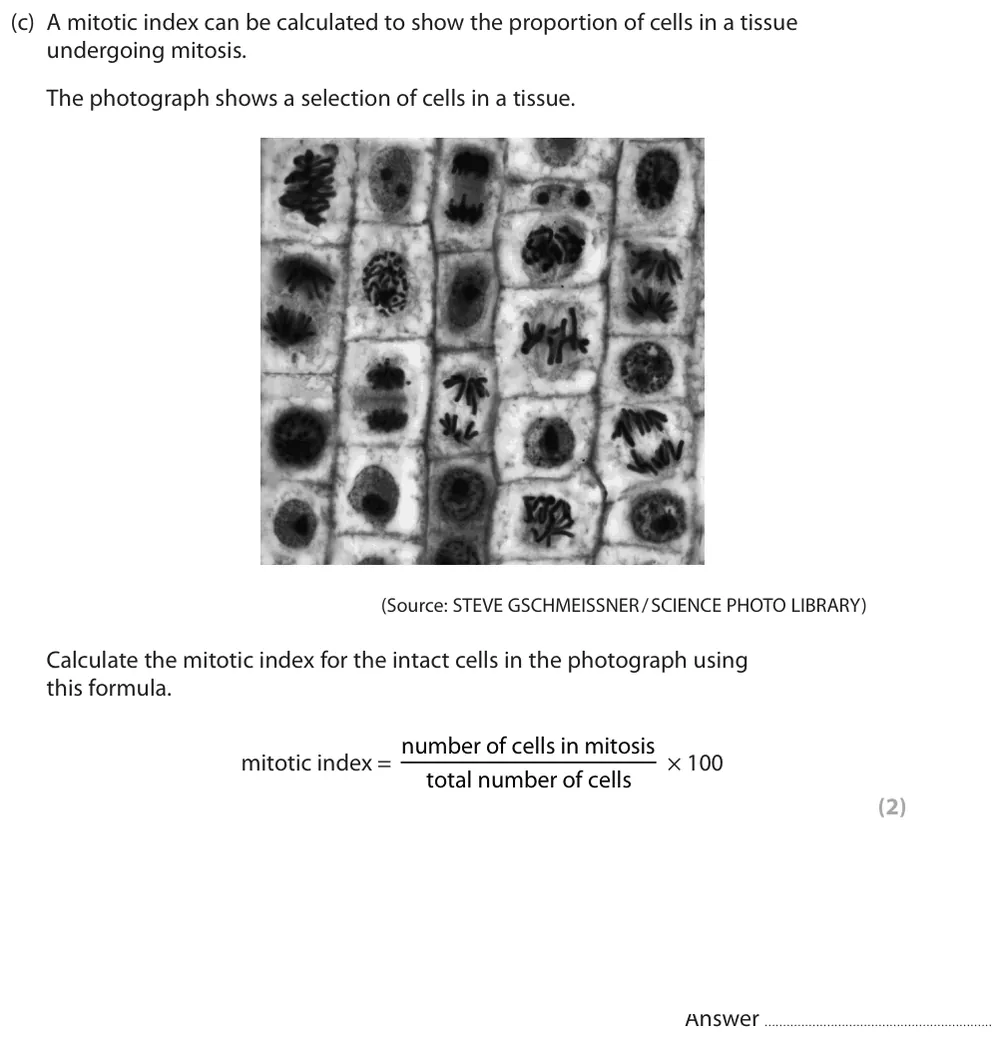
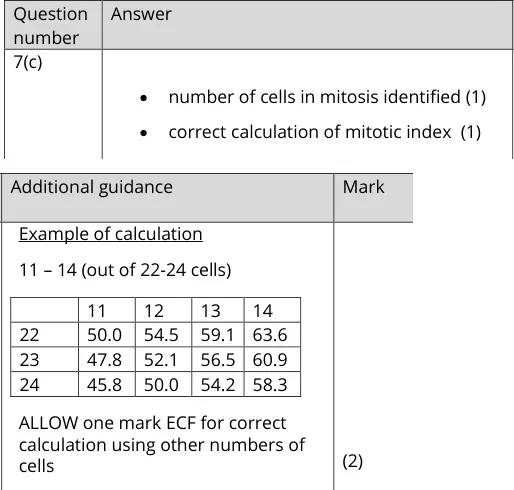
Count the cells in mitosis in a photograph and calculate the mitotic index with the formula given.
Show the mark scheme
Tap an image to open it full size.
From the examiners' report: Counts of 11 to 14 cells in mitosis, out of about 22 to 24 cells, were accepted. Candidates whose counts were outside the range still gained one mark for using the formula correctly.
Planning an investigation (CP5)
Question 8
AS Paper 2 · June 2017 · Q5(b)(ii) · 6 marks · Hard
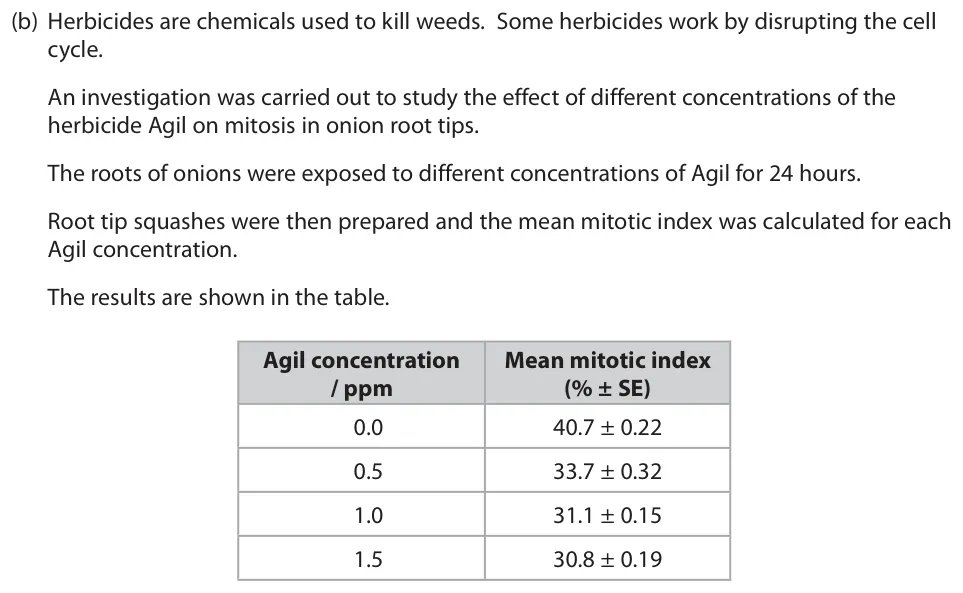
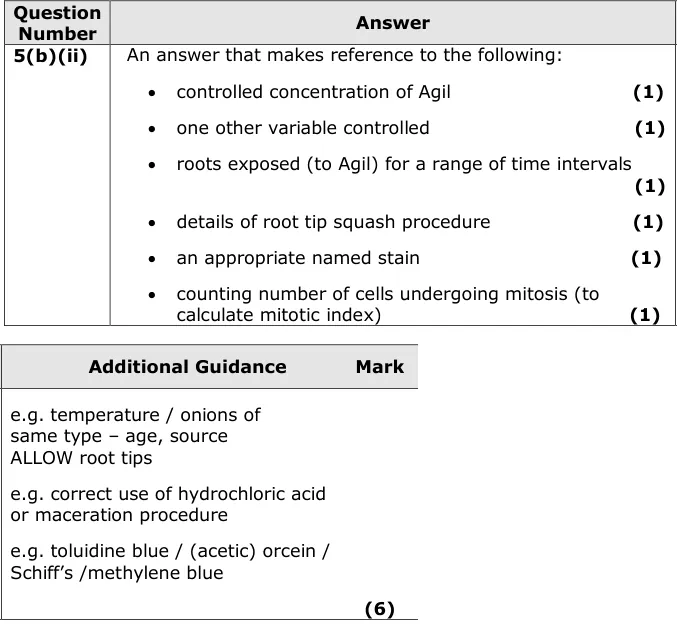
Devise an investigation into the effect of exposure time to Agil on the rate of mitosis in onion root tips.
Information from earlier in this question:

Show the mark scheme
Tap an image to open it full size.
From the examiners' report: Change the exposure time, not the concentration of Agil, which must be controlled. Count the cells undergoing mitosis to calculate the mitotic index: 'observing the mitotic index' or 'looking at the cells' was not credited.
Question 9
AS Paper 2 · June 2019 · Q3(b)(iii) · 5 marks
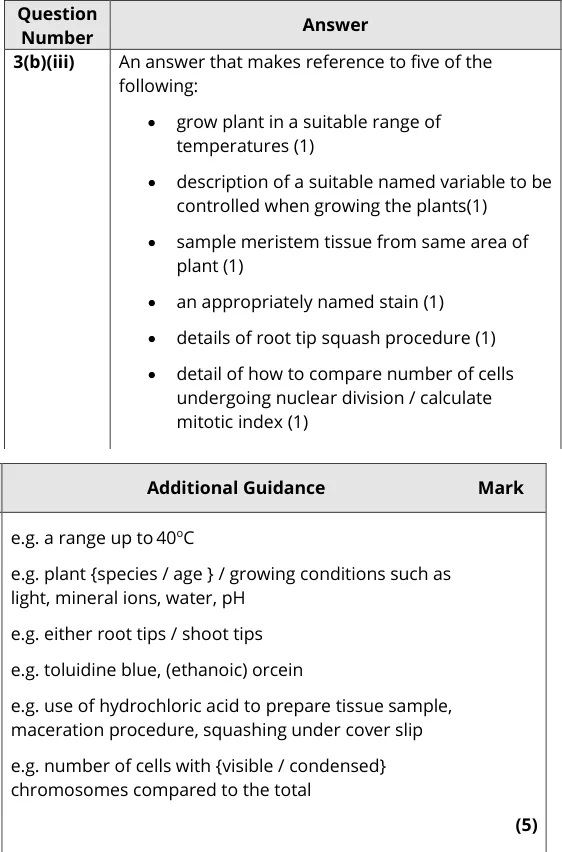
Devise an investigation into the effect of temperature on the rate of nuclear division in a plant meristem.
Show the mark scheme
Tap an image to open it full size.
From the examiners' report: Grow the plants at a range of temperatures: putting samples in water baths at different temperatures gained no credit. You cannot 'grow meristems'; sample meristem tissue, such as root tips, from the same area of each plant.
Question 10
AS Paper 2 · June 2022 · Q4(b)(ii) · 5 marks
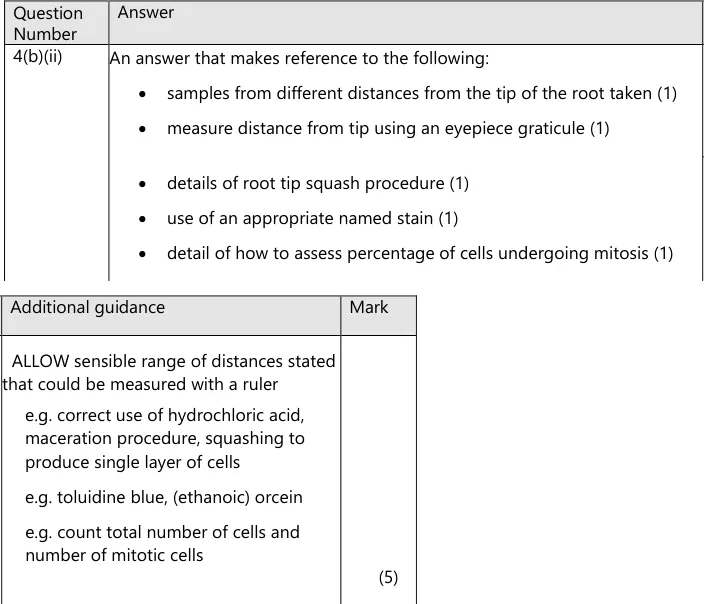
Devise an investigation into how the percentage of cells in nuclear division changes with distance from the root tip.

Show the mark scheme
Tap an image to open it full size.
Question 11
AS Paper 2 · June 2024 · Q7(d) · 5 marks
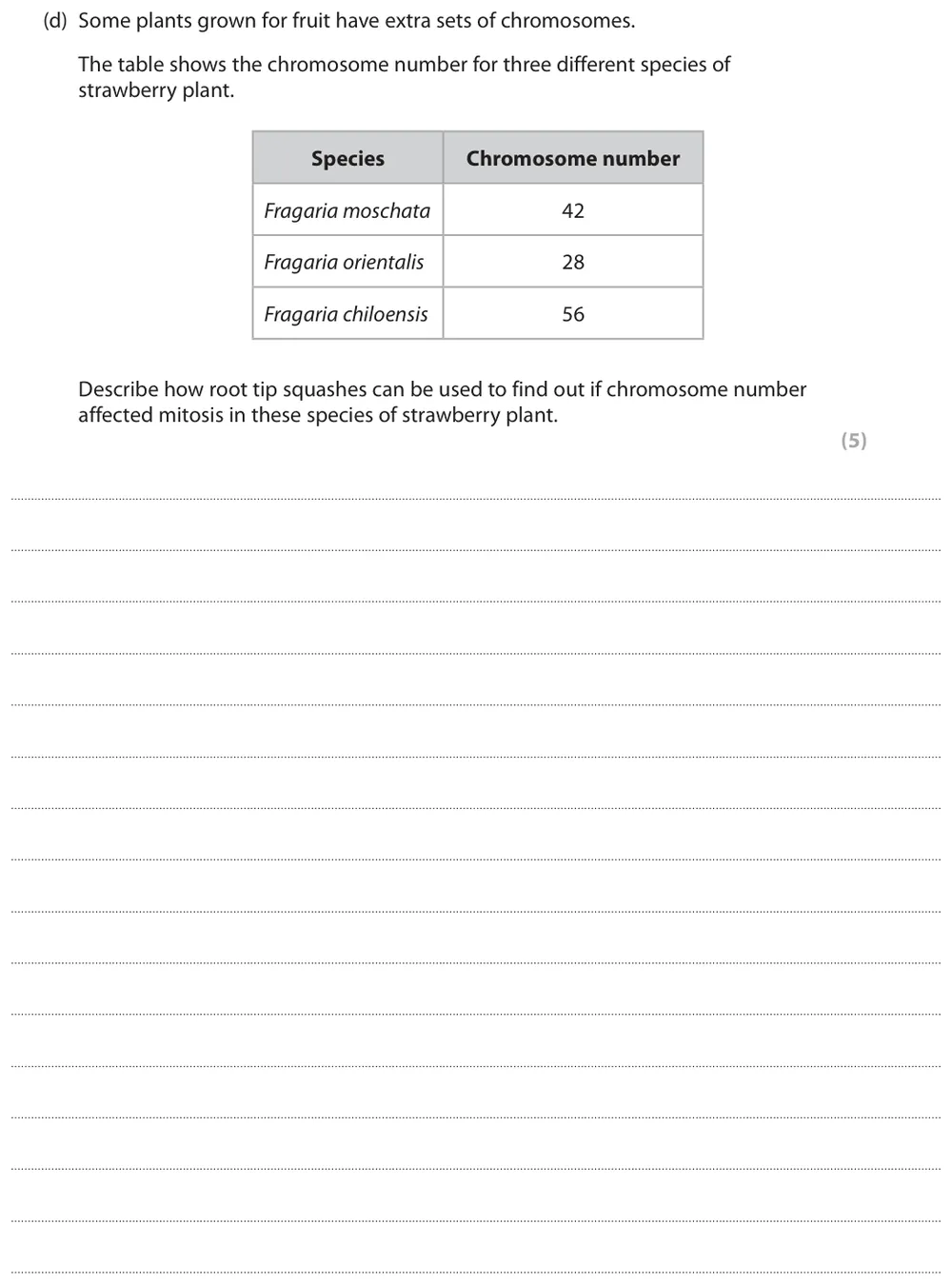
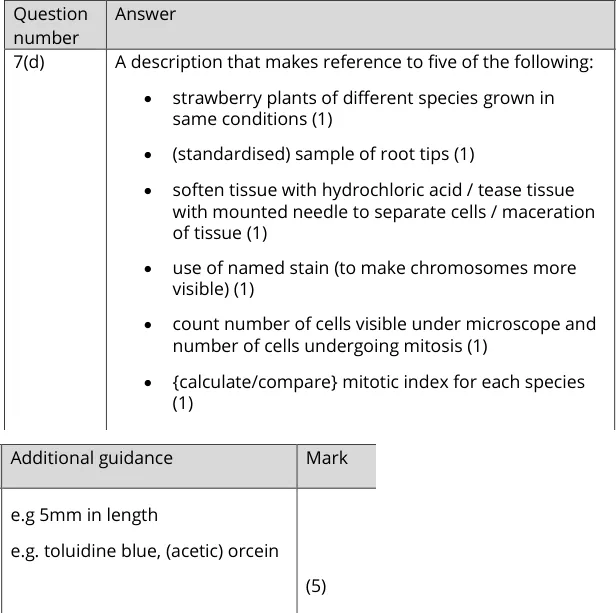
Describe how root tip squashes could show whether chromosome number affects mitosis in three strawberry species.
Show the mark scheme
Tap an image to open it full size.
From the examiners' report: Most used hydrochloric acid, a named stain and maceration. The best answers also grew the species in the same conditions and standardised the root tip sample; count both the cells in mitosis and the total number of cells.
Testing a hypothesis (CP5)
Question 12
A level Paper 3 · June 2018 · Q4(c) · 5 marks
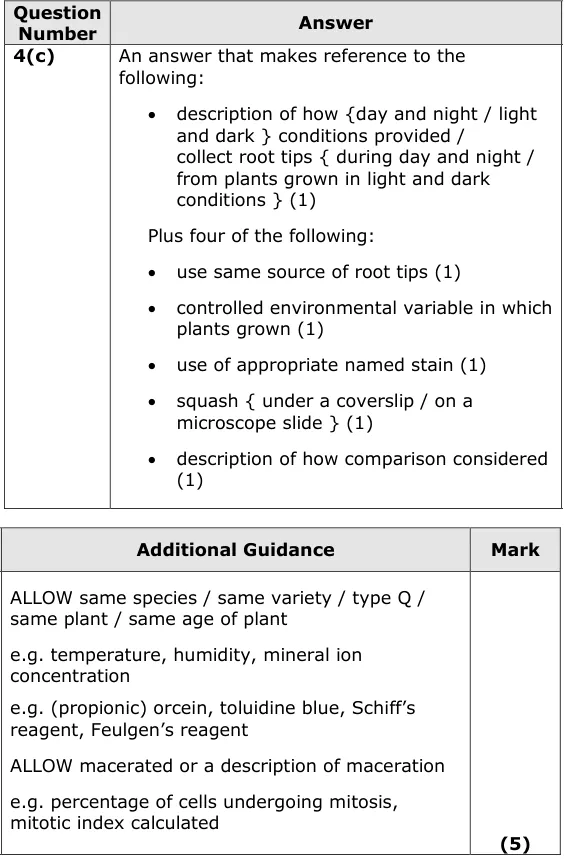
Devise an investigation to test whether the percentage of root tip cells in mitosis differs between day and night.

Show the mark scheme
Tap an image to open it full size.
From the examiners' report: The first marking point was needed for full marks: provide day and night (light and dark) conditions while the plants grow. Doing the squash itself in the dark or the light is not the same, and some answers gave no root tip squash details at all.
Question 13
A level Paper 2 · June 2019 · Q6(a)(ii) · 5 marks
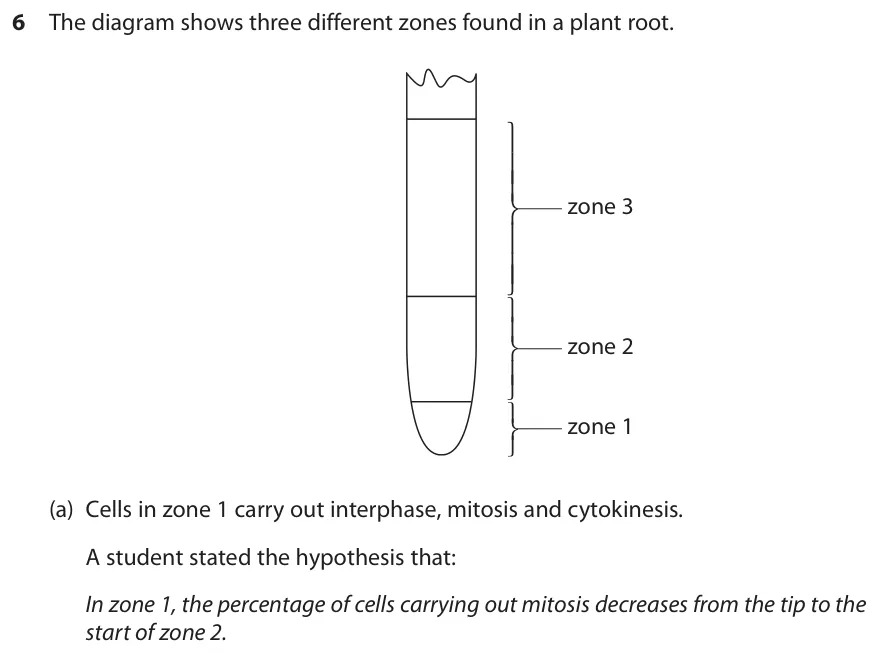
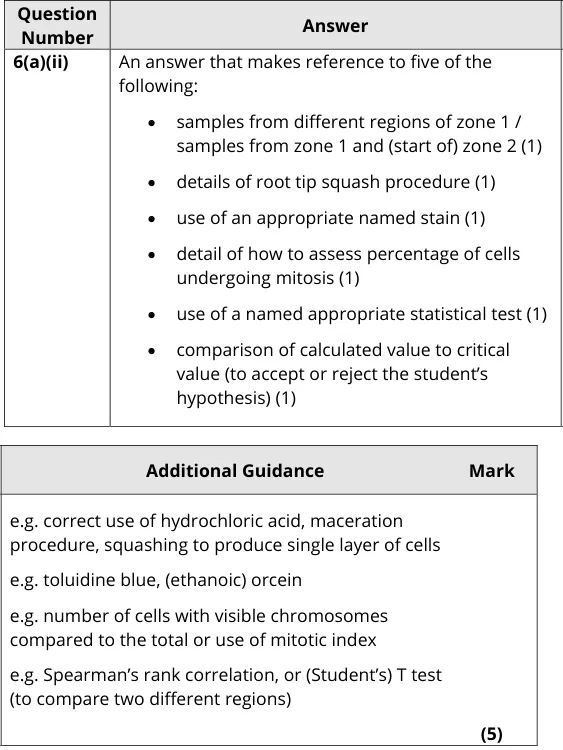
Devise an investigation to test the hypothesis that the percentage of cells in mitosis decreases from the root tip to the start of zone 2.
Information from earlier in this question:
Show the mark scheme
Tap an image to open it full size.
From the examiners' report: Apply the root tip squash to the hypothesis: sample the zones being compared and use a suitable statistical test so the hypothesis can be accepted or rejected. General answers gained no marks.
Where students lose marks (from Pearson examiners' reports and mark schemes)
Each point below comes from the examiners' reports and mark schemes, and is followed by wording that gained marks.
Name a stain for the chromosomes. Some students had difficulty naming a stain.
✔ Gains credit: 'An appropriately named stain, e.g. toluidine blue, (ethanoic) orcein.'
Don't forget the acid and the heat. Heating and the use of hydrochloric acid were often omitted.
✔ Gains credit: 'Tissue treated with hydrochloric acid; tissue heated; stained with toluidine blue / (acetic) orcein; tissue macerated / squashed.'
Multiply by 100 and round with care. Some rounded too far or incorrectly, and some neglected to multiply by 100.
✔ Gains credit: 'Correct number of cells undergoing mitosis and correct total number of cells, 67 and 529; correct answer 12.7(%).'
Vary exposure time, not concentration. Some well-described methods changed the concentration of Agil instead of the exposure time.
✔ Gains credit: 'Controlled concentration of Agil; roots exposed (to Agil) for a range of time intervals.'
Grow the plants at each temperature. Many used water baths at different temperatures instead of growing the plants at a range of temperatures.
✔ Gains credit: 'Grow plant in a suitable range of temperatures, e.g. a range up to 40°C.'
Count all the cells as well. Some did not say that both the number of cells in mitosis and the total number of cells must be counted.
✔ Gains credit: 'Count number of cells visible under microscope and number of cells undergoing mitosis; calculate / compare mitotic index for each species.'
Day and night apply while the plants grow. Some removed root tips and then did the squash in the dark or in the light.
✔ Gains credit: 'Collect root tips during day and night / from plants grown in light and dark conditions.'
A hypothesis needs a named statistical test. A suitable statistical test was expected so the hypothesis could be accepted or rejected; general answers gained no marks.
✔ Gains credit: 'Use of a named appropriate statistical test, e.g. Spearman's rank correlation or (Student's) t-test; comparison of calculated value to critical value.'
Download the questions
Download the PDF pack (13 questions, mark schemes at the end)
Keep practising
- Meiosis, Mitosis and Stem Cells (Topic 3): Edexcel SNAB exam questions by topic
- Edexcel SNAB A level Biology revision resources by topic (every topic and core practical page)
- Edexcel SNAB Topic 3 Multiple-Choice Quiz: Voice of the Genome
- Edexcel SNAB A level Biology past papers, mark schemes and examiners' reports
- Edexcel SNAB A level Biology grade boundaries
- Message Tom on WhatsApp about one-to-one Edexcel SNAB tutoring or an Edexcel group class
Questions, mark schemes and examiners' report extracts © Pearson Education Ltd.