

Extended response questions are the asterisked 6- and 9-mark questions on Edexcel SNAB papers. They are not marked point by point. The mark scheme lists indicative content, which is not prescriptive, and places each answer in a level; to reach the top level an answer must show 'a well-developed and sustained line of scientific reasoning which is clear and logically structured'. Most give you data or information to analyse, and several ask you to devise an investigation. This page has twelve of them from Topic 3 (Voice of the Genome) and Topic 4 (Biodiversity and Natural Resources), including a 9-mark question from Paper 3. Questions marked AS are from the AS papers (8BN0); the rest are from the A level papers (9BN0).
The examiners' reports keep returning to the data. Answers that used only a map, or ignored a table printed earlier in the question, were capped, so use every piece of information. In investigations, give a measurable dependent variable and the actual values you would test, and say how the results answer the question. Add your own knowledge, such as natural selection, what defines a species or the roles of an ion, rather than only describing the data. Finish evaluate, assess and discuss questions with a balanced conclusion.
Studying Edexcel SNAB and want more help? If you'd like to arrange one-to-one Edexcel tutoring, or to register your interest in an Edexcel group class, message Tom on WhatsApp using the link at the bottom of this page.
What you need first
Each question on this page assumes you're secure on these ideas. If any of them feels shaky, look it up before you start.
- Natural selection: a selection pressure changes allele frequencies in a population over time, and isolation can lead to new species.
- A species is a group of organisms that can interbreed to produce fertile offspring.
- The difference between totipotent and pluripotent stem cells, and the ethical issues around embryonic stem cells.
- Core practical techniques: growing plants in mineral solutions and testing for antimicrobial activity on agar plates.
Key terms
These words come up in the questions and mark schemes. Examiners expect you to use them exactly.
- Indicative content: the points listed in a levels-based mark scheme; it is not prescriptive and you are not expected to include all of it.
- Level: a band of marks (1–2, 3–4, 5–6, or 1–3, 4–6, 7–9) awarded for the overall quality and linkage of the answer.
- Selection pressure: an environmental factor, such as malaria, that affects which individuals survive and reproduce.
- Allele frequency: how common an allele is in the gene pool of a population.
- Pluripotent: able to give rise to many, but not all, cell types; embryonic stem cells are totipotent.
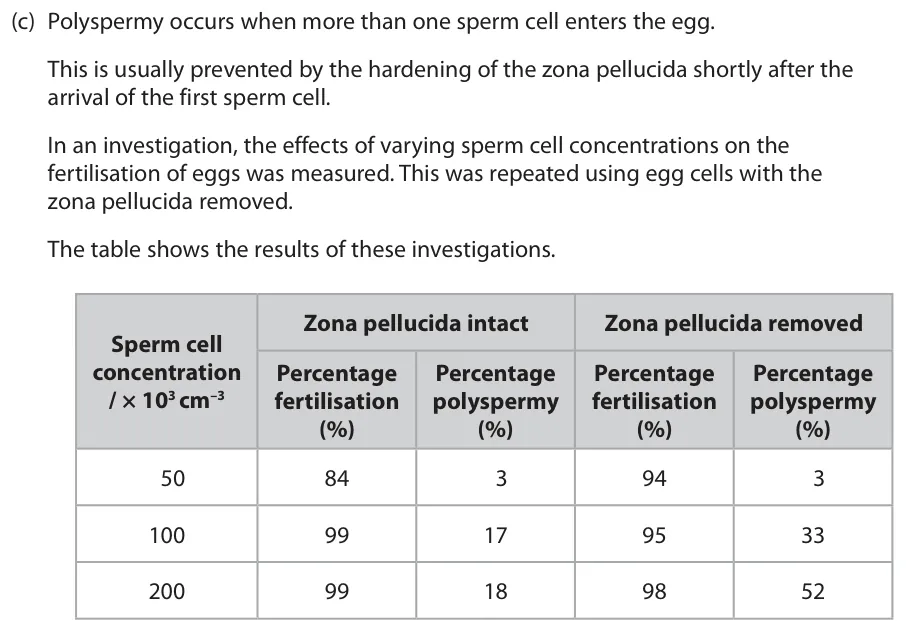
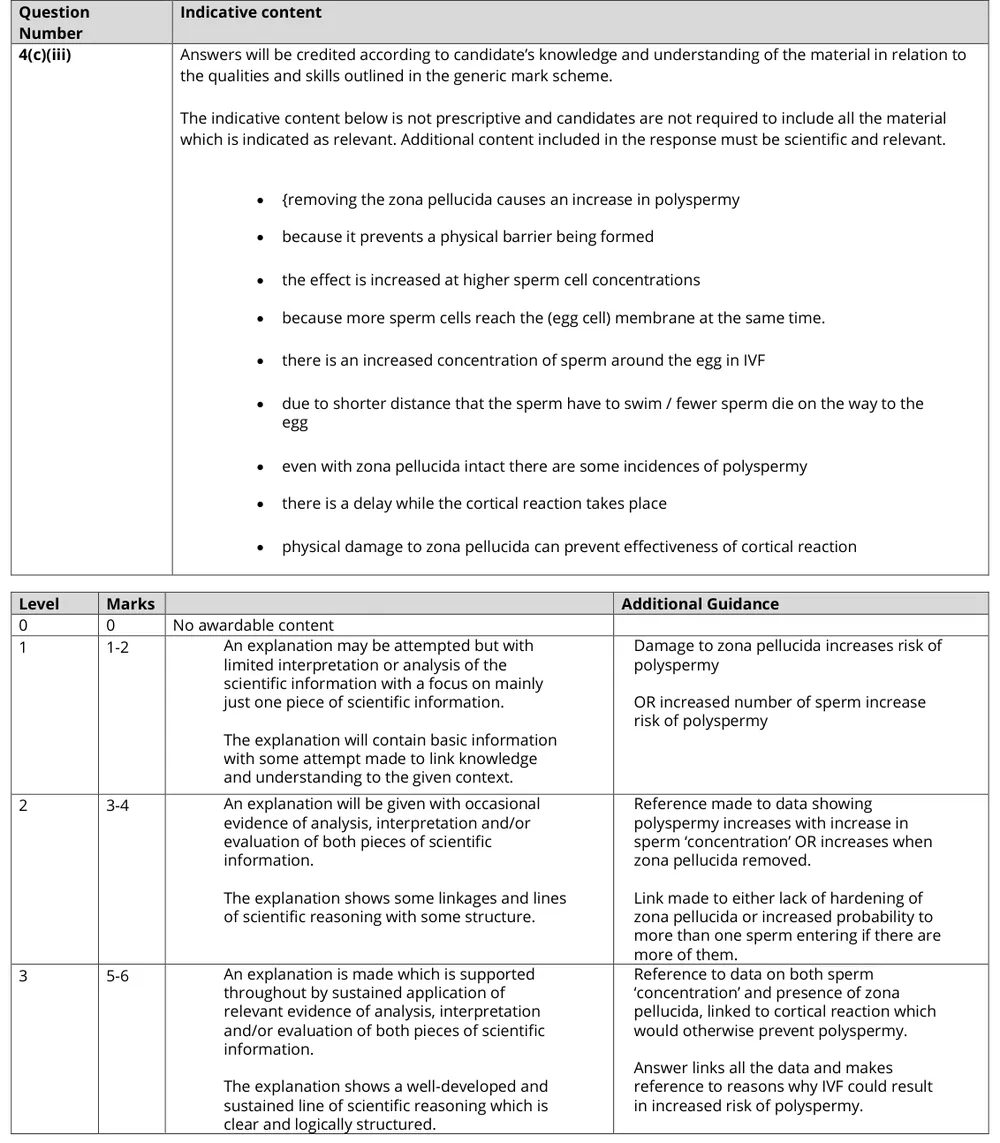
- Polyspermy: fertilisation of an egg cell by more than one sperm; normally prevented by the cortical reaction.
- DNA methylation: the addition of methyl groups to DNA, which affects transcription of a gene.
- Niche: the role of a species in its habitat; more habitats and niches support more species.
What these questions cover
The questions test these statements of the Pearson Edexcel A level Biology A (Salters-Nuffield) specification (9BN0).
- 3.6 Understand how mammalian gametes are specialised for their functions (including the acrosome in sperm and the zona pellucida in the egg).
- 3.7 Know the process of fertilisation in mammals, including the acrosome reaction, the cortical reaction and the fusion of nuclei.
- 3.10 Understand the role of mitosis and the cell cycle in producing identical daughter cells for growth and asexual reproduction.
- 3.11ii Be able to discuss the way society uses scientific knowledge to make decisions about the use of stem cells in medical therapies.
- 3.14i Understand how phenotype is the result of an interaction between genotype and the environment.
- 3.14ii Know how epigenetic changes, including DNA methylation and histone modification, can modify the activation of certain genes.
- 4.2ii Know how biodiversity can be measured within a habitat using species richness and within a species using genetic diversity by calculating the heterozygosity index (H)
- 4.4 Understand how natural selection can lead to adaptation and evolution.
- 4.6i Understand that classification is a means of organising the variety of life based on relationships between organisms using differences and similarities in phenotypes and
- 4.12 Understand the importance of water and inorganic ions (nitrate, calcium ions and magnesium ions) to plants.
- 4.16 Be able to evaluate the methods used by zoos and seed banks in the conservation of endangered species and their genetic diversity, including scientific research, captive
How to use this page
Write your answer on paper before you open the mark scheme. Allow about 1.2 minutes per mark: the 12 questions are worth 75 marks, so about 90 minutes in total. Then mark your answer strictly against the mark scheme and read the examiners' tip underneath it. If you'd rather print the questions, download the PDF pack.
Topic 3: Voice of the Genome
Question 1
AS Paper 2 · June 2019 · Q6(c) · 6 marks · Hard
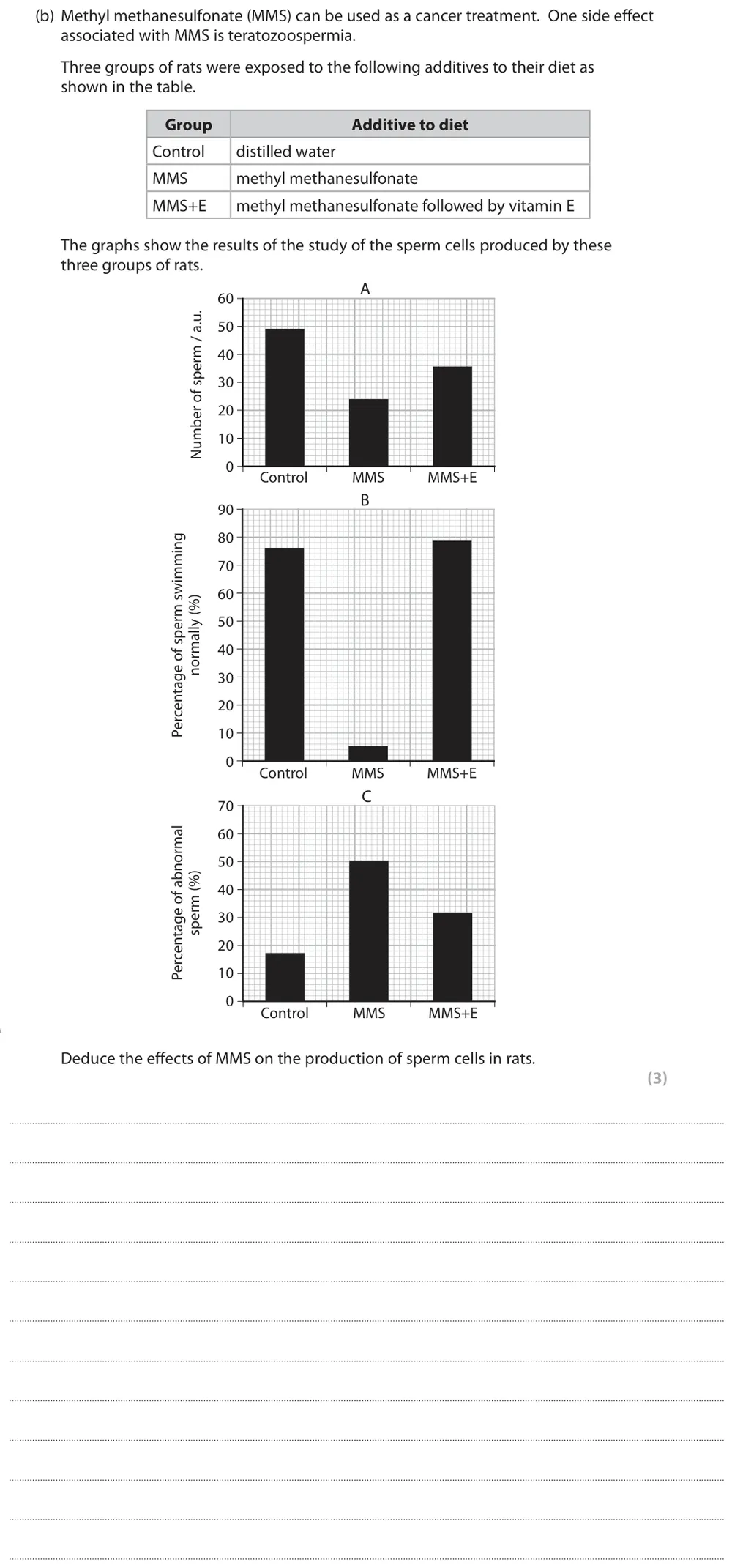
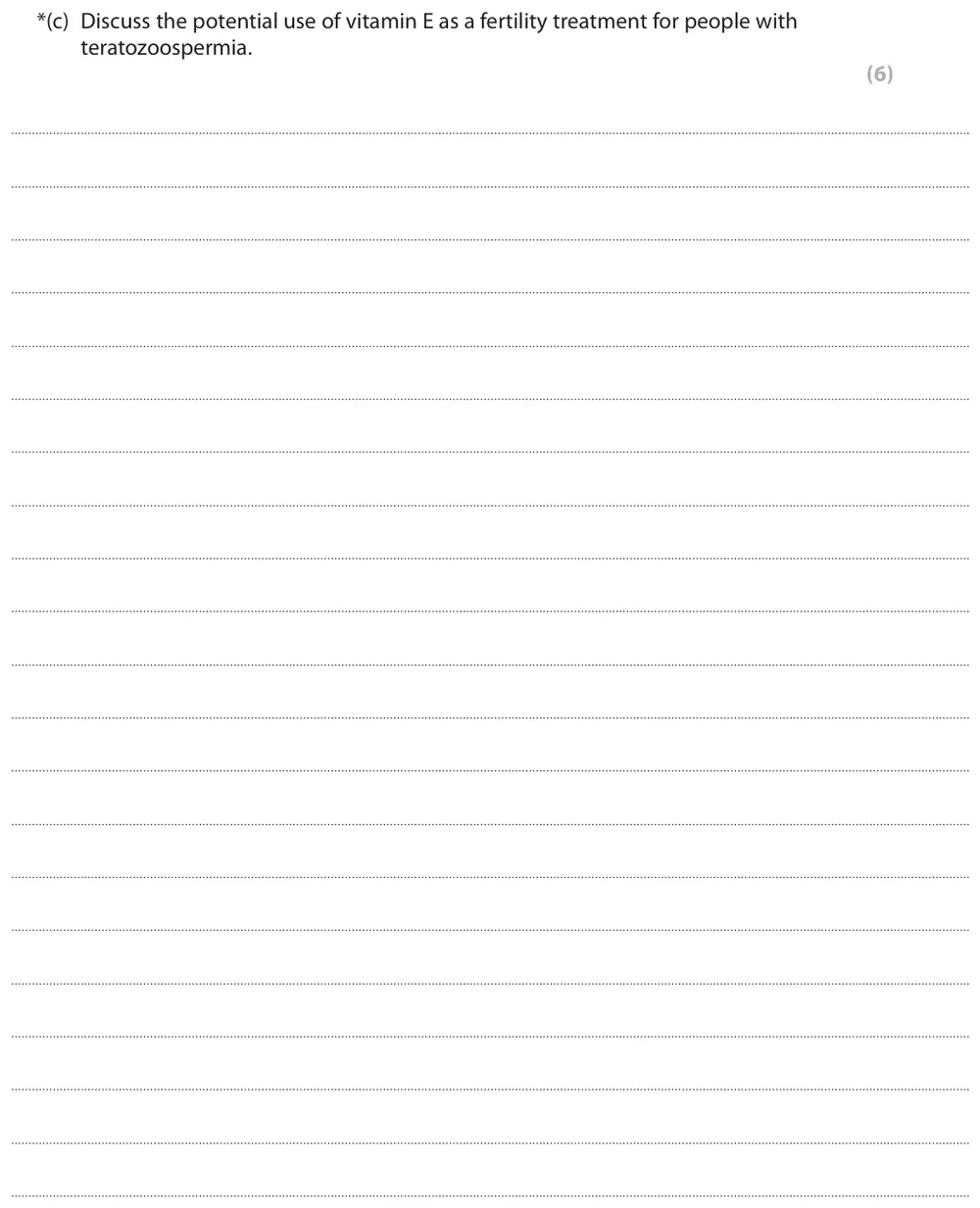
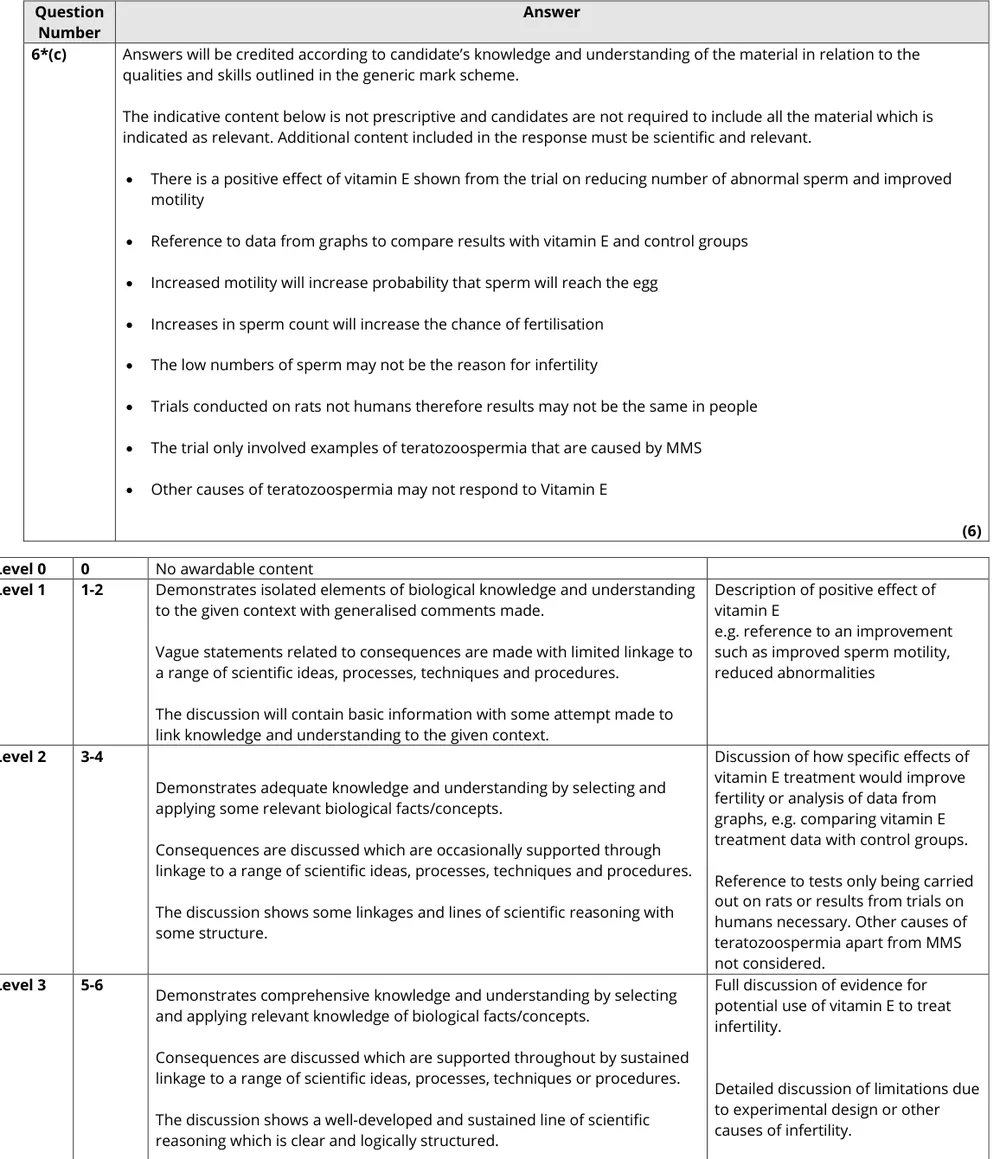
Use data from a trial on rats to discuss the potential use of vitamin E as a fertility treatment for people with teratozoospermia.
Information from earlier in this question:
Show the mark scheme
Tap an image to open it full size.
From the examiners' report: Few candidates went much beyond the detail from the graphs. Better answers linked the potential shown in the graphs to the limitations of the trial. A full account of the stages of drug trials, although detailed, did little to show linkage to other scientific ideas.
Question 2
AS Paper 2 · June 2023 · Q8(b)(ii) · 6 marks
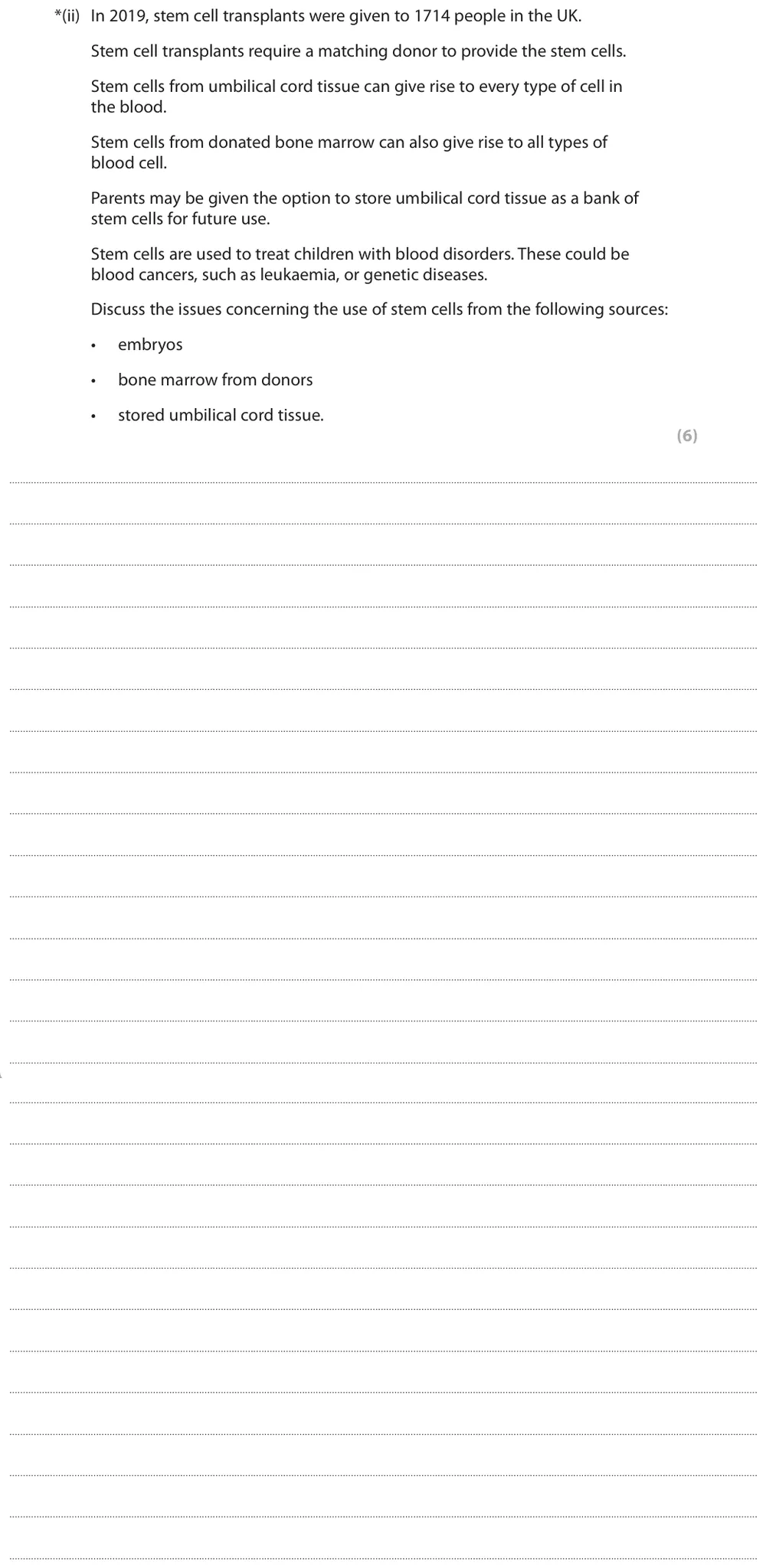
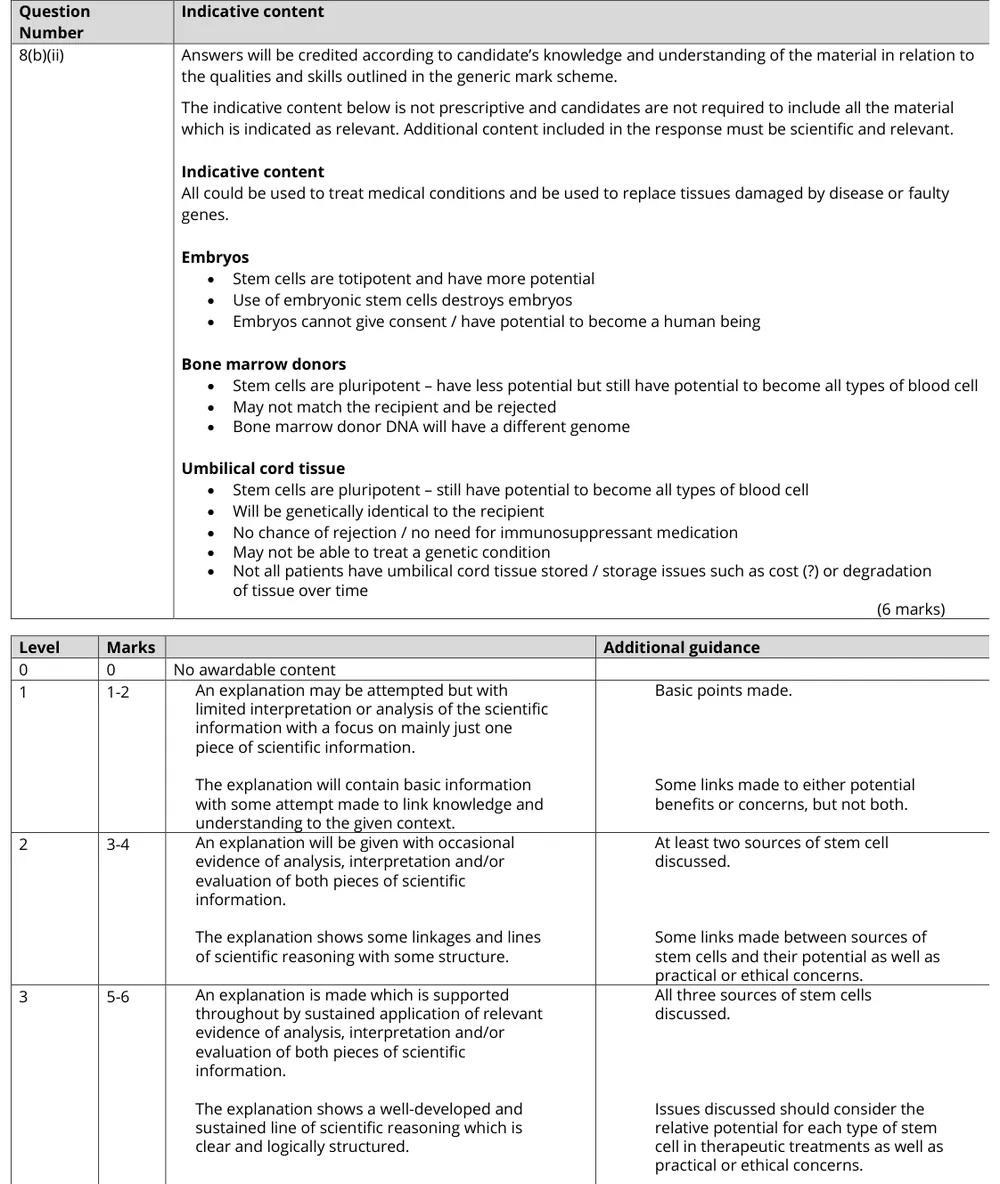
Discuss the issues concerning the use of stem cells from embryos, donated bone marrow and stored umbilical cord tissue.
Show the mark scheme
Tap an image to open it full size.
From the examiners' report: Many answered from their own knowledge alone without using the information given, and concentrated on the negatives. Some thought umbilical cord tissue is taken during pregnancy, killing the fetus. The full-mark answer discussed positive and negative points for each of the three sources.
Question 3
AS Paper 2 · October 2020 · Q4(c)(iii) · 6 marks
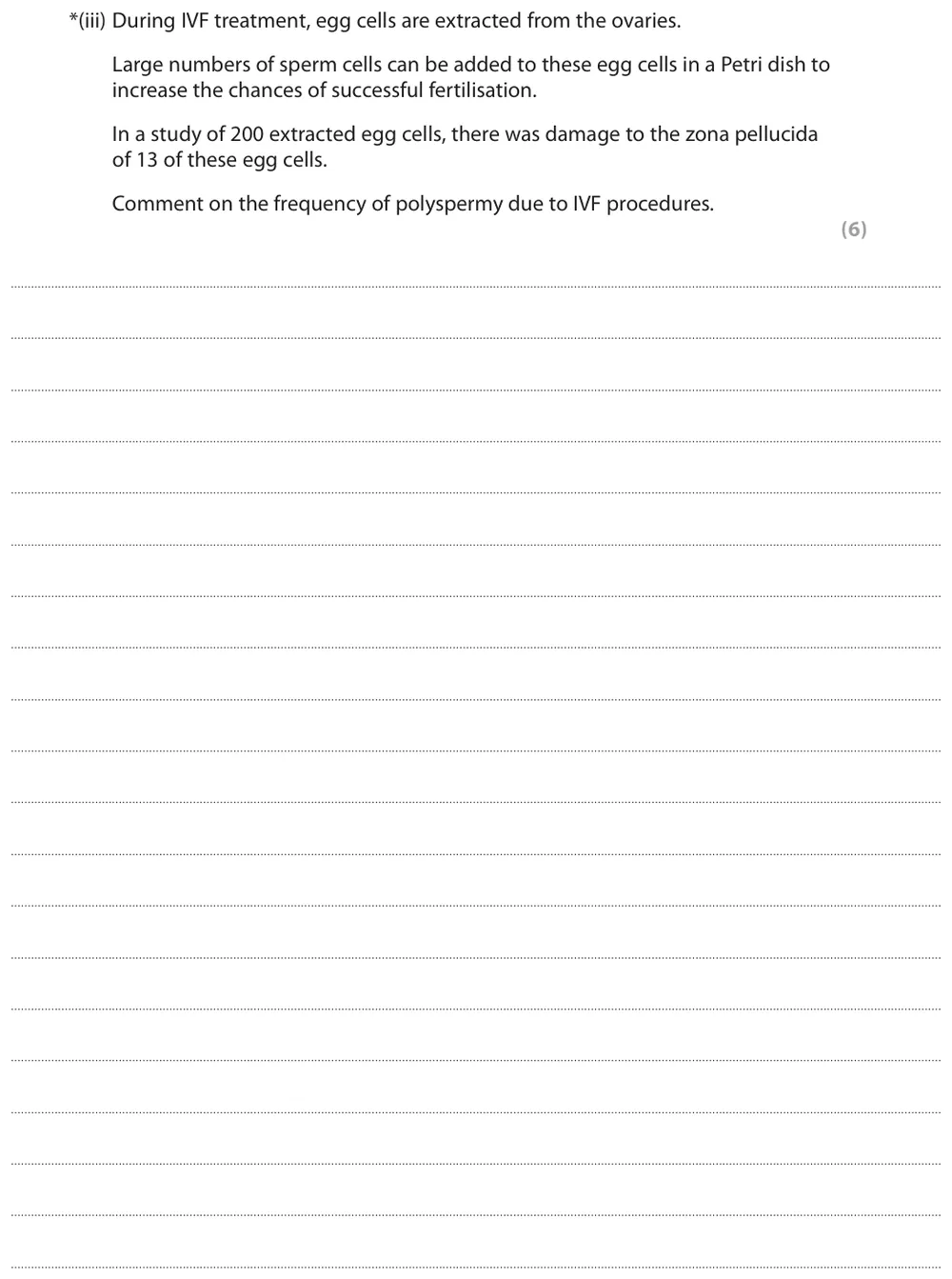
Use data on sperm concentration and the zona pellucida to comment on the frequency of polyspermy due to IVF procedures.
Information from earlier in this question:
Show the mark scheme
Tap an image to open it full size.
Question 4
A level Paper 2 · June 2019 · Q8(c)(ii) · 6 marks
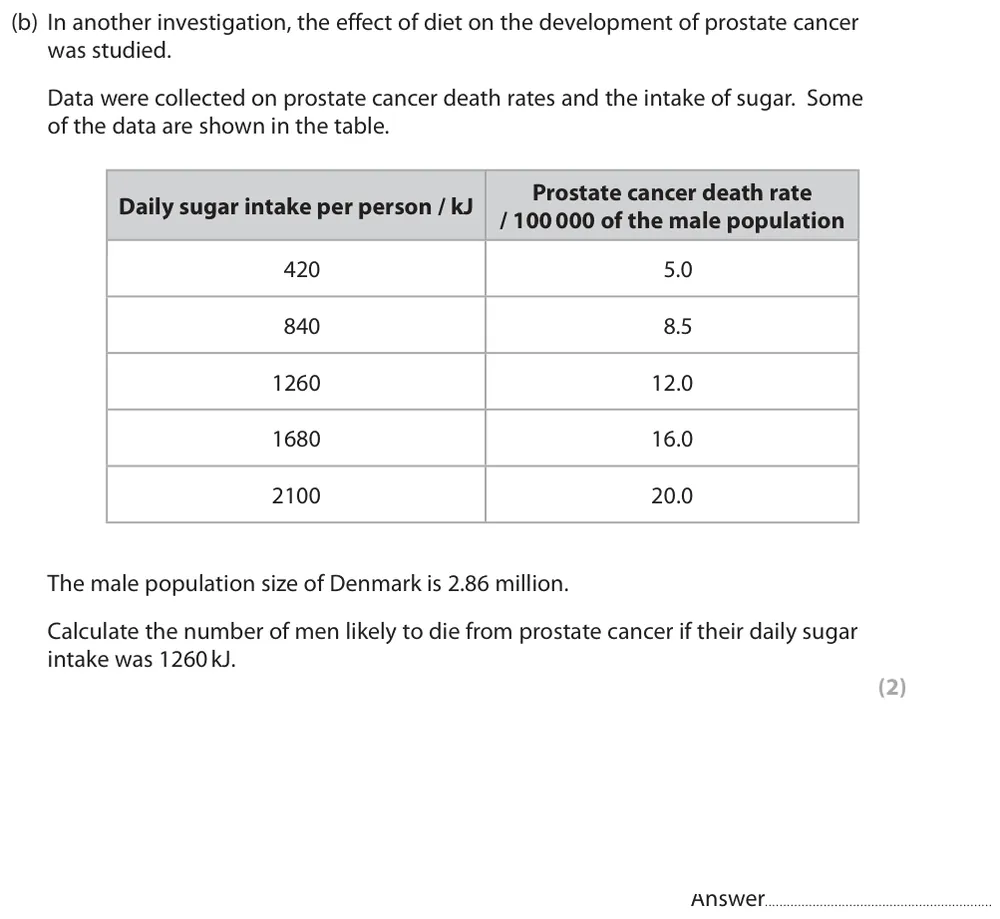
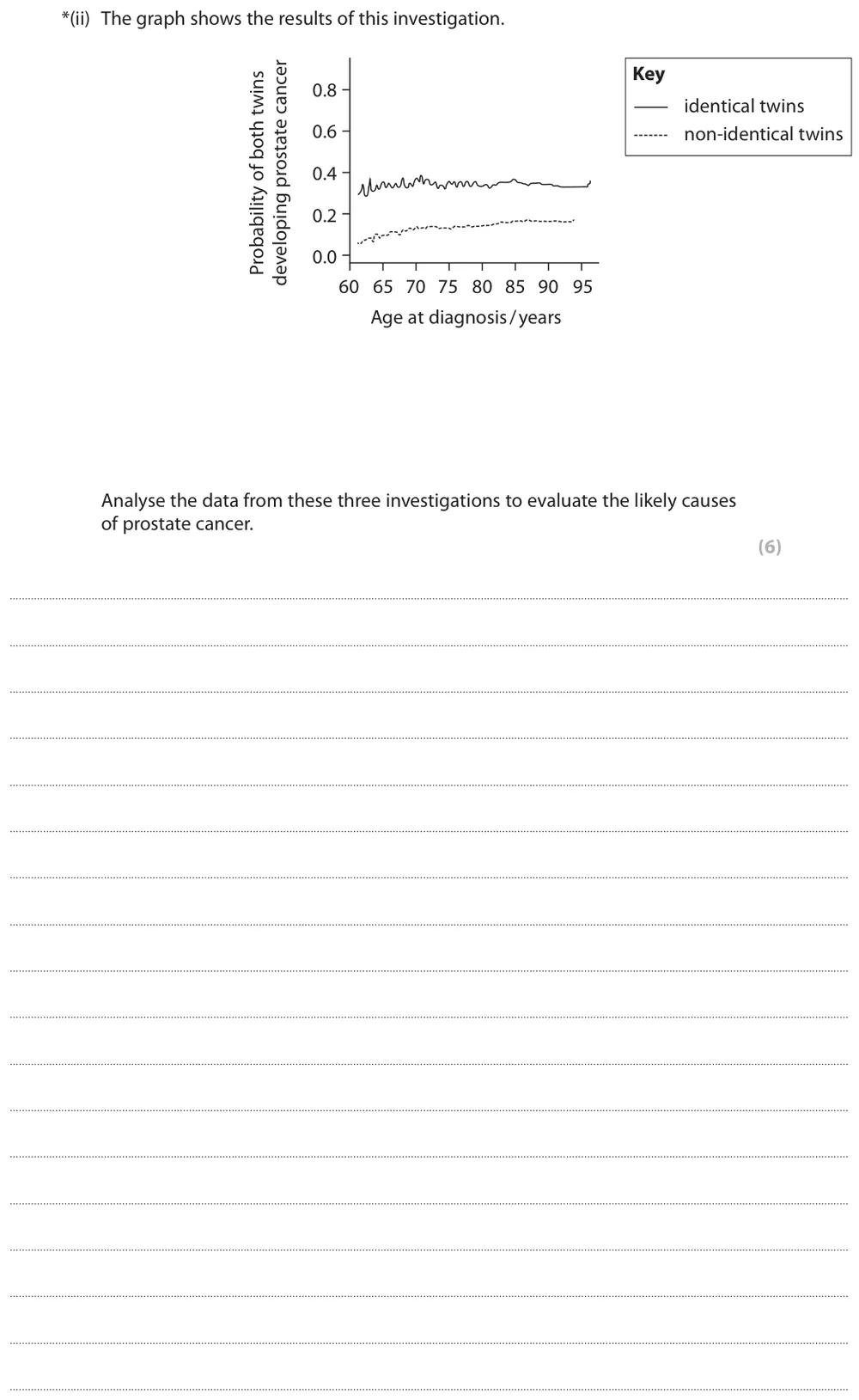
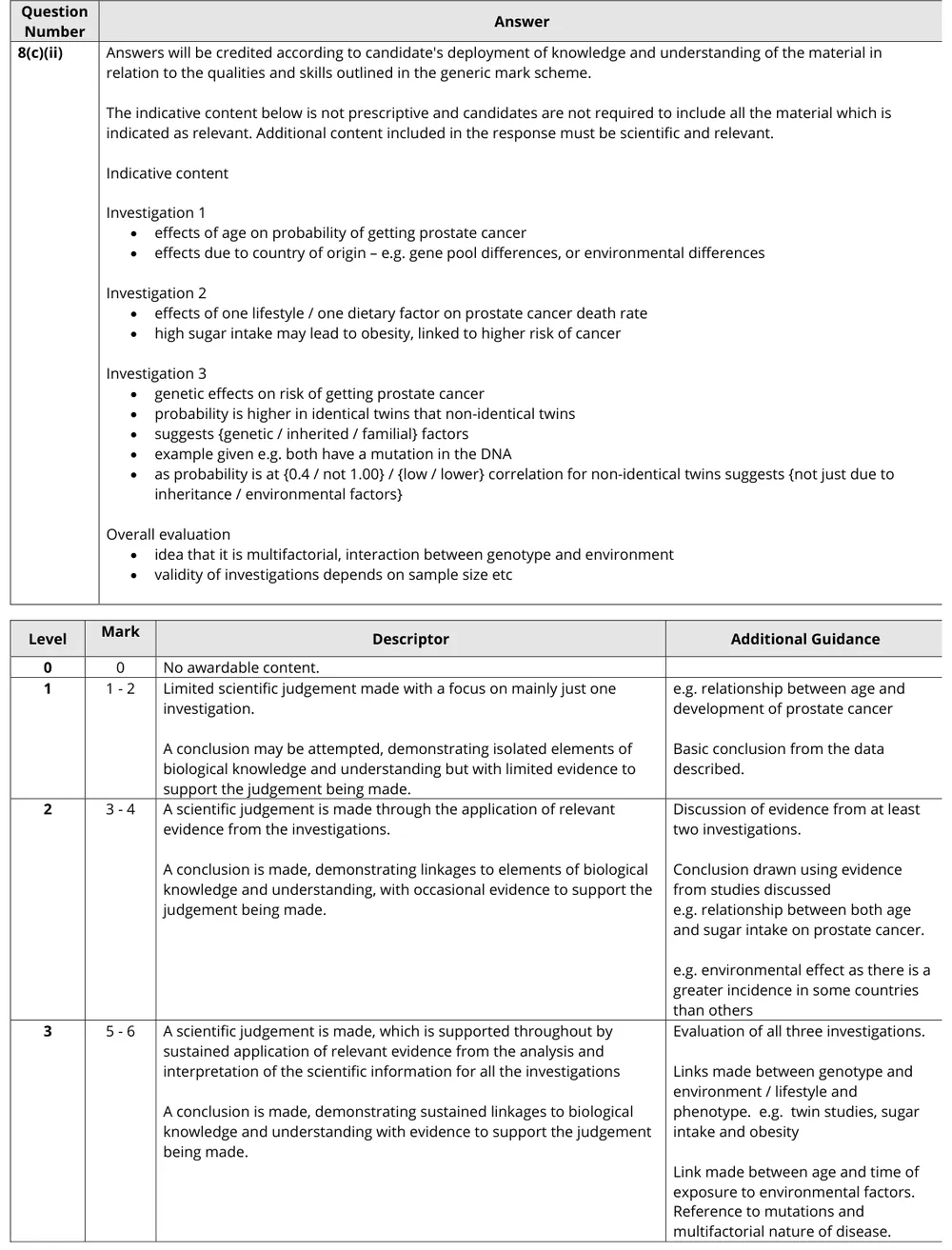
Analyse the data from three investigations to evaluate the likely causes of prostate cancer.
Information from earlier in this question:


Show the mark scheme
Tap an image to open it full size.
From the examiners' report: Describing the investigations with only basic conclusions was given three marks. A five-mark answer considered all three investigations and concluded that mutations accumulate over time and that prostate cancer is likely to be multifactorial.
Question 5
A level Paper 2 · October 2020 · Q10(b)(iii) · 6 marks
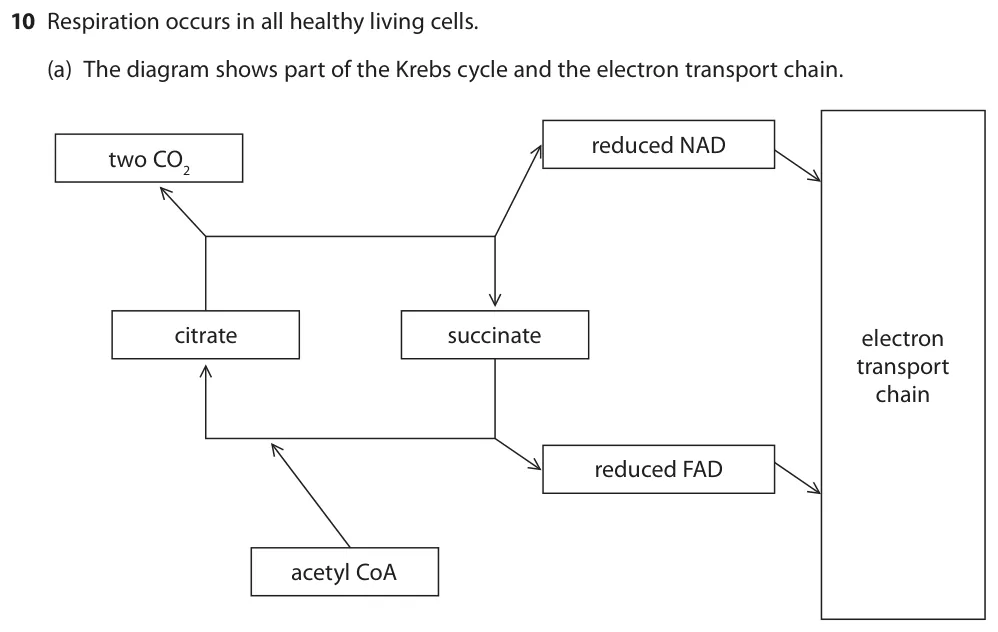
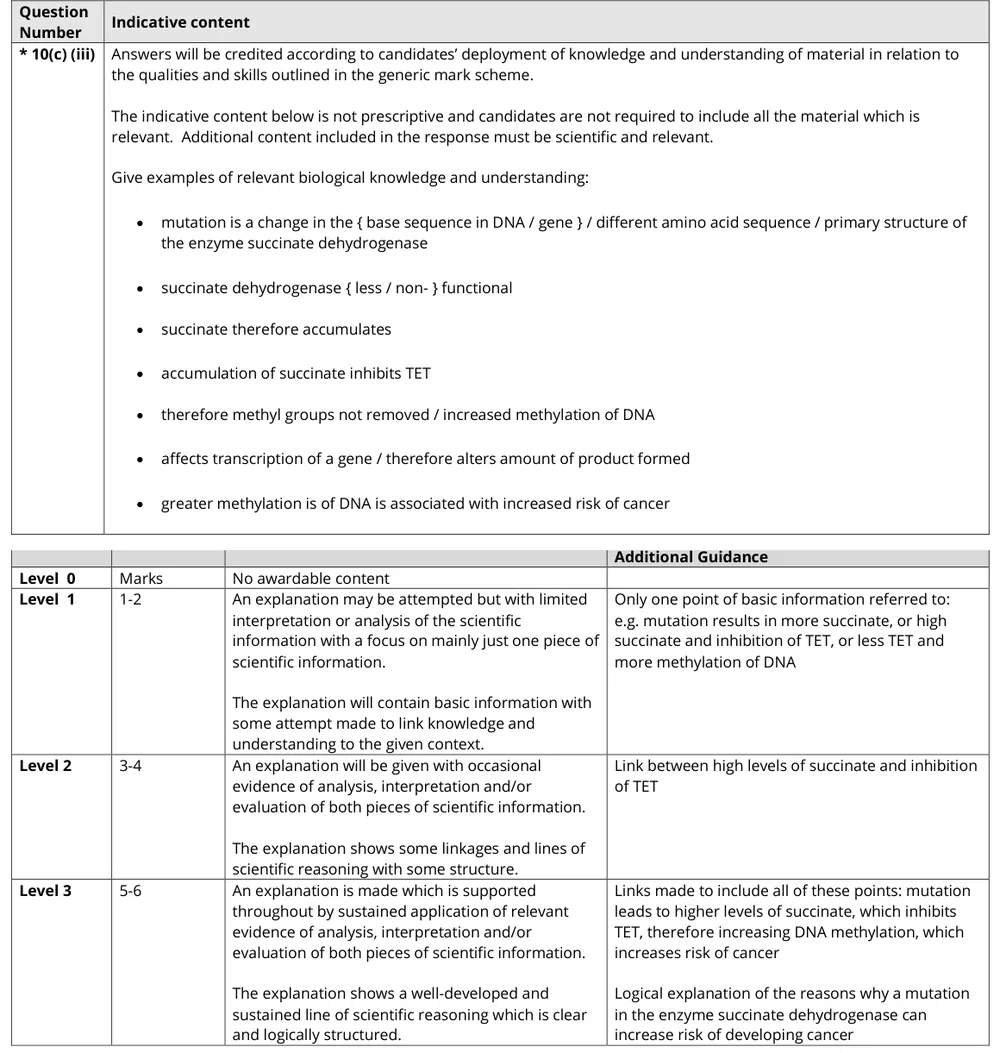
Explain how a mutation in the gene for succinate dehydrogenase can increase the risk of developing cancer.
Information from earlier in this question:
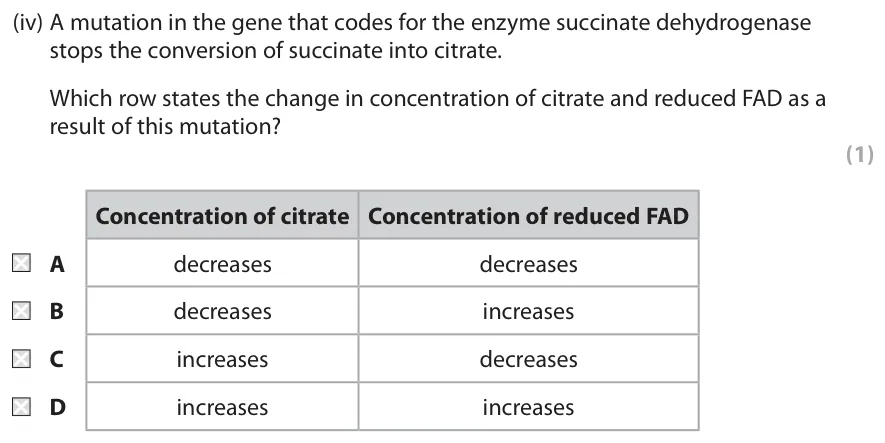
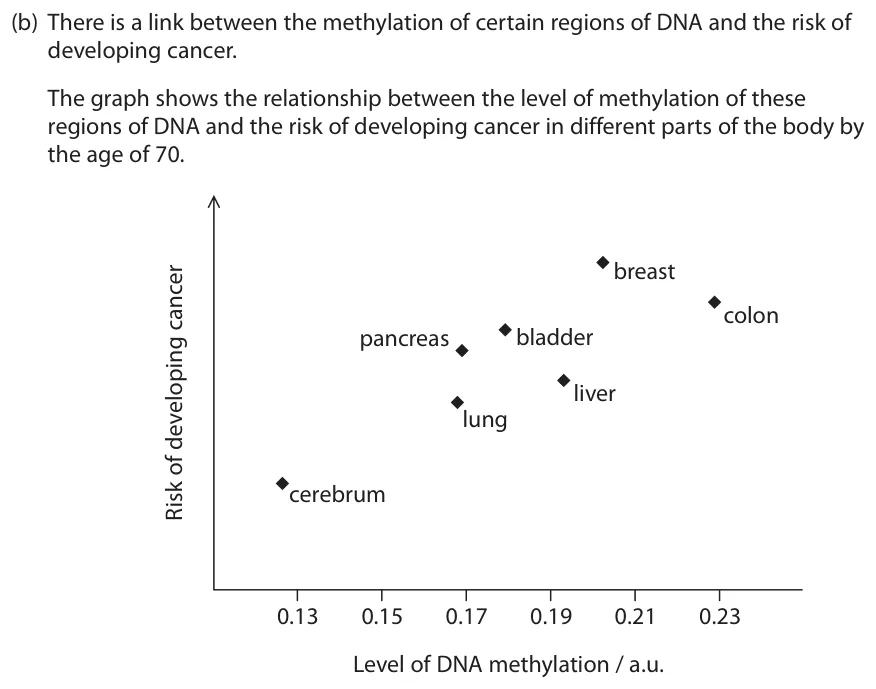
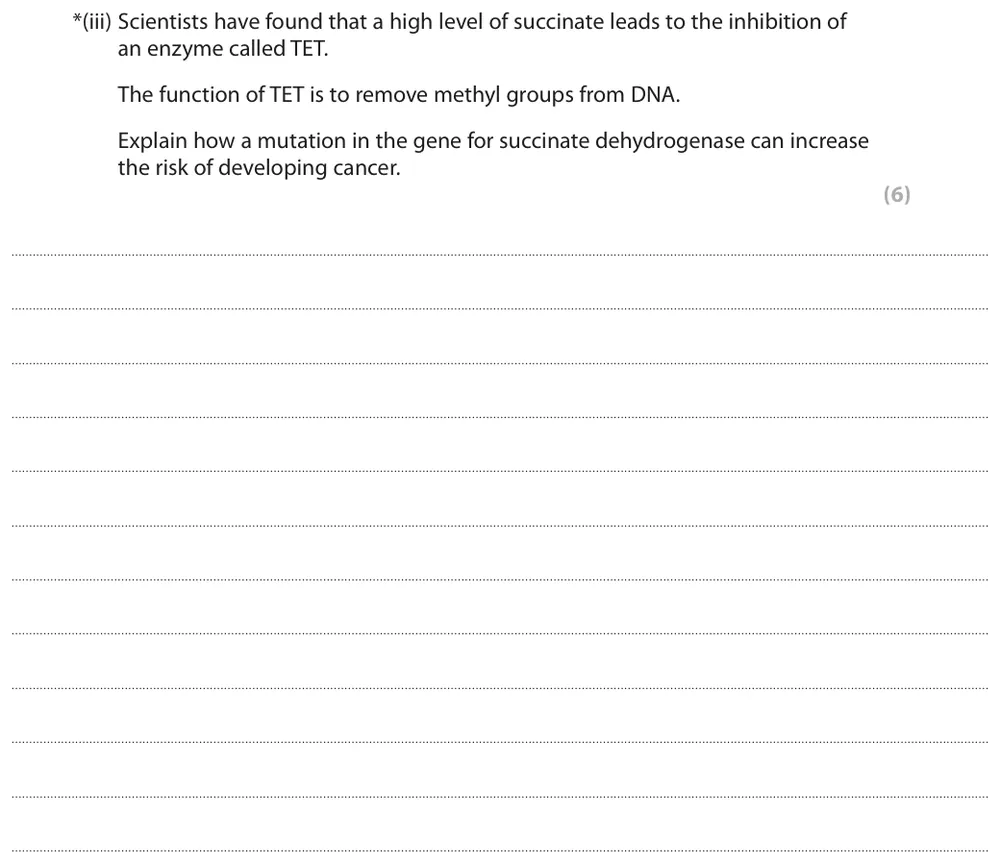
Show the mark scheme
Tap an image to open it full size.
From the examiners' report: Take all the data into account and give a logical sequence of events linking the mutation to cancer risk. An answer that did not really tackle the question scored nothing; a targeted explanation gained full marks.
Question 6
A level Paper 3 · November 2021 · Q7 · 9 marks
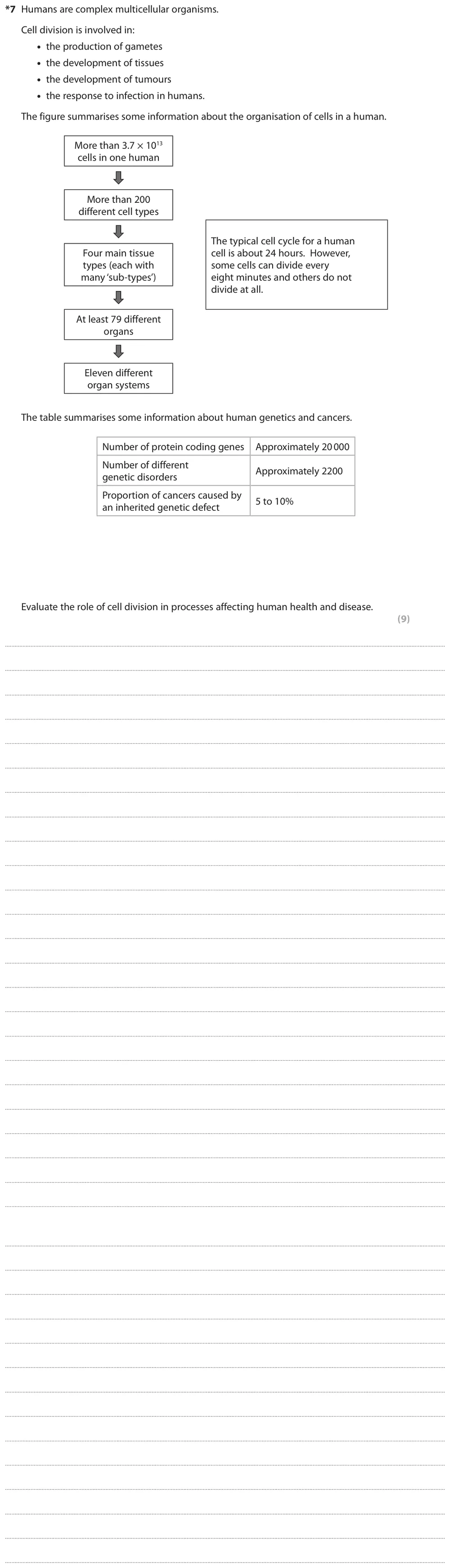
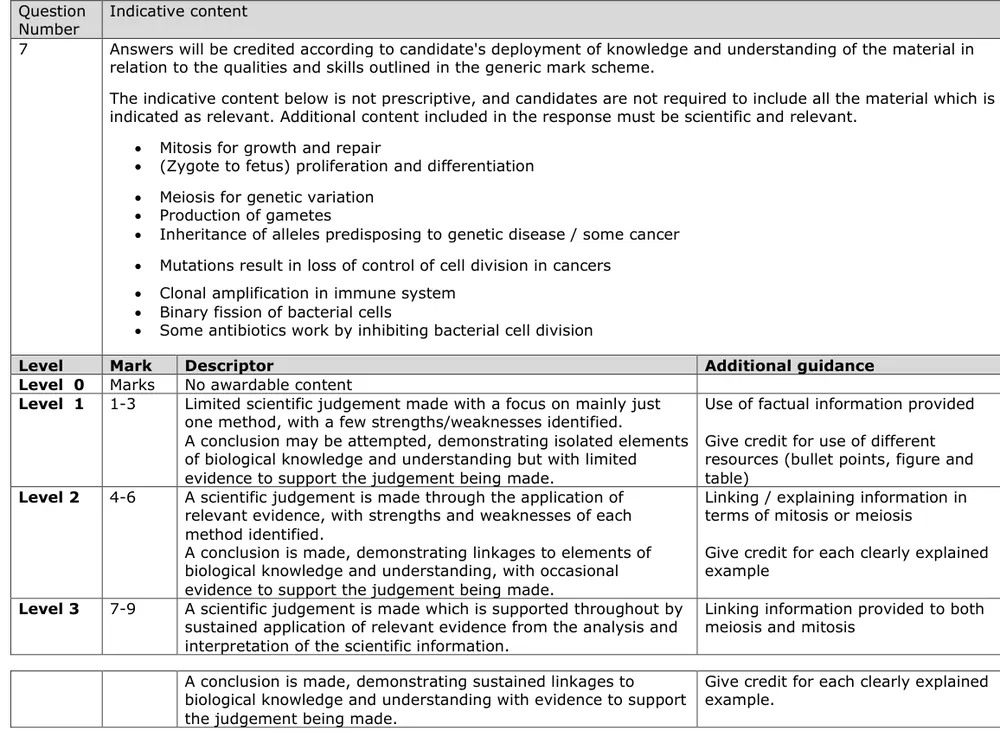
Use the information given to evaluate the role of cell division in processes affecting human health and disease.
Show the mark scheme
Tap an image to open it full size.
Topic 4: Biodiversity and Natural Resources
Question 7
AS Paper 2 · June 2016 · Q3(c) · 6 marks
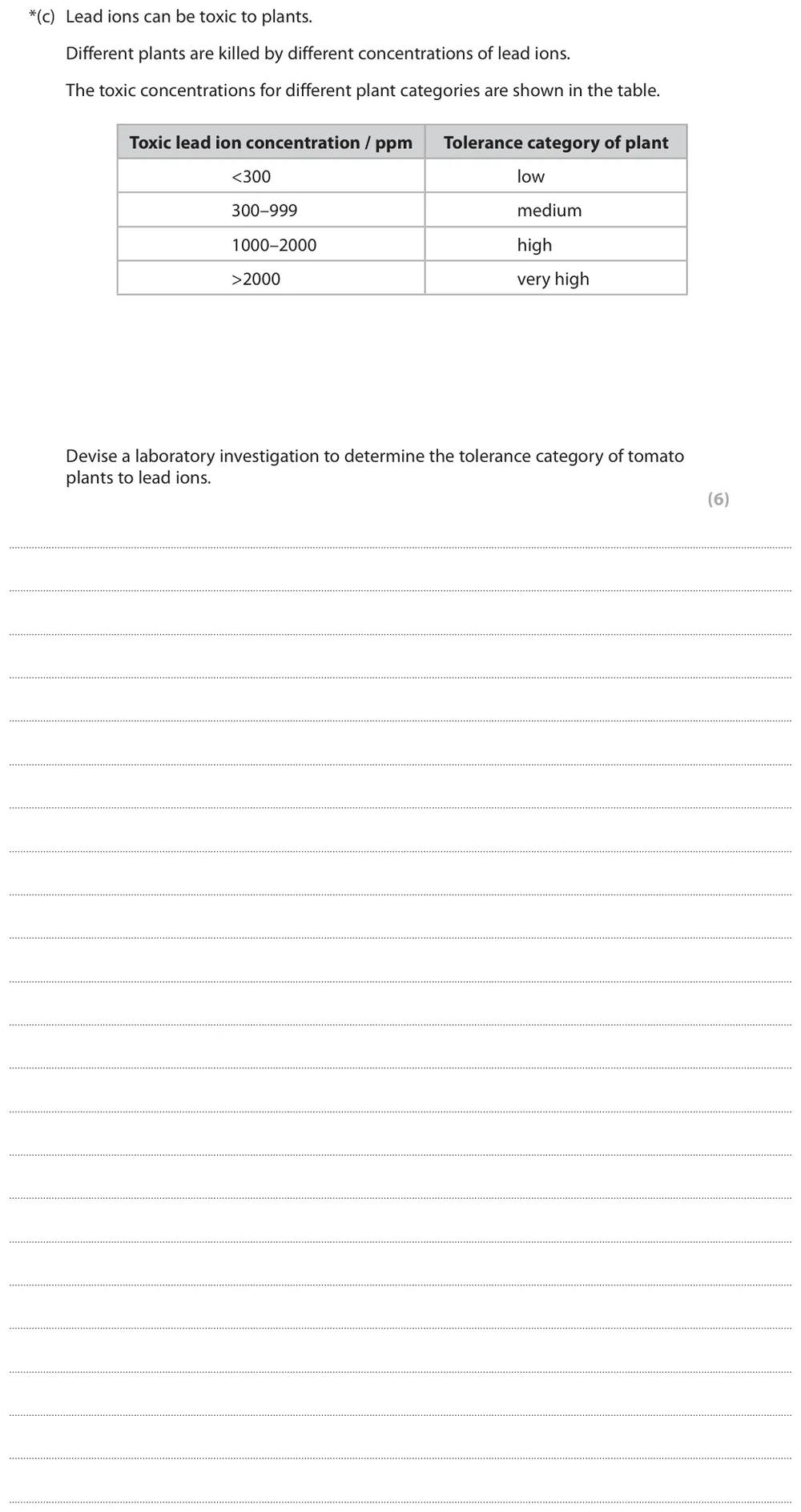
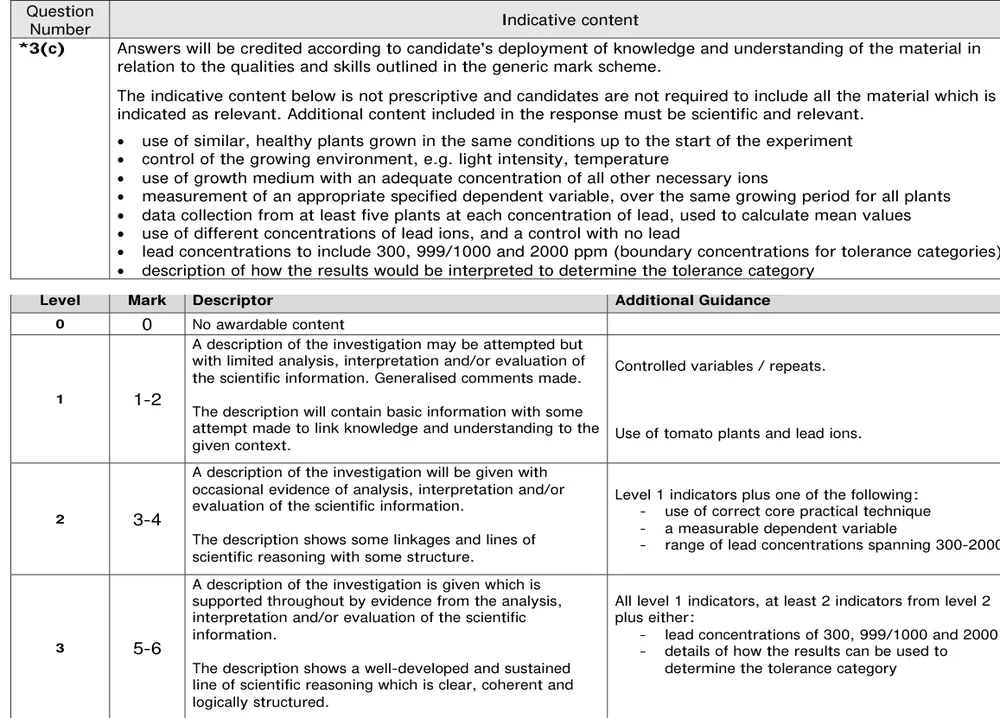
Devise a laboratory investigation to determine the tolerance category of tomato plants to lead ions.
Show the mark scheme
Tap an image to open it full size.
From the examiners' report: Most controlled variables and used repeats, reaching level 2, but many gave no specific, measurable dependent variable (length or mass were accepted). Ranges such as '300–999' do not say which concentration to use. Few saw that the boundary concentrations must be tested, or explained how the results would give the tolerance category.
Question 8
AS Paper 2 · June 2017 · Q4(b)(iii) · 6 marks
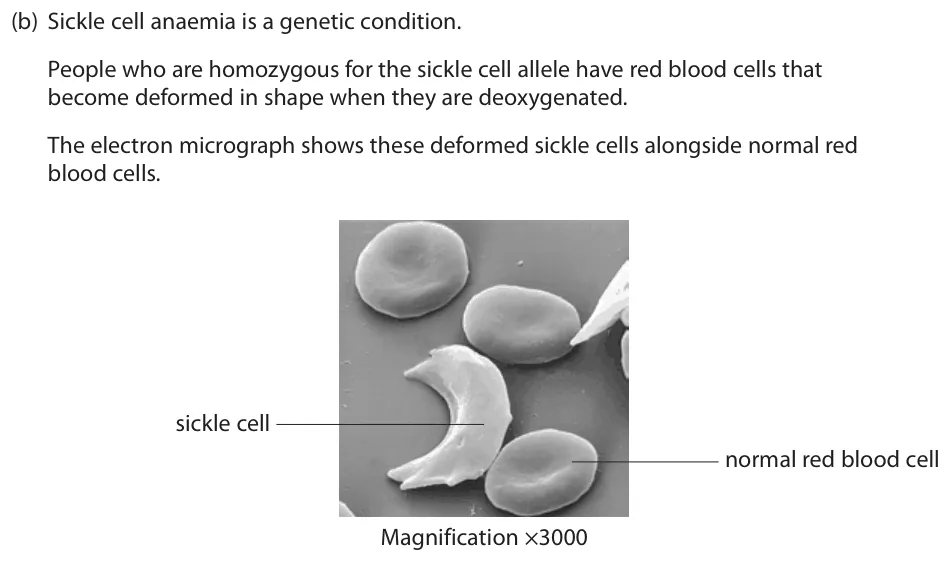
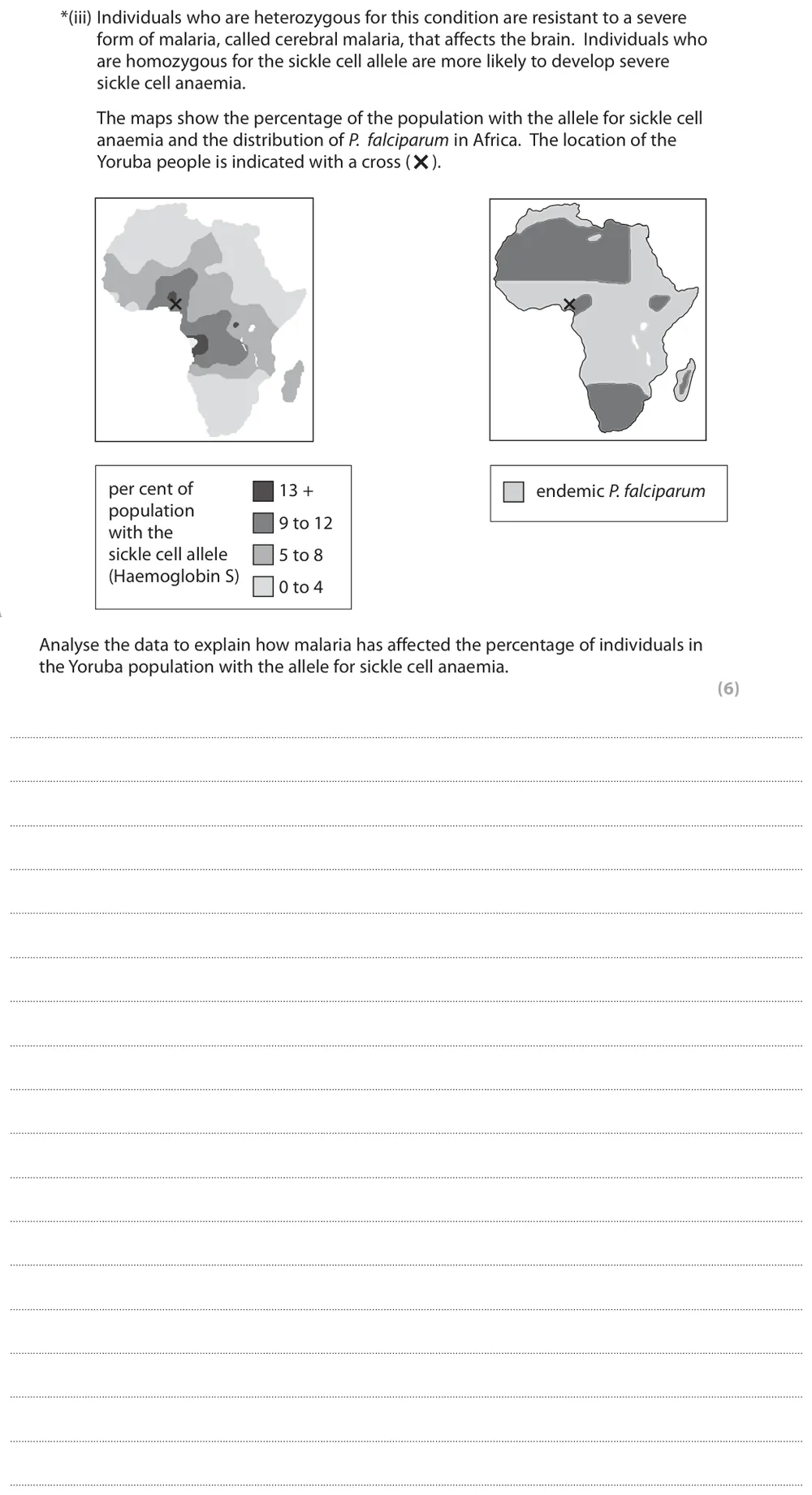
Analyse two maps to explain how malaria has affected the percentage of the Yoruba population with the sickle cell allele.
Information from earlier in this question:
Show the mark scheme
Tap an image to open it full size.
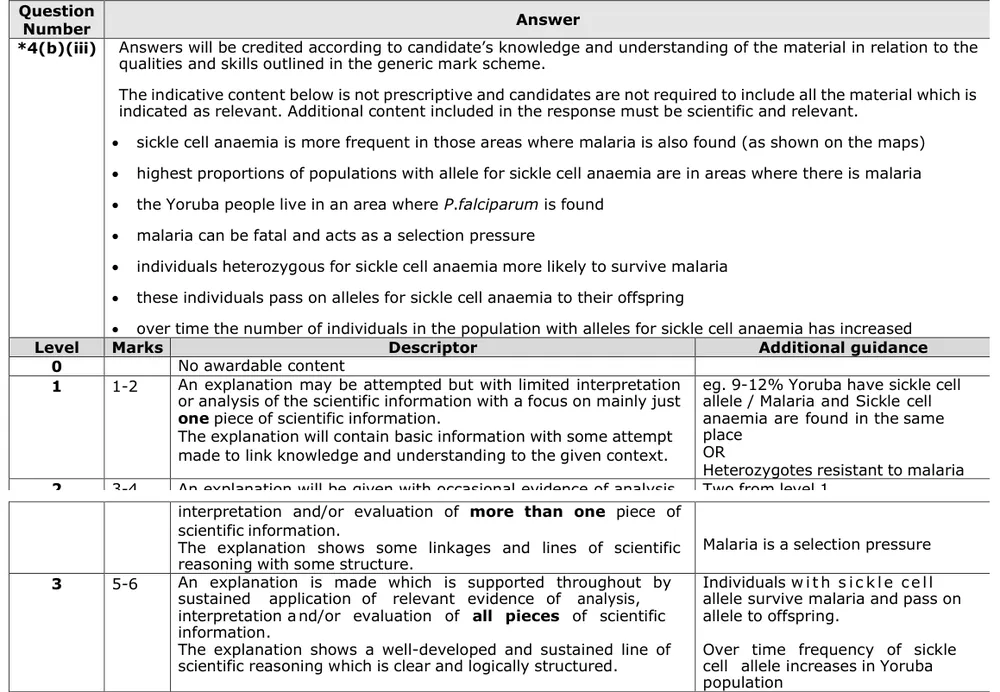
From the examiners' report: Many answers referred only to the map and did not get beyond level 1. The best used the data from the whole question as a platform to describe a change in allele frequency by natural selection.
Question 9
AS Paper 2 · June 2024 · Q8(d)(ii) · 6 marks
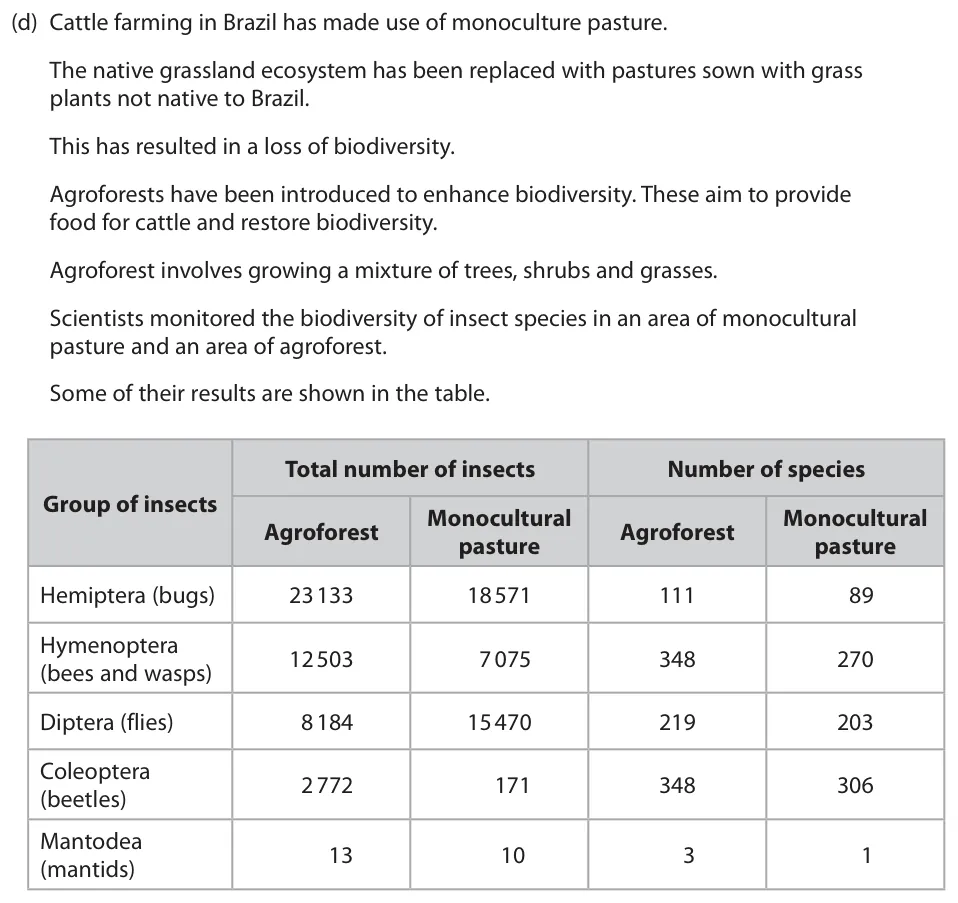
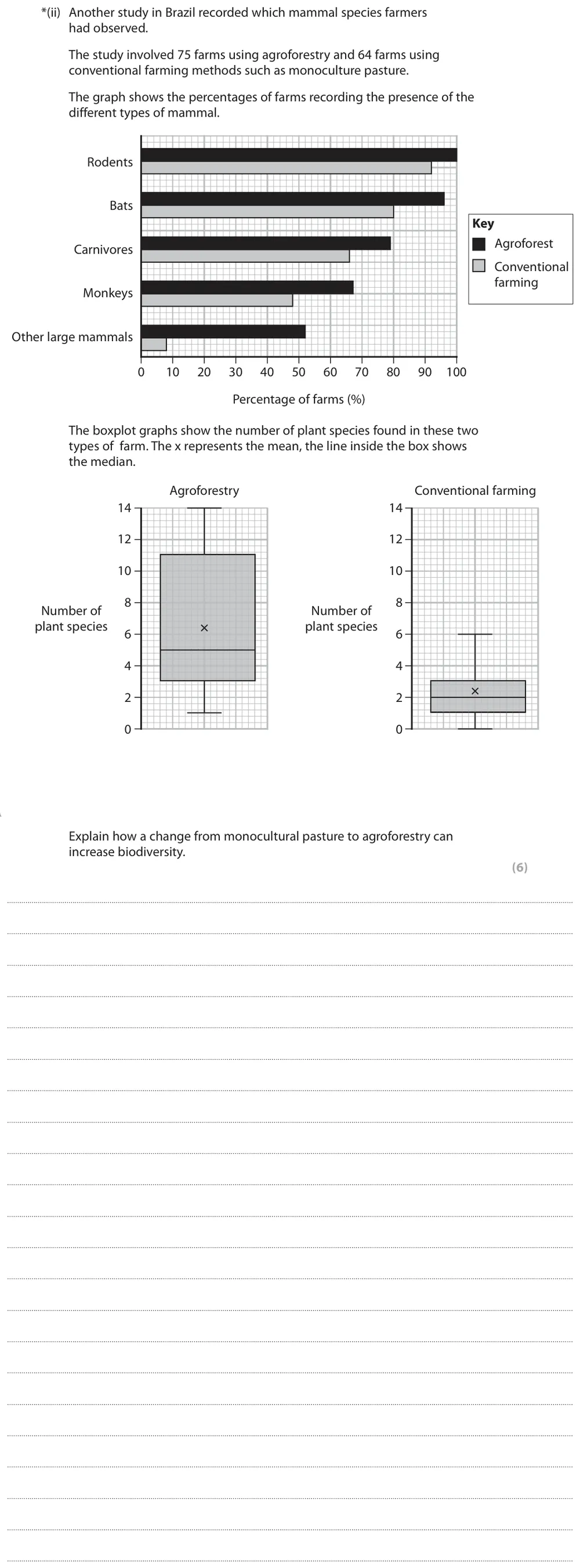
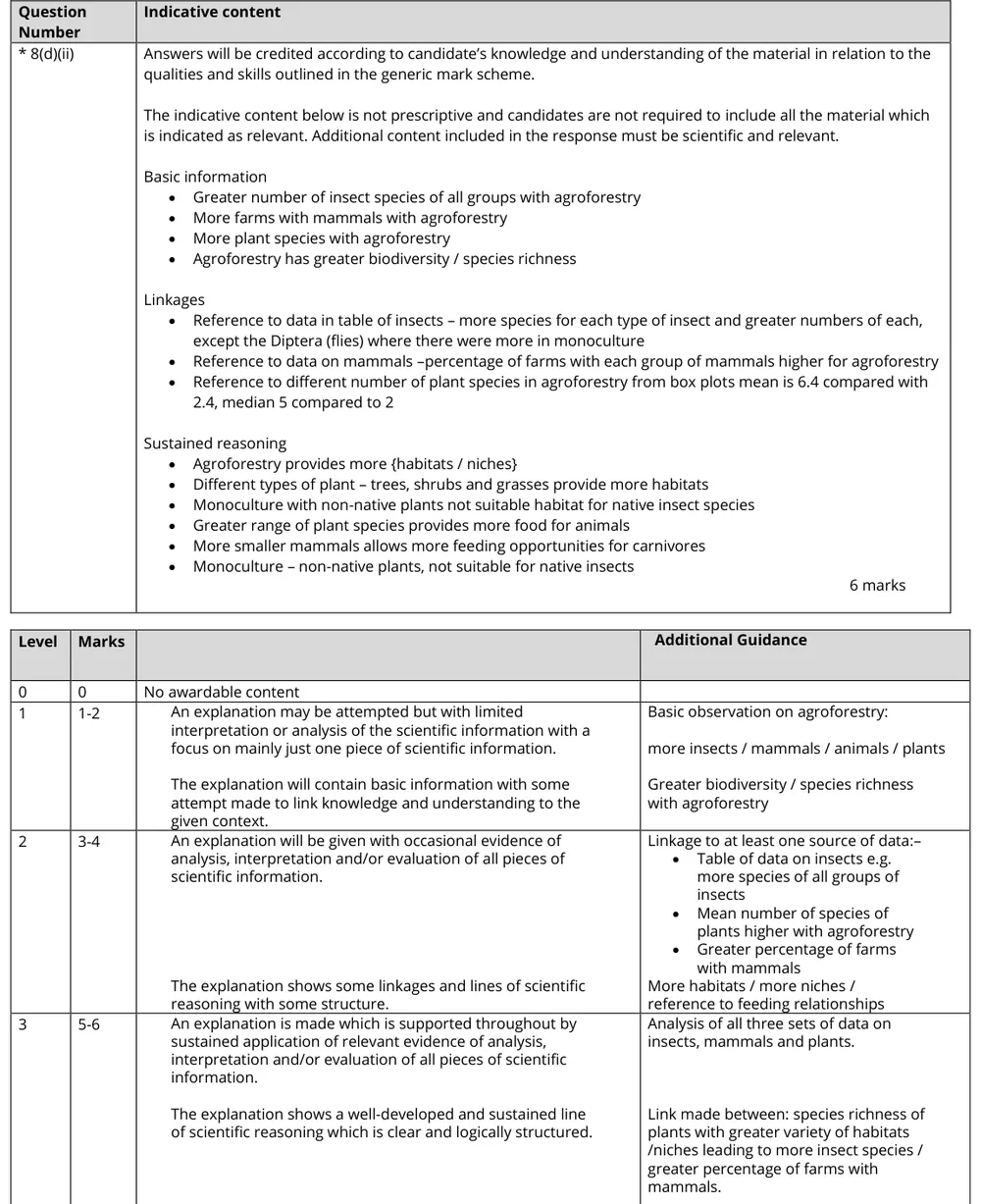
Use data on insects, mammals and plants to explain how a change from monoculture pasture to agroforestry can increase biodiversity.
Information from earlier in this question:
Show the mark scheme
Tap an image to open it full size.
From the examiners' report: Most gave good explanations but used no data from the insect table, which was on an earlier page, and were capped at 4 marks. The best linked niches, food and shelter to data from all the sources. Simply stating a definition of biodiversity gained little.
Question 10
A level Paper 1 · June 2017 · Q10(b)(i) · 6 marks
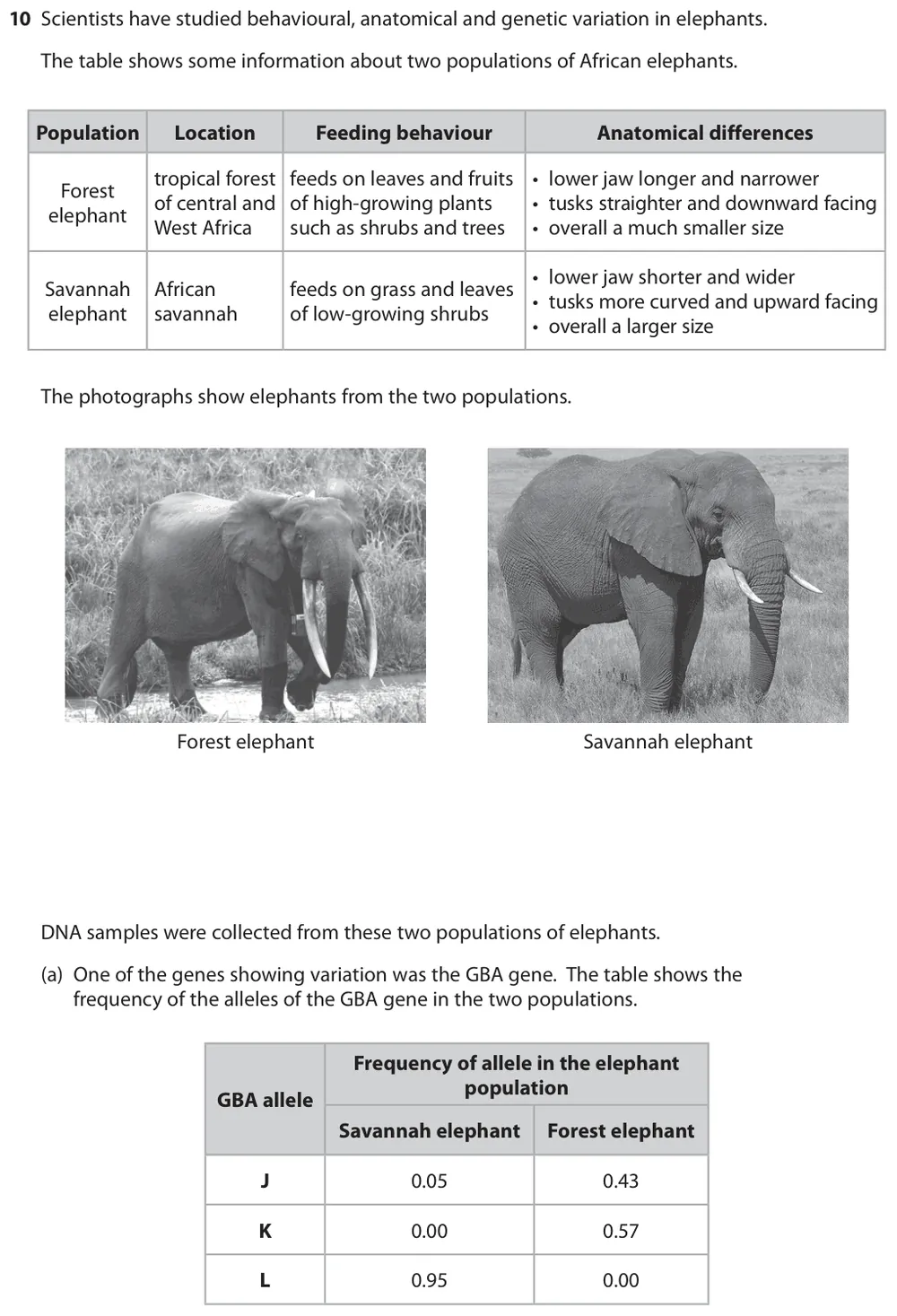
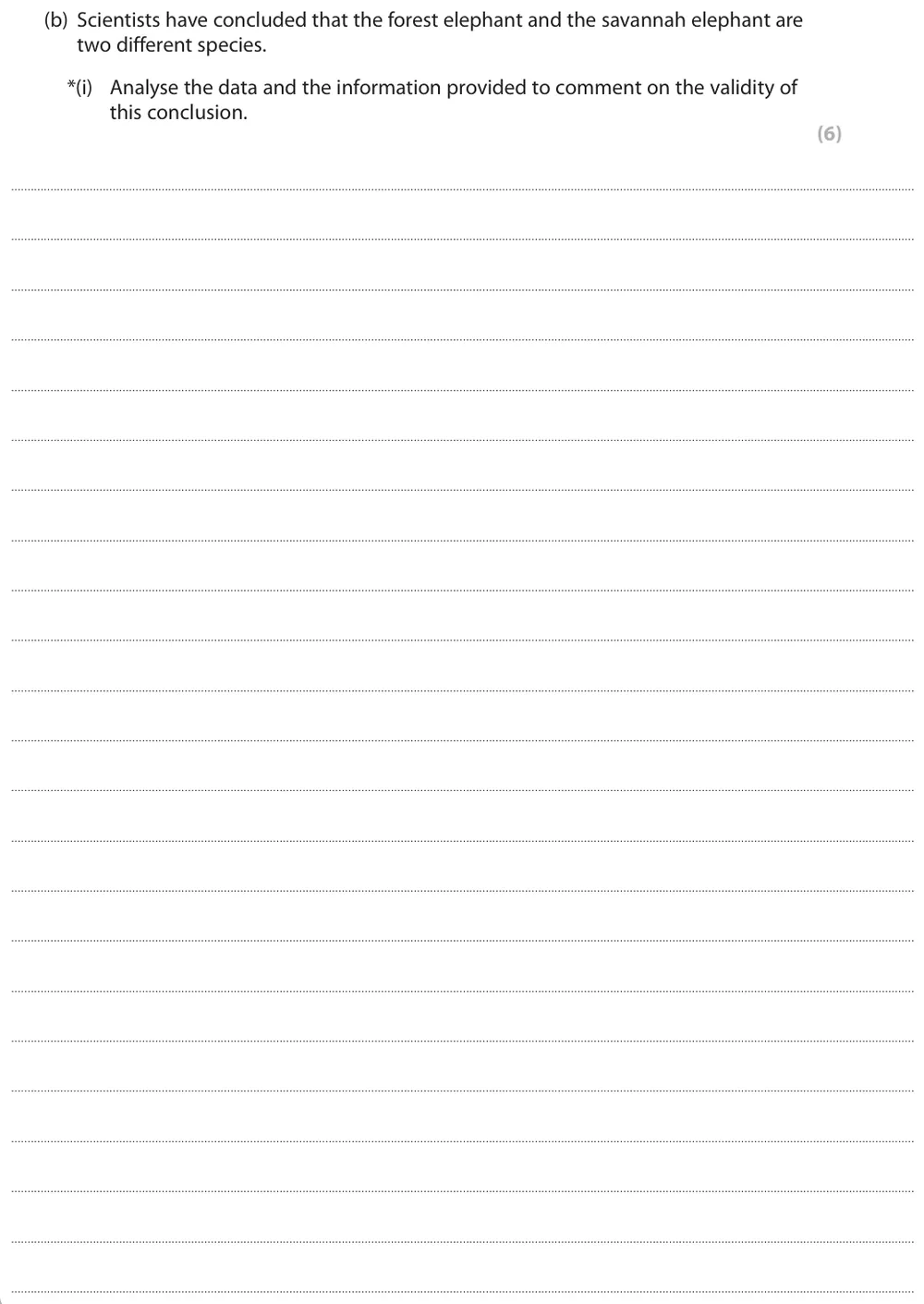
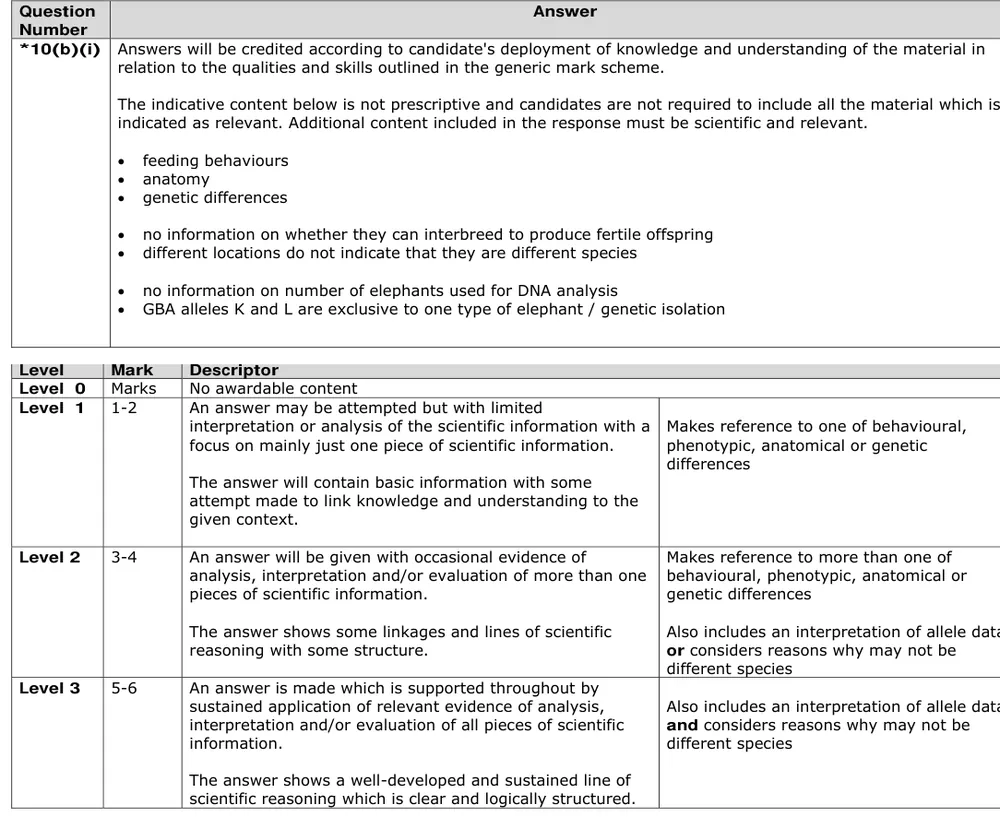
Analyse the data to comment on the validity of the conclusion that forest and savannah elephants are two different species.
Information from earlier in this question:
Show the mark scheme
Tap an image to open it full size.
From the examiners' report: Using only selected data, such as the allele data, limited answers to level 1. Using all the information, plus your own knowledge of how a species is defined, gives the balanced judgement needed for level 3. Some described how a new species evolves, which was the next question.
Question 11
A level Paper 1 · October 2020 · Q8(b)(ii) · 6 marks
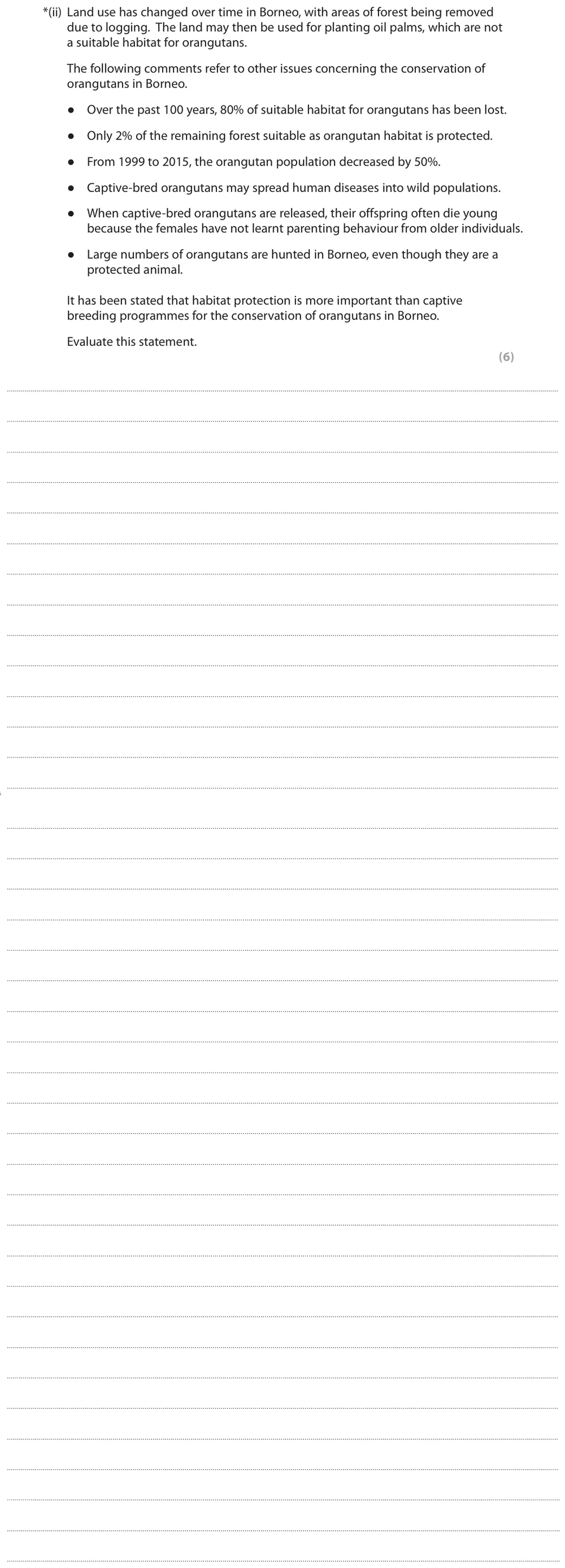
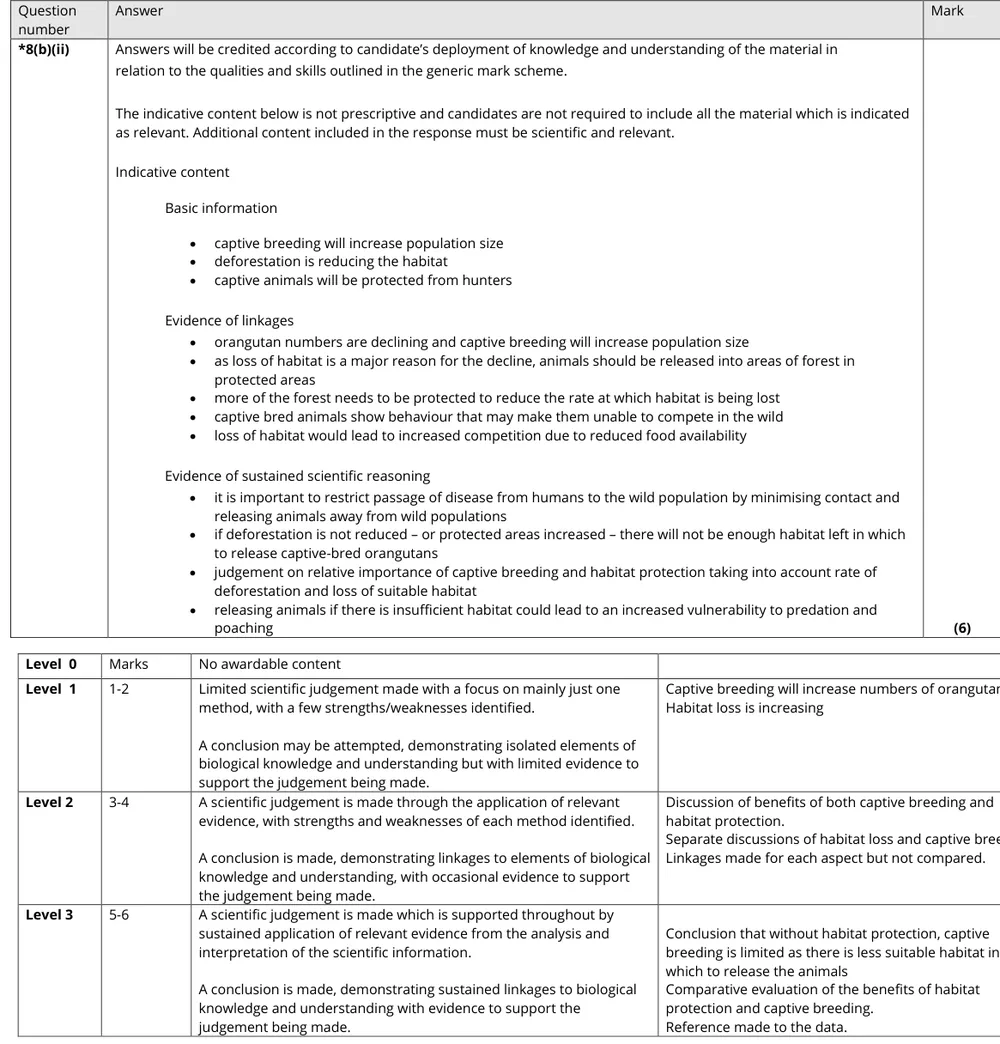
Evaluate the statement that habitat protection is more important than captive breeding for conserving orangutans in Borneo.
Show the mark scheme
Tap an image to open it full size.
From the examiners' report: For level 2 or 3 you must use all the data, linking the information on habitat loss with that on conservation. Many organised the information into a coherent argument, but only those who supported it with further biological knowledge reached level 3.
Question 12
A level Paper 2 · June 2022 · Q10(b)(ii) · 6 marks
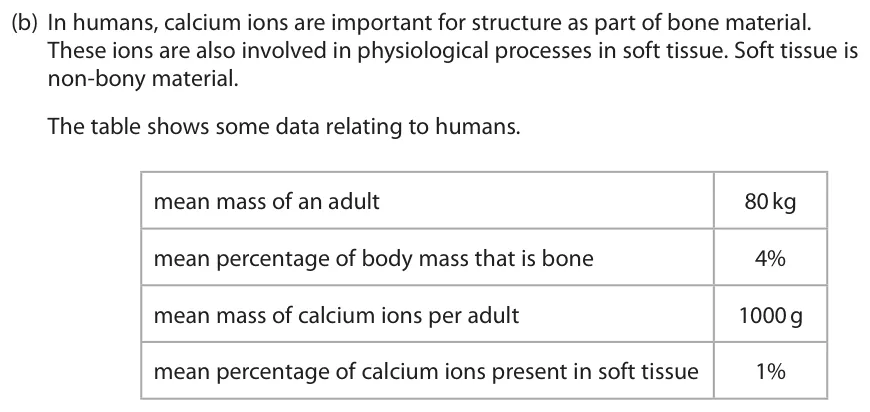
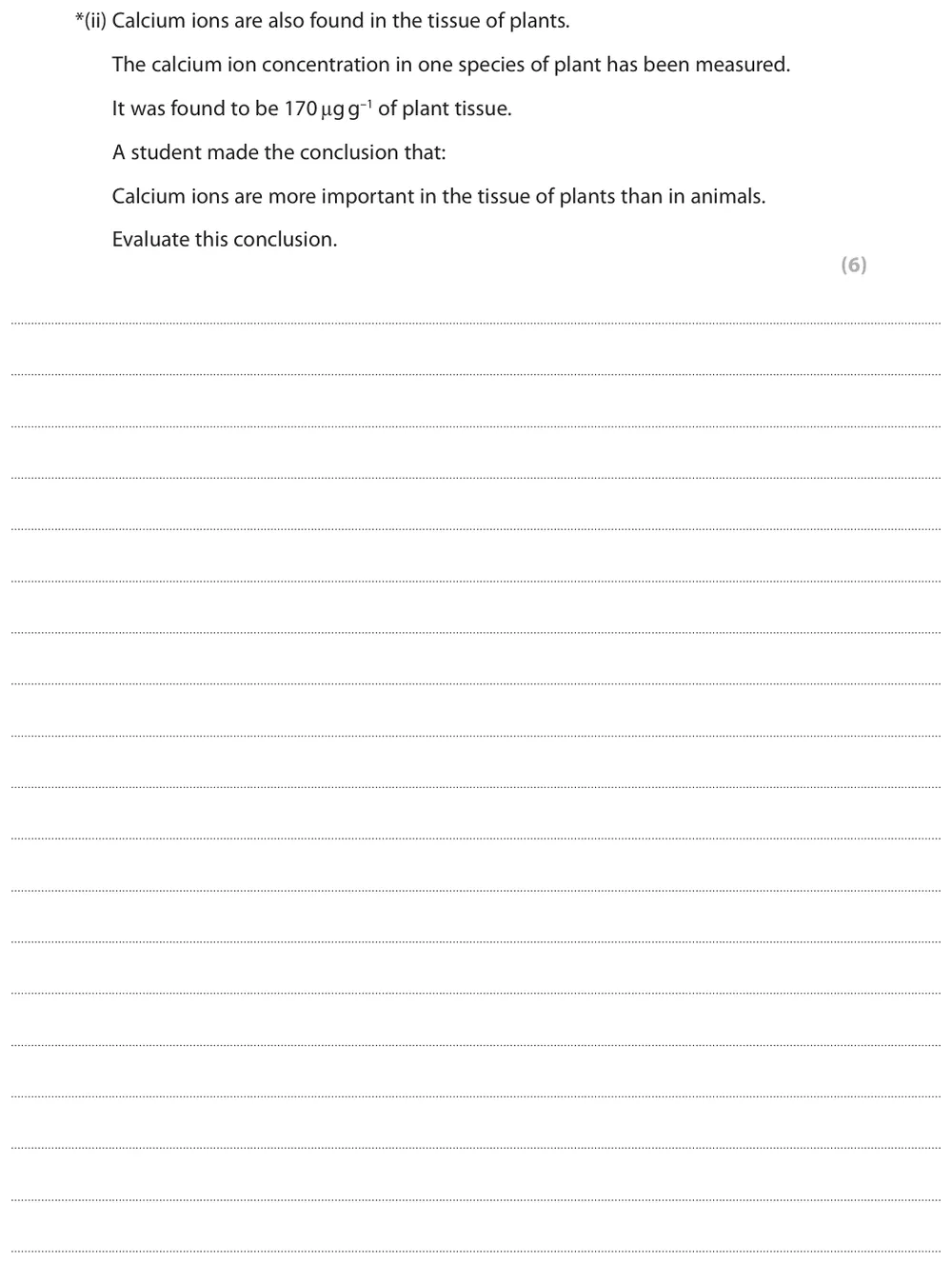
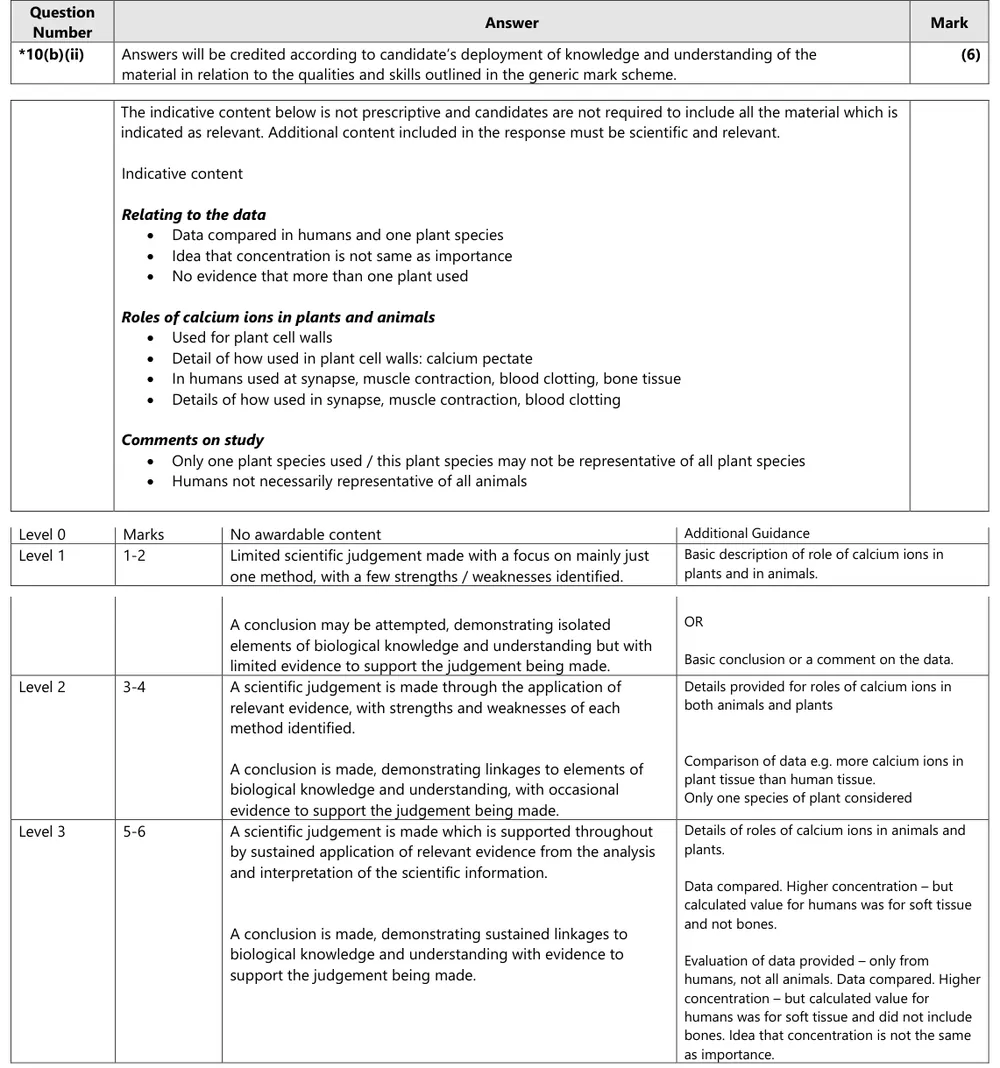
Evaluate a student's conclusion that calcium ions are more important in plant tissue than in animals.
Information from earlier in this question:
Show the mark scheme
Tap an image to open it full size.
From the examiners' report: Many knew the roles of calcium ions in humans well but were less secure on plants. Detailed roles in both reached level 2; the four-mark answer also recognised that the data came from only one species of plant.
Where students lose marks (from Pearson examiners' reports and mark schemes)
Each point below comes from the examiners' reports and mark schemes, and is followed by wording that gained marks.
Look beyond the graphs. Few candidates went much beyond the detail from the graphs.
✔ Gains credit: 'Trials conducted on rats not humans, therefore results may not be the same in people; other causes of teratozoospermia may not respond to vitamin E.'
Harvesting cord tissue doesn't harm the fetus. Many thought the umbilical cord was removed during pregnancy, causing the death of the fetus.
✔ Gains credit: 'Stem cells from umbilical cord tissue will be genetically identical to the recipient, so there is no chance of rejection and no need for immunosuppressant medication.'
Multifactorial, not one cause. Many described the three investigations but drew only basic conclusions.
✔ Gains credit: 'Probability is higher in identical twins than non-identical twins, suggesting genetic factors; the idea that it is multifactorial, an interaction between genotype and environment.'
Test the boundary concentrations. Methods used ranges such as '<300, 300–999, 1000–2000 and >2000' without saying which concentration to use.
✔ Gains credit: 'Lead concentrations to include 300, 999/1000 and 2000 ppm (boundary concentrations for tolerance categories), and a control with no lead.'
Don't stop at the map. Many responses only referred to the map, so did not progress beyond level 1.
✔ Gains credit: 'Malaria acts as a selection pressure; individuals heterozygous for sickle cell anaemia are more likely to survive malaria and pass on alleles for sickle cell anaemia to their offspring.'
The insect table counts too. Most failed to mention any data from the table of insect populations on the earlier page.
✔ Gains credit: 'Greater number of insect species of all groups with agroforestry; different types of plant – trees, shrubs and grasses – provide more habitats.'
Define a species. Many used only selected data, such as the allele data, and reached no judgement.
✔ Gains credit: 'No information on whether they can interbreed to produce fertile offspring; GBA alleles K and L are exclusive to one type of elephant.'
Concentration is not importance. Many did not compare the data or notice that only one plant species was used.
✔ Gains credit: 'Idea that concentration is not the same as importance; only one plant species used, which may not be representative of all plant species.'
Download the questions
Download the PDF pack (12 questions, mark schemes at the end)
Keep practising
- Edexcel SNAB A level Biology revision resources by topic
- Extended Response Questions (Topics 1 and 2): Edexcel SNAB A Level Biology Exam Questions
- Extended Response Questions (Topics 5 to 8): Edexcel SNAB A Level Biology Exam Questions
- All Edexcel SNAB exam questions by topic
- Edexcel SNAB A level Biology past papers, mark schemes and examiners' reports
- Edexcel SNAB A level Biology grade boundaries
- Message Tom on WhatsApp about one-to-one Edexcel SNAB tutoring or an Edexcel group class
Questions, mark schemes and examiners' report extracts © Pearson Education Ltd.