

Gametes, Fertilisation and Linkage comes in Topic 3, Voice of the Genome, of the Edexcel A level Biology A (Salters-Nuffield) specification. You need to understand how mammalian sperm and egg cells are specialised, including the acrosome and the zona pellucida, and know the process of fertilisation: the acrosome reaction, the cortical reaction and the fusion of nuclei. You also need to understand loci, linkage and sex linkage. The questions on this page come from AS Paper 2 and A level Papers 1 and 2. Questions marked AS are from the AS papers (8BN0); the rest are from the A level papers (9BN0).
Examiners want precise wording. Mitochondria release energy or make ATP for the flagellum; they do not produce energy. Say flagellum, not tail, and say that enzymes from the acrosome digest the zona pellucida. In fertilisation, the contents of the cortical granules are released, the zona pellucida hardens so other sperm cannot reach the egg cell membrane, and the haploid nuclei fuse. Genes further apart are more likely to be separated by crossing over, and for sex linkage explain that males have only one allele of genes on the X chromosome.
Studying Edexcel SNAB and want more help? If you'd like to arrange one-to-one Edexcel tutoring, or to register your interest in an Edexcel group class, message Tom on WhatsApp using the link at the bottom of this page.
What you need from GCSE
Each question on this page assumes you're secure on these ideas. If any of them feels shaky, look it up before you start.
- Sperm and egg cells are gametes; each has half the number of chromosomes of a body cell.
- Fertilisation is the fusion of a sperm nucleus with an egg nucleus.
- Human females are XX and males are XY.
- Mitochondria are the site of aerobic respiration, which releases energy as ATP.
Key terms
These words come up in the questions and mark schemes. Examiners expect you to use them exactly.
- Acrosome: a vesicle (specialised lysosome) in the sperm head containing digestive enzymes.
- Zona pellucida: the glycoprotein layer around the egg cell that the sperm must digest through.
- Acrosome reaction: the acrosome fuses with the sperm cell membrane and releases enzymes that digest the zona pellucida.
- Cortical reaction: cortical granules in the egg release their contents, which harden the zona pellucida so no other sperm can enter.
- Locus (plural loci): the position of a gene on a chromosome.
- Linkage: genes on the same chromosome tend to be inherited together unless separated by crossing over.
- Sex linkage: a gene is on a sex chromosome (usually the X), so a trait's inheritance differs between males and females.
What these questions cover (Edexcel SNAB Topic 3: Voice of the Genome)
The questions test these statements from Topic 3 of the Pearson Edexcel A level Biology A (Salters-Nuffield) specification (9BN0).
- 3.6 Understand how mammalian gametes are specialised for their functions (including the acrosome in sperm and the zona pellucida in the egg).
- 3.7 Know the process of fertilisation in mammals, including the acrosome reaction, the cortical reaction and the fusion of nuclei.
- 3.8 i Know that a locus (plural = loci) is the location of genes on a chromosome.
- 3.8 ii Understand the linkage of genes on a chromosome and sex linkage.
How to use this page
Write your answer on paper before you open the mark scheme. Allow about 1.2 minutes per mark: the 20 questions are worth 55 marks, so about 66 minutes in total. Then mark your answer strictly against the mark scheme and read the examiners' tip underneath it. If you'd rather print the questions, download the PDF pack.
How sperm and egg cells are specialised (3.6)
Question 1
AS Paper 2 · June 2016 · Q1(b)(ii) · 1 mark · Easy
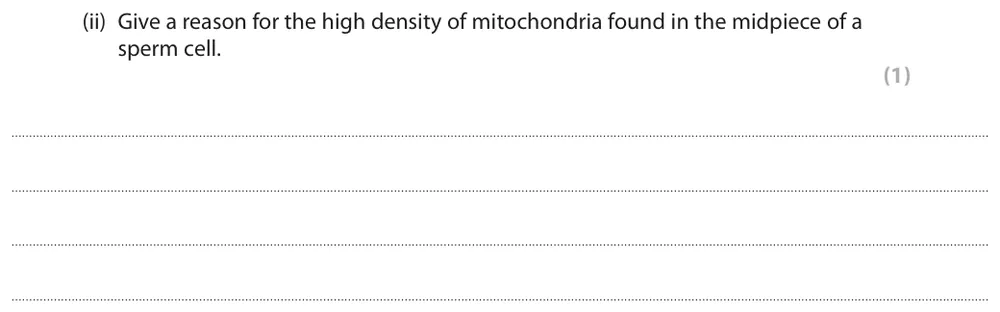
Give a reason for the high density of mitochondria in the midpiece of a sperm cell.
Show the mark scheme
Tap an image to open it full size.
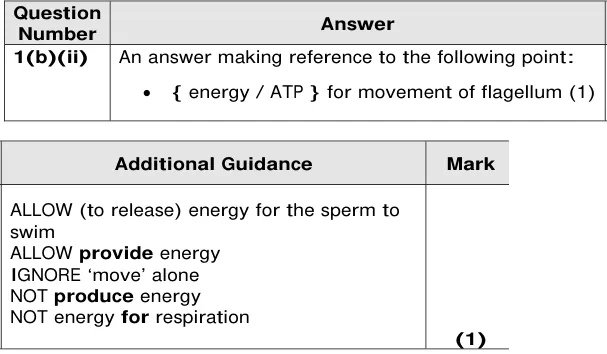
From the examiners' report: Link the energy to the flagellum: energy for the sperm to 'move' was not detailed enough. Mitochondria release energy (or make ATP); saying they make or produce energy was not credited.
Question 2
AS Paper 2 · June 2016 · Q5(b) · 2 marks
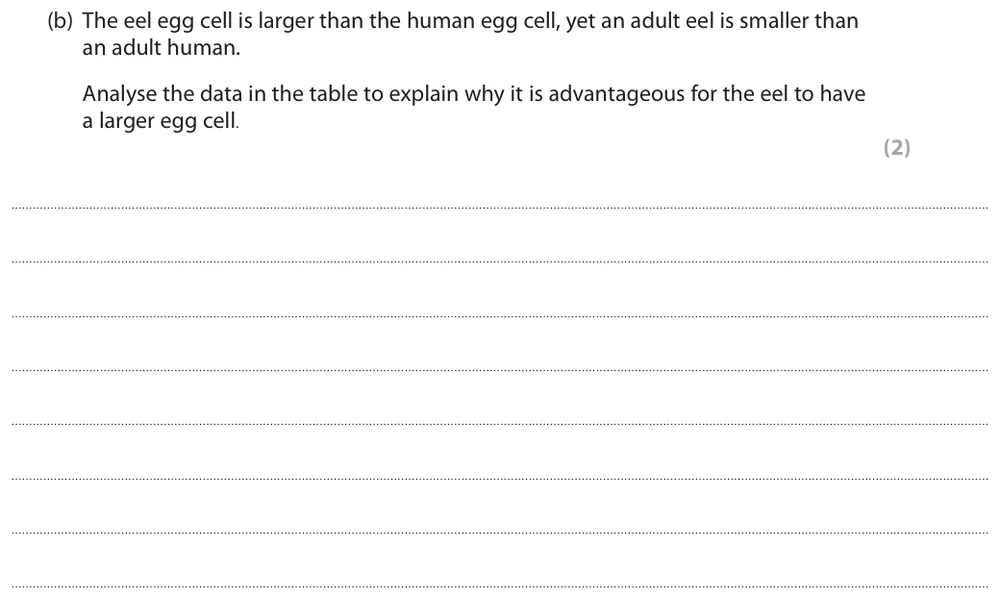
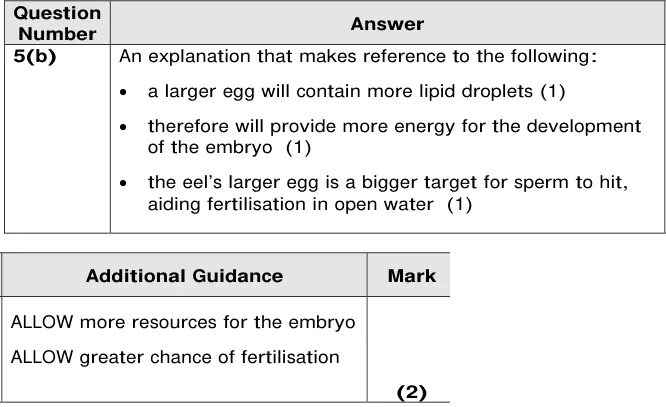
Analyse data to explain why it is an advantage for the eel to have a larger egg cell.
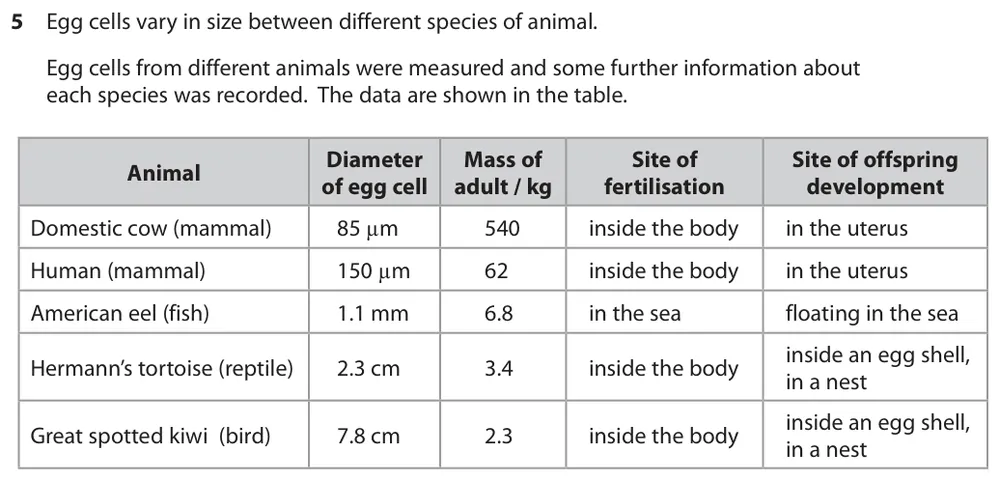
Information from earlier in this question:
Show the mark scheme
Tap an image to open it full size.
From the examiners' report: A larger egg is a bigger target for sperm, but 'easier to fertilise' was not accepted. Fewer used their own knowledge: a larger egg contains more lipid droplets, giving more energy for the developing embryo.
Question 3
AS Paper 2 · June 2019 · Q6(a) · 3 marks
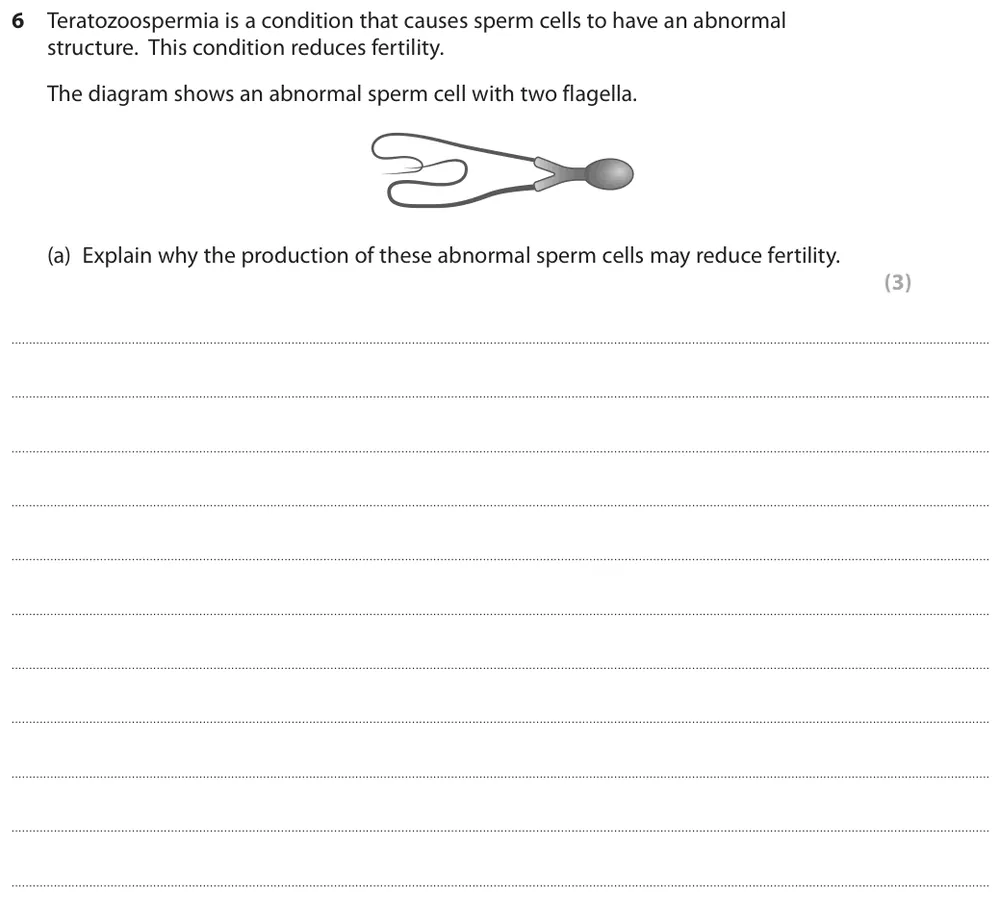
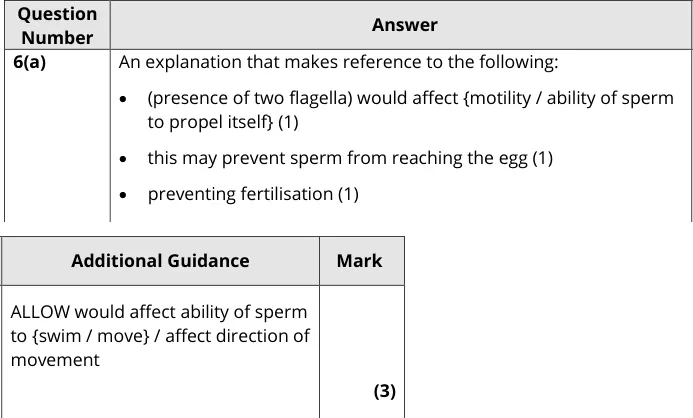
Explain why sperm cells with two flagella may reduce fertility.
Show the mark scheme
Tap an image to open it full size.
From the examiners' report: This was a high-scoring question. Answers that fell short stopped before fertilisation: the sperm's swimming is affected, so it may not reach the egg, preventing fertilisation.
Question 4
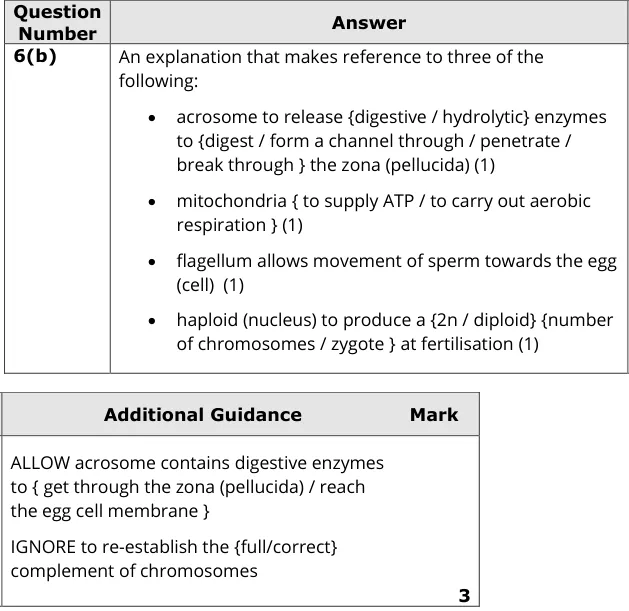
A level Paper 2 · June 2024 · Q6(b) · 3 marks
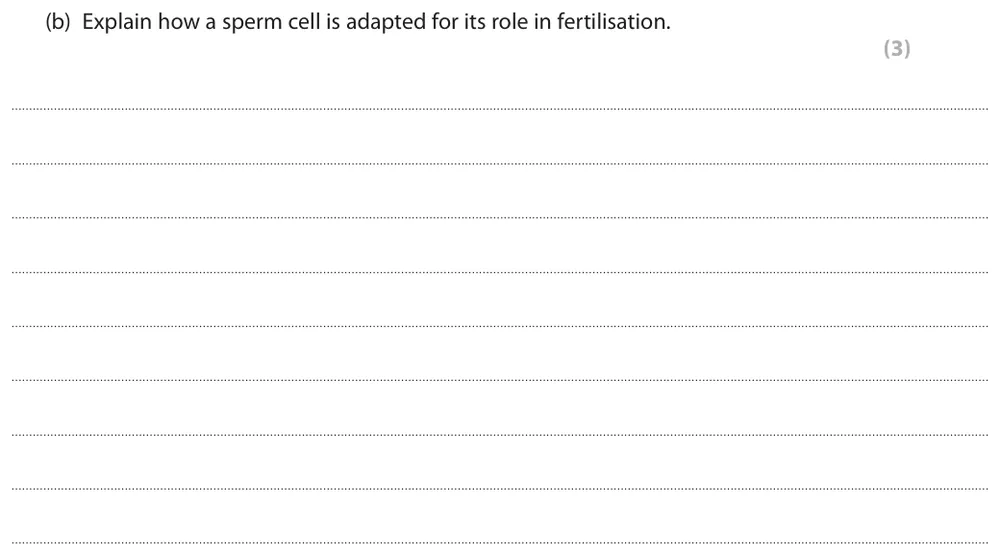
Explain how a sperm cell is adapted for its role in fertilisation.
Show the mark scheme
Tap an image to open it full size.
From the examiners' report: The acrosome mark needs all three ideas: the acrosome, its digestive enzymes, and that they break down the zona pellucida. Say flagellum, not tail. Only a minority mentioned the haploid nucleus, which gives a diploid zygote at fertilisation.
Question 5
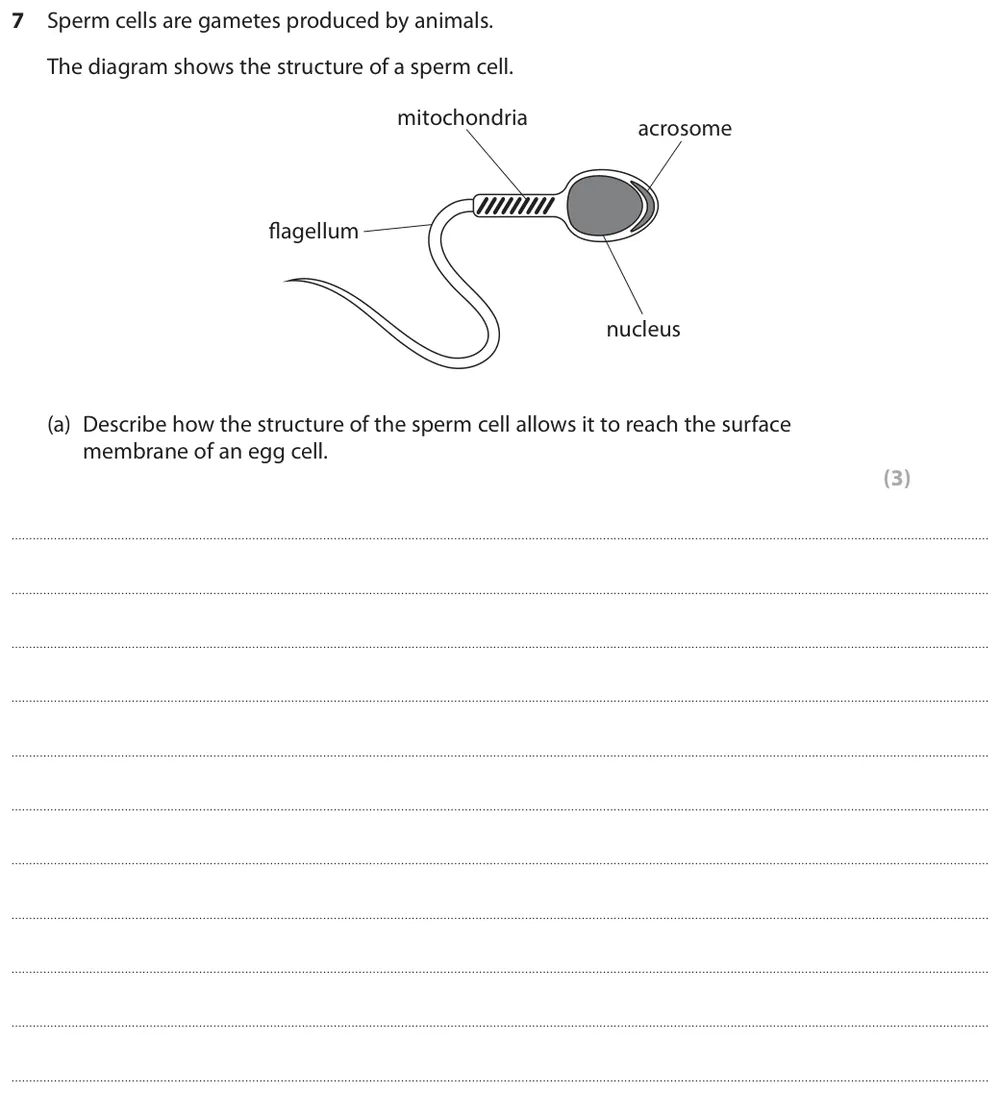
AS Paper 2 · June 2025 · Q7(a) · 3 marks
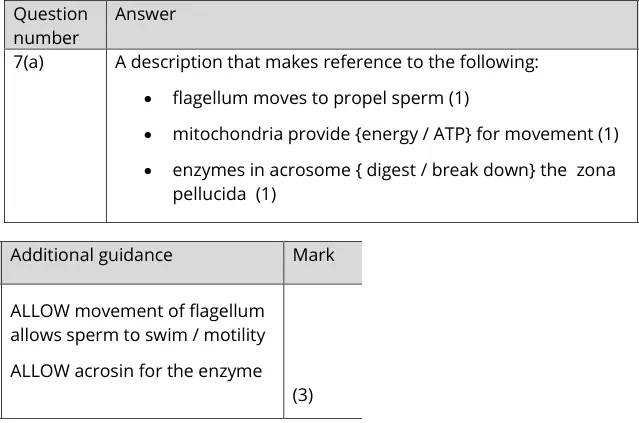
Describe how the structure of a sperm cell allows it to reach the egg cell membrane.
Show the mark scheme
Tap an image to open it full size.
From the examiners' report: Marks were mostly lost for saying mitochondria 'produce energy': they release energy or produce ATP for movement of the flagellum. Say that enzymes from the acrosome break down the zona pellucida.
Fertilisation: acrosome and cortical reactions (3.7)
Question 6
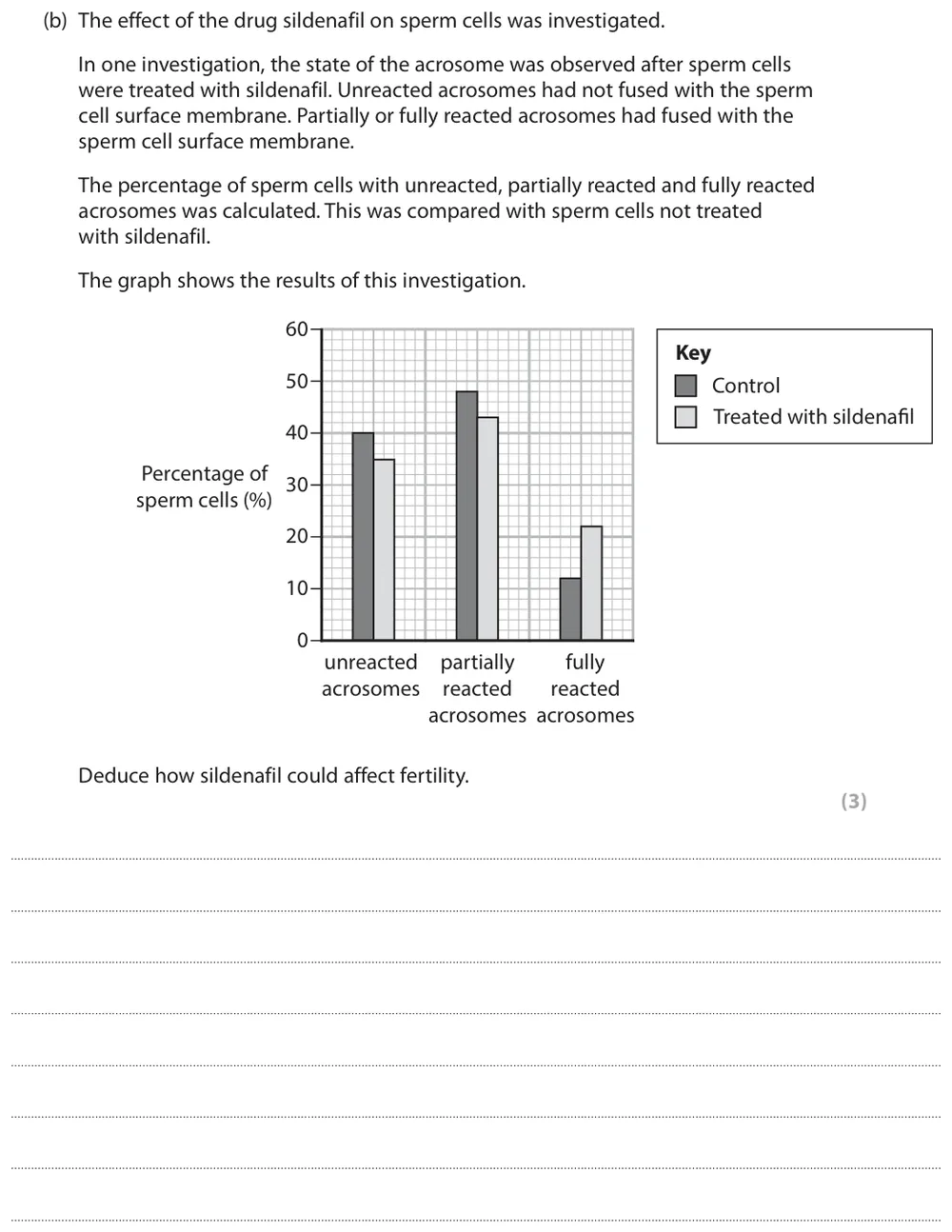
AS Paper 2 · June 2025 · Q7(b) · 3 marks · Easy
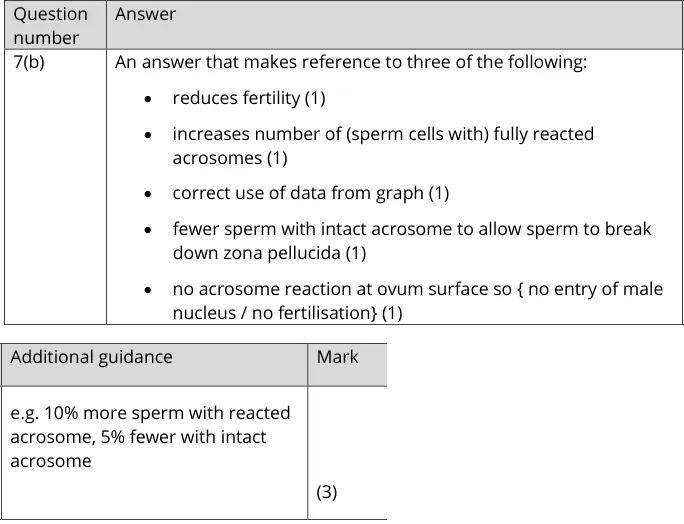
Use acrosome data to deduce how sildenafil could affect fertility.
Show the mark scheme
Tap an image to open it full size.
From the examiners' report: Many saw that sildenafil increases the percentage of fully reacted acrosomes but wrongly concluded that fertility increases. If the acrosome has already reacted, no enzyme is left to break down the zona pellucida, so fertility falls.
Question 7
AS Paper 2 · June 2018 · Q6(a)(ii) · 3 marks · Easy
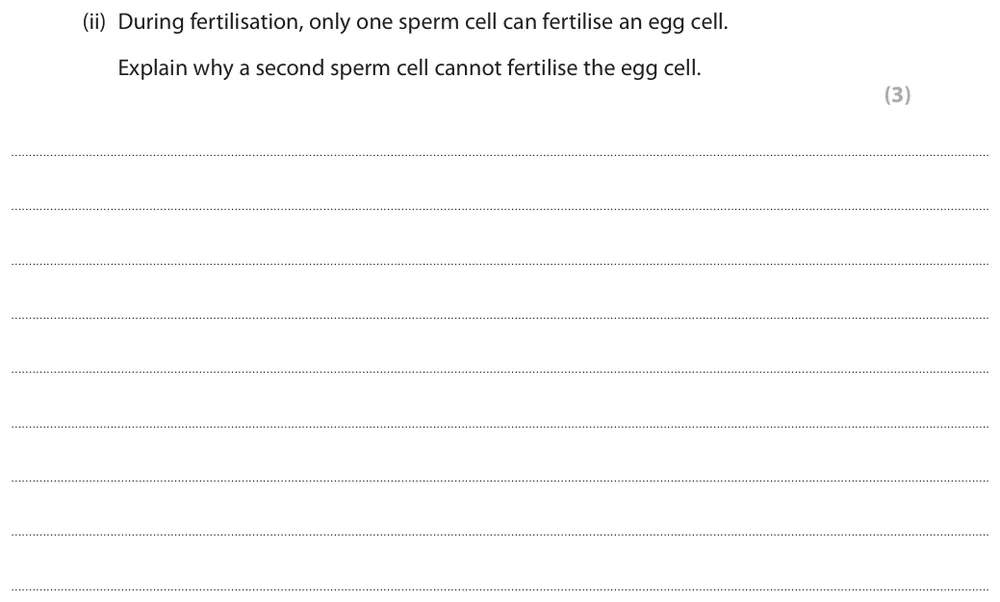
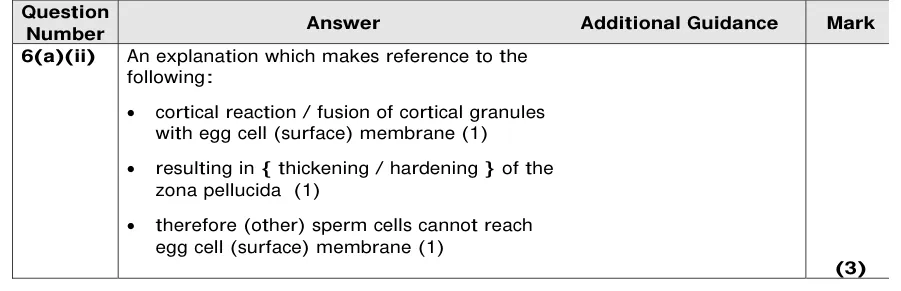
Explain why a second sperm cell cannot fertilise the egg cell.
Show the mark scheme
Tap an image to open it full size.
From the examiners' report: The cortical reaction was usually well described. The final mark was rarely given, because answers just reworded the question: say that the hardened zona pellucida stops other sperm reaching the egg cell membrane.
Question 8
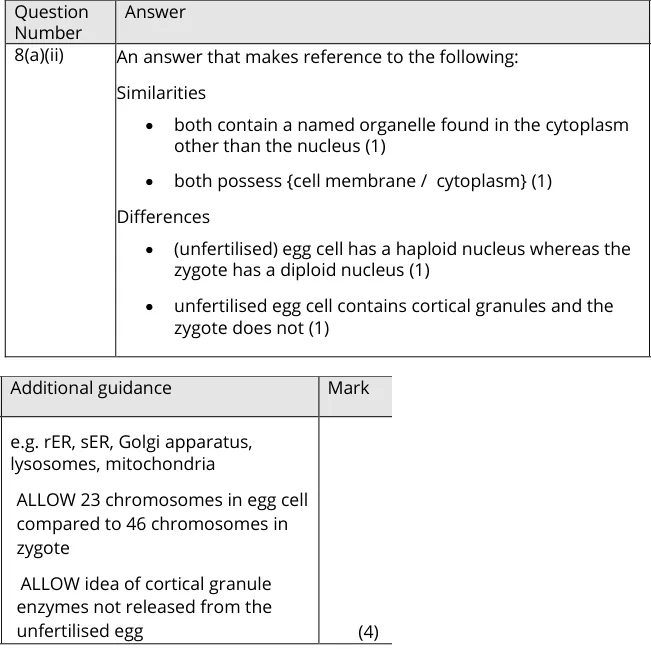
AS Paper 2 · June 2023 · Q8(a)(ii) · 4 marks
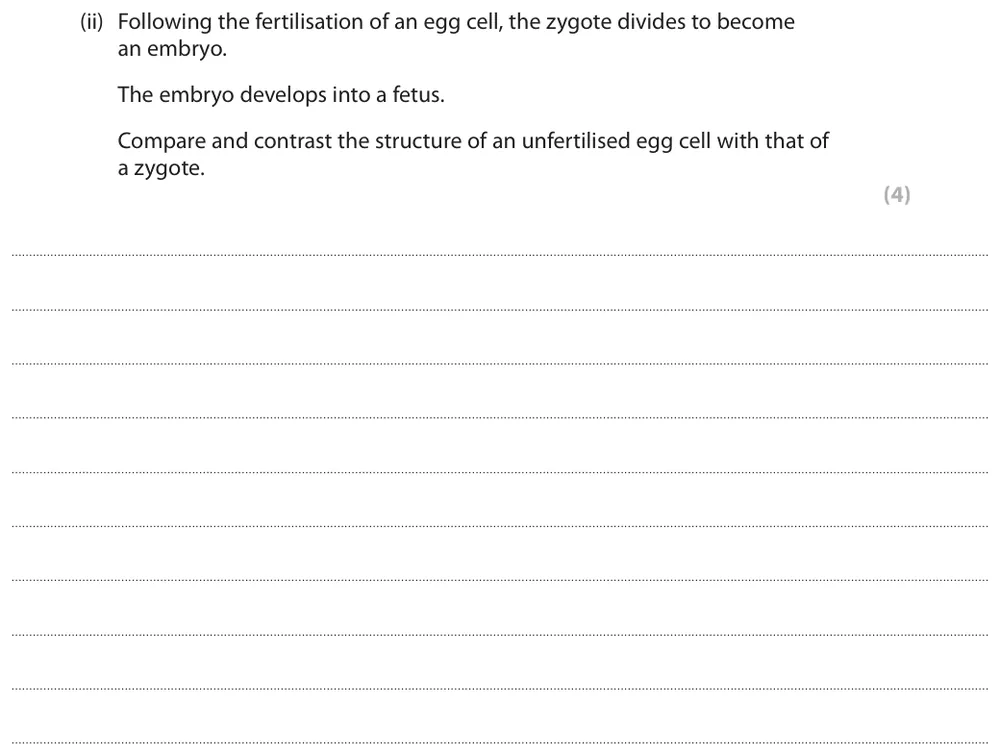
Compare and contrast the structure of an unfertilised egg cell with that of a zygote.
Show the mark scheme
Tap an image to open it full size.
From the examiners' report: Many missed the basic similarities: both have a cell membrane, cytoplasm and organelles such as mitochondria. 'Haploid' and 'diploid' alone were not enough: the egg has a haploid nucleus and the zygote a diploid nucleus. Only the unfertilised egg has intact cortical granules.
Question 9
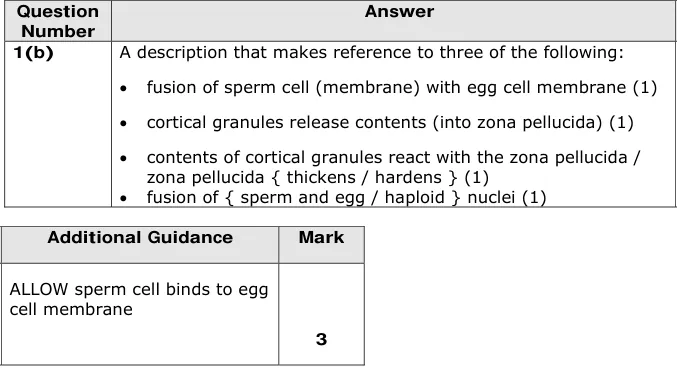
A level Paper 1 · June 2017 · Q1(b) · 3 marks
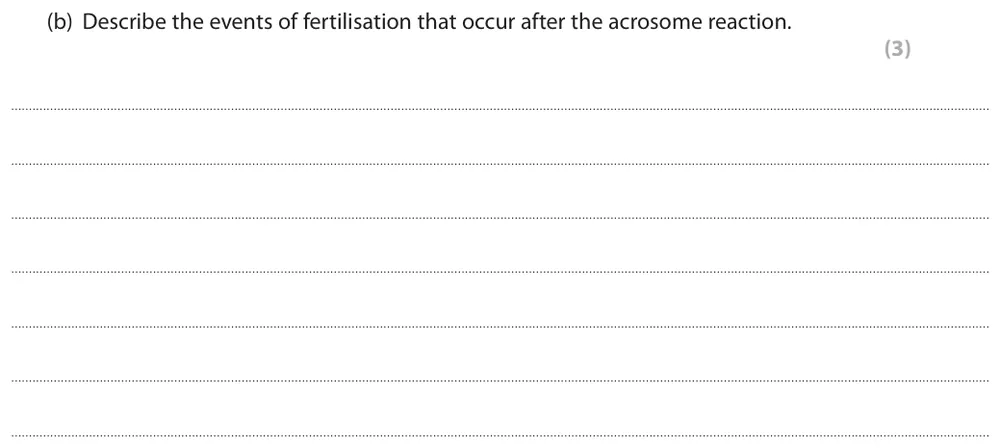
Describe the events of fertilisation that happen after the acrosome reaction.
Show the mark scheme
Tap an image to open it full size.
From the examiners' report: Be precise: it is the contents of the cortical granules that are released, and the haploid nuclei fuse. 'Cortical granules are released' and 'the sperm and egg nuclei join together' did not gain marks.
Question 10
A level Paper 1 · October 2020 · Q5(a)(i) · 3 marks
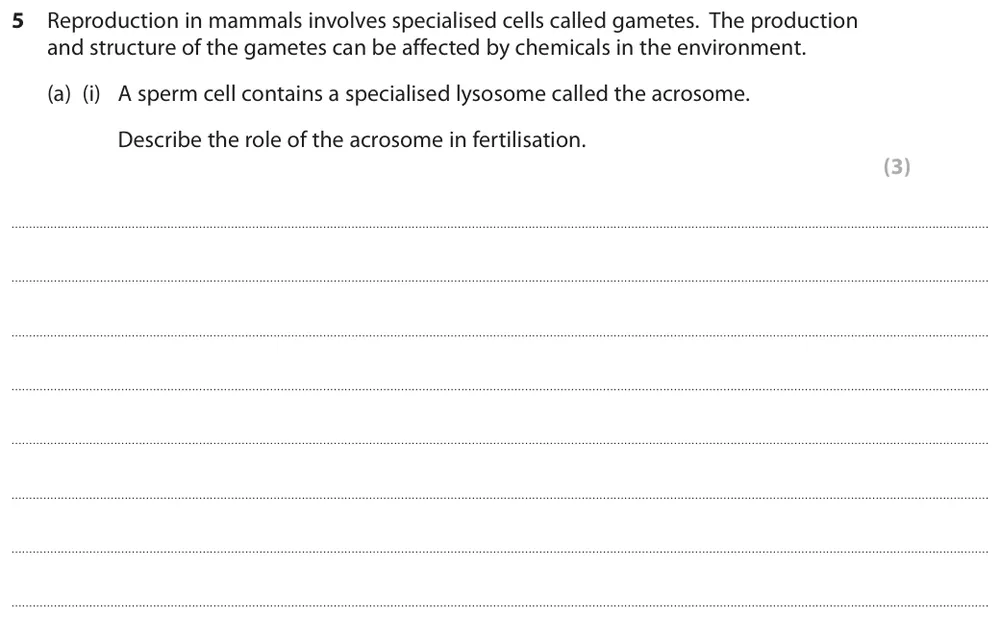
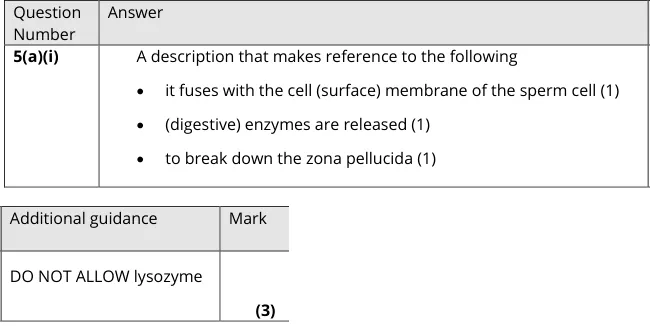
Describe the role of the acrosome in fertilisation.
Show the mark scheme
Tap an image to open it full size.
From the examiners' report: Many scored at least 2 marks. Only the better answers said that the acrosome fuses with the sperm's cell surface membrane before releasing enzymes that break down the zona pellucida. Lysozyme was not accepted as the enzyme.
Question 11
A level Paper 1 · June 2022 · Q6(b) · 2 marks
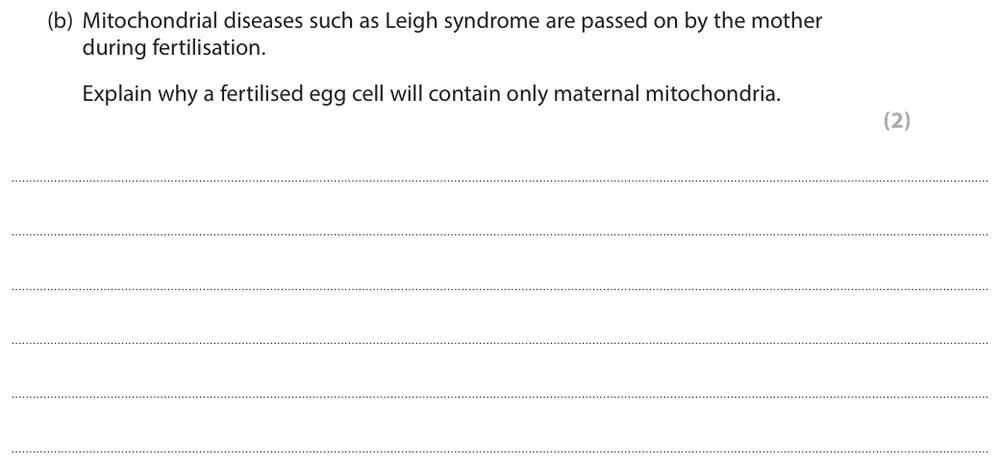
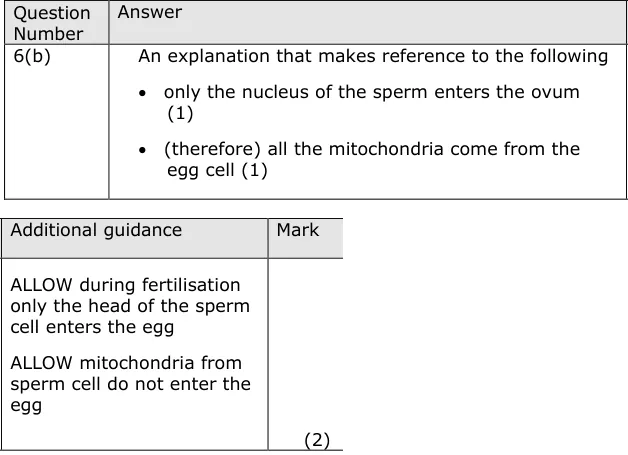
Explain why a fertilised egg cell contains only maternal mitochondria.
Show the mark scheme
Tap an image to open it full size.
From the examiners' report: Answers were often too vague. Saying the mitochondria are maternal just repeats the question: say that only the sperm nucleus enters the egg, so all the mitochondria come from the egg cell.
Question 12
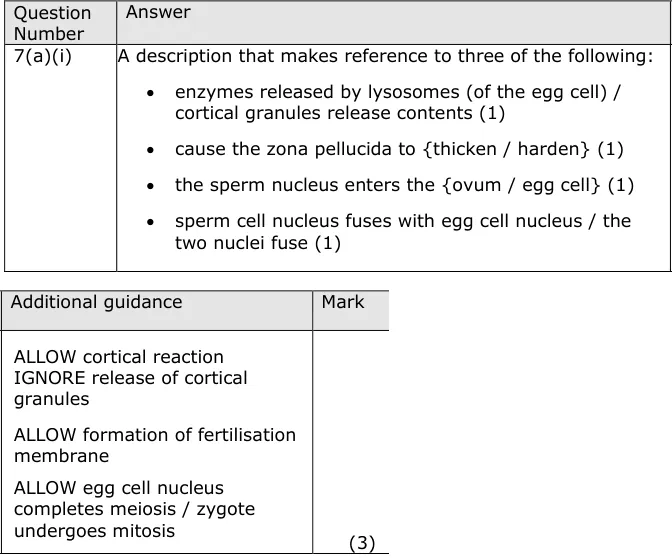
A level Paper 1 · June 2025 · Q7(a)(i) · 3 marks
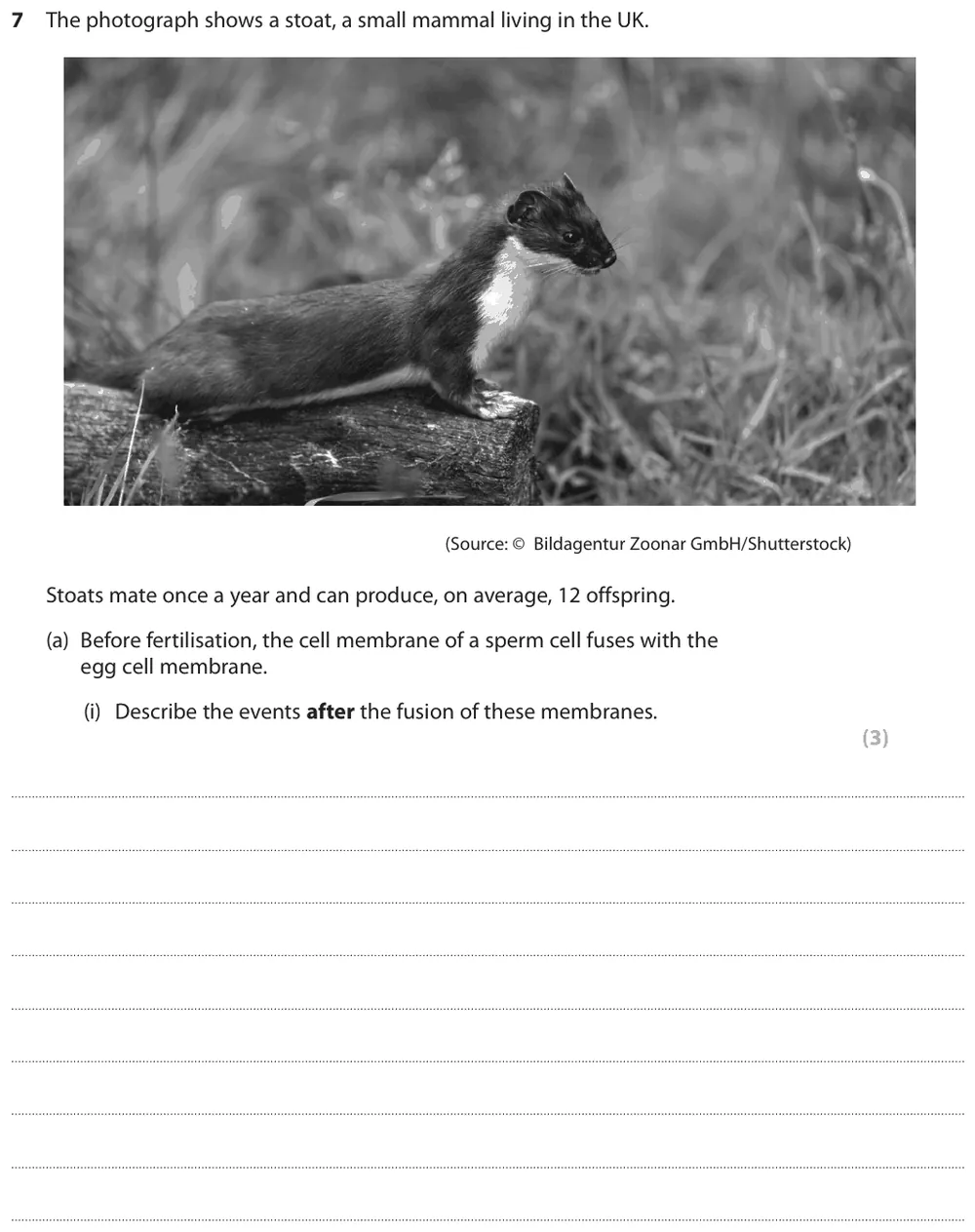
Describe the events after the sperm and egg cell membranes fuse.
Show the mark scheme
Tap an image to open it full size.
From the examiners' report: Start at the point given: the acrosome reaction comes before it and gained nothing. The cortical granules release their contents (not 'release of cortical granules'), the zona pellucida hardens, and the sperm and egg nuclei fuse.
Gene loci (3.8 i)
Question 13
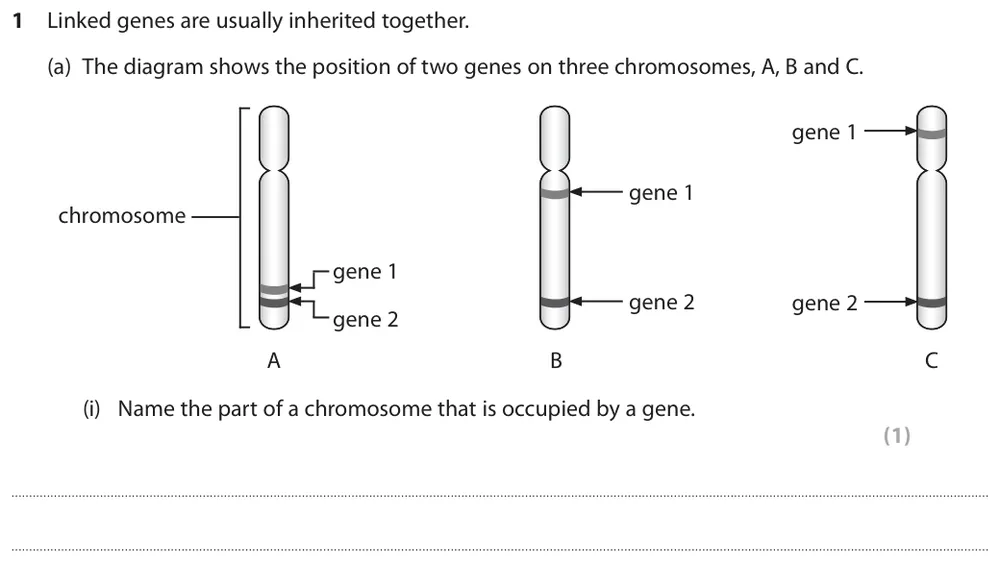
AS Paper 2 · June 2018 · Q1(a)(i) · 1 mark
Name the part of a chromosome occupied by a gene.
Show the mark scheme

Tap an image to open it full size.
From the examiners' report: Most gained the mark, usually with 'loci' rather than 'locus'. A common wrong answer was allele.
Linkage and sex linkage (3.8 ii)
Question 14
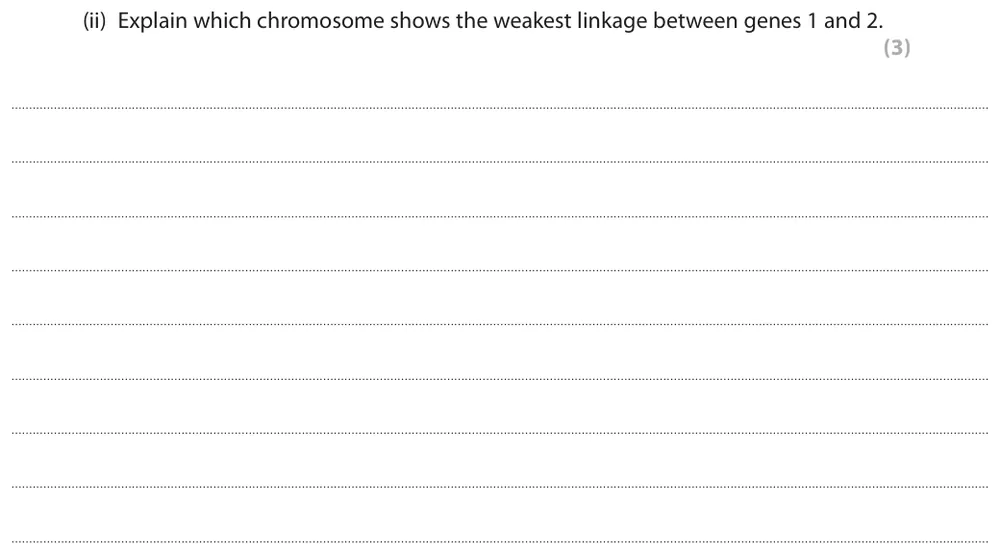
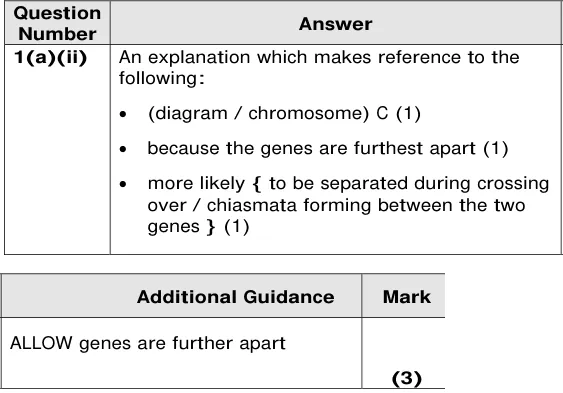
AS Paper 2 · June 2018 · Q1(a)(ii) · 3 marks
Explain which chromosome shows the weakest linkage between genes 1 and 2.
Show the mark scheme
Tap an image to open it full size.
From the examiners' report: Many chose C but did not compare it with A and B. Say that the genes are furthest apart on C, so they are more likely to be separated by crossing over.
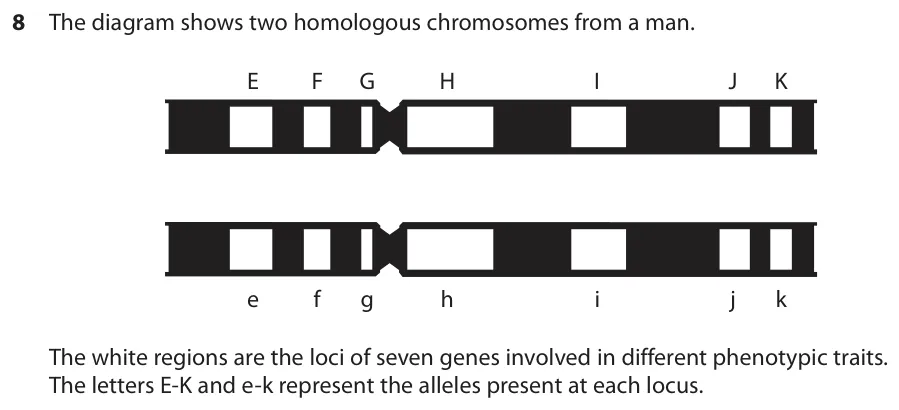
Question 15
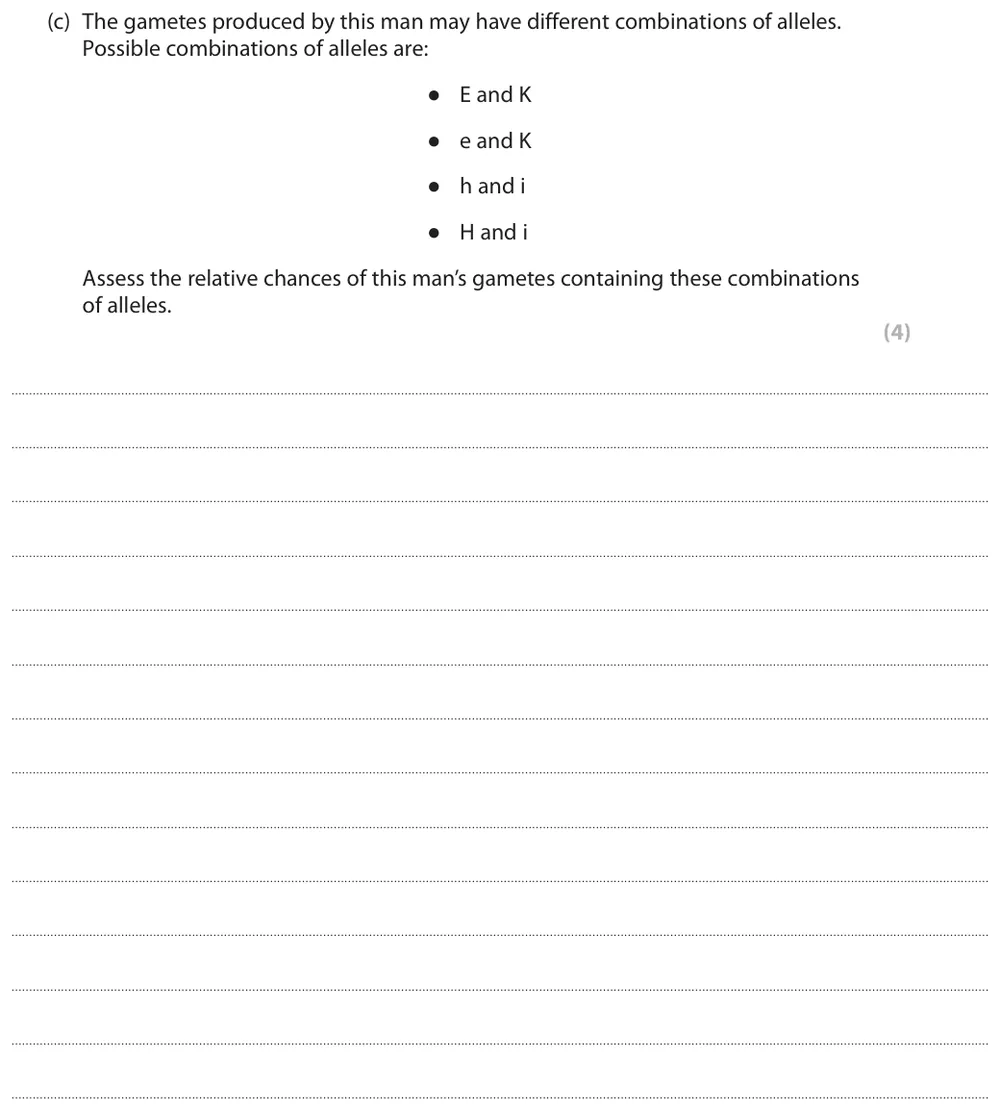
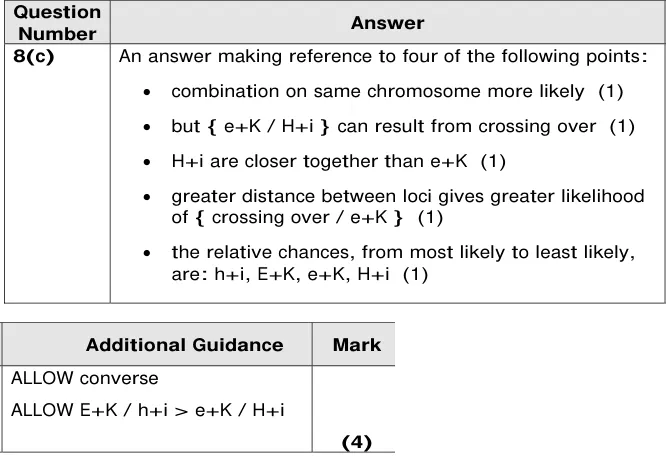
AS Paper 2 · June 2016 · Q8(c) · 4 marks
Assess the relative chances of a man's gametes containing four combinations of alleles.
Information from earlier in this question:
Show the mark scheme
Tap an image to open it full size.
From the examiners' report: Common misconceptions: that dominant alleles are more likely to be passed on, that crossing over is more likely than not, and that it is more likely between loci close together. Use the diagram and finish with a rank order of the combinations.
Question 16
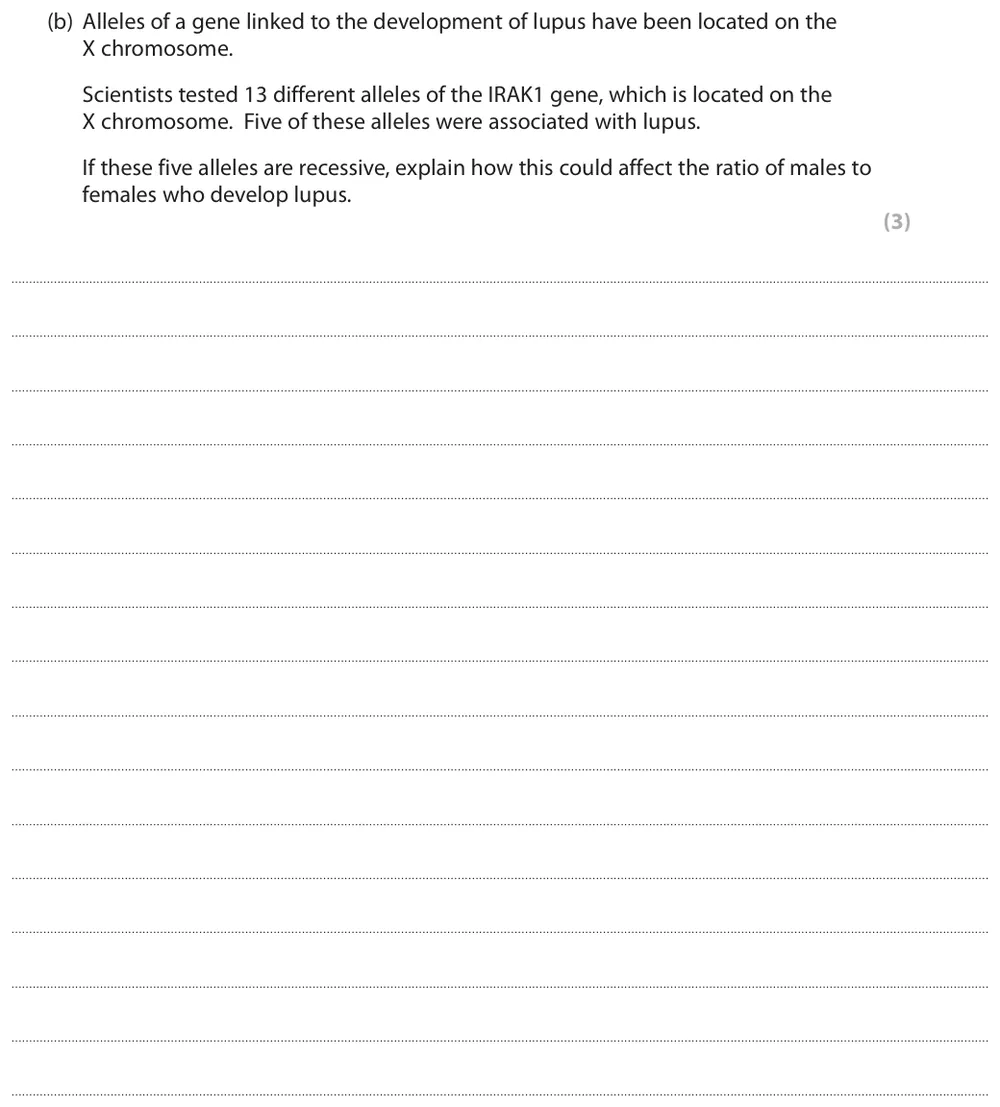
AS Paper 2 · June 2017 · Q2(b) · 3 marks
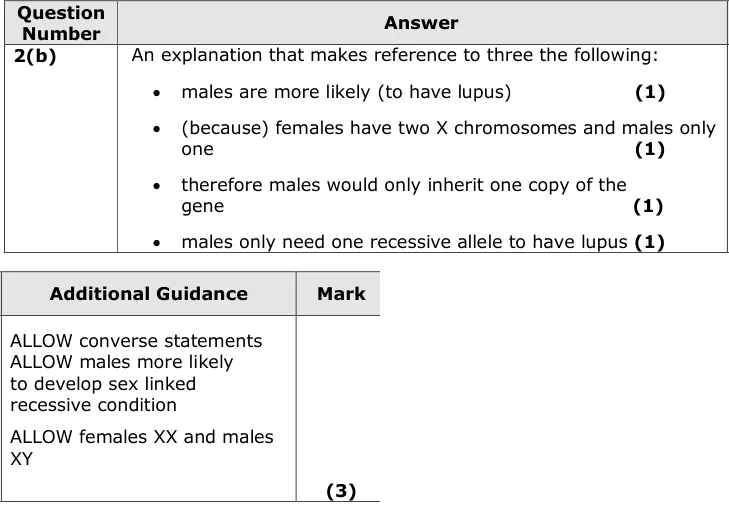
Explain how recessive X-linked alleles could affect the ratio of males to females with lupus.
Show the mark scheme
Tap an image to open it full size.
From the examiners' report: Many treated the five alleles as polygenic inheritance. Link the sex chromosomes to the recessive allele: males have one X chromosome, so one recessive allele causes lupus. Two X chromosomes do not make females twice as likely to have it.
Question 17
A level Paper 2 · June 2017 · Q5(a)(ii) · 2 marks
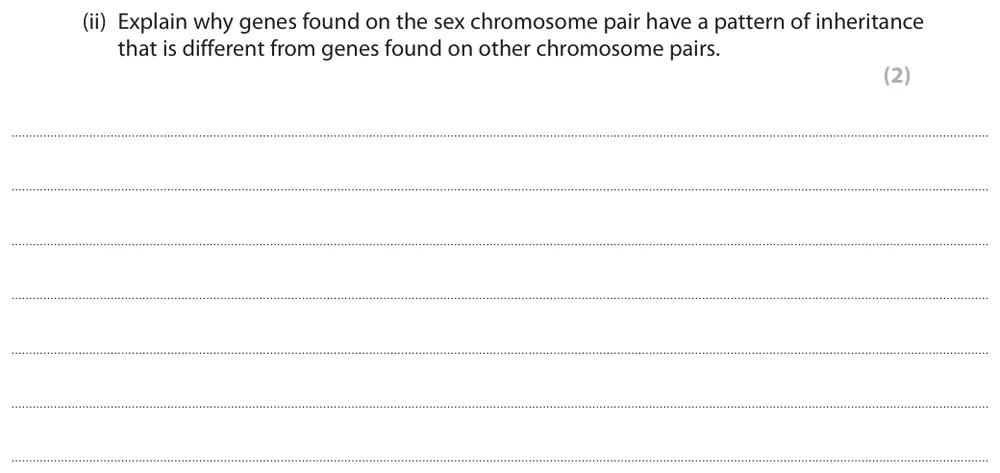
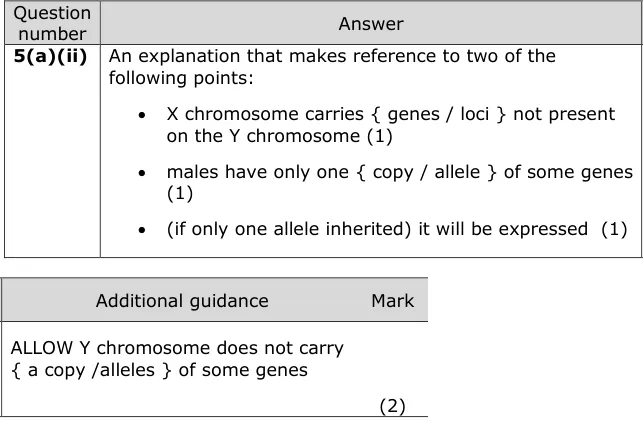
Explain why genes on the sex chromosomes are inherited differently from genes on other chromosomes.
Show the mark scheme
Tap an image to open it full size.
From the examiners' report: Many confused sex chromosomes with gametes, or wrote about crossing over or inheriting gender. Say that the X chromosome carries genes that are not on the Y chromosome, so males have only one allele of these genes, and it is expressed.
Question 18
A level Paper 2 · November 2021 · Q2(c) · 3 marks
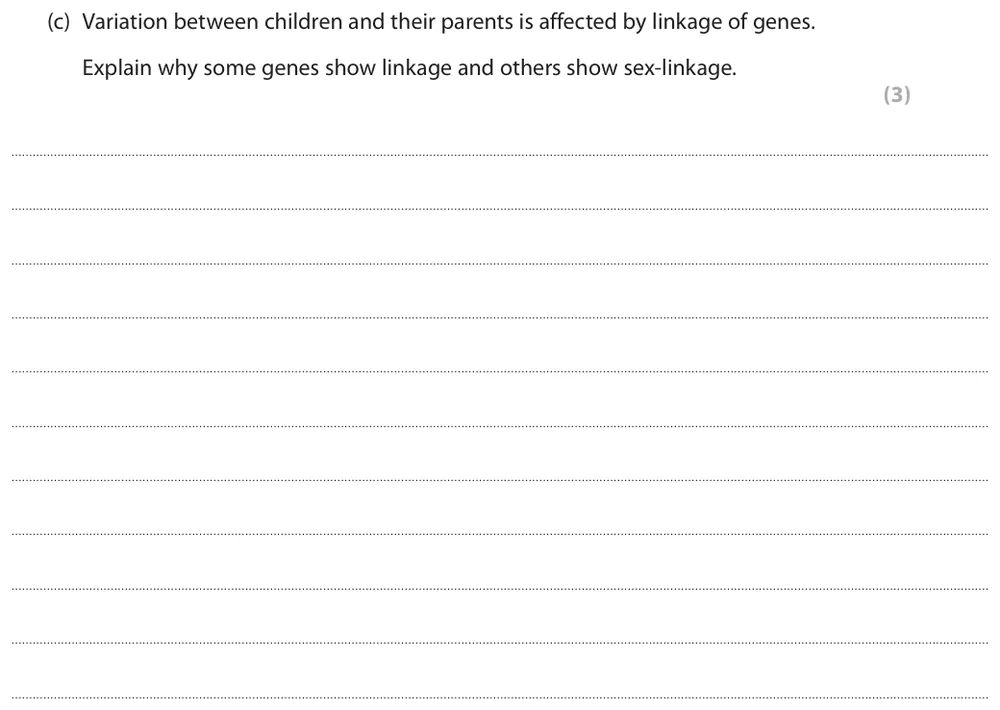
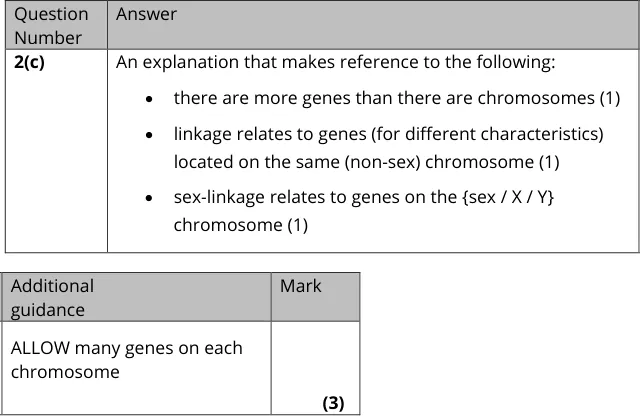
Explain why some genes show linkage and others show sex linkage.
Show the mark scheme
Tap an image to open it full size.
From the examiners' report: It was rare to see answers explaining why several genes must share a chromosome: there are more genes than chromosomes. Linkage is genes on the same non-sex chromosome; sex linkage is genes on a sex chromosome (X or Y). Sex linkage was usually better understood than linkage.
Question 19
A level Paper 1 · June 2023 · Q9(a)(ii) · 3 marks
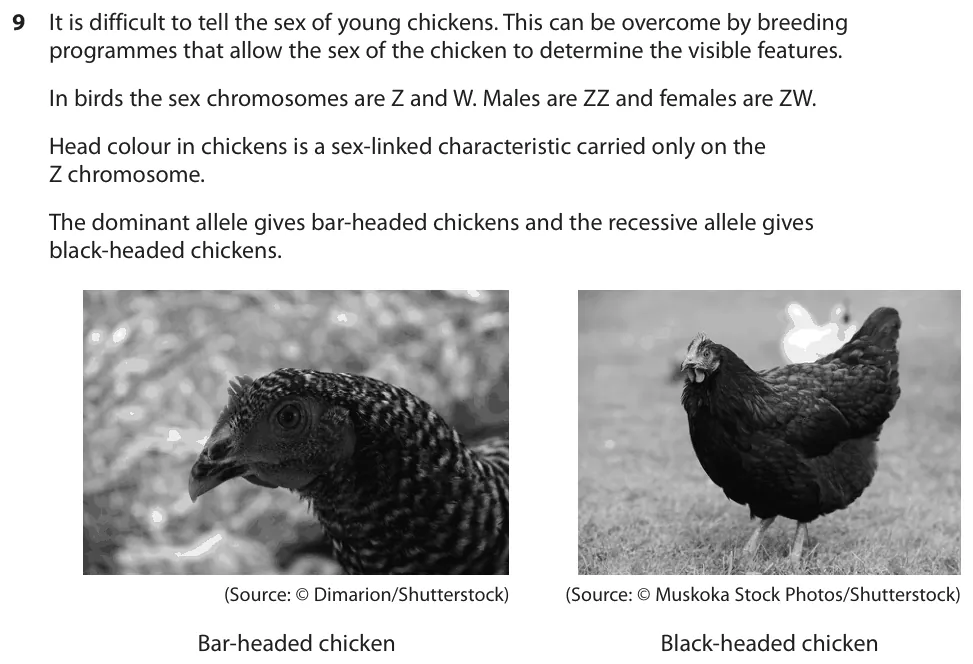
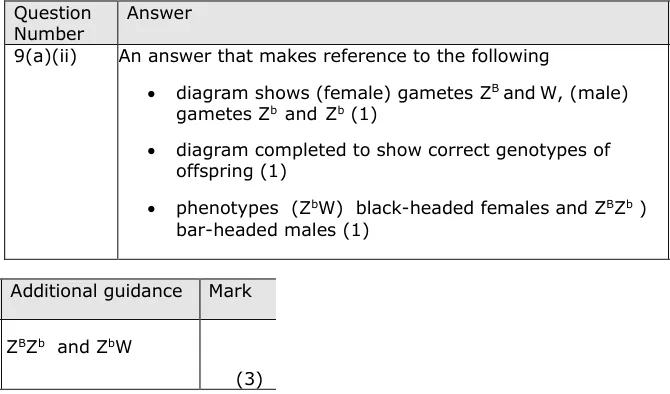
Draw a genetic diagram for a sex-linked cross between chickens.
Information from earlier in this question:

Show the mark scheme
Tap an image to open it full size.
From the examiners' report: Most drew a Punnett square, but marks were lost when the phenotypes were not stated. There is no allele for head colour on the W chromosome.
Question 20
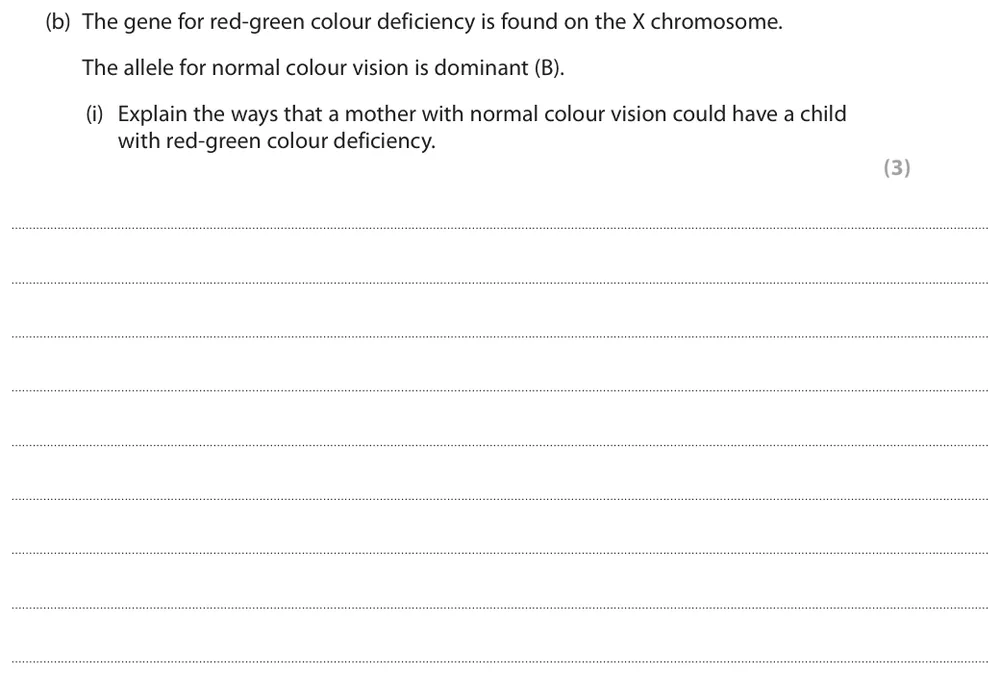
AS Paper 2 · June 2024 · Q3(b)(i) · 3 marks · Hard
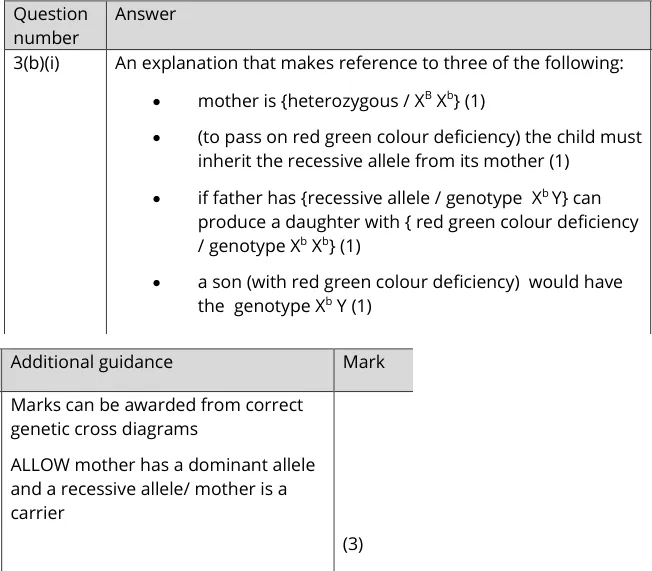
Explain how a mother with normal colour vision could have a child with red-green colour deficiency.
Show the mark scheme
Tap an image to open it full size.
From the examiners' report: Almost all said the mother must be a carrier. Better answers added that a father with the recessive allele on his X chromosome could have an affected daughter. A correct genetic diagram gained marks; write allele, not gene.
Where students lose marks (from Pearson examiners' reports and mark schemes)
Each point below comes from the examiners' reports and mark schemes, and is followed by wording that gained marks.
Midpiece mitochondria power the flagellum. Answers said energy for the sperm to 'move', or that mitochondria produce energy.
✔ Gains credit: 'Energy (ATP) for movement of the flagellum.'
A reacted acrosome can no longer digest the zona pellucida. Many saw more fully reacted acrosomes and concluded that sildenafil increases fertility.
✔ Gains credit: 'Fewer sperm with an intact acrosome to break down the zona pellucida, so sildenafil reduces fertility.'
The hardened zona pellucida keeps other sperm out. The final mark was rarely seen; most simply reworded the question.
✔ Gains credit: 'Cortical granules fuse with the egg cell membrane, the zona pellucida hardens, so other sperm cannot reach the egg cell membrane.'
Cortical granules release their contents, not themselves. 'Cortical granules are released into the zona pellucida' and 'the nuclei join' were not clear enough.
✔ Gains credit: 'Cortical granules release their contents, the zona pellucida hardens, and the haploid nuclei fuse.'
Mitochondria come from the egg cell, not 'the mother'. A common answer said the mitochondria are maternal, which repeats the question.
✔ Gains credit: 'Only the nucleus of the sperm enters the egg, so all the mitochondria come from the egg cell.'
Crossing over is likelier between distant loci. Many thought crossing over is more likely between loci that are close together, or more likely than not.
✔ Gains credit: 'Combinations on the same chromosome are more likely; a greater distance between loci gives a greater likelihood of crossing over.'
X-linked genes have no matching allele on the Y. Many confused sex chromosomes with gametes, or said the Y is small without explaining the effect.
✔ Gains credit: 'The X chromosome carries genes not present on the Y, so males have only one allele, which will be expressed.'
More genes than chromosomes means genes are linked. Few answers explained why several genes have to be on the same chromosome.
✔ Gains credit: 'There are more genes than chromosomes; linkage is genes on the same (non-sex) chromosome; sex linkage is genes on the X or Y chromosome.'
Download the questions
Download the PDF pack (20 questions, mark schemes at the end)
Keep practising
- Cell Structure and Organisation (Topic 3): Edexcel SNAB exam questions by topic
- Meiosis, Mitosis and Stem Cells (Topic 3): Edexcel SNAB exam questions by topic
- Gene Expression, Epigenetics and Phenotype (Topic 3): Edexcel SNAB exam questions by topic
- Topic 3 multiple-choice quiz (71 questions, marked as you tap)
- Edexcel SNAB A level Biology resources hub (every topic, practical and paper)
- Root Tip Squash and Mitosis (Core Practical 5): Edexcel SNAB A Level Biology Exam Questions
- Extended Response Questions (Topics 3 and 4): Edexcel SNAB A Level Biology Exam Questions
- Edexcel SNAB A level Biology past papers, mark schemes and examiners' reports
- Edexcel SNAB A level Biology grade boundaries
- Message Tom on WhatsApp about one-to-one Edexcel SNAB tutoring or an Edexcel group class
Questions, mark schemes and examiners' report extracts © Pearson Education Ltd.