

This page covers the specified practicals from the Core Concepts, with one from Component 2: food tests (iodine-potassium iodide, Benedict's for reducing and non-reducing sugars, biuret and the emulsion test), determining water potential from changes in mass, determining solute potential from incipient plasmolysis, membrane permeability in beetroot, the effects of temperature and of enzyme concentration on enzyme activity, extracting DNA, and the digestion of starch agar by germinating seeds. The written papers ask you to describe a test and its result, name the independent, dependent and controlled variables, calculate a mean or a percentage change, plot a graph, identify sources of inaccuracy, improve confidence in the data, adapt a method and reduce a risk. Questions marked AS are from the AS papers (B400); the rest are from the A level papers (A400).
The examiners' reports repeat that every specified practical can be assessed on the theory papers, not just the ones a centre uses for its practical assessment. Food tests cost marks: many candidates could not describe a simple Benedict's test or its colour change, gave Benedict's when asked for a protein test, or did not show a negative reducing sugar test first for a non-reducing sugar. In investigations, candidates confuse reliability with accuracy, and describe a change to the procedure when the question asks how to use the data. Graph marks are lost on unsuitable scales and misplaced plots. Name variables precisely: mass, not amount.
I don't teach the Eduqas specification myself, so for one-to-one help I recommend Sam. He teaches Eduqas A level Biology at a top-rated sixth form college and is very popular with his students. You can ask about lessons with Sam on WhatsApp using the link at the bottom of this page.
What you need first
Each question on this page assumes you're secure on these ideas. If any of them feels shaky, look it up before you start.
- Glucose is a reducing sugar and sucrose is a non-reducing sugar.
- Water moves by osmosis from a higher (less negative) water potential to a lower (more negative) water potential.
- Enzyme activity depends on temperature, pH, enzyme concentration and substrate concentration.
- The independent variable is the one you change, the dependent variable is the one you measure, and controlled variables are kept the same.
Key terms
These words come up in the questions and mark schemes. Examiners expect you to use them exactly.
- Benedict's reagent: a blue solution that changes to green, orange or brick red when heated with a reducing sugar.
- Non-reducing sugar: a sugar such as sucrose that gives a negative Benedict's test until it has been heated with acid and then neutralised with alkali.
- Biuret reagent: the test for protein: the solution changes from blue to violet, purple or lilac.
- Emulsion test: the test for lipids: mix the sample with ethanol, add to water and look for a cloudy white emulsion.
- Water potential (ψ): the tendency of water to leave a solution by osmosis. For a plant cell, ψcell = ψp + ψs.
- Incipient plasmolysis: the point at which the cell membrane just begins to pull away from the cell wall, so the pressure potential is zero.
- Semi-quantitative: giving an approximate value only, for example by judging a colour change.
- Reliability and accuracy: repeats and a mean improve reliability; better measurement, for example a balance reading to 0.01 g, improves accuracy.
What these questions cover
Every question on this page is set in one of these specified practicals from the Eduqas A level Biology specification (A400). Any of them can be examined on the written papers.
- CC1: Food tests to include: iodine-potassium iodide test for starch; Benedict's test for reducing and non-reducing sugars; biuret test for protein; emulsion test for fats and oils
- CC3: Determination of water potential by measuring changes in mass or length
- CC3: Determination of solute potential by measuring the degree of incipient plasmolysis
- CC3: Investigation into the permeability of cell membranes using beetroot
- CC4: Investigation into the effect of temperature or pH on enzyme activity
- CC4: Investigation into the effect of enzyme or substrate concentration on enzyme activity
- CC5: Simple extraction of DNA from living material
- 2.4: Investigation of the digestion of starch agar using germinating seeds
How to use this page
Write your answer on paper before you open the mark scheme. Allow about 1.2 minutes per mark: the 22 questions are worth 43 marks, so about 52 minutes in total. Then mark your answer strictly against the mark scheme and read the examiners' tip underneath it. If you'd rather print the questions, download the PDF pack.
Food tests
Question 1
A level Component 3 · Autumn 2020 · Q5(a)(ii) · 3 marks
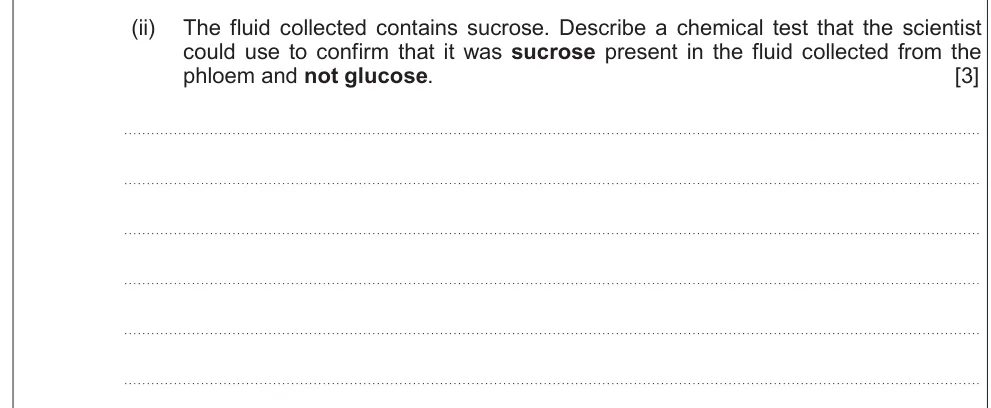
Describe a chemical test to confirm that a fluid from the phloem contains sucrose and not glucose.
Show the mark scheme

Tap an image to open it full size.
From the examiners' report: The sample is tested for a reducing sugar first, and this must stay blue. Adding acid, heating, adding alkali and then heating with Benedict's again all had to be present for the second mark.
Question 2
A level Component 3 · June 2017 · Q4(a)(i) · 3 marks
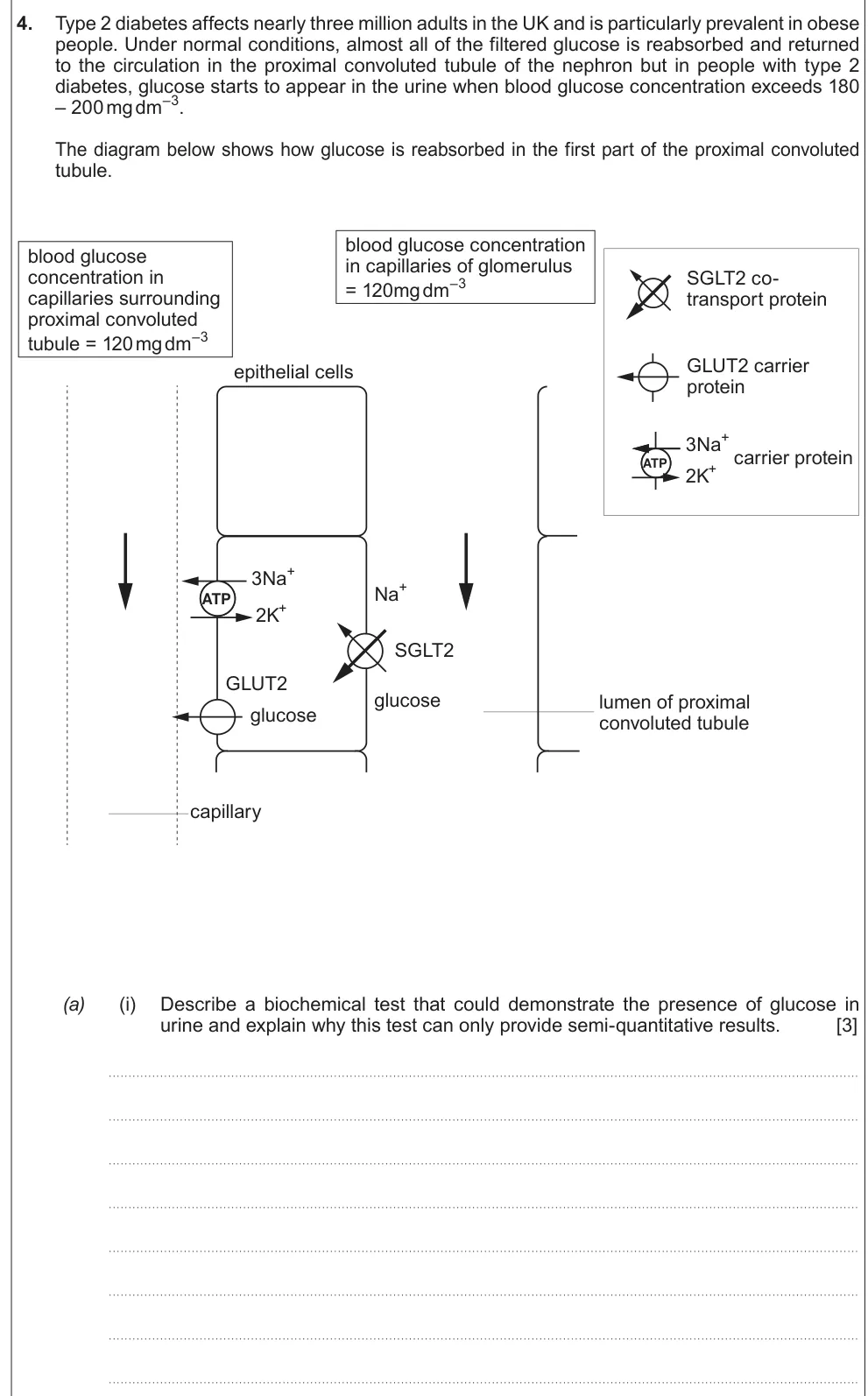
Describe a biochemical test for glucose in urine and explain why it gives only semi-quantitative results.
Show the mark scheme

Tap an image to open it full size.
From the examiners' report: Food tests are a specified practical, yet many candidates could not describe a simple Benedict's test for a reducing sugar or state the expected colour change.
Question 3
A level Component 2 · June 2024 · Q5(a)(ii) · 1 mark
Describe a chemical test to show that protein is present.

Show the mark scheme

Tap an image to open it full size.
From the examiners' report: The answer needed the name of the reagent, and Benedict's was often given by mistake, together with the result of the colour change. A wrong starting colour lost the mark.
Question 4
A level Component 3 · Autumn 2021 · Q1(c)(ii) · 1 mark
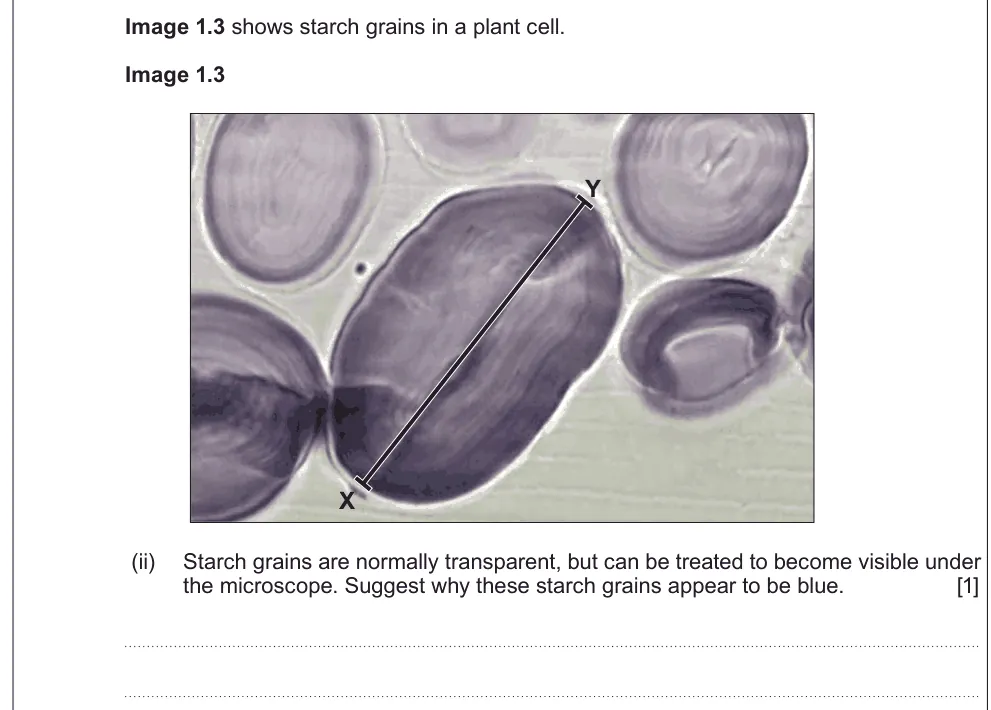
Suggest why the starch grains in a photomicrograph of a plant cell appear blue.
Show the mark scheme

Tap an image to open it full size.
From the examiners' report: Adding a blue dye was not enough for credit. Many gave Benedict's or biuret, and several gave Gram stain.
Question 5
AS Component 1 · Autumn 2020 · Q1(a)(iv) · 2 marks
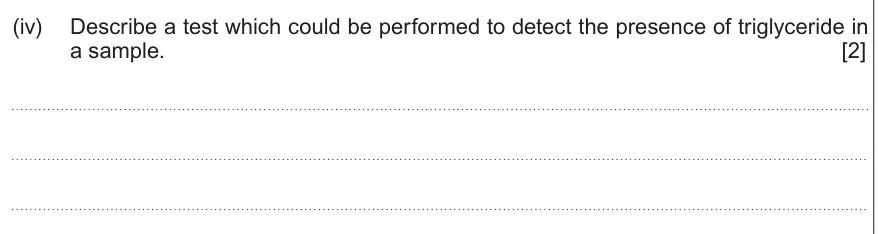
Describe a test for the presence of triglyceride in a sample.
Show the mark scheme

Tap an image to open it full size.
From the examiners' report: Almost all candidates could describe the ethanol test for triglycerides.
Determining water potential from changes in mass
Question 6
AS Component 1 · June 2022 · Q2(a)(i) · 2 marks
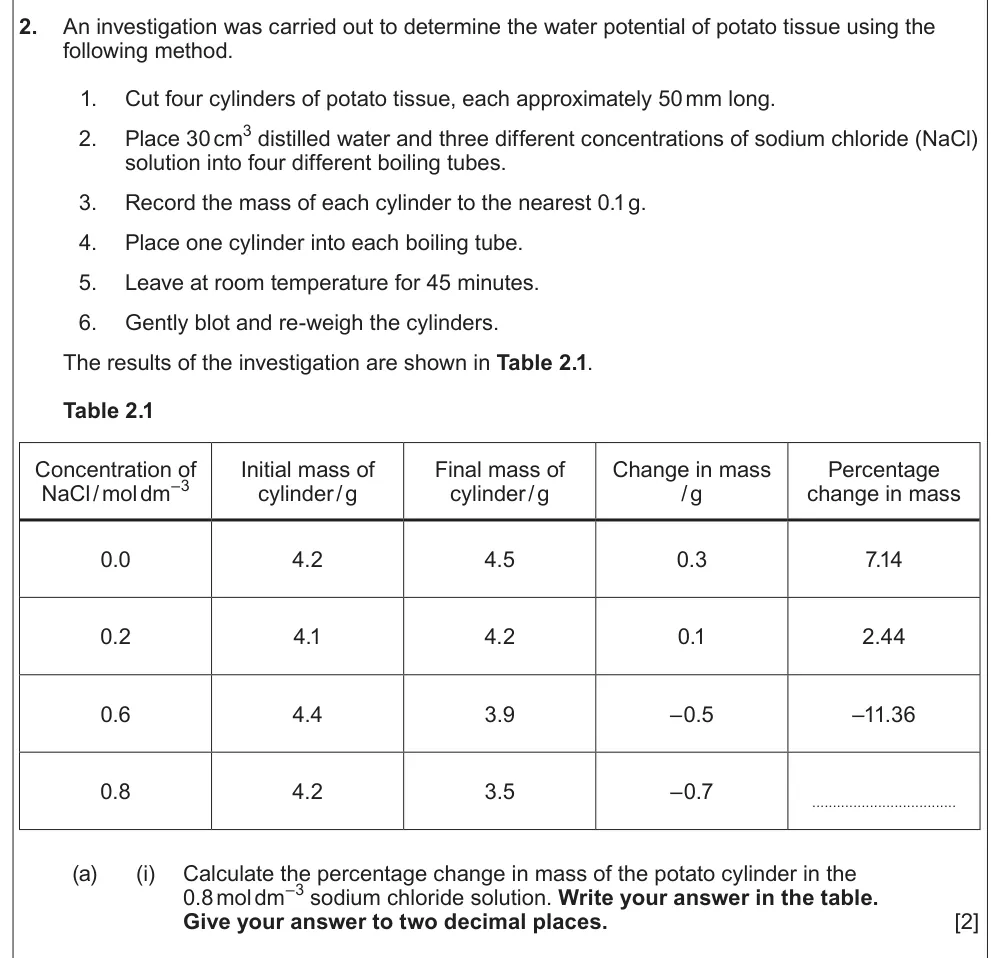
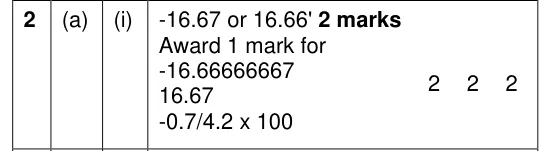
Calculate the percentage change in mass of a potato cylinder, to two decimal places.
Show the mark scheme
Tap an image to open it full size.
From the examiners' report: The majority calculated the percentage change in mass correctly.
Question 7
AS Component 1 · June 2022 · Q2(a)(iii) · 4 marks
Plot a graph of percentage change in mass against the concentration of sodium chloride solution.

Show the mark scheme

Tap an image to open it full size.
From the examiners' report: Marks were lost for misplaced plots or unsuitable scales, usually on the y-axis. Some compressed their scales even though there was plenty of grid space, which made the plots hard to read.
Question 8
AS Component 1 · June 2022 · Q2(a)(vi) · 2 marks
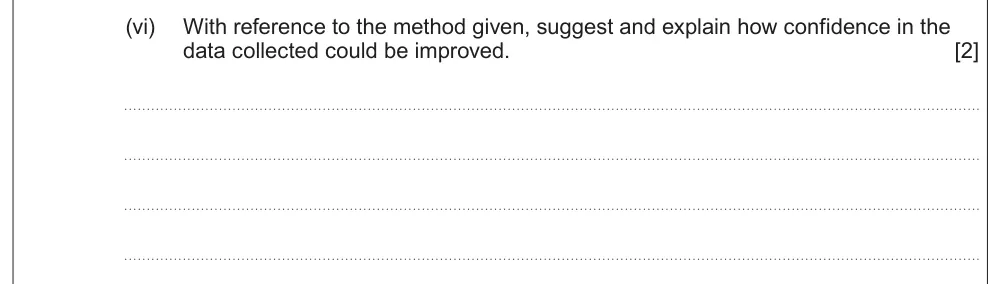
Suggest and explain how confidence in the data collected could be improved.
Show the mark scheme

Tap an image to open it full size.
From the examiners' report: A number of candidates confused reliability and accuracy in this part and the next, although the majority gave logical suggestions.
Determining solute potential from incipient plasmolysis
Question 9
AS Component 1 · June 2019 · Q6(b)(i) · 1 mark · Easy
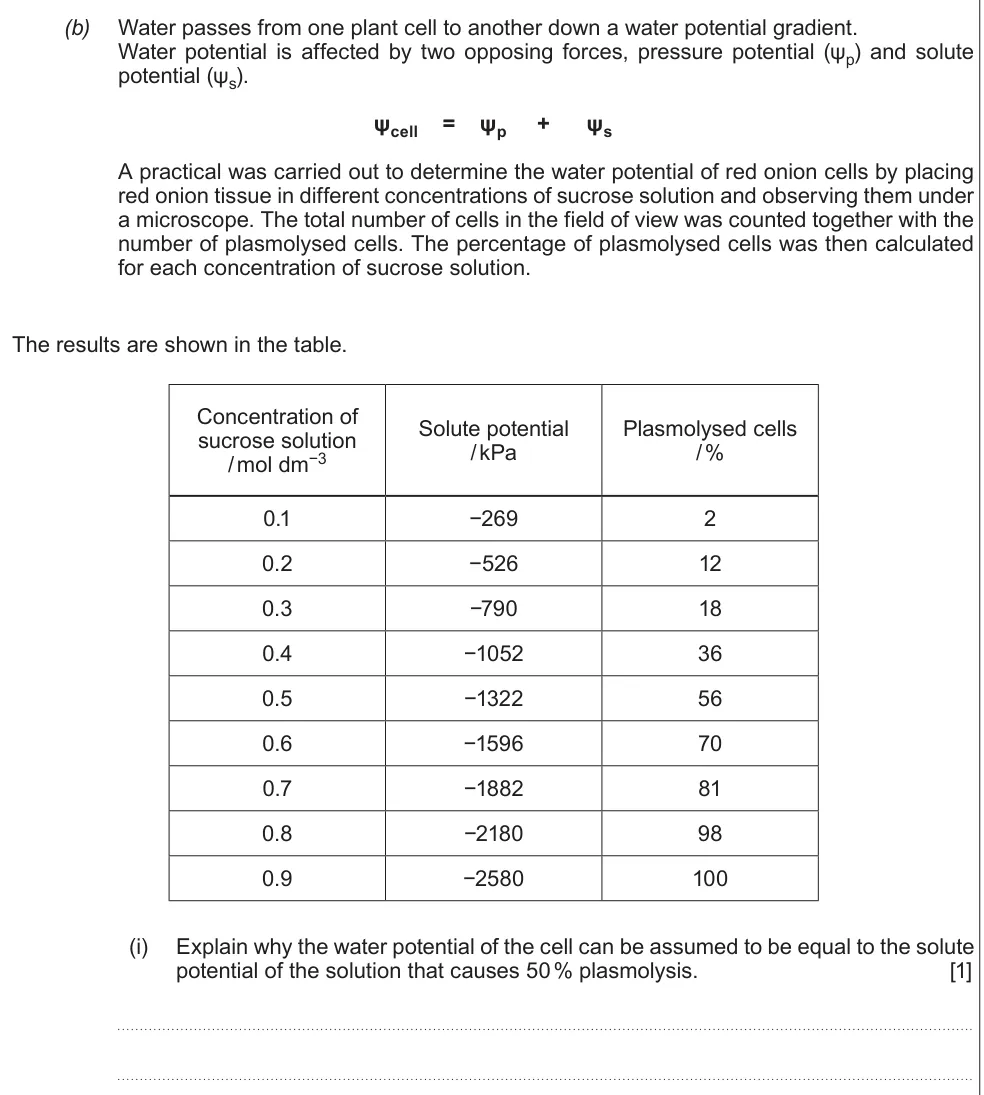
Explain why the water potential of a cell can be taken as equal to the solute potential of the solution that causes 50% plasmolysis.
Show the mark scheme

Tap an image to open it full size.
From the examiners' report: Good answers linked a pressure potential of zero to the cell membrane pulling away from the cell wall.
Question 10
AS Component 1 · June 2019 · Q6(b)(ii) · 1 mark · Easy
Use a table of results to estimate the water potential of onion tissue.

Show the mark scheme

Tap an image to open it full size.
From the examiners' report: Most identified a sensible negative value from the table. Less precise answers gave positive values and no units.
Question 11
AS Component 1 · June 2019 · Q6(b)(iii) · 2 marks
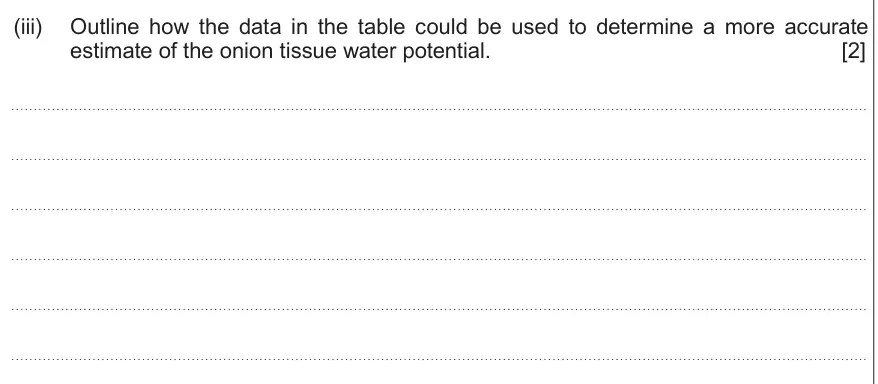
Outline how the data in the table could be used to get a more accurate estimate of the water potential.
Show the mark scheme

Tap an image to open it full size.
From the examiners' report: Many misread the question and gave an improvement to the procedure. It asks how to use the data already in the table.
Permeability of cell membranes using beetroot
Question 12
AS Component 1 · June 2023 · Q3(d)(ii) · 1 mark
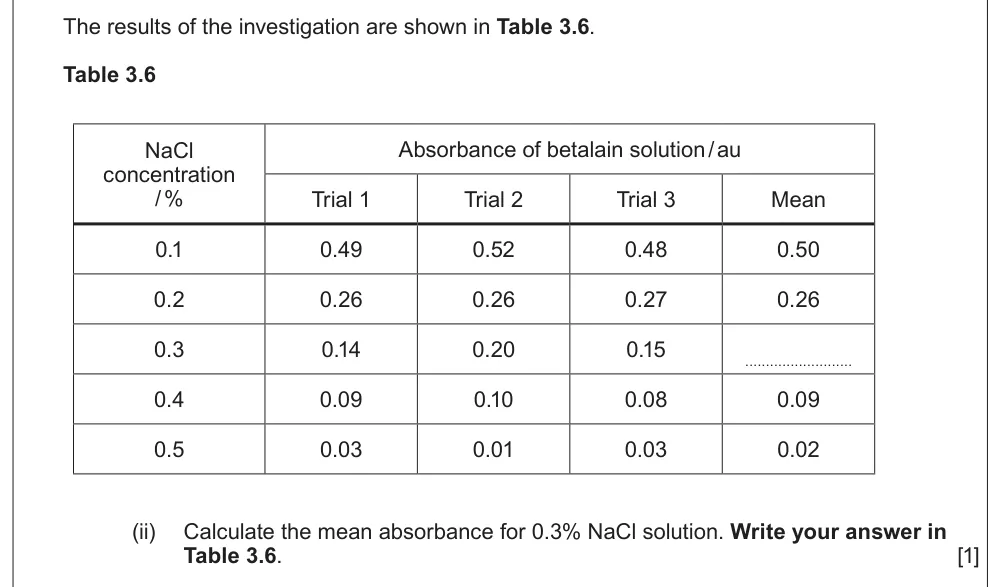
Calculate a mean absorbance from three trials and write it in the table.
Show the mark scheme

Tap an image to open it full size.
From the examiners' report: This caused little problem for many, but the examiners were surprised that several candidates could not calculate a mean from the data.
Question 13
AS Component 1 · June 2023 · Q3(d)(v) · 2 marks · Easy
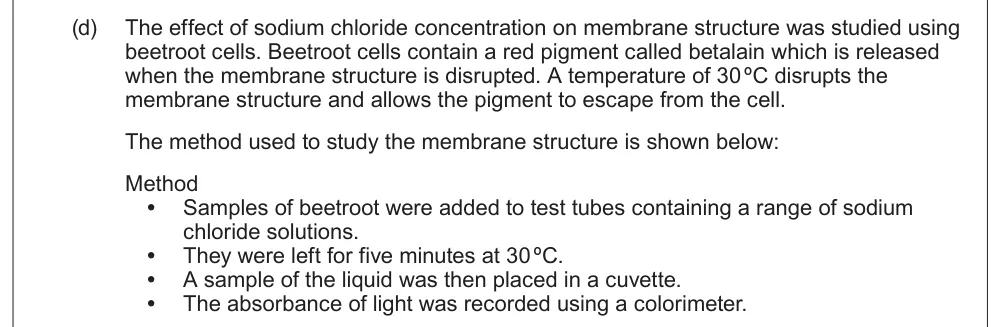
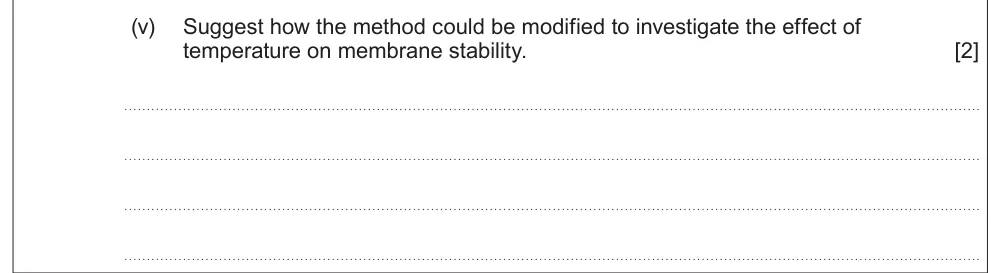
Suggest how the method could be changed to investigate the effect of temperature on membrane stability.
Information from earlier in this question:
Show the mark scheme

Tap an image to open it full size.
From the examiners' report: This was well answered. Most suggested a range of temperatures as the independent variable, many with examples, and some suggested thermostatically controlled water baths.
Effect of temperature on enzyme activity
Question 14
AS Component 1 · Autumn 2020 · Q3(a)(i) · 2 marks · Easy
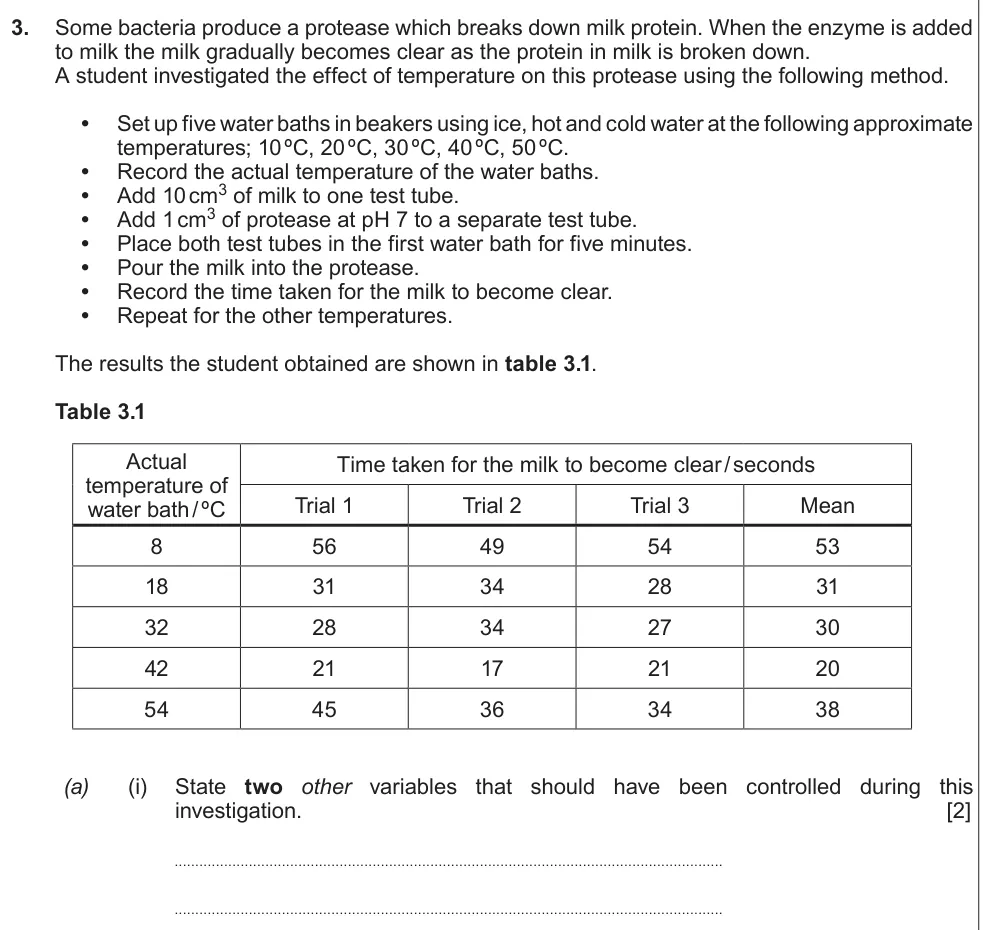
State two other variables that should have been controlled in an investigation of a protease and milk.
Show the mark scheme

Tap an image to open it full size.
From the examiners' report: Most candidates identified at least one controlled variable.
Question 15
AS Component 1 · Autumn 2020 · Q3(a)(ii) · 4 marks · Easy
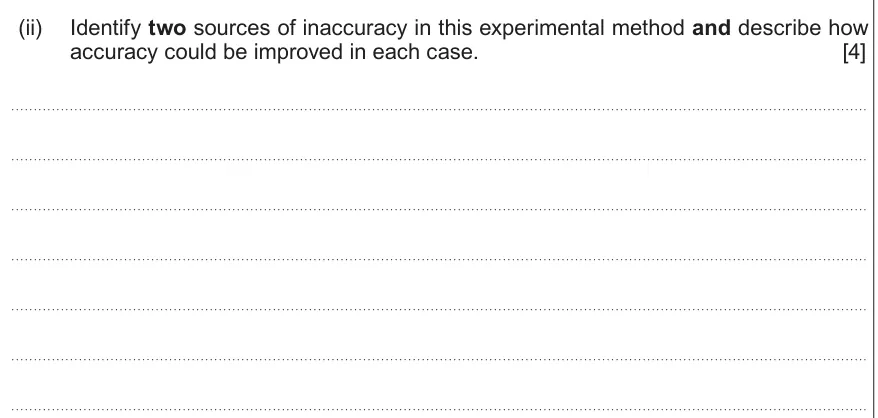
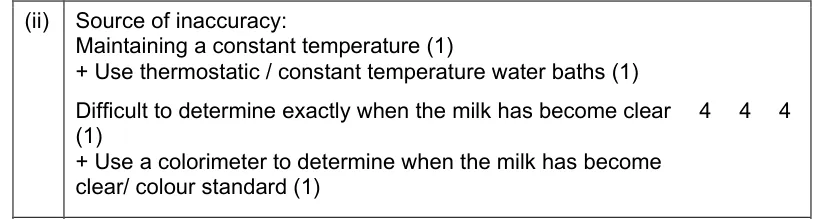
Identify two sources of inaccuracy in the method and describe how to improve accuracy for each one.
Show the mark scheme
Tap an image to open it full size.
From the examiners' report: The commonest sources of error given were the subjective end point of the reaction and the temperature changing during the investigation. Noticing that the method has no mixing step was also credited.
Question 16
AS Component 1 · Autumn 2020 · Q3(b)(ii) · 4 marks
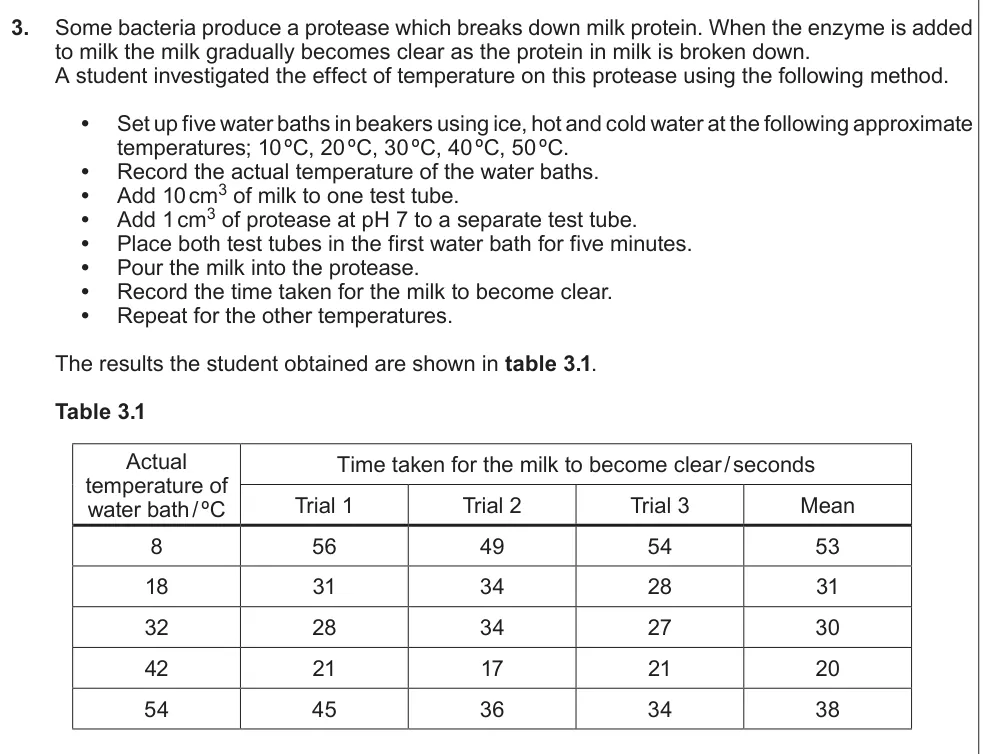
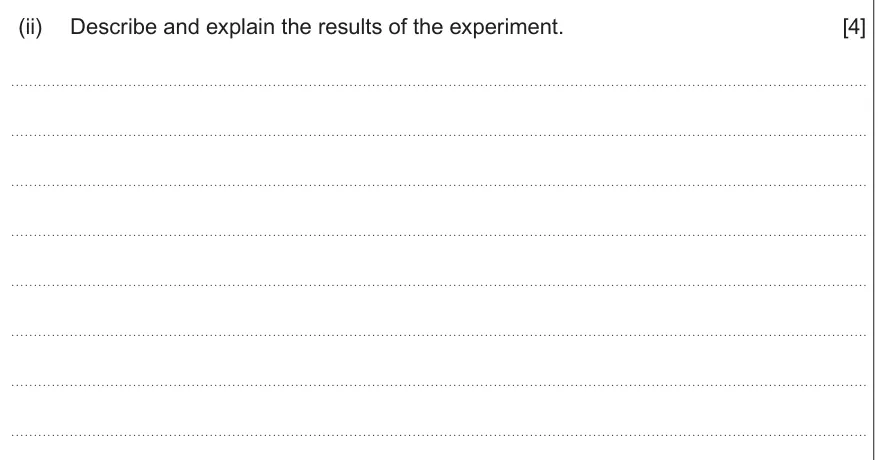
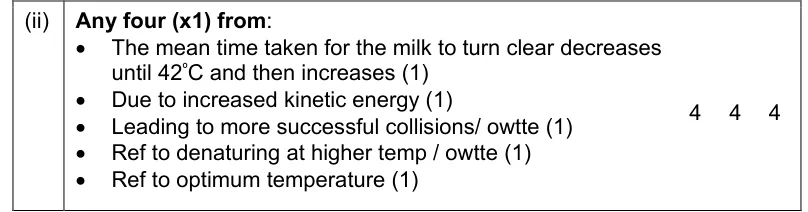
Describe and explain how temperature affected the time taken for the milk to become clear.
Information from earlier in this question:
Show the mark scheme
Tap an image to open it full size.
From the examiners' report: The best responses described the trend first and then built a logical explanation. Referring to specific ranges, such as between 8 °C and 42 °C, was an effective way to break the curve down.
Effect of enzyme concentration on enzyme activity
Question 17
AS Component 1 · June 2024 · Q3(b)(i) · 1 mark
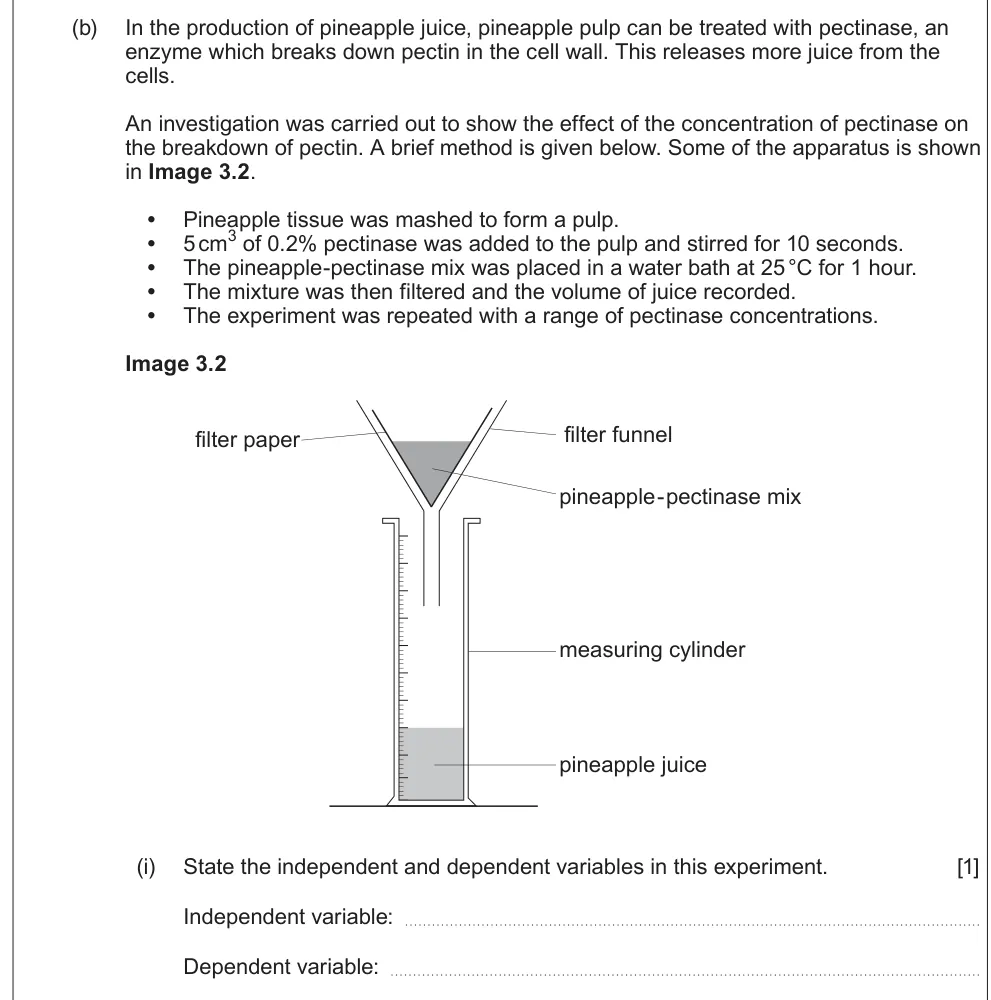
State the independent and dependent variables in an investigation of pectinase and pineapple pulp.
Show the mark scheme

Tap an image to open it full size.
From the examiners' report: Most candidates were able to identify the independent and dependent variables.
Question 18
AS Component 1 · June 2024 · Q3(b)(ii) · 2 marks
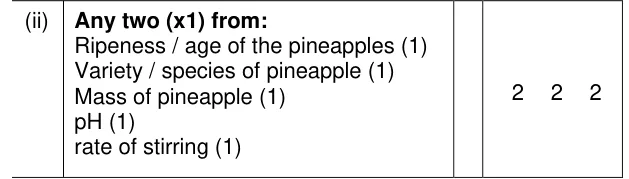
Suggest two variables that were not controlled in the pectinase investigation.

Show the mark scheme
Tap an image to open it full size.
From the examiners' report: More errors were made here. A common one was giving the amount or volume of pineapple rather than its mass; more able candidates referred to the type or species of pineapple.
Extracting DNA from living material
Question 19
A level Component 2 · Autumn 2020 · Q3(b)(i) · 1 mark
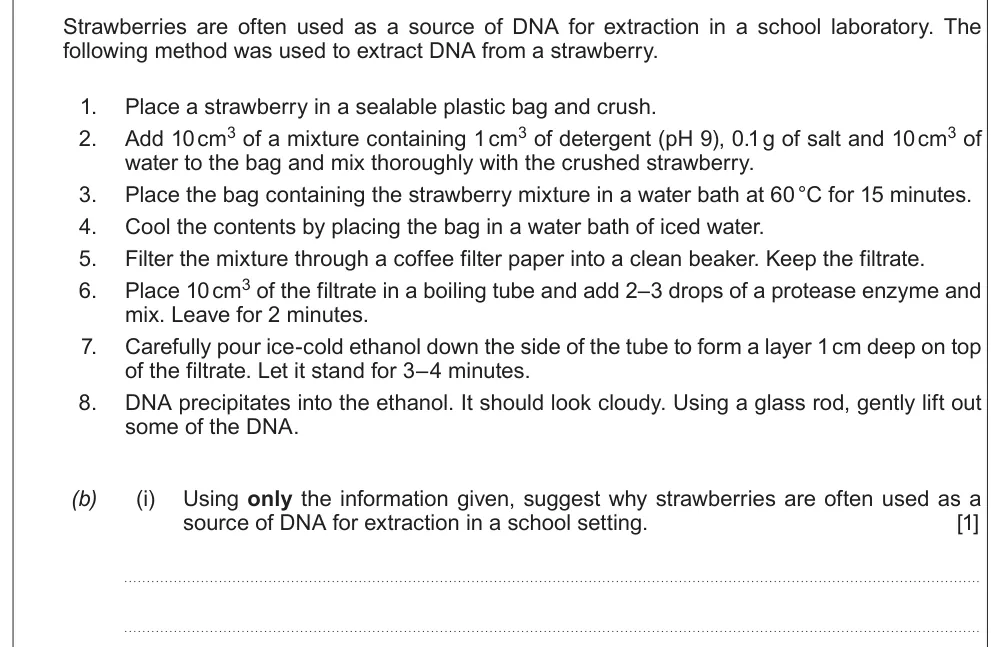
Use the method given to suggest why strawberries are often used as a source of DNA in school.
Information from earlier in this question:

Show the mark scheme

Tap an image to open it full size.
From the examiners' report: This is the DNA extraction practical from the laboratory manual. The report repeats that all the practicals can be assessed in theory papers, not just those a centre uses for its practical assessment.
Question 20
A level Component 2 · Autumn 2020 · Q3(b)(ii) · 1 mark
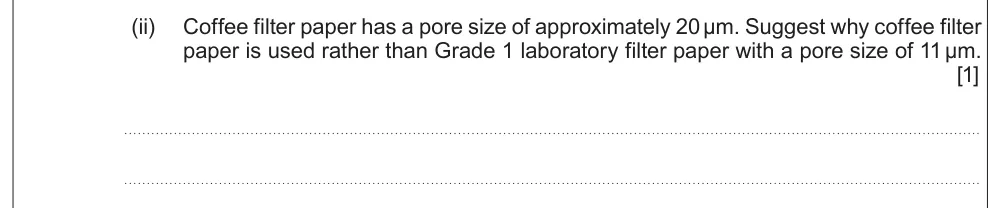
Suggest why coffee filter paper is used in the extraction and not laboratory filter paper with smaller pores.
Show the mark scheme

Tap an image to open it full size.
Digestion of starch agar by germinating seeds
Question 21
A level Component 2 · June 2022 · Q2(a)(ii) · 2 marks
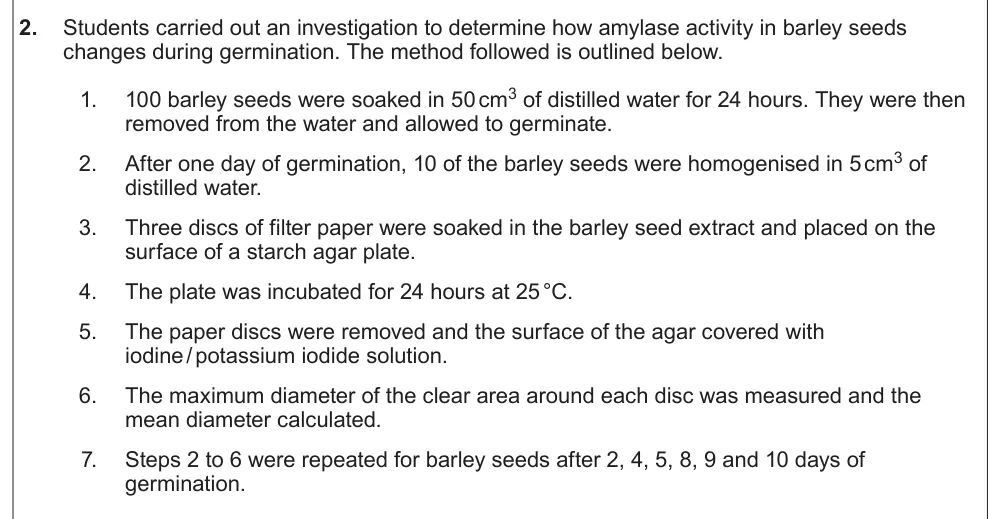
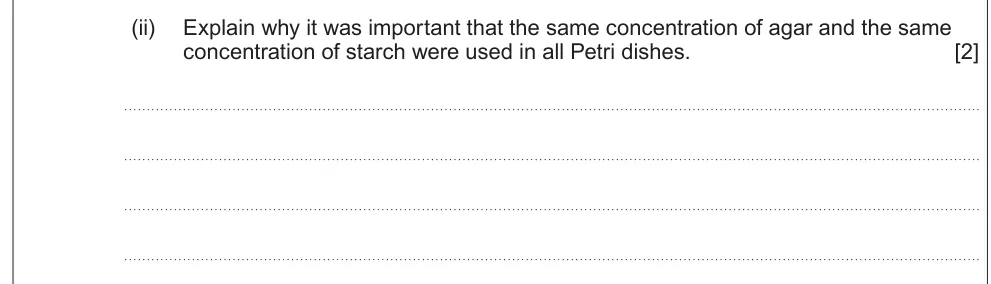
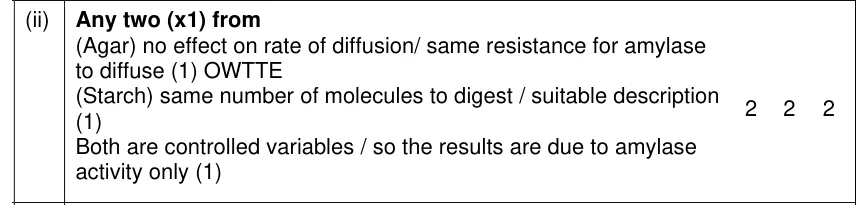
Explain why the same concentrations of agar and starch were used in every Petri dish.
Information from earlier in this question:
Show the mark scheme
Tap an image to open it full size.
From the examiners' report: This needed an understanding of controlled variables and the purpose of controlling them. There was a great deal of confusion between making sure only one independent variable is tested and improving accuracy.
Question 22
A level Component 2 · June 2025 · Q4(b)(i) · 1 mark
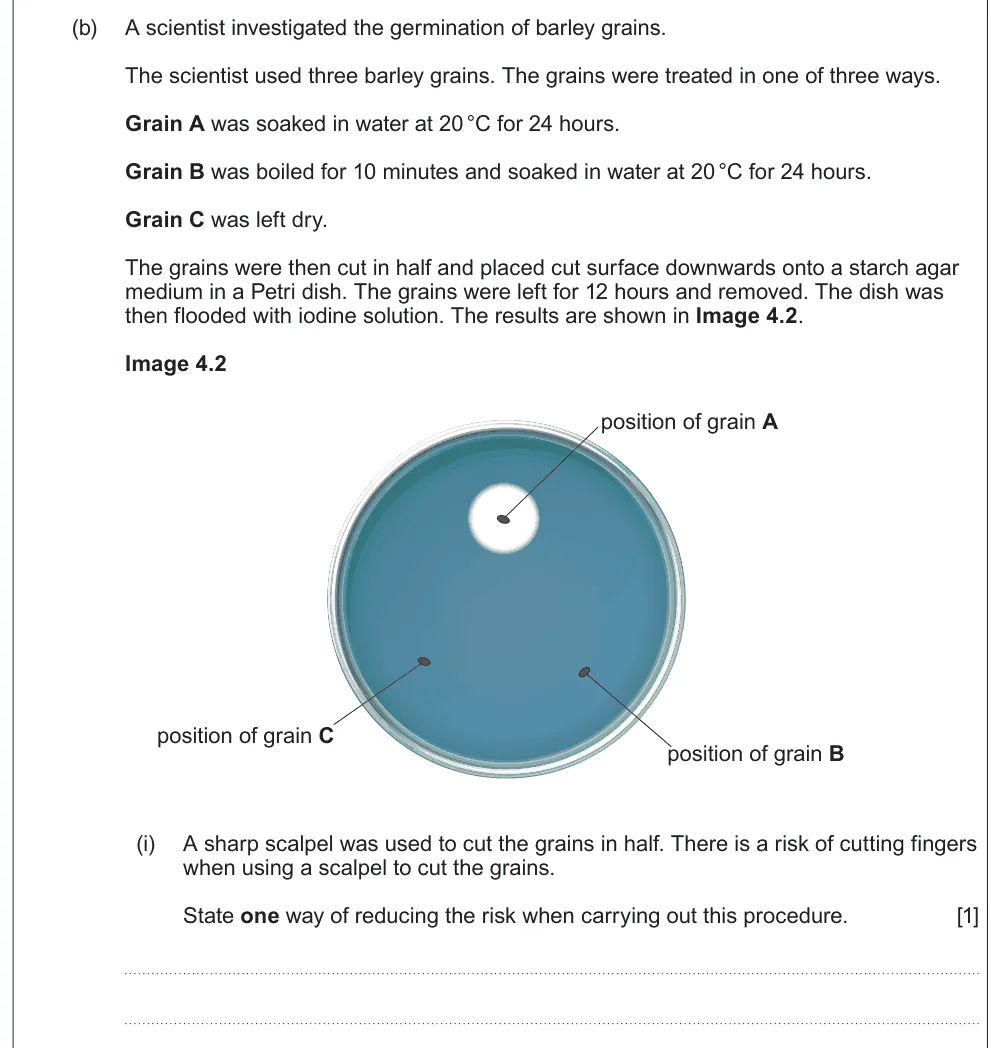
State one way of reducing the risk of cut fingers when halving barley grains with a scalpel.
Show the mark scheme

Tap an image to open it full size.
From the examiners' report: Using gloves or safety goggles does not gain credit for reducing the risk when using a scalpel.
Where students lose marks (from Eduqas examiners' reports and mark schemes)
Each point below is followed by wording that gained marks.
A negative Benedict's test comes first: Answers for a non-reducing sugar left out the first test for a reducing sugar, or missed one of the steps that follow it.
✔ Gains credit: "Benedict's test is negative, then add acid, heat, then add alkali, then Benedict's; turns from blue to orange / brick red."
Biuret for protein, not Benedict's: Benedict's was often given as the reagent for protein, and some gave a wrong starting colour.
✔ Gains credit: "Add Biuret and turns from blue to violet / purple / lilac."
A blue dye is not a named reagent: Saying that a blue dye had been added gained no credit, and many gave Benedict's, biuret or Gram stain.
✔ Gains credit: "Iodine (solution has been added)."
Say why a colour test is only approximate: Many could not describe a simple Benedict's test for a reducing sugar or state the expected colour change.
✔ Gains credit: "Add Benedict's and boil / heat; colour change from blue to green / brick red demonstrates presence of glucose; colour change indicates approximate values of glucose in urine only / is subjective."
Confidence in data means repeats and a mean: A number of candidates confused reliability and accuracy.
✔ Gains credit: "Repeats and calculate mean / standard deviation. This increases reliability / allows anomalous results to be excluded."
Using the data is not changing the method: Many misinterpreted the question and gave an improvement to the procedure when asked how the data in the table could give a more accurate estimate.
✔ Gains credit: "Plot percentage plasmolysed against solute potential; read down from 50% plasmolysed to solute potential."
Mass of tissue, not amount or volume: A common error was to give the amount or volume of pineapple as the uncontrolled variable.
✔ Gains credit: "Mass of pineapple; ripeness / age of the pineapples; variety / species of pineapple; pH; rate of stirring."
Gloves and goggles do not stop a scalpel cut: Wearing gloves or safety goggles was offered as the way to reduce the risk and gained no credit.
✔ Gains credit: "Cut away from body (onto a tile) / use forceps or tweezers to hold grain."
Download the questions
Download the PDF pack (22 questions, mark schemes at the end)
Keep practising
- Microscopy, Drawing and Dissection (Specified Practicals): Eduqas A Level Biology Exam Questions
- Photosynthesis, Respiration and Transpiration (Specified Practicals): Eduqas A Level Biology Exam Questions
- Ecology, Genetics and Statistics (Specified Practicals): Eduqas A Level Biology Exam Questions
- Biological Compounds (CC1): Eduqas A Level Biology exam questions by topic
- Cell Membranes and Transport (CC3): Eduqas A Level Biology exam questions by topic
- Enzymes (CC4): Eduqas A Level Biology exam questions by topic
- Nucleic Acids and their Functions (CC5): Eduqas A Level Biology exam questions by topic
- Sexual Reproduction in Plants (2.4): Eduqas A Level Biology exam questions by topic
- Eduqas A level Biology revision resources by topic
- Eduqas A level Biology past papers, mark schemes and examiners' reports
- Eduqas A level Biology grade boundaries
- Ask about Eduqas A level Biology lessons with Sam on WhatsApp
Questions, mark schemes and examiners' report extracts © WJEC CBAC Ltd (Eduqas).