

Enzymes is the Core Concept that turns up inside questions on almost every other topic, from respiration and digestion to fertilisation and pollution sensors. You need the protein nature of enzymes, active sites, the lock and key and induced fit models (lysozyme), activation energy, the effects of temperature, pH and concentration, competitive and non-competitive inhibition, and immobilised enzymes. Questions marked AS are from the AS papers (B400); the rest are from the A level papers (A400).
The examiners' reports want precise language. The active site is complementary to the substrate, not a perfect match; heat breaks hydrogen bonds, not all bonds; and advantages of immobilised enzymes must fit the situation in the question. When you explain rate data, use comparative words such as highest substrate concentration and link them to enzyme-substrate complexes.
I don't teach the Eduqas specification myself, so for one-to-one help I recommend Sam. He teaches Eduqas A level Biology at a top-rated sixth form college and is very popular with his students. You can ask about lessons with Sam on WhatsApp using the link at the bottom of this page.
What you need from GCSE and Year 12
Each question on this page assumes you're secure on these ideas. If any of them feels shaky, look it up before you start.
- Enzymes are biological catalysts that speed up reactions without being used up.
- Each enzyme has an active site with a shape that fits its substrate.
- High temperatures and extremes of pH denature enzymes so they stop working.
- Amylase breaks down starch, proteases break down proteins and lipases break down lipids.
Key terms
These words come up in the questions and mark schemes. Examiners expect you to use them exactly.
- Active site: the region of an enzyme with a specific 3D shape that is complementary to the substrate.
- Enzyme-substrate complex: the enzyme and substrate bound together at the active site.
- Induced fit: the active site changes shape slightly as the substrate binds, then returns to its original shape.
- Activation energy: the energy needed to start a reaction; enzymes lower it.
- Denaturation: a permanent change in the shape of the active site when hydrogen and ionic bonds break.
- Intracellular enzyme: an enzyme that works inside the cell that made it.
- Competitive inhibitor: a molecule similar in shape to the substrate that binds to the active site.
- Non-competitive inhibitor: a molecule that binds away from the active site (an allosteric site) and changes its shape.
- Immobilised enzyme: an enzyme fixed to an inert material, such as alginate beads, so it can be reused.
What these questions cover (Eduqas CC4)
The questions test these statements from Core Concept 4 of the Eduqas A level Biology specification (A400). Core Concepts are taught in Year 12, examined in AS Component 1 and tested again in every A level paper.
- (a) metabolism as a series of enzyme controlled reactions
- (b) the protein nature of enzymes
- (c) enzymes acting intracellularly or extracellularly
- (d) active sites, interpreted in terms of three dimensional structure
- (e) the theory of induced fit as illustrated by lysozyme
- (f) the meaning of catalysis
- (g) the influence of temperature, pH, substrate and enzyme concentration on rate of activity and inactivation and denaturation of enzymes and the importance of buffers for ma
- (h) the principles of competitive and non-competitive inhibition
- (i) the importance of immobilised enzymes and that industrial processes use immobilised enzymes, allowing enzyme reuse and improving stability
How to use this page
Write your answer on paper before you open the mark scheme. Allow about 1.2 minutes per mark: the 20 questions are worth 44 marks, so about 53 minutes in total. Then mark your answer strictly against the mark scheme and read the examiners' tip underneath it. If you'd rather print the questions, download the PDF pack.
Enzyme structure and specificity
Question 1
A level Component 3 · June 2022 · Q3(c)(ii) · 2 marks
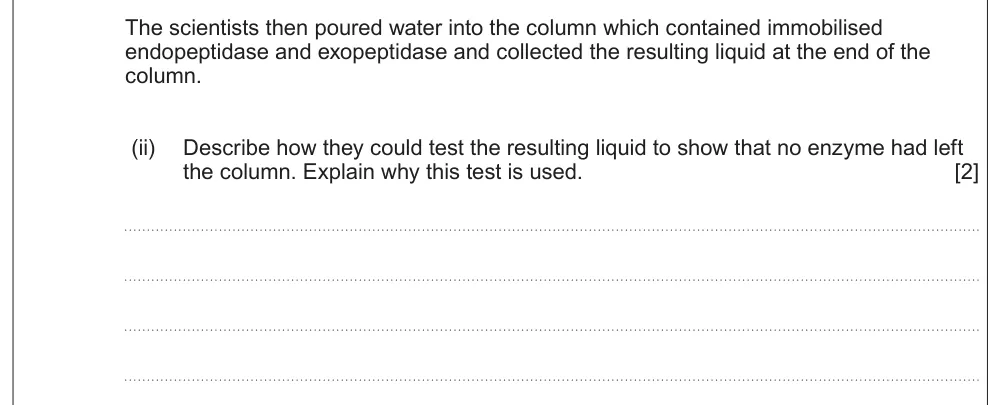
Describe how to show that no enzyme has left an immobilised enzyme column, and why.
Show the mark scheme

Tap an image to open it full size.
From the examiners' report: Add biuret: it stays blue because no protein (enzyme) is present. Many students said it would go violet and gave no explanation.
Question 2
A level Component 2 · June 2023 · Q1(a)(i) · 1 mark
Name the enzymes that work inside cells.

Show the mark scheme

Tap an image to open it full size.
From the examiners' report: Intracellular. The most common wrong answers were "intercellular" or the name of an enzyme.
Question 3
A level Component 3 · June 2024 · Q5(a)(i) · 2 marks
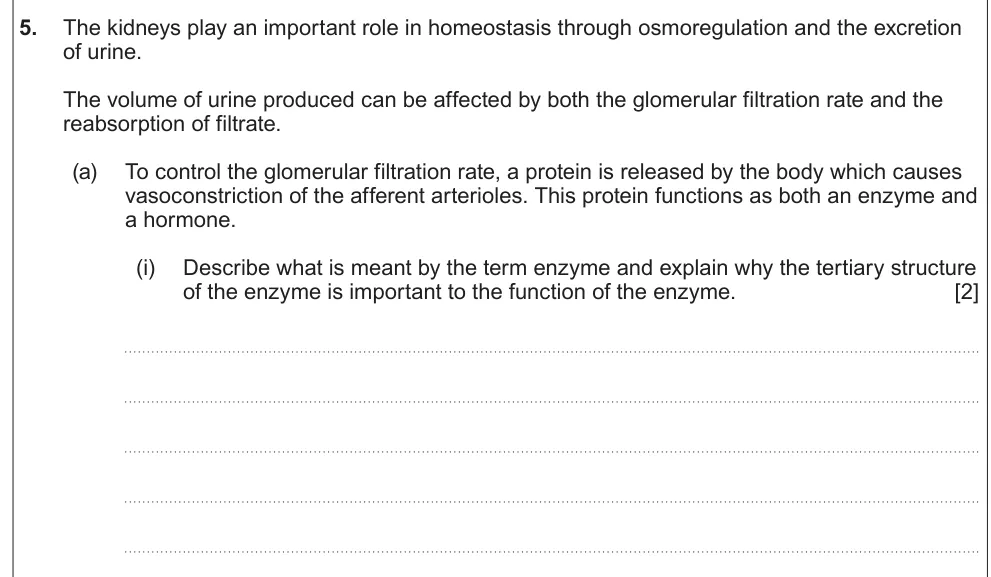
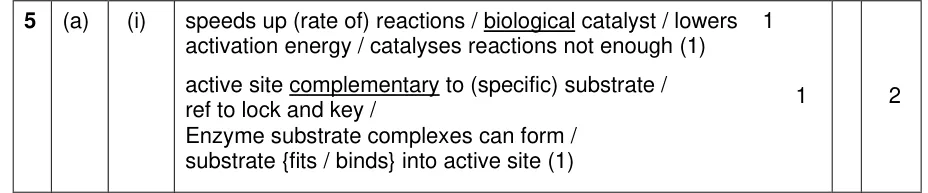
Say what an enzyme is and why its tertiary structure matters.
Show the mark scheme
Tap an image to open it full size.
From the examiners' report: Most students said biological catalyst, but many didn't mention the active site when explaining why the tertiary structure matters.
Question 4
A level Component 2 · June 2025 · Q5(a)(ii) · 2 marks
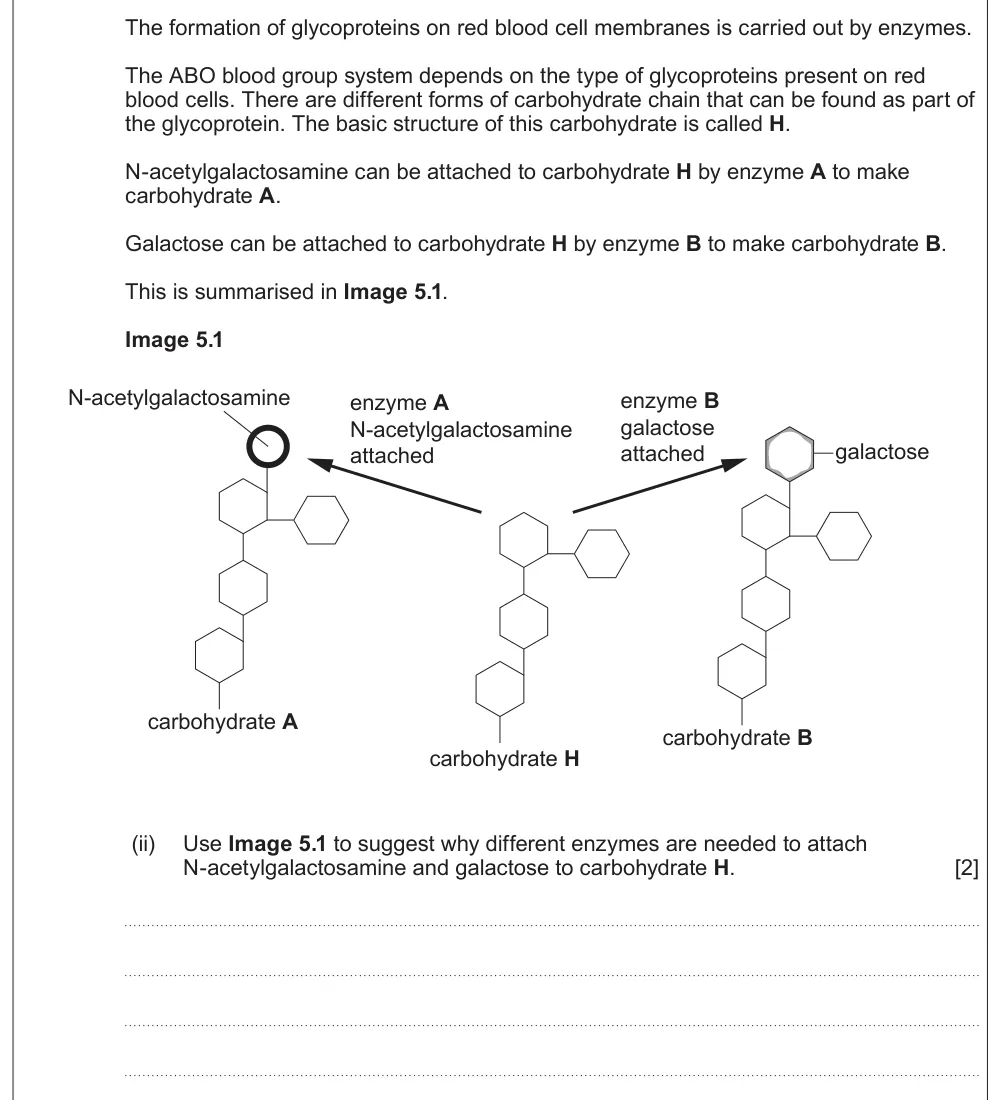
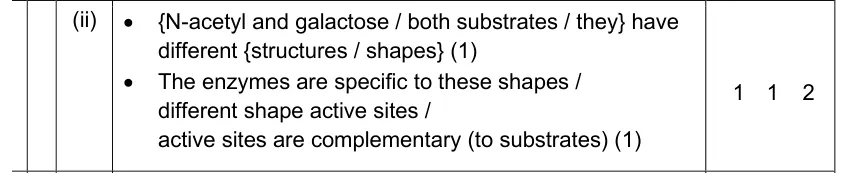
Suggest why two different enzymes are needed to attach two different sugars.
Show the mark scheme
Tap an image to open it full size.
From the examiners' report: This tests specificity. Substrates don't have active sites: some students lost the mark by writing about the active sites of the sugars.
Question 5
AS Component 2 · June 2016 · Q6(a)(i) · 3 marks
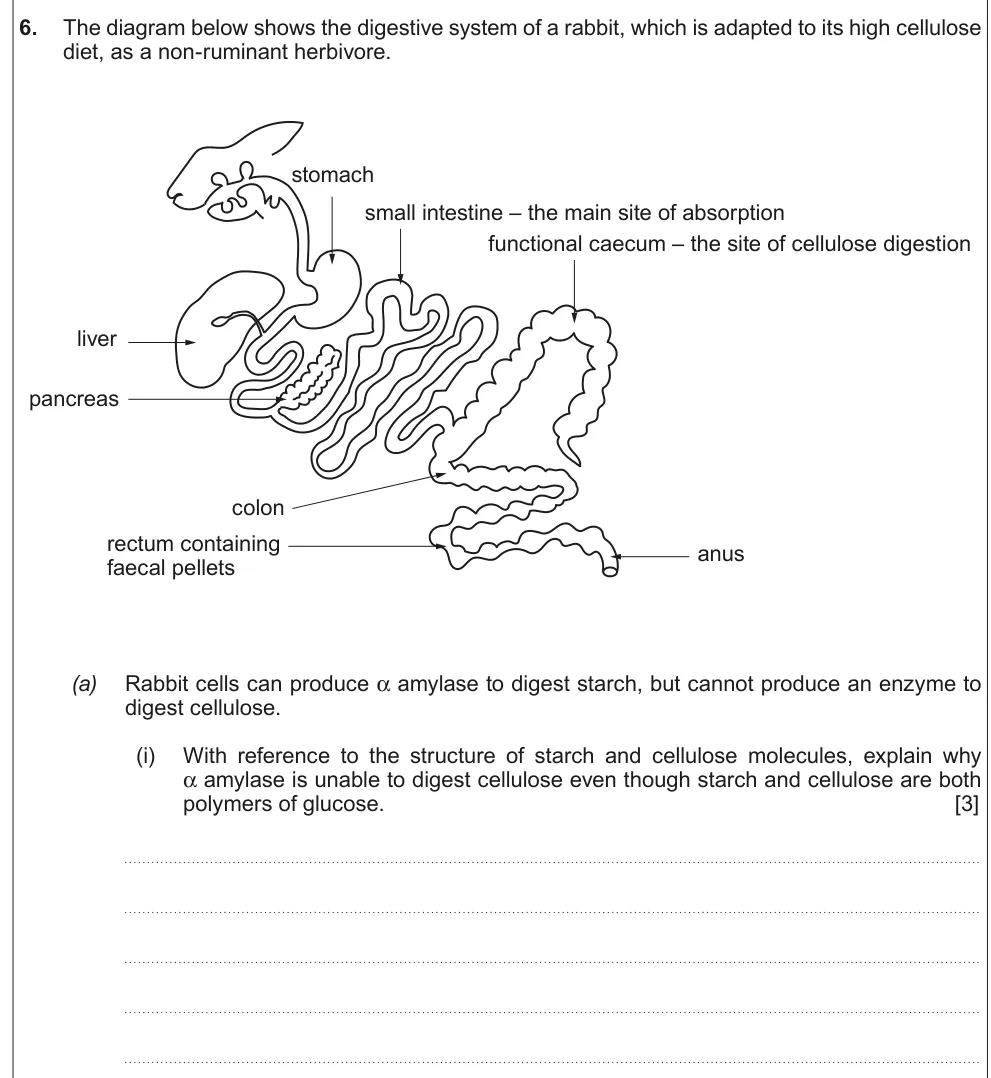
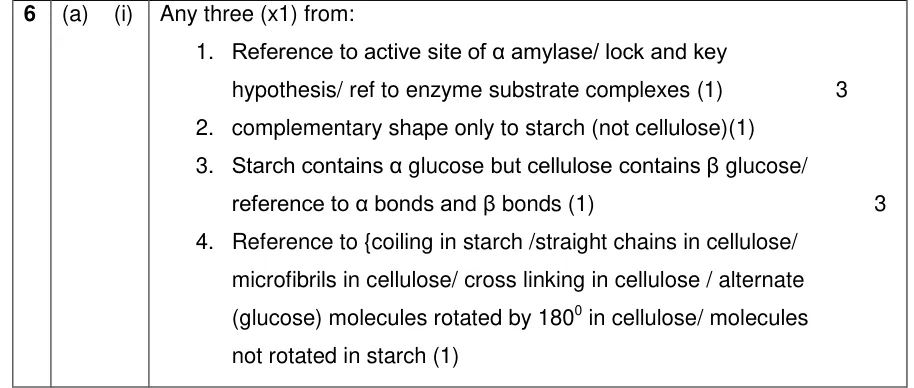
Explain why amylase can't digest cellulose.
Show the mark scheme
Tap an image to open it full size.
From the examiners' report: Refer to the difference between starch and cellulose (alpha and beta glucose), then explain it in terms of the active site and the 3D shape of the substrate.
Models of enzyme action
Question 6
AS Component 1 · June 2023 · Q1(b)(iii) · 4 marks · Easy
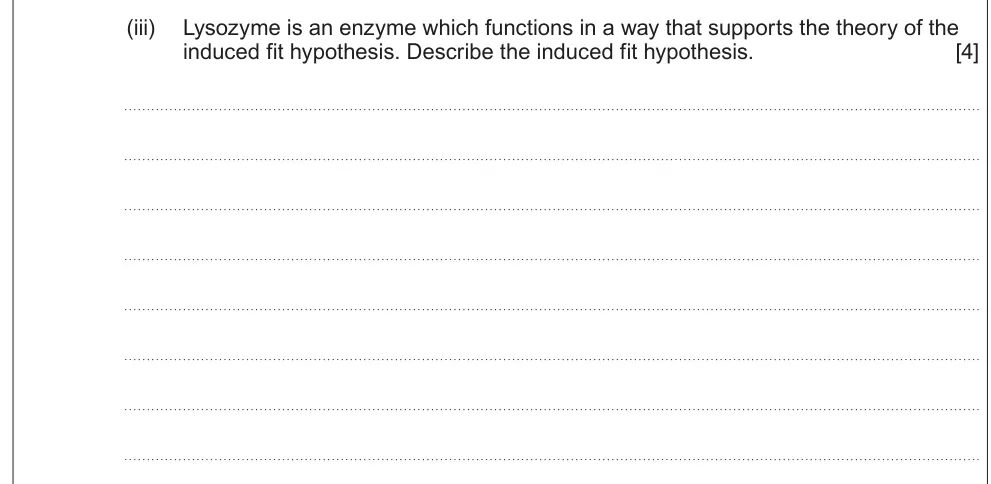
Describe the induced fit hypothesis.
Show the mark scheme

Tap an image to open it full size.
From the examiners' report: Many students answered this well. Some didn't finish by saying the active site returns to its original shape.
Question 7
AS Component 1 · June 2023 · Q1(b)(iv) · 2 marks
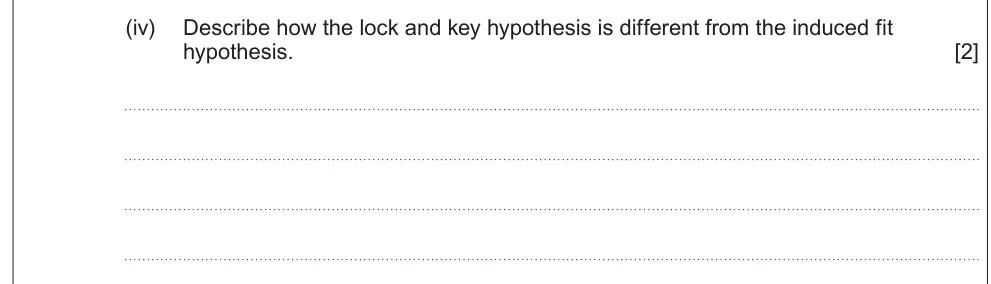
Describe how the lock and key hypothesis differs from induced fit.
Show the mark scheme

Tap an image to open it full size.
From the examiners' report: The shapes are complementary. Weaker answers said they "match" or are a "perfect" fit.
Factors affecting rate
Question 8
A level Component 1 · June 2019 · Q2(d) · 3 marks
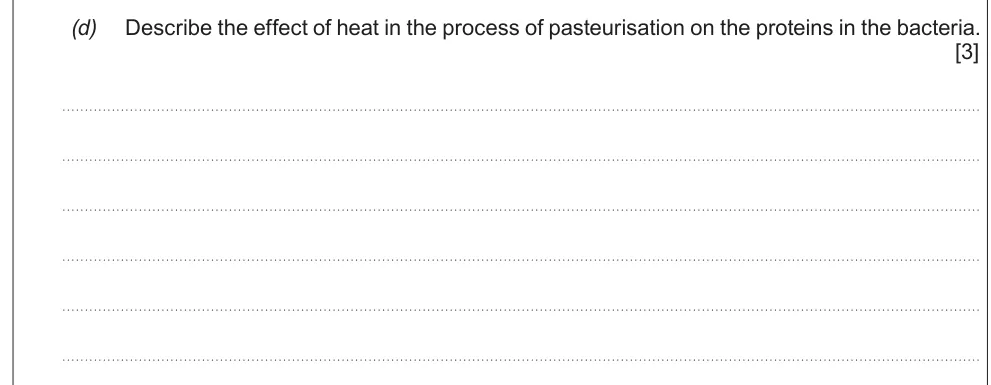
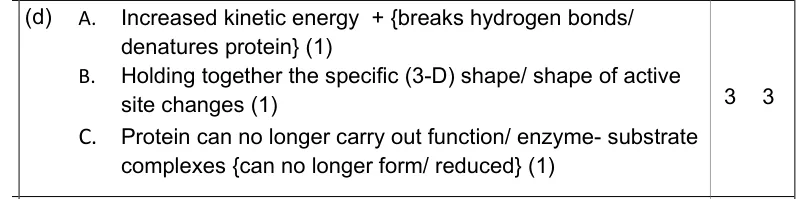
Describe the effect of pasteurisation heat on bacterial proteins.
Show the mark scheme
Tap an image to open it full size.
From the examiners' report: Few students said kinetic energy breaks hydrogen bonds. Too many said all bonds break, including peptide bonds, which is wrong.
Question 9
A level Component 3 · June 2024 · Q2(b) · 1 mark
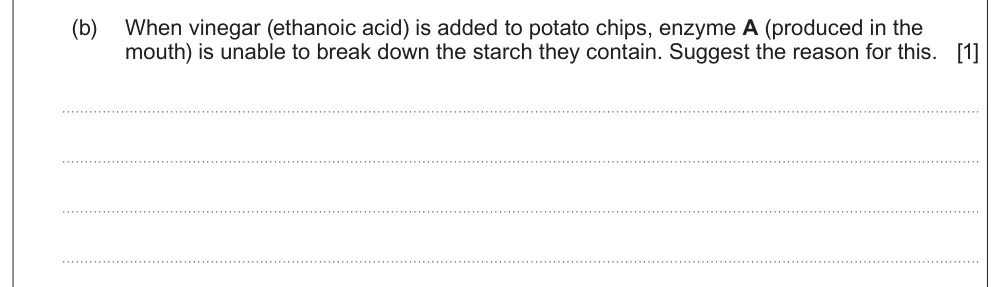
Suggest why mouth amylase can't break down starch in chips with vinegar.
Show the mark scheme

Tap an image to open it full size.
From the examiners' report: The enzyme is denatured. Describing the pH change, or saying the starch changes shape, didn't answer the question.
Question 10
A level Component 2 · Autumn 2020 · Q3(b)(iii) · 2 marks
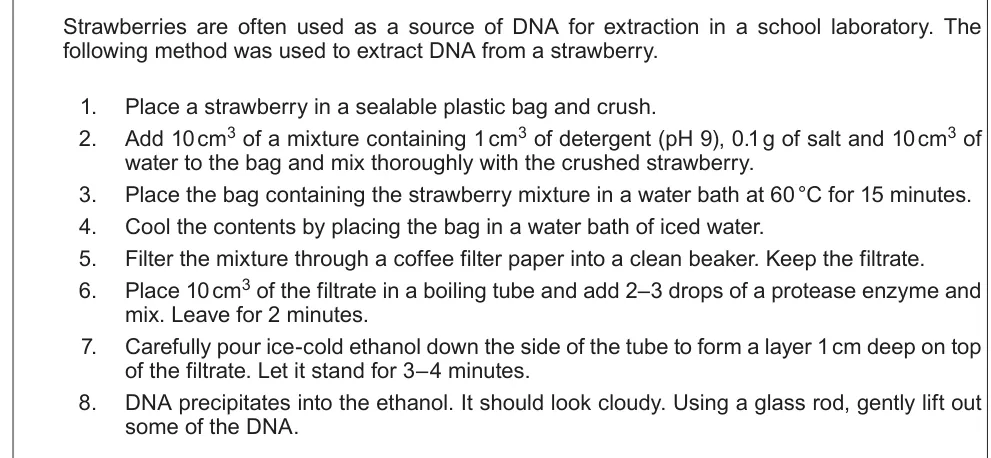
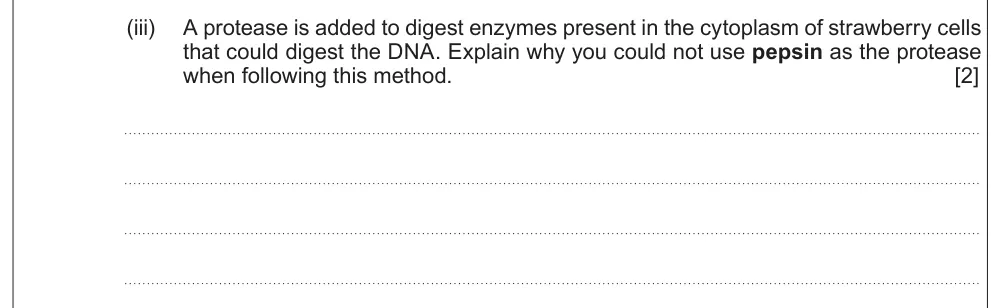
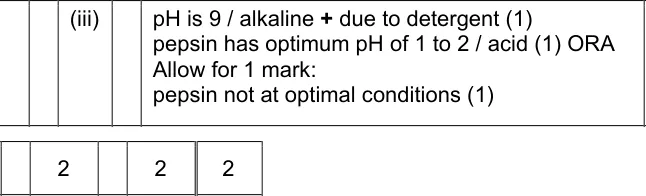
Explain why pepsin couldn't be used as the protease in DNA extraction.
Information from earlier in this question:

Show the mark scheme
Tap an image to open it full size.
From the examiners' report: This was based on the DNA extraction practical. Any practical can be assessed in a theory paper, so learn them all, not just the ones you did.
Question 11
A level Component 3 · Autumn 2020 · Q3(e)(i) · 1 mark
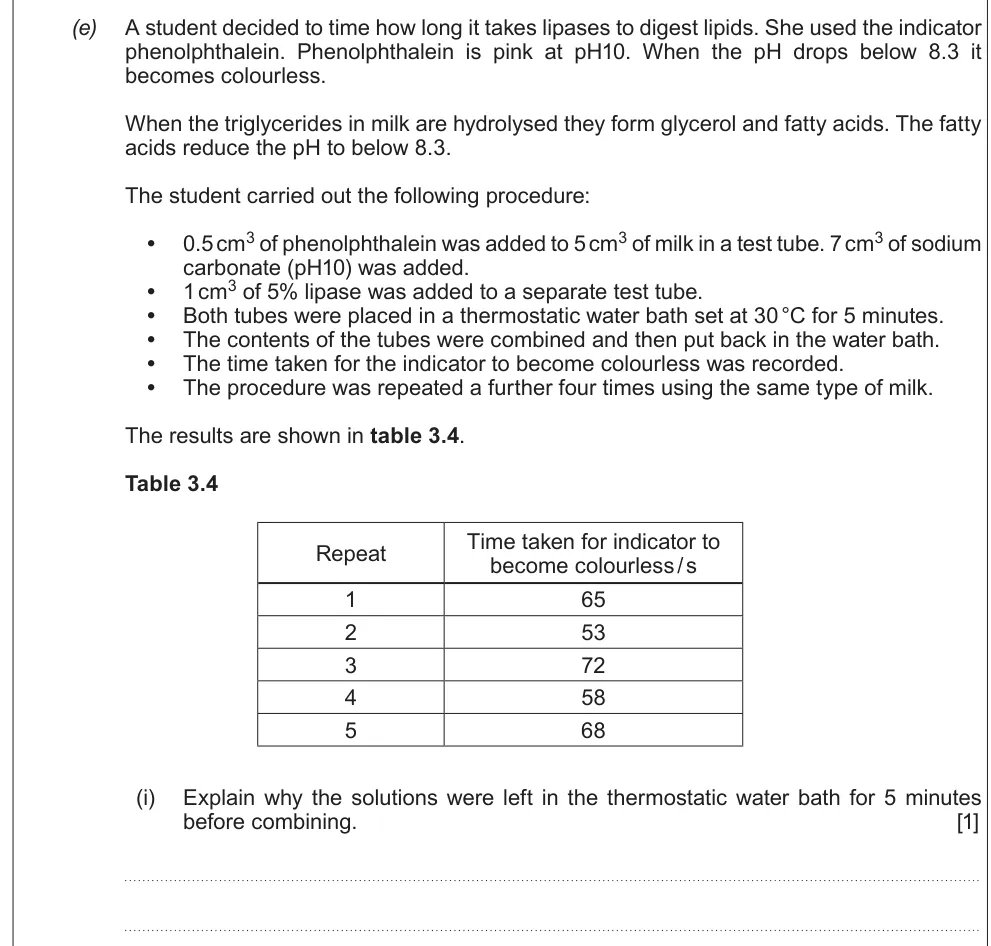
Explain why solutions are left in a water bath before they are mixed.
Show the mark scheme

Tap an image to open it full size.
From the examiners' report: So both solutions reach the same temperature. Saying that 5 minutes wasn't long enough didn't gain credit.
Question 12
AS Component 1 · June 2017 · Q5(b)(ii) · 2 marks
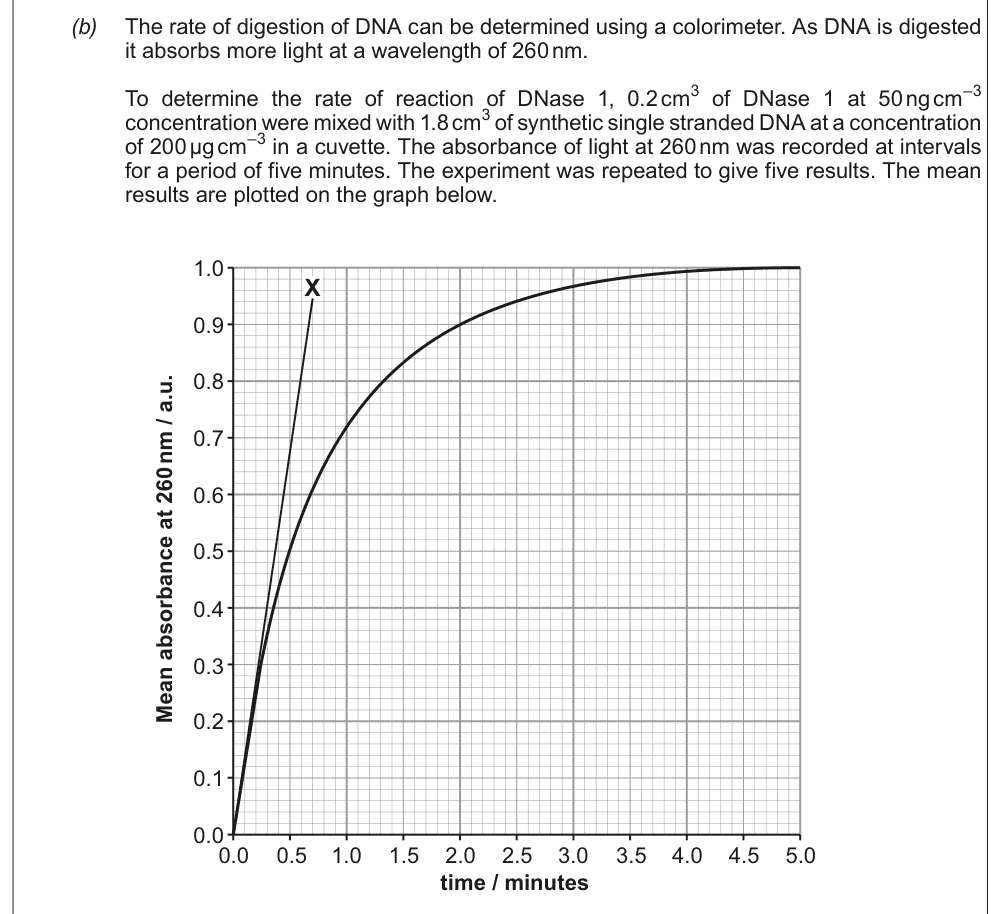
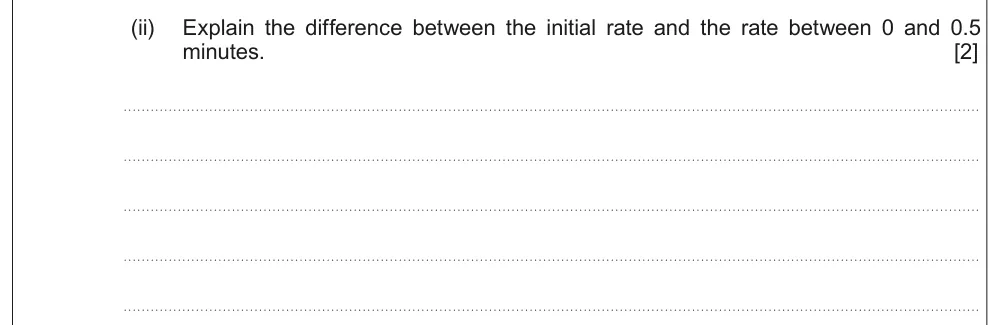
Explain why the initial rate is higher than the rate over the first half minute.
Information from earlier in this question:
Show the mark scheme

Tap an image to open it full size.
From the examiners' report: Use comparative words: the highest substrate concentration at the start, not just "more substrate", giving more enzyme-substrate complexes.
Question 13
AS Component 1 · June 2024 · Q3(c)(ii) · 4 marks
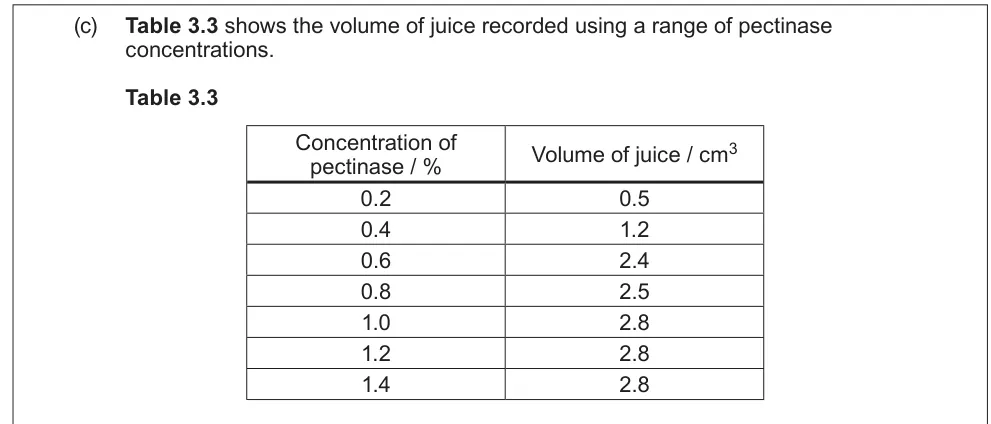
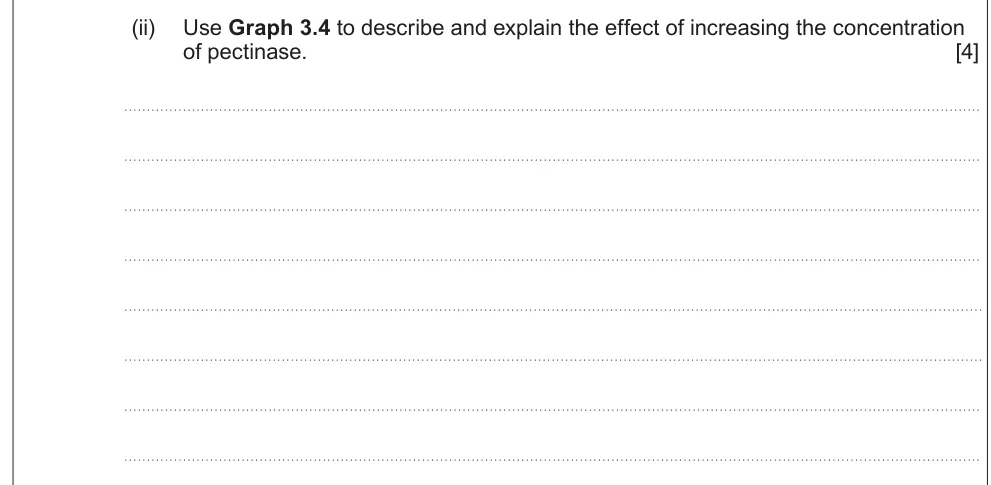
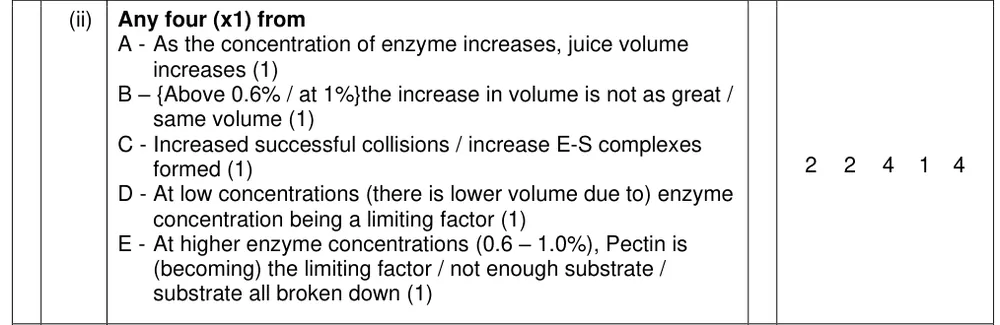
Use a graph to describe and explain the effect of pectinase concentration.
Information from earlier in this question:

Show the mark scheme
Tap an image to open it full size.
From the examiners' report: Many students scored full marks by linking the data to which factor was limiting, enzyme or substrate, at different points on the graph.
Question 14
AS Component 1 · June 2016 · Q5(b) · 1 mark
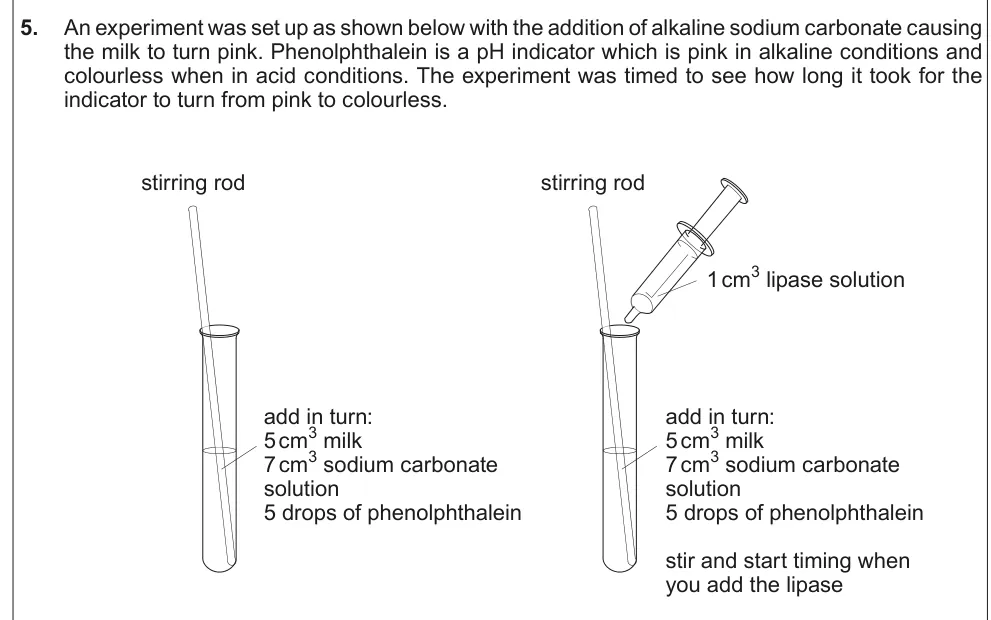
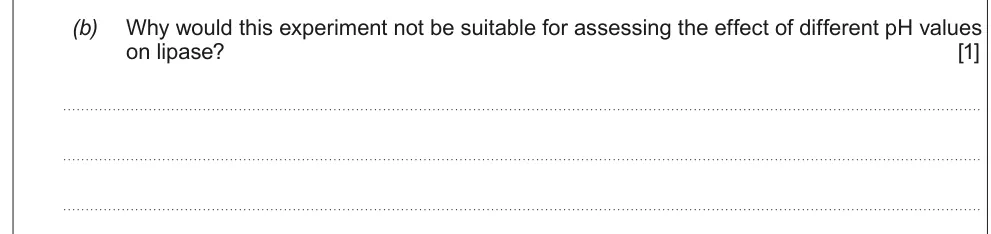
Explain why a colour-change lipase method can't test the effect of pH.
Information from earlier in this question:
Show the mark scheme

Tap an image to open it full size.
From the examiners' report: The method relies on the pH changing, so you can't set different pHs. Many students wrongly said it was because the colour change is qualitative.
Inhibition
Question 15
A level Component 1 · June 2019 · Q4(a) · 2 marks
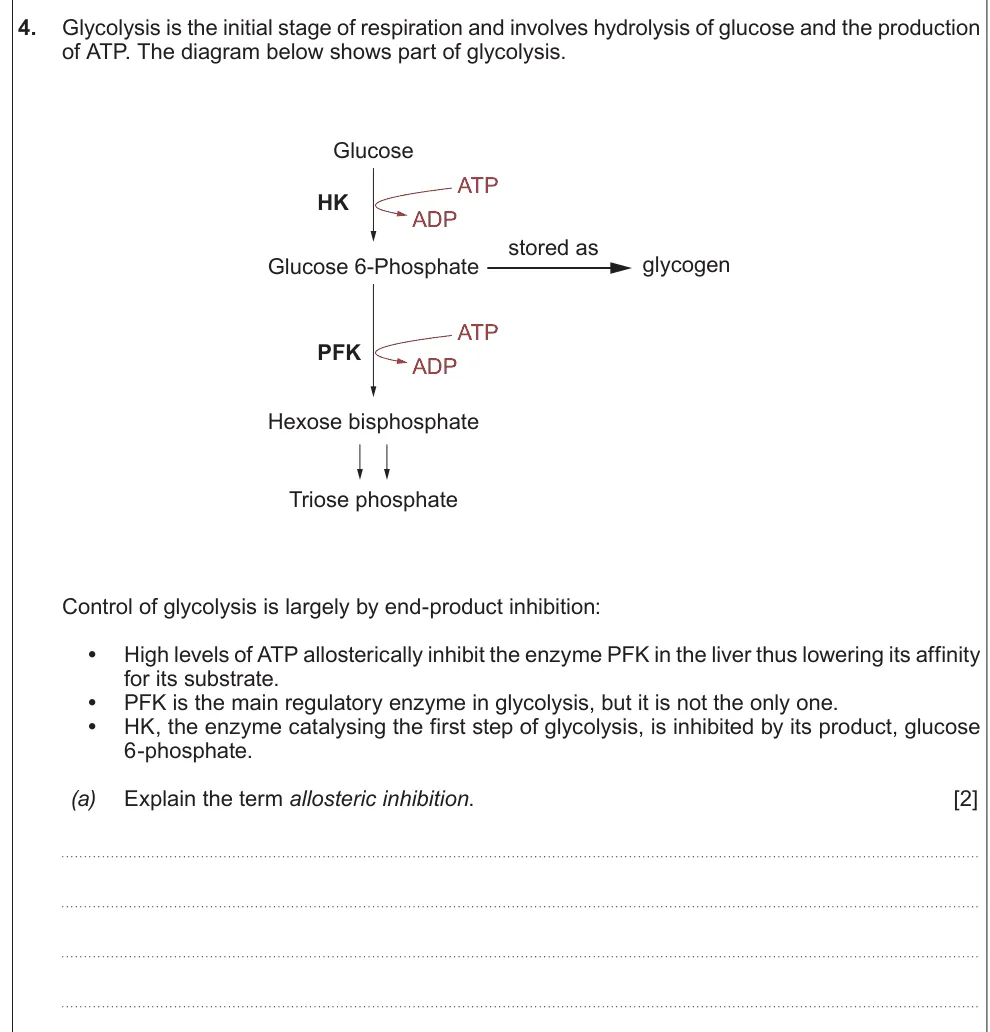
Explain the term allosteric inhibition.
Show the mark scheme

Tap an image to open it full size.
From the examiners' report: This was the least well done question on the paper. The inhibitor binds away from the active site and changes the active site's shape.
Question 16
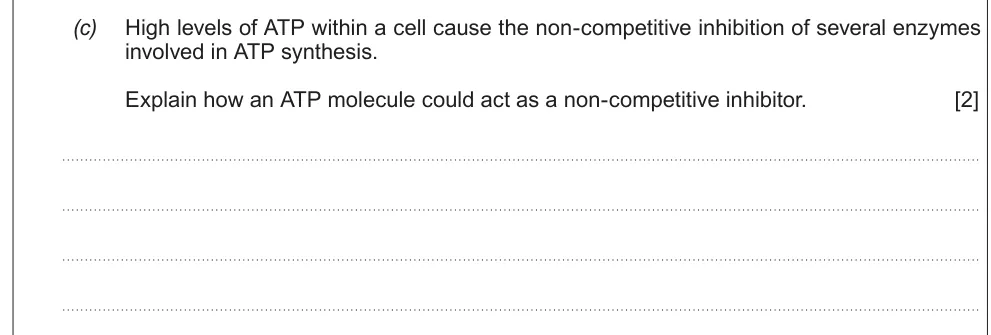
A level Component 1 · Autumn 2020 · Q3(c) · 2 marks
Explain how ATP could act as a non-competitive inhibitor.
Show the mark scheme

Tap an image to open it full size.
From the examiners' report: Clear understanding was shown: ATP binds to an allosteric site and changes the shape of the active site.
Question 17
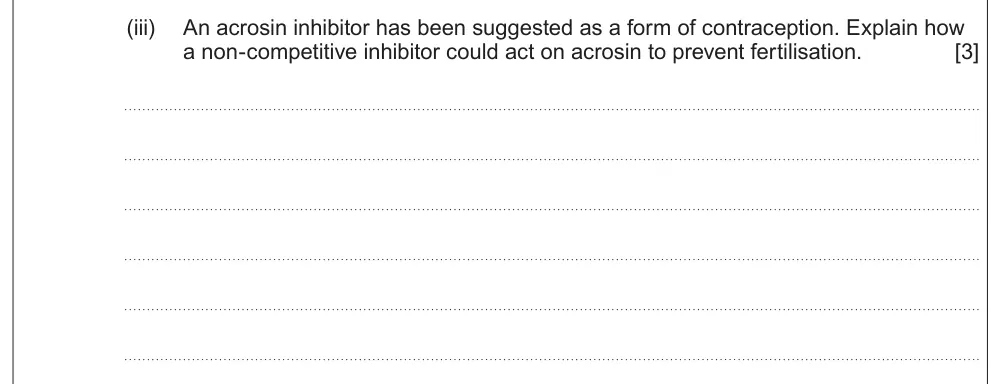
A level Component 2 · June 2023 · Q4(e)(iii) · 3 marks
Explain how a non-competitive inhibitor of acrosin could prevent fertilisation.
Information from earlier in this question:

Show the mark scheme

Tap an image to open it full size.
From the examiners' report: Many students answered this well, but some missed that acrosin is the enzyme, so the inhibitor binds to acrosin.
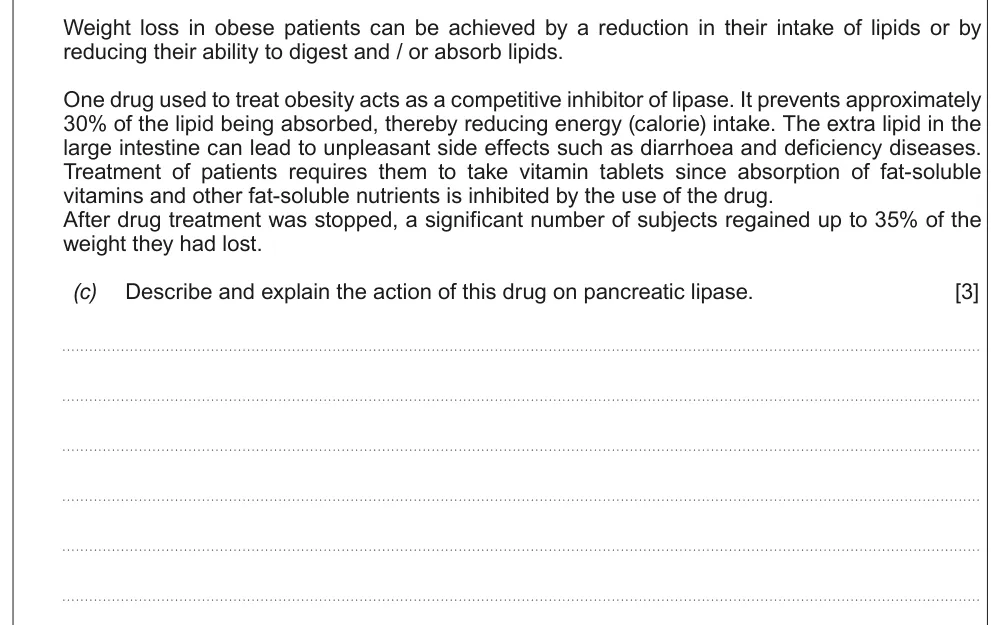
Question 18
AS Component 1 · June 2016 · Q5(c) · 3 marks
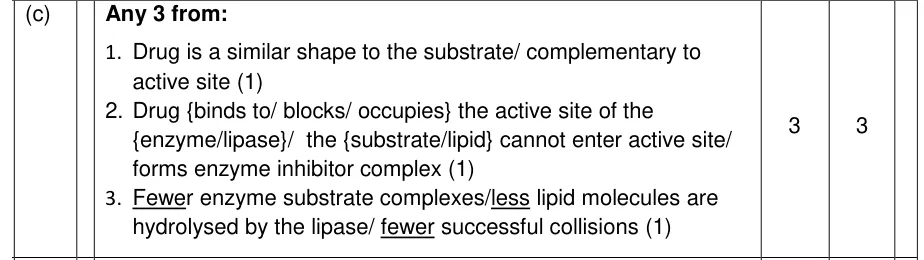
Describe and explain how a weight-loss drug acts on pancreatic lipase.
Show the mark scheme
Tap an image to open it full size.
From the examiners' report: Many good answers simply described competitive inhibition: the drug blocks the active site, so fewer lipid molecules are hydrolysed.
Immobilised enzymes
Question 19
AS Component 1 · June 2016 · Q3(b) · 2 marks
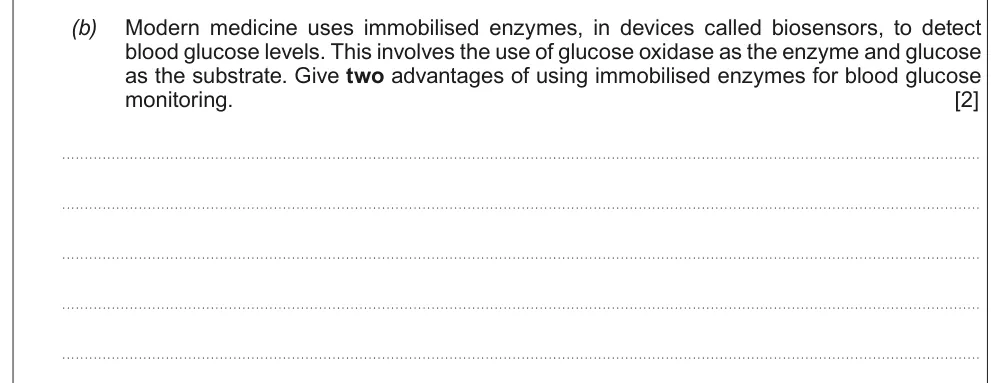
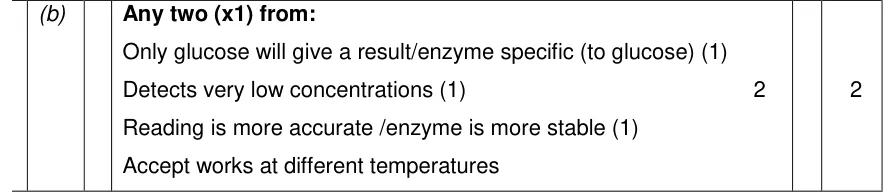
Give two advantages of immobilised enzymes for blood glucose monitoring.
Show the mark scheme
Tap an image to open it full size.
From the examiners' report: The advantages must fit the situation. There is no product to keep separate and no extreme pH, so give specificity, sensitivity or stability.
Question 20
A level Component 1 · June 2025 · Q4(d)(i) · 2 marks
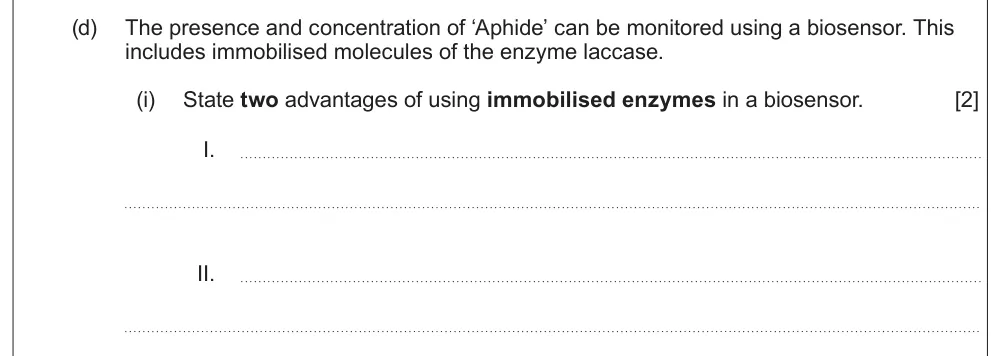
State two advantages of immobilised enzymes in a biosensor.
Show the mark scheme

Tap an image to open it full size.
From the examiners' report: This was less well understood, again because answers weren't set in the context of the question.
Where students lose marks (from Eduqas examiners' reports and mark schemes)
Each point below is followed by wording that gained marks.
Stays blue, and say why: Many students said biuret would go violet, with no explanation.
✔ Gains credit: "Add biuret, stays blue" because the "enzyme is a protein".
Intra, not inter: The most common wrong answer was intercellular.
✔ Gains credit: "Intracellular".
Only enzymes have active sites: Some students wrote about the active sites of the sugars.
✔ Gains credit: "The enzymes are specific to these shapes / different shape active sites".
Complementary, not perfect: Weaker answers said the shapes "match" or are "perfect".
✔ Gains credit: "Substrate complementary shape to active site".
Hydrogen bonds, not all bonds: Far too many students said heat breaks all bonds, including peptide bonds.
✔ Gains credit: "Increased kinetic energy" which "breaks hydrogen bonds".
Answer the question asked: Answers described the pH change in detail, or said the starch changed shape.
✔ Gains credit: "Vinegar inactivates / denatures enzyme".
Highest, not just more: Explanations of the initial rate didn't use comparative words.
✔ Gains credit: "Substrate is at maximum / higher concentration".
Fit advantages to the context: Students listed every advantage of immobilised enzymes.
✔ Gains credit: "Only glucose will give a result / enzyme specific".
Download the questions
Download the PDF pack (20 questions, mark schemes at the end)
Keep practising
- Biological Compounds (CC1): Eduqas A Level Biology exam questions by topic
- Cell Structure and Organisation (CC2): Eduqas A Level Biology exam questions by topic
- Cell Membranes and Transport (CC3): Eduqas A Level Biology exam questions by topic
- Nucleic Acids and their Functions (CC5): Eduqas A Level Biology exam questions by topic
- Eduqas A level Biology past papers, mark schemes and examiners' reports
- Eduqas A level Biology grade boundaries
- Ask about Eduqas A level Biology lessons with Sam on WhatsApp
Questions, mark schemes and examiners' report extracts © WJEC CBAC Ltd (Eduqas).