

Sexual reproduction in plants covers the structure of wind- and insect-pollinated flowers, how pollen and ovules develop (including the anther and ovary slides), cross- and self-pollination, double fertilisation, the structure of seeds and fruits in broad bean and maize, germination, and the role of gibberellin. Every question on this page is from the A level Component 2 papers.
Recall of flower parts and germination is usually good. Marks are lost on chromosome numbers in plant cells (n, 2n and 3n), on giving a clear account of double fertilisation, and on explaining why a grain is a fruit. The examiners' reports also ask you to use the photograph or plan you're given, rather than writing everything you remember about pollen, and to link the fall in amylase activity to the leaves appearing.
I don't teach the Eduqas specification myself, so for one-to-one help I recommend Sam. He teaches Eduqas A level Biology at a top-rated sixth form college and is very popular with his students. You can ask about lessons with Sam on WhatsApp using the link at the bottom of this page.
What you need from GCSE and Year 12
Each question on this page assumes you're secure on these ideas. If any of them feels shaky, look it up before you start.
- Flowers contain stamens (anther and filament) and carpels (stigma, style and ovary).
- Pollination is the transfer of pollen from an anther to a stigma.
- Seeds contain an embryo and a food store, and need water, oxygen and warmth to germinate.
- Enzymes such as amylase break down stored starch into sugars.
Key terms
These words come up in the questions and mark schemes. Examiners expect you to use them exactly.
- Cross-pollination: transfer of pollen to a flower on a different plant of the same species.
- Tapetum: the layer in the anther that nourishes developing pollen.
- Generative nucleus: the pollen grain nucleus that divides by mitosis to form two male gametes.
- Double fertilisation: one male nucleus fuses with the egg to form the zygote, the other with the two polar nuclei to form the endosperm nucleus.
- Endosperm: the triploid (3n) food store in seeds such as maize.
- Pericarp: the fruit wall, formed from the ovary wall.
- Imbibition: uptake of water by a seed at the start of germination.
- Aleurone layer: the layer around the endosperm that makes amylase when stimulated by gibberellin.
What these questions cover (Eduqas 2.4)
The questions test these statements from Component 2 (Continuity of Life) of the Eduqas A level Biology specification (A400). Component 2 content is examined in A level Component 2.
- (a) the generalised structure of flowers to be able to compare wind and insect pollinated flowers
- (b) the development of pollen and ovules, including examination of prepared slides of anther and ovary
- (c) cross and self-pollination
- (d) the process of double fertilisation
- (e) the formation and structure of seed and fruit as shown by broad bean and maize
- (f) the process of germination of Vicia faba (broad bean)
- (g) the effect of gibberellin
How to use this page
Write your answer on paper before you open the mark scheme. Allow about 1.2 minutes per mark: the 23 questions are worth 54 marks, so about 65 minutes in total. Then mark your answer strictly against the mark scheme and read the examiners' tip underneath it. If you'd rather print the questions, download the PDF pack.
Flower structure and pollination
Question 1
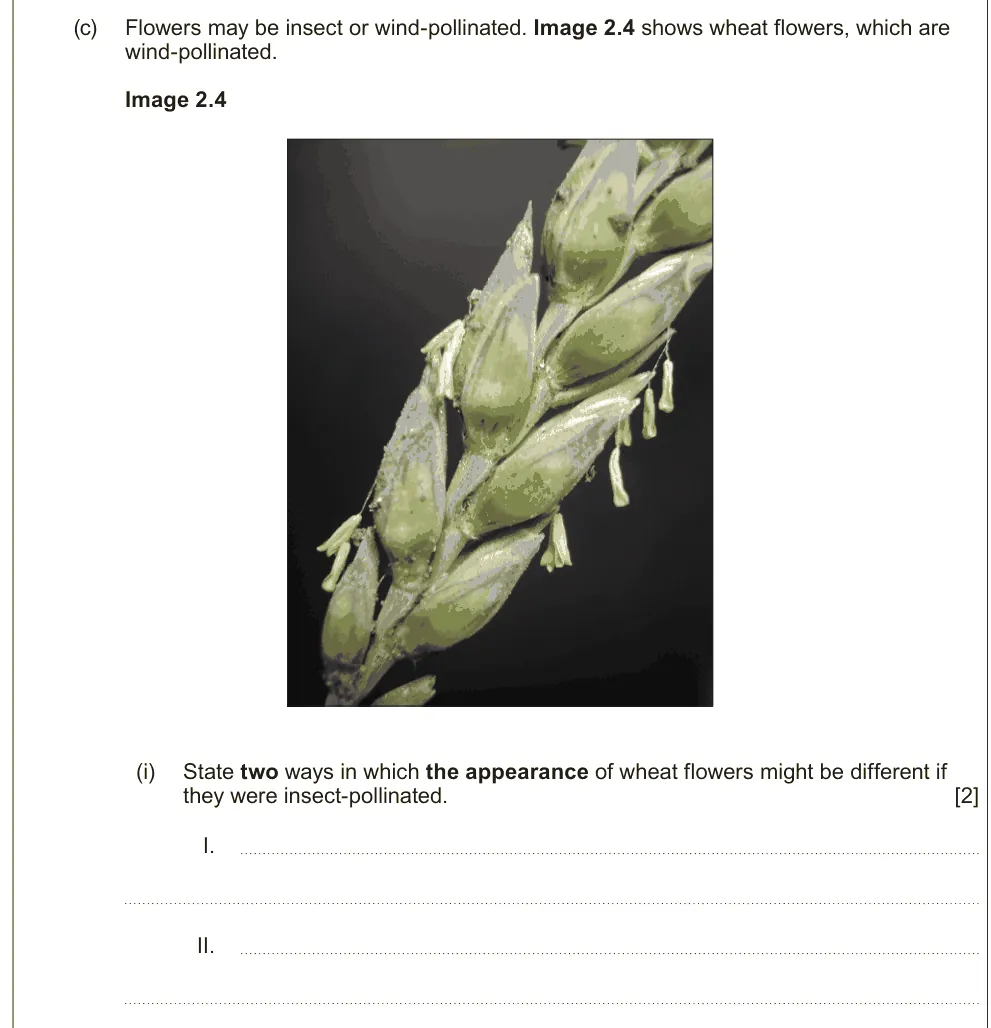
A level Component 2 · June 2025 · Q2(c)(i) · 2 marks · Easy
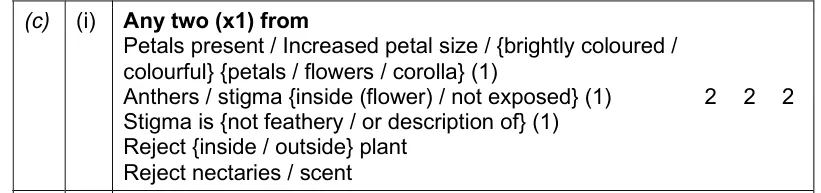
State two ways in which wheat flowers would look different if they were insect-pollinated.
Show the mark scheme
Tap an image to open it full size.
From the examiners' report: Anthers had to be inside the petals or flower, not "inside the plant".
Question 2
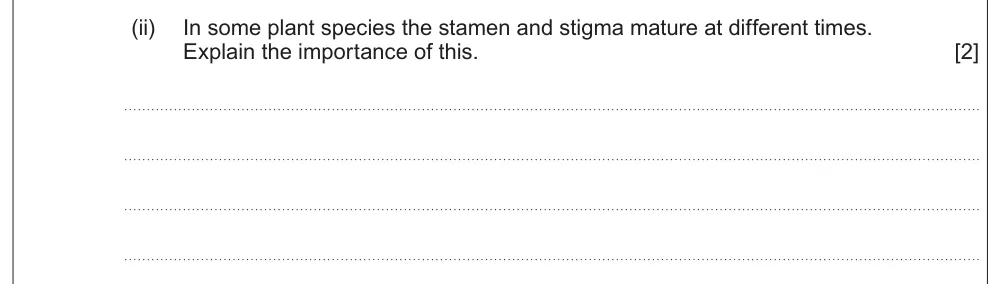
A level Component 2 · June 2025 · Q2(c)(ii) · 2 marks · Easy
Explain the importance of the stamen and stigma maturing at different times.
Show the mark scheme

Tap an image to open it full size.
Question 3
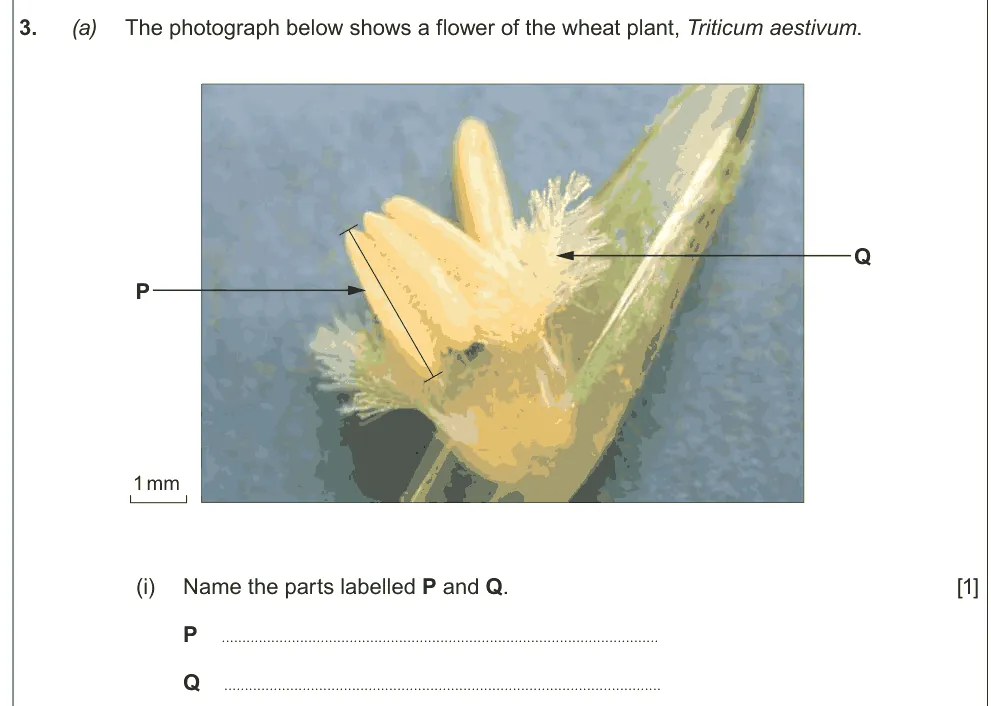
A level Component 2 · June 2018 · Q3(a)(i) · 1 mark
Name the parts labelled P and Q on a photograph of a wheat flower.
Show the mark scheme

Tap an image to open it full size.
From the examiners' report: A significant number confused the anther and the stigma.
Question 4
A level Component 2 · June 2018 · Q3(a)(iii) · 1 mark
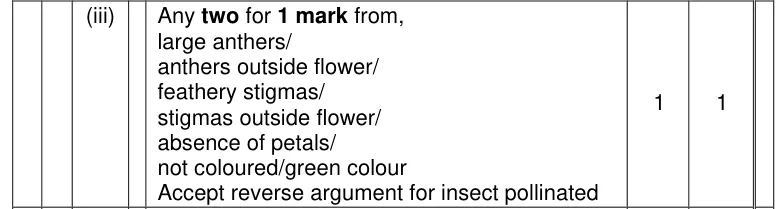
Describe two features of the flower in the photograph that suggest it is wind-pollinated.

Show the mark scheme
Tap an image to open it full size.
From the examiners' report: Many wrote about pollen from memory, but the question asked for features shown in the photograph.
Question 5
A level Component 2 · Autumn 2020 · Q1(b)(i) · 2 marks
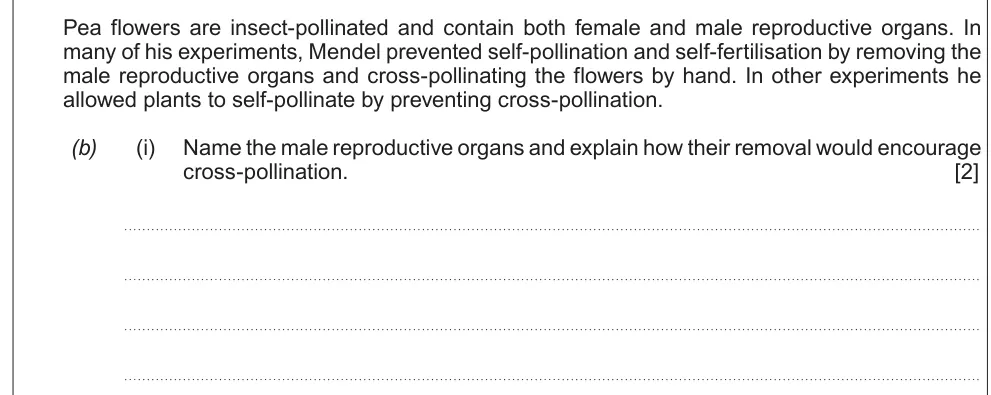
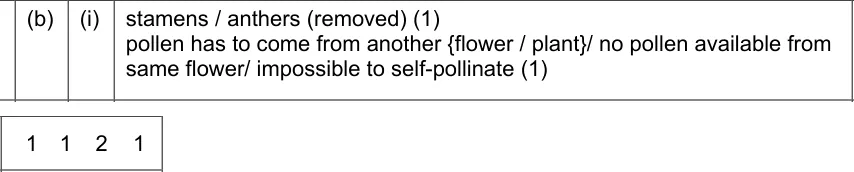
Name the male reproductive organs and explain how removing them encourages cross-pollination.
Show the mark scheme
Tap an image to open it full size.
Question 6
A level Component 2 · Autumn 2020 · Q1(b)(ii) · 1 mark
Suggest how Mendel could have prevented cross-pollination.

Show the mark scheme

Tap an image to open it full size.
Question 7
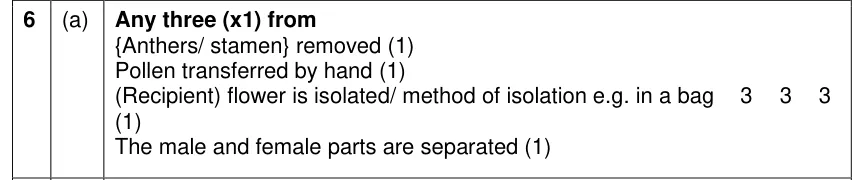
A level Component 2 · June 2023 · Q6(a) · 3 marks
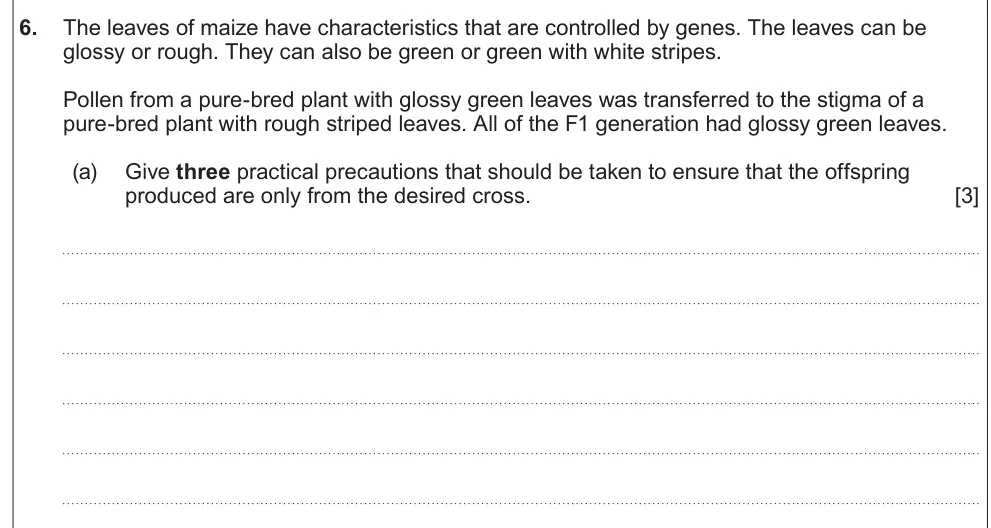
Give three precautions to make sure the offspring come only from the desired cross.
Show the mark scheme
Tap an image to open it full size.
From the examiners' report: The best answers removed the anthers, covered (isolated) the flower and pollinated it by hand.
Pollen development
Question 8
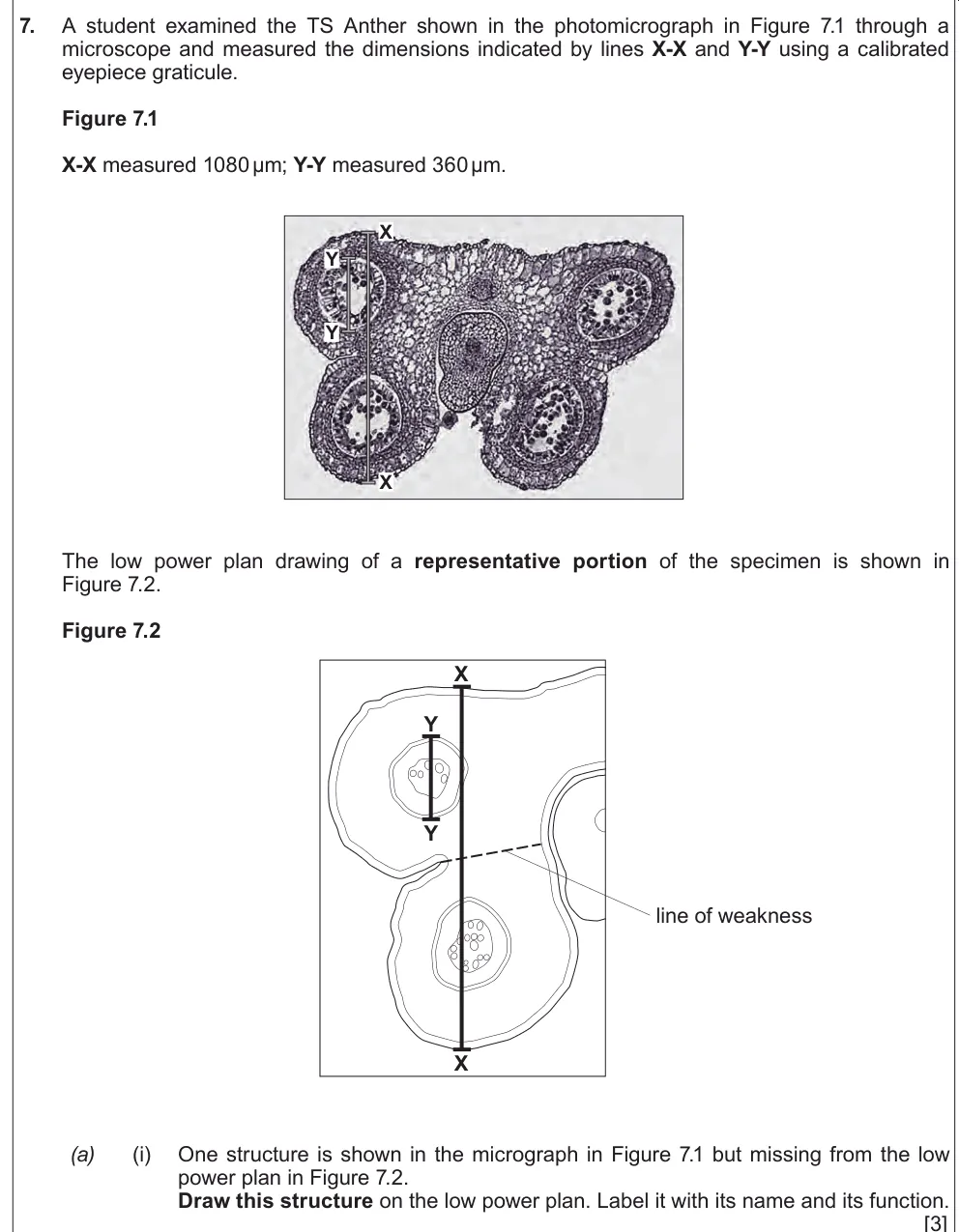
A level Component 2 · June 2019 · Q7(a)(i) · 3 marks
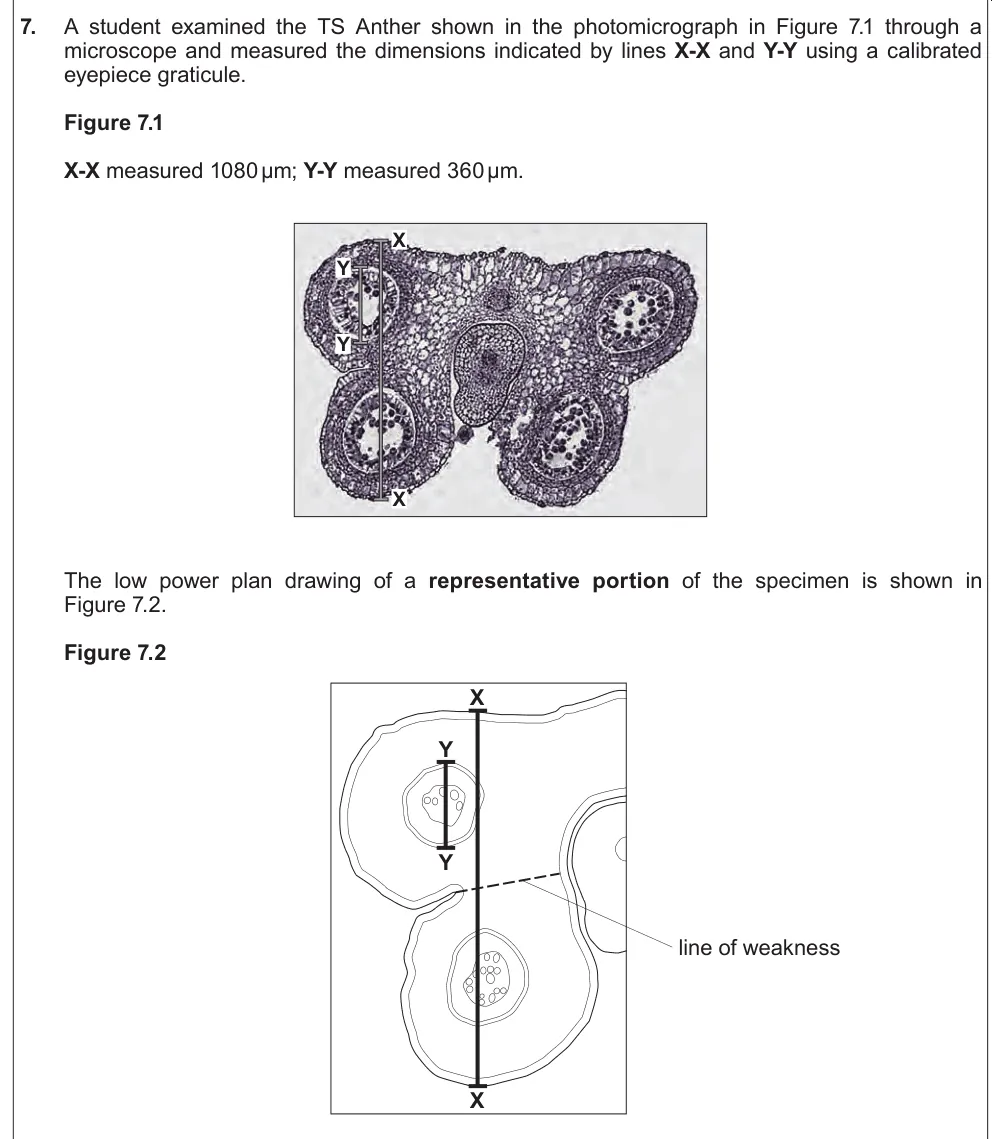
Draw the missing structure on a low power plan of an anther, and label its name and function.
Show the mark scheme

Tap an image to open it full size.
From the examiners' report: Less well answered than expected. Draw a clean line in the right place, name the vascular bundle and give its function. Don't draw over something already shown.
Question 9
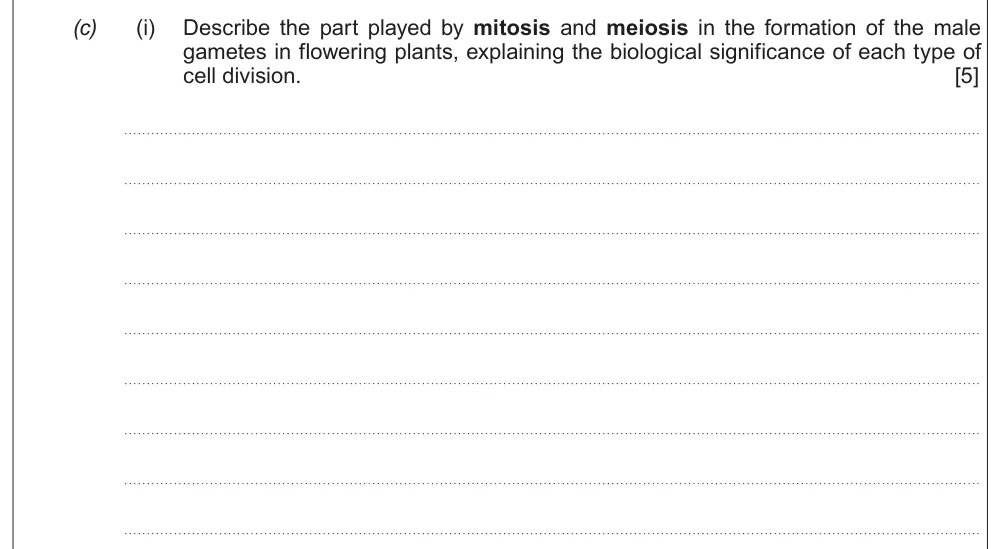
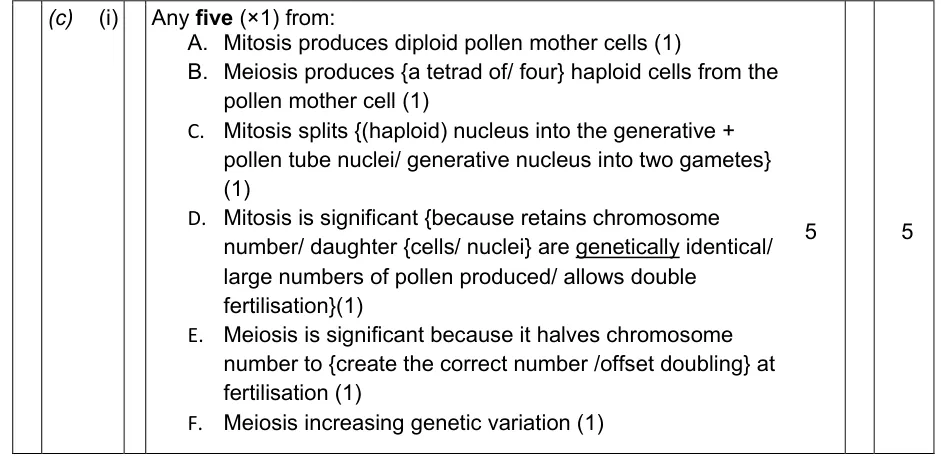
A level Component 2 · June 2019 · Q7(c)(i) · 5 marks · Hard
Describe the parts played by mitosis and meiosis in forming male gametes in flowering plants.
Show the mark scheme
Tap an image to open it full size.
From the examiners' report: This proved more challenging than expected, and written communication was an issue.
Question 10
A level Component 2 · June 2019 · Q7(c)(ii) · 1 mark · Hard
State the function of the tapetum.

Show the mark scheme

Tap an image to open it full size.
From the examiners' report: This part had the lowest attempt rate on the paper.
Question 11
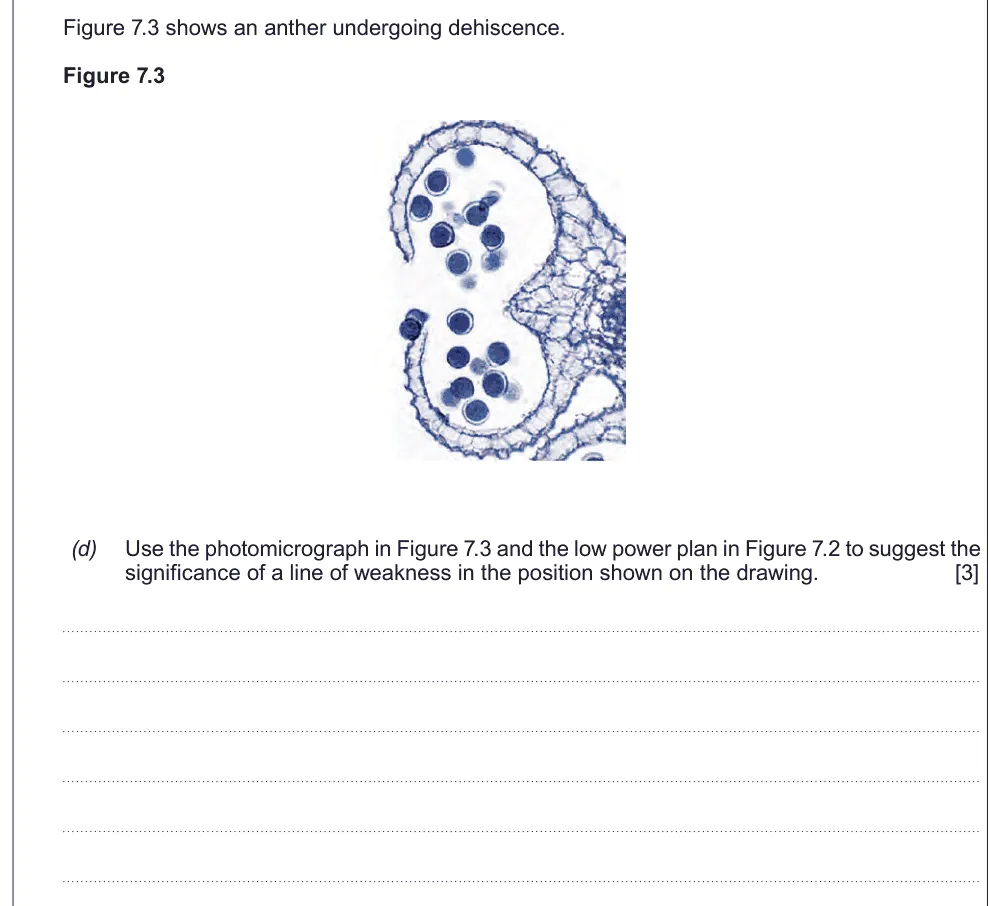
A level Component 2 · June 2019 · Q7(d) · 3 marks
Suggest the significance of the line of weakness in an anther wall.
Information from earlier in this question:
Show the mark scheme

Tap an image to open it full size.
Double fertilisation
Question 12
A level Component 2 · Autumn 2020 · Q3(a) · 2 marks
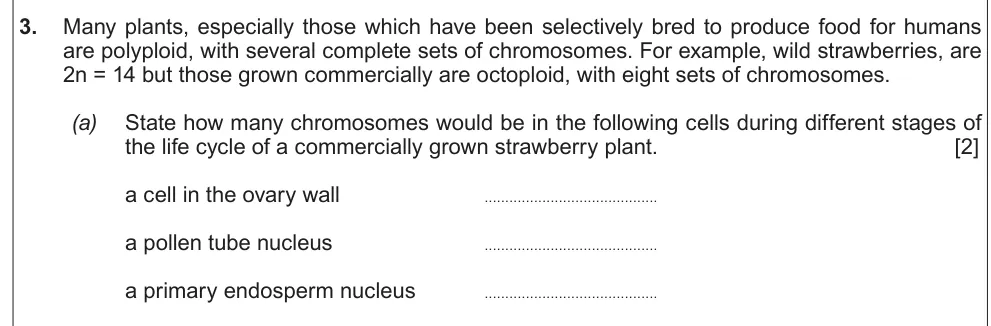
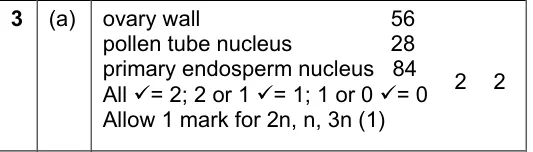
Give the number of chromosomes in an ovary wall cell, a pollen tube nucleus and a primary endosperm nucleus.
Show the mark scheme
Tap an image to open it full size.
From the examiners' report: Few could do this. Work out which cells are haploid (n), diploid (2n) and triploid (3n) first.
Question 13
A level Component 2 · June 2018 · Q3(b)(ii) · 2 marks · Hard
Explain why the events in the embryo sac are described as double fertilisation.
Show the mark scheme

Tap an image to open it full size.
From the examiners' report: Many had been taught the details but struggled to give a clear, accurate account.
Question 14
A level Component 2 · June 2023 · Q3(b)(i) · 6 marks
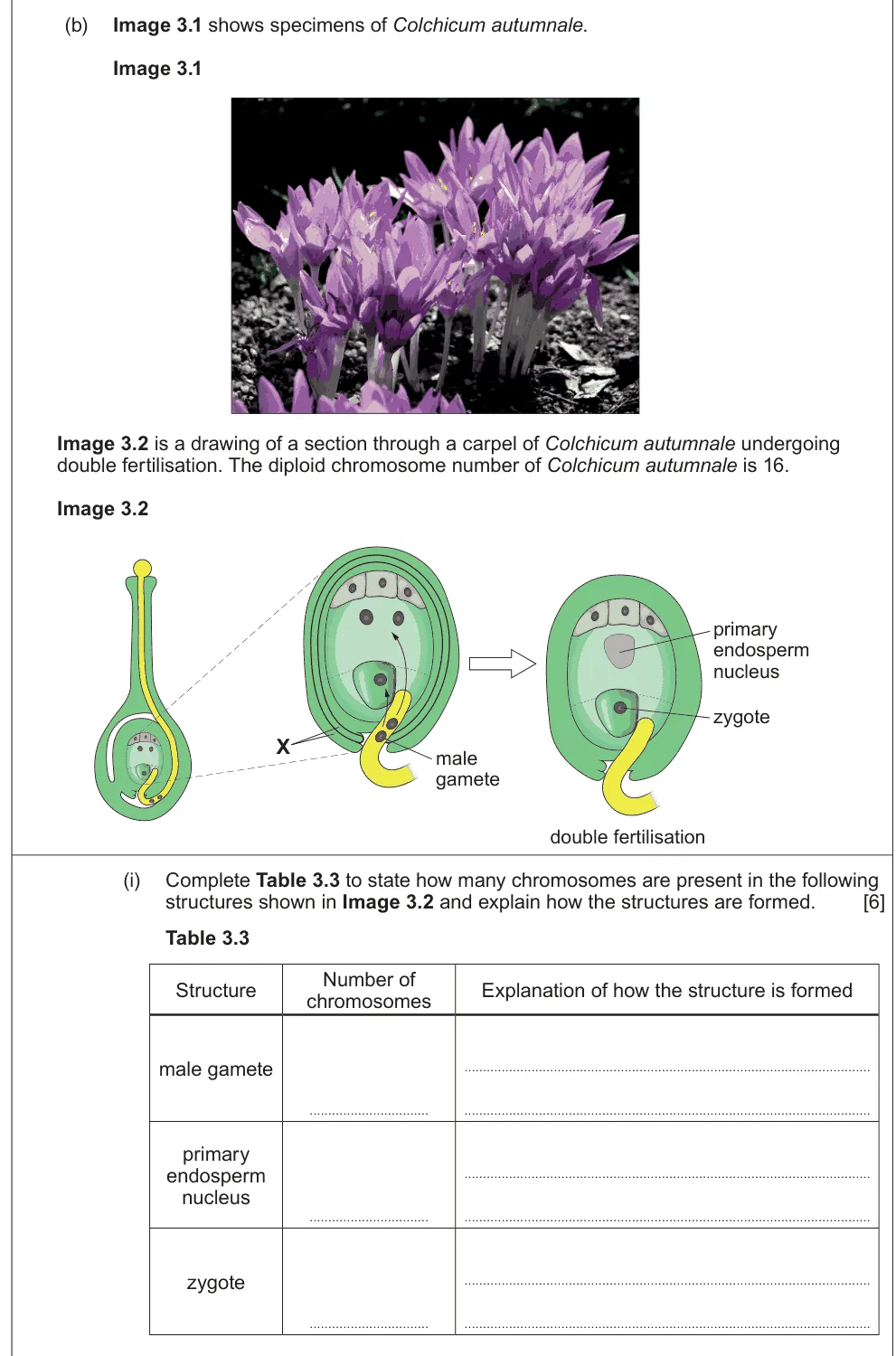
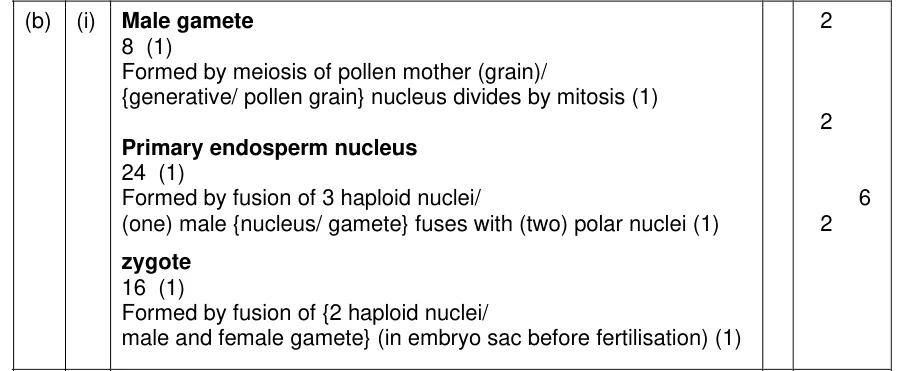
Give the chromosome number of the male gamete, primary endosperm nucleus and zygote, and how each forms.
Show the mark scheme
Tap an image to open it full size.
From the examiners' report: The most common mistake was writing "polar body" for the polar nuclei that form the endosperm nucleus.
Question 15
A level Component 2 · June 2023 · Q3(b)(iii) · 1 mark
Describe what happens to the integuments after fertilisation.

Show the mark scheme

Tap an image to open it full size.
Seeds and fruits
Question 16
A level Component 2 · June 2018 · Q3(b)(i) · 2 marks
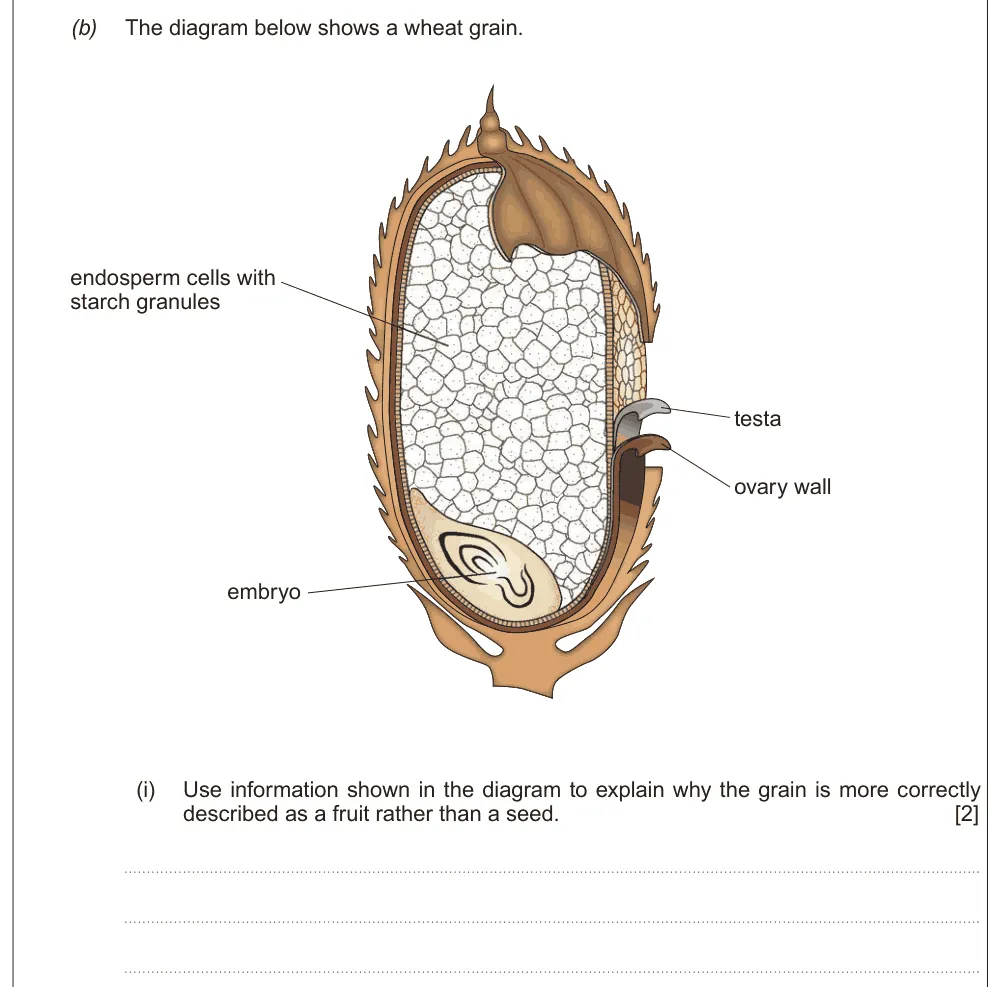
Explain why a wheat grain is more correctly described as a fruit than a seed.
Show the mark scheme

Tap an image to open it full size.
From the examiners' report: Many knew the ovary wall forms the pericarp but didn't explain the difference from a seed.
Question 17
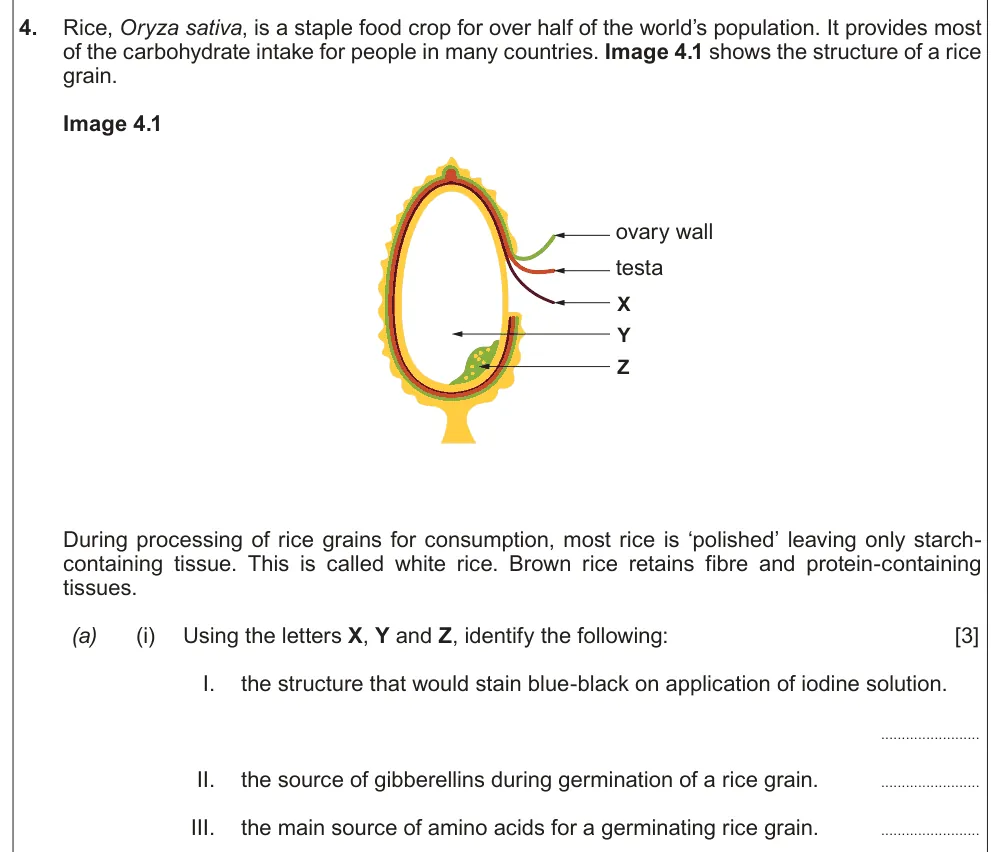
A level Component 2 · Autumn 2020 · Q4(a)(i) · 3 marks
Identify the parts of a rice grain that stain with iodine, make gibberellins and supply amino acids.
Show the mark scheme

Tap an image to open it full size.
Germination and gibberellin
Question 18
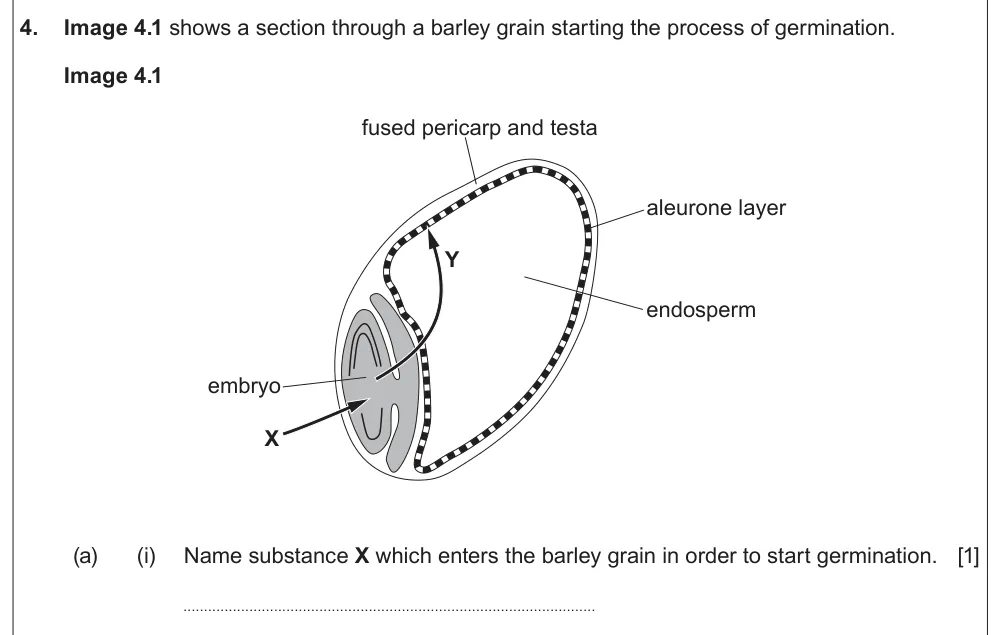
A level Component 2 · June 2025 · Q4(a)(i) · 1 mark
Name the substance that enters a barley grain to start germination.
Show the mark scheme

Tap an image to open it full size.
Question 19
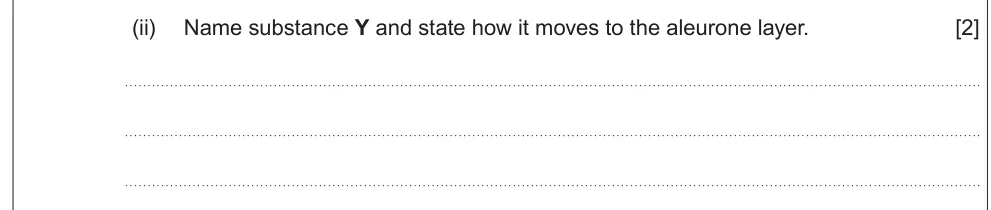
A level Component 2 · June 2025 · Q4(a)(ii) · 2 marks
Name substance Y and state how it moves to the aleurone layer.
Show the mark scheme

Tap an image to open it full size.
Question 20
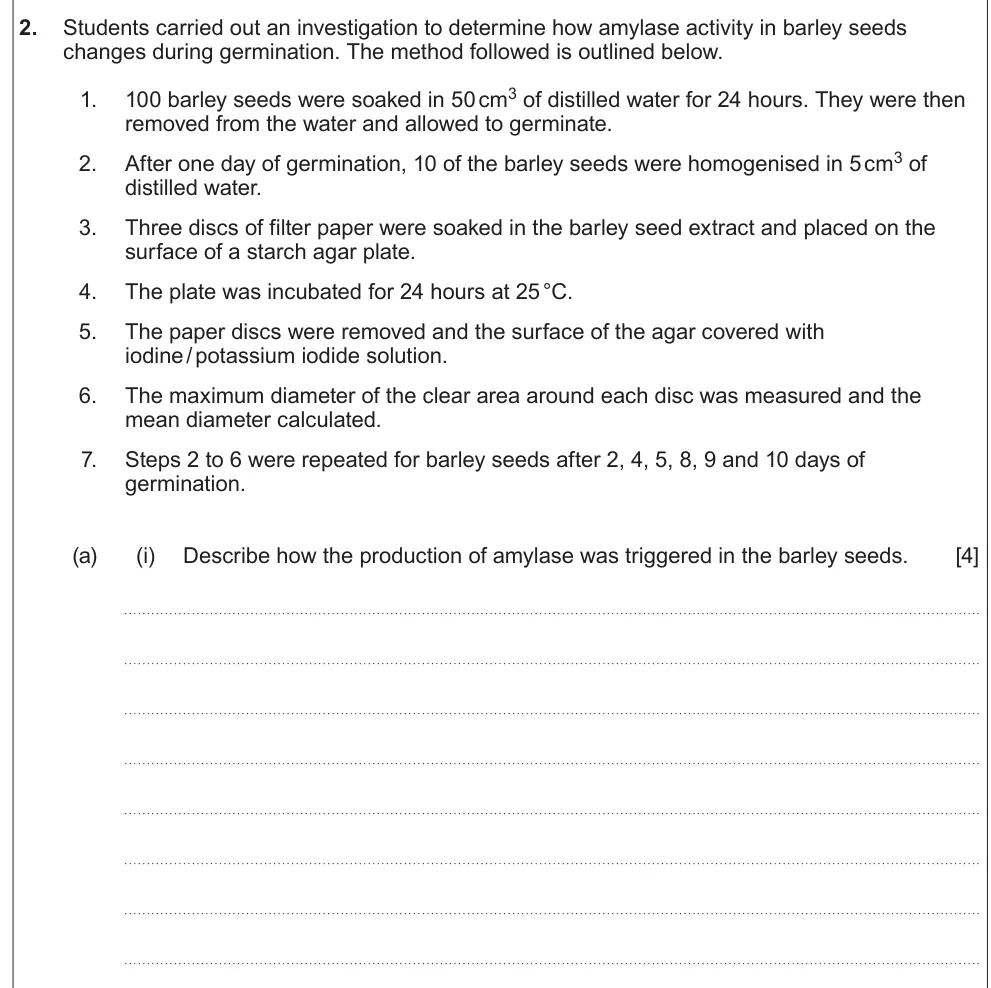
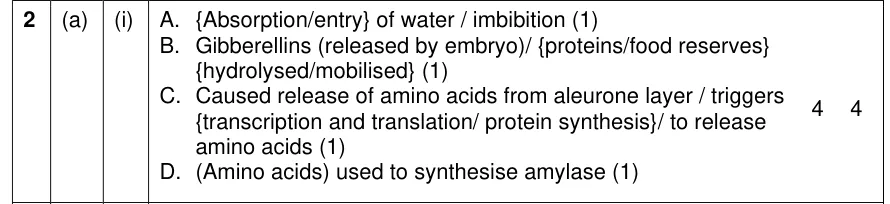
A level Component 2 · June 2022 · Q2(a)(i) · 4 marks
Describe how the production of amylase is triggered in barley seeds.
Show the mark scheme
Tap an image to open it full size.
From the examiners' report: Many didn't see that the amylase diffused out of the seed: the starch agar had nothing to do with triggering amylase synthesis.
Question 21
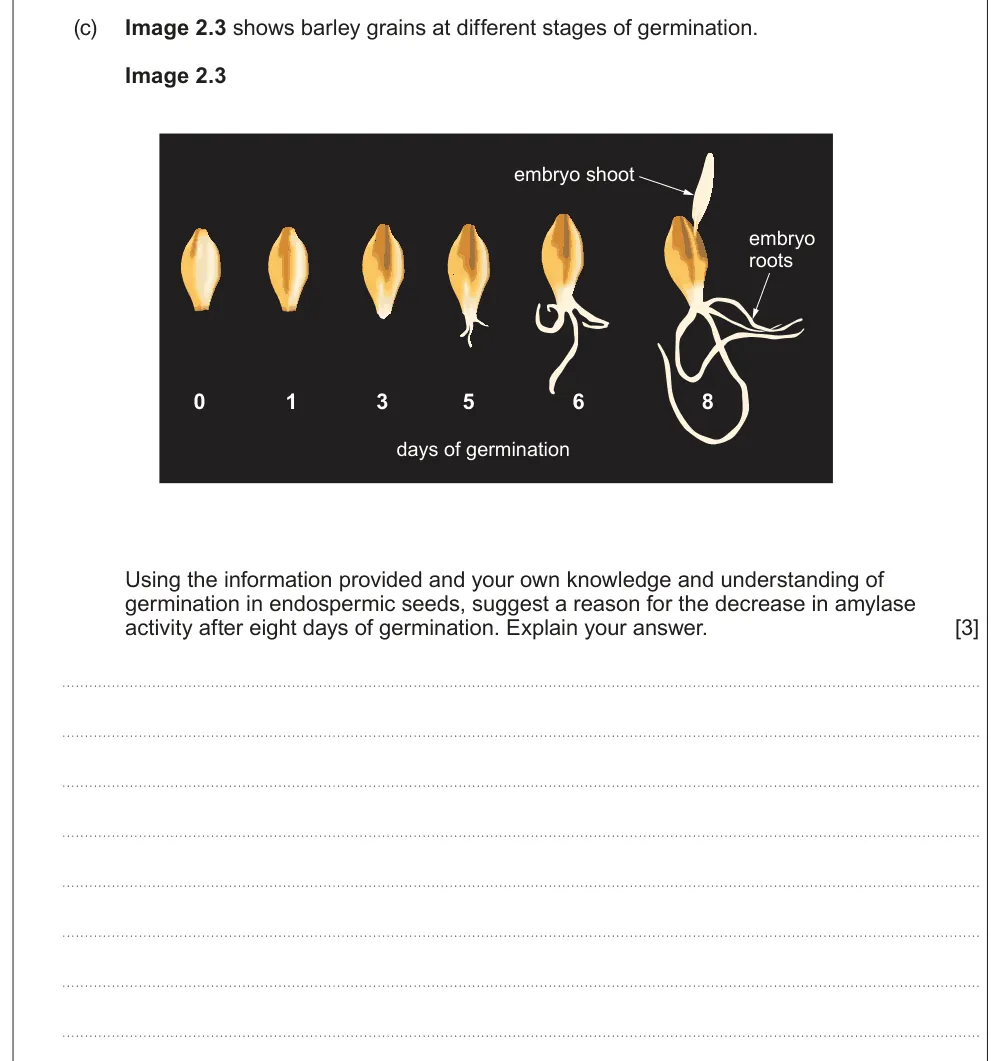
A level Component 2 · June 2022 · Q2(c) · 3 marks
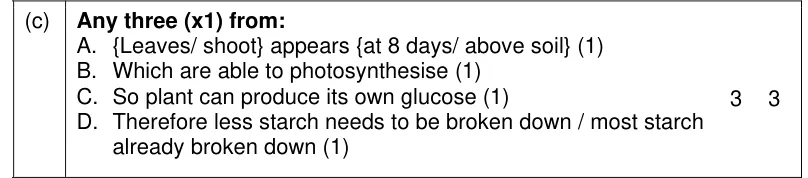
Suggest why amylase activity decreases after eight days of germination.
Show the mark scheme
Tap an image to open it full size.
From the examiners' report: The link between the fall in amylase activity and the leaves appearing was often missed.
Question 22
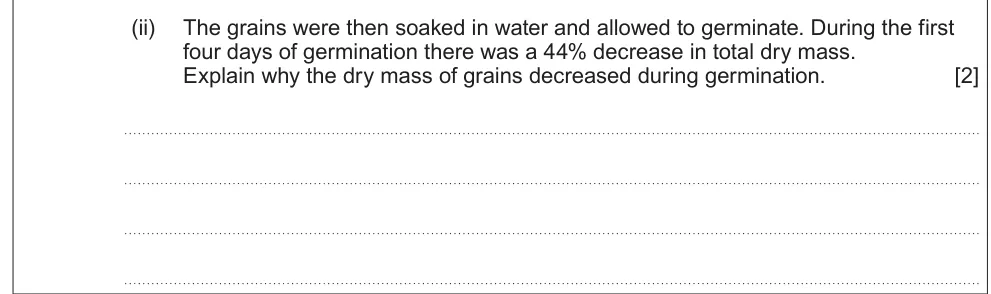
A level Component 2 · June 2025 · Q4(c)(ii) · 2 marks
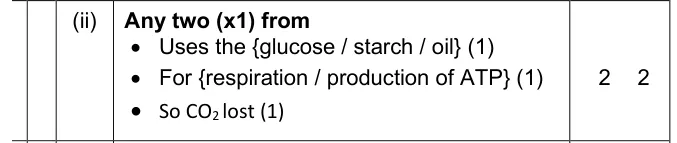
Explain why the dry mass of grains decreases during germination.
Show the mark scheme
Tap an image to open it full size.
Question 23
A level Component 2 · June 2024 · Q5(c)(i) · 2 marks
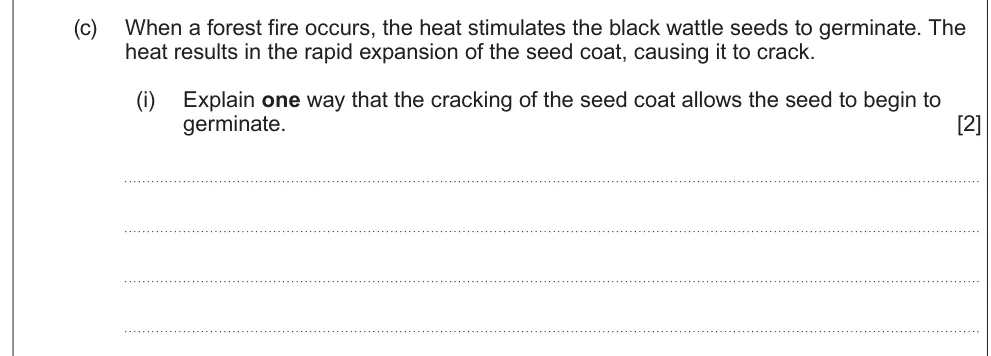
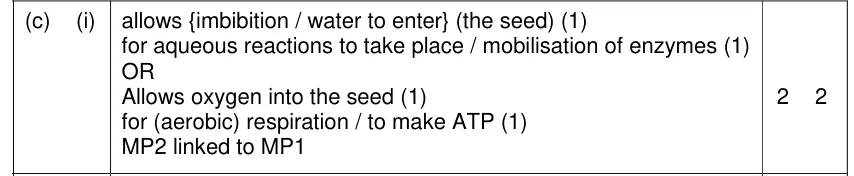
Explain one way that cracking of the seed coat allows a seed to germinate.
Show the mark scheme
Tap an image to open it full size.
From the examiners' report: Space for the radicle and plumule was ignored. Explain that water or oxygen can now get in.
Where students lose marks (from Eduqas examiners' reports and mark schemes)
Each point below is followed by wording that gained marks.
Use the photograph: Many gave recall answers about pollen.
✔ Gains credit: Features shown: "large anthers / anthers outside flower / feathery stigmas".
Polar nuclei, not polar body: The most common mistake was "polar body".
✔ Gains credit: "Male gamete fuses with (two) polar nuclei" to form the primary endosperm nucleus.
Know n, 2n and 3n: Few candidates could calculate chromosome numbers in plant cells.
✔ Gains credit: "Ovary wall 56, pollen tube nucleus 28, primary endosperm nucleus 84".
Explain, don't just state: Many knew the ovary wall forms the pericarp but offered no explanation.
✔ Gains credit: "Fruit retains ovary wall" and "a seed would only have a testa".
Link it to the leaves: The link to the appearance of leaves was often not made.
✔ Gains credit: "Leaves appear at 8 days" "which are able to photosynthesise".
Inside the flower: Answers said anthers were inside or outside the plant.
✔ Gains credit: "Anthers / stigma inside (flower) / not exposed".
Download the questions
Download the PDF pack (23 questions, mark schemes at the end)
Keep practising
- Classification and Biodiversity (2.1): Eduqas A Level Biology exam questions by topic
- Cell Division (2.2): Eduqas A Level Biology exam questions by topic
- Sexual Reproduction in Humans (2.3): Eduqas A Level Biology exam questions by topic
- Inheritance (2.5): Eduqas A Level Biology exam questions by topic
- Variation and Evolution (2.6): Eduqas A Level Biology exam questions by topic
- Application of Reproduction and Genetics (2.7): Eduqas A Level Biology exam questions by topic
- Eduqas A level Biology past papers, mark schemes and examiners' reports
- Eduqas A level Biology grade boundaries
- Ask about Eduqas A level Biology lessons with Sam on WhatsApp
Questions, mark schemes and examiners' report extracts © WJEC CBAC Ltd (Eduqas).