

This page covers six specified practicals from Components 1 and 3: dehydrogenase activity with artificial hydrogen acceptors, separating chloroplast pigments by chromatography, factors affecting the rate of photosynthesis, the role of minerals in plant growth, the rate of respiration in yeast and transpiration with a potometer. The written papers set them in unfamiliar contexts, such as resazurin instead of methylene blue or floating leaf discs. You are asked to explain steps in a method, name the independent, dependent and controlled variables, suggest a control, modify a method to test a different factor, calculate rates and standard deviations, plot results and comment on reliability. Questions marked AS are from the AS papers (B400); the rest are from the A level papers (A400).
The examiners' reports show where marks go. A control is not a controlled variable, and leaving out the yeast is not a suitable control. A water bath controls a variable; it is not there to give optimum conditions. When you modify a method, give details that someone else could follow, with five values of the independent variable, and set it in the laboratory if the question says so. Predict results, not conclusions. In calculations, read the key to the formula and check whether the answer is wanted per minute or per hour. Many answers showed that the practical had not been carried out.
I don't teach the Eduqas specification myself, so for one-to-one help I recommend Sam. He teaches Eduqas A level Biology at a top-rated sixth form college and is very popular with his students. You can ask about lessons with Sam on WhatsApp using the link at the bottom of this page.
What you need first
Each question on this page assumes you're secure on these ideas. If any of them feels shaky, look it up before you start.
- The independent variable is the factor you change, the dependent variable is what you measure and controlled variables are kept the same.
- Dehydrogenase enzymes remove hydrogen from substrates in respiration, and the hydrogen is passed to a hydrogen acceptor such as NAD.
- The light-dependent stage of photosynthesis uses light absorbed by chloroplast pigments and releases oxygen from the photolysis of water.
- Transpiration is the loss of water vapour from the leaves, mainly through the stomata, and it draws water up the xylem.
Key terms
These words come up in the questions and mark schemes. Examiners expect you to use them exactly.
- Control experiment: a repeat of the experiment without the factor being tested (for example boiled and cooled yeast), with all other conditions the same, to show that this factor causes the result.
- Controlled variable: a factor kept the same throughout so that only the independent variable affects the results.
- Artificial hydrogen acceptor: a dye such as methylene blue, DCPIP or resazurin that changes colour when it is reduced.
- Buffer: a solution that keeps the pH constant.
- Rf value: distance travelled by the pigment ÷ distance travelled by the solvent front.
- Standard deviation: a measure of how far the results spread from the mean.
- Potometer: apparatus that measures the rate of water uptake by a shoot, used to estimate the rate of transpiration.
What these questions cover
Every question on this page is set in one of these specified practicals from the Eduqas A level Biology specification (A400). Any of them can be examined on the written papers.
- 1.1: Investigation of dehydrogenase activity using artificial hydrogen acceptors, as illustrated by methylene blue, DCPIP or tetrazolium compounds
- 1.2: Investigation into the separation of chloroplast pigments by chromatography
- 1.2: Investigation into factors affecting the rate of photosynthesis
- 1.2: Investigation into the role of nitrogen and magnesium in plant growth
- 1.3: Investigation into factors affecting the rate of respiration in yeast
- 3.2: Investigation into transpiration using a simple potometer
How to use this page
Write your answer on paper before you open the mark scheme. Allow about 1.2 minutes per mark: the 22 questions are worth 49 marks, so about 59 minutes in total. Then mark your answer strictly against the mark scheme and read the examiners' tip underneath it. If you'd rather print the questions, download the PDF pack.
Investigating dehydrogenase activity with artificial hydrogen acceptors
Question 1
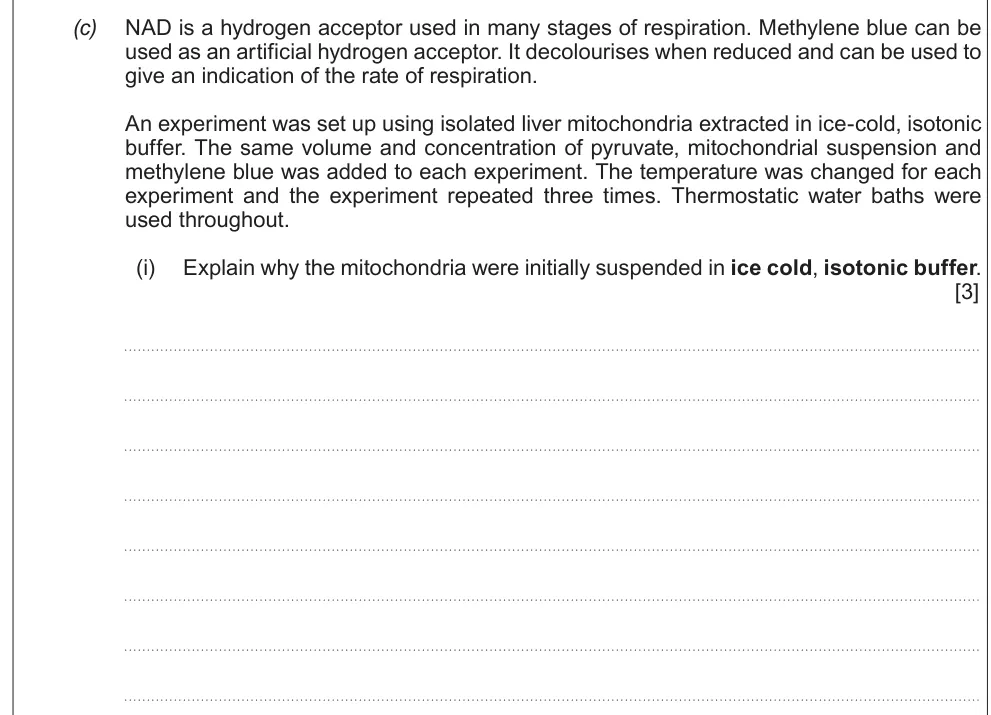
A level Component 1 · June 2019 · Q4(c)(i) · 3 marks
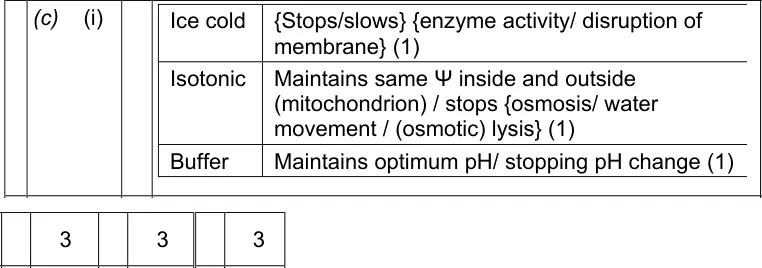
Explain why isolated mitochondria were first suspended in an ice-cold, isotonic buffer.
Show the mark scheme
Tap an image to open it full size.
From the examiners' report: Incomplete answers were common: often only two of the three explanations were given.
Question 2
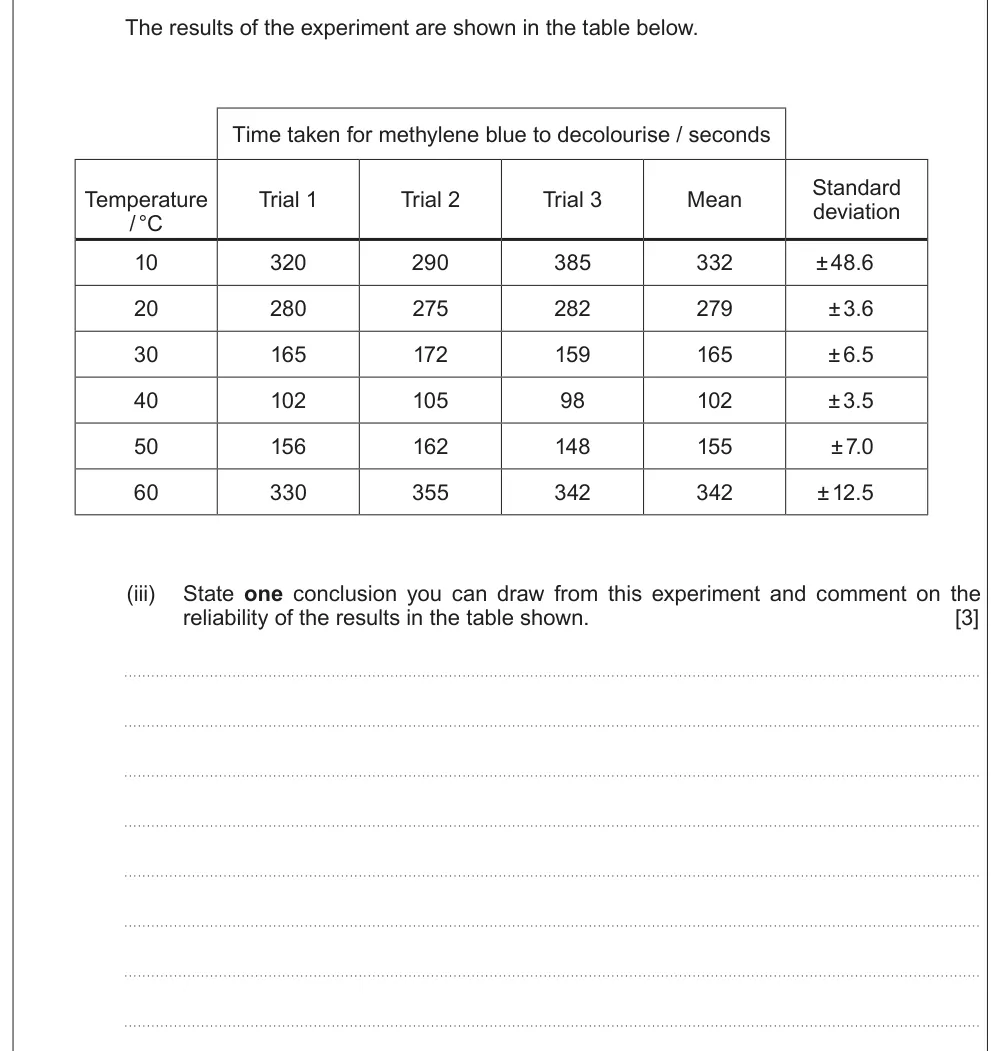
A level Component 1 · June 2019 · Q4(c)(iii) · 3 marks
Use a table of times and standard deviations for methylene blue to decolourise to state a conclusion and comment on the reliability of the results.
Show the mark scheme

Tap an image to open it full size.
From the examiners' report: Data analysis was poor. You needed to refer to the data sets and the standard deviations and pick out the least reliable temperature. Very few gave a conclusion that could be drawn from the data.
Question 3
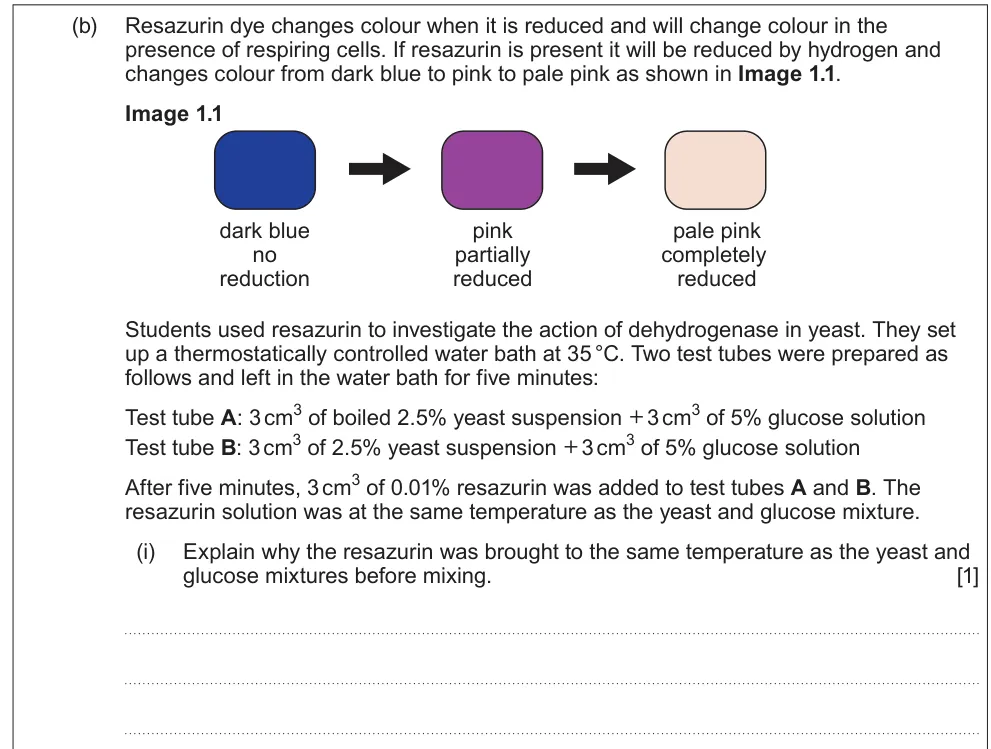
A level Component 1 · June 2025 · Q1(b)(i) · 1 mark
Explain why the resazurin solution was brought to the same temperature as the yeast and glucose mixture before mixing.
Show the mark scheme

Tap an image to open it full size.
From the examiners' report: The report noted a lack of understanding of why solutions are brought to the same temperature before they are mixed.
Question 4
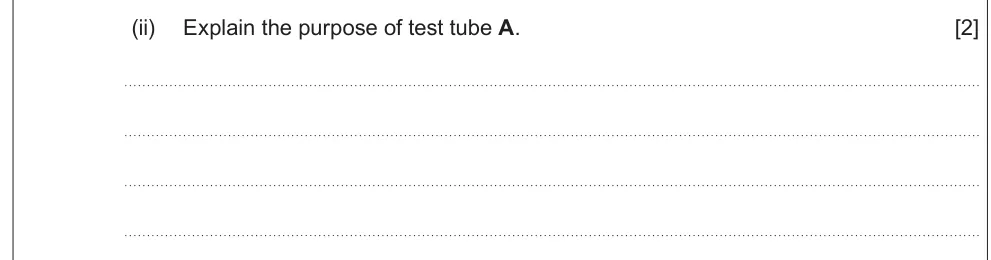
A level Component 1 · June 2025 · Q1(b)(ii) · 2 marks
Explain the purpose of a test tube that contained boiled yeast suspension.
Show the mark scheme

Tap an image to open it full size.
From the examiners' report: Some answers showed a lack of understanding of the purpose of a control experiment. Good answers came from candidates who were familiar with the dehydrogenase practical in the lab book.
Separating chloroplast pigments by chromatography
Question 5
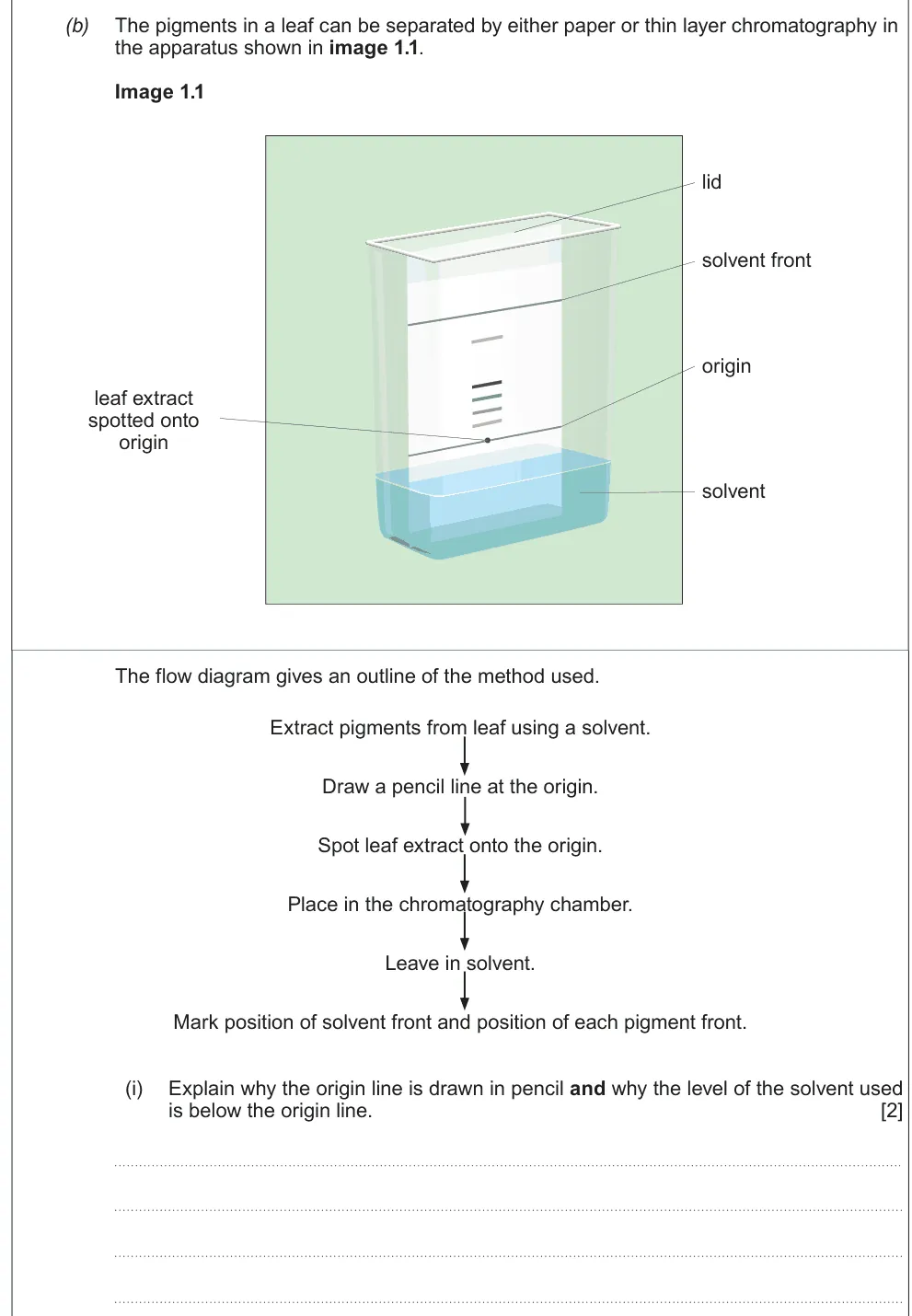
A level Component 1 · Autumn 2021 · Q1(b)(i) · 2 marks
Explain why the origin line is drawn in pencil and why the solvent level is kept below the origin line.
Show the mark scheme

Tap an image to open it full size.
From the examiners' report: The principles of chromatography were well understood.
Question 6
A level Component 1 · Autumn 2021 · Q1(b)(ii) · 1 mark
Describe how the pigment is concentrated on the origin line of a chromatogram.

Show the mark scheme

Tap an image to open it full size.
From the examiners' report: Many described how the pigment is applied to the origin rather than how it is concentrated.
Question 7
A level Component 1 · Autumn 2021 · Q1(b)(iv) · 1 mark
State one variable to control when chromatography is used to compare the pigments in the leaves of two species.

Show the mark scheme

Tap an image to open it full size.
From the examiners' report: Many were unable to state a variable that would need to be controlled.
Question 8
A level Component 1 · June 2024 · Q4(b)(ii) · 1 mark
Explain why a pencil is used to draw the origin line on chromatography paper.

Show the mark scheme

Tap an image to open it full size.
From the examiners' report: Saying that pencil won't run did not gain the mark. An answer that pencil is insoluble, so does not run, would have gained it.
Investigating factors affecting the rate of photosynthesis
Question 9
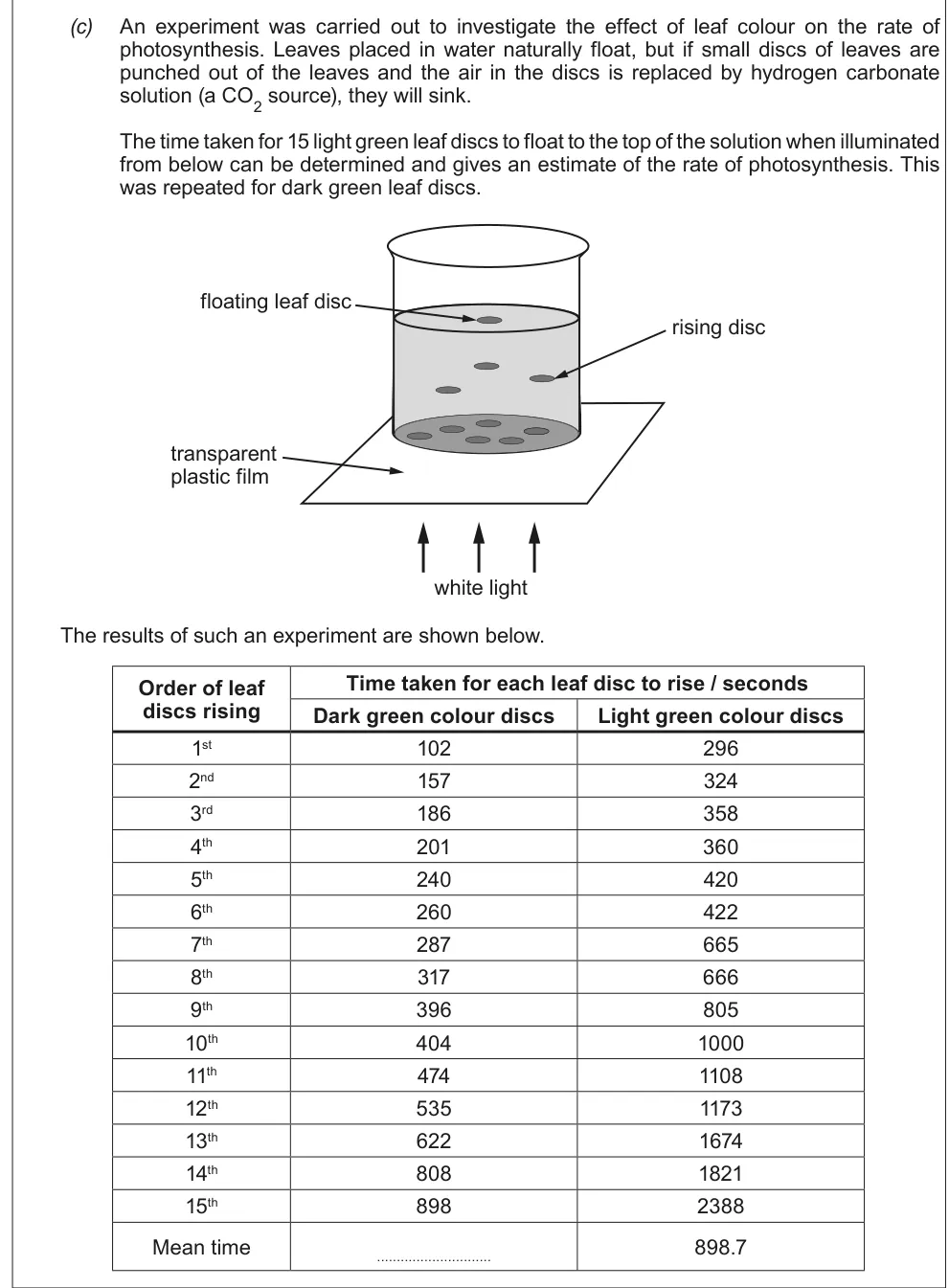
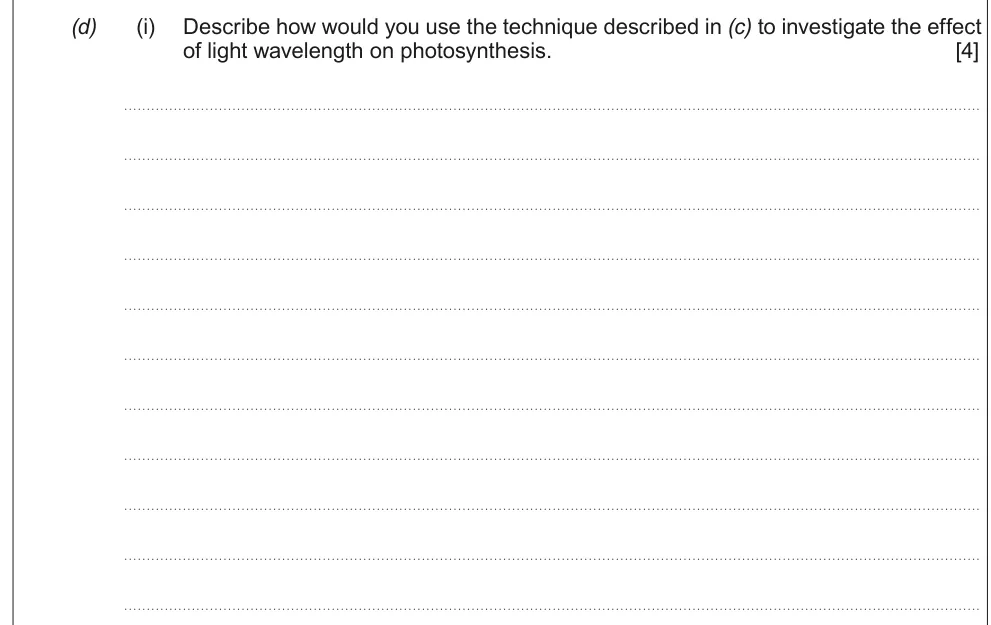
A level Component 1 · June 2017 · Q4(d)(i) · 4 marks
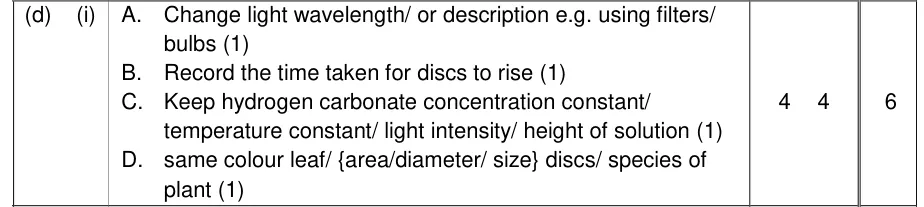
Describe how the floating leaf disc technique could be used to investigate the effect of light wavelength on photosynthesis.
Information from earlier in this question:
Show the mark scheme
Tap an image to open it full size.
From the examiners' report: Descriptions of how the experiment could be modified were very vague. Modifying a given experiment by changing the independent variable is a skill that needs practice.
Question 10
A level Component 1 · June 2017 · Q4(d)(ii) · 2 marks
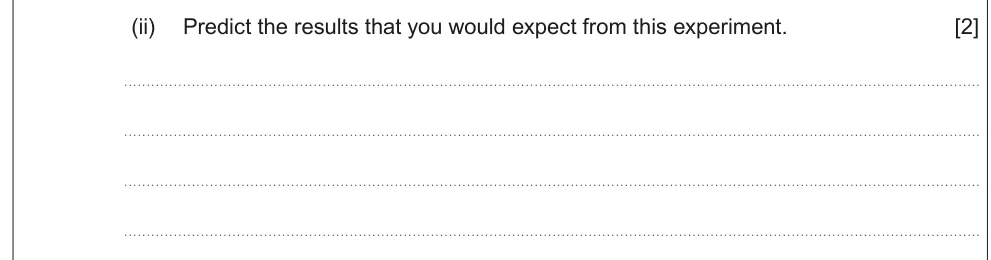
Predict the results of the leaf disc experiment at different wavelengths of light.
Show the mark scheme

Tap an image to open it full size.
From the examiners' report: Predict the results in terms of how long the discs take to rise. Many did not mention the results at all and only wrote about the rate of photosynthesis, which is a conclusion.
Question 11
A level Component 1 · Autumn 2021 · Q3(a)(i) · 1 mark
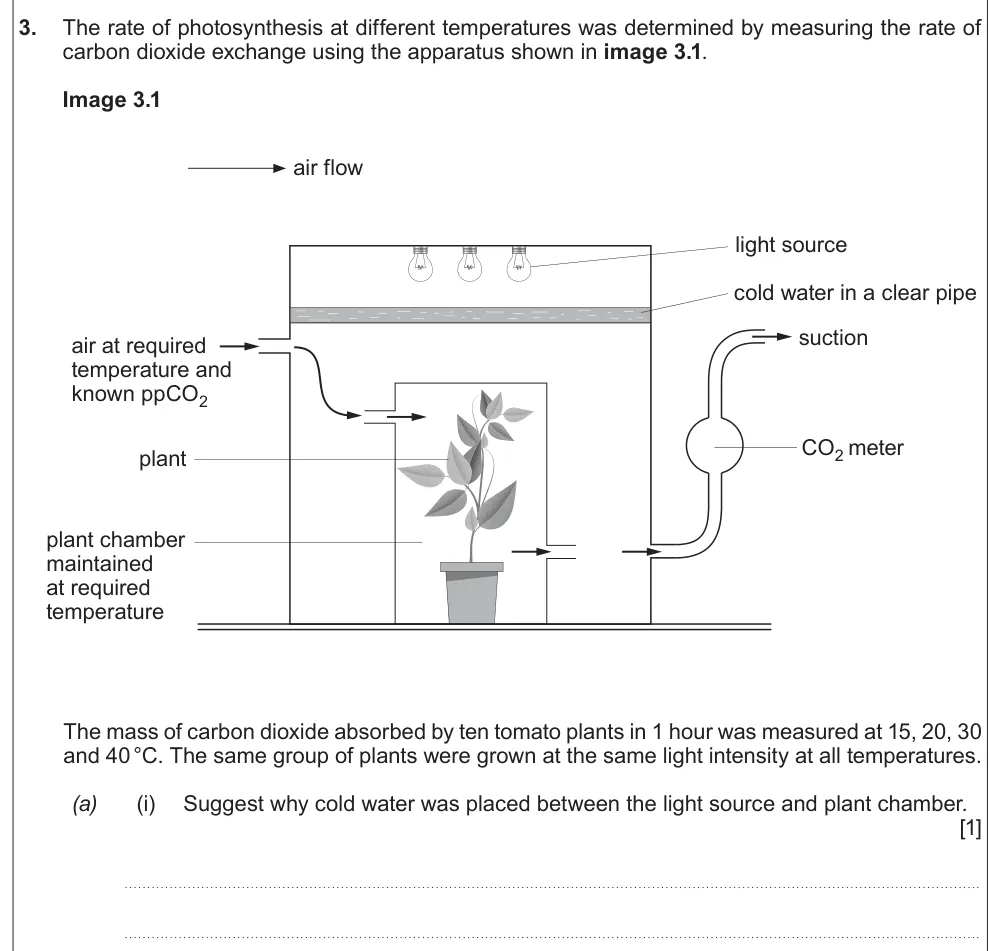
Suggest why cold water was placed between the light source and the plant chamber.
Show the mark scheme

Tap an image to open it full size.
From the examiners' report: Candidates were able to give a reason for the cold water between the light source and the chamber.
Question 12
A level Component 1 · Autumn 2021 · Q3(a)(iii) · 2 marks
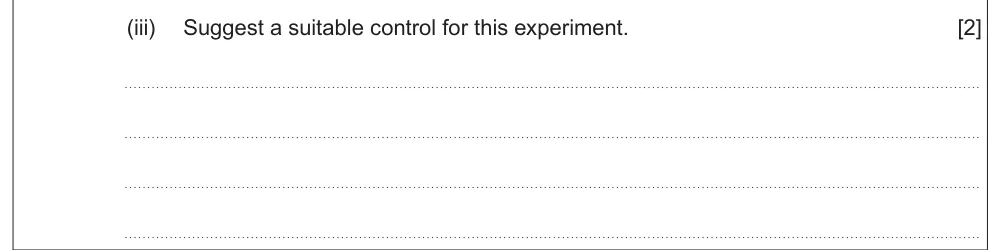
Suggest a suitable control for an experiment measuring CO₂ uptake by tomato plants at different temperatures.
Show the mark scheme

Tap an image to open it full size.
From the examiners' report: Very few stated a control for the experiment: answers confused a control with a controlled variable.
Investigating the role of minerals in plant growth
Question 13
A level Component 1 · June 2017 · Q2(c) · 4 marks
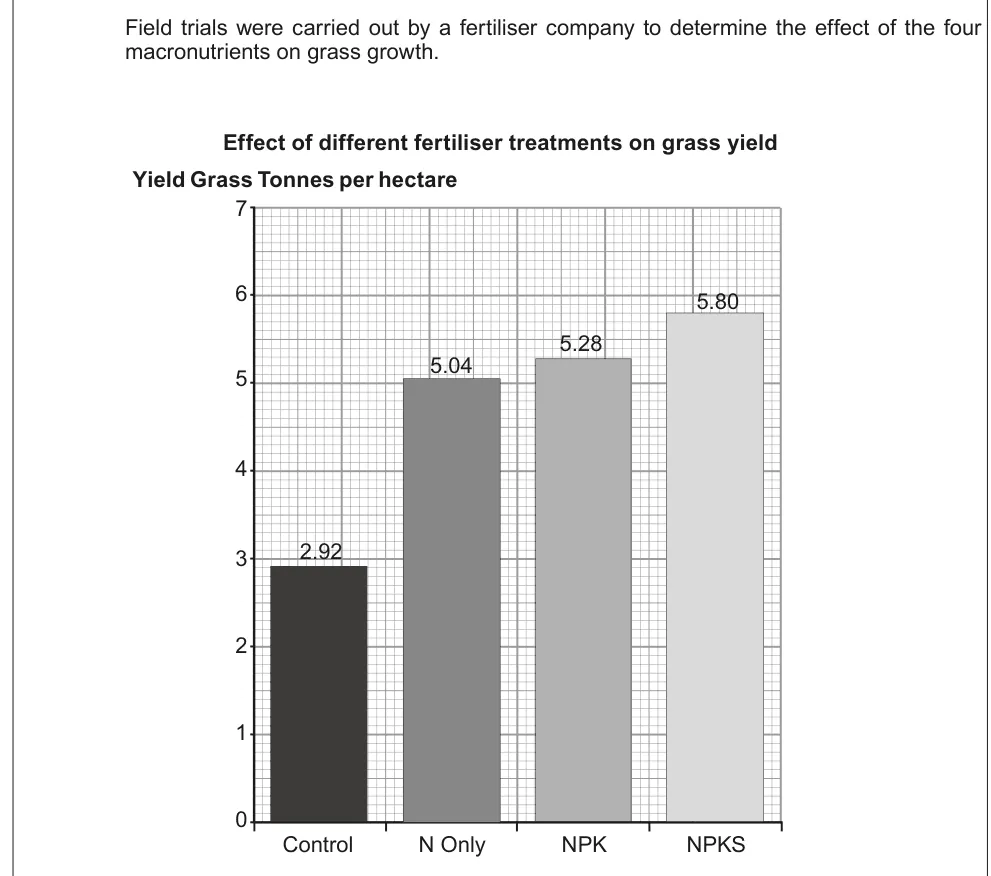
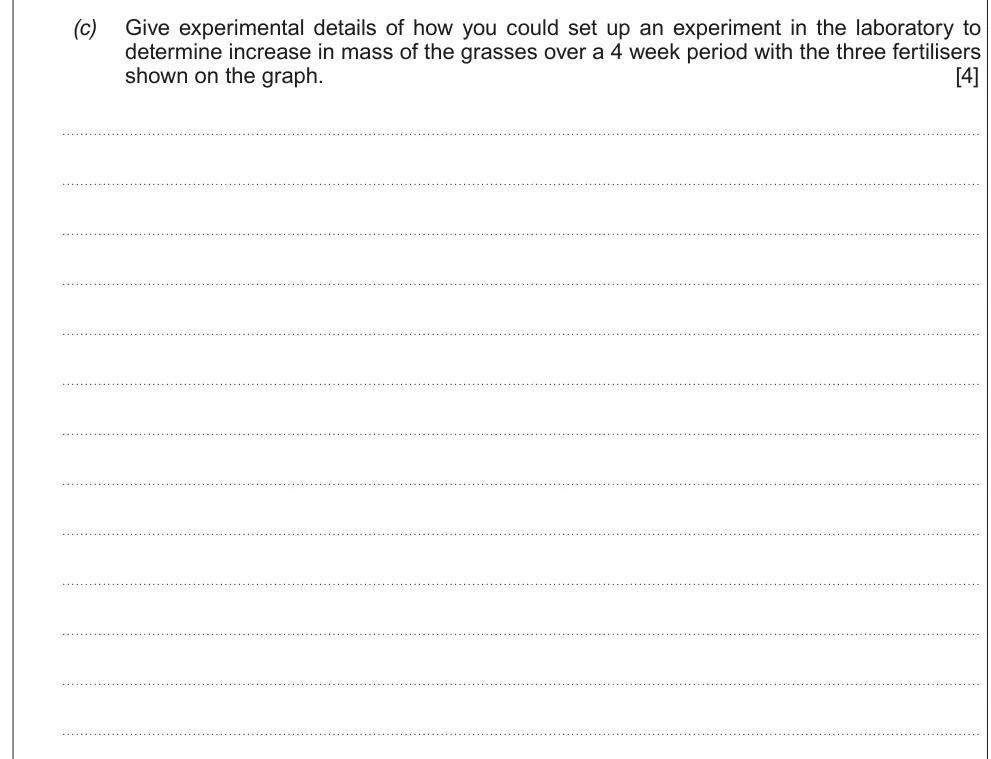
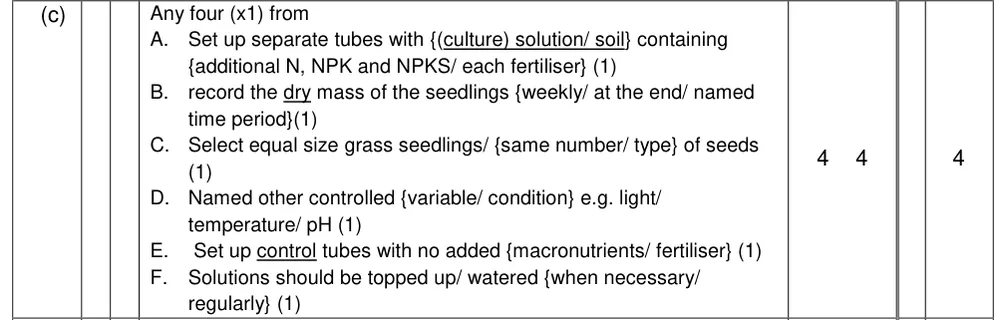
Give experimental details of a laboratory experiment to find the increase in mass of grasses over four weeks with three fertilisers.
Information from earlier in this question:
Show the mark scheme
Tap an image to open it full size.
From the examiners' report: The question asked for an experiment in the laboratory, but far too many pegged out areas in fields. Vague descriptions gained no credit: the method had to be detailed enough to be reproduced.
Question 14
A level Component 1 · June 2025 · Q3(b)(iv) · 3 marks
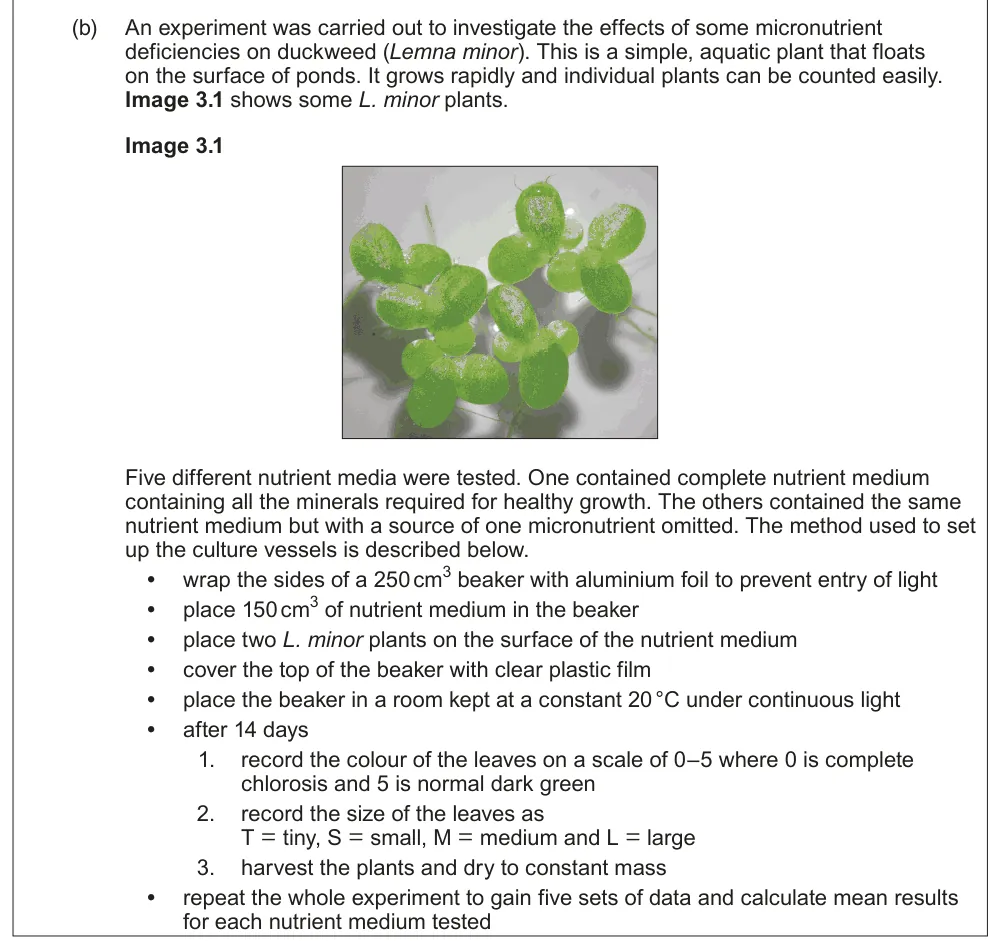
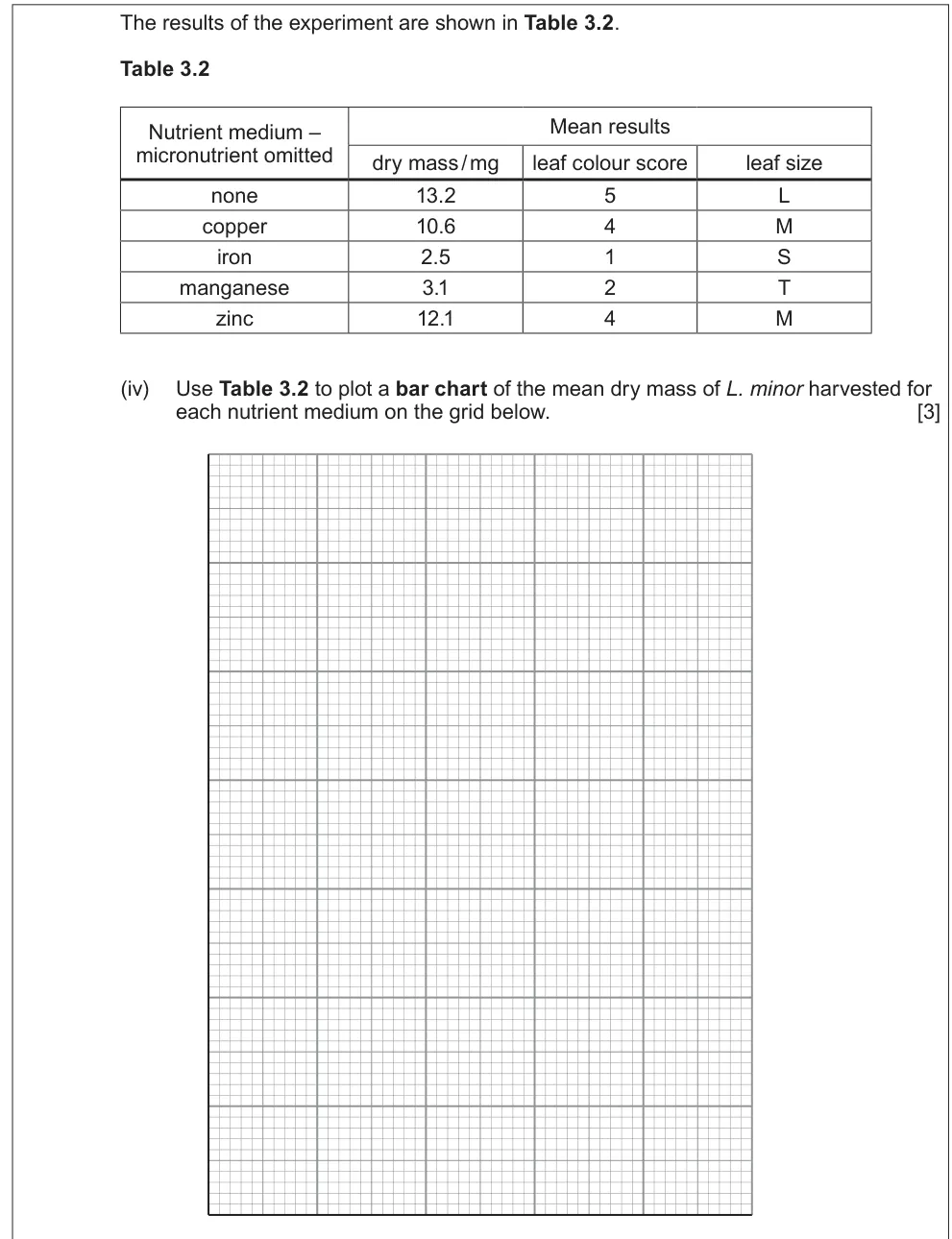
Plot a bar chart of the mean dry mass of duckweed grown in five nutrient media.
Information from earlier in this question:
Show the mark scheme

Tap an image to open it full size.
From the examiners' report: Many did not gain full marks. Errors were made in plotting, in choosing a scale for the y axis and in labelling the axes.
Investigating the rate of respiration in yeast
Question 15
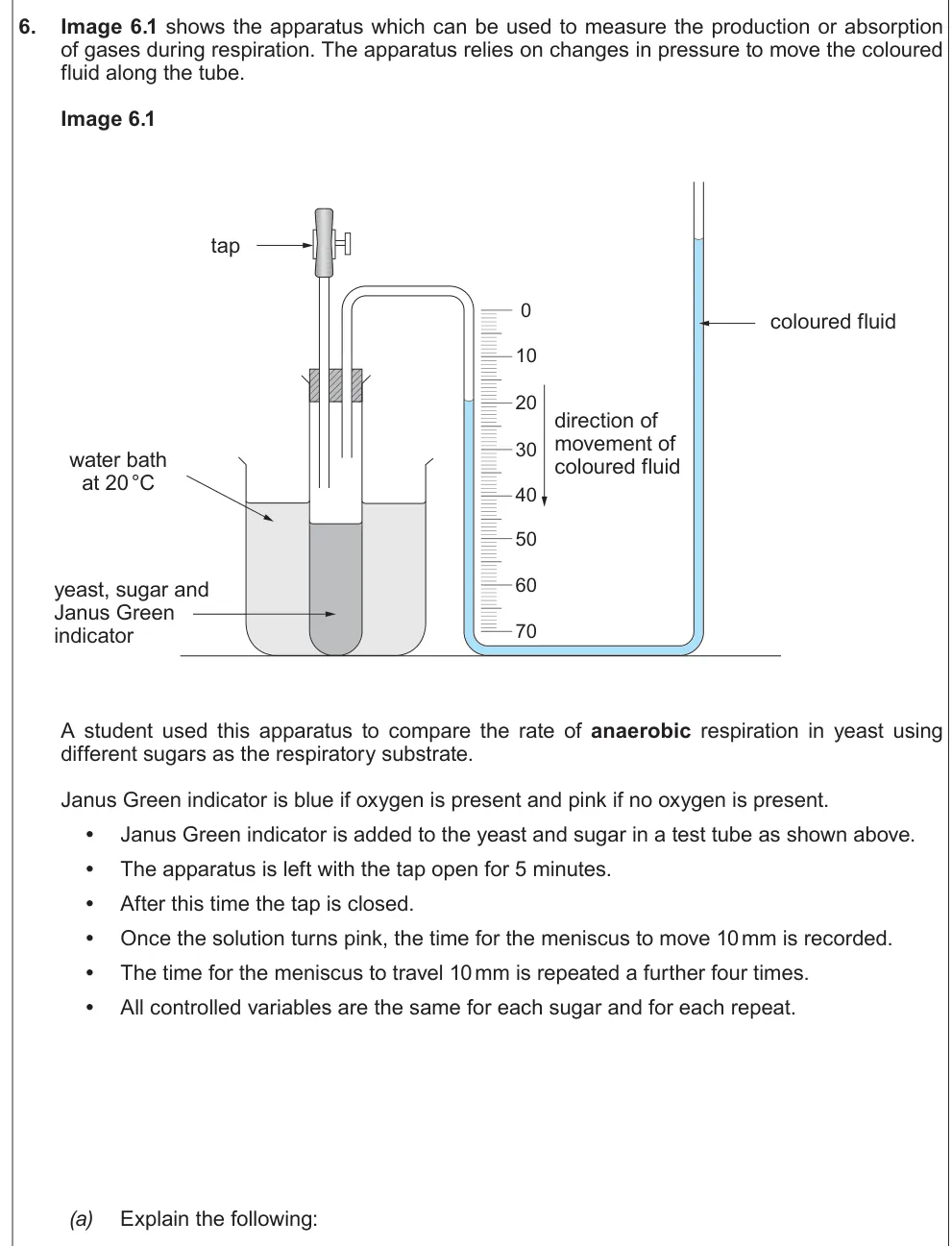
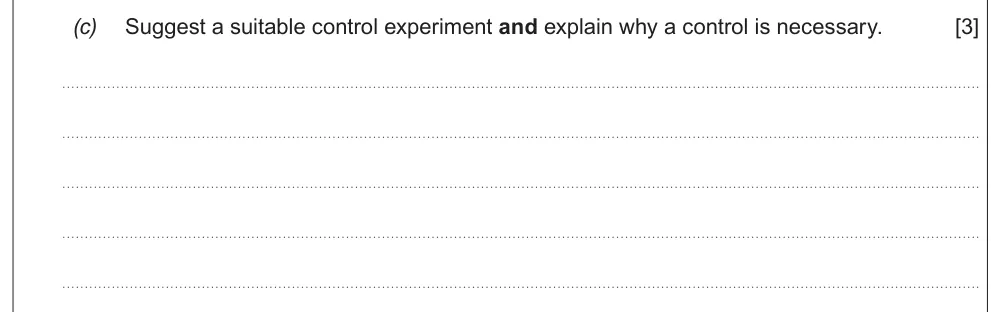
A level Component 1 · Autumn 2020 · Q6(c) · 3 marks
Suggest a suitable control for an experiment on anaerobic respiration in yeast and explain why a control is needed.
Information from earlier in this question:
Show the mark scheme

Tap an image to open it full size.
From the examiners' report: Not adding yeast was a common answer but was not accepted. Say that every other condition in the control is kept the same.
Question 16
A level Component 1 · Autumn 2020 · Q6(d)(i) · 3 marks · Hard
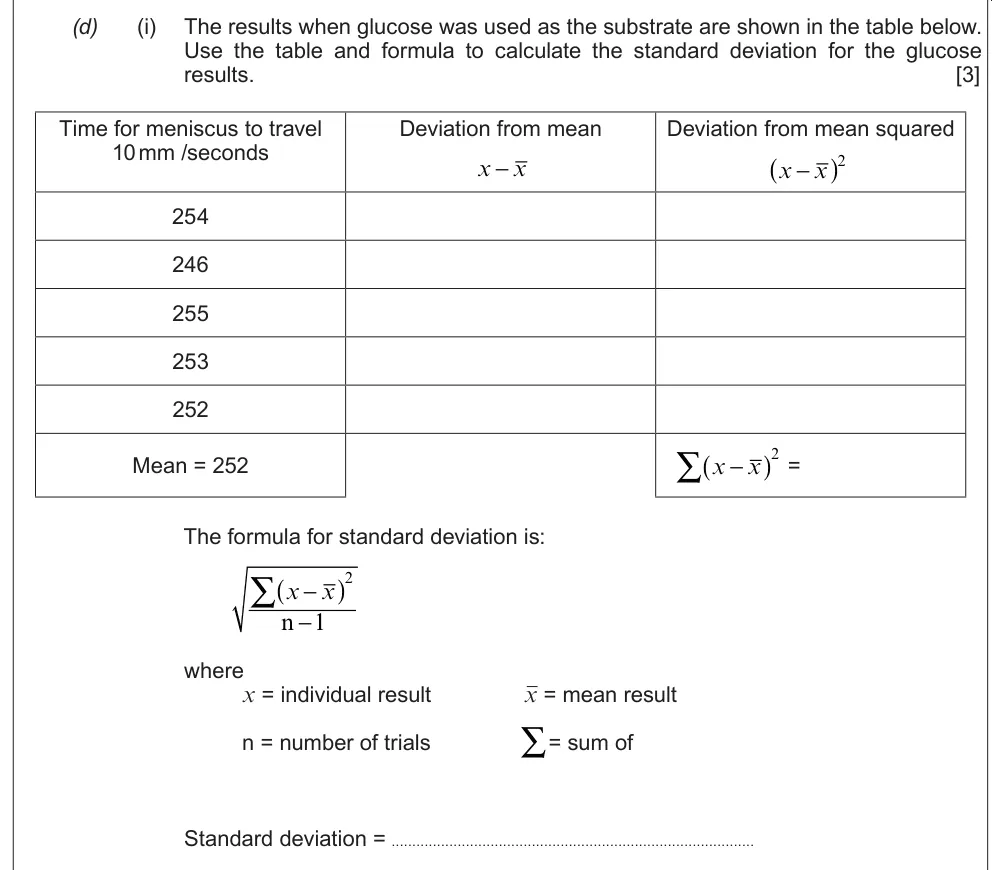
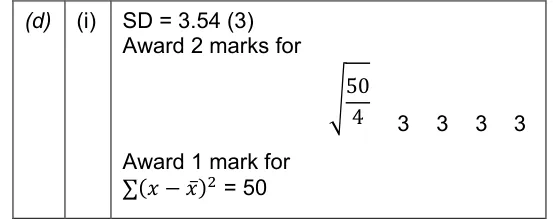
Use a table and the formula given to calculate the standard deviation of five repeat times.
Show the mark scheme
Tap an image to open it full size.
From the examiners' report: Most candidates had no difficulty with the calculation.
Question 17
A level Component 1 · June 2024 · Q3(b)(i) · 1 mark
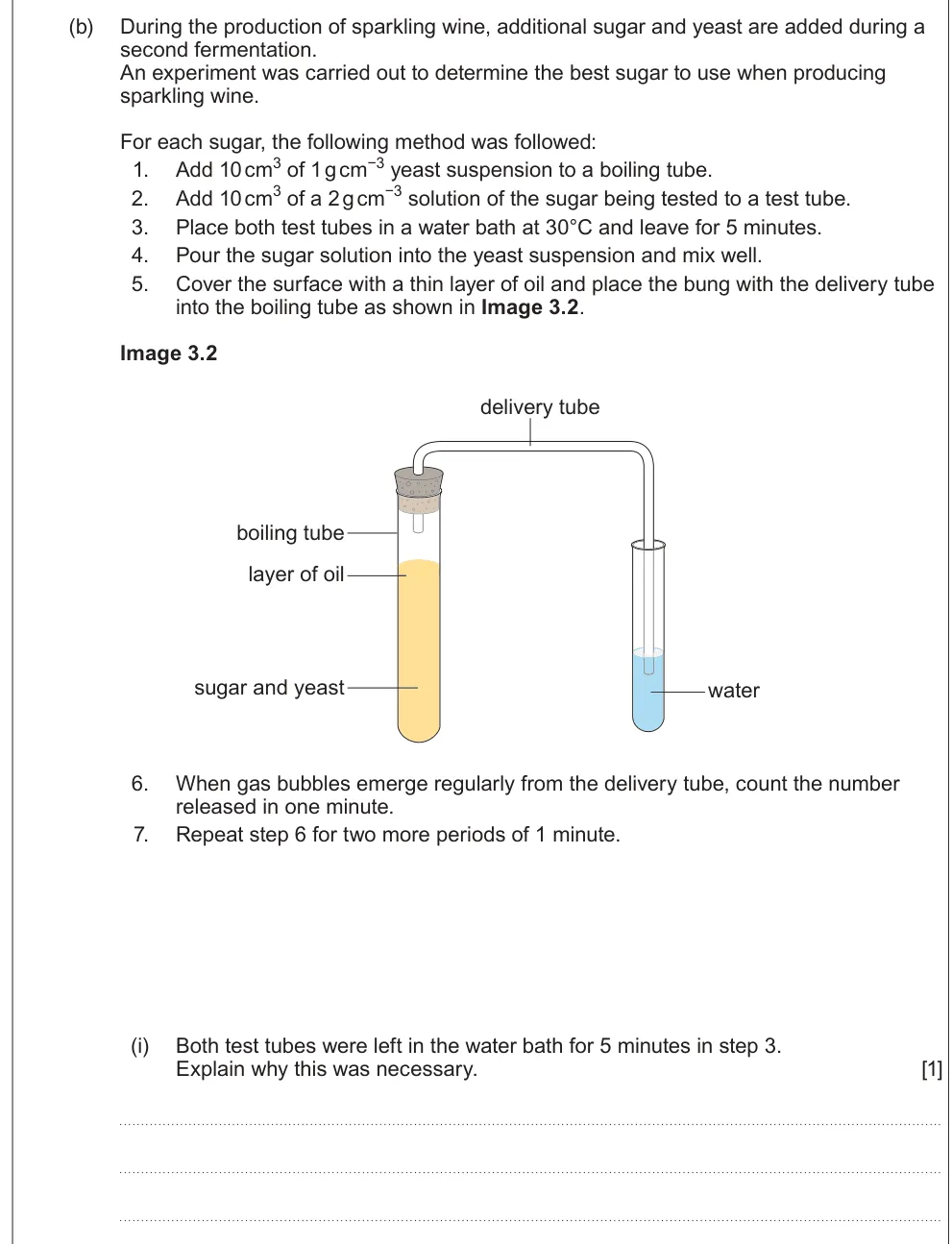
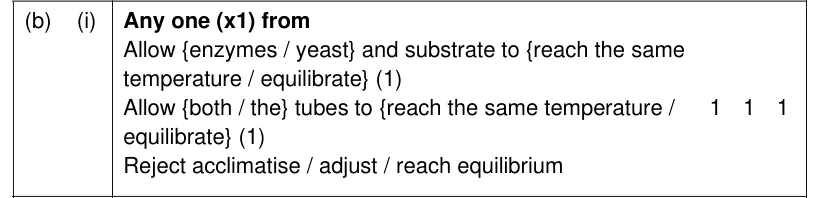
Explain why the yeast suspension and the sugar solution were both left in the water bath for five minutes before mixing.
Show the mark scheme
Tap an image to open it full size.
From the examiners' report: A water bath at a set temperature is not there to provide optimum conditions. It controls a variable that could otherwise affect the rate of reaction.
Investigating transpiration with a potometer
Question 18
A level Component 3 · June 2019 · Q3(a)(i) · 2 marks
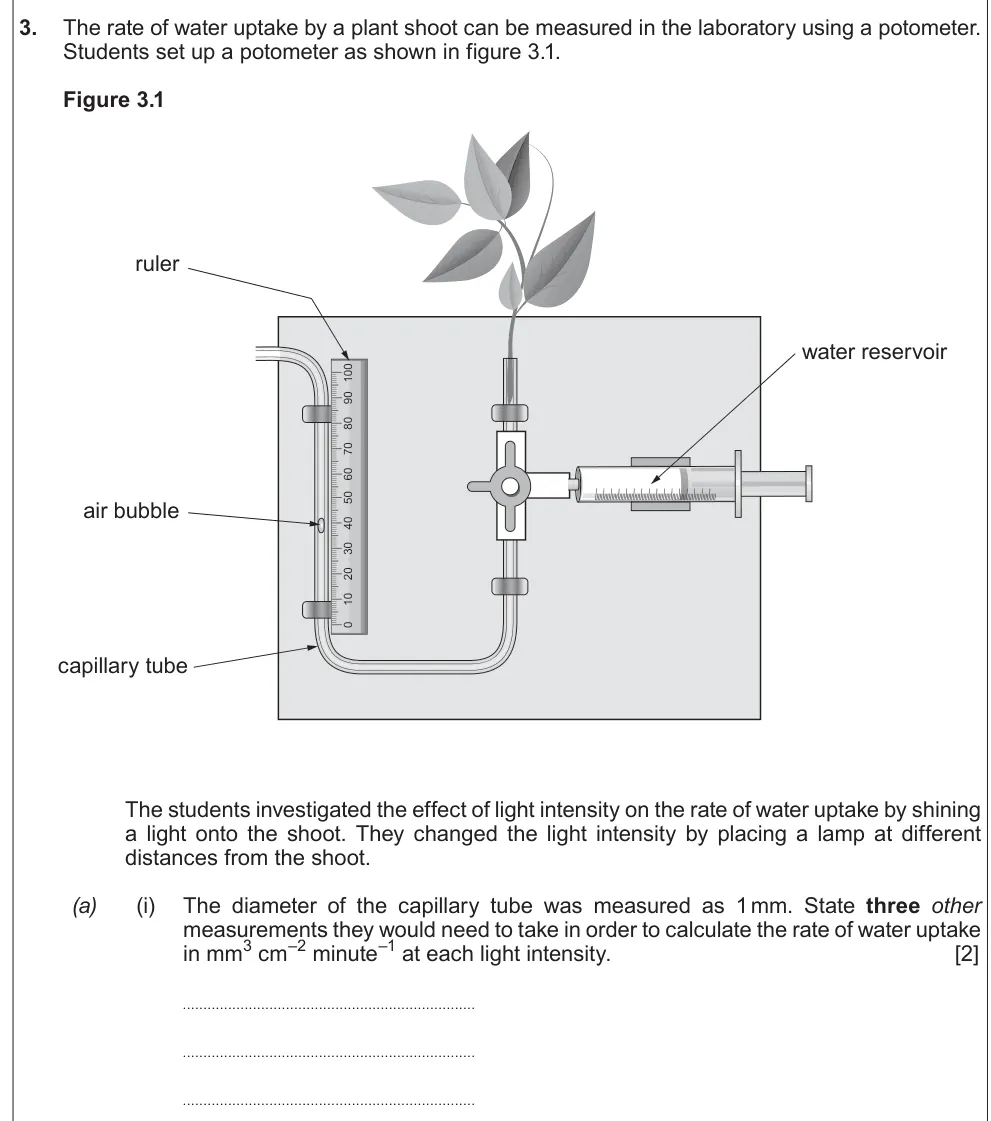
State three other measurements needed to calculate the rate of water uptake in mm³ cm⁻² minute⁻¹.
Show the mark scheme

Tap an image to open it full size.
From the examiners' report: Very few could look at the unit of water uptake and recognise the measurements needed to calculate the rate.
Question 19
AS Component 2 · Autumn 2020 · Q2(b)(i) · 3 marks
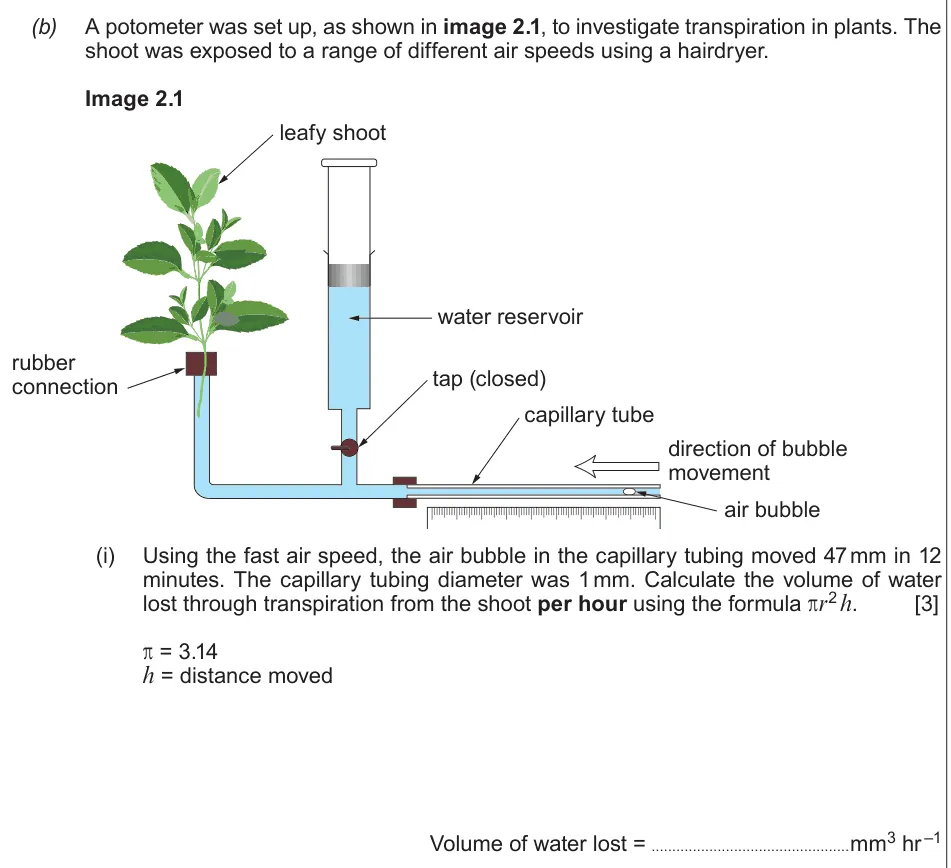
Calculate the volume of water lost from a shoot per hour from the distance moved by the air bubble, using πr²h.
Show the mark scheme

Tap an image to open it full size.
From the examiners' report: Most could take the values from the text and substitute them into the formula, but converting the answer to a value per hour was seen less often. Weaker answers took h to mean hours, although the key said it was the distance moved.
Question 20
AS Component 2 · June 2022 · Q5(a)(i) · 2 marks
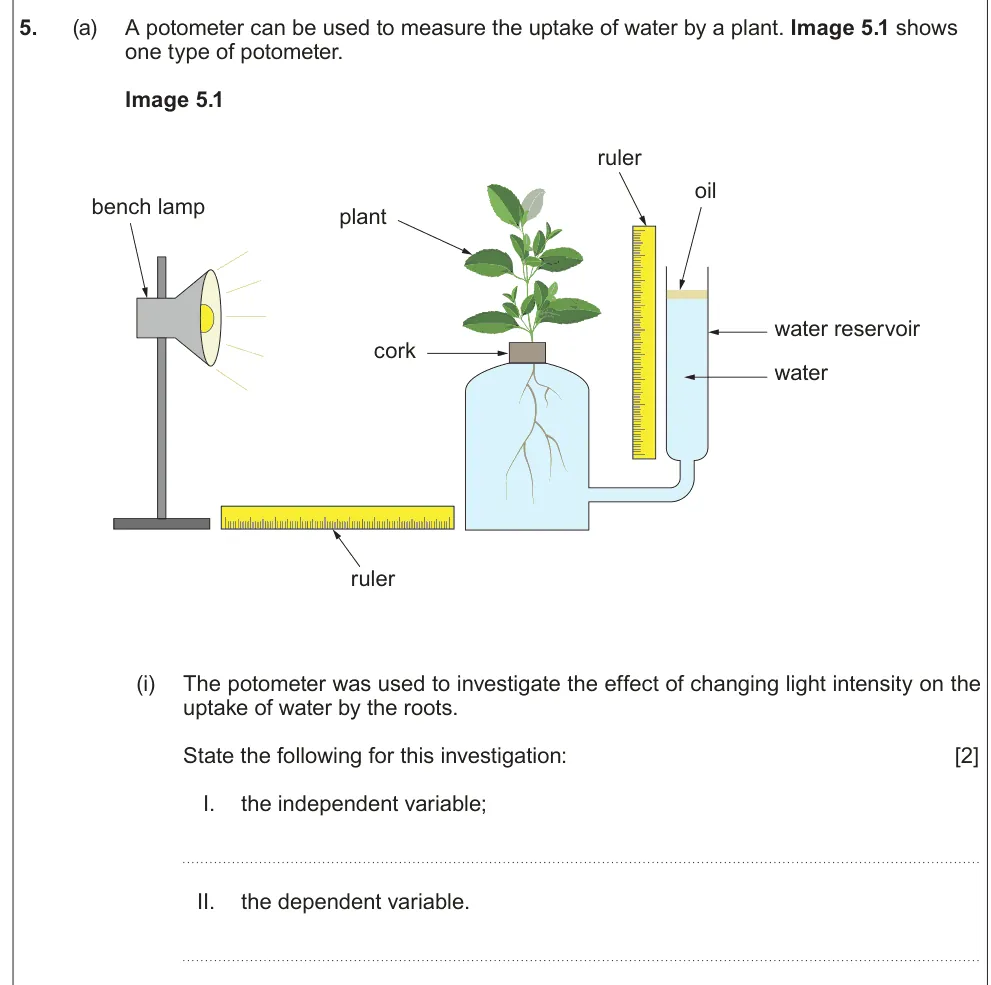
State the independent and dependent variables in a potometer investigation into light intensity.
Show the mark scheme

Tap an image to open it full size.
From the examiners' report: A few gave light intensity as the independent variable and the amount of transpiration or water uptake as the dependent variable. The examiners wanted the distance of the lamp from the plant and the distance the water level moved.
Question 21
AS Component 2 · June 2022 · Q5(b)(ii) · 3 marks
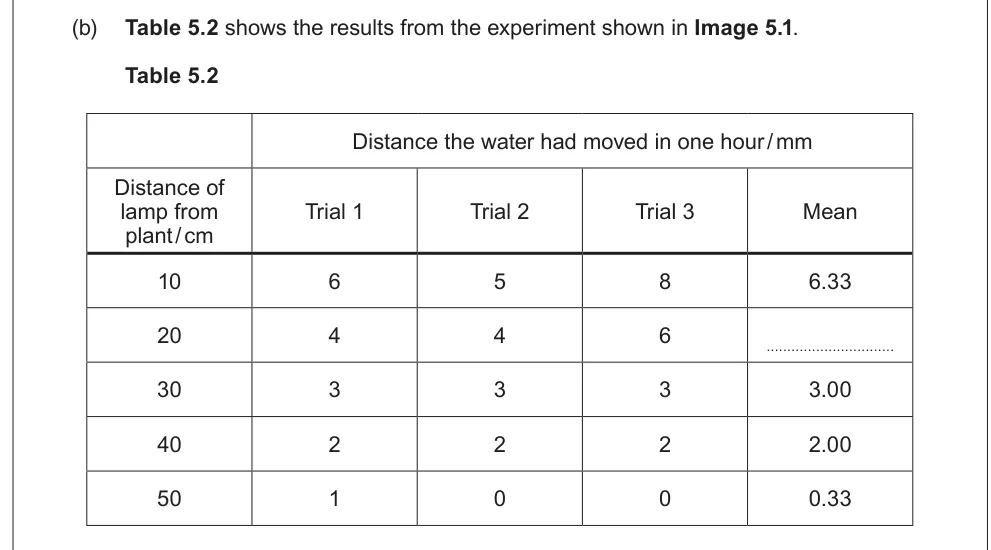
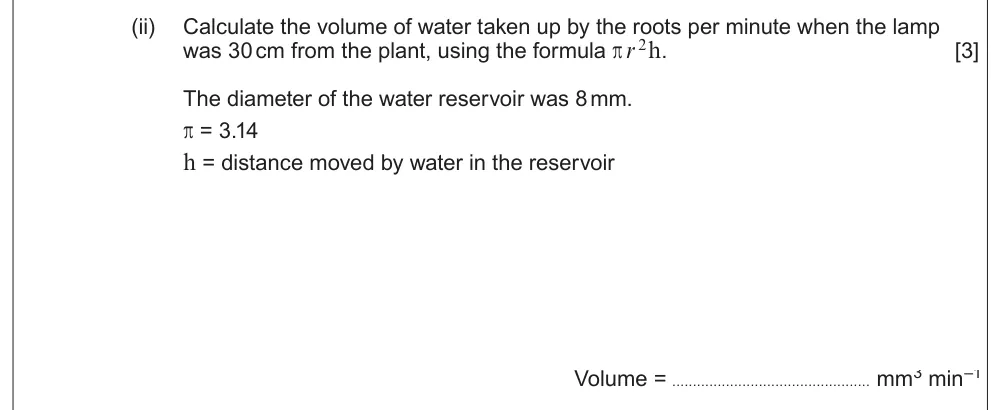
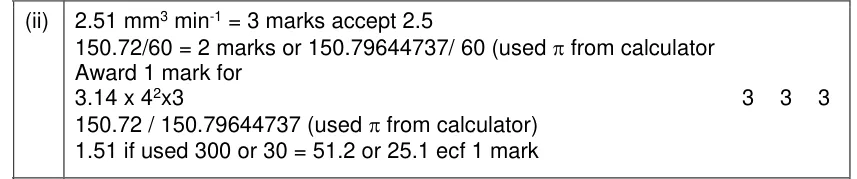
Calculate the volume of water taken up by the roots per minute from a table of results, using πr²h.
Information from earlier in this question:
Show the mark scheme
Tap an image to open it full size.
From the examiners' report: Some used 300 or 30 as the value of h instead of the distance in millimetres. Another error was not dividing by 60 to give the rate per minute.
Question 22
AS Component 2 · June 2022 · Q5(b)(iii) · 2 marks
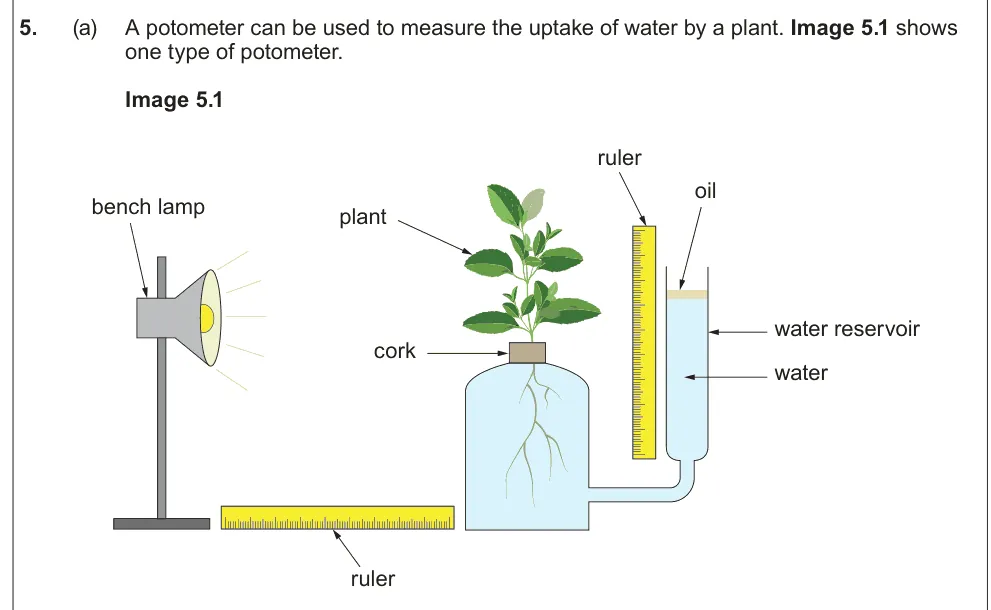
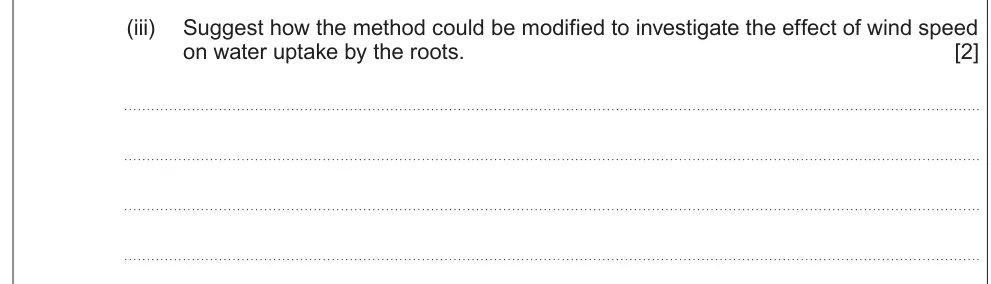
Suggest how the method could be modified to investigate the effect of wind speed on water uptake.
Information from earlier in this question:
Show the mark scheme

Tap an image to open it full size.
From the examiners' report: To gain credit for modifying a method, a range of five values of the independent variable was needed, so stating five different wind speeds would do.
Where students lose marks (from Eduqas examiners' reports and mark schemes)
Each point below is followed by wording that gained marks.
Boiled yeast, not no yeast: Not adding yeast was a common control and was not accepted. Candidates also needed to stress that all other conditions stay the same.
✔ Gains credit: "Repeated with boiled and cooled yeast", "Keep all other conditions the same".
A control is not a controlled variable: Very few stated a control for the CO₂ uptake experiment because they confused a control with a controlled variable.
✔ Gains credit: "Repeat with same apparatus and conditions", "No plant".
Insoluble, not "won't run": Stating that pencil won't run did not gain the mark.
✔ Gains credit: "Pencil does not dissolve / is insoluble (in the solvents used)".
Concentrating the pigment spot: Many described how the pigment is applied rather than how it is concentrated on the origin.
✔ Gains credit: "Spot extract, evaporate / dry, repeat".
Water baths control a variable: Candidates wrote that the water bath provides optimum conditions. Its job is to control a variable that could otherwise affect the rate of reaction.
✔ Gains credit: "Allow enzymes / yeast and substrate to reach the same temperature / equilibrate".
h is a distance, not hours: Weaker answers took h in πr²h to mean hours, and many did not convert the volume to a value per hour.
✔ Gains credit: "3.14 × (0.5)² × 47", then multiply by "60 ÷ 12" to give the volume per hour.
Name what is changed and what is measured: Some gave light intensity as the independent variable and transpiration or water uptake as the dependent variable.
✔ Gains credit: "The distance the light is from the plant", "The distance the water level dropped".
A laboratory method, not a field trial: Far too many pegged out areas in fields when a laboratory experiment was asked for, and vague descriptions gained no credit.
✔ Gains credit: "Set up separate tubes with culture solution containing each fertiliser", "record the dry mass of the seedlings", "Set up control tubes with no added fertiliser".
Download the questions
Download the PDF pack (22 questions, mark schemes at the end)
Keep practising
- Microscopy, Drawing and Dissection (Specified Practicals): Eduqas A Level Biology Exam Questions
- Food Tests, Membranes, Enzymes and DNA (Specified Practicals): Eduqas A Level Biology Exam Questions
- Ecology, Genetics and Statistics (Specified Practicals): Eduqas A Level Biology Exam Questions
- Importance of ATP (1.1): Eduqas A Level Biology exam questions by topic
- Photosynthesis (1.2): Eduqas A Level Biology exam questions by topic
- Respiration (1.3): Eduqas A Level Biology exam questions by topic
- Transport in Plants (3.2): Eduqas A Level Biology exam questions by topic
- Eduqas A level Biology revision resources by topic
- Eduqas A level Biology past papers, mark schemes and examiners' reports
- Eduqas A level Biology grade boundaries
- Ask about Eduqas A level Biology lessons with Sam on WhatsApp
Questions, mark schemes and examiners' report extracts © WJEC CBAC Ltd (Eduqas).