

Variation and evolution covers genetic and environmental variation, continuous and discontinuous variation, competition and selective agencies, gene pools and genetic drift, how selection changes allele frequencies, the Hardy-Weinberg principle and its conditions, isolation mechanisms and speciation, and Darwin's theory of natural selection. Every question on this page is from the A level papers, mostly Component 2.
The Hardy-Weinberg calculations reward practice: students who had practised them scored full marks, and those who hadn't scored nothing. Most marks are lost on natural selection questions, where answers are generic instead of using the information given. Say that the allele, not the gene or the characteristic, is passed on, and explain speciation through a barrier to interbreeding rather than naming allopatric or sympatric speciation without explanation.
I don't teach the Eduqas specification myself, so for one-to-one help I recommend Sam. He teaches Eduqas A level Biology at a top-rated sixth form college and is very popular with his students. You can ask about lessons with Sam on WhatsApp using the link at the bottom of this page.
What you need from GCSE and Year 12
Each question on this page assumes you're secure on these ideas. If any of them feels shaky, look it up before you start.
- Variation is caused by genes, the environment, or both.
- Individuals with useful adaptations are more likely to survive and reproduce.
- Natural selection over many generations can lead to evolution.
- A species is a group of organisms that can interbreed to produce fertile offspring.
Key terms
These words come up in the questions and mark schemes. Examiners expect you to use them exactly.
- Continuous variation: a range of values with no clear categories, usually controlled by many genes and the environment.
- Discontinuous variation: clear-cut categories, usually controlled by one gene.
- Gene pool: all the alleles of all the genes in a population.
- Genetic drift: chance changes in allele frequency, with bigger effects in small populations.
- Selection pressure: an environmental factor that gives some phenotypes a survival advantage.
- Hardy-Weinberg principle: allele frequencies stay constant if there is no selection, migration, mutation or drift and mating is random.
- Allopatric speciation: a new species forms after geographical isolation stops gene flow.
- Sympatric speciation: a new species forms in the same area, through a reproductive barrier such as behaviour.
What these questions cover (Eduqas 2.6)
The questions test these statements from Component 2 (Continuity of Life) of the Eduqas A level Biology specification (A400). Component 2 content is examined in A level Component 2.
- (a) genetic and environmental factors producing variation between individuals
- (b) variation as continuous and discontinuous
- (c) the effect of inter- and intra-specific competition on breeding success and survival
- (d) the impact of selective agencies (e.g. supply of food, breeding sites, climate, human impact) on the survival of organisms
- (e) the concept of gene pool and genetic drift
- (f) the effect of selection changing the frequency of alleles in a population
- (g) the use of the Hardy-Weinberg principle and equation
- (h) the conditions under which the Hardy-Weinberg principle applies
- (i) the concepts of isolation and speciation
- (j) the separation of populations by geographical, behavioural, morphological, seasonal and other isolation mechanisms including hybrid sterility
How to use this page
Write your answer on paper before you open the mark scheme. Allow about 1.2 minutes per mark: the 24 questions are worth 58 marks, so about 70 minutes in total. Then mark your answer strictly against the mark scheme and read the examiners' tip underneath it. If you'd rather print the questions, download the PDF pack.
Variation
Question 1
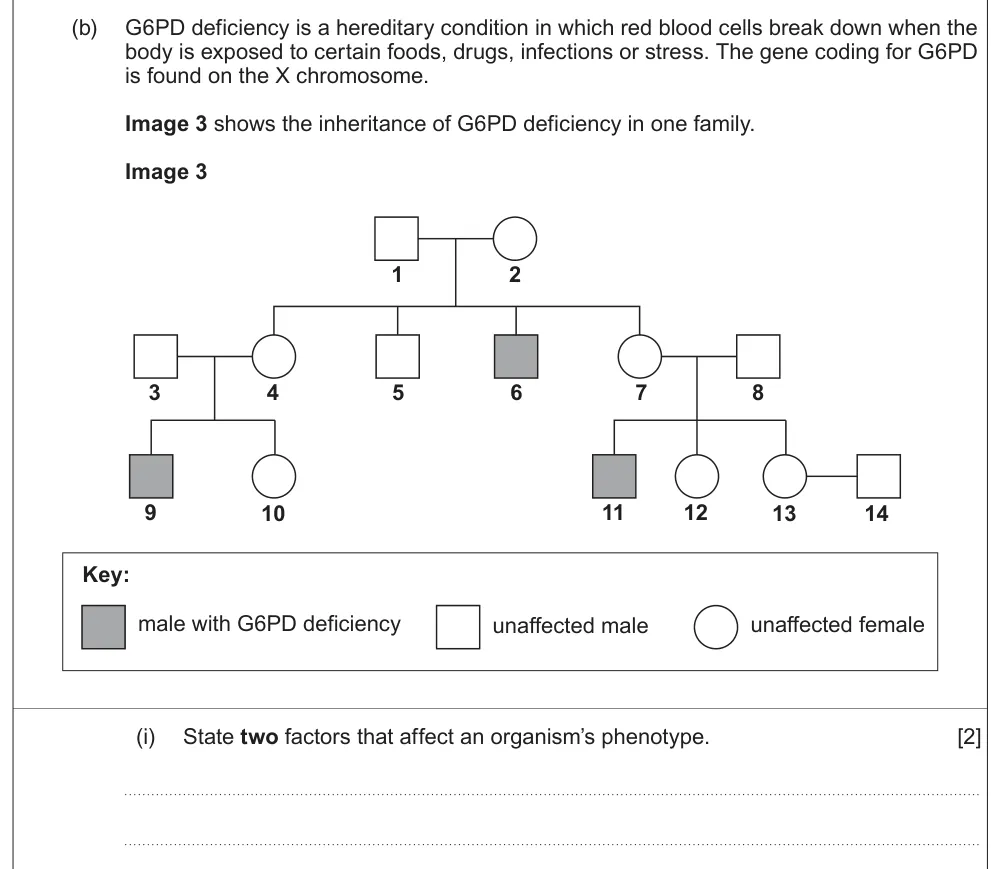
A level Component 2 · June 2024 · Q3(b)(i) · 2 marks
State two factors that affect an organism's phenotype.
Show the mark scheme

Tap an image to open it full size.
Question 2
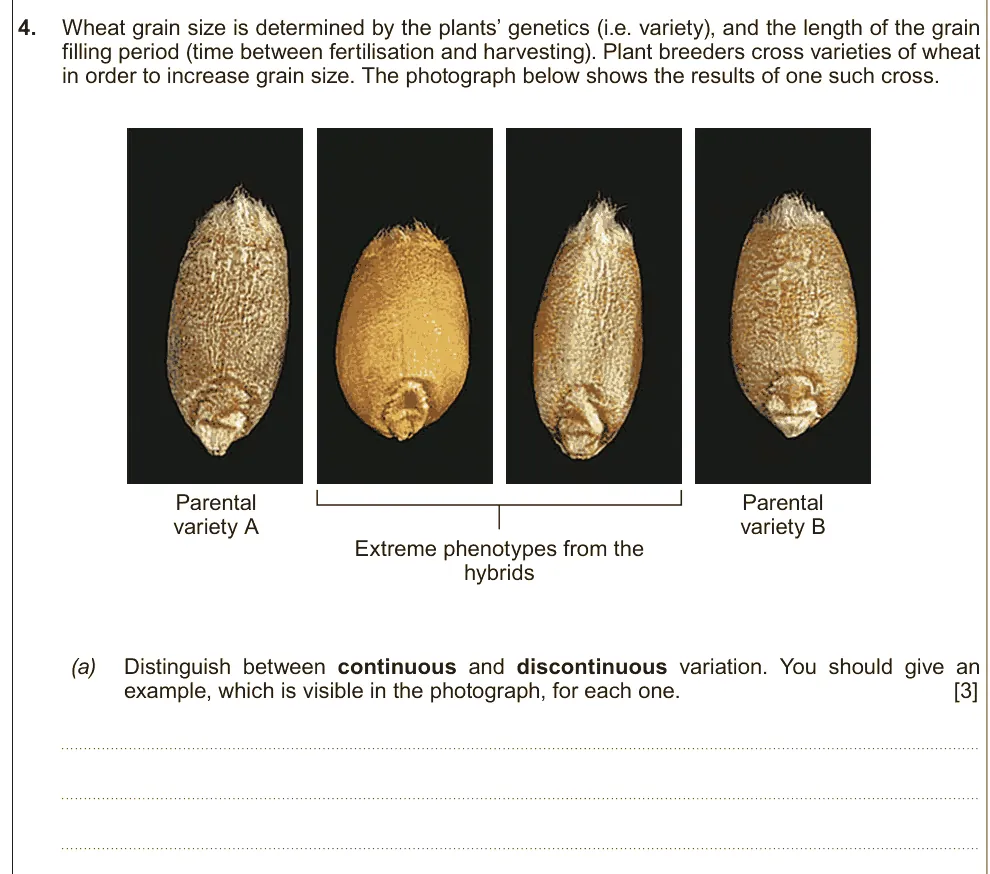
A level Component 2 · June 2018 · Q4(a) · 3 marks
Distinguish between continuous and discontinuous variation, with an example of each from a photograph.
Show the mark scheme

Tap an image to open it full size.
From the examiners' report: Many lost the mark for examples. Name a feature, such as grain size, not "variety A".
Question 3
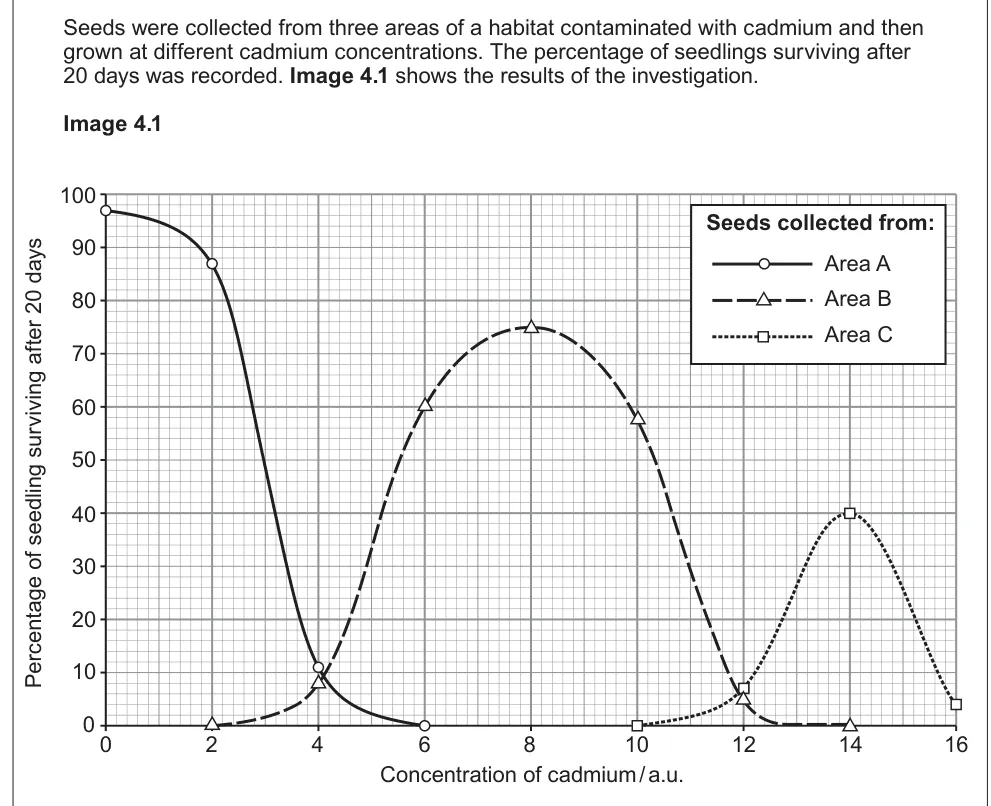
A level Component 2 · June 2022 · Q4(b)(ii) · 1 mark
State the type of variation shown in three populations.
Information from earlier in this question:

Show the mark scheme

Tap an image to open it full size.
Question 4
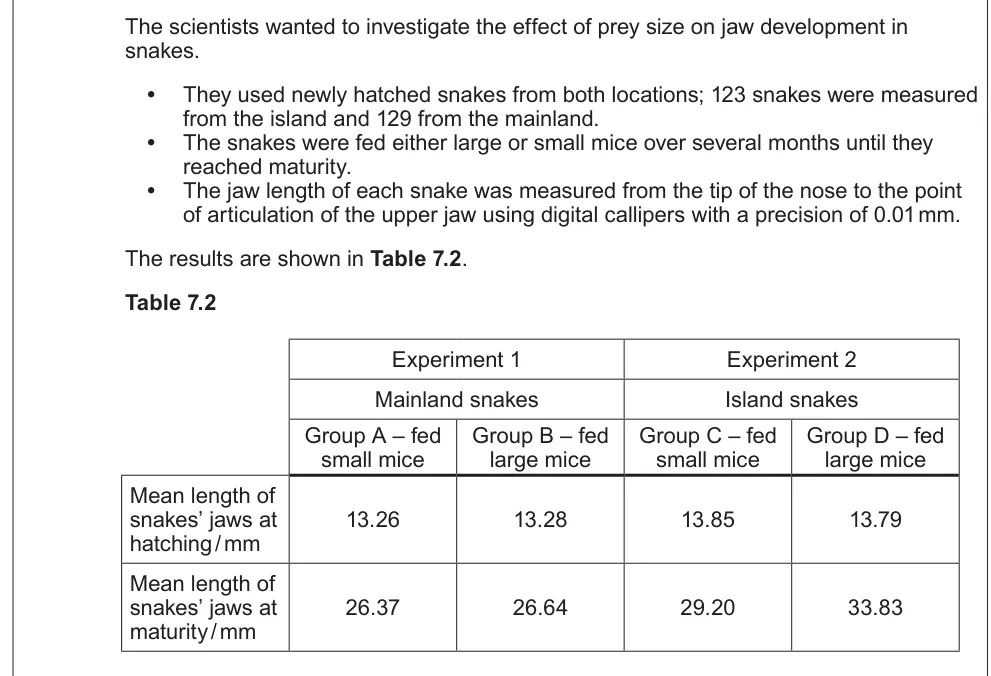
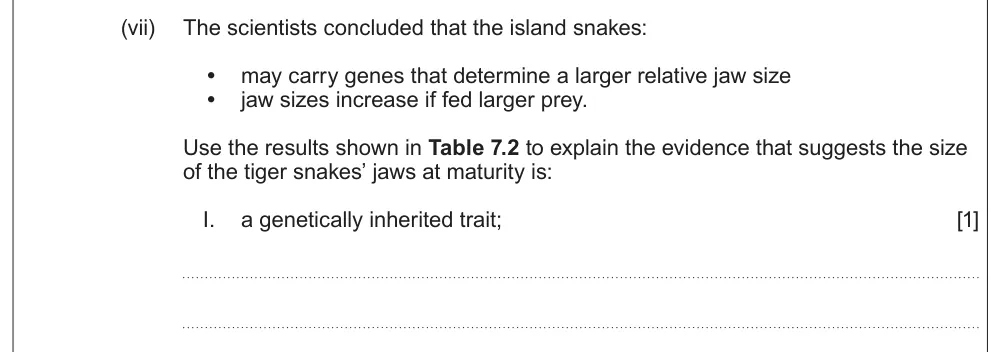
A level Component 2 · June 2023 · Q7(a)(vii)I · 1 mark
Use results to explain why jaw size in tiger snakes is genetically inherited.
Information from earlier in this question:
Show the mark scheme

Tap an image to open it full size.
Question 5
A level Component 2 · June 2023 · Q7(a)(vii)II · 1 mark
Use results to explain why jaw size is also affected by the environment.

Show the mark scheme

Tap an image to open it full size.
Competition and selection pressures
Question 6
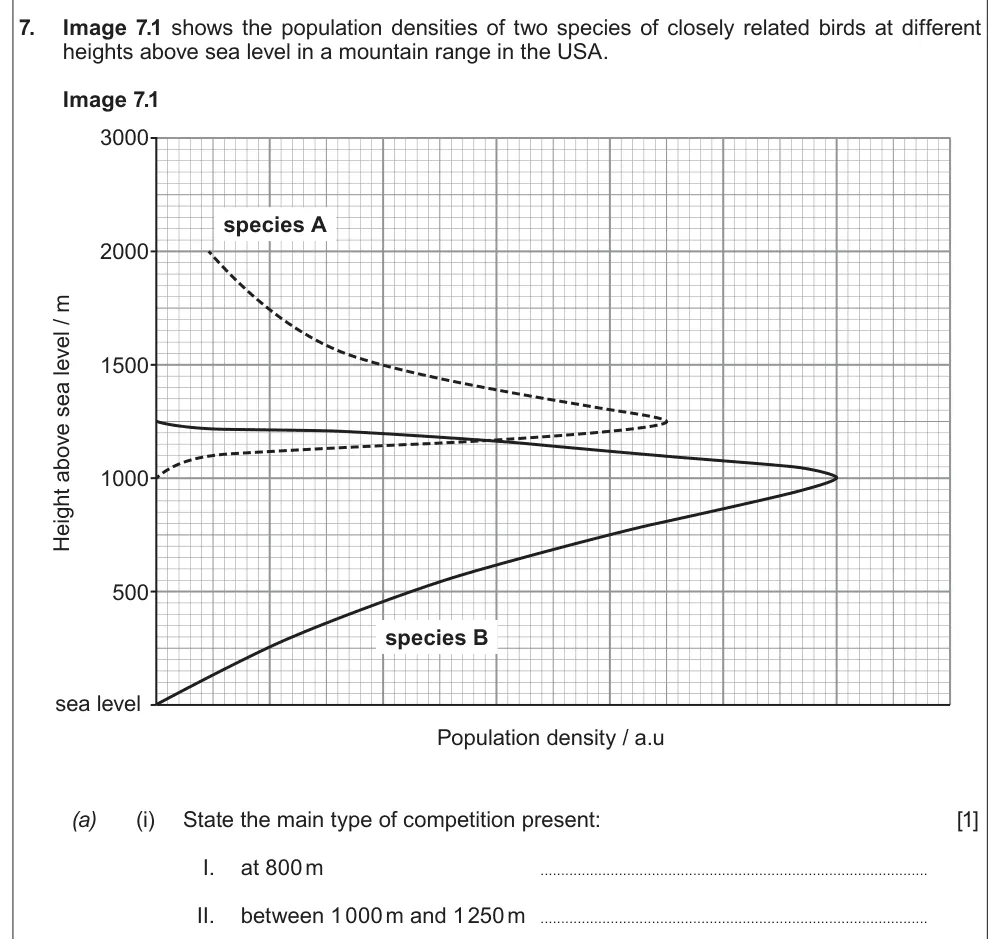
A level Component 2 · Autumn 2021 · Q7(a)(i) · 1 mark
State the main type of competition at two altitudes.
Show the mark scheme

Tap an image to open it full size.
From the examiners' report: The main problem was confusing intraspecific and interspecific competition: two species don't compete for the same mates.
Question 7
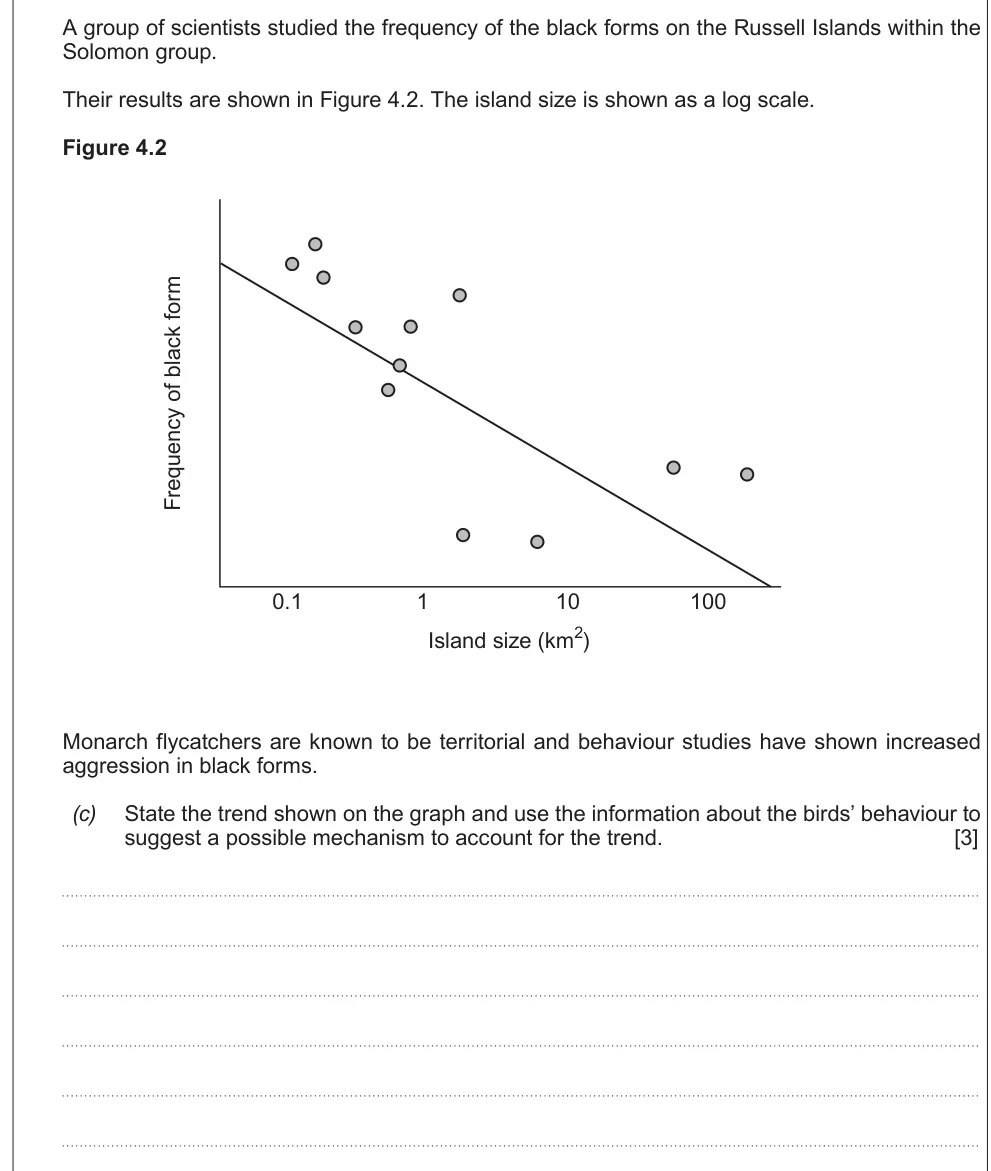
A level Component 2 · June 2019 · Q4(c) · 3 marks
State the trend in black monarch flycatchers with island size and suggest a mechanism.
Show the mark scheme

Tap an image to open it full size.
From the examiners' report: The best answers linked more competition for territories on small islands to aggression. Some put more competition on the larger islands.
Question 8
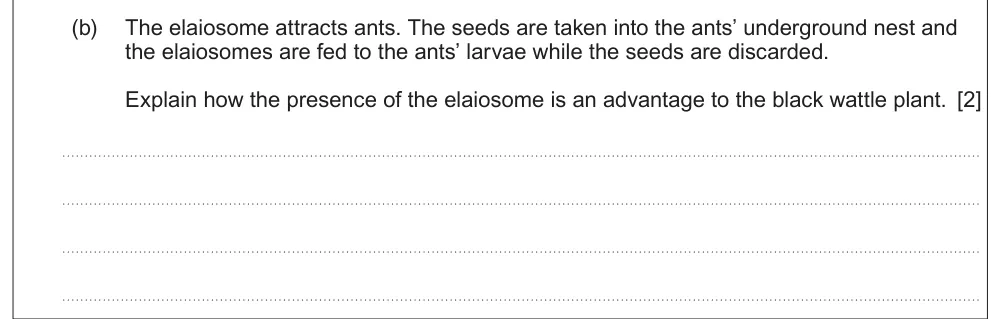
A level Component 2 · June 2024 · Q5(b) · 2 marks
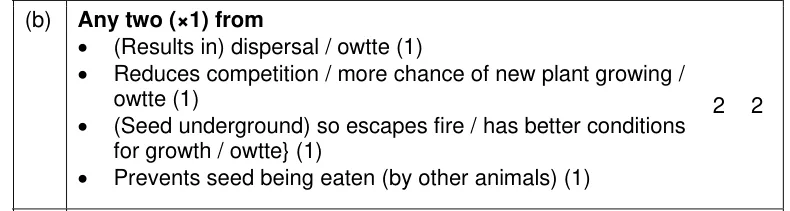
Explain how the elaiosome is an advantage to the black wattle plant.
Show the mark scheme
Tap an image to open it full size.
From the examiners' report: Read the stem: the elaiosomes are fed to the ant larvae, so they aren't used for plant growth.
Question 9
A level Component 1 · June 2017 · Q3(d) · 3 marks
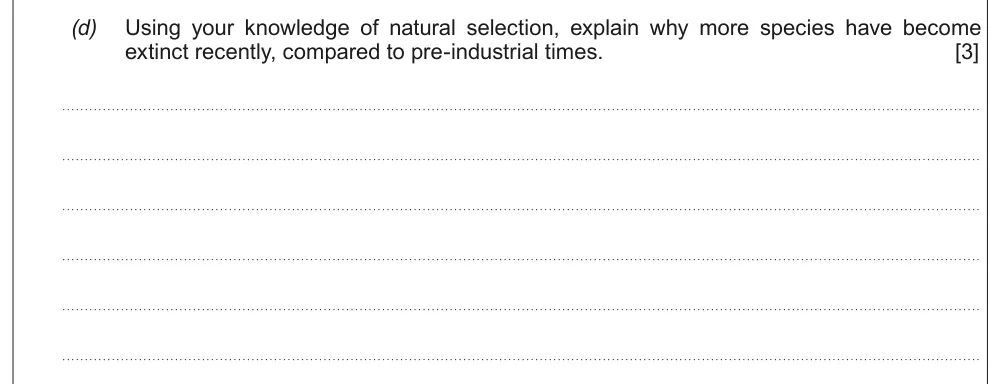
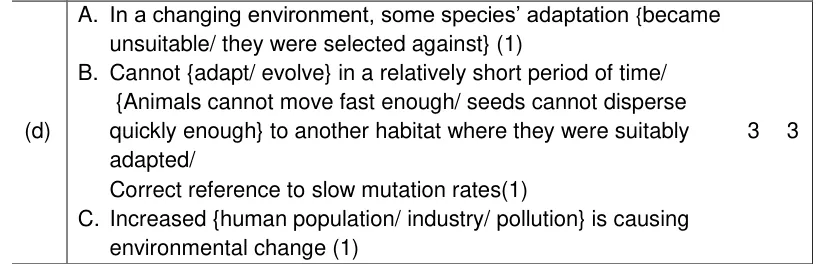
Use natural selection to explain why more species have become extinct since industrialisation.
Show the mark scheme
Tap an image to open it full size.
Hardy-Weinberg
Question 10
A level Component 2 · June 2018 · Q1(f)(i) · 3 marks
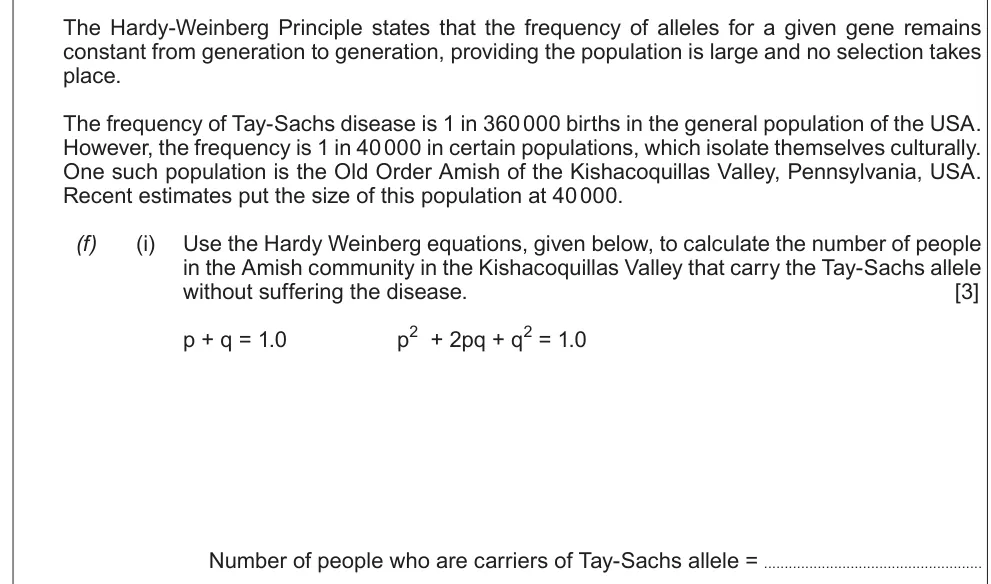
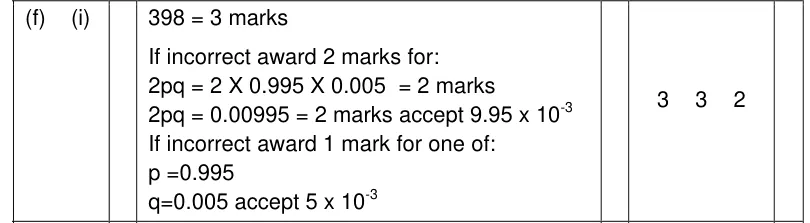
Calculate the number of carriers of the Tay-Sachs allele in a community.
Show the mark scheme
Tap an image to open it full size.
From the examiners' report: Many got the right values into 2pq but still didn't finish the calculation.
Question 11
A level Component 2 · June 2018 · Q1(f)(ii) · 2 marks · Hard
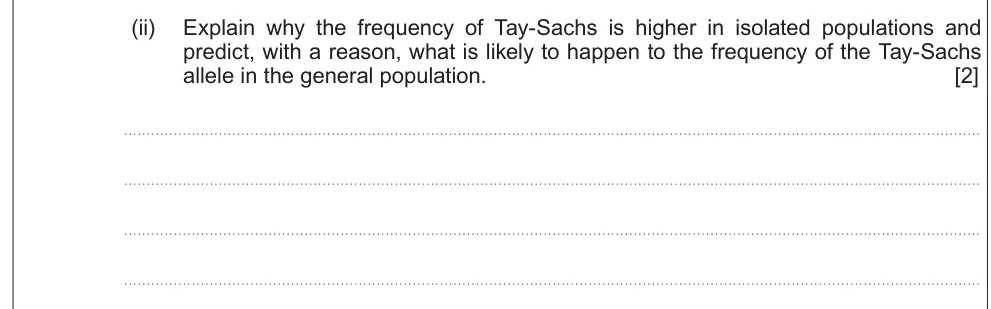
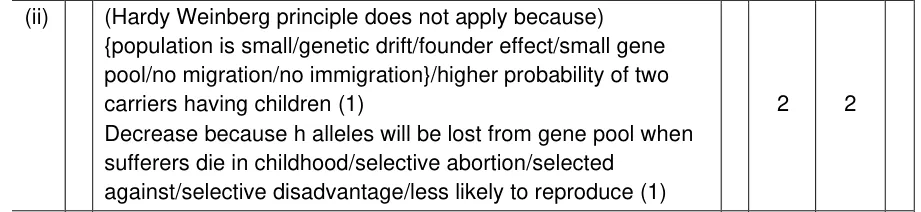
Explain why Tay-Sachs is more frequent in isolated populations and predict the general trend.
Show the mark scheme
Tap an image to open it full size.
From the examiners' report: This was the most challenging part. Avoid vague references to inbreeding: think small gene pool and the founder effect.
Question 12
A level Component 2 · June 2025 · Q5(c)(ii) · 4 marks
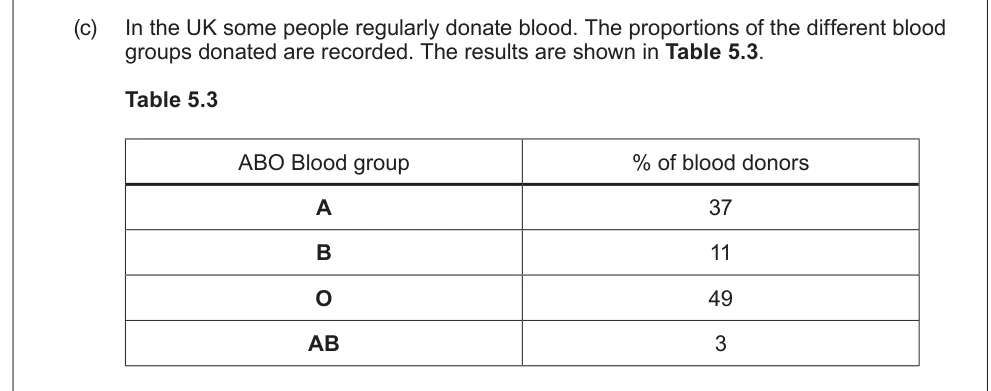
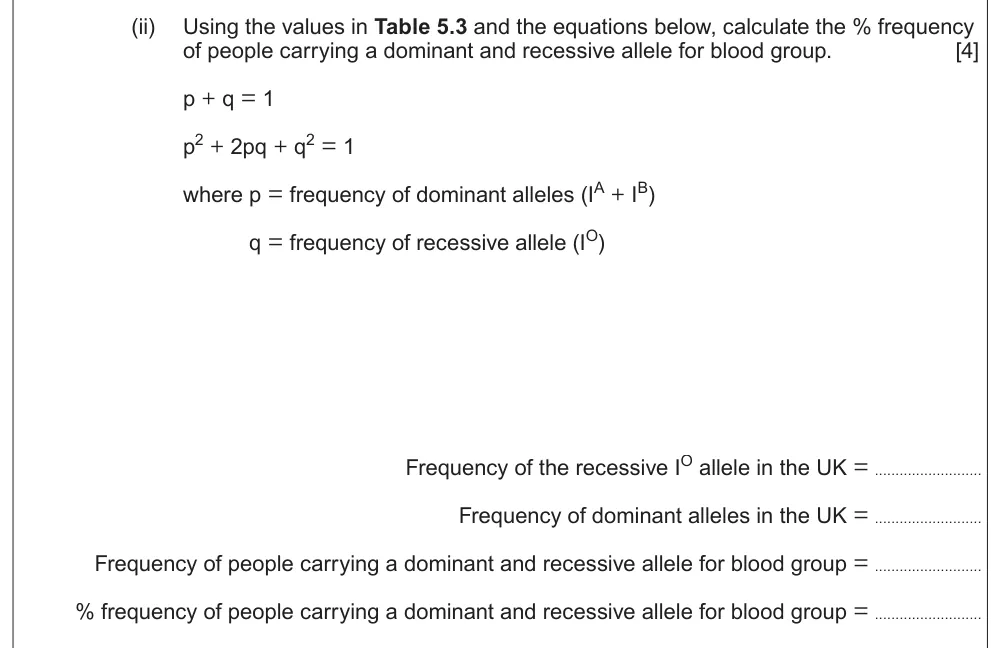
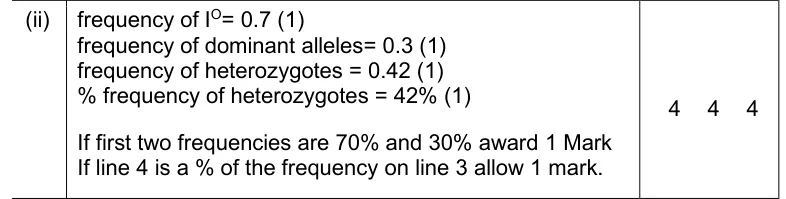
Use Hardy-Weinberg to calculate allele and heterozygote frequencies for blood group O.
Information from earlier in this question:
Show the mark scheme
Tap an image to open it full size.
Question 13
A level Component 2 · June 2025 · Q5(c)(iii) · 1 mark
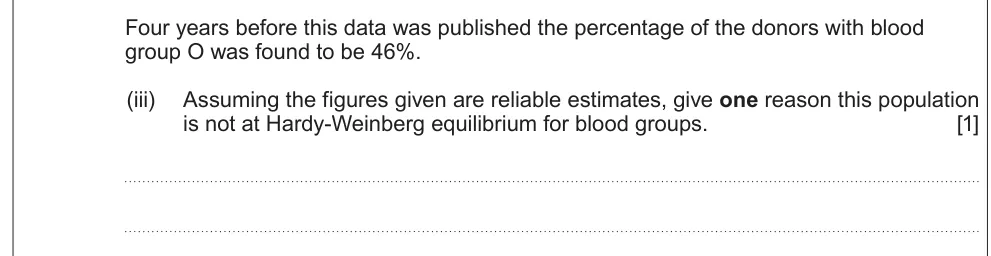
Give one reason why the population is not at Hardy-Weinberg equilibrium.
Show the mark scheme

Tap an image to open it full size.
From the examiners' report: "The population is isolated" gained no mark: people need to move in and out of the population.
Question 14
A level Component 2 · June 2017 · Q3(b) · 4 marks
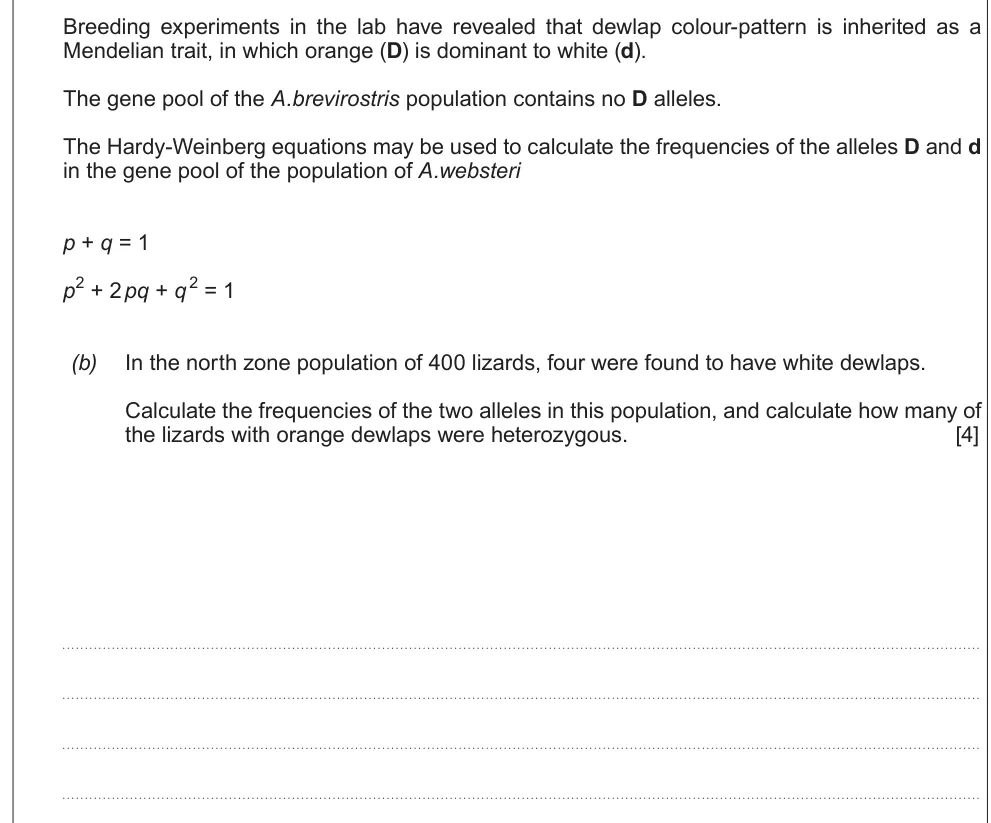
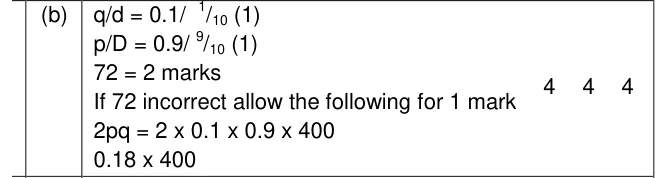
Calculate allele frequencies and the number of heterozygous lizards.
Show the mark scheme
Tap an image to open it full size.
From the examiners' report: Students who had practised Hardy-Weinberg scored all four marks. Those who hadn't scored none.
Natural selection and allele frequencies
Question 15
A level Component 2 · June 2017 · Q3(c)(i) · 4 marks · Hard
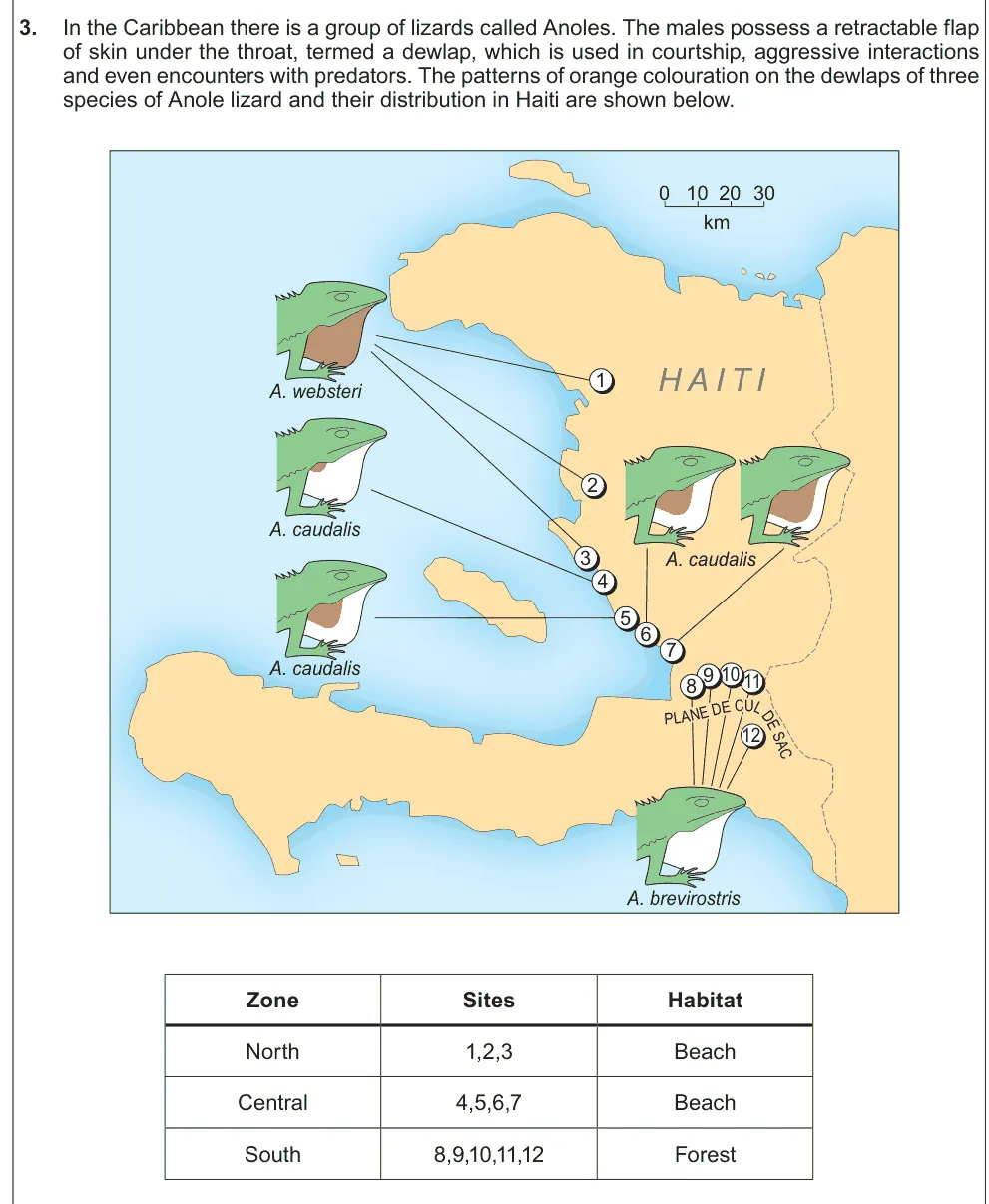
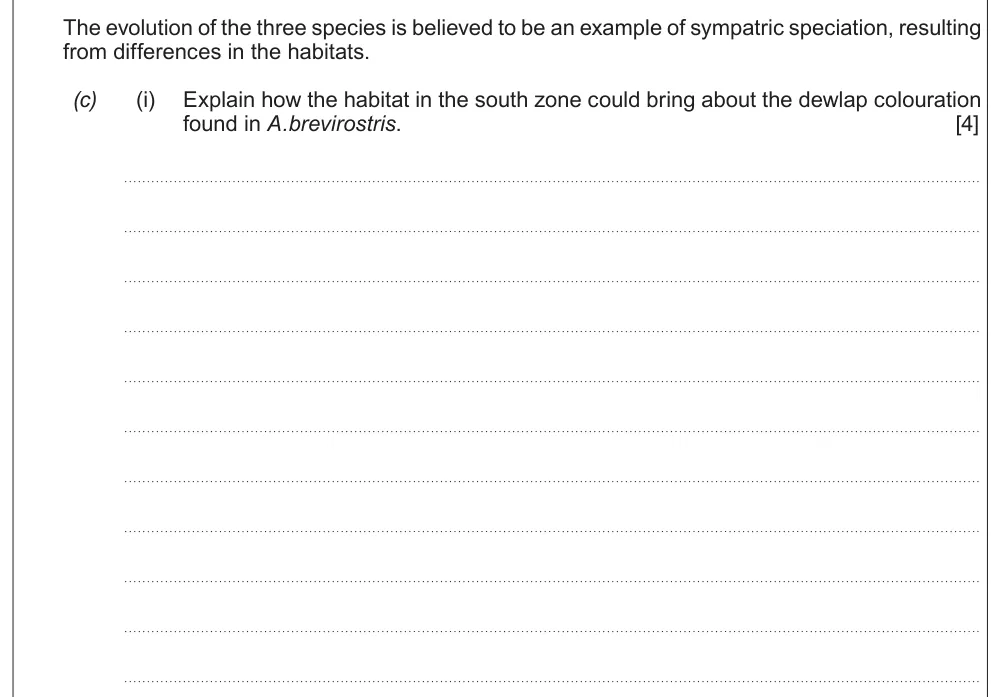
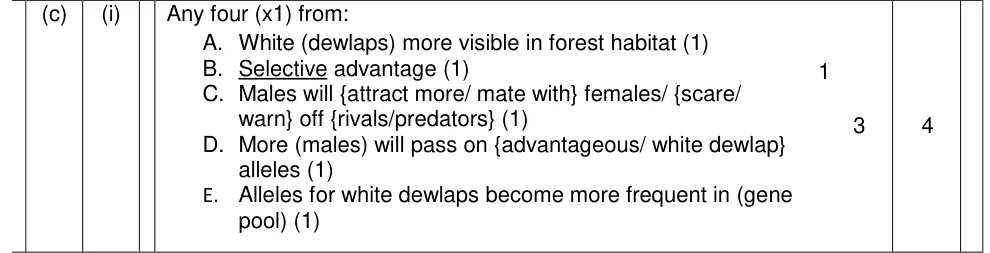
Explain how the habitat could bring about white dewlap colouration.
Information from earlier in this question:
Show the mark scheme
Tap an image to open it full size.
From the examiners' report: Many ignored the information about what dewlaps do and gave a vague answer about camouflage.
Question 16
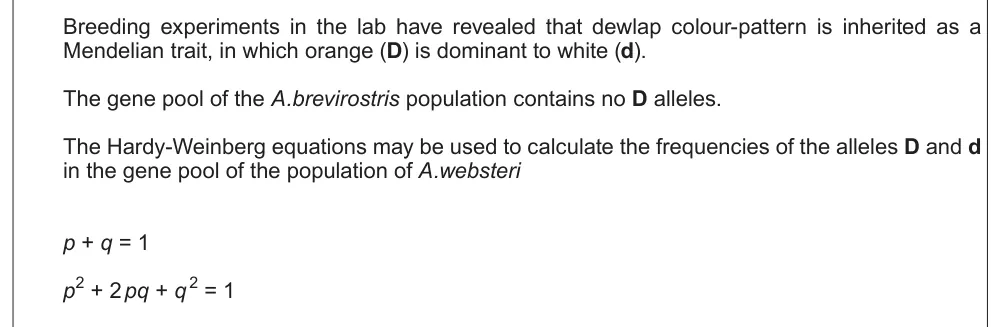
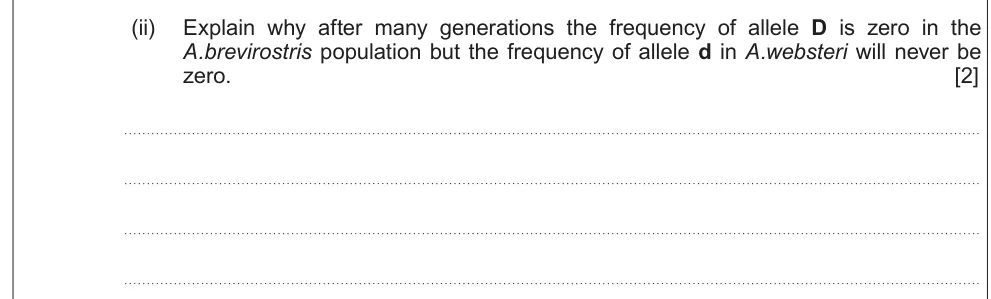
A level Component 2 · June 2017 · Q3(c)(ii) · 2 marks · Hard
Explain why allele D can reach zero in one species but allele d never will in another.
Information from earlier in this question:
Show the mark scheme

Tap an image to open it full size.
From the examiners' report: This had the lowest facility on the paper. Link heterozygotes to the allele staying in the gene pool.
Question 17
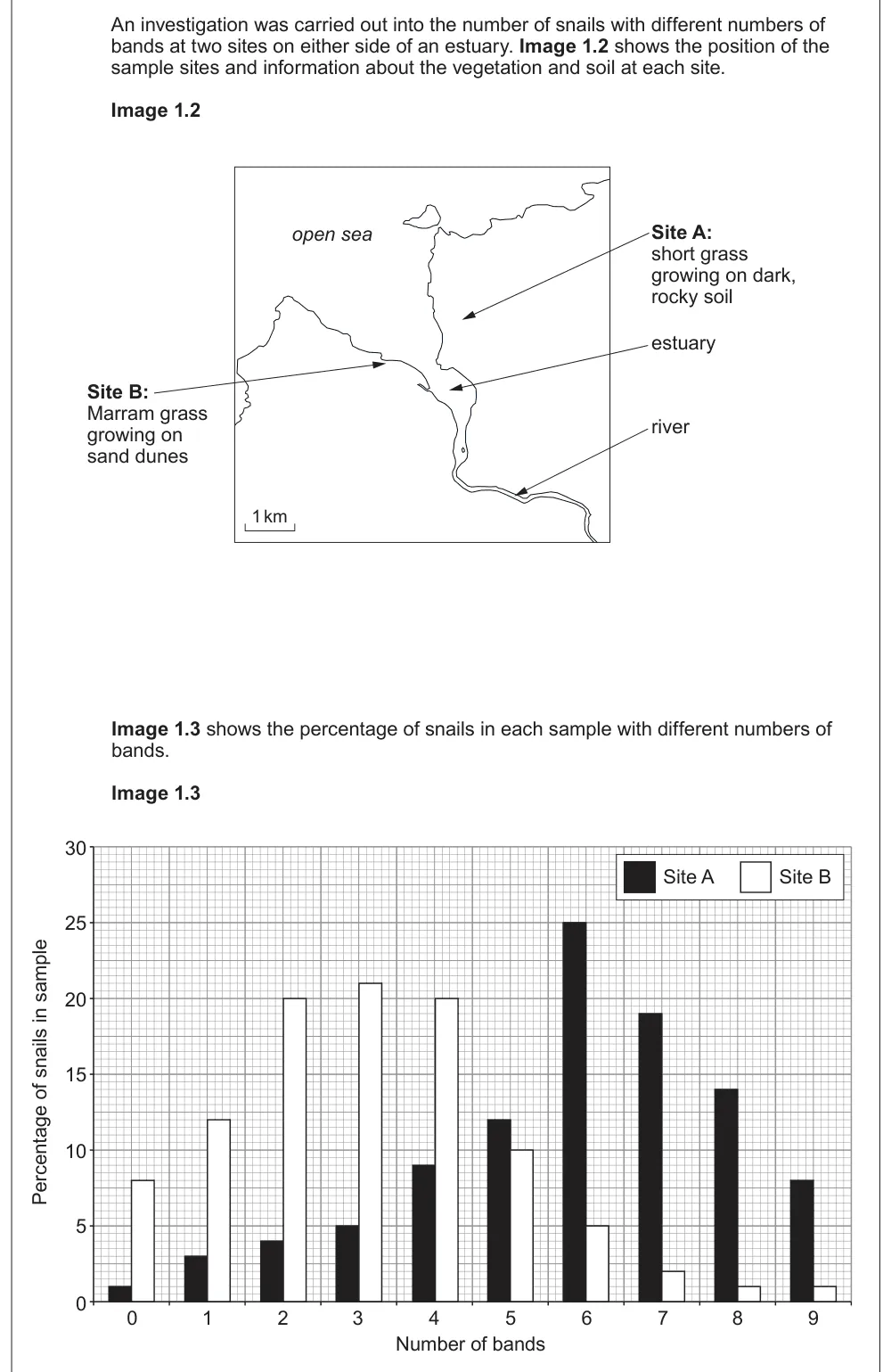
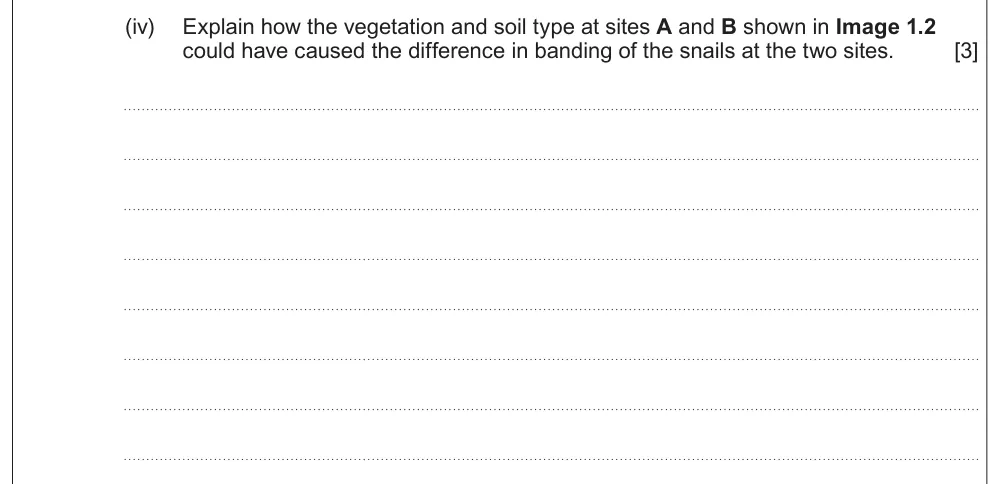
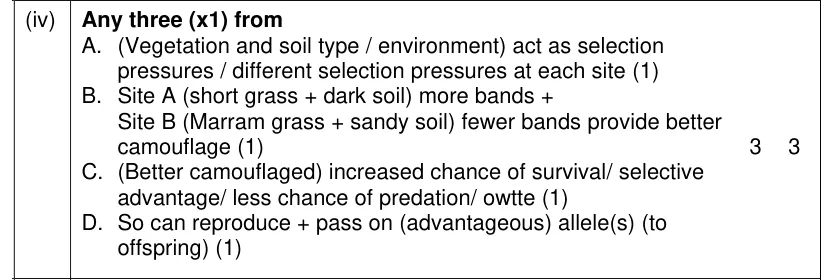
A level Component 2 · June 2022 · Q1(b)(iv) · 3 marks
Explain how vegetation and soil type could cause different banding in snails at two sites.
Information from earlier in this question:

Show the mark scheme
Tap an image to open it full size.
From the examiners' report: This part had a facility factor of only 16.7%: unclear answers and misuse of the image and graph cost marks.
Question 18
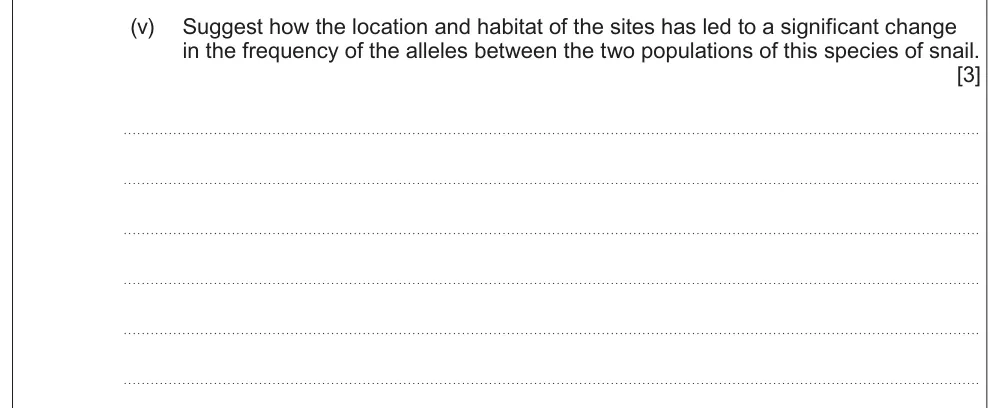
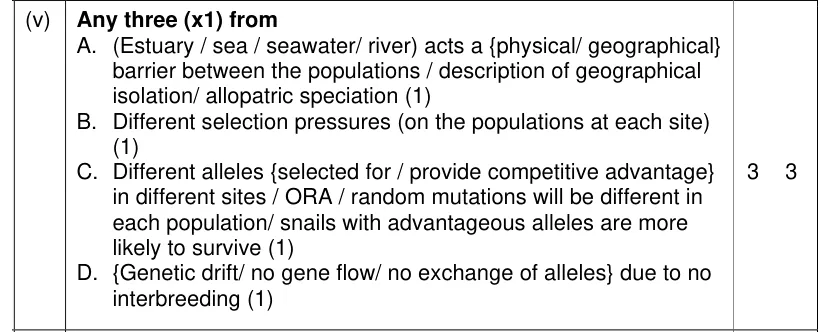
A level Component 2 · June 2022 · Q1(b)(v) · 3 marks
Suggest how location and habitat led to a change in allele frequencies between two snail populations.
Show the mark scheme
Tap an image to open it full size.
From the examiners' report: Many confused what was being tested here with the part before.
Question 19
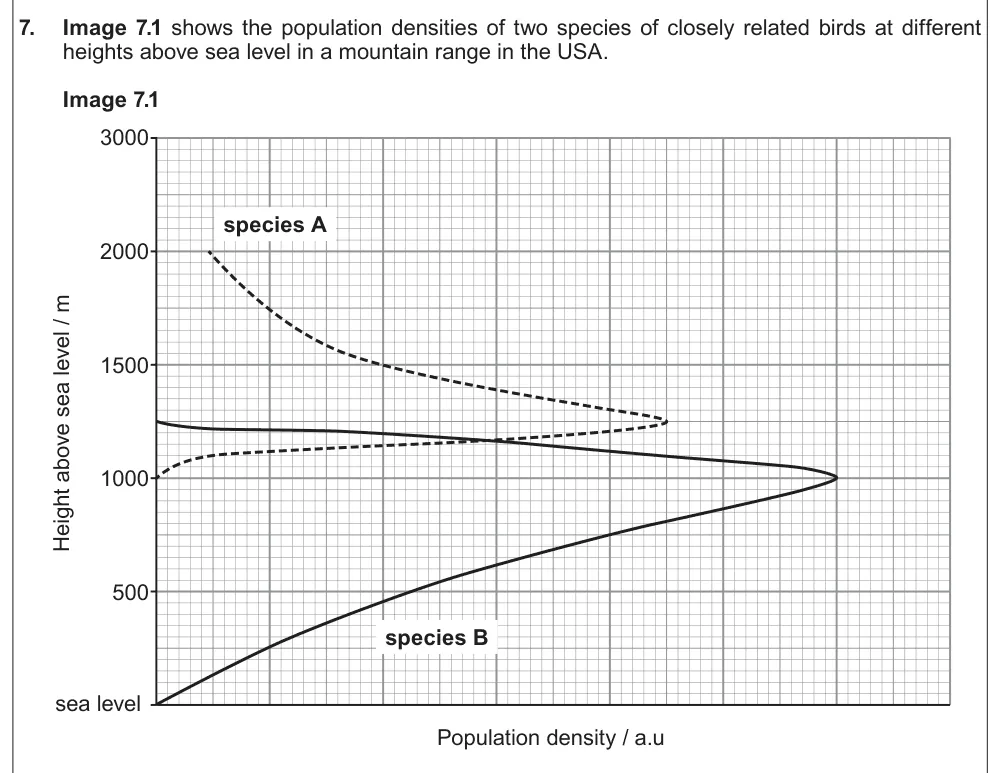
A level Component 2 · Autumn 2021 · Q7(b)(i) · 3 marks
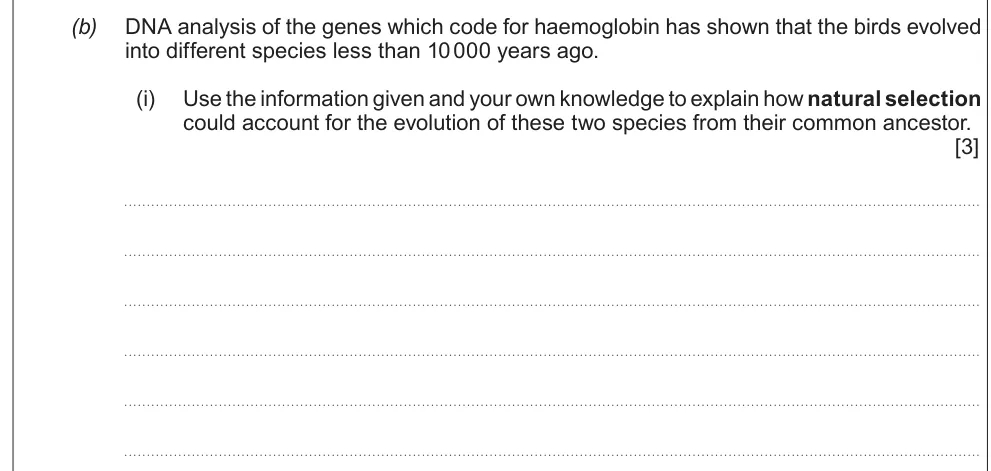
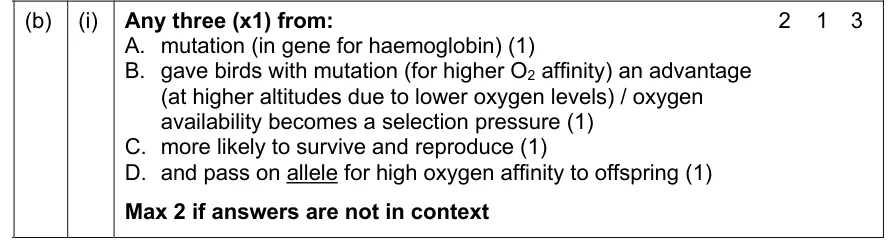
Explain how natural selection could account for the evolution of two bird species.
Information from earlier in this question:
Show the mark scheme
Tap an image to open it full size.
From the examiners' report: Most gave generic answers. Use the context (oxygen at altitude) and say the allele is passed on, not the gene.
Isolation and speciation
Question 20
A level Component 2 · Autumn 2021 · Q7(b)(ii) · 2 marks
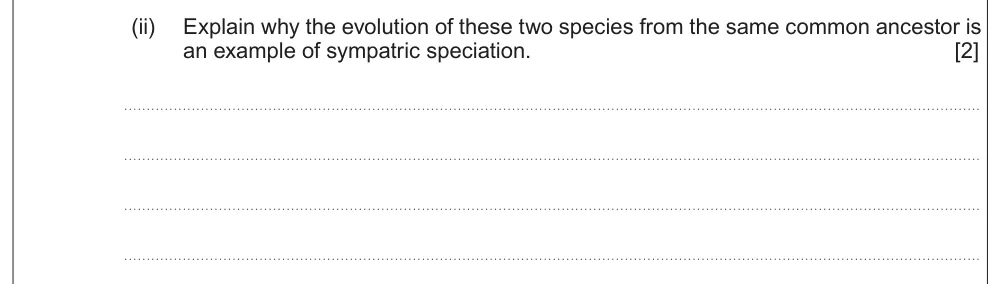
Explain why the evolution of the two bird species is sympatric speciation.
Show the mark scheme

Tap an image to open it full size.
Question 21
A level Component 2 · June 2017 · Q3(d) · 3 marks
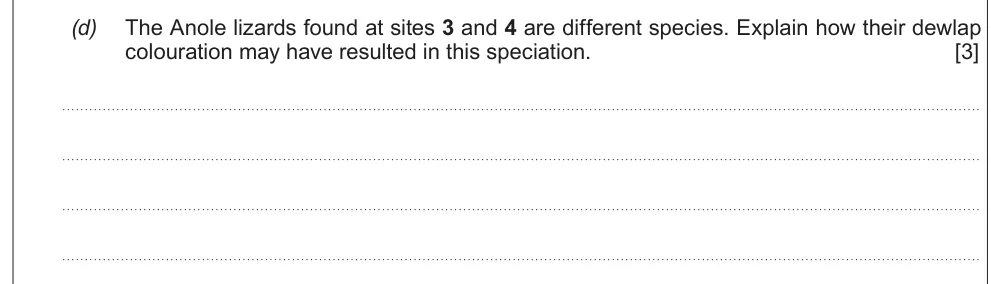
Explain how dewlap colouration may have led to speciation in Anole lizards.
Information from earlier in this question:
Show the mark scheme

Tap an image to open it full size.
From the examiners' report: Many named sympatric or allopatric speciation with no explanation. Describe the reproductive barrier of a different dewlap colour.
Question 22
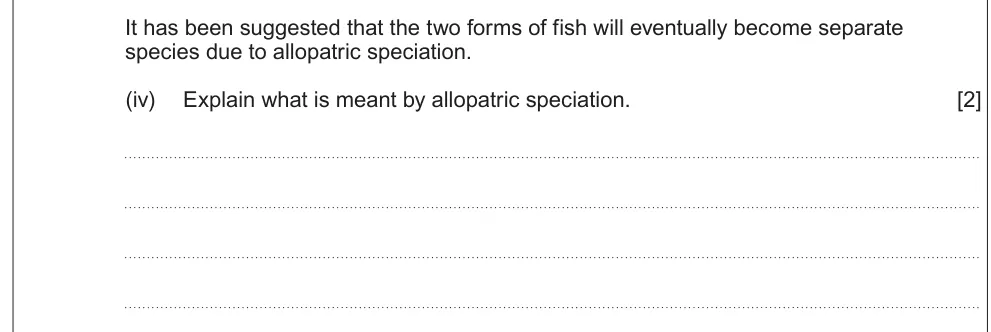
A level Component 2 · June 2024 · Q4(b)(iv) · 2 marks · Hard
Explain what is meant by allopatric speciation.
Show the mark scheme

Tap an image to open it full size.
Question 23
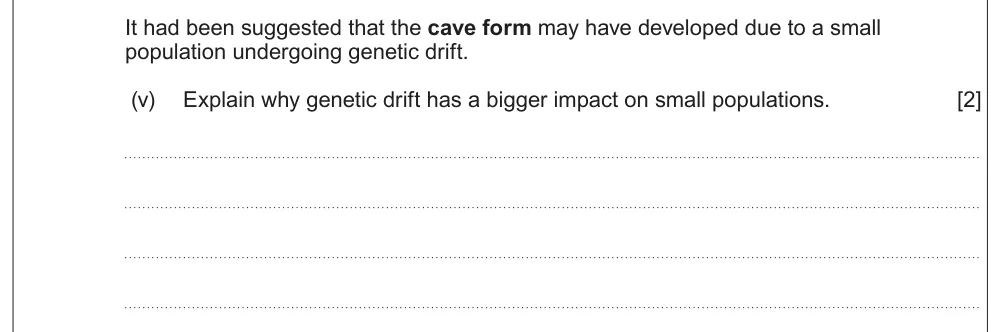
A level Component 2 · June 2024 · Q4(b)(v) · 2 marks
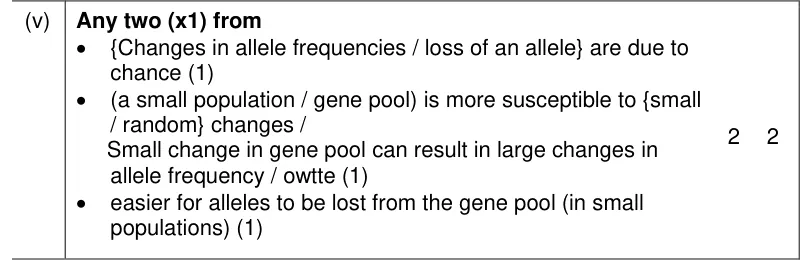
Explain why genetic drift has a bigger impact on small populations.
Show the mark scheme
Tap an image to open it full size.
From the examiners' report: Students found genetic drift harder to define than allopatric speciation.
Question 24
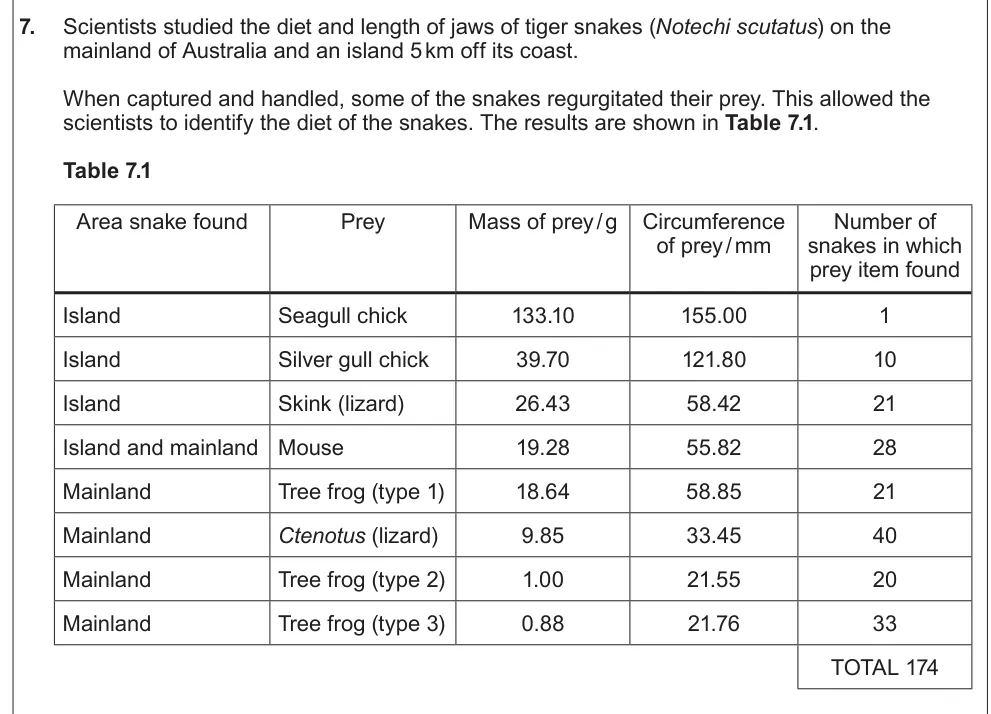
A level Component 2 · June 2023 · Q7(b)(i) · 3 marks · Hard
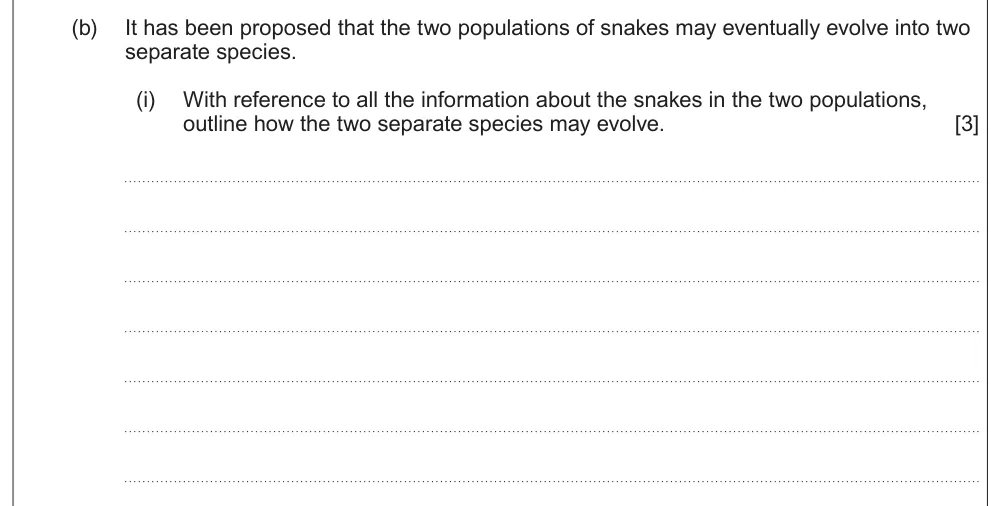
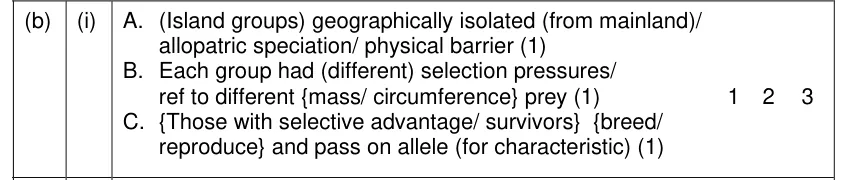
Outline how two populations of tiger snakes may evolve into separate species.
Information from earlier in this question:
Show the mark scheme
Tap an image to open it full size.
From the examiners' report: Many wrote that the snakes "need to adapt". The survivors must breed and pass on the allele.
Where students lose marks (from Eduqas examiners' reports and mark schemes)
Each point below is followed by wording that gained marks.
Allele, not gene: Many said the next generation inherits the genes that give an advantage.
✔ Gains credit: "Pass on allele for high oxygen affinity to offspring".
Use the context: Many gave a vague generic answer about camouflage.
✔ Gains credit: "White dewlaps more visible in forest habitat" so males "attract more females".
Explain the barrier: Many made vague references to sympatric or allopatric speciation.
✔ Gains credit: "Different dewlap colour", "males will not attract females", "reproductive barrier".
Heterozygotes keep alleles: Very few related heterozygotes to allele frequency.
✔ Gains credit: d "is not expressed / masked in heterozygotes and therefore remains in the gene pool".
Finish the calculation: Many substituted correctly into 2pq but didn't reach the answer.
✔ Gains credit: "2pq = 2 × 0.995 × 0.005" then × population = "398".
Survivors breed: Many said the snakes needed to adapt or evolve.
✔ Gains credit: "Those with selective advantage reproduce and pass on allele".
Download the questions
Download the PDF pack (24 questions, mark schemes at the end)
Keep practising
- Classification and Biodiversity (2.1): Eduqas A Level Biology exam questions by topic
- Cell Division (2.2): Eduqas A Level Biology exam questions by topic
- Sexual Reproduction in Humans (2.3): Eduqas A Level Biology exam questions by topic
- Sexual Reproduction in Plants (2.4): Eduqas A Level Biology exam questions by topic
- Inheritance (2.5): Eduqas A Level Biology exam questions by topic
- Application of Reproduction and Genetics (2.7): Eduqas A Level Biology exam questions by topic
- Eduqas A level Biology past papers, mark schemes and examiners' reports
- Eduqas A level Biology grade boundaries
- Ask about Eduqas A level Biology lessons with Sam on WhatsApp
Questions, mark schemes and examiners' report extracts © WJEC CBAC Ltd (Eduqas).