

Heart and Circulation opens Topic 1, Lifestyle, Health and Risk, of the Edexcel A level Biology A (Salters-Nuffield) specification. You need to explain why many animals need a heart and circulation, why the dipole nature of water makes it a good transport medium, how the structures of arteries, veins and capillaries relate to their functions, and how the heart works through the cardiac cycle. This topic is examined on AS Paper 1 and on A level Papers 1 and 3. Questions marked AS are from the AS papers (8BN0); the rest are from the A level papers (9BN0).
The examiners' reports keep returning to precise wording. Say where substances are carried (to respiring cells, not just around the body), link the dipole of water to hydrogen bonding and to dissolving, name the tissue in the artery wall and say what it does, and name the chamber and valve at each stage of the cardiac cycle. When a question gives you a pressure graph, explain the changes using systole, diastole and changes in volume, not just a description of the line.
Studying Edexcel SNAB and want more help? If you'd like to arrange one-to-one Edexcel tutoring, or to register your interest in an Edexcel group class, message Tom on WhatsApp using the link at the bottom of this page.
What you need from GCSE
Each question on this page assumes you're secure on these ideas. If any of them feels shaky, look it up before you start.
- Blood is pumped by the heart through arteries, capillaries and veins.
- The heart has four chambers: two atria and two ventricles, with valves between them.
- Small organisms can rely on diffusion; larger organisms have a smaller surface area to volume ratio.
- Oxygen and glucose are needed by cells for aerobic respiration.
Key terms
These words come up in the questions and mark schemes. Examiners expect you to use them exactly.
- Mass transport: the bulk movement of a fluid, such as blood, carrying substances to where they are needed.
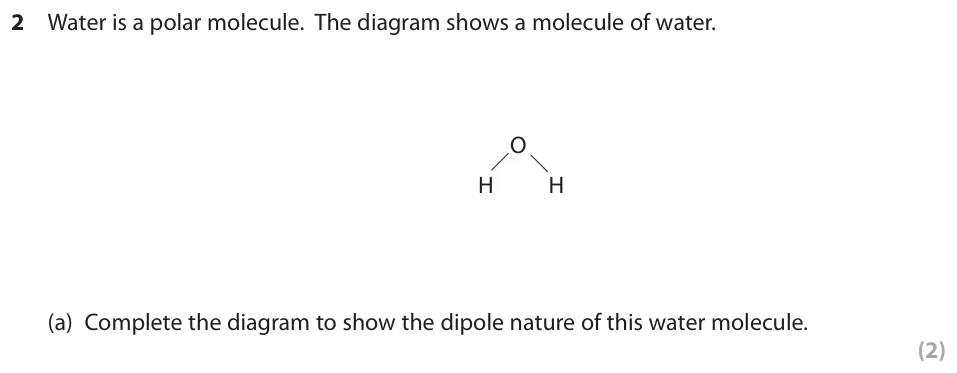
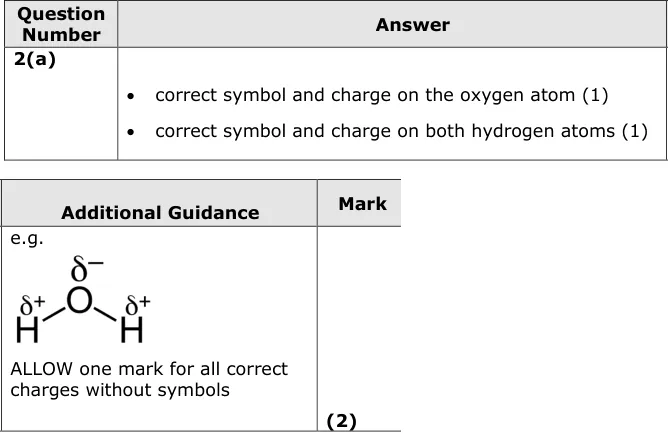
- Dipole: a molecule with an uneven distribution of charge; in water the oxygen is slightly negative and the hydrogens slightly positive.
- Systole: contraction of the heart muscle (atrial systole, then ventricular systole).
- Diastole: relaxation of the atria and ventricles, when the heart fills with blood.
- Atrioventricular valves: the valves between the atria and ventricles; they close when ventricular pressure rises above atrial pressure.
- Semilunar valves: the valves at the base of the aorta and pulmonary artery; they stop blood flowing back into the ventricles.
- Elastic recoil: elastic fibres in the artery wall stretch when blood is pumped in, then spring back to maintain pressure.
What these questions cover (Edexcel SNAB Topic 1: Lifestyle, Health and Risk)
The questions test these statements from Topic 1 of the Pearson Edexcel A level Biology A (Salters-Nuffield) specification (9BN0).
- 1.1 Understand why many animals have a heart and circulation (mass transport to overcome limitations of diffusion in meeting the requirements of organisms).
- 1.2 Understand the importance of water as a solvent in transport, including its dipole nature.
- 1.3 Understand how the structures of blood vessels (capillaries, arteries and veins) relate to their functions.
- 1.4 i Know the cardiac cycle (atrial systole, ventricular systole and cardiac diastole) and relate the structure and operation of the mammalian heart, including the major blood
How to use this page
Write your answer on paper before you open the mark scheme. Allow about 1.2 minutes per mark: the 19 questions are worth 44 marks, so about 53 minutes in total. Then mark your answer strictly against the mark scheme and read the examiners' tip underneath it. If you'd rather print the questions, download the PDF pack.
Why animals need a heart and circulation (1.1)
Question 1
A level Paper 3 · June 2023 · Q1(a) · 2 marks
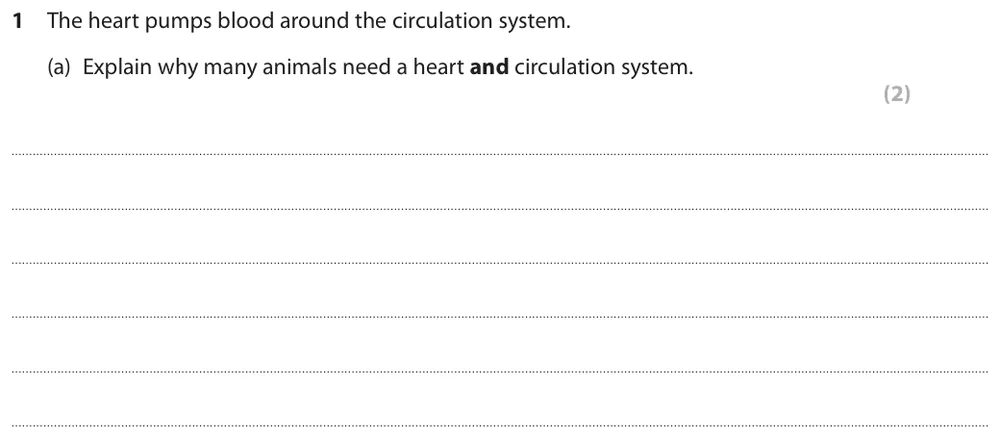
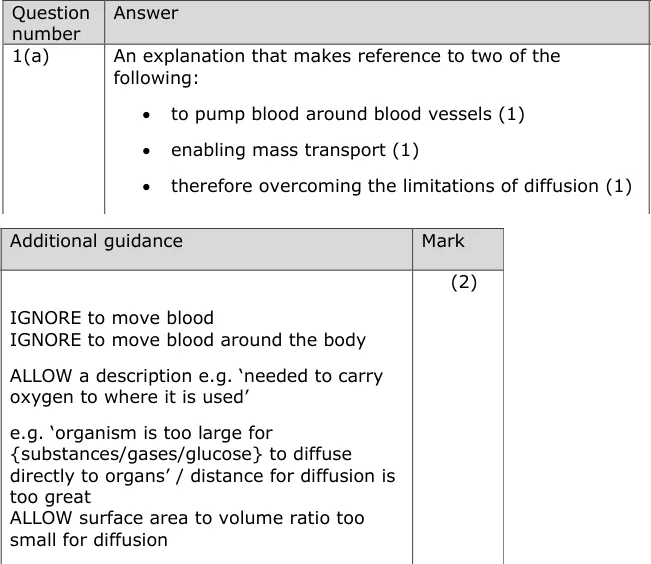
Explain why many animals need a heart and a circulation system.
Show the mark scheme
Tap an image to open it full size.
From the examiners' report: Saying 'animals need a heart to pump blood' was not enough: the heart pumps blood around blood vessels. 'To pump oxygen around the body' was also too vague; say the oxygen goes to respiring cells or tissues.
Question 2
AS Paper 1 · June 2025 · Q7(a) · 3 marks · Easy
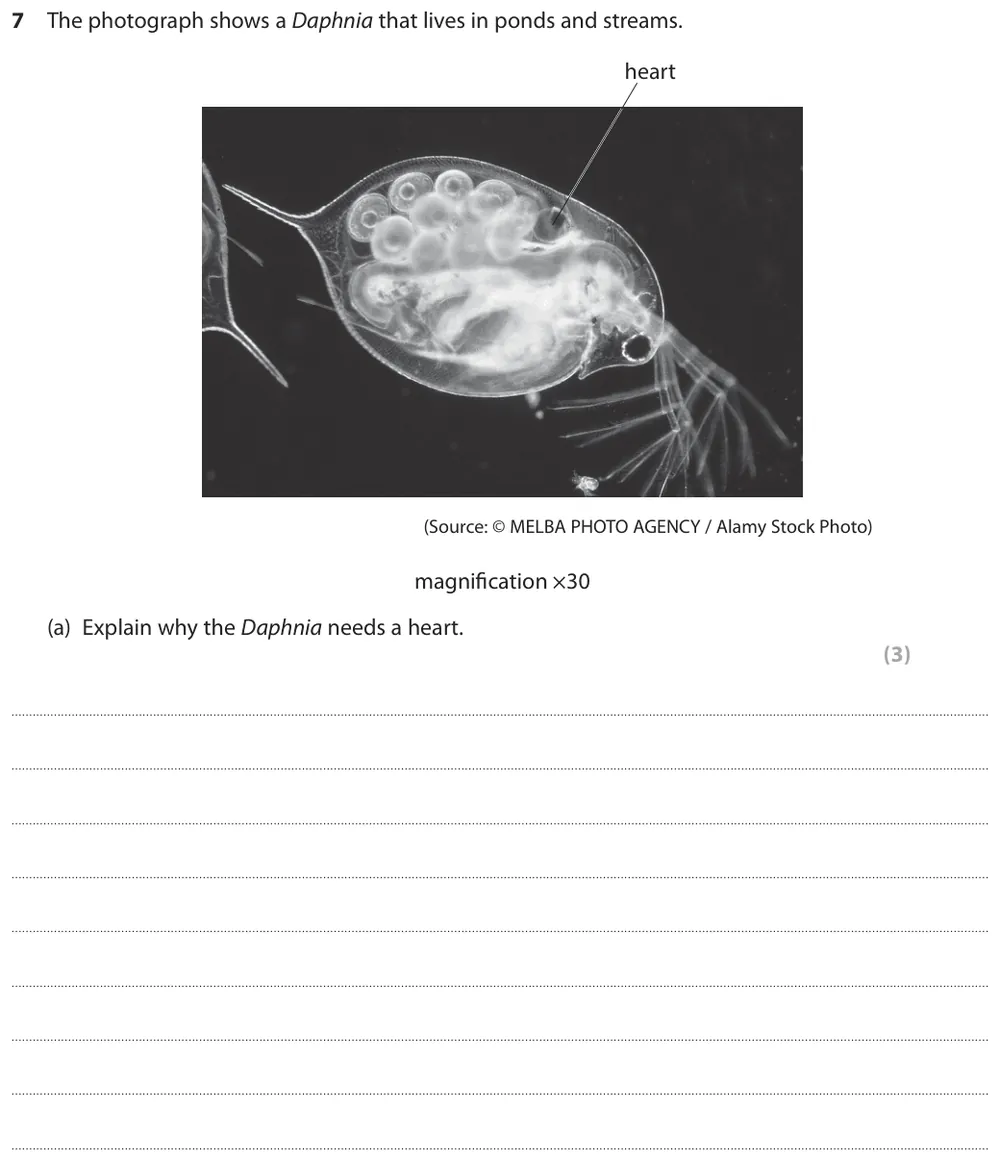
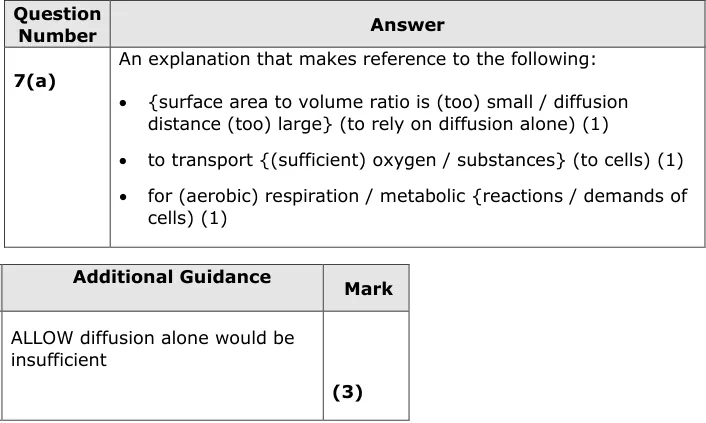
Explain why a Daphnia needs a heart.
Show the mark scheme
Tap an image to open it full size.
From the examiners' report: The most common error was saying the Daphnia has a large surface area to volume ratio. Its surface area to volume ratio is too small for diffusion alone, so it needs a heart to transport oxygen to cells for aerobic respiration.
Question 3
A level Paper 2 · November 2021 · Q4(a) · 4 marks
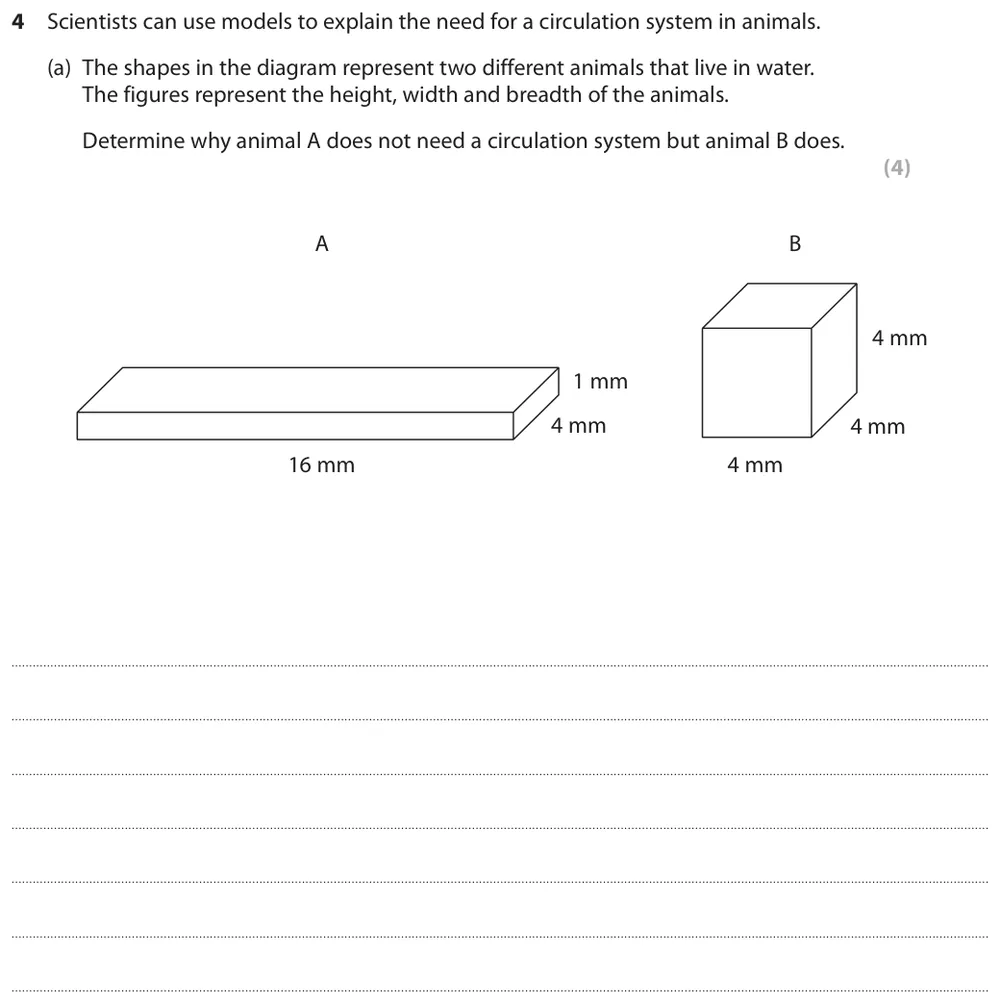
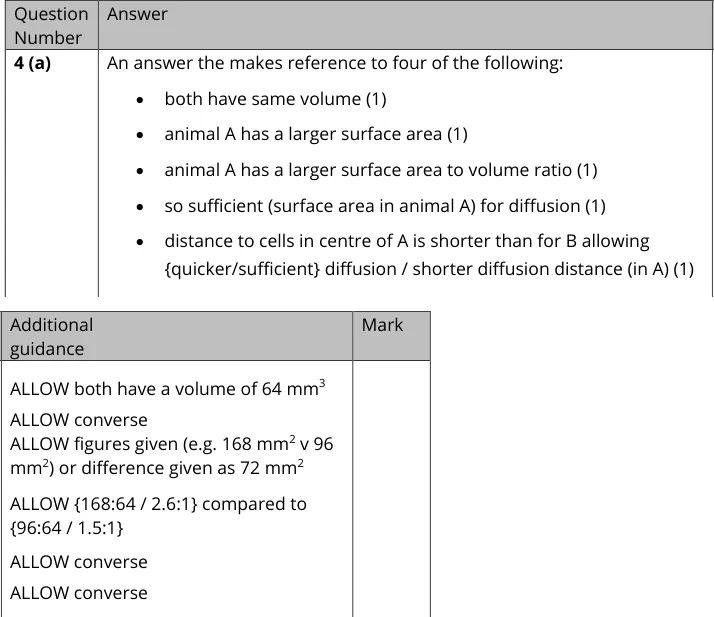
Use the dimensions of two animals to work out why one needs a circulation system and the other does not.
Show the mark scheme
Tap an image to open it full size.
From the examiners' report: Most candidates calculated the surface areas and volumes. Those who missed the higher marks did not go on to explain what the ratios mean: whether diffusion is enough to supply the animal's cells.
Question 4
AS Paper 1 · June 2024 · Q8(c)(i) · 3 marks
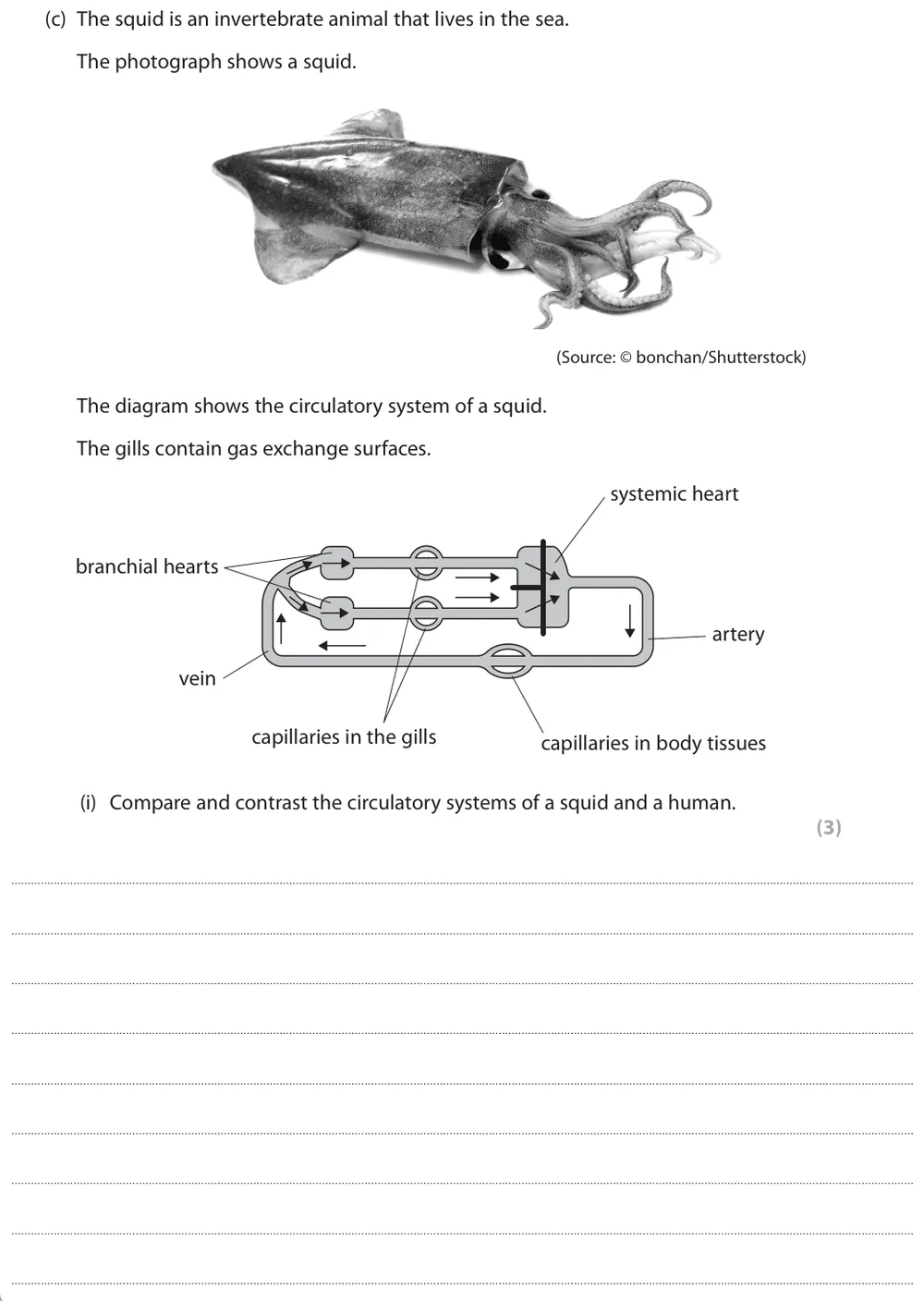
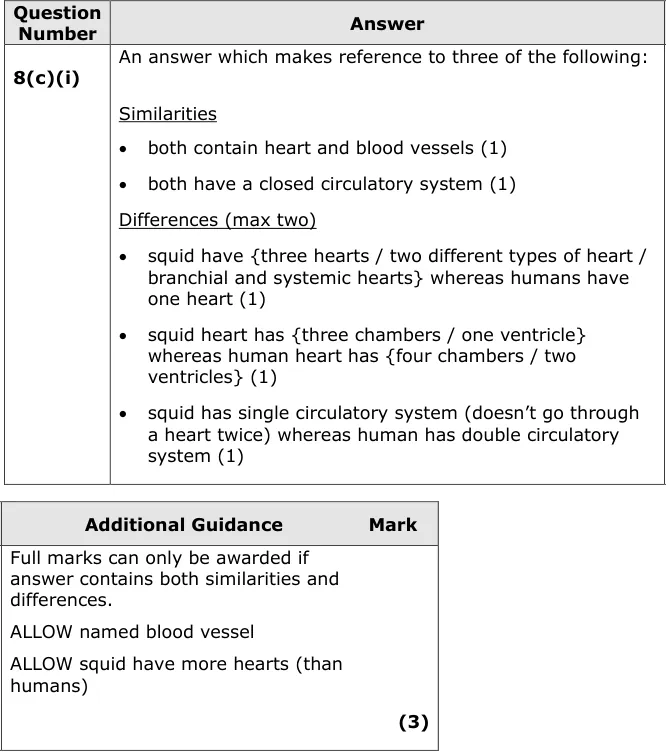
Compare and contrast the circulatory system of a squid with that of a human.
Show the mark scheme
Tap an image to open it full size.
From the examiners' report: Give both similarities and differences: full marks needed both. A few candidates misread the diagram and said the squid has a double circulation.
Water as a transport medium (1.2)
Question 5
AS Paper 1 · June 2018 · Q2(a) · 2 marks
Complete a diagram of a water molecule to show its dipole nature.
Show the mark scheme
Tap an image to open it full size.
From the examiners' report: Almost a quarter of candidates scored nothing. Some put the charges the wrong way round or drew hydrogen bonds to another molecule. Show δ– on the oxygen and δ+ on both hydrogens, with the symbols.
Question 6
AS Paper 1 · June 2017 · Q3(a) · 2 marks
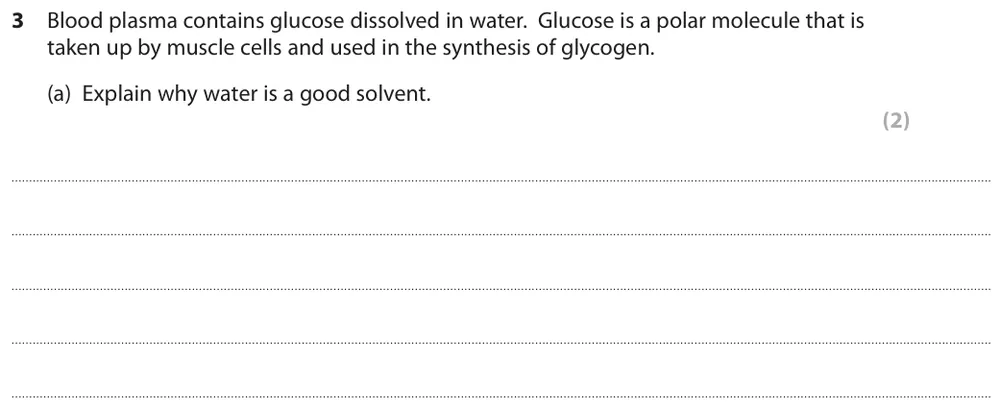
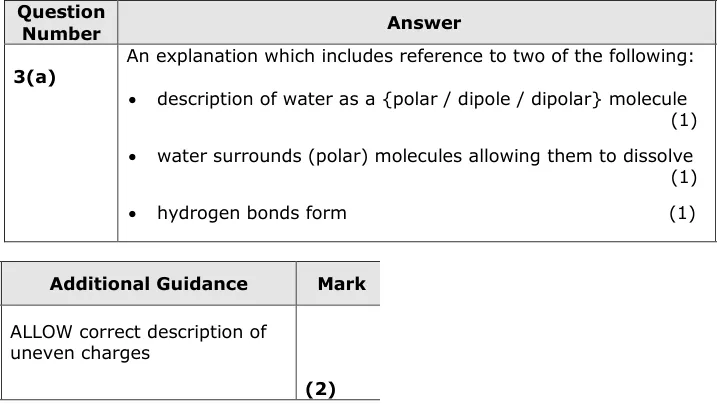
Explain why water is a good solvent.
Show the mark scheme
Tap an image to open it full size.
From the examiners' report: Most candidates said water is polar, but only about a quarter went on to explain that water molecules surround polar molecules, allowing them to dissolve.
Question 7
A level Paper 3 · June 2023 · Q4(a) · 2 marks
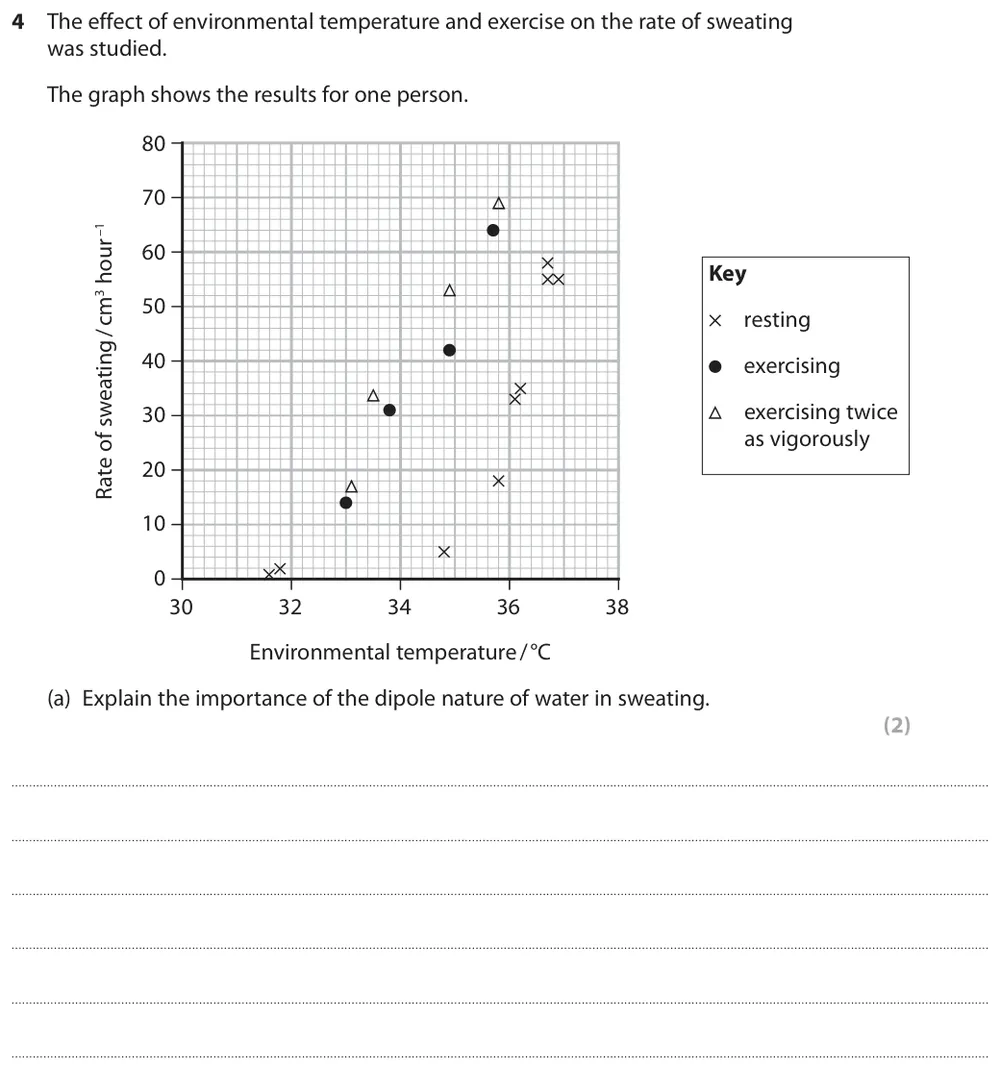
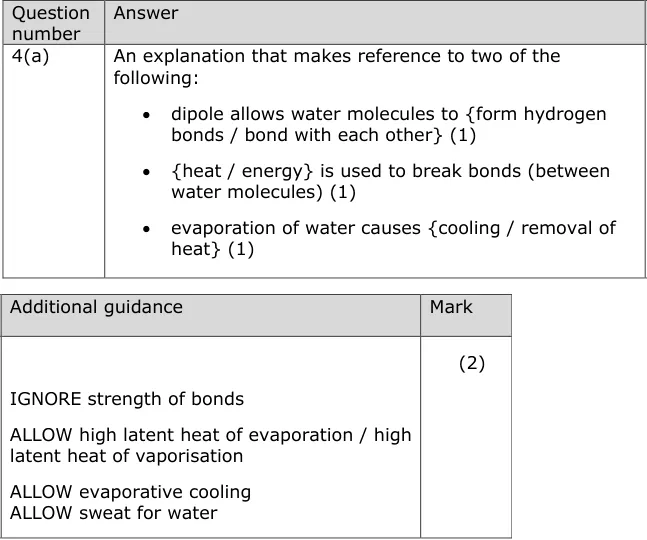
Explain the importance of the dipole nature of water in sweating.
Show the mark scheme
Tap an image to open it full size.
From the examiners' report: Many candidates ignored the question and wrote about water dissolving and transporting polar substances. Few said that heat energy is used to break the hydrogen bonds between water molecules when sweat evaporates.
Blood vessels (1.3)
Question 8
AS Paper 1 · June 2017 · Q6(a) · 3 marks
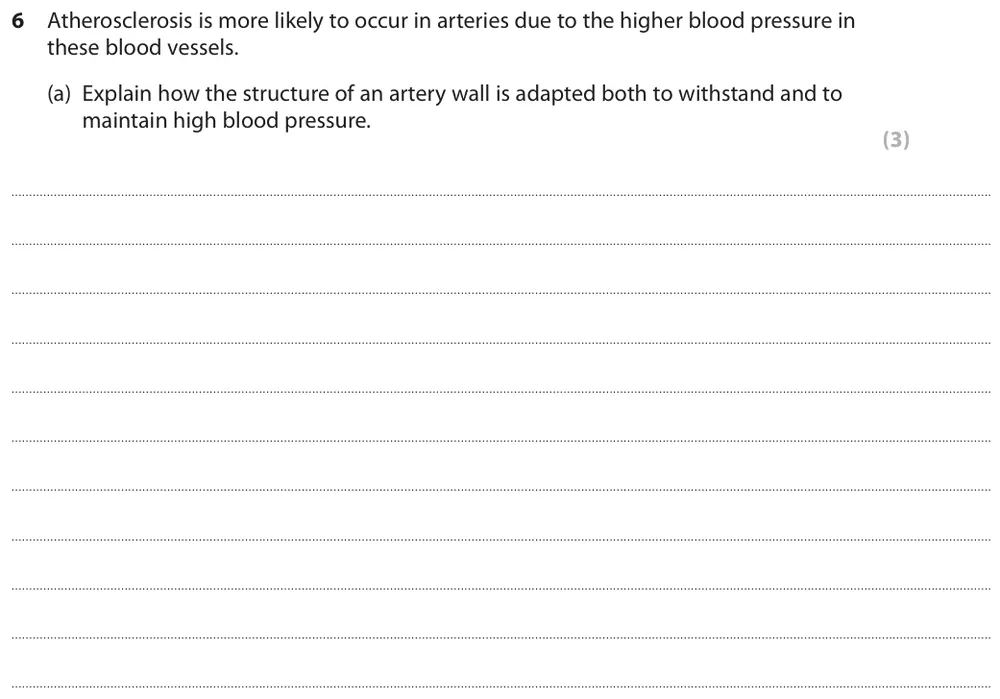
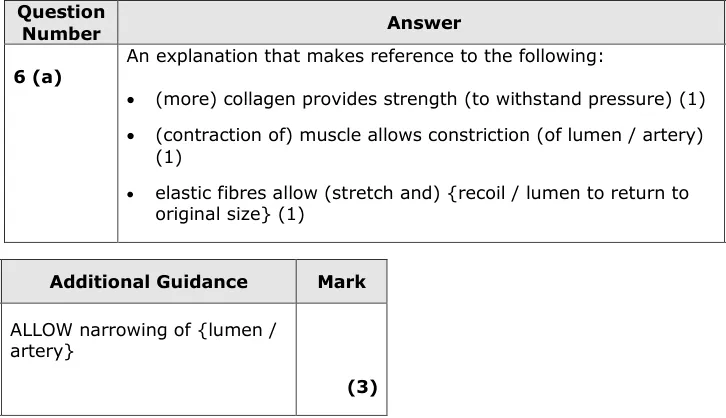
Explain how the structure of an artery wall is adapted to withstand and to maintain high blood pressure.
Show the mark scheme
Tap an image to open it full size.
From the examiners' report: Many described the whole artery instead of the wall. Few explained that collagen gives strength to withstand pressure; the most common mark was for elastic fibres allowing recoil.
Question 9
AS Paper 1 · June 2022 · Q6(b)(i) · 2 marks
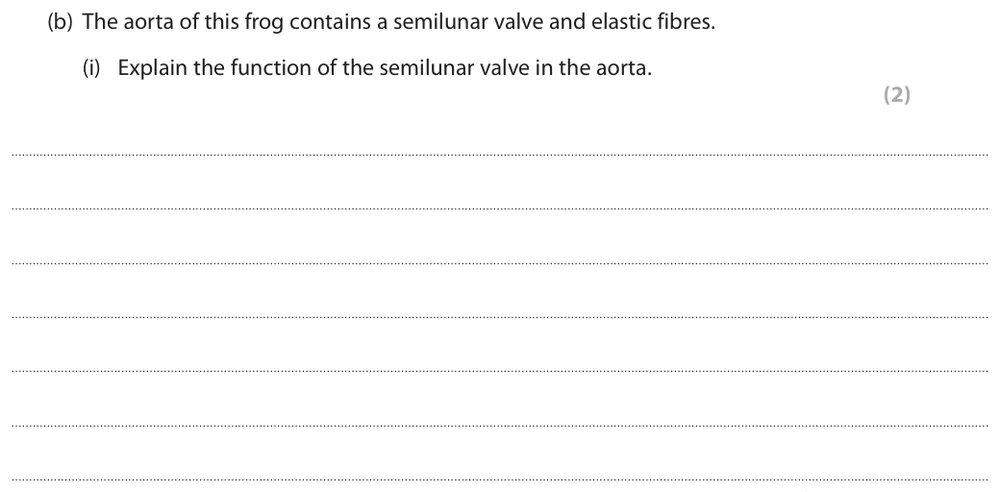
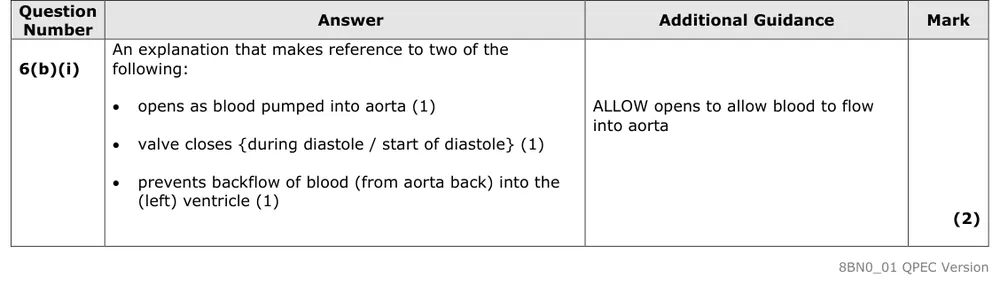
Explain the function of the semilunar valve in the aorta of a frog.
Show the mark scheme
Tap an image to open it full size.
From the examiners' report: Generic answers about all semilunar valves were not credited. The best answers covered both the open valve (blood enters the aorta) and the closed valve (no backflow into the ventricle).
Question 10
AS Paper 1 · June 2022 · Q6(b)(ii) · 2 marks
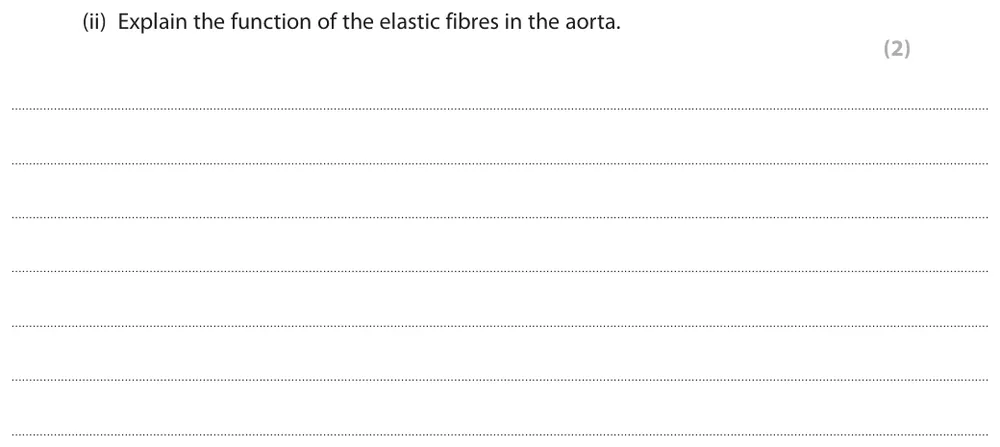
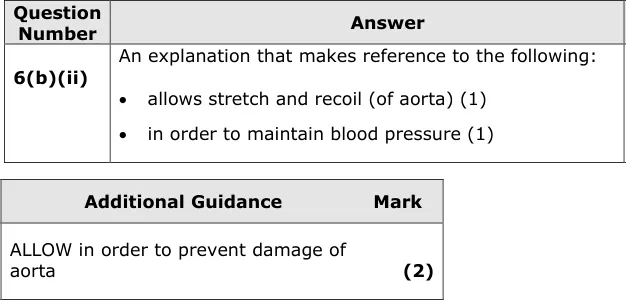
Explain the function of the elastic fibres in the aorta.
Show the mark scheme
Tap an image to open it full size.
From the examiners' report: Most said the fibres stretch and recoil; better answers added that this maintains blood pressure. Elastic fibres do not contract and relax: that is muscle.
Question 11
A level Paper 2 · June 2022 · Q1(a)(i) · 2 marks
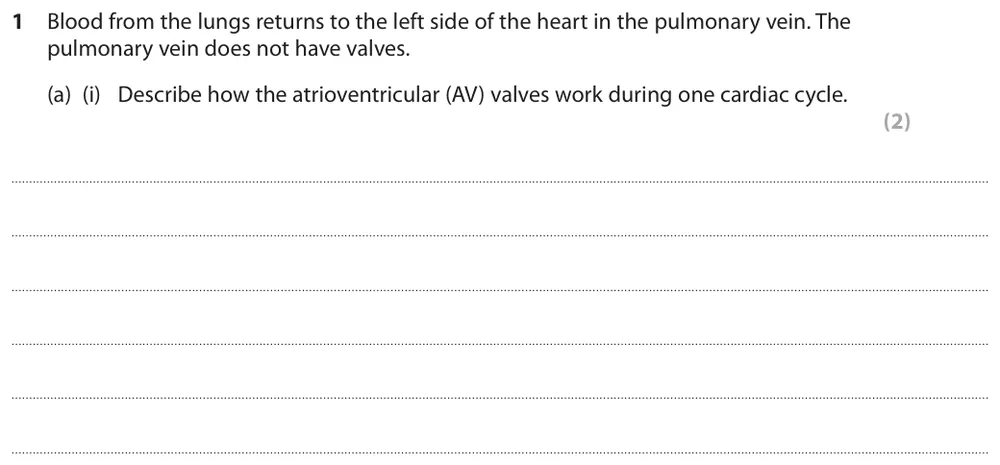
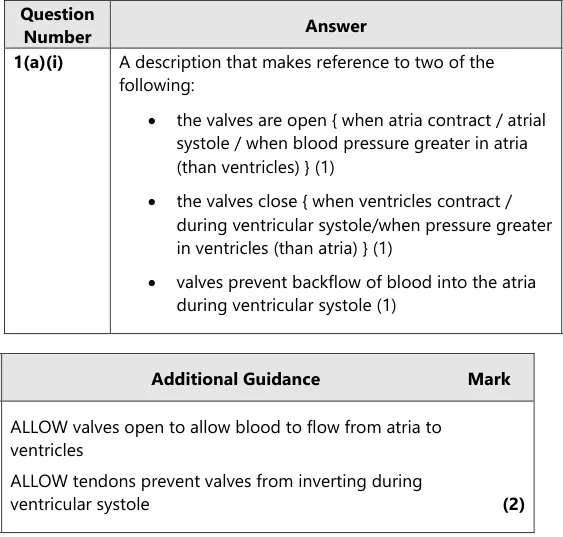
Describe how the atrioventricular valves work during one cardiac cycle.
Show the mark scheme
Tap an image to open it full size.
From the examiners' report: Over half the candidates scored both marks. A minority mixed up the atria and the ventricles.
Question 12
A level Paper 2 · June 2022 · Q1(a)(ii) · 2 marks
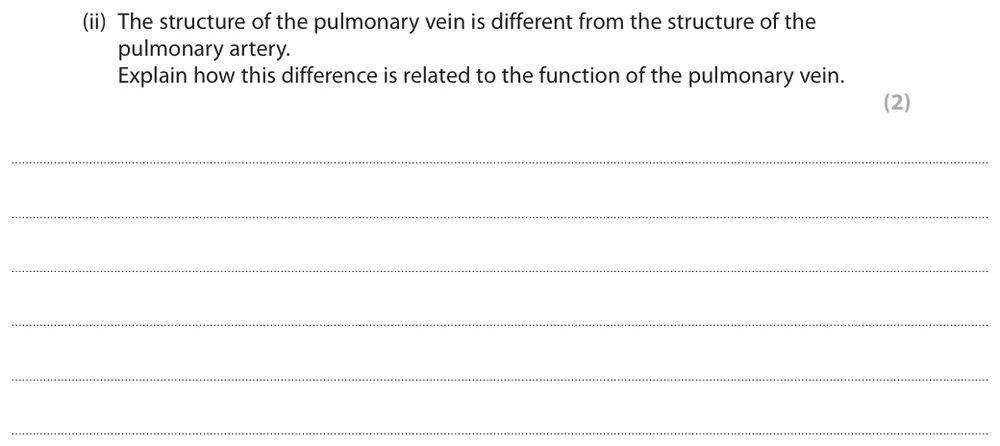
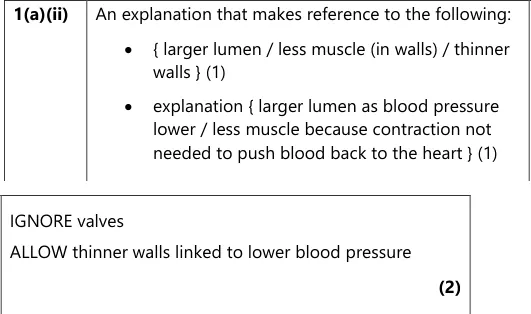
Explain how the structure of the pulmonary vein relates to its function, compared with the pulmonary artery.
Show the mark scheme
Tap an image to open it full size.
From the examiners' report: The pulmonary vein has no valves, but many answers mentioned them. Give a structural difference (larger lumen, thinner wall, less muscle) and link it to the lower blood pressure in the vein.
Question 13
A level Paper 3 · October 2020 · Q1(c) · 2 marks
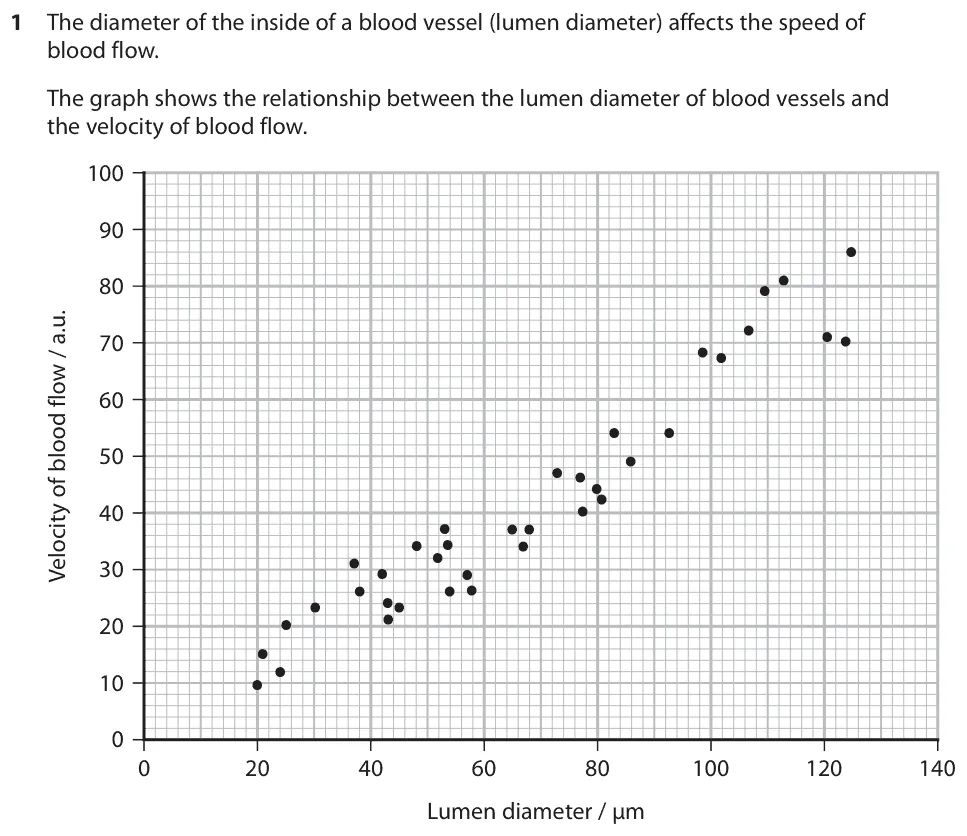
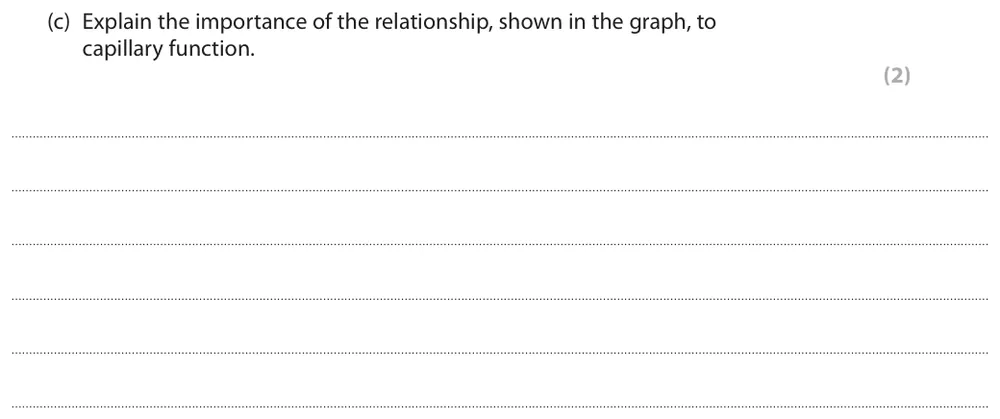
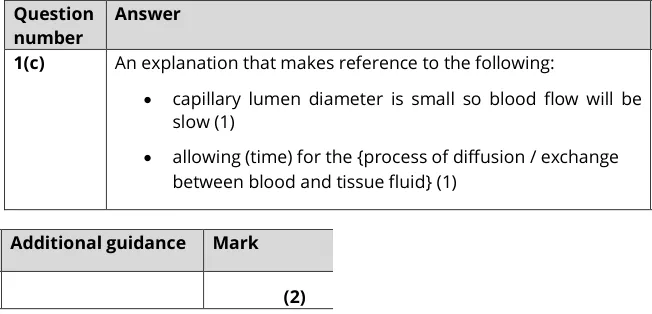
Explain why the relationship between lumen diameter and blood velocity matters for capillary function.
Information from earlier in this question:
Show the mark scheme
Tap an image to open it full size.
From the examiners' report: A surprising number said blood flows fast in capillaries. It flows slowly, giving time for diffusion or exchange between blood and tissue fluid; 'glucose leaks out' was not enough.
The heart and the cardiac cycle (1.4 i)
Question 14
AS Paper 1 · November 2021 · Q1(a)(i) · 2 marks
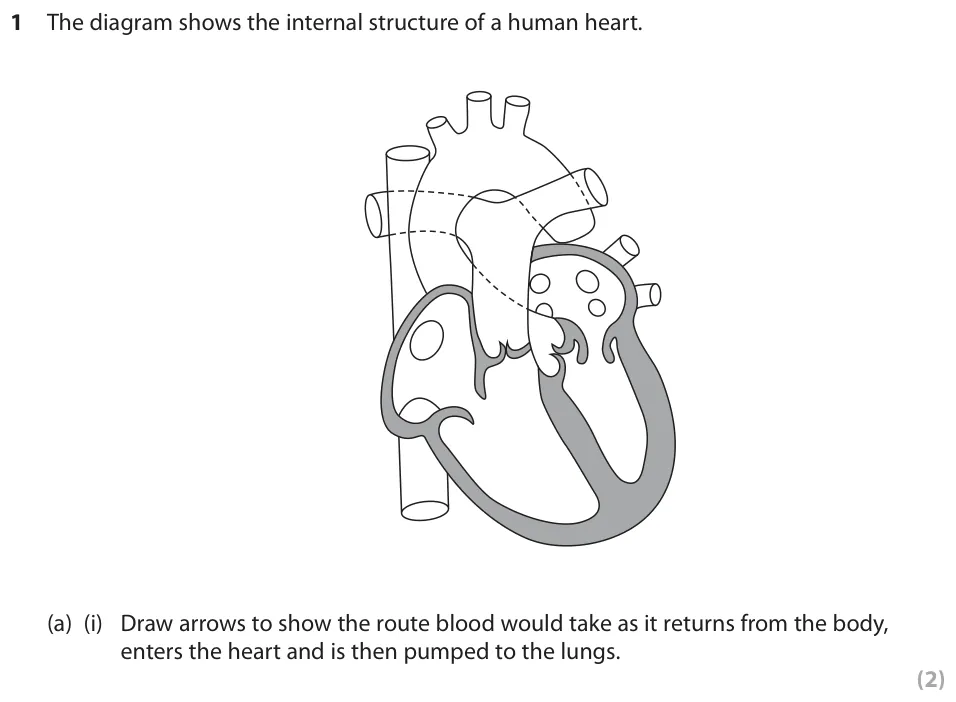
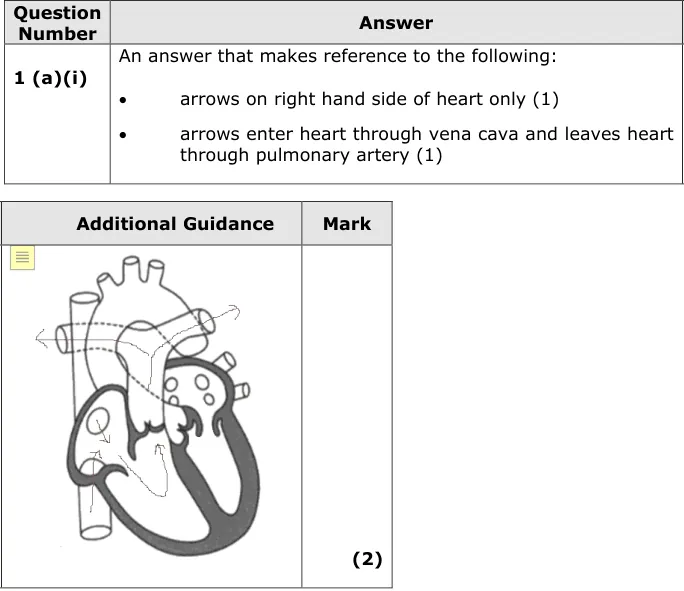
Draw arrows to show the route of blood from the body, through the heart, to the lungs.
Show the mark scheme
Tap an image to open it full size.
From the examiners' report: Most knew the blood only travels through the right side. The most common error was not showing the blood entering the right atrium from the vena cava.
Question 15
AS Paper 1 · November 2021 · Q1(a)(ii) · 1 mark · Easy
State which stage of the cardiac cycle the diagram shows.

Show the mark scheme

Tap an image to open it full size.
From the examiners' report: Well answered. A few wrote diastole or ventricular systole instead of atrial systole.
Question 16
AS Paper 1 · June 2023 · Q2(a)(iii) · 2 marks
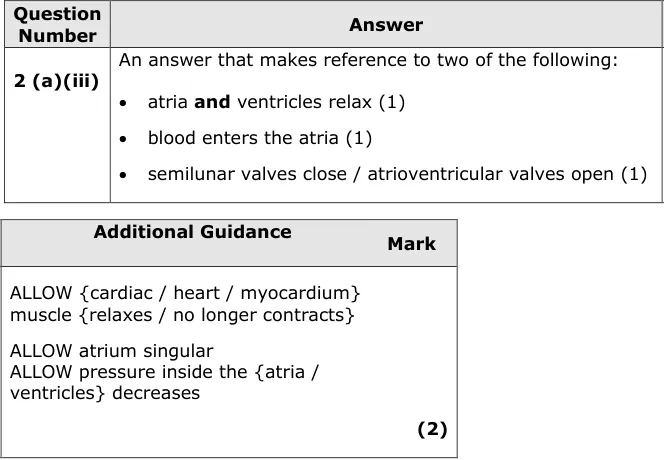
Describe what happens during diastole.
Show the mark scheme
Tap an image to open it full size.
From the examiners' report: Name the atria and ventricles, not just 'chambers'. Some thought both sets of valves stay closed throughout diastole: the semilunar valves close and the atrioventricular valves open.
Question 17
AS Paper 1 · June 2025 · Q5(a)(i) · 1 mark · Easy
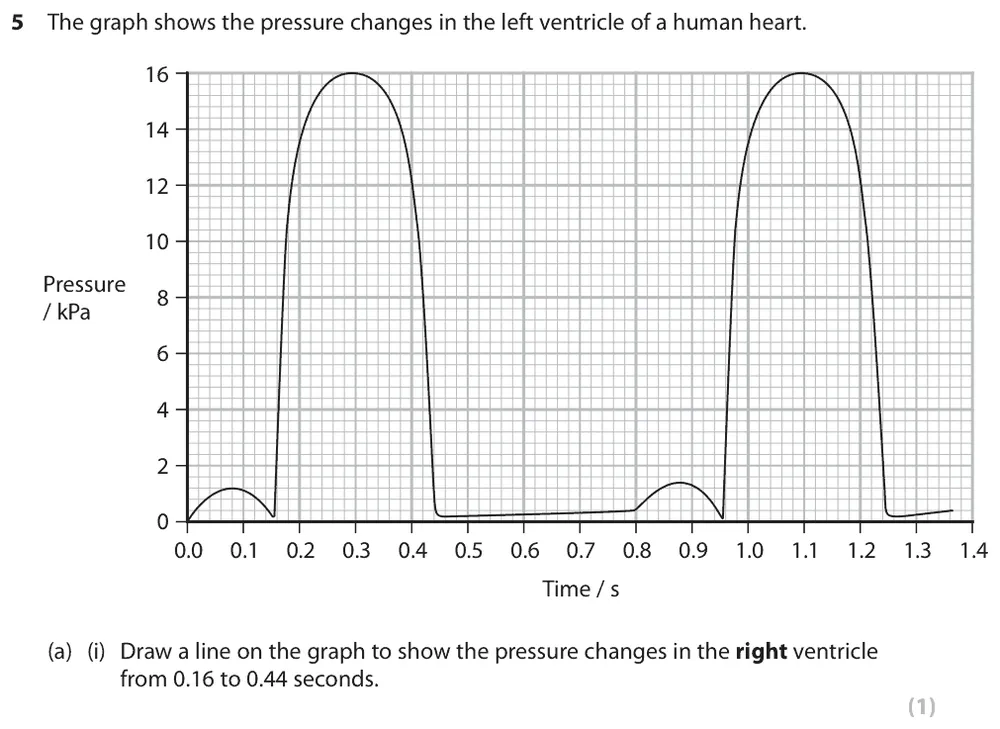
Draw a line on the graph to show the pressure changes in the right ventricle.
Show the mark scheme

Tap an image to open it full size.
From the examiners' report: Most drew a suitable line, below the left ventricle's but the same shape. A small minority left it blank: look for the mark allocation, not just answer lines.
Question 18
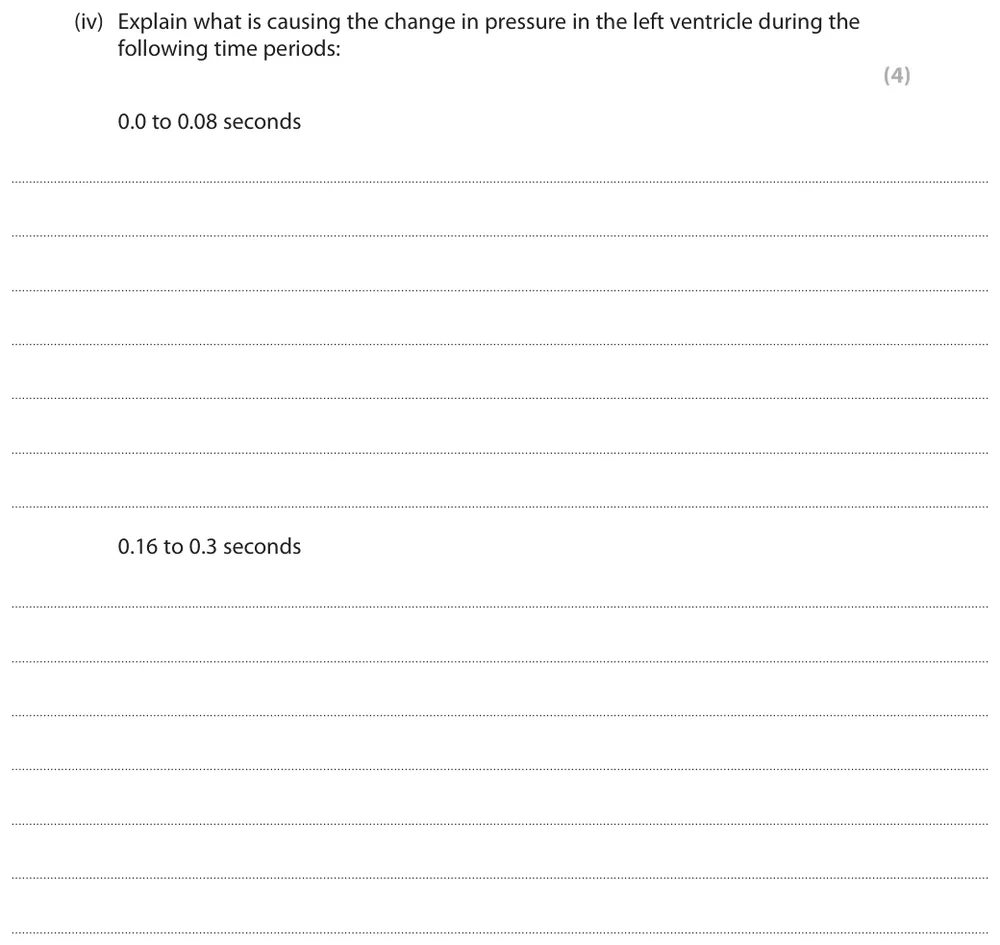
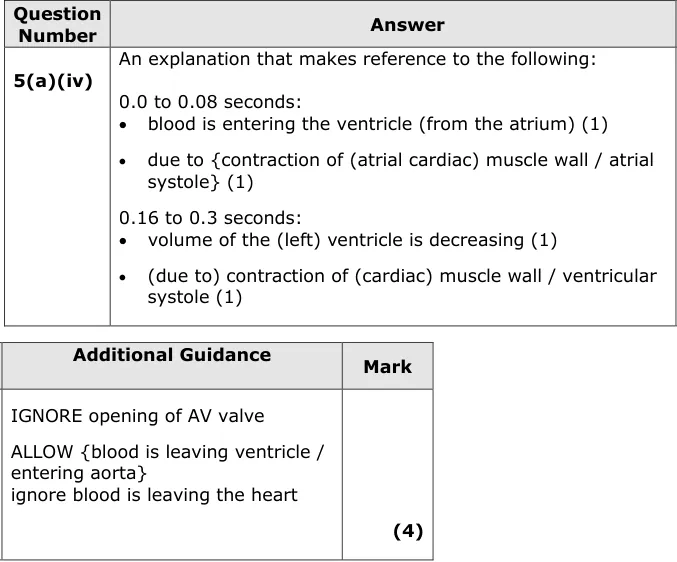
AS Paper 1 · June 2025 · Q5(a)(iv) · 4 marks
Explain what causes the pressure changes in the left ventricle during two time periods.
Show the mark scheme
Tap an image to open it full size.
From the examiners' report: Explain, don't describe the data. 'The ventricle contracts' was not enough without the muscle wall or systole, and fewer candidates explained that pressure rises because the ventricle's volume decreases.
Question 19
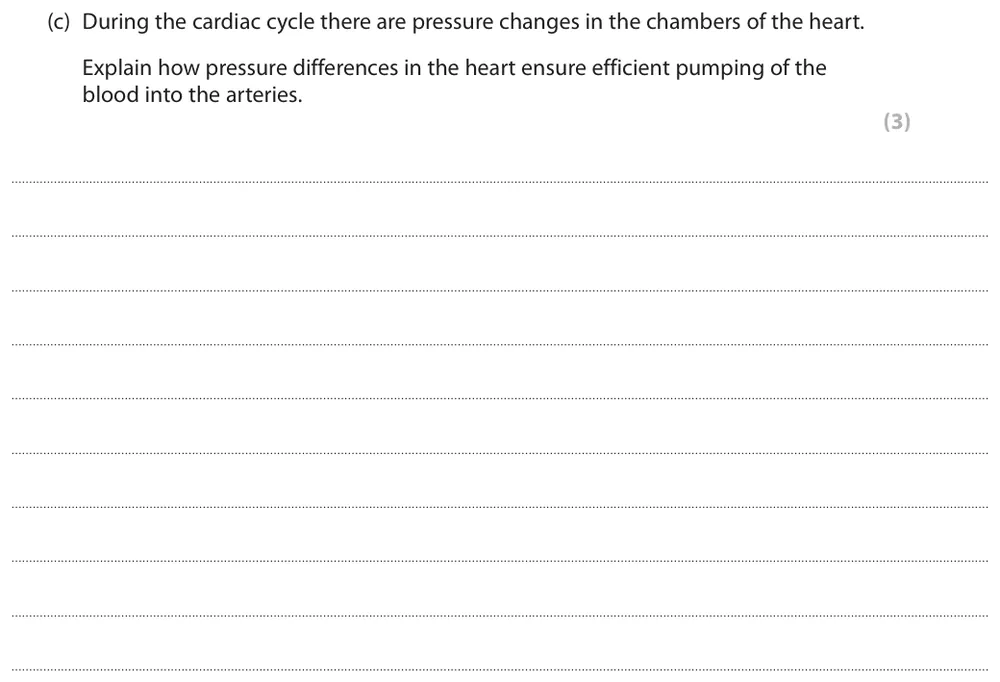
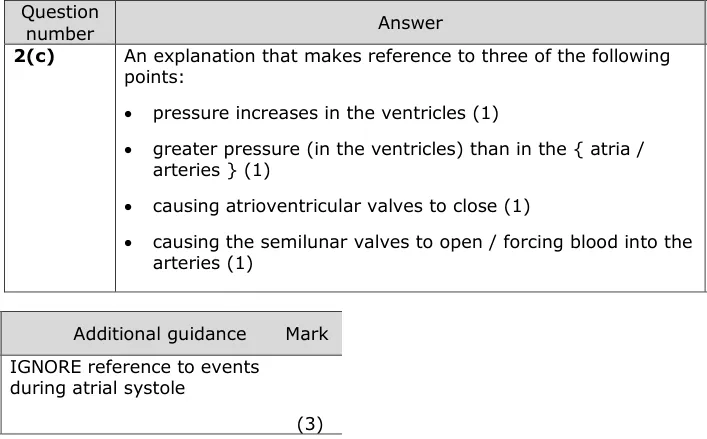
A level Paper 2 · June 2017 · Q2(c) · 3 marks
Explain how pressure differences in the heart ensure efficient pumping of blood into the arteries.
Show the mark scheme
Tap an image to open it full size.
From the examiners' report: Many described the whole cardiac cycle from diastole instead of answering the question. Say that pressure in the ventricles becomes higher than in the atria and arteries, closing the atrioventricular valves and opening the semilunar valves.
Where students lose marks (from Pearson examiners' reports and mark schemes)
Each point below comes from the examiners' reports and mark schemes, and is followed by wording that gained marks.
Say where the oxygen goes. 'To pump oxygen around the body' lacked the detail needed at A level.
✔ Gains credit: 'The heart pumps blood around blood vessels, enabling mass transport of oxygen to respiring cells.'
A Daphnia's ratio is too small. The most common error was saying the Daphnia has a large surface area to volume ratio.
✔ Gains credit: 'Its surface area to volume ratio is too small for diffusion alone, so a heart is needed to transport oxygen to cells for aerobic respiration.'
Polar is only half the answer. Most said water is polar but did not explain how that makes it a solvent.
✔ Gains credit: 'Water is a dipole, so water molecules surround polar molecules, allowing them to dissolve.'
Sweating is about breaking hydrogen bonds. Many wrote about dissolving and transporting substances instead.
✔ Gains credit: 'The dipole lets water molecules form hydrogen bonds with each other; heat energy is used to break these bonds when sweat evaporates, cooling the body.'
Collagen withstands, muscle and elastic tissue maintain. Few explained why collagen helps the artery withstand pressure.
✔ Gains credit: 'Collagen provides strength to withstand pressure; elastic fibres stretch and recoil, and smooth muscle contracts to narrow the lumen.'
Elastic fibres don't contract. Some answers said the elastic fibres contract and relax.
✔ Gains credit: 'Elastic fibres allow the aorta to stretch and recoil, maintaining blood pressure.'
Blood is slow in capillaries. A surprising number said blood velocity is high in capillaries.
✔ Gains credit: 'The small lumen means blood flows slowly, allowing time for exchange between the blood and tissue fluid by diffusion.'
Higher, not just high. Many described ventricular pressure as 'high' rather than higher than in the atria and arteries, or never named the valves.
✔ Gains credit: 'Pressure in the ventricles becomes greater than in the atria, closing the atrioventricular valves, and greater than in the arteries, opening the semilunar valves.'
Download the questions
Download the PDF pack (19 questions, mark schemes at the end)
Keep practising
- Atherosclerosis, Blood Clotting and CVD Treatment (Topic 1): Edexcel SNAB exam questions by topic
- Risk, Diet and Health Data (Topic 1): Edexcel SNAB exam questions by topic
- Carbohydrates and Lipids (Topic 1): Edexcel SNAB exam questions by topic
- Caffeine and Daphnia Heart Rate (Core Practical 1): Edexcel SNAB core practical questions
- Topic 1 multiple-choice quiz (50 questions, marked as you tap)
- Edexcel SNAB A level Biology resources hub (every topic, practical and paper)
- Vitamin C and Membrane Permeability (Core Practicals 2 and 3): Edexcel SNAB A Level Biology Exam Questions
- Extended Response Questions (Topics 1 and 2): Edexcel SNAB A Level Biology Exam Questions
- Edexcel SNAB A level Biology past papers, mark schemes and examiners' reports
- Edexcel SNAB A level Biology grade boundaries
- Message Tom on WhatsApp about one-to-one Edexcel SNAB tutoring or an Edexcel group class
Questions, mark schemes and examiners' report extracts © Pearson Education Ltd.