

Core Practical 1 asks you to investigate the effect of caffeine on heart rate in Daphnia. A Daphnia is placed on a cavity slide in a small volume of solution, left to acclimatise, and its heartbeats are counted under a microscope for a set time. The independent variable is the caffeine concentration, the dependent variable is the heart rate, and temperature, volume of solution and the size and age of the animals are controlled, with a control solution containing no caffeine. Exam questions often swap in zebrafish, frogs, ghost shrimps, alcohol or dopamine. These questions come from real Edexcel A level Biology A (Salters-Nuffield) papers. Core practicals can be examined on any paper, but Paper 3 at A level tests practical skills most heavily. Questions marked AS are from the AS papers (8BN0); the rest are from the A level papers (9BN0).
The examiners' reports return to the same problems. Many students confuse a control (a solution with no caffeine or alcohol) with a controlled variable, and many state a variable without justifying it. When you are asked to justify a conclusion, quantify the change from the data, and when error bars are shown, say what overlap or no overlap means. In devise questions, use the data you are given to choose a sensible range of concentrations, allow time for acclimatisation, and repeat with several animals to calculate a mean. Write volume, not 'amount'.
Studying Edexcel SNAB and want more help? If you'd like to arrange one-to-one Edexcel tutoring, or to register your interest in an Edexcel group class, message Tom on WhatsApp using the link at the bottom of this page.
What you need first
Each question on this page assumes you're secure on these ideas. If any of them feels shaky, look it up before you start.
- Heart rate is the number of heartbeats per minute; it can be found by counting beats in a set time and scaling up.
- In an experiment the independent variable is changed, the dependent variable is measured and other variables are kept the same.
- Daphnia is a small, transparent aquatic invertebrate, so its heart can be seen under a microscope.
- A mean of repeated readings, with standard deviation or error bars, shows how much the results vary.
Key terms
These words come up in the questions and mark schemes. Examiners expect you to use them exactly.
- Control: a treatment without the factor being tested, such as water with no caffeine, to give a baseline for comparison.
- Controlled variable: a variable kept the same in every treatment, such as temperature or volume of solution, so it cannot affect the results.
- Acclimatisation: leaving the organism in the new solution or conditions for a set time before recording, so the reading is not affected by the stress of moving it.
- Non-invasive: a procedure that measures something without cutting into or harming the organism, such as viewing the heart through a transparent body.
- Valid: results or conclusions that measure what they are meant to, because other variables have been controlled and the method is suitable.
- Standard deviation: a measure of the spread of results around the mean; non-overlapping SD bars suggest a significant difference.
- Ethical issues: concerns about the welfare of the organisms used, such as whether they may feel pain or are endangered.
What these questions cover
Every question on this page is set on Core Practical 1 of the Pearson Edexcel A level Biology A (Salters-Nuffield) specification (9BN0).
- Core Practical 1: Investigate the effect of caffeine on heart rate in Daphnia.
How to use this page
Write your answer on paper before you open the mark scheme. Allow about 1.2 minutes per mark: the 20 questions are worth 58 marks, so about 70 minutes in total. Then mark your answer strictly against the mark scheme and read the examiners' tip underneath it. If you'd rather print the questions, download the PDF pack.
Choosing the organism (CP1)
Question 1
AS Paper 1 · June 2025 · Q7(b)(i) · 2 marks
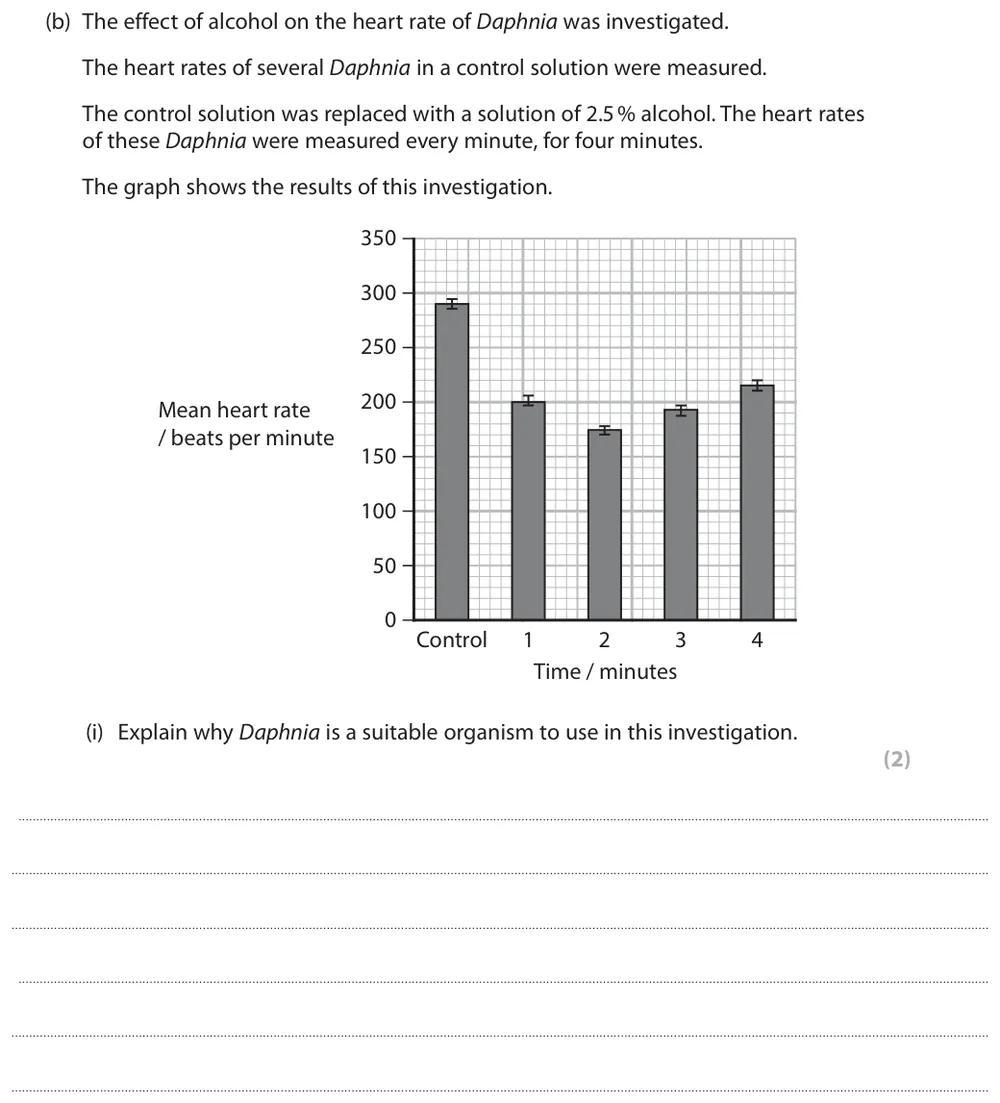
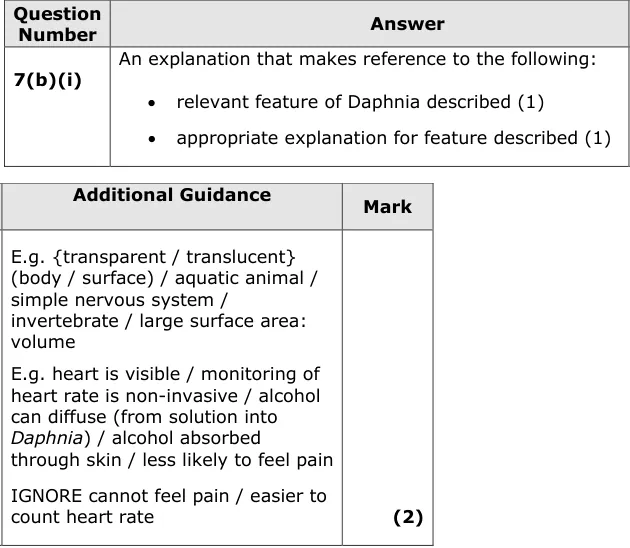
Explain why Daphnia is a suitable organism to use in an investigation into the effect of alcohol on heart rate.
Show the mark scheme
Tap an image to open it full size.
From the examiners' report: This was answered very well; the most common answer was that the transparent body means the heart is visible. Saying Daphnia is an invertebrate gained the first mark, but 'so it cannot feel pain' was not credited.
Question 2
AS Paper 1 · June 2017 · Q1(a)(iii) · 2 marks
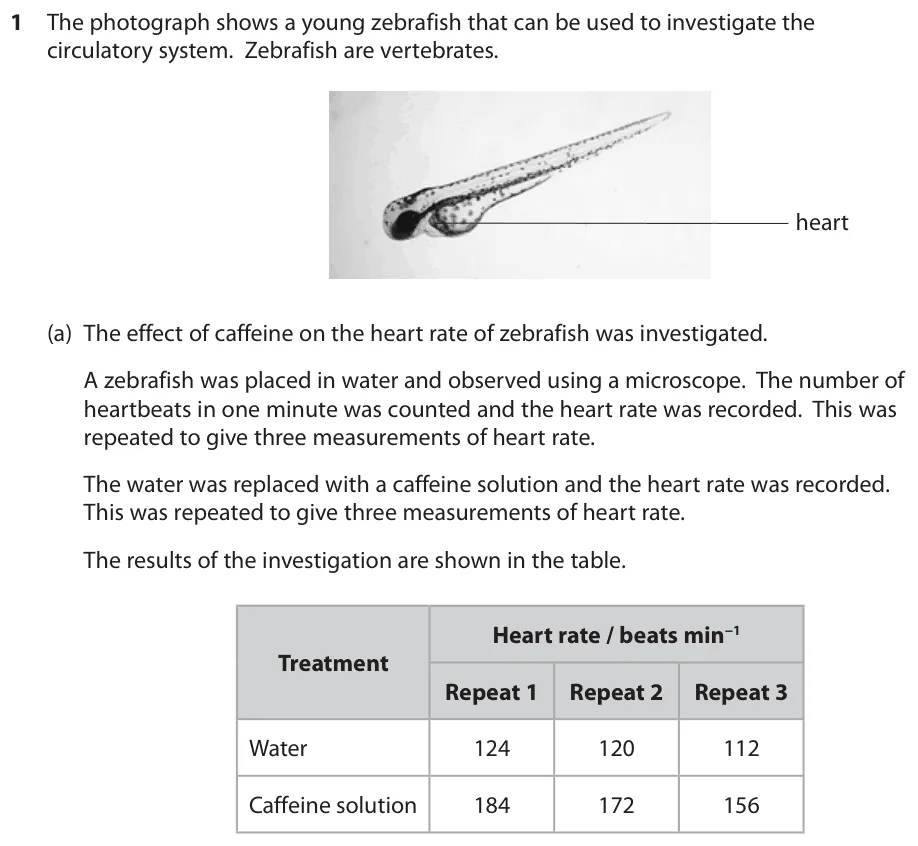
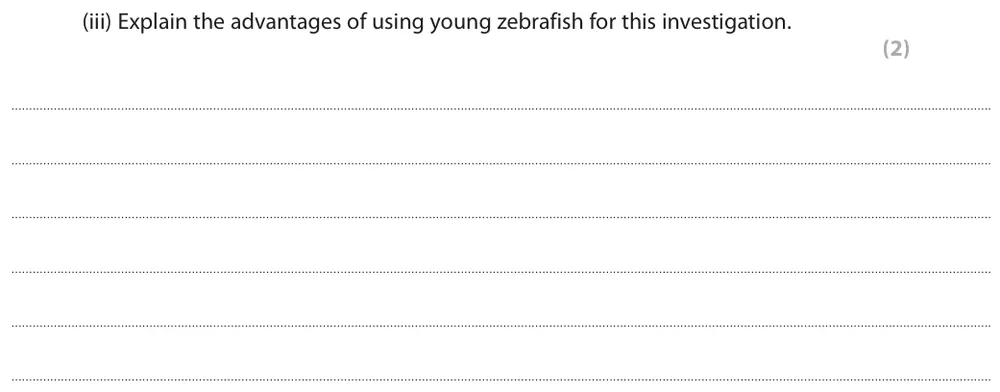
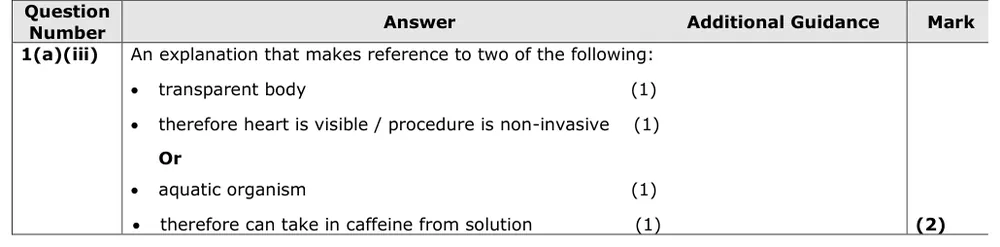
Explain the advantages of using young zebrafish to investigate the effect of caffeine on heart rate.
Information from earlier in this question:
Show the mark scheme
Tap an image to open it full size.
From the examiners' report: Use the image: the transparent body means the heart is visible, so the procedure is non-invasive. Answers about young zebrafish being less likely to have heart conditions scored nothing, and very few gave the alternative that an aquatic organism can take in caffeine from the solution.
Question 3
AS Paper 1 · June 2022 · Q6(c)(i) · 2 marks
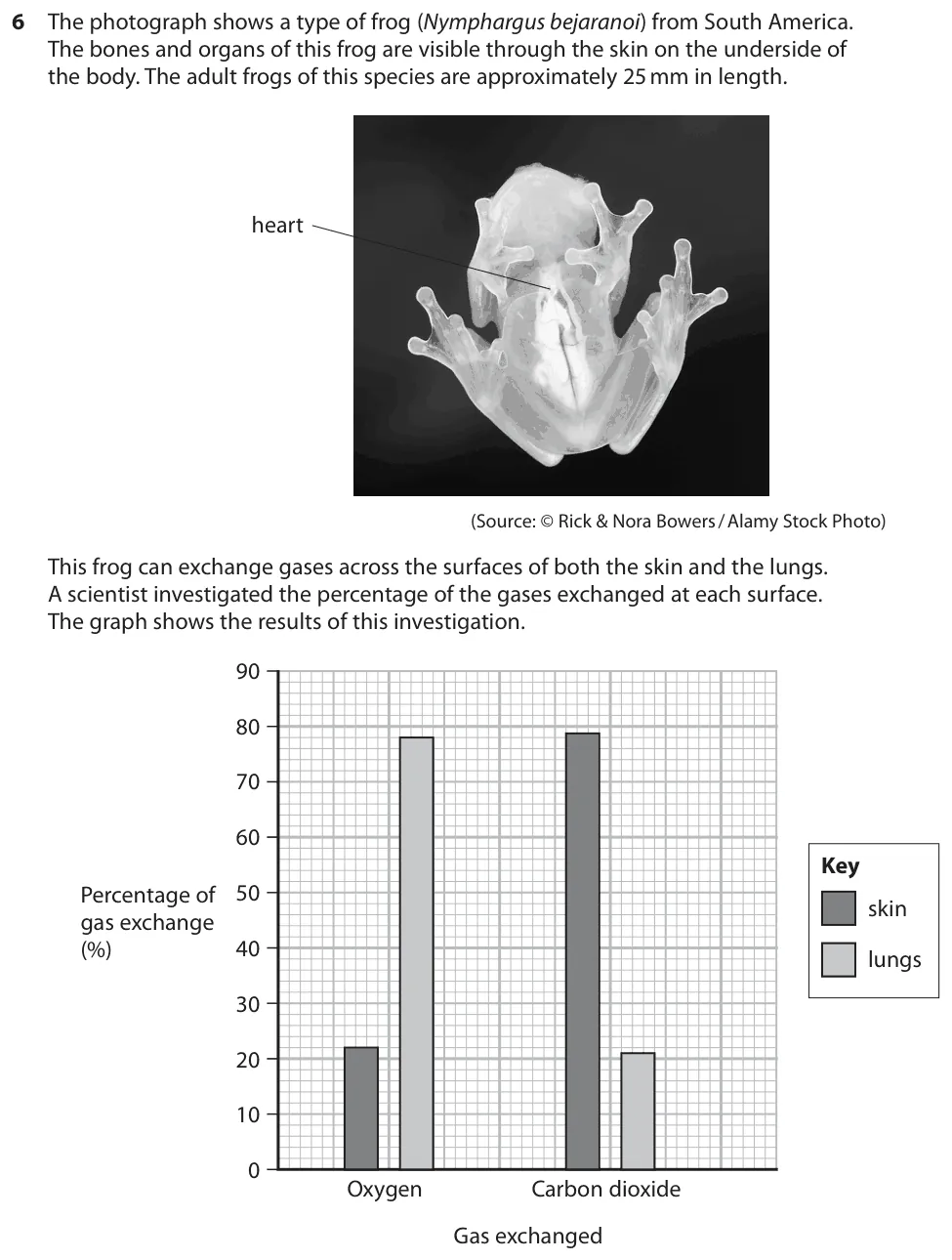
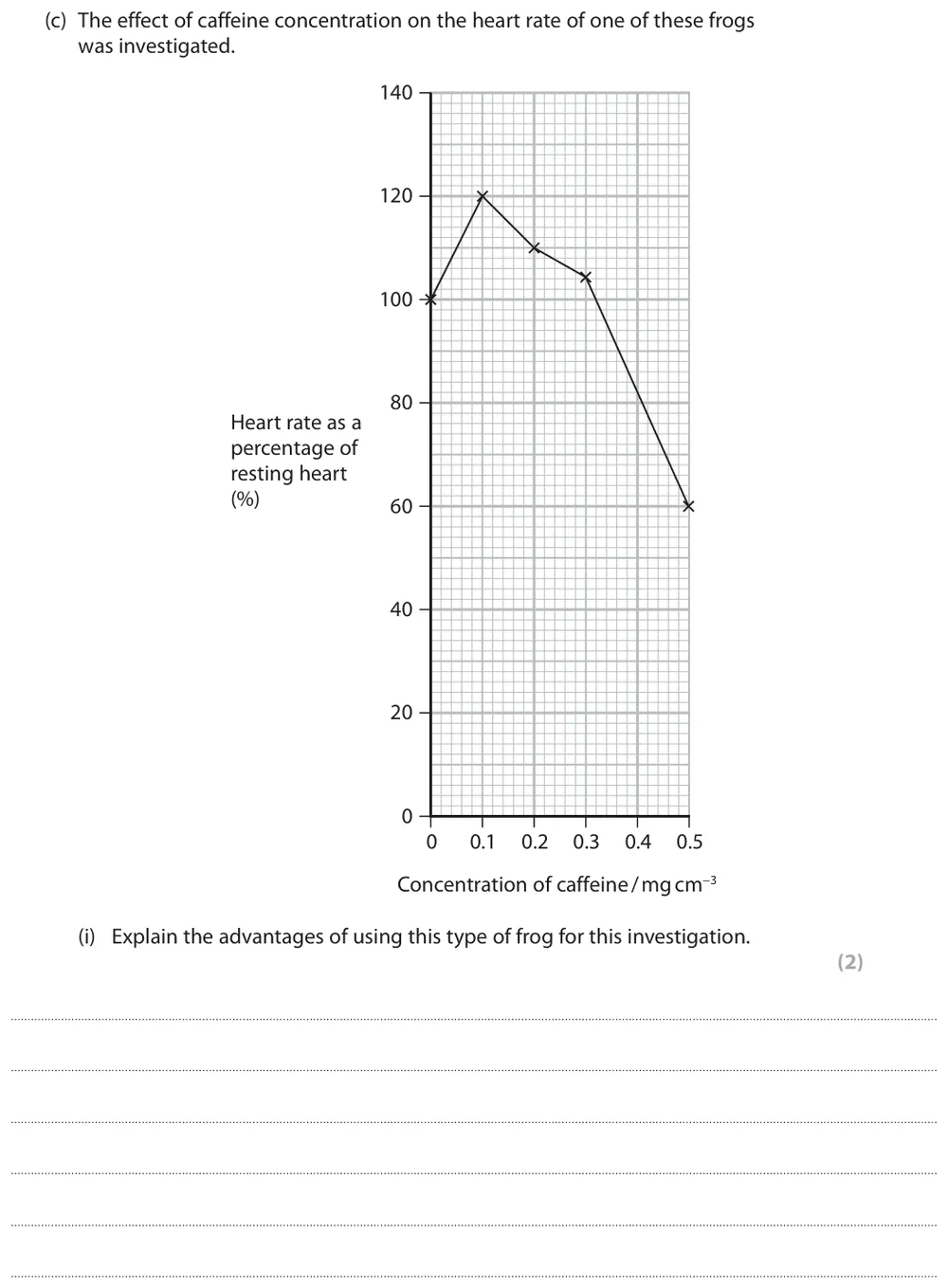
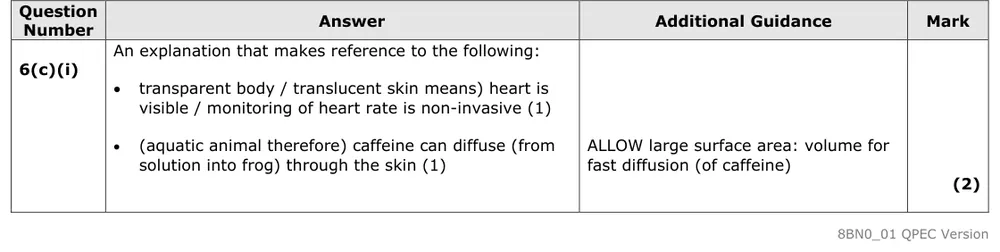
Explain the advantages of using the frog Nymphargus bejaranoi to investigate the effect of caffeine on heart rate.
Information from earlier in this question:
Show the mark scheme
Tap an image to open it full size.
From the examiners' report: Only a small minority gave more than one advantage, so most scored one mark at most. A significant number wrongly said the frog was an invertebrate.
Question 4
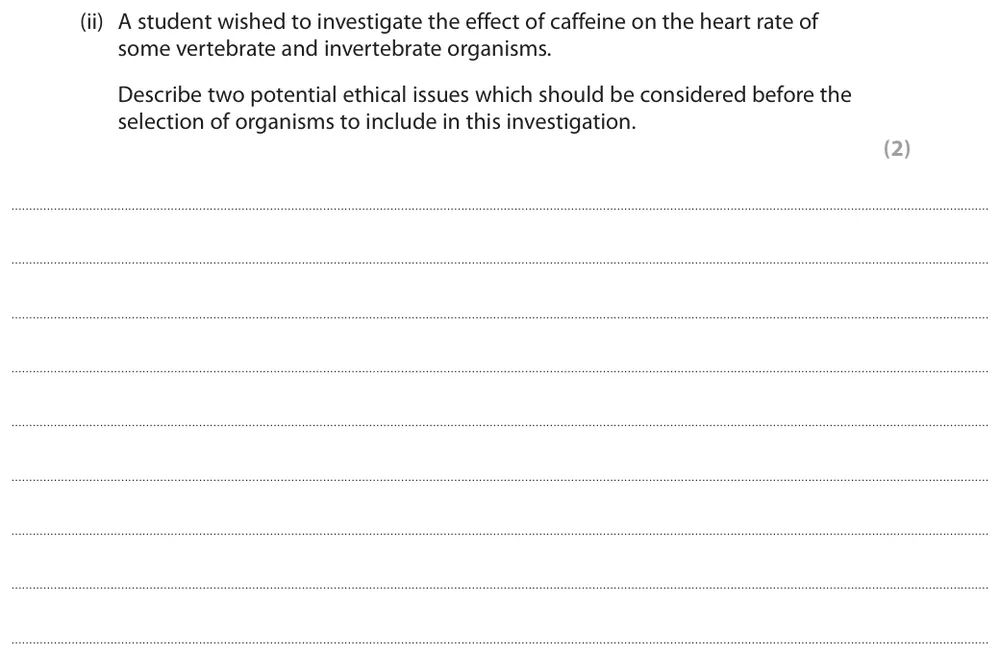
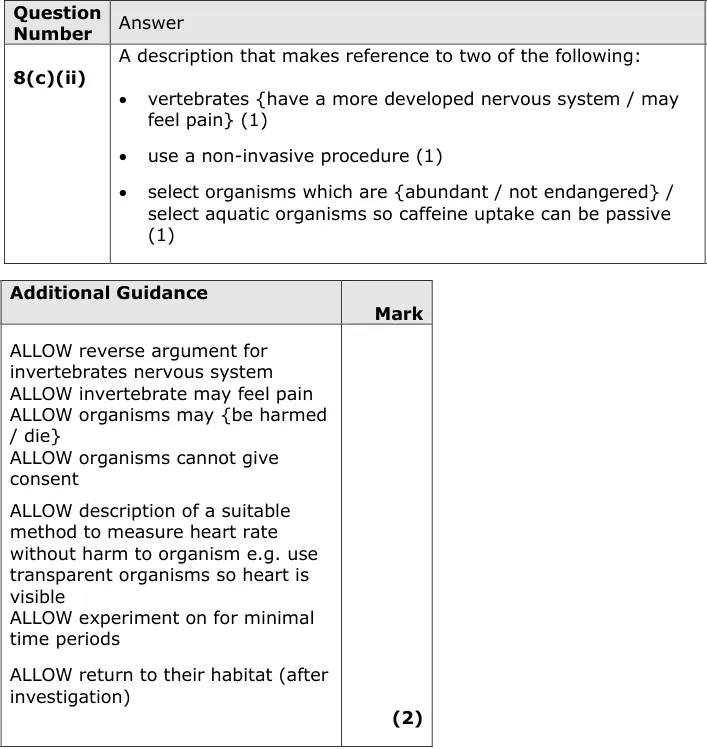
AS Paper 1 · June 2024 · Q8(c)(ii) · 2 marks
Describe two ethical issues to consider before choosing vertebrates and invertebrates for a caffeine investigation.
Show the mark scheme
Tap an image to open it full size.
From the examiners' report: Most were credited for the idea that vertebrates have a more developed nervous system and may feel pain. More detailed answers also chose abundant, non-endangered organisms or a non-invasive way to measure the heart rate.
Controls and controlled variables (CP1)
Question 5
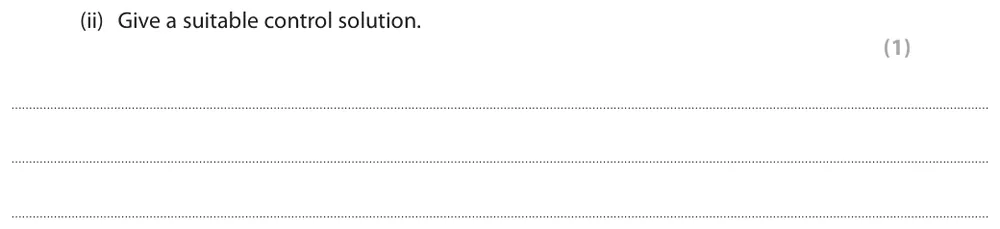
AS Paper 1 · June 2025 · Q7(b)(ii) · 1 mark
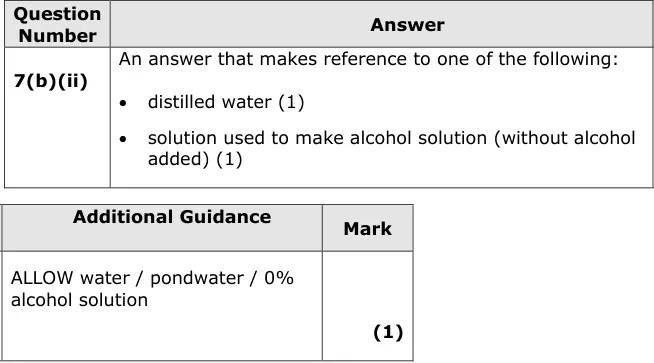
Give a suitable control solution for the alcohol investigation.
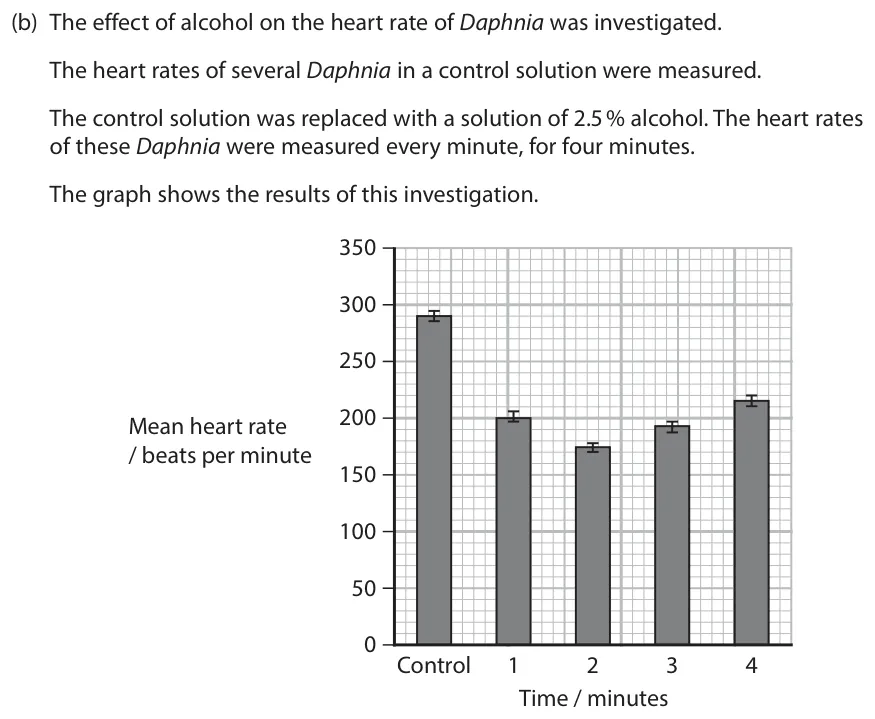
Information from earlier in this question:
Show the mark scheme
Tap an image to open it full size.
From the examiners' report: A significant number confused a control with a controlled variable and gave the volume of solution or the age of the Daphnia. The control is a solution, such as distilled water or the solution used to make the alcohol solution, without alcohol.
Question 6
AS Paper 1 · November 2021 · Q8(a)(i) · 2 marks
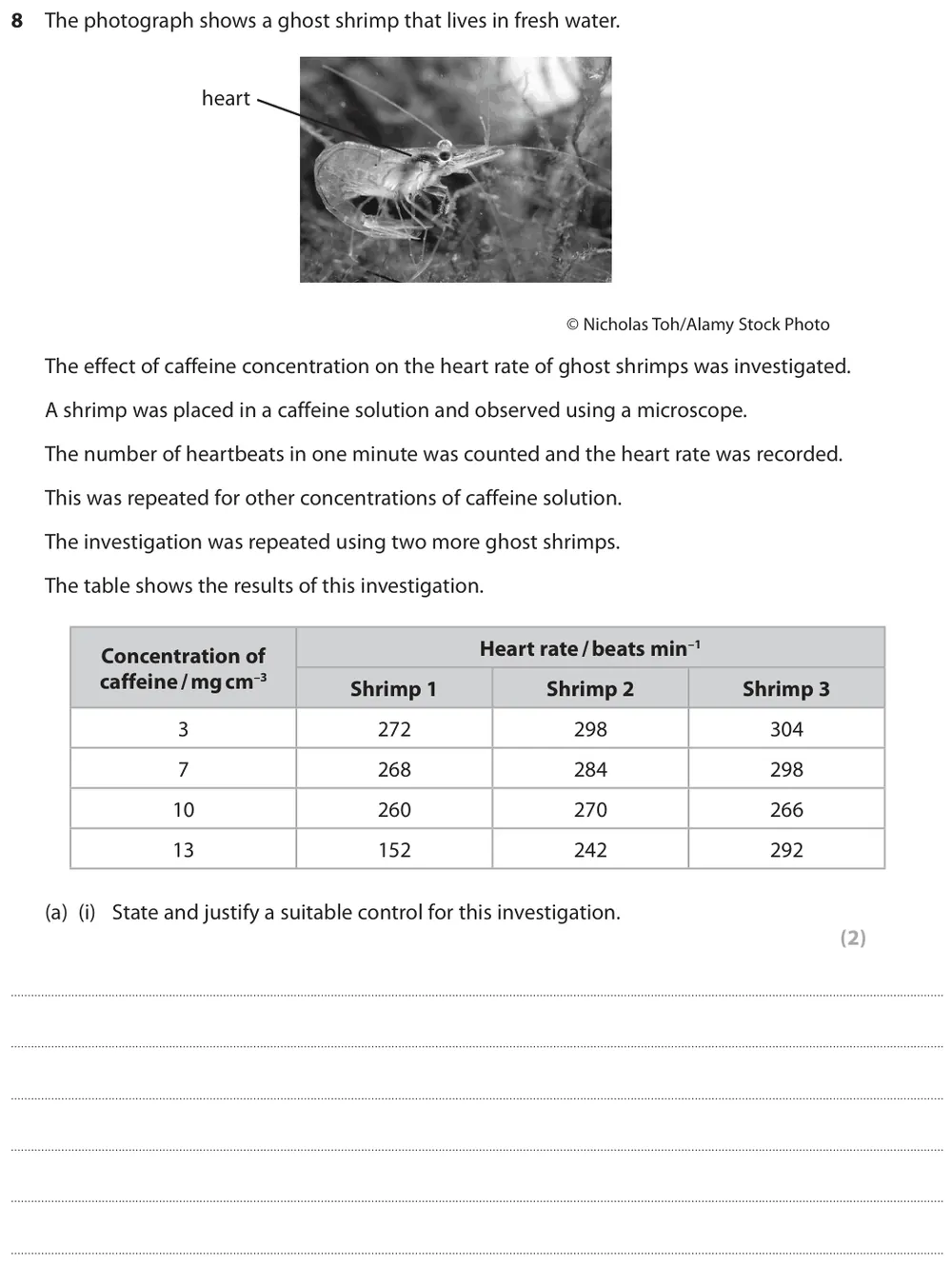
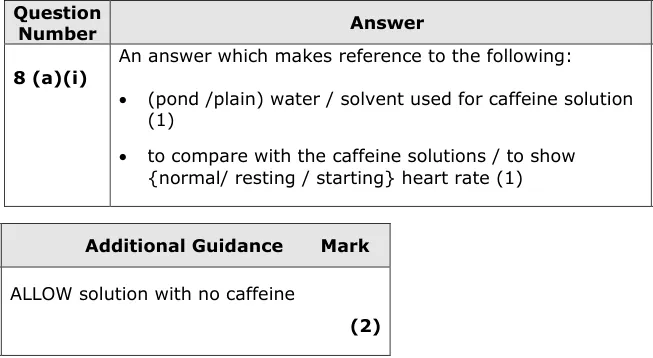
State and justify a suitable control for an investigation into caffeine and ghost shrimp heart rate.
Show the mark scheme
Tap an image to open it full size.
From the examiners' report: This was well answered, with most students gaining both marks, an improvement on a similar question in an earlier paper.
Question 7
AS Paper 1 · June 2017 · Q1(a)(i) · 1 mark
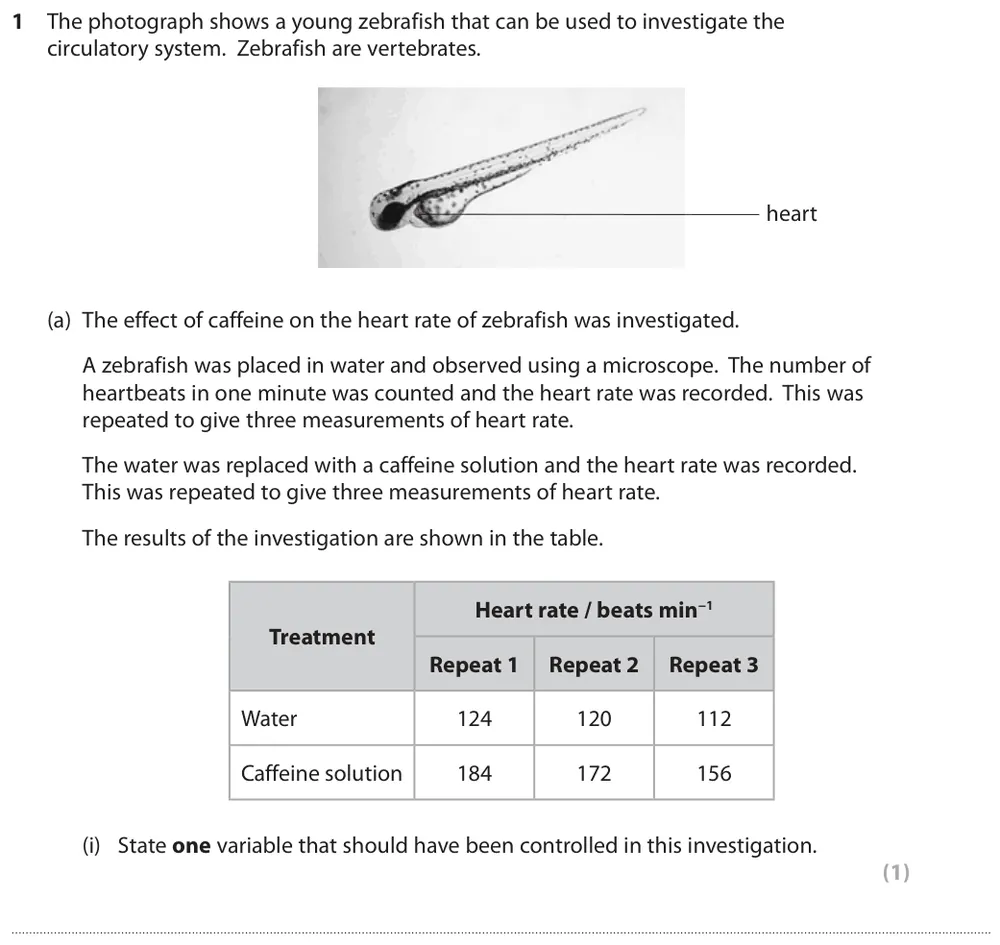
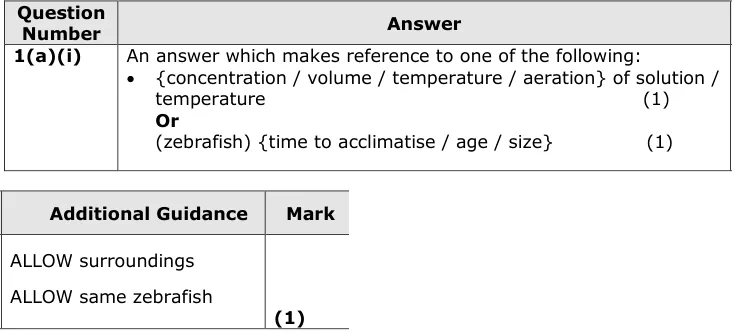
State one variable that should have been controlled in the zebrafish caffeine investigation.
Show the mark scheme
Tap an image to open it full size.
From the examiners' report: Nearly 85% answered well; the concentration of the caffeine solution and temperature were the most common answers. The most common reason for losing the mark was writing 'amount' instead of volume.
Question 8
AS Paper 1 · November 2021 · Q8(a)(ii) · 4 marks
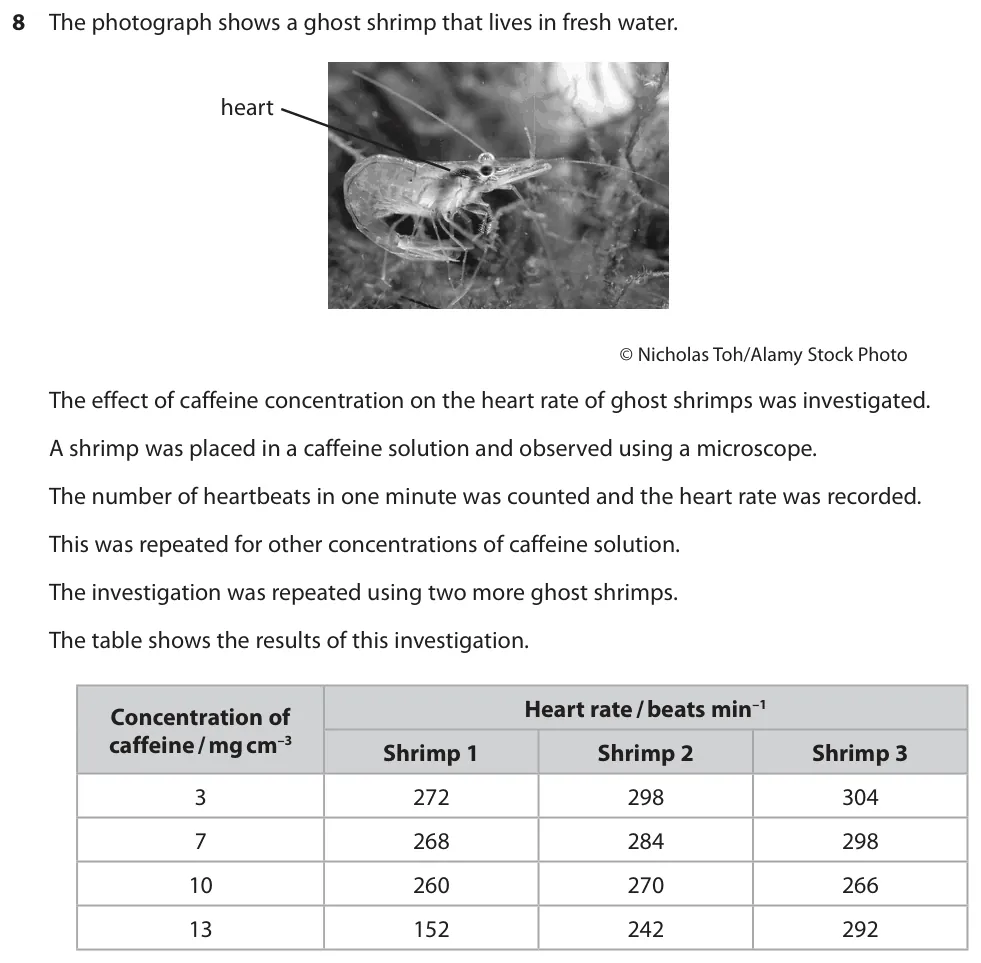
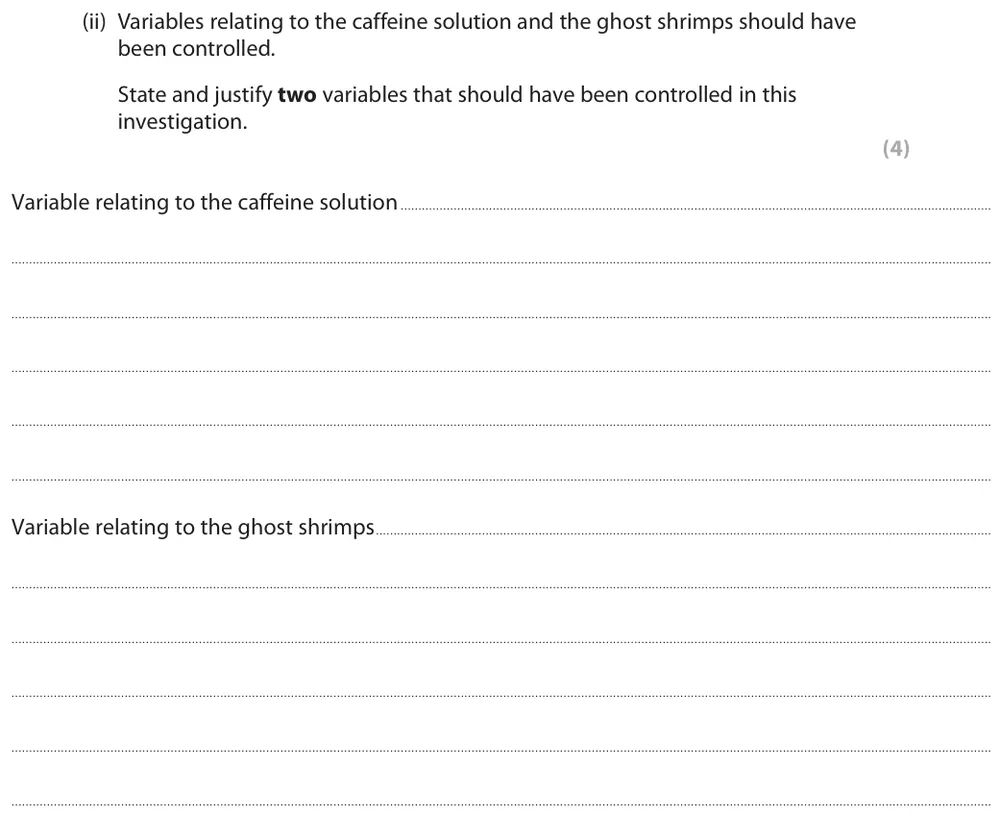
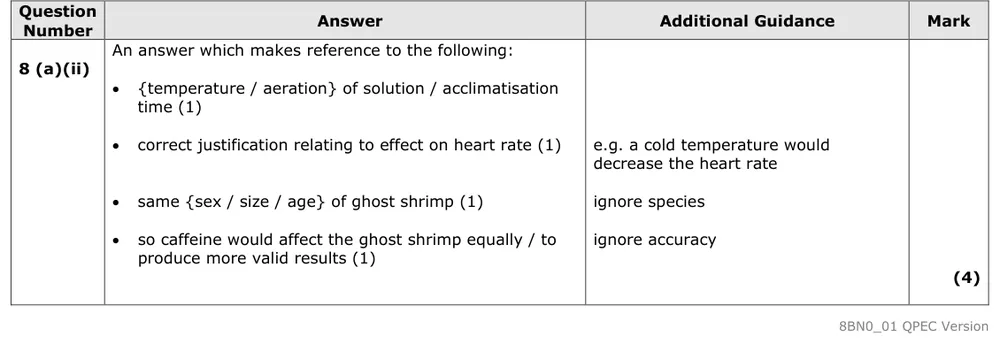
State and justify two variables, one for the solution and one for the shrimps, that should have been controlled.
Information from earlier in this question:
Show the mark scheme
Tap an image to open it full size.
From the examiners' report: Most stated two variables but lost marks by not following the command to justify them, for example a cold temperature would decrease the heart rate. 'Use the same ghost shrimp' ignored the table, which shows three shrimps were used.
Question 9
A level Paper 2 · October 2020 · Q5(b)(ii) · 2 marks
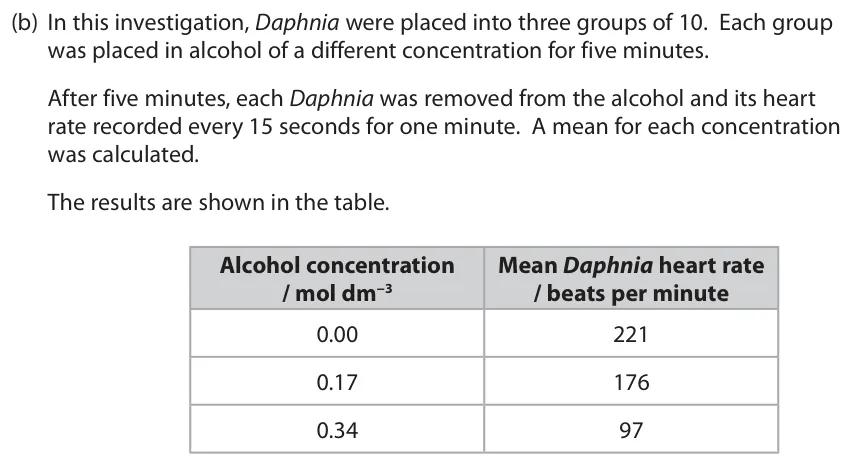
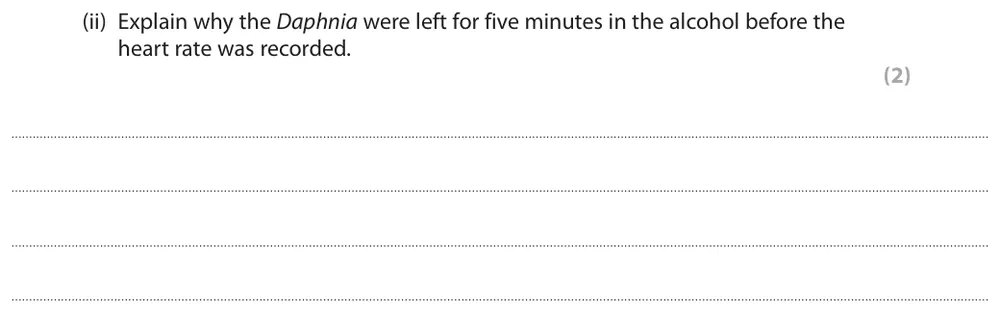
Explain why the Daphnia were left in the alcohol for five minutes before the heart rate was recorded.
Information from earlier in this question:
Show the mark scheme
Tap an image to open it full size.
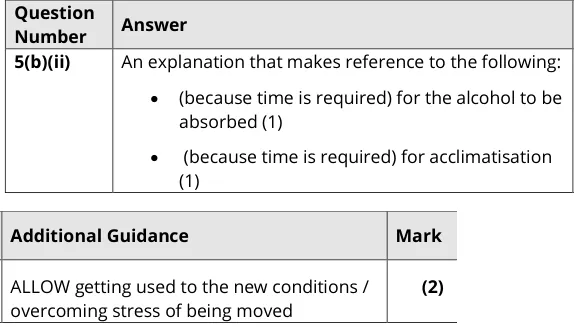
From the examiners' report: Most gained at least one mark. The alcohol needs time to be absorbed, and the Daphnia need time to acclimatise to the new conditions.
Question 10
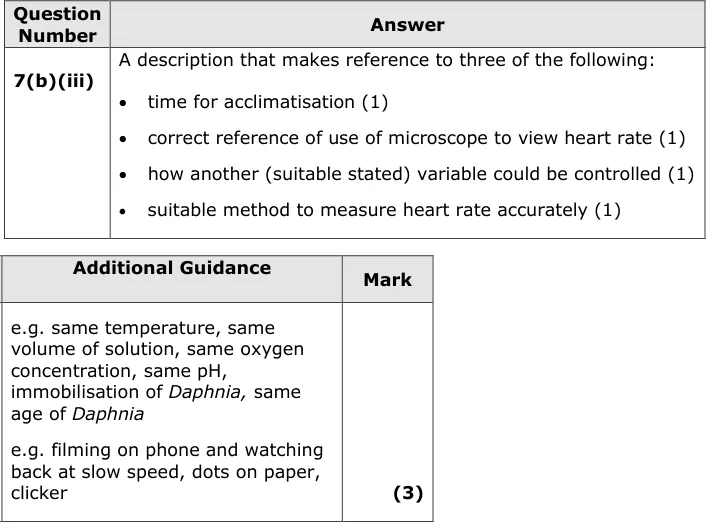
AS Paper 1 · June 2025 · Q7(b)(iii) · 3 marks · Easy
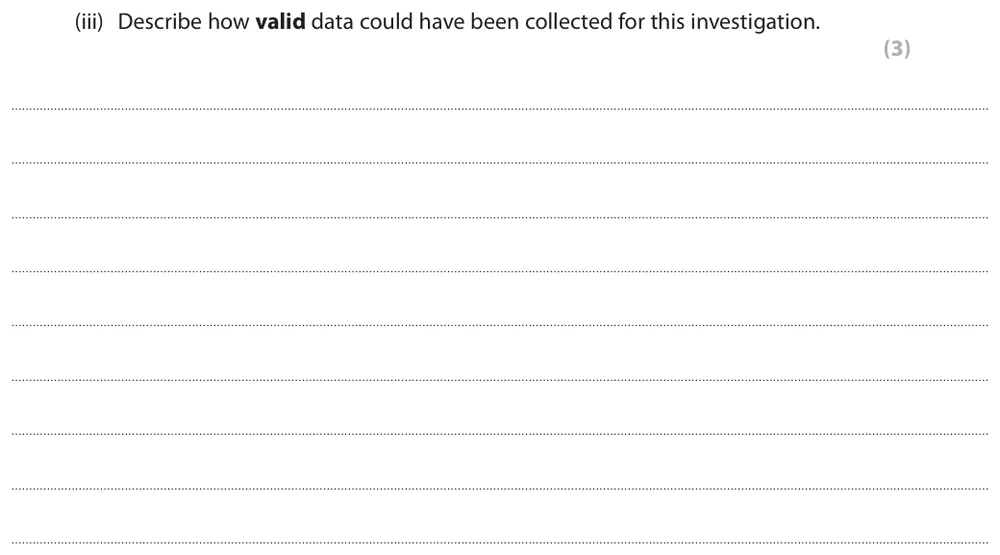
Describe how valid data could have been collected in the Daphnia alcohol investigation.
Information from earlier in this question:
Show the mark scheme
Tap an image to open it full size.
From the examiners' report: Most identified at least one variable to control. The best answers also made sure the heart rate was counted accurately, for example by filming and replaying at slow speed, and allowed time for acclimatisation.
Devising a procedure (CP1)
Question 11
AS Paper 1 · October 2020 · Q7(b)(iii) · 5 marks
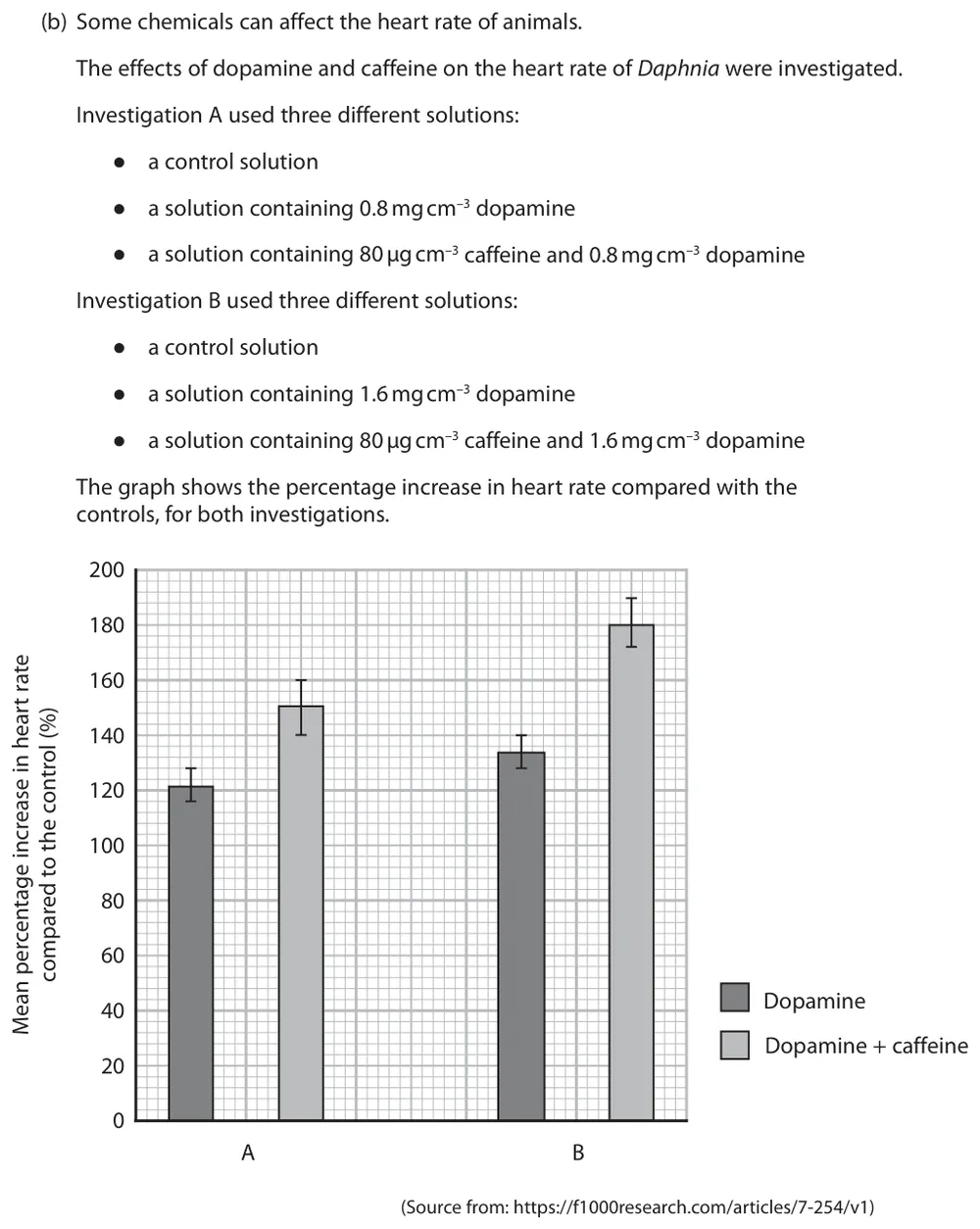
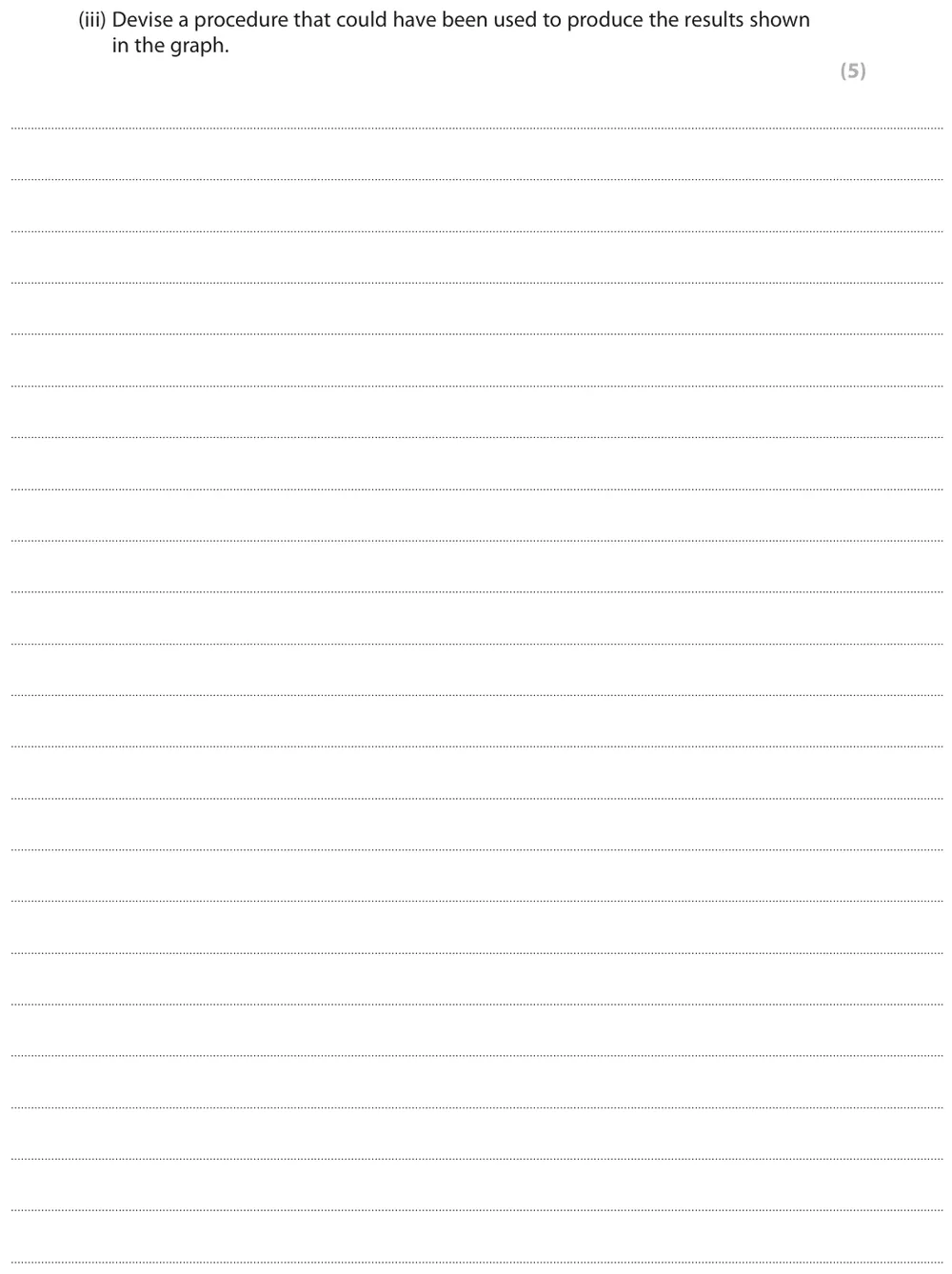
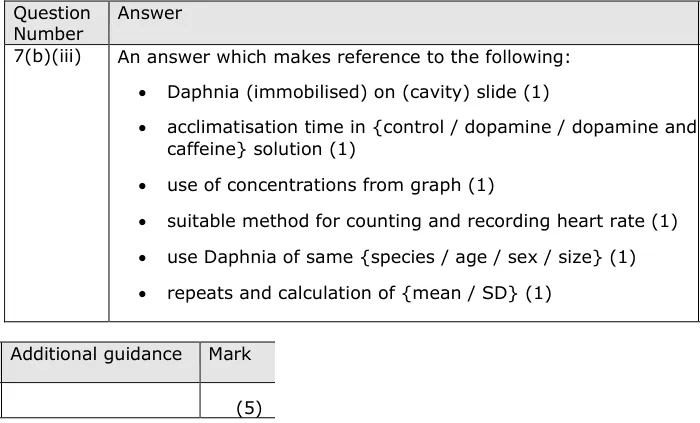
Devise a procedure that could have produced the dopamine and caffeine results shown in the graph.
Information from earlier in this question:
Show the mark scheme
Tap an image to open it full size.
Question 12
A level Paper 2 · November 2021 · Q5(b)(ii) · 4 marks
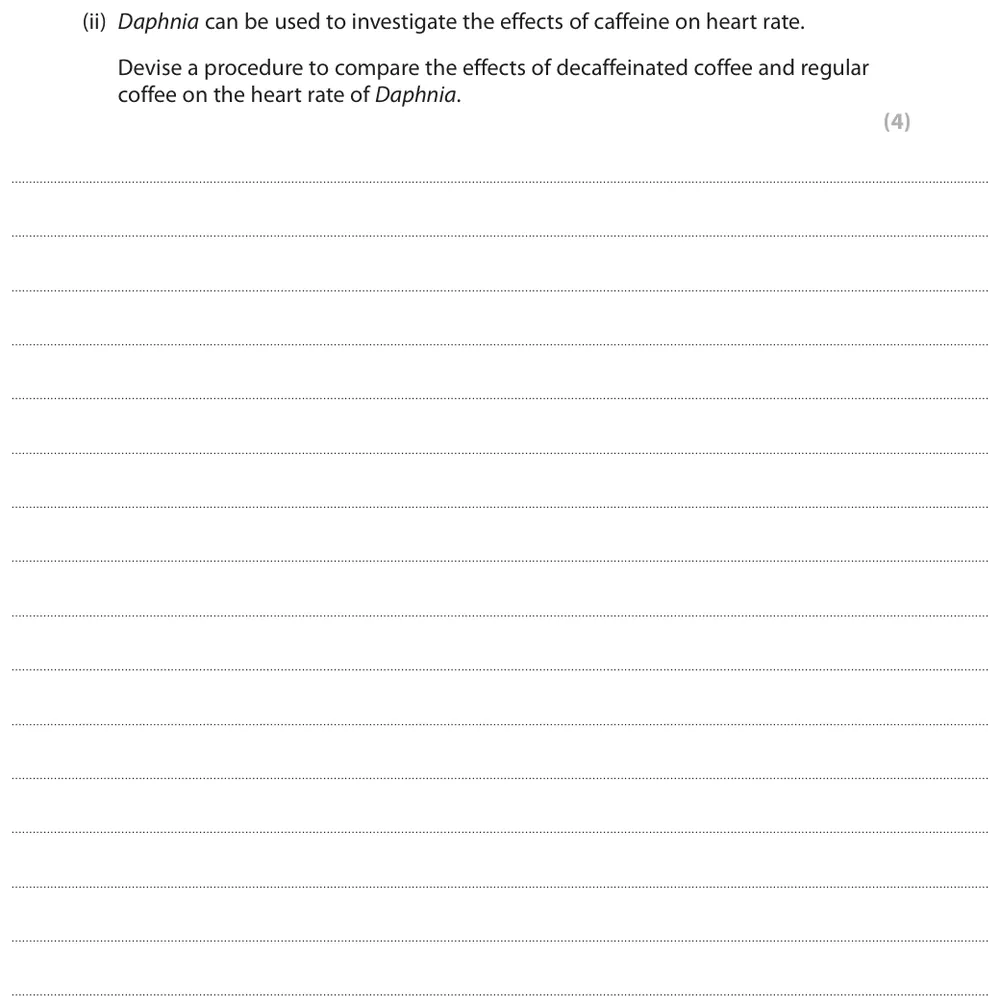
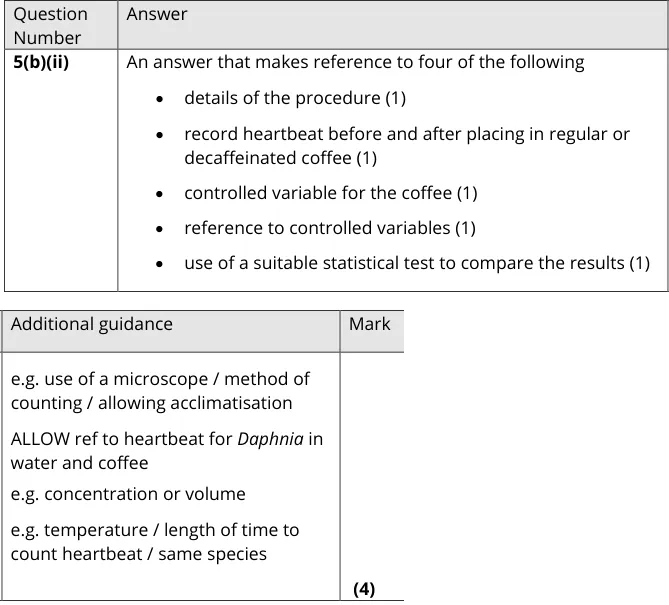
Devise a procedure to compare the effects of decaffeinated and regular coffee on Daphnia heart rate.
Show the mark scheme
Tap an image to open it full size.
From the examiners' report: Most gave good procedural details and controlled variables, but few recorded the heart rate before the coffee was added or used a statistical test to compare the results.
Question 13
A level Paper 2 · October 2020 · Q5(c) · 5 marks
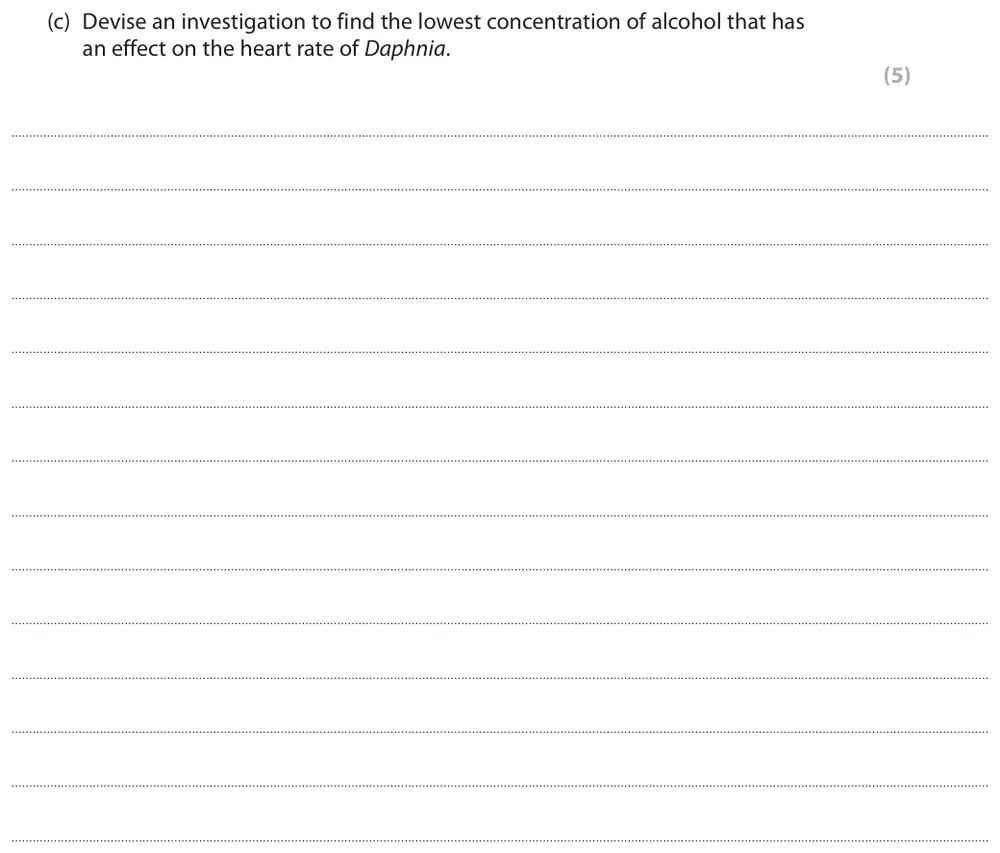
Devise an investigation to find the lowest concentration of alcohol that affects Daphnia heart rate.
Information from earlier in this question:
Show the mark scheme
Tap an image to open it full size.
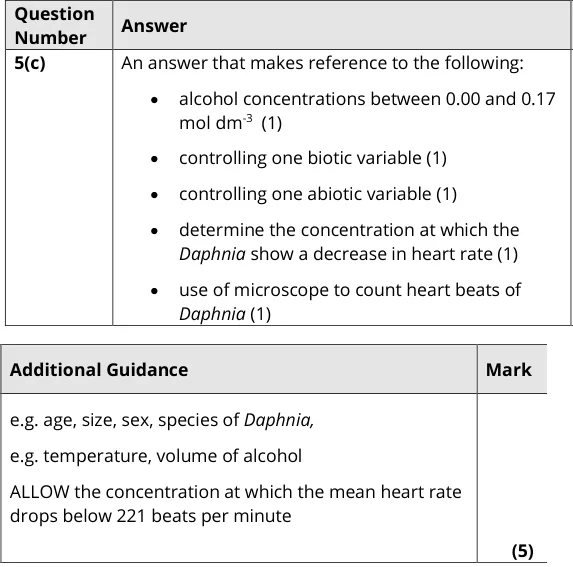
From the examiners' report: Many did not use the data table to choose the range of concentrations. To find the lowest concentration with an effect, test concentrations between 0.00 and 0.17 mol dm⁻³.
Question 14
A level Paper 2 · June 2025 · Q10(b)(ii) · 5 marks
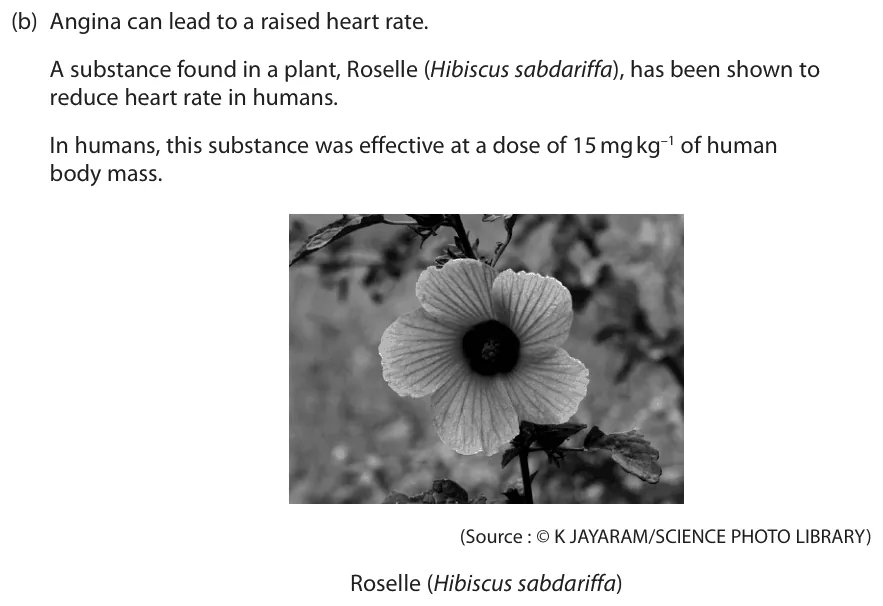
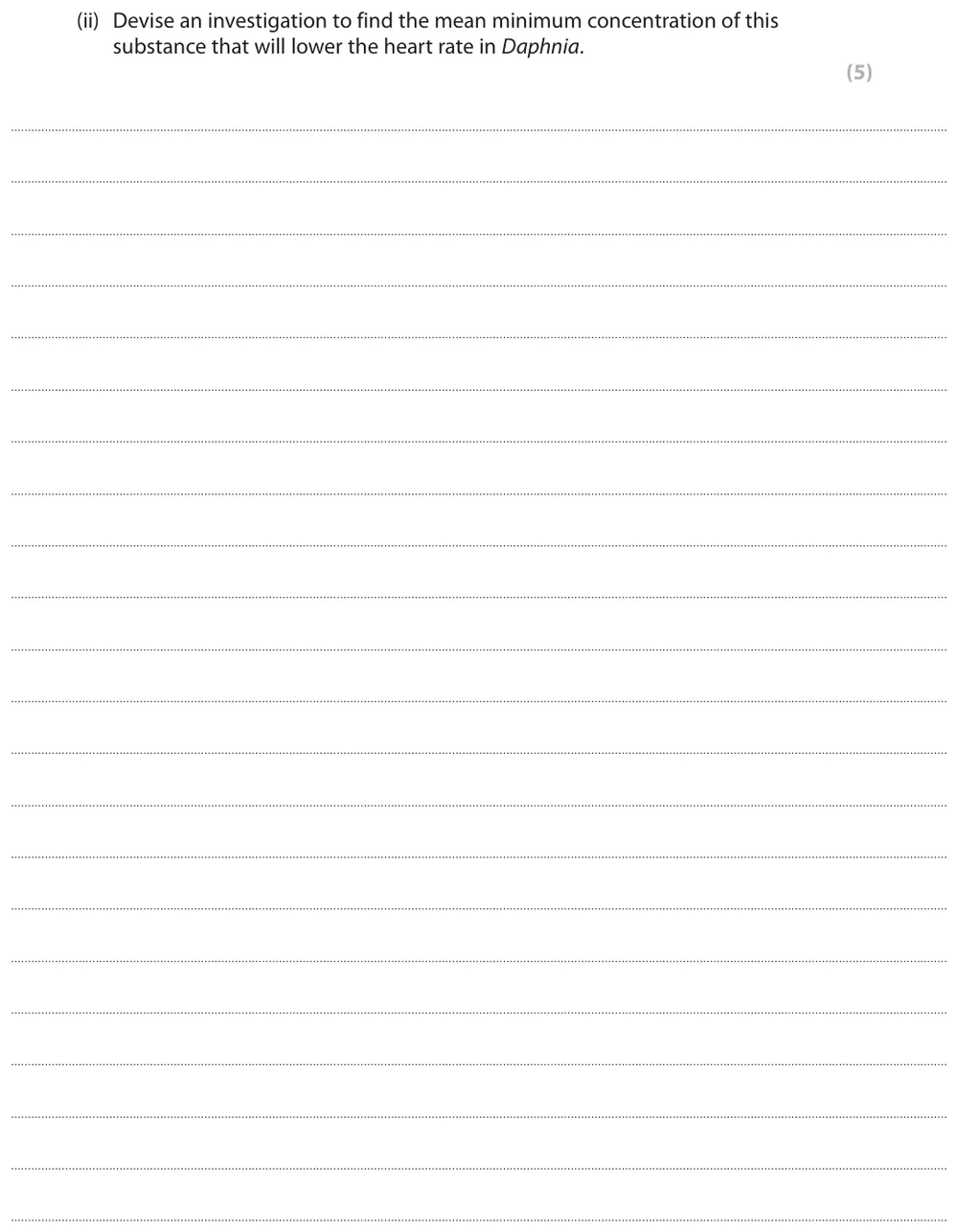
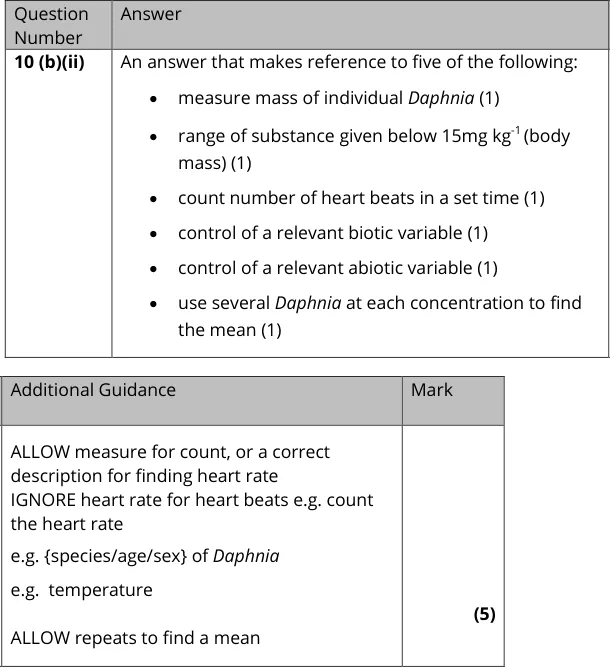
Devise an investigation to find the mean minimum concentration of a substance that lowers Daphnia heart rate.
Information from earlier in this question:
Show the mark scheme
Tap an image to open it full size.
From the examiners' report: Few noticed that the dose was given in mg per kg of body mass, so each Daphnia's mass is needed. 'Mean' in the question is a clue: use several Daphnia at each concentration and calculate a mean.
Processing and interpreting results (CP1)
Question 15
A level Paper 2 · October 2020 · Q5(b)(i) · 1 mark
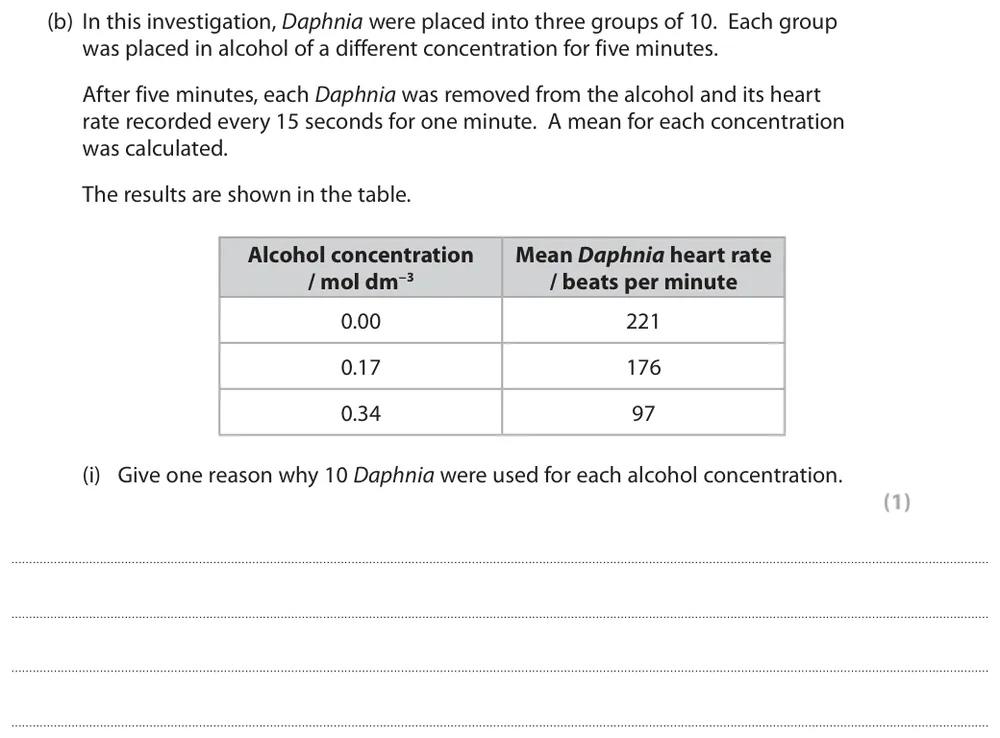
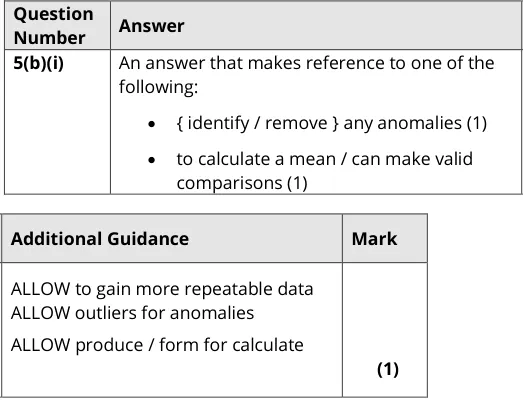
Give one reason why 10 Daphnia were used for each alcohol concentration.
Show the mark scheme
Tap an image to open it full size.
From the examiners' report: Many understood why several Daphnia were used. A good answer said any outliers could be identified and removed before a mean was calculated.
Question 16
AS Paper 1 · June 2017 · Q1(a)(ii) · 2 marks
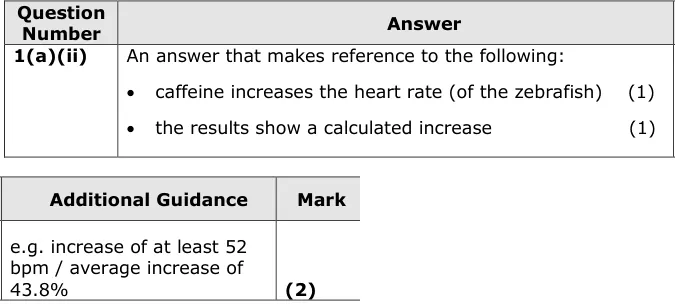
Analyse the zebrafish data to justify a conclusion.
Information from earlier in this question:
Show the mark scheme
Tap an image to open it full size.
From the examiners' report: Most concluded that caffeine increased the heart rate, but fewer understood 'justify' and did not support it with the data. Calculate the increase: 'about a 40% increase' was not specific enough.
Question 17
AS Paper 1 · June 2025 · Q7(b)(iv) · 3 marks
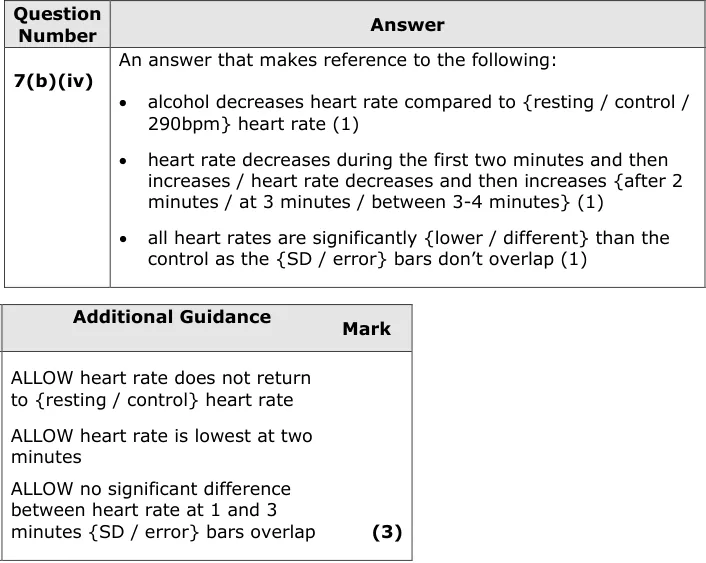
Comment on the effect of alcohol on the heart rate of Daphnia shown in the graph.
Information from earlier in this question:
Show the mark scheme
Tap an image to open it full size.
From the examiners' report: Explanations of why the heart rate rose again were not needed. Most saw that the heart rate did not return to the control rate; fewer described the significance of the non-overlapping SD bars.
Question 18
AS Paper 1 · November 2021 · Q8(b)(ii) · 4 marks
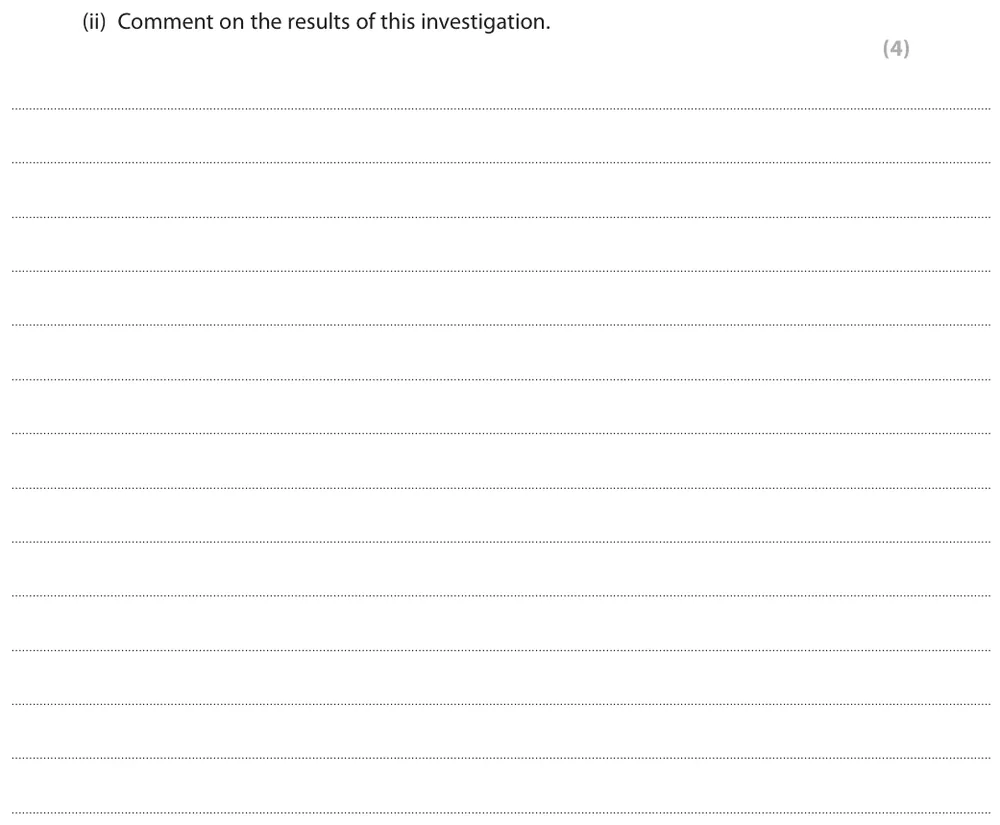
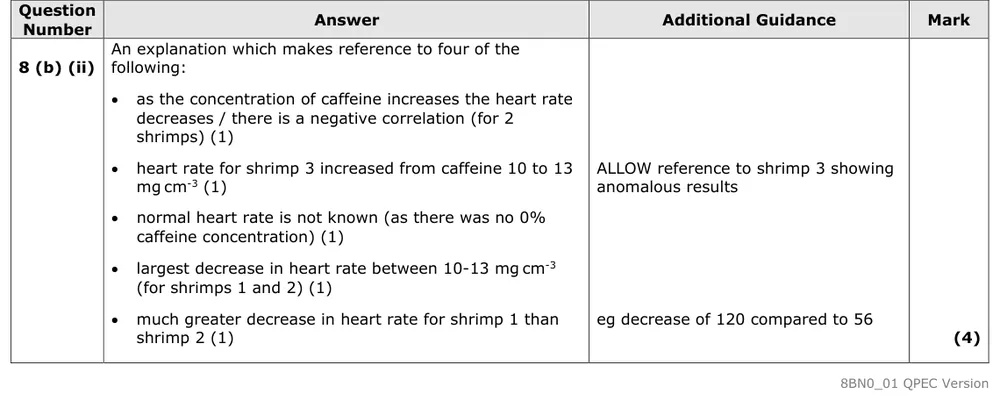
Comment on the results of the ghost shrimp caffeine investigation.
Information from earlier in this question:
Show the mark scheme
Tap an image to open it full size.
From the examiners' report: Most said heart rate fell as caffeine concentration rose and that shrimp 3 did not fit the trend. Few noticed there was no 0% caffeine concentration, so the normal heart rate was not known.
Question 19
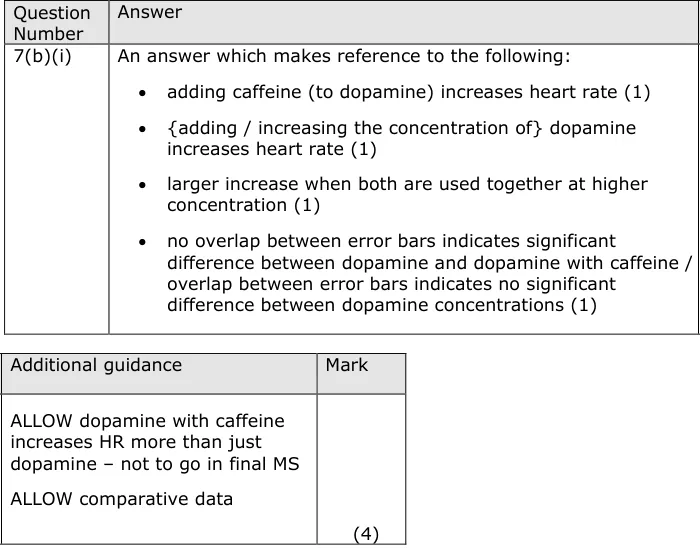
AS Paper 1 · October 2020 · Q7(b)(i) · 4 marks
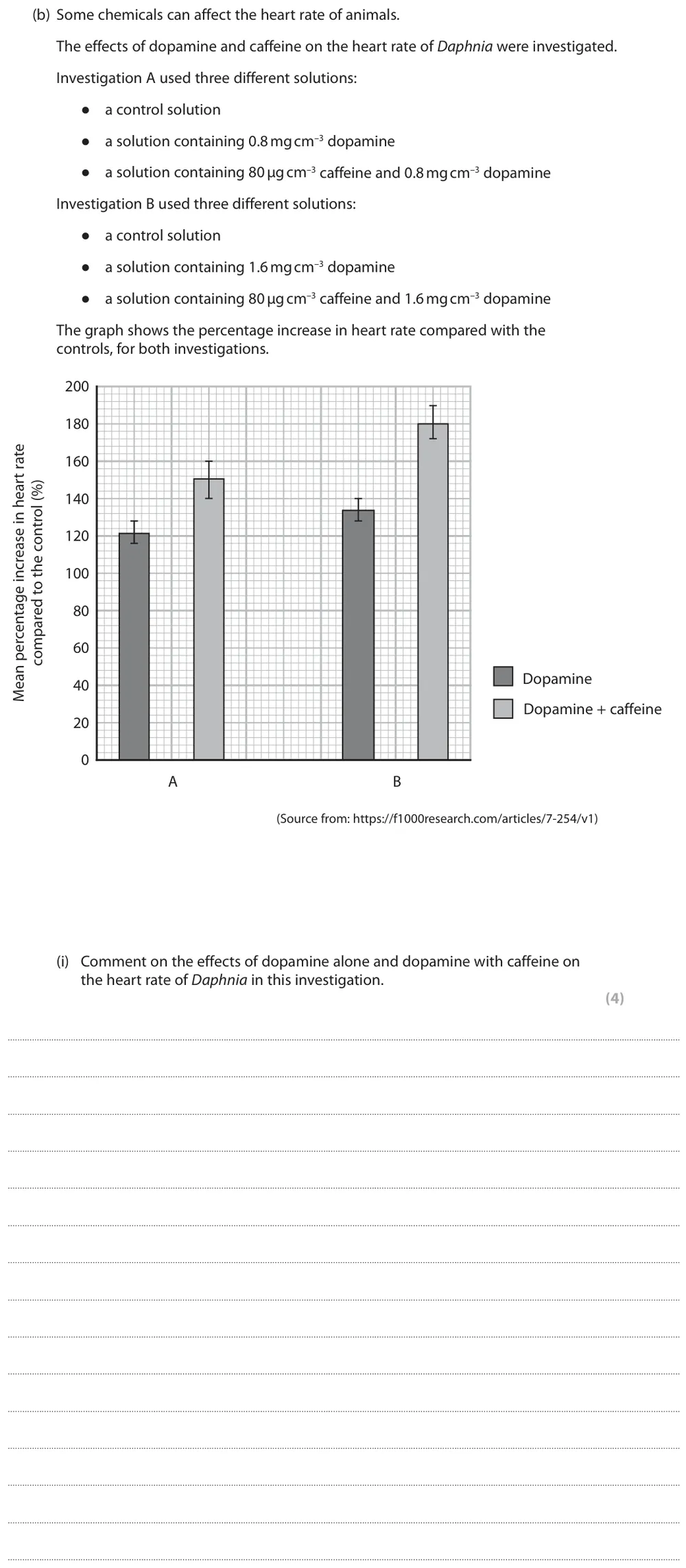
Comment on the effects of dopamine alone and dopamine with caffeine on Daphnia heart rate.
Show the mark scheme
Tap an image to open it full size.
Evaluating conclusions (CP1)
Question 20
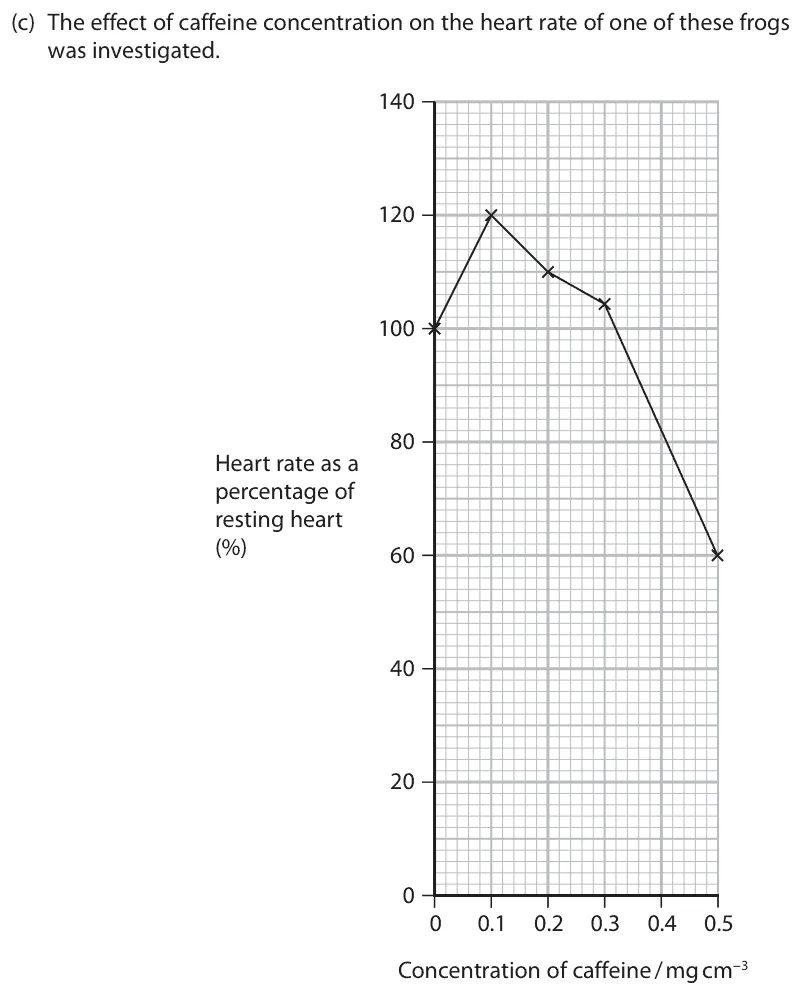
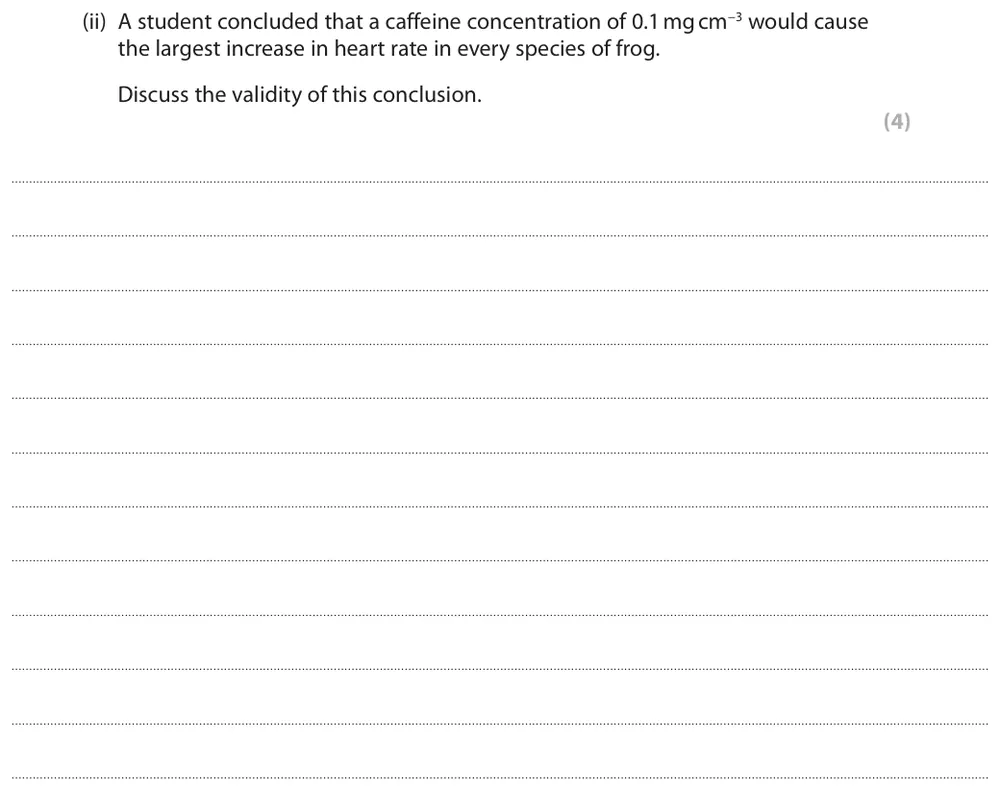
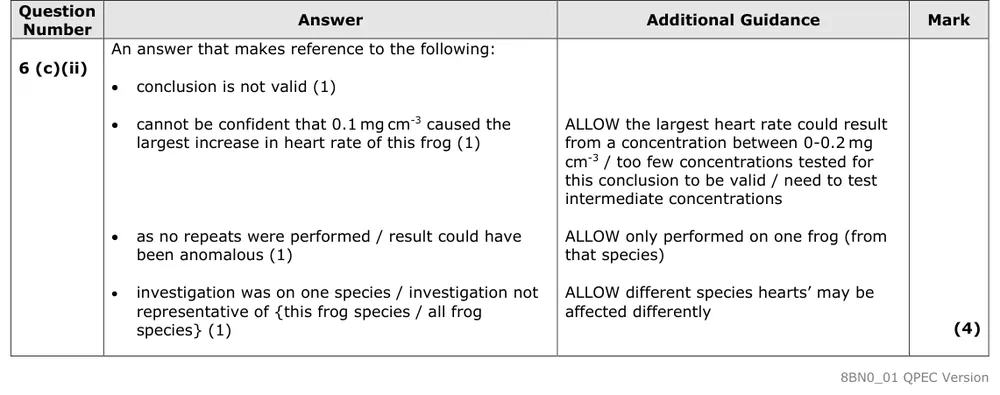
AS Paper 1 · June 2022 · Q6(c)(ii) · 4 marks
Discuss the validity of a conclusion that 0.1 mg cm⁻³ caffeine causes the largest increase in heart rate in every frog species.
Information from earlier in this question:
Show the mark scheme
Tap an image to open it full size.
From the examiners' report: Most saw that only one frog was tested, so the results do not represent this species or all frogs. Fewer discussed the concentrations tested. Some wrote about reliability and the conditions instead of validity.
Where students lose marks (from Pearson examiners' reports and mark schemes)
Each point below comes from the examiners' reports and mark schemes, and is followed by wording that gained marks.
Less likely to feel pain, not unable to. Some said Daphnia is an invertebrate and so would not feel any pain, which was not credited.
✔ Gains credit: 'Daphnia is an invertebrate, so it is less likely to feel pain.'
Use the picture, not the age. Many focused on the zebrafish being young and less likely to have heart conditions, and scored nothing.
✔ Gains credit: 'The zebrafish has a transparent body, therefore the heart is visible and the procedure is non-invasive.'
A control is a solution, not a variable. A significant number gave a controlled variable, such as volume of solution or age of the Daphnia, instead of a control.
✔ Gains credit: 'Distilled water' or 'the solution used to make the alcohol solution, without alcohol added.'
Write volume, not amount. The most common reason for losing the mark was writing 'amount' instead of volume.
✔ Gains credit: 'The volume of the caffeine solution' or 'the temperature of the solution.'
State it, then justify it. Most stated two controlled variables but did not justify them.
✔ Gains credit: 'Temperature of the solution, because a cold temperature would decrease the heart rate.'
Put a number on the increase. Fewer understood 'justify' and did not use the data; 'about a 40% increase' was not specific enough.
✔ Gains credit: 'Caffeine increases the heart rate; the results show an increase of at least 52 bpm.'
Let the table set your range. Many did not use the data table to choose a range of alcohol concentrations.
✔ Gains credit: 'Use alcohol concentrations between 0.00 and 0.17 mol dm⁻³ and find the concentration at which the mean heart rate drops below 221 beats per minute.'
Say what the SD bars show. Fewer candidates could describe the significance of the non-overlapping SD bars.
✔ Gains credit: 'All heart rates are significantly lower than the control as the SD bars don't overlap.'
Download the questions
Download the PDF pack (20 questions, mark schemes at the end)
Keep practising
- Heart and Circulation (Topic 1): Edexcel SNAB exam questions by topic
- Edexcel SNAB A level Biology revision resources by topic (every topic and core practical page)
- Edexcel SNAB Topic 1 Multiple-Choice Quiz: Lifestyle, Health and Risk
- Edexcel SNAB A level Biology past papers, mark schemes and examiners' reports
- Edexcel SNAB A level Biology grade boundaries
- Message Tom on WhatsApp about one-to-one Edexcel SNAB tutoring or an Edexcel group class
Questions, mark schemes and examiners' report extracts © Pearson Education Ltd.