

Plant Cells, Plant Fibres and Polysaccharides is the plant half of Topic 4, Biodiversity and Natural Resources, of the Edexcel A level Biology A (Salters-Nuffield) specification. You need to know the ultrastructure of plant cells and recognise it in electron micrographs, explain how the structures of starch and cellulose suit their functions, and link cellulose microfibrils and lignin to the strength of plant fibres. You also need to compare sclerenchyma, xylem and phloem, explain why plants need water, nitrate, calcium and magnesium ions, and say why plant fibres and starch can be more sustainable than oil-based plastics. This topic is examined on AS Paper 2 and on A level Papers 1, 2 and 3. Questions marked AS are from the AS papers (8BN0); the rest are from the A level papers (9BN0).
The examiners' reports keep asking for structure linked to function. Say which feature of starch makes it compact or quick to break down, and explain how microfibrils and hydrogen bonds give strength rather than just writing 'cellulose is strong'. Put the lignin in the walls of the xylem, and give positions in the stem relative to the vascular bundles. Write nitrate, not nitrogen ions, and follow magnesium through chlorophyll and photosynthesis to growth. For sustainability, write about a renewable resource that will not run out: biodegradable is a different idea.
Studying Edexcel SNAB and want more help? If you'd like to arrange one-to-one Edexcel tutoring, or to register your interest in an Edexcel group class, message Tom on WhatsApp using the link at the bottom of this page.
What you need from GCSE
Each question on this page assumes you're secure on these ideas. If any of them feels shaky, look it up before you start.
- Plant cells have a cellulose cell wall, chloroplasts and a large permanent vacuole, as well as the organelles found in animal cells.
- Plants store glucose as starch; cellulose is the main material of the cell wall.
- Xylem carries water and mineral ions from the roots; phloem carries dissolved sugars.
- Plants need nitrate ions to make proteins and magnesium ions to make chlorophyll.
Key terms
These words come up in the questions and mark schemes. Examiners expect you to use them exactly.
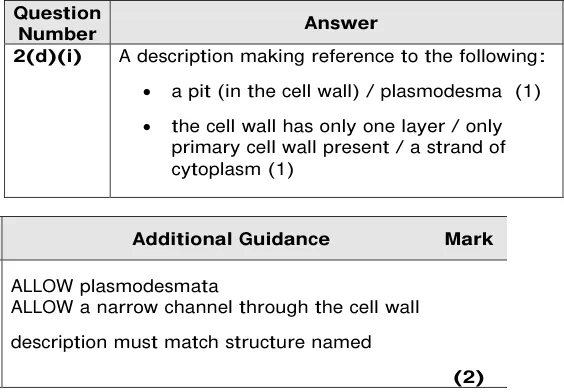
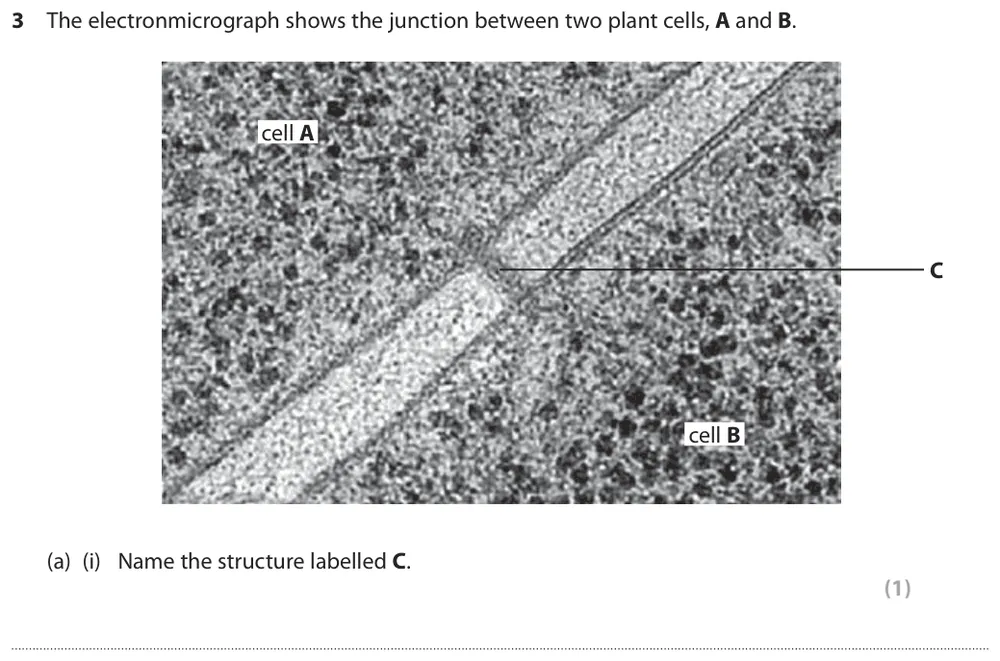
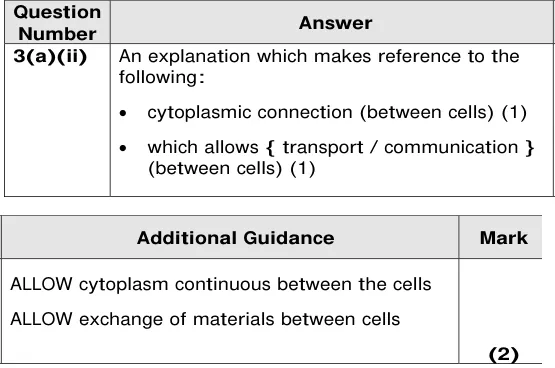
- Plasmodesmata: narrow channels through the cell walls of neighbouring plant cells, containing strands of cytoplasm that link the cells (singular: plasmodesma).
- Pit: a thin area of a cell wall where there is no secondary thickening, letting water and solutes pass between cells.
- Middle lamella: the layer of calcium pectate between the walls of neighbouring plant cells that holds the cells together.
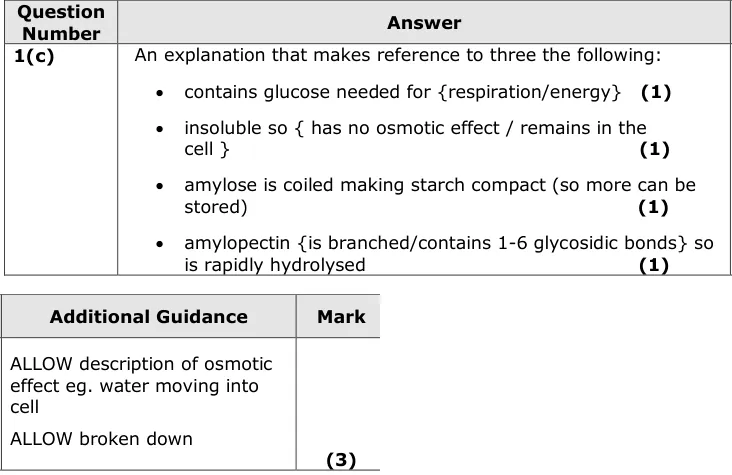
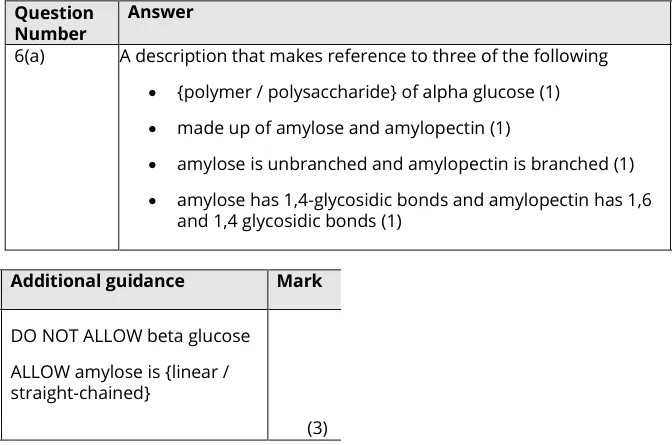
- Amylose and amylopectin: the two polymers in starch: amylose is an unbranched, coiled chain of α-glucose with 1,4 glycosidic bonds; amylopectin is branched, with 1,4 and 1,6 glycosidic bonds.
- Microfibril: a bundle of cellulose molecules held side by side by hydrogen bonds.
- Lignin: a polymer laid down in the walls of xylem vessels and sclerenchyma fibres; it adds strength and makes the walls waterproof.
- Sclerenchyma fibres: long dead cells with thick lignified walls that support the plant stem.
- Sustainable: able to be used without running out, because the resource is renewable and will be available to future generations.
What these questions cover (Edexcel SNAB Topic 4: Biodiversity and Natural Resources)
The questions test these statements from Topic 4 of the Pearson Edexcel A level Biology A (Salters-Nuffield) specification (9BN0).
- 4.7 Know the ultrastructure of plant cells (cell walls, chloroplasts, amyloplasts, vacuole, tonoplast, plasmodesmata, pits and middle lamella) and be able to compare it with
- 4.8 Be able to recognise the organelles in 4.7 from electron microscope (EM) images.
- 4.9 Understand the structure and function of the polysaccharides starch and cellulose, including the role of hydrogen bonds between β-glucose molecules in the formation of ce
- 4.10 Understand how the arrangement of cellulose microfibrils and secondary thickening in plant cell walls contributes to the physical properties of xylem vessels and sclerenc
- 4.11 Know the similarities and differences between the structures, position in the stem and function of sclerenchyma fibres (support), xylem vessels (support and transport of
- 4.12 Understand the importance of water and inorganic ions (nitrate, calcium ions and magnesium ions) to plants.
- 4.15 Understand how the uses of plant fibres and starch may contribute to sustainability, including plant-based products to replace oil-based plastics.
How to use this page
Write your answer on paper before you open the mark scheme. Allow about 1.2 minutes per mark: the 20 questions are worth 54 marks, so about 65 minutes in total. Then mark your answer strictly against the mark scheme and read the examiners' tip underneath it. If you'd rather print the questions, download the PDF pack.
Plant cell ultrastructure and electron micrographs (4.7, 4.8)
Question 1
AS Paper 2 · June 2016 · Q2(d)(i) · 2 marks · Hard
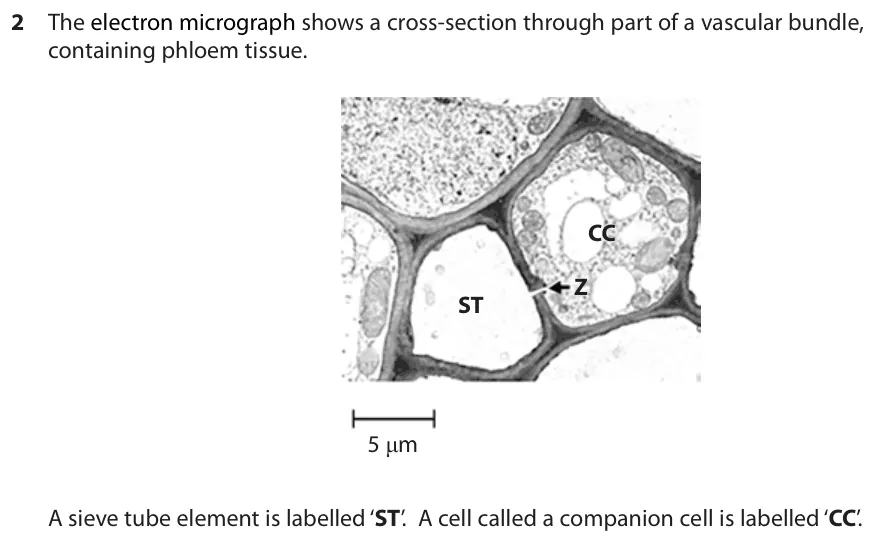
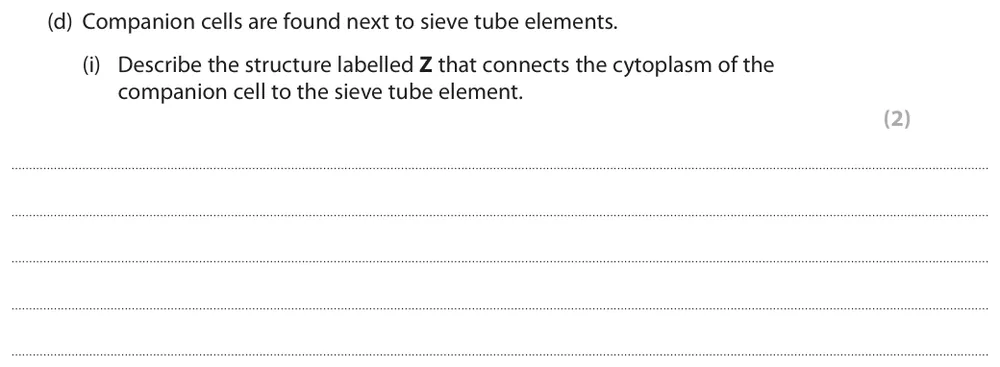
Describe the structure labelled Z that connects a companion cell to a sieve tube element.
Information from earlier in this question:
Show the mark scheme
Tap an image to open it full size.
From the examiners' report: Most identified Z as a pit or a plasmodesma, but many could not describe it further. The two were often mixed up: the description you give must match the structure you name. Plasmodesmata is plural; one is a plasmodesma.
Question 2
AS Paper 2 · June 2018 · Q3(a)(i) · 1 mark
Name the structure labelled C on an electron micrograph of the junction between two plant cells.
Show the mark scheme

Tap an image to open it full size.
Question 3
AS Paper 2 · June 2018 · Q3(a)(ii) · 2 marks
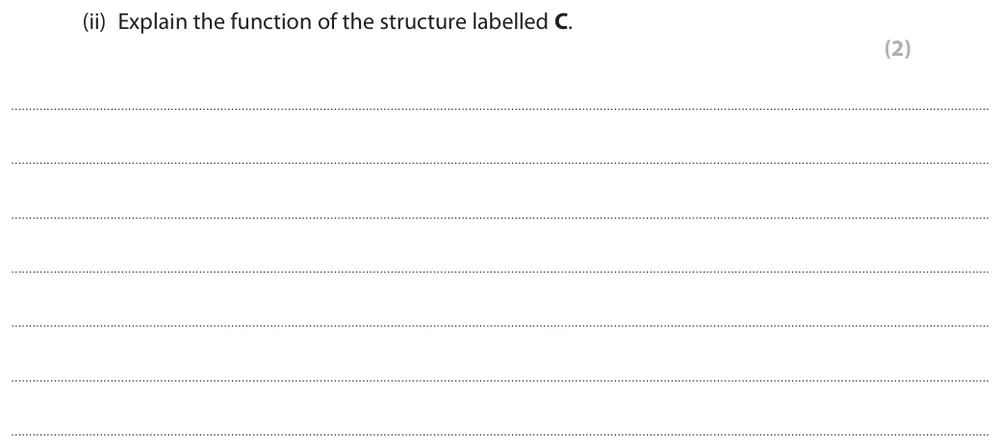
Explain the function of the structure labelled C.
Show the mark scheme
Tap an image to open it full size.
From the examiners' report: Students who had named the plasmodesma in (i) could describe molecules moving between cells. Few said that the cytoplasm is continuous between the two cells.
Starch and cellulose (4.9)
Question 4
AS Paper 2 · June 2017 · Q1(c) · 3 marks
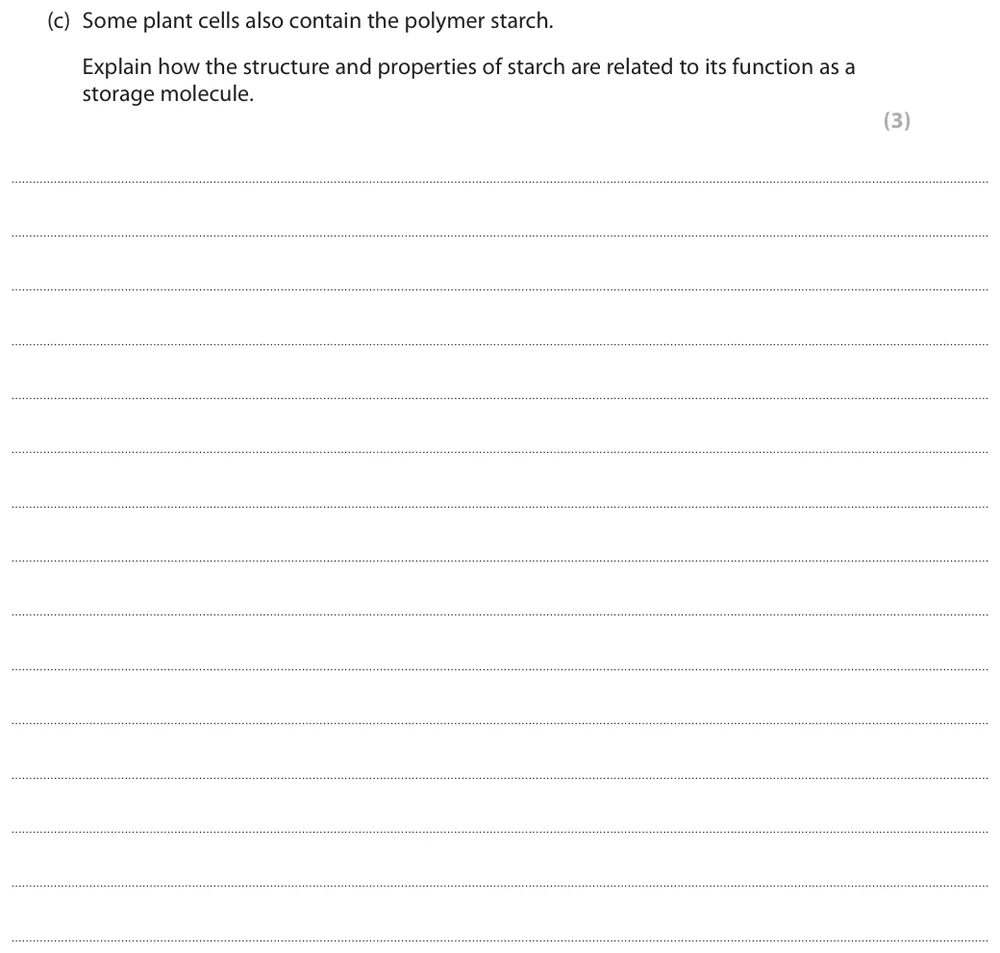
Explain how the structure and properties of starch are related to its function as a storage molecule.
Show the mark scheme
Tap an image to open it full size.
From the examiners' report: Many correct facts about starch were not linked to storage. Say which polymer does what: amylose is coiled, making starch compact; amylopectin is branched, so it is rapidly hydrolysed. Planning the answer like a table of feature and function helps.
Question 5
A level Paper 1 · June 2024 · Q6(a) · 3 marks · Easy
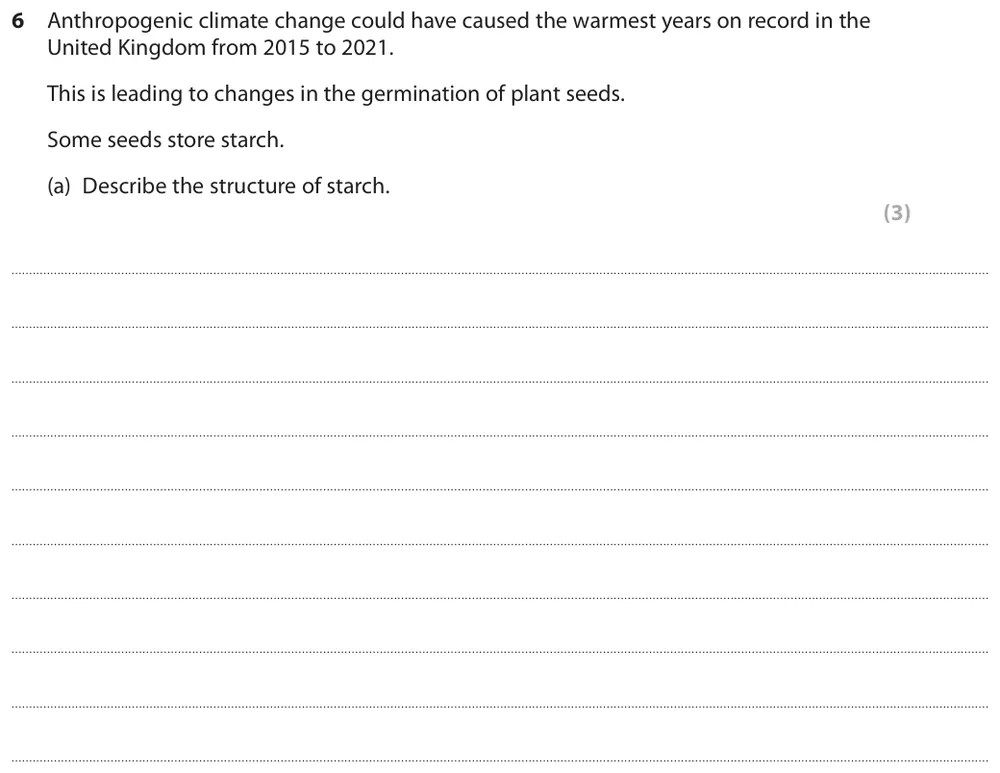
Describe the structure of starch.
Show the mark scheme
Tap an image to open it full size.
From the examiners' report: Well answered, but many wasted time on properties and functions that were not asked for. Do not confuse alpha and beta glucose, and starch is a polysaccharide, not a polypeptide.
Question 6
AS Paper 2 · June 2024 · Q6(a) · 4 marks · Easy
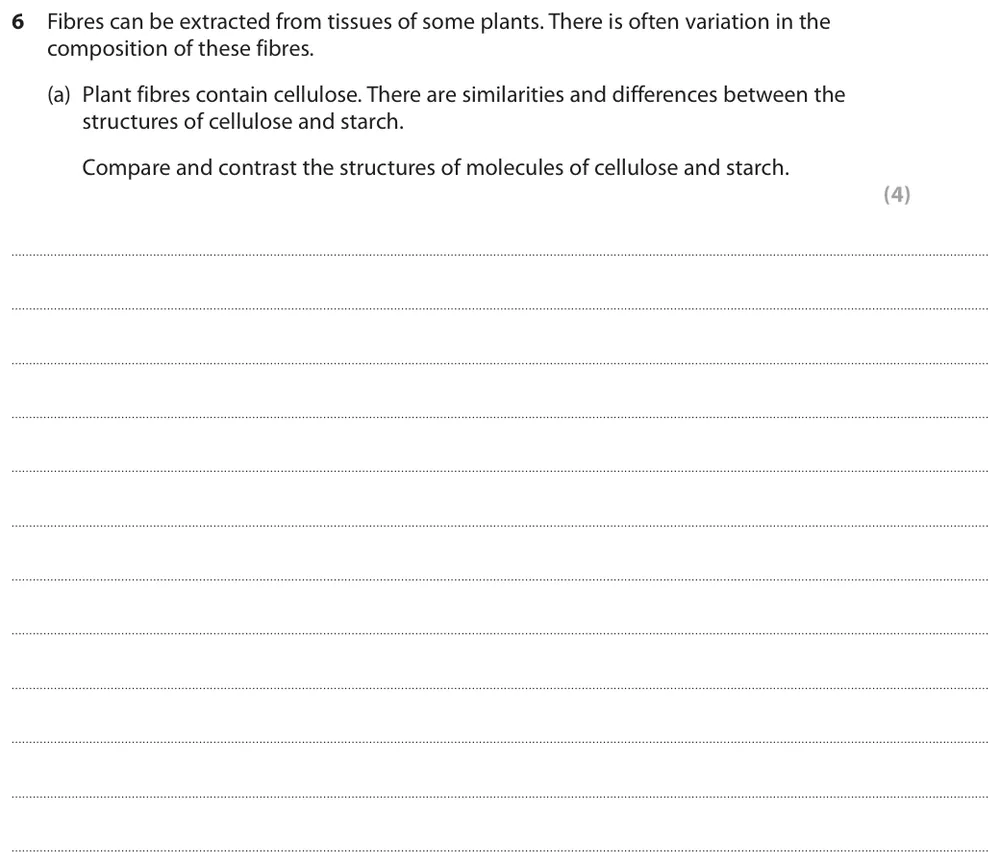
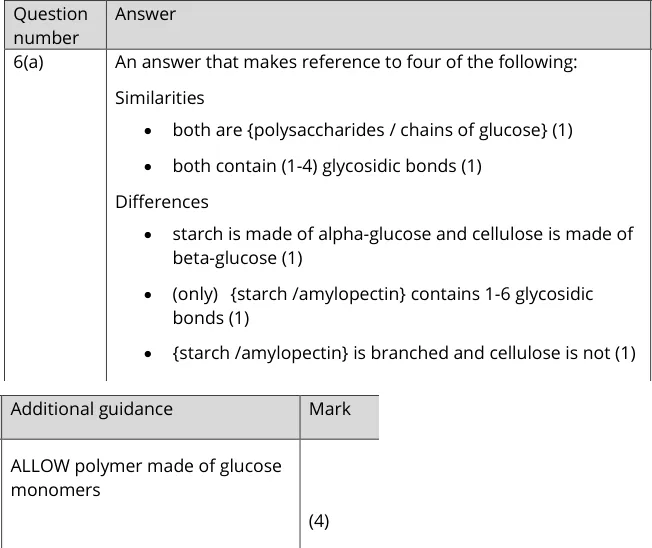
Compare and contrast the structures of molecules of cellulose and starch.
Show the mark scheme
Tap an image to open it full size.
From the examiners' report: Very well answered. Marks were lost by not writing comparative statements, by giving only similarities or only differences, or by vague points such as 'they both contain C, O and H'. The best answers gave 1,4 glycosidic bonds as a similarity and 1,6 bonds and branching as found only in starch.
Question 7
A level Paper 2 · June 2019 · Q6(b)(ii) · 1 mark
Name the bond between adjacent cellulose molecules in a microfibril.

Show the mark scheme

Tap an image to open it full size.
From the examiners' report: About two thirds gave hydrogen bonds. Glycosidic and ester bonds were the most common wrong answers: glycosidic bonds join the glucose monomers within one chain.
Cellulose microfibrils, lignin and fibre strength (4.10)
Question 8
AS Paper 2 · June 2019 · Q5(a) · 4 marks
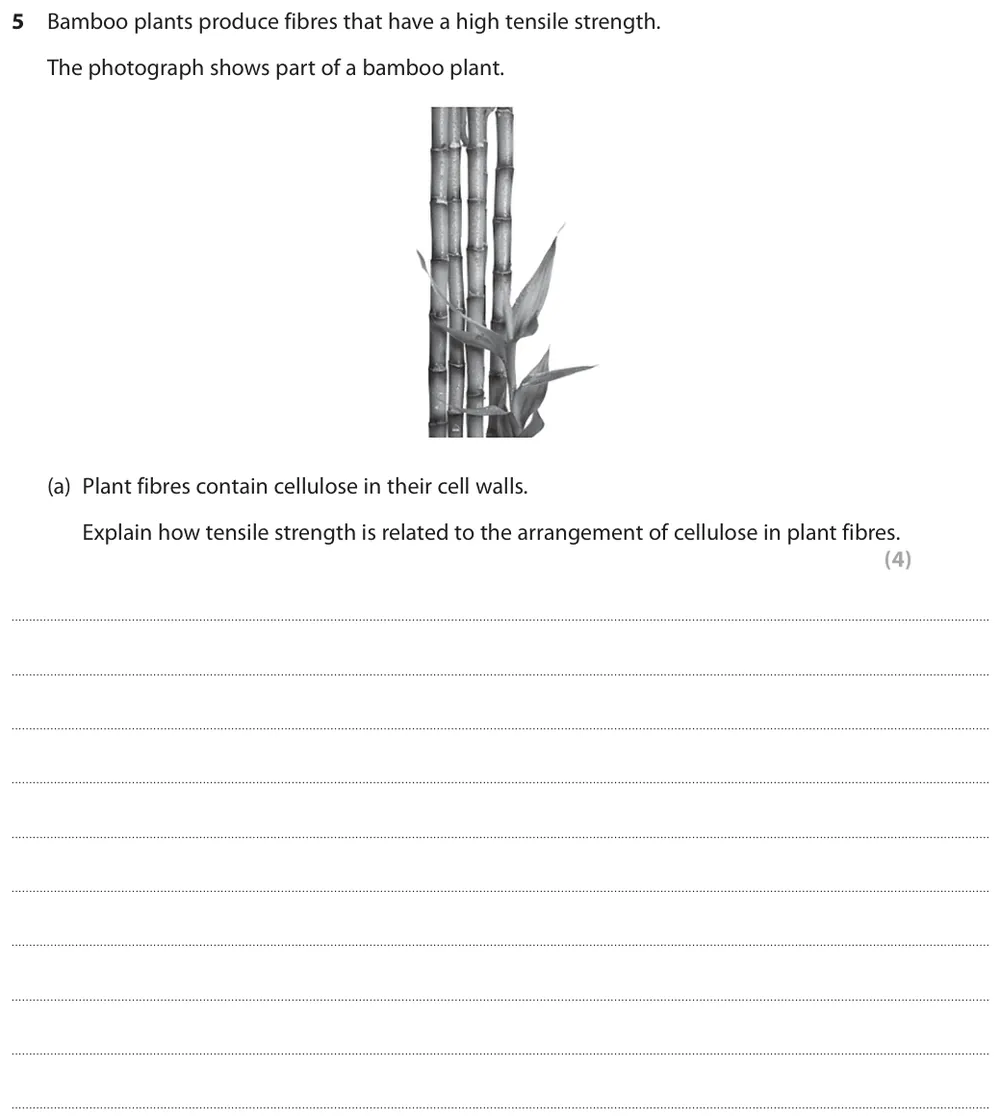
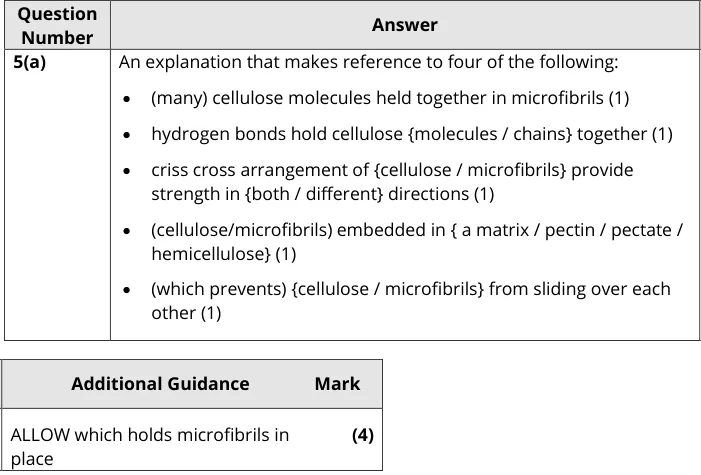
Explain how tensile strength is related to the arrangement of cellulose in plant fibres.
Show the mark scheme
Tap an image to open it full size.
From the examiners' report: Many wrote out everything they knew about cellulose, starting from glucose, but few linked it to tensile strength; 'makes cellulose very strong' earned nothing. Explain the microfibrils, the hydrogen bonds, the criss-cross arrangement and the matrix that stops microfibrils sliding.
Question 9
AS Paper 2 · June 2017 · Q1(b)(ii) · 1 mark · Hard
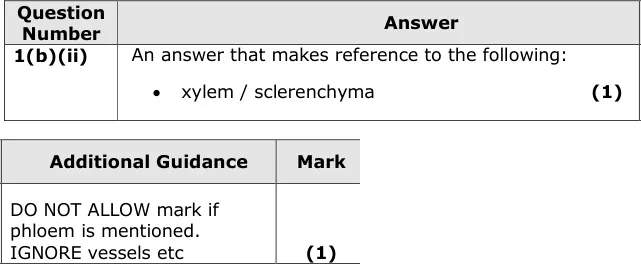
Name a plant tissue that has lignin in its cell walls.

Show the mark scheme
Tap an image to open it full size.
From the examiners' report: Xylem was the most common correct answer, then sclerenchyma. Phloem and cellulose were wrong. The question asks for 'a' tissue: give one answer, not a list.
Question 10
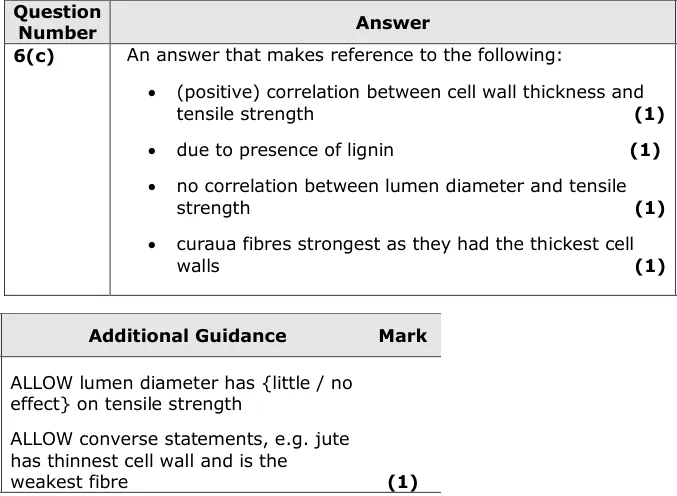
AS Paper 2 · June 2017 · Q6(c) · 4 marks
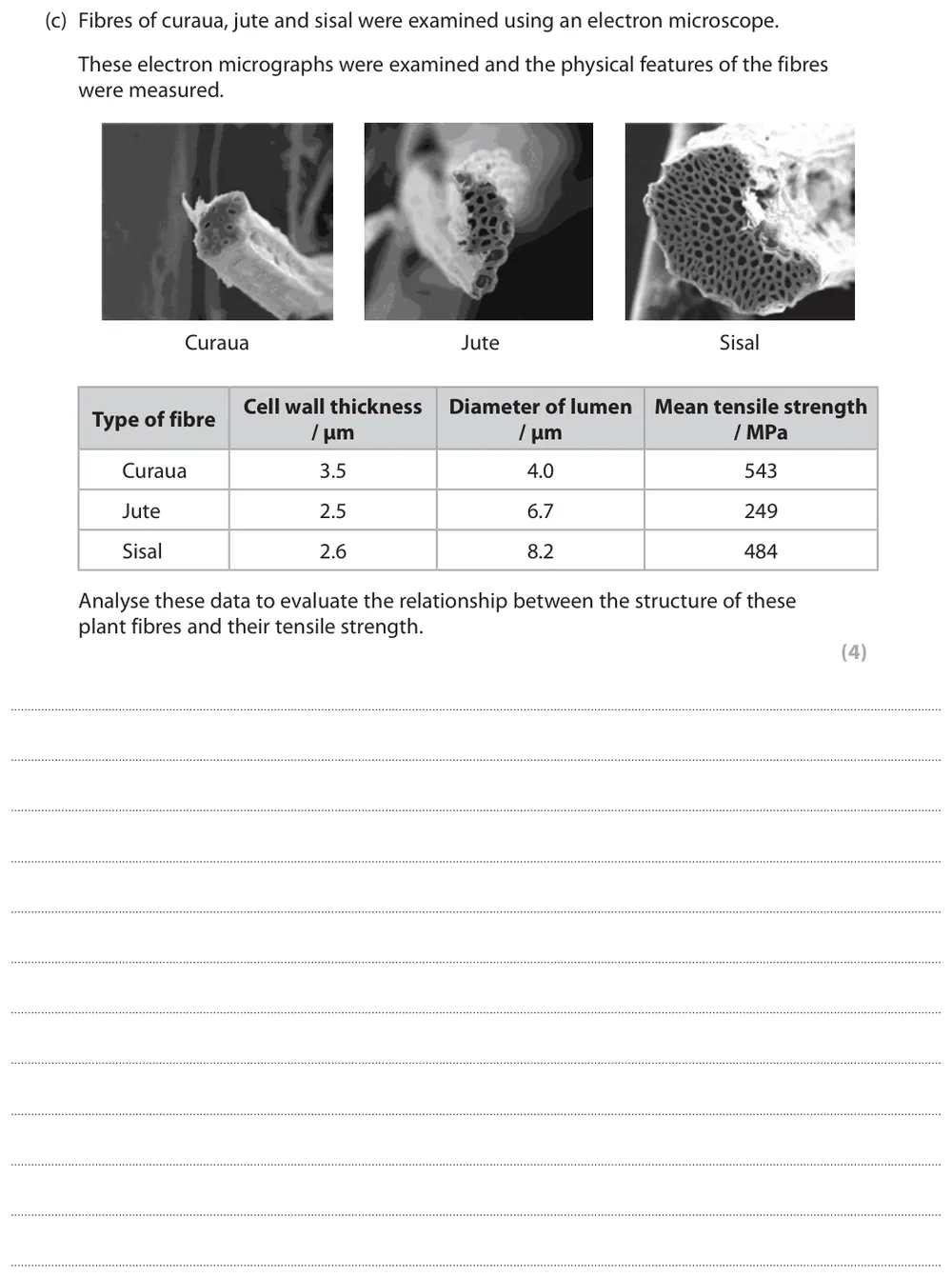
Analyse data on cell wall thickness and lumen diameter to evaluate their relationship with the tensile strength of three plant fibres.
Show the mark scheme
Tap an image to open it full size.
From the examiners' report: Most scored low marks. Many described a relationship with lumen diameter that the data did not show: there is no correlation. Consider each variable separately, and explain the link between wall thickness and strength using lignin rather than listing values.
Sclerenchyma, xylem and phloem (4.11)
Question 11
A level Paper 3 · June 2017 · Q1(d) · 2 marks
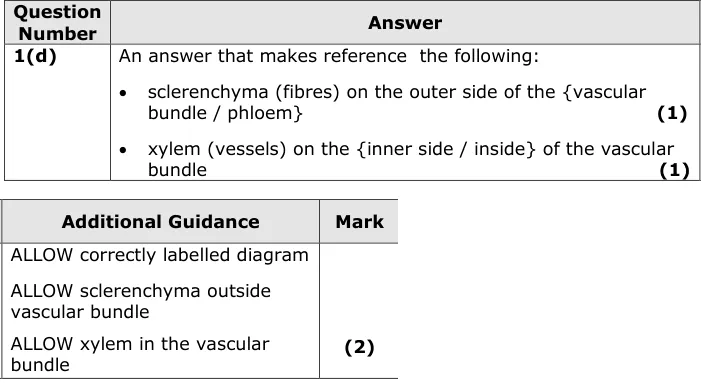
Describe the positions in the stem of the tissues that contain lignin.
Show the mark scheme
Tap an image to open it full size.
From the examiners' report: Many named the tissues and then described where lignin is inside them, which was not the question. 'In the stem' or 'in front of' gained nothing: place sclerenchyma on the outside and xylem on the inside of the vascular bundle. A clearly labelled diagram is credited.
Question 12
AS Paper 2 · June 2025 · Q3(b)(ii) · 4 marks
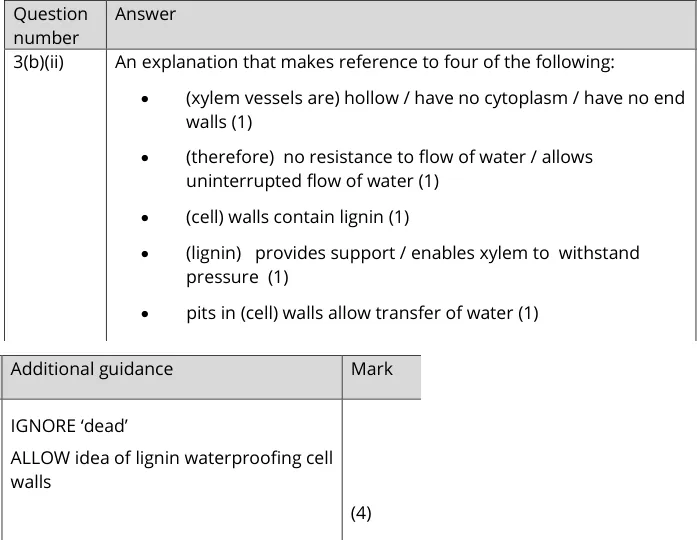
Explain how the features of xylem vessels are related to their functions.
Show the mark scheme
Tap an image to open it full size.
From the examiners' report: Many scored 3 or 4. Marks were lost for saying the xylem is lignified without saying the lignin is in the walls, and for describing dead cells: the feature that matters is that there is no cytoplasm, so there is no resistance to water flow.
Question 13
A level Paper 1 · June 2025 · Q5(c) · 4 marks
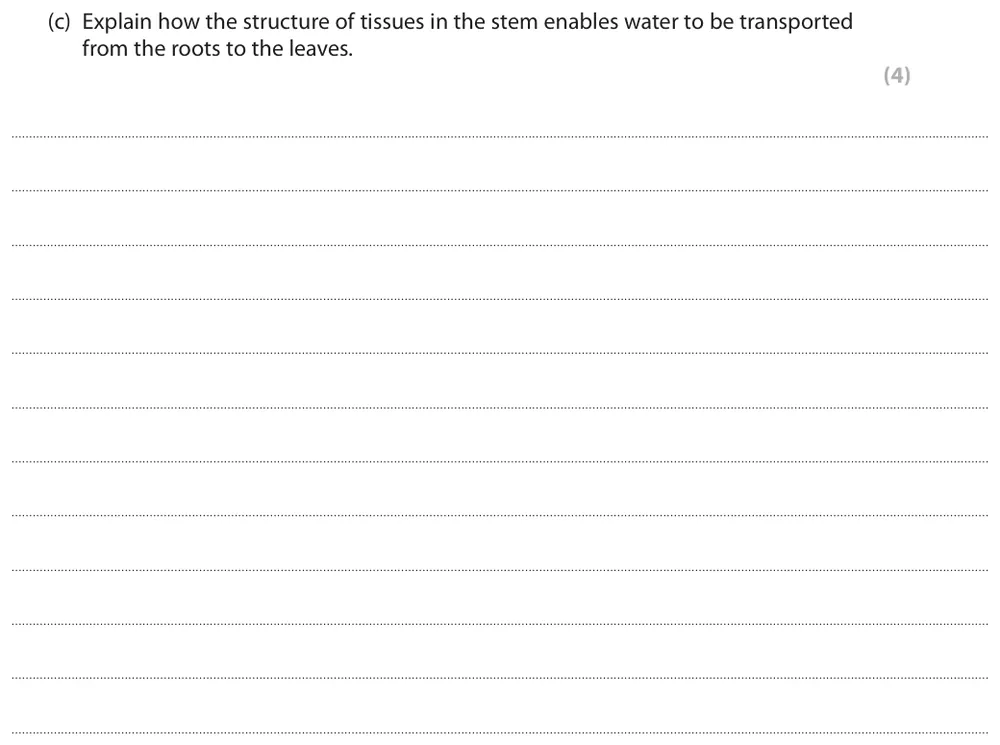
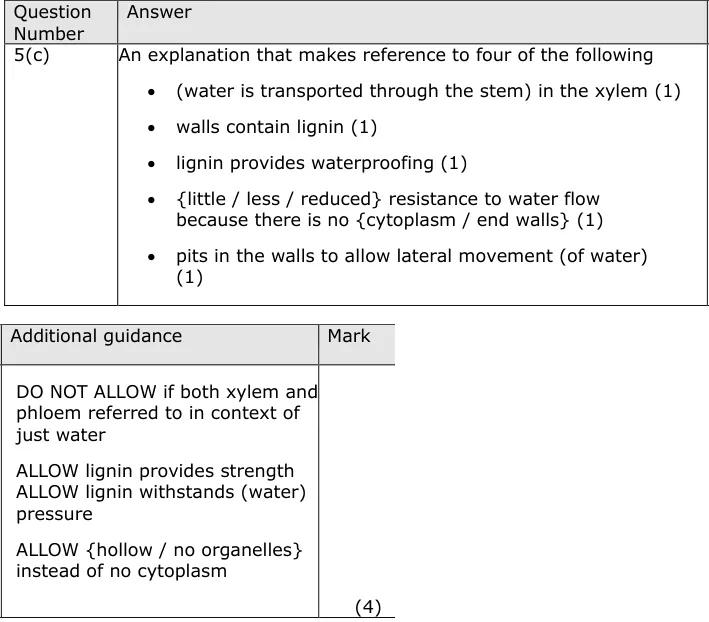
Explain how the structure of tissues in the stem enables water to be transported from the roots to the leaves.
Show the mark scheme
Tap an image to open it full size.
From the examiners' report: Many wrote about cohesion and adhesion instead of structure, and some mixed up xylem and phloem. Say the lignin is in the xylem walls. Sclerenchyma does not transport water, so it is not relevant here.
Question 14
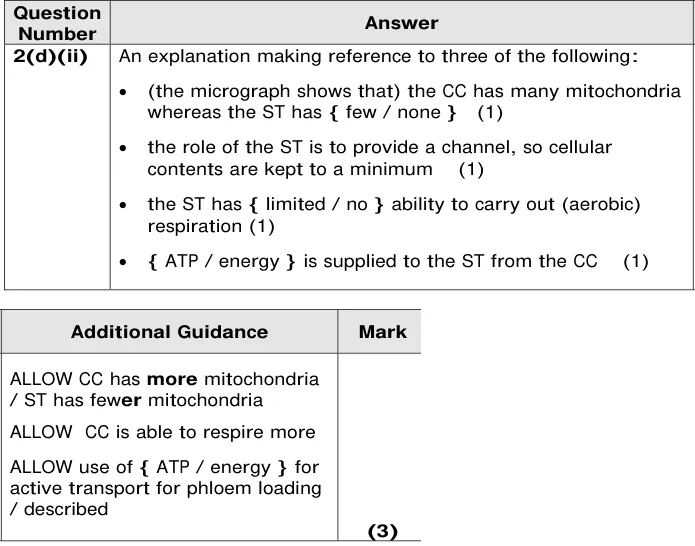
AS Paper 2 · June 2016 · Q2(d)(ii) · 3 marks
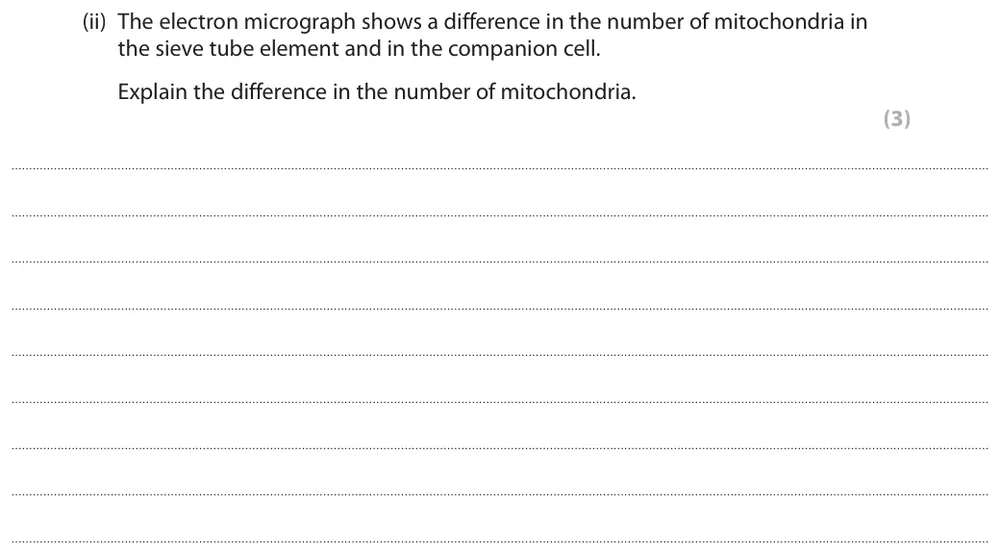
Explain the difference in the number of mitochondria in a sieve tube element and a companion cell.
Information from earlier in this question:
Show the mark scheme
Tap an image to open it full size.
From the examiners' report: Almost all spotted the difference, and many linked the companion cell to supplying ATP or loading solutes. Few completed the explanation with the role of the sieve tube: it is a channel, so its contents are kept to a minimum.
Water and inorganic ions (4.12)
Question 15
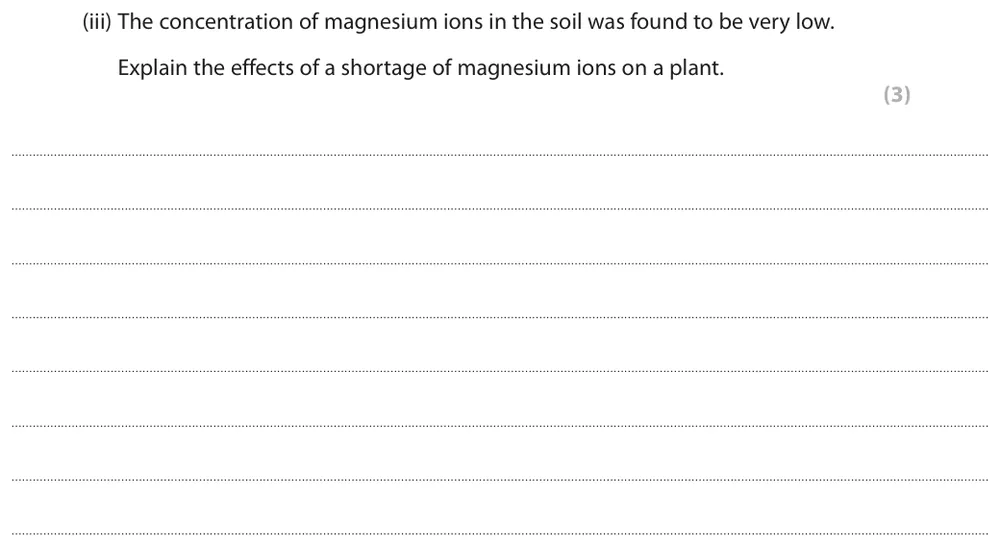
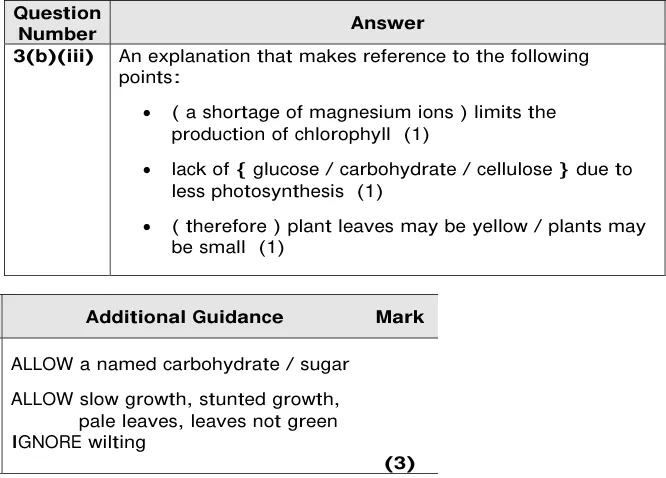
AS Paper 2 · June 2016 · Q3(b)(iii) · 3 marks · Easy
Explain the effects of a shortage of magnesium ions on a plant.
Show the mark scheme
Tap an image to open it full size.
From the examiners' report: Most gave the symptoms, and many linked them to less chlorophyll. Few completed the explanation: less photosynthesis means less glucose for growth. Wilting is caused by a lack of water, not a lack of magnesium.
Question 16
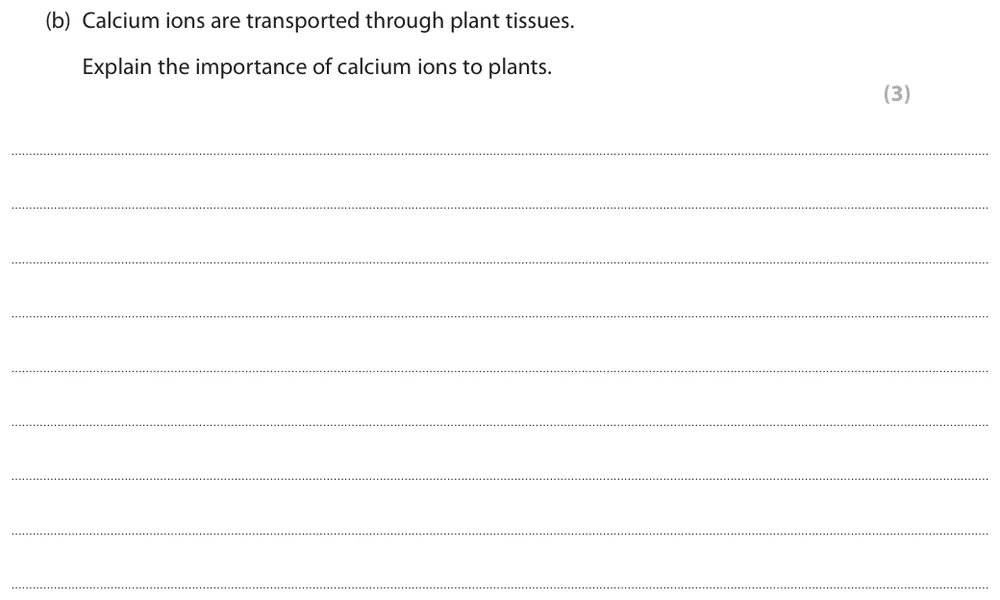
AS Paper 2 · June 2024 · Q1(b) · 3 marks · Easy
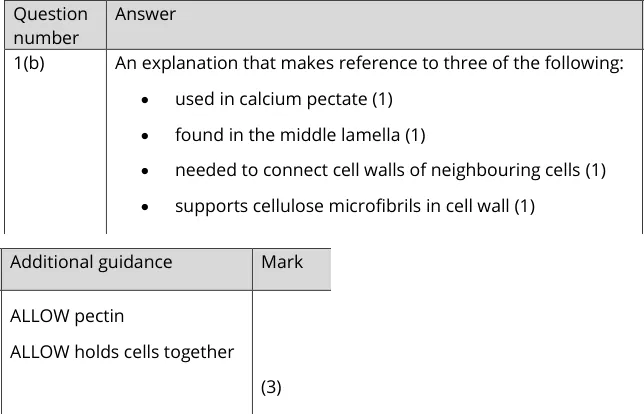
Explain the importance of calcium ions to plants.
Show the mark scheme
Tap an image to open it full size.
From the examiners' report: Mostly answered well by naming calcium pectate, placing it in the middle lamella and saying it joins neighbouring cells. Vague answers about stunted growth, or saying calcium is needed for photosynthesis, were not credited.
Question 17
A level Paper 1 · June 2024 · Q1(b) · 3 marks · Easy
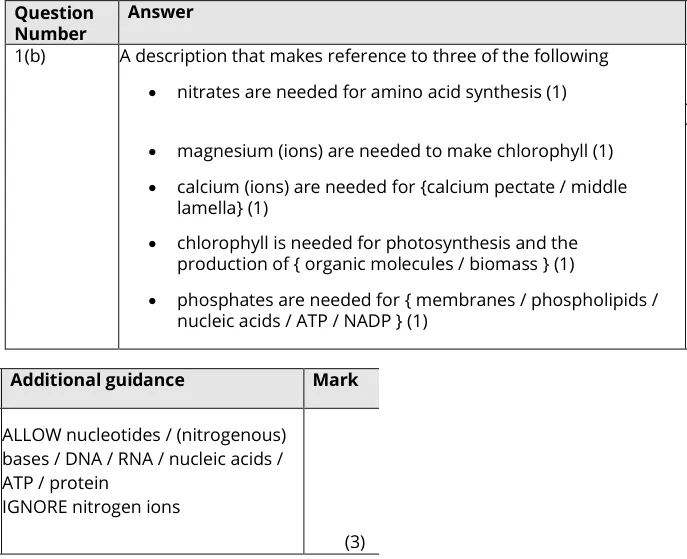
Describe the role of mineral ions in the production of plant biomass.
Show the mark scheme
Tap an image to open it full size.
From the examiners' report: Most could give several ions and their functions. Some lost a mark by writing 'nitrogen ions' instead of nitrates; nitrogen is not an ion. Name photosynthesis when linking chlorophyll to biomass.
Plant fibres, starch and sustainability (4.15)
Question 18
AS Paper 2 · June 2025 · Q3(c) · 2 marks · Easy
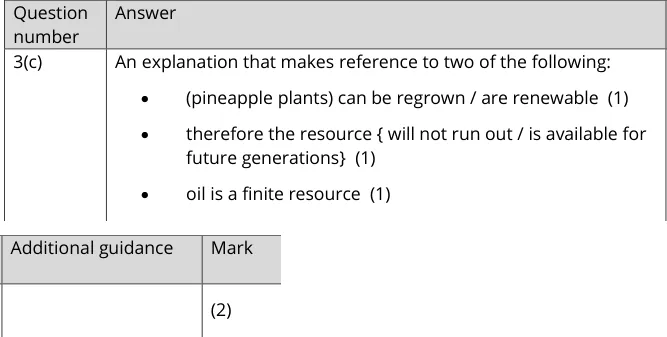
Explain why fibres from pineapple leaves are more sustainable than fibres made from oil-based plastics.
Show the mark scheme
Tap an image to open it full size.
From the examiners' report: Well answered by most. Writing about biodegradable leaves or landfill gained no credit, and neither did global warming. Say the plants can be regrown, so the resource will not run out, while oil is finite.
Question 19
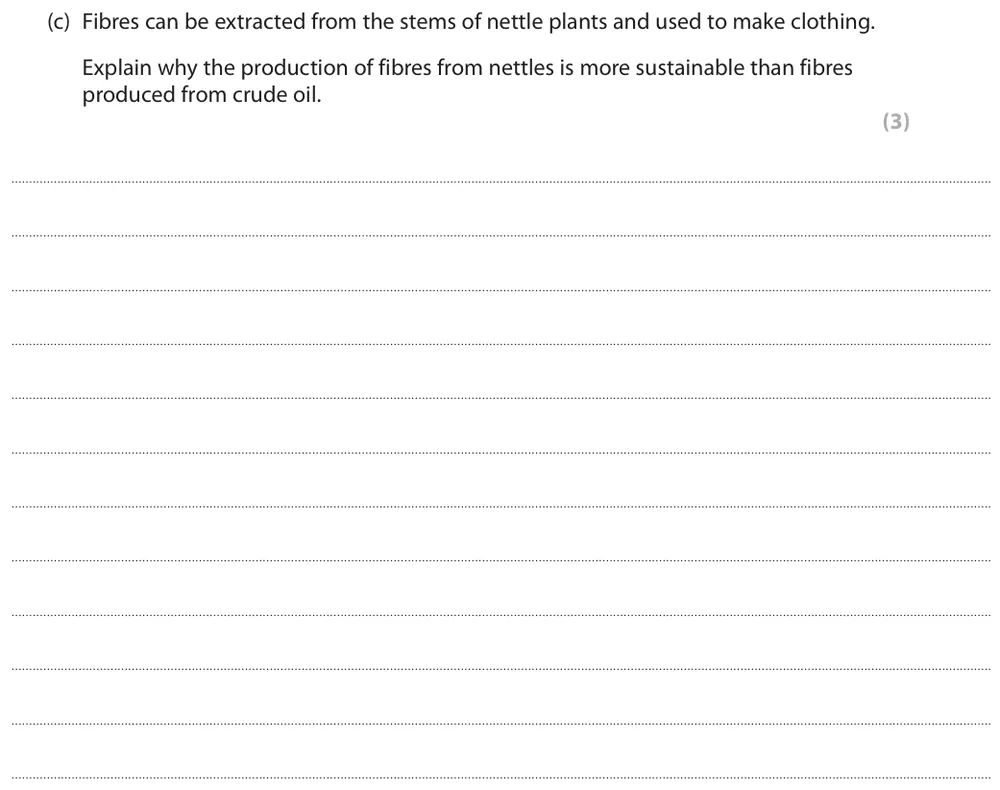
A level Paper 1 · November 2021 · Q7(c) · 3 marks
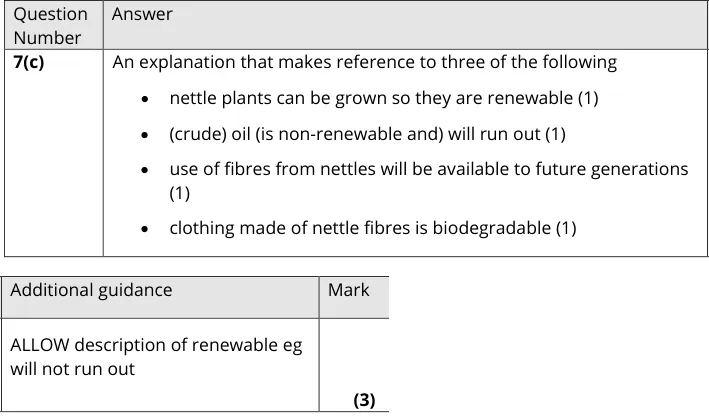
Explain why fibres from nettles are more sustainable than fibres produced from crude oil.
Show the mark scheme
Tap an image to open it full size.
From the examiners' report: Students often confused sustainability with climate change. This is an explain question: say why nettles are renewable and why oil is a finite resource.
Question 20
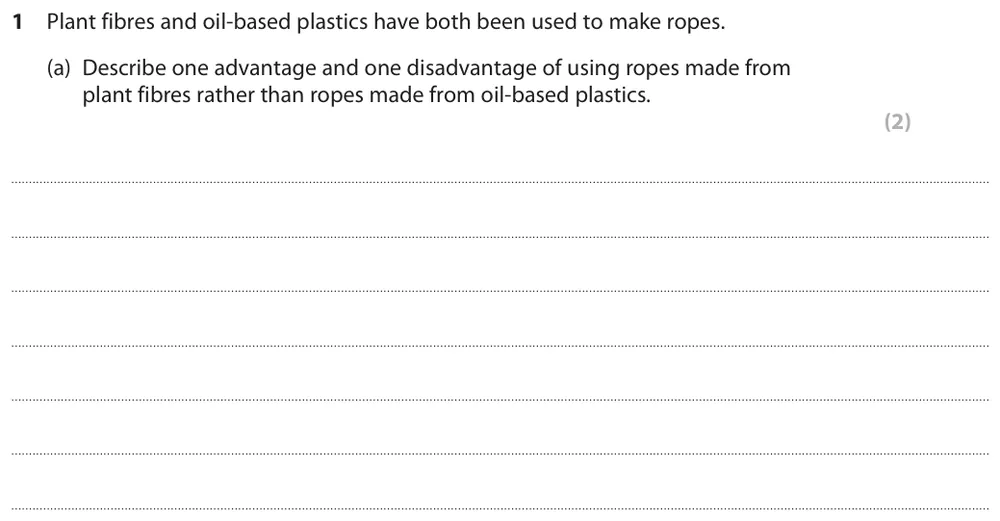
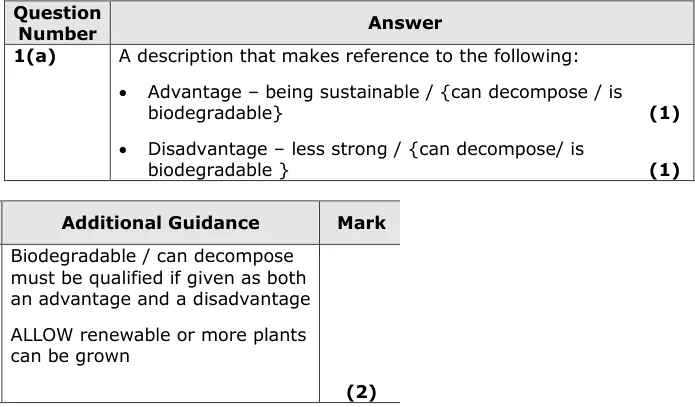
A level Paper 3 · June 2017 · Q1(a) · 2 marks
Describe one advantage and one disadvantage of ropes made from plant fibres rather than oil-based plastics.
Show the mark scheme
Tap an image to open it full size.
From the examiners' report: Sustainable or renewable was the most common advantage; the disadvantage was found harder. Ideas about food shortages, cost or biofuels were not credited. Give one of each: plant fibre ropes are less strong.
Where students lose marks (from Pearson examiners' reports and mark schemes)
Each point below comes from the examiners' reports and mark schemes, and is followed by wording that gained marks.
Match the description to plasmodesma or pit. Plasmodesmata were often described as pits, and pits as plasmodesmata, so the description did not match the structure named.
✔ Gains credit: 'Z is a plasmodesma: a narrow channel through the cell wall containing a strand of cytoplasm.'
Name amylose or amylopectin for each storage feature. Weaker answers listed starch's structure without saying which polymer made starch compact or quick to break down.
✔ Gains credit: 'Amylose is coiled, making starch compact; amylopectin is branched, so it is rapidly hydrolysed; starch is insoluble, so it has no osmotic effect.'
Hydrogen bonds hold cellulose chains side by side. Glycosidic and ester bonds were the most common wrong answers for the bond between adjacent cellulose molecules.
✔ Gains credit: 'Hydrogen bonds.'
'Very strong' is not an explanation of tensile strength. Most quoted 'makes cellulose very strong' without linking the arrangement of cellulose to tensile strength.
✔ Gains credit: 'Hydrogen bonds hold cellulose molecules together in microfibrils; the criss-cross arrangement of microfibrils gives strength in different directions.'
The lignin is in the xylem walls. Many said the xylem is lignified without saying the lignin is in the walls, or described dead cells instead of the lack of cytoplasm.
✔ Gains credit: 'Xylem vessels have no cytoplasm or end walls, so there is no resistance to the flow of water; the cell walls contain lignin, which withstands pressure.'
Magnesium shortage: follow it through to glucose. Few explained that the plant grows less because limited photosynthesis gives less glucose; some said the plant would wilt.
✔ Gains credit: 'A shortage of magnesium limits the production of chlorophyll, so there is less glucose from photosynthesis and growth is stunted.'
Nitrate ions, not nitrogen ions. Some lost a mark by referring to nitrogen ions rather than nitrates.
✔ Gains credit: 'Nitrates are needed for amino acid synthesis; magnesium ions are needed to make chlorophyll.'
Renewable, not biodegradable, makes a fibre sustainable. A significant proportion wrote about leaves being biodegradable or about global warming.
✔ Gains credit: 'Pineapple plants can be regrown, so the resource will not run out, whereas oil is a finite resource.'
Download the questions
Download the PDF pack (20 questions, mark schemes at the end)
Keep practising
- Plant Stems, Mineral Deficiencies and Fibre Strength (Core Practicals 6 to 8): Edexcel SNAB core practical questions
- Topic 4 multiple-choice quiz (63 questions, marked as you tap)
- Edexcel SNAB A level Biology resources hub (every topic, practical and paper)
- Antimicrobial Properties of Plants (Core Practical 9): Edexcel SNAB A Level Biology Exam Questions
- Extended Response Questions (Topics 3 and 4): Edexcel SNAB A Level Biology Exam Questions
- Edexcel SNAB A level Biology past papers, mark schemes and examiners' reports
- Edexcel SNAB A level Biology grade boundaries
- Message Tom on WhatsApp about one-to-one Edexcel SNAB tutoring or an Edexcel group class
Questions, mark schemes and examiners' report extracts © Pearson Education Ltd.