

In Core Practical 9 you investigate the antimicrobial properties of plants. You make extracts from plant material, put them on paper discs or in wells on an agar plate spread with a lawn of bacteria, incubate the plate, then measure the diameter of the clear zone of inhibition around each disc. Throughout, you use aseptic techniques to handle the bacteria safely and keep the plates free of contamination. The questions here cover those techniques, how to plan a valid test, and how to interpret zones of inhibition and growth data. They come from real Edexcel A level Biology A (Salters-Nuffield) papers. Core practicals can be examined on any paper, but A level Paper 3 tests practical skills most heavily. Questions marked AS are from the AS papers (8BN0); the rest are from the A level papers (9BN0).
The examiners warn that many safety precautions are not aseptic techniques, and that 'use sterile equipment' is not a technique at all. Working near a Bunsen burner is about the convection current, not killing airborne bacteria. Repeats do not make results valid; controlling variables does, so control the bacteria, the extract and the incubation, with a stated temperature and time. When you compare extracts, look at the ranges or standard deviations before naming a 'best' one, and when asked to improve an investigation, improve that one instead of describing a different method.
Studying Edexcel SNAB and want more help? If you'd like to arrange one-to-one Edexcel tutoring, or to register your interest in an Edexcel group class, message Tom on WhatsApp using the link at the bottom of this page.
What you need first
Each question on this page assumes you're secure on these ideas. If any of them feels shaky, look it up before you start.
- Bacteria grow on nutrient agar; a lawn of bacteria covers the whole surface of the plate.
- An antimicrobial substance diffuses out into the agar and kills bacteria or stops their growth, leaving a clear area.
- The area of a circle is πr², where r is half the diameter.
- Overlapping ranges or standard deviations suggest a difference between two means may not be significant.
Key terms
These words come up in the questions and mark schemes. Examiners expect you to use them exactly.
- Aseptic technique: a way of working that stops unwanted microorganisms contaminating a culture, such as flaming the loop and lifting the lid only slightly.
- Antimicrobial: able to kill microorganisms or stop them growing.
- Bacterial lawn: an even layer of bacteria spread over the whole surface of an agar plate.
- Zone of inhibition: the clear area around a disc or well where bacteria have not grown.
- Inoculate: to add microorganisms to a culture medium such as agar.
- Contamination: the growth of unwanted microorganisms in a culture.
- Incubation: keeping plates at a set temperature for a set time so the bacteria grow.
- Standard deviation: a measure of the spread of results around the mean.
What these questions cover
Every question on this page is set on Core Practical 9 of the Pearson Edexcel A level Biology A (Salters-Nuffield) specification (9BN0).
- Core Practical 9: Investigate the antimicrobial properties of plants, including aseptic techniques for the safe handling of bacteria.
How to use this page
Write your answer on paper before you open the mark scheme. Allow about 1.2 minutes per mark: the 14 questions are worth 40 marks, so about 48 minutes in total. Then mark your answer strictly against the mark scheme and read the examiners' tip underneath it. If you'd rather print the questions, download the PDF pack.
Aseptic technique and safety (CP9)
Question 1
AS Paper 2 · June 2016 · Q4(a) · 2 marks
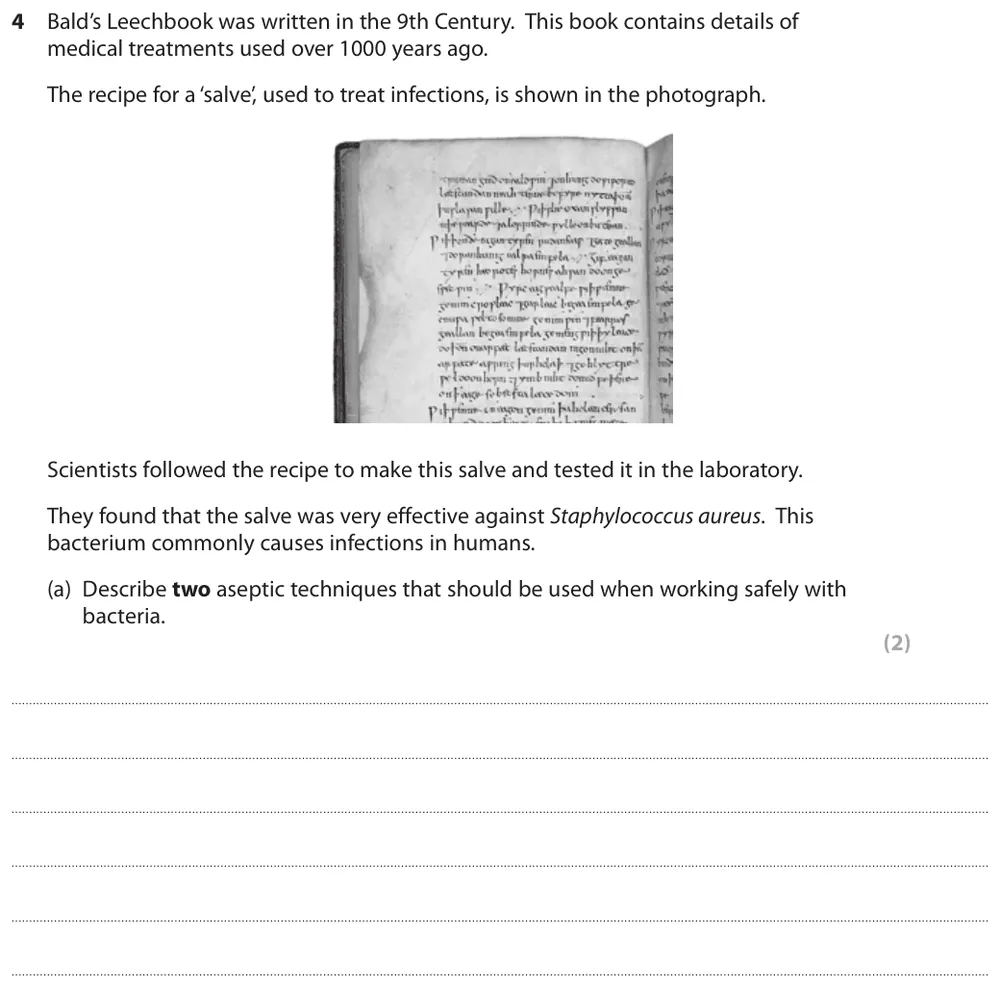
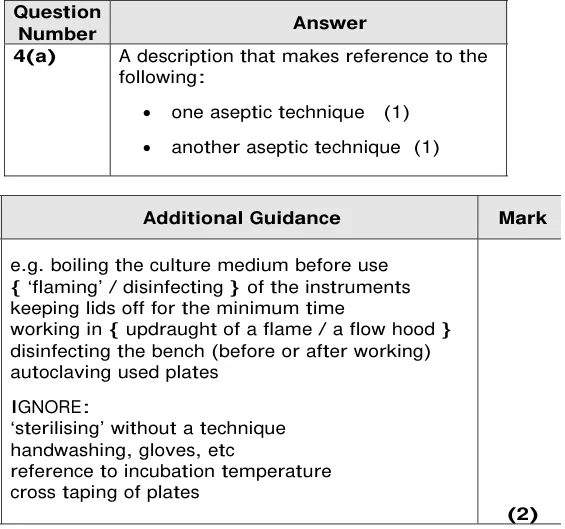
Describe two aseptic techniques used when working safely with bacteria.
Show the mark scheme
Tap an image to open it full size.
From the examiners' report: Many safety precautions gained no marks because they were not aseptic or not described in enough detail. 'Use of sterile equipment' is not a technique, and incubating at a low temperature is not aseptic.
Question 2
AS Paper 2 · June 2019 · Q7(a) · 3 marks
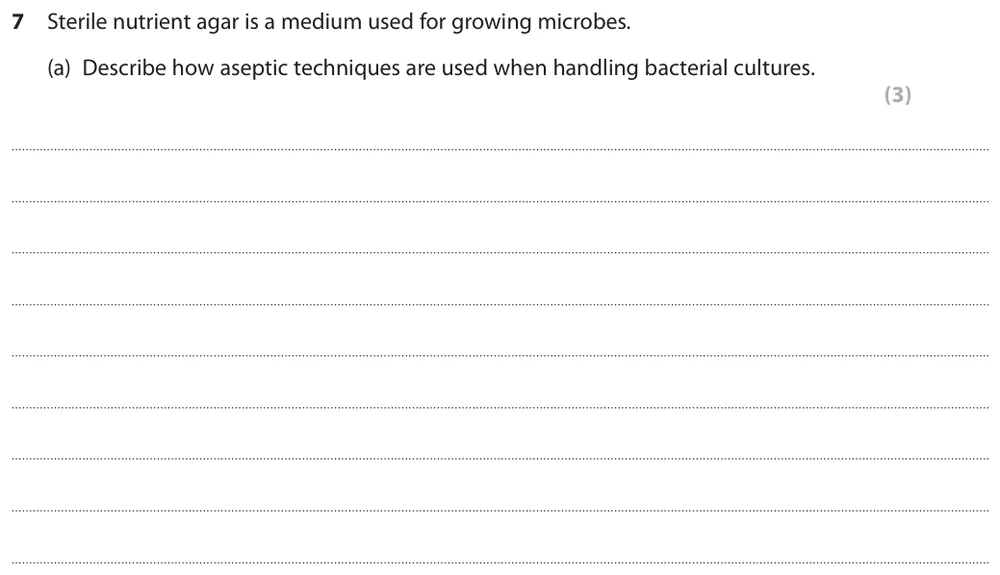
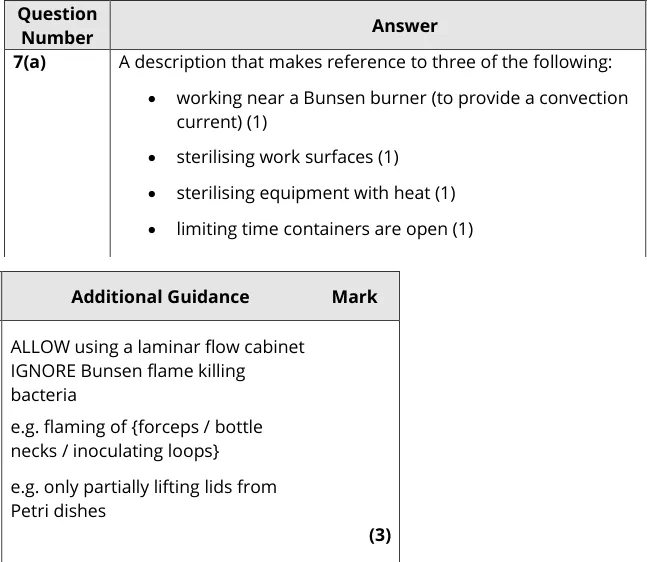
Describe how aseptic techniques are used when handling bacterial cultures.
Show the mark scheme
Tap an image to open it full size.
From the examiners' report: The main misconception was that the Bunsen burner kills airborne bacteria. Working near the flame is credited because it produces a convection current.
Question 3
AS Paper 2 · June 2019 · Q7(b)(i) · 2 marks
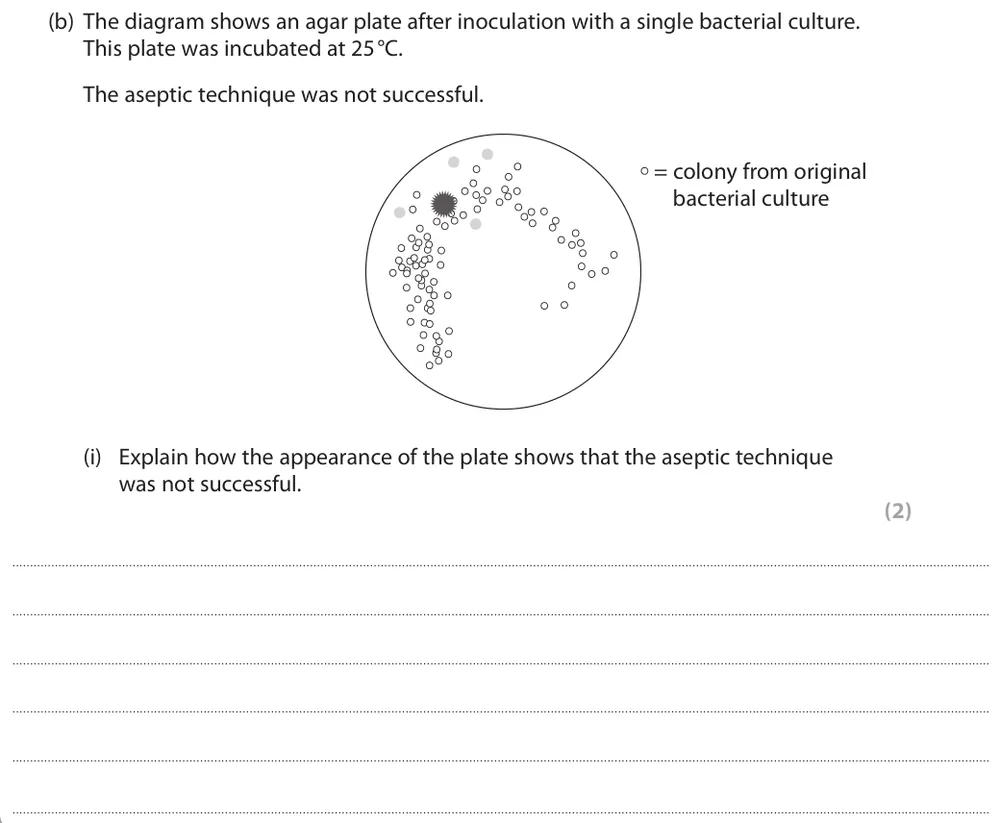
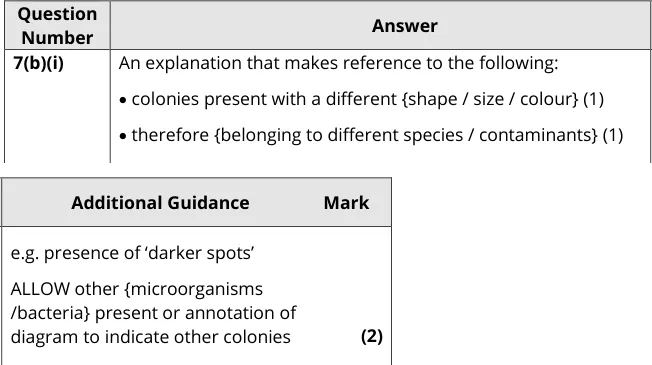
Explain how the appearance of an agar plate shows the aseptic technique failed.
Show the mark scheme
Tap an image to open it full size.
From the examiners' report: Most said other bacteria were present but few described the plate. Point to colonies with a different shape, size or colour, not an uneven spread of bacteria.
Question 4
AS Paper 2 · June 2019 · Q7(b)(ii) · 2 marks
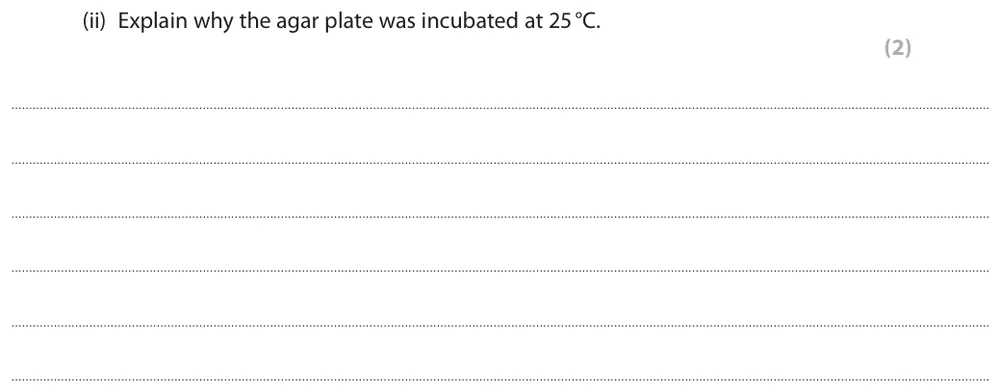
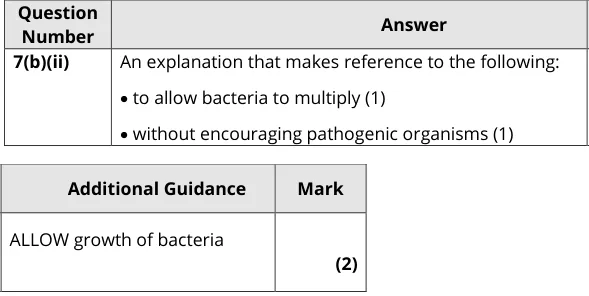
Explain why the agar plate was incubated at 25 °C.
Show the mark scheme
Tap an image to open it full size.
From the examiners' report: 25 °C is not the optimum temperature for bacterial growth, and bacteria do not 'become pathogenic' at higher temperatures. It lets the bacteria multiply without encouraging pathogenic organisms.
Question 5
A level Paper 3 · June 2024 · Q2(b) · 3 marks
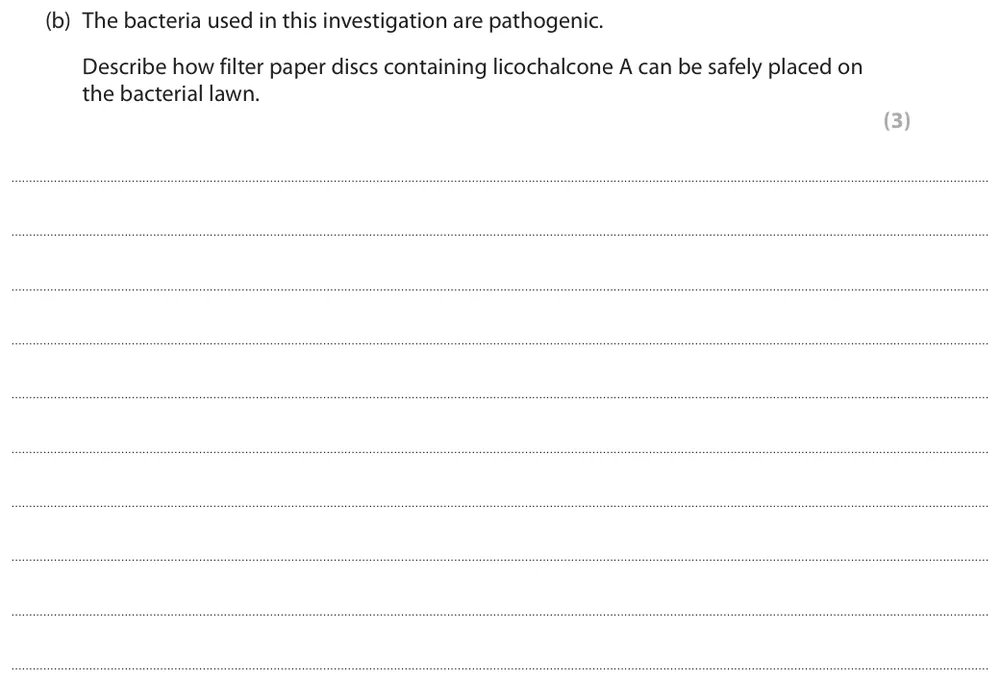
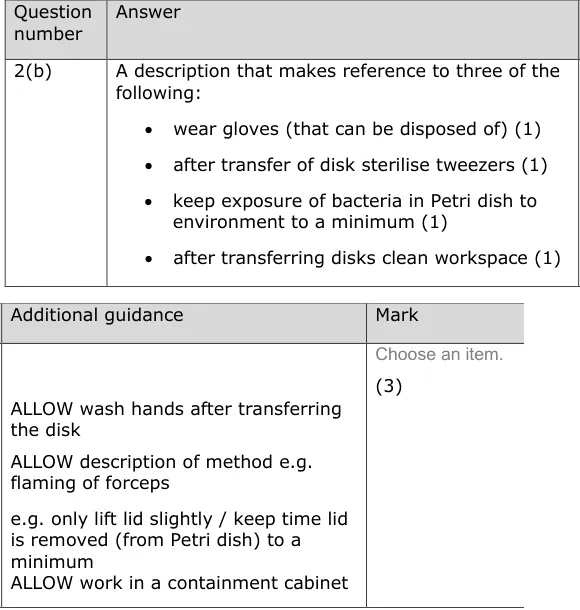
Describe how filter paper discs can be placed safely on a lawn of pathogenic bacteria.
Show the mark scheme
Tap an image to open it full size.
From the examiners' report: Many ignored the question and simply described aseptic technique. Credit for sterilising the tweezers or cleaning the workspace needed the step to be done after transferring the discs.
Planning a valid investigation (CP9)
Question 6
A level Paper 1 · June 2019 · Q7(b) · 4 marks
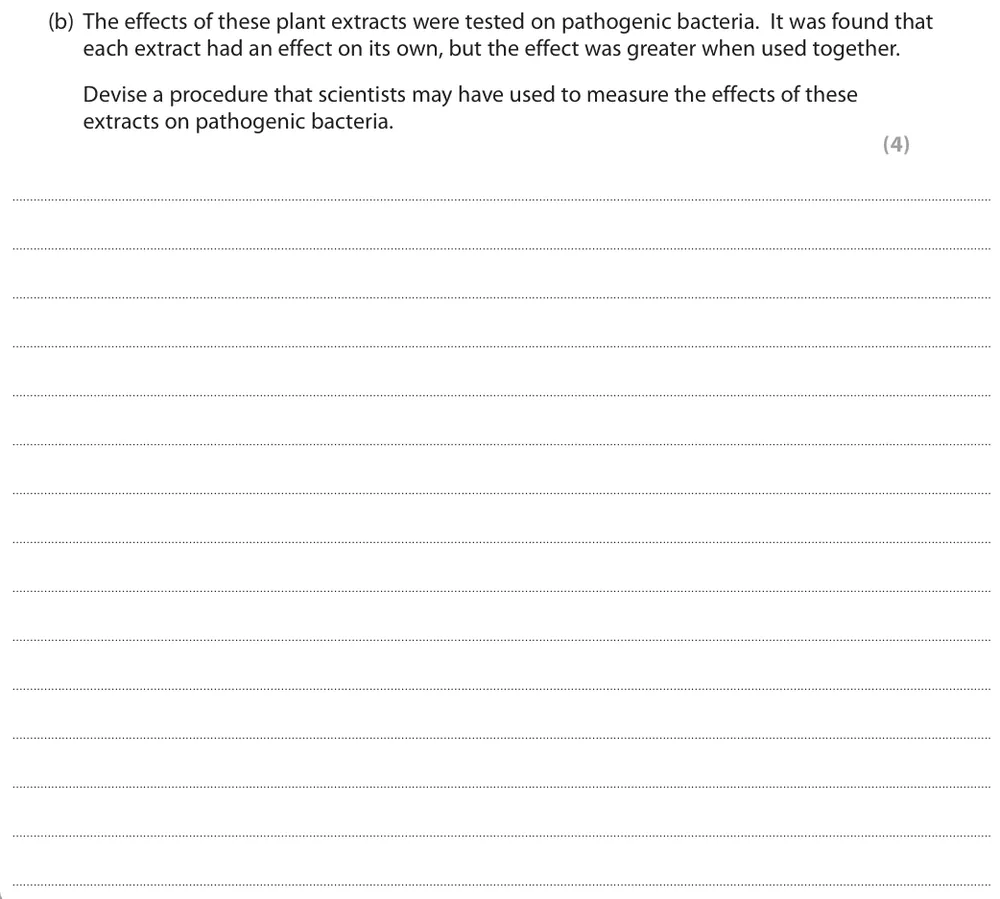
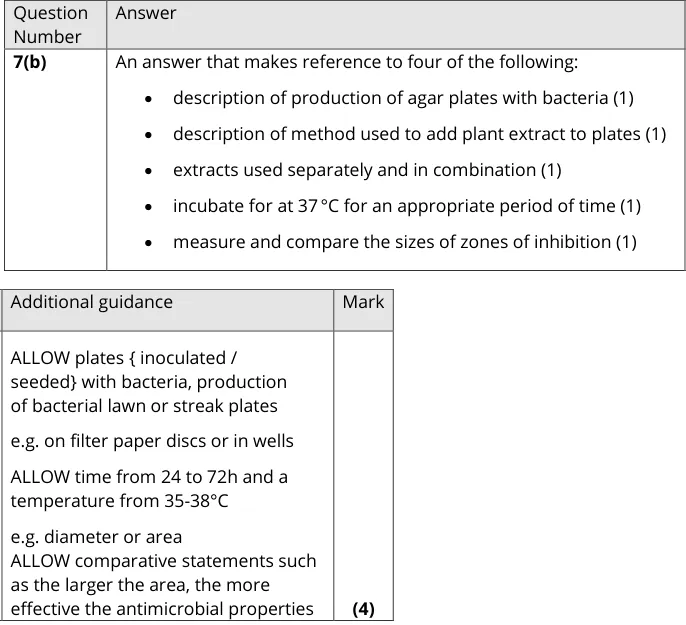
Devise a procedure to measure the effects of plant extracts, alone and together, on pathogenic bacteria.
Show the mark scheme
Tap an image to open it full size.
From the examiners' report: Transfer your knowledge to the new context: these bacteria live in the human body, so the correct incubation temperature was 37 °C. Many high-scoring answers described the plates, how the extracts were added, and measuring the zones of inhibition.
Question 7
AS Paper 2 · June 2023 · Q6(a)(ii) · 4 marks
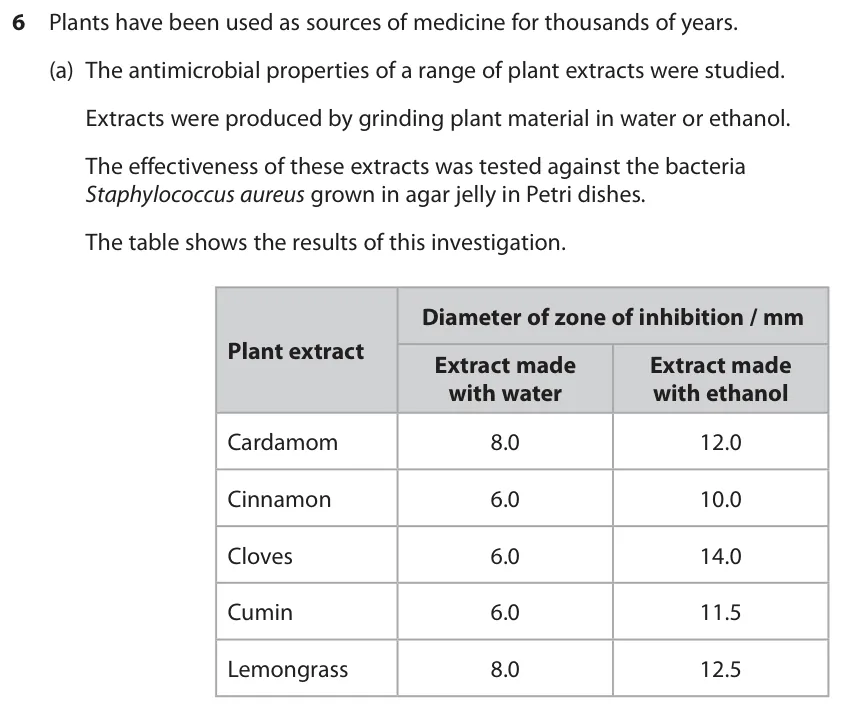
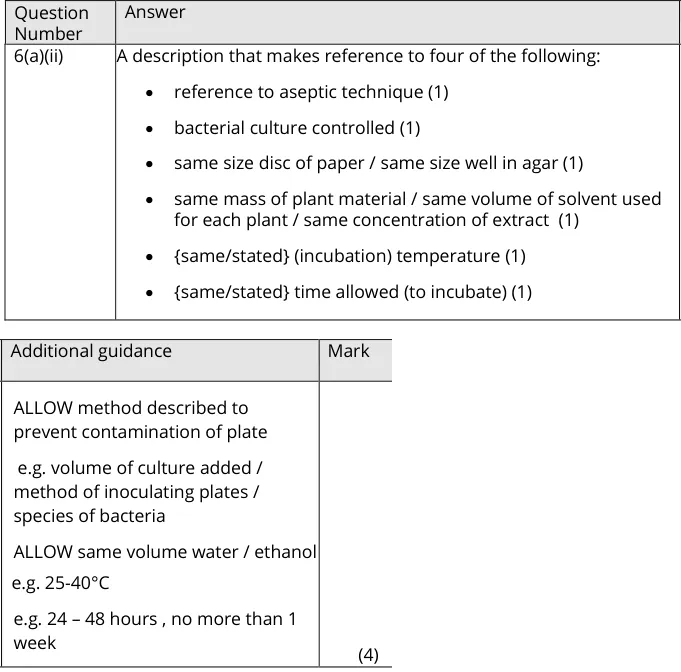
Describe how valid results could have been obtained for a plant extract investigation.
Information from earlier in this question:
Show the mark scheme
Tap an image to open it full size.
From the examiners' report: Repeats do not make results valid; controlling variables does. Many wrote only about aseptic technique, or gave vague incubation times such as 'about 48 hours', instead of controlling the bacteria, the extract and the incubation.
Question 8
A level Paper 3 · June 2022 · Q4(b)(ii) · 4 marks
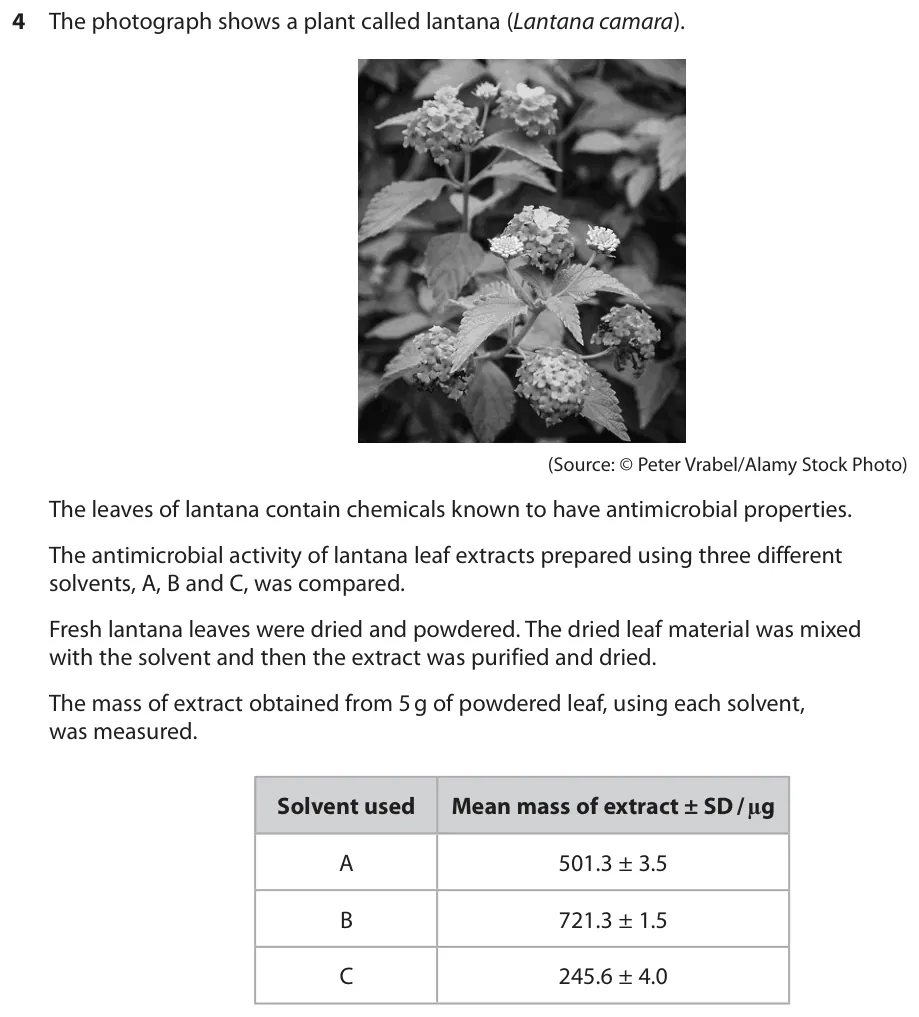
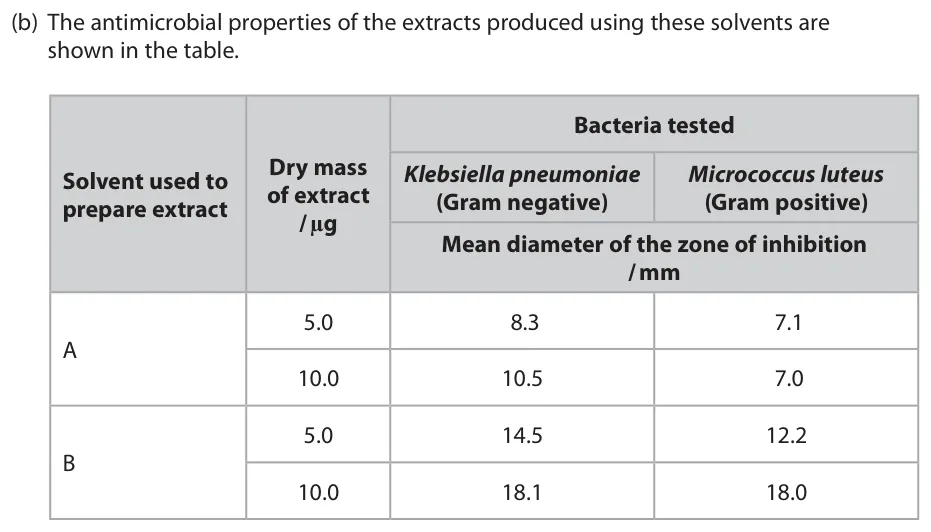
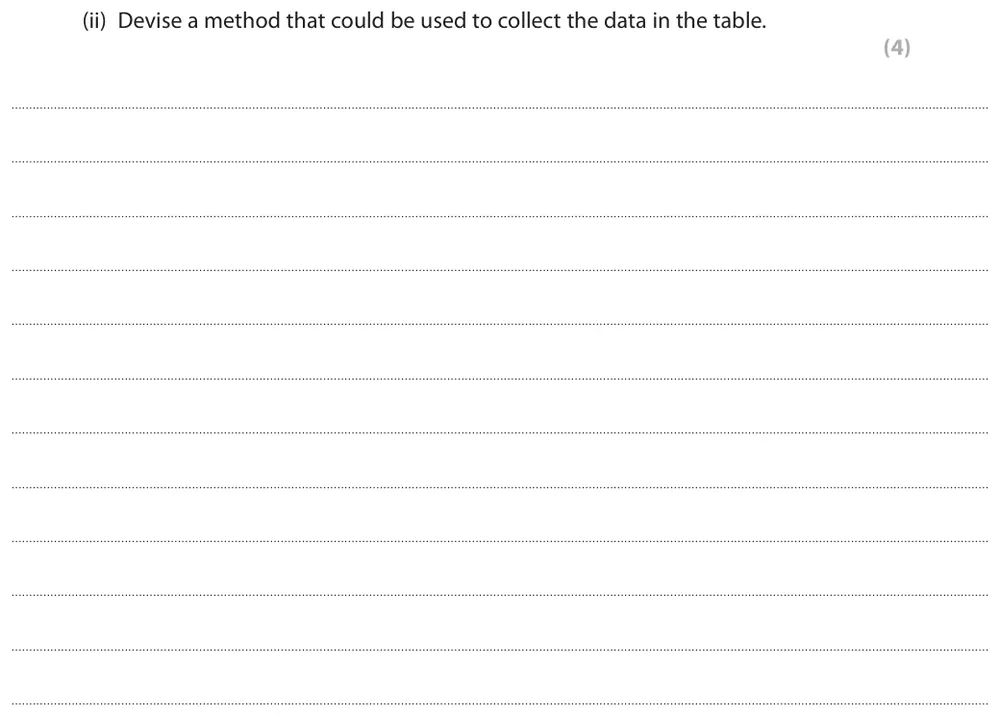
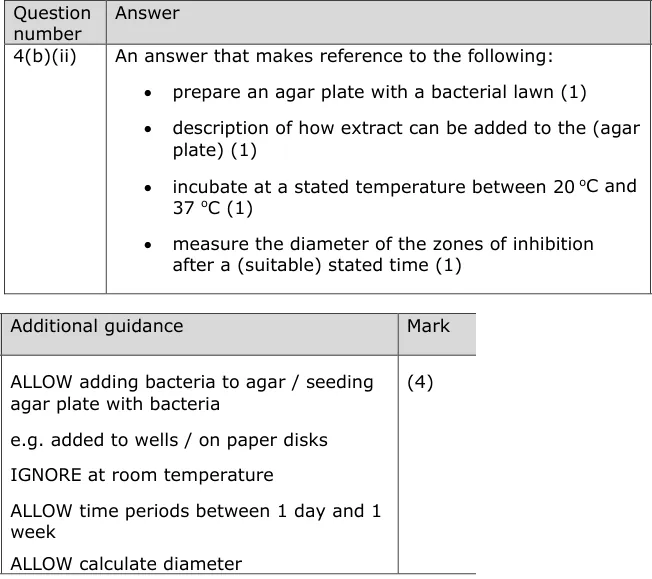
Devise a method that could be used to collect the zone of inhibition data in the table.
Information from earlier in this question:
Show the mark scheme
Tap an image to open it full size.
From the examiners' report: Many wrote at length about aseptic technique without linking it to the table. Measure the diameters of the zones of inhibition, not just 'the zones', and say how you would add 5 µg and 10 µg of extract, for example dissolved at a known concentration and added to wells or paper discs.
Processing and interpreting results (CP9)
Question 9
A level Paper 3 · June 2022 · Q4(b)(i) · 2 marks
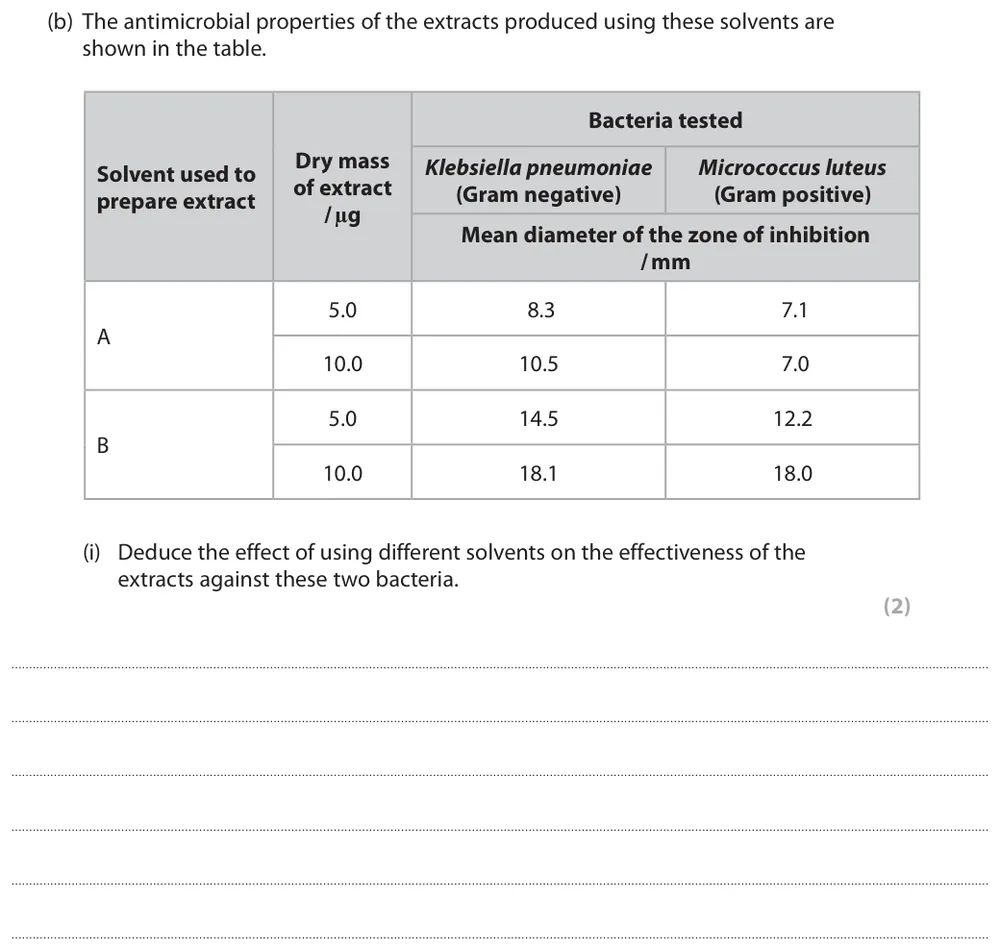
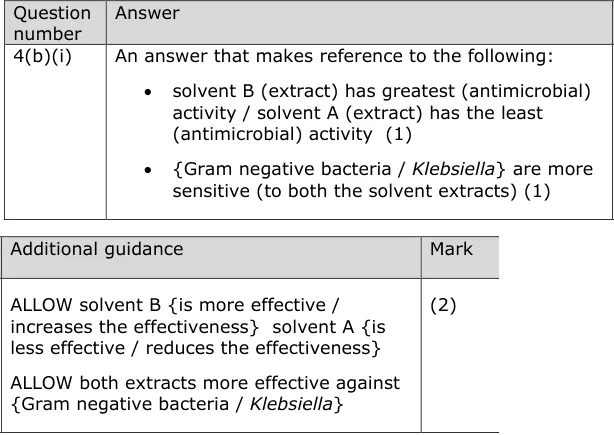
Deduce the effect of the solvent used on the effectiveness of extracts against two bacteria.
Show the mark scheme
Tap an image to open it full size.
From the examiners' report: Many described the effects on the bacteria without comparing the two. Say the extract made with solvent B was more effective, and that both extracts were more effective against the Gram negative Klebsiella.
Question 10
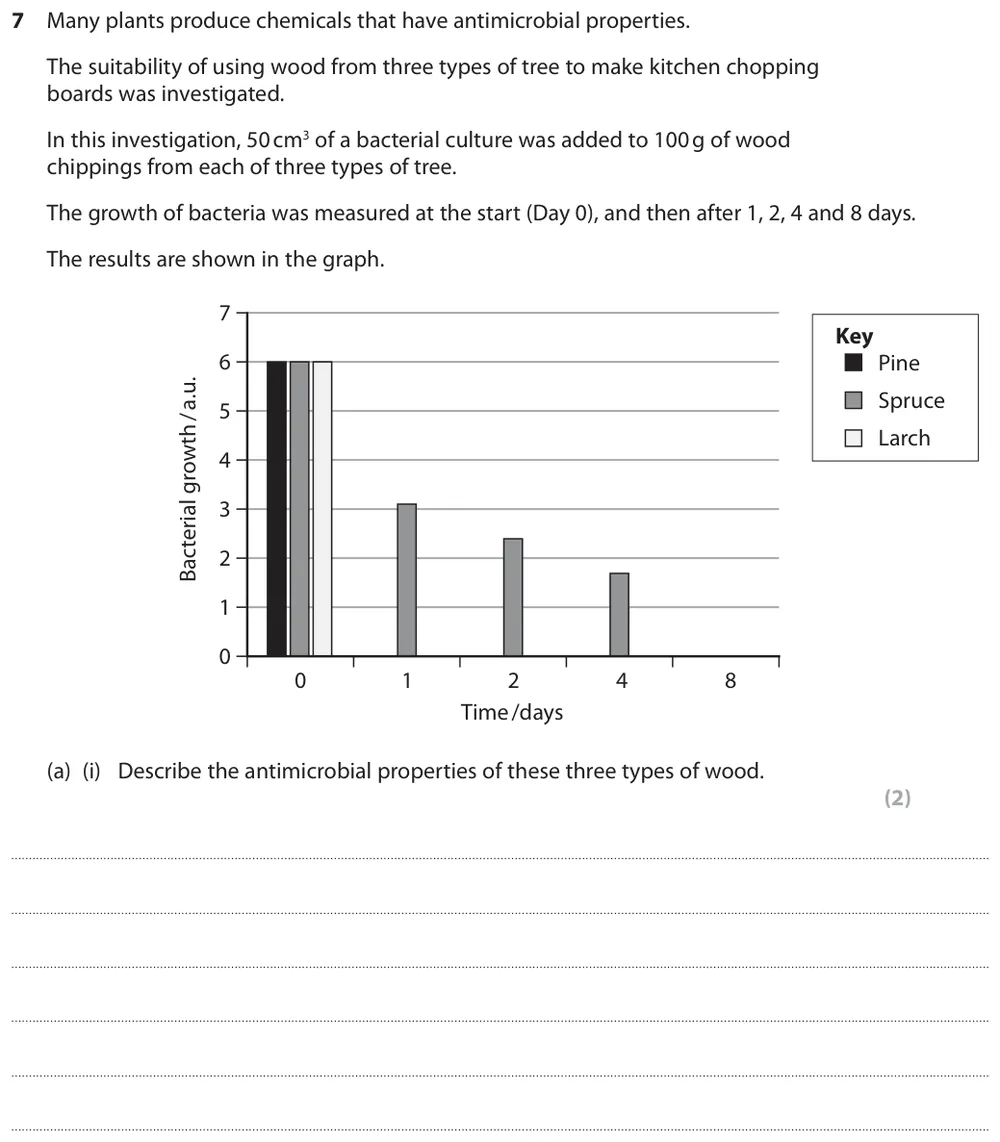
AS Paper 2 · June 2018 · Q7(a)(i) · 2 marks
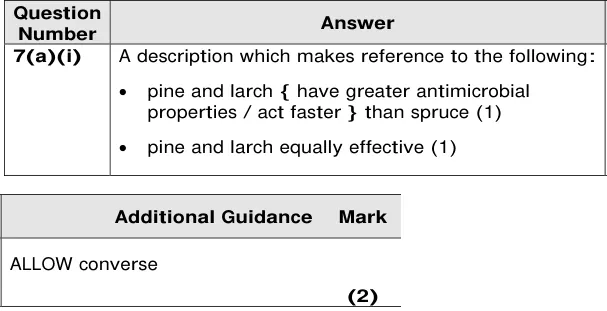
Describe the antimicrobial properties of three types of wood from a graph.
Show the mark scheme
Tap an image to open it full size.
From the examiners' report: Most said spruce was less effective, but few noted that pine and larch were equally effective. A few misread the graph and ranked spruce highest.
Question 11
AS Paper 2 · June 2019 · Q7(c)(ii) · 3 marks
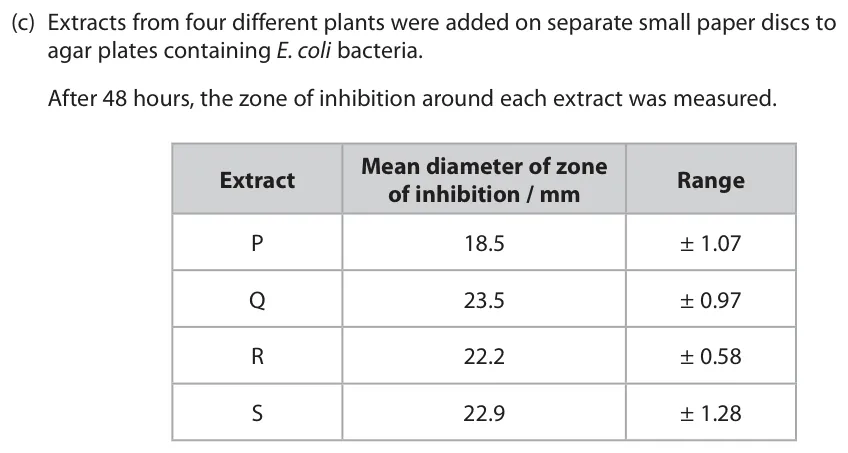
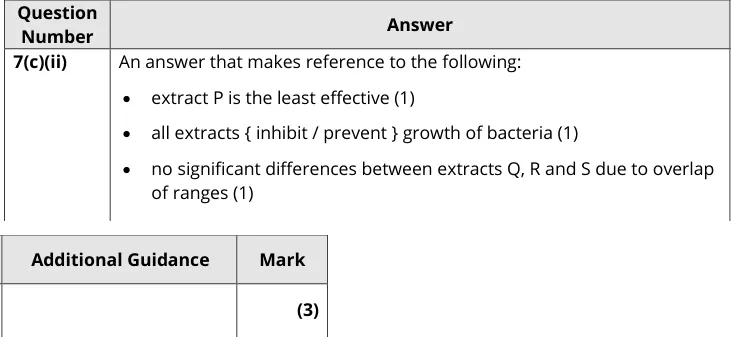
Comment on the antimicrobial properties of four plant extracts.
Information from earlier in this question:
Show the mark scheme
Tap an image to open it full size.
From the examiners' report: Most just ranked the extracts, for one mark. Full marks meant resisting the idea of a 'best' extract: there is no significant difference between Q, R and S because their ranges overlap.
Question 12
AS Paper 2 · June 2025 · Q8(b) · 3 marks · Easy
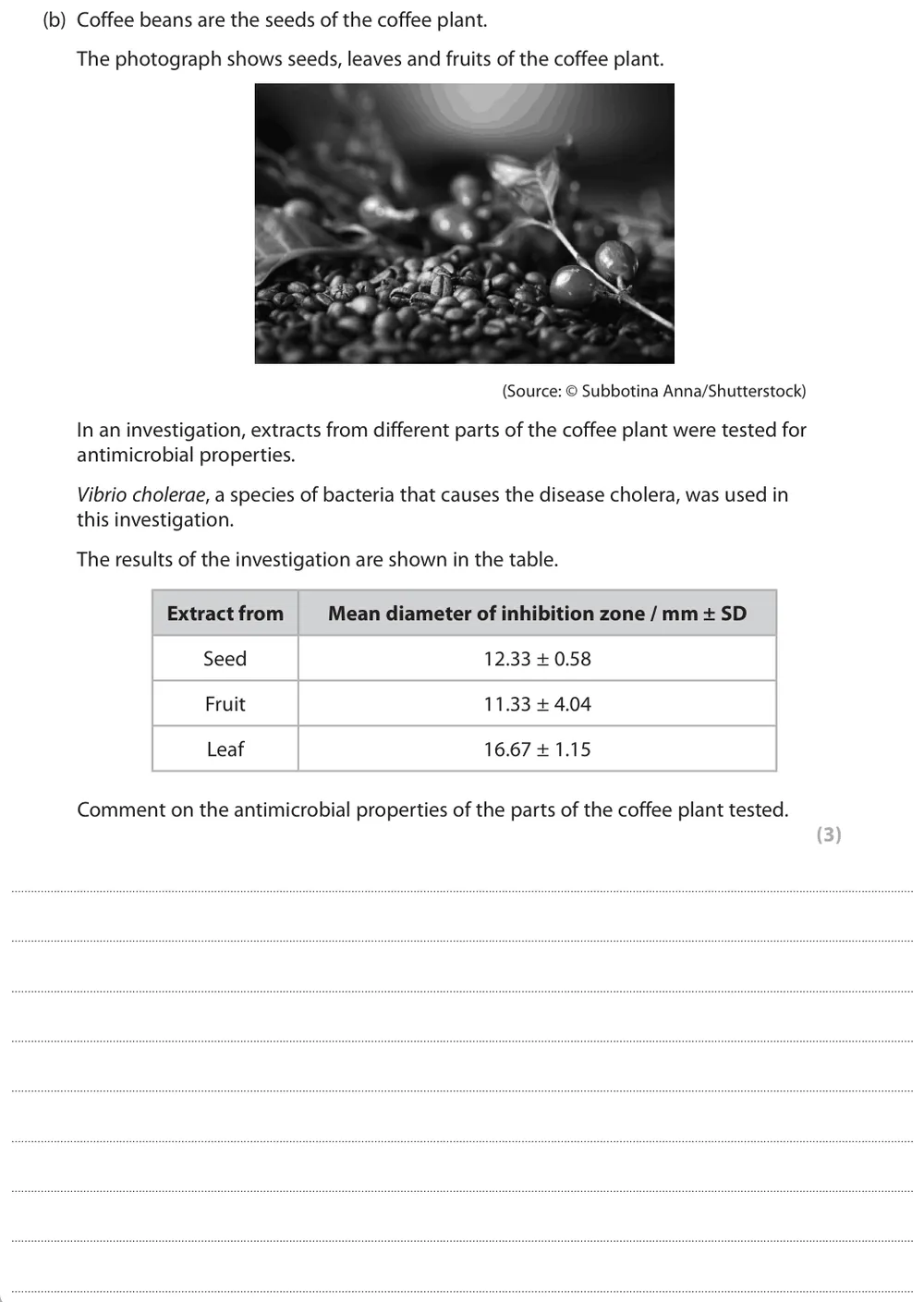
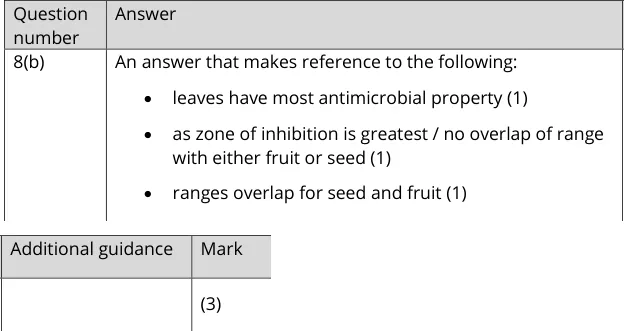
Comment on the antimicrobial properties of extracts from parts of the coffee plant.
Show the mark scheme
Tap an image to open it full size.
From the examiners' report: Most saw that the leaf extract was most effective. Link it to the data: the leaf extract has the largest zone of inhibition and its range does not overlap with seed or fruit, while the seed and fruit ranges overlap.
Evaluating the method (CP9)
Question 13
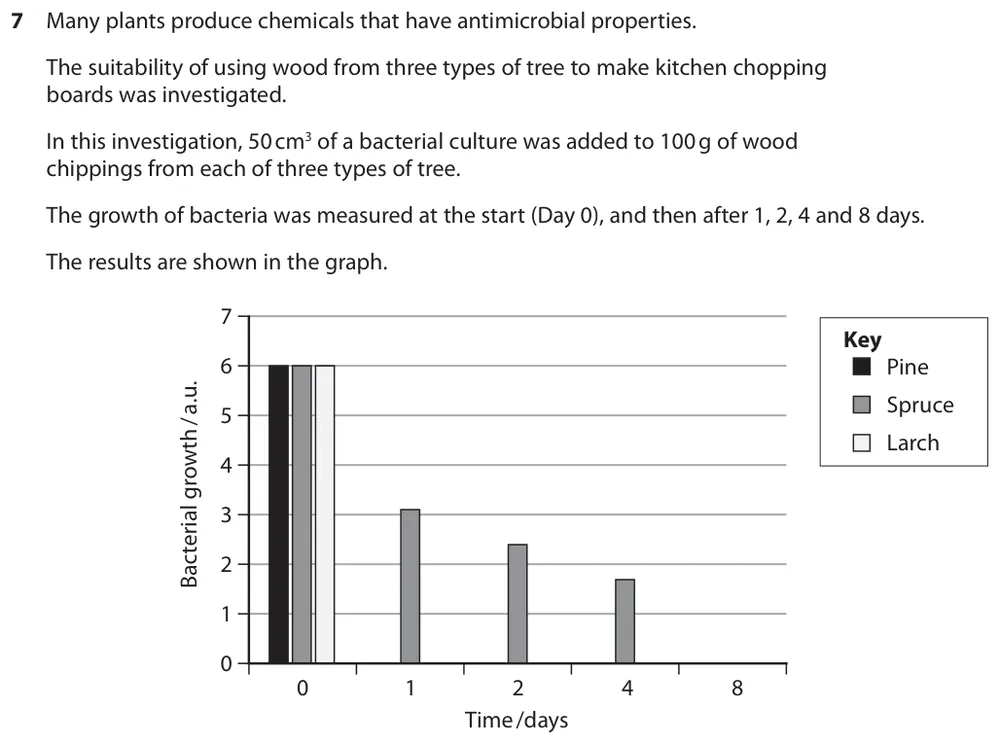
AS Paper 2 · June 2018 · Q7(a)(iii) · 4 marks · Easy
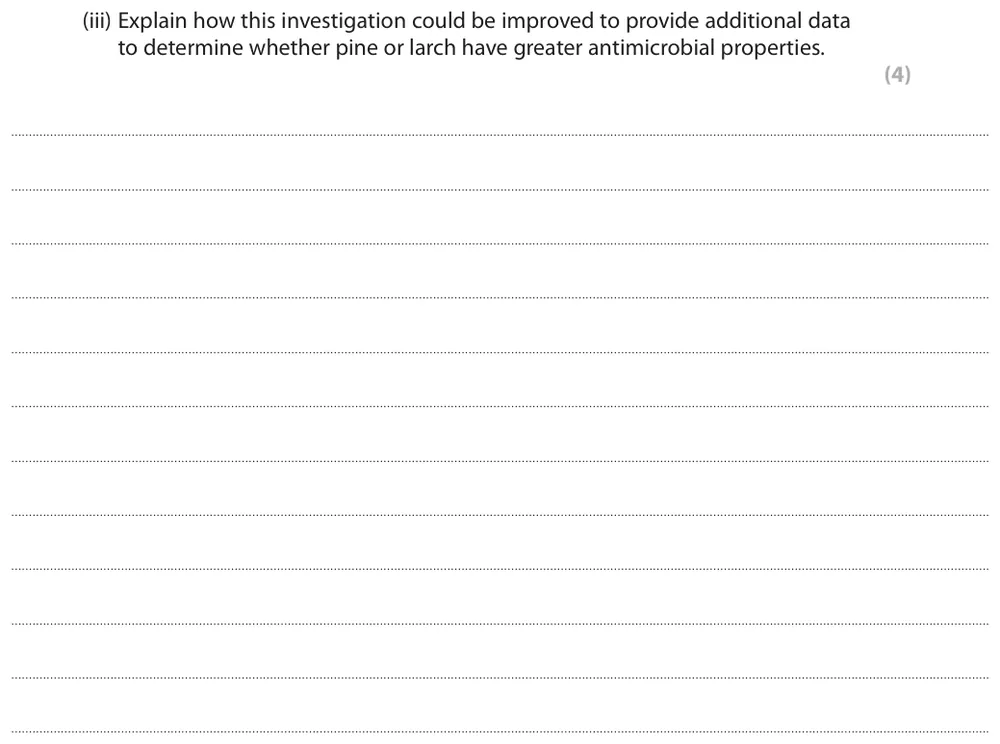
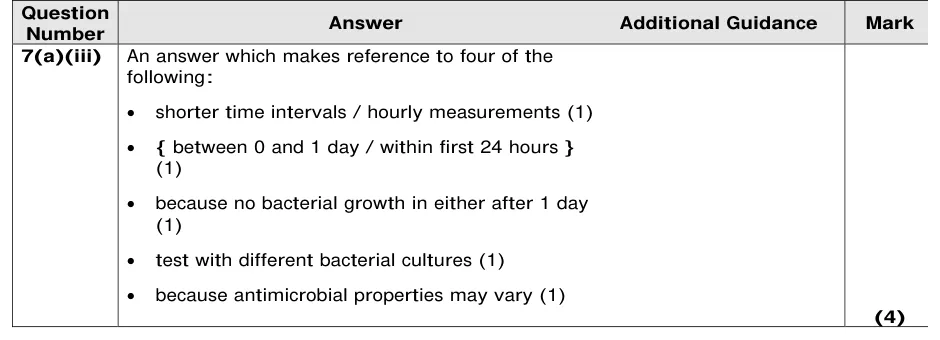
Explain how the wood investigation could be improved to compare pine and larch.
Information from earlier in this question:
Show the mark scheme
Tap an image to open it full size.
From the examiners' report: Too many described a different investigation using zones of inhibition instead of improving this one, and few explained why. Take measurements within the first 24 hours, because neither wood had bacterial growth after one day.
Question 14
A level Paper 3 · June 2024 · Q2(c) · 2 marks
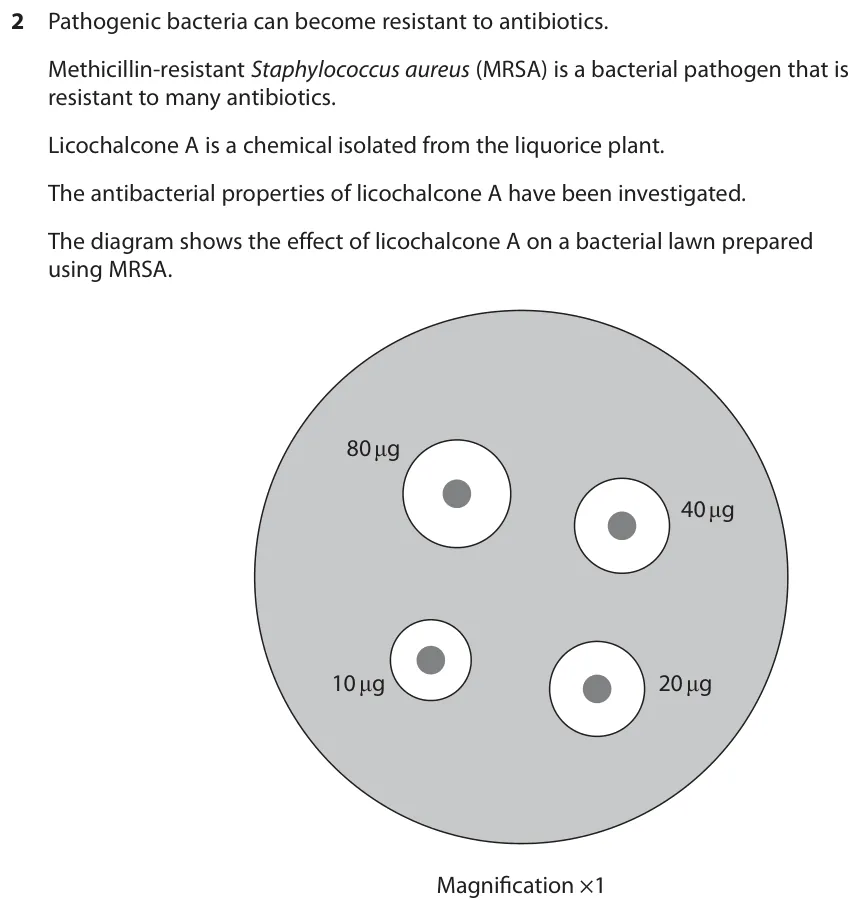
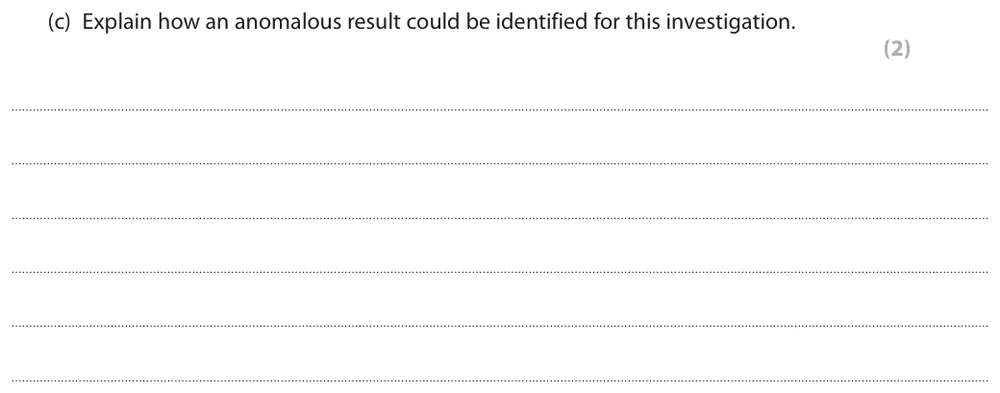
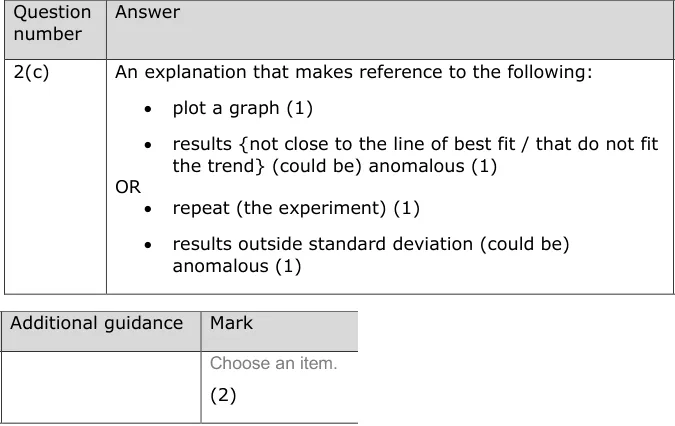
Explain how an anomalous result could be identified in the licochalcone investigation.
Information from earlier in this question:
Show the mark scheme
Tap an image to open it full size.
From the examiners' report: Use one approach and don't mix them: repeat and treat results outside the standard deviation as anomalous, or plot a graph and look for results not close to the line of best fit.
Where students lose marks (from Pearson examiners' reports and mark schemes)
Each point below comes from the examiners' reports and mark schemes, and is followed by wording that gained marks.
Sterile equipment is not a technique. Many precautions were not aseptic or not described in enough detail, such as 'use of sterile equipment' or incubating at low temperature.
✔ Gains credit: 'Flaming of the instruments' or 'keeping lids off for the minimum time'.
The flame makes a convection current. The main misconception was that the Bunsen burner kills airborne bacteria.
✔ Gains credit: 'Working near a Bunsen burner (to provide a convection current).'
Describe the contaminant colonies. Few described the plate; many commented on the uneven distribution of bacteria.
✔ Gains credit: 'Colonies present with a different shape, size or colour, therefore contaminants.'
25 °C is not the optimum. Many said 25 °C is the optimum temperature for bacterial growth, or that the bacteria 'become pathogenic' at higher temperatures.
✔ Gains credit: 'To allow bacteria to multiply without encouraging pathogenic organisms.'
Repeats do not make results valid. Many relied on repeats or wrote only about aseptic technique, with vague incubation times such as 'about 48 hours'.
✔ Gains credit: 'Same concentration of extract' and '{same/stated} (incubation) temperature'.
Overlapping ranges mean no clear winner. Most simply ranked the extracts and named a 'best' one.
✔ Gains credit: 'No significant differences between extracts Q, R and S due to overlap of ranges.'
Improve the investigation you are given. Too many described a different investigation based on zones of inhibition, and few explained their improvement.
✔ Gains credit: 'Shorter time intervals, within first 24 hours, because no bacterial growth in either after 1 day.'
Safety steps come after the transfer. Many ignored the question and simply described aseptic techniques.
✔ Gains credit: 'After transfer of disk sterilise tweezers' and 'after transferring disks clean workspace'.
Download the questions
Download the PDF pack (14 questions, mark schemes at the end)
Keep practising
- Drug Testing, Bacterial Growth and Conservation (Topic 4): Edexcel SNAB exam questions by topic
- Edexcel SNAB A level Biology revision resources by topic (every topic and core practical page)
- Edexcel SNAB Topic 4 Multiple-Choice Quiz: Biodiversity and Natural Resources
- Edexcel SNAB A level Biology past papers, mark schemes and examiners' reports
- Edexcel SNAB A level Biology grade boundaries
- Message Tom on WhatsApp about one-to-one Edexcel SNAB tutoring or an Edexcel group class
Questions, mark schemes and examiners' report extracts © Pearson Education Ltd.