

Required practical 6 is the use of aseptic techniques to investigate the effect of antimicrobial substances on microbial growth. It sits in section 3.4.4 of the specification and turns up on both AS and A-level papers. You need to describe how to move a culture from a broth bottle onto an agar plate without contaminating it, explain why each step works, interpret the clear zones around discs or wells of disinfectant, antibiotic or plant oil, and use a dilution series to work back to the number of bacteria in the original culture.
The examiners' reports show where the marks go. Students list steps without saying why they matter, think the air rising from a Bunsen burner kills bacteria, write 'work quickly' instead of lifting the lid at an angle, and give 'fair test' when the answer is the same number of bacteria on each plate. Very few mix each dilution, and in the calculations only about 15% carry the dilution factor and the volume plated all the way through.
Start with the aseptic technique questions, then the clear zones and evaluations, and finish with the dilution series and calculations. Answer each question on paper, with a calculator, before you open the mark scheme. If you'd like help with this topic, my AQA masterclasses run online on Tuesdays at 5.15pm for Year 12 and on Wednesdays or Thursdays at 6.30pm for Year 13.
What you need from GCSE and Year 12
Each question on this page assumes you're secure on these GCSE and Year 12 ideas. If any of them feels shaky, revise it before you start.
- GCSE: growing bacteria on nutrient agar plates and in nutrient broth, sterilising Petri dishes and inoculating loops, and why school cultures are incubated at 25 °C.
- GCSE: the effect of antiseptics or antibiotics on bacteria, measured from the size of the clear zone around a disc using πr².
- Year 12 (AQA 3.2.1.2): prokaryotic cells divide by binary fission. See the Prokaryotic cells and viruses page.
- Year 12 (AQA RP 3 and AT c): making a dilution series by transferring a fixed volume into fresh liquid and mixing at each step. See the Required practicals 3 and 11 page.
- Year 12 (AQA 3.4.4): antibiotic resistance arises by mutation and spreads by natural selection. See the Genetic diversity and adaptation page.
Key terms
These words come up in the questions and mark schemes. Examiners expect you to use them exactly.
- Aseptic technique: working methods that stop unwanted microorganisms getting into a culture and stop the culture escaping into the lab.
- Sterile: free of all living microorganisms, for example a pipette from an unopened pack or a loop flamed until red hot.
- Agar plate: a Petri dish of solid nutrient agar on which bacteria grow as colonies or as a lawn.
- Broth: a liquid nutrient medium; a liquid culture is bacteria growing in broth.
- Colony: a visible group of bacteria on agar, assumed to have grown from one cell, so counting colonies estimates the number of cells plated.
- Clear zone: the area around a disc or well where the antimicrobial substance has killed the bacteria; a larger area means a more effective substance.
- Antimicrobial substance: a substance that kills or inhibits microorganisms, such as a disinfectant, antiseptic or antibiotic.
- Upward air movement: the convection current above a lit Bunsen burner that carries airborne microorganisms away from the open plate; it does not kill them.
- Positive control: a treatment known to work, such as a named antibiotic or disinfectant, to show the method can detect an effect.
- Negative control: the same set-up without the antimicrobial substance, such as sterile water or oil without cinnamon.
- Dilution factor: how many times a culture has been diluted; multiply the count by it, and by the volume conversion, to find the number in the undiluted culture.
What these questions cover (AQA required practical 6)
The questions come from the sixth required practical in the AQA AS and A-level Biology specification (7401/7402), and test these statements and practical skills:
- Required practical 6: Use of aseptic techniques to investigate the effect of antimicrobial substances on microbial growth (every question on this page; the antimicrobial substances are disinfectants, antibiotics, cinnamon oil and two unnamed substances)
- AT i use microbiological aseptic techniques, including the use of agar plates and broth
- AT c use laboratory glassware apparatus for a variety of experimental techniques to include serial dilutions (one question asks you to describe a dilution series; the calculations use the dilution factor to work back to the undiluted culture)
- PS 2.1 Comment on experimental design and evaluate scientific methods
- PS 2.4 Identify variables including those that must be controlled
- PS 3.3 Consider margins of error, accuracy and precision of data
- MS 0.2 Recognise and use expressions in decimal and standard form
- MS 0.3 Use ratios, fractions and percentages
How to use this page
Write your answer on paper before you open the mark scheme. Allow about 1.3 minutes per mark: the 18 questions are worth 39 marks, so about 51 minutes in total. Then mark your answer strictly against the mark scheme and read the examiners' tip underneath it. If you'd rather print the questions, download the PDF pack.
Aseptic technique
Question 1
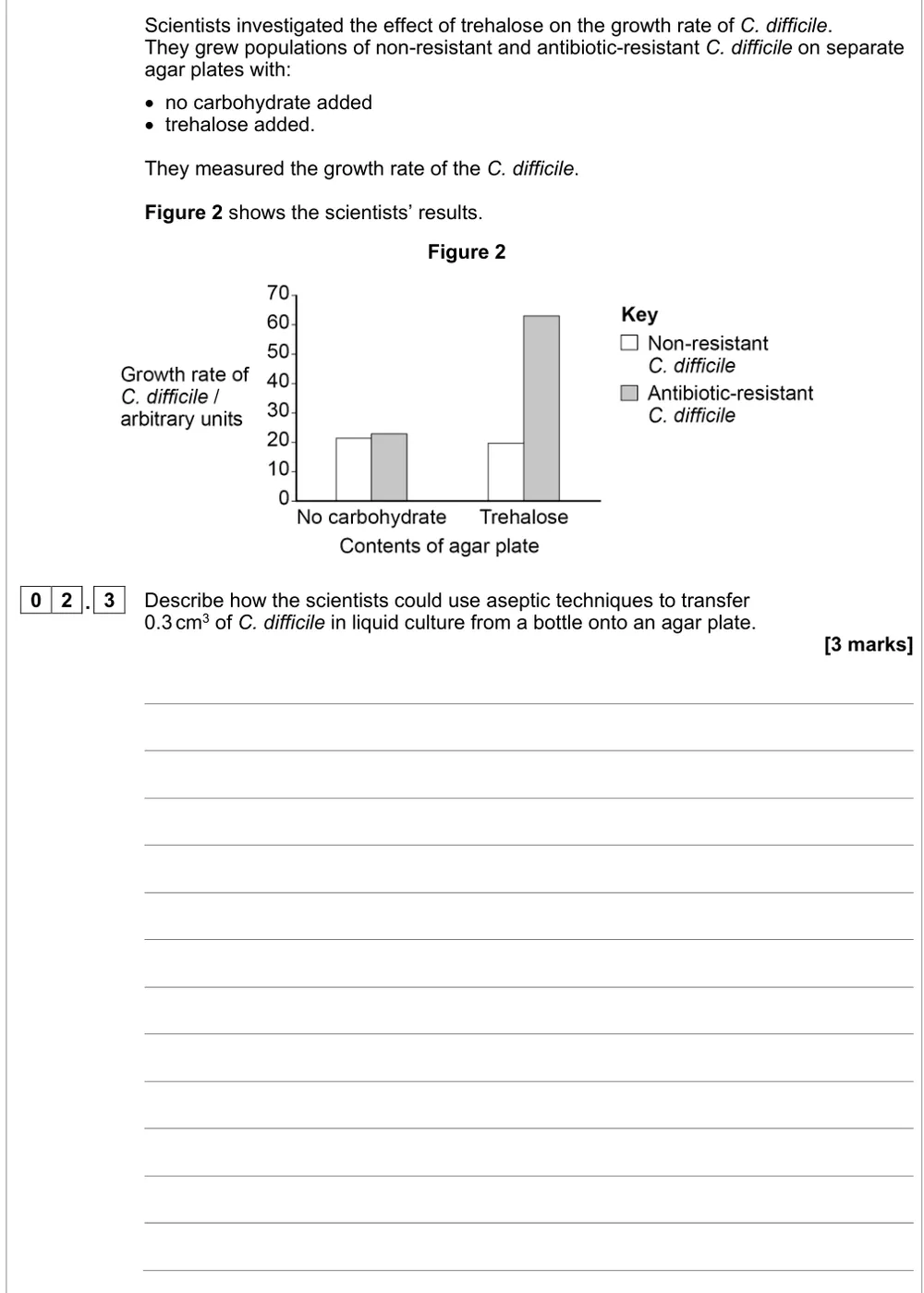
A level Paper 1 · June 2022 · Q02.3 · 3 marks · Easy
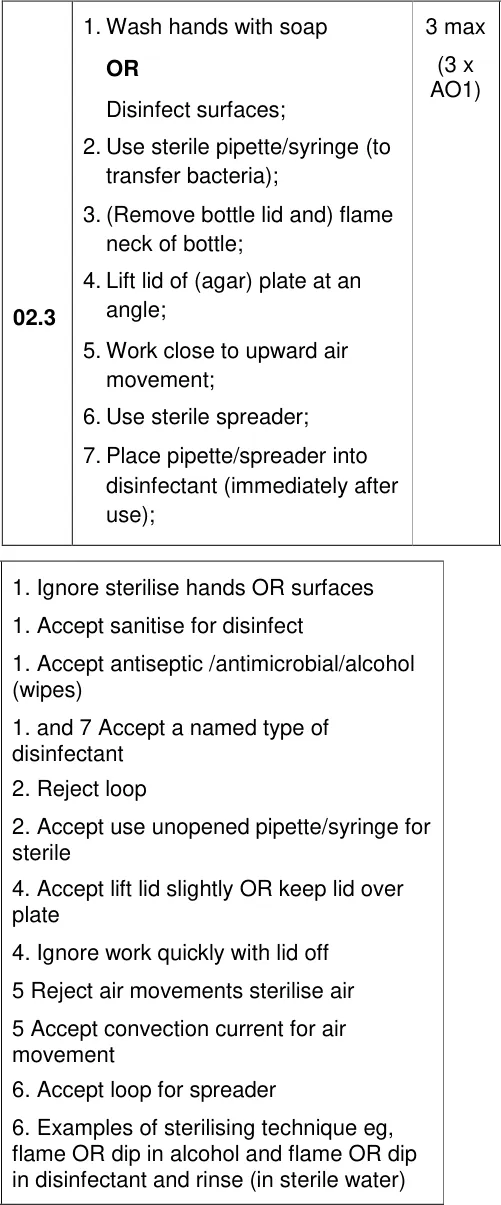
Describe the aseptic techniques for transferring 0.3 cm³ of a liquid culture from a bottle onto an agar plate.
Show the mark scheme
Tap an image to open it full size.
From the examiners' report: Two-thirds got 2 or 3 marks. A loop can't transfer a measured volume, so use a sterile pipette. Hold the lid at an angle rather than just working quickly.
Question 2
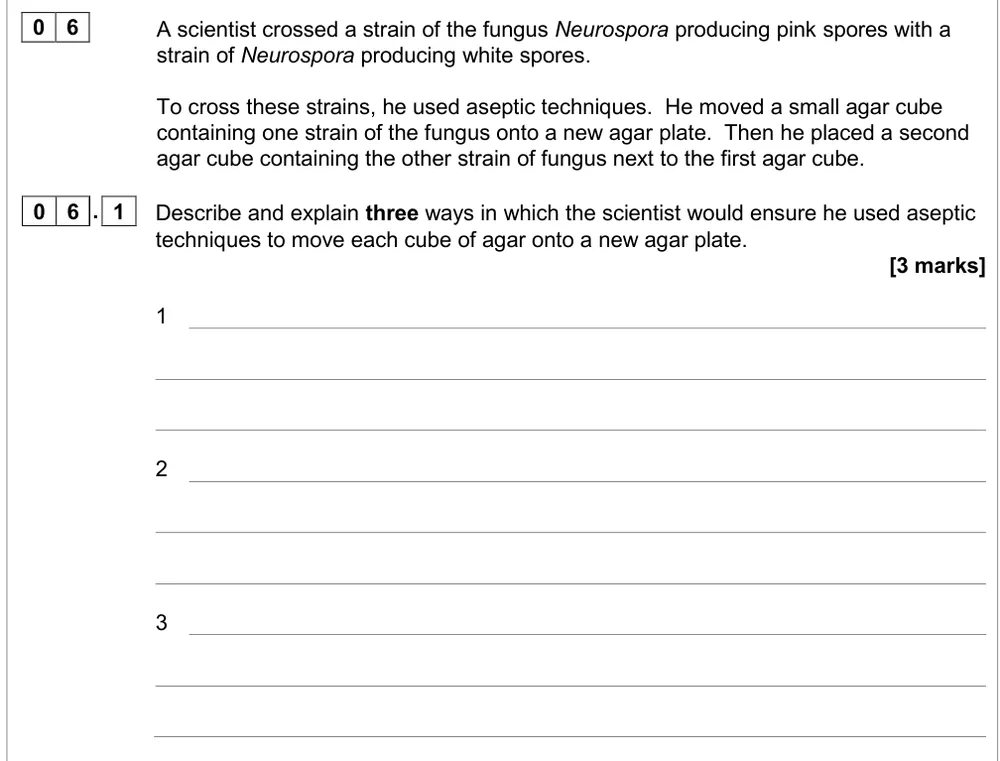
AS Paper 2 · June 2019 · Q06.1 · 3 marks · Medium
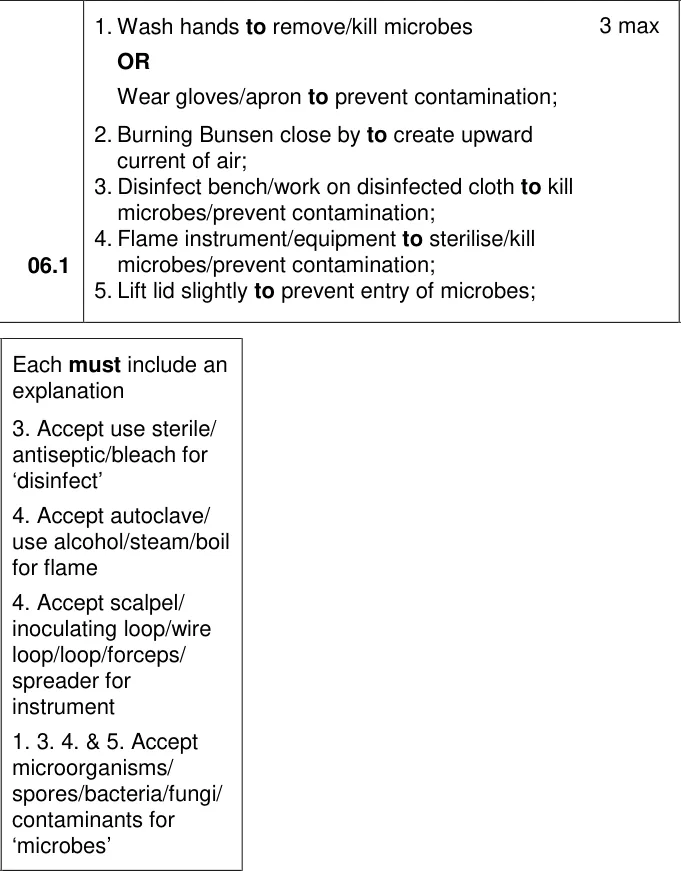
Describe and explain three ways to keep the technique aseptic when moving agar cubes of a fungus onto a new plate.
Show the mark scheme
Tap an image to open it full size.
From the examiners' report: About a third scored nothing because they didn't explain each step, or said the upward air current kills bacteria. Say how the loop or scalpel is sterilised, and keep to moving the cubes.
Question 3
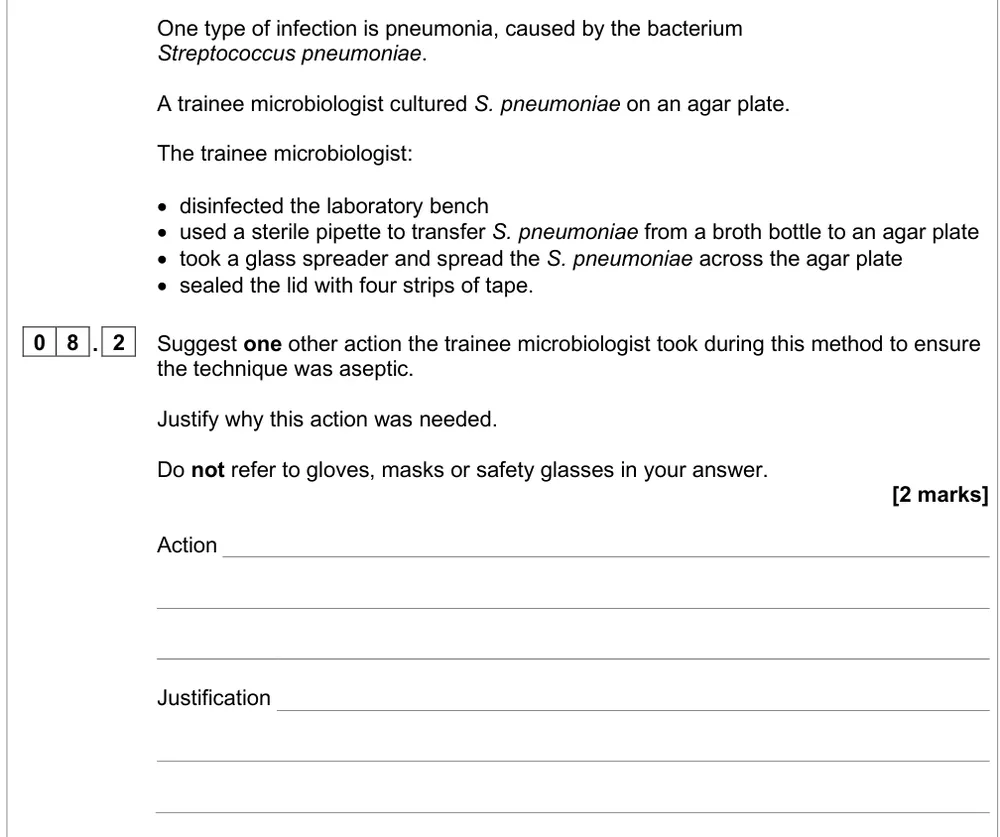
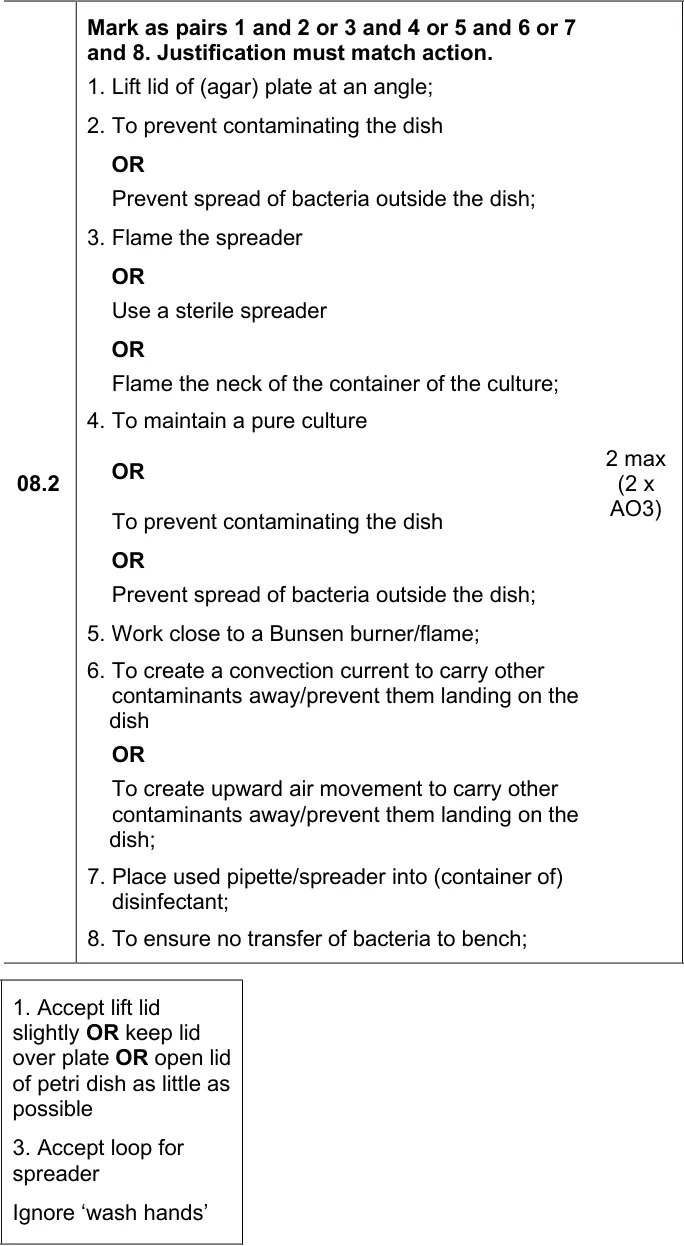
AS Paper 2 · June 2025 · Q08.2 · 2 marks · Medium
Suggest one more aseptic step a trainee microbiologist took when culturing a bacterium, and justify it.
Show the mark scheme
Tap an image to open it full size.
From the examiners' report: About a third got both marks. Don't repeat a step already listed. If you choose the Bunsen burner, say the rising air carries contaminants away from the dish.
Question 4
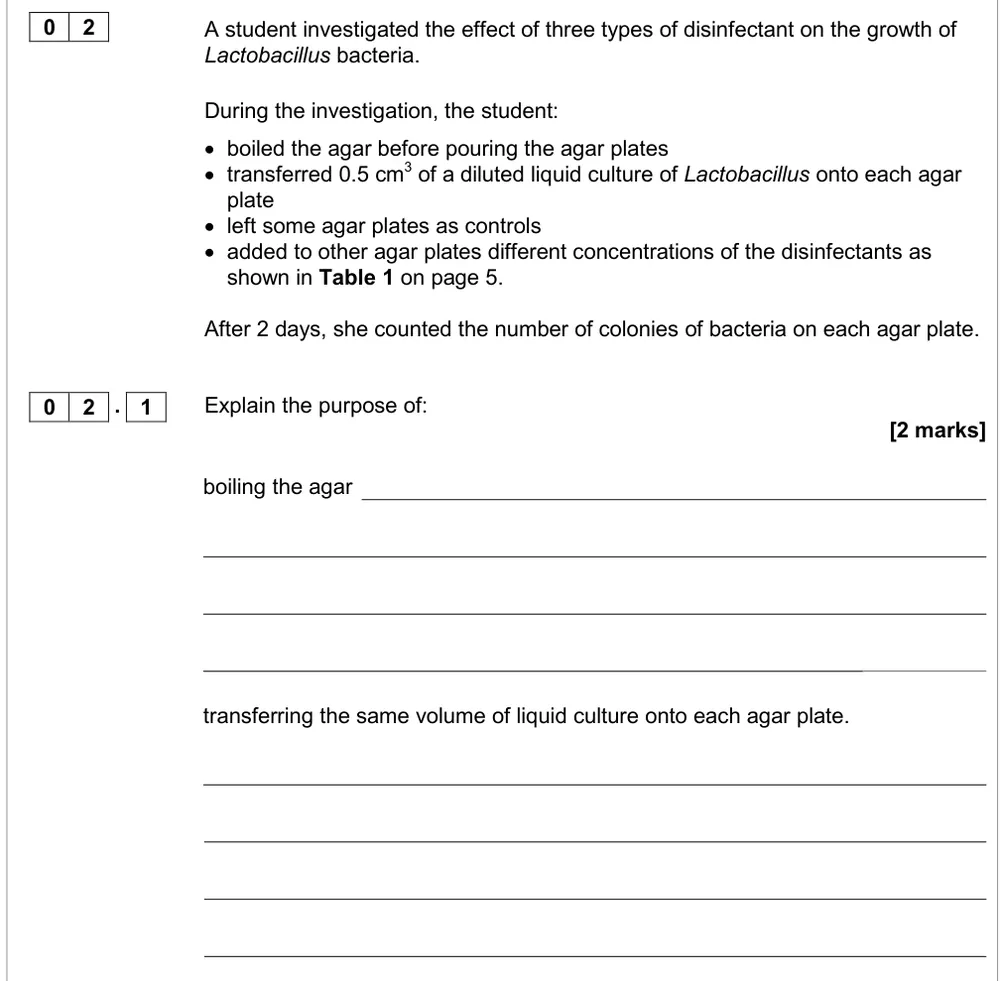
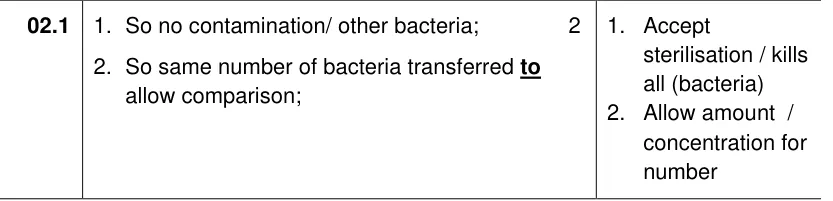
AS Paper 1 · June 2017 · Q02.1 · 2 marks · Hard
Explain why the agar was boiled and why the same volume of culture went onto each plate.
Show the mark scheme
Tap an image to open it full size.
From the examiners' report: Only 7.6% got both marks. 'So it could be poured' copies the stem, and 'fair test' is too vague. Say the same volume gives the same number of bacteria on each plate.
Question 5
AS Paper 1 · June 2022 · Q08.1 · 2 marks · Medium
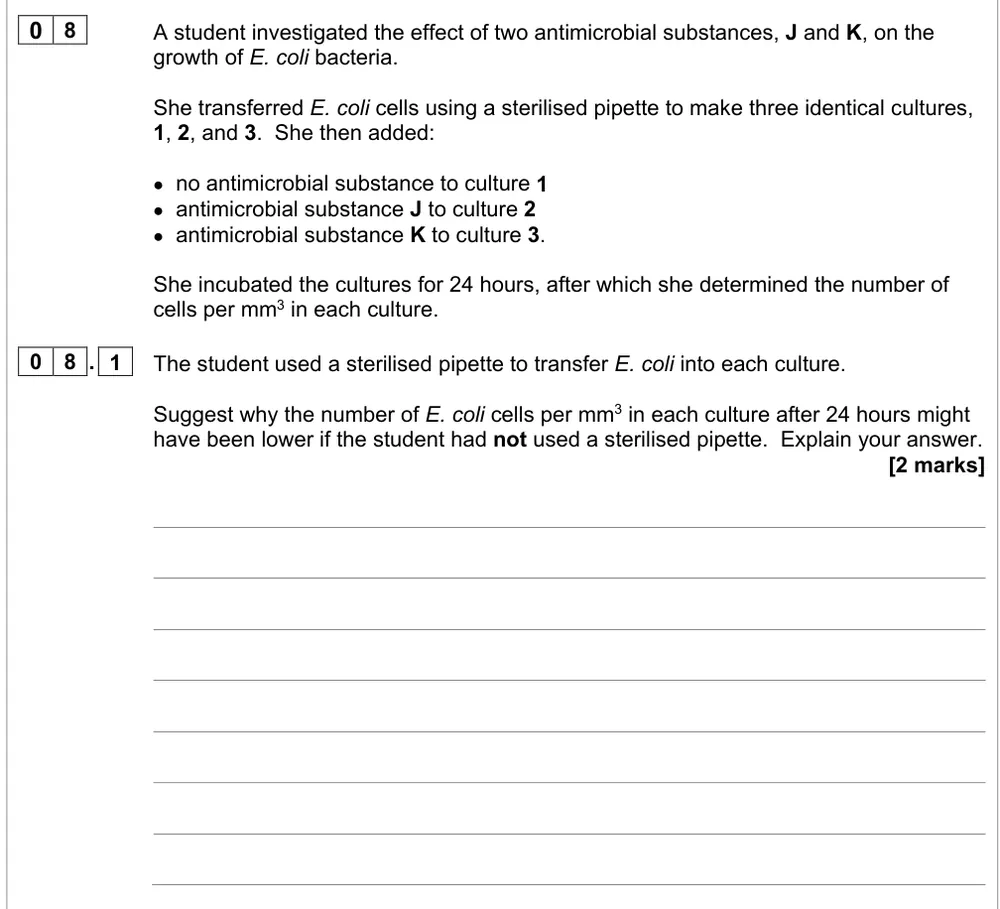
Explain why the E. coli count could have been lower if the pipette hadn't been sterilised.
Show the mark scheme
Tap an image to open it full size.
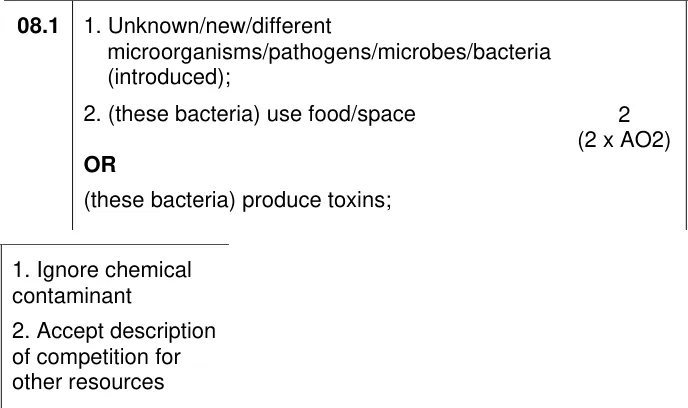
From the examiners' report: 63% got at least one mark. Name new microorganisms, not chemicals, then say what they compete for, food or space, or that they make toxins.
Clear zones and controls
Question 6
AS Paper 2 · June 2016 · Q08.1 · 1 mark · Easy
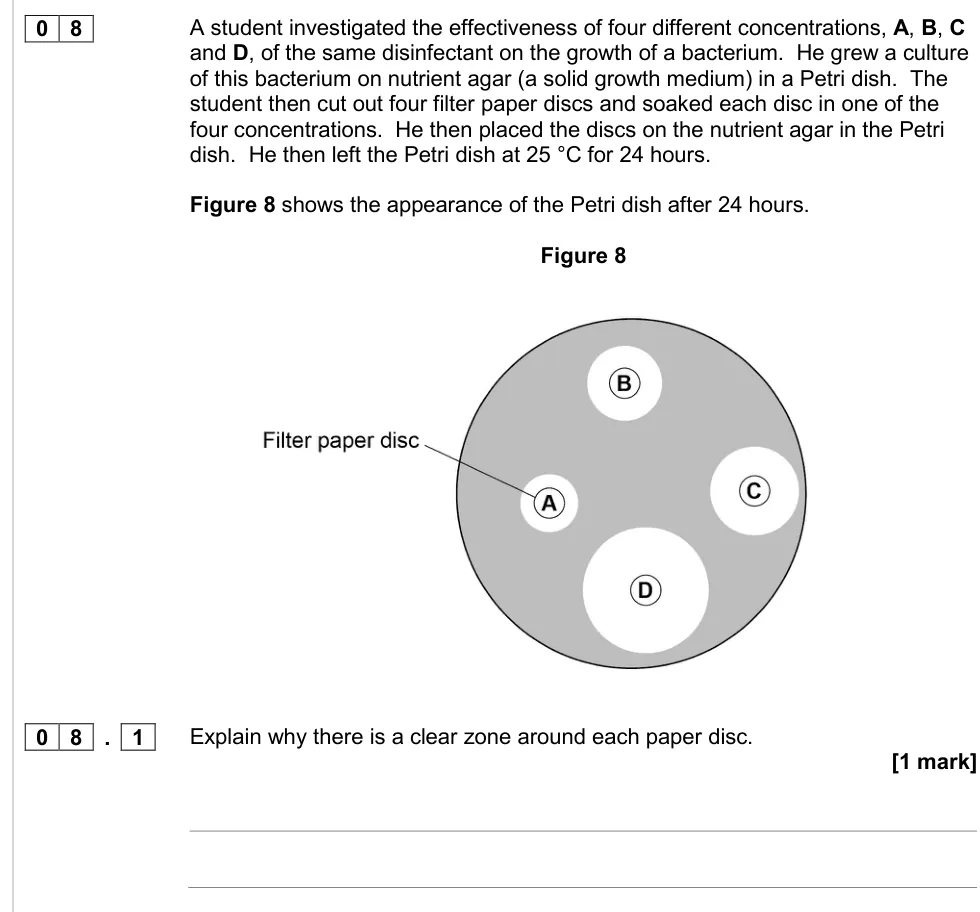
Explain why there's a clear zone around each disc of disinfectant on a lawn of bacteria.
Show the mark scheme
Tap an image to open it full size.
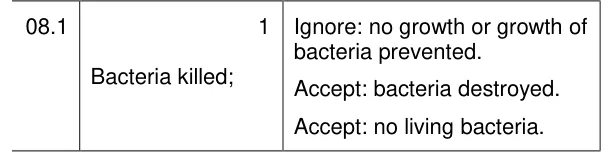
From the examiners' report: About two thirds got it. The bacteria had already grown before the discs went on, so 'growth prevented' didn't score: say the bacteria were killed.
Question 7
AS Paper 2 · June 2016 · Q08.2 · 1 mark · Medium
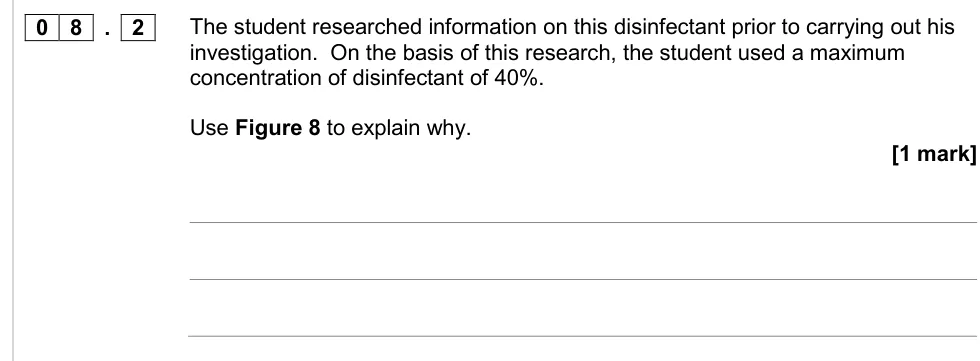
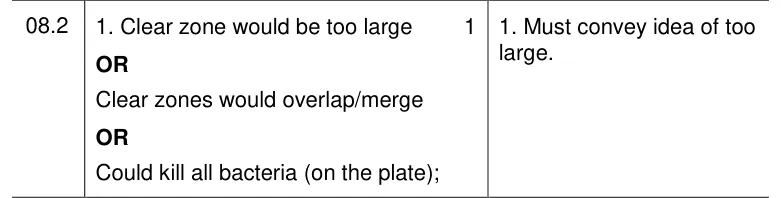
Use the clear zones to explain why the student used no more than 40% disinfectant.
Show the mark scheme
Tap an image to open it full size.
From the examiners' report: Slightly over half got this. Use the figure: the zone around D is already large, so a stronger solution would make zones merge. Vague answers about concentration or safety didn't score.
Question 8
AS Paper 2 · June 2016 · Q08.3 · 2 marks · Easy
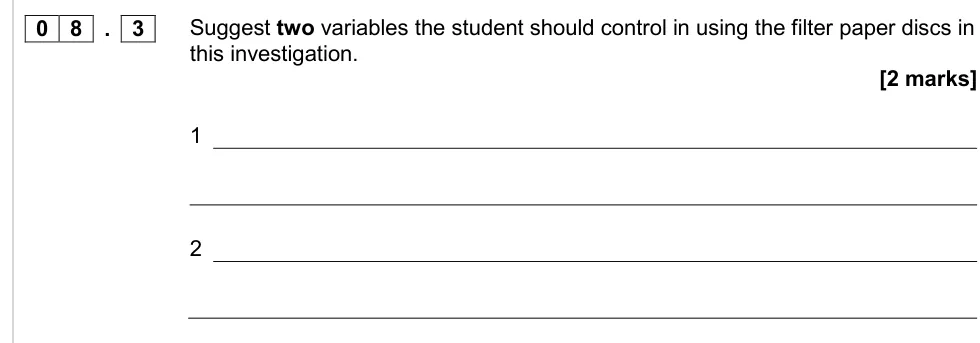
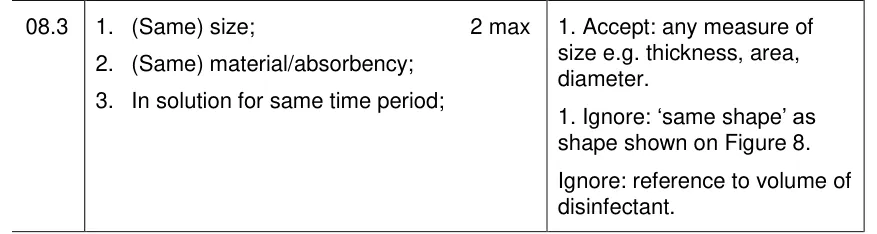
Suggest two variables to control when using the filter paper discs.
Show the mark scheme
Tap an image to open it full size.
From the examiners' report: Almost 90% got one mark, usually for disc size, but only about 40% added soaking time. The discs were soaked, so 'same volume of disinfectant' didn't score.
Question 9
AS Paper 2 · June 2016 · Q08.4 · 2 marks · Medium
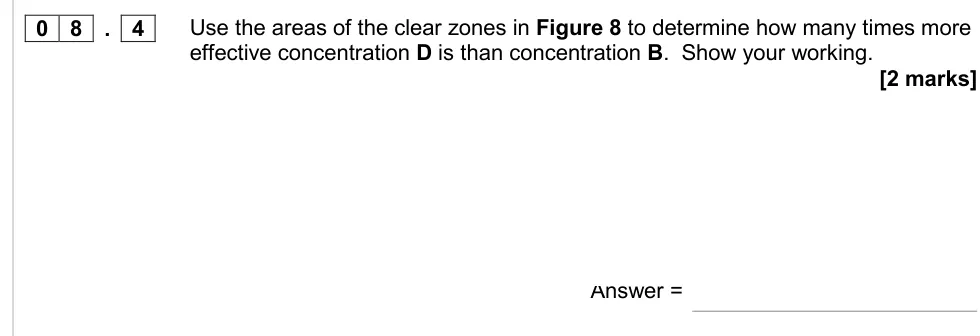
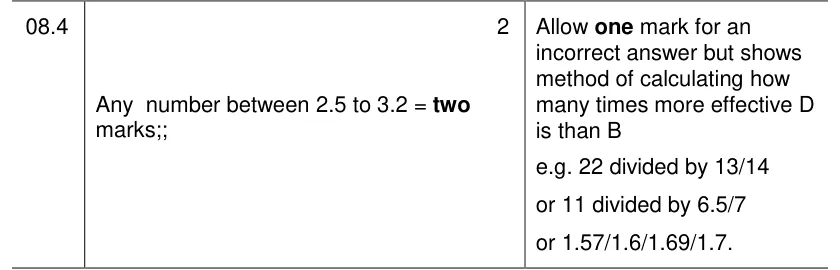
Use the areas of the clear zones to find how many times more effective concentration D is than B.
Show the mark scheme
Tap an image to open it full size.
From the examiners' report: 30% got both marks. Most who got one mark divided the diameters or radii. Square the radius (πr²) for each zone before you divide.
Question 10
A level Paper 1 · June 2023 · Q05.3 · 2 marks
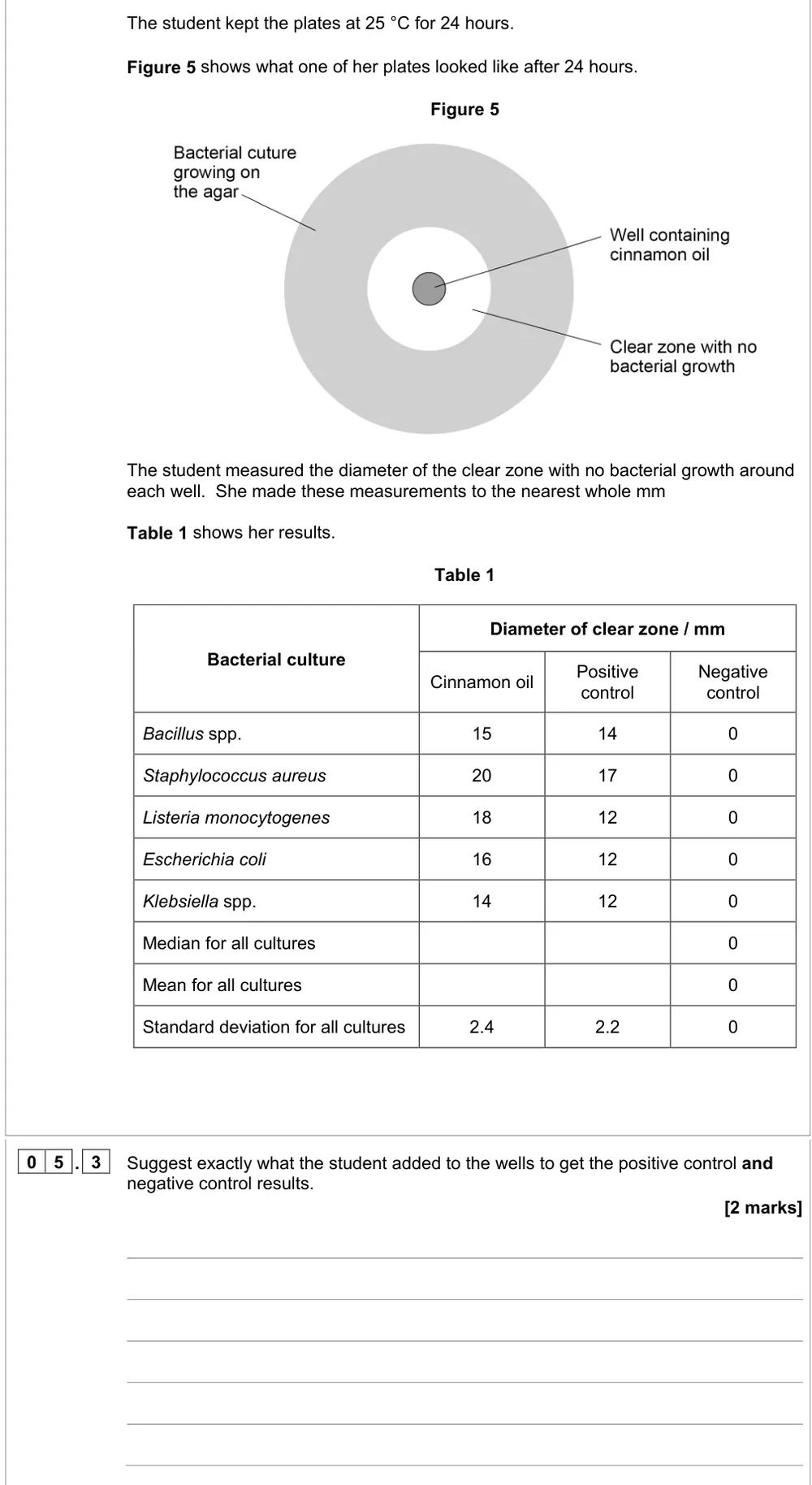
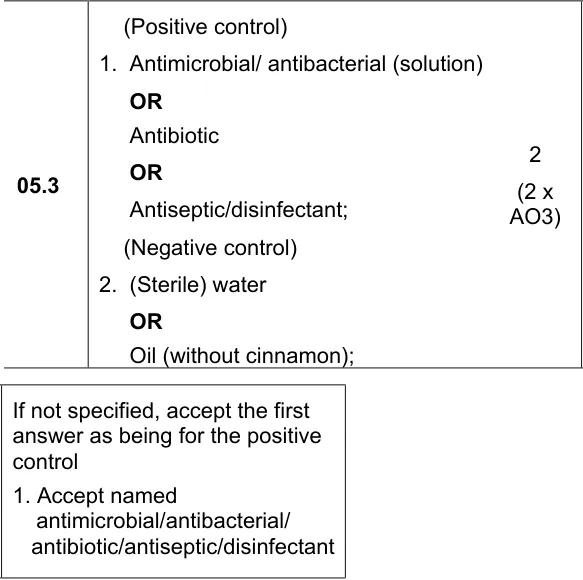
Suggest what was added to the wells for the positive and negative controls.
Information from earlier in this question:

Show the mark scheme
Tap an image to open it full size.
From the examiners' report: 'Doing nothing to the well' was the commonest wrong negative control. The positive control is a known antimicrobial; the negative is the liquid without cinnamon, such as sterile water.
Evaluating antimicrobial investigations
Question 11
AS Paper 1 · June 2017 · Q02.3 · 2 marks · Hard
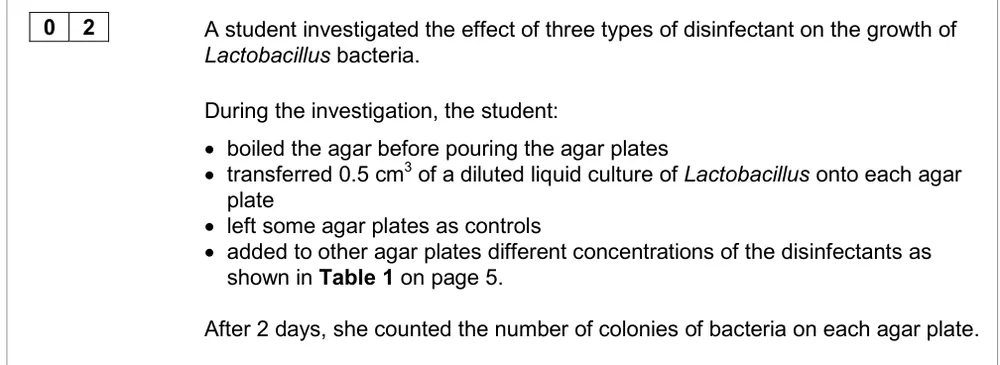
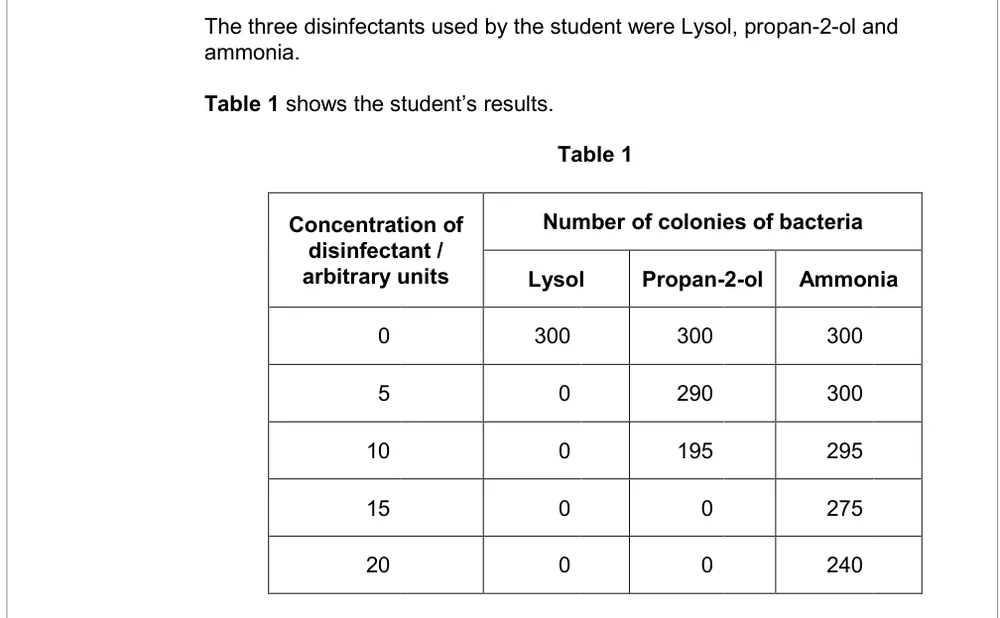
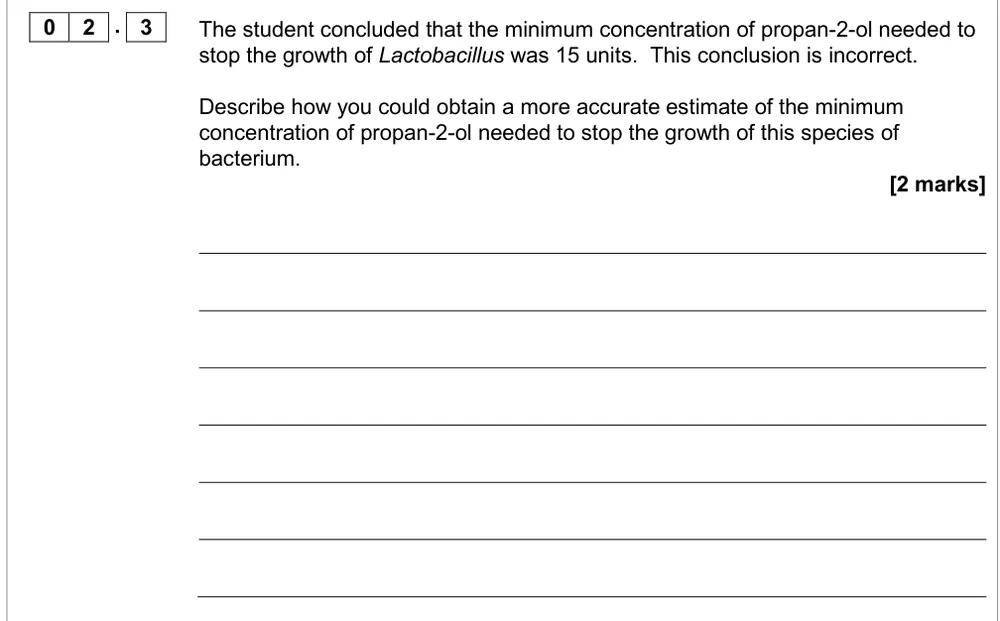
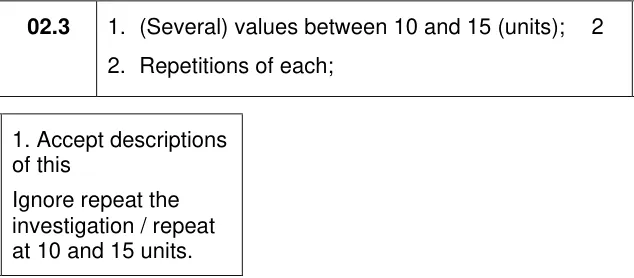
Describe how to get a more accurate minimum concentration of propan-2-ol that stops growth.
Information from earlier in this question:
Show the mark scheme
Tap an image to open it full size.
From the examiners' report: Over half got the first mark for testing between 10 and 15 units, but very few added that each concentration should be repeated. It wasn't wrong, just left out.
Question 12
AS Paper 2 · June 2024 · Q06.3 · 4 marks · Hard
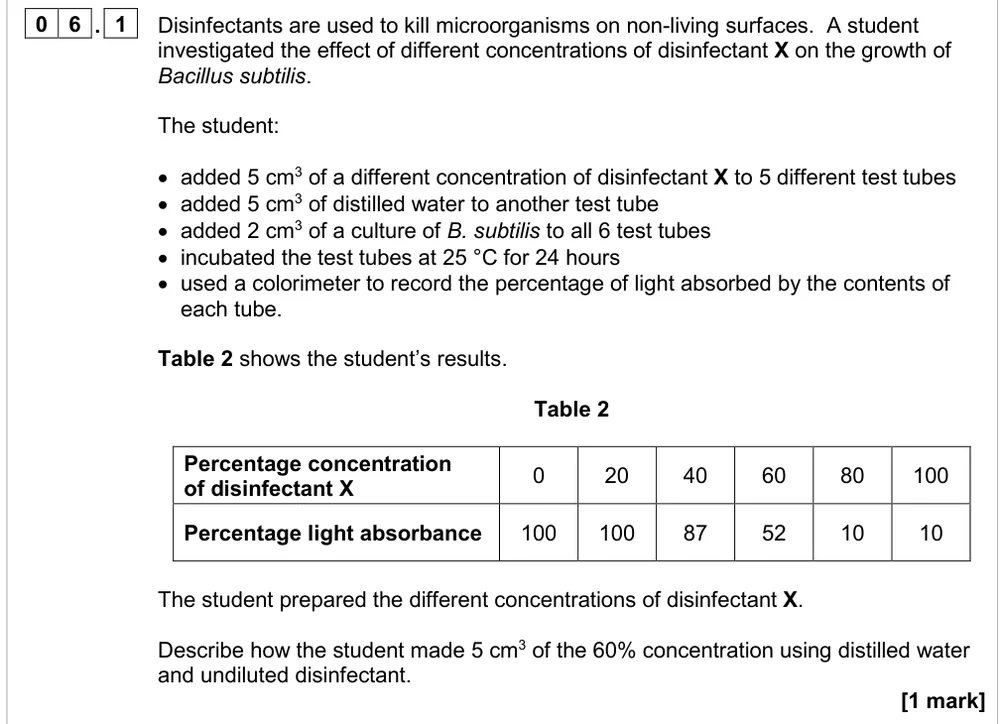
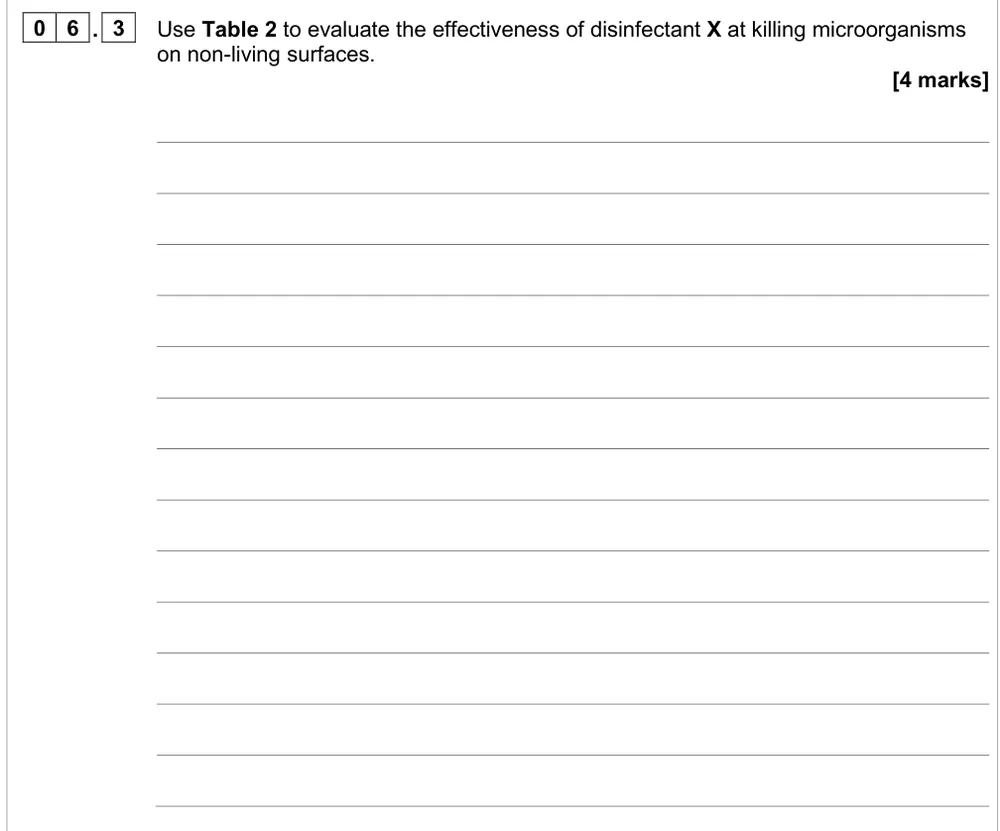
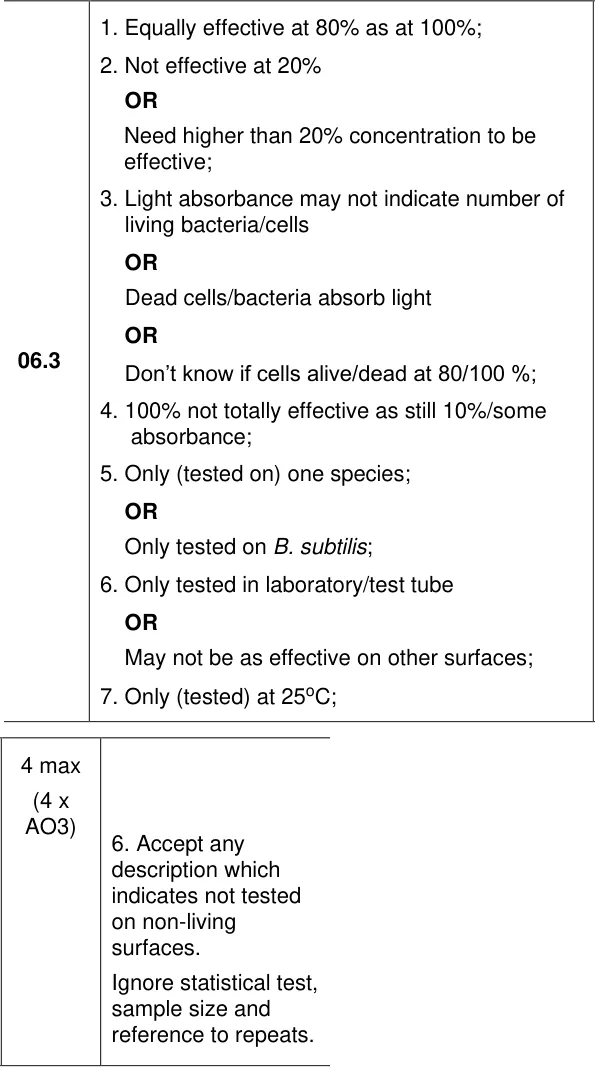
Evaluate how well disinfectant X kills microorganisms on non-living surfaces.
Information from earlier in this question:
Show the mark scheme
Tap an image to open it full size.
From the examiners' report: Many rambling answers just restated the table. Use separate points: what the data show, then the limits, such as dead cells also absorbing light and testing in tubes, not on surfaces.
Question 13
A level Paper 3 · June 2023 · Q03.4 · 2 marks · Medium
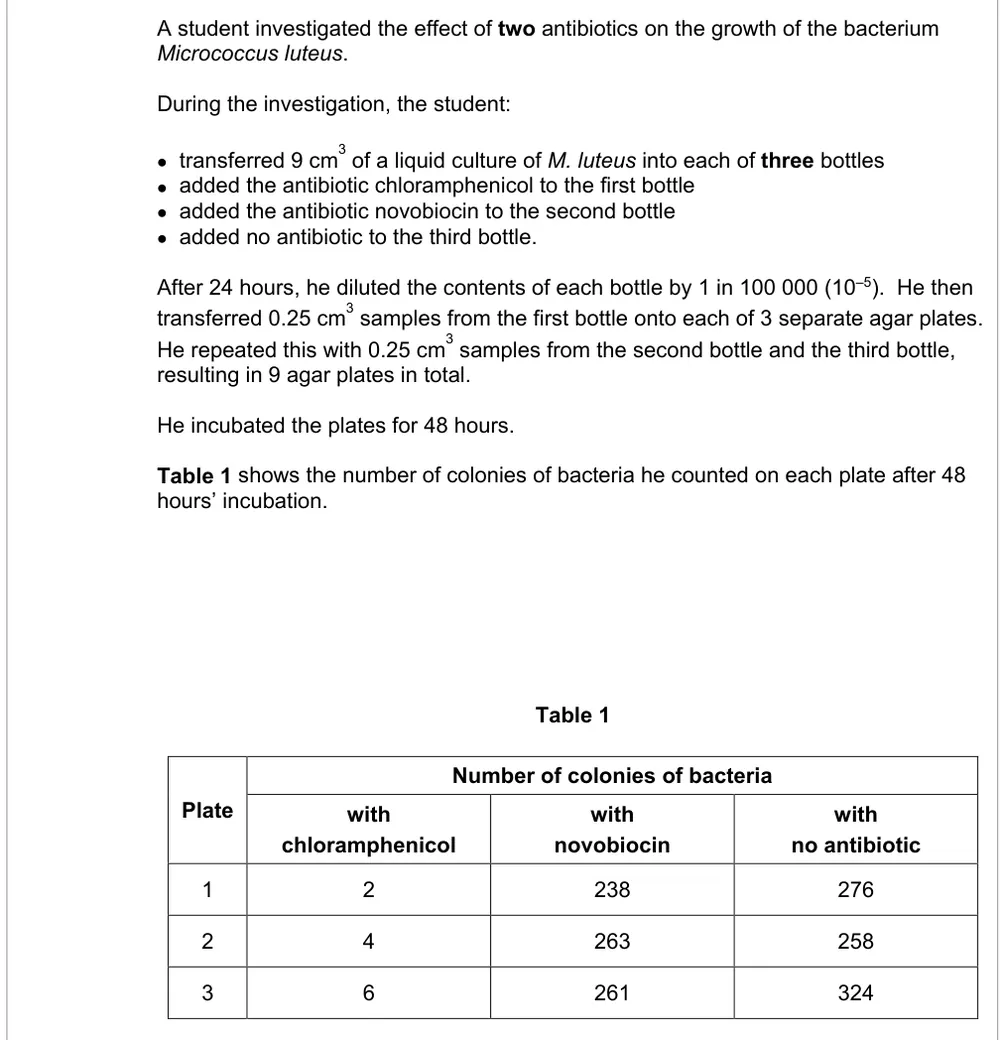
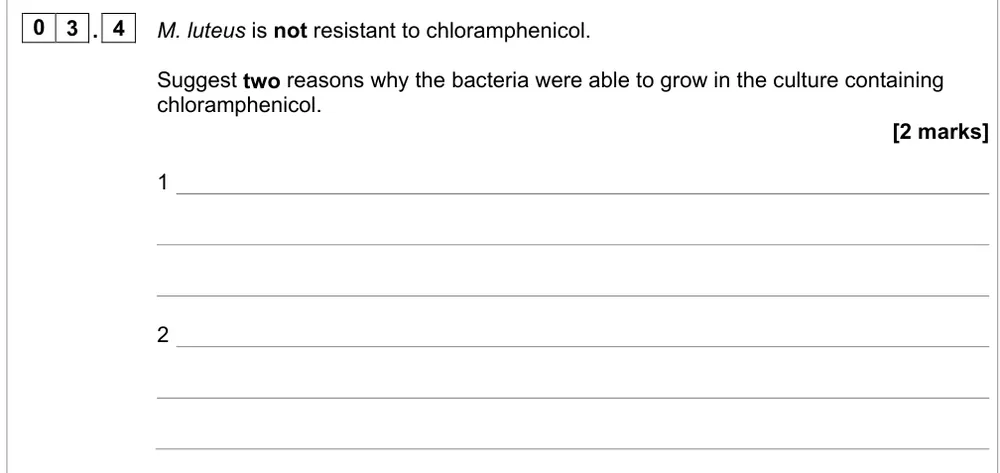
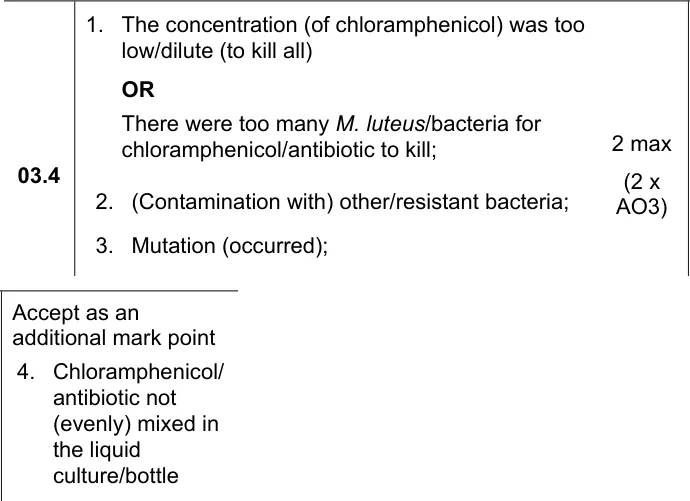
Suggest two reasons why bacteria still grew with chloramphenicol, when M. luteus isn't resistant to it.
Information from earlier in this question:
Show the mark scheme
Tap an image to open it full size.
From the examiners' report: 45% got one mark and 14% both. Read the method: the antibiotic was mixed into the bottle, not spread on the plate. Bacteria become resistant by mutation, never 'immune'.
Dilution series and counting bacteria
Question 14
AS Paper 2 · June 2018 · Q08.1 · 3 marks · Hard
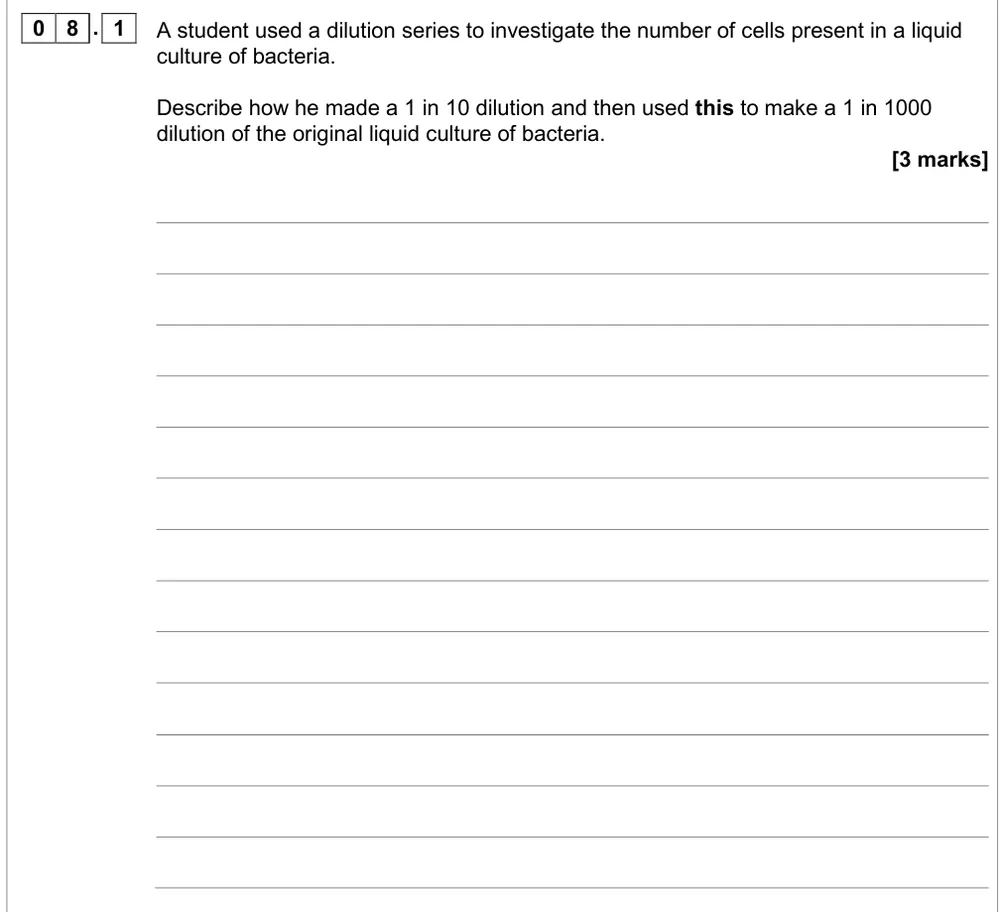
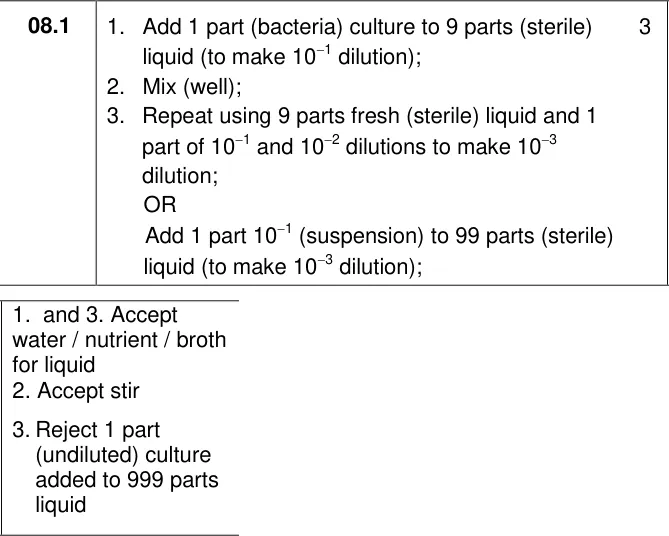
Describe how to make a 1 in 10 dilution of a bacterial culture and use it to make a 1 in 1000 dilution.
Show the mark scheme
Tap an image to open it full size.
From the examiners' report: Only 3.2% got all three, mostly because they didn't mix. 1 in 10 is 1 part culture to 9 parts liquid, not 10, and the 1 in 1000 must be made from the 1 in 10 dilution.
Question 15
AS Paper 2 · June 2018 · Q08.2 · 2 marks · Hard
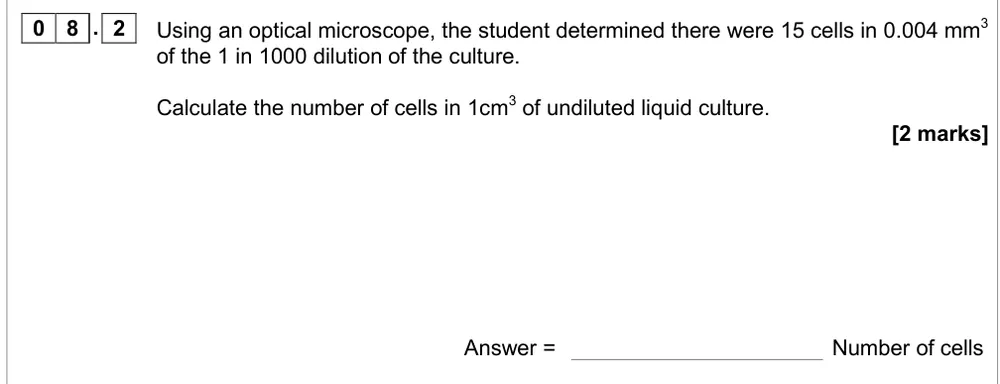
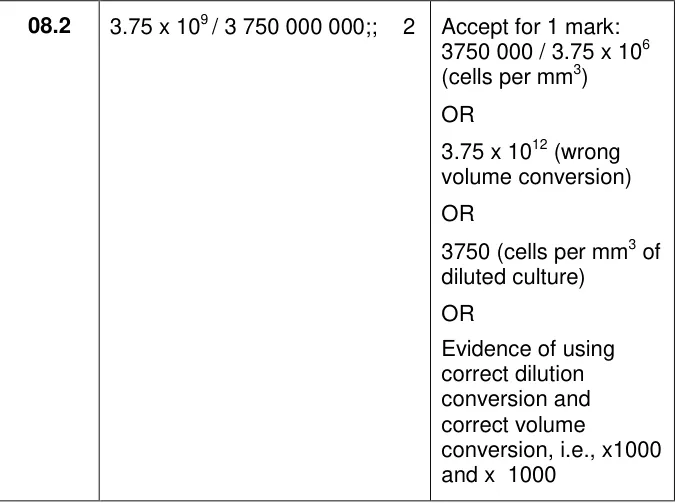
Calculate the number of cells in 1 cm³ of undiluted culture from a count in 0.004 mm³ of a 1 in 1000 dilution.
Show the mark scheme
Tap an image to open it full size.
From the examiners' report: Many missed one step and got one mark, with the number of zeros after 375 varying wildly. Set your working out step by step: per mm³, then × 1000 for the dilution, then × 1000 for cm³.
Question 16
AS Paper 2 · June 2018 · Q08.3 · 2 marks · Hard
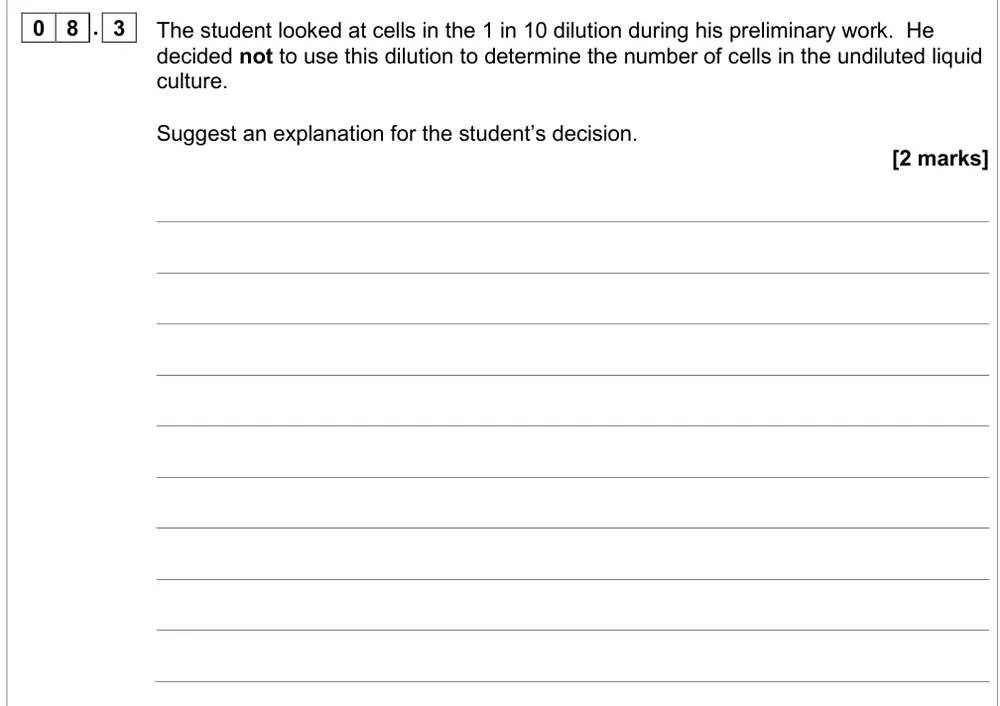
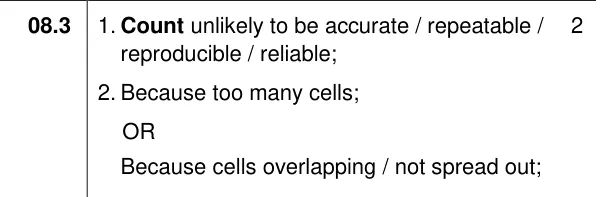
Suggest why the student didn't use the 1 in 10 dilution to count the cells.
Show the mark scheme
Tap an image to open it full size.
From the examiners' report: Many thought a 1 in 10 dilution would have too few cells. It's only slightly diluted, so there are too many to count accurately. 'Time-consuming' didn't score.
Question 17
AS Paper 1 · June 2017 · Q02.2 · 2 marks · Medium
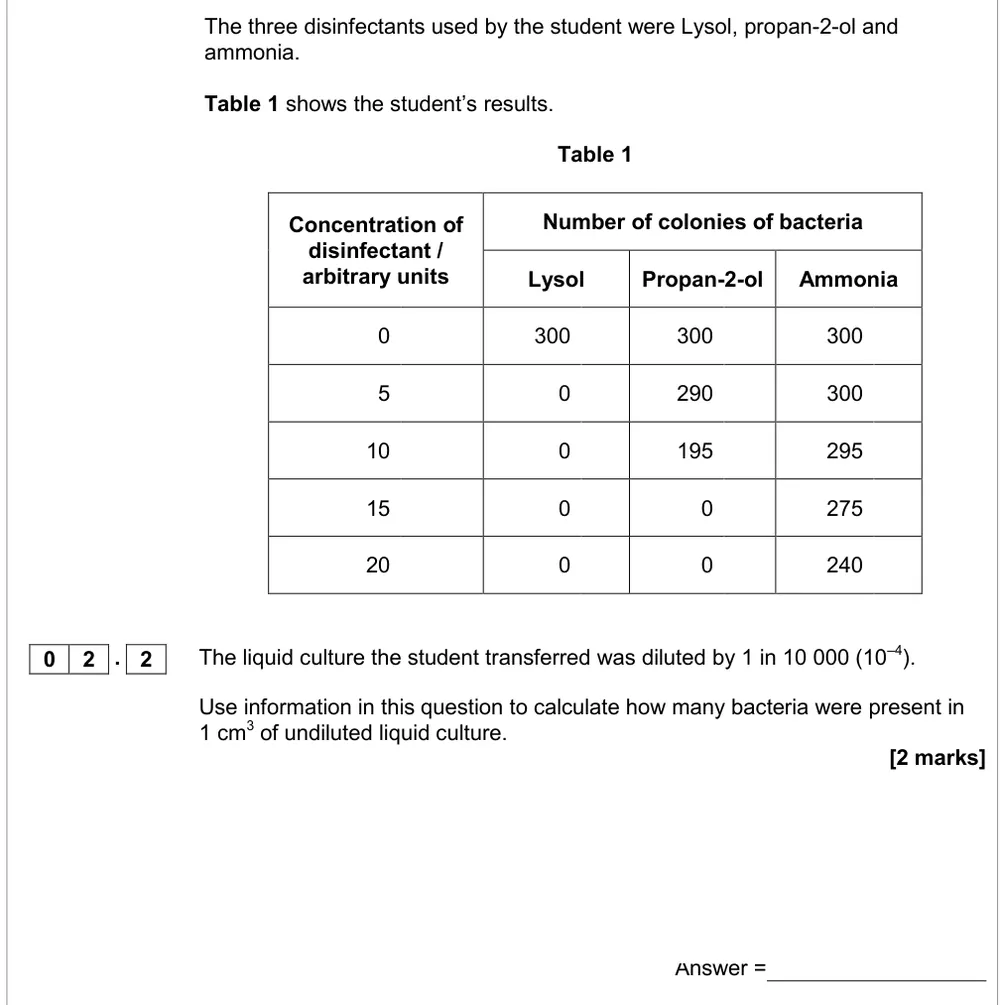
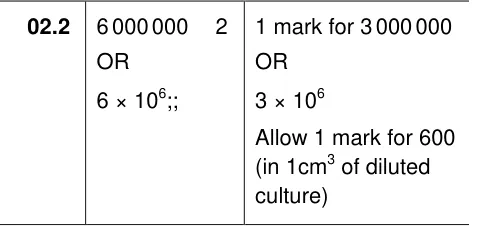
Calculate the number of bacteria in 1 cm³ of undiluted culture from a 1 in 10 000 dilution.
Information from earlier in this question:
Show the mark scheme
Tap an image to open it full size.
From the examiners' report: Only 15.6% got both marks, though it only needs three numbers multiplied together: 300 colonies, × 2 for 1 cm³, × 10 000 for the dilution.
Question 18
A level Paper 3 · June 2023 · Q03.2 · 2 marks · Hard
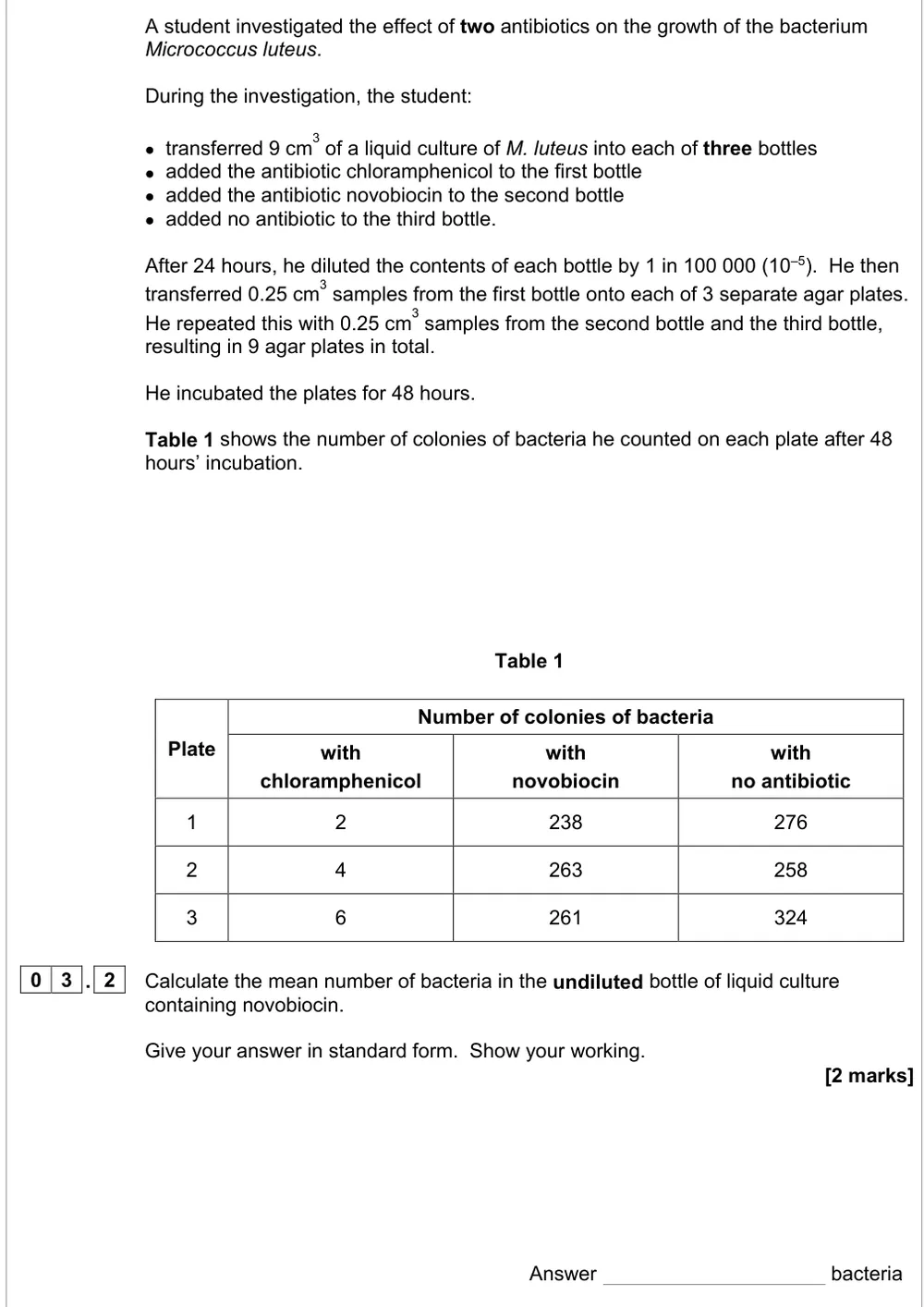
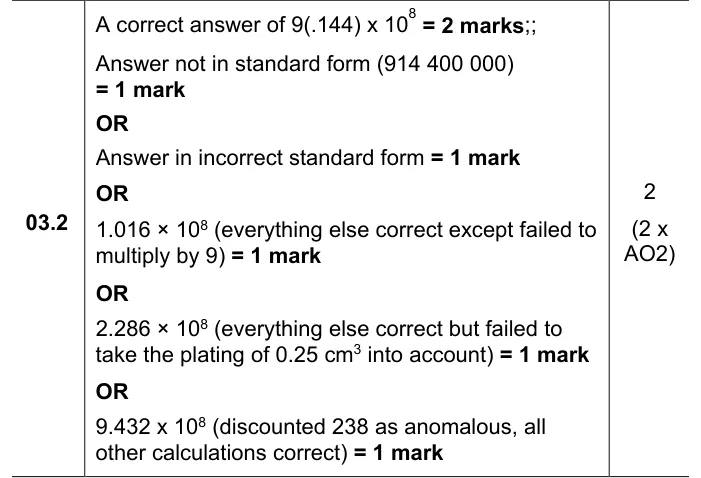
Calculate the mean number of bacteria in the undiluted culture containing novobiocin, in standard form.
Show the mark scheme
Tap an image to open it full size.
From the examiners' report: Only 15% scored 2 marks and 77% scored 0. Work through every step: mean colonies, ÷ 0.25 for 1 cm³, × 100 000 for the dilution, × 9 for the whole bottle.
Where students lose marks (from AQA examiners' reports and mark schemes)
Each point below is followed by wording that gained marks.
Give the reason for each aseptic step: About one third of students scored nothing on describing and explaining three aseptic techniques, because they didn't explain why each step worked or gave a wrong reason. Some described flaming a lid or the agar plate, or didn't say how a loop or spreader was sterilised.
✔ Gains credit: "Flame instrument/equipment to sterilise/kill microbes/prevent contamination"; "Disinfect bench/work on disinfected cloth to kill microbes/prevent contamination."
Lift the Petri dish lid at an angle: Many students were vague, saying they reduced the time the lid was off the plate instead of holding it at an angle. 'Work quickly (with the lid off)' gained no marks.
✔ Gains credit: "Lift lid of (agar) plate at an angle" (lift lid slightly or keep lid over plate accepted).
The Bunsen's air current carries microbes away; it doesn't kill them: Many students mentioned working near a Bunsen burner but few could say why. Answers saying upward air movements kill bacteria or sterilise the air were rejected.
✔ Gains credit: "To create a convection current to carry other contaminants away/prevent them landing on the dish."
Contaminant microbes compete for food and space: 63% gained at least one mark. Chemical contamination didn't score, and many said the bacteria would compete without saying for what, or 'kill' the E. coli without saying how.
✔ Gains credit: "Unknown/new/different microorganisms ... (introduced)"; "(these bacteria) use food/space OR (these bacteria) produce toxins."
Same volume of culture, same number of bacteria: Only 7.6% scored both marks. Students copied the stem ('so it could be poured'), and gave generic answers such as 'to make it a fair test' or 'to control variables'.
✔ Gains credit: "So no contamination/other bacteria"; "So same number of bacteria transferred to allow comparison."
A clear zone on a grown lawn means bacteria were killed: About two thirds got this. Answers that only said growth of bacteria was prevented weren't credited, because the bacteria had already been grown on the agar.
✔ Gains credit: "Bacteria killed" (bacteria destroyed or no living bacteria accepted).
Mix at every step of the dilution series: Only 3.2% scored all three marks, mainly because most didn't mix the diluted suspension. Others added 10 parts liquid to 1 part culture, or 1 part of the 1 in 10 dilution to 999 parts water.
✔ Gains credit: "Add 1 part (bacteria) culture to 9 parts (sterile) liquid"; "Mix (well)"; "Add 1 part 10⁻¹ (suspension) to 99 parts (sterile) liquid."
A negative control well still gets a liquid: 'Doing nothing to the well' was a frequent wrong negative control, and 'adding bacteria to the well' was invalid. Some put water as the positive control and the antimicrobial as the negative.
✔ Gains credit: (Positive control) "Antimicrobial/antibacterial (solution) OR Antibiotic OR Antiseptic/disinfectant"; (Negative control) "(Sterile) water OR Oil (without cinnamon)."
Download the questions
Download the PDF pack (18 questions, mark schemes at the end)
Keep practising
- Required practicals 3 and 11, dilution series and calibration curves: AQA A Level Biology exam questions
- Prokaryotic cells and viruses: AQA A Level Biology exam questions by topic
- Genetic diversity and adaptation: AQA A Level Biology exam questions by topic
- Arithmetic and numerical skills (MS 0): AQA A Level Biology exam questions by topic
- Nutrient cycles: AQA A Level Biology exam questions by topic
- AQA A Level Biology masterclasses
Questions, mark schemes and examiners' report extracts © AQA.