

Arithmetic turns up all over AQA A Level Biology papers, usually as a two-mark calculation tucked inside a question about hearts, ecosystems or cell division. The MS 0 skills in the specification are the basics: using and converting units, working in decimals and standard form, ratios, fractions and percentages, estimating to check an answer, and using the power, eˣ and log buttons on your calculator.
The examiners' reports show that students rarely lose these marks on the biology. They lose them converting joules to kilojoules or mm³ to dm³, giving an answer to the wrong number of significant figures, dividing by the wrong value in a percentage change, splitting a ratio wrongly, or raising the starting number to a power instead of multiplying by 2ⁿ. Every question below is from a real AQA paper, with the mark scheme and the examiners' comments turned into advice.
Answer each question on paper with a calculator, showing every step, before you open the mark scheme. If you'd like help with maths skills, my AQA masterclasses run online on Tuesdays at 5.15pm for Year 12 and on Wednesdays or Thursdays at 6.30pm for Year 13.
What you need from GCSE
Each question on this page assumes you're secure on these GCSE ideas. If any of them feels shaky, look it up before you start.
- GCSE: unit prefixes and conversions: 1 mm = 1000 µm, 1 µm = 1000 nm, 1 kJ = 1000 J, and 1 dm³ = 1000 cm³ = 1 000 000 mm³.
- GCSE: writing numbers in standard form, such as 0.0035 = 3.5 × 10⁻³, and rounding to decimal places and significant figures.
- GCSE: sharing an amount in a ratio, simplifying a ratio, and finding a percentage of an amount.
- GCSE: percentage change = (new value − original value) ÷ original value × 100.
- GCSE: bacterial populations double each generation, so after n generations there are 2ⁿ times as many cells.
Key terms
These words come up in the questions and mark schemes. Examiners expect you to use them exactly.
- Standard form: a number written as A × 10ⁿ, where A is between 1 and 10, for example 1.31 × 10⁸.
- Significant figures: the digits that carry meaning in a number, counted from the first non-zero digit; 0.0155 has 3. An answer shouldn't have more than the least precise data.
- Decimal places: the number of digits after the decimal point; a mean is usually given to one more decimal place than the raw data.
- Unit prefix: a word part that multiplies a unit: k (10³), m (10⁻³), µ (10⁻⁶), n (10⁻⁹).
- Negative index: the AQA way of writing per in a unit, for example kJ g⁻¹ for kilojoules per gram.
- Ratio: a comparison of two amounts, usually given as x : 1 by dividing both by the smaller value.
- Percentage change: the change divided by the original (starting or reference) value, × 100; a decrease gives a negative value.
- Estimate: a quick, rounded calculation used to check that a calculated value is the right size.
- Exponential growth: growth where the number increases by the same factor in each time period, for example doubling every generation (2ⁿ) or Xt = X0 eʳᵗ.
- Logarithm: the power a base must be raised to; log₁₀ 1000 = 3. Undo log₁₀ with the 10ˣ button and a natural log (ln) with eˣ.
What these questions cover (AQA maths skills MS 0: arithmetic and numerical computation)
The questions test these mathematical skills from the AQA AS and A-level Biology specification (7401/7402):
- MS 0.1 Recognise and make use of appropriate units in calculations
- MS 0.2 Recognise and use expressions in decimal and standard form
- MS 0.3 Use ratios, fractions and percentages
- MS 0.4 Estimate results (the only MS 0.4 part available; it is also a ratio question)
- MS 0.5 Use calculators to find and use power, exponential and logarithmic functions
How to use this page
Write your answer on paper before you open the mark scheme. Allow about 1.3 minutes per mark: the 17 questions are worth 32 marks, so about 42 minutes in total. Then mark your answer strictly against the mark scheme and read the examiners' tip underneath it. If you'd rather print the questions, download the PDF pack.
Units and conversions (MS 0.1)
Question 1
AS Paper 2 · June 2016 · Q02.1 · 1 mark
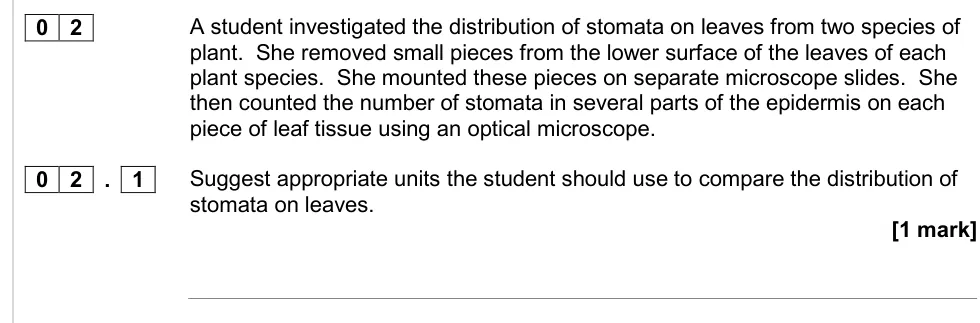
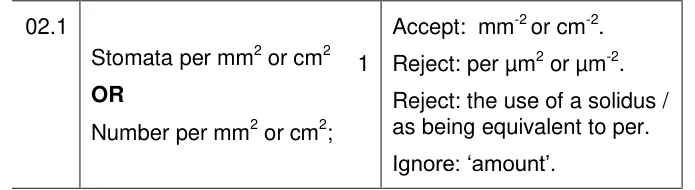
Suggest suitable units for comparing the distribution of stomata on two leaves.
Show the mark scheme
Tap an image to open it full size.
From the examiners' report: Most students got this wrong, giving units of length or volume. Distribution on a surface means a number per unit area: stomata per mm² (or mm⁻²), not /mm².
Question 2
A level Paper 3 · June 2018 · Q06.1 · 2 marks · Medium
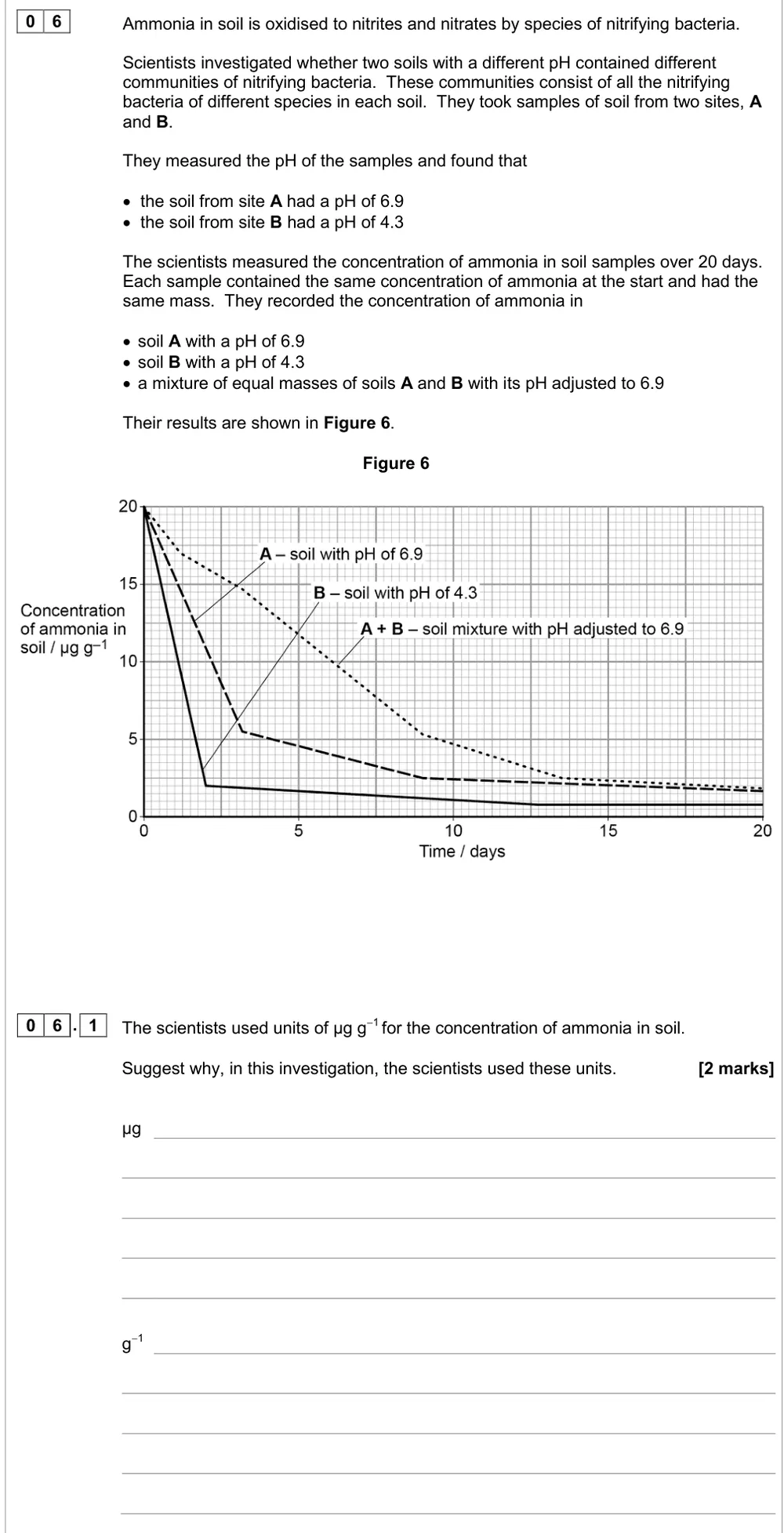
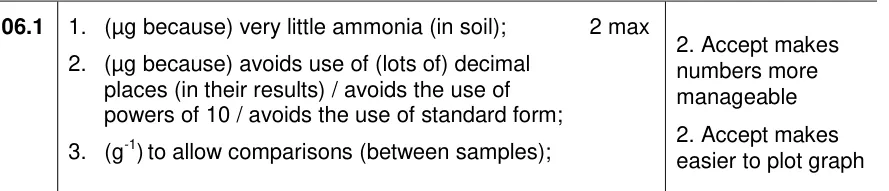
Suggest why scientists gave ammonia concentration in soil in µg g⁻¹.
Show the mark scheme
Tap an image to open it full size.
From the examiners' report: 22% got both marks and 31% scored nothing. Explain each part of the unit: µg because the amounts are tiny (no long decimals), and per gram so samples of soil can be compared. It isn't because ammonia is a small molecule.
Question 3
A level Paper 2 · June 2025 · Q03.2 · 2 marks · Easy
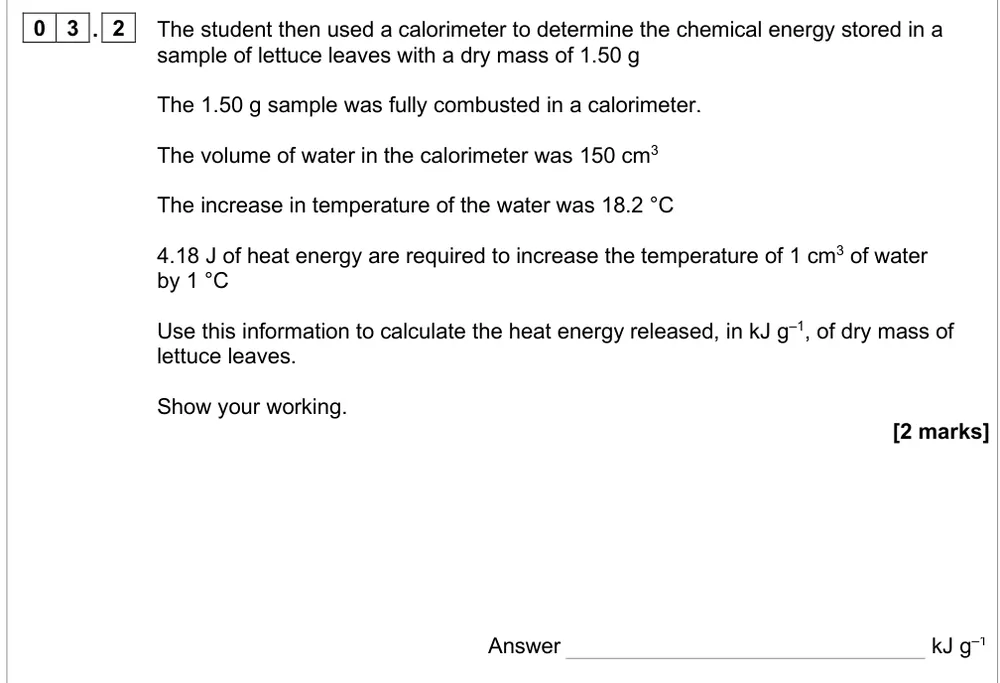
Calculate the heat energy released per gram of lettuce in a calorimeter, in kJ g⁻¹.
Show the mark scheme
Tap an image to open it full size.
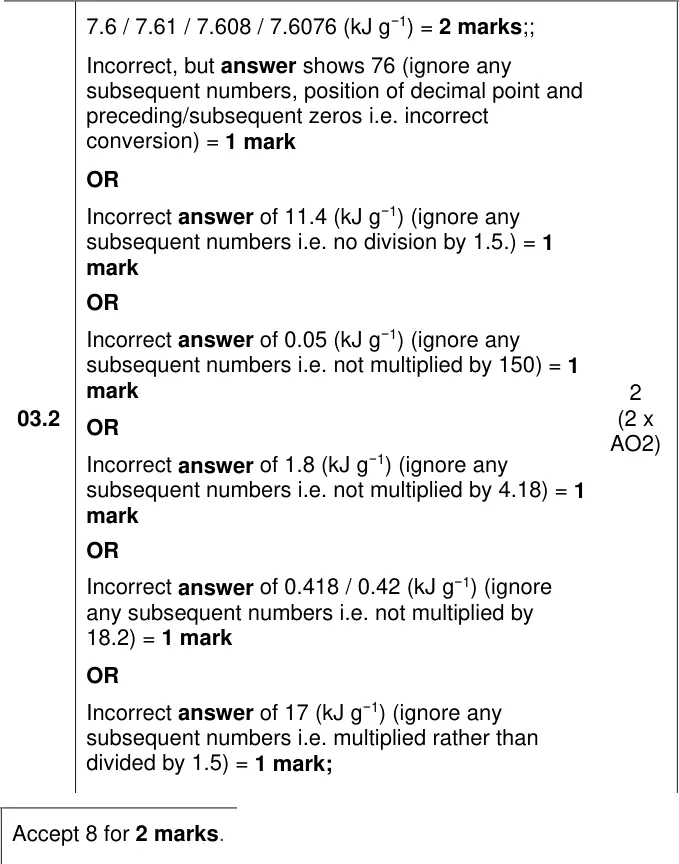
From the examiners' report: About half got both marks. The usual slip was joules to kilojoules: 150 × 18.2 × 4.18 = 11 412 J = 11.4 kJ, then divide by 1.5 g.
Question 4
AS Paper 2 · June 2024 · Q02.2 · 2 marks
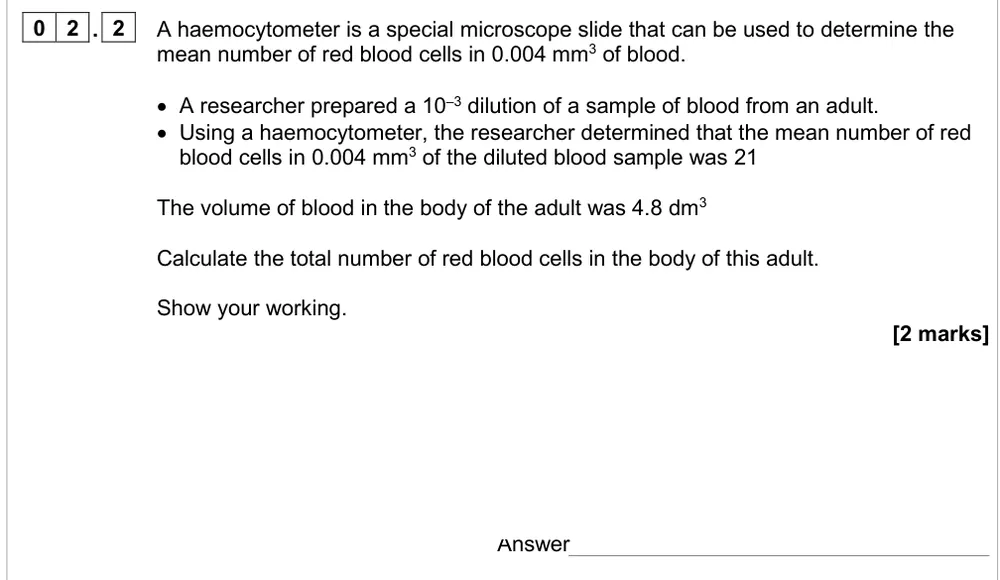
Scale a haemocytometer count up to the number of red blood cells in the whole body.
Show the mark scheme
Tap an image to open it full size.
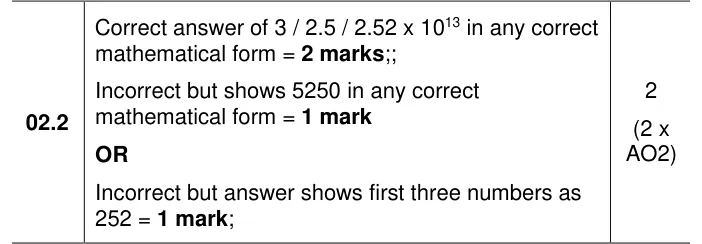
From the examiners' report: Far fewer got full marks here; most errors were in scaling from mm³ to dm³. Work out cells per mm³ (21 ÷ 0.004 × 1000), then remember 1 dm³ = 10⁶ mm³.
Question 5
A level Paper 2 · November 2021 · Q10.2 · 2 marks · Hard
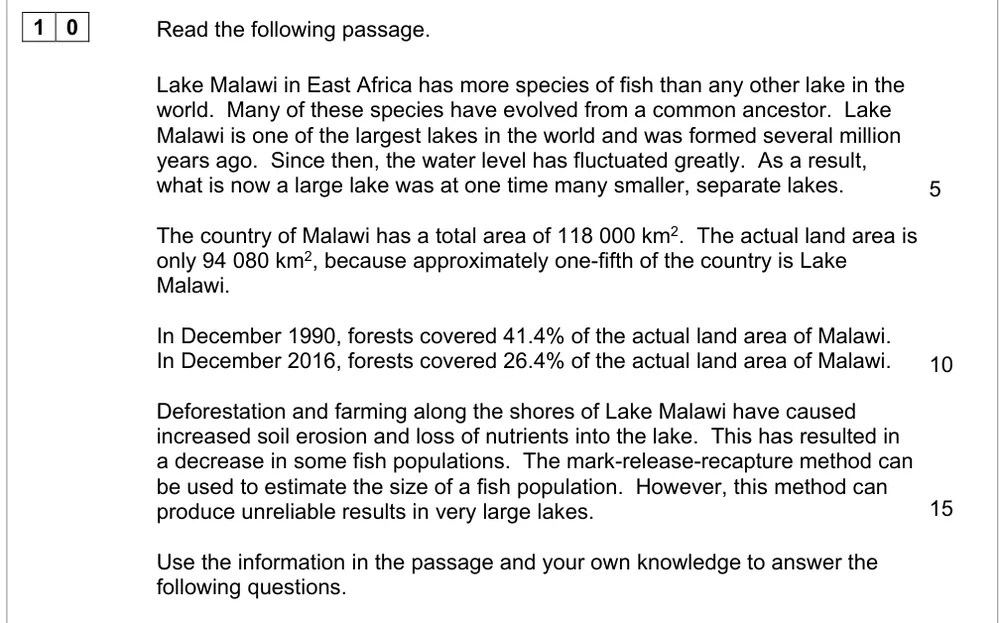
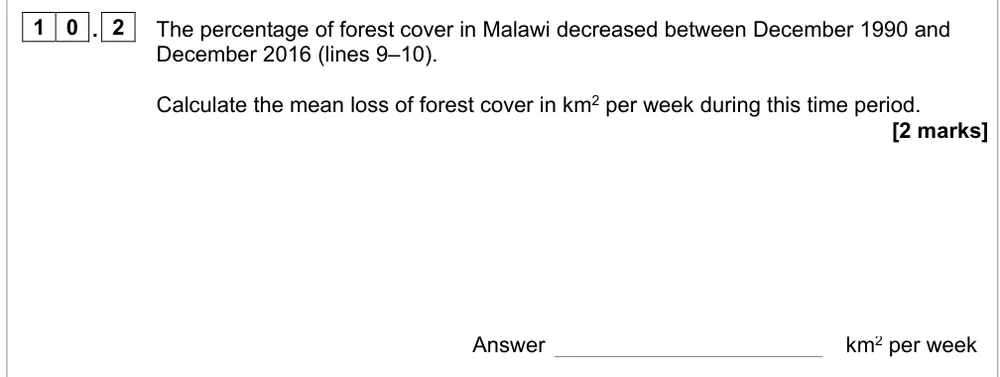
Calculate the mean loss of forest cover in Malawi in km² per week from 1990 to 2016.
Information from earlier in this question:
Show the mark scheme
Tap an image to open it full size.
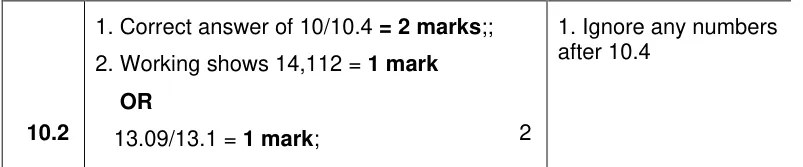
From the examiners' report: 45% got both marks. Use the land area (94 080 km²), not the country's total area, and 26 years × 52 weeks. Examiners saw years of 48, 54 and even 60 weeks.
Decimals and standard form (MS 0.2)
Question 6
AS Paper 2 · June 2019 · Q02.3 · 2 marks · Easy
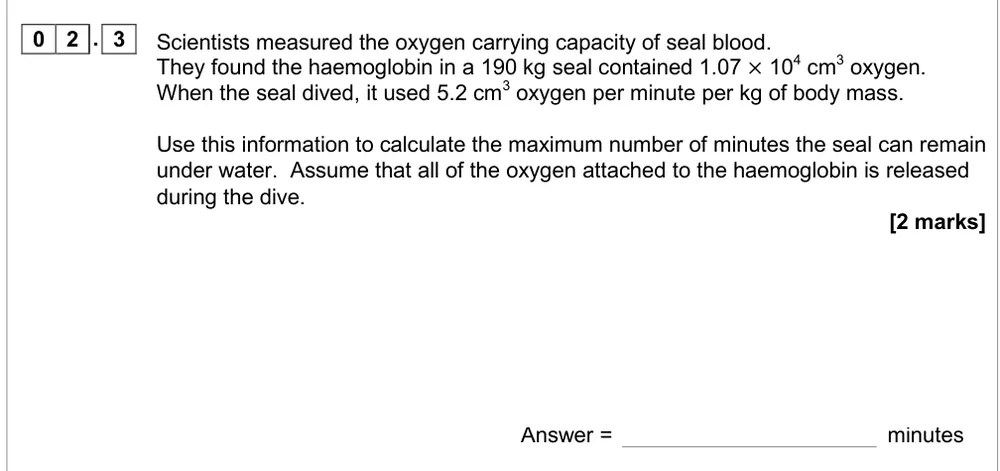
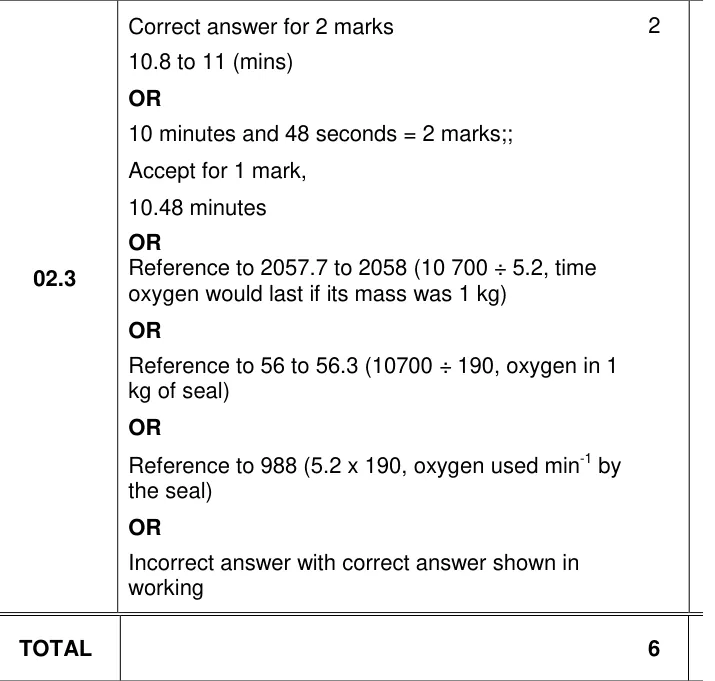
Calculate how long a diving seal's oxygen store would last, using a number in standard form.
Show the mark scheme
Tap an image to open it full size.
From the examiners' report: About 80% got at least one mark. Marks were lost by rounding the answer down, or by working out the time for a 1 kg seal. Find the seal's use per minute first (5.2 × 190).
Question 7
A level Paper 3 · June 2025 · Q04.3 · 2 marks · Medium
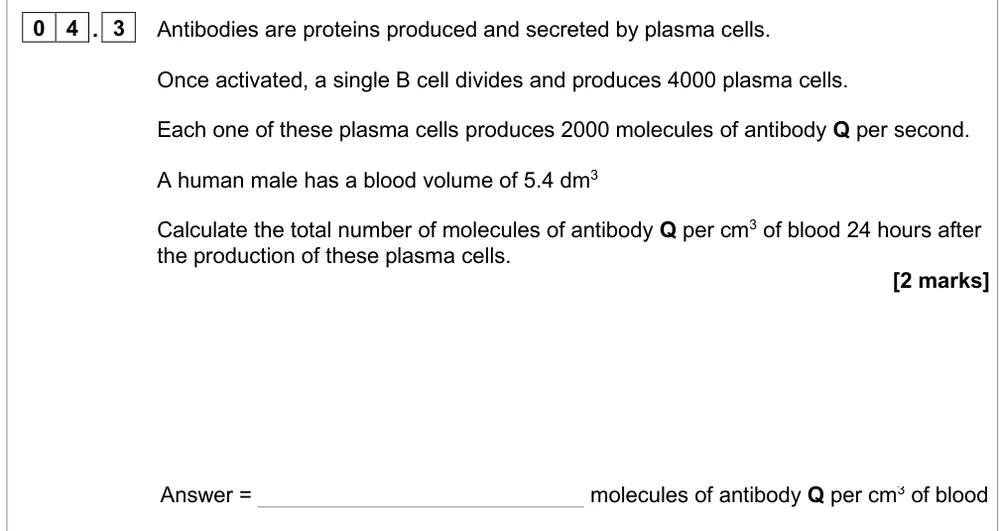
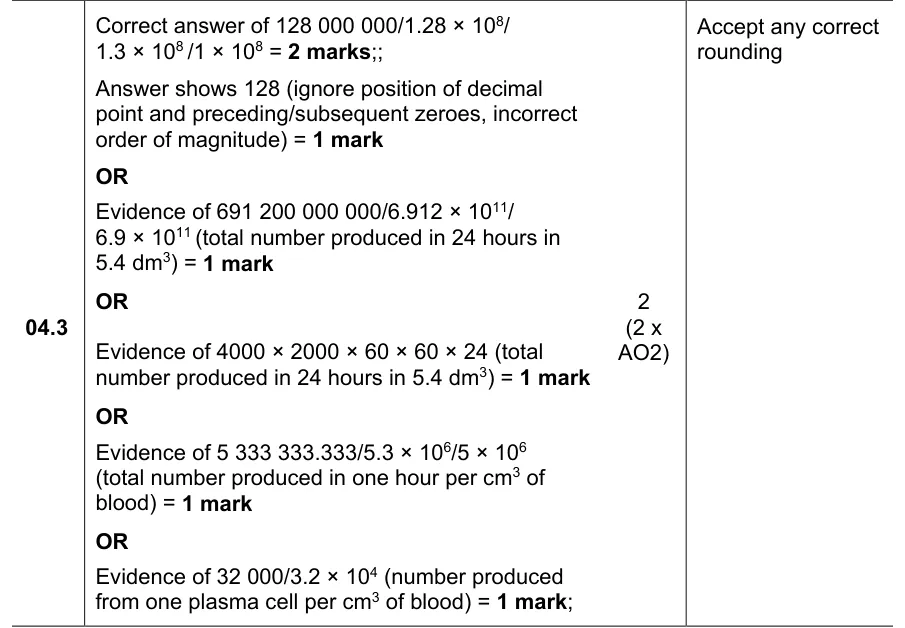
Calculate the number of antibody molecules per cm³ of blood after 24 hours.
Show the mark scheme
Tap an image to open it full size.
From the examiners' report: Under half got both marks; most slips were converting dm³ to cm³ or writing standard form wrongly. The answer didn't have to be in standard form, so if you're unsure, leave the full number.
Question 8
AS Paper 2 · June 2023 · Q09.2 · 2 marks · Medium
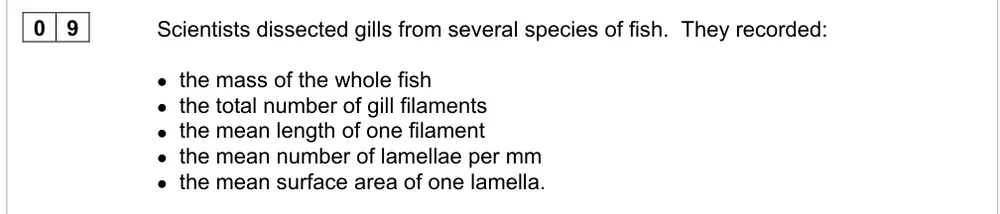
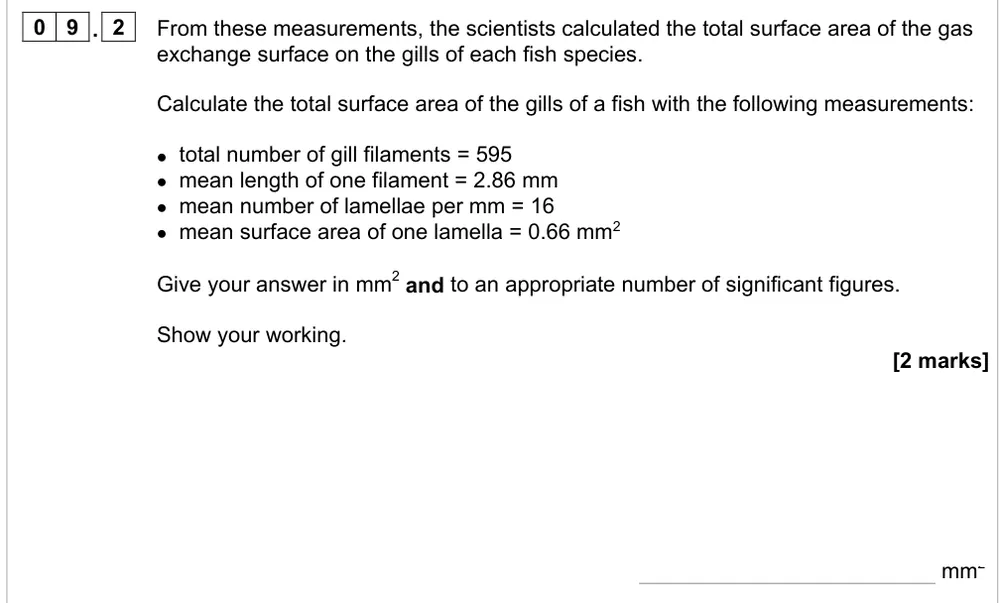
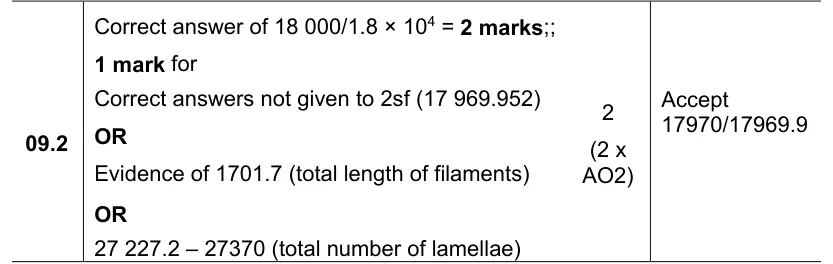
Calculate the total surface area of a fish's gills to an appropriate number of significant figures.
Information from earlier in this question:
Show the mark scheme
Tap an image to open it full size.
From the examiners' report: Just over two-thirds got at least 1 mark. The least precise value (0.66) has 2 significant figures, so give 18 000 mm², not 17 969.952.
Question 9
A level Paper 3 · June 2022 · Q05.4 · 2 marks · Medium
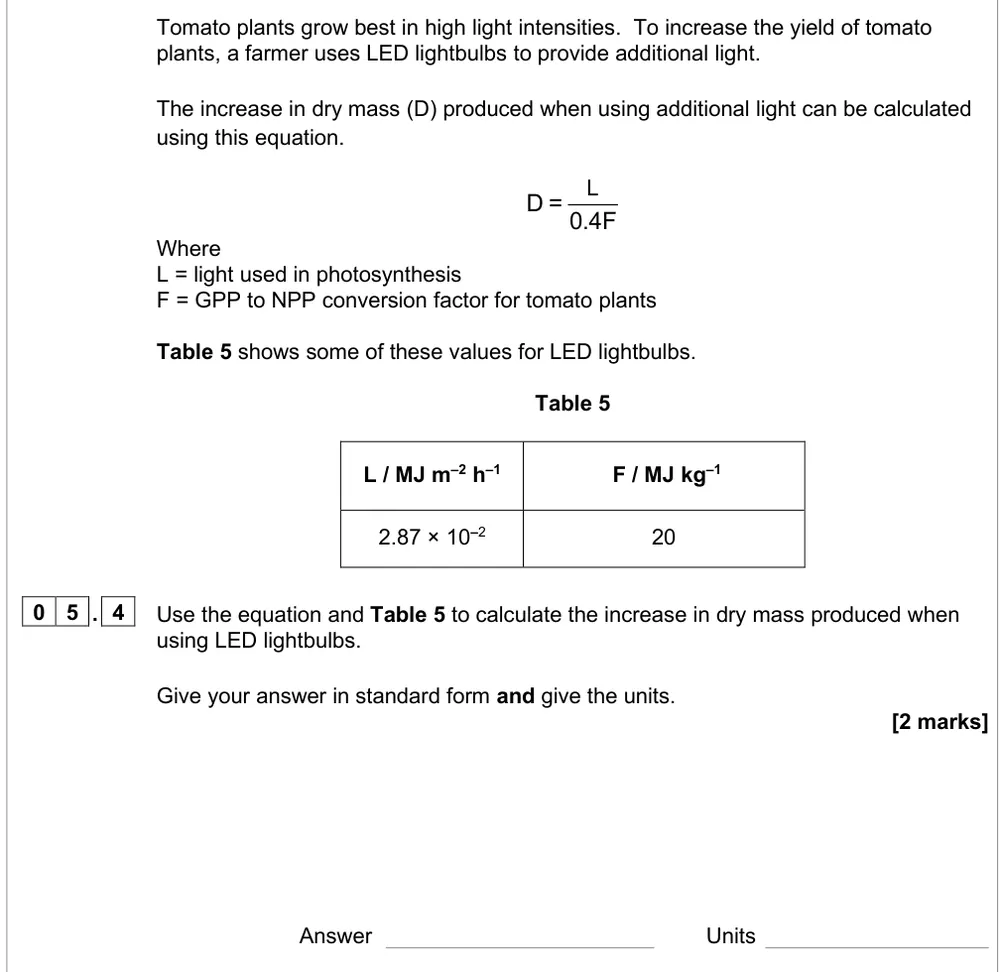
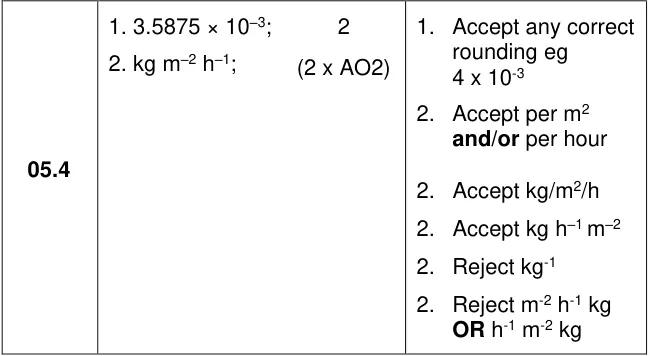
Use an equation to calculate the increase in dry mass of tomatoes, in standard form with units.
Show the mark scheme
Tap an image to open it full size.
From the examiners' report: 60% scored the mark for the number but only 23% got the units too. Cancel the units as you divide: MJ cancels, leaving a mass per area per time, kg m⁻² h⁻¹.
Ratios, fractions and percentages (MS 0.3)
Question 10
AS Paper 2 · June 2019 · Q08.2 · 1 mark · Easy
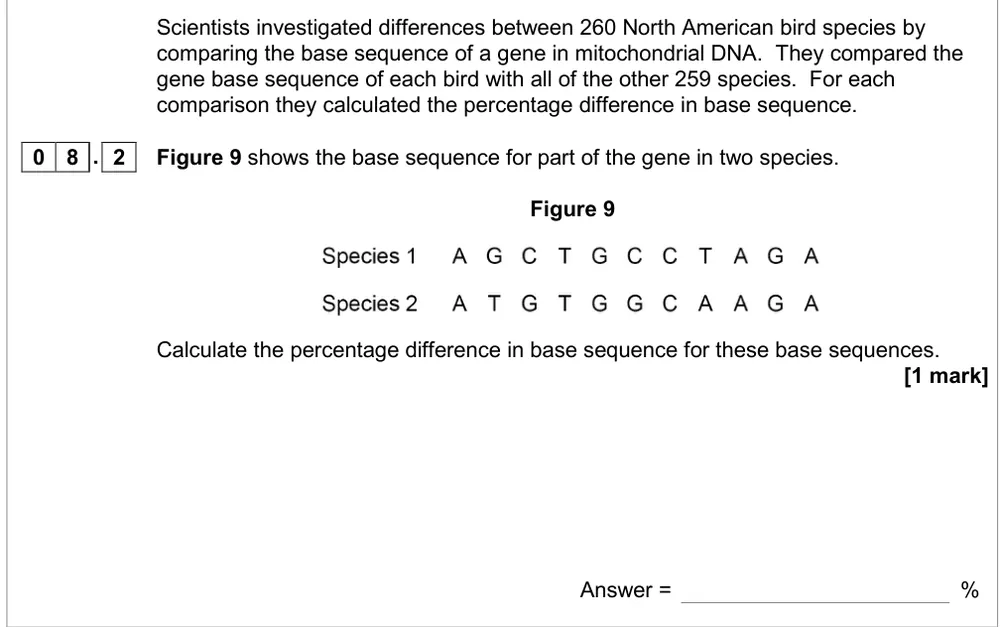
Calculate the percentage difference between two short base sequences.
Show the mark scheme

Tap an image to open it full size.
From the examiners' report: About two-thirds got this. Count the bases that differ (4 out of 11); some miscounted or gave the percentage that is the same instead of the difference.
Question 11
A level Paper 2 · June 2018 · Q06.4 · 2 marks · Easy
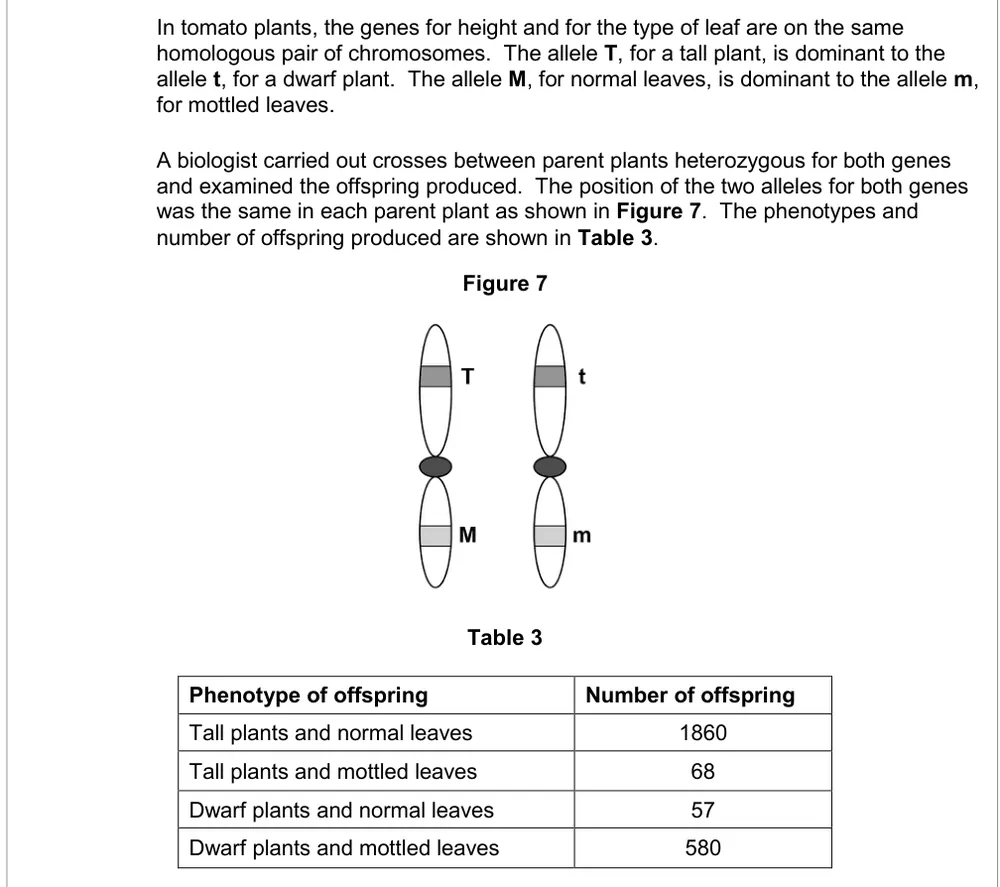
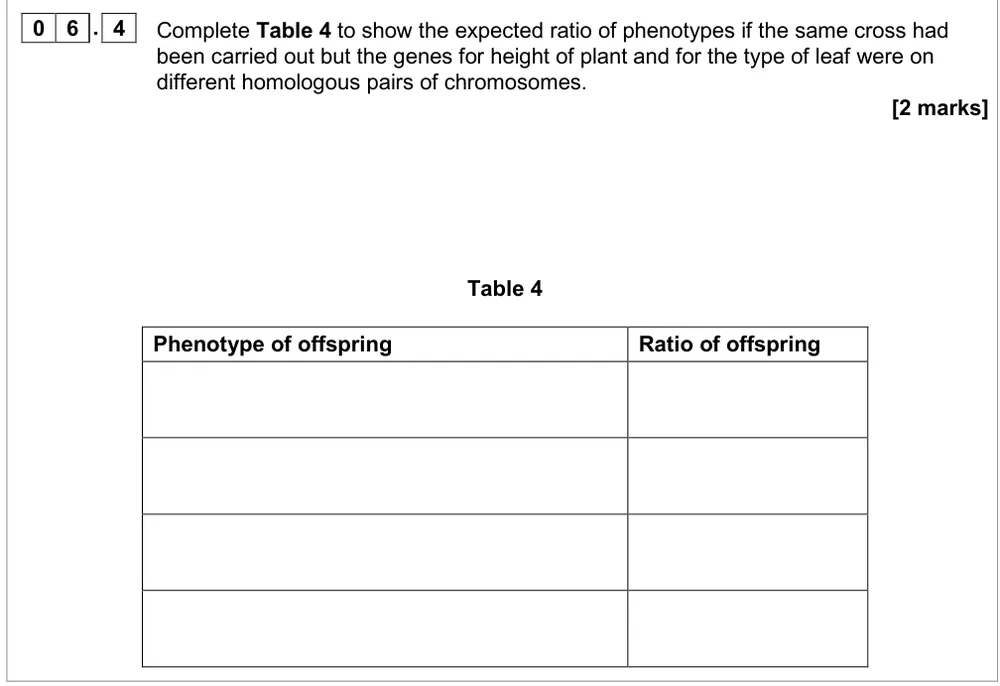
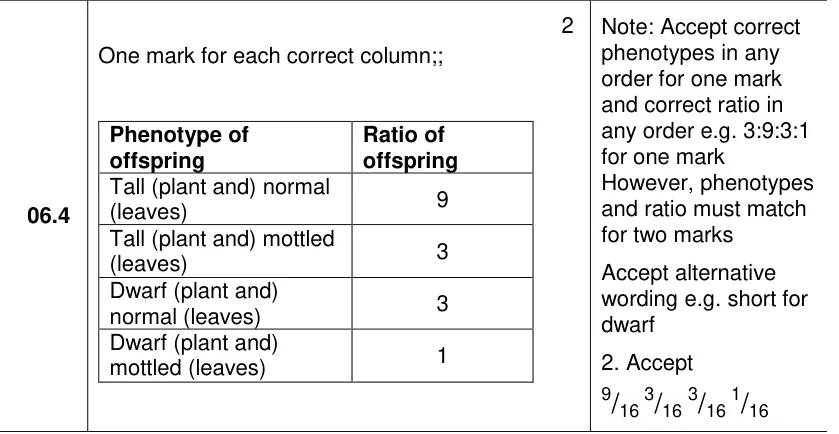
Give the expected phenotypic ratio from a dihybrid cross if the genes were not linked.
Information from earlier in this question:
Show the mark scheme
Tap an image to open it full size.
From the examiners' report: Almost half got both marks. A cross between two double heterozygotes with unlinked genes gives 9 : 3 : 3 : 1; 1 : 1 : 1 : 1 was a common wrong answer.
Question 12
A level Paper 1 · June 2024 · Q08.3 · 3 marks
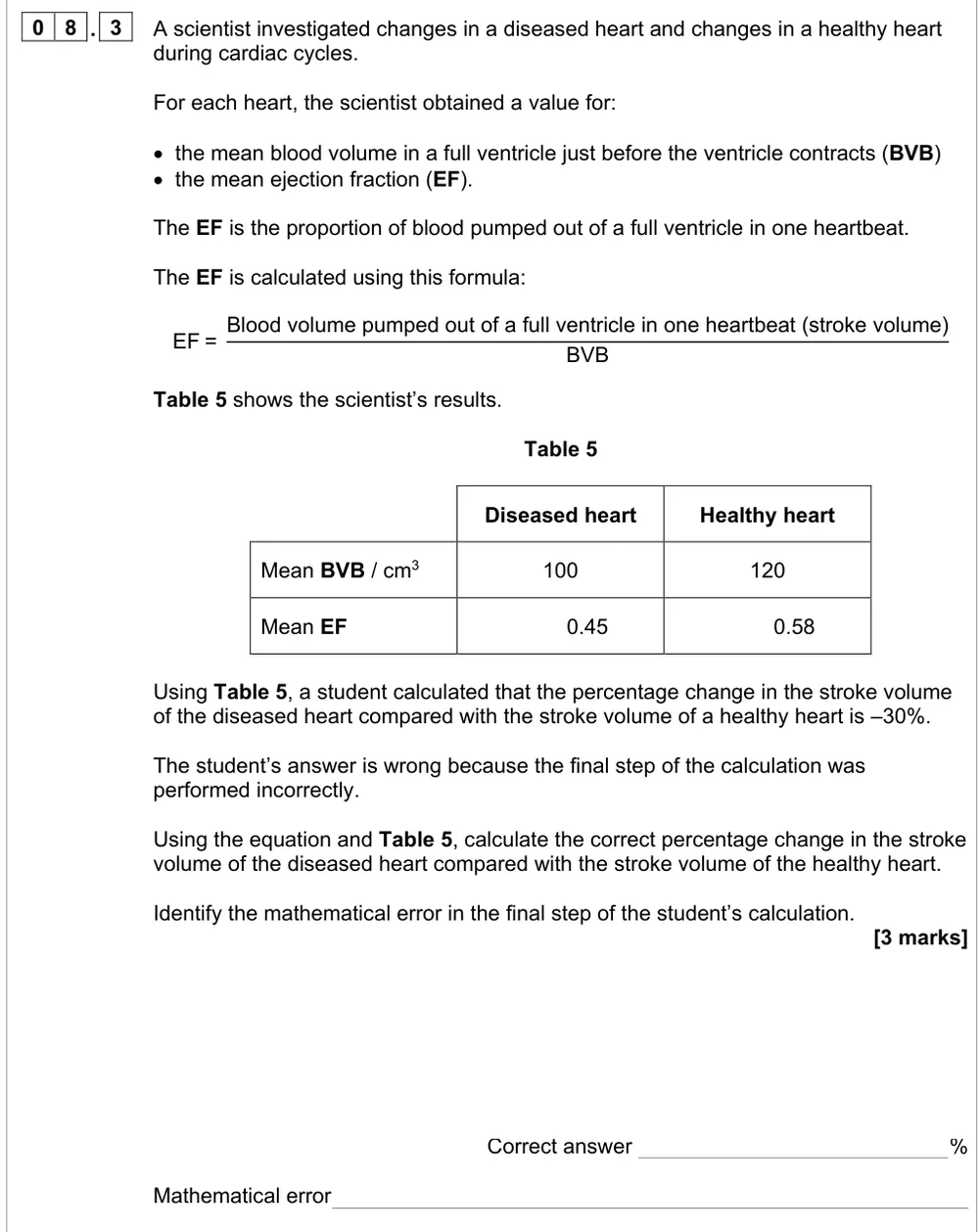
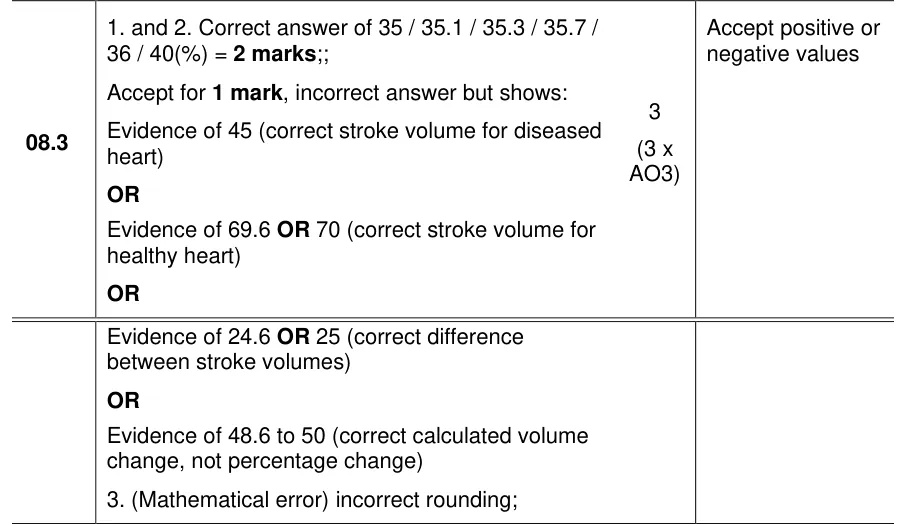
Calculate the correct percentage change in stroke volume and find the student's mistake.
Show the mark scheme
Tap an image to open it full size.
From the examiners' report: Over three-quarters rearranged the formula correctly. Divide the change by the healthy heart's stroke volume (69.6), not the diseased one (−55% was common), and round −35.34 correctly. The student's error was rounding to one significant figure.
Question 13
A level Paper 2 · June 2019 · Q01.2 · 1 mark · Hard
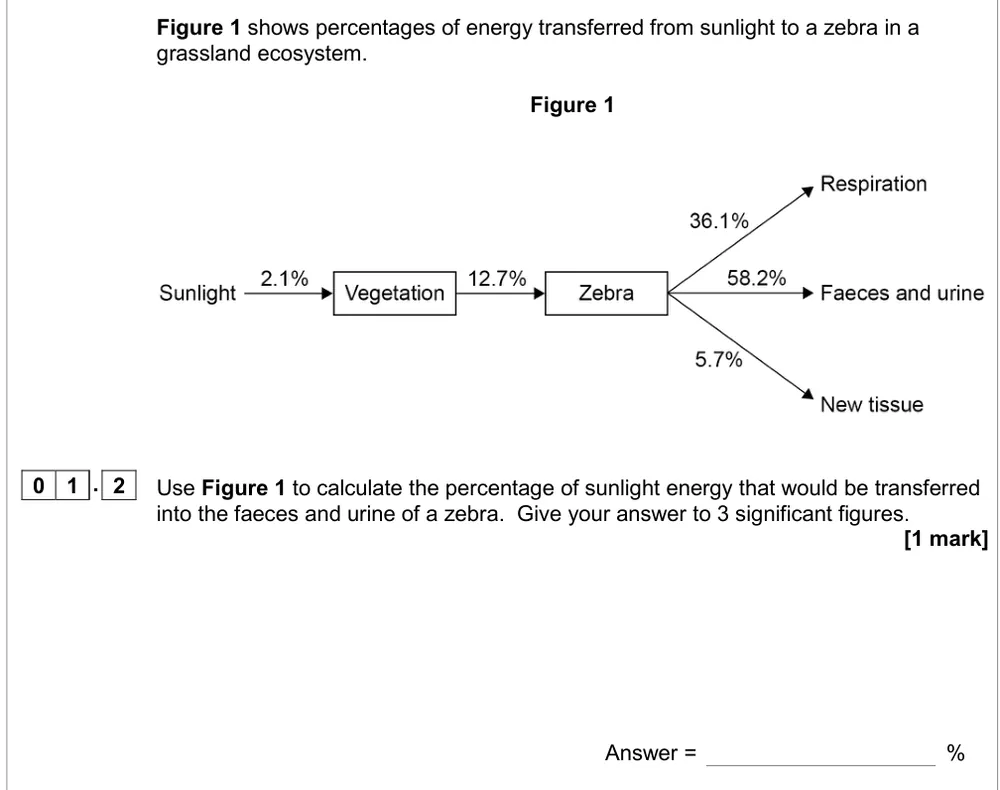
Calculate the percentage of sunlight energy that ends up in a zebra's faeces and urine.
Show the mark scheme

Tap an image to open it full size.
From the examiners' report: About a third got this. Multiply the percentages as decimals (0.021 × 0.127 × 0.582 × 100) and give 3 significant figures; many were out by a power of ten.
Estimating results (MS 0.4)
Question 14
AS Paper 2 · June 2022 · Q02.4 · 2 marks · Easy
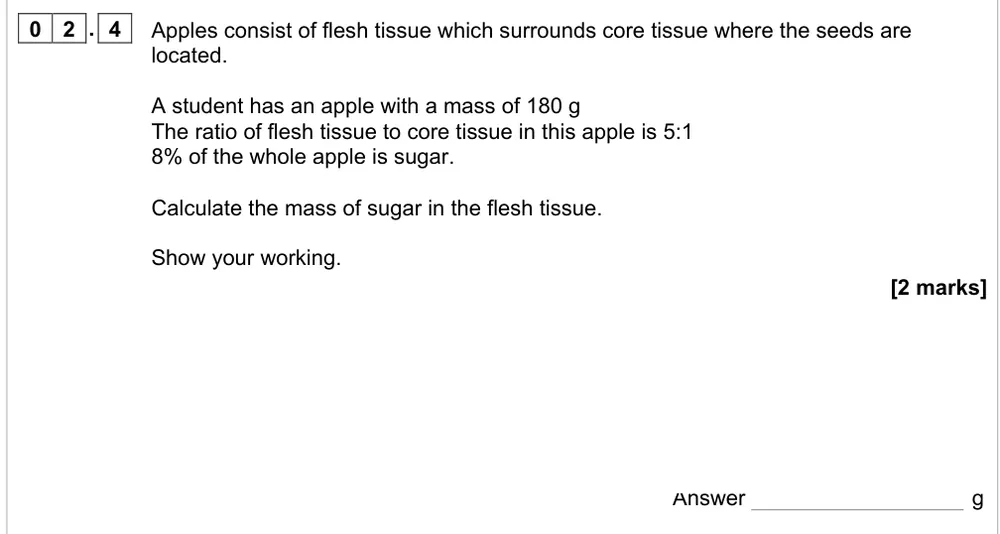
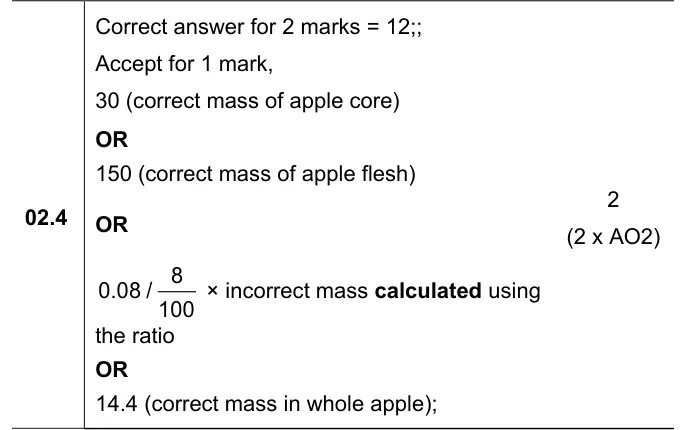
Use a ratio and a percentage to calculate the mass of sugar in the flesh of an apple.
Show the mark scheme
Tap an image to open it full size.
From the examiners' report: 66% got both marks. A 5 : 1 ratio means six parts, so the flesh is 150 g. A quick estimate (8% of 180 g is under 15 g) tells you the answer must be smaller than that.
Powers, exponentials and logs (MS 0.5)
Question 15
A level Paper 2 · November 2020 · Q03.5 · 2 marks · Medium
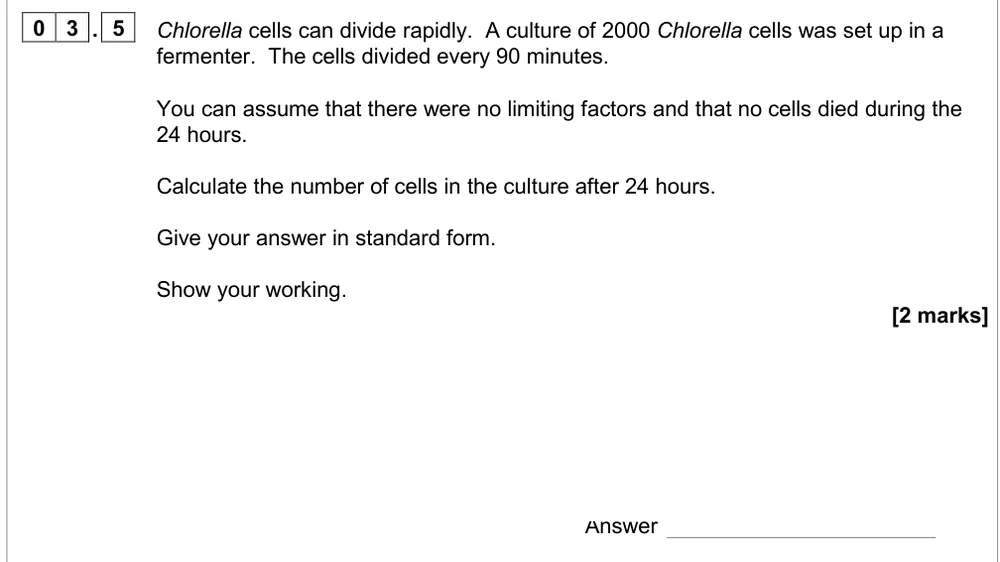
Calculate the number of Chlorella cells after 24 hours of dividing every 90 minutes.
Information from earlier in this question:

Show the mark scheme
Tap an image to open it full size.
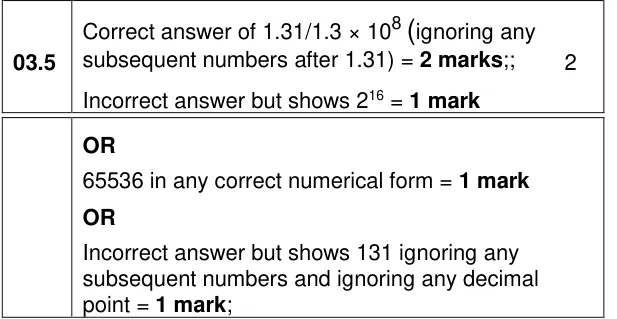
From the examiners' report: Half scored zero, though about 37% got it right. Work out the divisions (24 ÷ 1.5 = 16), then 2000 × 2¹⁶, not 2000¹⁶. Finish in standard form.
Question 16
A level Paper 2 · June 2018 · Q03.6 · 2 marks · Easy
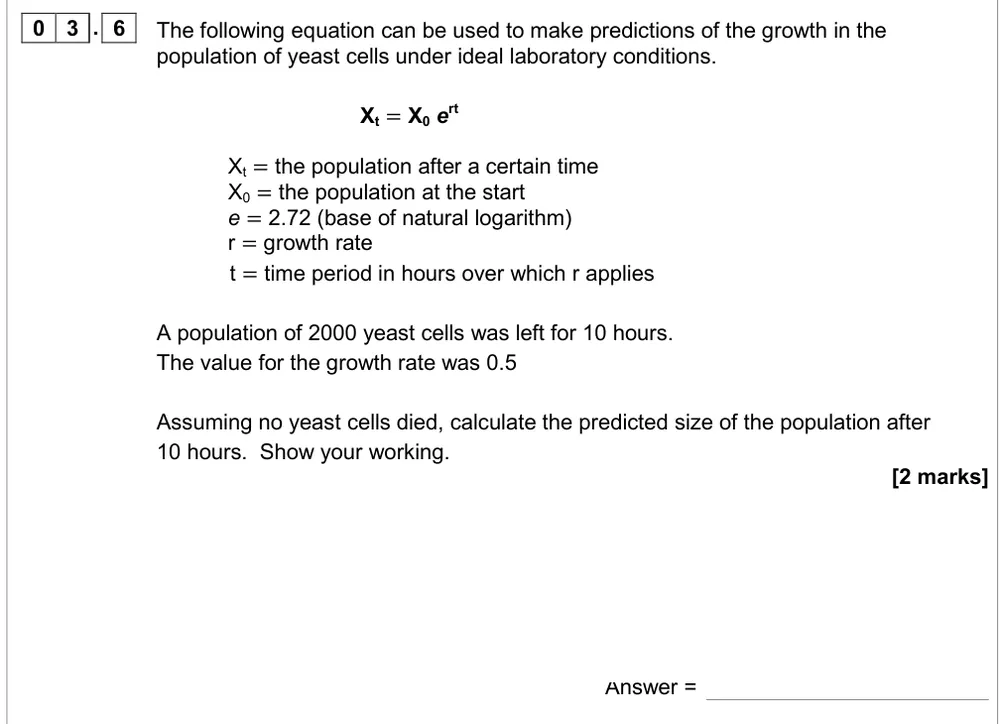
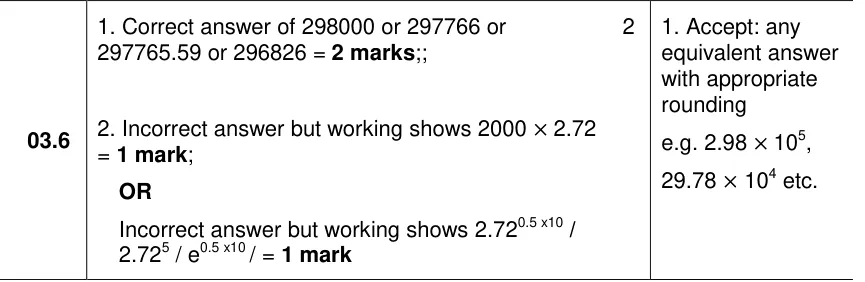
Use Xt = X0 e^rt to predict a yeast population after 10 hours.
Show the mark scheme
Tap an image to open it full size.
From the examiners' report: Over 75% got both marks. Work out the power first (rt = 5), use the eˣ button, then multiply by 2000.
Question 17
A level Paper 3 · November 2021 · Q04.4 · 2 marks · Medium
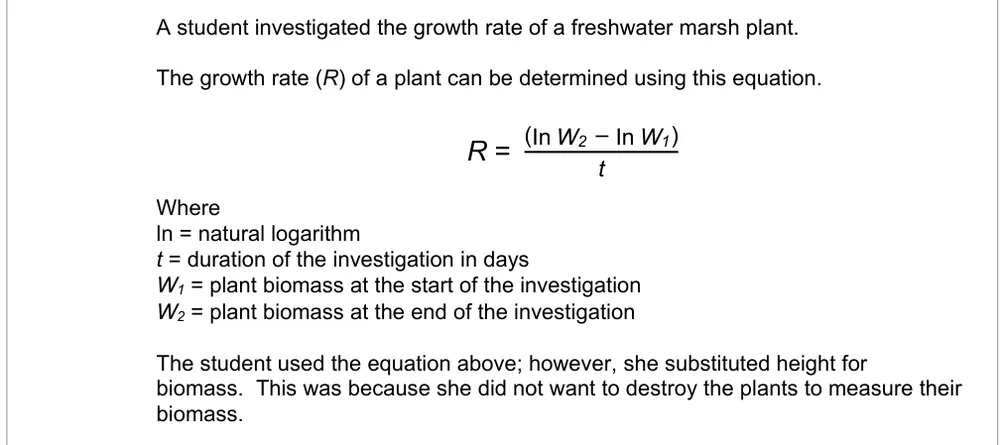
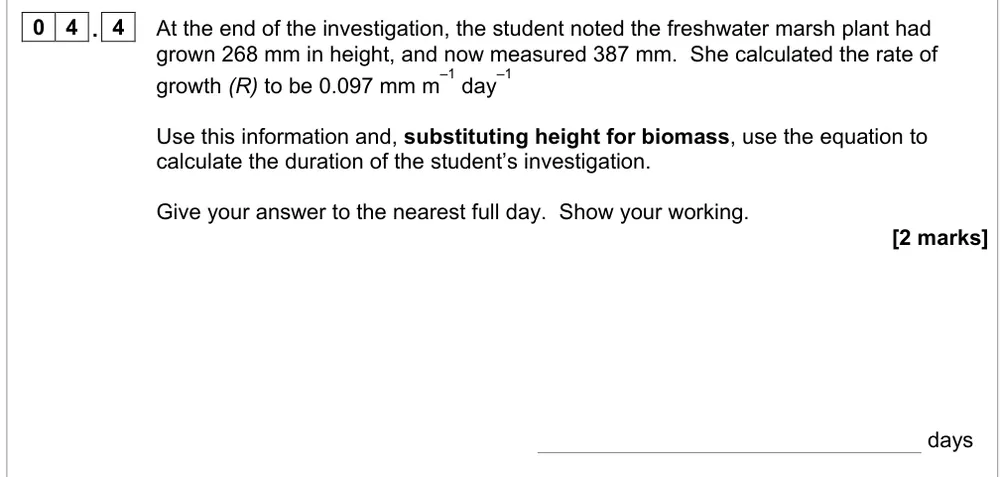
Rearrange a natural log growth-rate equation to find how long an investigation lasted.
Information from earlier in this question:
Show the mark scheme
Tap an image to open it full size.
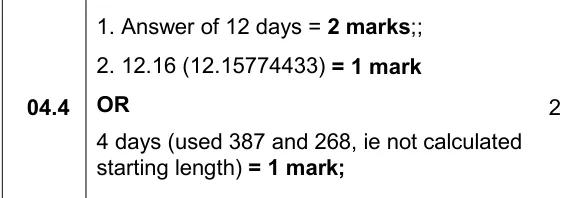
From the examiners' report: 35% got both marks. Most who scored one used 268 as the starting height: work out W1 first (387 − 268 = 119 mm), then t = (ln 387 − ln 119) ÷ 0.097.
Where students lose marks (from AQA examiners' reports and mark schemes)
Each point below is followed by wording that gained marks.
Stomata per mm², not per mm: Most students couldn't give units to compare the distribution of stomata on leaves: answers were lengths or volumes, from nanometres to metres, and many wrote per as a solidus.
✔ Gains credit: "Stomata per mm²" (accept mm⁻² or cm⁻²).
Explain both halves of µg g⁻¹: Only 22% got both marks for explaining the units of ammonia concentration. Many said µg was used because ammonia is a small molecule.
✔ Gains credit: "µg because there is very little ammonia, so it avoids lots of decimal places; per g allows comparisons between samples."
Joules to kilojoules: In the lettuce calorimetry question, students who scored nothing had nearly always made a conversion error between joules and kilojoules; others forgot to divide by the 1.5 g sample and got 11.4.
✔ Gains credit: 7.6 kJ g⁻¹.
Land area and 52 weeks: Some students used Malawi's total area (118 000 km²) instead of its land area (94 080 km²). Examiners were surprised to see a year given as 48, 54 and even 60 weeks.
✔ Gains credit: 15% of 94 080 = 14 112 km² over 26 years; 14 112 ÷ (26 × 52) = 10.4 km² per week.
Cancel the units to find the new one: 60% substituted into the dry mass equation correctly, but only 23% gave the right units. Some answers didn't even start with a unit of mass.
✔ Gains credit: 3.5875 × 10⁻³ kg m⁻² h⁻¹.
Percentages of percentages: Only about a third found the percentage of sunlight energy in the zebra's faeces and urine. Many were powers of ten out, for example 15.5% or 0.0155%, or didn't give 3 significant figures.
✔ Gains credit: 0.155%.
Six parts in a 5 : 1 ratio: The most common reason for scoring nothing on the apple question was splitting the 5 : 1 ratio of flesh to core wrongly.
✔ Gains credit: Flesh = 180 ÷ 6 × 5 = 150 g; 8% of 150 g = 12 g.
Multiply by 2 to the power of the divisions: Half the students scored zero on the Chlorella question. Many saw that there were 16 divisions but calculated 2000¹⁶ instead of 2000 × 2¹⁶; others didn't finish in standard form.
✔ Gains credit: 1.31 × 10⁸ cells.
Download the questions
Download the PDF pack (17 questions, mark schemes at the end)
Keep practising
- Graph skills: AQA A Level Biology exam questions by topic
- Required practical 2, mitosis: AQA A Level Biology exam questions
- Required practical 1, enzyme rates: AQA A Level Biology exam questions
- Calculations and mathematical content in A level Biology, from AQA papers
- AQA A Level Biology masterclasses
Questions, mark schemes and examiners' report extracts © AQA.