

Required practicals 7 and 8 are the two photosynthesis practicals in AQA 3.5.1, and both are A-level only. In practical 7 you separate the pigments from leaves by paper or thin-layer chromatography and work out Rf values. In practical 8 you add DCPIP, a blue dye that goes colourless when it is reduced, to a suspension of isolated chloroplasts and use it to follow the activity of dehydrogenase in the light-dependent reaction.
The examiners' reports say these marks are lost on method, not hard biology. Students forget to keep the solvent below the origin or to take the paper out before the solvent reaches the top, put the pigment in the beaker and the solvent on the origin, and say pencil is used because ink 'runs' without saying why that matters. On DCPIP they write 'it's a control' without saying what the tube shows, and say DCPIP is reduced by protons or by reduced NADP instead of by electrons.
Answer each question on paper before you open the mark scheme, and picture yourself at the bench. If you'd like help with this topic, my AQA masterclasses run online on Tuesdays at 5.15pm for Year 12 and on Wednesdays or Thursdays at 6.30pm for Year 13.
What you need from GCSE and Year 12
Each question on this page assumes you're secure on these GCSE and Year 12 ideas. If any of them feels shaky, revise it before you start.
- GCSE: paper chromatography separates a mixture because substances differ in solubility in the solvent; you draw the start line in pencil and calculate Rf = distance moved by the substance ÷ distance moved by the solvent.
- GCSE: photosynthesis takes place in chloroplasts and chlorophyll absorbs light; light intensity, carbon dioxide concentration and temperature limit the rate.
- GCSE: a control is set up to show that only the independent variable causes the change in the dependent variable.
- Year 12 (AQA 3.2.1.3): cell fractionation, where cells are homogenised in a cold, isotonic, buffered solution and organelles such as chloroplasts are separated by centrifugation.
- Year 12 (AQA 3.1.4.2): enzymes such as dehydrogenases catalyse reactions, and inhibitors reduce the rate of an enzyme-controlled reaction.
Key terms
These words come up in the questions and mark schemes. Examiners expect you to use them exactly.
- Origin: the pencil line near the bottom of the chromatography paper where the pigment solution is spotted; it must stay above the level of the solvent.
- Solvent: the organic liquid that moves up the paper and carries the pigments; water or an aqueous solution is not accepted.
- Solvent front: the furthest point the solvent reaches; mark it, and remove the paper before the solvent reaches the top.
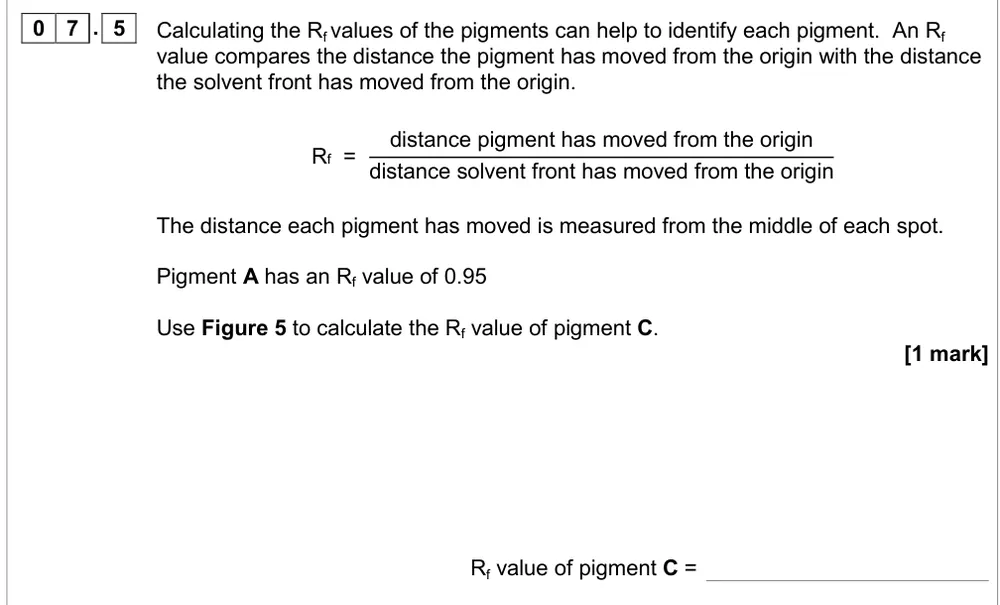
- Rf value: distance the pigment has moved from the origin ÷ distance the solvent front has moved from the origin, measured to the middle of each spot.
- Solubility: how well a pigment dissolves in the solvent; pigments separate because they have different solubilities in the solvent.
- Chloroplast suspension: isolated chloroplasts in a solution; it is the source of the dehydrogenase activity in required practical 8.
- DCPIP: a blue dye that is colourless when reduced; it is reduced by electrons from chlorophyll or the light-dependent reaction.
- Dehydrogenase: an enzyme that removes hydrogen, and so electrons, from a molecule; its activity is shown by how fast DCPIP decolourises.
- Control tube: a tube that shows the result is caused by the factor being tested, for example that light alone does not decolourise DCPIP.
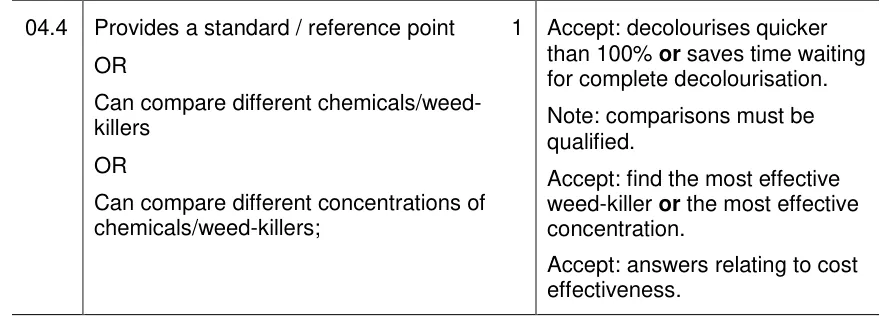
- IC50: the concentration of a chemical that inhibits the decolourisation of DCPIP by 50%; a standard reference point for comparing chemicals.
What these questions cover (AQA required practicals 7 and 8)
The questions come from the seventh and eighth required practicals in the AQA A-level Biology specification (7402), and test these statements and practical skills:
- Required practical 7: Use of chromatography to investigate the pigments isolated from leaves of different plants, eg, leaves from shade-tolerant and shade-intolerant plants or leaves of different colours (five questions use paper chromatography of leaf pigments; none compares shade-tolerant and shade-intolerant leaves)
- Required practical 8: Investigation into the effect of a named factor on the rate of dehydrogenase activity in extracts of chloroplasts (all three RP 8 questions come from one 2017 investigation with DCPIP and spinach chloroplasts; the named factors are light and weed-killer concentration)
- AT g separate biological compounds using thin layer/paper chromatography or electrophoresis
- AT b use appropriate instrumentation to record quantitative measurements, such as a colorimeter or potometer (no available part asks you to use a colorimeter to measure the colour change of DCPIP)
- PS 4.1 Know and understand how to use a wide range of experimental and practical instruments, equipment and techniques appropriate to the knowledge and understanding included in the specification
- PS 2.1 Comment on experimental design and evaluate scientific methods
- PS 3.2 Process and analyse data using appropriate mathematical skills
- MS 0.3 Use ratios, fractions and percentages
How to use this page
Write your answer on paper before you open the mark scheme. Allow about 1.3 minutes per mark: the 8 questions are worth 15 marks, so about 20 minutes in total. Then mark your answer strictly against the mark scheme and read the examiners' tip underneath it. If you'd rather print the questions, download the PDF pack.
Required practical 7: separating pigments by chromatography
Question 1
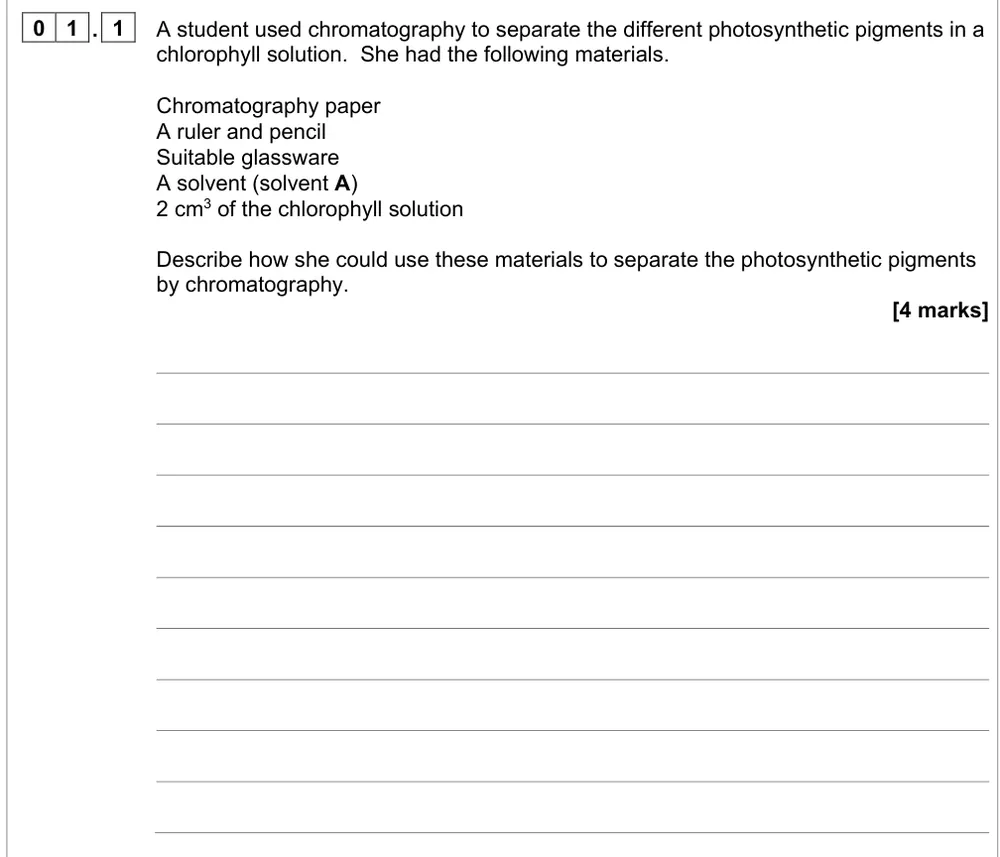
A level Paper 2 · June 2023 · Q01.1 · 4 marks · Easy
Describe how to separate photosynthetic pigments by paper chromatography with the materials given.
Show the mark scheme
Tap an image to open it full size.
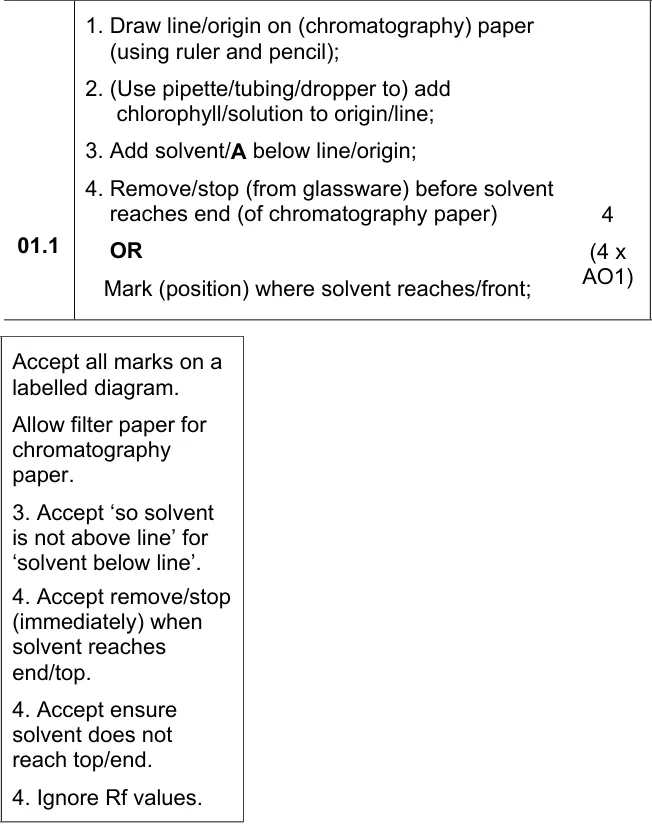
From the examiners' report: About 30% got all four and 97% at least one, usually for the pencil line. Don't mix up the two liquids: chlorophyll goes on the origin, solvent goes in the beaker below the line, and the paper comes out before the solvent reaches the top.
Question 2
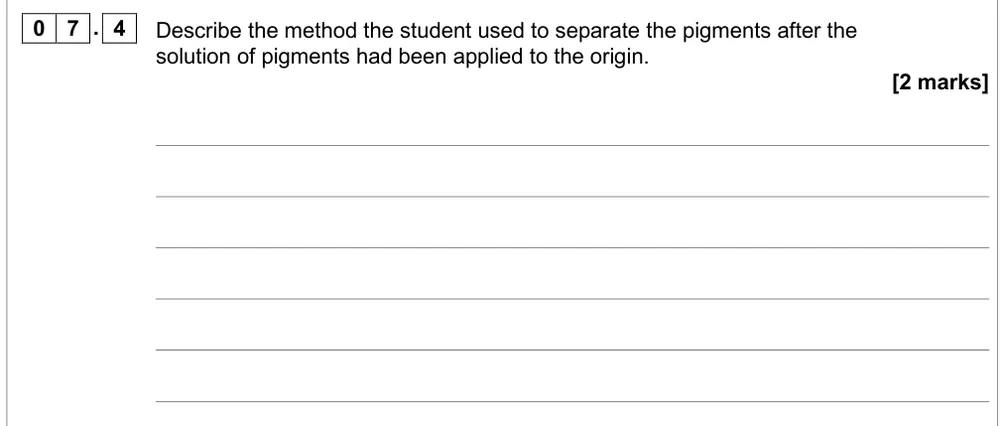
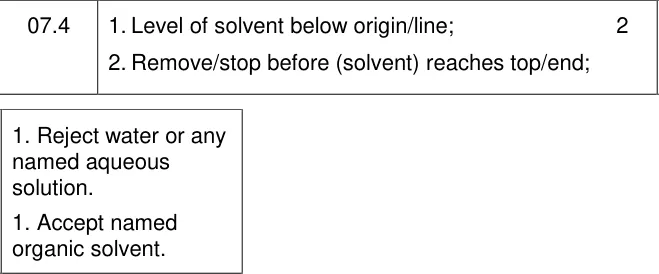
A level Paper 2 · June 2019 · Q07.4 · 2 marks · Hard
Describe how the pigments were separated once the solution was on the origin.
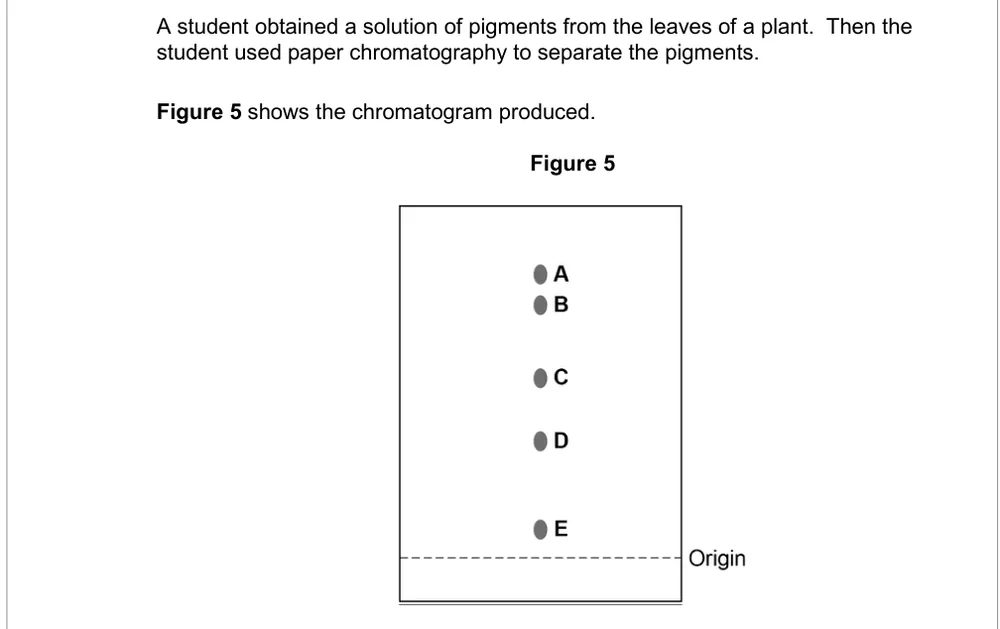
Information from earlier in this question:
Show the mark scheme
Tap an image to open it full size.
From the examiners' report: About 12% got both marks. 'Put it in solvent with a lid' isn't enough: say the solvent is below the origin and the paper is removed before the solvent reaches the top. Water isn't a suitable solvent.
Question 3
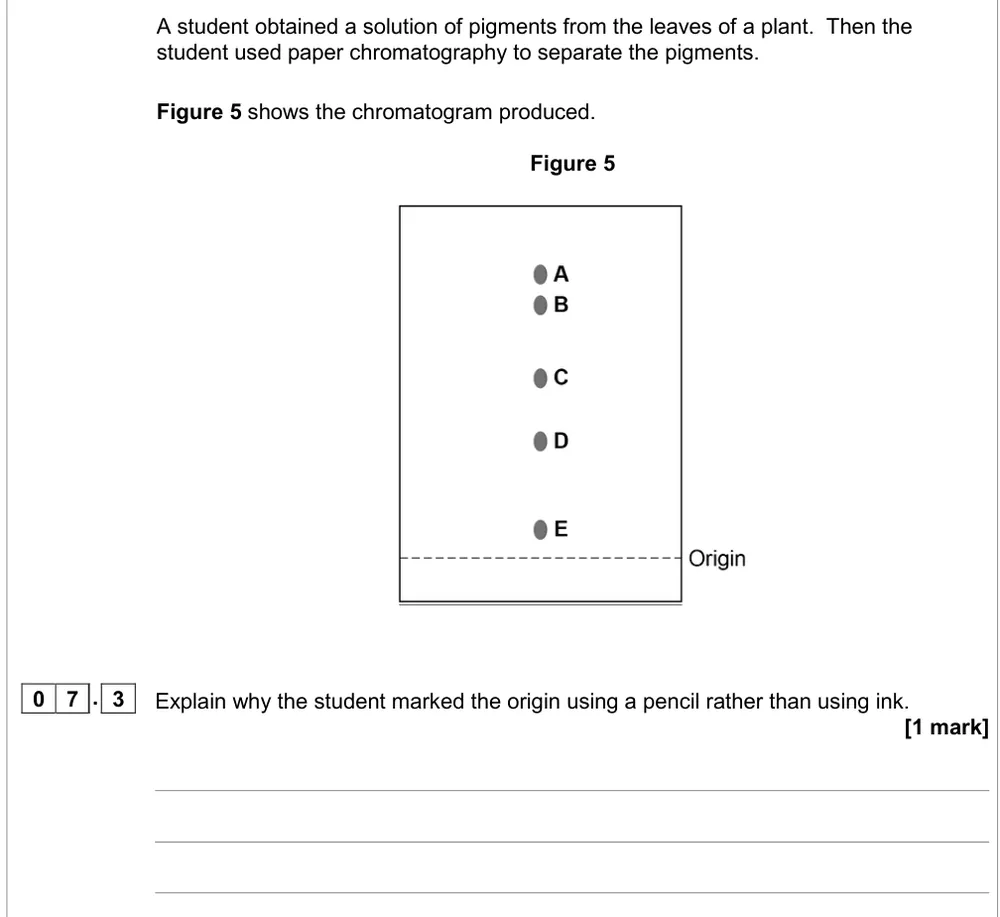
A level Paper 2 · June 2019 · Q07.3 · 1 mark · Hard
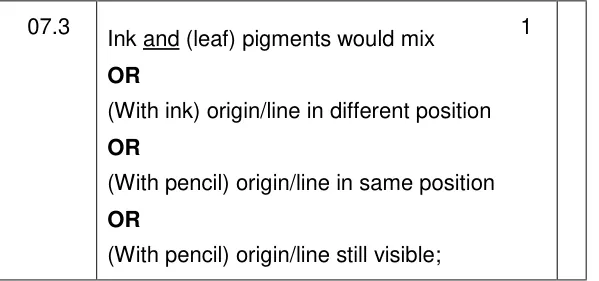
Explain why the origin is marked in pencil rather than ink.
Show the mark scheme
Tap an image to open it full size.
From the examiners' report: Slightly more than 20% got it. 'Ink runs' isn't enough: say the ink would mix with the leaf pigments, or that a pencil line stays where it is and is still visible.
Question 4
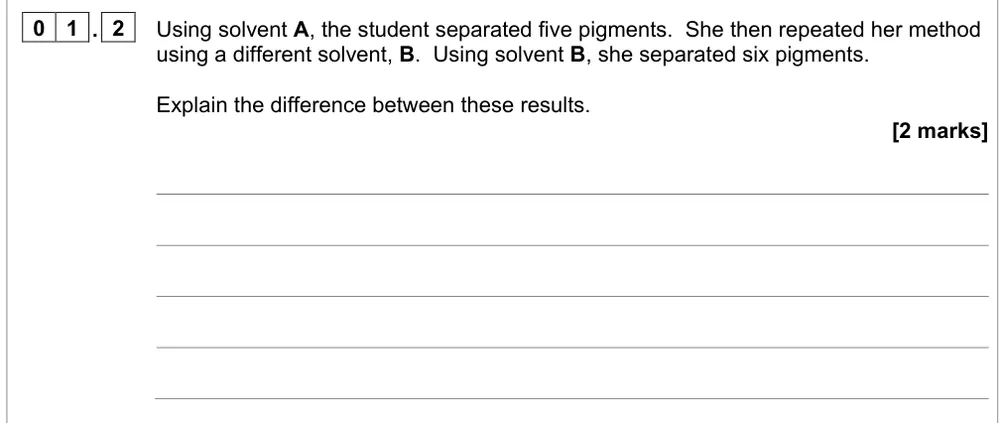
A level Paper 2 · June 2023 · Q01.2 · 2 marks · Hard
Explain why one solvent separated five pigments and another separated six.
Show the mark scheme
Tap an image to open it full size.
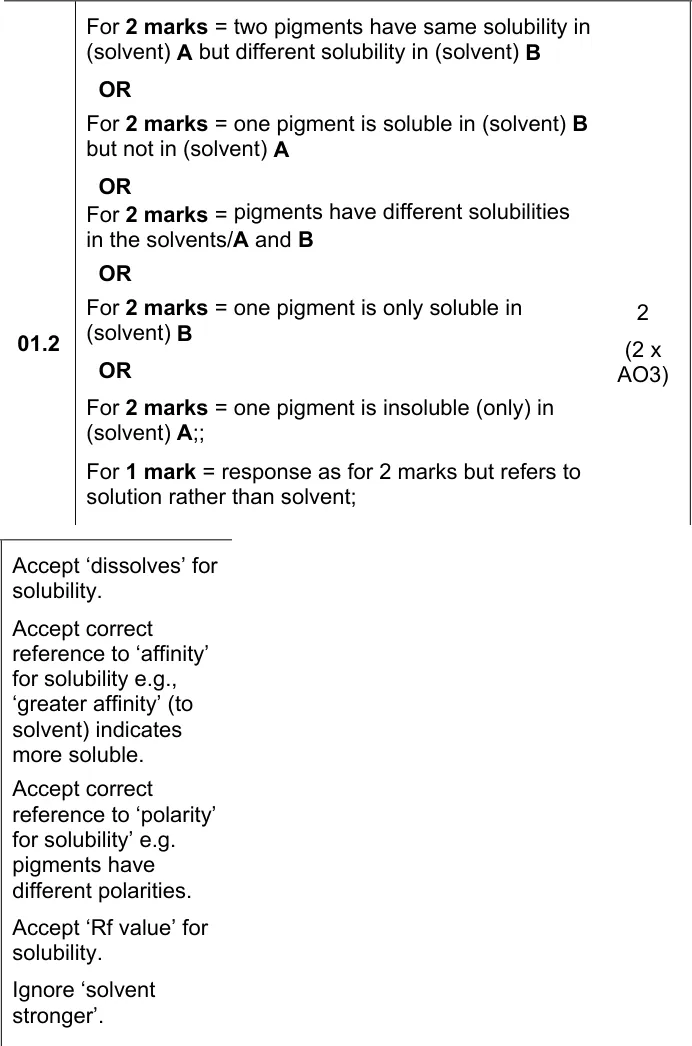
From the examiners' report: 61% scored zero. Pigments separate because they have different solubilities in the solvent, so two that ran together in A must differ in solubility in B. 'Solvent B is stronger' doesn't score.
Required practical 8: DCPIP and chloroplasts
Question 5
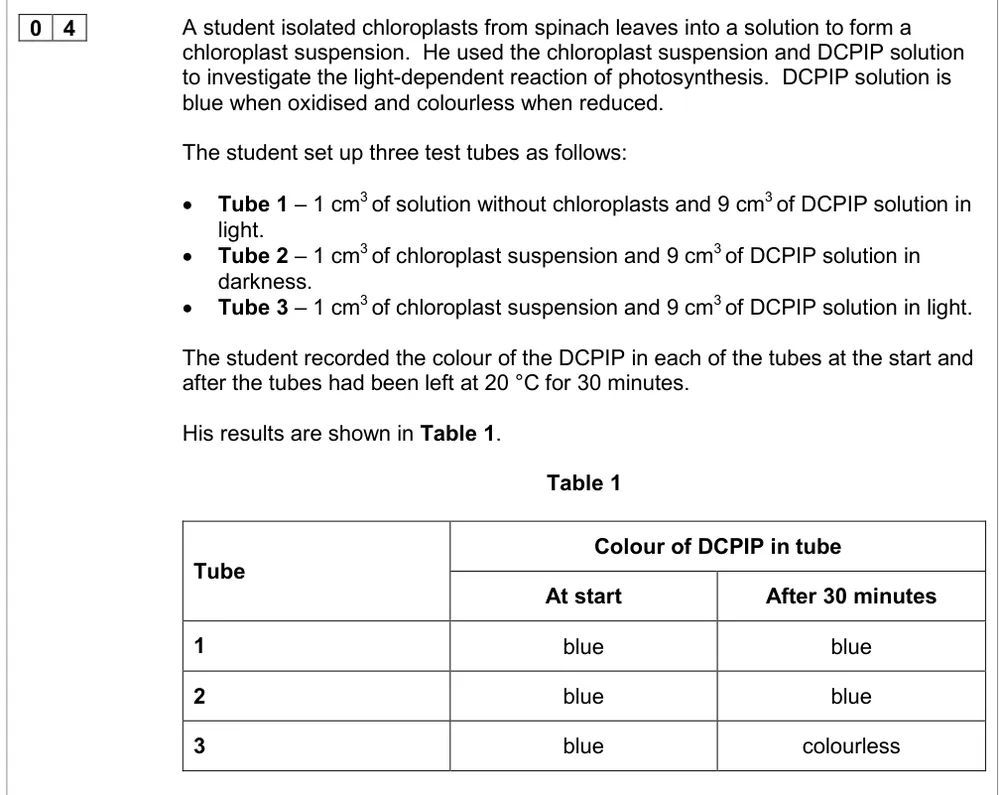
A level Paper 2 · June 2017 · Q04.3 · 2 marks · Easy
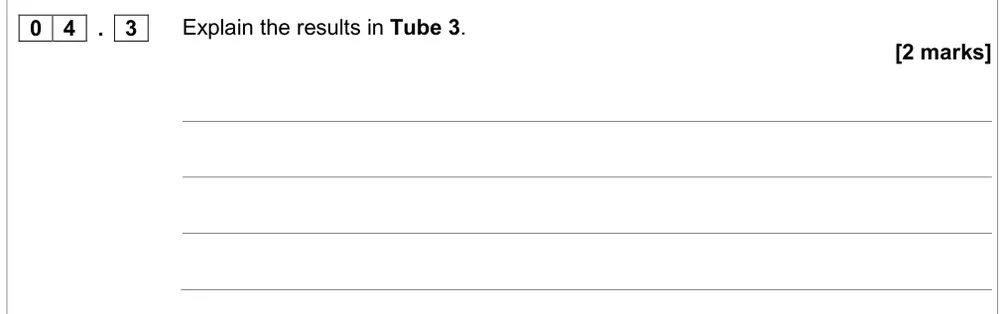
Explain why DCPIP turned colourless with chloroplasts in the light.
Information from earlier in this question:
Show the mark scheme
Tap an image to open it full size.
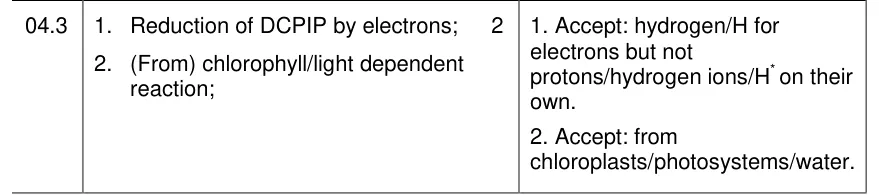
From the examiners' report: Over 80% got at least one mark, usually for the light-dependent reaction. DCPIP is reduced by electrons, not by protons or reduced NADP, and it isn't oxidised by oxygen.
Question 6
A level Paper 2 · June 2017 · Q04.2 · 2 marks · Medium
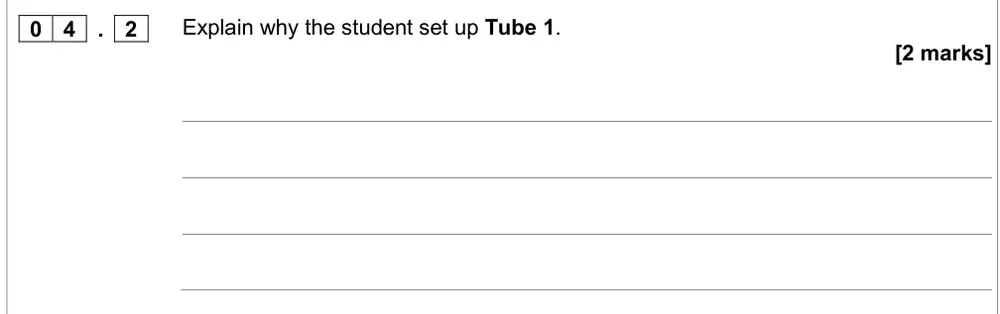
Explain why the student set up a tube of DCPIP without chloroplasts.
Show the mark scheme

Tap an image to open it full size.
From the examiners' report: Less than 10% got both. 'It's a control' or 'to compare with the other tubes' doesn't score: say what Tube 1 shows, that light alone doesn't decolourise DCPIP, so chloroplasts are needed.
Question 7
A level Paper 2 · June 2017 · Q04.4 · 1 mark · Medium
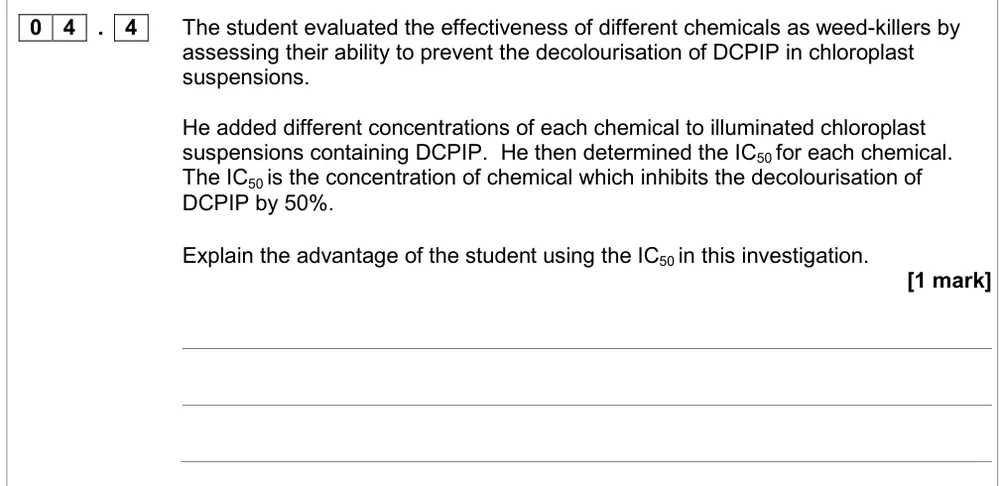
Explain the advantage of using the IC50 to compare weed-killers.
Show the mark scheme
Tap an image to open it full size.
From the examiners' report: Slightly more than 40% got it. 'For comparison' on its own doesn't score: say what it lets you compare, such as different weed-killers, or call it a standard reference point.
Calculating Rf values
Question 8
A level Paper 2 · June 2019 · Q07.5 · 1 mark · Easy
Use the chromatogram to calculate the Rf value of pigment C.
Information from earlier in this question:
Show the mark scheme

Tap an image to open it full size.
From the examiners' report: About 66% used the formula correctly. Measure from the origin to the middle of spot C, and use pigment A's Rf of 0.95 to work out how far the solvent front moved.
Where students lose marks (from AQA examiners' reports and mark schemes)
Each point below is followed by wording that gained marks.
Pigment on the origin, solvent in the beaker: Almost 97% scored at least one mark on describing chromatography, usually for the pencil line, but weaker answers confused the chlorophyll solution with the solvent, adding chlorophyll to the beaker and a dot of solvent to the origin, or mixing the two.
✔ Gains credit: "Draw line/origin on (chromatography) paper (using ruler and pencil); (Use pipette/tubing/dropper to) add chlorophyll/solution to origin/line; Add solvent/A below line/origin; Remove/stop (from glassware) before solvent reaches end."
Solvent below the origin, paper out before the top: Approximately 12% got both marks for the method after the pigments had been applied. Many only mentioned putting the paper in solvent, adding a lid or running it for a set time, and some explained the principle of chromatography or used water, glucose or hydrochloric acid as the solvent.
✔ Gains credit: "Level of solvent below origin/line"; "Remove/stop before (solvent) reaches top/end" (water or any aqueous solution rejected).
Say why pencil matters, not just that ink runs: Slightly more than 20% scored the mark. Answers often said only that ink would run, smudge or dissolve in the solvent and affect the results; few said the ink and leaf pigments would mix, or that the pencil line stays visible.
✔ Gains credit: "Ink and (leaf) pigments would mix" or "(With pencil) origin/line still visible".
Pigments separate by solubility in the solvent: 61% failed to score on why solvent B separated six pigments and solvent A five. Common wrong answers said solvent B was 'stronger' or 'more concentrated', or that the pigments had different wavelengths.
✔ Gains credit: "Two pigments have same solubility in (solvent) A but different solubility in (solvent) B" (affinity, polarity or Rf value also accepted).
Electrons reduce DCPIP, not protons: Over 80% got at least one mark for linking Tube 3 to chlorophyll or the light-dependent reaction, but common misconceptions were that DCPIP was reduced by protons or by reduced NADP (or reduced NAD), or oxidised by oxygen.
✔ Gains credit: "Reduction of DCPIP by electrons; (From) chlorophyll/light dependent reaction" (hydrogen accepted, but not protons or H⁺ on their own).
Say what the control tube rules out: Less than 10% got both marks for why Tube 1 was set up. Many simply called it a control or said it allowed comparison with the other tubes; the idea that it shows light does not affect DCPIP was rarely given.
✔ Gains credit: "To show light does not affect DCPIP; To show chloroplasts are required."
Qualify the comparison an IC50 allows: Slightly more than 40% scored the IC50 mark. Answers that simply said 'for comparison', or repeated the stem, didn't gain credit; few called it a standard or reference point.
✔ Gains credit: "Provides a standard / reference point OR Can compare different chemicals/weed-killers OR Can compare different concentrations of chemicals/weed-killers."
Download the questions
Download the PDF pack (8 questions, mark schemes at the end)
Keep practising
- Photosynthesis: AQA A Level Biology exam questions by topic
- AQA 3.5.1 photosynthesis: self-marking quiz
- Required practical 1, enzyme rates: AQA A Level Biology exam questions
- Required practical 6, aseptic technique: AQA A Level Biology exam questions
- Arithmetic and numerical skills: AQA A Level Biology exam questions by topic
- AQA A Level Biology masterclasses
Questions, mark schemes and examiners' report extracts © AQA.