

Prokaryotic cells and viruses (AQA 3.2.1.2) is a short section, but it comes up on AS and A-level papers, often as a labelled bacterium or virus, and it's the background to questions on HIV, antibiotics and the immune system. You need to know how prokaryotic cells differ from eukaryotic cells (smaller, no membrane-bound organelles, smaller ribosomes, circular DNA not associated with proteins, a murein cell wall), the extra structures many prokaryotes have (plasmids, a capsule, flagella), and the structure of a virus particle: genetic material, capsid and attachment protein.
The examiners' reports show the same errors year after year. Students mix up a bacterial capsule with a viral capsid, name cellulose as the bacterial cell wall, list plasmids or flagella when asked for features of all bacteria, say all viruses have DNA when some have RNA, and define acellular as 'not alive'.
Start with the structure of prokaryotic cells, then questions comparing them with eukaryotic cells, then viruses, and finish with a short calculation. Answer each on paper before you open the mark scheme. If you'd like help with this topic, my AQA masterclasses run online on Tuesdays at 5.15pm for Year 12 and on Wednesdays or Thursdays at 6.30pm for Year 13.
What you need from GCSE and Year 12
Each question on this page assumes you're secure on these GCSE and Year 12 ideas. If any of them feels shaky, revise it before you start.
- GCSE: bacteria are prokaryotic: they have no nucleus, and their genetic material is a single loop of DNA, with some extra small rings called plasmids.
- GCSE: bacteria have a cell wall, cell membrane, cytoplasm and ribosomes, and some have a flagellum.
- GCSE: viruses are much smaller than cells and can only reproduce inside a host cell.
- Year 12 (AQA 3.2.1.1): the organelles of eukaryotic cells, including the nucleus, mitochondria and rough endoplasmic reticulum. See the Eukaryotic Cell Structure page.
Key terms
These words come up in the questions and mark schemes. Examiners expect you to use them exactly.
- Prokaryotic cell: a cell with no nucleus and no membrane-bound organelles, such as a bacterium. Much smaller than a eukaryotic cell.
- Murein: the glycoprotein in a bacterial cell wall (also called peptidoglycan). Bacterial walls don't contain cellulose.
- Circular DNA: the single DNA molecule of a prokaryote, free in the cytoplasm and not associated with proteins (histones).
- Smaller (70S) ribosomes: the ribosomes of prokaryotes. Eukaryotic cells have larger (80S) ribosomes in their cytoplasm.
- Plasmid: a small ring of DNA, separate from the main DNA, found in some prokaryotes. It often carries genes such as antibiotic resistance.
- Capsule: a layer that surrounds some bacterial cells, outside the cell wall. Not the same as a capsid.
- Flagellum: a long whip-like structure some prokaryotes use to move. Plural flagella.
- Capsid: the protein coat of a virus particle, which protects its genetic material.
- Attachment protein: a protein on the surface of a virus particle that binds to receptors on a host cell.
- Acellular: not made of cells: a virus has no cell-surface membrane, cytoplasm or organelles.
- Non-living: having no metabolism of its own: a virus can only replicate inside a host cell.
What these questions cover (AQA 3.2.1.2)
The questions test these statements from the AQA AS and A-level Biology specification (7401/7402):
- Size and differences: Prokaryotic cells are much smaller than eukaryotic cells. They also differ from eukaryotic cells in having: (the specification adds that details of these structural differences are not required)
- Prokaryotic cells have: cytoplasm that lacks membrane-bound organelles
- Prokaryotic cells have: smaller ribosomes
- Prokaryotic cells have: no nucleus; instead they have a single circular DNA molecule that is free in the cytoplasm and is not associated with proteins
- Prokaryotic cells have: a cell wall that contains murein, a glycoprotein.
- Many prokaryotic cells have: one or more plasmids
- Many prokaryotic cells have: a capsule surrounding the cell
- Many prokaryotic cells have: one or more flagella.
- Viruses: Viruses are acellular and non-living. The structure of virus particles to include genetic material, capsid and attachment protein.
How to use this page
Write your answer on paper before you open the mark scheme. Allow about 1.3 minutes per mark: the 15 questions are worth 33 marks, so about 43 minutes in total. Then mark your answer strictly against the mark scheme and read the examiners' tip underneath it. If you'd rather print the questions, download the PDF pack.
The structure of prokaryotic cells (3.2.1.2)
Question 1
AS Paper 1 · June 2018 · Q04.1 · 2 marks · Medium
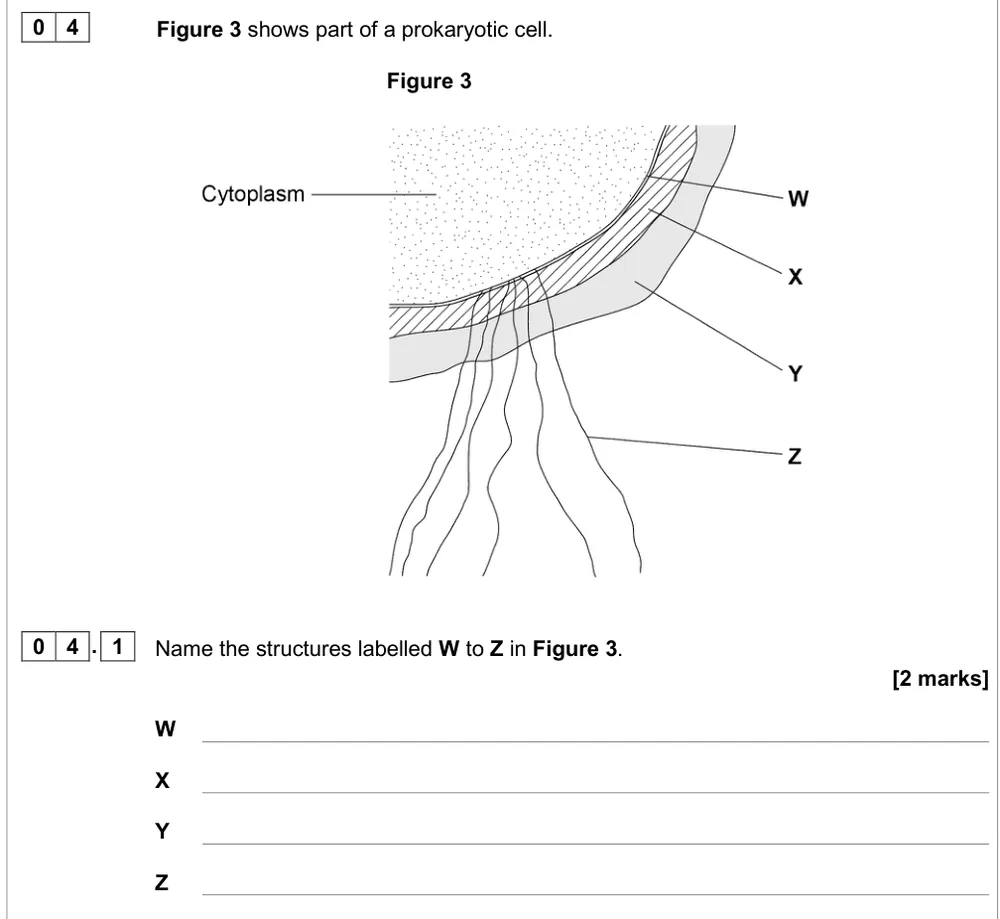
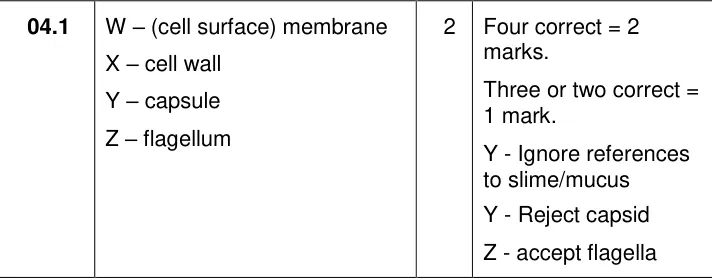
Name structures W to Z on a diagram of part of a prokaryotic cell.
Show the mark scheme
Tap an image to open it full size.
From the examiners' report: 31.7% got both marks. W and X aren't 'inner and outer membranes', and Y is a capsule, not a capsid. Spell the key terms correctly.
Question 2
AS Paper 1 · June 2018 · Q04.2 · 2 marks · Medium
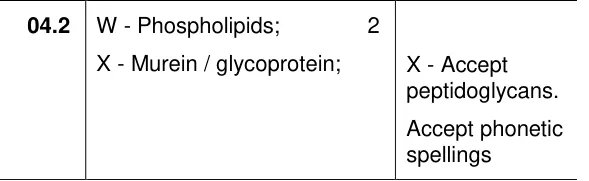
Name the main biological molecule in the membrane and the cell wall.

Show the mark scheme
Tap an image to open it full size.
From the examiners' report: Only 16.7% got both. The commonest answer for X was cellulose, which is wrong for bacteria. Name the molecule, not what it does.
Question 3
AS Paper 1 · June 2022 · Q03.1 · 1 mark
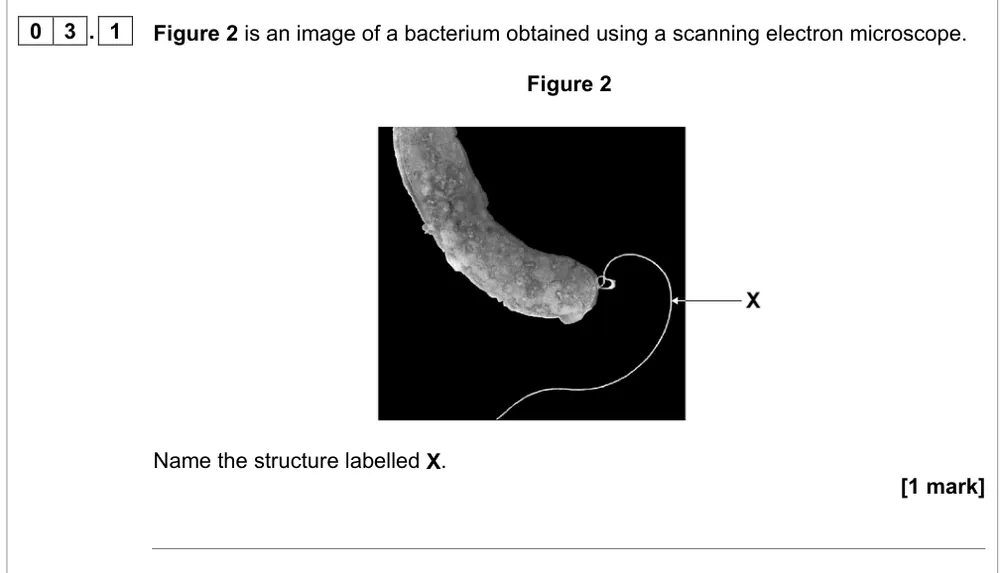
Name structure X on a scanning electron micrograph of a bacterium.
Show the mark scheme
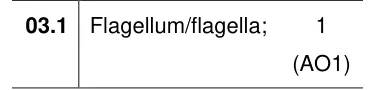
Tap an image to open it full size.
From the examiners' report: 94% named the flagellum. Learn the spelling: flagellum, plural flagella.
Question 4
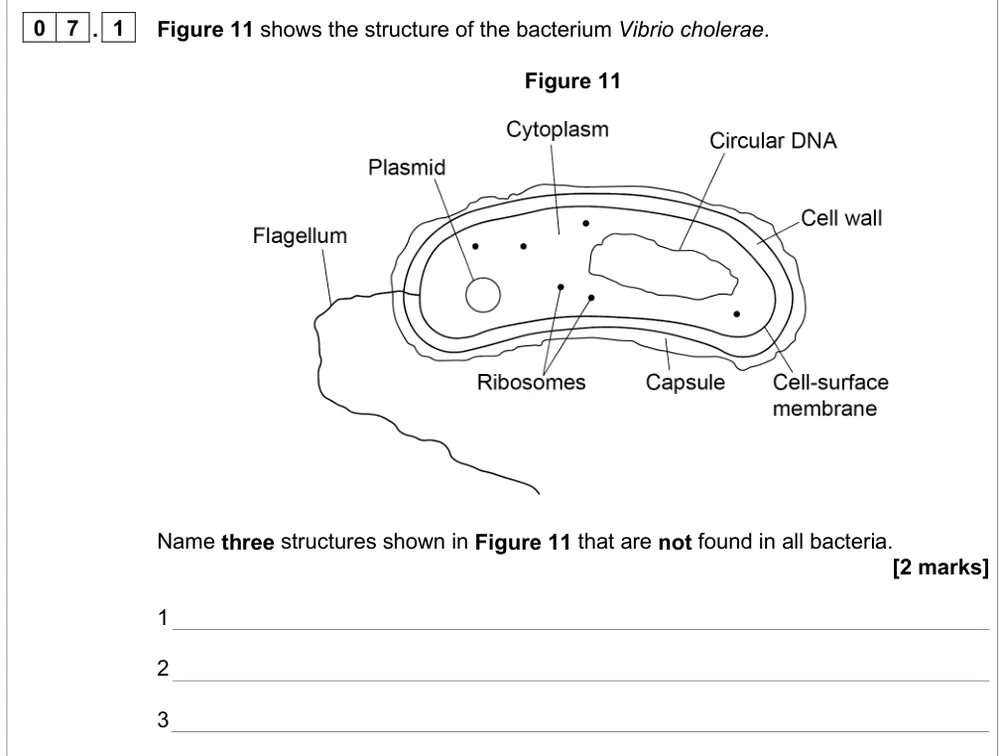
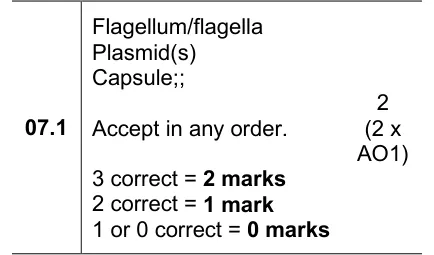
AS Paper 2 · June 2025 · Q07.1 · 2 marks · Easy
Name three structures in Vibrio cholerae that aren't found in all bacteria.
Show the mark scheme
Tap an image to open it full size.
From the examiners' report: About 52% got both marks. DNA, ribosomes and the cell-surface membrane are in all bacteria, so they didn't score.
Comparing prokaryotic and eukaryotic cells (3.2.1.2)
Question 5
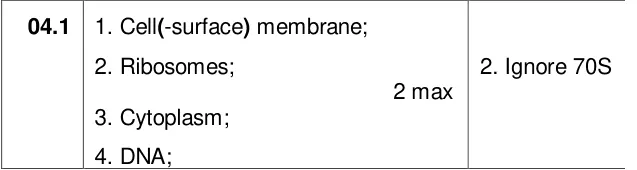
AS Paper 2 · November 2021 · Q04.1 · 2 marks
Give two structures found in all prokaryotic cells and all eukaryotic cells.

Show the mark scheme
Tap an image to open it full size.
From the examiners' report: There's no examiners' report for this paper, so this tip comes from the mark scheme. Both have ribosomes (prokaryotic ones are smaller), so 'ribosomes' scores; a cell wall doesn't, because animal cells have none.
Question 6
A level Paper 1 · June 2022 · Q03.1 · 1 mark · Hard
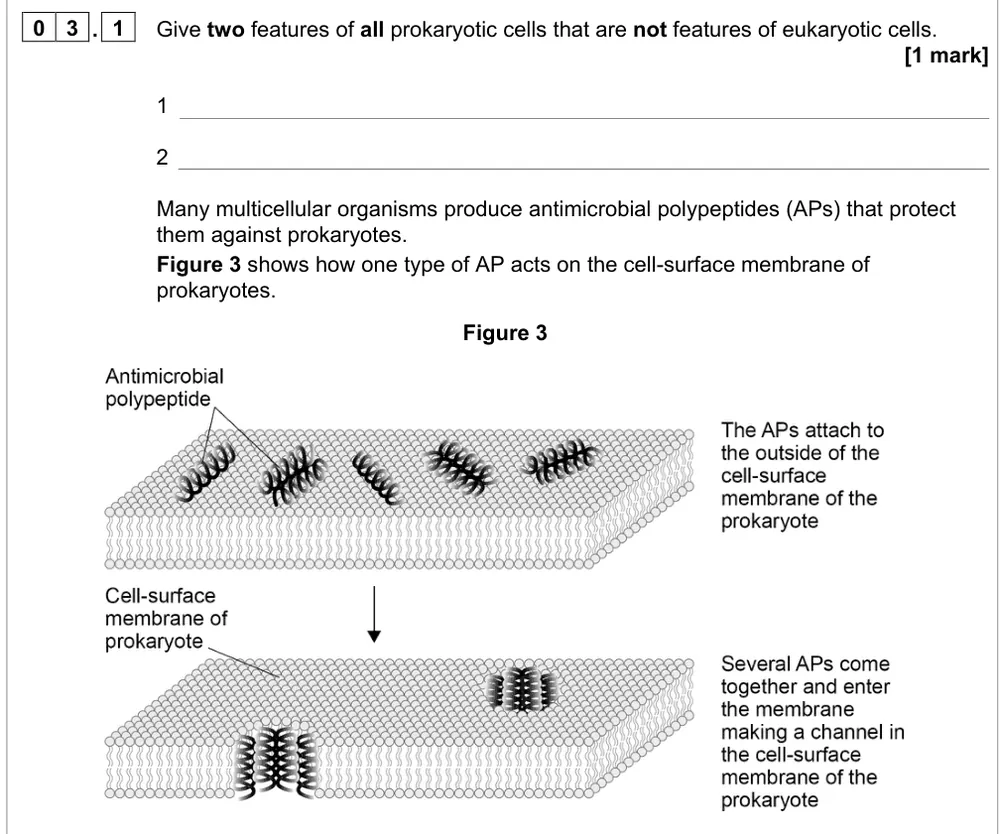
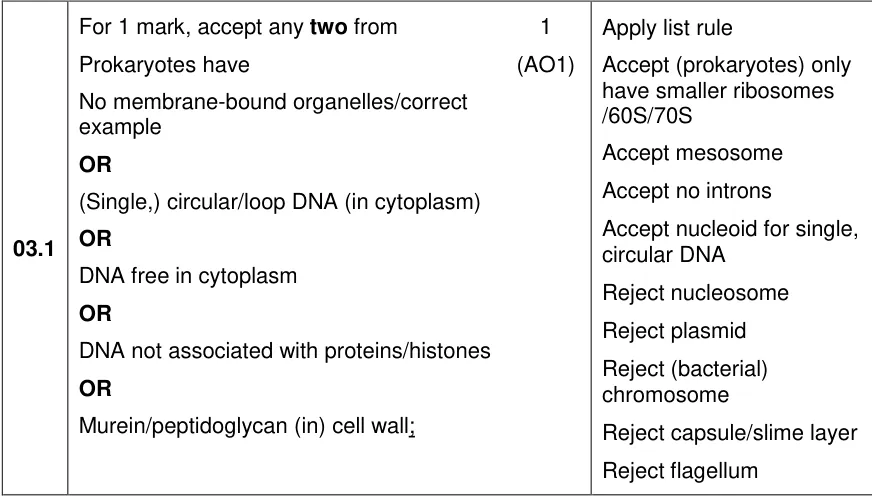
Give two features of all prokaryotic cells that aren't features of eukaryotic cells.
Show the mark scheme
Tap an image to open it full size.
From the examiners' report: Only about a fifth got this. Plasmids, capsules and flagella are only in some prokaryotes. Ignore Figure 3: it belongs to the next part.
Question 7
AS Paper 1 · June 2022 · Q03.5 · 2 marks · Hard
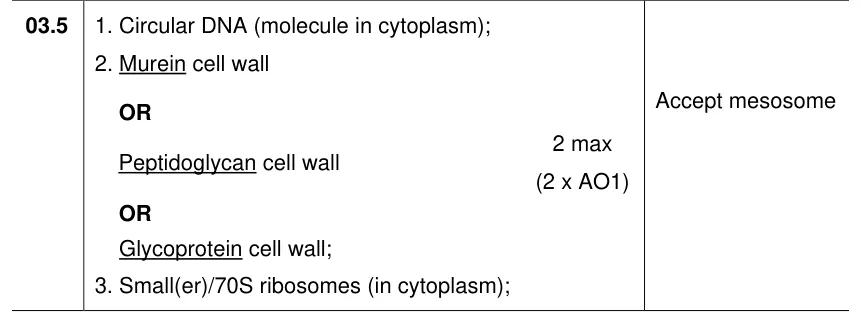
Name two structures found in all bacteria that aren't found in plant cells.

Show the mark scheme
Tap an image to open it full size.
From the examiners' report: 32% scored at least one mark. Unqualified 'DNA' or 'plasmids' didn't count, and flagella aren't in all bacteria. Say circular DNA or a murein cell wall.
Question 8
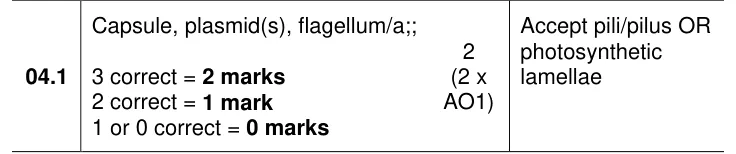
A level Paper 1 · June 2025 · Q04.1 · 2 marks · Medium
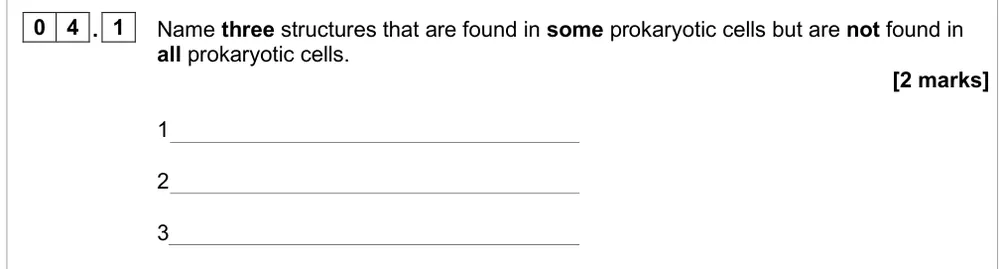
Name three structures found in some prokaryotic cells but not all.
Show the mark scheme
Tap an image to open it full size.
From the examiners' report: About 40% got both. 'Capsid' is a virus structure and 70S ribosomes are in every prokaryote, so neither scored.
Question 9
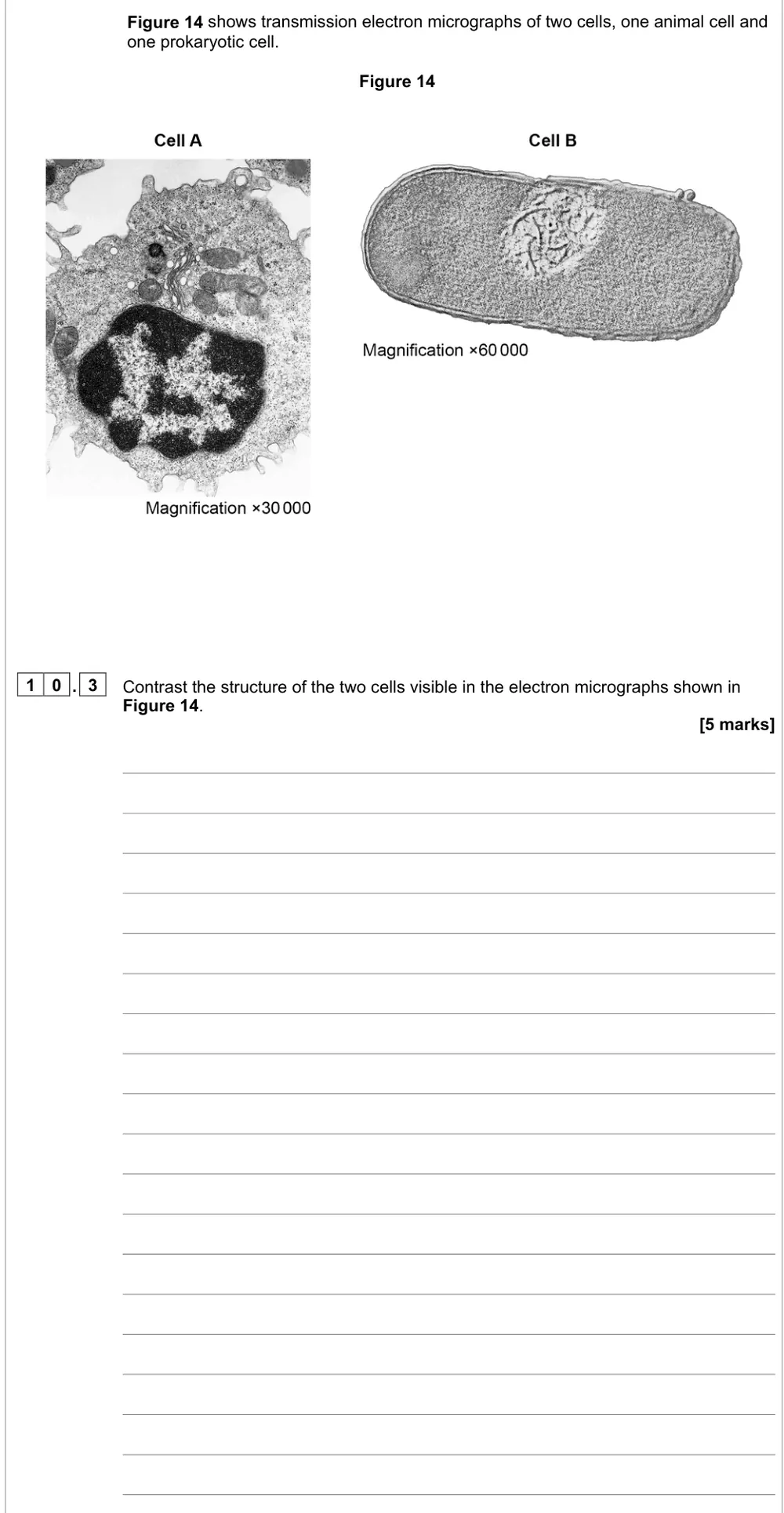
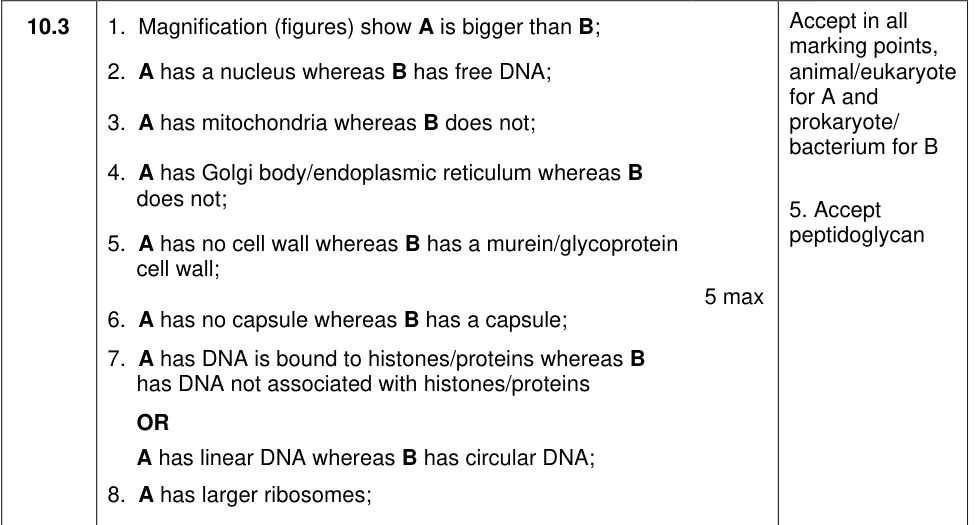
A level Paper 1 · November 2021 · Q10.3 · 5 marks · Hard
Contrast an animal cell and a prokaryotic cell in electron micrographs.
Show the mark scheme
Tap an image to open it full size.
From the examiners' report: A common error was calling the bacterial capsule a capsid. Make each point a direct contrast: 'A has…, whereas B…'.
Viruses (3.2.1.2)
Question 10
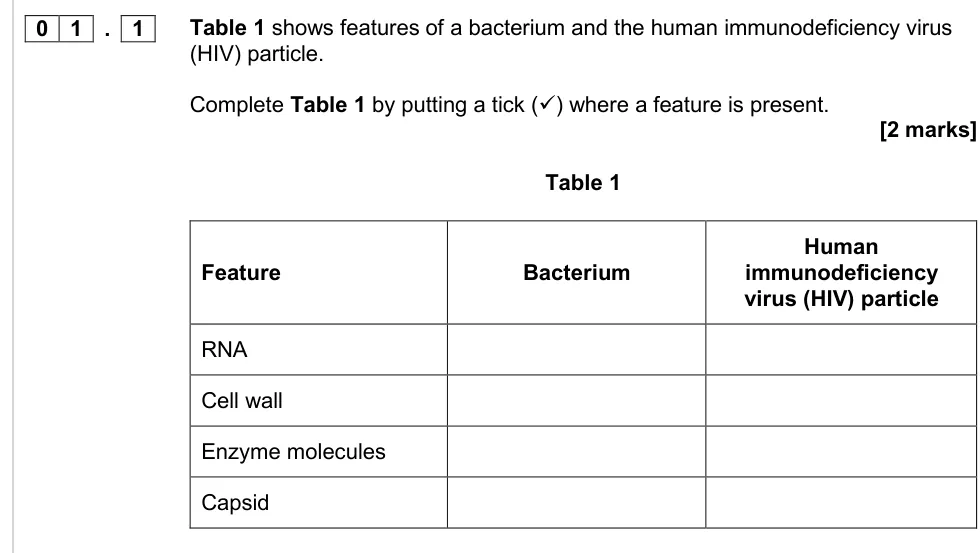
AS Paper 1 · June 2016 · Q01.1 · 2 marks
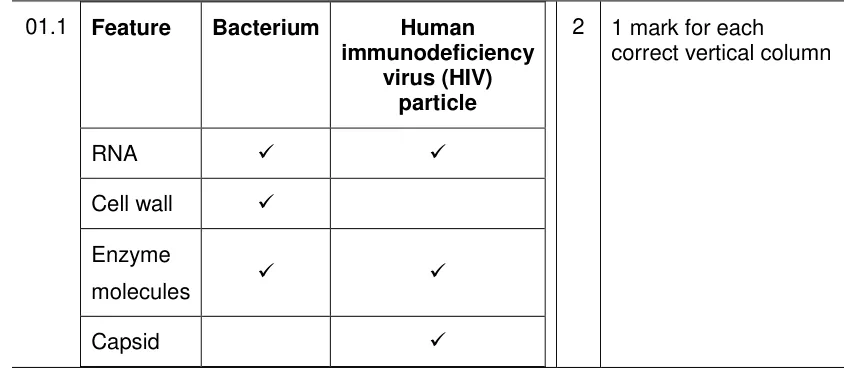
Tick which features are present in a bacterium and in an HIV particle.
Show the mark scheme
Tap an image to open it full size.
From the examiners' report: There's no examiners' report for this paper, so this tip comes from the mark scheme. Bacteria contain RNA too, and HIV carries enzymes (reverse transcriptase), so tick both columns for those rows.
Question 11
A level Paper 1 · June 2023 · Q01.1 · 2 marks
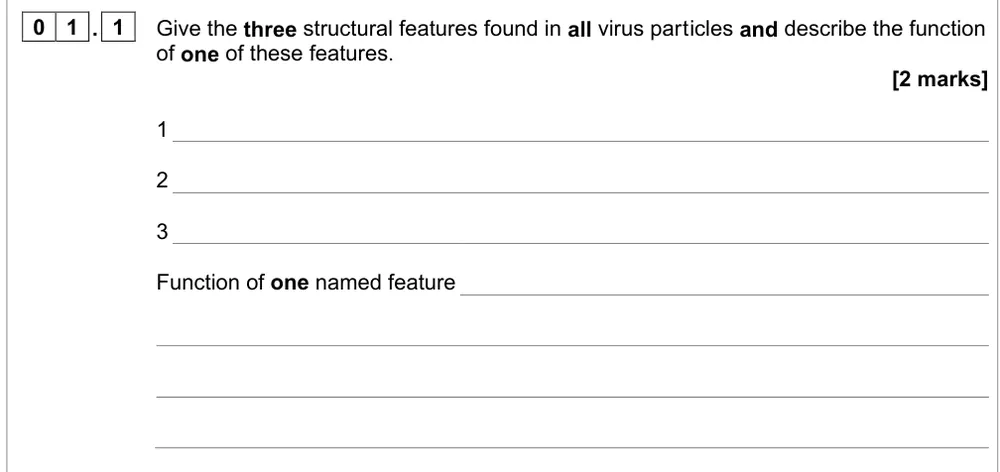
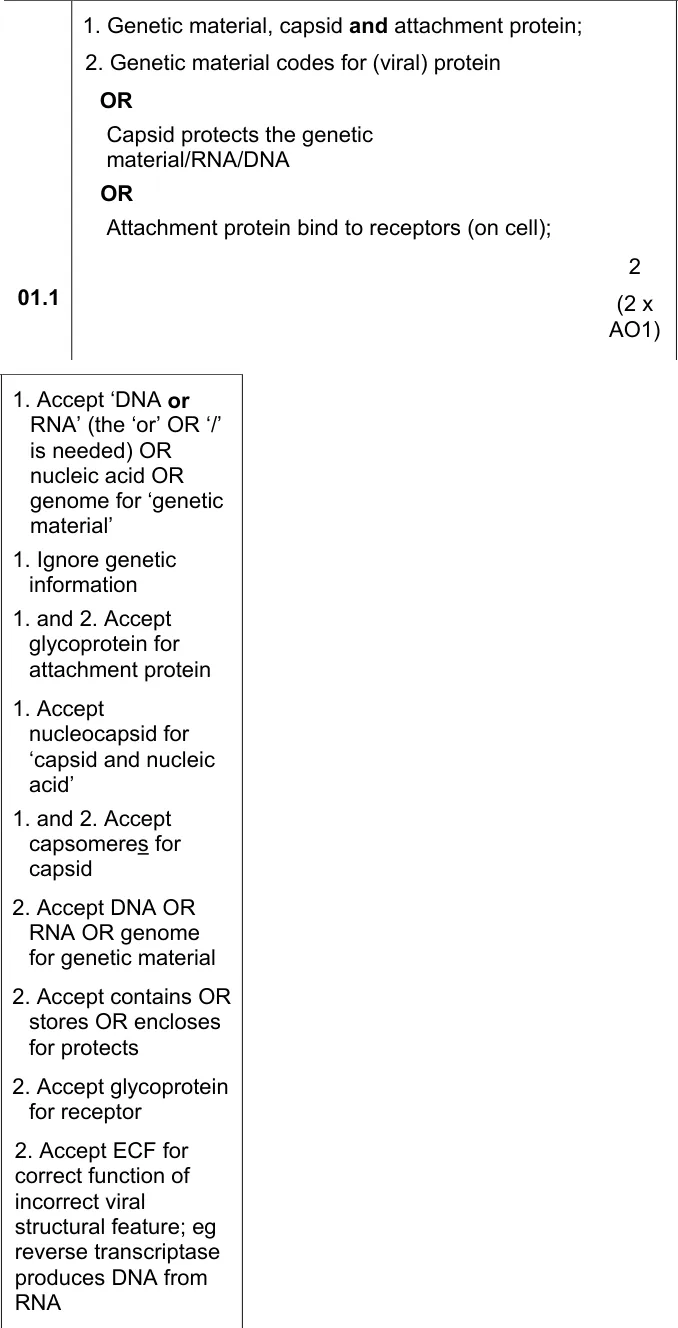
Give the three features found in all virus particles and the function of one.
Show the mark scheme
Tap an image to open it full size.
From the examiners' report: Fewer than 10% named all three. Reverse transcriptase and a lipid envelope are only in some viruses, and 'DNA' alone is wrong: write DNA or RNA. Attachment proteins bind to receptors.
Question 12
A level Paper 1 · June 2023 · Q01.2 · 2 marks · Easy
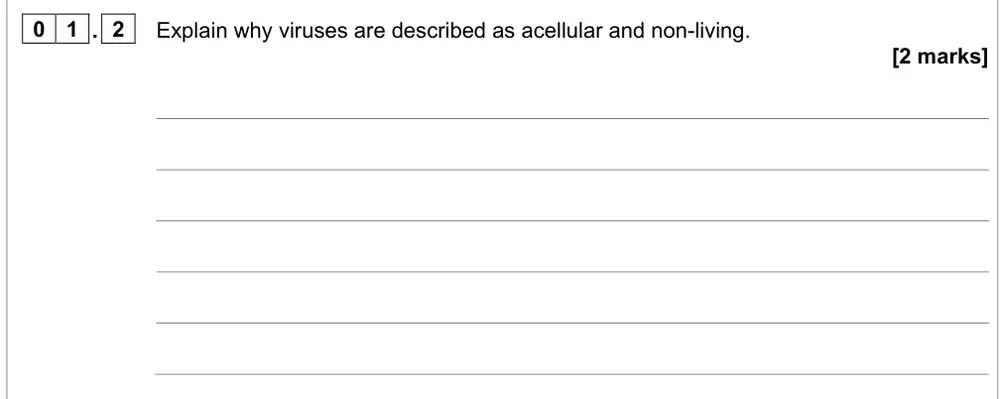
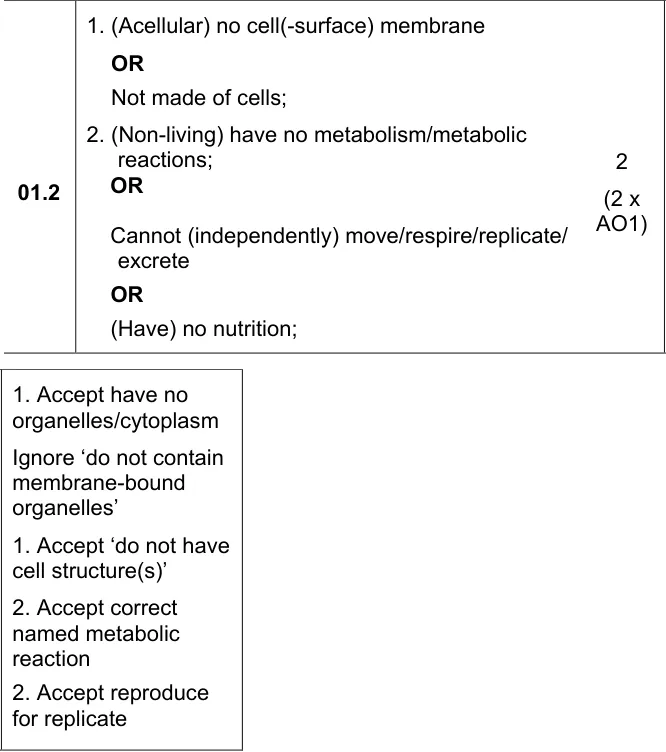
Explain why viruses are described as acellular and non-living.
Show the mark scheme
Tap an image to open it full size.
From the examiners' report: Only about 15% defined acellular correctly. Acellular is about structure (no membrane, cytoplasm or organelles); non-living is about not replicating or respiring on their own.
Question 13
AS Paper 1 · June 2022 · Q03.6 · 2 marks · Medium
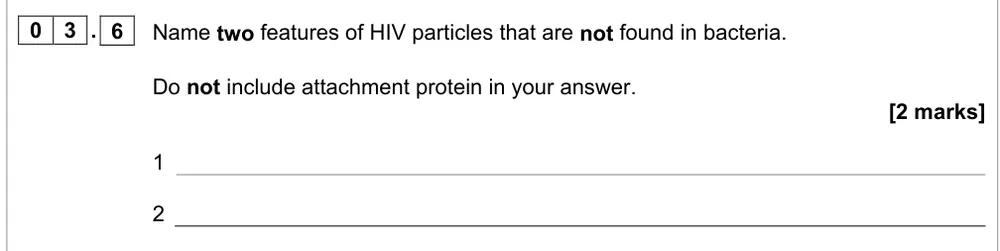
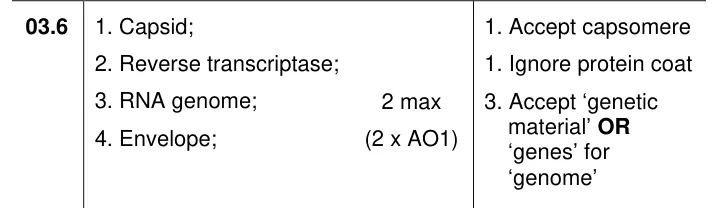
Name two features of HIV particles that aren't found in bacteria.
Show the mark scheme
Tap an image to open it full size.
From the examiners' report: 69% scored at least one mark, usually for capsid or reverse transcriptase. Many ignored the instruction and wrote attachment proteins.
Question 14
A level Paper 1 · June 2019 · Q05.1 · 4 marks
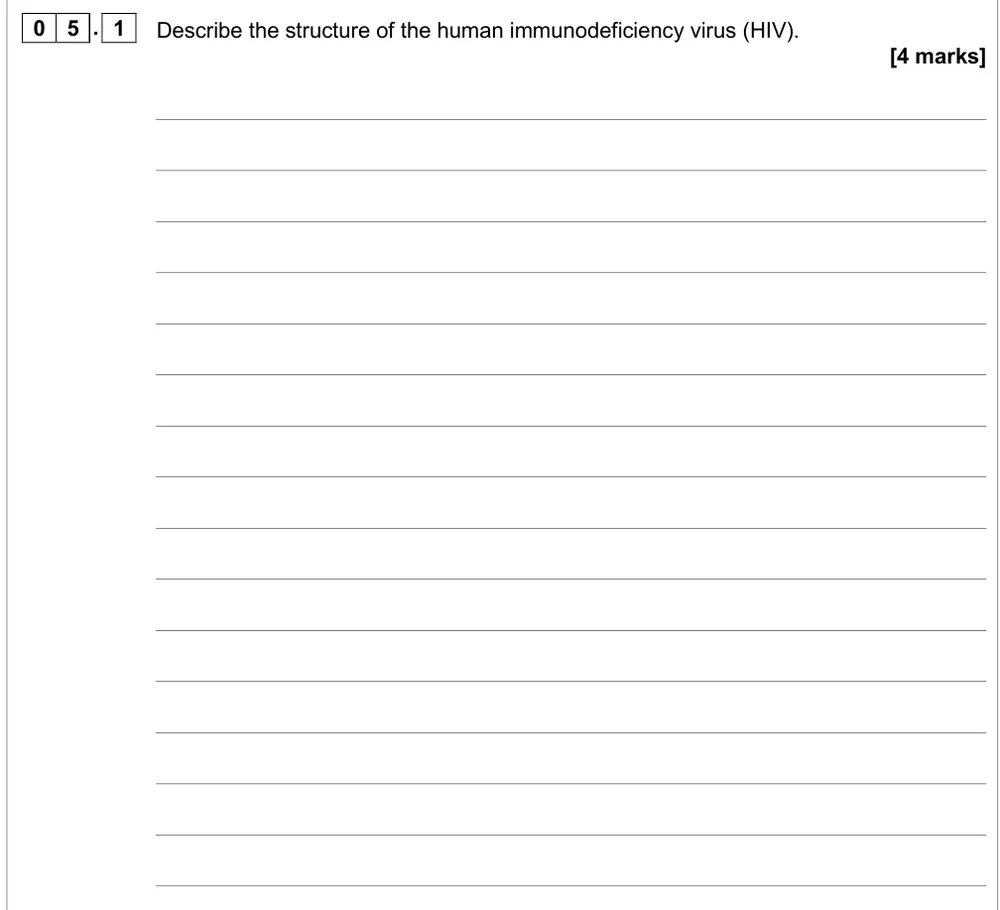
Describe the structure of HIV.
Show the mark scheme
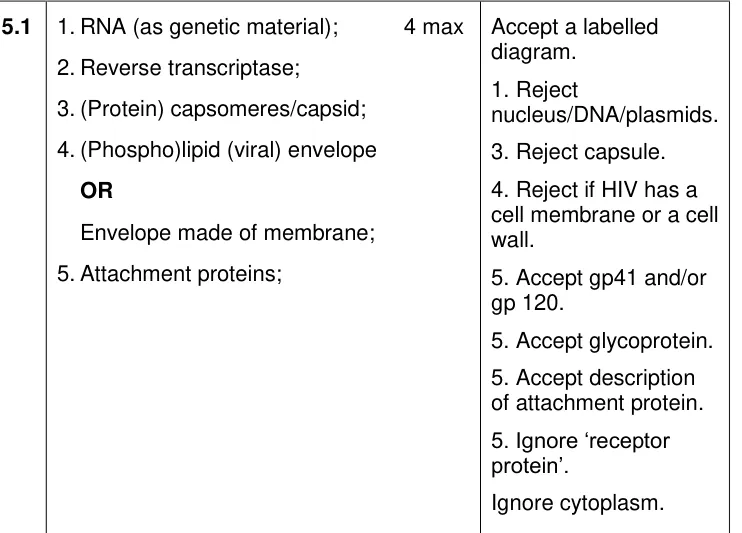
Tap an image to open it full size.
From the examiners' report: There's no examiners' report for this paper, so this tip comes from the mark scheme. HIV has RNA, not DNA, and a capsid, not a capsule; a labelled diagram is accepted.
Using numbers (3.2.1.2)
Question 15
A level Paper 1 · June 2025 · Q08.4 · 2 marks
Calculate the total length of plasmid DNA in a Bacillus thuringiensis cell.
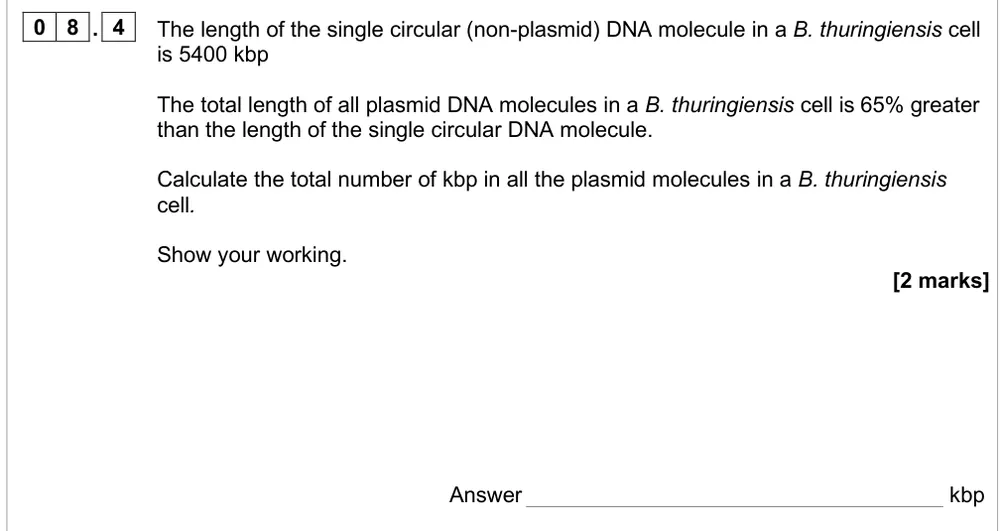
Show the mark scheme
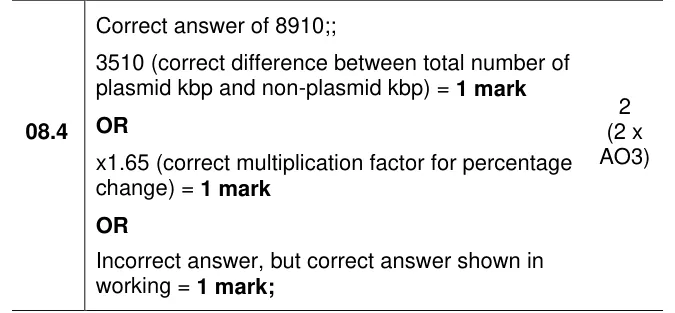
Tap an image to open it full size.
From the examiners' report: About 70% got this. Stop at 5400 × 1.65 = 8910: some went on to multiply by 11, the number of plasmid types.
Where students lose marks (from AQA examiners' reports and mark schemes)
Each point below is followed by wording that gained marks.
Capsule on bacteria, capsid on viruses: Examiners repeatedly saw the bacterial capsule labelled as a 'capsid', and the viral capsid given as a structure of some prokaryotes. Only 31.7% got both marks for labelling the bacterium.
✔ Gains credit: "Y – capsule; Z – flagellum" (capsid rejected) for the bacterium, and "capsid" only for the virus.
Murein, not cellulose: Only 16.7% named both molecules: the most common answer for the bacterial cell wall was cellulose, and some gave functions instead of molecules.
✔ Gains credit: "W – phospholipids; X – murein / glycoprotein" (peptidoglycan accepted).
In all prokaryotes, or only some?: Only about a fifth got the mark for features of all prokaryotes: many listed plasmids, a capsule or flagella, which only some have. Unqualified 'DNA' didn't score either.
✔ Gains credit: "Single circular DNA free in the cytoplasm, not associated with histones; murein cell wall; no membrane-bound organelles."
Ribosomes are smaller, not missing: Some gave 70S ribosomes as found only in prokaryotes, forgetting eukaryotic cells have ribosomes too, and '70S ribosomes' was a frequent wrong answer for structures found in only some prokaryotes.
✔ Gains credit: "(Prokaryotes) only have smaller ribosomes / 70S" and "both have ribosomes" when asked what all cells share.
Acellular means no cell structure: Only about 15% defined acellular correctly. Many explained it with non-living features ('needs a cell to respire'), or said viruses are 'smaller than a cell' or 'unicellular'.
✔ Gains credit: "Acellular: not made of cells / no cell-surface membrane, cytoplasm or organelles. Non-living: no metabolism; cannot replicate independently."
Genetic material, not 'DNA': Fewer than 10% named the three features found in all viruses. Many said all viruses have DNA, or all have RNA, or named reverse transcriptase or a lipid envelope, which only some viruses have.
✔ Gains credit: "Genetic material (DNA or RNA), capsid and attachment protein; attachment protein binds to receptors on the cell."
Leave out what the question excludes: Asked for HIV features not found in bacteria, many still wrote attachment proteins even though the question said not to.
✔ Gains credit: "Capsid; reverse transcriptase; RNA genome; envelope."
Stop at 165% of the DNA length: About 70% got this, but some then multiplied their correct answer by 11, the number of plasmid types.
✔ Gains credit: "5400 × 1.65 = 8910 kbp" (3510 or × 1.65 shown gained 1 mark).
Download the questions
Download the PDF pack (15 questions, mark schemes at the end)
Keep practising
- Eukaryotic cell structure: AQA A Level Biology exam questions by topic
- DNA and RNA structure: AQA A Level Biology exam questions by topic
- Mastering AQA A Level Biology 3.4.1: DNA, genes and chromosomes
- Calculations and mathematical content in A level Biology, from AQA papers
- AQA A Level Biology masterclasses
Questions, mark schemes and examiners' report extracts © AQA.