

Genetic diversity and adaptation (AQA 3.4.4) is where natural selection gets the A-level treatment. You need to know genetic diversity as the number of different alleles in a population, explain how a random mutation produces a new allele that can increase reproductive success, and show how that allele is passed on and rises in frequency over many generations. You also need directional selection, with antibiotic resistance in bacteria as the example, and stabilising selection, with human birth weights, and you need to apply all of this to data and contexts you've never seen before.
The examiners' reports keep finding the same problems. Students write 'gene' when they mean 'allele', say antibiotics cause mutations or that bacteria become immune, give stock answers that never mention the organism in the question, invent types of selection that aren't in the specification, and say the number of alleles goes up rather than the frequency.
Start with the core natural selection explanations, then the antibiotic resistance questions, and finish with the data and evaluation questions on fish, birth weights, guppies and bacteria. Answer each question on paper before you open the mark scheme. If you'd like help with this topic, my AQA masterclasses run online on Tuesdays at 5.15pm for Year 12 and on Wednesdays or Thursdays at 6.30pm for Year 13.
What you need from GCSE and Year 12
Each question on this page assumes you're secure on these GCSE and Year 12 ideas. If any of them feels shaky, revise it before you start.
- GCSE: variation within a species can be genetic, environmental or both, and new variants arise from random mutations in DNA.
- GCSE: in evolution by natural selection, individuals with characteristics best suited to their environment are more likely to survive and breed, passing on their genes.
- GCSE: antibiotic-resistant bacteria such as MRSA arise by mutation, and they spread because the antibiotic kills the non-resistant bacteria.
- Year 12 (AQA 3.4.3): a gene mutation is a change in the base sequence of DNA, and mutations arise spontaneously during DNA replication.
- Year 12 (AQA 3.2.2): prokaryotic cells divide by binary fission, so a resistance allele is passed to both daughter cells.
Key terms
These words come up in the questions and mark schemes. Examiners expect you to use them exactly.
- Genetic diversity: the number of different alleles of genes in a population.
- Allele: a different form of a gene; mark schemes reject 'gene' when 'allele' is meant.
- Mutation: a random change in the base sequence of DNA that can result in a new allele of a gene; it isn't caused by the selection pressure.
- Selection pressure: an environmental factor, such as an antibiotic or a predator, that makes individuals with one allele more likely to survive and reproduce than others.
- Reproductive success: surviving to reproduce and passing an advantageous allele on to the next generation.
- Allele frequency: the proportion (or percentage) of a population's alleles of a gene that are one particular allele; examiners don't accept 'number' for frequency.
- Directional selection: selection that favours one extreme of the range of a characteristic, such as antibiotic resistance in bacteria.
- Stabilising selection: selection against both extremes, favouring the middle of the range, such as human birth weights.
- Antibiotic resistance: bacteria with a resistance allele survive the antibiotic and reproduce; it is not immunity.
- Adaptation: an anatomical, physiological or behavioural feature that makes an organism better adapted to its environment, produced by natural selection.
What these questions cover (AQA 3.4.4)
The questions test these statements from the AQA AS and A-level Biology specification (7401/7402):
- Genetic diversity: Genetic diversity as the number of different alleles of genes in a population. (none of the written questions available asks for this definition on its own)
- Genetic diversity and natural selection: Genetic diversity is a factor enabling natural selection to occur. (none of the written questions available tests this on its own, but every selection question here relies on it)
- Natural selection: The principles of natural selection in the evolution of populations.
- New alleles: Random mutation can result in new alleles of a gene.
- Advantageous alleles: Many mutations are harmful but, in certain environments, the new allele of a gene might benefit its possessor, leading to increased reproductive success.
- Inheritance: The advantageous allele is inherited by members of the next generation.
- Allele frequency: As a result, over many generations, the new allele increases in frequency in the population.
- Types of selection: Directional selection, exemplified by antibiotic resistance in bacteria, and stabilising selection, exemplified by human birth weights.
- Adaptation: Natural selection results in species that are better adapted to their environment. These adaptations may be anatomical, physiological or behavioural. (none of the written questions available asks about anatomical, physiological or behavioural adaptations; the AMY1 question treats extra gene copies as an adaptation to diet)
- Selection in unfamiliar contexts: use unfamiliar information to explain how selection produces changes within a population of a species
- Interpreting selection data: interpret data relating to the effect of selection in producing change within populations
- Adaptation, selection and evolution: show understanding that adaptation and selection are major factors in evolution and contribute to the diversity of living organisms. (none of the written questions available tests this statement on its own)
How to use this page
Write your answer on paper before you open the mark scheme. Allow about 1.3 minutes per mark: the 18 questions are worth 52 marks, so about 68 minutes in total. Then mark your answer strictly against the mark scheme and read the examiners' tip underneath it. If you'd rather print the questions, download the PDF pack.
Mutation, natural selection and allele frequency (3.4.4)
Question 1
AS Paper 2 · June 2023 · Q06.3 · 4 marks · Medium
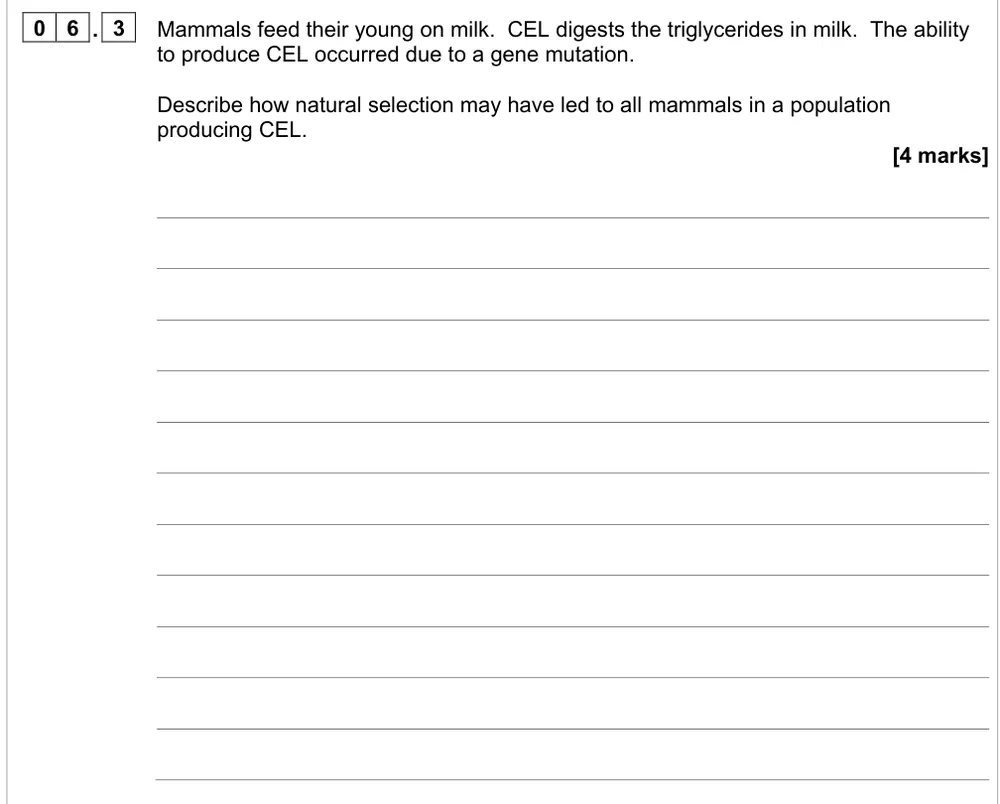
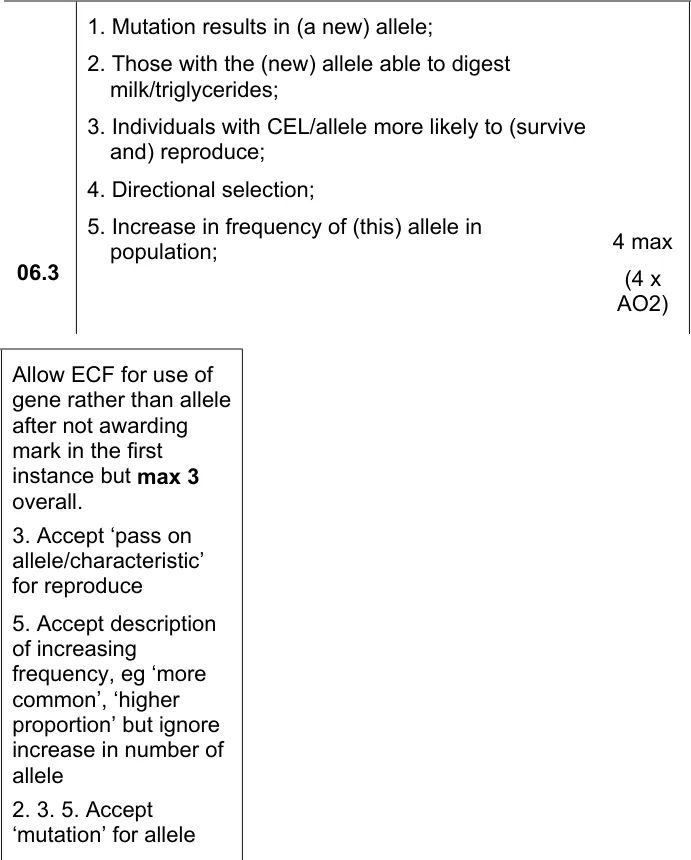
Describe how natural selection may have led to all mammals in a population producing the enzyme CEL.
Show the mark scheme
Tap an image to open it full size.
From the examiners' report: Only around 20% got 3 or more. Write 'allele', not 'gene', and don't just repeat the stem. Name directional selection and say the allele's frequency increases.
Question 2
A level Paper 2 · June 2018 · Q09.1 · 4 marks · Hard
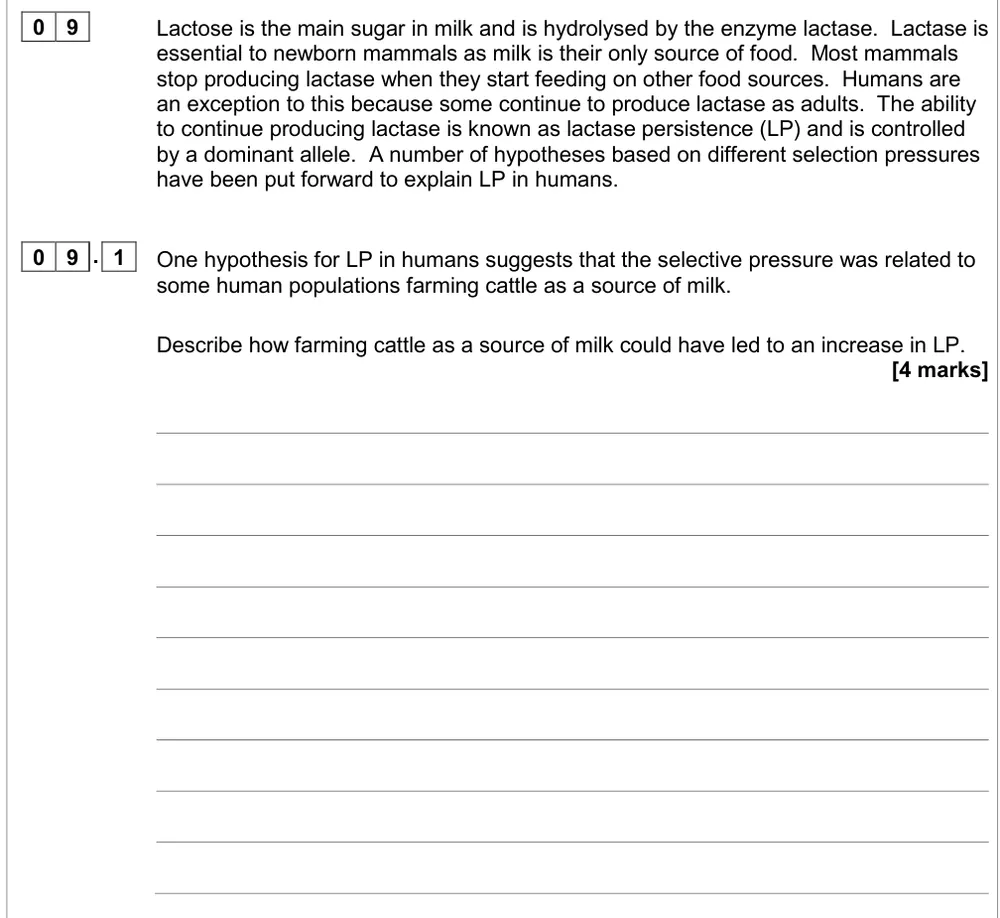
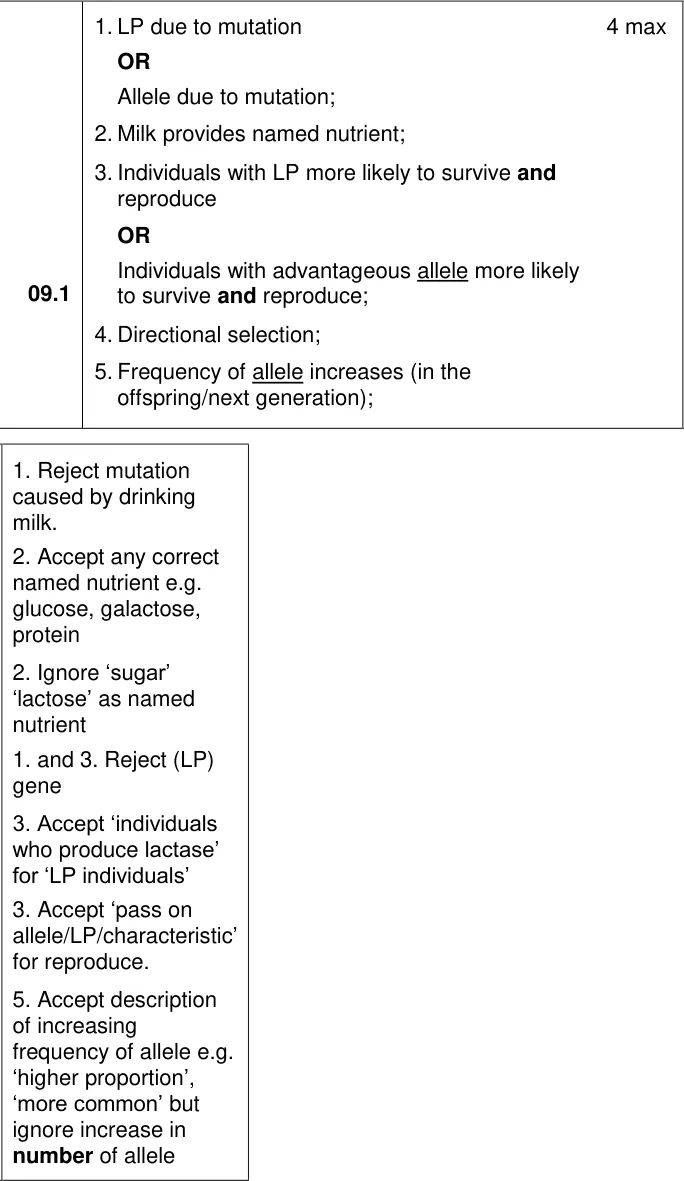
Describe how farming cattle for milk could have led to an increase in lactase persistence in humans.
Show the mark scheme
Tap an image to open it full size.
From the examiners' report: Fewer than 13% got more than 2. The mutation isn't caused by drinking milk; name a nutrient, not 'sugar'; write allele, not gene. LP is in the humans, not the cattle.
Question 3
AS Paper 2 · June 2017 · Q03.3 · 3 marks
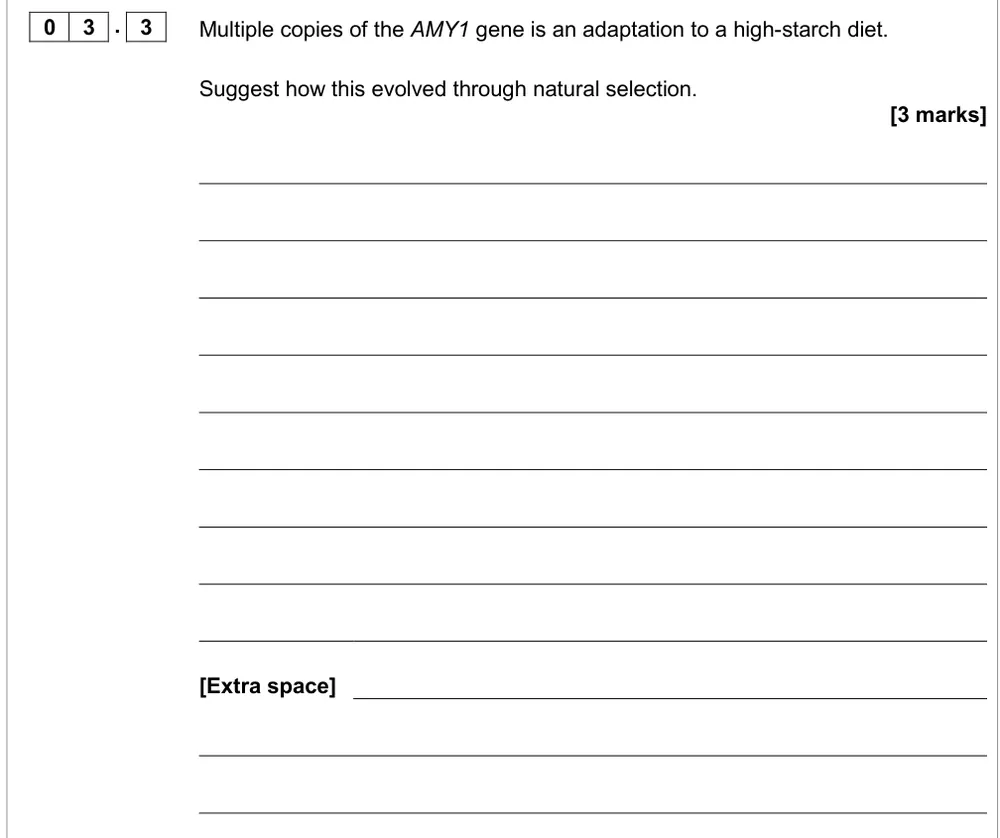
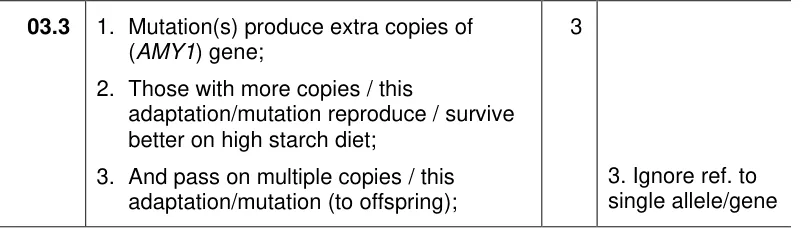
Suggest how multiple copies of the amylase gene AMY1 evolved through natural selection as an adaptation to a high-starch diet.
Show the mark scheme
Tap an image to open it full size.
From the examiners' report: No examiners' report for this part. The mark scheme wants three steps: a mutation gives the extra copies, people with them do better on a high-starch diet, and they pass the copies on.
Question 4
A level Paper 1 · June 2023 · Q03.5 · 4 marks · Medium
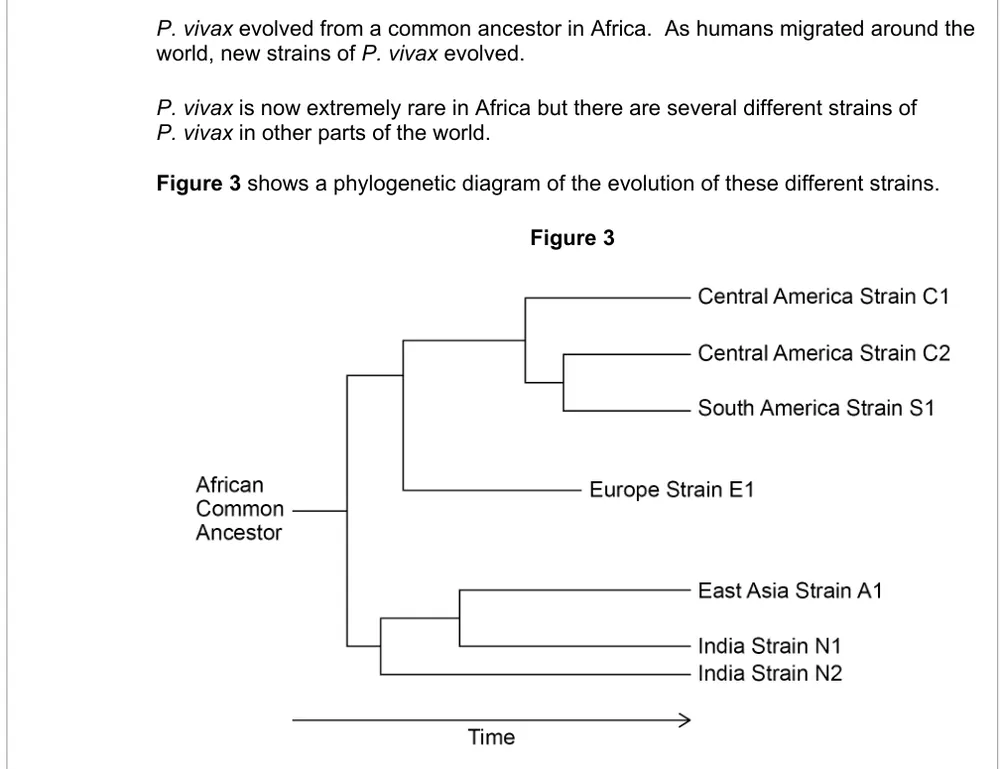
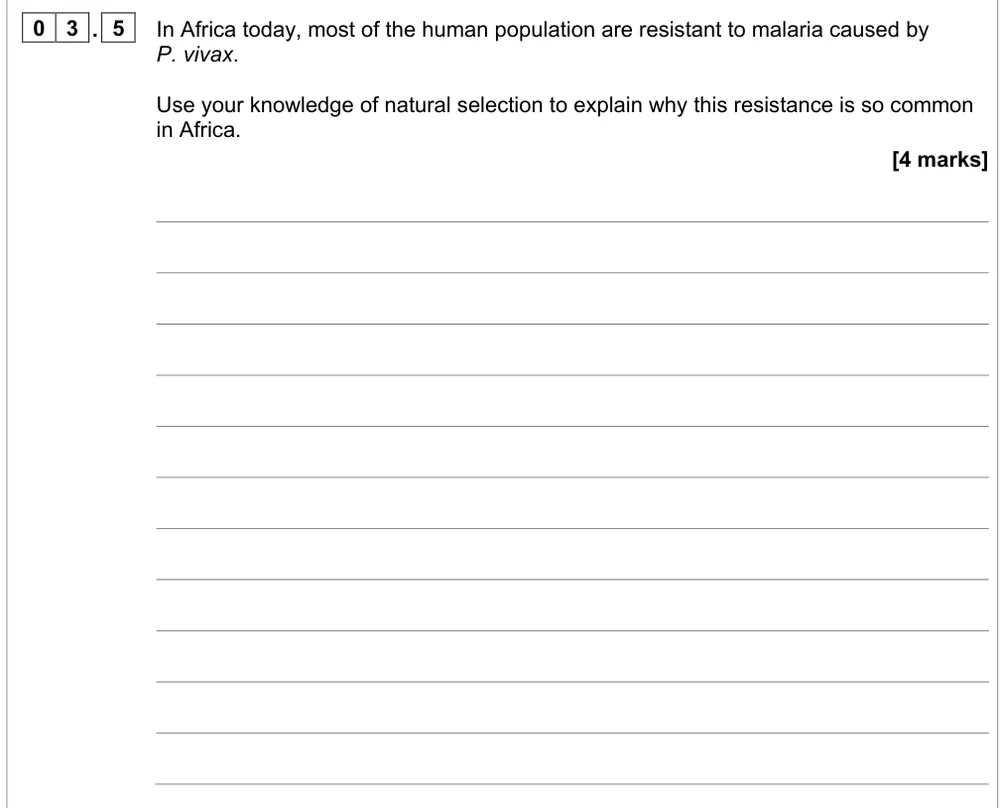
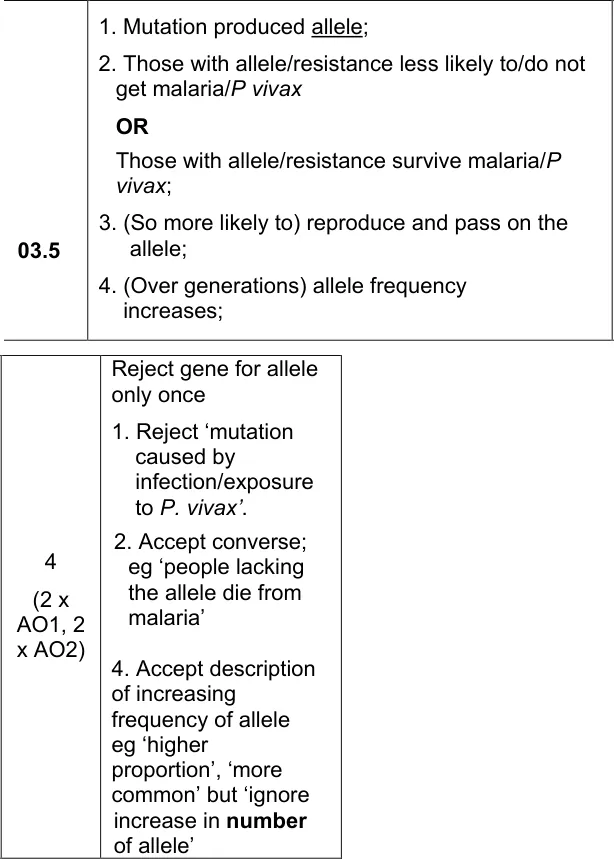
Use natural selection to explain why resistance to P. vivax malaria is so common in Africa.
Information from earlier in this question:
Show the mark scheme
Tap an image to open it full size.
From the examiners' report: 40% got 3 or 4. Stock phrases with no mutation or malaria miss the first two marks. Say a mutation produced an allele in humans, not in P. vivax, and write resistance, not immunity.
Question 5
AS Paper 2 · November 2021 · Q06.3 · 4 marks
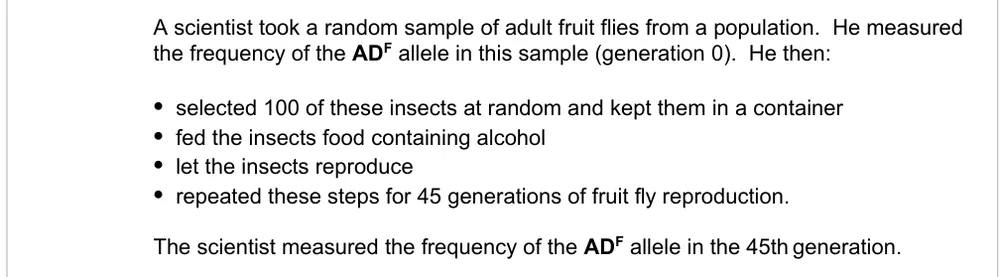
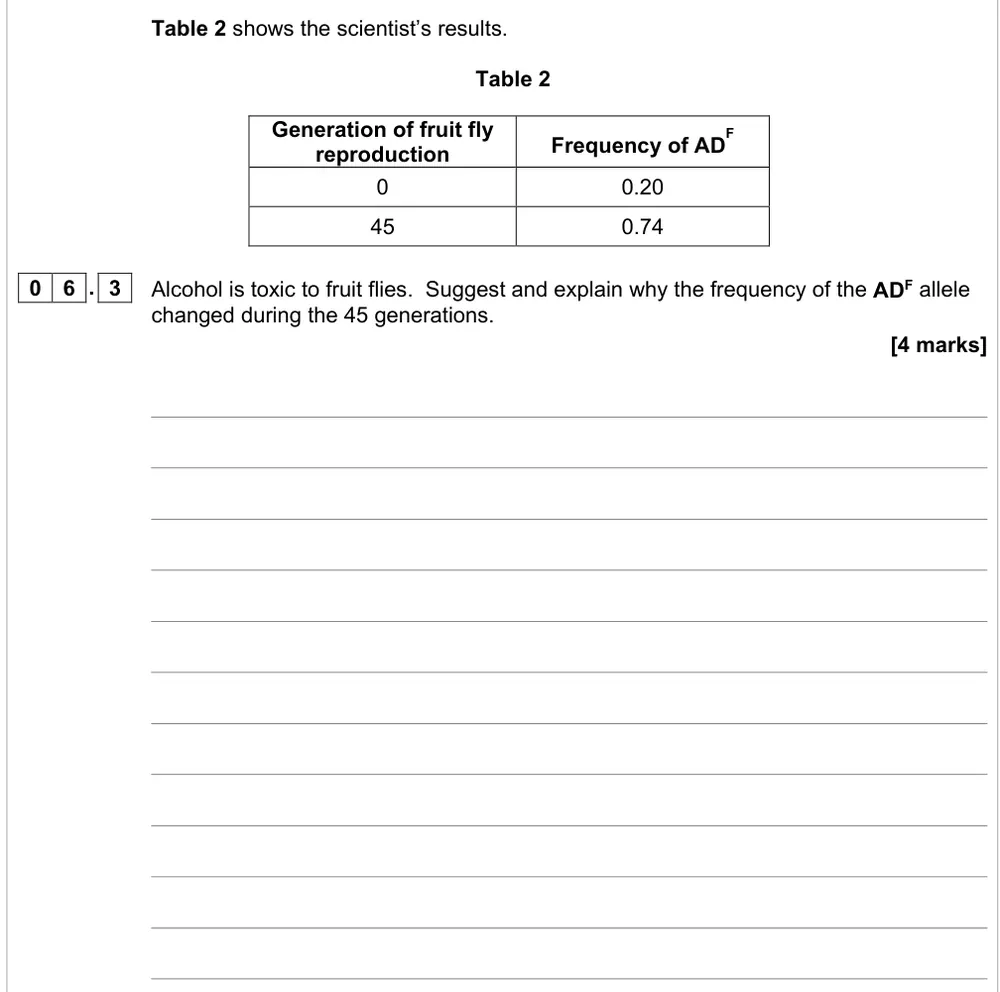
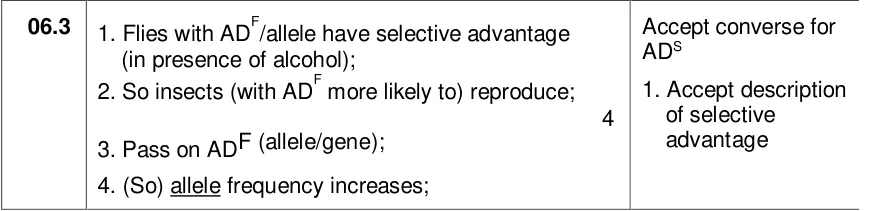
Suggest and explain why the frequency of the ADF allele in fruit flies fed alcohol changed over 45 generations.
Information from earlier in this question:

Show the mark scheme
Tap an image to open it full size.
From the examiners' report: No examiners' report for this paper. The mark scheme wants a chain: selective advantage with alcohol, more likely to reproduce, pass on ADF, so its frequency increases.
Directional selection and antibiotic resistance (3.4.4)
Question 6
AS Paper 1 · June 2025 · Q09.1 · 1 mark · Medium
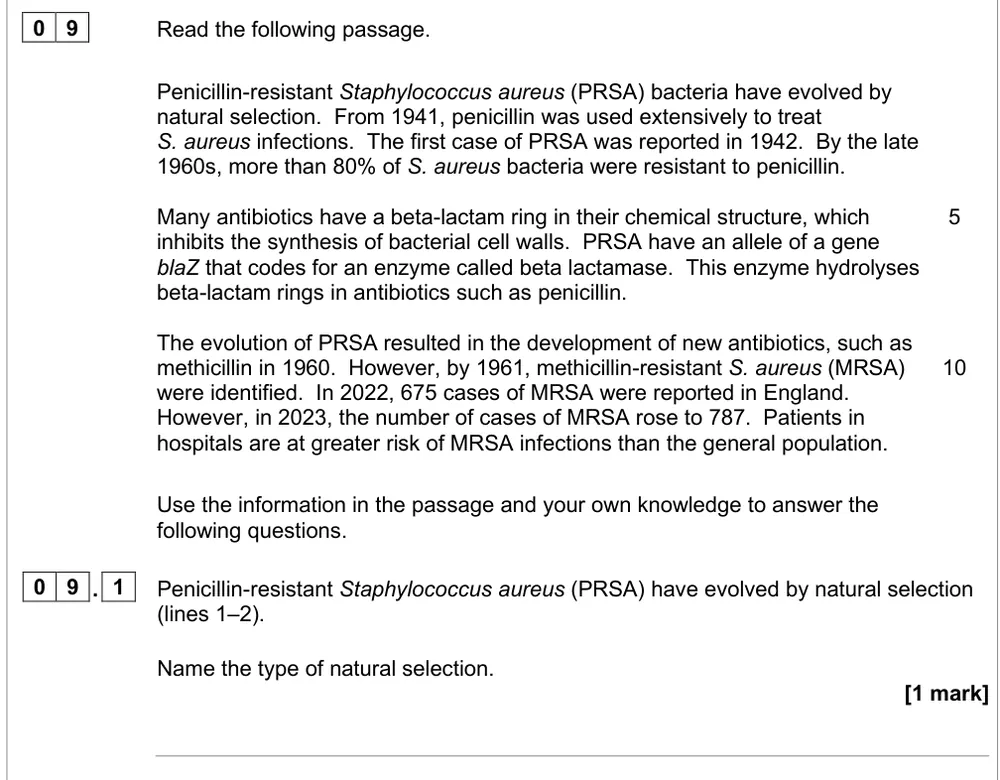
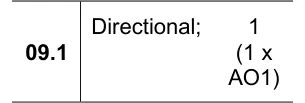
Name the type of natural selection by which penicillin-resistant S. aureus evolved.
Show the mark scheme
Tap an image to open it full size.
From the examiners' report: Slightly under 50% wrote directional. 'Mutation', 'survival of the fittest' and 'adaptations' aren't types of selection.
Question 7
AS Paper 1 · June 2025 · Q09.2 · 3 marks · Hard
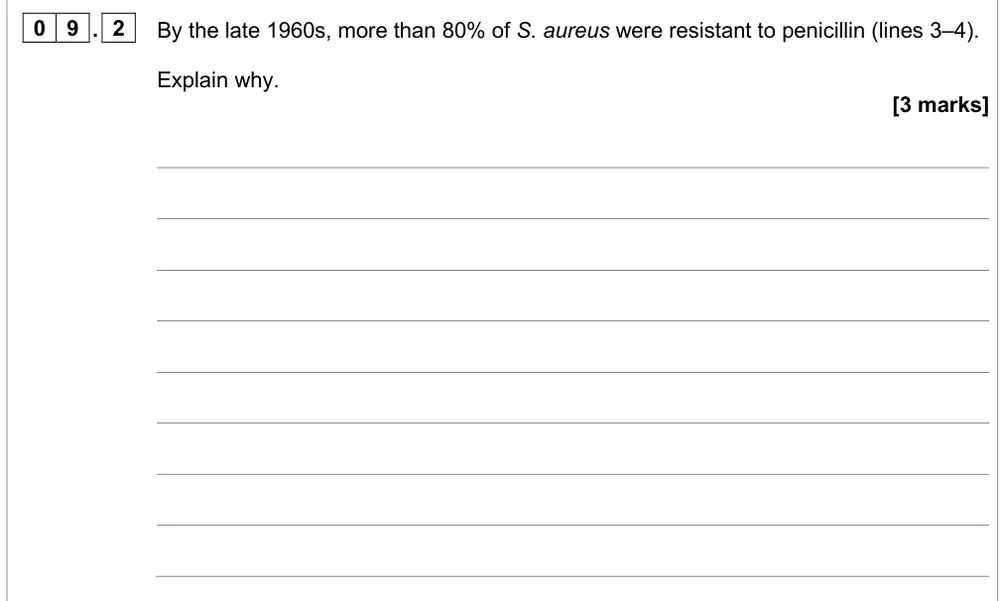
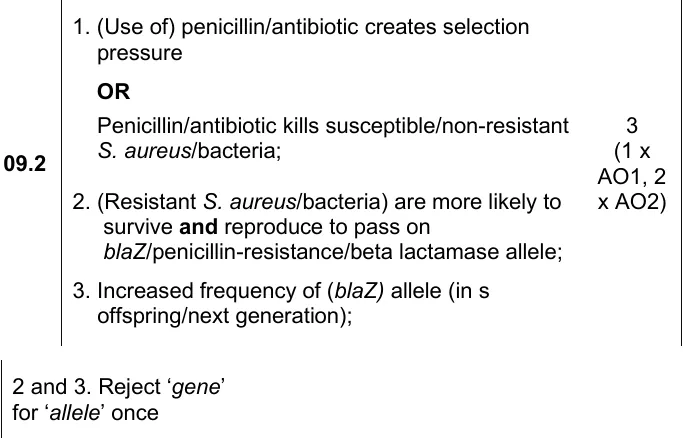
Explain why more than 80% of S. aureus were resistant to penicillin by the late 1960s.
Show the mark scheme
Tap an image to open it full size.
From the examiners' report: About 5% got all 3. Bacteria are resistant, not 'immune'. Name the blaZ or penicillin-resistance allele, not just a 'beneficial allele', and say its frequency increases.
Question 8
A level Paper 1 · June 2022 · Q02.1 · 3 marks · Medium
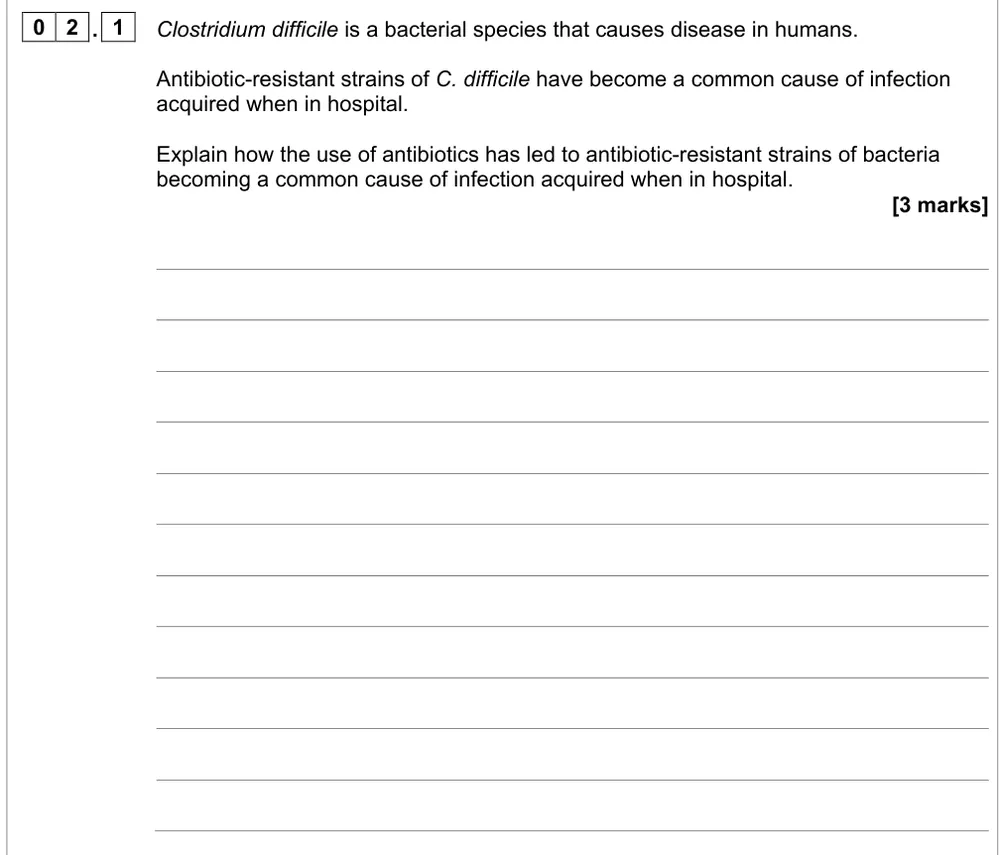
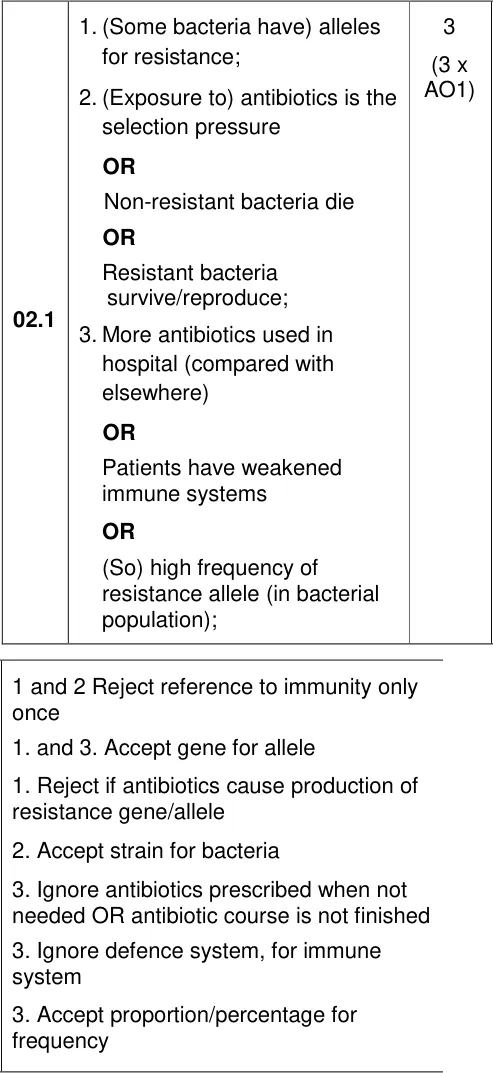
Explain how antibiotic use has made resistant C. difficile a common cause of infection acquired in hospital.
Show the mark scheme
Tap an image to open it full size.
From the examiners' report: 80% scored at least 1. Antibiotics don't cause mutations, and bacteria don't make an immune response. For the hospital mark, say more antibiotics are used there or patients have weakened immune systems.
Question 9
AS Paper 2 · June 2018 · Q08.4 · 2 marks · Hard
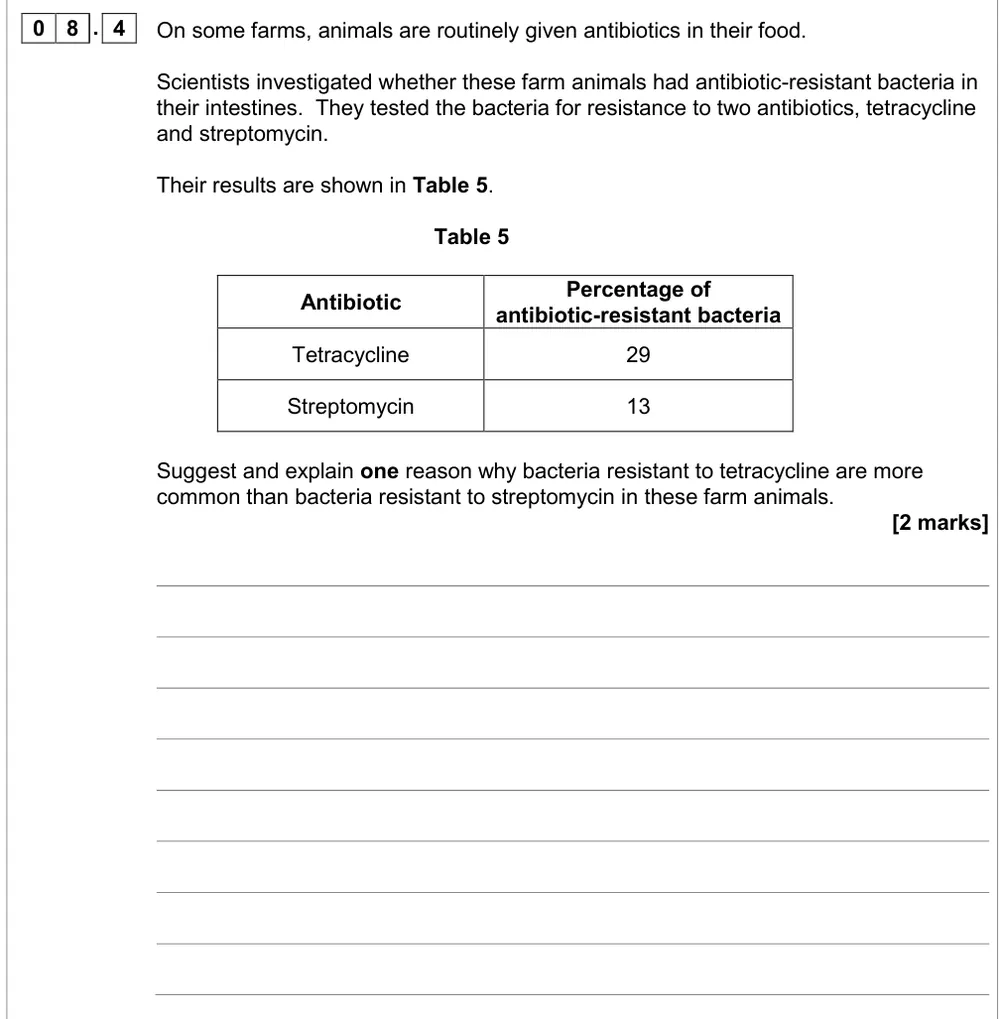
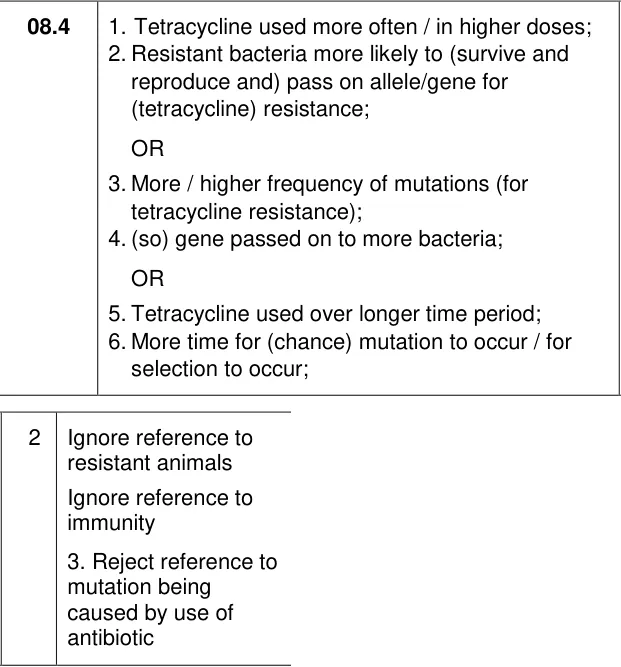
Suggest and explain why tetracycline-resistant bacteria are more common than streptomycin-resistant bacteria in farm animals.
Show the mark scheme
Tap an image to open it full size.
From the examiners' report: Most got 1 mark for more tetracycline or longer use. Then explain: resistant bacteria survive, reproduce and pass on the resistance allele. Antibiotics don't cause mutations.
Question 10
AS Paper 2 · June 2018 · Q08.5 · 1 mark · Hard
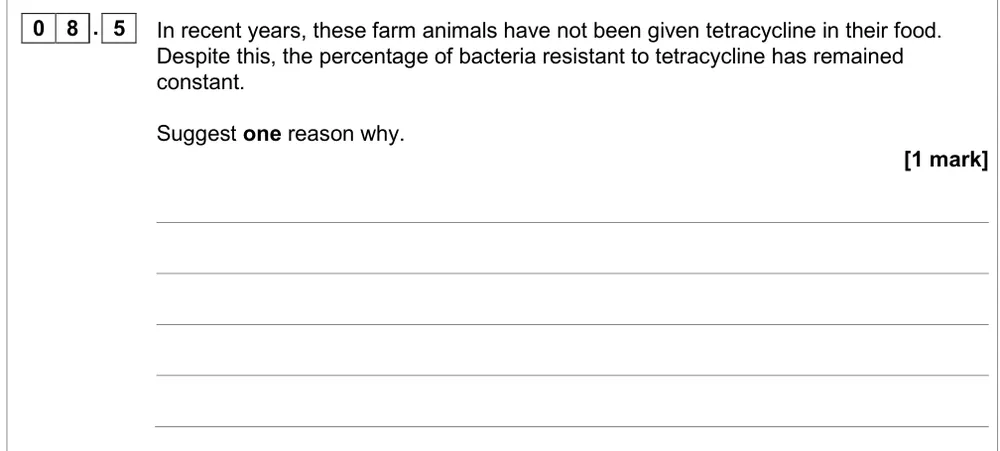
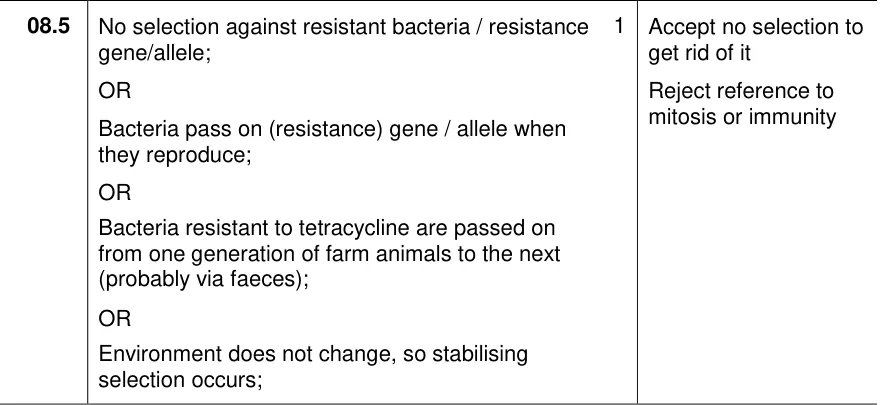
Suggest why tetracycline resistance stayed constant after farm animals stopped being given tetracycline.
Show the mark scheme
Tap an image to open it full size.
From the examiners' report: Only 16.7% scored. With no selection against them, resistant bacteria still pass on the resistance allele when they reproduce. The animals' immune response isn't relevant.
Question 11
A level Paper 1 · June 2017 · Q05.5 · 3 marks
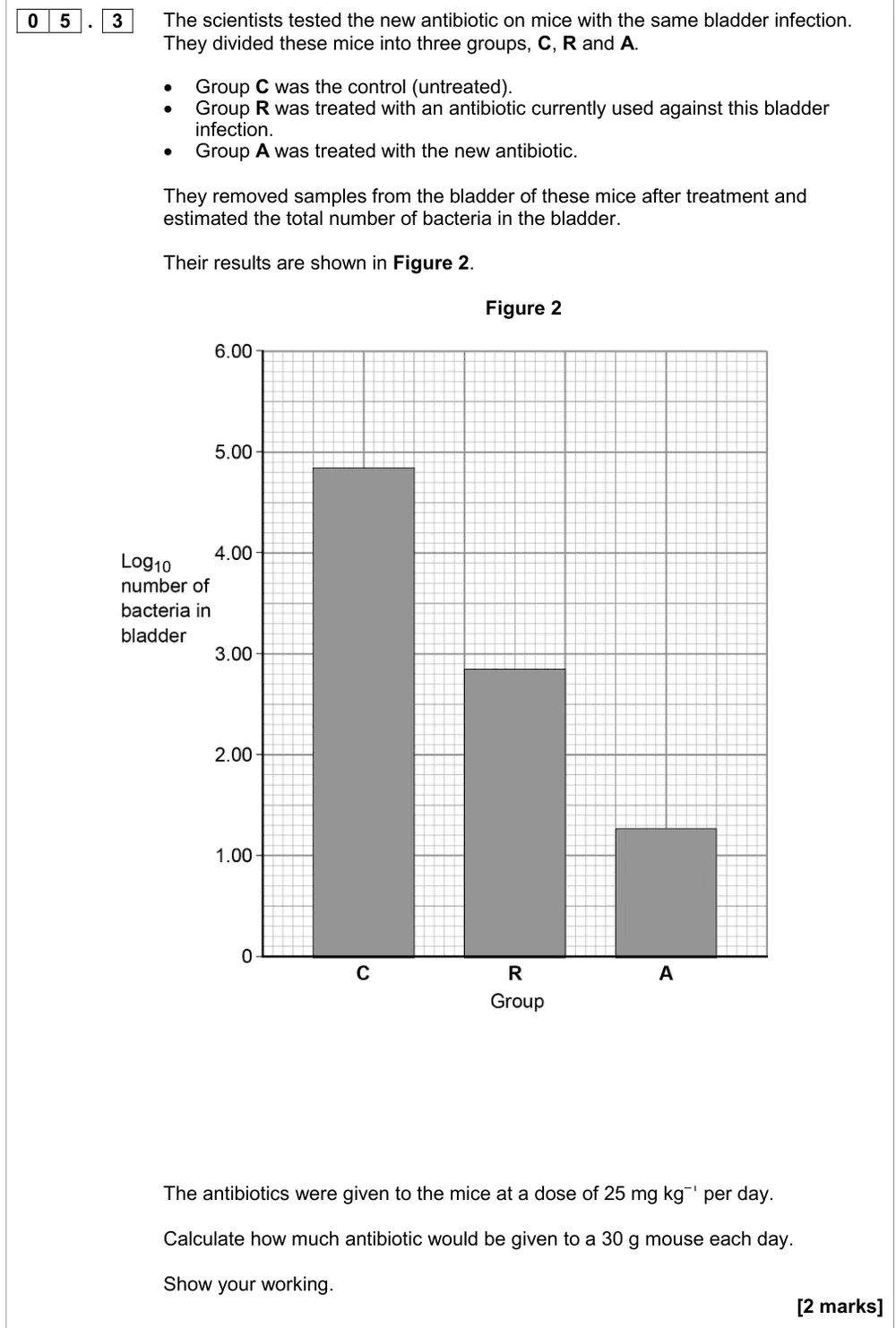
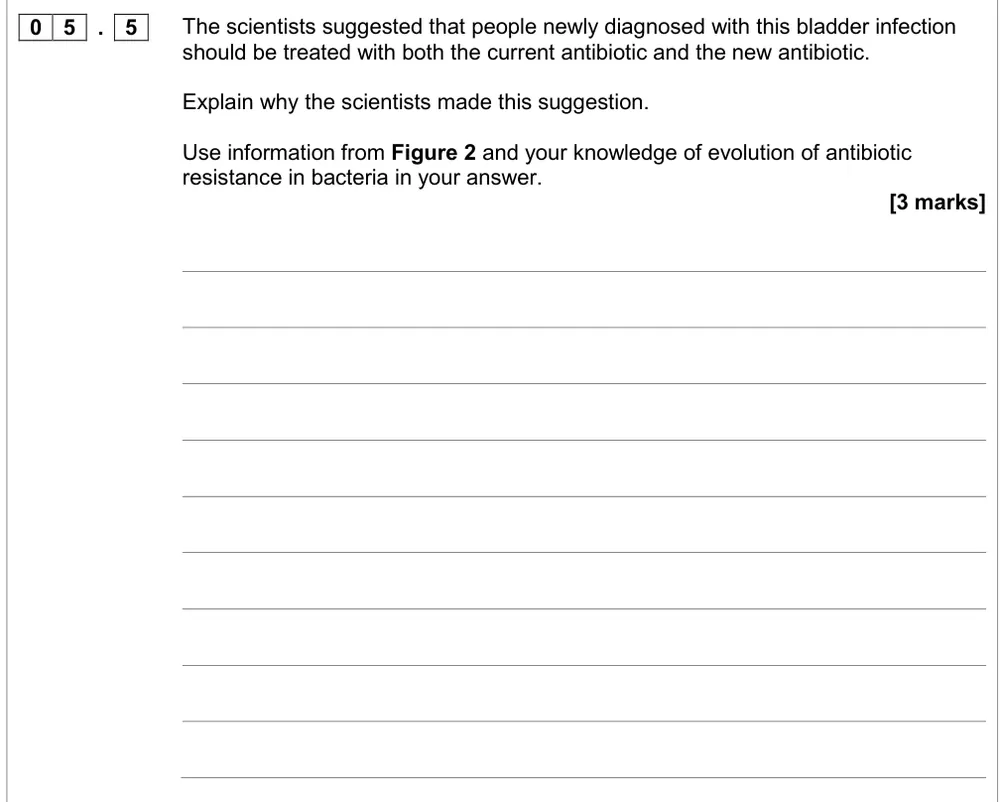
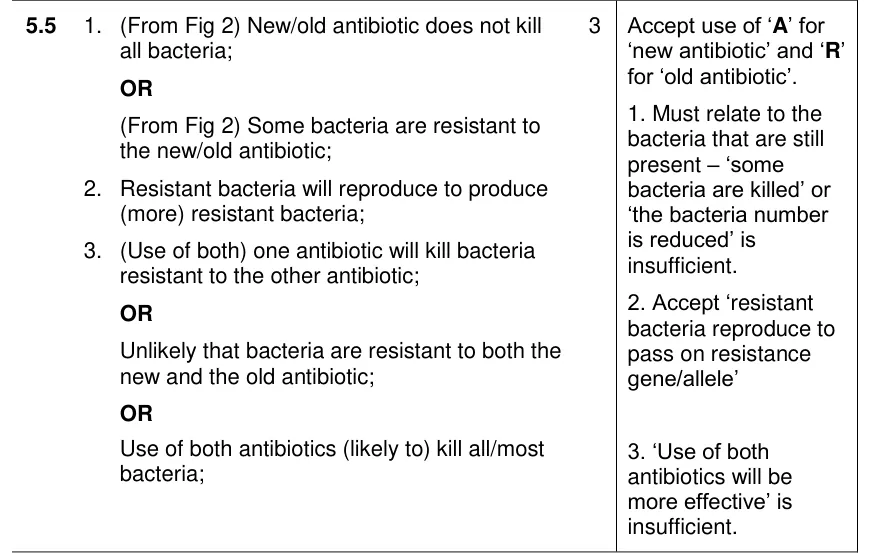
Explain why patients with a bladder infection should be treated with both the current and the new antibiotic.
Information from earlier in this question:

Show the mark scheme
Tap an image to open it full size.
From the examiners' report: No examiners' report for this part. Use Figure 2: some bacteria survive each antibiotic. 'More effective' isn't enough: say one kills the bacteria resistant to the other.
Selection in unfamiliar contexts and data (3.4.4)
Question 12
AS Paper 2 · June 2019 · Q07.1 · 2 marks · Hard
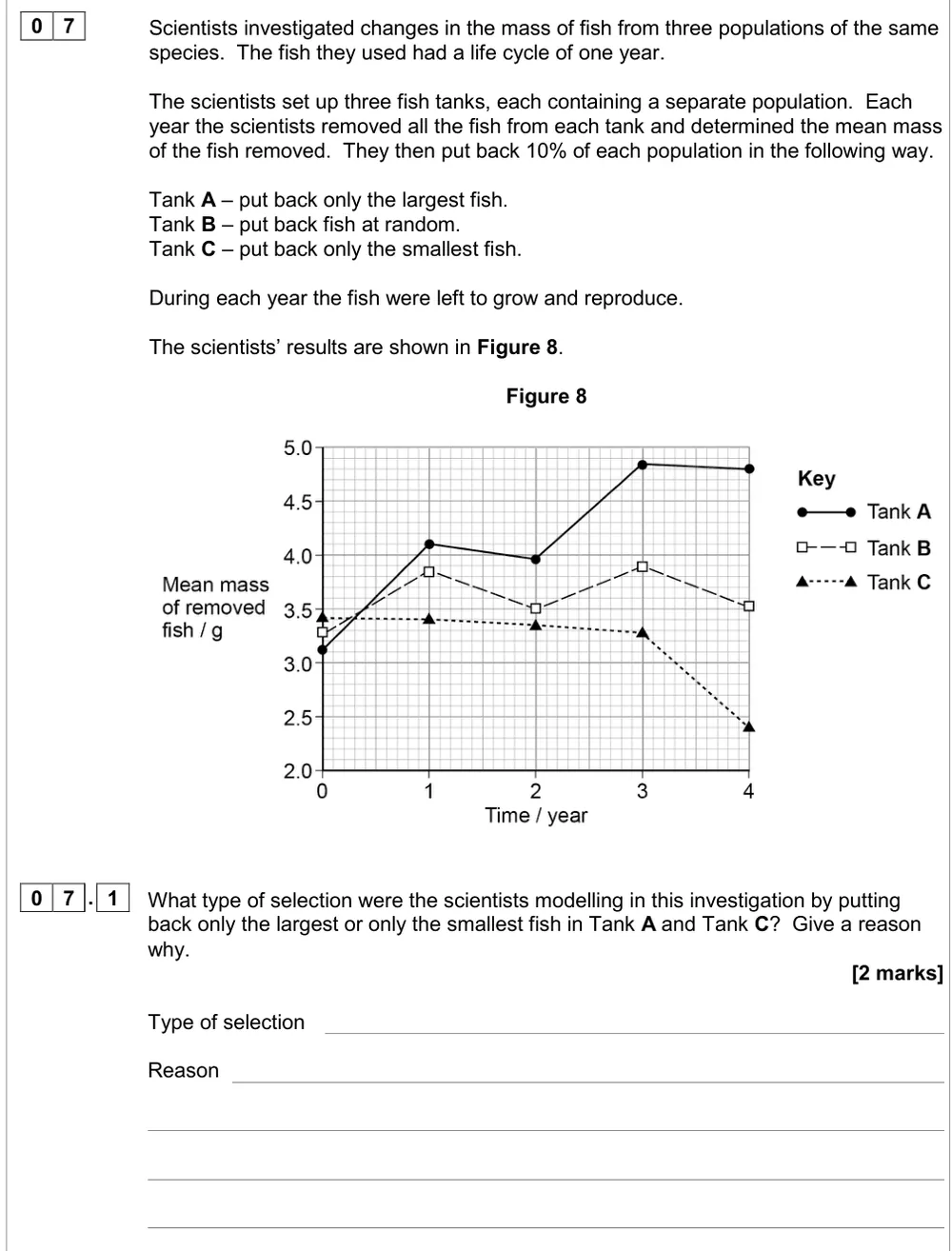
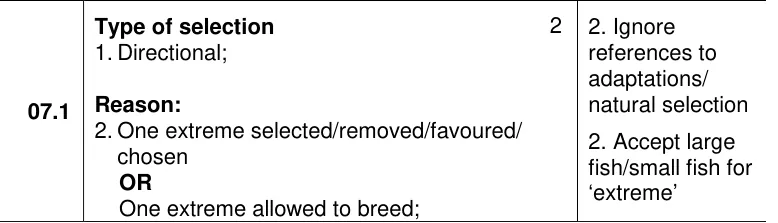
Name the type of selection modelled by putting back only the largest or only the smallest fish, and give a reason.
Show the mark scheme
Tap an image to open it full size.
From the examiners' report: Many named types of selection not in the specification, such as artificial, planned or continuous. Write directional, then say one extreme is favoured; 'to get the best fish' doesn't score.
Question 13
AS Paper 2 · June 2019 · Q07.4 · 3 marks · Medium
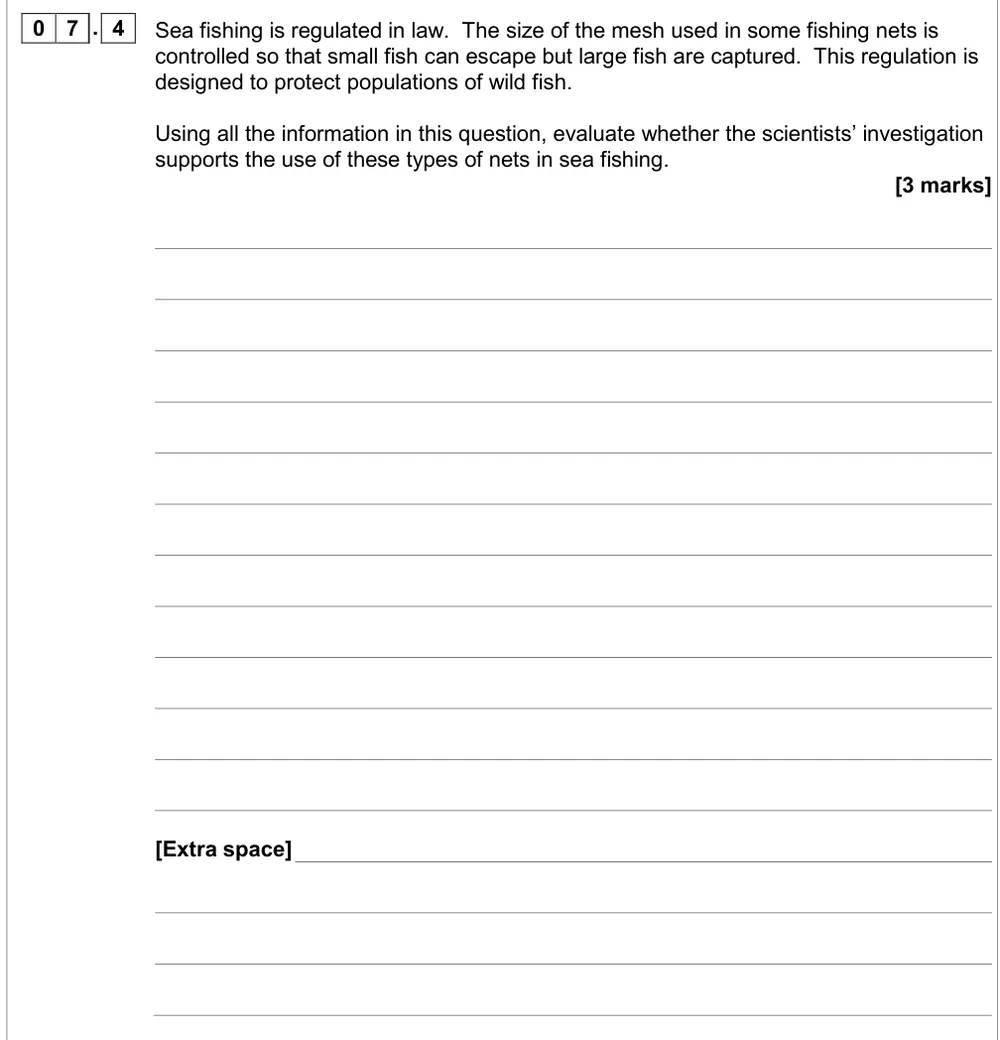
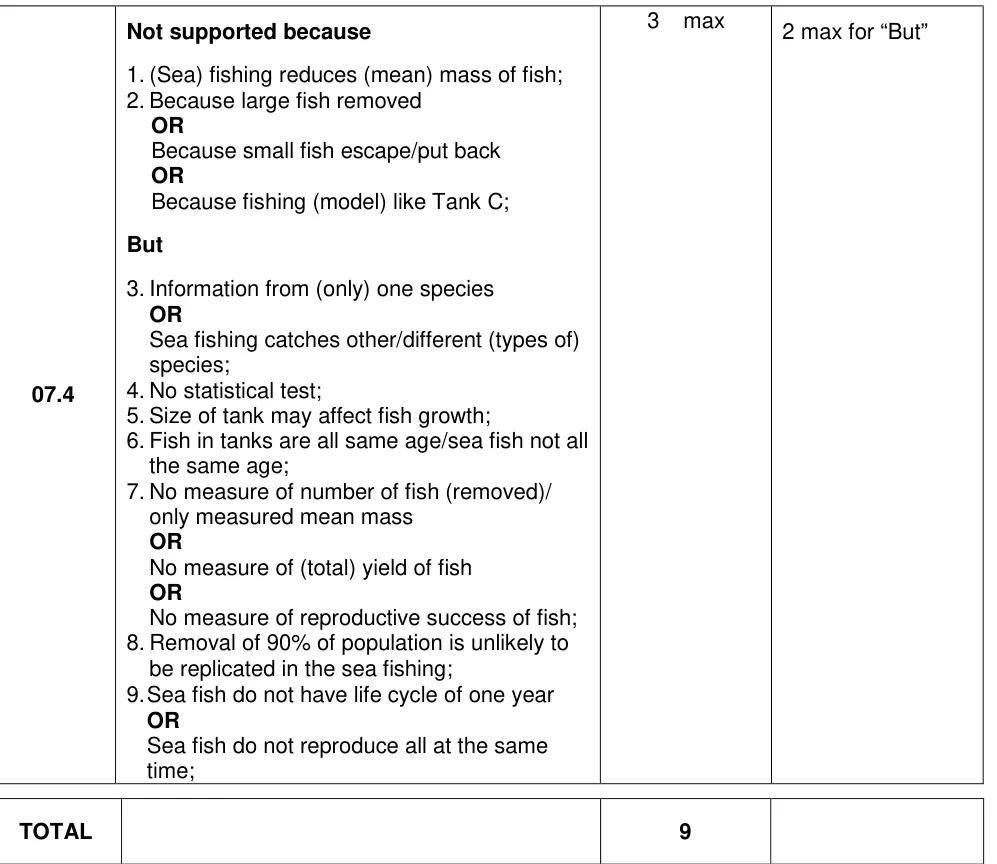
Evaluate whether the fish tank investigation supports using nets that let small fish escape in sea fishing.
Show the mark scheme
Tap an image to open it full size.
From the examiners' report: Just under half concluded it isn't supported, and about 1% gave both sides. State your conclusion clearly, and read the y-axis: it shows mean mass, not population size.
Question 14
A level Paper 1 · June 2019 · Q04.1 · 3 marks
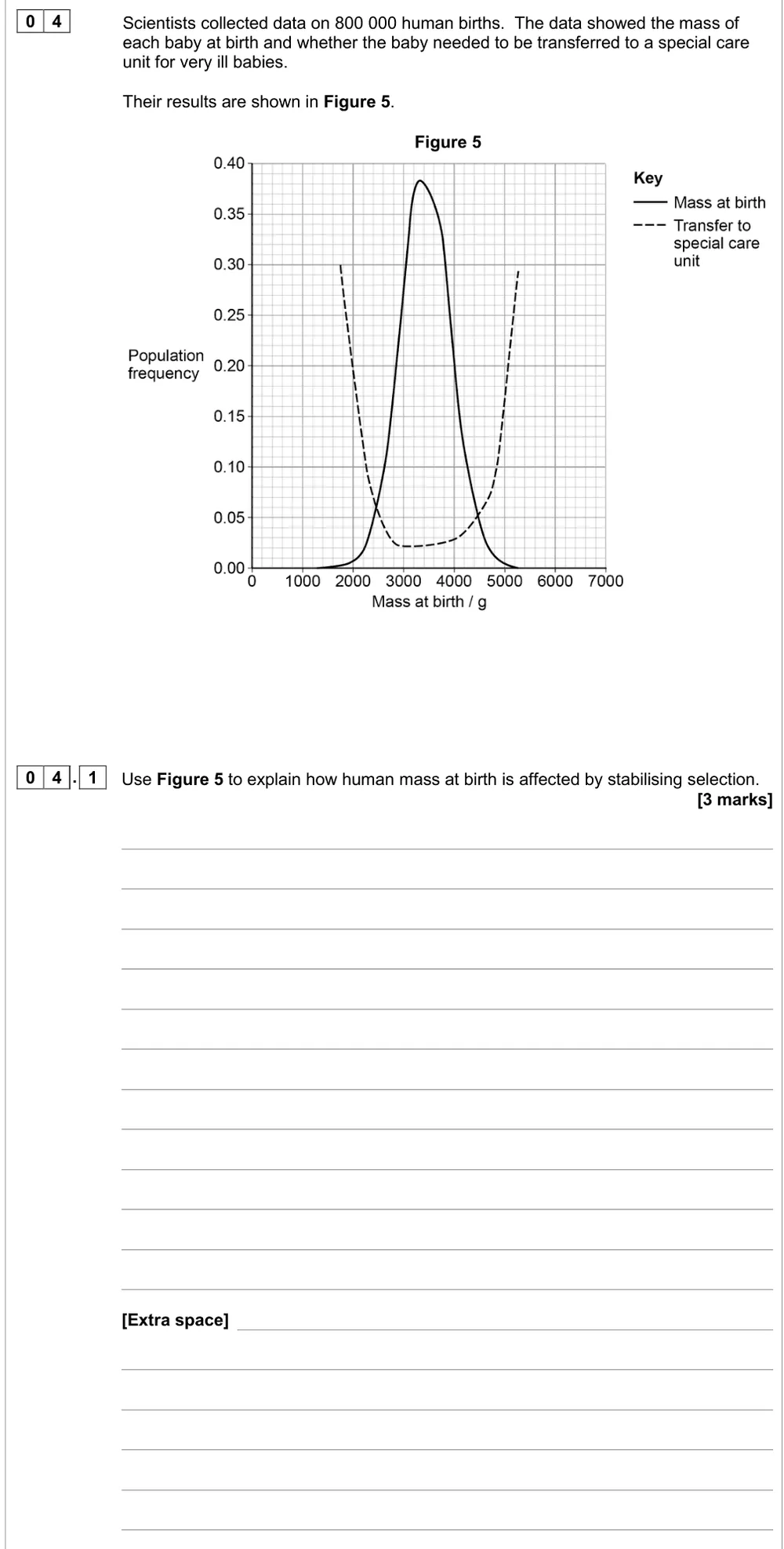
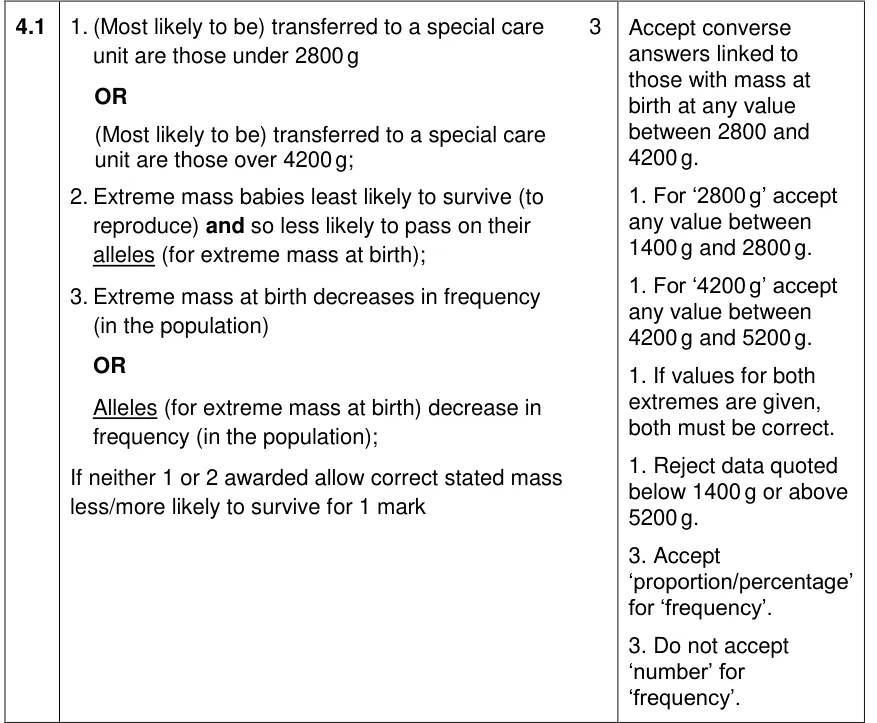
Use a graph of 800 000 births to explain how human mass at birth is affected by stabilising selection.
Show the mark scheme
Tap an image to open it full size.
From the examiners' report: No examiners' report for this paper. Quote Figure 5, link survival to passing on alleles, and say alleles for extreme mass fall in frequency (or proportion), not number.
Question 15
AS Paper 2 · June 2022 · Q08.3 · 4 marks · Hard
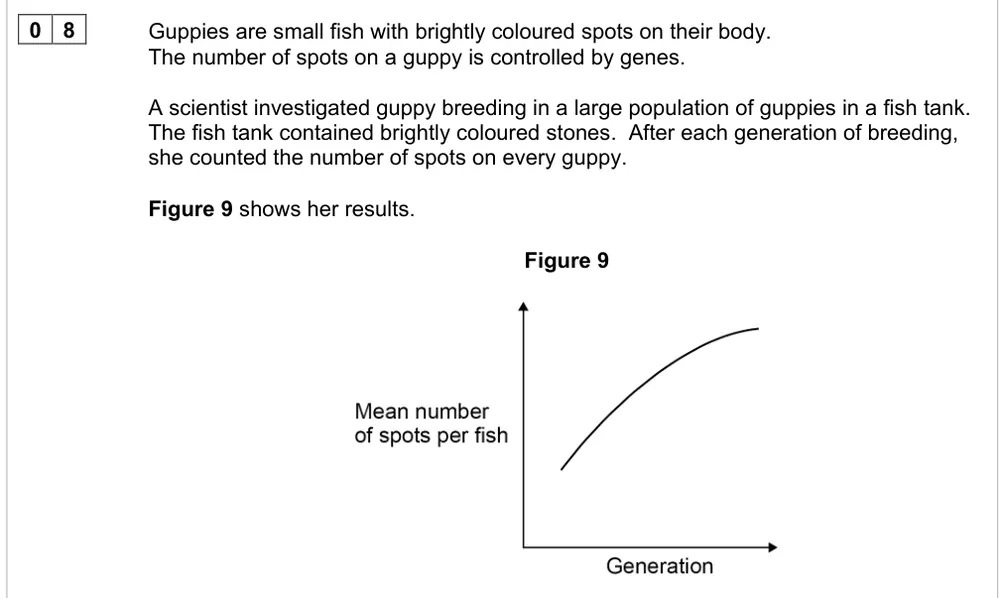
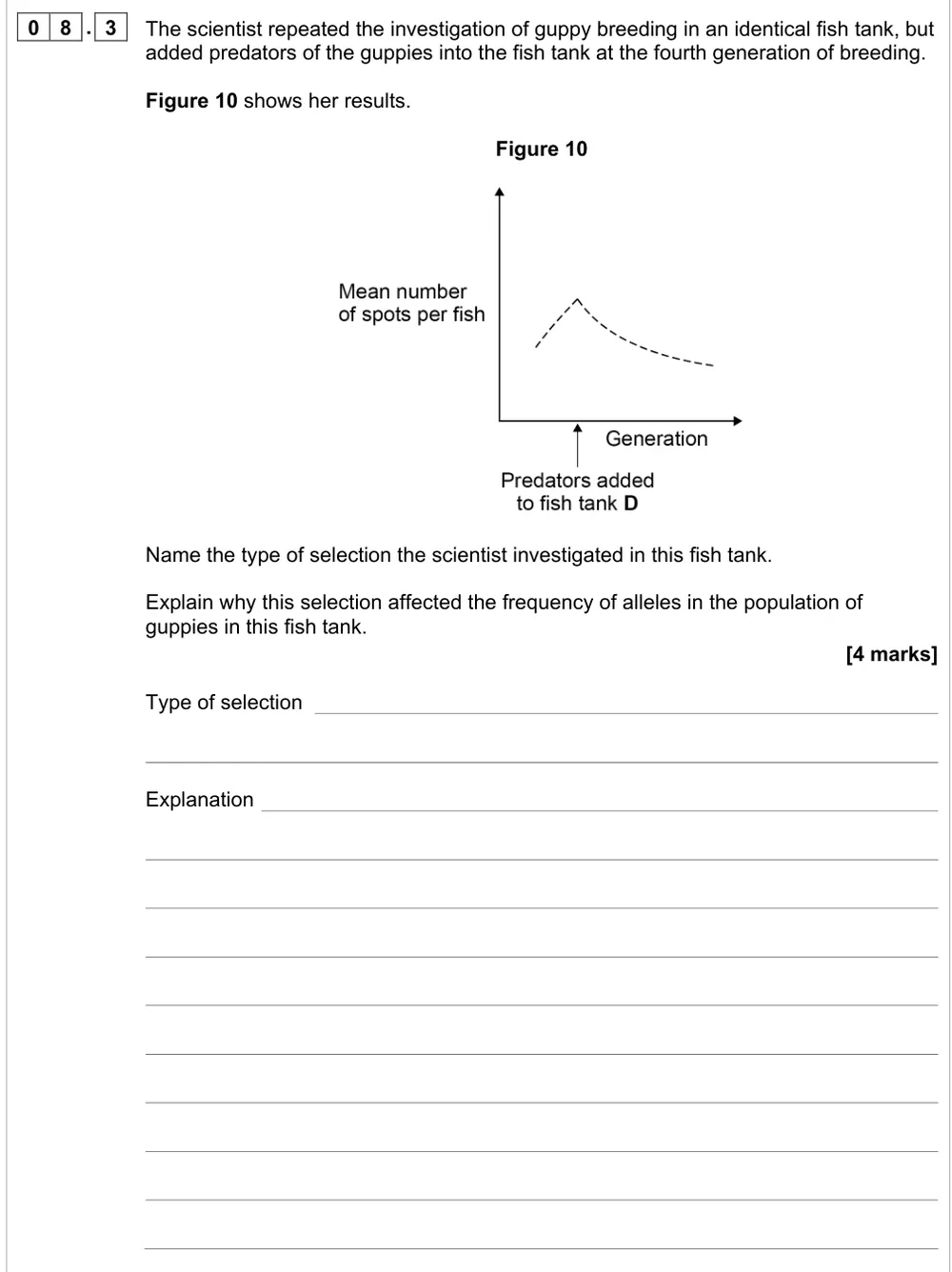
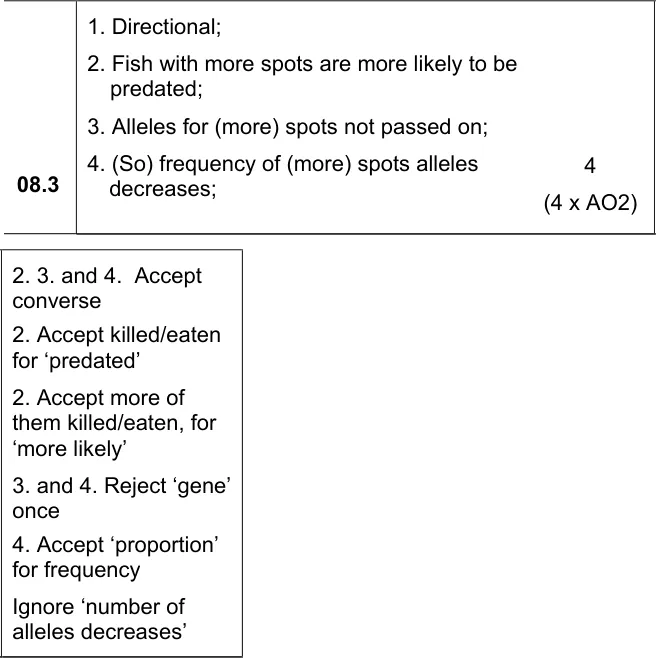
Name the selection caused by adding predators to a guppy tank and explain how it changed allele frequency.
Information from earlier in this question:
Show the mark scheme
Tap an image to open it full size.
From the examiners' report: Under 4% got all 4, though over half got 1. Name directional selection and say which allele: fish with more spots are eaten, so alleles for more spots fall in frequency.
Question 16
A level Paper 1 · June 2018 · Q06.4 · 3 marks
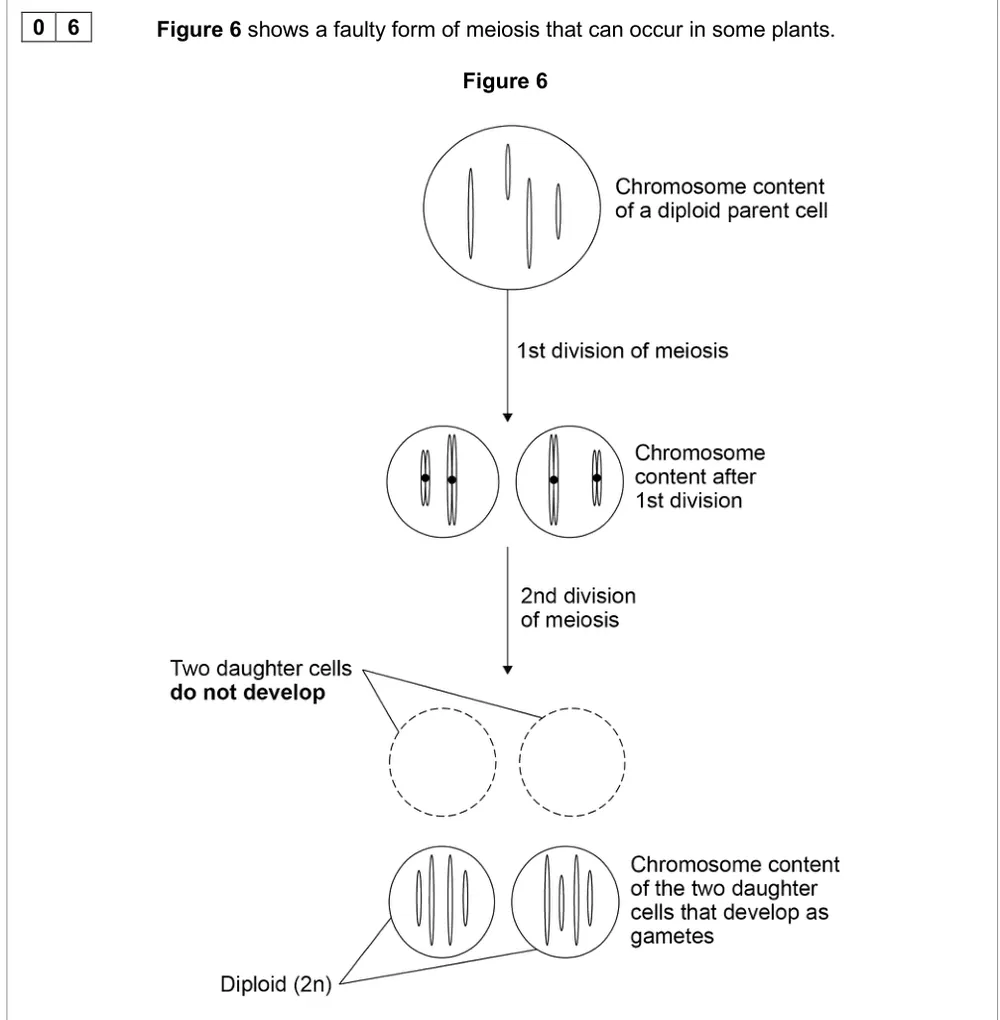
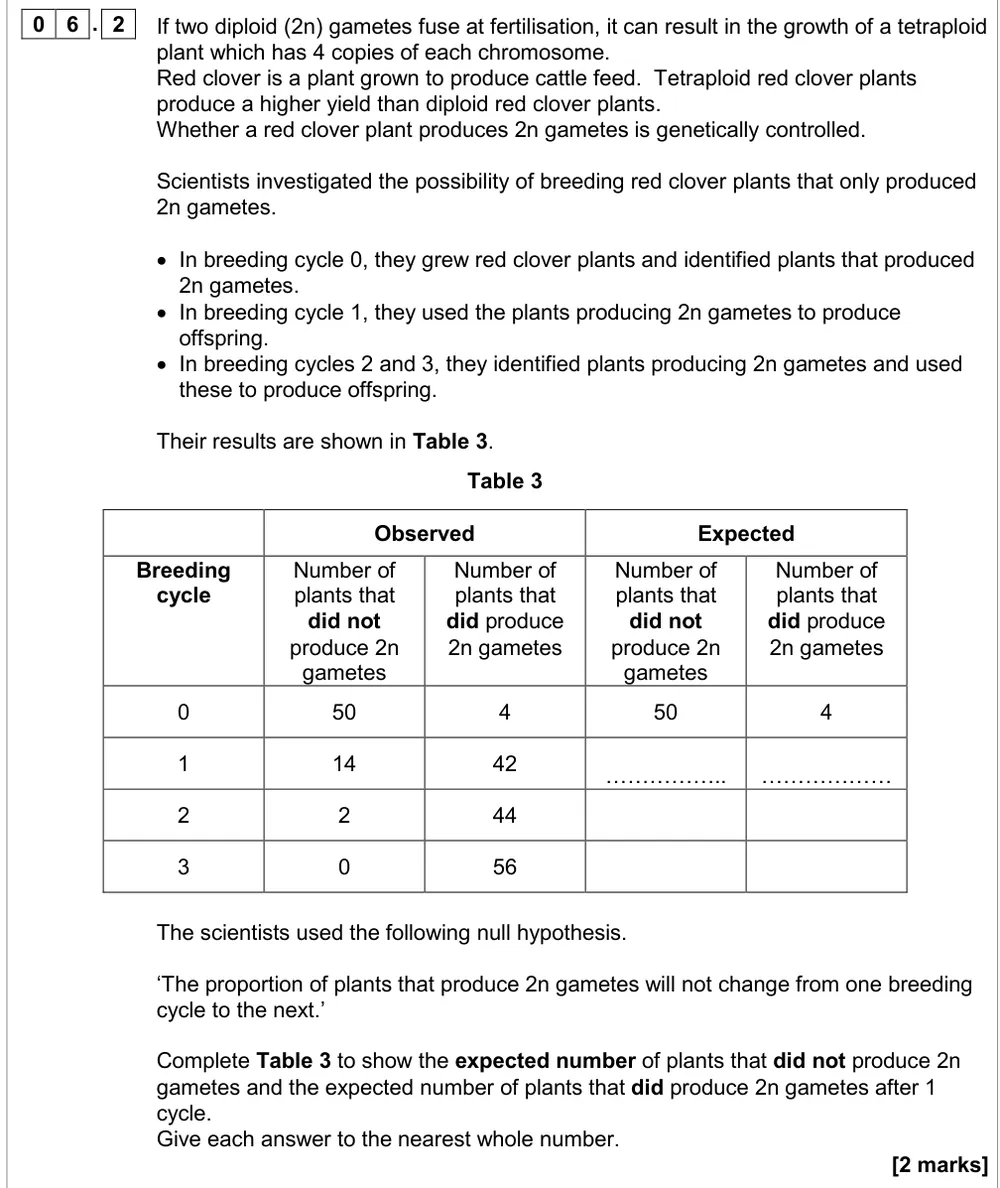
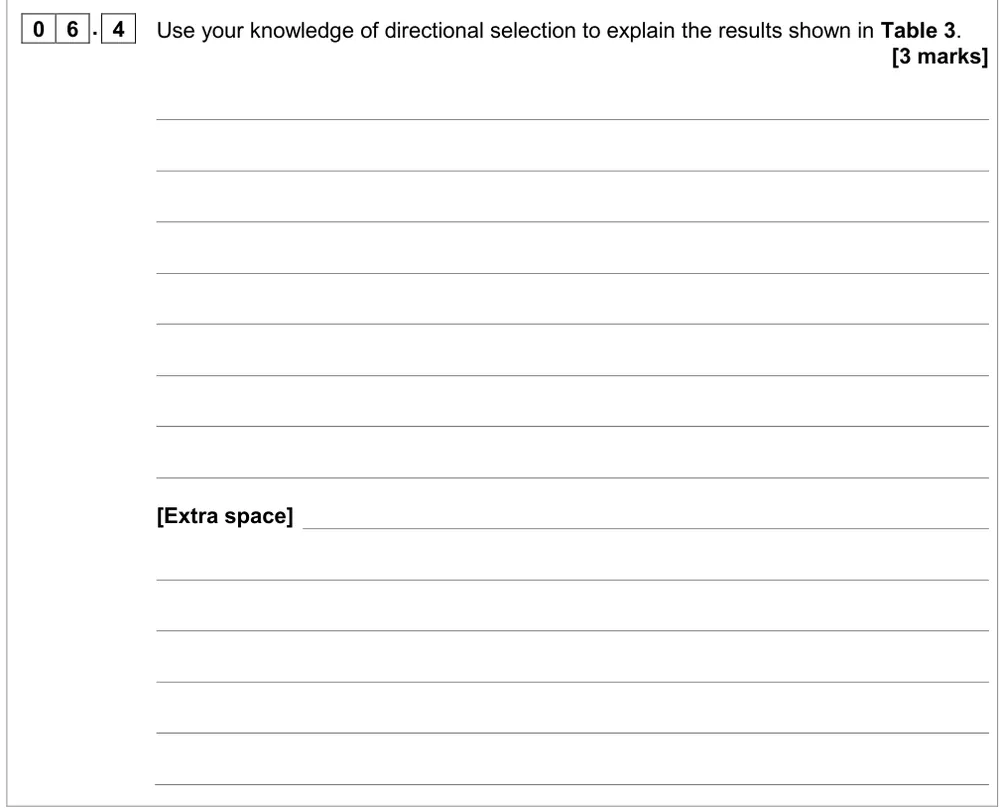
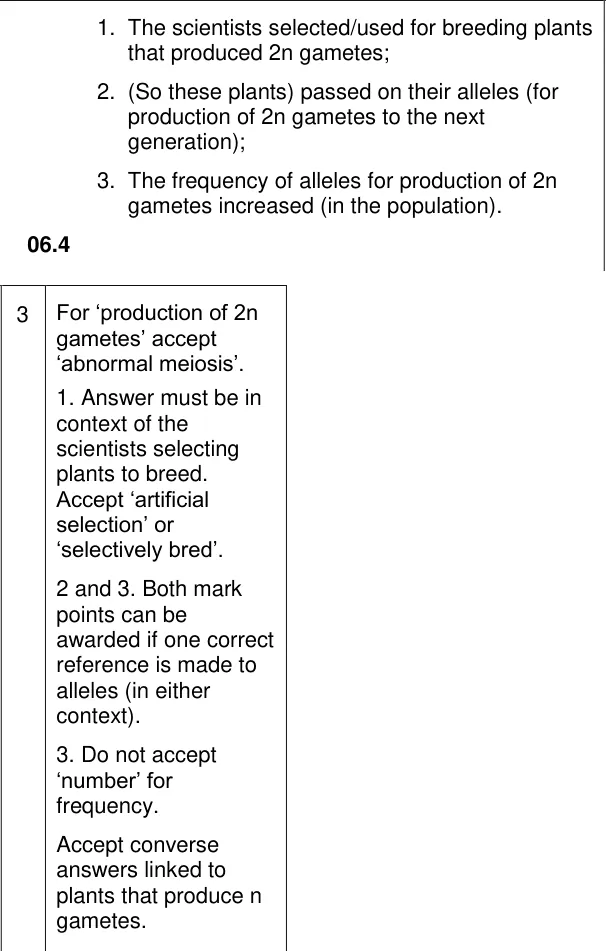
Use directional selection to explain how breeding red clover increased the number of plants producing 2n gametes.
Information from earlier in this question:
Show the mark scheme
Tap an image to open it full size.
From the examiners' report: Many just described directional selection or said the environment changed. Use the stem: the scientists bred only from 2n plants, so their alleles were passed on and rose in frequency.
Question 17
AS Paper 2 · June 2016 · Q07.3 · 2 marks · Hard
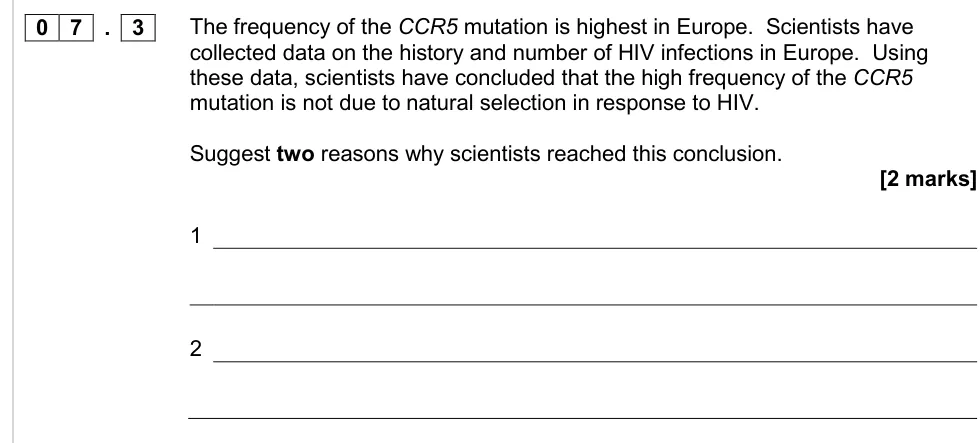
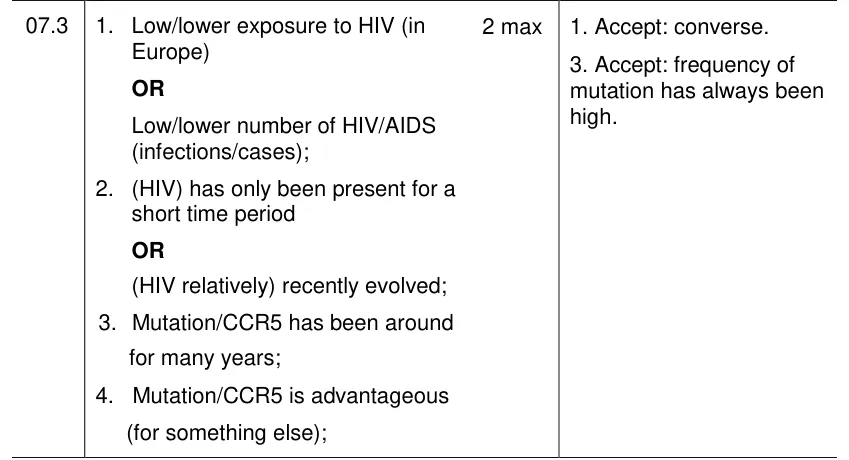
Suggest why the high frequency of the CCR5 mutation in Europe is not due to natural selection by HIV.
Show the mark scheme
Tap an image to open it full size.
From the examiners' report: Under 5% got both marks. Use the context: there are fewer HIV infections in Europe, and HIV hasn't been in humans for long enough for selection to raise the frequency.
Question 18
A level Paper 1 · June 2022 · Q02.4 · 3 marks · Hard
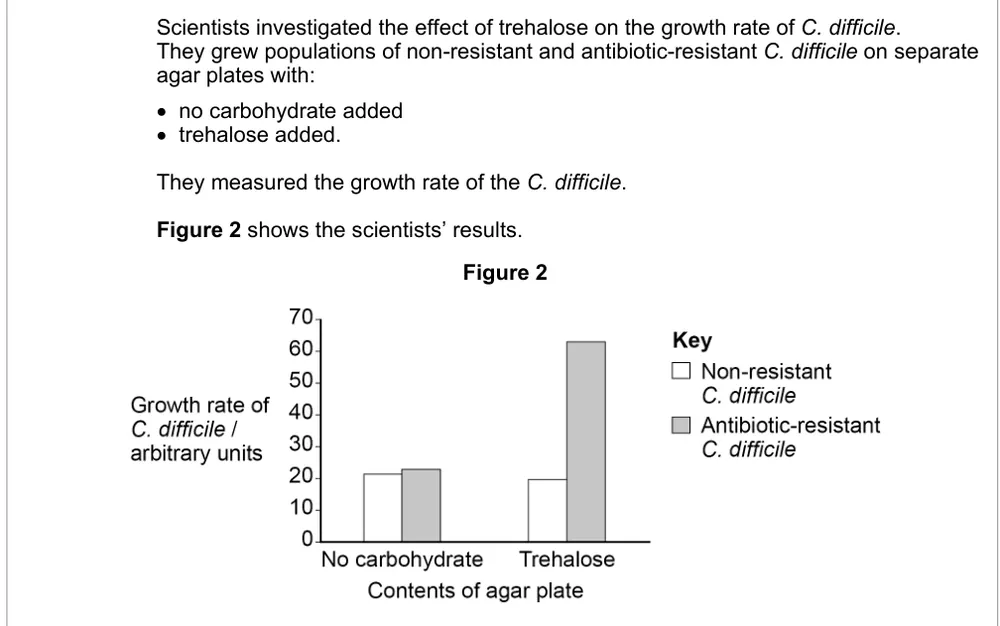
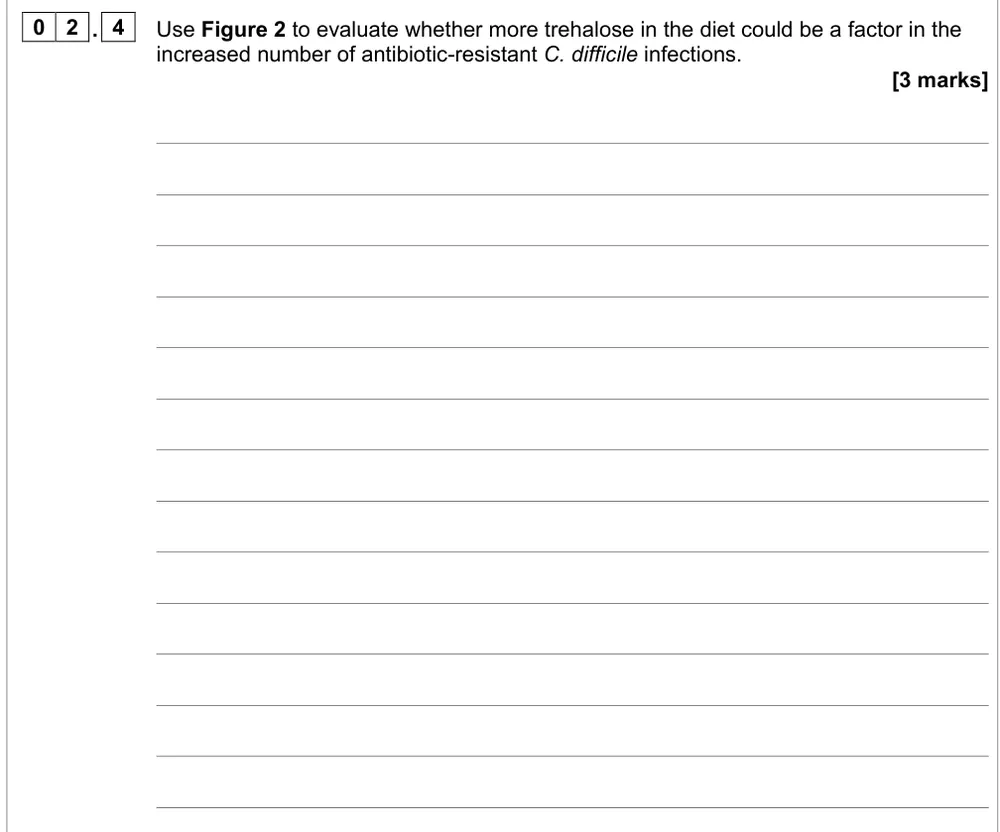
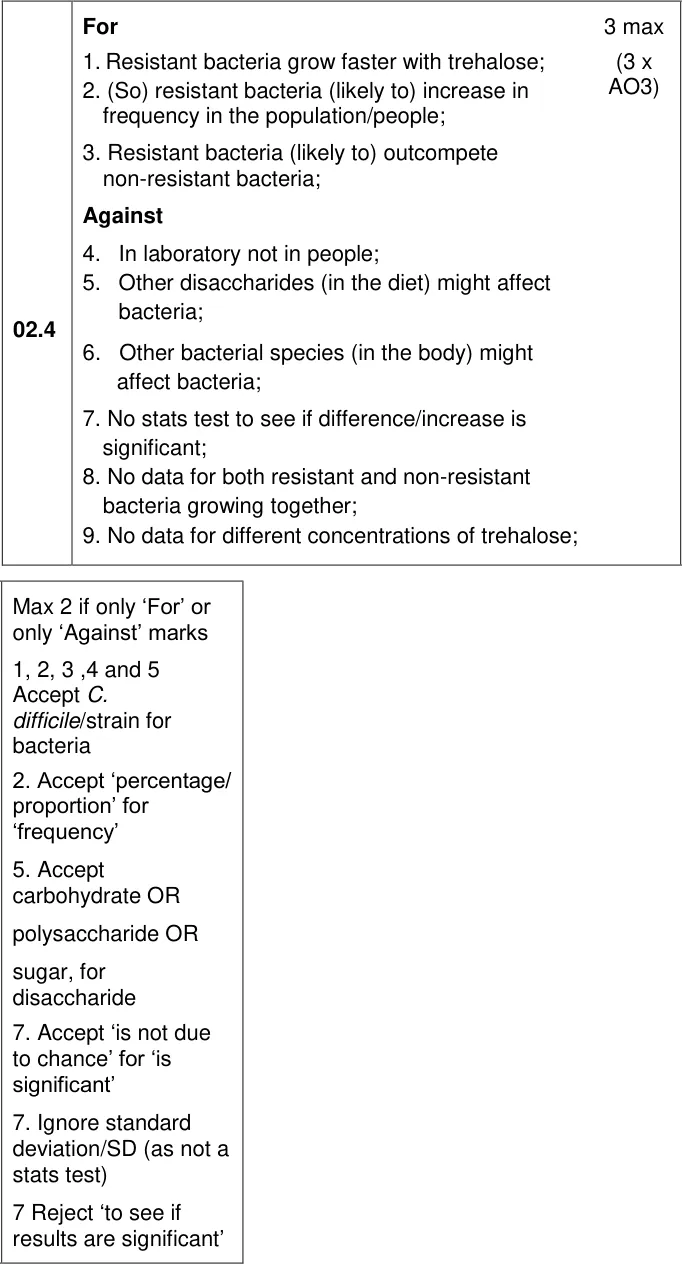
Evaluate whether more trehalose in the diet could explain more antibiotic-resistant C. difficile infections.
Information from earlier in this question:
Show the mark scheme
Tap an image to open it full size.
From the examiners' report: Link Figure 2 to growth rate, not just 'more bacteria'. Note there's no statistical test, only one concentration and no data from people. 'Correlation isn't causation' scores nothing.
Where students lose marks (from AQA examiners' reports and mark schemes)
Each point below is followed by wording that gained marks.
Allele, not gene, every time: On the CEL question only around 20% scored 3 out of 4, and marks were lost by writing 'gene' rather than 'allele'. On the malaria question a 'resistance gene' wasn't credited where a 'resistance allele' was.
✔ Gains credit: "Mutation results in a new allele"; "individuals with the allele are more likely to survive and reproduce"; "increase in frequency of this allele in the population".
Antibiotics select; they don't cause mutations: On the hospital C. difficile question, examiners again saw antibiotic use given as the cause of mutations, and bacteria described as making an immune response with white blood cells and antibodies. The mark scheme rejects answers where antibiotics cause the resistance allele.
✔ Gains credit: "Some bacteria have alleles for resistance"; "antibiotics are the selection pressure: non-resistant bacteria die, resistant bacteria survive and reproduce".
Bacteria are resistant, never immune: On the penicillin-resistant S. aureus question about 5% got all 3 marks. A very common misconception was that bacteria become 'immune' to penicillin, and weaker answers wrote only about a 'beneficial allele'.
✔ Gains credit: "Resistant S. aureus are more likely to survive and reproduce to pass on the blaZ / penicillin-resistance allele"; "increased frequency of the blaZ allele in the next generation".
Name a type of selection from the specification: Slightly less than 50% named directional selection for penicillin resistance; 'mutation', 'survival of the fittest' and 'adaptations' were given instead. In the fish tank question students offered planned, continuous, artificial, systematic and statistical selection.
✔ Gains credit: "Directional"; "one extreme is selected / favoured / allowed to breed".
Keep the mutation in the right organism: On the malaria question 40% scored 3 or 4. Stock phrases about favourable alleles, with no mention of a mutation or of malaria, couldn't reach the first two marks, and some put the mutation in P. vivax. In the lactase question some thought lactase persistence was in the cattle.
✔ Gains credit: "Mutation produced an allele"; "those with the allele are less likely to get malaria / survive malaria"; "so are more likely to reproduce and pass on the allele".
Allele frequency, not allele number: The birth weight mark scheme does not accept 'number' for 'frequency', and the lactase scheme ignores an 'increase in number of allele'. On the penicillin question, allele frequency was poorly expressed, for example 'the majority of bacteria will have the allele'.
✔ Gains credit: "Alleles for extreme mass at birth decrease in frequency (proportion / percentage) in the population."
The scientists did the selecting: On the red clover question, many answers just described the outcome of directional selection, or said the environment had changed, instead of using the information that the scientists bred only from plants producing 2n gametes. 'Allele' in the right context was seen infrequently.
✔ Gains credit: "The scientists selected plants that produced 2n gametes for breeding; these plants passed on their alleles; the frequency of alleles for 2n gametes increased."
Check the y-axis before you evaluate: Just under half concluded that the fish tank evidence did not support the fishing nets, and only around 1% covered both sides. Many thought the nets reduced population size, when Figure 8 shows the mean mass of fish.
✔ Gains credit: "Not supported: fishing reduces the mean mass of fish because large fish are removed"; "but only one species was studied / no statistical test".
Download the questions
Download the PDF pack (18 questions, mark schemes at the end)
Keep practising
- Species and taxonomy: AQA A Level Biology exam questions by topic
- Mutation and meiosis: AQA A Level Biology exam questions by topic
- Investigating diversity: AQA A Level Biology exam questions by topic
- Mastering AQA A Level Biology 3.4.3: genetic diversity via mutation and meiosis
- AQA A Level Biology masterclasses
Questions, mark schemes and examiners' report extracts © AQA.