

Topic 2.1 opens Component 2 and is part of the AS course too, so this page mixes A level and AS questions (the AS ones are marked AS). The first half is about how organisms are classified, why the three domains replaced the five kingdoms, how we name species and what counts as evidence that two organisms are related. The second half is biodiversity: what it means, how it changes from place to place and over time, and how you measure it, from a quadrat survey and Simpson's Diversity Index down to the variety of alleles in a gene pool.
The examiners' reports for this topic keep pointing to the same few slips. Students lose a mark for one feature when the question wants two, write a binomial name without a capital letter for the genus, mention "common ancestors" when the mark needs a more recent common ancestor, and forget to round a diversity index to the number of decimal places asked for. Each question below has the mark scheme and a tip from the report so you can see exactly what gained credit.
I don't teach the Eduqas specification myself, so for one-to-one help I recommend Sam. He teaches Eduqas A level Biology at a top-rated sixth form college and is very popular with his students. You can ask about lessons with Sam on WhatsApp using the link at the bottom of this page.
What you need from GCSE
Each question on this page assumes you're secure on these GCSE ideas. If any of them feels shaky, look it up before you start.
- Living things are sorted into groups: kingdom, phylum, class, order, family, genus and species.
- A species has a two-part scientific name, the genus followed by the species, e.g. Homo sapiens.
- Members of a species can breed together to produce fertile offspring.
- Quadrats and transects are used to estimate how many organisms live in an area.
- Natural selection: individuals vary, the best adapted survive and breed, and pass on their alleles.
Key terms
These words come up in the questions and mark schemes. Examiners expect you to use them exactly.
- Domain: the highest group in classification: Archaea, Eubacteria (Bacteria) and Eukaryota.
- Phylogenetic tree: a branching diagram of evolutionary relationships; the closer two branches join, the more recent their common ancestor.
- Binomial system: naming a species by genus (capital letter) then species (lower case), giving one name that scientists everywhere use.
- Species: a group of organisms that can interbreed to produce fertile offspring.
- Homologous structures: similar structures with different functions, inherited from a common ancestor.
- Analogous structures: different structures with a similar function, produced by convergent evolution.
- Species richness: the number of different species in an area.
- Species evenness: how evenly the individuals are spread across those species.
- Genetic diversity: the variety of alleles in the gene pool of a population, e.g. the proportion of polymorphic loci.
What these questions cover (Eduqas 2.1)
The questions test these statements from topic 2.1 of the Eduqas A level Biology specification (A400). AS questions (B400) are marked AS.
- (a) the classification of organisms into groups based on their evolutionary relationships
- (b) the need for classification and its tentative nature
- (c) the three domain classification system as compared with the five Kingdom classification system
- (d) the characteristic features of Kingdoms: Prokaryotae, Protoctista, Plantae, Fungi, Animalia
- (e) the use of physical features and biochemical methods to assess the relatedness of organisms (including DNA fingerprinting and enzyme studies)
- (f) the concept of species
- (g) the use of the binomial system in naming organisms
- (h) biodiversity as the number and variety of organisms found within a specified geographic region
- (i) biodiversity varying spatially and over time and affected by many factors
- (j) biodiversity can be assessed in a habitat (e.g. Simpson's Diversity Index)
- (k) biodiversity can be assessed within a species at a genetic level by looking at the variety of alleles in the gene pool of a population
- (l) biodiversity can be assessed at a molecular level using DNA fingerprinting and sequencing
- (m) biodiversity has been generated through natural selection
- (n) the different types of adaptations of organisms to their environment including anatomical, physiological and behavioural adaptations
How to use this page
Write your answer on paper before you open the mark scheme. Allow about 1.2 minutes per mark: the 19 questions are worth 42 marks, so about 50 minutes in total. Then mark your answer strictly against the mark scheme and read the examiners' tip underneath it. If you'd rather print the questions, download the PDF pack.
Classification and the domains
Question 1
AS Component 2 · June 2023 · Q1(a)(i) · 1 mark · Easy
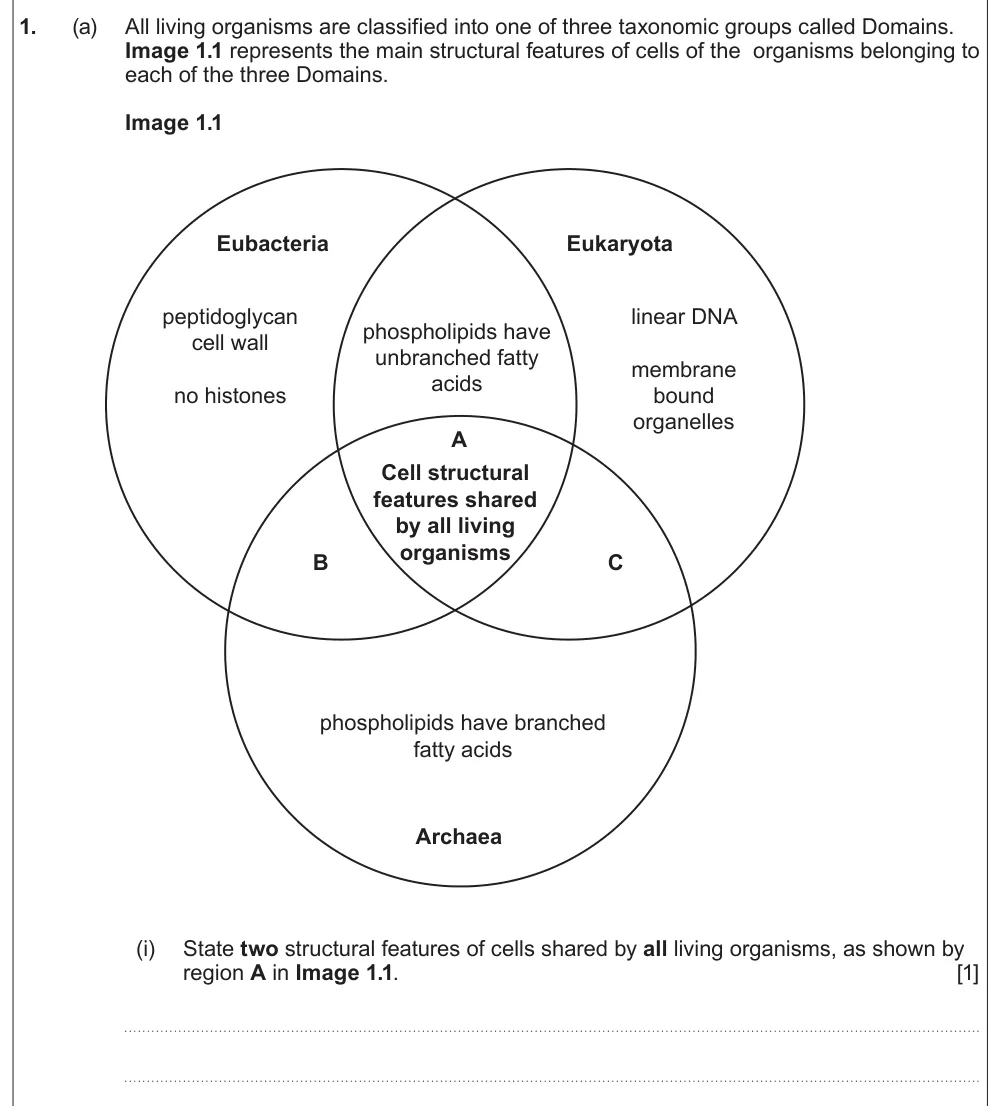
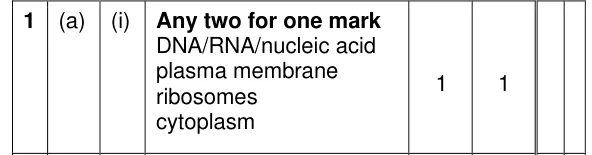
Use a Venn diagram of the three domains to state two features shared by all cells.
Show the mark scheme
Tap an image to open it full size.
From the examiners' report: Read the mark allocation: two features earn the single mark, so one correct feature on its own scores nothing.
Question 2
A level Component 2 · June 2019 · Q1(a)(i) · 3 marks
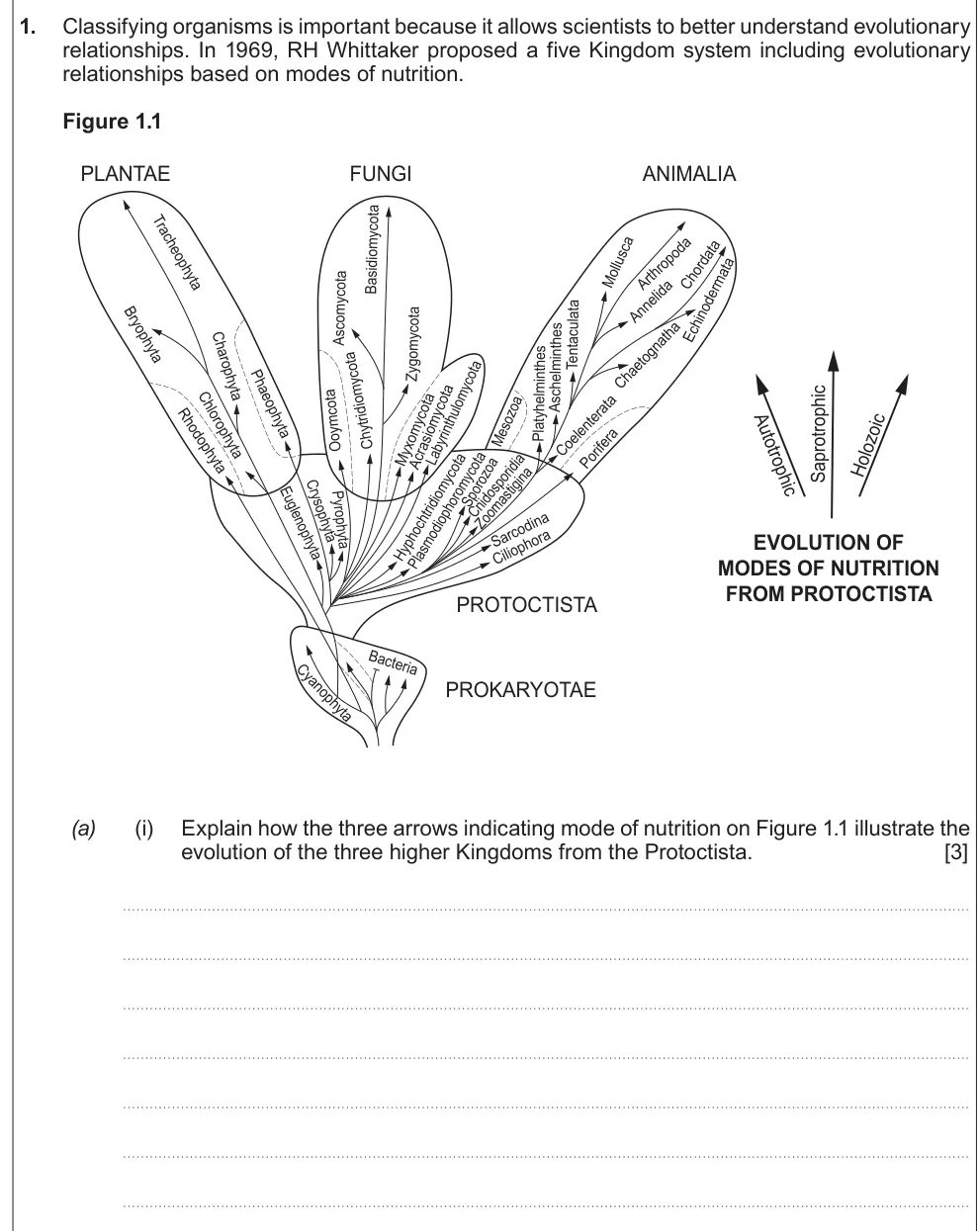
Explain how modes of nutrition show the evolution of plants, fungi and animals from the Protoctista.
Show the mark scheme

Tap an image to open it full size.
From the examiners' report: Link each kingdom to its own mode of nutrition. Describing autotrophic, saprotrophic and holozoic nutrition without saying which kingdom each belongs to doesn't earn the marks.
Question 3
A level Component 2 · June 2022 · Q1(a)(ii) · 2 marks
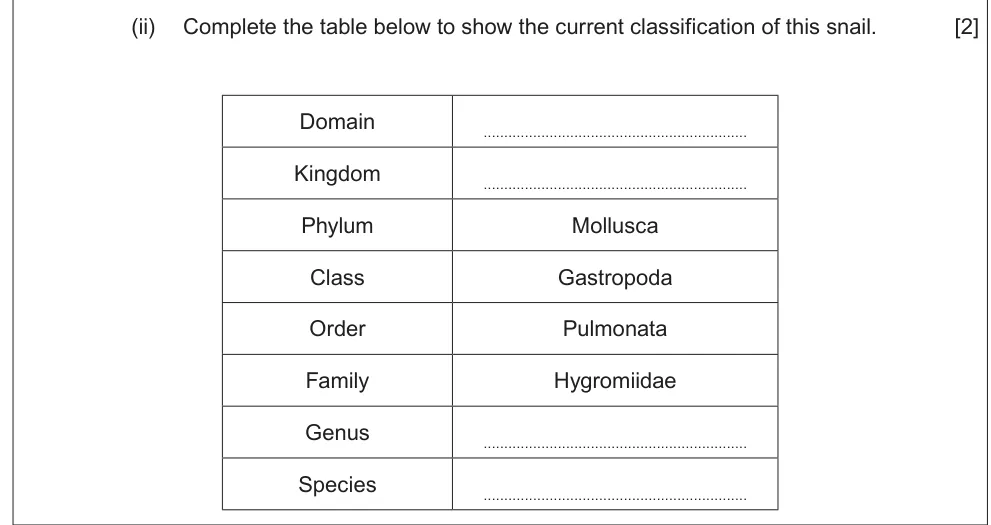
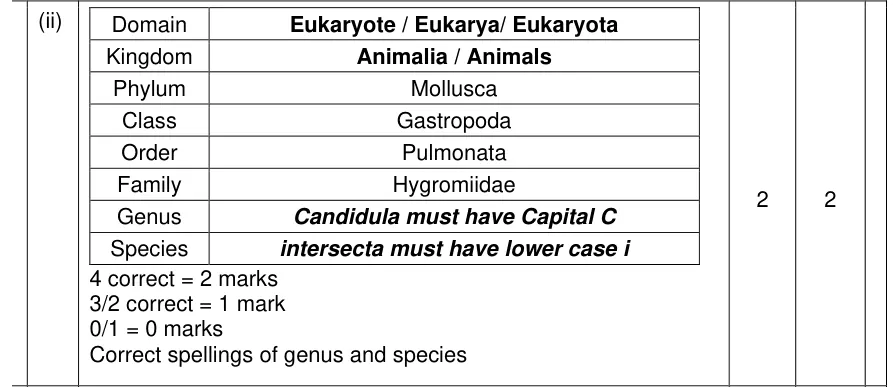
Complete the classification of a snail from domain down to species.
Show the mark scheme
Tap an image to open it full size.
From the examiners' report: Learn the full hierarchy from domain to species, and copy the genus and species exactly as written in the stem: capital letter for the genus, lower case for the species.
Question 4
A level Component 2 · Autumn 2021 · Q2(c)(ii) · 2 marks
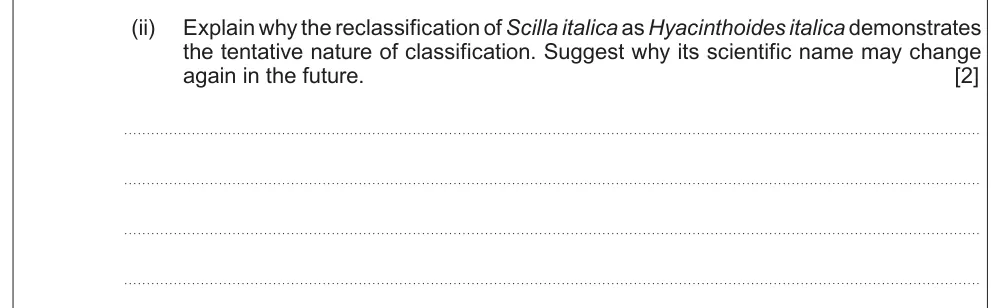
Explain why renaming a bluebell shows that classification is tentative.
Show the mark scheme

Tap an image to open it full size.
Naming species
Question 5
AS Component 2 · June 2022 · Q2(b) · 3 marks
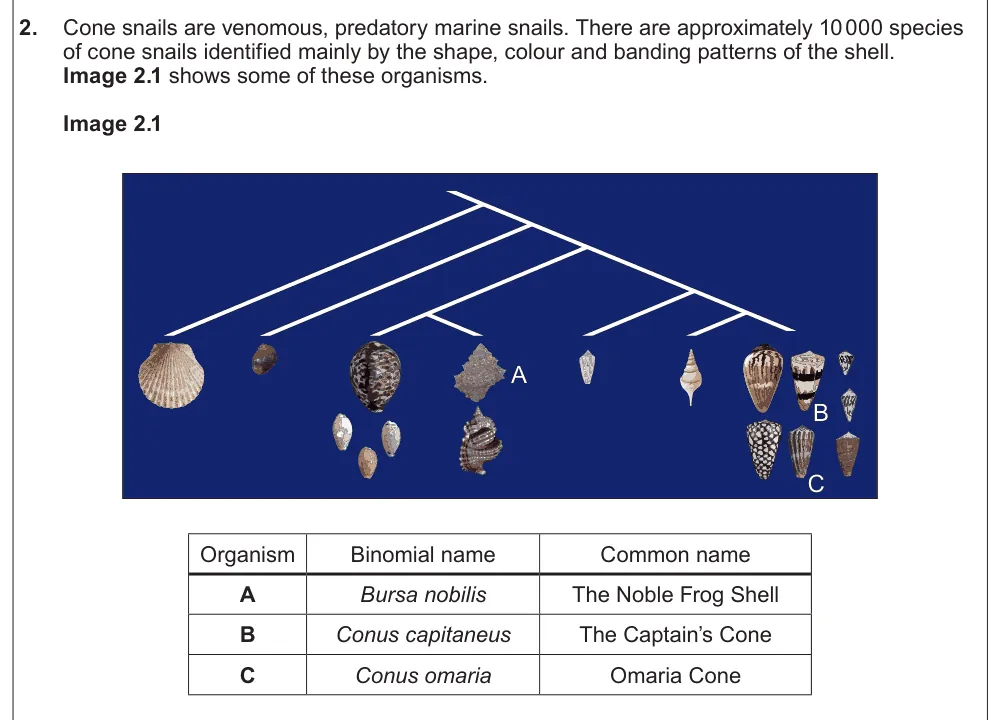
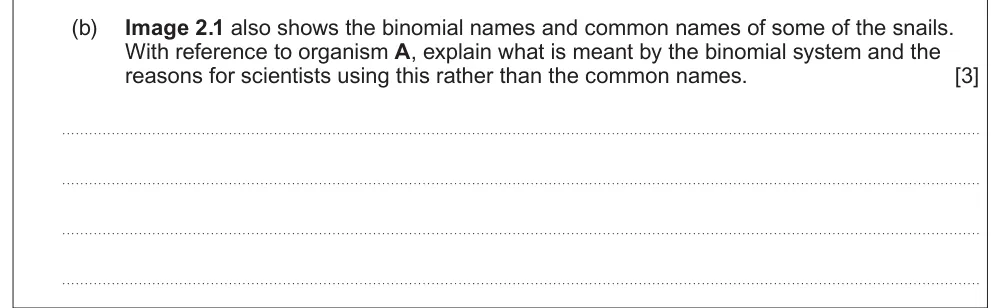
Explain the binomial system using a cone snail, and why scientists use it instead of common names.
Information from earlier in this question:
Show the mark scheme

Tap an image to open it full size.
From the examiners' report: Answer both halves. Saying the binomial name is "international" isn't enough: explain that common names differ between regions or languages, so they cause confusion.
Question 6
AS Component 2 · June 2024 · Q1(a)(ii) · 1 mark
Explain why damselfish living on the same reef are separate species.

Show the mark scheme

Tap an image to open it full size.
From the examiners' report: Say that they cannot interbreed to produce fertile offspring. Leaving out "fertile" loses the mark.
Evidence for relatedness
Question 7
A level Component 2 · June 2018 · Q3(d)(i) · 1 mark
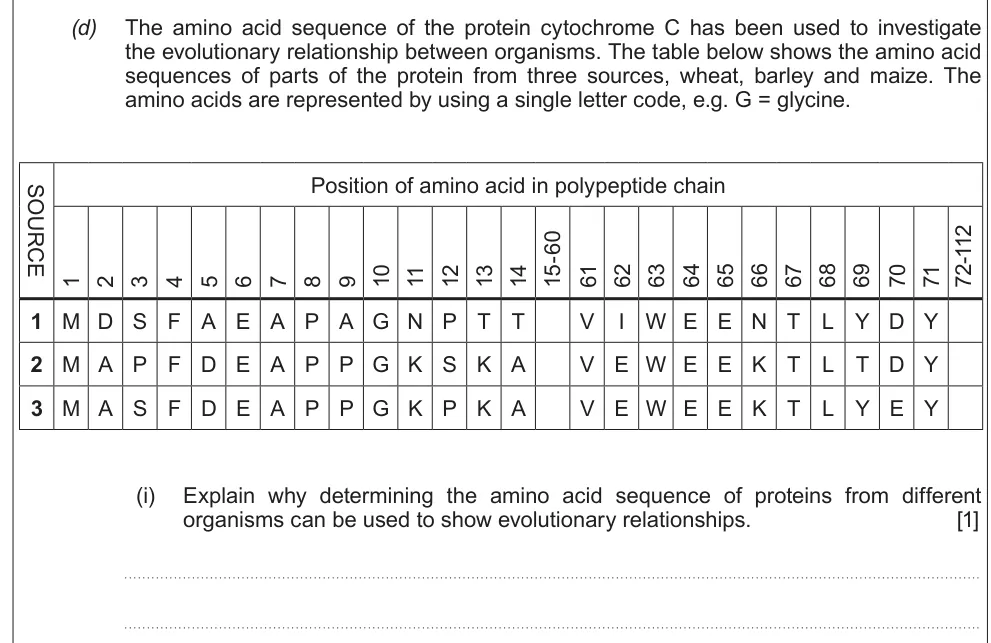
Explain why comparing amino acid sequences shows evolutionary relationships.
Show the mark scheme

Tap an image to open it full size.
From the examiners' report: Be precise: it's the number of differences in the sequence that matters, and fewer differences mean a more recent common ancestor, not just a common ancestor. Don't drift into vague comments about DNA.
Question 8
A level Component 2 · June 2018 · Q3(d)(iii) · 2 marks · Easy
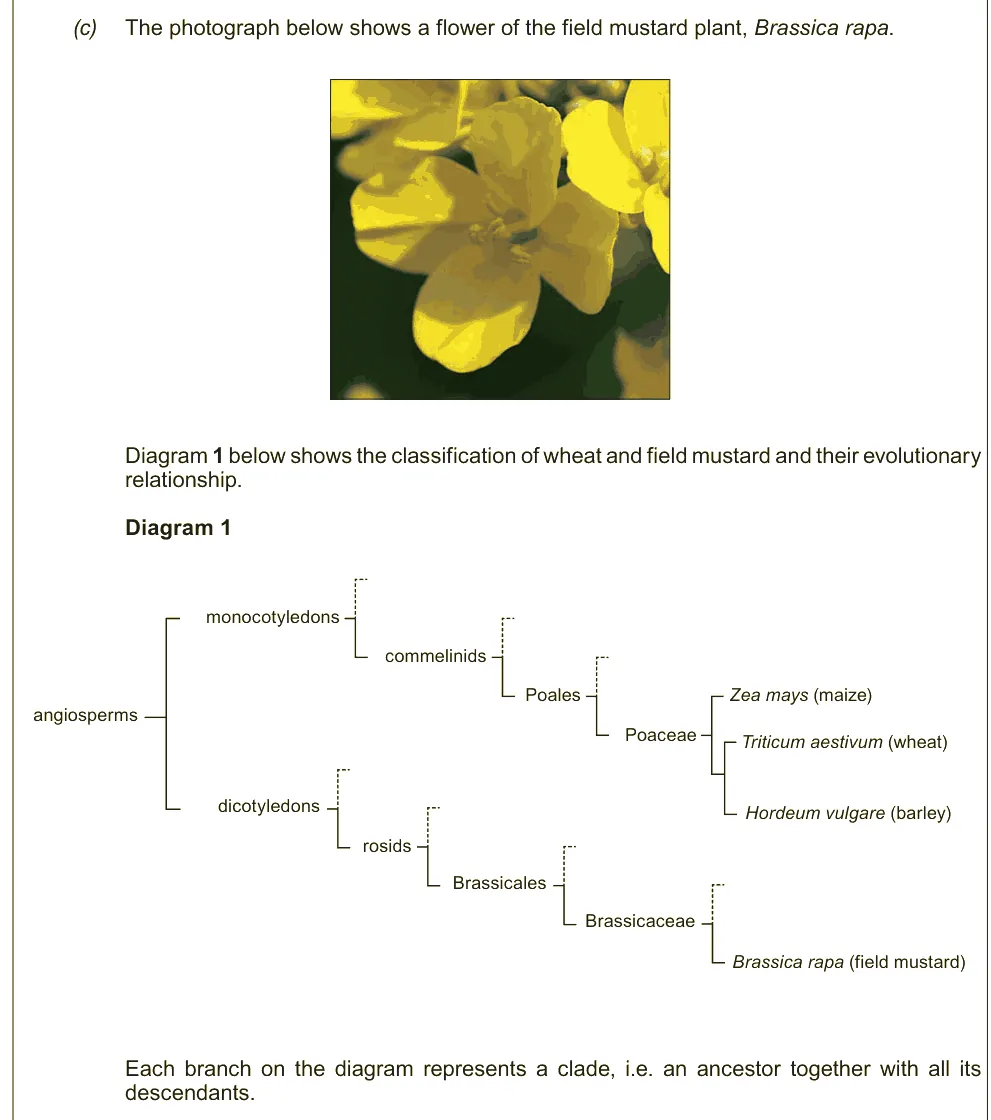
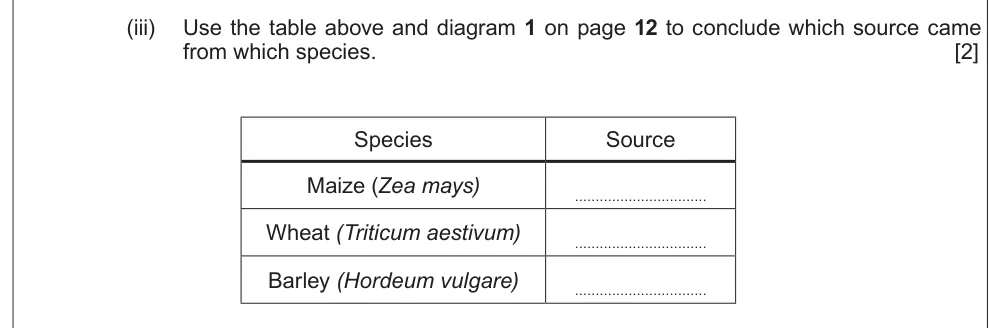
Use the sequence table and a classification diagram to match each source to maize, wheat or barley.
Information from earlier in this question:
Show the mark scheme

Tap an image to open it full size.
From the examiners' report: Wheat and barley are the most closely related, so they are the two sources with the fewest differences; maize is the odd one out.
Question 9
AS Component 2 · June 2018 · Q2(c) · 3 marks
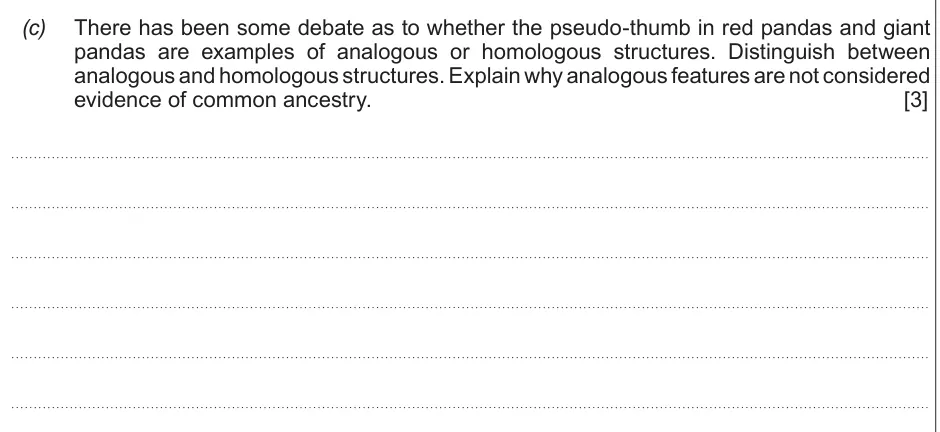
Distinguish analogous from homologous structures and explain why analogous features don't show common ancestry.
Show the mark scheme

Tap an image to open it full size.
From the examiners' report: Most students got the two definitions; the third mark goes to saying that analogous structures arise by convergent evolution.
Question 10
A level Component 2 · June 2024 · Q2(d)(ii) · 3 marks · Easy
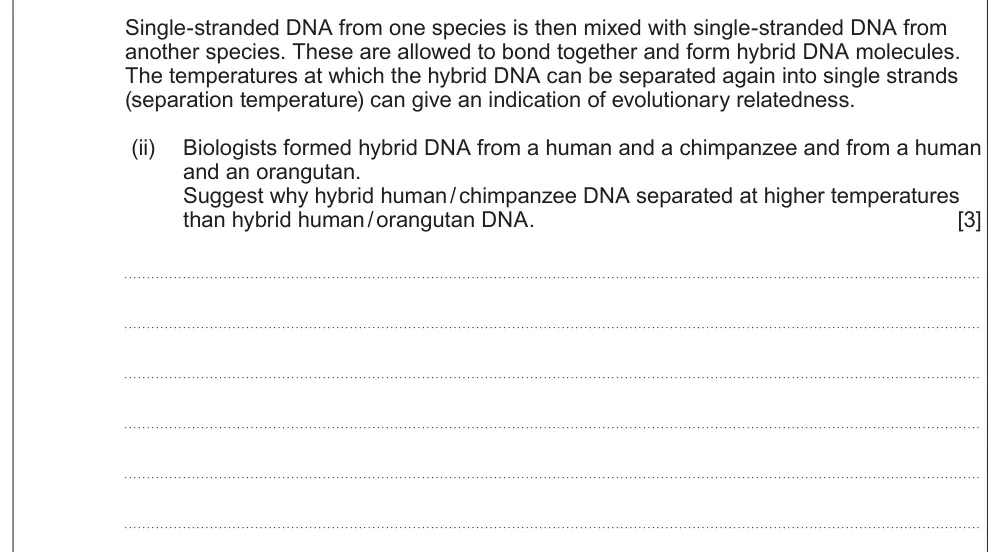
Suggest why human/chimpanzee hybrid DNA separates at a higher temperature than human/orangutan DNA.
Information from earlier in this question:

Show the mark scheme

Tap an image to open it full size.
From the examiners' report: Build a three-step chain: more closely related, so more complementary bases, so more hydrogen bonds to break.
Measuring biodiversity
Question 11
A level Component 2 · June 2025 · Q6(a)(ii) · 1 mark
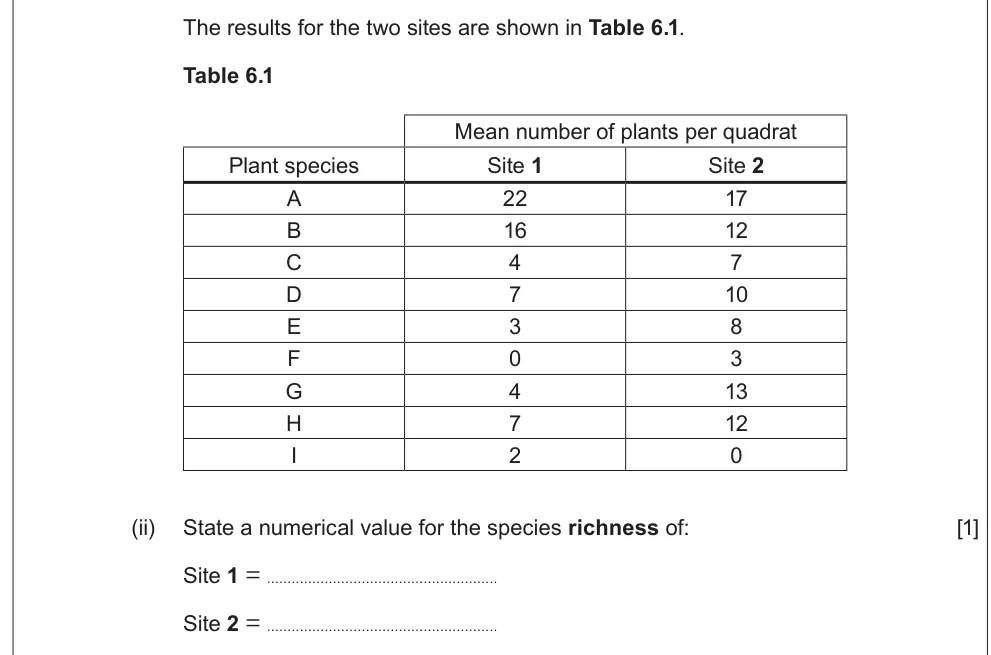
State the species richness of two sites from a table of quadrat data.
Show the mark scheme

Tap an image to open it full size.
From the examiners' report: Species richness is simply the number of species present. Don't count a species with a mean of zero at that site.
Question 12
A level Component 2 · June 2025 · Q6(a)(iv) · 2 marks
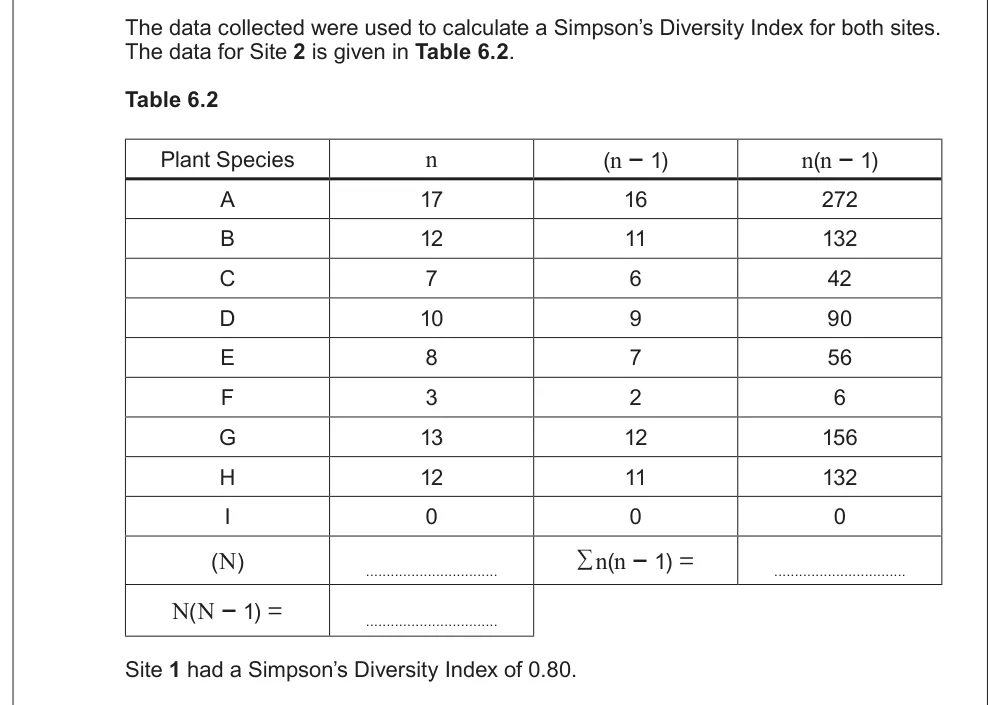
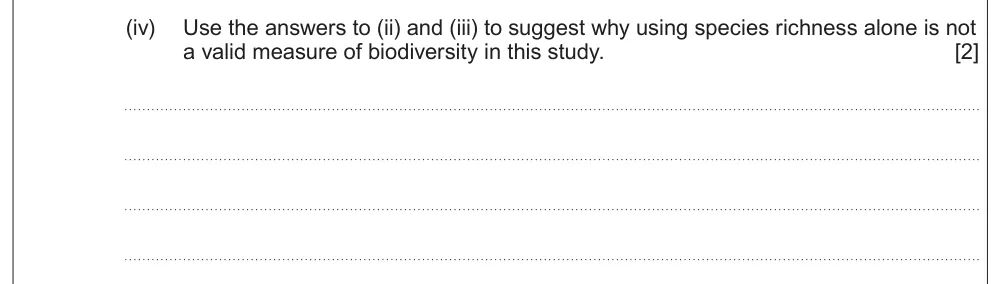
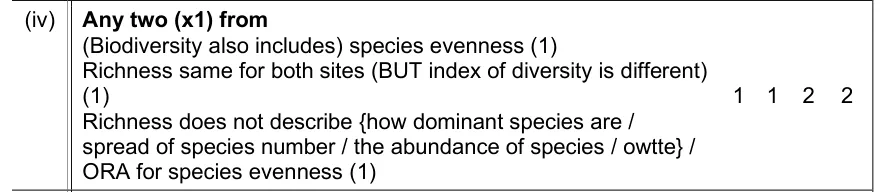
Work out Site 2's diversity index from Table 6.2 (Site 1 is 0.80), then suggest why species richness alone is not a valid measure of biodiversity here.
Information from earlier in this question:
Show the mark scheme
Tap an image to open it full size.
From the examiners' report: Use your own numbers: the richness is the same at both sites but the index differs, because biodiversity also depends on species evenness.
Question 13
AS Component 2 · June 2019 · Q4(a)(ii) · 4 marks · Hard
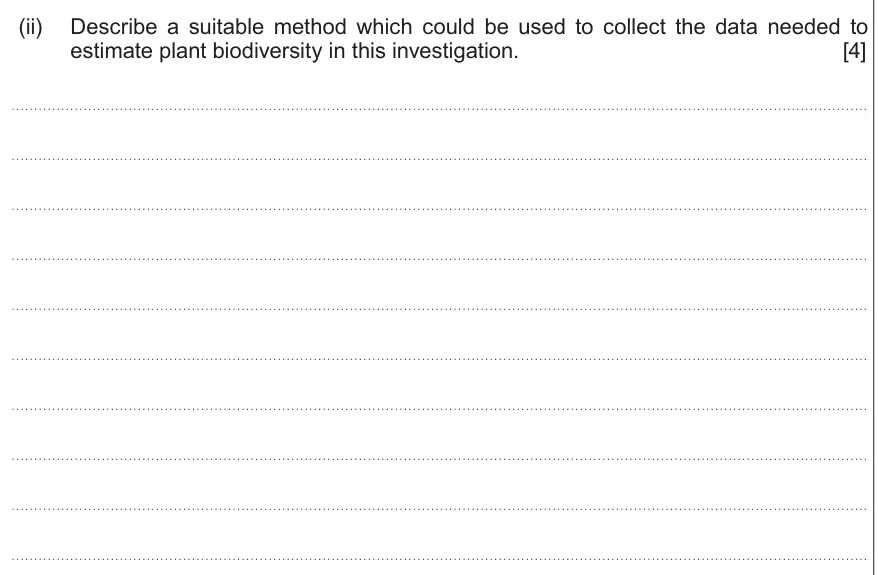
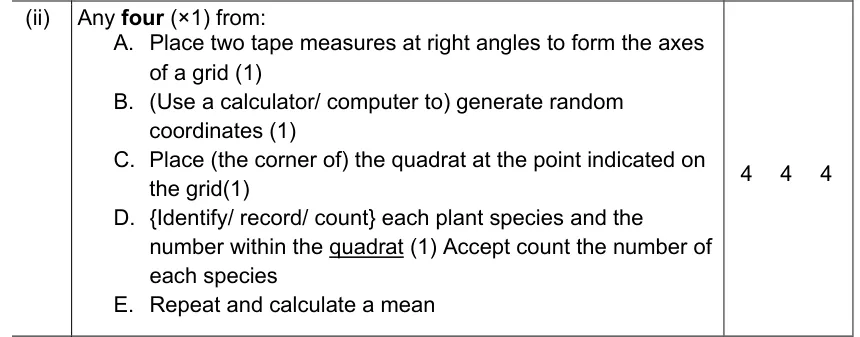
Describe a method for collecting data to estimate plant biodiversity on an upland heath.
Information from earlier in this question:

Show the mark scheme
Tap an image to open it full size.
From the examiners' report: Full marks went to step-by-step methods: grid, random coordinates, quadrat placed at each coordinate, then each species identified and counted.
Question 14
AS Component 2 · June 2019 · Q4(b)(i) · 3 marks · Easy
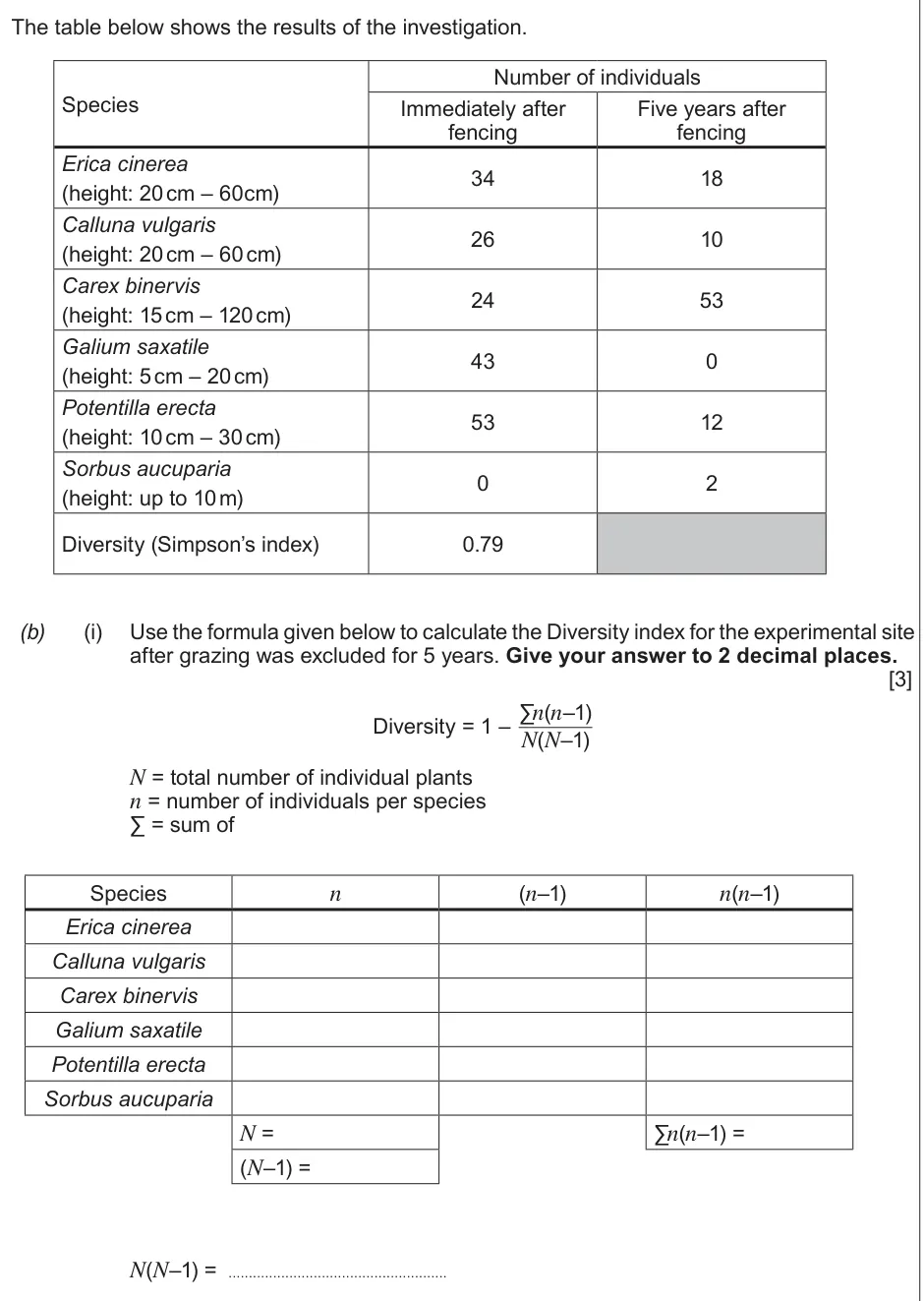
Calculate Simpson's Diversity Index for a heath after five years without grazing.
Show the mark scheme

Tap an image to open it full size.
From the examiners' report: Give the answer to 2 decimal places as asked. Students who left it unrounded were limited to 2 of the 3 marks.
Question 15
AS Component 2 · June 2019 · Q4(c) · 3 marks · Hard
Use plant heights to suggest how more heather cover changed the biodiversity of the site.
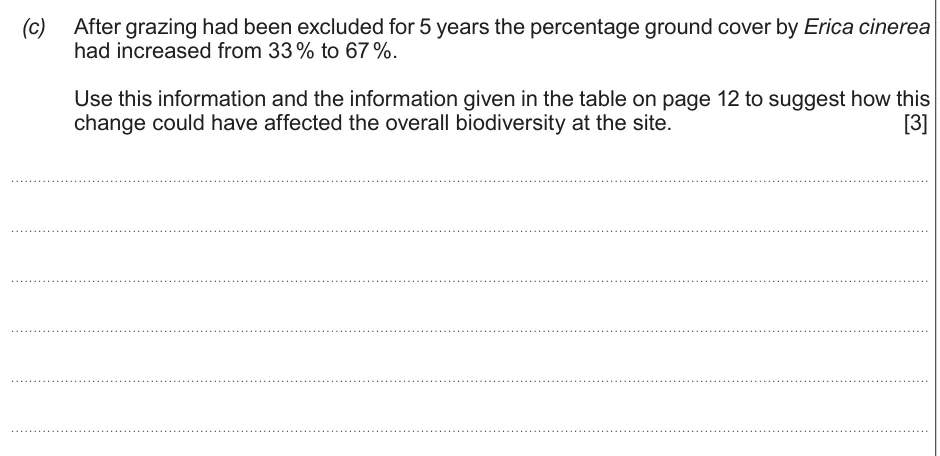
Show the mark scheme
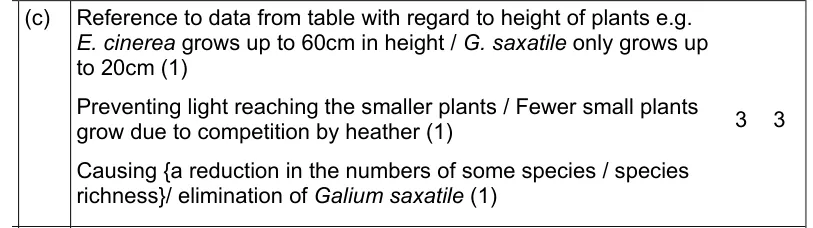
Tap an image to open it full size.
From the examiners' report: The question tells you to use the data, so quote the plant heights from the table. Answers that ignored the data struggled to score.
Genetic diversity, natural selection and adaptation
Question 16
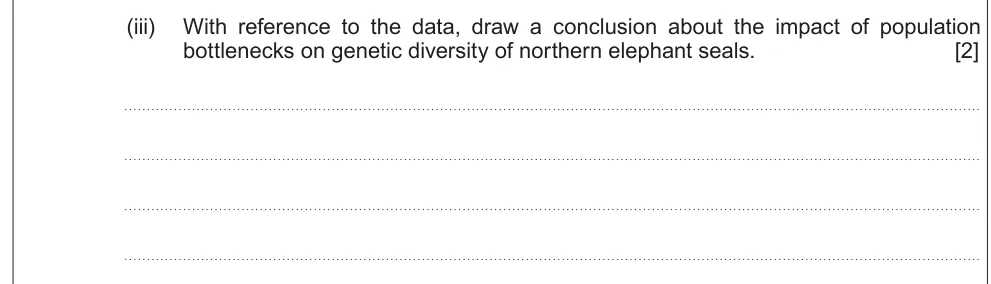
A level Component 2 · June 2018 · Q5(c)(iii) · 2 marks · Easy
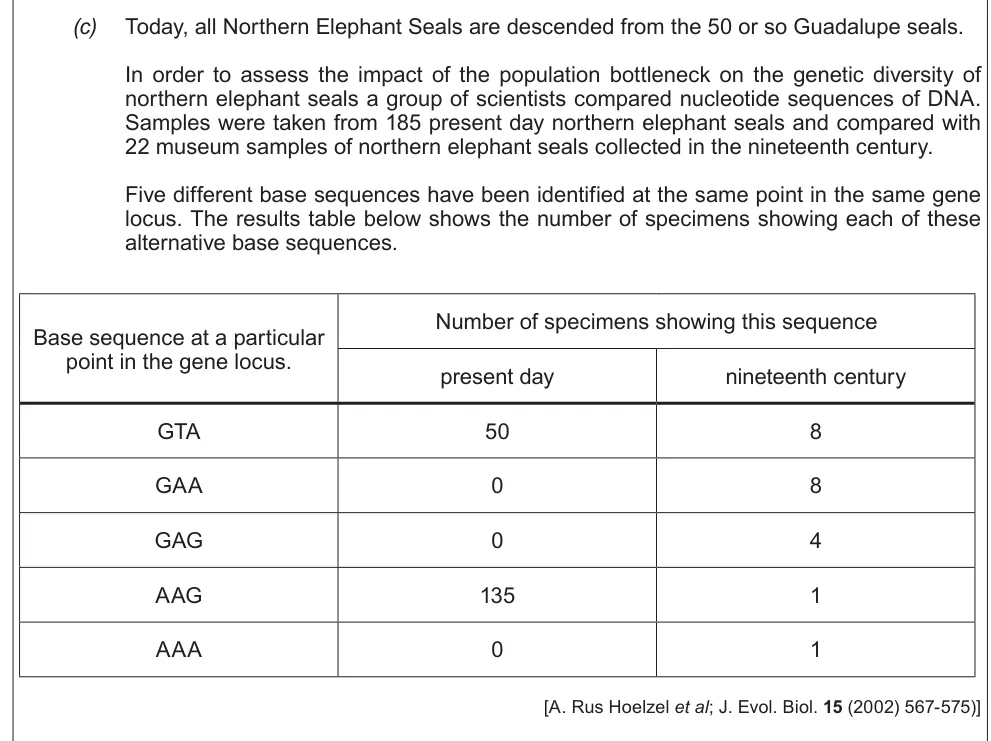
Use DNA sequence data to conclude how a population bottleneck affected northern elephant seals.
Information from earlier in this question:
Show the mark scheme

Tap an image to open it full size.
From the examiners' report: State the conclusion, then back it up with numbers from the data, such as 2 sequences now against 5 in the nineteenth century.
Question 17
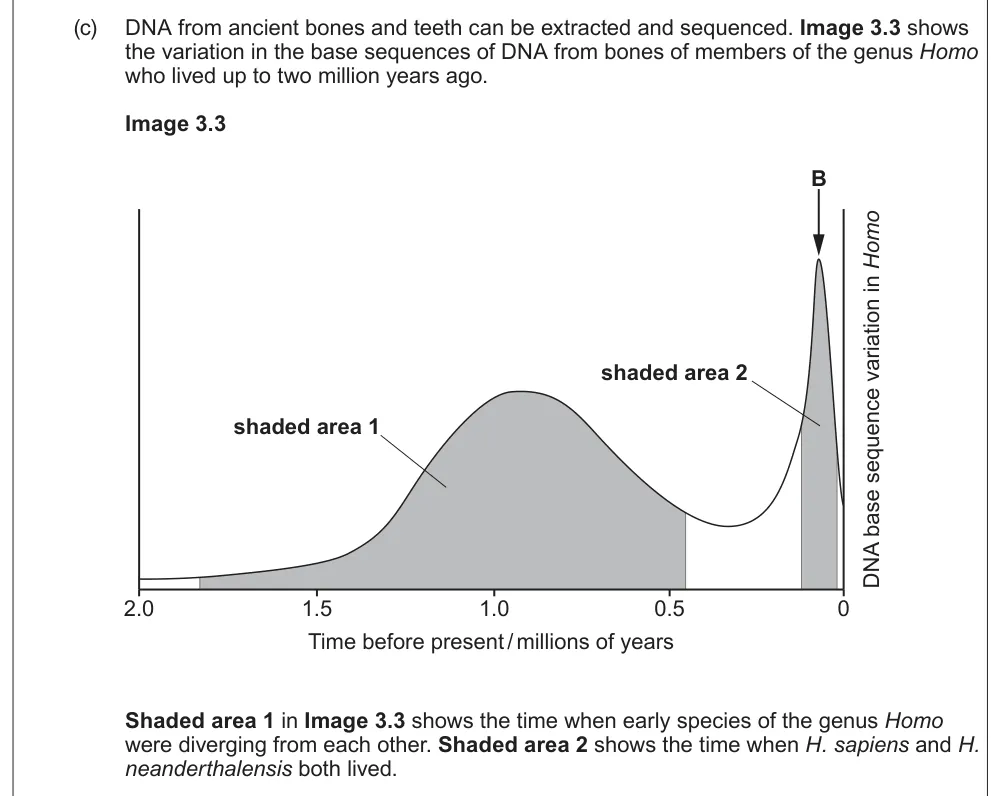
AS Component 2 · June 2025 · Q3(c)(ii) · 1 mark
Explain why a point on a DNA sequence diagram shows when the genus Homo had its highest genetic diversity.
Information from earlier in this question:

Show the mark scheme

Tap an image to open it full size.
Question 18
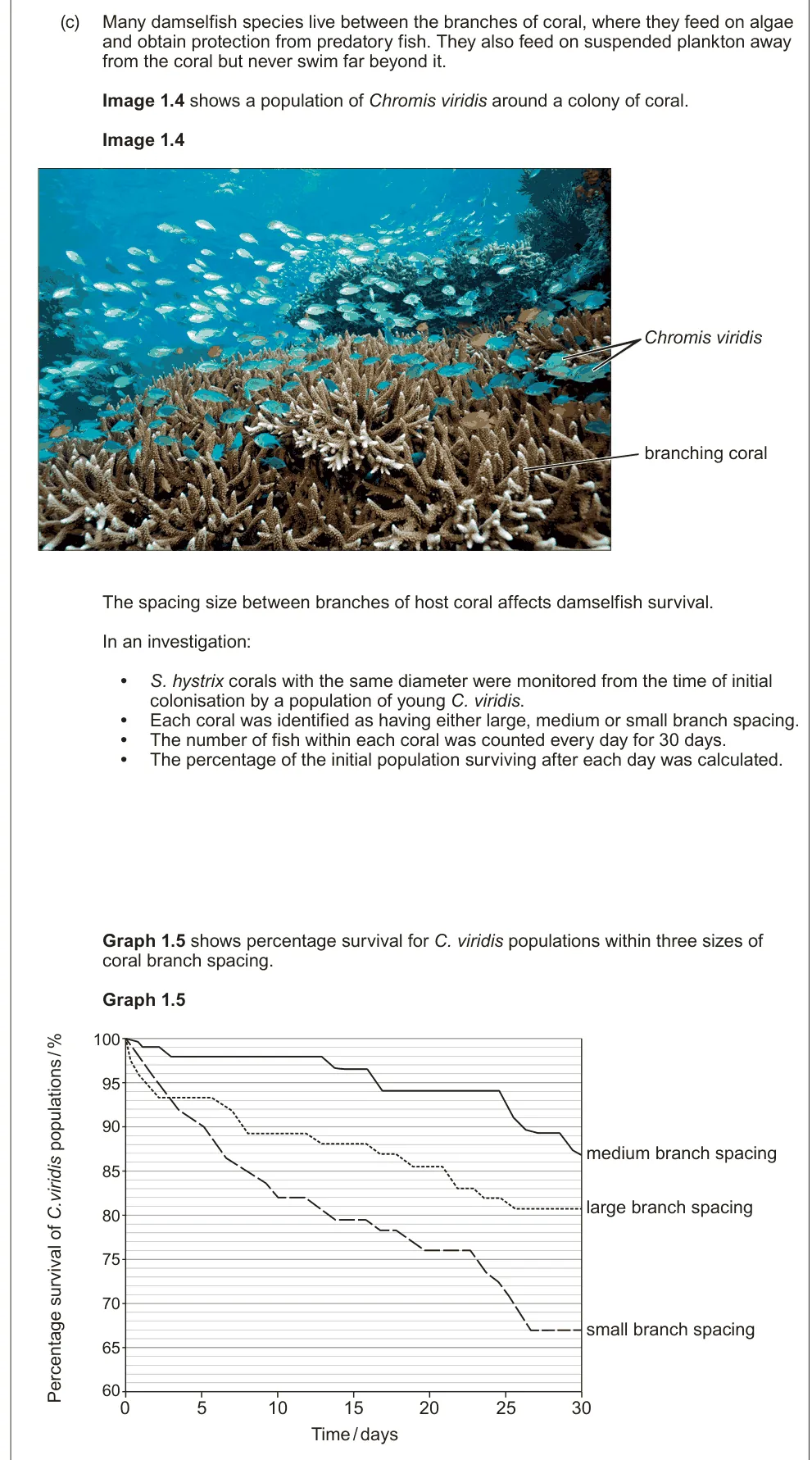
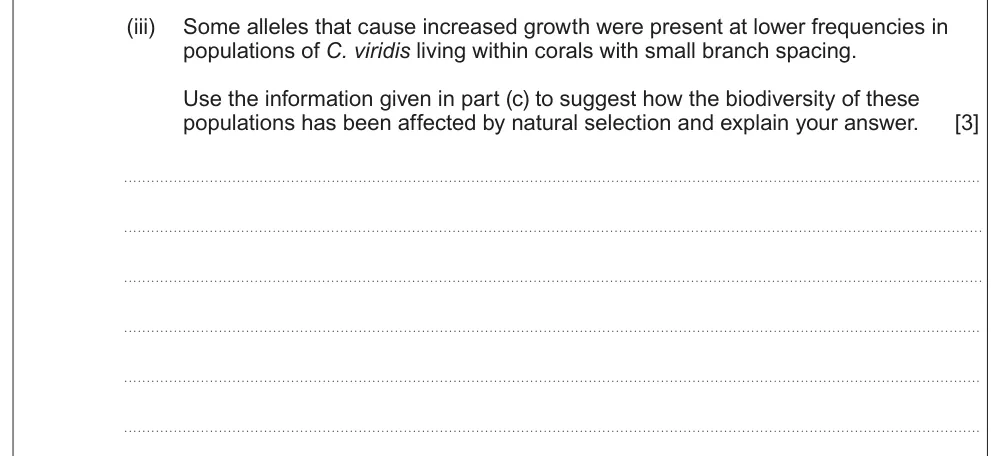
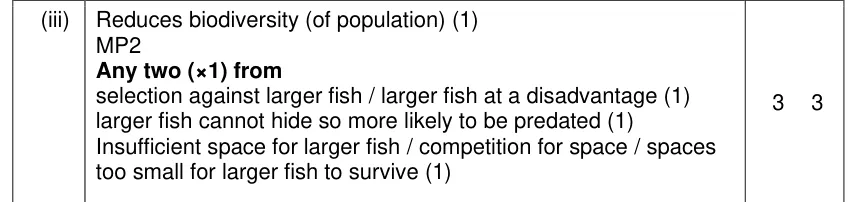
AS Component 2 · June 2024 · Q1(c)(iii) · 3 marks
Suggest how natural selection has affected the biodiversity of damselfish living in closely branched coral.
Information from earlier in this question:
Show the mark scheme
Tap an image to open it full size.
From the examiners' report: Stick to this example: one species, with fewer growth alleles where branch spacing is small, so genetic diversity falls. General accounts of natural selection didn't score.
Question 19
AS Component 2 · June 2019 · Q2(c) · 2 marks · Hard
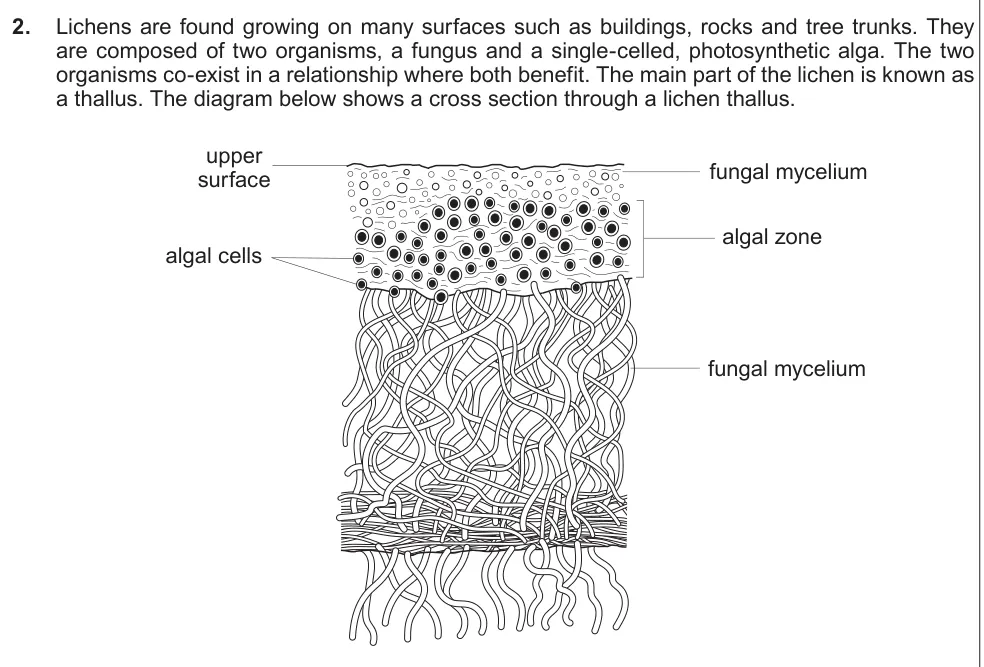
Explain the position and distribution of the algae inside a lichen.
Information from earlier in this question:

Show the mark scheme

Tap an image to open it full size.
From the examiners' report: Explain the distribution as well as the position. Very few students saw that the fungus keeps the algae moist so they don't dry out.
Where students lose marks (from Eduqas examiners' reports and mark schemes)
Each point below is followed by wording that gained marks.
Two features earn the one mark: Many students named just one feature shared by all three domains, or a feature shared by only two of them.
✔ Gains credit: Any two of "DNA/RNA", "plasma membrane", "ribosomes", "cytoplasm".
Capital for the genus, lower case for the species: Binomial names lost marks for wrong spelling or letter case.
✔ Gains credit: "Candidula intersecta" and "Bursa nobilis": genus with a capital letter, species in lower case.
"International" is only half the reason: Students said the binomial system is an international language but didn't say what goes wrong with common names.
✔ Gains credit: "Common names could vary regionally or in different languages, which could cause confusion when identifying species".
Interbreed to give fertile offspring: Answers didn't make clear that two species mating cannot produce fertile offspring.
✔ Gains credit: "Different species are unable to interbreed to produce fertile offspring".
Fewer differences, more recent ancestor: Students made vague references to DNA, or wrote "common ancestor" without saying recent.
✔ Gains credit: "The fewer differences, the more recent the common ancestor".
Analogous points to convergent evolution: The third mark, why analogous features don't show common ancestry, was the one most students missed.
✔ Gains credit: "Analogous structures arise through convergent evolution".
Richness is a count of species: Fewer students than expected knew that species richness is just the number of species present.
✔ Gains credit: "Both 8": count only the species found at each site.
Finish the index: subtract from 1, then round: Some students forgot to subtract from 1 (giving 0.13 in June 2025), and others didn't give 2 decimal places.
✔ Gains credit: "Diversity index = 0.63" to 2 decimal places.
Download the questions
Download the PDF pack (19 questions, mark schemes at the end)
Keep practising
- Eduqas A level Biology past papers, mark schemes and examiners' reports
- Eduqas A level Biology grade boundaries
- Ask about Eduqas A level Biology lessons with Sam on WhatsApp
Questions, mark schemes and examiners' report extracts © WJEC CBAC Ltd (Eduqas).