

Inheritance is the genetics topic of Component 2. You need monohybrid crosses including codominance, dihybrid crosses including linkage, the chi squared test, sex linkage (haemophilia and Duchenne muscular dystrophy), gene and chromosome mutations, mutagens, carcinogens and oncogenes, and epigenetics. Every question on this page is from the A level Component 2 papers.
Straightforward genetic diagrams and chi squared calculations are usually done well. Marks are lost on conventions: changing the allele symbols you're given, drawing diploid gametes, leaving out male or female in a sex-linked phenotype, and giving a ratio when a probability is asked for. In chi squared questions, the critical value is read at p = 0.05, not 0.5. The examiners' reports also want linkage explained through crossing over and recombinants, and epigenetics applied to the diagram you're given.
I don't teach the Eduqas specification myself, so for one-to-one help I recommend Sam. He teaches Eduqas A level Biology at a top-rated sixth form college and is very popular with his students. You can ask about lessons with Sam on WhatsApp using the link at the bottom of this page.
What you need from GCSE and Year 12
Each question on this page assumes you're secure on these ideas. If any of them feels shaky, look it up before you start.
- Genes come in different versions called alleles; you inherit one allele of each gene from each parent.
- Dominant alleles are expressed in heterozygotes; recessive alleles only when homozygous.
- Punnett squares show the possible offspring genotypes and their proportions.
- Sex is determined by the X and Y chromosomes: XX female, XY male.
Key terms
These words come up in the questions and mark schemes. Examiners expect you to use them exactly.
- Codominance: both alleles are expressed in the heterozygote, as in the AB blood group.
- Dihybrid cross: a cross following two genes at once; unlinked genes give 9:3:3:1 from two heterozygotes.
- Linkage: genes on the same chromosome, which tend to be inherited together.
- Recombinant: an offspring with a new combination of characteristics, produced by crossing over.
- Chi squared (χ²): a test of whether observed numbers differ significantly from the expected numbers.
- Sex linkage: a gene carried on the X chromosome, so males have only one copy.
- Oncogene: a mutated proto-oncogene that causes uncontrolled cell division.
- Epigenetics: changes in gene expression without changes to the DNA base sequence, such as methylation.
What these questions cover (Eduqas 2.5)
The questions test these statements from Component 2 (Continuity of Life) of the Eduqas A level Biology specification (A400). Component 2 content is examined in A level Component 2.
- (b) the principles of monohybrid Mendelian inheritance including simple crosses involving codominance
- (c) the principles of dihybrid Mendelian inheritance including simple crosses involving linkage
- (d) the use of a chi squared test
- (e) sex linkage as illustrated by haemophilia and Duchenne muscular dystrophy
- (f) gene mutation as illustrated by sickle cell anaemia and chromosome mutation as illustrated by Down's syndrome
- (g) the effect of mutagens, carcinogens and oncogenes
- (h) the control of gene expression by factors other than changes in the DNA sequence
How to use this page
Write your answer on paper before you open the mark scheme. Allow about 1.2 minutes per mark: the 24 questions are worth 58 marks, so about 70 minutes in total. Then mark your answer strictly against the mark scheme and read the examiners' tip underneath it. If you'd rather print the questions, download the PDF pack.
Monohybrid crosses and codominance
Question 1
A level Component 2 · June 2019 · Q4(b) · 4 marks
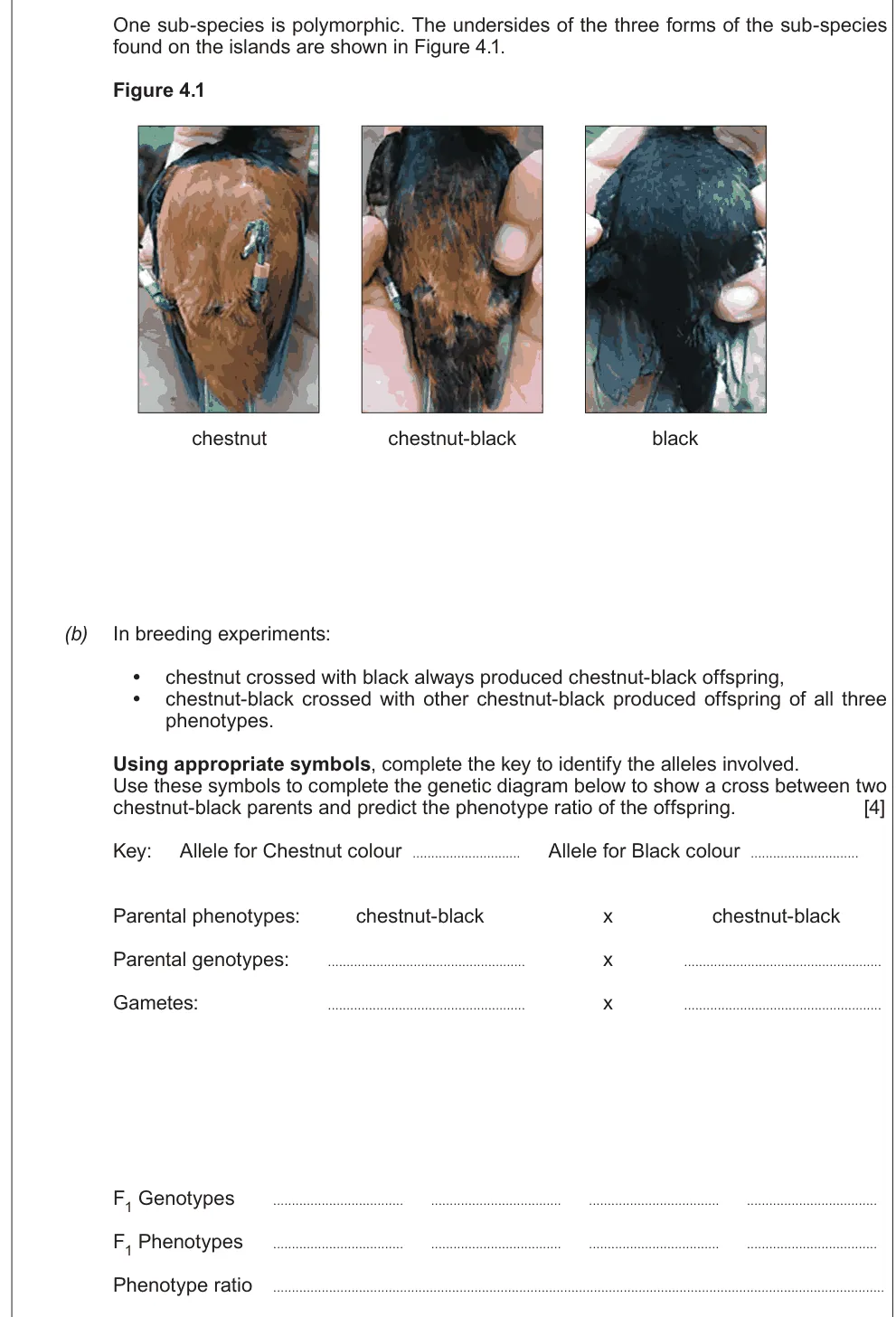
Draw a genetic diagram for a cross involving incomplete dominance and give the phenotype ratio.
Show the mark scheme

Tap an image to open it full size.
From the examiners' report: Many didn't use a suitable convention for incomplete dominance, and some attempted a dihybrid cross.
Question 2
A level Component 2 · June 2025 · Q5(b)(ii) · 2 marks
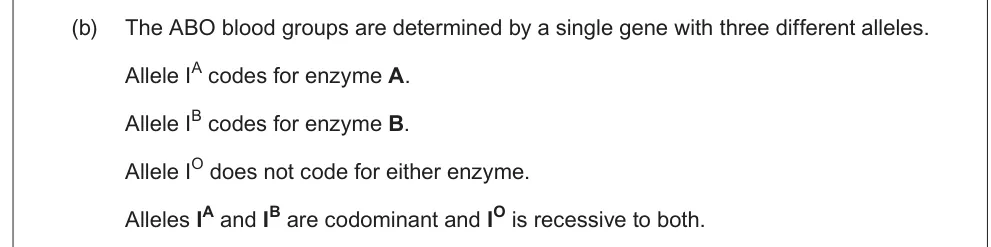
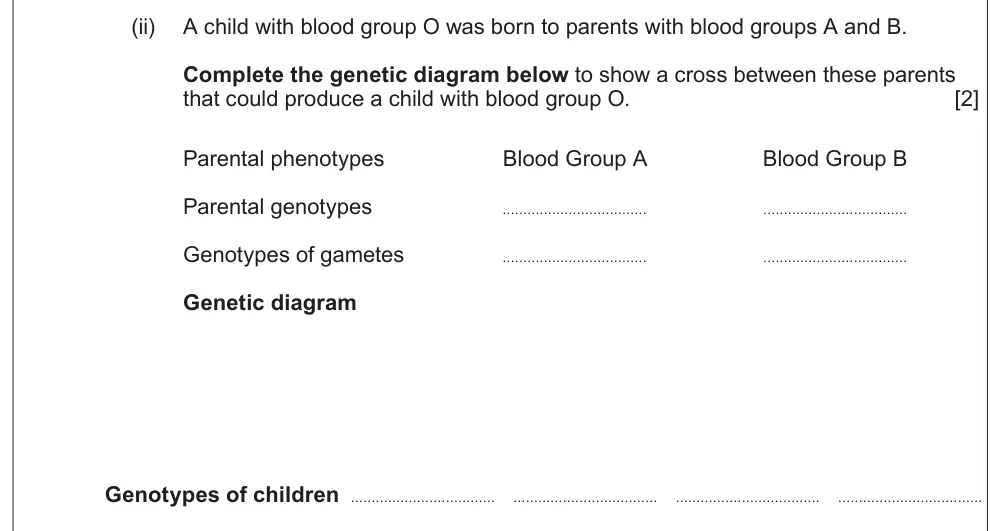
Draw a genetic diagram for the ABO blood groups of two parents and their children.
Information from earlier in this question:
Show the mark scheme

Tap an image to open it full size.
Question 3
A level Component 2 · June 2025 · Q5(b)(iii) · 1 mark
State the probability that another child of these parents will have blood group O.

Show the mark scheme

Tap an image to open it full size.
From the examiners' report: Some gave ratios instead of probabilities and lost the mark.
Question 4
A level Component 2 · June 2024 · Q3(b)(ii) · 2 marks
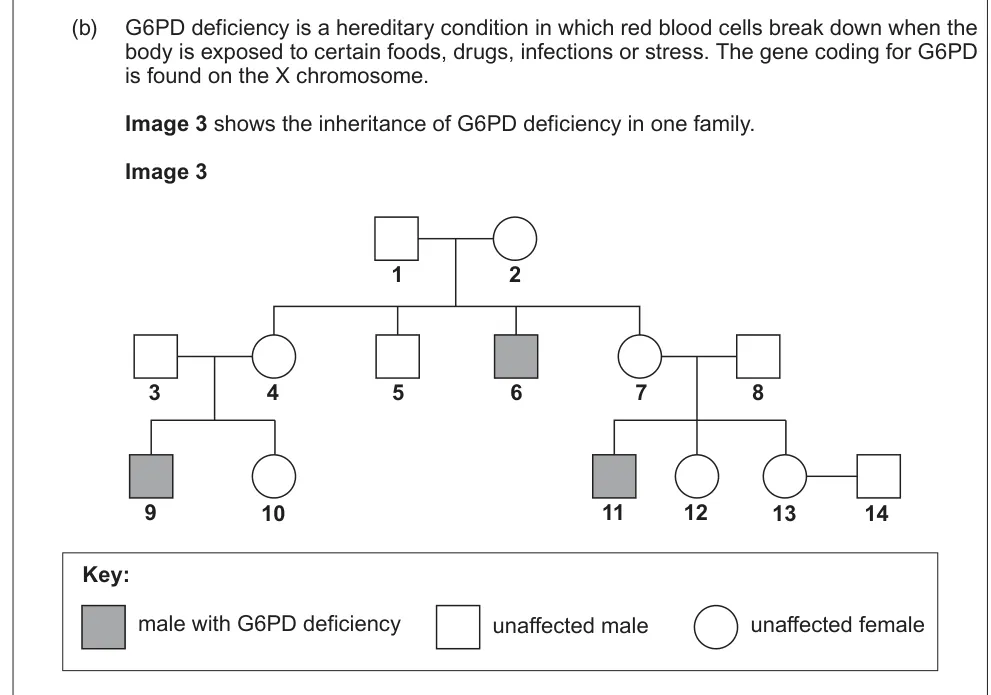
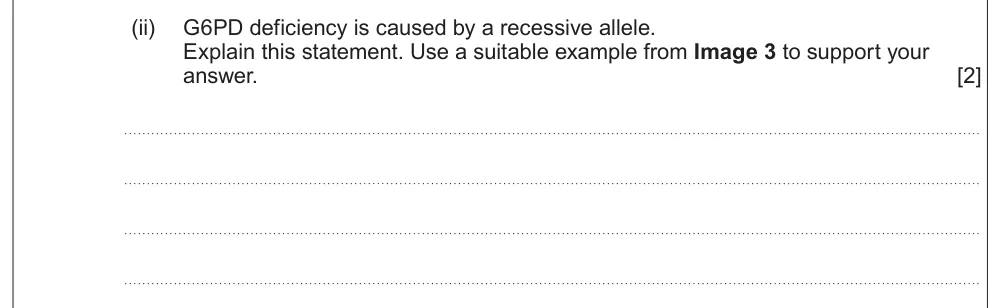
Explain, with an example from a pedigree, why G6PD deficiency is caused by a recessive allele.
Information from earlier in this question:
Show the mark scheme

Tap an image to open it full size.
From the examiners' report: The best answers used an example from the pedigree, such as unaffected parents 1 and 2 having an affected child 6.
Dihybrid crosses and linkage
Question 5
A level Component 2 · Autumn 2020 · Q1(d)(i) · 1 mark
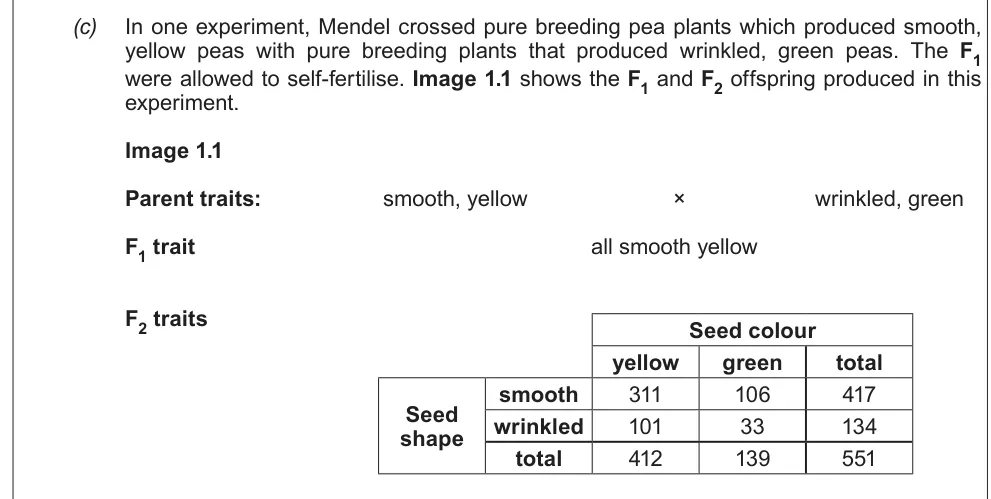
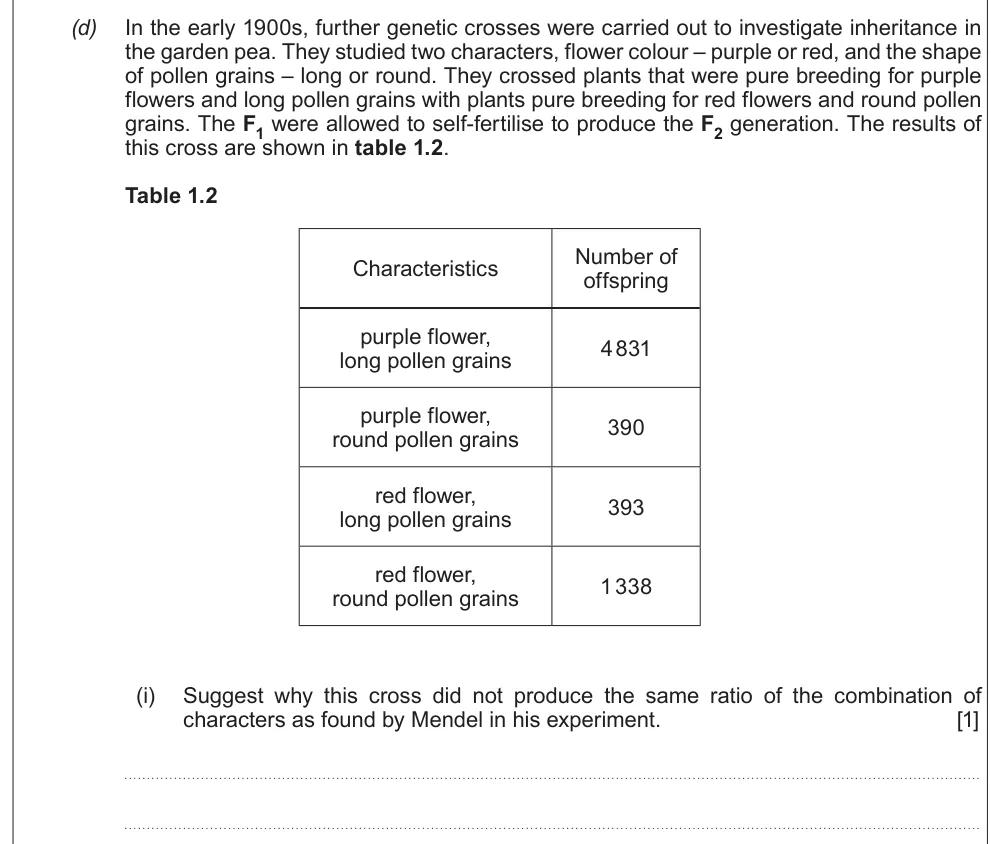
Suggest why a cross did not give the ratio Mendel found.
Information from earlier in this question:
Show the mark scheme

Tap an image to open it full size.
Question 6
A level Component 2 · Autumn 2021 · Q5(a)(ii) · 2 marks
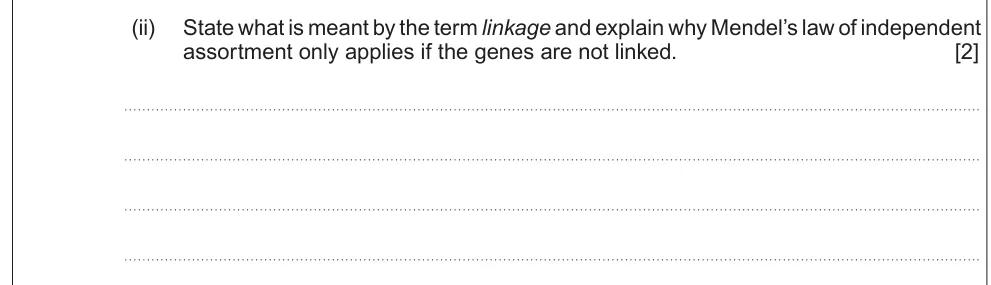
State what is meant by linkage and explain why independent assortment only applies to unlinked genes.
Show the mark scheme

Tap an image to open it full size.
Question 7
A level Component 2 · June 2017 · Q4(a)(i) · 4 marks
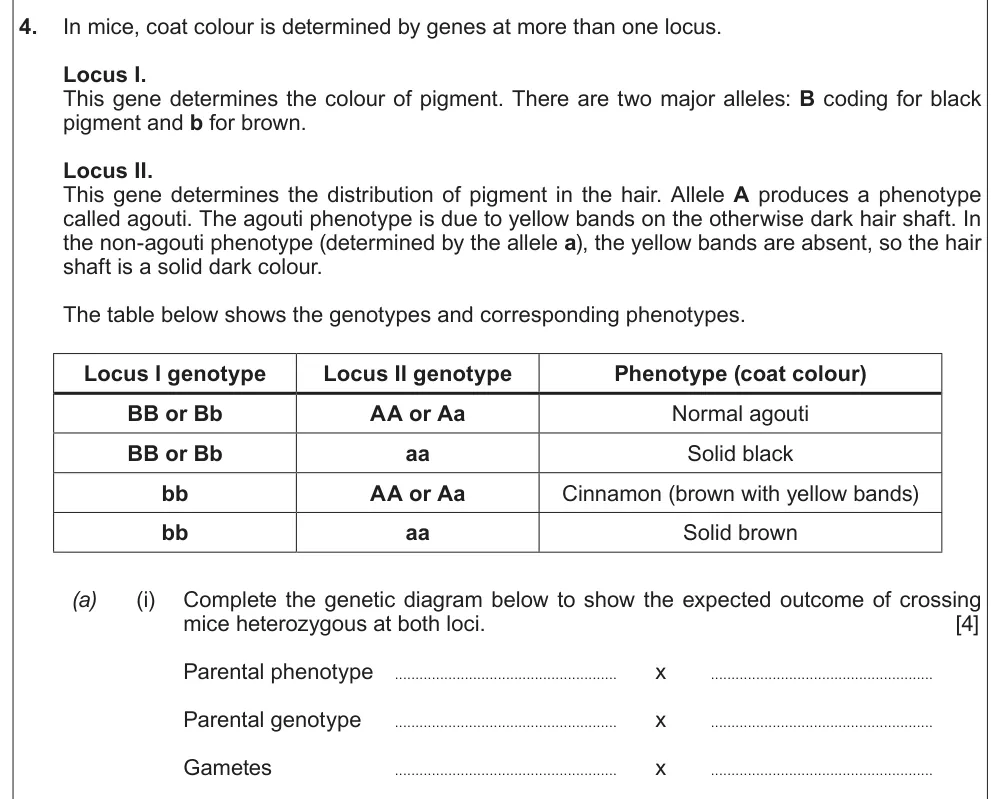
Complete a dihybrid genetic diagram for coat colour in mice.
Show the mark scheme

Tap an image to open it full size.
Question 8
A level Component 2 · June 2017 · Q4(a)(ii) · 1 mark
Give the ratio of phenotypes in the offspring of the dihybrid cross.

Show the mark scheme

Tap an image to open it full size.
The chi squared test
Question 9
A level Component 2 · June 2017 · Q4(b)(i) · 3 marks
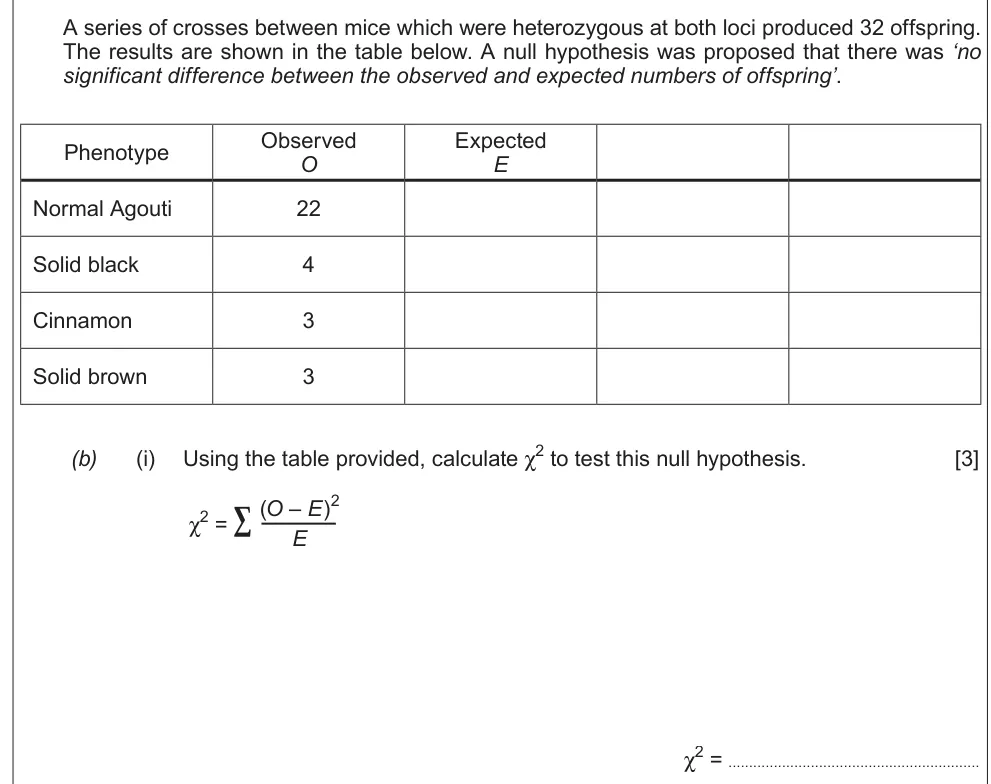
Calculate χ² from observed and expected numbers of offspring.
Show the mark scheme

Tap an image to open it full size.
From the examiners' report: Round to the same number of decimal places as the probability table.
Question 10
A level Component 2 · June 2017 · Q4(b)(ii) · 1 mark
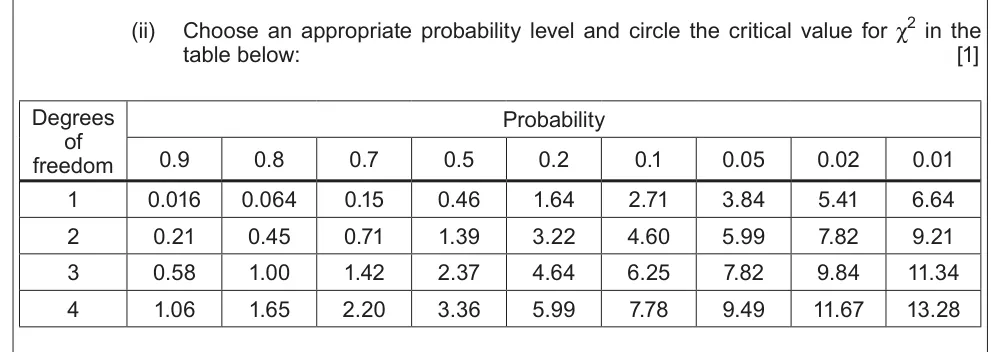
Circle the critical value for χ² in the table.
Show the mark scheme

Tap an image to open it full size.
From the examiners' report: A common error was choosing the 0.5 probability column. Use p = 0.05.
Question 11
A level Component 2 · June 2017 · Q4(b)(iii) · 2 marks
State whether you accept or reject the null hypothesis, and why.

Show the mark scheme

Tap an image to open it full size.
From the examiners' report: There was some confusion about how to describe accepting or rejecting the null hypothesis.
Question 12
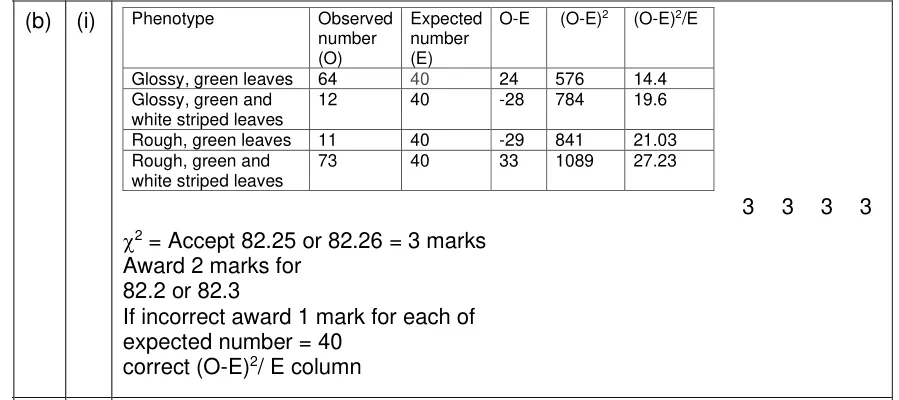
A level Component 2 · June 2023 · Q6(b)(i) · 3 marks · Easy
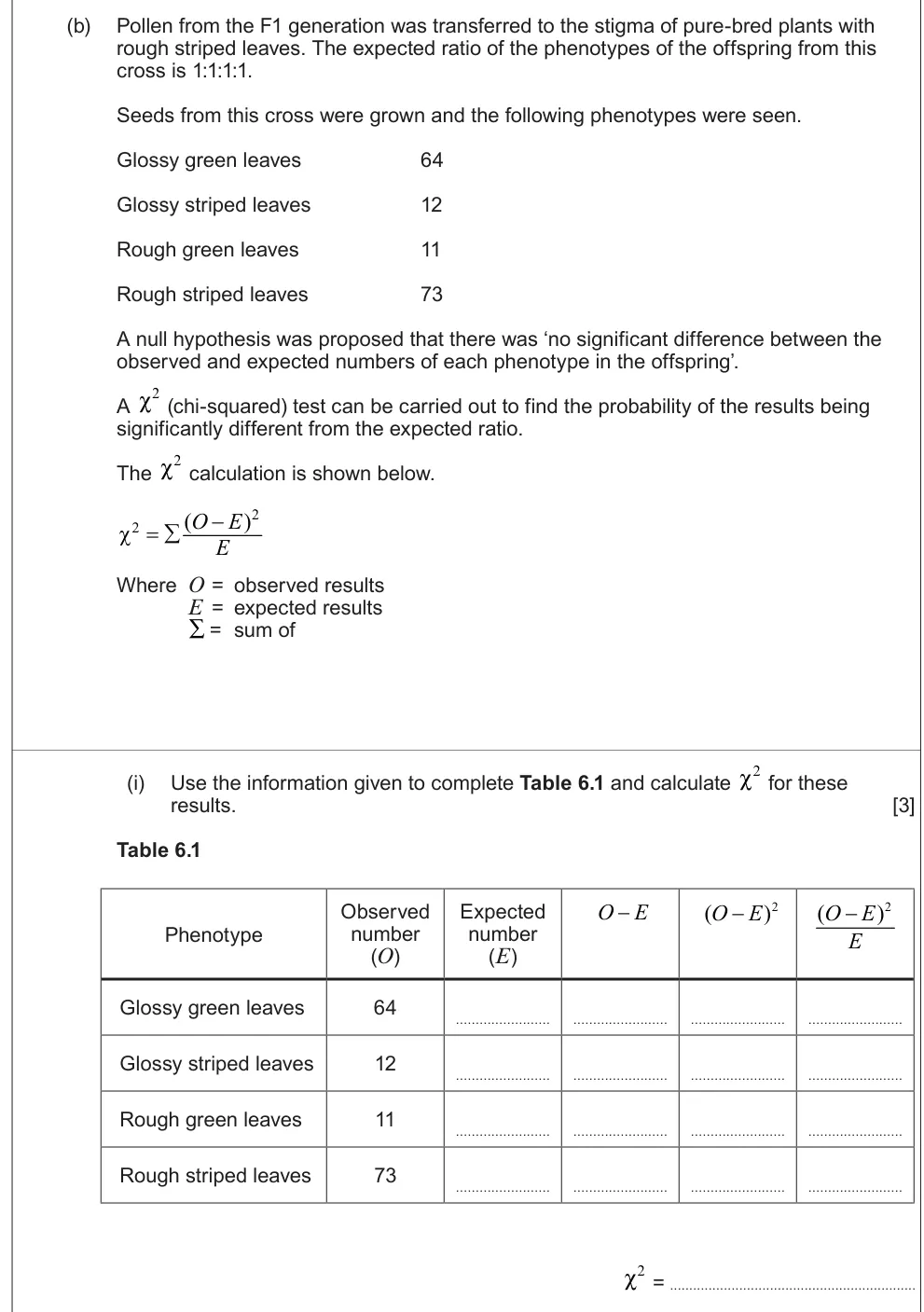
Complete the table to calculate χ² for a cross of leaf characteristics.
Show the mark scheme
Tap an image to open it full size.
Question 13
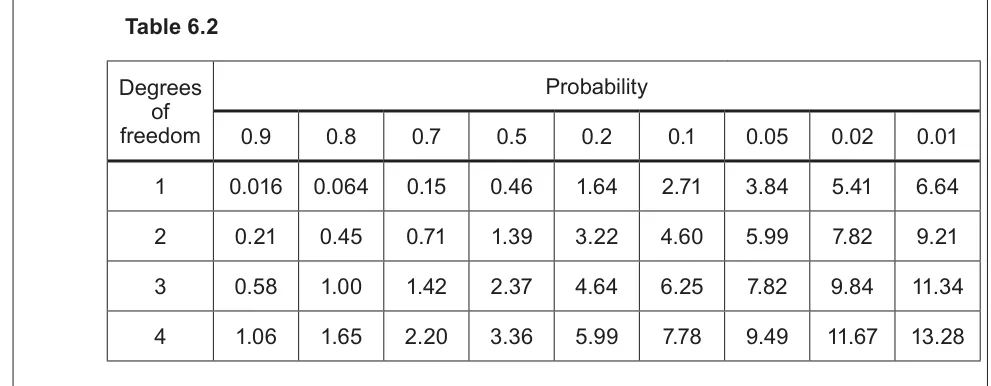
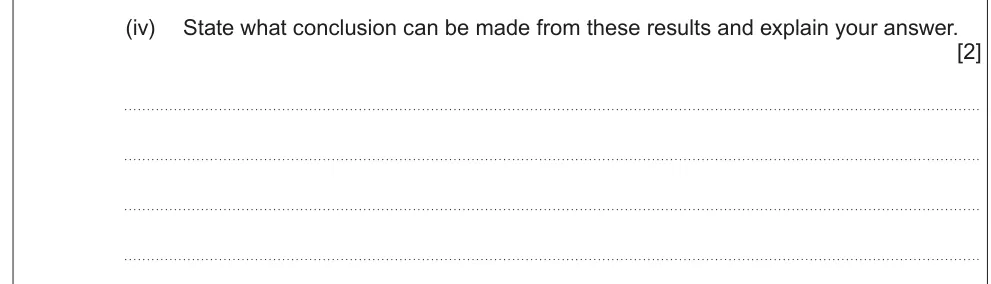
A level Component 2 · June 2023 · Q6(b)(iv) · 2 marks · Easy
State the conclusion from the χ² result and explain your answer.
Information from earlier in this question:
Show the mark scheme

Tap an image to open it full size.
Question 14
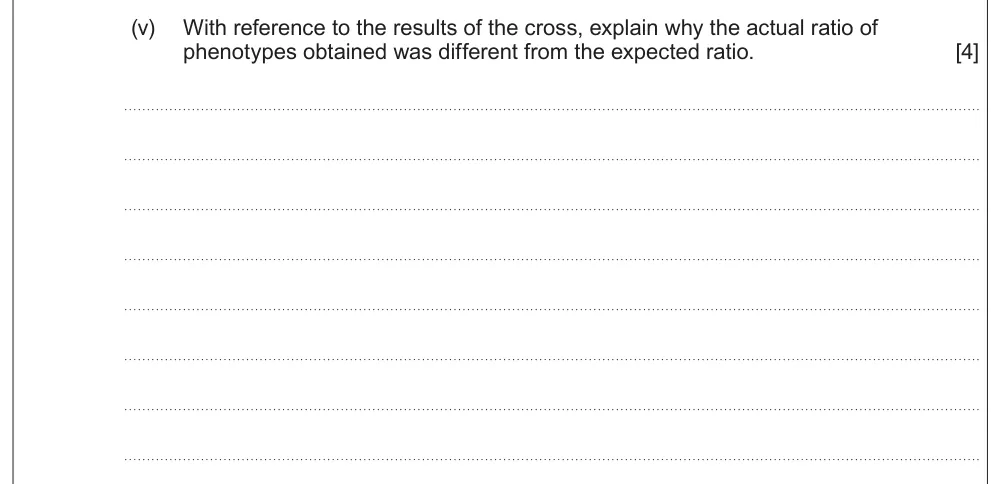
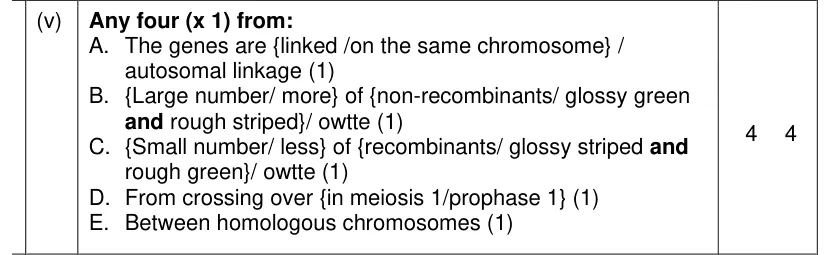
A level Component 2 · June 2023 · Q6(b)(v) · 4 marks
Explain why the actual ratio of phenotypes differed from the expected ratio.
Show the mark scheme
Tap an image to open it full size.
From the examiners' report: Many described the numbers but vague references to crossing over and dominance gained no credit. Explain autosomal linkage and recombinants.
Sex linkage
Question 15
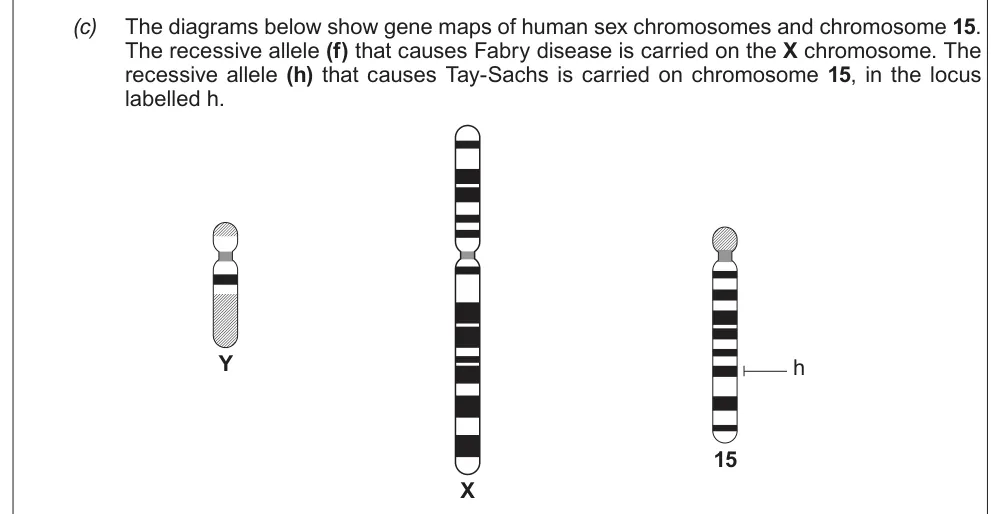
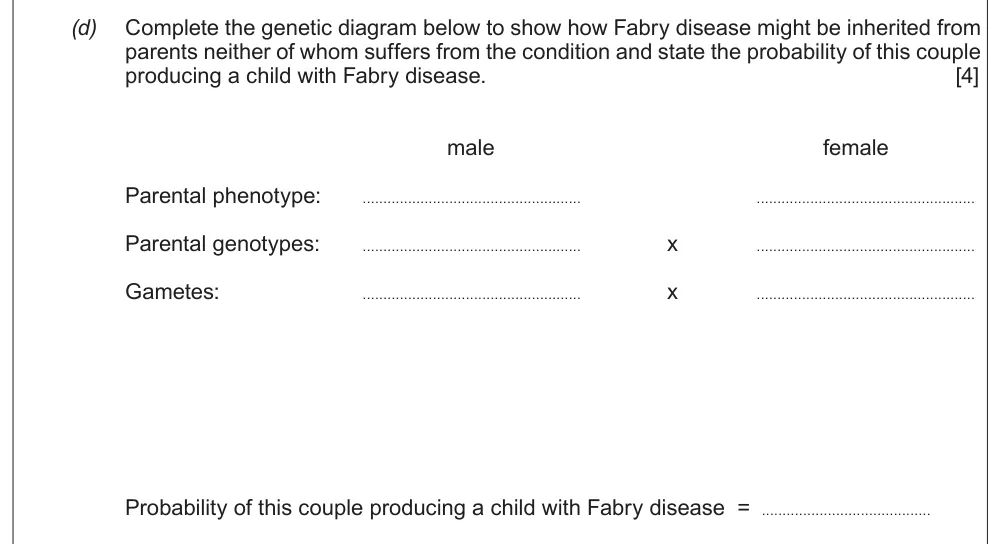
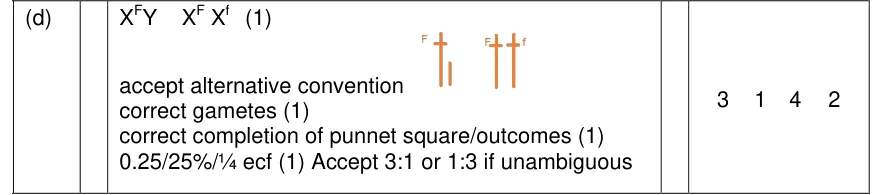
A level Component 2 · June 2018 · Q1(d) · 4 marks
Draw a genetic diagram for Fabry disease and give the probability of an affected child.
Information from earlier in this question:
Show the mark scheme
Tap an image to open it full size.
From the examiners' report: Use a convention for sex linkage. Some drew unlinked alleles or even diploid gametes.
Question 16
A level Component 2 · June 2022 · Q6(c)(i) · 1 mark
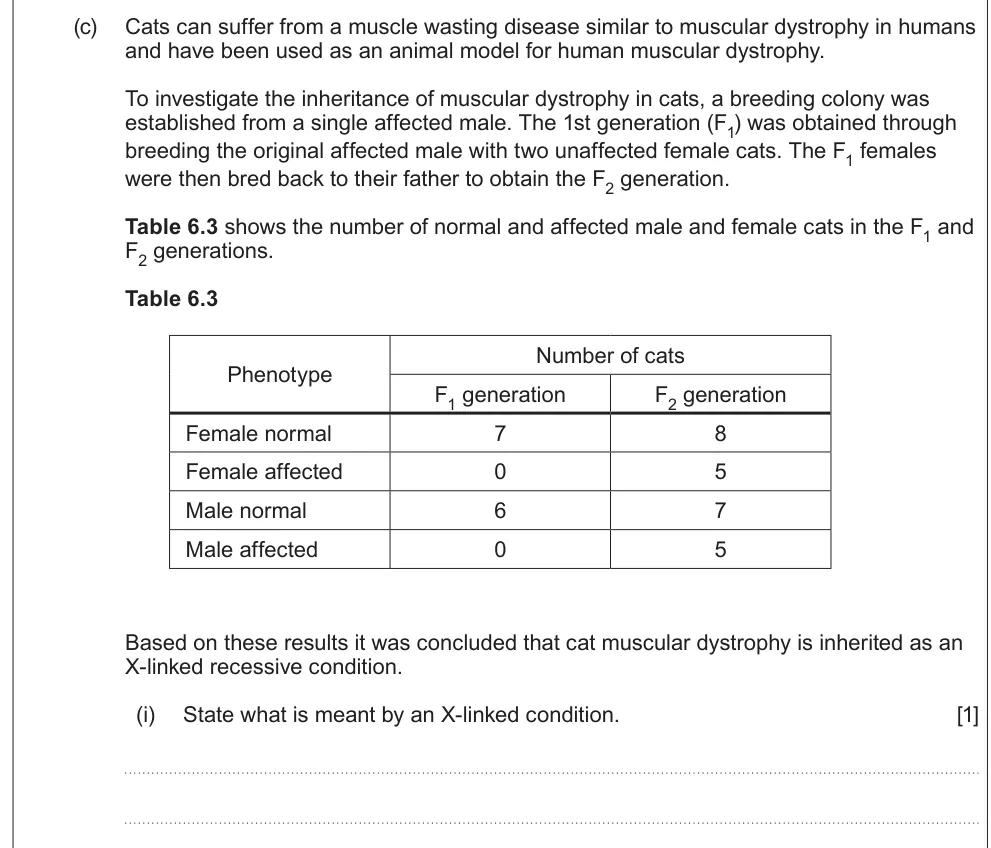
State what is meant by an X-linked condition.
Show the mark scheme

Tap an image to open it full size.
Question 17
A level Component 2 · June 2022 · Q6(c)(ii) · 4 marks
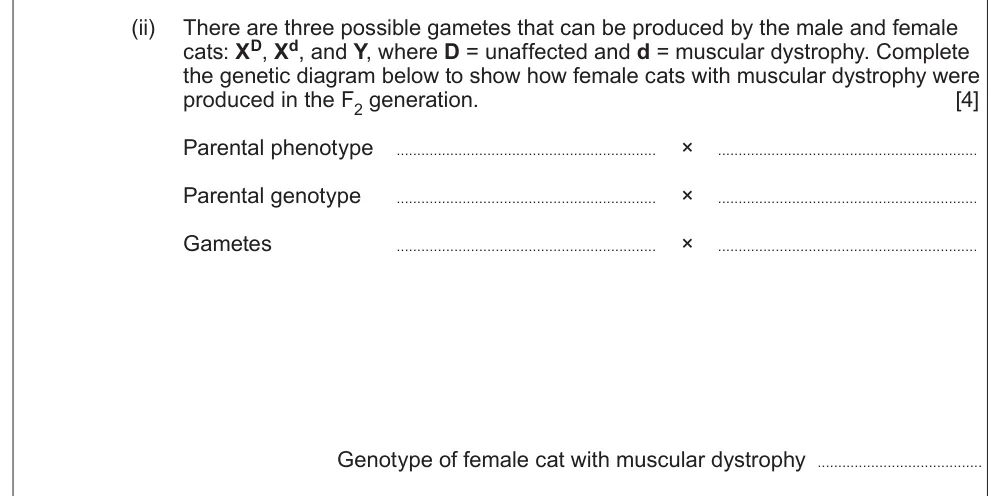
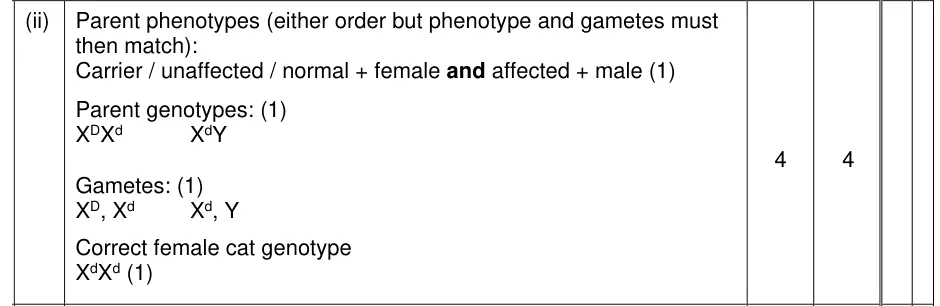
Draw a genetic diagram to show how a female cat with muscular dystrophy could be produced.
Show the mark scheme
Tap an image to open it full size.
From the examiners' report: For a sex-linked condition, each phenotype must say male or female as well as normal, carrier or affected.
Question 18
A level Component 2 · June 2024 · Q3(b)(iv) · 1 mark
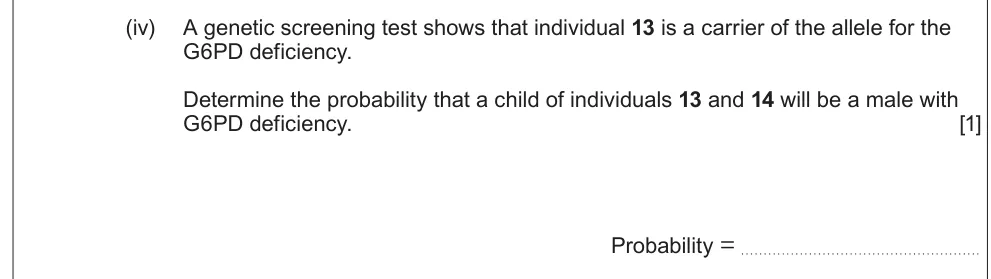
Determine the probability that a child of a carrier will be a male with G6PD deficiency.
Information from earlier in this question:

Show the mark scheme

Tap an image to open it full size.
Mutation and cancer
Question 19
A level Component 2 · June 2025 · Q5(d)(iii) · 3 marks · Easy
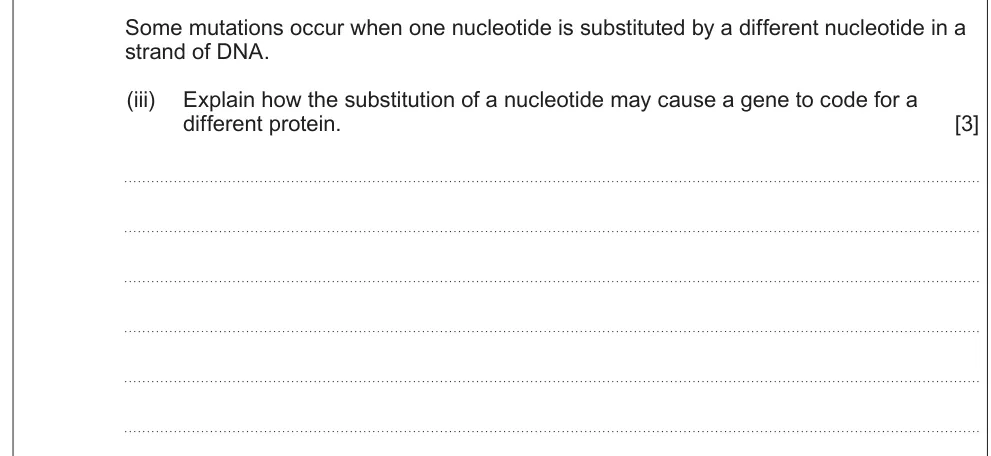
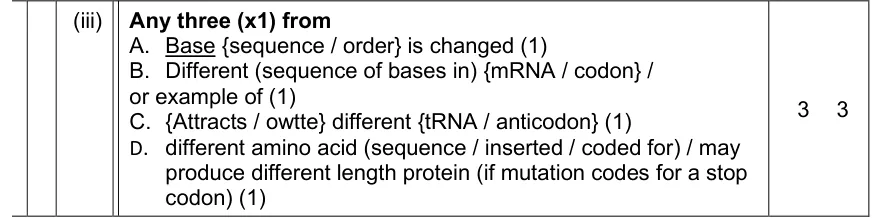
Explain how substituting a nucleotide may cause a gene to code for a different protein.
Show the mark scheme
Tap an image to open it full size.
From the examiners' report: Some didn't mention bases. Follow it through: base sequence, mRNA codon, tRNA anticodon, amino acid.
Question 20
A level Component 2 · June 2019 · Q4(e) · 2 marks · Hard
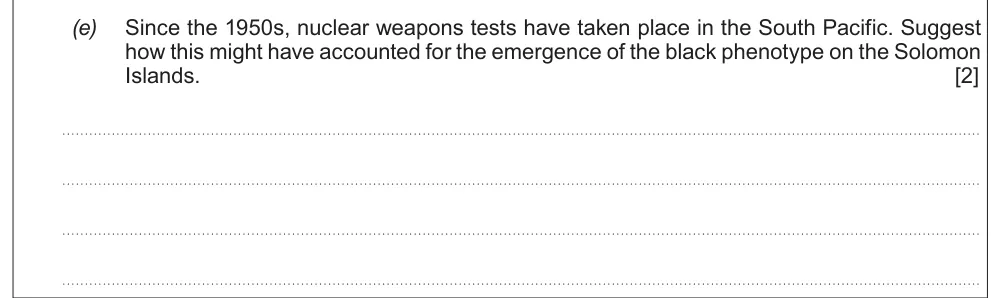
Suggest how nuclear weapons tests might explain a new black phenotype.
Show the mark scheme

Tap an image to open it full size.
From the examiners' report: Many didn't make the link between radiation and mutation.
Question 21
A level Component 2 · Autumn 2020 · Q2(d)(i) · 2 marks
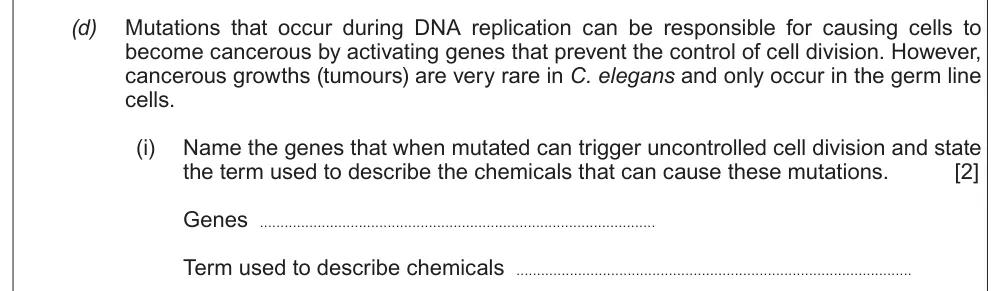
Name the genes whose mutation can cause cancer and the term for chemicals that cause these mutations.
Show the mark scheme

Tap an image to open it full size.
Epigenetics
Question 22
A level Component 2 · Autumn 2020 · Q2(e) · 3 marks
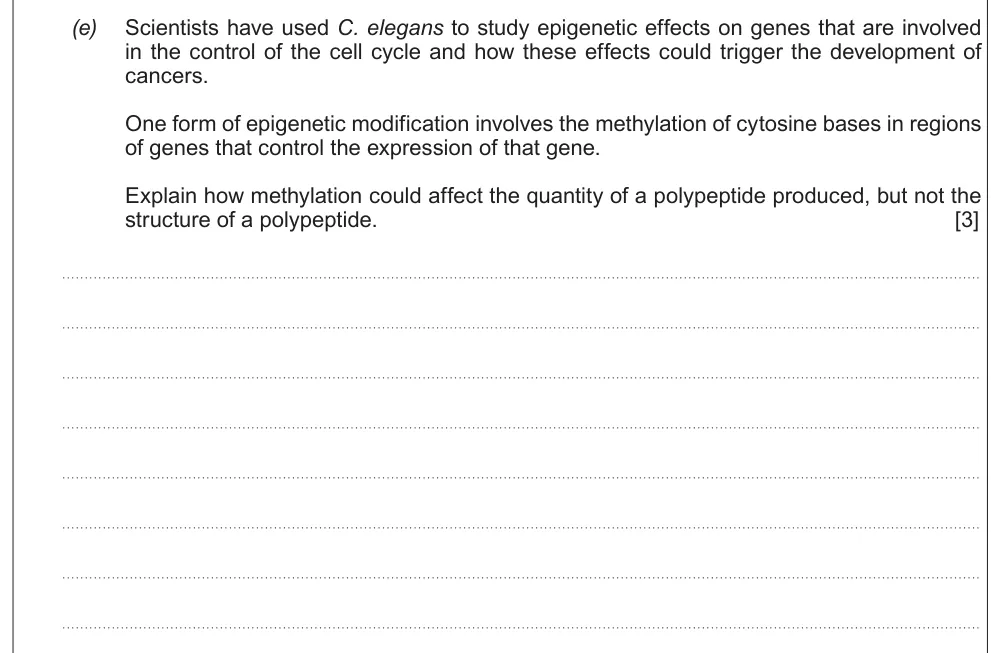
Explain how methylation could affect the quantity but not the structure of a polypeptide.
Show the mark scheme

Tap an image to open it full size.
From the examiners' report: Many wrote about acetylation of histones even though the question was about methylation of promoter regions.
Question 23
A level Component 2 · June 2017 · Q4(c)(iii) · 3 marks · Hard
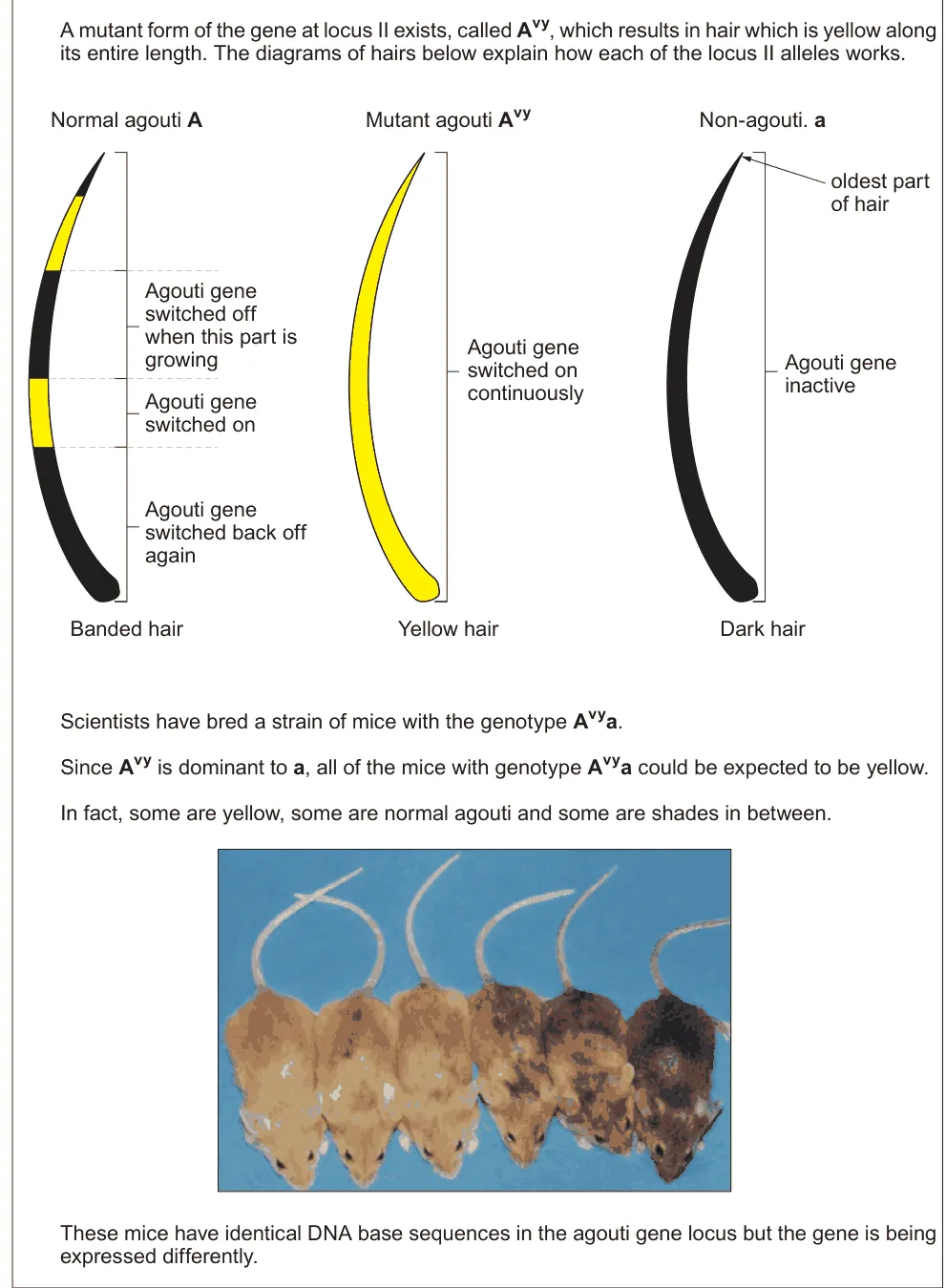
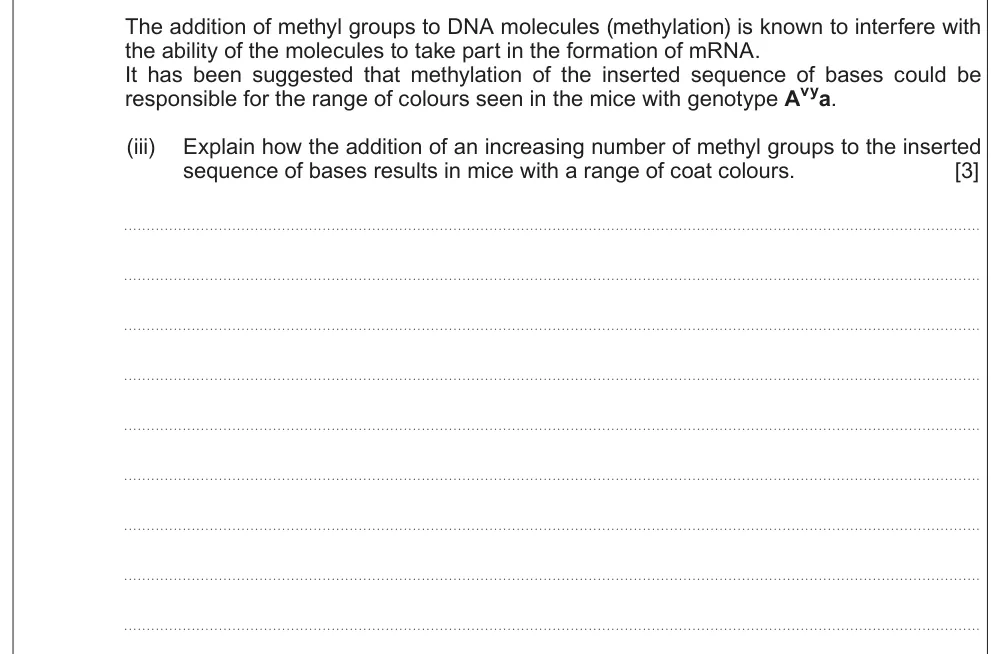
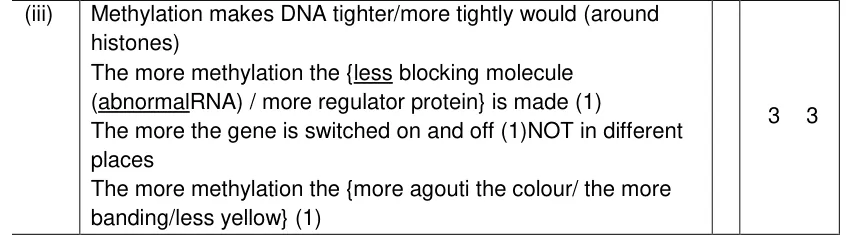
Explain how more methyl groups on an inserted sequence give mice a range of coat colours.
Information from earlier in this question:

Show the mark scheme
Tap an image to open it full size.
From the examiners' report: Many gave generic recall instead of using the diagram. The methylation is of the inserted sequence, so blocking it gives more regulator protein, not less.
Question 24
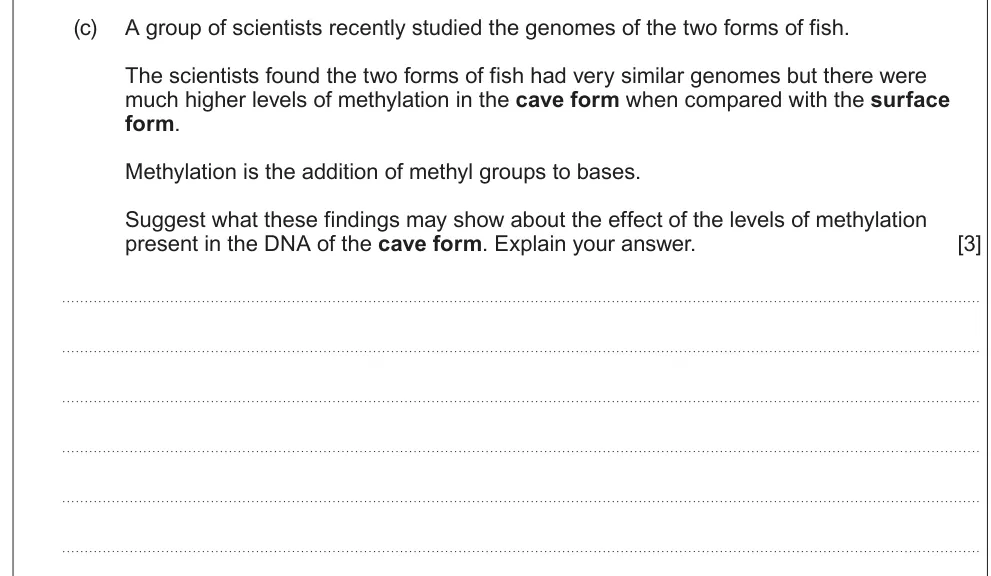
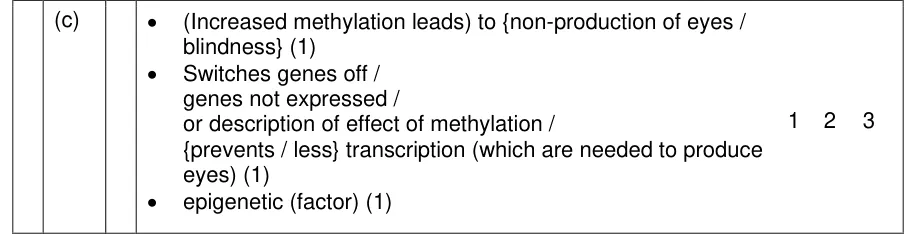
A level Component 2 · June 2024 · Q4(c) · 3 marks
Suggest what high methylation levels show about gene expression in cave fish.
Show the mark scheme
Tap an image to open it full size.
Where students lose marks (from Eduqas examiners' reports and mark schemes)
Each point below is followed by wording that gained marks.
Read the table at 0.05: A common error was to choose the 0.5 probability level.
✔ Gains credit: "7.82" (3 degrees of freedom, p = 0.05).
Probability, not ratio: Some gave ratios, not probabilities.
✔ Gains credit: "0.25 / ¼ / 1 in 4 / 25%". Reject ratios.
Male or female, every time: Sex-linked phenotypes were given without the sex.
✔ Gains credit: "Carrier + female and affected + male", "XDXd × XdY".
Explain linkage fully: Vague references to crossing over and dominance gained no credit.
✔ Gains credit: "The genes are linked", "small number of recombinants" "from crossing over in prophase I".
Haploid gametes: Some drew diploid gametes or unlinked alleles.
✔ Gains credit: Parents "XFY" and "XFXf", one allele in each gamete.
Apply it to the diagram: Many gave generic recall about methylation.
✔ Gains credit: "The more methylation the more regulator protein is made" "the more agouti the colour".
Download the questions
Download the PDF pack (24 questions, mark schemes at the end)
Keep practising
- Classification and Biodiversity (2.1): Eduqas A Level Biology exam questions by topic
- Cell Division (2.2): Eduqas A Level Biology exam questions by topic
- Sexual Reproduction in Humans (2.3): Eduqas A Level Biology exam questions by topic
- Sexual Reproduction in Plants (2.4): Eduqas A Level Biology exam questions by topic
- Variation and Evolution (2.6): Eduqas A Level Biology exam questions by topic
- Application of Reproduction and Genetics (2.7): Eduqas A Level Biology exam questions by topic
- Eduqas A level Biology past papers, mark schemes and examiners' reports
- Eduqas A level Biology grade boundaries
- Ask about Eduqas A level Biology lessons with Sam on WhatsApp
Questions, mark schemes and examiners' report extracts © WJEC CBAC Ltd (Eduqas).