

Photosynthesis is one of the biggest topics in Component 1. You need the absorption and action spectra, how photosystems harvest light, cyclic and non-cyclic photophosphorylation, photolysis, the Calvin cycle (RuBP, GP, triose phosphate) and the roles of nitrate, phosphate and magnesium. Every question on this page is from the A level papers, mostly Component 1, with a few synoptic questions from Component 2.
Many marks here come from linking the stages. The examiners' reports keep asking students to follow the chain through: no light-dependent stage means no ATP or reduced NADP for the Calvin cycle, so no carbohydrate for respiration. They also want precise wording: light is absorbed by photosystems, oxygen comes from photolysis of water, and nitrate and phosphate are needed to make named molecules, not just "for growth".
I don't teach the Eduqas specification myself, so for one-to-one help I recommend Sam. He teaches Eduqas A level Biology at a top-rated sixth form college and is very popular with his students. You can ask about lessons with Sam on WhatsApp using the link at the bottom of this page.
What you need from GCSE and Year 12
Each question on this page assumes you're secure on these ideas. If any of them feels shaky, look it up before you start.
- Photosynthesis uses light energy to make glucose from carbon dioxide and water, releasing oxygen.
- Chlorophyll in chloroplasts absorbs light, mainly red and blue.
- Light intensity, carbon dioxide concentration and temperature can limit the rate of photosynthesis.
- ATP is made by chemiosmosis when protons flow through ATP synthetase (topic 1.1).
Key terms
These words come up in the questions and mark schemes. Examiners expect you to use them exactly.
- Photosystem: a cluster of pigments in the thylakoid membrane, with chlorophyll a at the reaction centre.
- Absorption spectrum: how much light a pigment absorbs at each wavelength.
- Photon: a particle of light energy.
- Photolysis: splitting water using light energy into protons, electrons and oxygen.
- Photophosphorylation: making ATP using light energy; non-cyclic also makes reduced NADP.
- Reduction: gain of electrons or hydrogen.
- RuBP: ribulose bisphosphate, the 5-carbon compound that accepts CO₂ in the Calvin cycle.
- GP and TP: glycerate 3-phosphate is reduced to triose phosphate using ATP and reduced NADP.
- Compensation point: the light intensity at which photosynthesis and respiration rates are equal.
What these questions cover (Eduqas 1.2)
The questions test these statements from Component 1 (Energy for Life) of the Eduqas A level Biology specification (A400). Component 1 content is examined in A level Component 1.
- (b) chloroplasts acting as transducers converting the energy of light photons into the chemical energy of ATP
- (c) the process of light harvesting and the absorption of various wavelengths of light by chlorophyll and associated pigments and the energy transfer to reaction centres
- (d) the basic features of Photosystems I and II
- (e) cyclic and non-cyclic photophosphorylation as sources of electrons for the electron transport chain
- (f) photolysis as a source of electrons for Photosystem II
- (g) the reduction of NADP by the addition of electrons and hydrogen ions in the stroma maintaining the proton gradient
- (h) reduced NADP as a source of reducing power and ATP as a source of energy for the following reactions
- (i) the reduction of glycerate-3-phosphate to produce triose phosphate (carbohydrate) with the regeneration of ribulose bisphosphate
- (l) the role of inorganic nutrients in plant metabolism as illustrated by the use of nitrogen and magnesium
How to use this page
Write your answer on paper before you open the mark scheme. Allow about 1.2 minutes per mark: the 22 questions are worth 52 marks, so about 62 minutes in total. Then mark your answer strictly against the mark scheme and read the examiners' tip underneath it. If you'd rather print the questions, download the PDF pack.
Pigments and photosystems
Question 1
A level Component 1 · Autumn 2020 · Q1(a)(i) · 2 marks
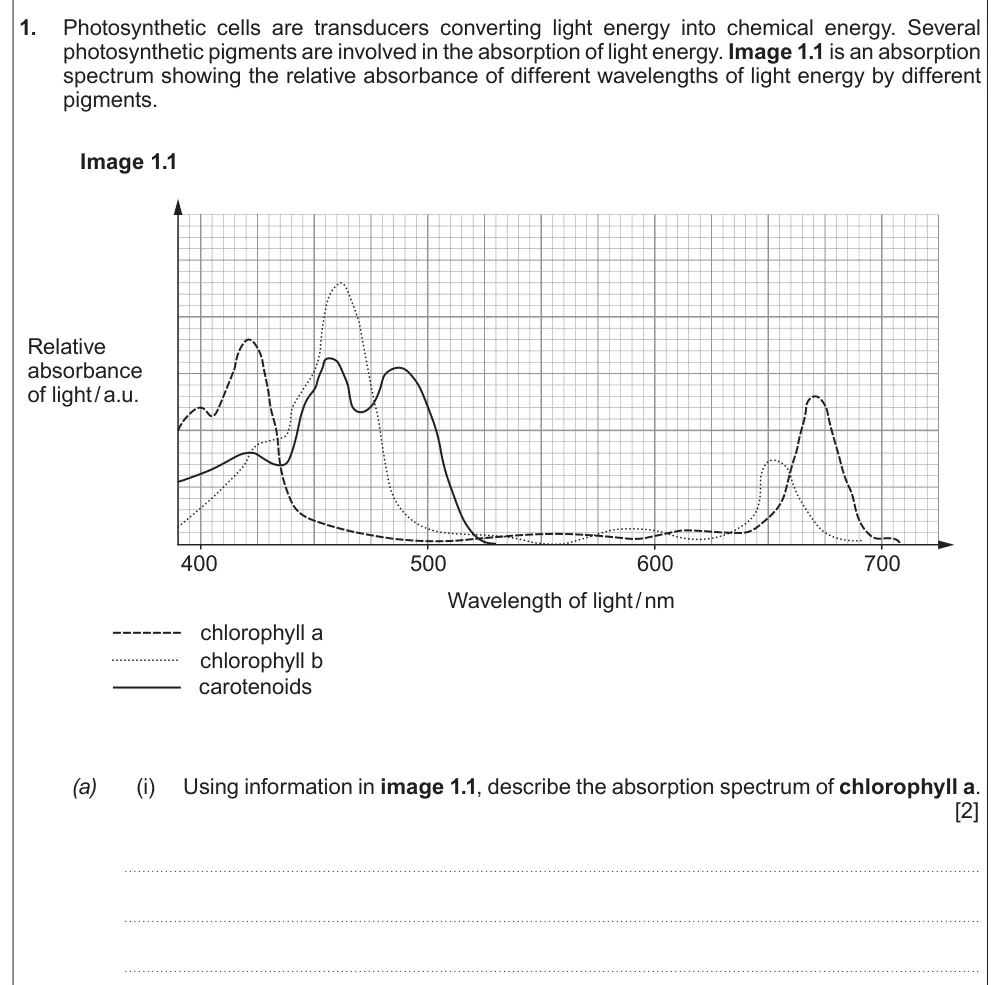
Use a graph to describe the absorption spectrum of chlorophyll a.
Show the mark scheme

Tap an image to open it full size.
From the examiners' report: Almost everyone gave the peaks, but many didn't mention the reduced absorption in the green, or wrongly said there was no absorption there.
Question 2
A level Component 1 · Autumn 2020 · Q1(a)(ii) · 1 mark
Suggest the advantage of having several light-absorbing pigments.

Show the mark scheme

Tap an image to open it full size.
From the examiners' report: A pleasing number realised that more pigments means a wider range of wavelengths absorbed. "All light" isn't accepted.
Question 3
A level Component 2 · Autumn 2020 · Q6(a)(ii) · 2 marks
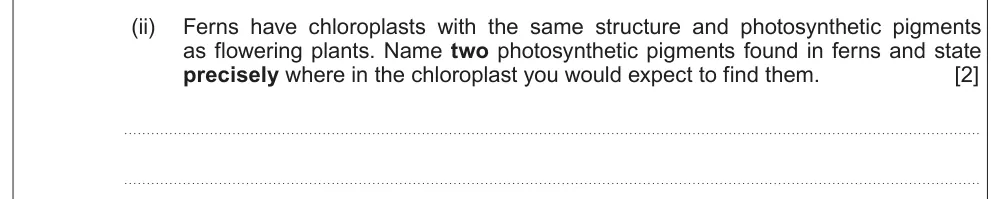
Name two pigments and state precisely where in the chloroplast they are found.
Show the mark scheme

Tap an image to open it full size.
From the examiners' report: Many students didn't recall this or weren't precise. Name the pigments and say they are in photosystems on the thylakoid membranes.
Question 4
A level Component 1 · Autumn 2021 · Q1(a)(i) · 1 mark
State the precise location of photosystems in plants.

Show the mark scheme

Tap an image to open it full size.
From the examiners' report: Most students said the thylakoid membranes, which is right.
Question 5
A level Component 1 · Autumn 2021 · Q1(a)(ii) · 3 marks
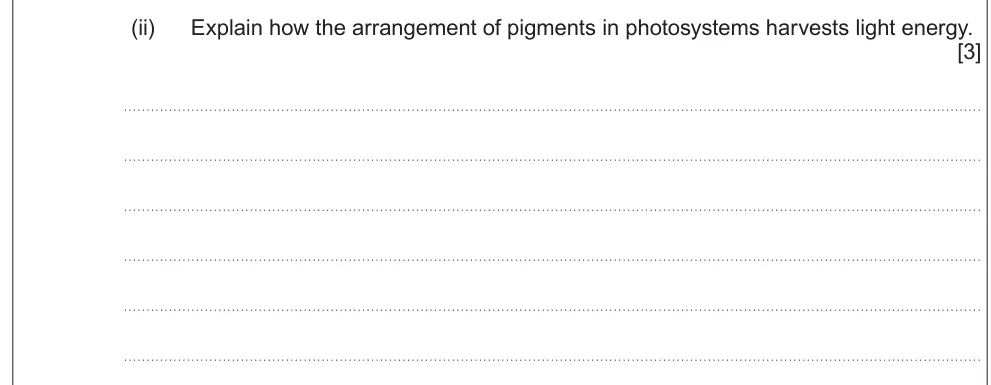
Explain how the arrangement of pigments in photosystems harvests light energy.
Show the mark scheme

Tap an image to open it full size.
From the examiners' report: Very few said chlorophyll a is at the reaction centre or mentioned PSI and PSII. Accessory pigments absorb different wavelengths and pass the energy inwards.
Question 6
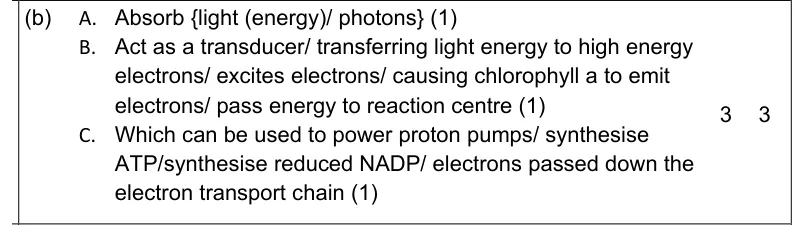
A level Component 1 · June 2019 · Q3(b) · 3 marks
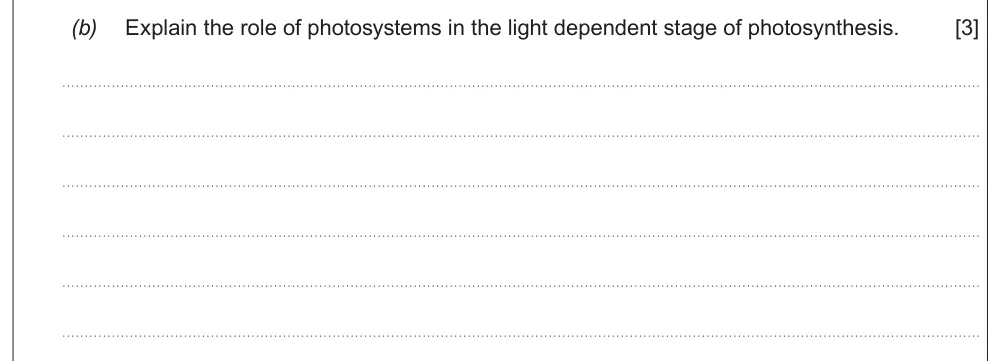
Explain the role of photosystems in the light-dependent stage.
Show the mark scheme
Tap an image to open it full size.
From the examiners' report: Unscientific language lost marks: light isn't "hitting", "entering" or "trapped". Photons are absorbed, and the energy excites electrons.
The light-dependent stage
Question 7
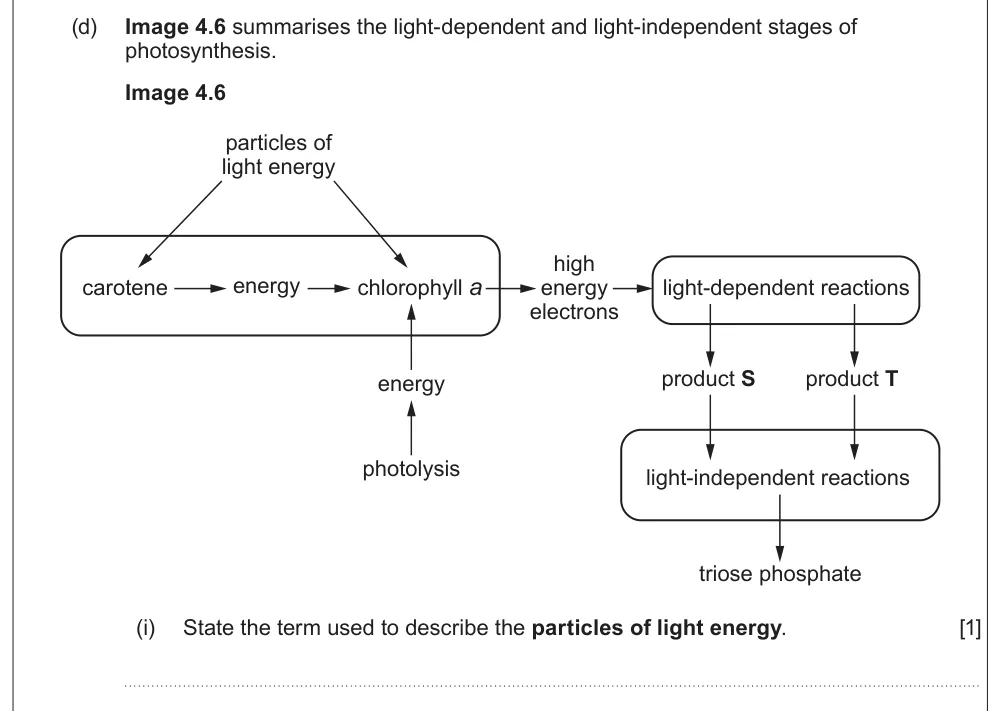
A level Component 1 · June 2024 · Q4(d)(i) · 1 mark
State the term for particles of light energy.
Show the mark scheme

Tap an image to open it full size.
From the examiners' report: Most students knew it: photons.
Question 8
A level Component 1 · June 2024 · Q4(d)(ii) · 2 marks
Name the two products of the light-dependent stage on an unfamiliar diagram.

Show the mark scheme

Tap an image to open it full size.
From the examiners' report: Most identified ATP and reduced NADP. NADH is rejected: it is NADP in photosynthesis.
Question 9
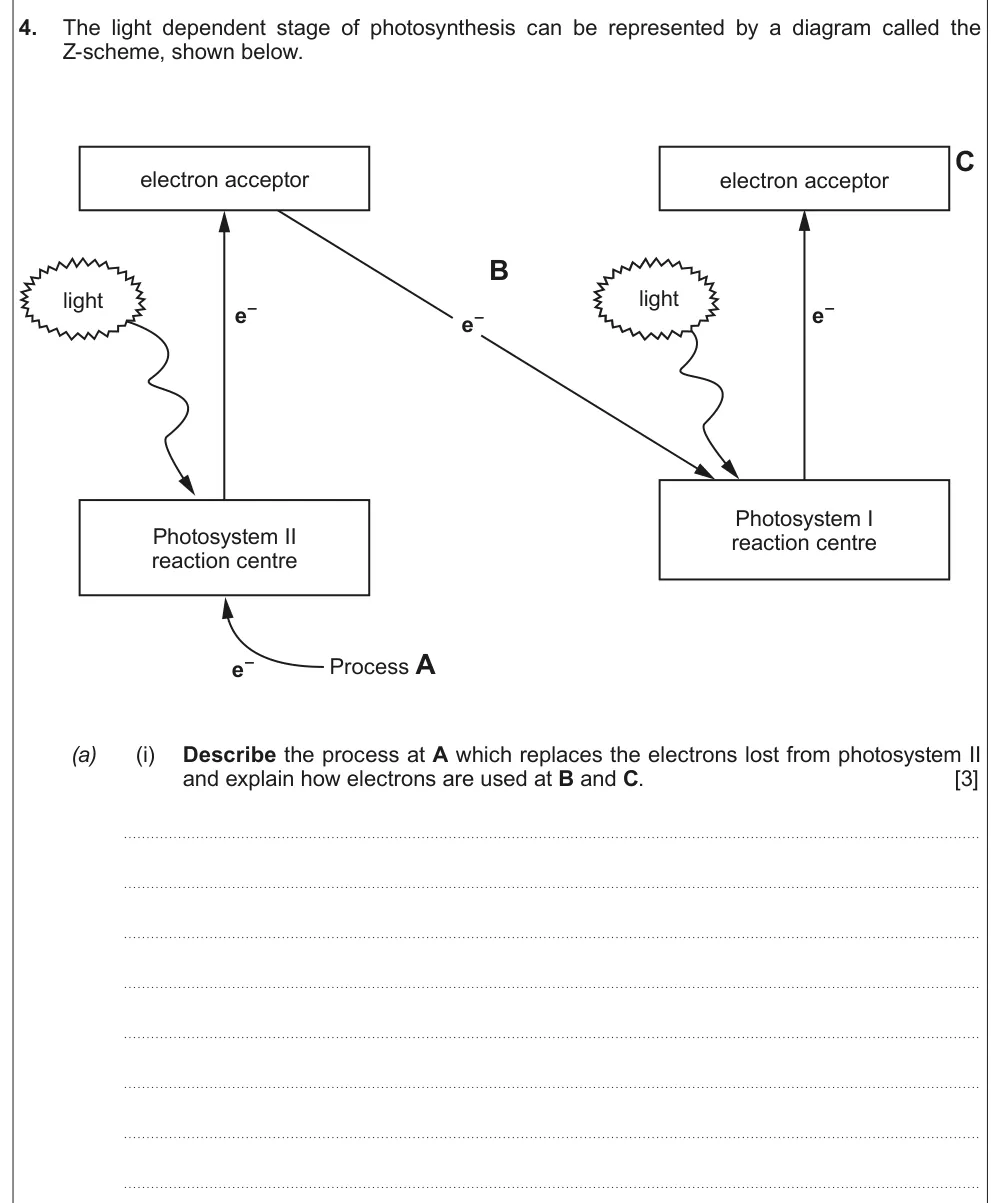
A level Component 1 · June 2017 · Q4(a)(i) · 3 marks
Describe how lost electrons are replaced in photosystem II and how electrons are used.
Show the mark scheme

Tap an image to open it full size.
Question 10
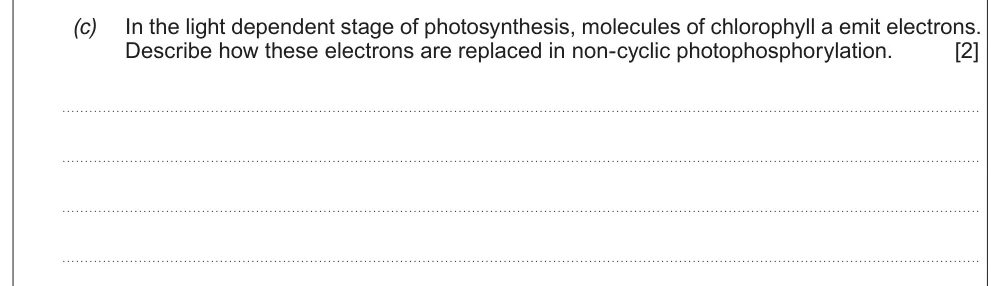
A level Component 1 · Autumn 2020 · Q1(c) · 2 marks
Describe how electrons are replaced in non-cyclic photophosphorylation.
Show the mark scheme

Tap an image to open it full size.
From the examiners' report: Many excellent answers on photolysis, and fewer students than before confused it with hydrolysis.
Question 11
A level Component 1 · June 2017 · Q4(c)(ii) · 2 marks
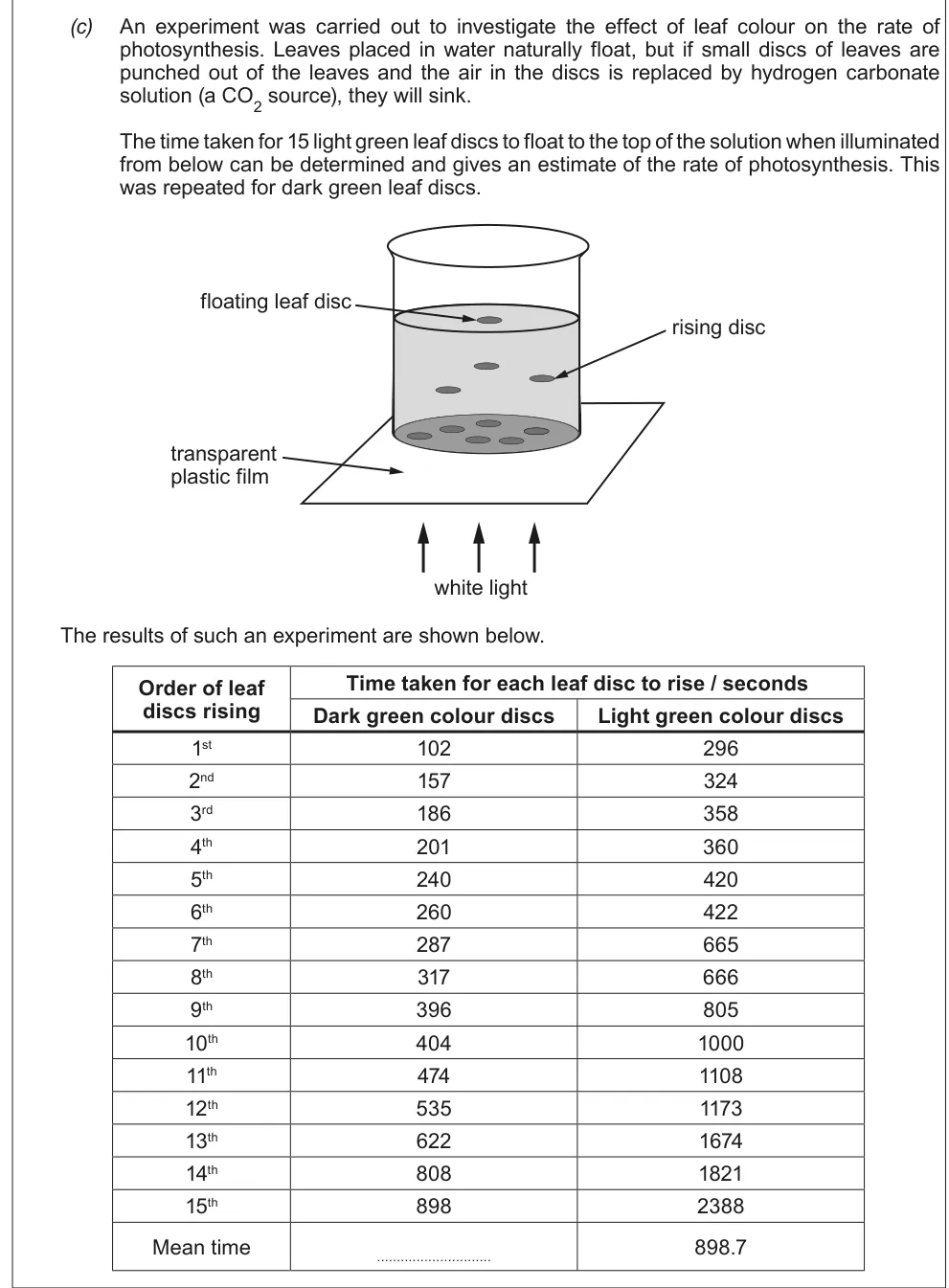
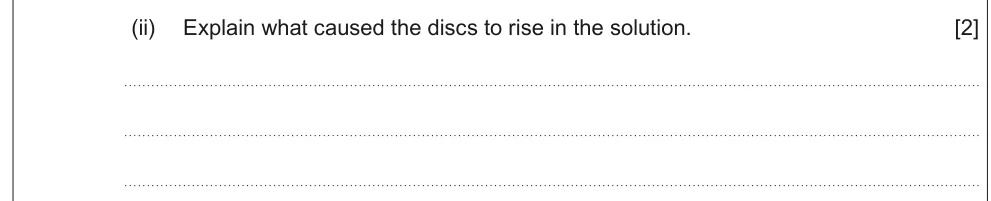
Explain what caused leaf discs to rise in the solution.
Information from earlier in this question:
Show the mark scheme

Tap an image to open it full size.
From the examiners' report: Many students didn't say that oxygen from photolysis fills the air spaces, making the discs less dense. Using up CO₂ isn't the reason.
Question 12
A level Component 1 · June 2022 · Q6(a)(ii) · 2 marks · Hard
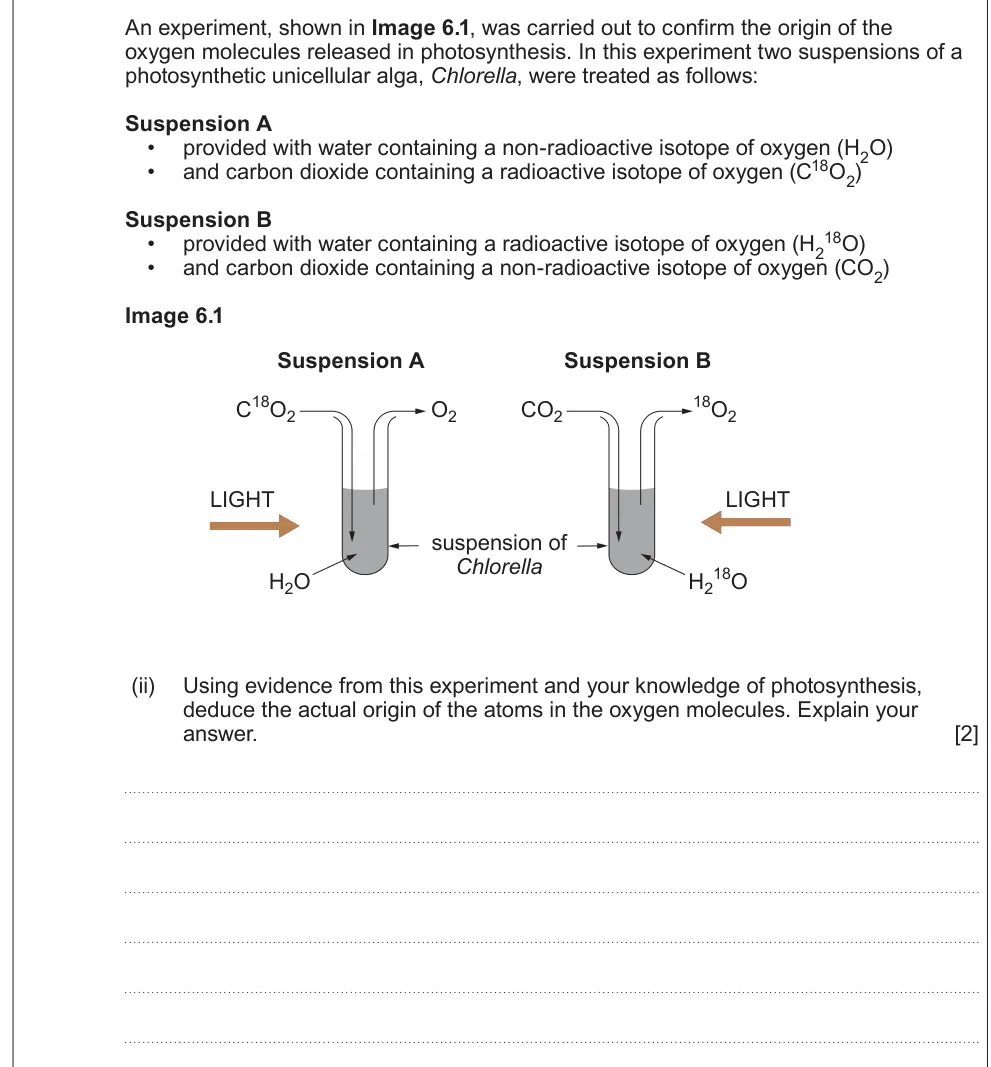
Use isotope data to explain where the oxygen atoms released come from.
Show the mark scheme

Tap an image to open it full size.
From the examiners' report: Many found this hard because they mixed up atoms and molecules. The ¹⁸O₂ only appears when H₂¹⁸O is supplied, so the oxygen comes from water.
Question 13
A level Component 1 · June 2022 · Q6(b)(ii) · 2 marks
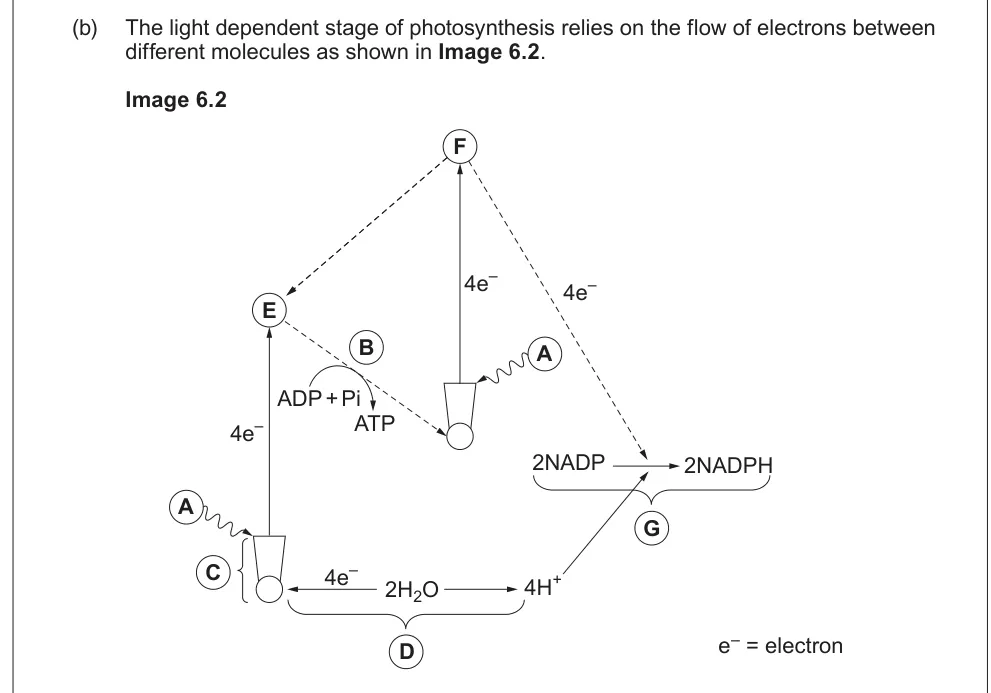
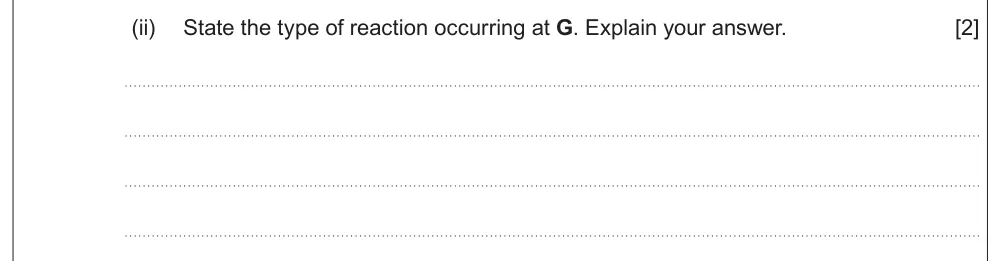
State the type of reaction at G and explain your answer.
Information from earlier in this question:
Show the mark scheme

Tap an image to open it full size.
From the examiners' report: Most students correctly said reduction: a gain of electrons or hydrogen.
Question 14
A level Component 1 · June 2022 · Q6(c)(iii) · 4 marks
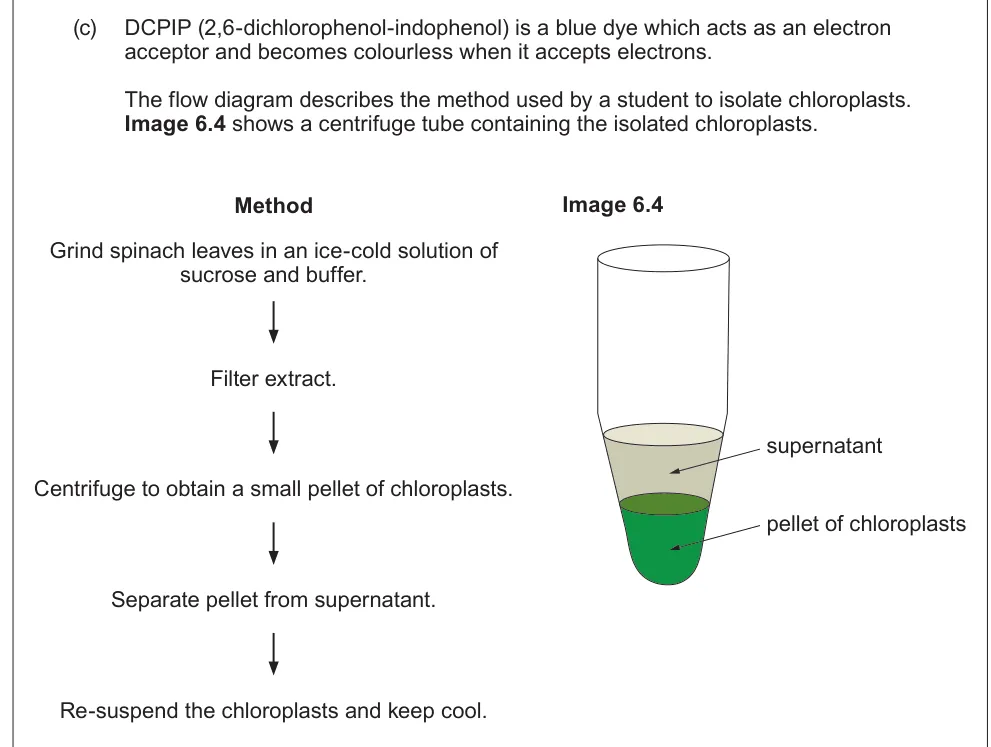
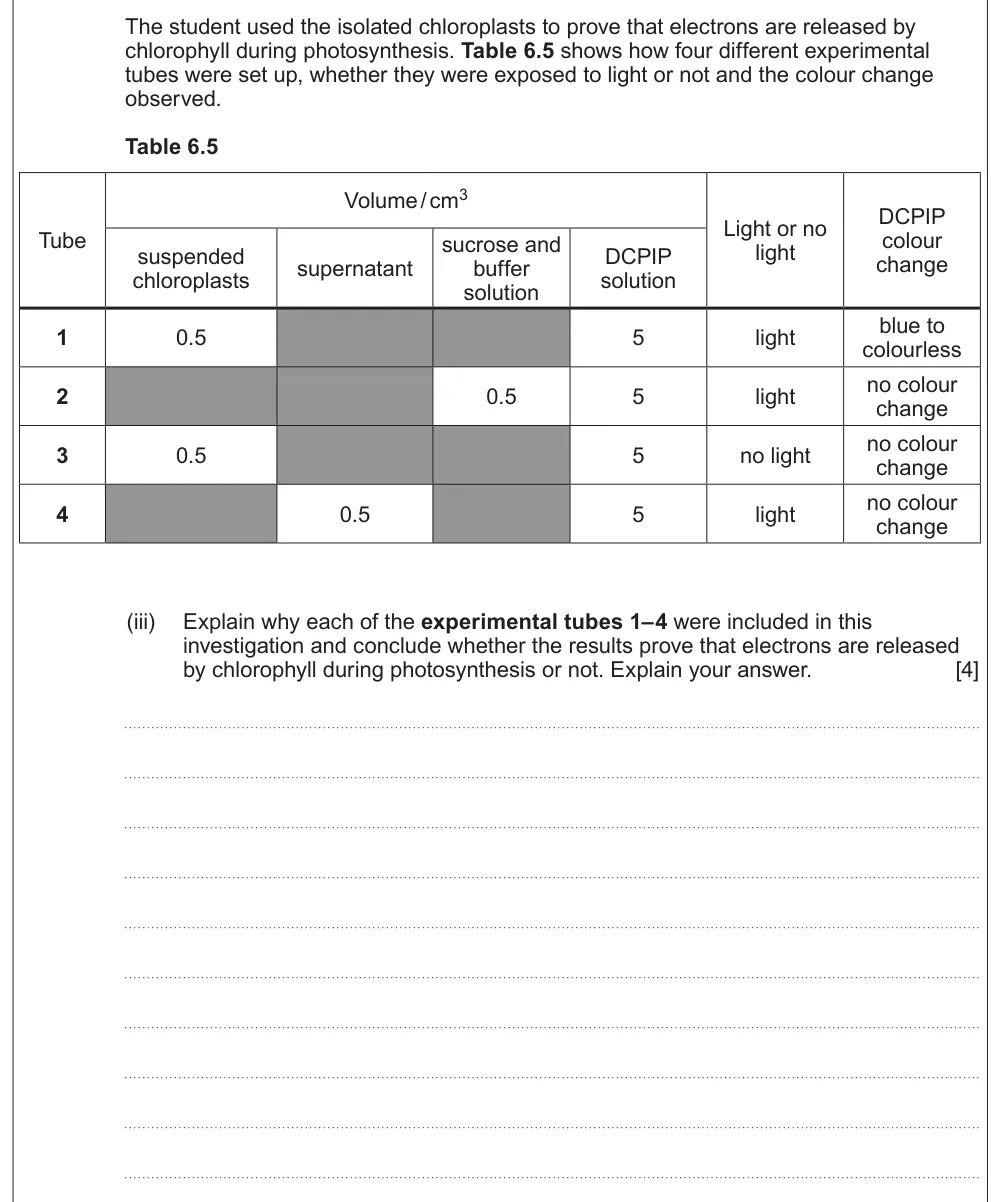
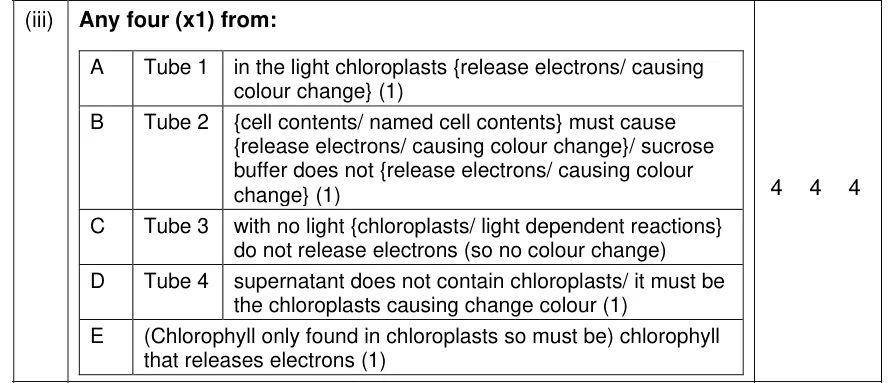
Explain what four DCPIP tubes show about electrons released by chlorophyll.
Information from earlier in this question:
Show the mark scheme
Tap an image to open it full size.
From the examiners' report: Many just described what was in each tube and its colour change. Explain why each tube was included and what it shows.
The light-independent stage
Question 15
A level Component 1 · Autumn 2020 · Q2(b)(i) · 2 marks
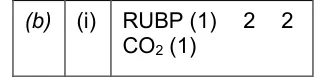
Name the two reactants of the reaction catalysed by RuBisCO.

Show the mark scheme
Tap an image to open it full size.
From the examiners' report: RuBP and CO₂ were often given correctly.
Question 16
A level Component 1 · Autumn 2020 · Q2(b)(ii)I · 1 mark
Name the first phosphorylated sugar made in the Calvin cycle.

Show the mark scheme

Tap an image to open it full size.
From the examiners' report: GP was commonly given, but GP isn't a sugar. The first phosphorylated sugar is triose phosphate.
Question 17
A level Component 1 · June 2022 · Q6(b)(iv) · 4 marks
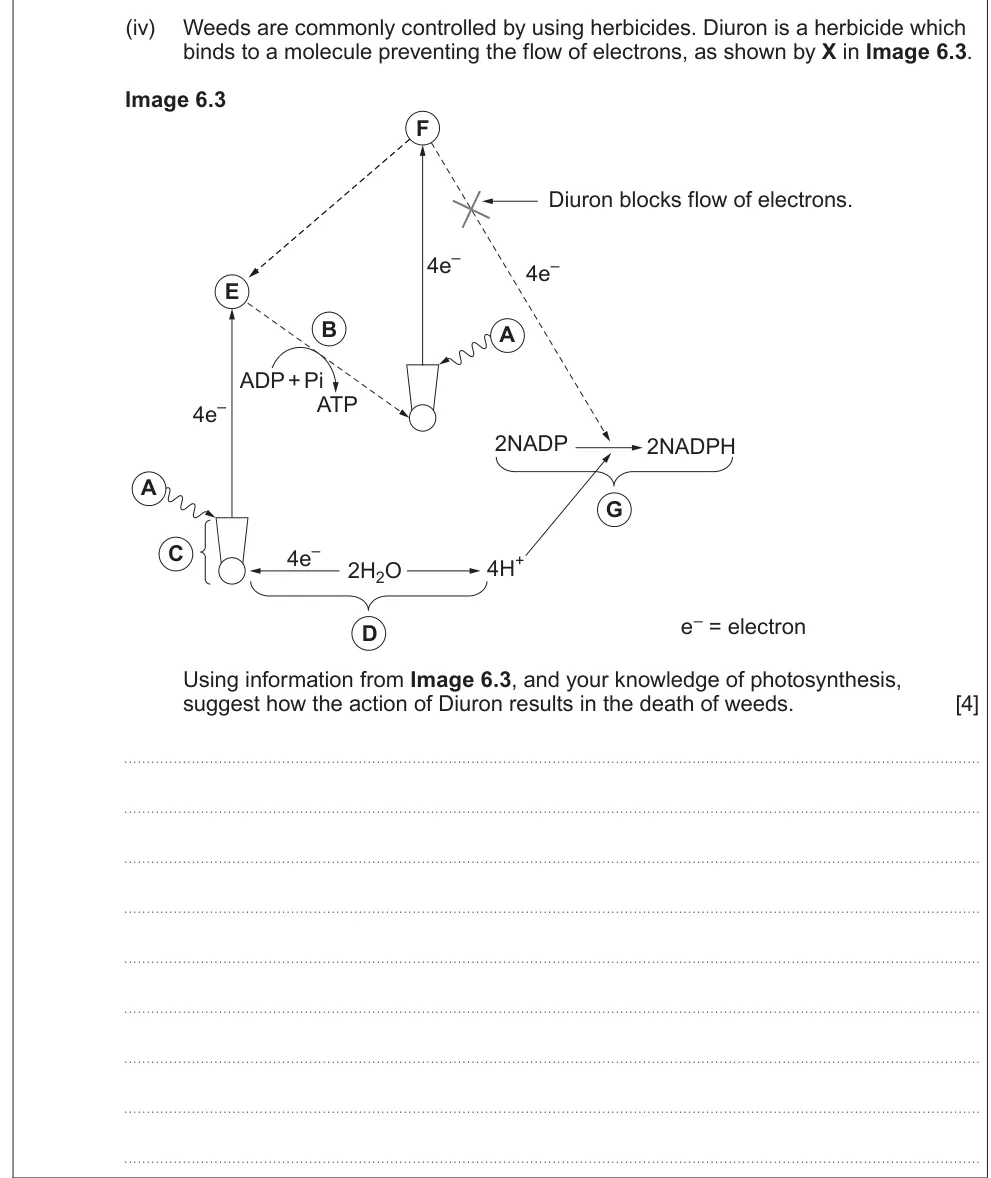
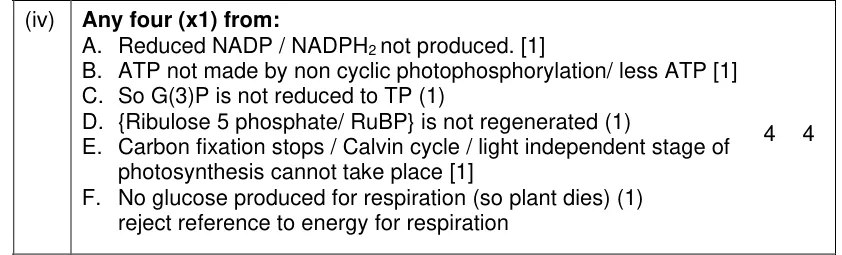
Suggest how the herbicide Diuron kills weeds.
Information from earlier in this question:
Show the mark scheme
Tap an image to open it full size.
From the examiners' report: There were many excellent, logically argued answers: no reduced NADP or ATP, so GP isn't reduced, RuBP isn't regenerated and the Calvin cycle stops.
Question 18
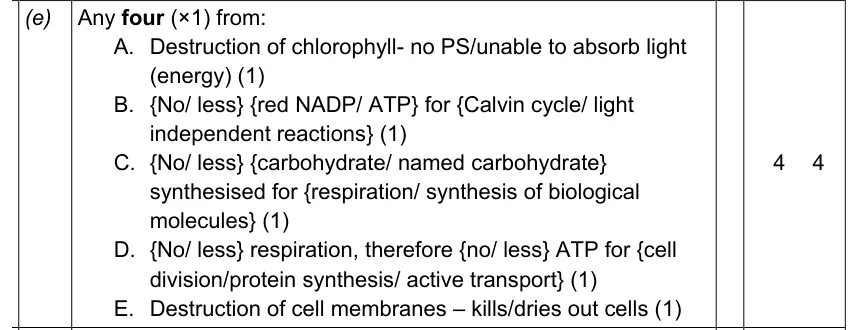
A level Component 1 · June 2019 · Q3(e) · 4 marks
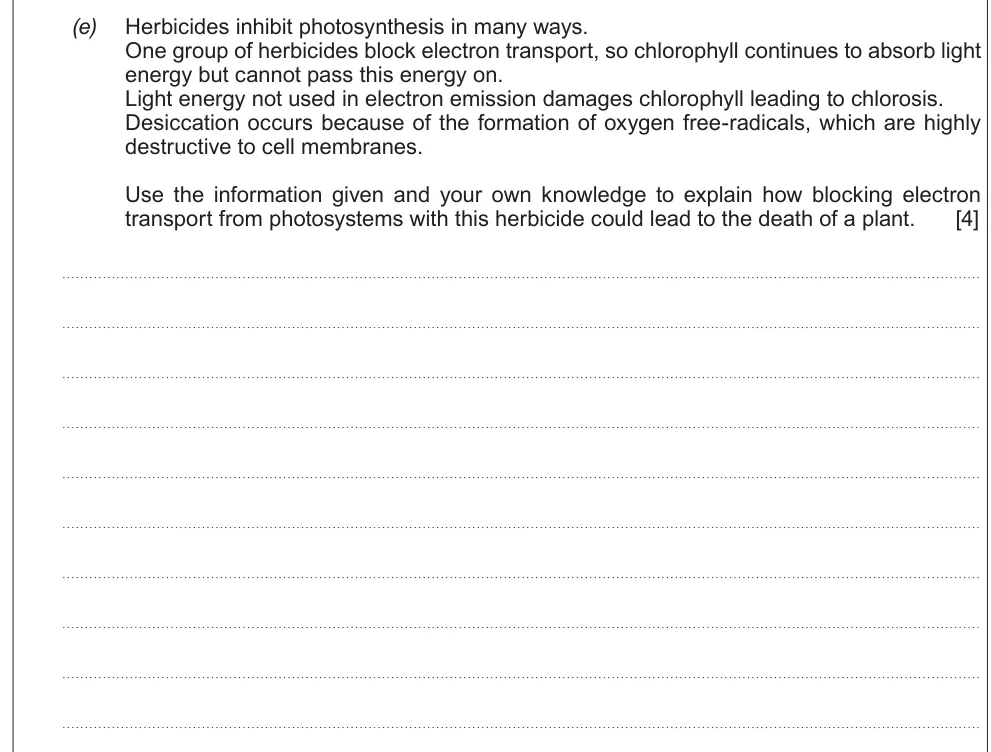
Explain how a herbicide that removes photosystems could kill a plant.
Show the mark scheme
Tap an image to open it full size.
From the examiners' report: Many answers were poor. Follow the chain: no ATP or reduced NADP for the Calvin cycle, no carbohydrate for respiration, so too little ATP for named processes. "Metabolic processes" isn't enough.
Question 19
A level Component 1 · June 2018 · Q5(a)(iii) · 4 marks · Hard
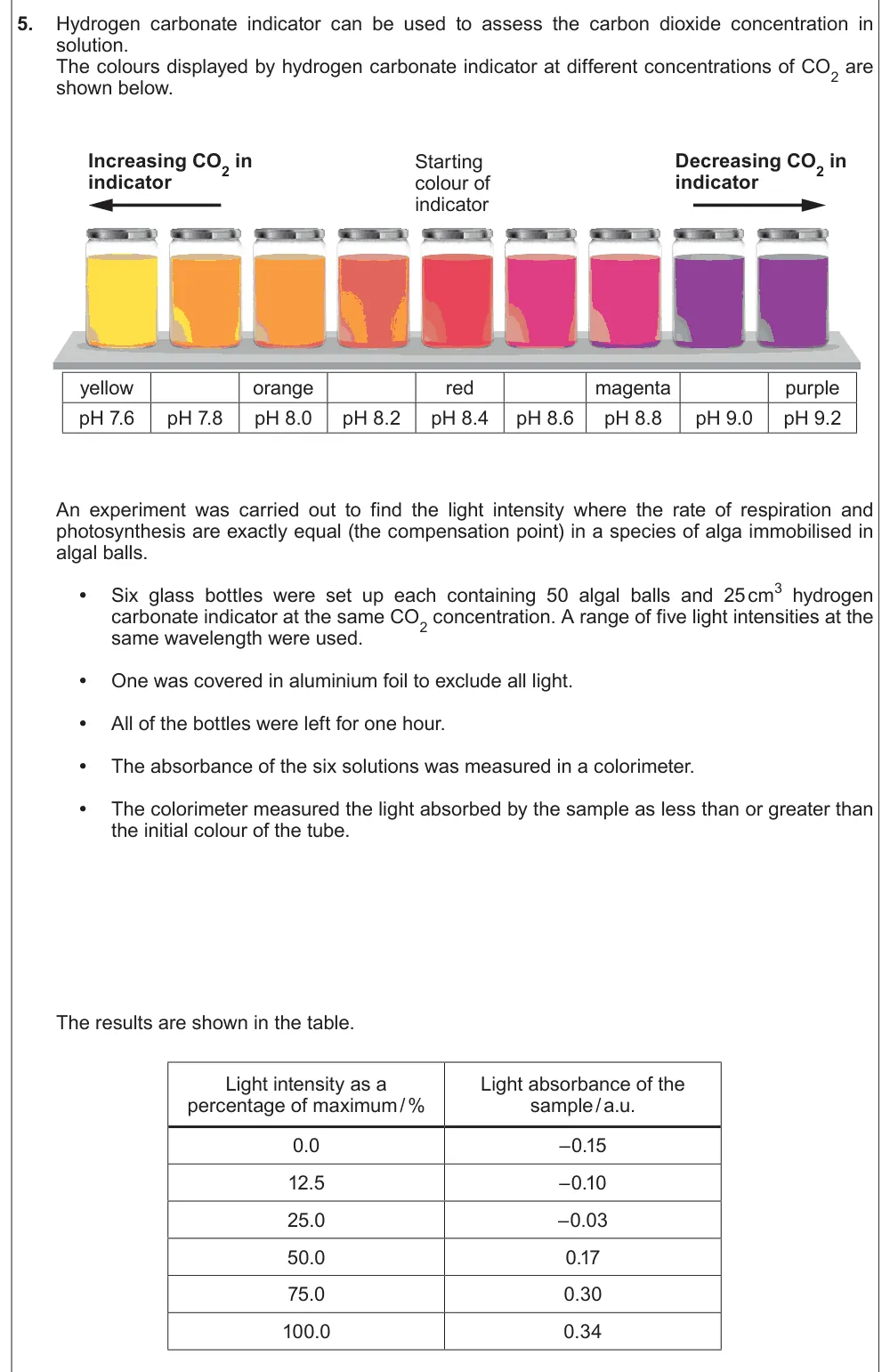
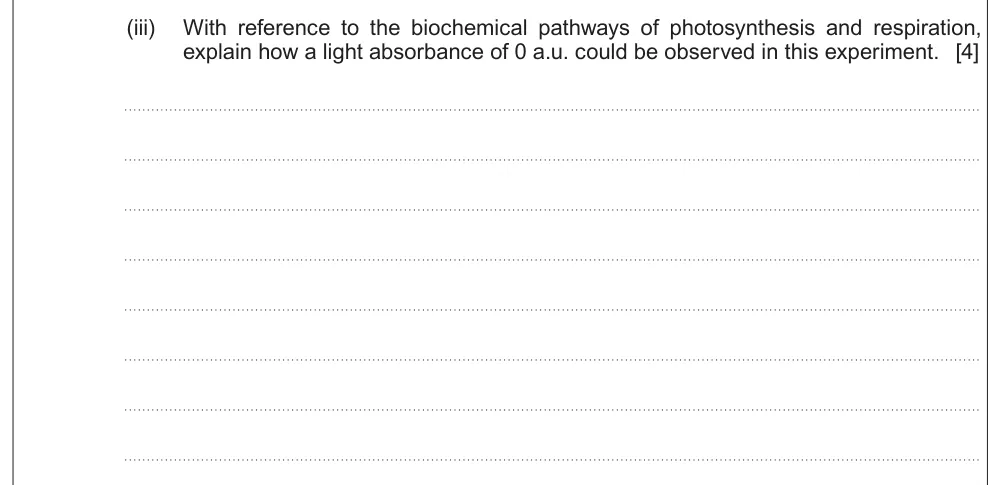
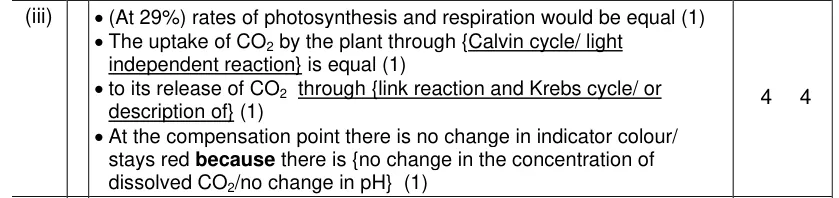
Explain how an indicator could show no change at the compensation point.
Information from earlier in this question:
Show the mark scheme
Tap an image to open it full size.
From the examiners' report: Very few used the pathways: CO₂ released in the link reaction and Krebs cycle is balanced by CO₂ fixed in the Calvin cycle.
Question 20
A level Component 2 · June 2023 · Q1(b)(i) · 2 marks
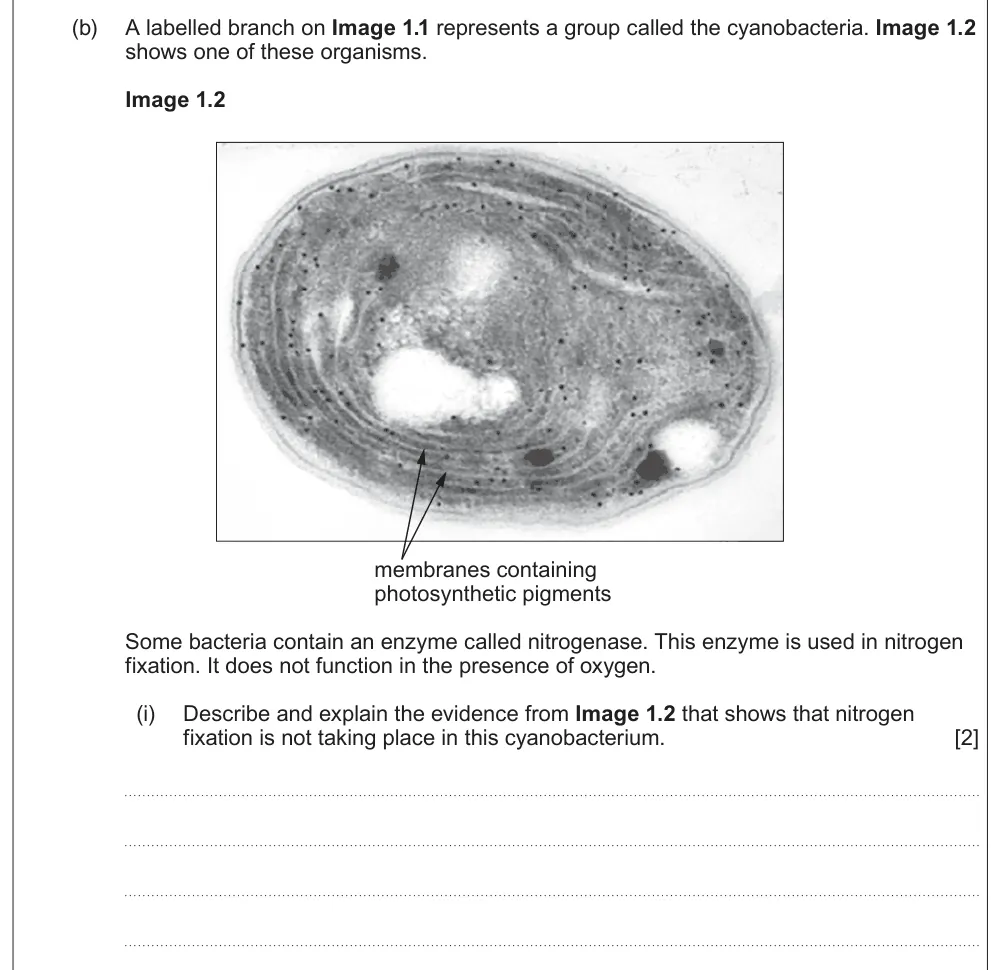
Use evidence to show nitrogen fixation isn't taking place in a cyanobacterium.
Show the mark scheme

Tap an image to open it full size.
From the examiners' report: Photosynthesis produces oxygen, which inhibits nitrogen fixation. A significant number said oxygen is needed for photosynthesis and lost the second mark.
Mineral nutrients
Question 21
A level Component 1 · June 2019 · Q3(d) · 3 marks
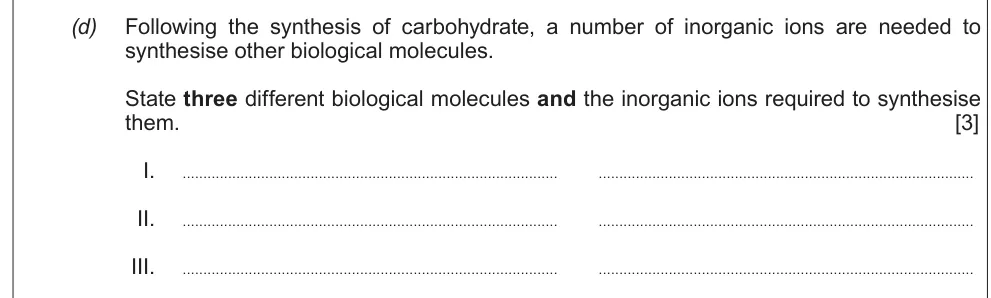
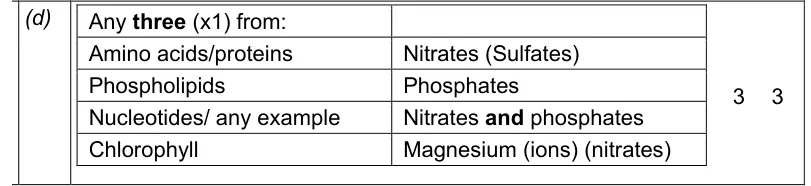
Name molecules plants make using nitrates, phosphates and magnesium.
Show the mark scheme
Tap an image to open it full size.
From the examiners' report: It was common to see zero or one mark for what is essentially recall: amino acids, nucleotides, phospholipids and chlorophyll.
Question 22
A level Component 2 · June 2022 · Q4(a)(i) · 2 marks
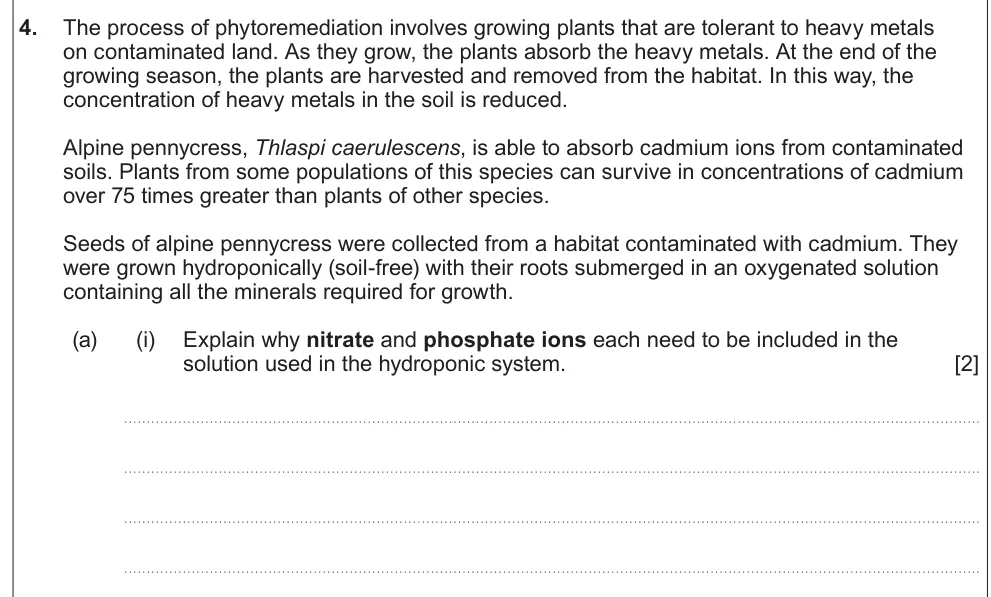
State why nitrate and phosphate ions are needed in a hydroponic solution.
Show the mark scheme

Tap an image to open it full size.
From the examiners' report: Answered well, but generic answers such as "needed for growth" cost marks. Name the molecules each ion is used to make.
Where students lose marks (from Eduqas examiners' reports and mark schemes)
Each point below is followed by wording that gained marks.
Less absorption, not none: Many said there was no absorption in the green part of the spectrum.
✔ Gains credit: "Less absorption in green / minimal absorbance between 480–650".
Chlorophyll a at the centre: Very few said chlorophyll a is at the reaction centre or mentioned PSI and PSII.
✔ Gains credit: "Chlorophyll a in reaction centre" and "PS1 and PSII".
Photons are absorbed: Light was described as entering, hitting or being trapped by photosystems.
✔ Gains credit: "Absorb light (energy) / photons".
Oxygen makes discs float: Many thought using up CO₂ made the discs less dense.
✔ Gains credit: "Oxygen produced from photolysis of water" so the leaf is "less dense".
GP isn't a sugar: GP was commonly given as the first phosphorylated sugar.
✔ Gains credit: "Triose phosphate".
Explain each tube: Many described each tube's contents and colour change without explaining why it was included.
✔ Gains credit: "Sucrose buffer does not release electrons / cause colour change".
Name the molecule: Generic answers such as "needed for growth" cost marks.
✔ Gains credit: Nitrate for "proteins / amino acids / nucleic acids / chlorophyll"; phosphate for "nucleic acids / phospholipids / ATP".
Download the questions
Download the PDF pack (22 questions, mark schemes at the end)
Keep practising
- Importance of ATP (1.1): Eduqas A Level Biology exam questions by topic
- Respiration (1.3): Eduqas A Level Biology exam questions by topic
- Microbiology (1.4): Eduqas A Level Biology exam questions by topic
- Populations and Ecosystems (1.5): Eduqas A Level Biology exam questions by topic
- Human Impact on the Environment (1.6): Eduqas A Level Biology exam questions by topic
- Eduqas A level Biology past papers, mark schemes and examiners' reports
- Eduqas A level Biology grade boundaries
- Ask about Eduqas A level Biology lessons with Sam on WhatsApp
Questions, mark schemes and examiners' report extracts © WJEC CBAC Ltd (Eduqas).