

This page covers the plant half of topic 3.2: the dicotyledon root, water uptake and the apoplast, symplast and vacuolar pathways, the endodermis and Casparian strip, the structure of xylem, cohesion-tension and the transpiration stream, factors affecting transpiration (with the potometer), xerophytes and hydrophytes, phloem structure and translocation, including the mass flow hypothesis and the evidence for it. It mixes A level and AS questions. Transport in animals has its own page.
Naming the pathways and the role of the Casparian strip is usually done well. Marks are lost on precise explanations: cohesion is due to hydrogen bonds between water molecules, adhesion to the xylem walls is often left out, tension pulls the xylem walls inwards, and sunken stomata work because still air traps water vapour. Translocation questions need the water potential and pressure steps in order, and data questions need you to use the evidence given.
I don't teach the Eduqas specification myself, so for one-to-one help I recommend Sam. He teaches Eduqas A level Biology at a top-rated sixth form college and is very popular with his students. You can ask about lessons with Sam on WhatsApp using the link at the bottom of this page.
What you need from GCSE and Year 12
Each question on this page assumes you're secure on these ideas. If any of them feels shaky, look it up before you start.
- Water enters root hair cells by osmosis.
- Xylem carries water and minerals; phloem carries sugars.
- Transpiration is the loss of water vapour from leaves through the stomata.
- Transpiration is faster in warm, dry, windy and bright conditions.
Key terms
These words come up in the questions and mark schemes. Examiners expect you to use them exactly.
- Apoplast pathway: water moving through cell walls and the spaces between cells.
- Symplast pathway: water moving through the cytoplasm, from cell to cell via plasmodesmata.
- Casparian strip: a band of suberin in endodermis cell walls that blocks the apoplast pathway.
- Cohesion-tension: transpiration pulls a continuous column of water, held together by hydrogen bonds, up the xylem.
- Adhesion: attraction between water molecules and the xylem walls.
- Potometer: apparatus that measures water uptake by a shoot as an estimate of transpiration.
- Xerophyte: a plant adapted to dry conditions, such as marram grass.
- Translocation: movement of sugars and other solutes in the phloem from source to sink.
- Mass flow: the hypothesis that a hydrostatic pressure gradient pushes phloem sap from source to sink.
What these questions cover (Eduqas 3.2(i)–(r))
The questions test these statements from Component 3 (Requirements for Life) of the Eduqas A level Biology specification (A400). Transport is in the AS course too, so AS questions (B400) are included and marked AS. Transport in animals (3.2(a)–(h)) has its own page.
- (j) the absorption of water by the root
- (k) the movement of water through the root
- (l) the structure and the role of the endodermis
- (m) the detailed structure of xylem as seen by the light and electron microscope, including examination of microscope slides of T.S. dicotyledon primary stem
- (n) the movement of water from root to leaf including the transpiration stream and cohesion-tension theory
- (o) the effect of environmental factors affecting transpiration
- (p) the adaptations shown by some angiosperms
- (q) the detailed structure of phloem as seen by the light and electron microscope
- (r) the translocation of organic materials from source to sink, including the ideas surrounding phloem transport
How to use this page
Write your answer on paper before you open the mark scheme. Allow about 1.2 minutes per mark: the 22 questions are worth 69 marks, so about 83 minutes in total. Then mark your answer strictly against the mark scheme and read the examiners' tip underneath it. If you'd rather print the questions, download the PDF pack.
Water uptake by roots
Question 1
A level Component 3 · June 2019 · Q1(b)(ii) · 2 marks
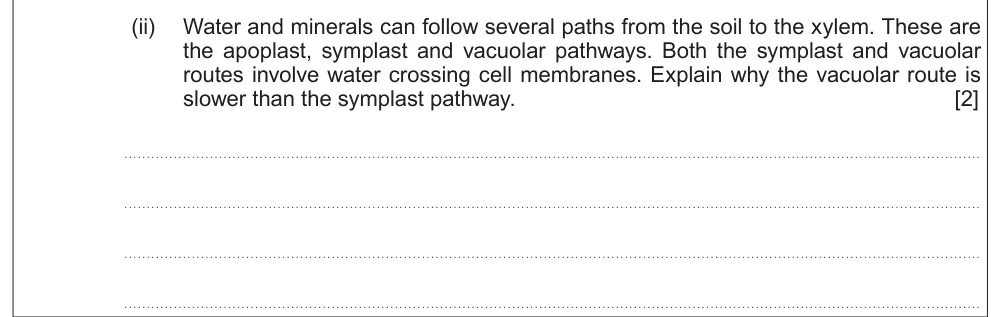
Explain why the vacuolar route is slower than the symplast pathway.
Show the mark scheme

Tap an image to open it full size.
From the examiners' report: Many implied water moves straight from vacuole to vacuole. It must cross the tonoplast and the cytoplasm too.
Question 2
A level Component 3 · June 2024 · Q3(a)(i) · 2 marks · Easy
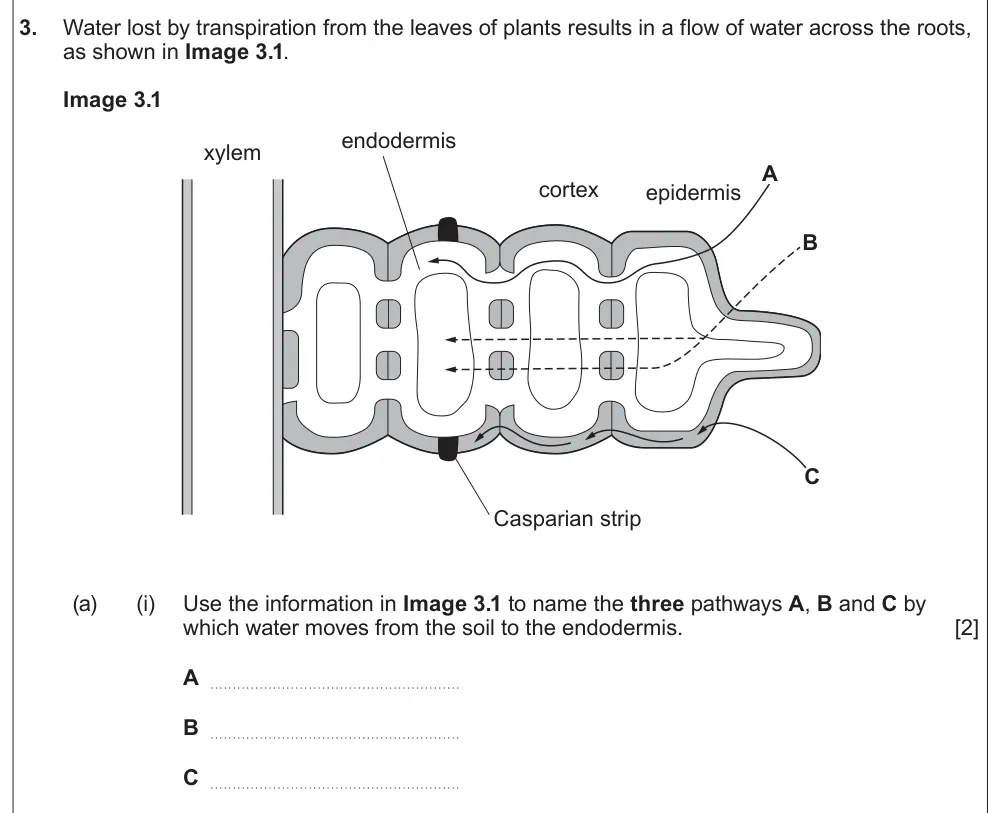
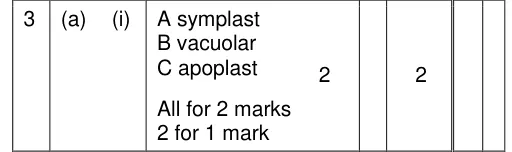
Name the three pathways water takes from the soil to the endodermis.
Show the mark scheme
Tap an image to open it full size.
From the examiners' report: Some confused the apoplast and symplast pathways.
Question 3
A level Component 3 · June 2024 · Q3(a)(ii) · 3 marks · Easy
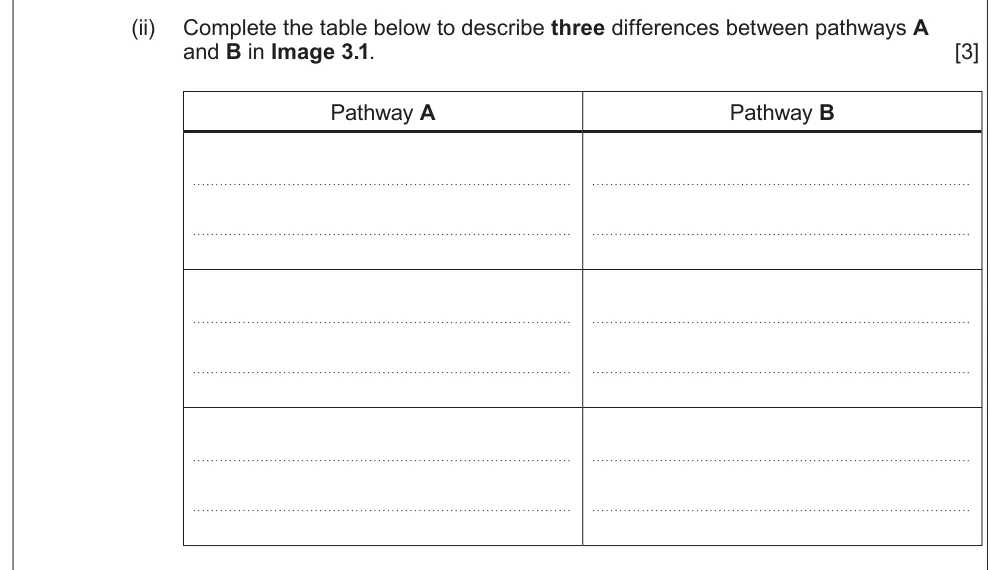
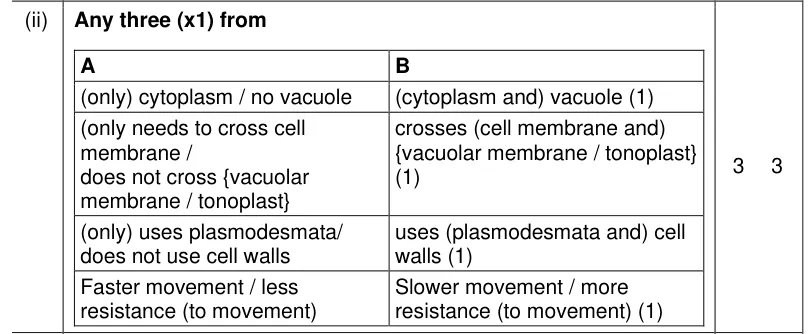
Describe three differences between the symplast and vacuolar pathways.
Show the mark scheme
Tap an image to open it full size.
Question 4
A level Component 3 · June 2024 · Q3(a)(iii) · 2 marks · Easy
State the function of the Casparian strip.
Show the mark scheme

Tap an image to open it full size.
Question 5
AS Component 2 · June 2018 · Q5(f) · 3 marks
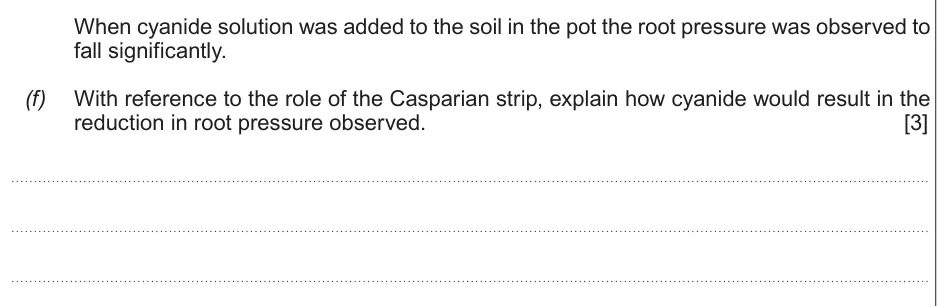
Explain how cyanide reduces root pressure, with reference to the Casparian strip.
Show the mark scheme

Tap an image to open it full size.
From the examiners' report: Far fewer linked the loss of active transport to a smaller water potential gradient.
Question 6
A level Component 2 · June 2022 · Q4(a)(ii) · 3 marks
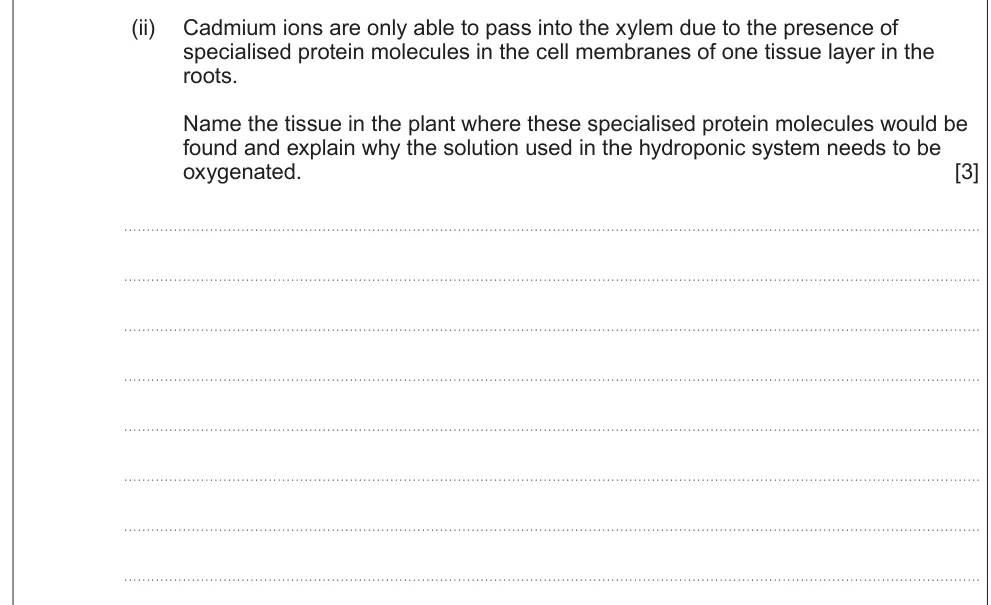
Name the root tissue with ion carrier proteins and explain why the hydroponic solution is oxygenated.
Show the mark scheme

Tap an image to open it full size.
From the examiners' report: Few identified the endodermis, and many explained uptake into the root instead of into the xylem.
Xylem and the transpiration stream
Question 7
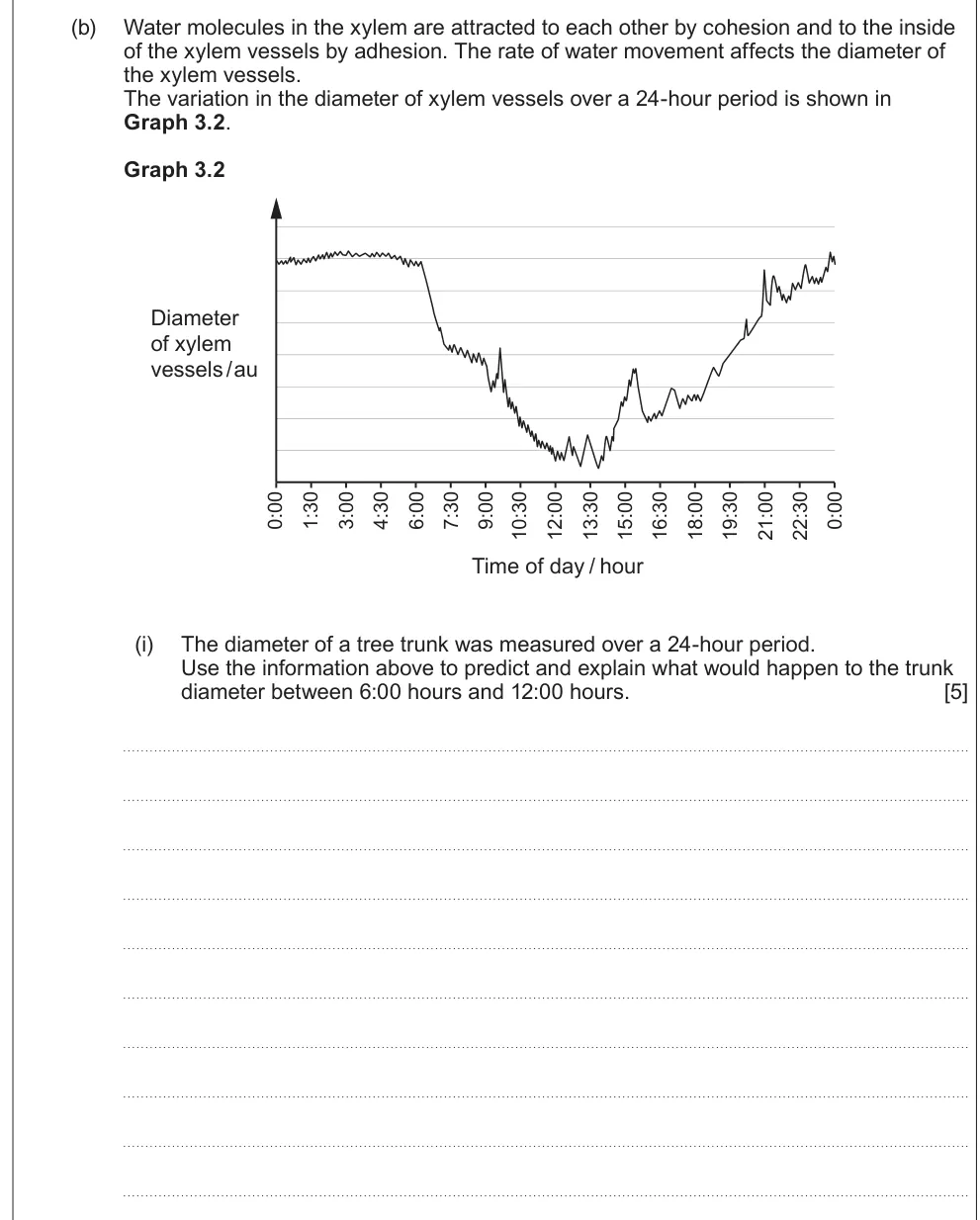
A level Component 3 · June 2024 · Q3(b)(i) · 5 marks · Easy
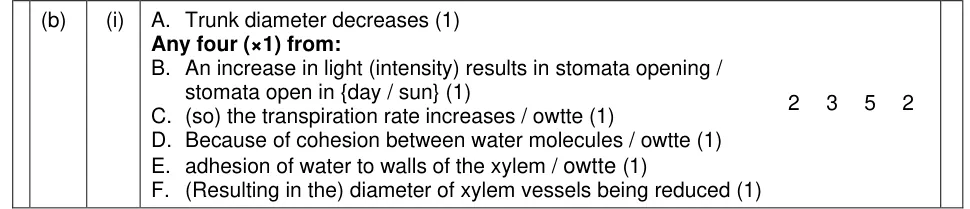
Predict and explain the change in trunk diameter between 06:00 and 12:00.
Show the mark scheme
Tap an image to open it full size.
From the examiners' report: Few explained that the rising tension in the water column pulls the xylem walls inwards.
Question 8
A level Component 3 · June 2019 · Q1(c)(i) · 1 mark · Hard
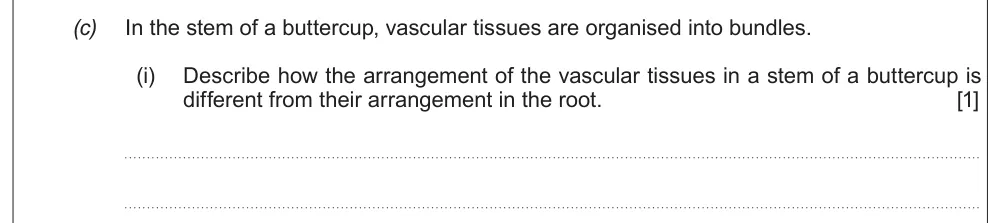
Describe how vascular tissue is arranged differently in a buttercup stem and root.
Show the mark scheme

Tap an image to open it full size.
From the examiners' report: Few could describe this. Learn all the slides named in the specification.
Question 9
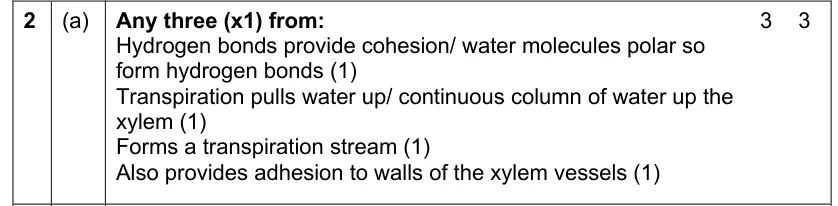
A level Component 3 · Autumn 2021 · Q2(a) · 3 marks
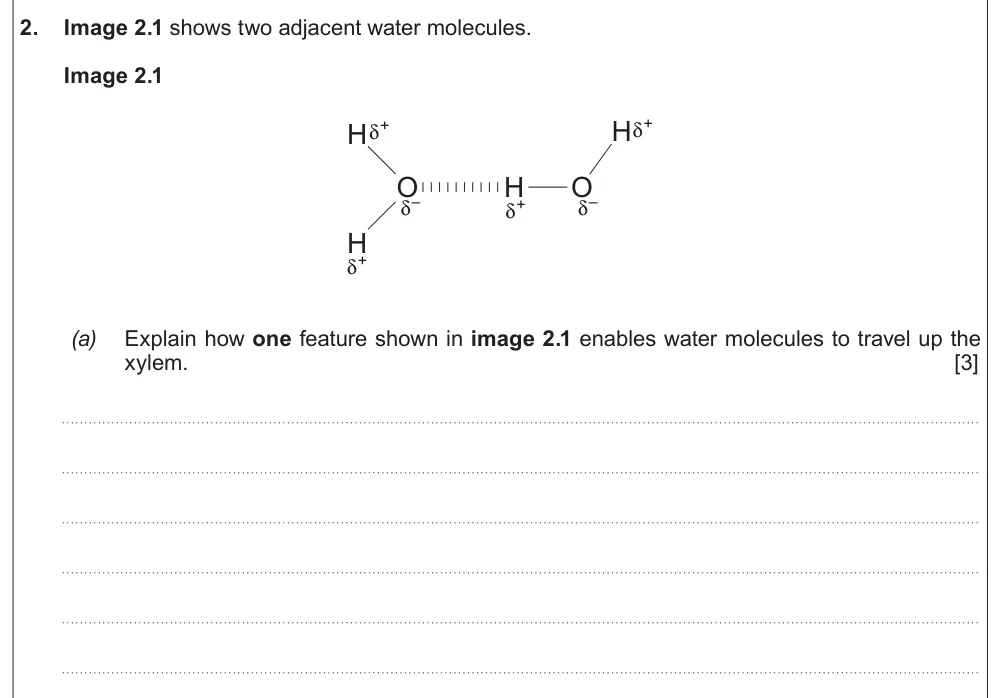
Explain how a feature of water molecules lets water travel up the xylem.
Show the mark scheme
Tap an image to open it full size.
From the examiners' report: The O–H bond within a molecule gains nothing: it is the hydrogen bonds between molecules.
Question 10
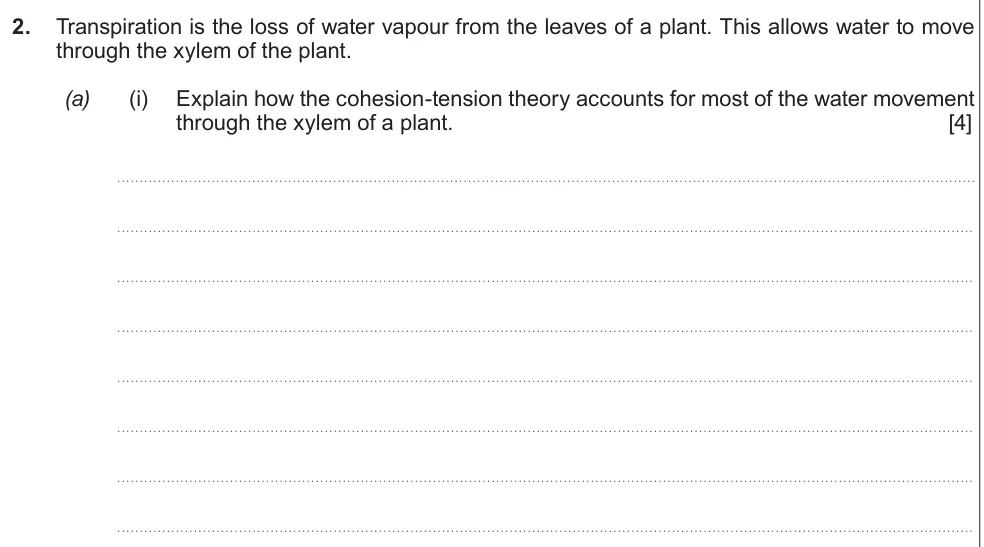
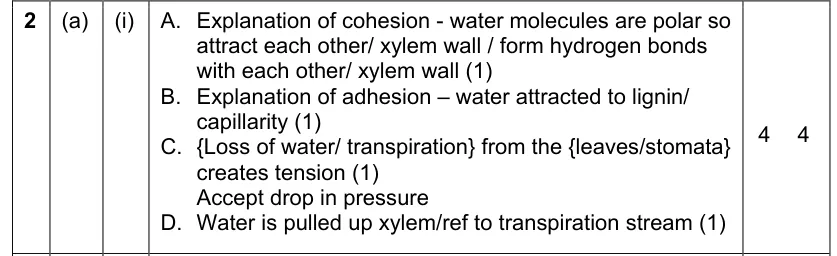
AS Component 2 · Autumn 2020 · Q2(a)(i) · 4 marks
Explain how the cohesion-tension theory accounts for water movement through xylem.
Show the mark scheme
Tap an image to open it full size.
From the examiners' report: The most common omission was adhesion to the xylem walls, and "tension" was often unclear.
Transpiration
Question 11
AS Component 2 · Autumn 2020 · Q2(c) · 3 marks · Hard
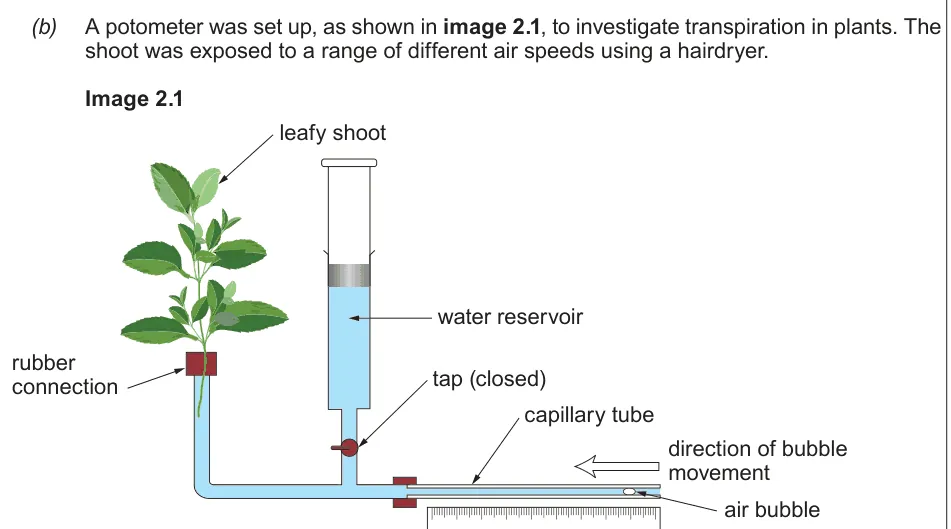
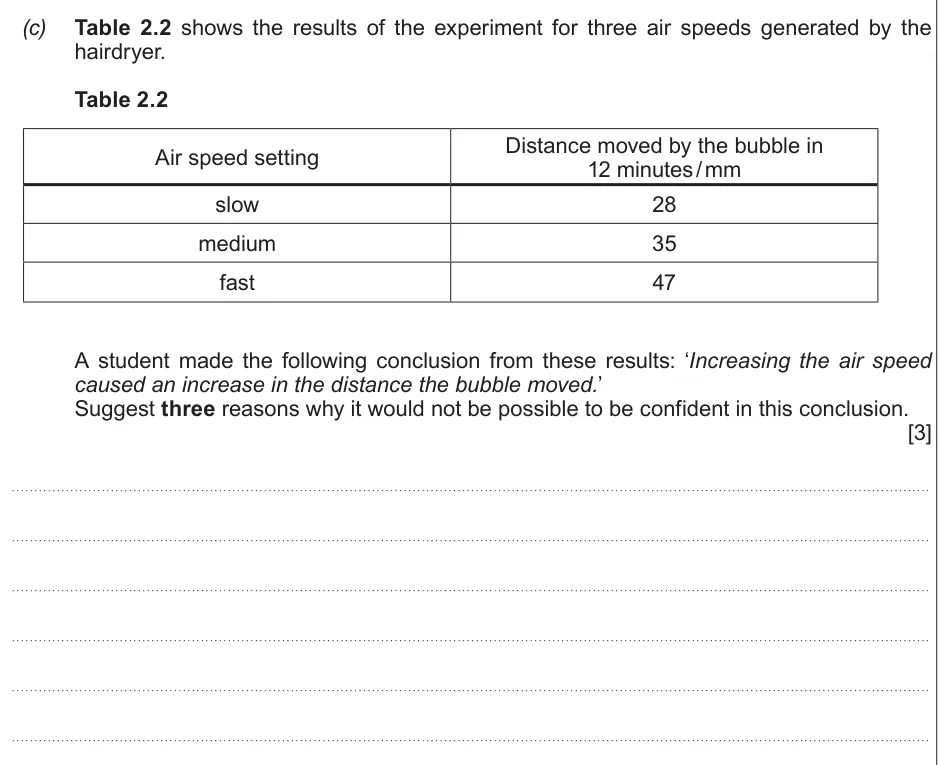
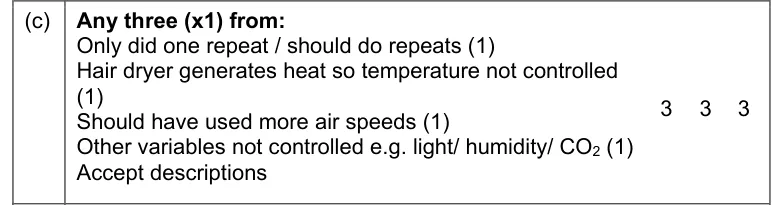
Suggest three reasons why a conclusion about air speed and transpiration isn't secure.
Information from earlier in this question:
Show the mark scheme
Tap an image to open it full size.
From the examiners' report: This caused the greatest difficulty. The hair dryer also heats the shoot; there were no repeats and only three air speeds.
Question 12
AS Component 2 · June 2017 · Q2(b)(iii) · 5 marks · Hard
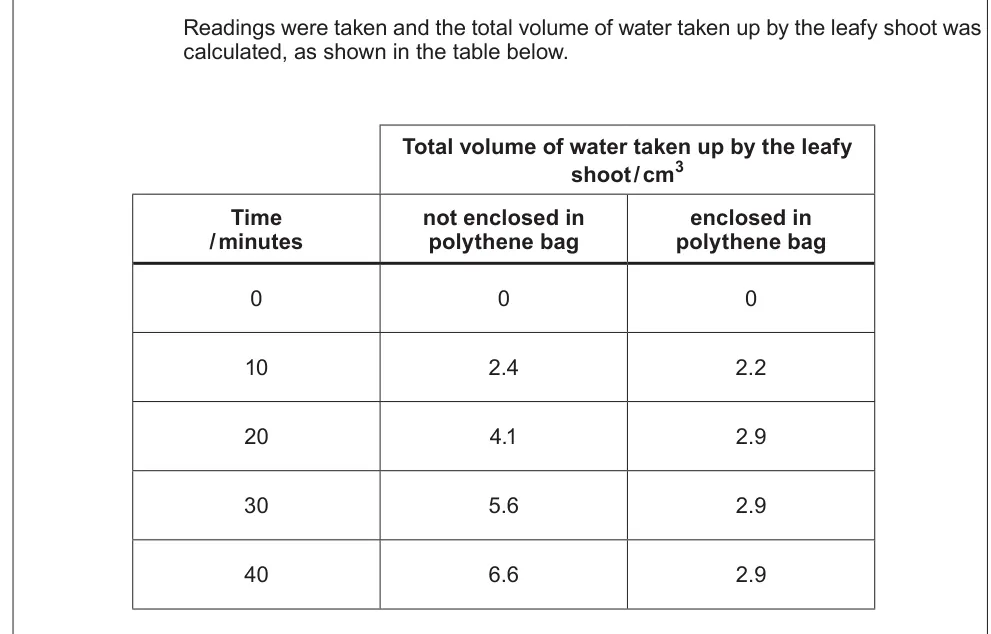
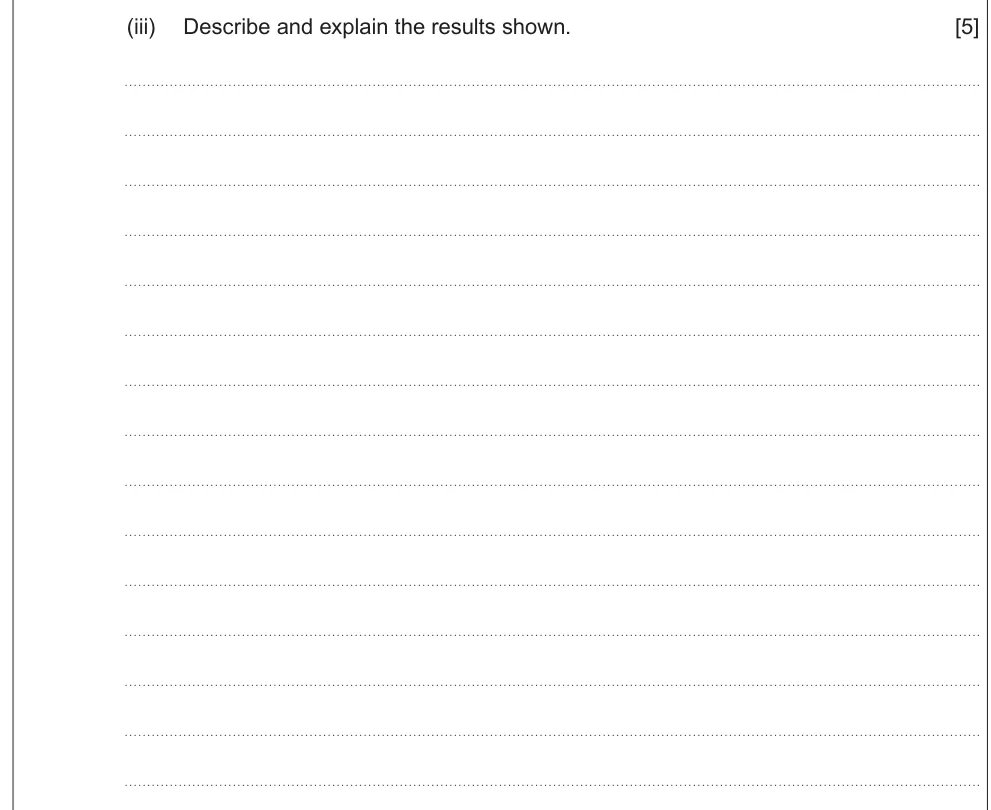
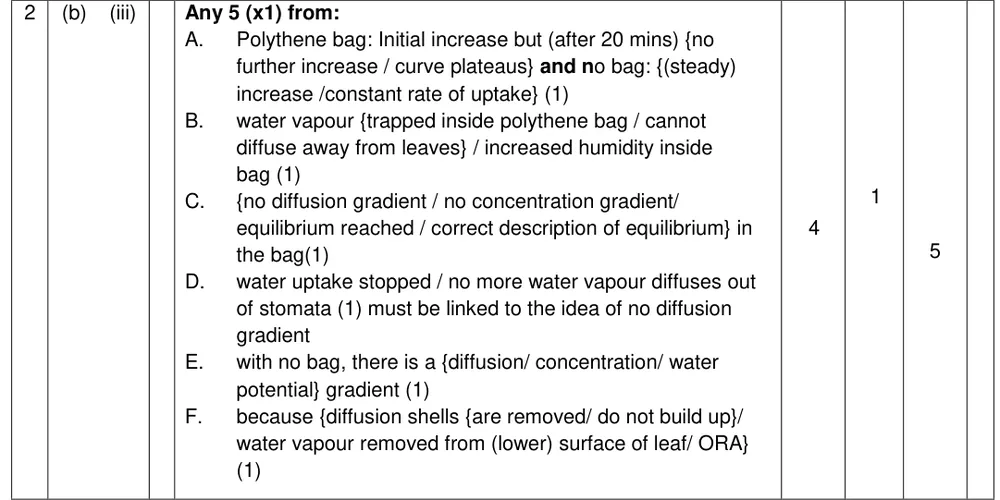
Describe and explain potometer results for a shoot with and without a polythene bag.
Information from earlier in this question:
Show the mark scheme
Tap an image to open it full size.
From the examiners' report: Few gained all 5 marks: long, rambling answers often made only one point. Say water vapour, not water.
Xerophytes
Question 13
A level Component 3 · June 2022 · Q5(b)(ii) · 3 marks · Easy
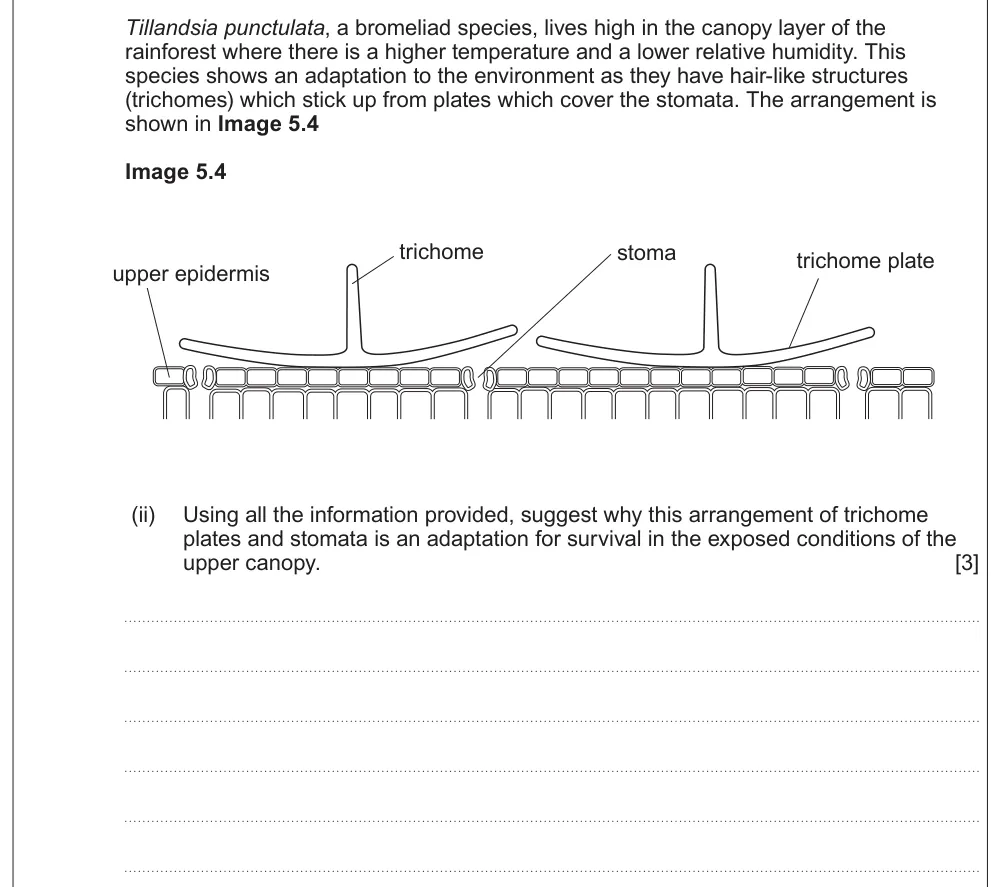
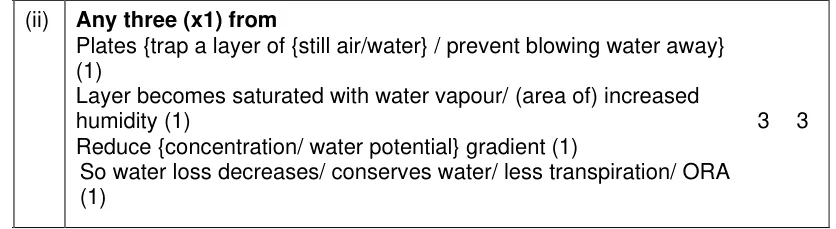
Suggest why trichome plates over the stomata help a bromeliad survive in the upper canopy.
Show the mark scheme
Tap an image to open it full size.
Question 14
AS Component 2 · June 2022 · Q3(b)(i) · 4 marks
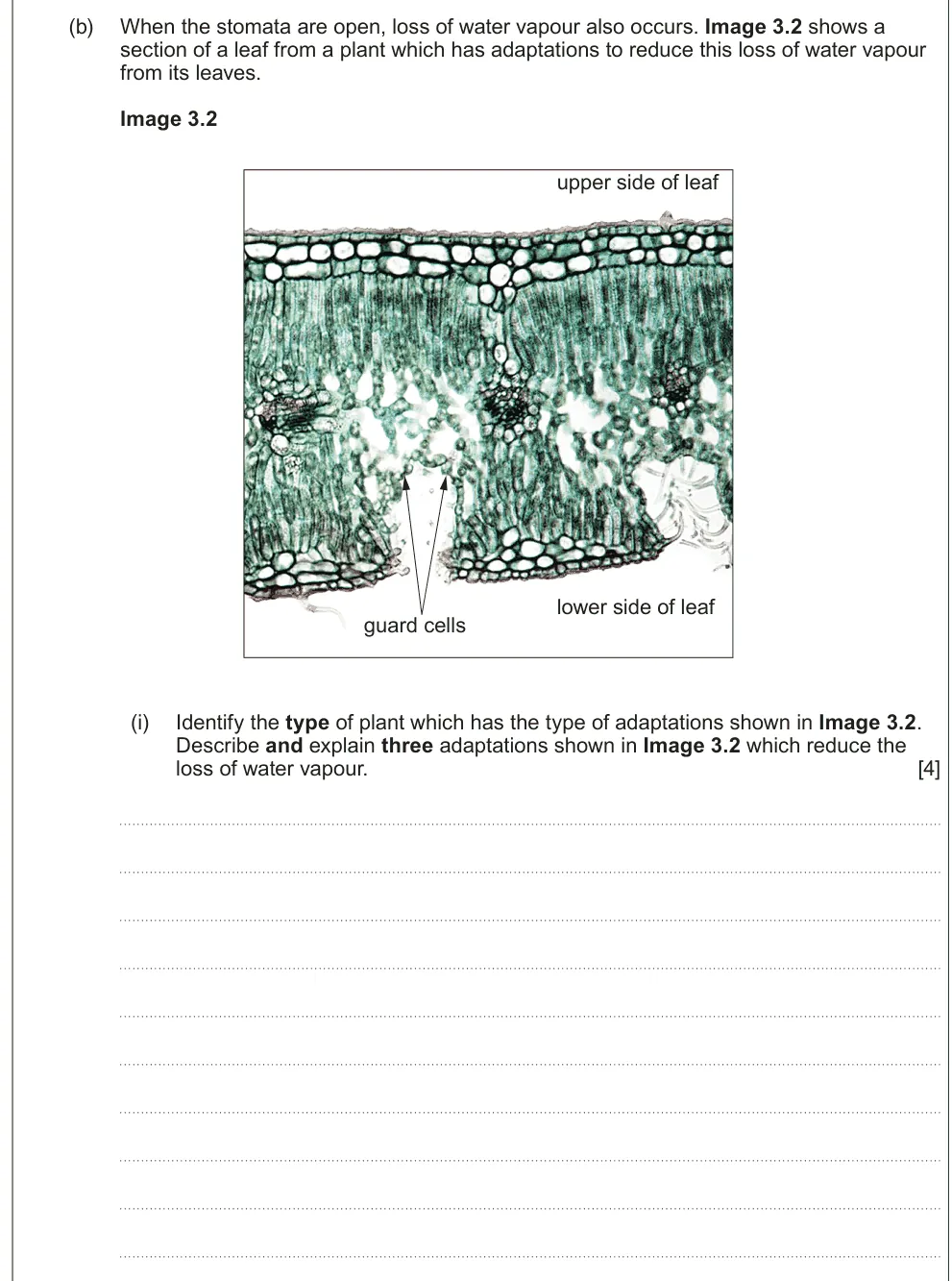
Identify the type of plant and explain three leaf adaptations that reduce water loss.
Show the mark scheme

Tap an image to open it full size.
From the examiners' report: Many couldn't say why sunken stomata reduce transpiration: moving air doesn't carry the water vapour away.
Question 15
AS Component 2 · June 2018 · Q3(a) · 3 marks
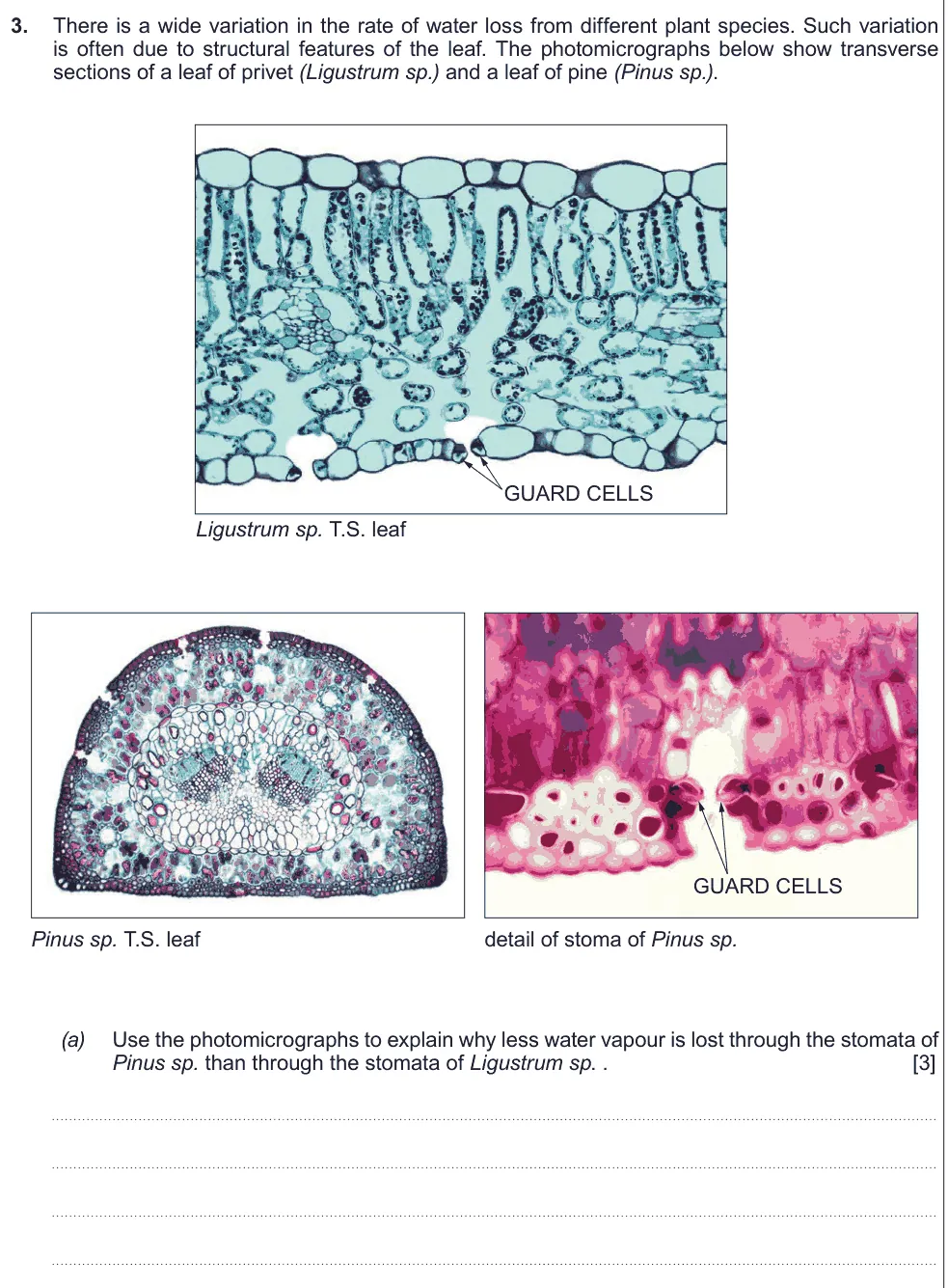
Use photomicrographs to explain why pine stomata lose less water vapour than privet stomata.
Show the mark scheme

Tap an image to open it full size.
From the examiners' report: Full marks were rare. Finish the comparison by explaining why privet loses more.
Phloem and translocation
Question 16
A level Component 3 · Autumn 2020 · Q5(c)(i) · 3 marks
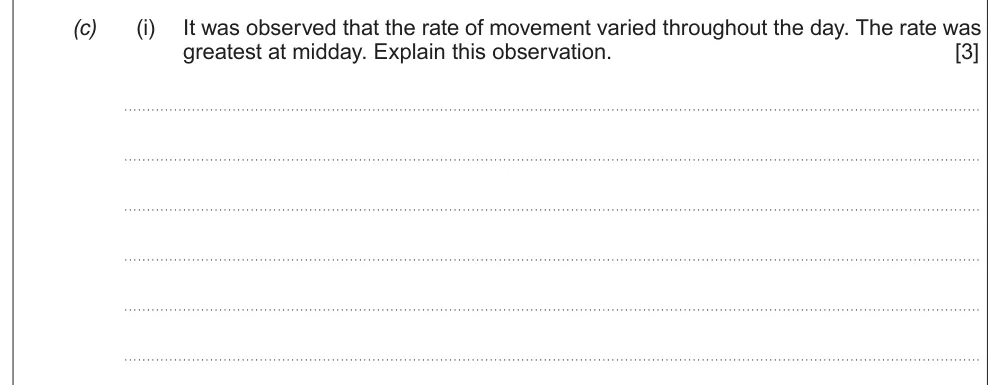
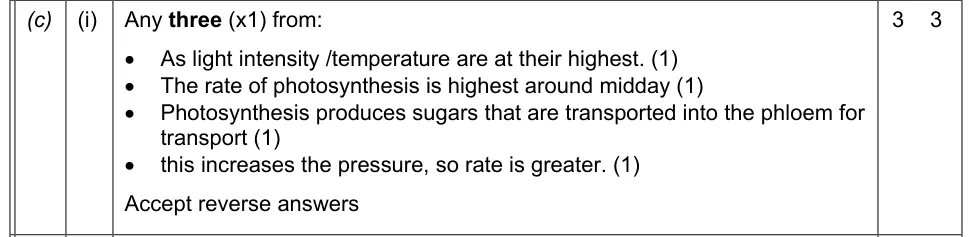
Explain why the rate of translocation is greatest at midday.
Show the mark scheme
Tap an image to open it full size.
From the examiners' report: "Strongest sun" isn't precise enough. Say highest light intensity.
Question 17
A level Component 3 · Autumn 2020 · Q5(d) · 4 marks
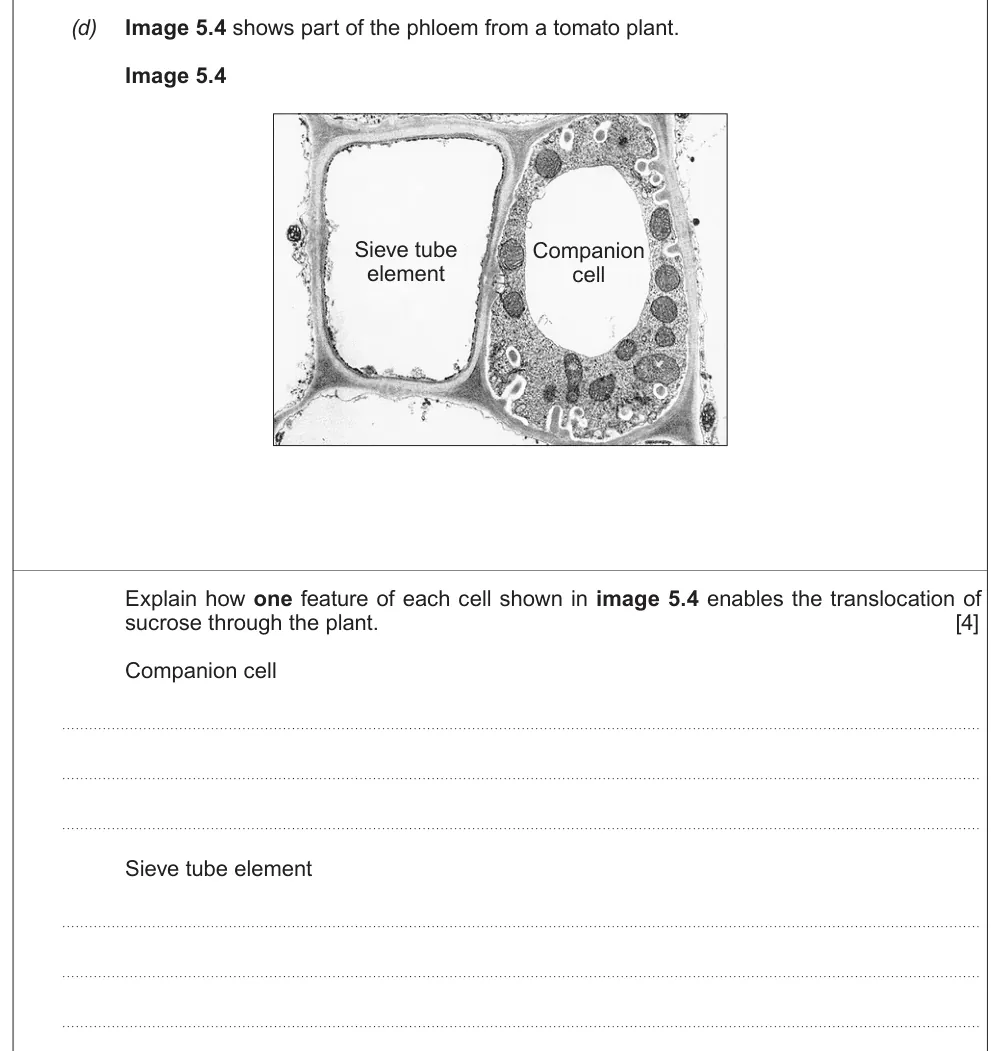
Explain how one feature of a companion cell and a sieve tube element enables translocation.
Show the mark scheme
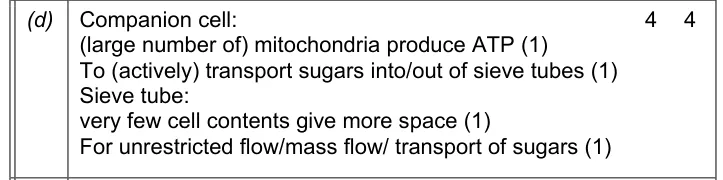
Tap an image to open it full size.
From the examiners' report: Use features visible in the image: sieve plates and plasmodesmata weren't credited here.
Question 18
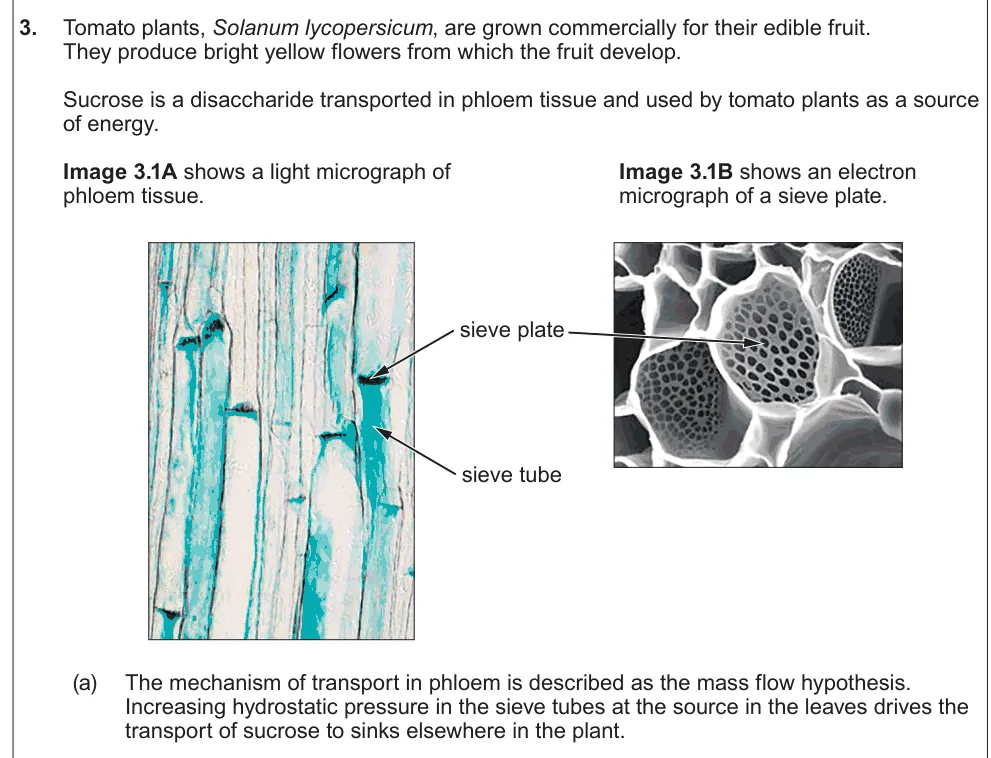
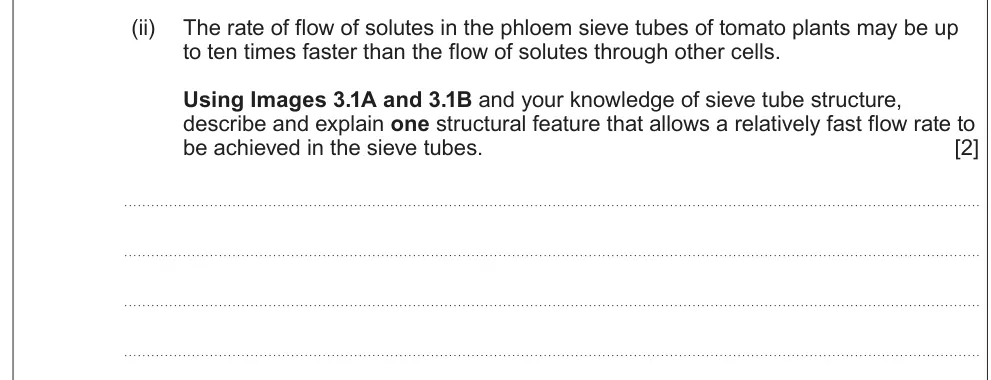
AS Component 2 · June 2023 · Q3(a)(ii) · 2 marks
Describe and explain a structural feature that allows fast flow in sieve tubes.
Information from earlier in this question:
Show the mark scheme

Tap an image to open it full size.
From the examiners' report: Say little cytoplasm or few organelles, not "no" organelles or "empty", and explain the effect on flow.
Question 19
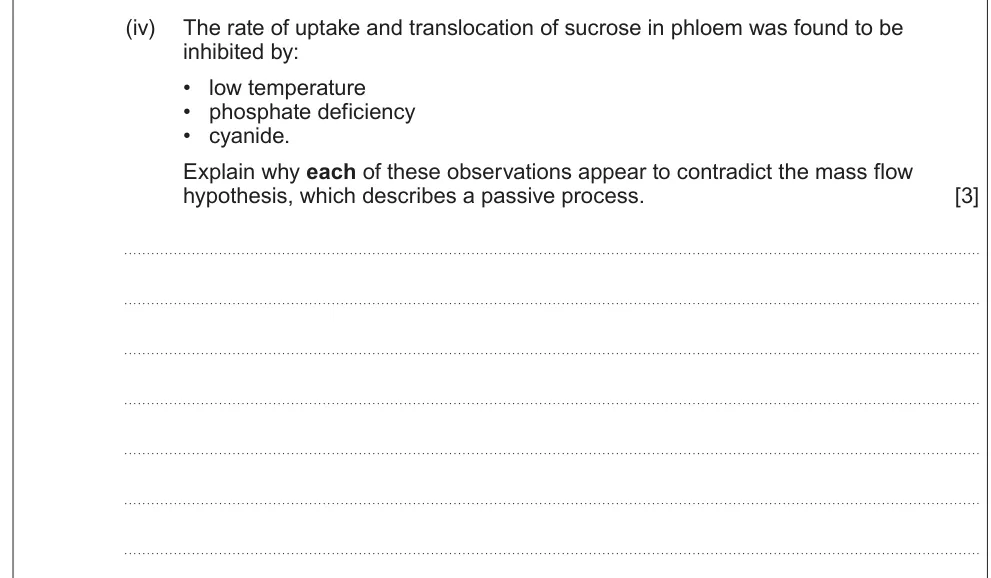
AS Component 2 · June 2023 · Q3(a)(iv) · 3 marks
Explain why inhibition by low temperature, phosphate deficiency and cyanide contradicts mass flow.
Show the mark scheme

Tap an image to open it full size.
Question 20
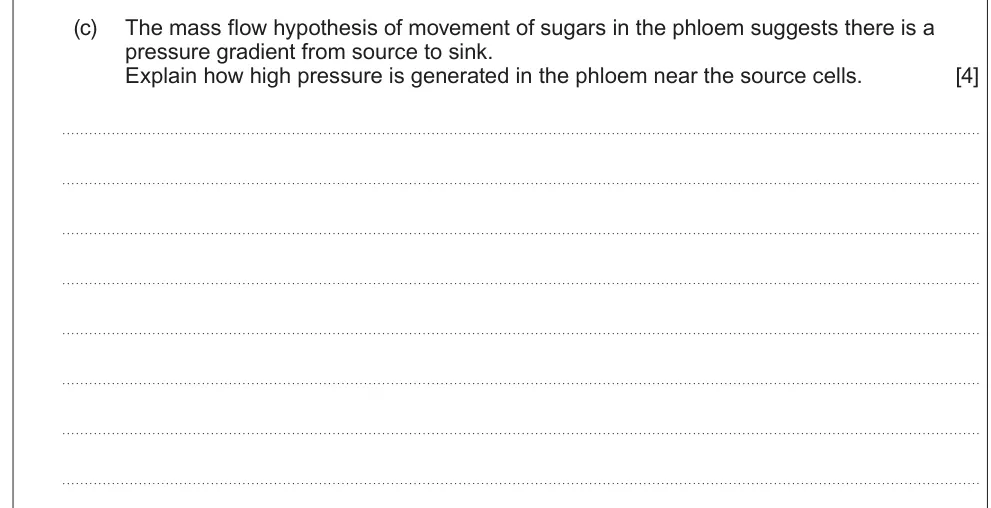
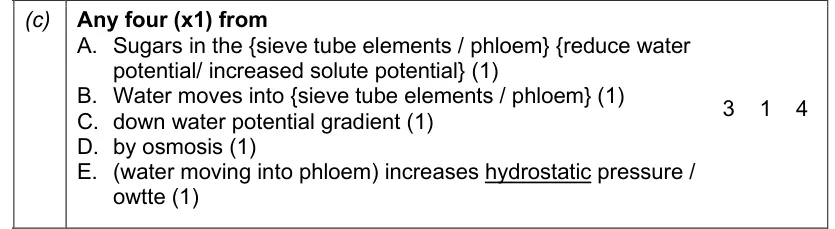
A level Component 3 · June 2025 · Q3(c) · 4 marks
Explain how high pressure is generated in the phloem near the source.
Show the mark scheme
Tap an image to open it full size.
Question 21
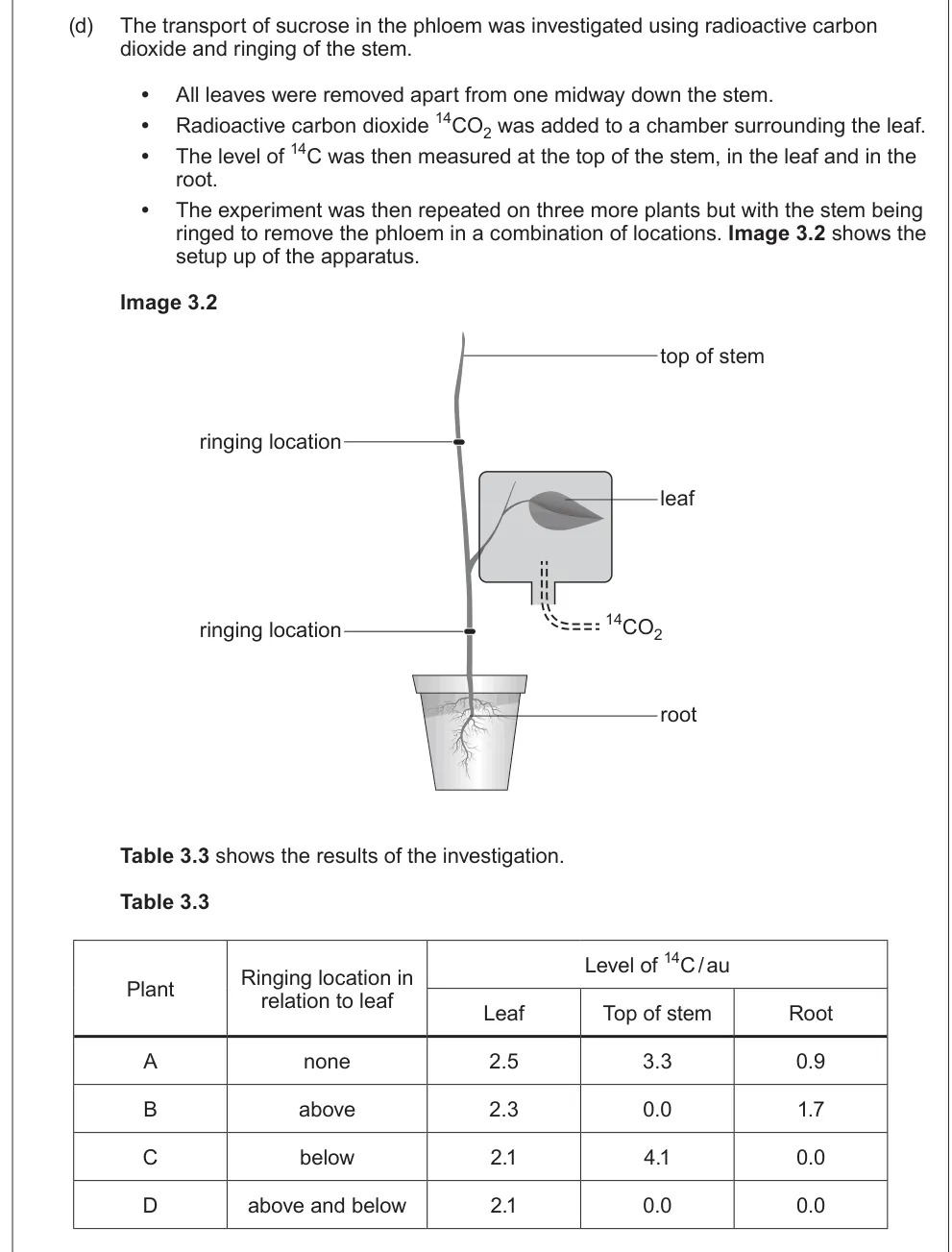
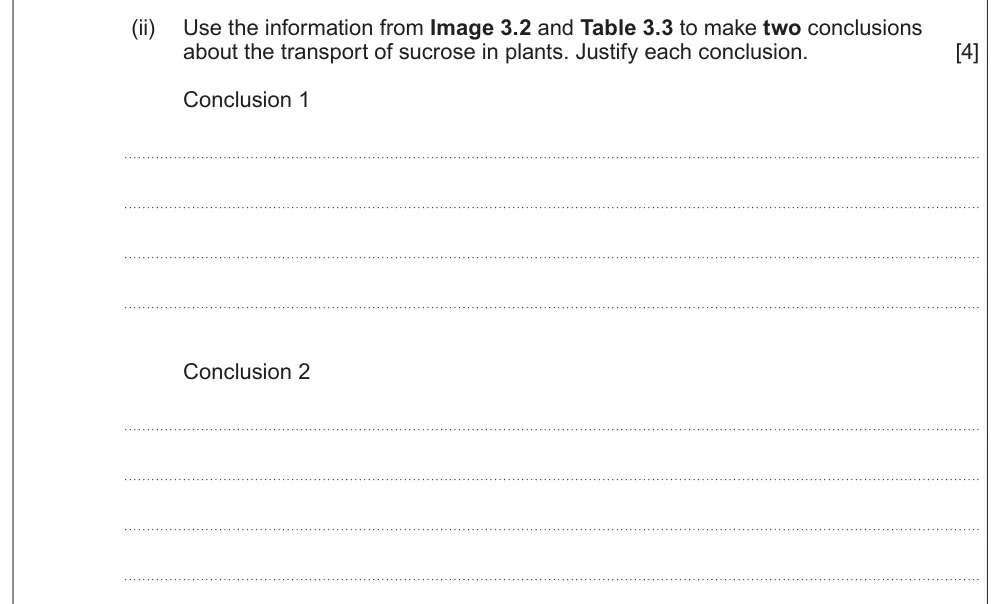
A level Component 3 · June 2025 · Q3(d)(ii) · 4 marks
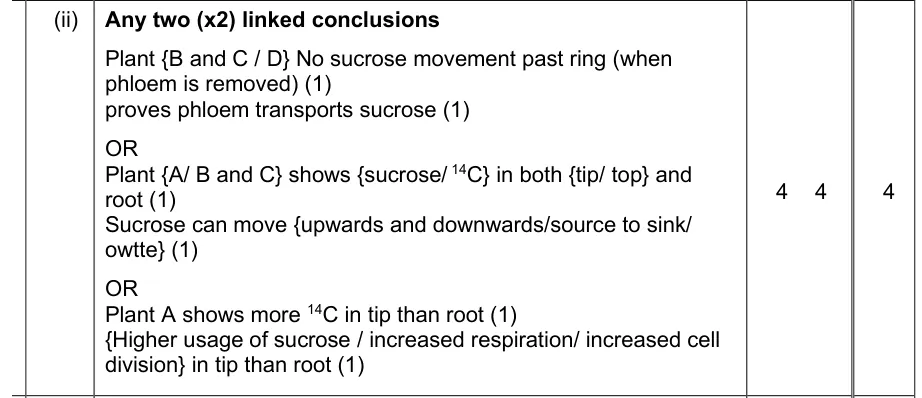
Use ringing and radioactive tracer data to make two justified conclusions about sucrose transport.
Information from earlier in this question:
Show the mark scheme
Tap an image to open it full size.
From the examiners' report: The best answers named the plants from the table and then gave the conclusion. Many didn't use the information.
Question 22
AS Component 2 · June 2016 · Q3(b) · 3 marks
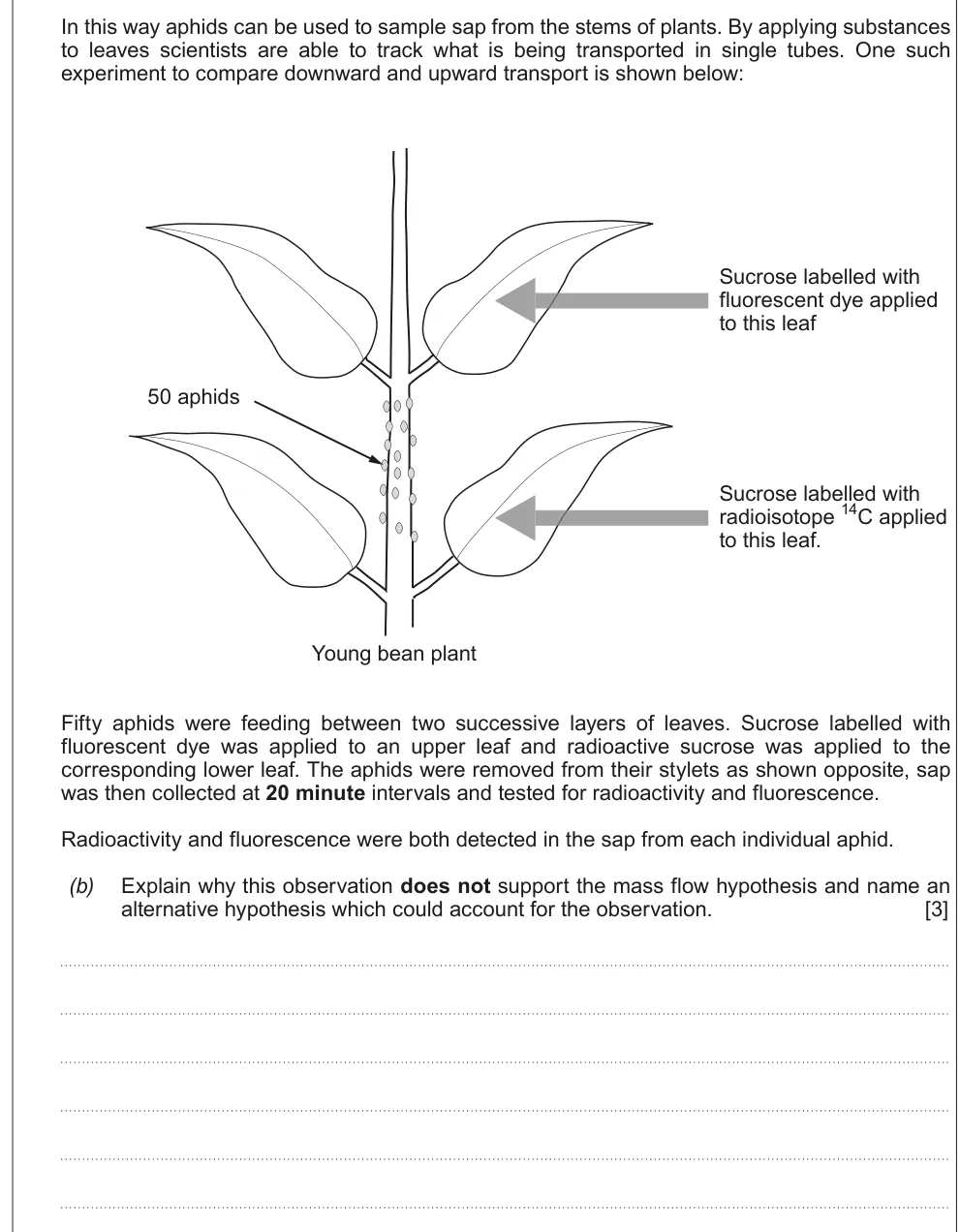
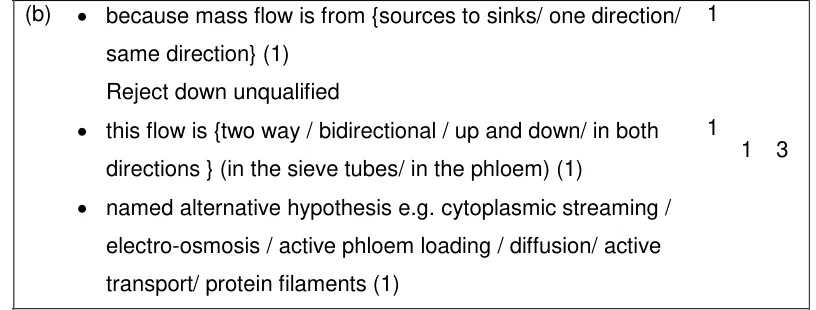
Explain why sap moving both ways doesn't support mass flow, and name an alternative hypothesis.
Show the mark scheme
Tap an image to open it full size.
From the examiners' report: Most saw it was about two-way movement, but many answers lacked clarity.
Where students lose marks (from Eduqas examiners' reports and mark schemes)
Each point below is followed by wording that gained marks.
Hydrogen bonds between molecules: The bond between oxygen and hydrogen within a molecule gained nothing.
✔ Gains credit: "Hydrogen bonds provide cohesion" and "adhesion to the walls of the xylem".
Don't forget adhesion: The most common omission was adhesion to the xylem walls.
✔ Gains credit: "Water attracted to lignin", "transpiration creates tension".
Explain sunken stomata: Many couldn't say why sunken stomata reduce transpiration.
✔ Gains credit: "Stomata in pits + less air movement".
Complete the comparison: Answers explained pine but not why privet loses more.
✔ Gains credit: "Moving air can easily blow away water vapour" from privet.
Not vacuole to vacuole: Many implied vacuoles in different cells are adjacent.
✔ Gains credit: "Water has to pass through the tonoplast / vacuole and cytoplasm".
Precise language: "Strongest sun" and "stronger light" were not good enough.
✔ Gains credit: "Light intensity / temperature are at their highest".
Download the questions
Download the PDF pack (22 questions, mark schemes at the end)
Keep practising
- Adaptations for Gas Exchange (3.1): Eduqas A Level Biology exam questions by topic
- Transport in Animals (3.2): Eduqas A Level Biology exam questions by topic
- Adaptations for Nutrition (3.3): Eduqas A Level Biology exam questions by topic
- Homeostasis and the Kidney (3.4): Eduqas A Level Biology exam questions by topic
- The Nervous System (3.5): Eduqas A Level Biology exam questions by topic
- Eduqas A level Biology past papers, mark schemes and examiners' reports
- Eduqas A level Biology grade boundaries
- Ask about Eduqas A level Biology lessons with Sam on WhatsApp
Questions, mark schemes and examiners' report extracts © WJEC CBAC Ltd (Eduqas).