

Importance of ATP is the first topic of Component 1, Energy for Life, and it sets up both photosynthesis and respiration. You need chemiosmosis: how electron transport chains drive proton pumps, how a proton gradient builds up across the inner mitochondrial membrane or the thylakoid membrane, and how protons flowing back through ATP synthetase make ATP. Every question on this page is from the A level Component 1 papers.
These questions are short, and most students do well on them. The marks usually go to the direction of proton flow (from the intermembrane space into the matrix), the name of the enzyme (ATP synthetase, not ATPase), and what happens when a membrane becomes leaky to protons: the gradient is lost, less ATP is made and the energy is released as heat.
I don't teach the Eduqas specification myself, so for one-to-one help I recommend Sam. He teaches Eduqas A level Biology at a top-rated sixth form college and is very popular with his students. You can ask about lessons with Sam on WhatsApp using the link at the bottom of this page.
What you need from GCSE and Year 12
Each question on this page assumes you're secure on these ideas. If any of them feels shaky, look it up before you start.
- ATP is made from ADP and inorganic phosphate (Pi) and releases energy when it is hydrolysed.
- Mitochondria have an inner membrane folded into cristae; chloroplasts have thylakoid membranes.
- Electrons can carry energy; oxidation is loss of electrons or hydrogen and reduction is gain.
- Diffusion is net movement down a concentration gradient.
Key terms
These words come up in the questions and mark schemes. Examiners expect you to use them exactly.
- Chemiosmosis: making ATP using the energy of protons flowing down their gradient through ATP synthetase.
- Proton pump: a membrane carrier protein that uses energy from electrons to move H⁺ against its gradient.
- Electron transport chain: a series of electron carriers and proton pumps in a membrane.
- Proton gradient: a higher concentration of H⁺ on one side of a membrane, a store of potential energy.
- ATP synthetase: the enzyme in the stalked particles that joins ADP and Pi as protons flow through it.
- Intermembrane space: the gap between the outer and inner mitochondrial membranes, where protons build up.
- Final electron acceptor: oxygen, which takes electrons at the end of the chain in aerobic respiration.
What these questions cover (Eduqas 1.1)
The questions test these statements from Component 1 (Energy for Life) of the Eduqas A level Biology specification (A400). Component 1 content is examined in A level Component 1.
- (a) the synthesis of ATP involving a flow of protons through the enzyme ATP synthetase, the process of chemiosmosis and the electrochemical gradient
- (b) the similarity between mitochondrial and chloroplast membrane function in providing a proton gradient for ATP synthesis
- (c) the proton gradient
- (d) the electron transport chain is formed from an alternate arrangement of pumps and electron carriers (names of proton pumps and electron carriers in the electron transport
How to use this page
Write your answer on paper before you open the mark scheme. Allow about 1.2 minutes per mark: the 14 questions are worth 34 marks, so about 41 minutes in total. Then mark your answer strictly against the mark scheme and read the examiners' tip underneath it. If you'd rather print the questions, download the PDF pack.
Chemiosmosis
Question 1
A level Component 1 · Autumn 2020 · Q3(b)(ii) · 3 marks
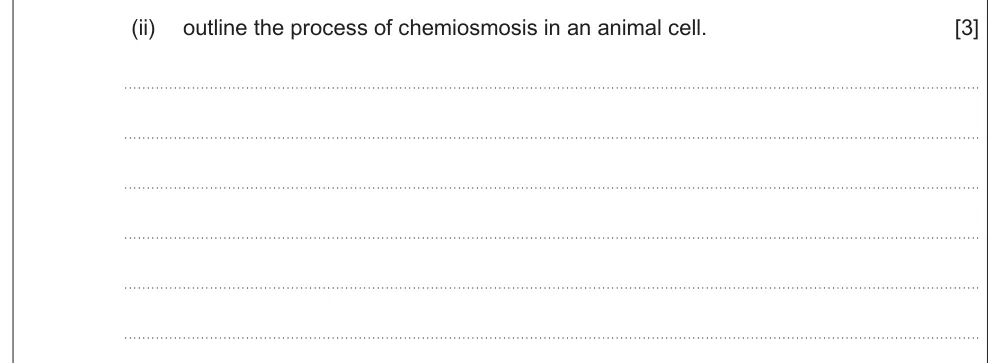
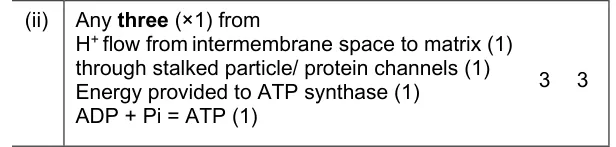
Outline the process of chemiosmosis in an animal cell.
Show the mark scheme
Tap an image to open it full size.
From the examiners' report: Understanding was very good and most students scored all three marks: H⁺ flows from the intermembrane space to the matrix, through ATP synthase, giving energy to join ADP and Pi.
Question 2
A level Component 1 · June 2017 · Q6(a) · 2 marks
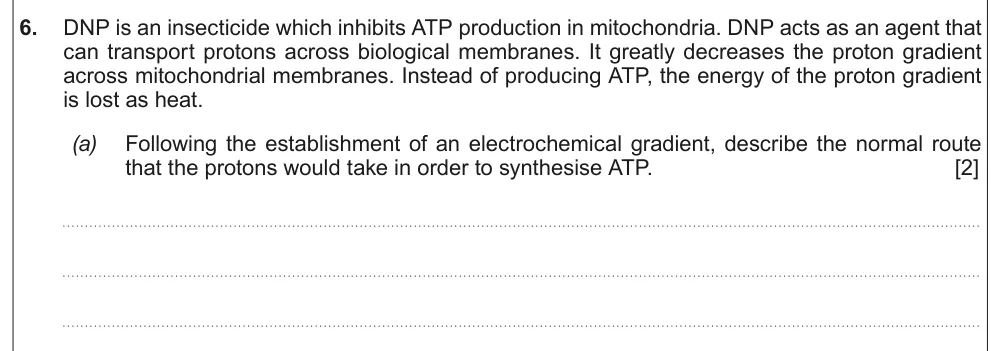
Describe the route protons normally take to make ATP.
Show the mark scheme

Tap an image to open it full size.
From the examiners' report: Well done by most: from the intermembrane space into the matrix, through the stalked particle containing ATP synthase.
Question 3
A level Component 1 · June 2025 · Q1(a)(ii) · 3 marks
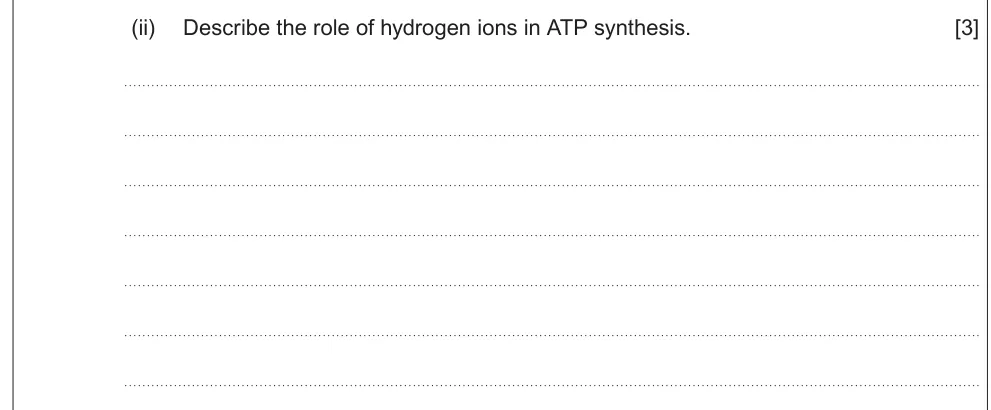
Describe the role of hydrogen ions in ATP synthesis.
Show the mark scheme
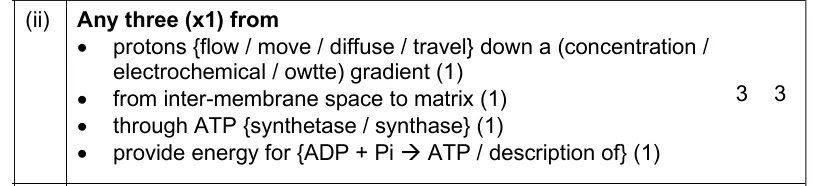
Tap an image to open it full size.
Question 4
A level Component 1 · Autumn 2020 · Q3(d)(i) · 2 marks
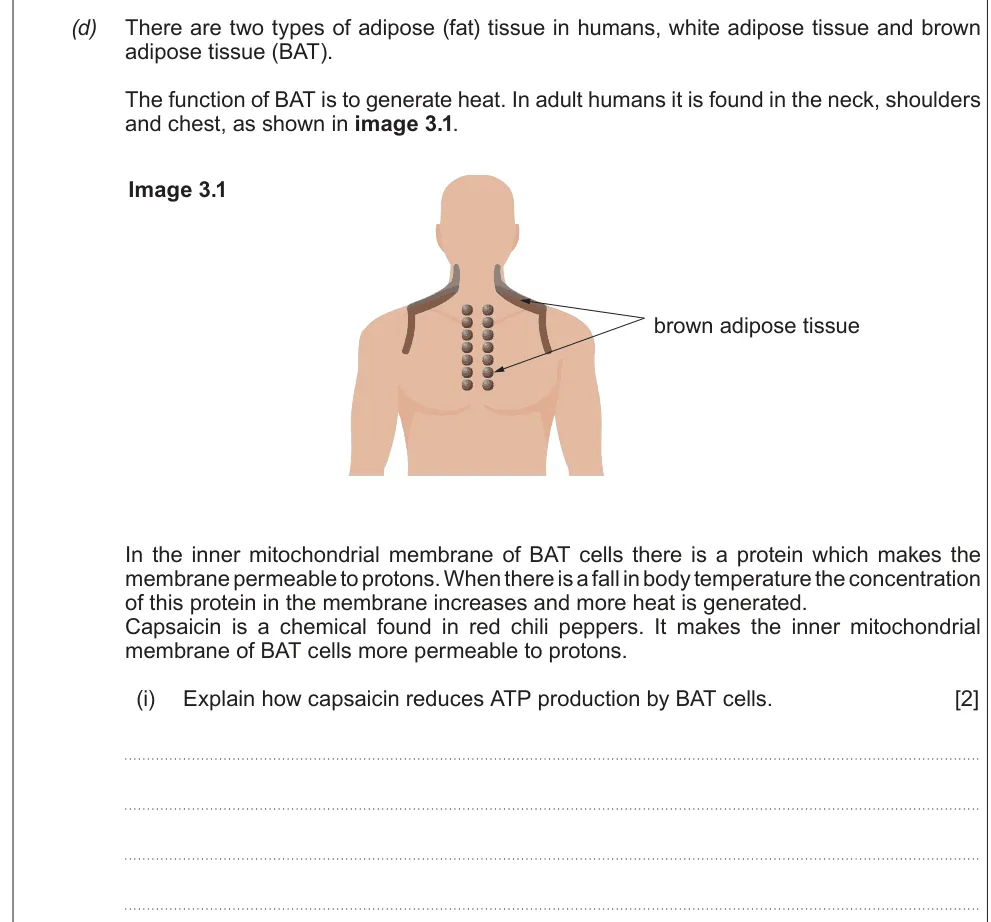
Explain how capsaicin, which makes the membrane leaky to protons, reduces ATP production.
Show the mark scheme

Tap an image to open it full size.
From the examiners' report: Most students got this: a smaller proton gradient means fewer protons flow through ATP synthetase.
Question 5
A level Component 1 · June 2022 · Q2(b)(i) · 3 marks
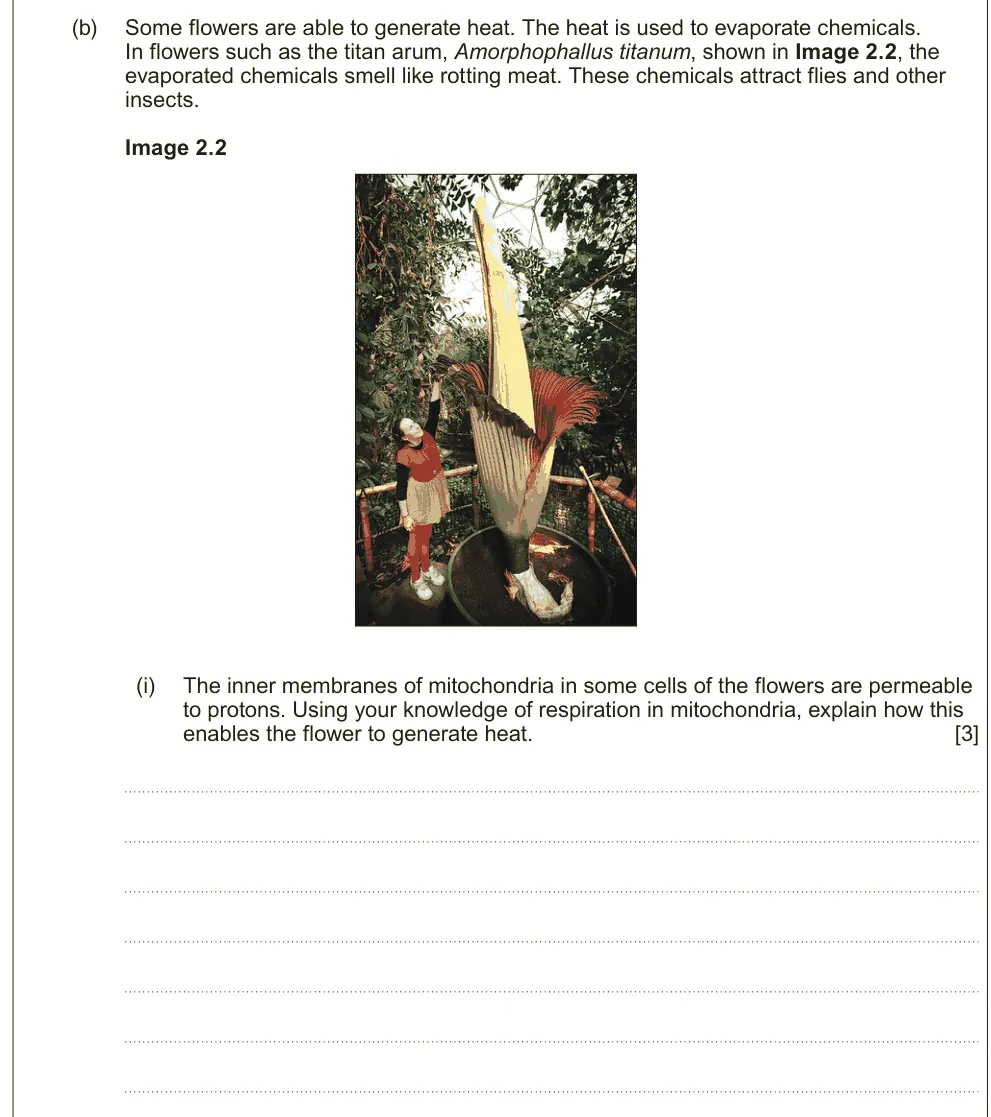
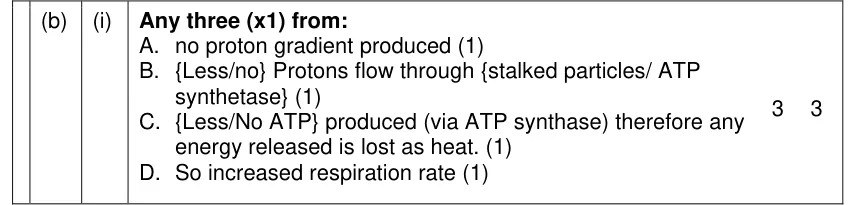
Explain how a membrane leaky to protons lets a flower generate heat.
Show the mark scheme
Tap an image to open it full size.
From the examiners' report: Stronger students explained it. Many wrongly thought it would increase ATP production, with the ATP then used to make heat: no gradient means little ATP, so the energy is lost as heat.
Proton gradients
Question 6
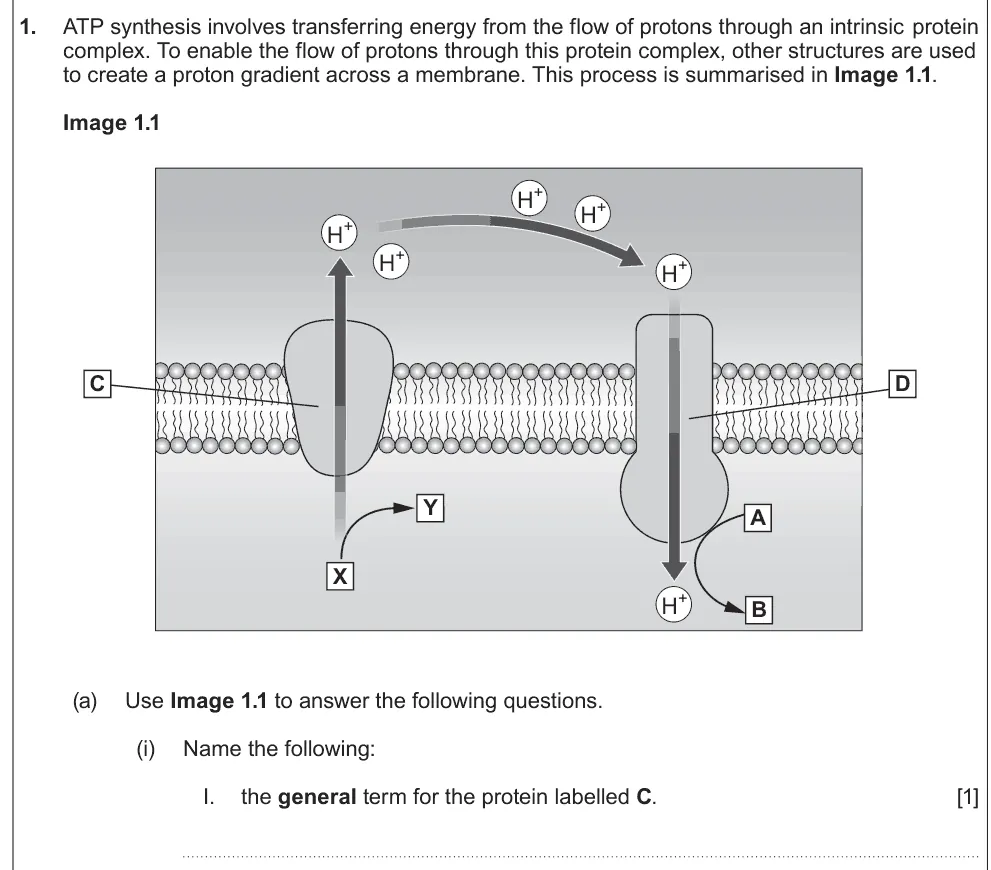
A level Component 1 · June 2023 · Q1(a)(i)I · 1 mark
Name the general term for a protein that moves protons across the membrane.
Show the mark scheme

Tap an image to open it full size.
Question 7
A level Component 1 · June 2023 · Q1(a)(i)II · 1 mark
Name the enzyme in the protein complex that makes ATP.

Show the mark scheme

Tap an image to open it full size.
Mitochondria and chloroplasts
Question 8
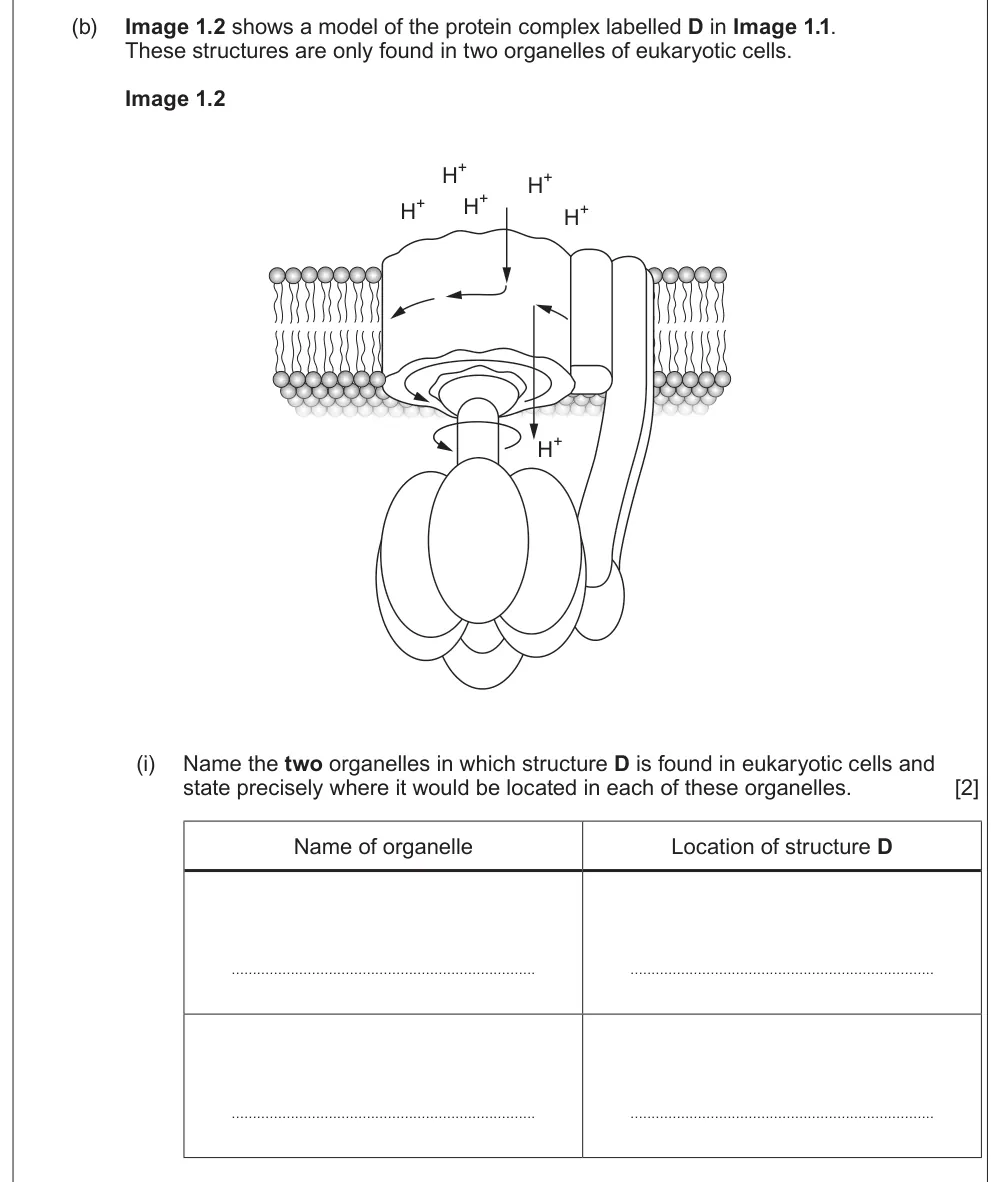
A level Component 1 · June 2023 · Q1(b)(i) · 2 marks
Identify where the structures in the diagram are found in mitochondria and chloroplasts.
Show the mark scheme

Tap an image to open it full size.
From the examiners' report: The report asks you to make sure you can compare ATP synthesis in mitochondria and chloroplasts correctly: the inner mitochondrial membrane and the thylakoid membrane.
Question 9
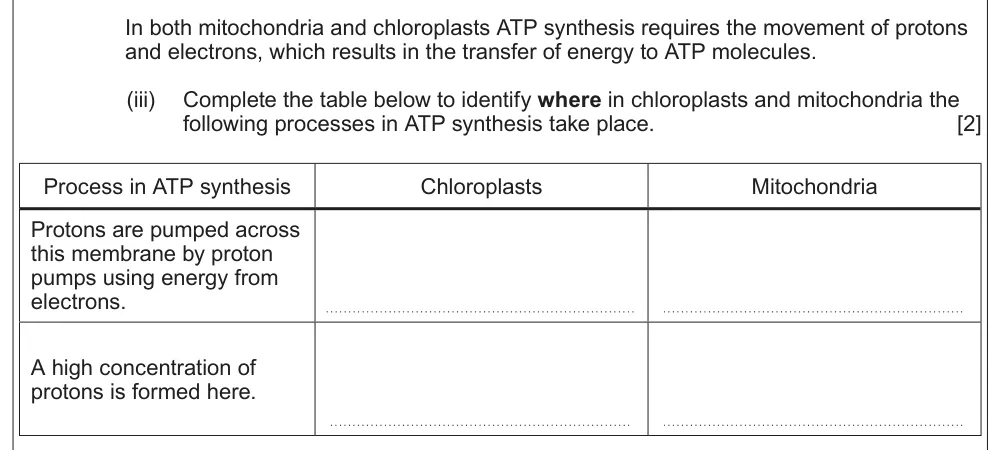
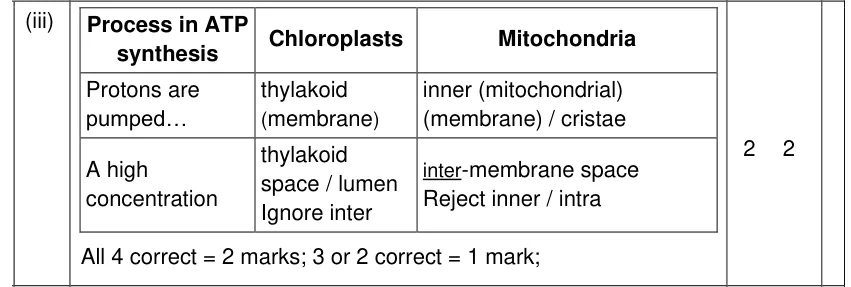
A level Component 1 · June 2024 · Q1(b)(iii) · 2 marks
Complete a table showing where protons are pumped and where they build up.
Show the mark scheme
Tap an image to open it full size.
From the examiners' report: Many students couldn't compare the structure of chloroplasts and mitochondria correctly. Protons build up in the thylakoid space and in the intermembrane space.
Question 10
A level Component 1 · June 2018 · Q1(c) · 4 marks
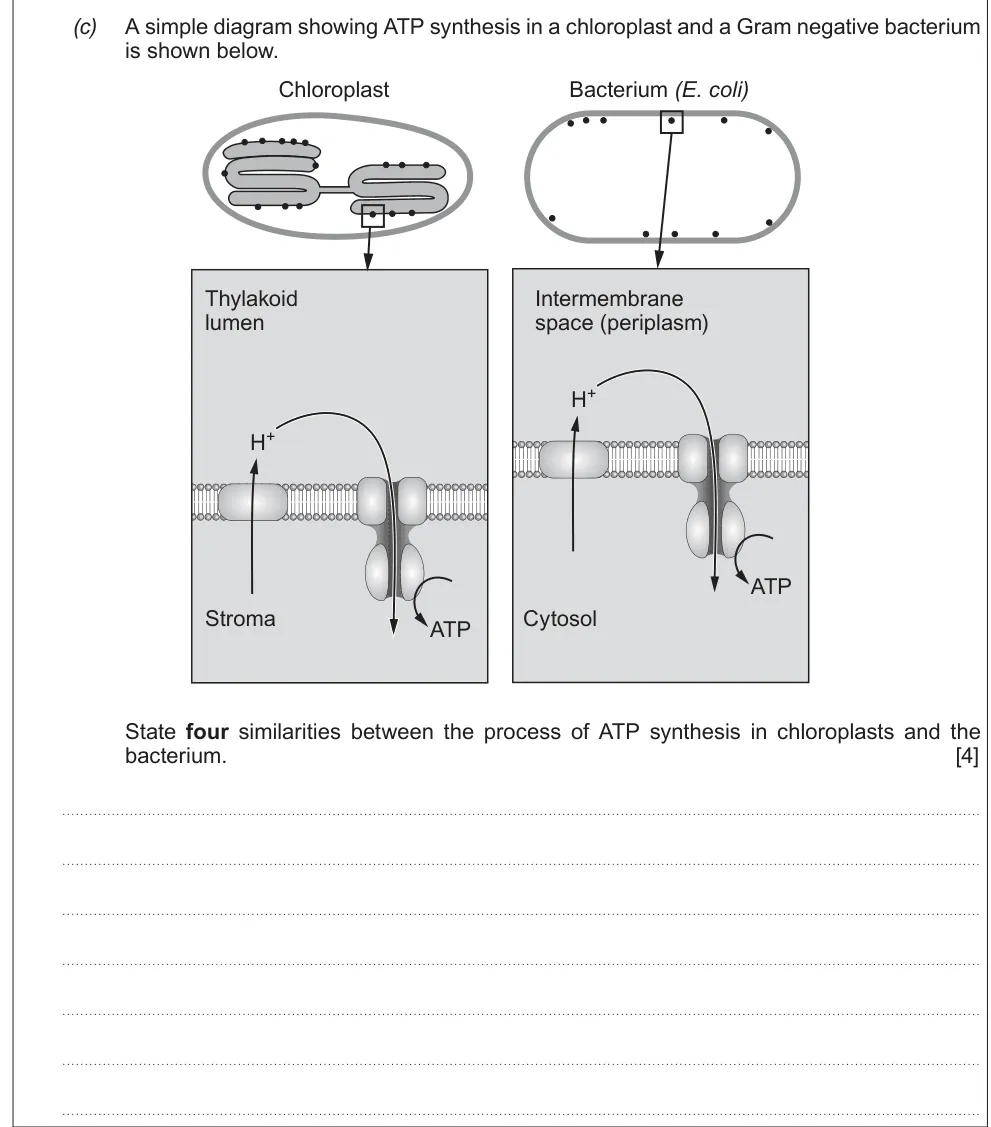
State four similarities between ATP synthesis in chloroplasts and a bacterium.
Show the mark scheme

Tap an image to open it full size.
The electron transport chain
Question 11
A level Component 1 · Autumn 2021 · Q4(b)(ii) · 1 mark
Name the series of molecules that electrons pass along in the membrane.

Show the mark scheme

Tap an image to open it full size.
Question 12
A level Component 1 · Autumn 2021 · Q4(b)(iii) · 3 marks
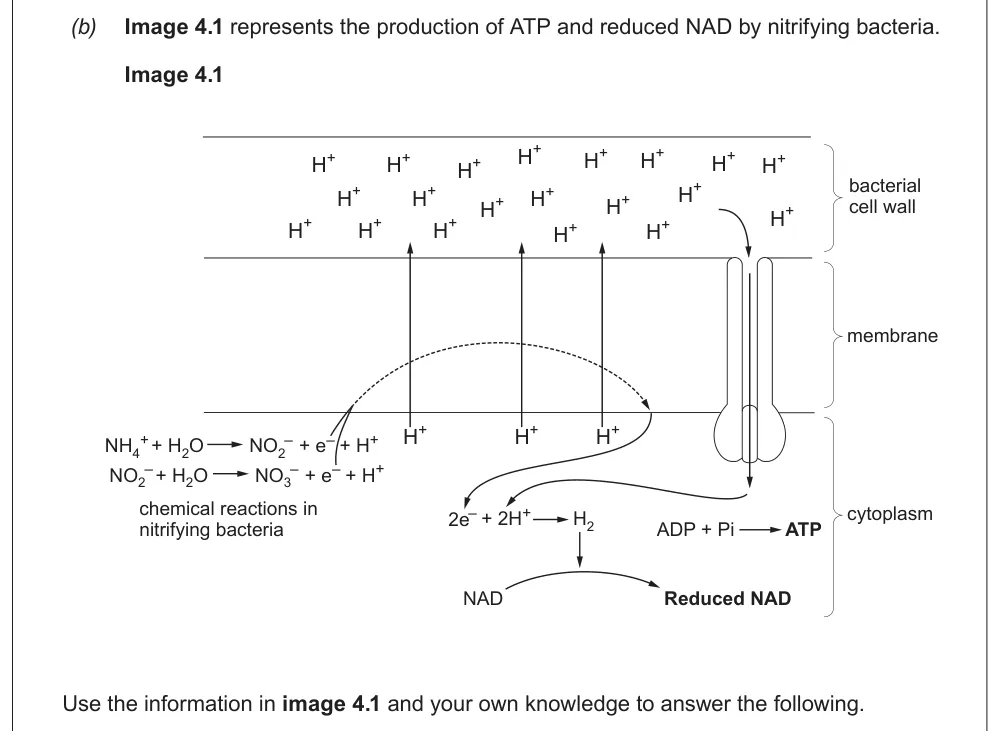
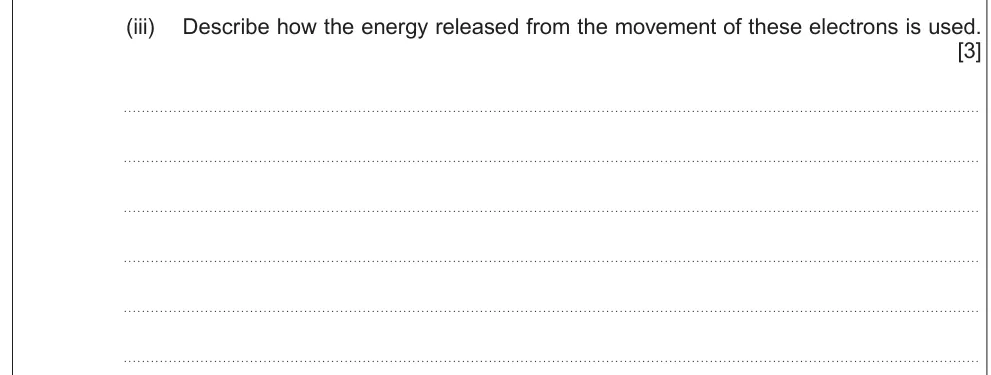
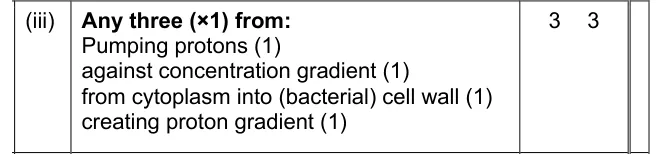
Describe how the energy released by the moving electrons is used.
Information from earlier in this question:
Show the mark scheme
Tap an image to open it full size.
From the examiners' report: Students had a very good understanding of ATP synthesis here: the energy pumps protons against their gradient, building up a proton gradient.
Question 13
A level Component 1 · Autumn 2021 · Q4(b)(iv) · 3 marks
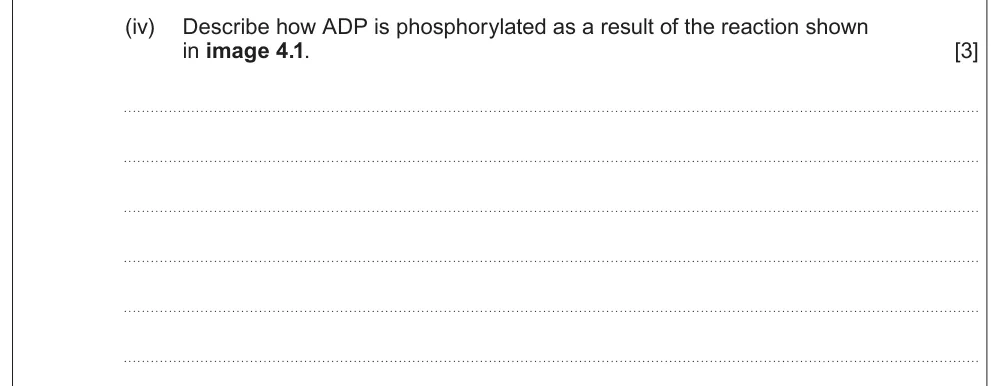
Describe how ADP is then phosphorylated.
Show the mark scheme

Tap an image to open it full size.
Question 14
A level Component 1 · Autumn 2021 · Q6(a)(i) · 4 marks
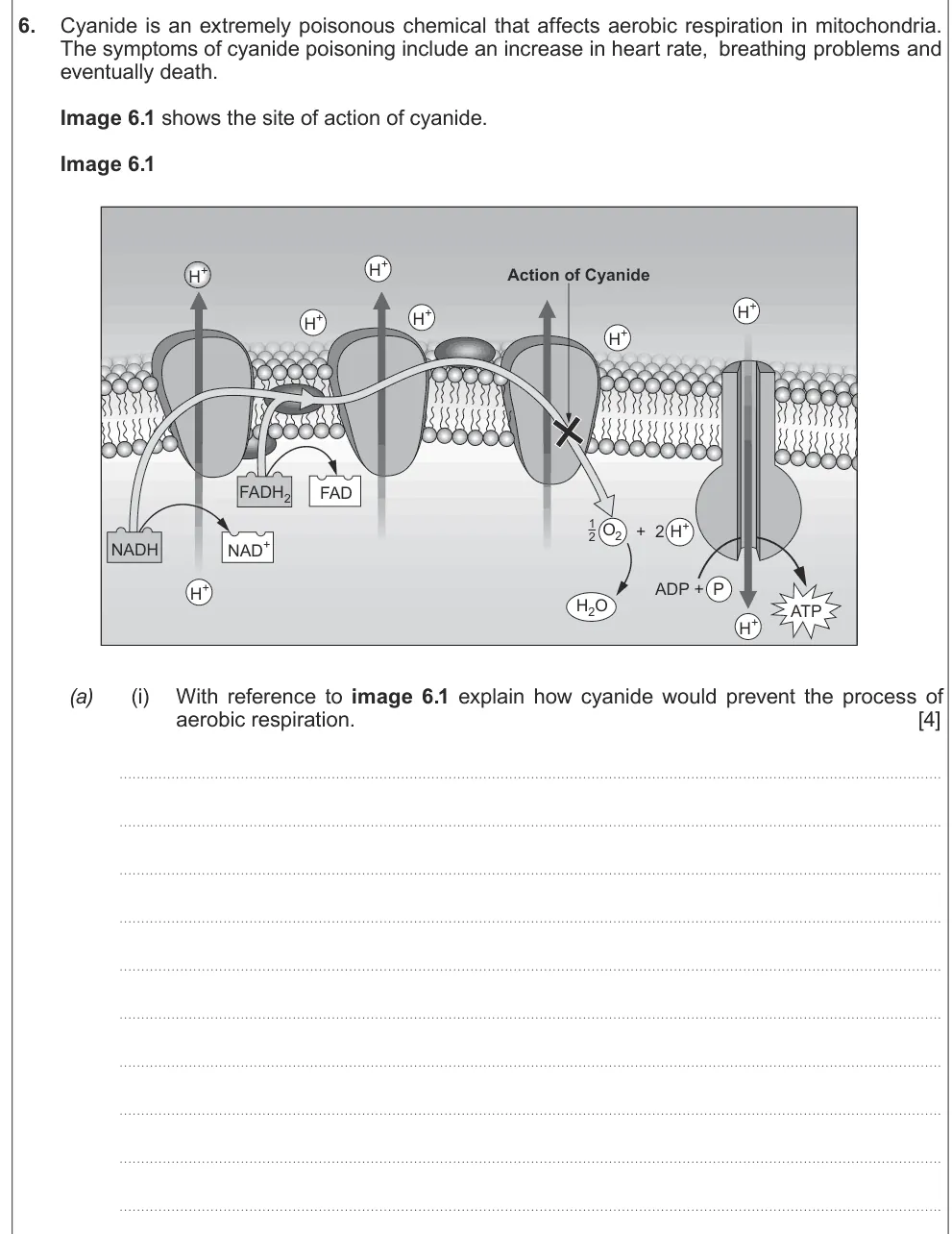
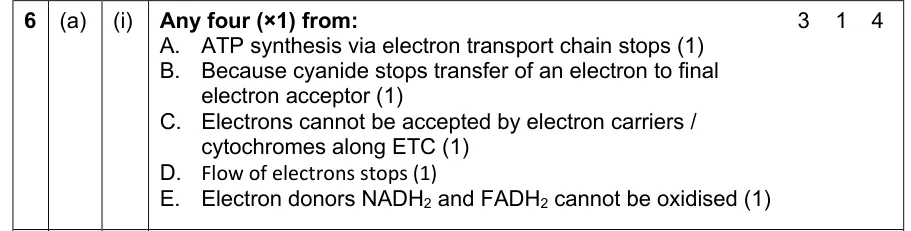
Explain how cyanide prevents aerobic respiration.
Show the mark scheme
Tap an image to open it full size.
From the examiners' report: There were some excellent answers: electrons can't pass to the final acceptor, so the flow of electrons stops and NADH and FADH₂ can't be oxidised.
Where students lose marks (from Eduqas examiners' reports and mark schemes)
Each point below is followed by wording that gained marks.
Leaky membrane means less ATP, not more: Many students thought a membrane permeable to protons would increase ATP production, which was then used to make heat.
✔ Gains credit: "No proton gradient produced" so "less / no ATP produced" and "energy released is lost as heat".
Compare the right membranes: Students couldn't compare ATP synthesis in mitochondria and chloroplasts correctly.
✔ Gains credit: "Mitochondria + inner membrane" and "Chloroplasts + thylakoid membrane".
Intermembrane space, not inner: Many students couldn't compare the structure of chloroplasts and mitochondria.
✔ Gains credit: Protons build up in the "thylakoid space / lumen" and the "inter-membrane space" (inner and intra are rejected).
ATP synthetase, not ATPase: The mark scheme rejects ATPase for the enzyme that makes ATP.
✔ Gains credit: "ATP synthetase / synthase" (Reject ATPase).
A pump, not a channel: The mark scheme rejects channel protein for the protein that moves protons against their gradient.
✔ Gains credit: "Proton pump / carrier protein" (Reject channel protein).
Download the questions
Download the PDF pack (14 questions, mark schemes at the end)
Keep practising
- Microbiology (1.4): Eduqas A Level Biology exam questions by topic
- Human Impact on the Environment (1.6): Eduqas A Level Biology exam questions by topic
- Eduqas A level Biology past papers, mark schemes and examiners' reports
- Eduqas A level Biology grade boundaries
- Ask about Eduqas A level Biology lessons with Sam on WhatsApp
Questions, mark schemes and examiners' report extracts © WJEC CBAC Ltd (Eduqas).