

Microbiology is the Component 1 topic built around the lab: classifying bacteria by shape and Gram stain, culturing them, aseptic technique, the conditions bacteria need to grow, and counting them with serial dilutions and viable counts. It links to the microbiology specified practical. Every question on this page is from the A level papers, mostly Component 1, with a few from Component 3 where bacteria turn up again.
The examiners' reports keep finding the same gaps. Be precise about conditions (an autoclave works above boiling point, gut bacteria need anaerobic conditions as well as 37 °C), say what a Gram stain tells you about the cell wall, and practise serial dilution calculations: use the mean, multiply by the volume factor and keep the powers of ten right.
I don't teach the Eduqas specification myself, so for one-to-one help I recommend Sam. He teaches Eduqas A level Biology at a top-rated sixth form college and is very popular with his students. You can ask about lessons with Sam on WhatsApp using the link at the bottom of this page.
What you need from GCSE and Year 12
Each question on this page assumes you're secure on these ideas. If any of them feels shaky, look it up before you start.
- Bacteria are prokaryotes with a cell wall, a loop of DNA and often plasmids.
- Bacteria reproduce by binary fission and can be grown on agar or in nutrient broth.
- Aseptic technique stops contamination of cultures and protects the person working.
- Standard form writes very large numbers as a × 10ⁿ.
Key terms
These words come up in the questions and mark schemes. Examiners expect you to use them exactly.
- Gram positive: bacteria with a thick peptidoglycan (murein) wall that stain purple.
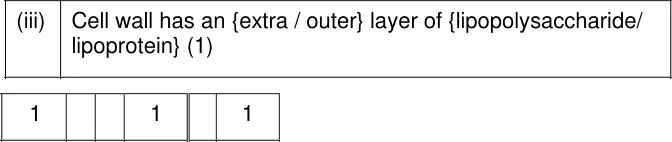
- Gram negative: bacteria with a thin peptidoglycan wall and an outer lipopolysaccharide layer that stain red or pink.
- Coccus, bacillus, spirillum: sphere-shaped, rod-shaped and spiral bacteria.
- Obligate anaerobe: a microorganism that can only grow without oxygen.
- Facultative anaerobe: a microorganism that can respire aerobically and anaerobically.
- Serial dilution: a series of dilutions, each by the same factor (often 10×), so colonies can be counted.
- Viable count: the number of living cells in a known volume, found by counting colonies.
- Total count: the number of all cells, living and dead, for example with a haemocytometer.
What these questions cover (Eduqas 1.4)
The questions test these statements from Component 1 (Energy for Life) of the Eduqas A level Biology specification (A400). Component 1 content is examined in A level Component 1.
- (a) the classification of bacteria according to their shape and by their reaction to the Gram stain as determined by their cell wall structure, including the preparation and
- (c) the conditions necessary for bacterial growth and the principles of aseptic technique
- (d) the methods used to monitor population growth in microorganisms including viable count, using serial dilutions, plating and counting colonies
How to use this page
Write your answer on paper before you open the mark scheme. Allow about 1.2 minutes per mark: the 19 questions are worth 35 marks, so about 42 minutes in total. Then mark your answer strictly against the mark scheme and read the examiners' tip underneath it. If you'd rather print the questions, download the PDF pack.
Classifying bacteria
Question 1
A level Component 1 · Autumn 2021 · Q2(a)(i) · 1 mark
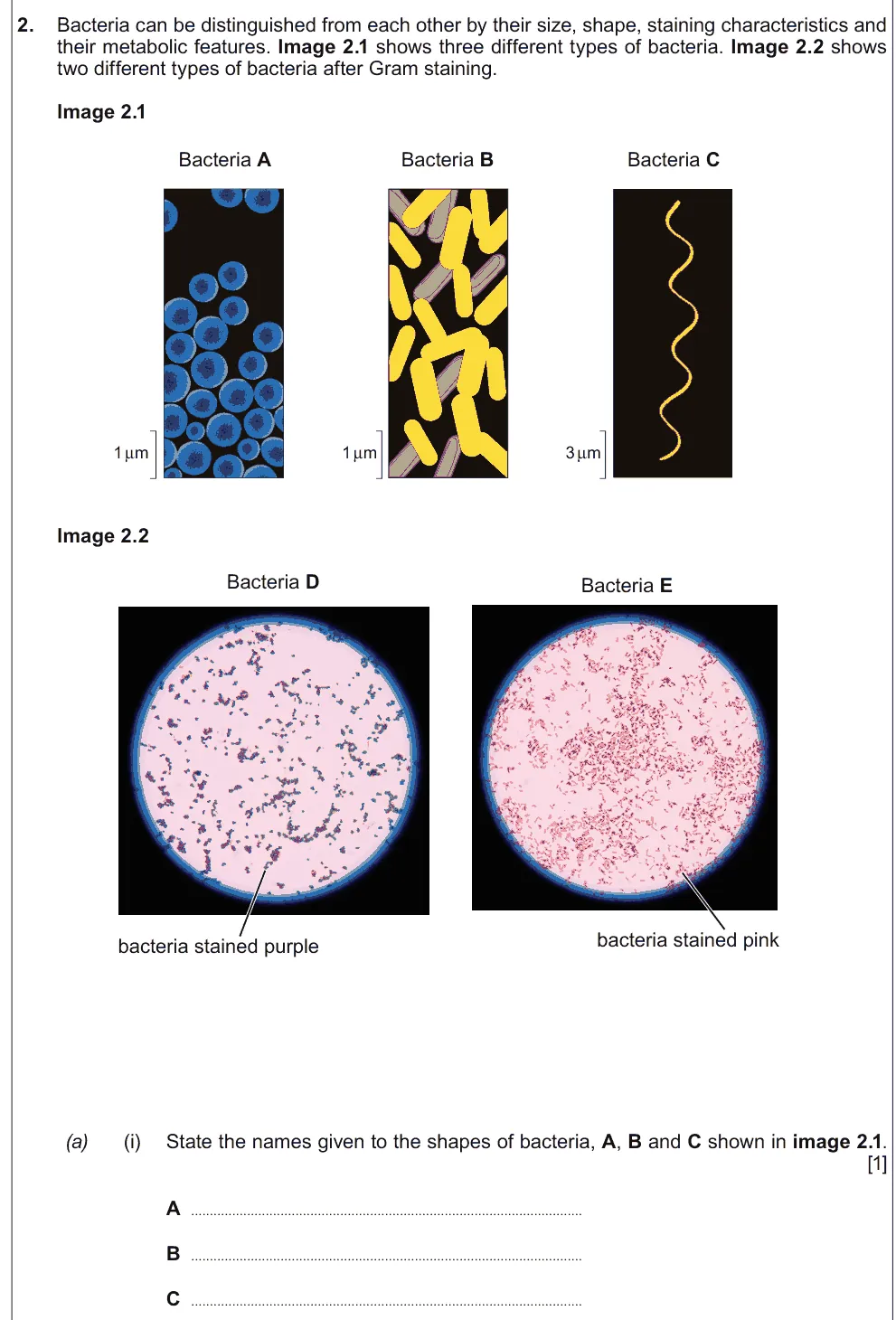
Name the shapes of three bacteria.
Show the mark scheme
Tap an image to open it full size.
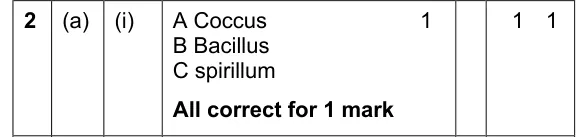
From the examiners' report: Most students identified the three shapes correctly: coccus, bacillus and spirillum.
Question 2
A level Component 1 · Autumn 2021 · Q2(a)(ii) · 2 marks
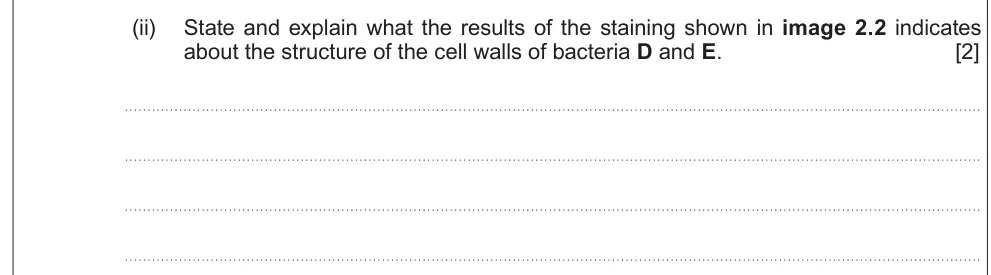
Explain what Gram staining shows about the cell walls of two bacteria.
Show the mark scheme

Tap an image to open it full size.
From the examiners' report: Most students explained the staining difference well: Gram positive has a peptidoglycan wall; Gram negative has an extra outer lipopolysaccharide layer.
Question 3
A level Component 3 · June 2022 · Q7(c)(i) · 2 marks
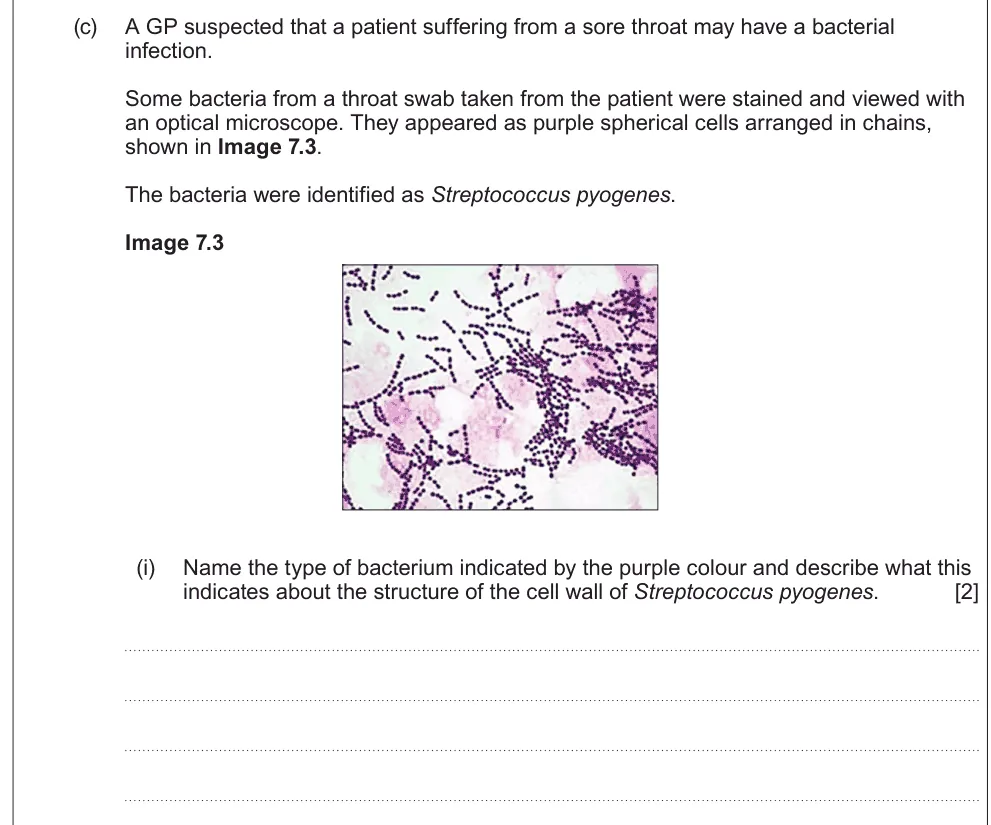
Name the type of purple-staining bacterium and say what this shows about its wall.
Show the mark scheme

Tap an image to open it full size.
From the examiners' report: Most students showed a clear understanding: Gram positive, with a thicker peptidoglycan layer and no lipopolysaccharide layer.
Question 4
A level Component 1 · June 2018 · Q2(b)(iii) · 3 marks
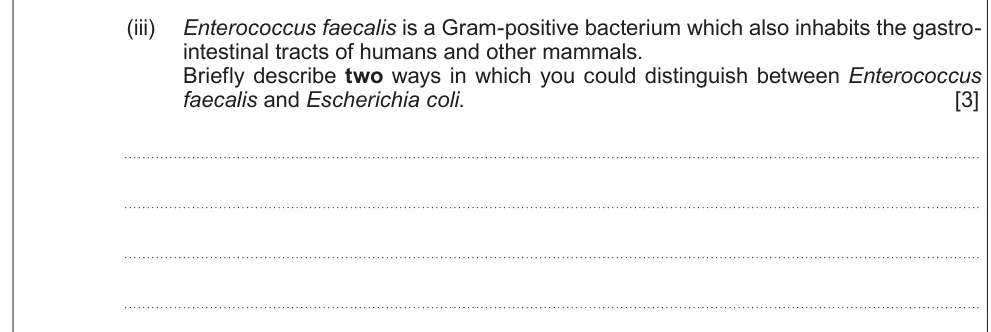
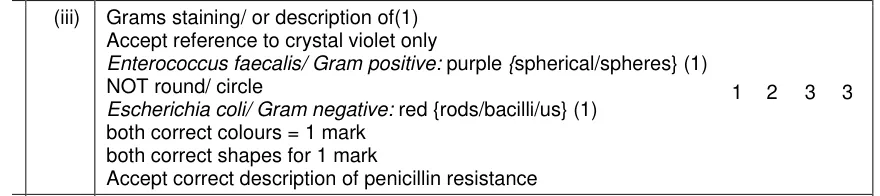
Describe two ways to tell Enterococcus faecalis from E. coli.
Show the mark scheme
Tap an image to open it full size.
From the examiners' report: This only needed a Gram stain with the colours and shapes seen (purple spheres, red rods). It is a frequent question, yet it caused problems for some.
Question 5
A level Component 1 · June 2023 · Q5(b)(i) · 1 mark
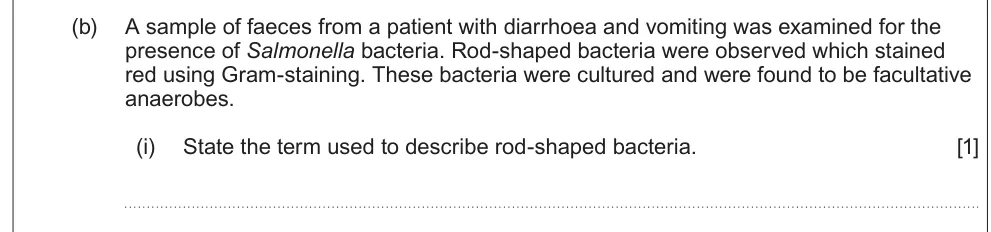
State the term for rod-shaped bacteria.
Show the mark scheme

Tap an image to open it full size.
Question 6
A level Component 1 · June 2023 · Q5(b)(iii) · 1 mark
Explain what a red Gram stain result tells you about Salmonella.

Show the mark scheme
Tap an image to open it full size.
Growing bacteria
Question 7
A level Component 1 · June 2023 · Q5(b)(ii) · 1 mark
Explain what is meant by a facultative anaerobe.

Show the mark scheme

Tap an image to open it full size.
Question 8
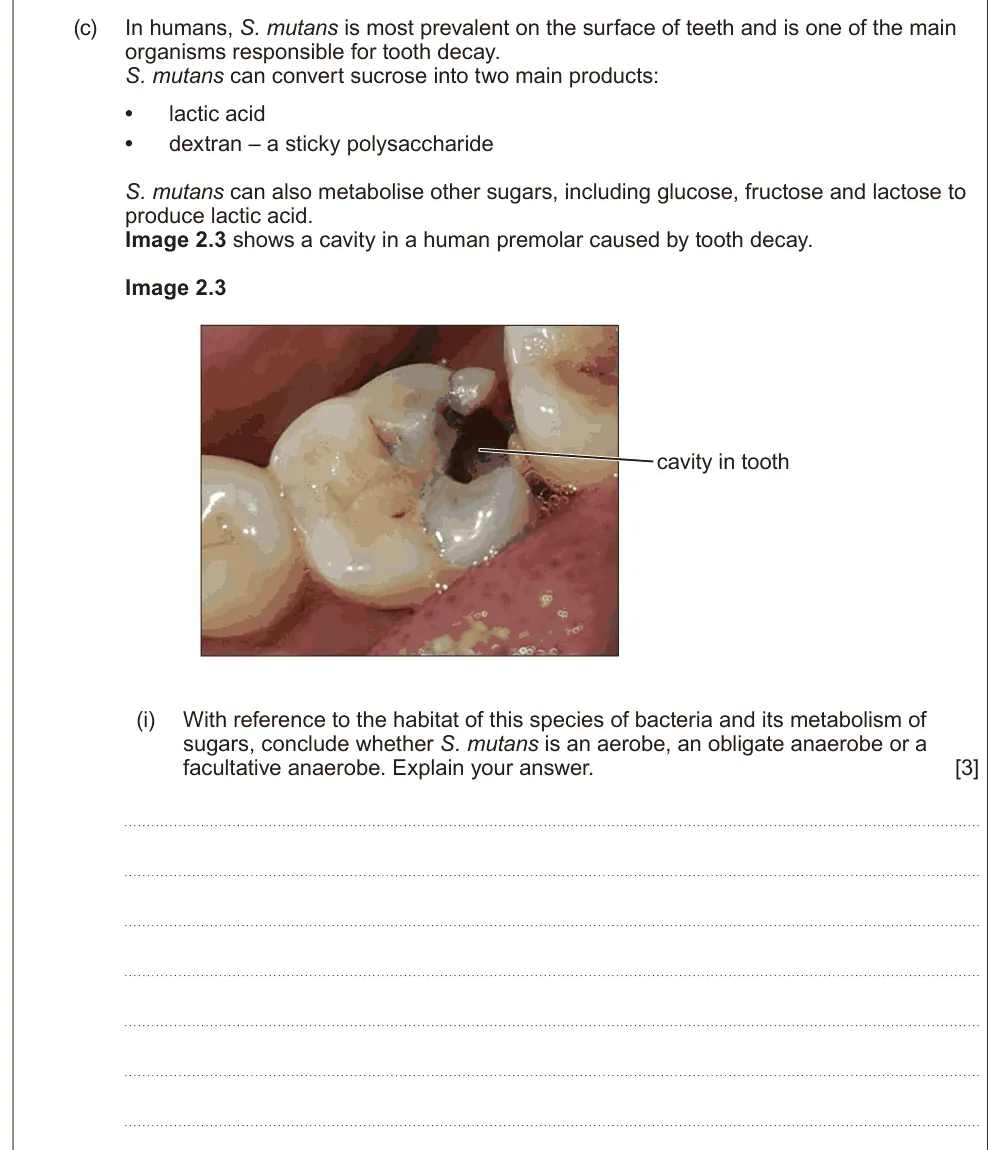
A level Component 1 · June 2025 · Q2(c)(i) · 3 marks
Decide whether a tooth-decay bacterium is an aerobe, obligate anaerobe or facultative anaerobe.
Show the mark scheme

Tap an image to open it full size.
From the examiners' report: Students showed a good understanding of the oxygen requirements of bacteria here.
Question 9
A level Component 3 · June 2019 · Q8(d)(ii) · 2 marks
Describe two techniques to keep conditions sterile when inoculating plates.
Show the mark scheme

Tap an image to open it full size.
Culturing and counting bacteria
Question 10
A level Component 1 · Autumn 2020 · Q5(a)(i) · 1 mark
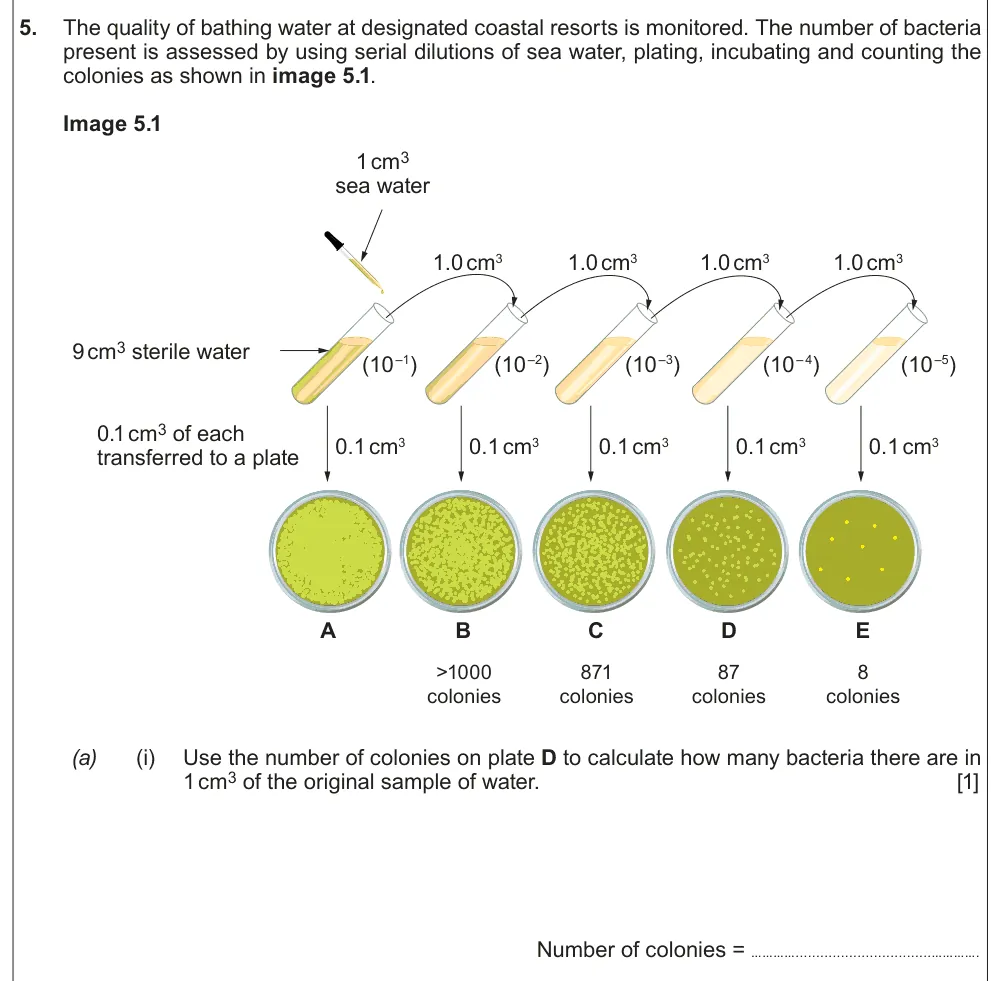
Use a colony count after serial dilution to find the number of bacteria per cm³.
Show the mark scheme

Tap an image to open it full size.
From the examiners' report: Serial dilution still causes many students problems. Work back through every dilution step, and include the 0.1 cm³ that was plated.
Question 11
A level Component 1 · Autumn 2020 · Q5(a)(ii) · 2 marks · Easy
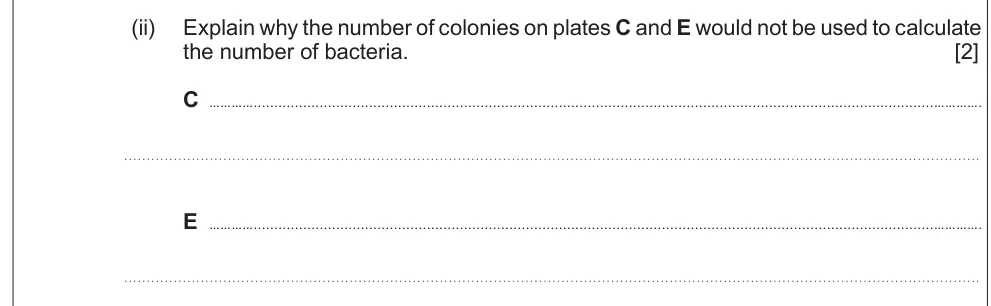
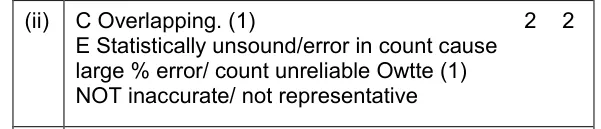
Explain why two of the plates weren't used to count colonies.
Show the mark scheme
Tap an image to open it full size.
From the examiners' report: Almost everyone said the colonies overlap on plate C. For plate E, too few colonies make the count statistically unreliable; "can't be counted accurately" didn't score.
Question 12
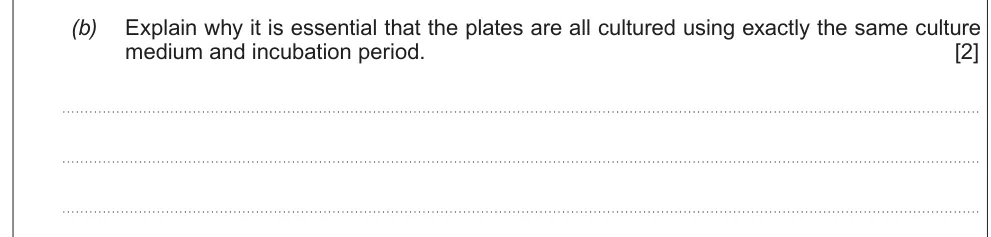
A level Component 1 · Autumn 2020 · Q5(b) · 2 marks
Explain why every plate must use the same medium and incubation time.
Show the mark scheme

Tap an image to open it full size.
From the examiners' report: Few students said why: different nutrients change the growth rate, and different incubation times change colony size and the risk of colonies merging.
Question 13
A level Component 1 · Autumn 2020 · Q5(c) · 1 mark
State the condition in an autoclave that sterilises plates.

Show the mark scheme

Tap an image to open it full size.
From the examiners' report: Be precise: a temperature above boiling point. "Increase the temperature" or "expose them to heat" lost the mark.
Question 14
A level Component 1 · Autumn 2020 · Q5(d) · 2 marks · Hard
Suggest two incubation conditions for culturing human gut bacteria.

Show the mark scheme

Tap an image to open it full size.
From the examiners' report: Most students gave 37 °C, but very few gave the second condition: anaerobic, because these bacteria live in the intestine.
Question 15
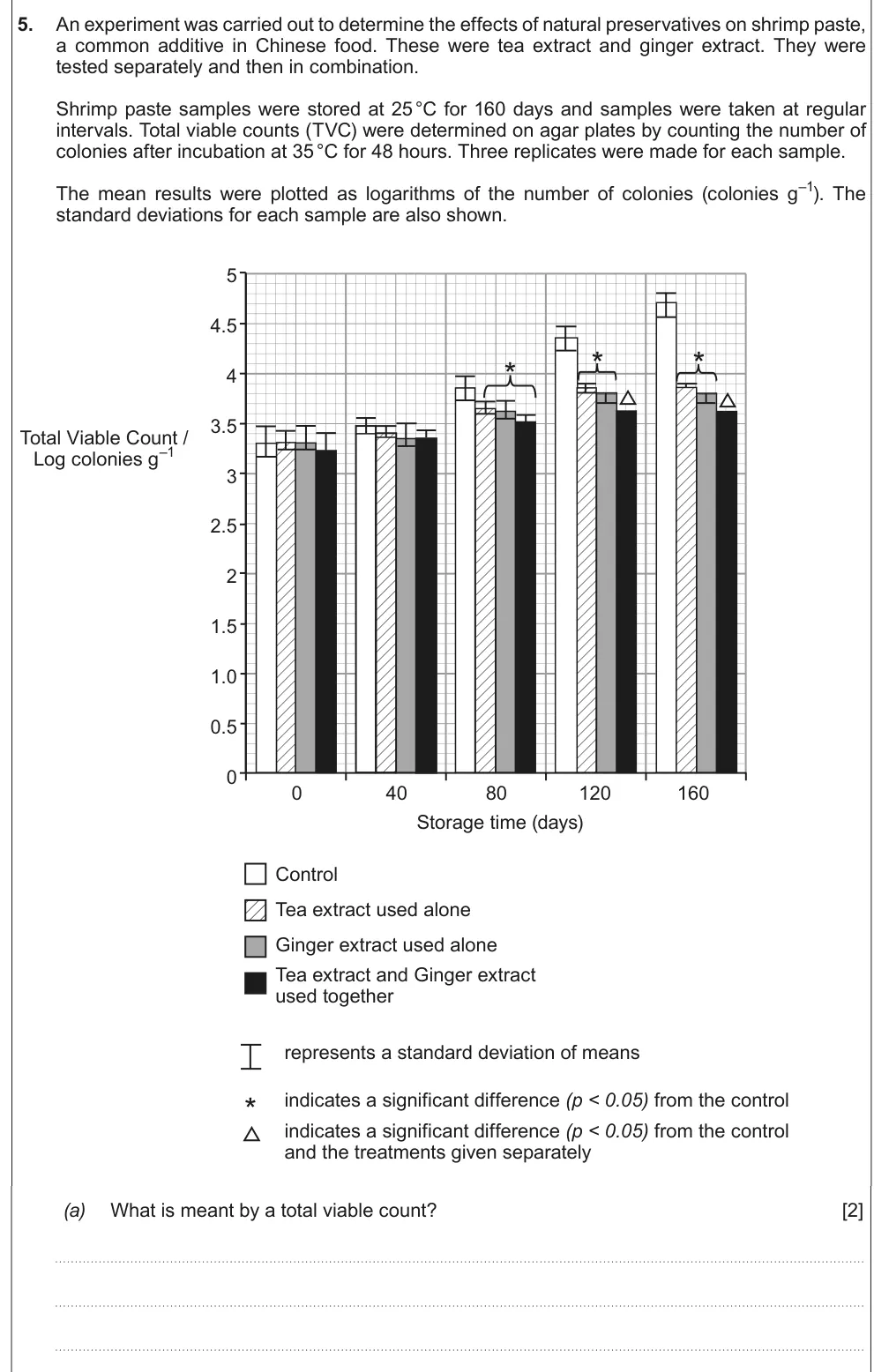
A level Component 1 · June 2017 · Q5(a) · 2 marks
Explain what is meant by a total viable count.
Show the mark scheme

Tap an image to open it full size.
Question 16
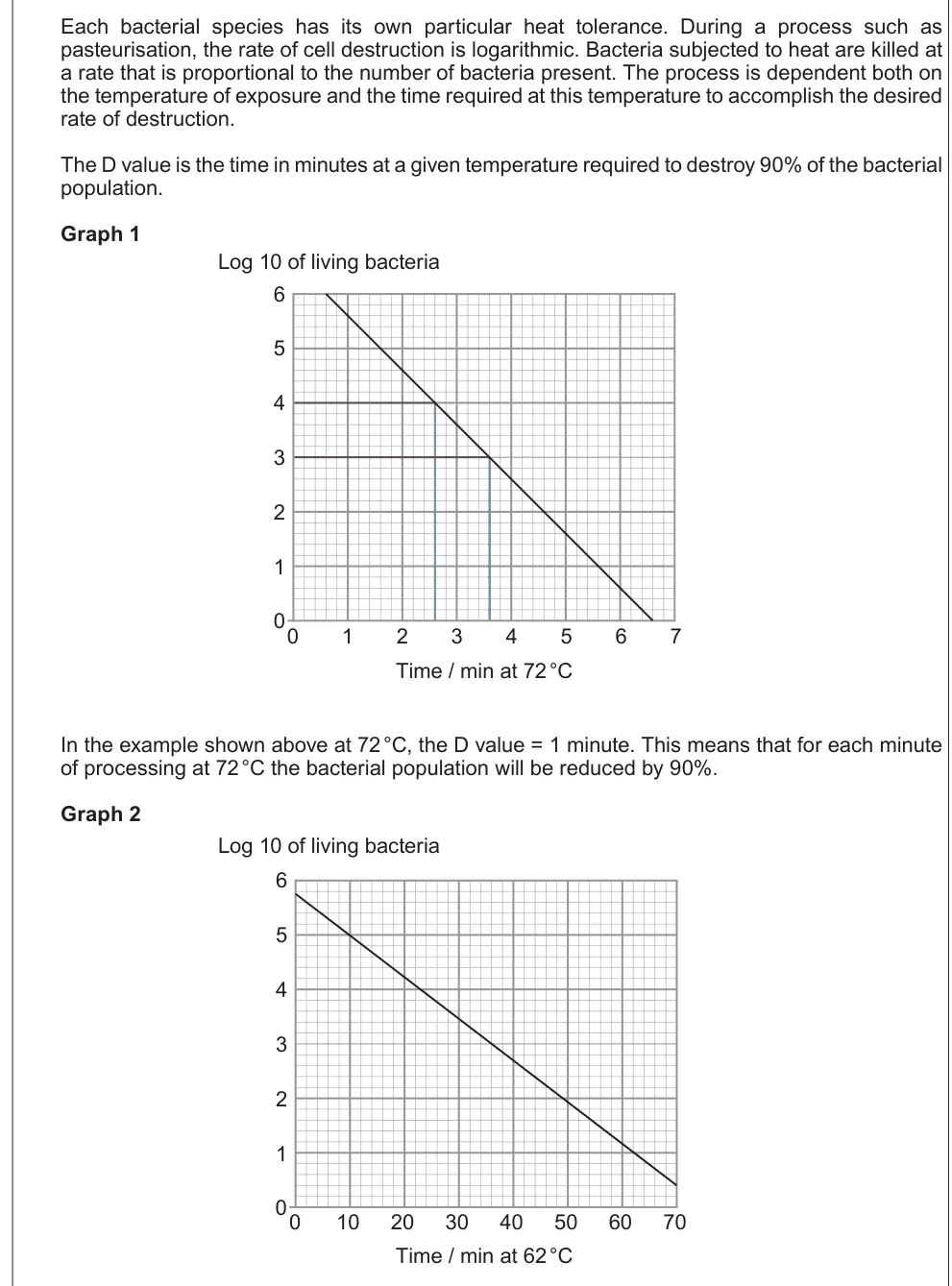
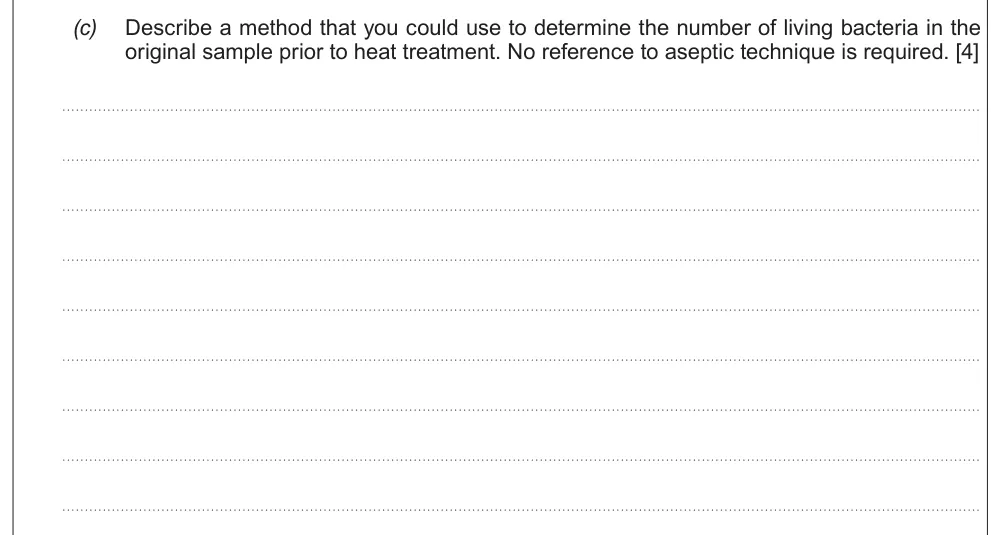
A level Component 1 · June 2019 · Q2(c) · 4 marks
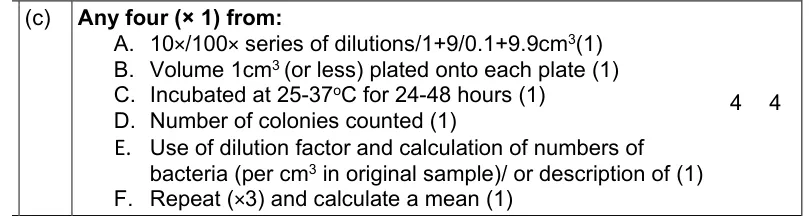
Describe how to find the number of living bacteria in a sample.
Information from earlier in this question:
Show the mark scheme
Tap an image to open it full size.
Question 17
A level Component 1 · June 2018 · Q2(c)(ii) · 1 mark
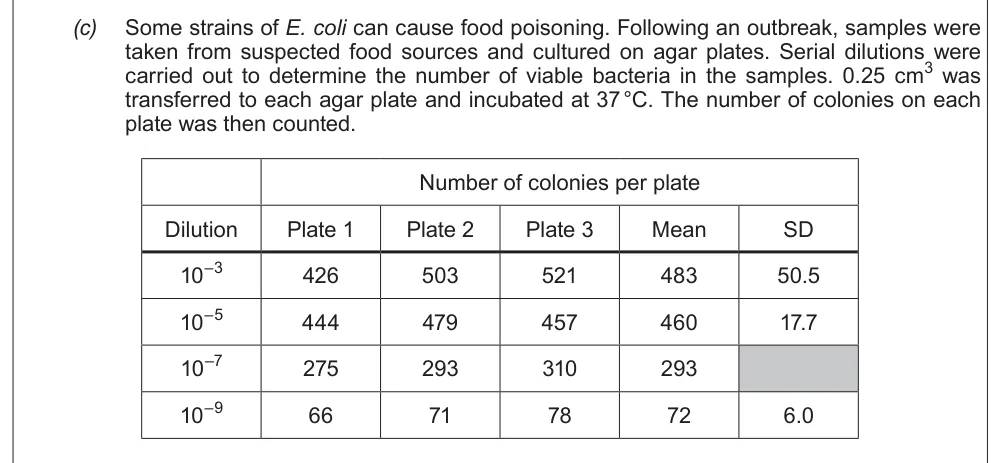
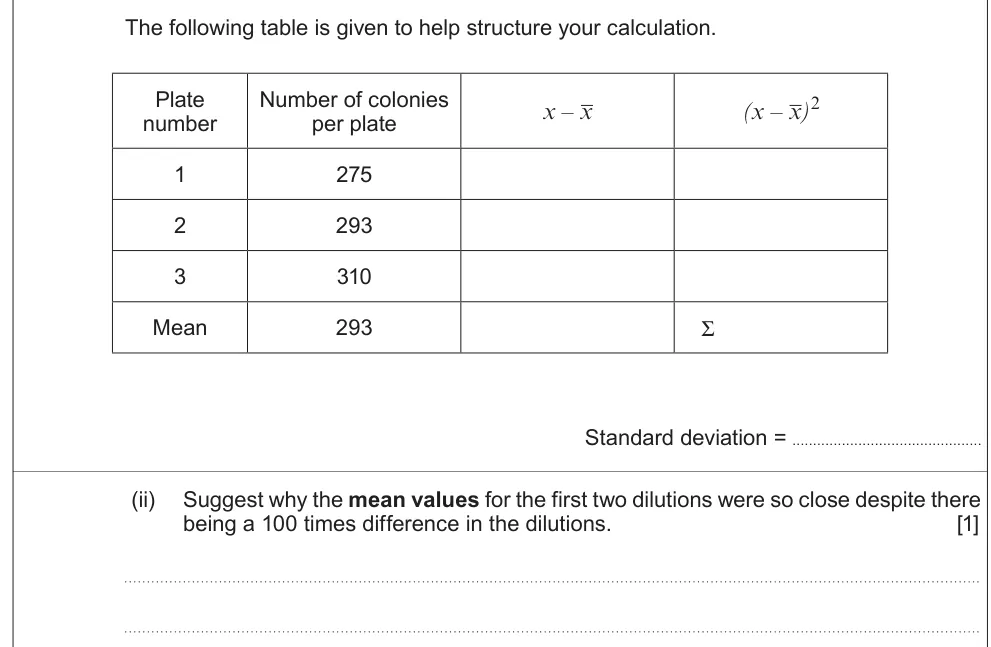
Suggest why mean counts at two dilutions 100 times apart were so close.
Information from earlier in this question:
Show the mark scheme

Tap an image to open it full size.
From the examiners' report: Answers were variable, showing poor understanding of why serial dilutions are done. Too many colonies clump and overlap, so they can't be counted properly.
Question 18
A level Component 1 · June 2018 · Q2(c)(iv) · 3 marks
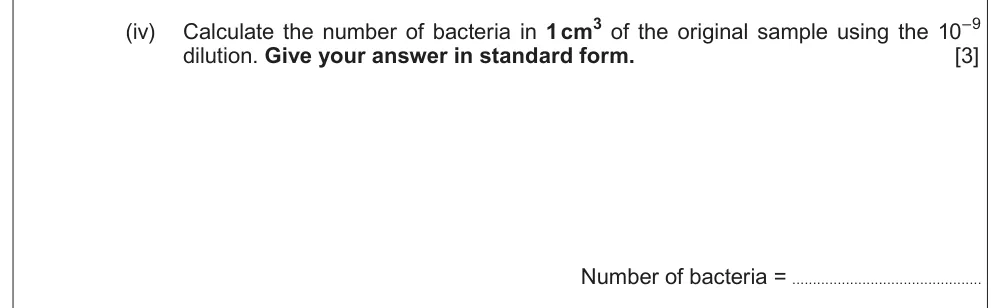
Calculate the number of bacteria per cm³ from the 10⁻⁹ dilution, in standard form.
Show the mark scheme

Tap an image to open it full size.
From the examiners' report: Many gave perfect answers, but others didn't use the mean, forgot to multiply by 4, or got the power of ten wrong: 72 × 4 × 10⁹ = 2.9 × 10¹¹.
Question 19
A level Component 1 · June 2022 · Q1(a)(ii) · 1 mark
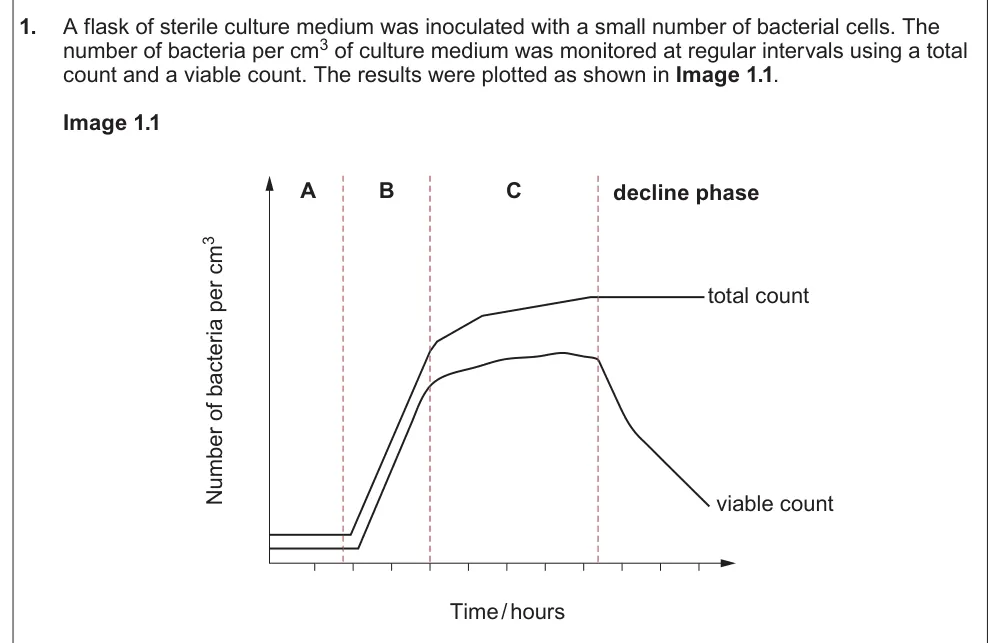
Explain the difference between the decline phase in a total count and a viable count.
Information from earlier in this question:

Show the mark scheme

Tap an image to open it full size.
From the examiners' report: There were excellent answers: the total count includes dead cells, so it stays higher; the viable count only counts living cells.
Where students lose marks (from Eduqas examiners' reports and mark schemes)
Each point below is followed by wording that gained marks.
Gram stain plus shape: Some students struggled with a frequent question on telling two bacteria apart.
✔ Gains credit: Gram staining: "purple spheres" for Gram positive and "red rods" for Gram negative.
Too few is unreliable, not uncountable: Many said plate E couldn't be counted accurately.
✔ Gains credit: "Statistically unsound / count unreliable" (NOT inaccurate).
Above boiling point: Answers said "increase the temperature" or "expose them to heat".
✔ Gains credit: "Temperature above boiling point".
Gut bacteria are anaerobic: Very few students gave anaerobic as the second incubation condition.
✔ Gains credit: "37 ºC" and "anaerobic".
Use the mean and the volume factor: Students didn't use the mean, forgot to multiply by 4, or got the power of ten wrong.
✔ Gains credit: "72 x 4 x 10⁹" = "2.9 x 10¹¹ bacteria in 1 cm³".
Explain, don't describe: Many students described the shape of the growth curve instead of explaining it.
✔ Gains credit: "Total count will include dead cells".
Download the questions
Download the PDF pack (19 questions, mark schemes at the end)
Keep practising
- Importance of ATP (1.1): Eduqas A Level Biology exam questions by topic
- Human Impact on the Environment (1.6): Eduqas A Level Biology exam questions by topic
- Eduqas A level Biology past papers, mark schemes and examiners' reports
- Eduqas A level Biology grade boundaries
- Ask about Eduqas A level Biology lessons with Sam on WhatsApp
Questions, mark schemes and examiners' report extracts © WJEC CBAC Ltd (Eduqas).