

Homeostasis and the kidney covers negative and positive feedback, the structure of the kidney and nephron (including slides and electron micrographs), ultrafiltration and the glomerular filtration rate, selective reabsorption in the proximal convoluted tubule, ADH and the posterior pituitary, kidney failure, and how the loop of Henle and excretory products are adapted to different environments. Every question on this page is from the A level papers, mostly Component 3.
Recall of ADH and aquaporins is usually good. Marks are lost when you have to apply the nephron to an image or graph: telling the cortex from the medulla, reading a glomerular filtration rate graph, and explaining why glucose appears in urine (the carrier proteins are saturated). The examiners' reports want the sequence of glucose reabsorption in order, starting with sodium ions pumped out of the epithelial cells, and say clearly where ions go in the loop of Henle.
I don't teach the Eduqas specification myself, so for one-to-one help I recommend Sam. He teaches Eduqas A level Biology at a top-rated sixth form college and is very popular with his students. You can ask about lessons with Sam on WhatsApp using the link at the bottom of this page.
What you need from GCSE and Year 12
Each question on this page assumes you're secure on these ideas. If any of them feels shaky, look it up before you start.
- Homeostasis keeps internal conditions, such as temperature and water content, within narrow limits.
- The kidneys filter the blood and make urine containing urea.
- ADH controls how much water the kidneys reabsorb.
- Glucose is normally not found in urine.
Key terms
These words come up in the questions and mark schemes. Examiners expect you to use them exactly.
- Negative feedback: a change sets off a response that reverses it, returning the condition to its set point.
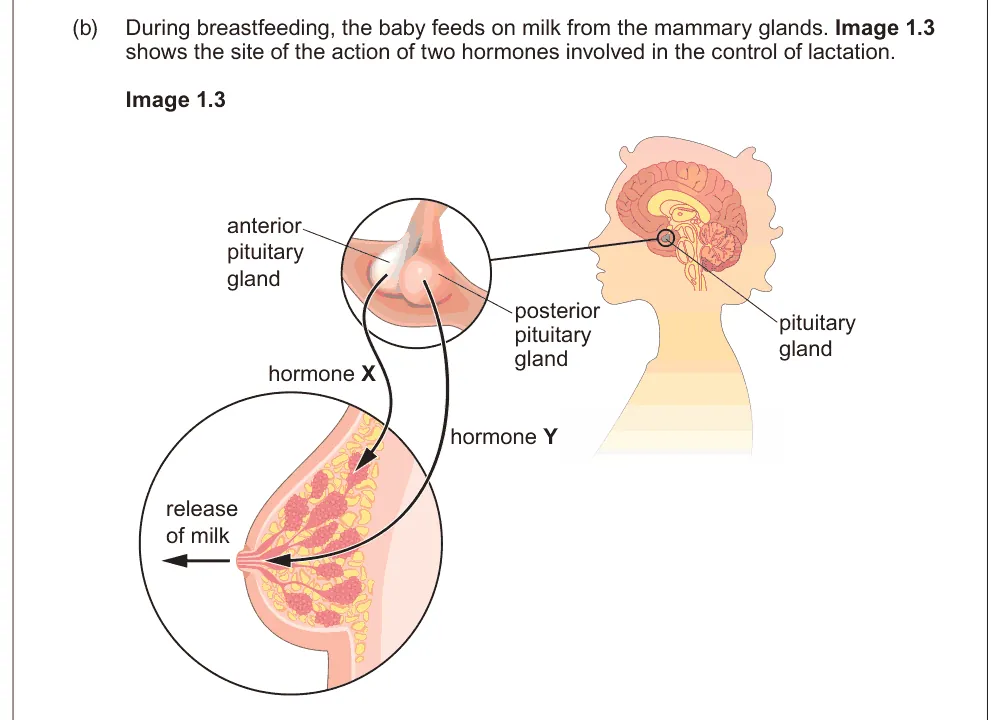
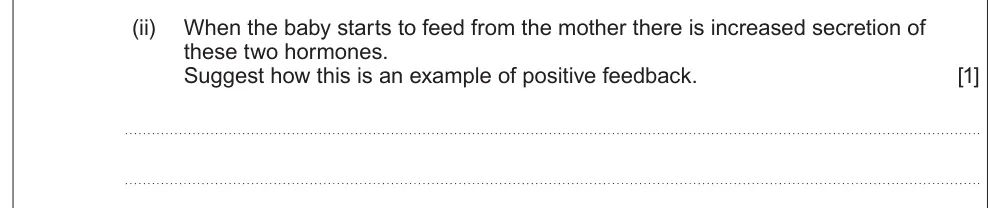
- Positive feedback: a change sets off a response that increases it further, as in childbirth or milk release.
- Ultrafiltration: high hydrostatic pressure in the glomerulus forces small molecules into the Bowman's capsule.
- Glomerular filtration rate: the volume of filtrate formed by the kidneys per minute.
- Selective reabsorption: useful substances such as glucose are taken back into the blood in the proximal convoluted tubule.
- Co-transport: glucose enters epithelial cells with sodium ions, driven by the sodium gradient.
- ADH: antidiuretic hormone from the posterior pituitary; it makes the collecting duct more permeable to water.
- Loop of Henle: creates a low water potential in the medulla, so water can be reabsorbed from the collecting duct.
What these questions cover (Eduqas 3.4)
The questions test these statements from Component 3 (Requirements for Life) of the Eduqas A level Biology specification (A400). Component 3 content is examined in A level Component 3.
- (b) the role of negative feedback in restoring conditions to their original levels and the role of positive feedback in enhancing the size of a stimulus
- (c) the structure of the mammalian kidney and the nephron, including examination of microscope slides and electron micrographs of kidney
- (d) the functions of the mammalian kidney including nitrogenous excretion and water regulation
- (e) the adaptations of the cells of the proximal tubule for reabsorption
- (f) the contribution of the endocrine glands to homeostatic balance as illustrated by the role of the posterior pituitary gland in the secretion of antidiuretic hormone
- (g) the role of antidiuretic hormone
- (i) the need for different excretory products and adaptations of the loop of Henlé in different environments
How to use this page
Write your answer on paper before you open the mark scheme. Allow about 1.2 minutes per mark: the 23 questions are worth 46 marks, so about 55 minutes in total. Then mark your answer strictly against the mark scheme and read the examiners' tip underneath it. If you'd rather print the questions, download the PDF pack.
Homeostasis and feedback
Question 1
A level Component 2 · June 2025 · Q1(b)(ii) · 1 mark
Suggest how milk release during breastfeeding is an example of positive feedback.
Information from earlier in this question:
Show the mark scheme

Tap an image to open it full size.
Question 2
A level Component 3 · June 2024 · Q5(a)(ii) · 2 marks
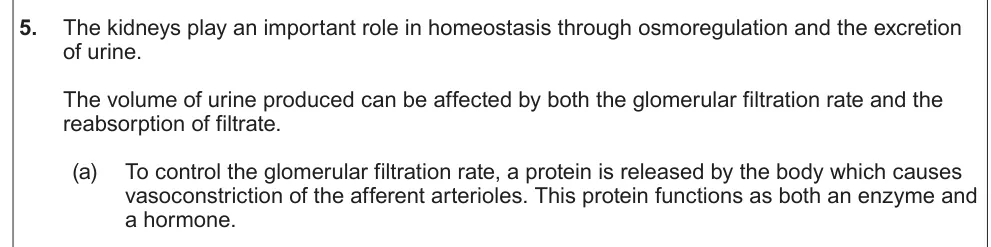
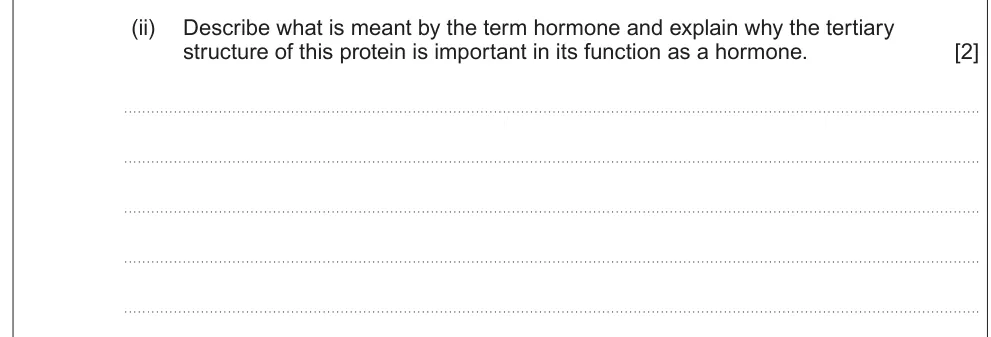
Describe what a hormone is and why its tertiary structure matters to its function.
Information from earlier in this question:
Show the mark scheme

Tap an image to open it full size.
From the examiners' report: Fewer could explain the importance of shape: the hormone binds to specific receptors on its target.
Kidney structure
Question 3
A level Component 3 · Autumn 2020 · Q4(a)(i) · 1 mark
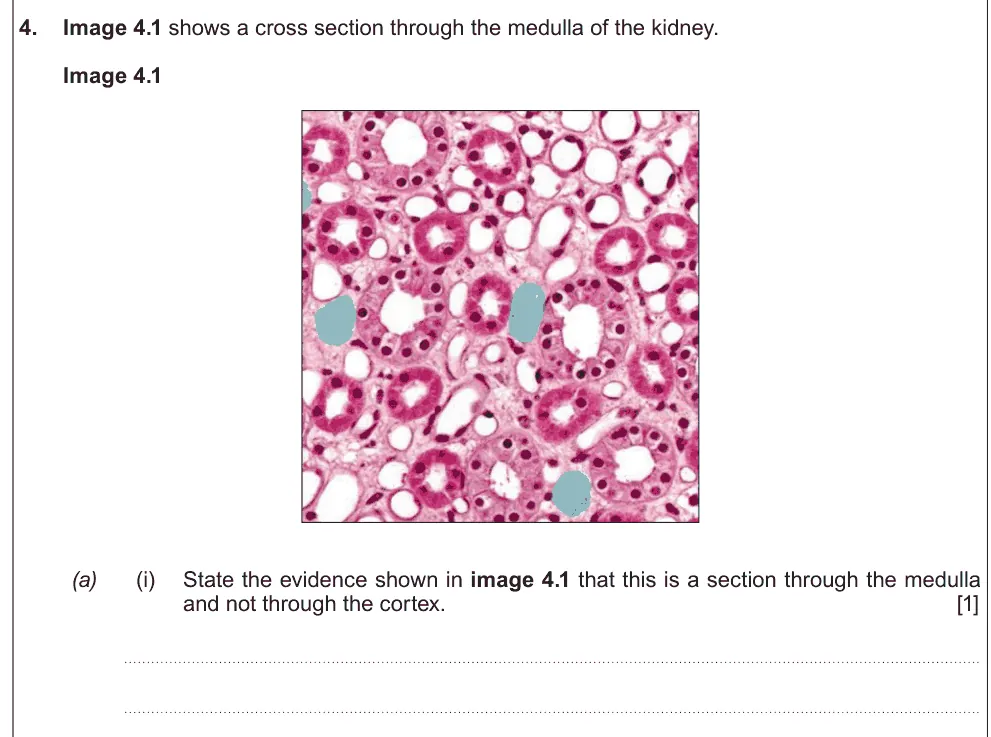
State the evidence that a kidney section is through the medulla, not the cortex.
Show the mark scheme

Tap an image to open it full size.
From the examiners' report: Many mixed up the medulla and cortex. There are no glomeruli or Bowman's capsules in the medulla.
Question 4
A level Component 3 · June 2019 · Q2(a)(i) · 1 mark · Hard
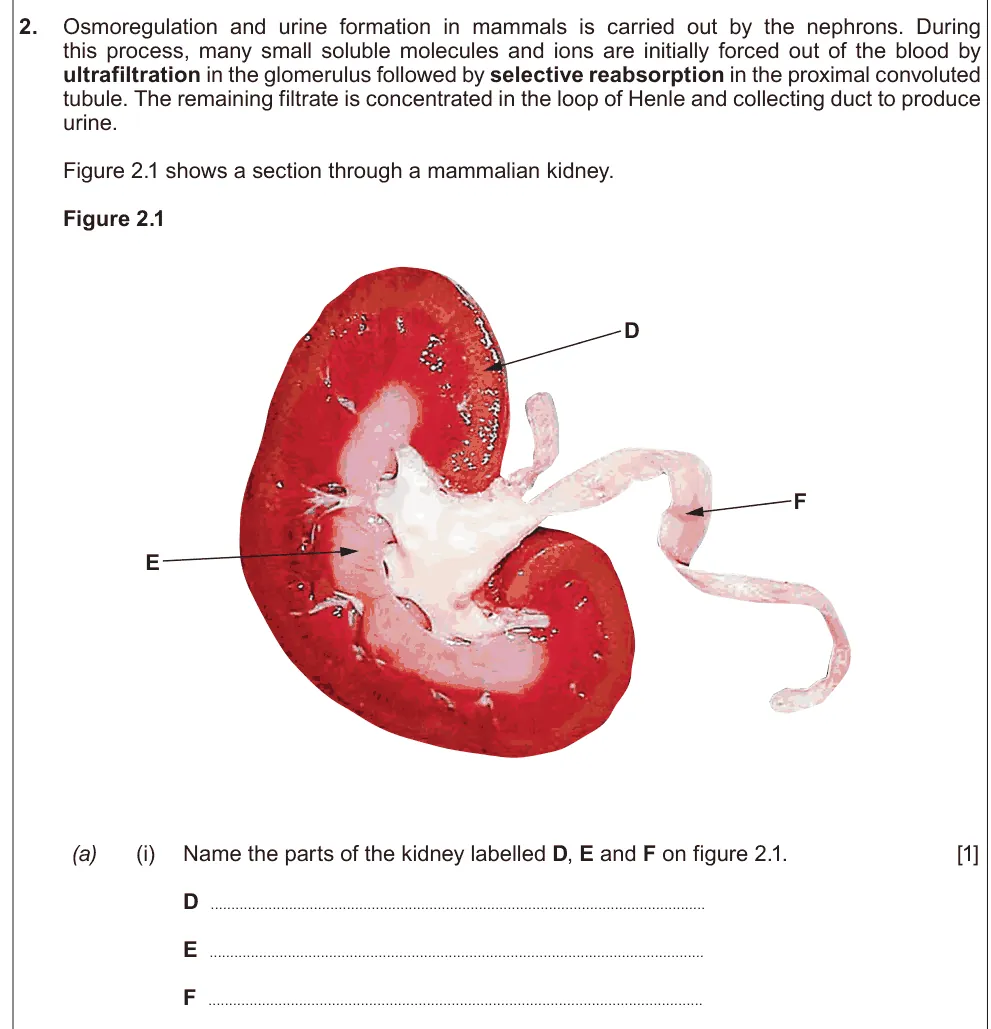
Name the parts labelled on a dissected kidney.
Show the mark scheme

Tap an image to open it full size.
From the examiners' report: Very few could apply nephron structure to the image of a dissected kidney.
Question 5
A level Component 3 · June 2019 · Q2(a)(ii) · 1 mark · Hard
Identify where ultrafiltration and selective reabsorption take place in the kidney.

Show the mark scheme

Tap an image to open it full size.
Question 6
A level Component 3 · June 2023 · Q1(b) · 3 marks
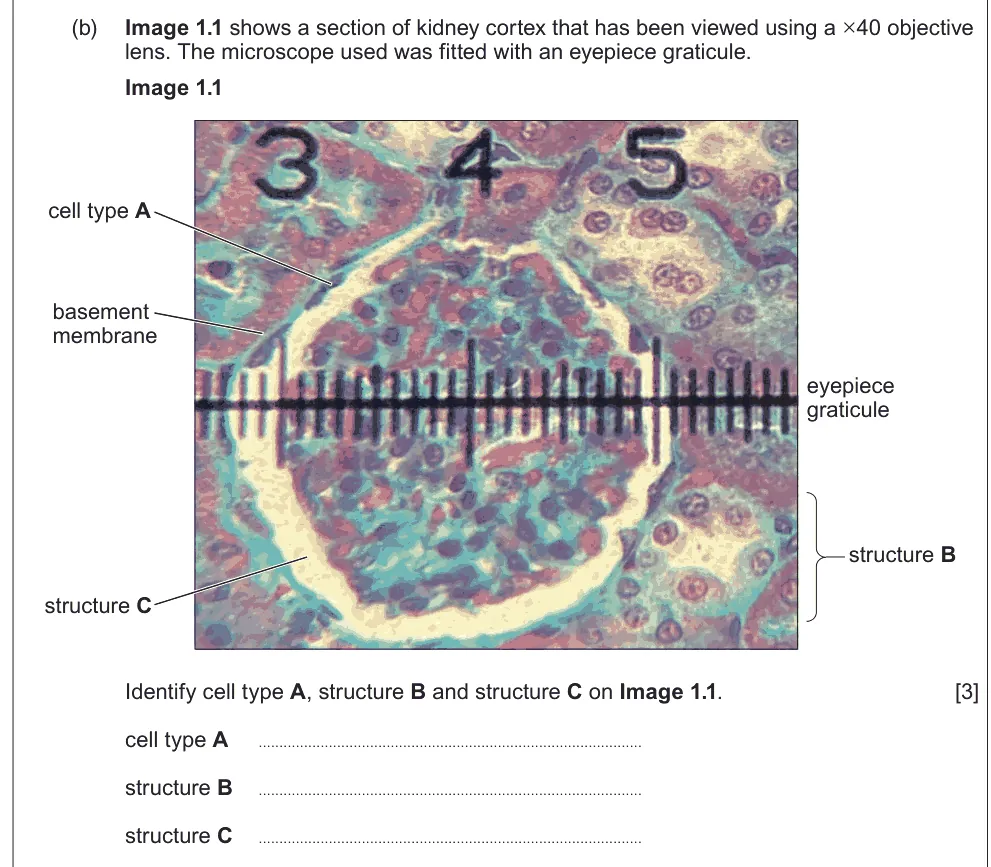
Identify the tissue and nephron structures labelled on a micrograph.
Show the mark scheme

Tap an image to open it full size.
Ultrafiltration
Question 7
A level Component 3 · June 2024 · Q5(b)(i) · 1 mark
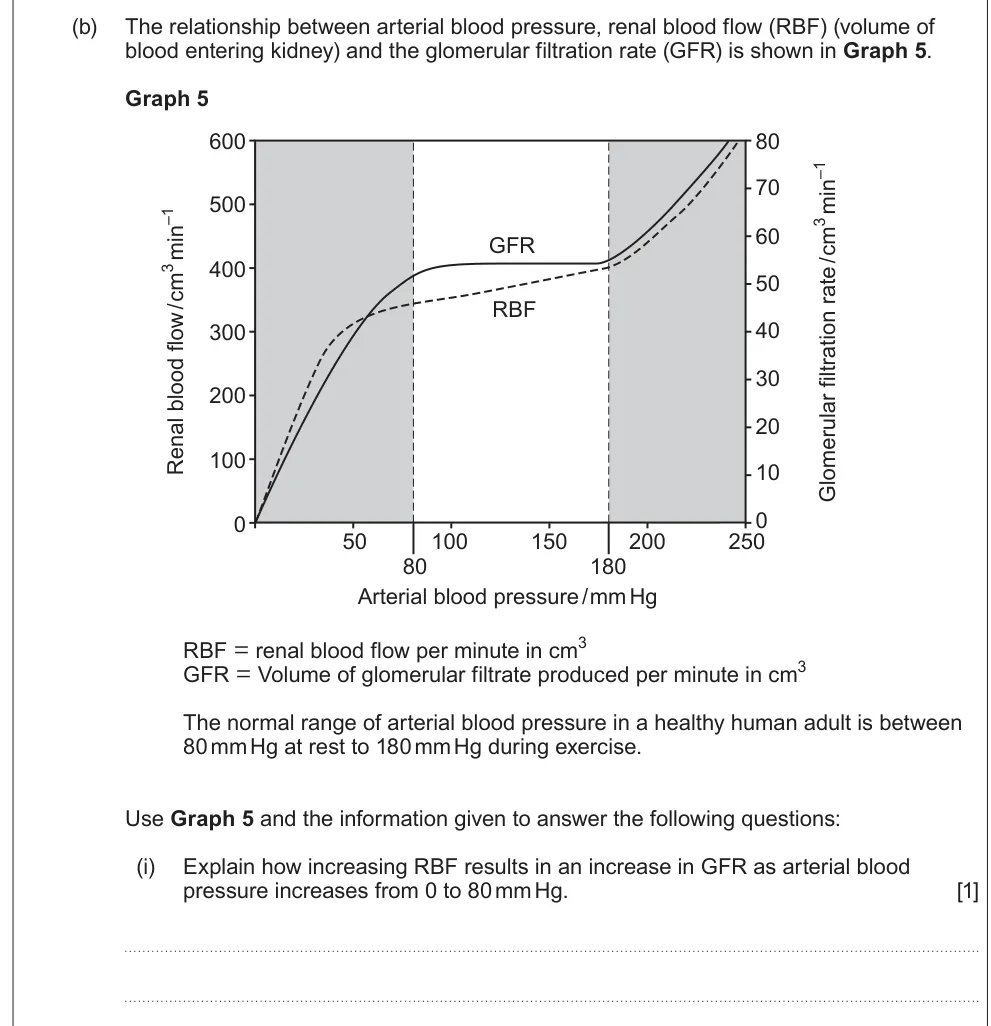
Explain how increasing renal blood flow increases the glomerular filtration rate.
Show the mark scheme

Tap an image to open it full size.
Question 8
A level Component 3 · June 2024 · Q5(b)(ii) · 2 marks
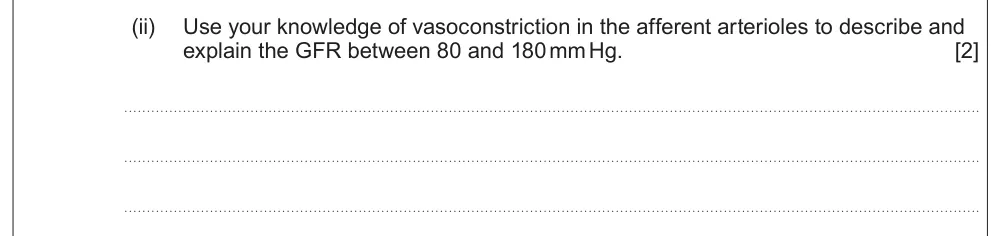
Describe and explain the glomerular filtration rate between 80 and 180 mm Hg.
Show the mark scheme

Tap an image to open it full size.
From the examiners' report: Very few gained both marks. Say GFR stays constant, then link it to vasoconstriction of the afferent arterioles.
Question 9
A level Component 3 · June 2024 · Q5(b)(iii) · 1 mark · Hard
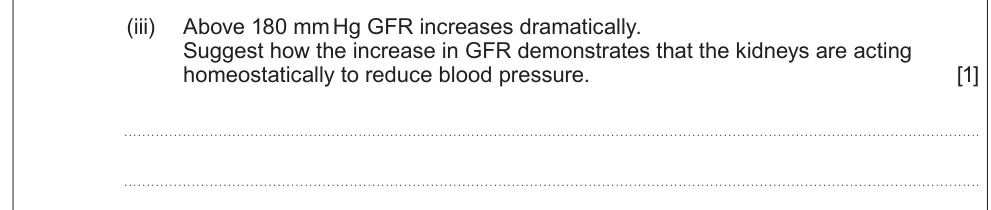
Suggest how a dramatic rise in GFR above 180 mm Hg lowers blood pressure.
Show the mark scheme

Tap an image to open it full size.
From the examiners' report: This proved very challenging. More water leaves the body in the urine, which reduces blood volume.
Question 10
A level Component 3 · June 2022 · Q4(b)(i) · 2 marks · Easy
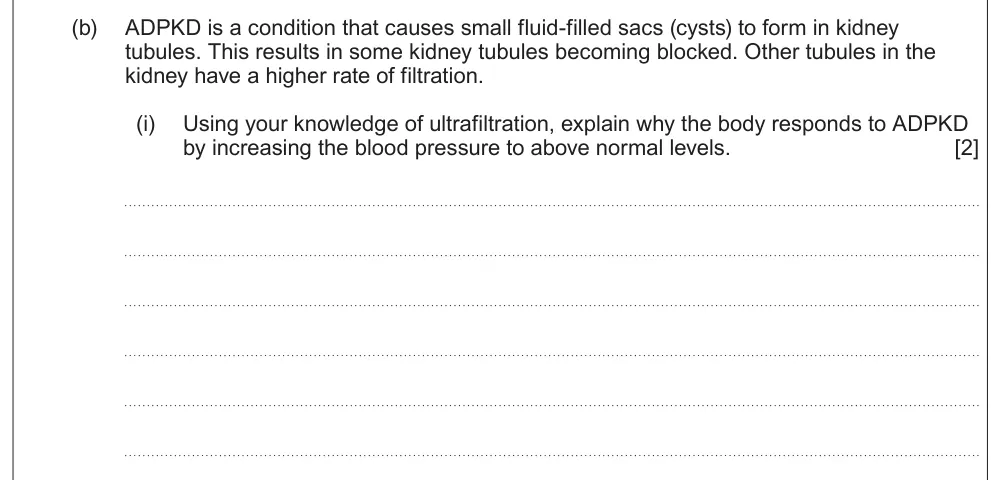
Explain why the body raises blood pressure when some kidney tubules are blocked.
Show the mark scheme

Tap an image to open it full size.
From the examiners' report: Many thought the extra pressure would force the cysts out. It raises filtration in the other tubules to compensate.
Selective reabsorption
Question 11
A level Component 3 · June 2019 · Q2(b)(i) · 2 marks
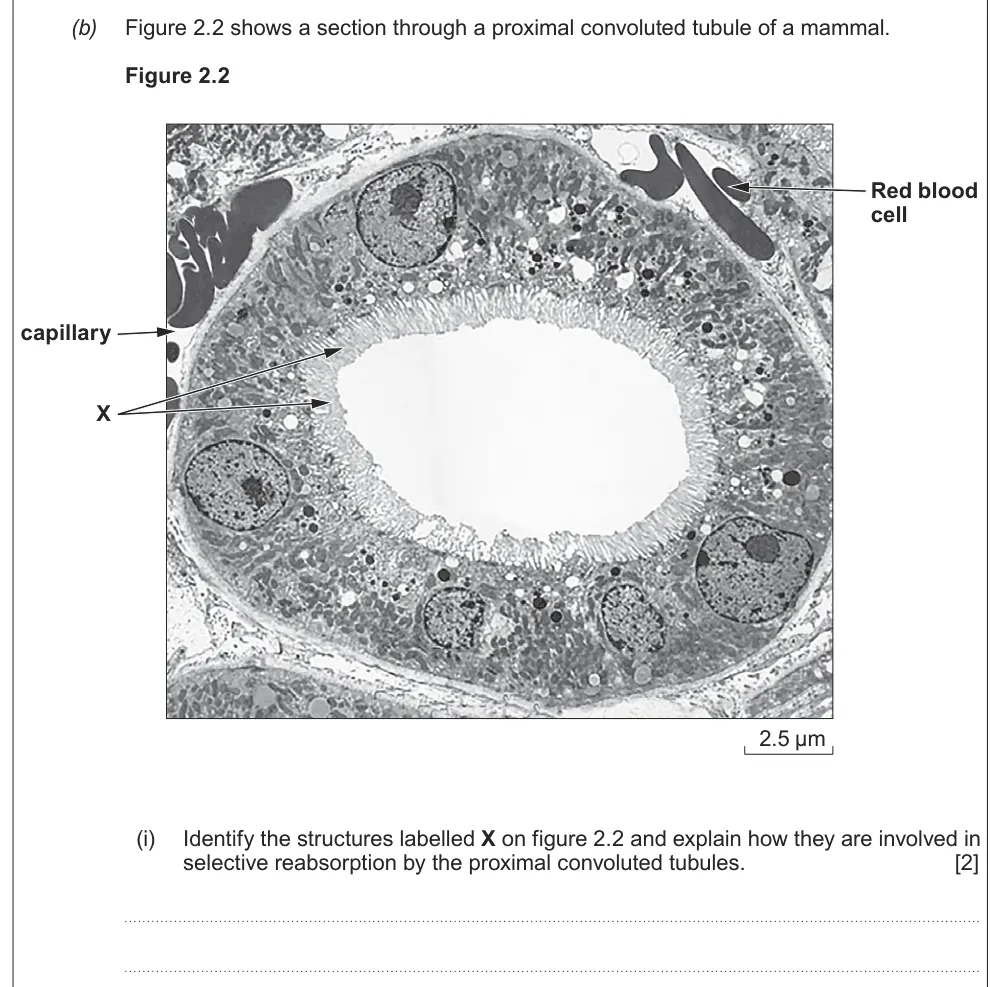
Identify the structures labelled X on a proximal convoluted tubule and explain their role.
Show the mark scheme

Tap an image to open it full size.
From the examiners' report: The main confusion was calling microvilli villi or cilia.
Question 12
A level Component 3 · June 2019 · Q2(b)(ii) · 1 mark
Explain how the capillaries increase the rate of selective reabsorption.
Show the mark scheme

Tap an image to open it full size.
Question 13
A level Component 3 · June 2017 · Q4(a)(ii) · 4 marks
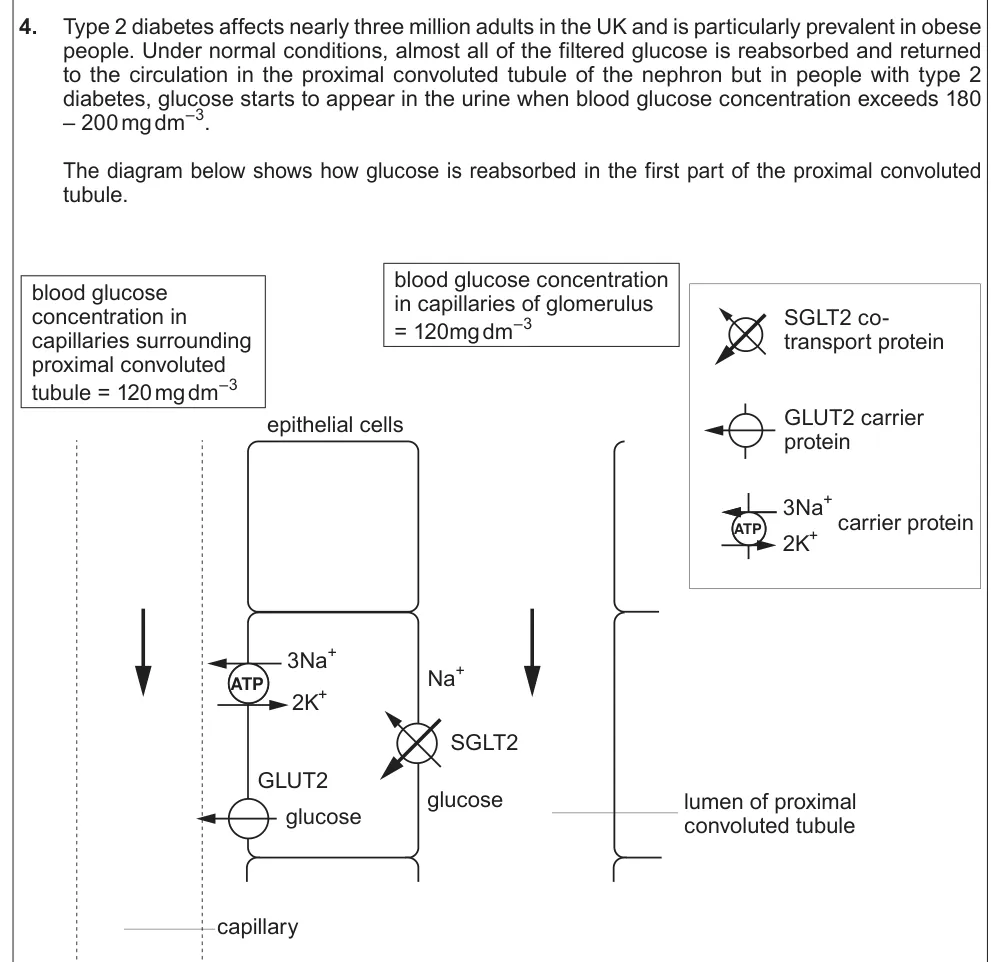
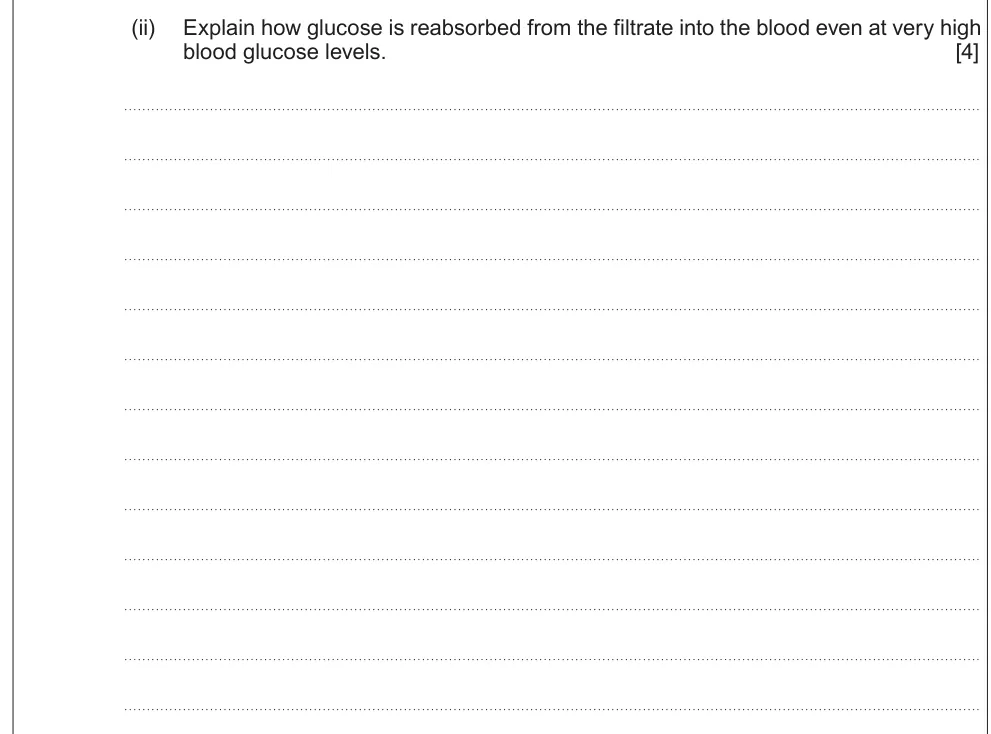
Explain how glucose is reabsorbed from the filtrate even at very high blood glucose levels.
Information from earlier in this question:
Show the mark scheme
Tap an image to open it full size.
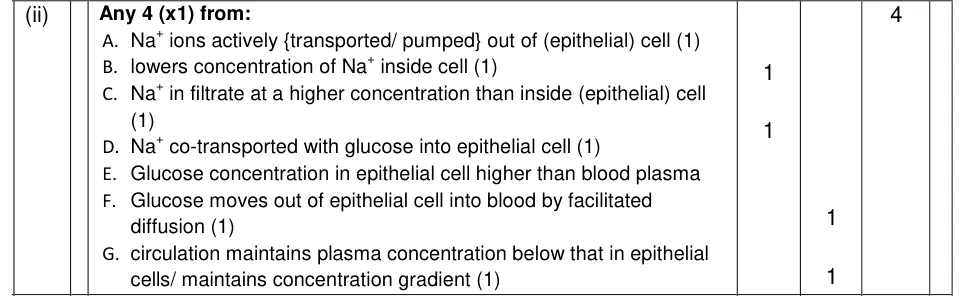
From the examiners' report: Give the steps in order: Na⁺ pumped out of the epithelial cell, Na⁺ and glucose co-transported in, then glucose diffuses into the blood.
Question 14
A level Component 3 · June 2017 · Q4(b)(i) · 2 marks
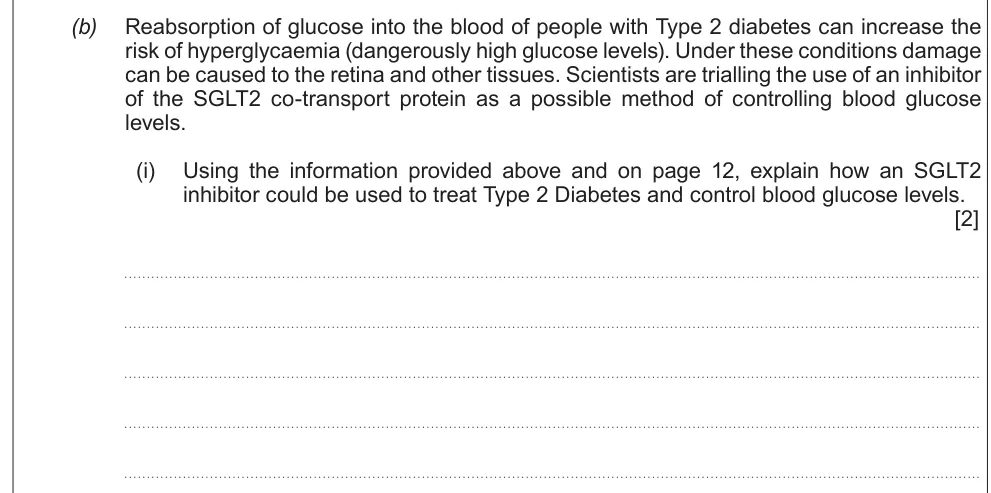
Explain how an SGLT2 inhibitor could help treat type 2 diabetes.
Show the mark scheme

Tap an image to open it full size.
Question 15
A level Component 3 · June 2023 · Q4(a)(i) · 2 marks · Easy
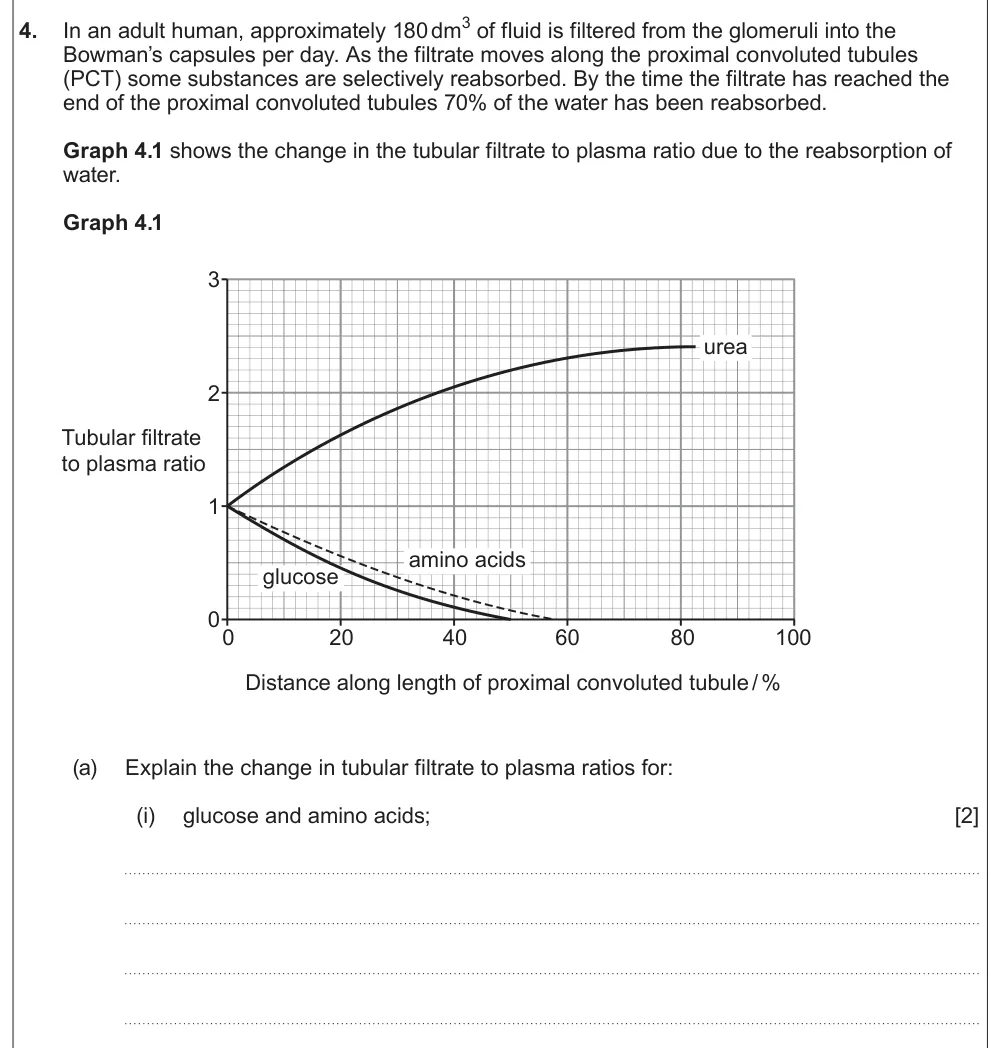
Explain the change in filtrate to plasma ratio for glucose and amino acids along the PCT.
Show the mark scheme

Tap an image to open it full size.
Question 16
A level Component 3 · June 2023 · Q4(a)(ii) · 2 marks
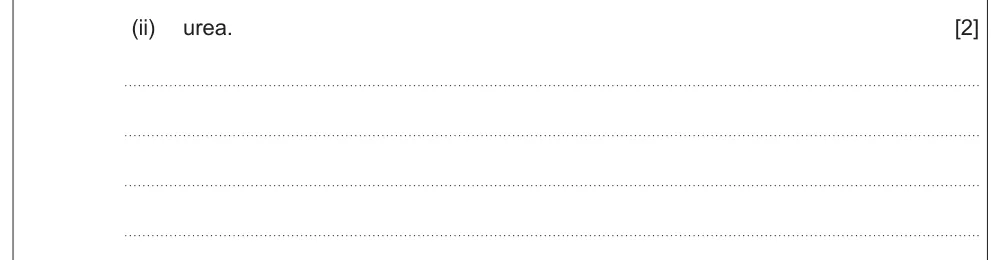
Explain the change in filtrate to plasma ratio for urea along the PCT.
Show the mark scheme

Tap an image to open it full size.
Question 17
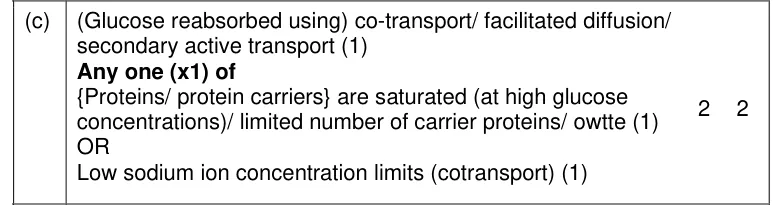
A level Component 3 · June 2023 · Q4(c) · 2 marks · Easy
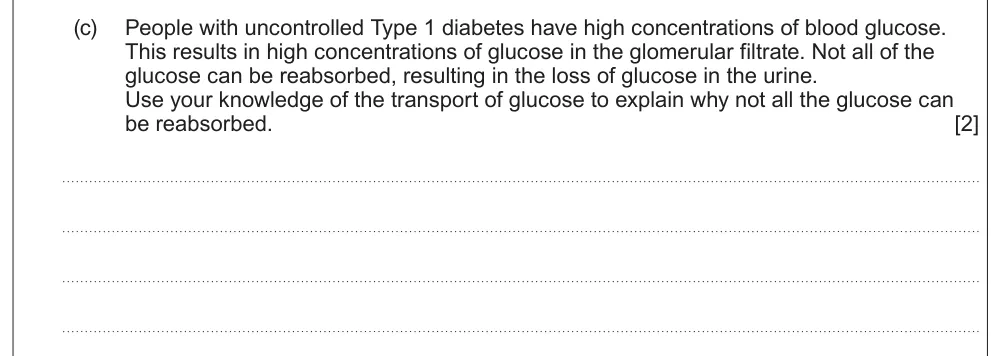
Explain why not all glucose can be reabsorbed when blood glucose is very high.
Show the mark scheme
Tap an image to open it full size.
From the examiners' report: Fewer said the carrier proteins become saturated at high glucose concentrations.
Question 18
A level Component 2 · June 2022 · Q4(c) · 1 mark
Suggest which part of the nephron is damaged if glucose, phosphate and amino acids are lost in urine.

Show the mark scheme

Tap an image to open it full size.
From the examiners' report: This showed a poor understanding of the kidney: only about 29% of the marks were scored. It is the proximal convoluted tubule.
ADH
Question 19
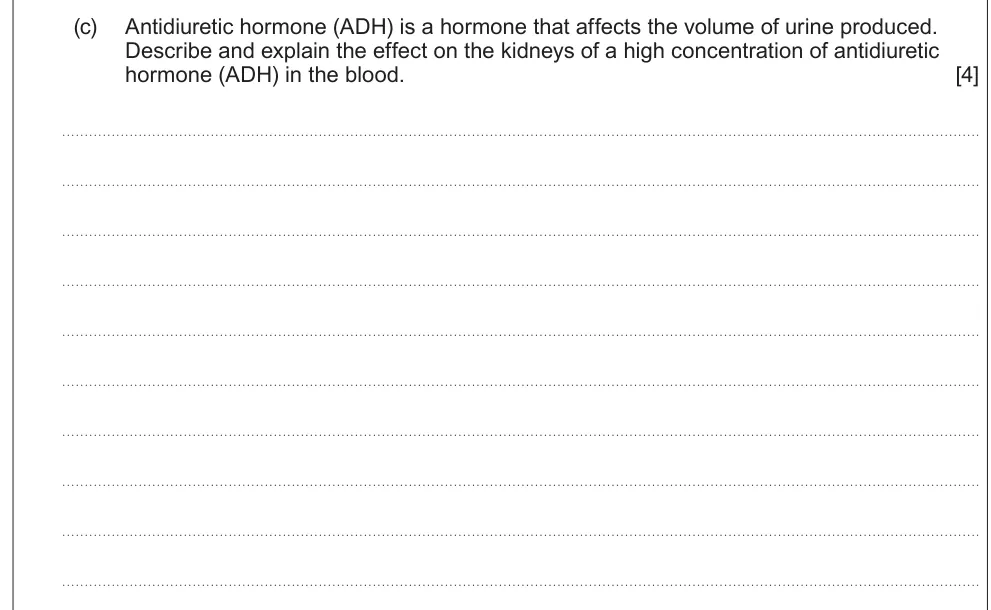
A level Component 3 · June 2024 · Q5(c) · 4 marks · Easy
Describe and explain the effect on the kidneys of a high concentration of ADH.
Show the mark scheme

Tap an image to open it full size.
The loop of Henle and excretion
Question 20
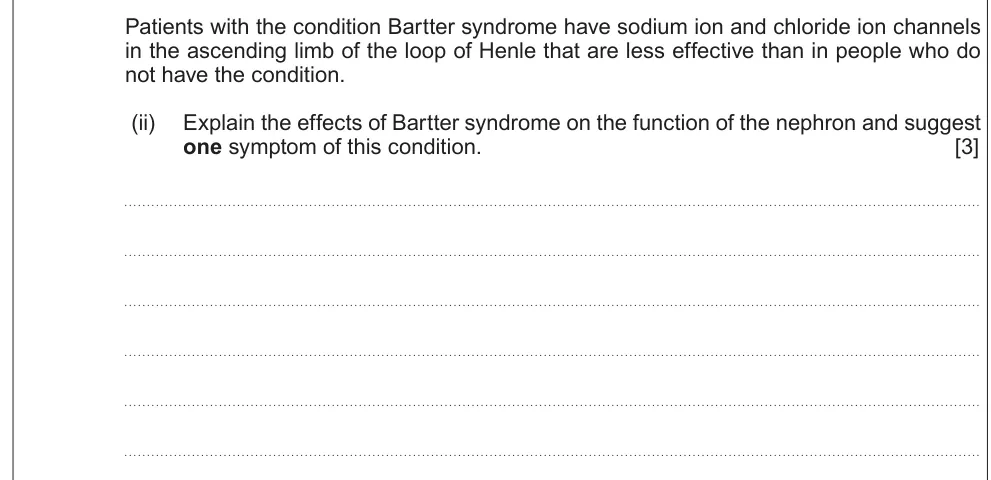
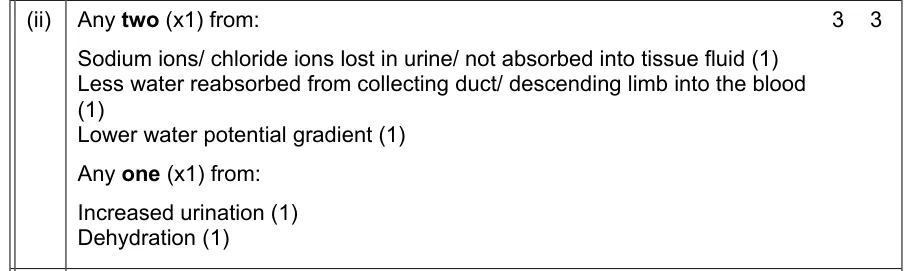
A level Component 3 · Autumn 2020 · Q4(a)(ii) · 3 marks
Explain the effects of faulty ion channels in the loop of Henle and suggest a symptom.
Show the mark scheme
Tap an image to open it full size.
Question 21
A level Component 3 · Autumn 2020 · Q4(c) · 3 marks
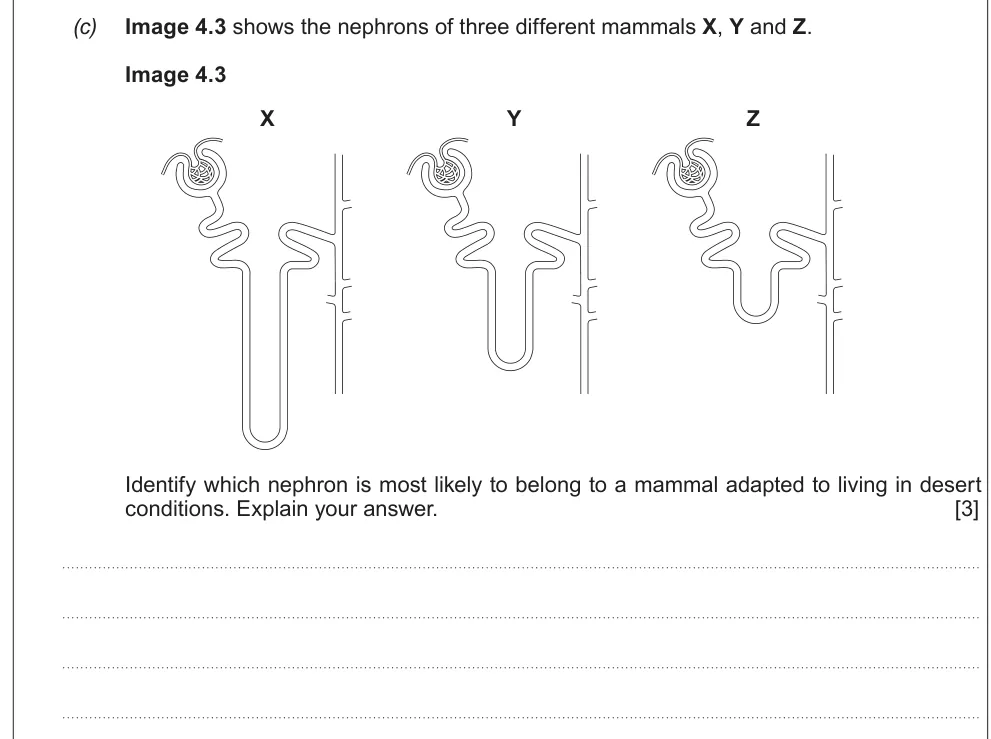
Identify the nephron most likely to belong to a desert mammal and explain why.
Show the mark scheme

Tap an image to open it full size.
Question 22
A level Component 3 · June 2025 · Q5(b)(i) · 1 mark · Easy
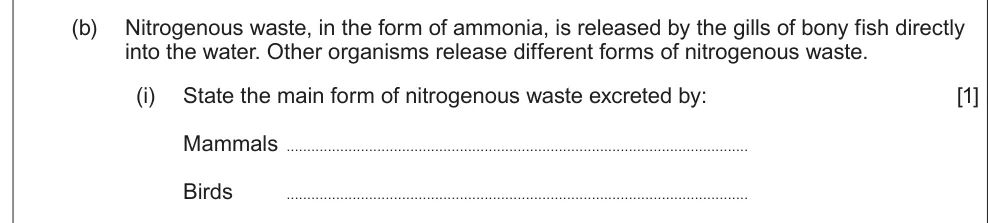
State the main nitrogenous waste of mammals and of birds.
Show the mark scheme

Tap an image to open it full size.
From the examiners' report: Some wrote ammonia, faeces or nitrogen for birds. Birds excrete uric acid.
Question 23
A level Component 3 · June 2025 · Q5(b)(iv) · 4 marks
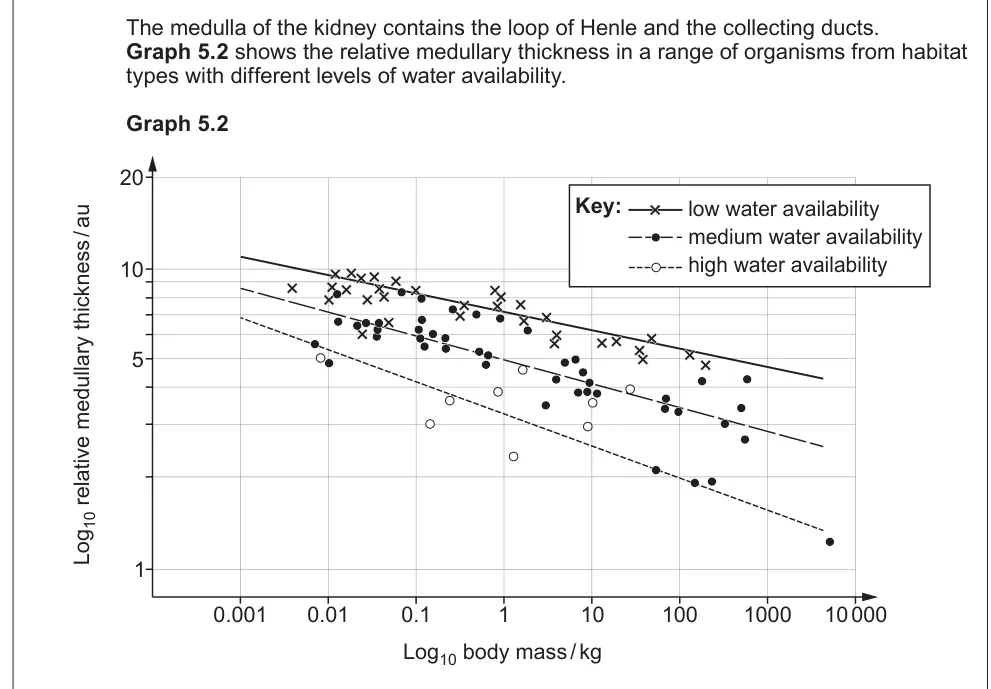
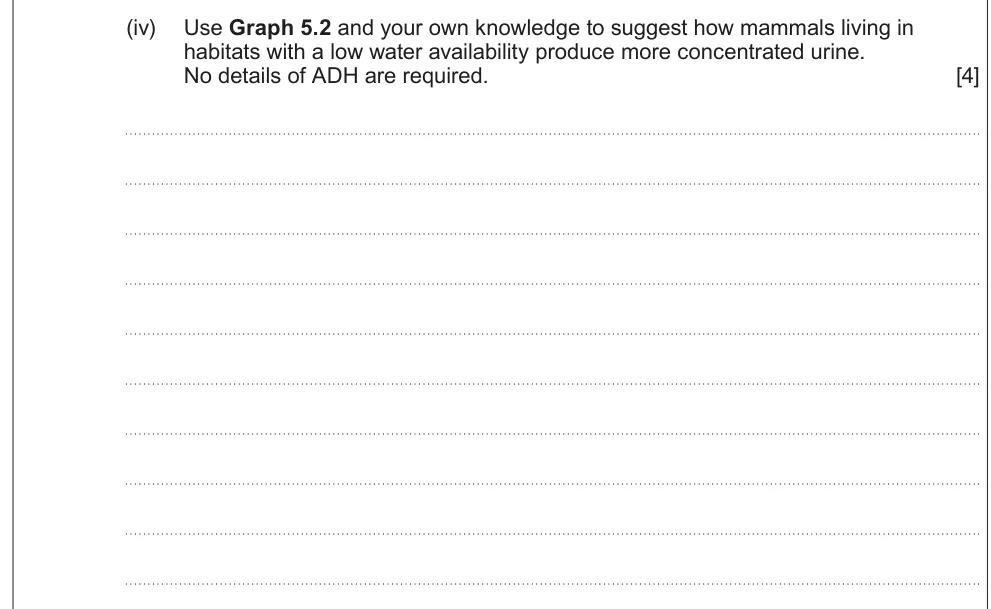
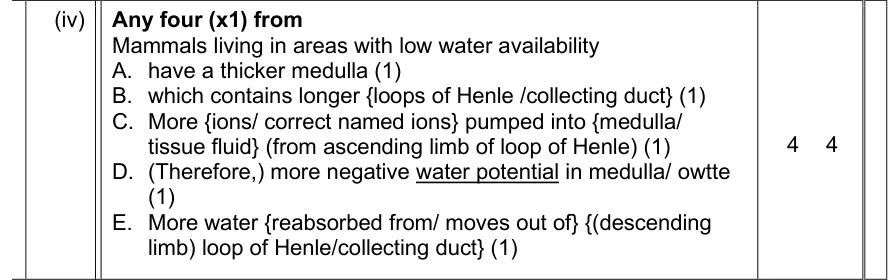
Suggest how mammals in dry habitats produce more concentrated urine.
Information from earlier in this question:
Show the mark scheme
Tap an image to open it full size.
From the examiners' report: Some wrote about ADH though it wasn't needed. Fewer said where the ions are pumped: into the tissue fluid of the medulla.
Where students lose marks (from Eduqas examiners' reports and mark schemes)
Each point below is followed by wording that gained marks.
Cortex or medulla: Many candidates mixed up the medulla and cortex.
✔ Gains credit: "No glomeruli / Bowman's capsules" in the medulla.
Saturated carriers: Fewer said the carriers would be saturated.
✔ Gains credit: "Protein carriers are saturated (at high glucose concentrations)".
Sodium first: The sequence of events in glucose reabsorption was often unclear.
✔ Gains credit: "Na⁺ ions actively pumped out of epithelial cell", then "Na⁺ co-transported with glucose".
Read the GFR graph: Very few gained both marks.
✔ Gains credit: "GFR stays constant even though RBF is increasing", "afferent arterioles vasoconstrict".
Microvilli, not villi: The main confusion was villi or cilia.
✔ Gains credit: "X = microvilli" (reject villi / cilia), "increase surface area".
Say where the ions go: Few explained the pumping of ions into the medulla.
✔ Gains credit: "More ions pumped into medulla / tissue fluid" so "more negative water potential in medulla".
Download the questions
Download the PDF pack (23 questions, mark schemes at the end)
Keep practising
- Adaptations for Gas Exchange (3.1): Eduqas A Level Biology exam questions by topic
- Transport in Animals (3.2): Eduqas A Level Biology exam questions by topic
- Transport in Plants (3.2): Eduqas A Level Biology exam questions by topic
- Adaptations for Nutrition (3.3): Eduqas A Level Biology exam questions by topic
- The Nervous System (3.5): Eduqas A Level Biology exam questions by topic
- Eduqas A level Biology past papers, mark schemes and examiners' reports
- Eduqas A level Biology grade boundaries
- Ask about Eduqas A level Biology lessons with Sam on WhatsApp
Questions, mark schemes and examiners' report extracts © WJEC CBAC Ltd (Eduqas).