

These three core practicals sit in Topics 7 and 8. In Core Practical 16 you measure the rate of respiration with a respirometer: soda lime or potassium hydroxide absorbs carbon dioxide, so the coloured liquid moves as oxygen is used, and you record the distance it travels in a set time. In Core Practical 17 you use spirometer traces to find tidal volume, breathing rate, respiratory minute ventilation and oxygen consumption, at rest and during exercise. In Core Practical 18 you repeat a stimulus, such as a touch or a tap, and record how the response declines as the organism habituates. These questions come from real Edexcel A level Biology A (Salters-Nuffield) papers. Core practicals can be examined on any paper, but Paper 3 tests practical skills most heavily. All the questions are from the A level papers (9BN0).
The examiners' reports return to the same problems. In spirometer calculations, many candidates used tidal volume instead of oxygen uptake, forgot to convert dm³ to cm³ or seconds to minutes, or wrote about breathing rate when the question asked for oxygen uptake. Describe how each value is read from the trace, not just what it is. In respirometer plans, say what absorbs the carbon dioxide and what you measure, and choose a sensible range of temperatures or times. For habituation, control the stimulus itself (its frequency, duration and strength), stay with the organism in the question, and say how you would check that habituation has happened.
Studying Edexcel SNAB and want more help? If you'd like to arrange one-to-one Edexcel tutoring, or to register your interest in an Edexcel group class, message Tom on WhatsApp using the link at the bottom of this page.
What you need first
Each question on this page assumes you're secure on these ideas. If any of them feels shaky, look it up before you start.
- Aerobic respiration uses oxygen and releases carbon dioxide; soda lime or potassium hydroxide absorbs carbon dioxide.
- Breathing rate and depth increase when the carbon dioxide concentration in the blood rises.
- During exercise, muscles need more ATP, and after exercise extra oxygen is used to convert lactate.
- Habituation is a type of learning: the response to a repeated, harmless stimulus decreases.
Key terms
These words come up in the questions and mark schemes. Examiners expect you to use them exactly.
- Respirometer: apparatus that measures the rate of respiration from the volume of oxygen taken up, shown by movement of a coloured liquid along a scale.
- Spirometer: apparatus that records the volume of air breathed in and out as a trace over time.
- Tidal volume: the volume of air breathed in or out in one breath, found from the peak-to-trough difference on a spirometer trace.
- Breathing rate: the number of breaths per minute, found by counting peaks or troughs on the trace in a set time.
- Respiratory minute ventilation: the volume of air breathed in per minute: tidal volume multiplied by breathing rate.
- Oxygen consumption: the fall in volume from one peak to a later one on a spirometer trace, divided by the time between them.
- Habituation: a decrease in response to a repeated stimulus that is neither harmful nor rewarding.
- Stimulus variables: the frequency, duration and strength of the stimulus, which must be controlled in a habituation investigation.
What these questions cover
Every question on this page is set on Core Practical 16 or Core Practical 17 or Core Practical 18 of the Pearson Edexcel A level Biology A (Salters-Nuffield) specification (9BN0).
- Core Practical 16: Investigate rate of respiration.
- Core Practical 17: Investigate the effects of exercise on tidal volume, breathing rate, respiratory minute ventilation and oxygen consumption using data from spirometer traces.
- Core Practical 18: Investigate habituation to a stimulus.
How to use this page
Write your answer on paper before you open the mark scheme. Allow about 1.2 minutes per mark: the 19 questions are worth 56 marks, so about 67 minutes in total. Then mark your answer strictly against the mark scheme and read the examiners' tip underneath it. If you'd rather print the questions, download the PDF pack.
Core Practical 16: how a respirometer works
Question 1
A level Paper 2 · June 2023 · Q6(b) · 2 marks
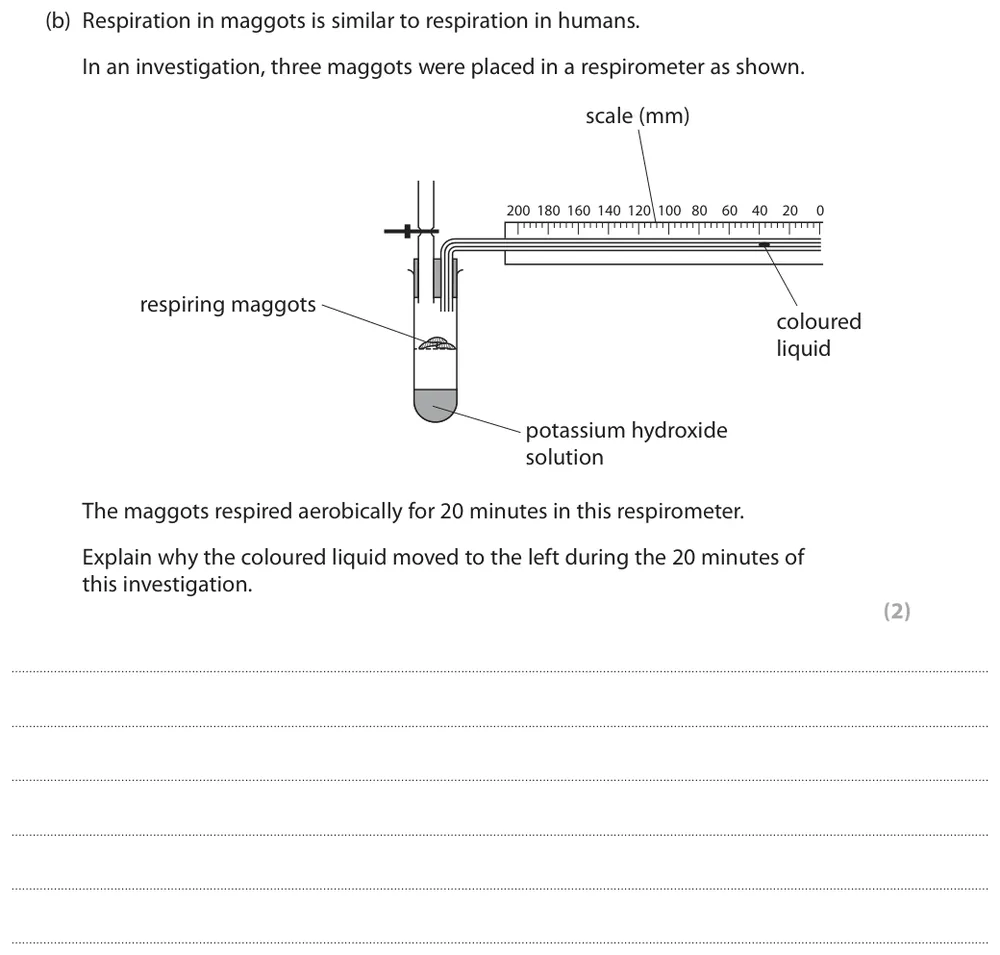
Explain why the coloured liquid in a maggot respirometer moved to the left.
Show the mark scheme
Tap an image to open it full size.
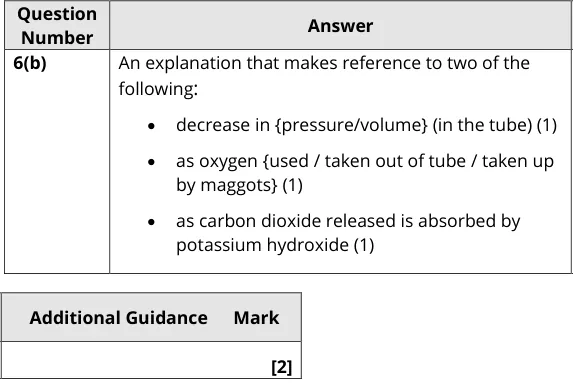
From the examiners' report: Many candidates had a thorough grasp of the respirometer. For both marks, link the fall in pressure or volume in the tube to oxygen being taken up by the maggots while the carbon dioxide they release is absorbed by the potassium hydroxide.
Core Practical 16: planning with a respirometer
Question 2
A level Paper 2 · June 2023 · Q6(c) · 5 marks
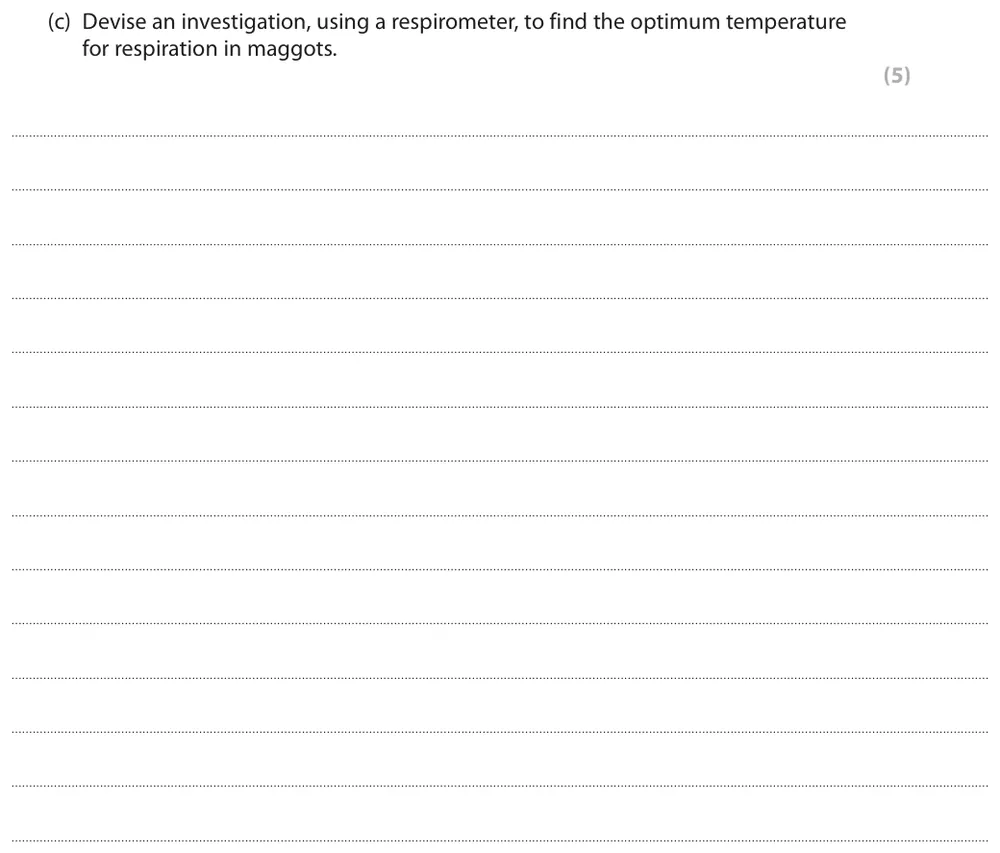
Devise an investigation, using a respirometer, to find the optimum temperature for respiration in maggots.
Show the mark scheme
Tap an image to open it full size.
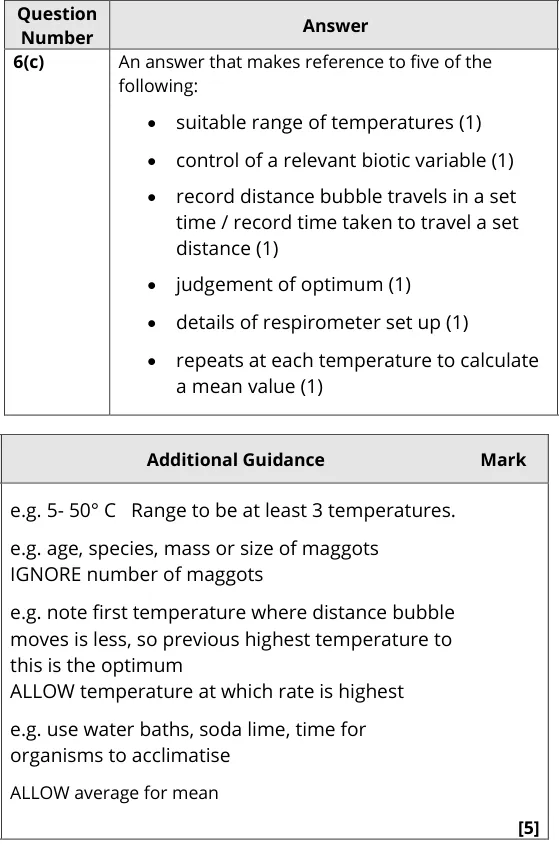
From the examiners' report: Some answers lacked precision, such as a temperature range that would not have been suitable. Use at least three temperatures across a sensible range, control a biotic variable such as the mass of the maggots, record the distance the bubble travels in a set time and repeat to calculate a mean.
Question 3
A level Paper 3 · June 2022 · Q6(c)(ii) · 3 marks
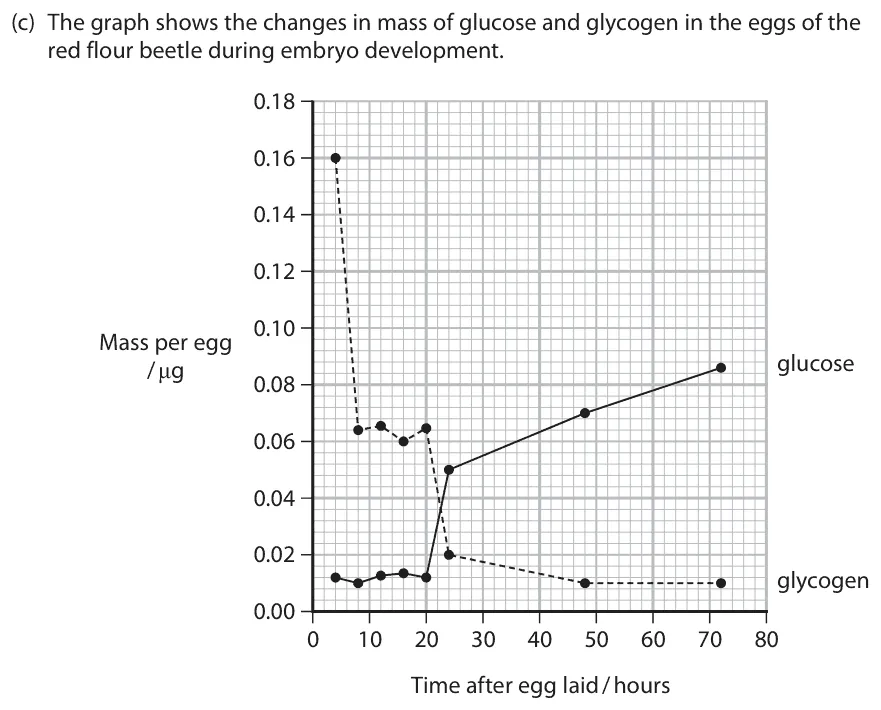
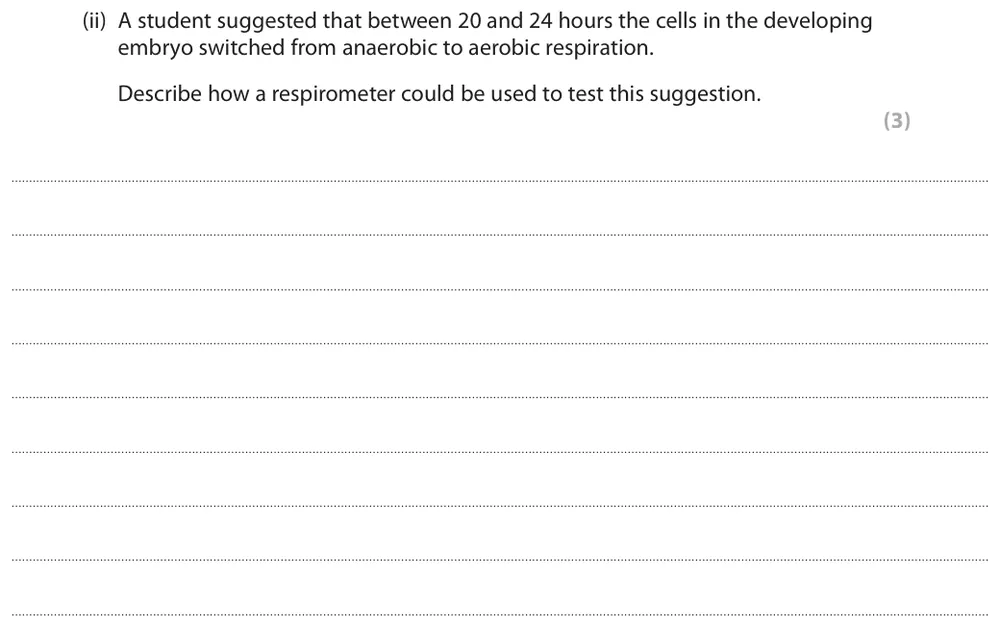
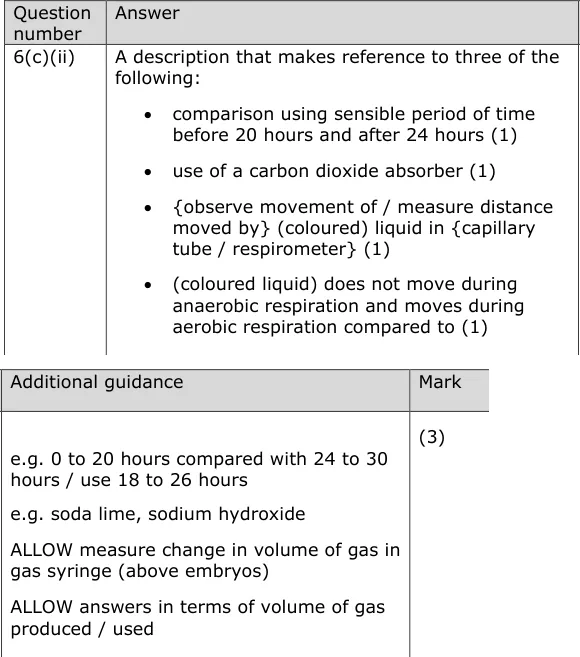
Describe how a respirometer could test whether embryo cells switch from anaerobic to aerobic respiration between 20 and 24 hours.
Information from earlier in this question:
Show the mark scheme
Tap an image to open it full size.
From the examiners' report: Many did not gain the first mark because they used the period 20 to 24 hours. The switch could happen at any point in that window, so compare a period before 20 hours with one after 24 hours.
Question 4
A level Paper 2 · June 2018 · Q7(b)(iii) · 4 marks
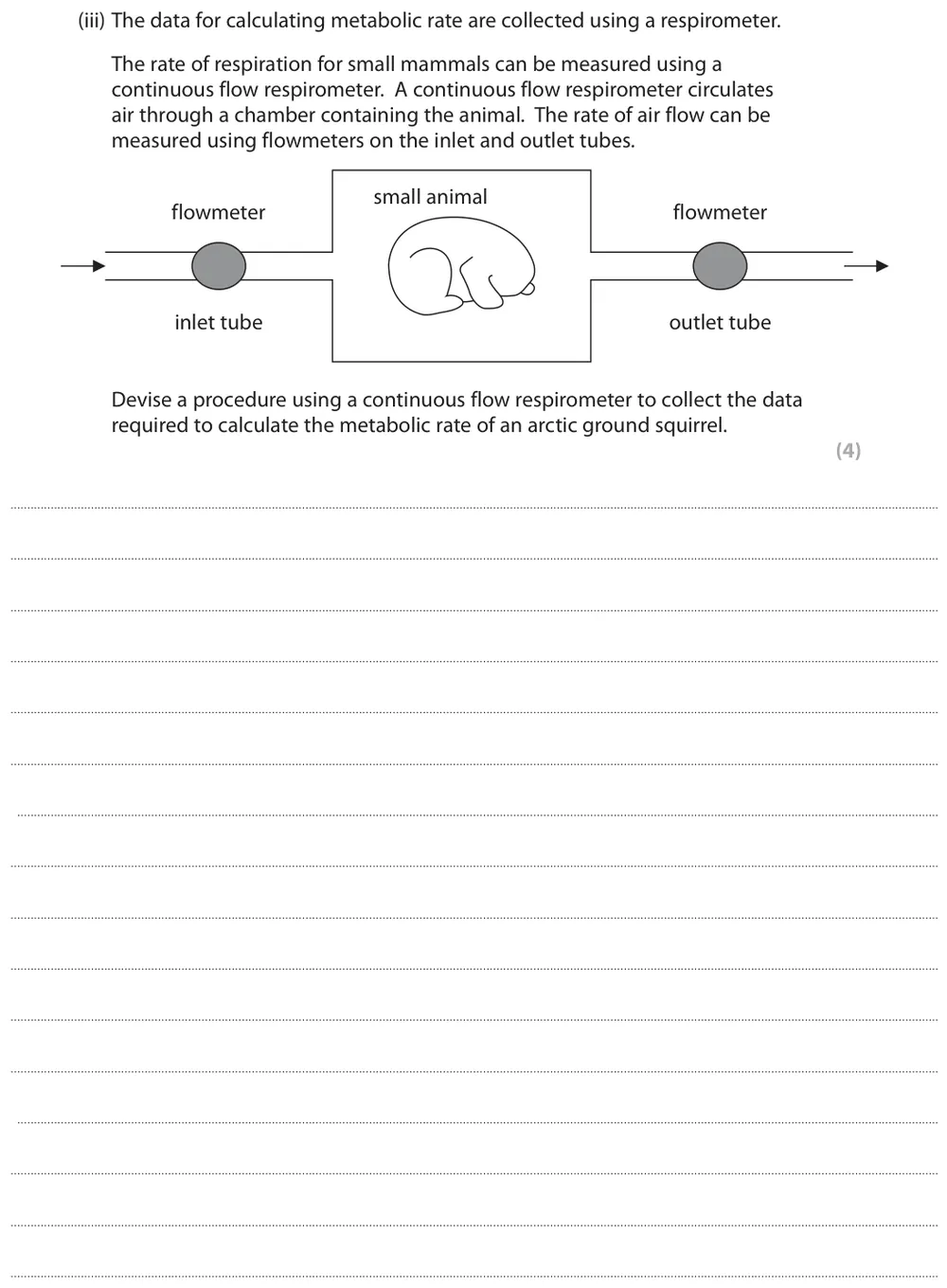
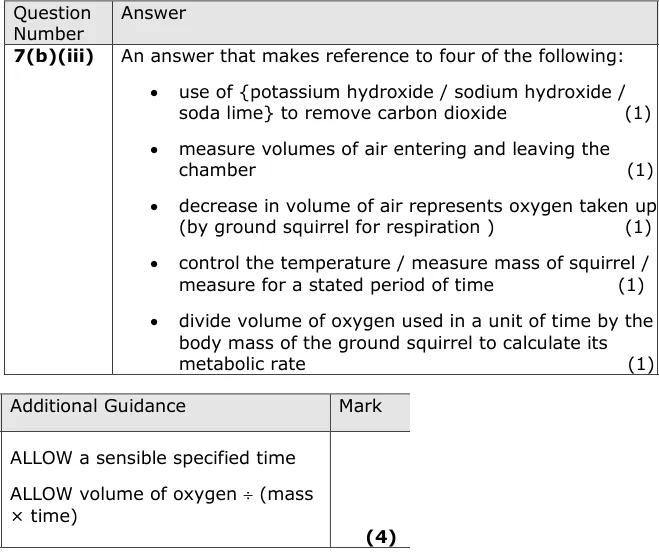
Devise a procedure using a continuous flow respirometer to collect the data needed to calculate the metabolic rate of an arctic ground squirrel.
Show the mark scheme
Tap an image to open it full size.
From the examiners' report: Very few gained more than 2 marks. Most repeated the information and said they would measure the rate of flow: use it to find the volumes of air entering and leaving the chamber, as the decrease in volume is the oxygen taken up once carbon dioxide is removed.
Core Practical 17: using spirometer traces
Question 5
A level Paper 2 · June 2025 · Q2(a) · 3 marks
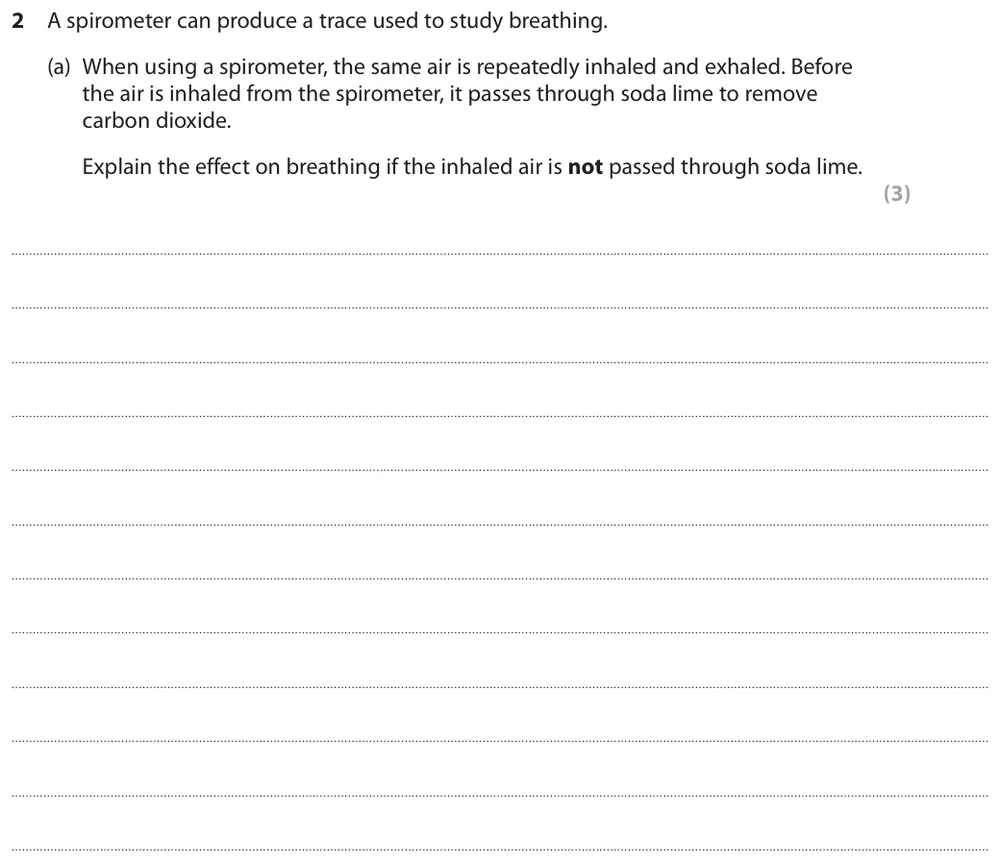
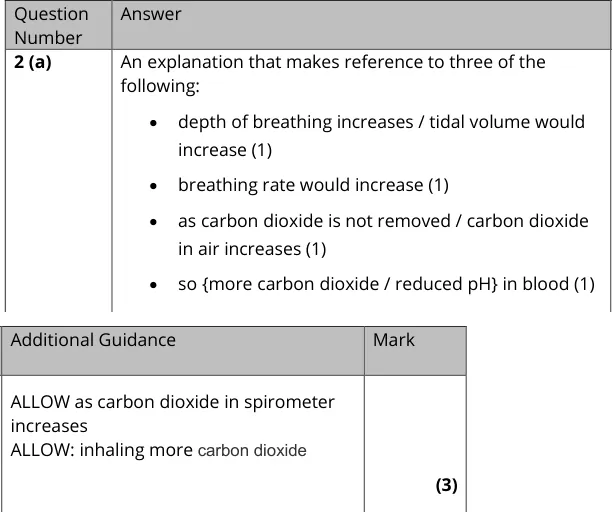
Explain the effect on breathing if the air inhaled from a spirometer is not passed through soda lime.
Show the mark scheme
Tap an image to open it full size.
From the examiners' report: Strong answers explained how breathing is controlled: without soda lime, carbon dioxide builds up in the air and then in the blood, so breathing rate and tidal volume increase.
Question 6
A level Paper 2 · October 2020 · Q2(a) · 4 marks
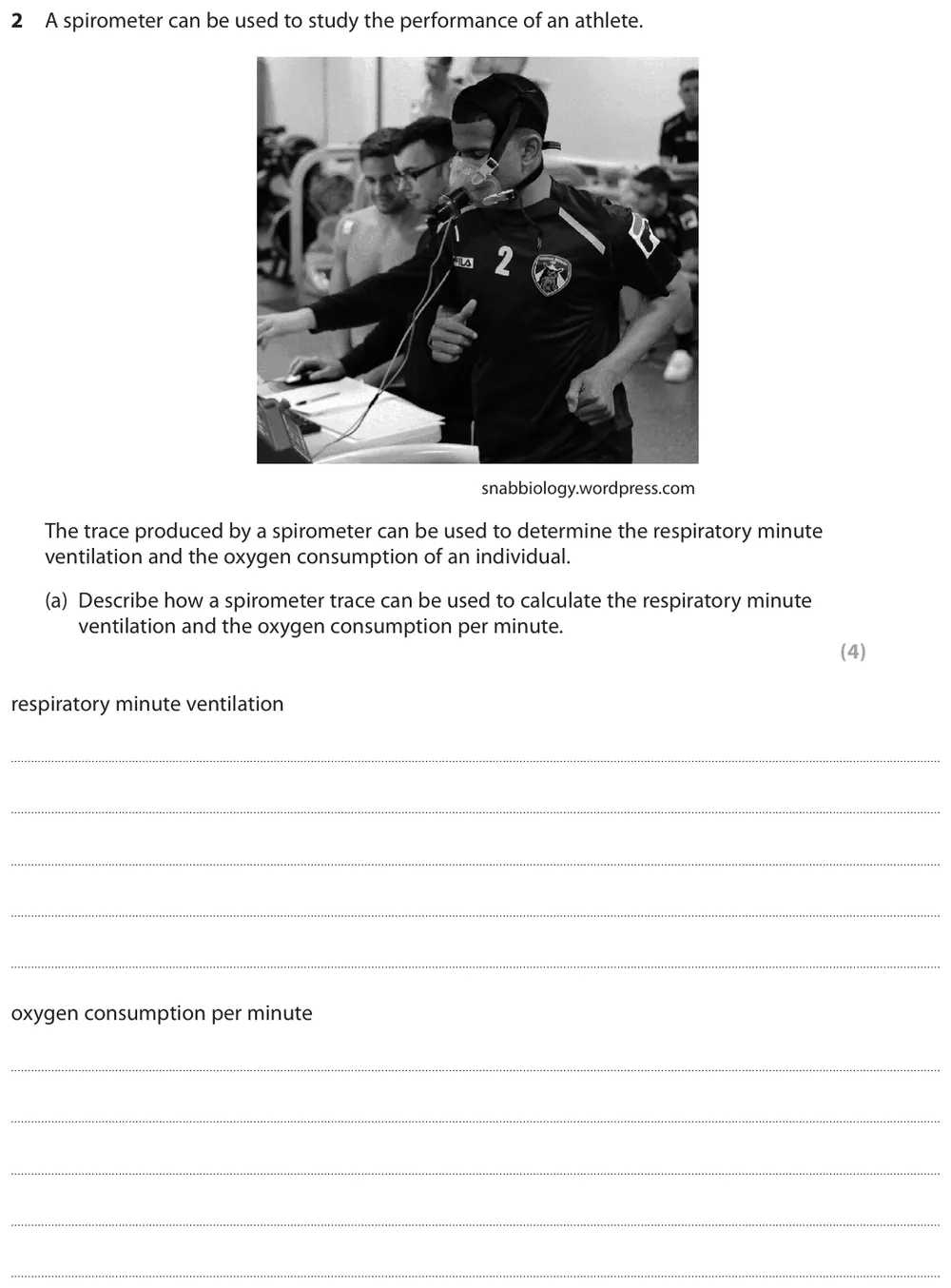
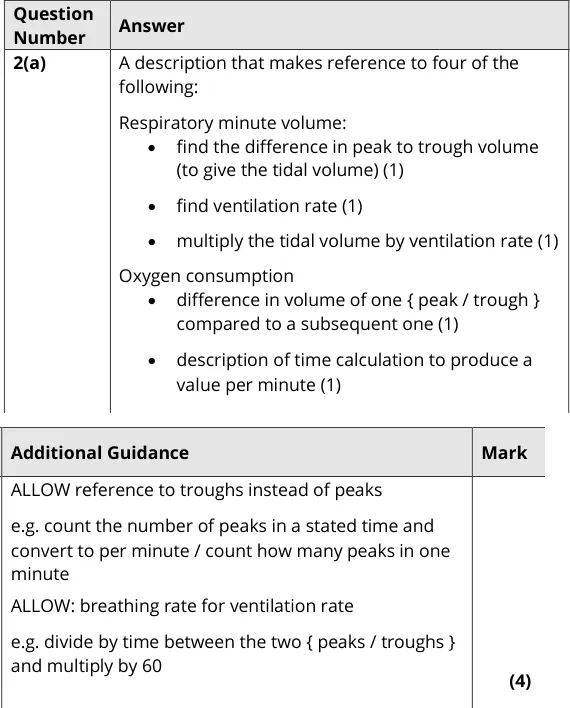
Describe how a spirometer trace can be used to calculate respiratory minute ventilation and oxygen consumption per minute.
Show the mark scheme
Tap an image to open it full size.
From the examiners' report: Many did not describe how to do the calculations or did not use the trace. Stating a breathing rate gained no credit: say how to find it from the trace, and find oxygen consumption from the difference between one peak and a later one, converted to a value per minute.
Question 7
A level Paper 2 · October 2020 · Q2(b) · 2 marks
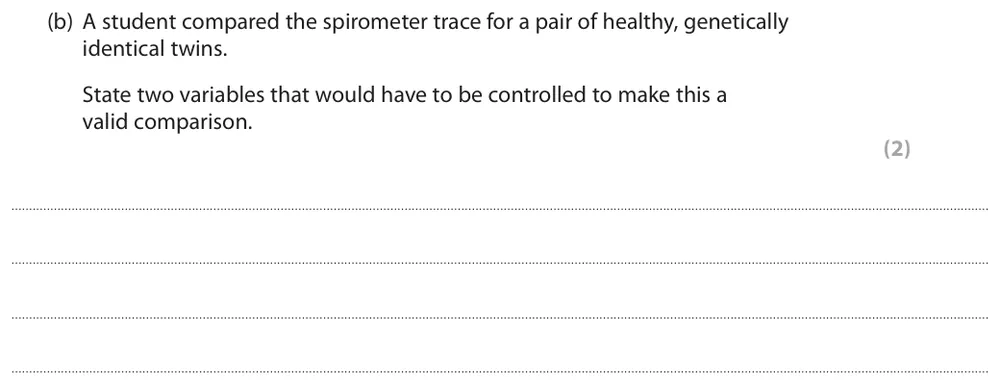
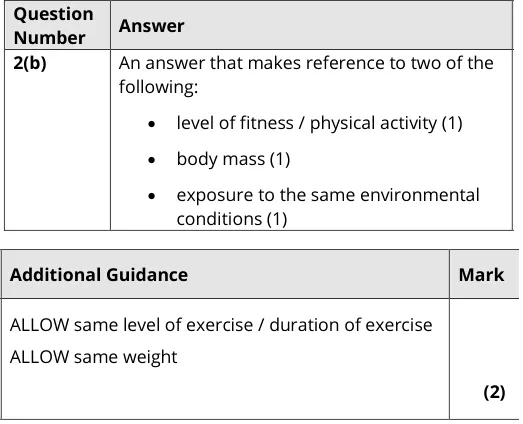
State two variables to control when comparing the spirometer traces of identical twins.
Show the mark scheme
Tap an image to open it full size.
Core Practical 17: calculating oxygen consumption
Question 8
A level Paper 2 · June 2017 · Q3(b)(iv) · 3 marks
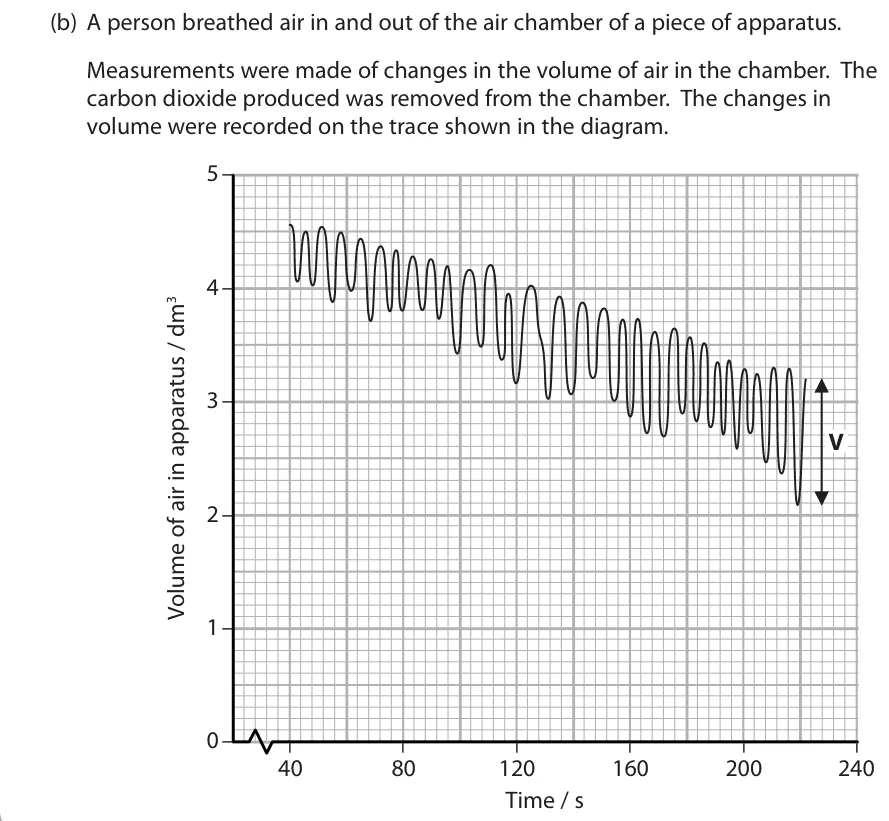
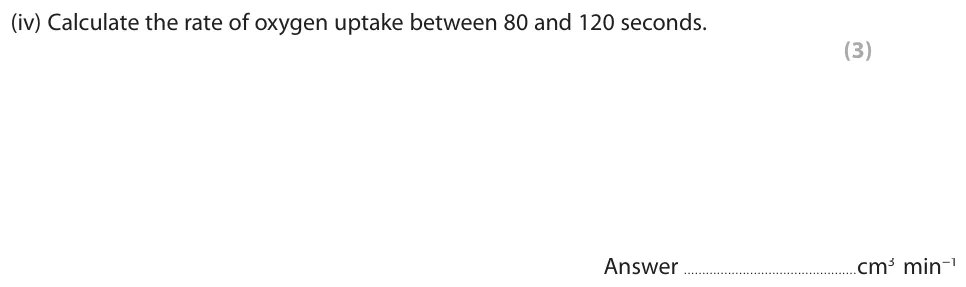
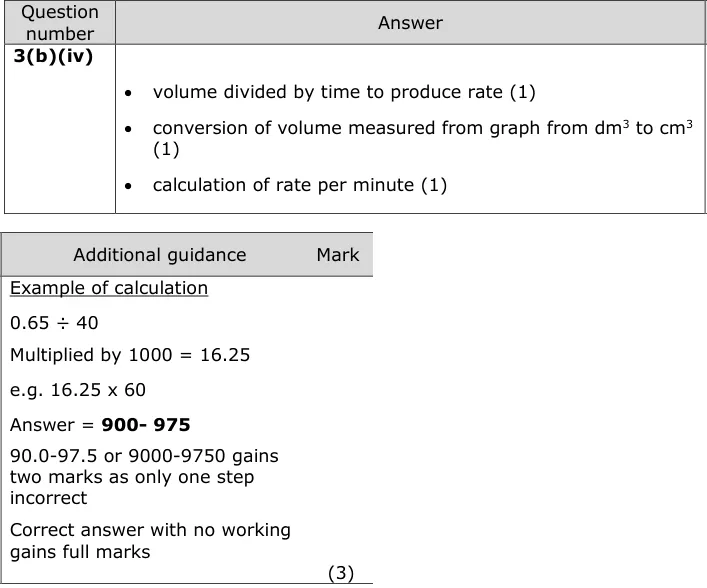
Calculate the rate of oxygen uptake from a spirometer trace between 80 and 120 seconds.
Information from earlier in this question:
Show the mark scheme
Tap an image to open it full size.
From the examiners' report: Almost two thirds of candidates scored nothing. Carbon dioxide was removed, so the fall in volume is oxygen uptake, not tidal volume; convert dm³ to cm³ and seconds to minutes to match the units on the answer line.
Question 9
A level Paper 3 · June 2019 · Q3(a) · 2 marks · Hard
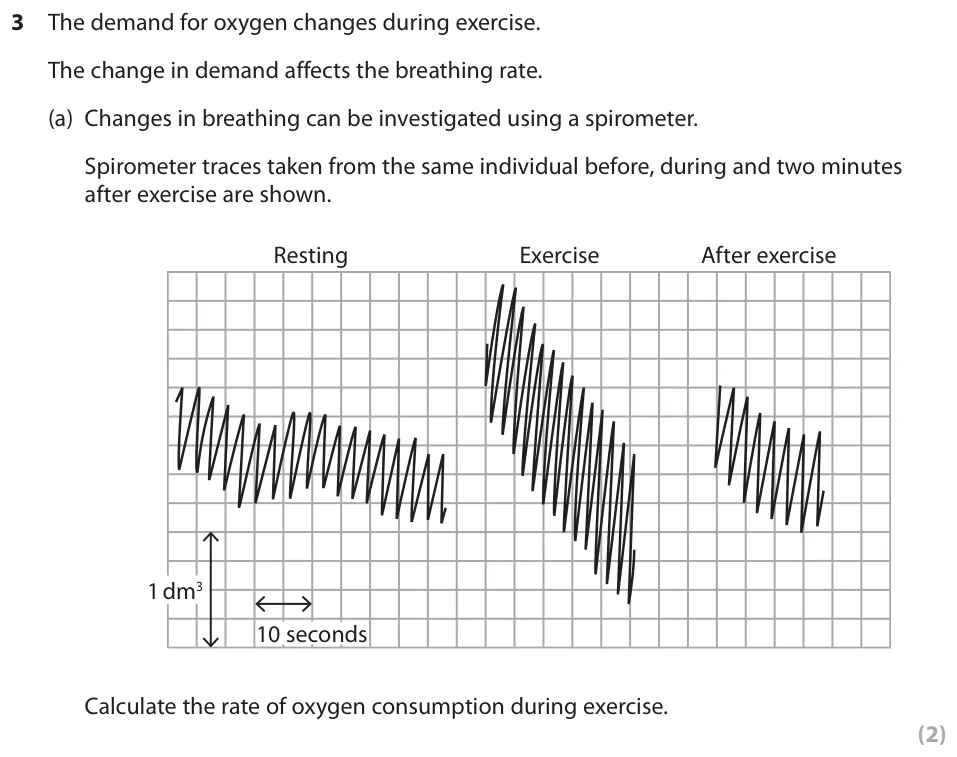
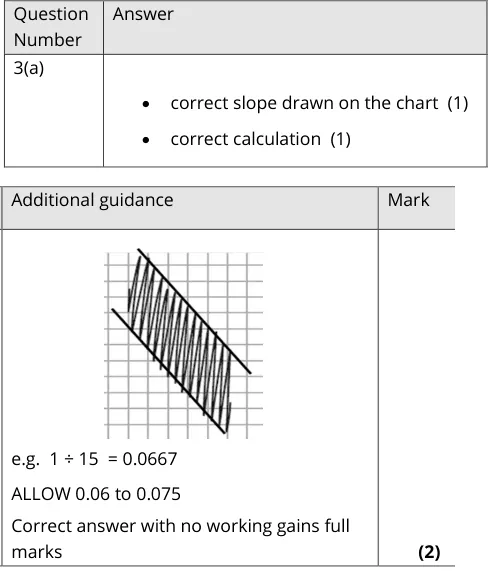
Calculate the rate of oxygen consumption during exercise from a spirometer trace.
Show the mark scheme
Tap an image to open it full size.
From the examiners' report: Many candidates struggled with this calculation. Draw the slope on the trace and divide the fall in volume by the time it took.
Question 10
A level Paper 3 · June 2019 · Q3(b) · 4 marks
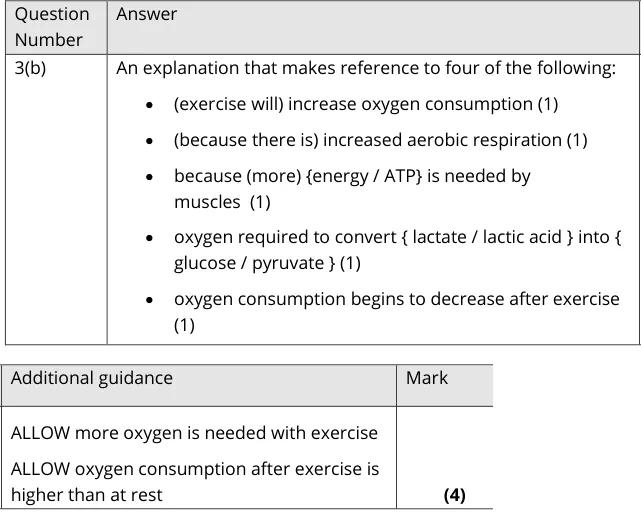
Explain the effect of exercise on the changes in oxygen consumption.

Show the mark scheme
Tap an image to open it full size.
From the examiners' report: Say 'aerobic' respiration, and that the ATP is needed by the muscles. 'Oxygen is required to break down lactate' was not accepted: link oxygen to converting lactate into pyruvate or glucose.
Core Practical 17: planning with a spirometer
Question 11
A level Paper 2 · June 2022 · Q5(b)(i) · 4 marks
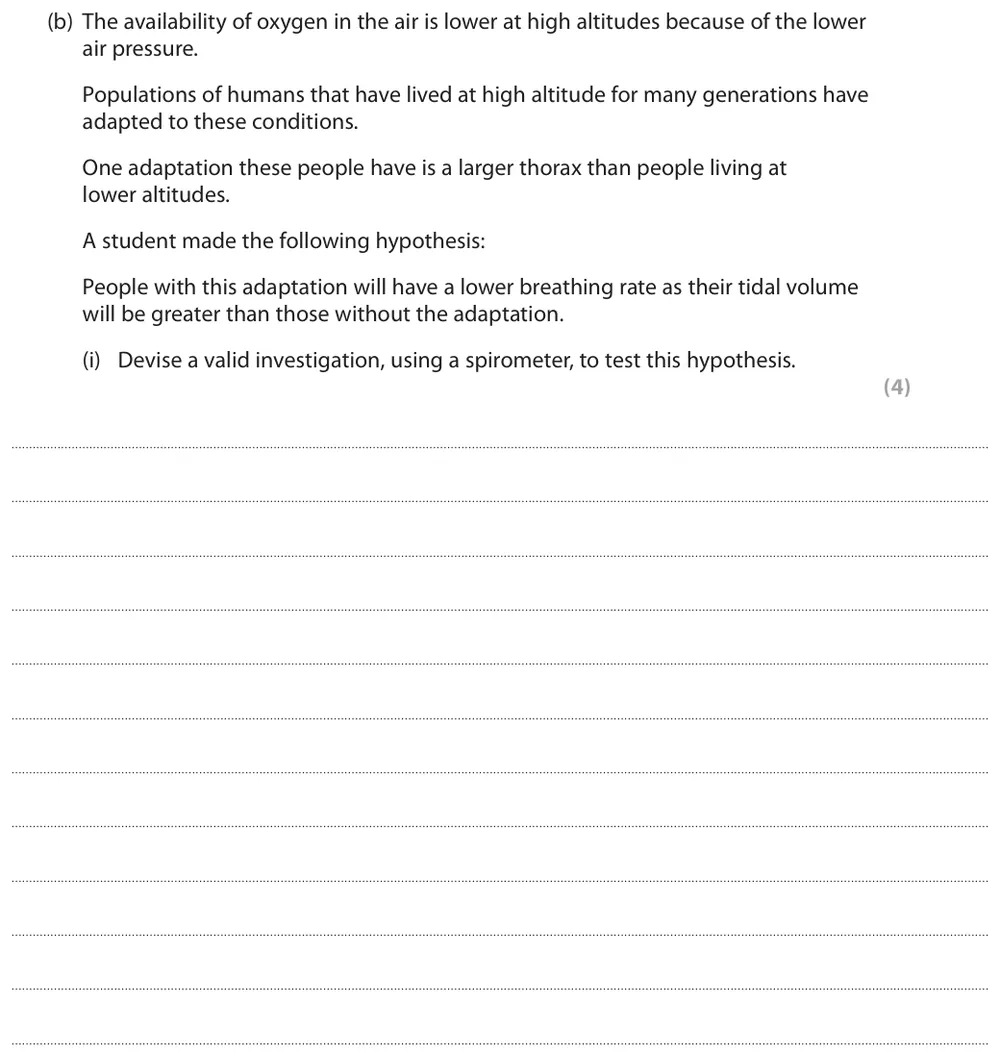
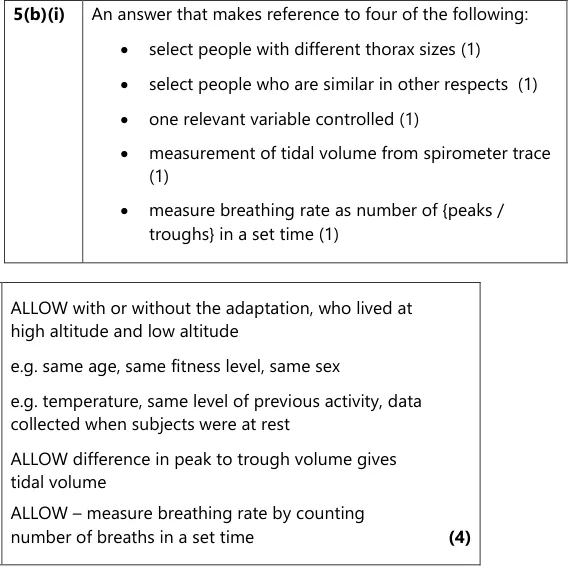
Devise a valid investigation, using a spirometer, to test whether people with a larger thorax have a lower breathing rate.
Show the mark scheme
Tap an image to open it full size.
From the examiners' report: Many answers focused on selecting the participants. Fewer described how to find tidal volume (peak-to-trough difference) and breathing rate (peaks in a set time) from the spirometer trace.
Question 12
A level Paper 2 · June 2025 · Q2(b)(iii) · 3 marks
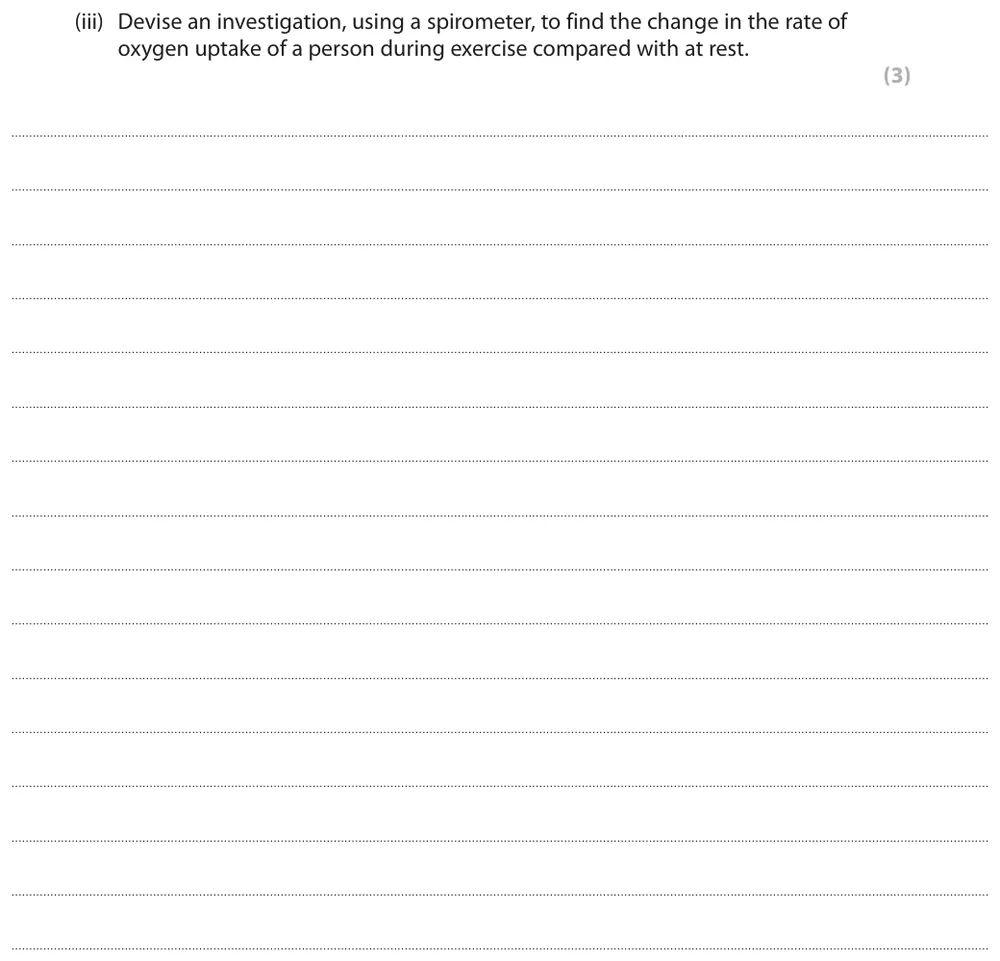
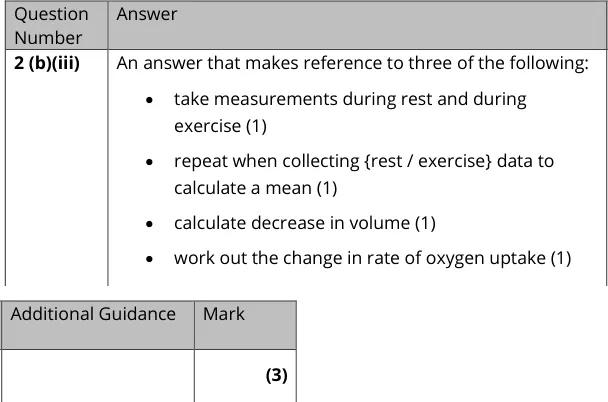
Devise an investigation, using a spirometer, to find the change in rate of oxygen uptake during exercise compared with at rest.
Show the mark scheme
Tap an image to open it full size.
From the examiners' report: Many limited their answers to breathing rate. Describe how to find oxygen uptake: calculate the decrease in volume on the trace at rest and during exercise, with repeats to calculate a mean.
Core Practical 18: stimulus variables and results
Question 13
A level Paper 3 · June 2025 · Q2(b)(i) · 1 mark
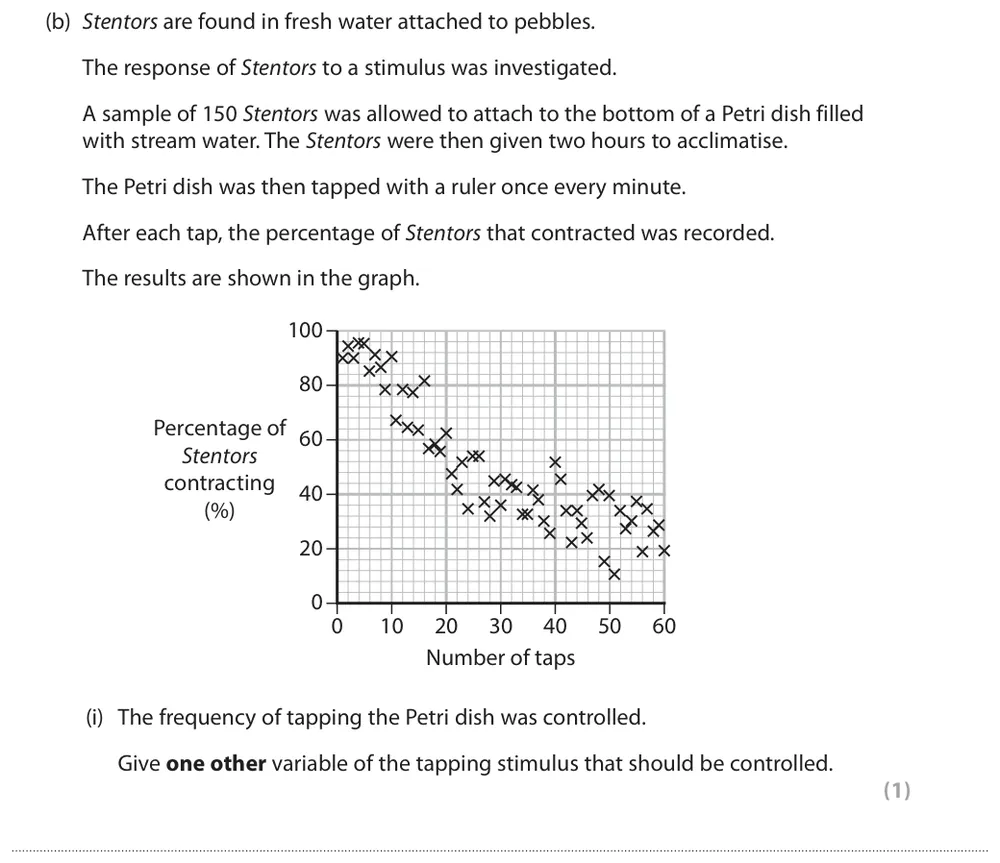
Give one variable of a tapping stimulus, other than frequency, that should be controlled.
Show the mark scheme

Tap an image to open it full size.
From the examiners' report: Many lost the mark by giving control variables unrelated to the tapping stimulus. The mark was for the strength or force of the tap.
Question 14
A level Paper 3 · June 2025 · Q2(b)(iii) · 2 marks · Easy
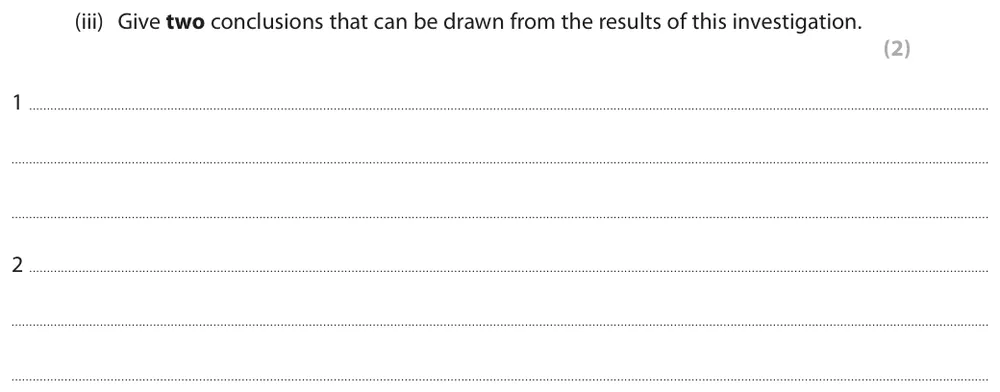
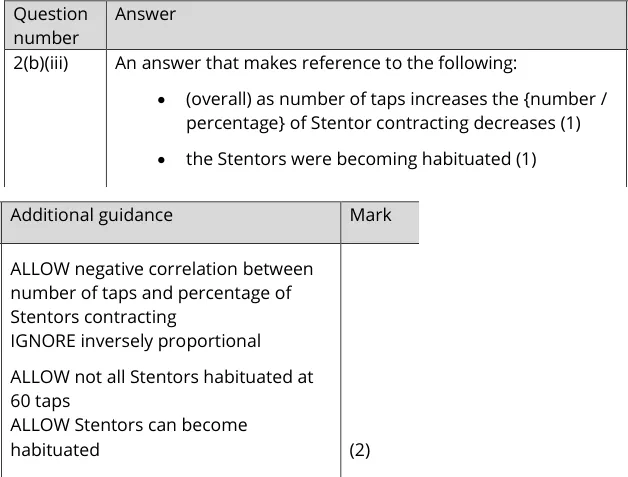
Give two conclusions from the percentage of Stentors contracting after repeated taps.
Show the mark scheme
Tap an image to open it full size.
From the examiners' report: Most gained the mark for the trend, but fewer stated that the Stentors were becoming habituated.
Question 15
A level Paper 3 · June 2022 · Q5(b)(i) · 2 marks
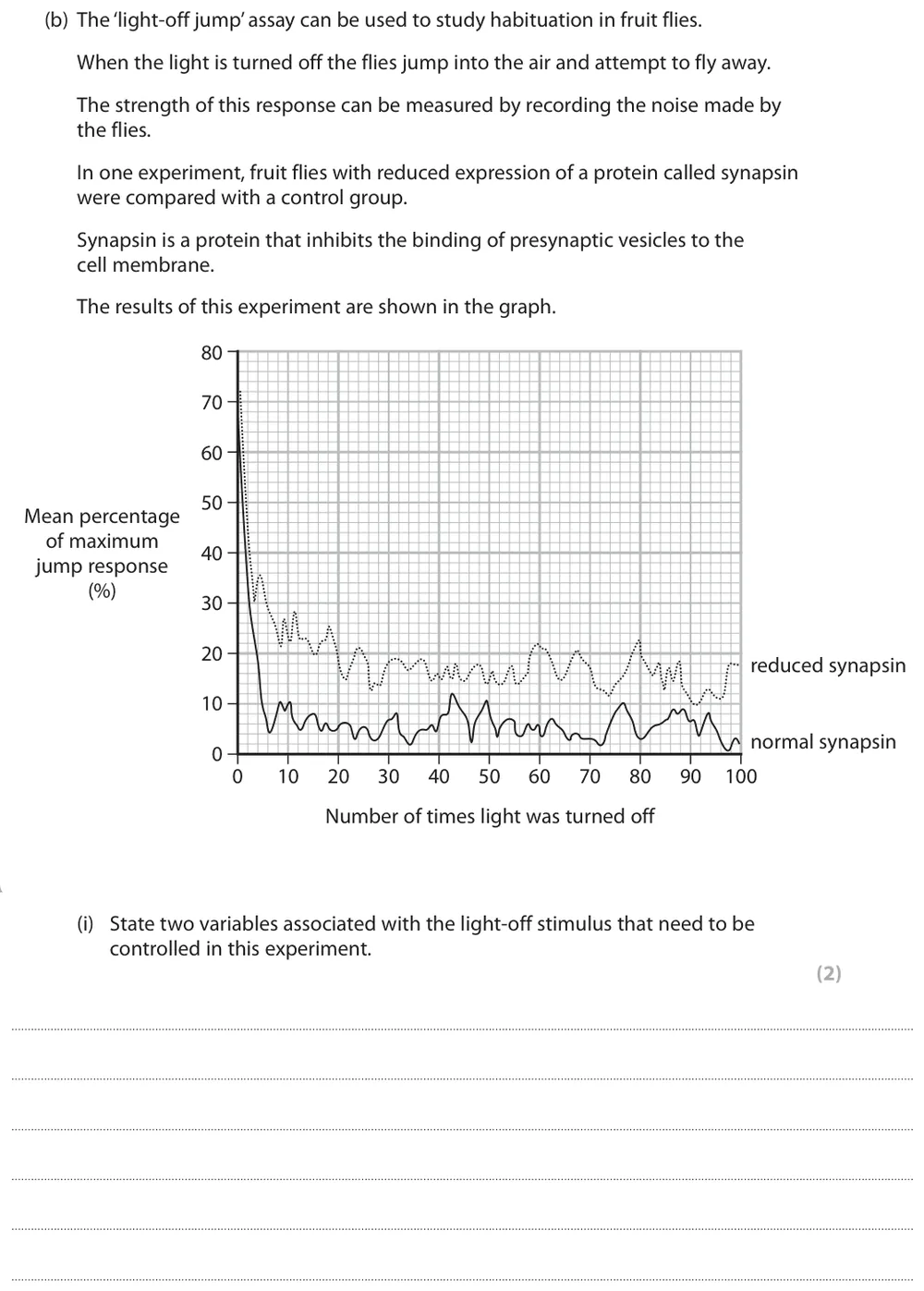
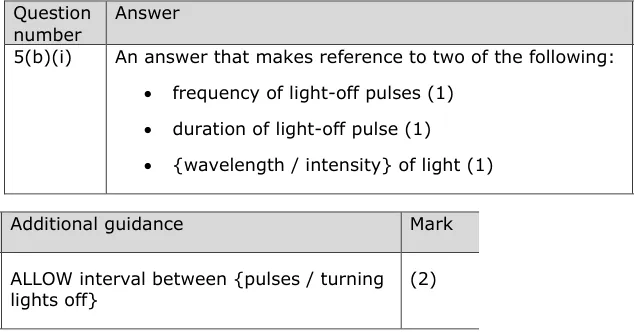
State two variables of the light-off stimulus to control in a fruit fly habituation experiment.
Show the mark scheme
Tap an image to open it full size.
From the examiners' report: The question asks for variables of the stimulus: its frequency, duration and strength. Many ignored the reference to the stimulus, gave other variables and gained no credit.
Question 16
A level Paper 3 · June 2022 · Q5(b)(ii) · 3 marks
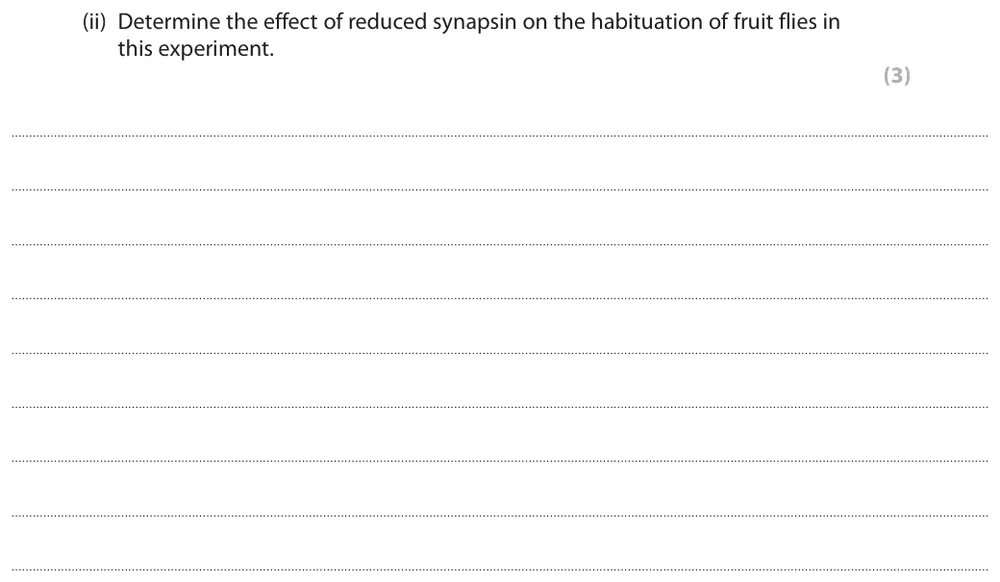
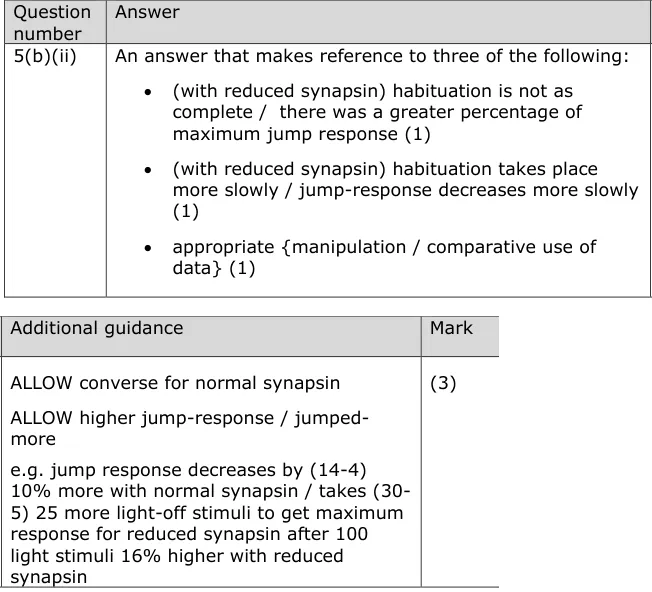
Determine the effect of reduced synapsin on habituation in fruit flies.
Show the mark scheme
Tap an image to open it full size.
From the examiners' report: 'Determine' means use the data, preferably by manipulating it. Many saw that habituation was less complete with reduced synapsin; fewer saw that it also took longer.
Core Practical 18: explaining habituation data
Question 17
A level Paper 2 · June 2019 · Q9(b)(i) · 2 marks · Hard
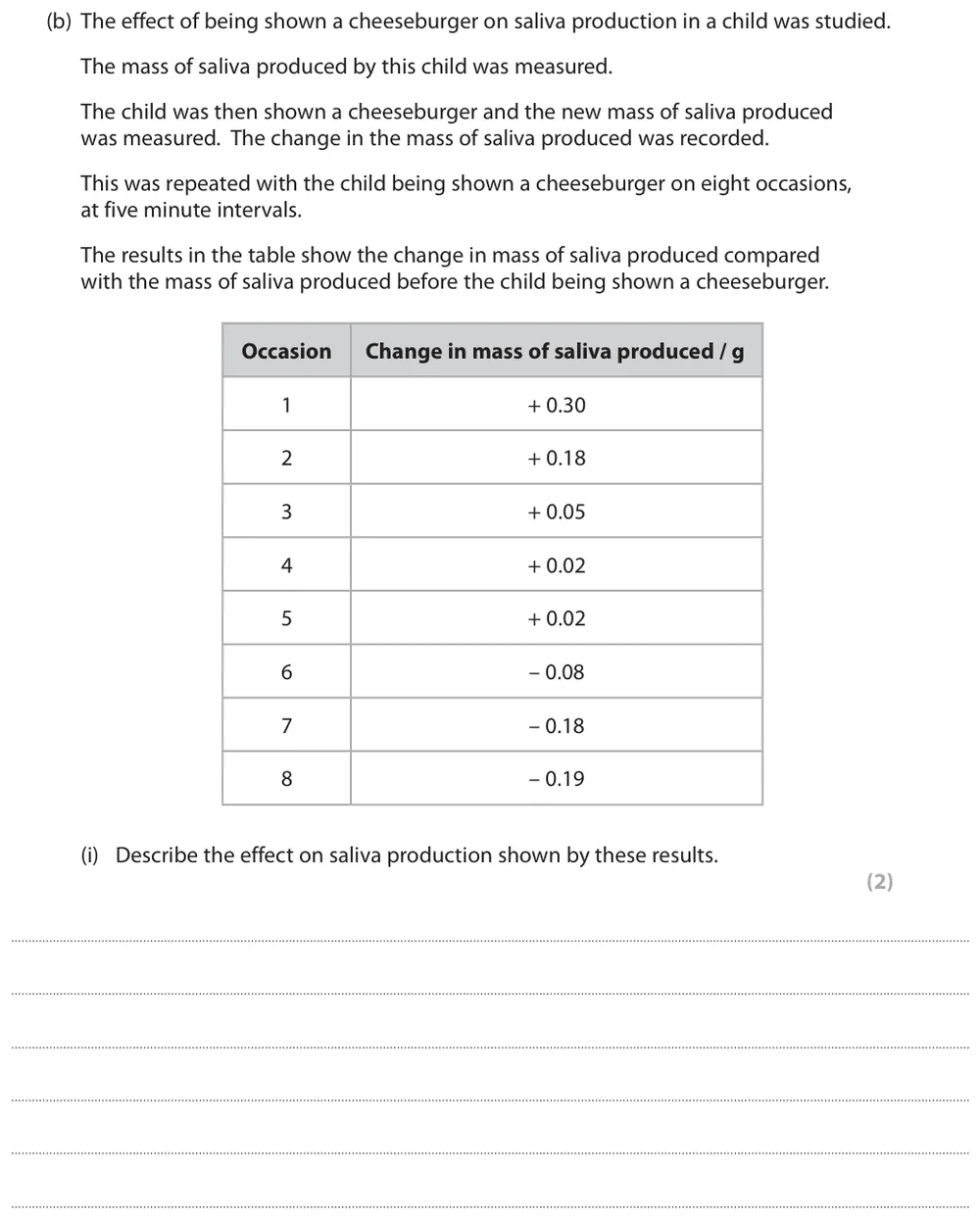
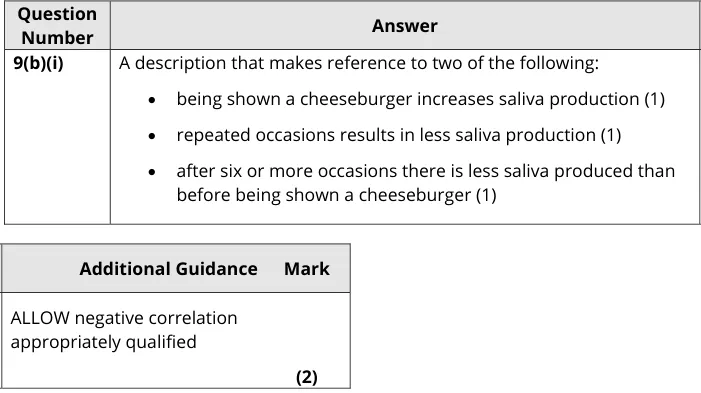
Describe the effect of repeatedly being shown a cheeseburger on a child's saliva production.
Show the mark scheme
Tap an image to open it full size.
From the examiners' report: Many found this hard because of the form of the data. The table shows the change in mass compared with before: saliva production first increased, then fell with repeated showings, until after six occasions less was produced than before.
Question 18
A level Paper 3 · June 2023 · Q3(b)(ii) · 3 marks
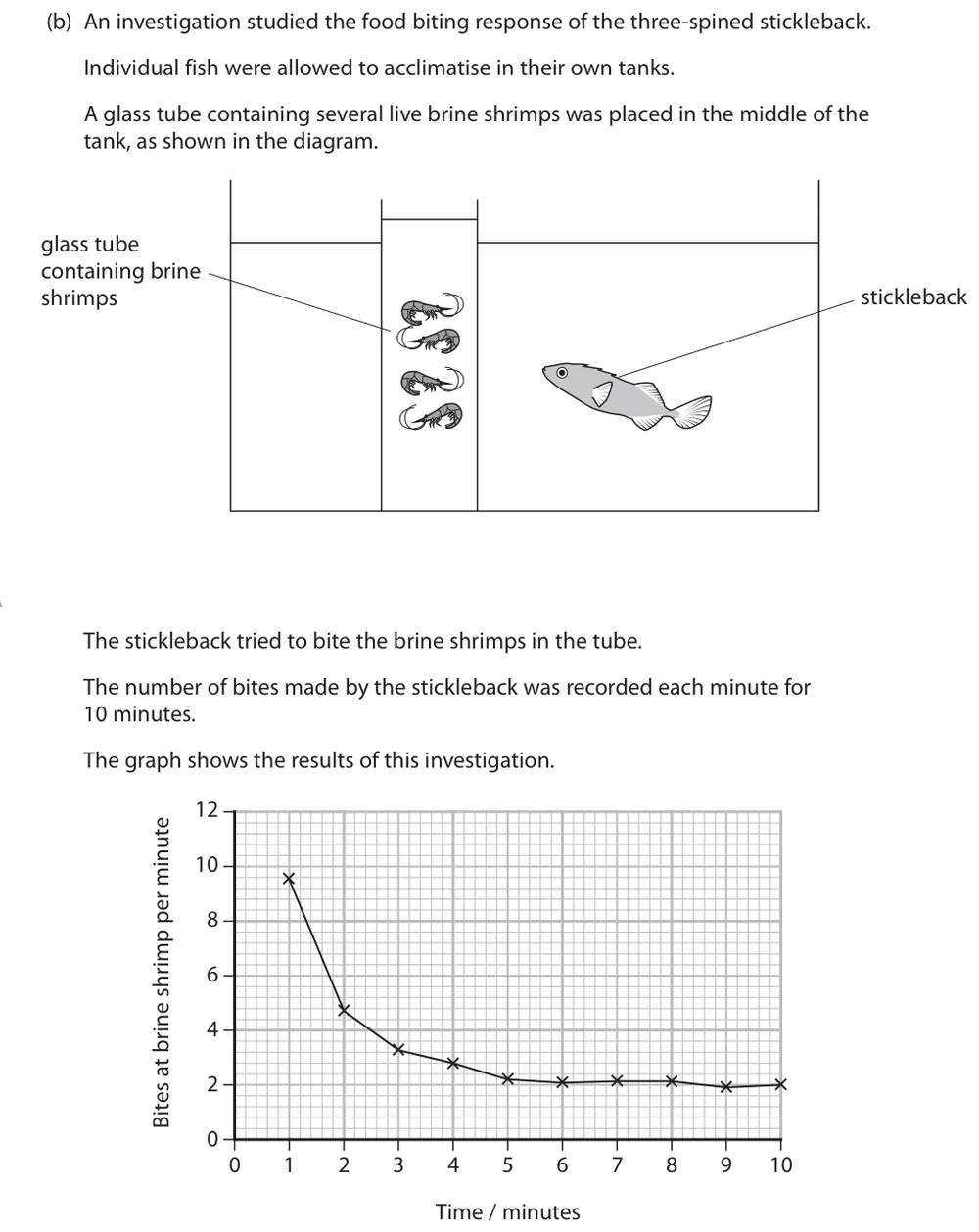
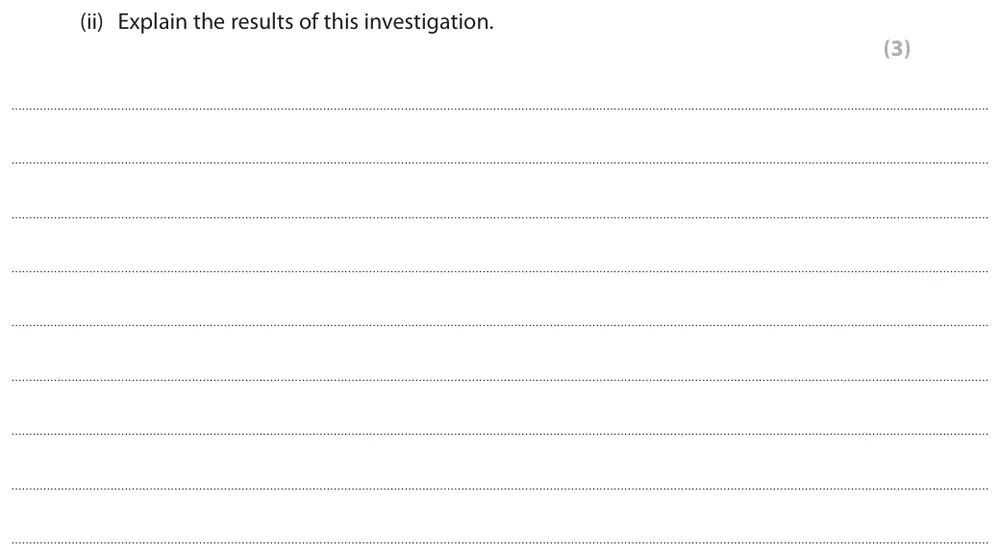
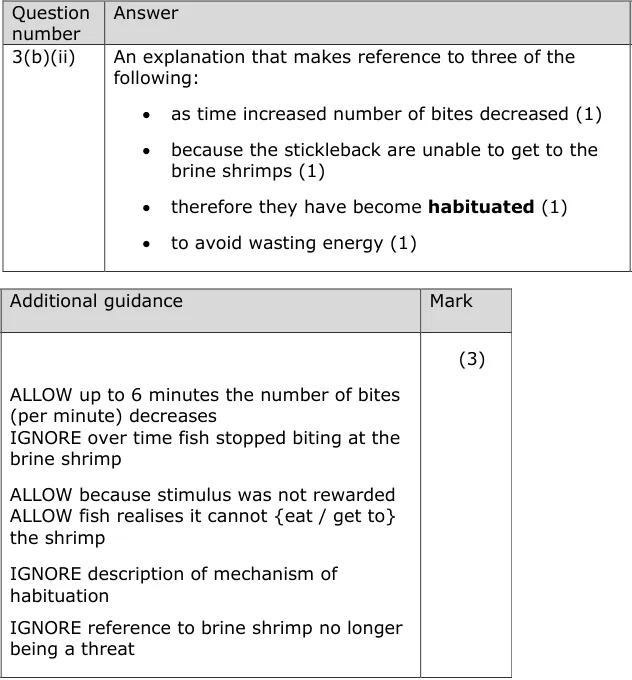
Explain the decrease in biting by sticklebacks at brine shrimps they cannot reach.
Information from earlier in this question:
Show the mark scheme
Tap an image to open it full size.
From the examiners' report: Most described the trend and recognised habituation; fewer said the fish could not reach the shrimps or that habituating avoids wasting energy. 'No longer a threat' was not credited, and detail of the mechanism was not needed.
Core Practical 18: planning a habituation investigation
Question 19
A level Paper 2 · June 2017 · Q8(c)(ii) · 4 marks
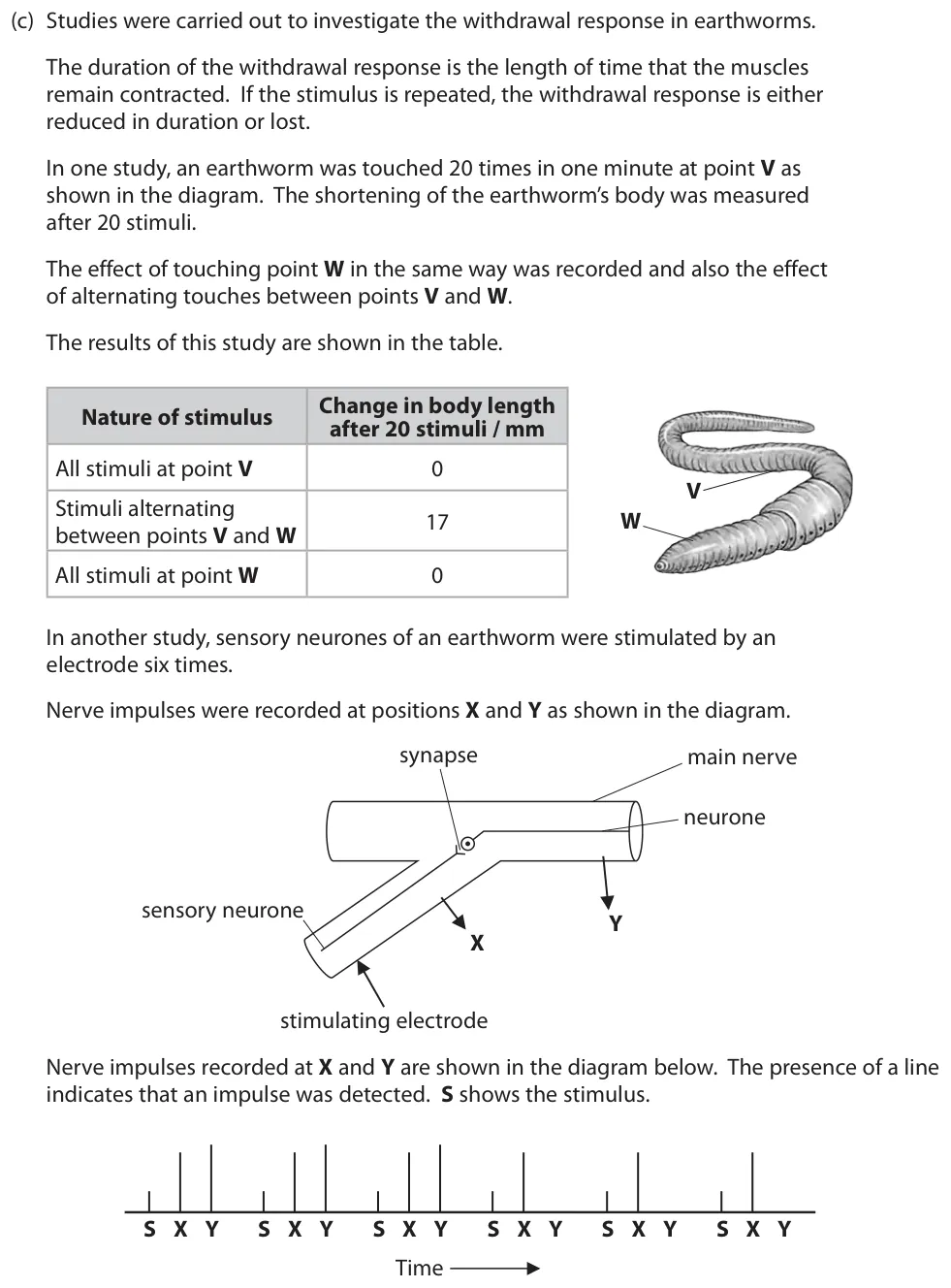
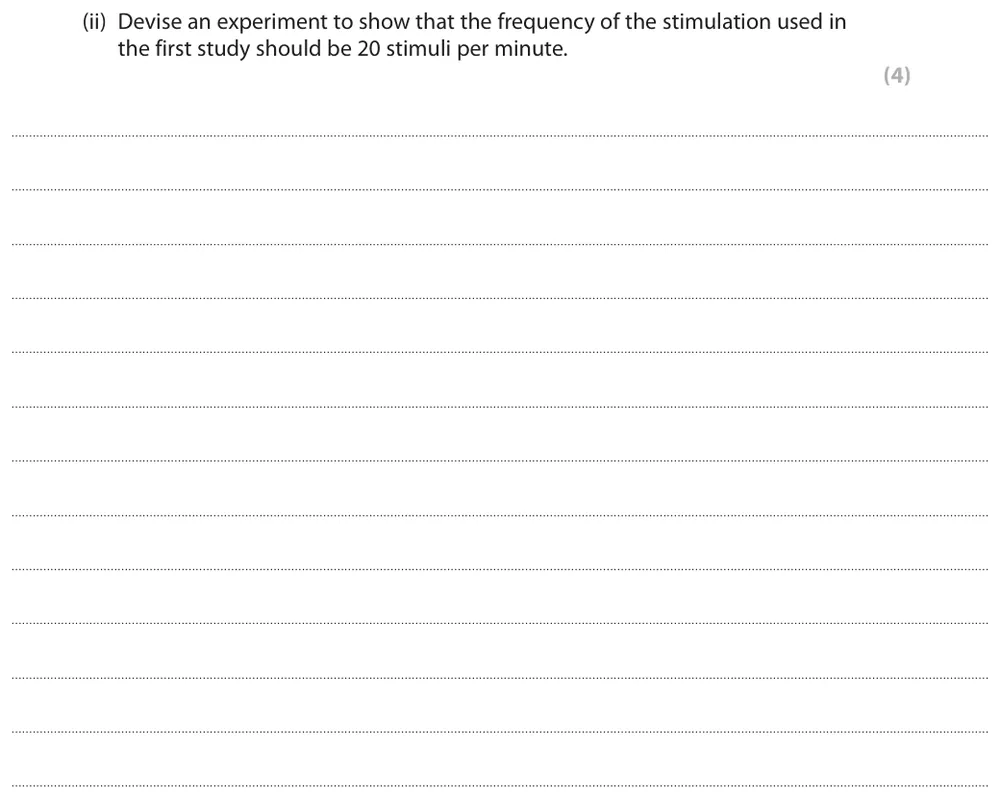
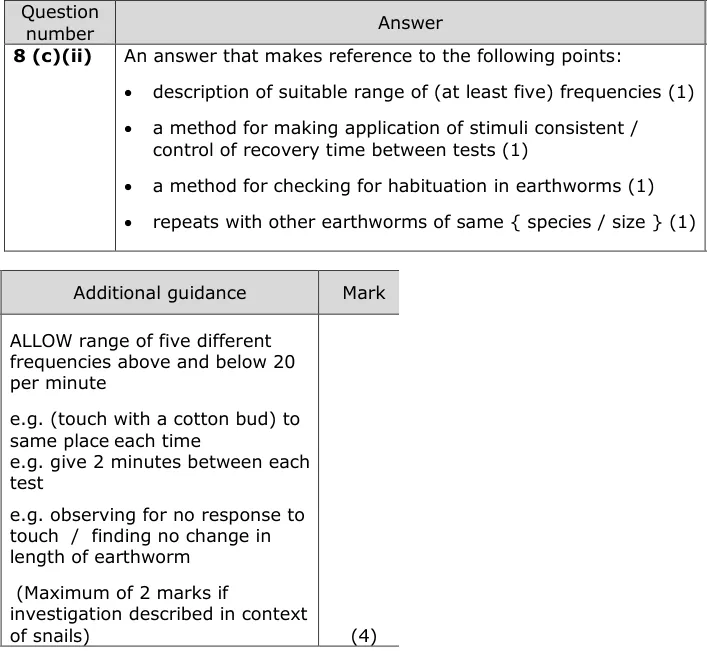
Devise an experiment to show that earthworms should be stimulated 20 times per minute.
Information from earlier in this question:
Show the mark scheme
Tap an image to open it full size.
From the examiners' report: A third of candidates scored 0. The study used earthworms, not snails. Test a range of frequencies above and below 20 per minute, touch the same place each time, allow recovery time between tests and say how you would check for habituation.
Where students lose marks (from Pearson examiners' reports and mark schemes)
Each point below comes from the examiners' reports and mark schemes, and is followed by wording that gained marks.
Oxygen uptake is not tidal volume. Some used tidal volume instead of oxygen uptake, and many did not convert dm³ to cm³ or seconds to minutes.
✔ Gains credit: 'Volume divided by time to produce rate; conversion of volume measured from graph from dm³ to cm³; calculation of rate per minute.'
Describe the method on the trace. Many did not describe how to do the calculations or did not use the trace, and simply stated a breathing rate.
✔ Gains credit: 'Find the difference in peak to trough volume (to give the tidal volume); difference in volume of one peak compared to a subsequent one, divided by the time between the two peaks and multiplied by 60.'
Breathing rate is not oxygen uptake. Many limited their plans to breathing rate instead of oxygen uptake.
✔ Gains credit: 'Take measurements during rest and during exercise; calculate decrease in volume; work out the change in rate of oxygen uptake.'
Turn flow rate into volumes. Most repeated the stem and said they would measure the rate of flow.
✔ Gains credit: 'Measure volumes of air entering and leaving the chamber; decrease in volume of air represents oxygen taken up.'
Start before the switch and finish after it. Many used only the 20 to 24 hour period, when the switch could happen at any point in it.
✔ Gains credit: 'Comparison using sensible period of time before 20 hours and after 24 hours, e.g. 18 to 26 hours.'
Aerobic respiration, for the muscles. Many did not say aerobic, and 'oxygen is required to break down lactate' was not accepted.
✔ Gains credit: 'Increased aerobic respiration because more ATP is needed by muscles; oxygen required to convert lactate into pyruvate.'
Variables of the stimulus itself. Many ignored the reference to the stimulus and gave other variables.
✔ Gains credit: 'Frequency of light-off pulses; duration of light-off pulse; intensity of light.'
Stay with the earthworms. Candidates defaulted to the snail practical, and very few described how to check for habituation.
✔ Gains credit: 'A method for checking for habituation in earthworms, e.g. observing for no response to touch.'
Download the questions
Download the PDF pack (19 questions, mark schemes at the end)
Keep practising
- Muscles and Respiration (Topic 7): Edexcel SNAB exam questions by topic
- Heart, Ventilation and Homeostasis (Topic 7): Edexcel SNAB exam questions by topic
- Senses, Plant Responses, the Brain and Learning (Topic 8): Edexcel SNAB exam questions by topic
- Edexcel SNAB A level Biology revision resources by topic (every topic and core practical page)
- Edexcel SNAB Topic 7 Multiple-Choice Quiz: Run for your Life
- Edexcel SNAB Topic 8 Multiple-Choice Quiz: Grey Matter
- Edexcel SNAB A level Biology past papers, mark schemes and examiners' reports
- Edexcel SNAB A level Biology grade boundaries
- Message Tom on WhatsApp about one-to-one Edexcel SNAB tutoring or an Edexcel group class
Questions, mark schemes and examiners' report extracts © Pearson Education Ltd.