

Heart, Ventilation and Homeostasis is the second part of Topic 7, Run for your Life, of the Edexcel A level Biology A (Salters-Nuffield) specification. You need to know that cardiac muscle is myogenic, explain how the sinoatrial node, atrioventricular node, bundle of His and Purkyne fibres coordinate the heartbeat, calculate cardiac output, and explain how heart rate and ventilation rate are controlled during exercise. The topic also covers negative feedback, homeostasis and thermoregulation by the hypothalamus, the risks of too much and too little exercise, medical technology such as keyhole surgery, and how transcription factors and hormones switch genes on and off. This topic is examined on A level Papers 2 and 3. All questions are from the A level papers (9BN0).
The examiners' reports keep penalising vague words. Write 'impulses' or 'depolarisation', not 'signals' or 'messages'; say thermoreceptors are in the skin or hypothalamus, not just 'in the body'; and say how a response is controlled (impulses from the heat loss centre to the sweat glands), not just what it is. Read the question carefully: 'starting to exercise' is not the same as long exercise, and the SAN question asks how heart rate increases. In calculations, convert to the units asked for, and when you are given a graph, explain the changes rather than describe them.
Studying Edexcel SNAB and want more help? If you'd like to arrange one-to-one Edexcel tutoring, or to register your interest in an Edexcel group class, message Tom on WhatsApp using the link at the bottom of this page.
What you need from GCSE
Each question on this page assumes you're secure on these ideas. If any of them feels shaky, look it up before you start.
- The heart pumps blood to the lungs and the body; heart rate and breathing rate increase during exercise.
- Homeostasis keeps internal conditions, such as body temperature, within narrow limits.
- The hypothalamus in the brain monitors body temperature; sweating and vasodilation help cool the body.
- Hormones are chemical messengers carried in the blood to target organs.
Key terms
These words come up in the questions and mark schemes. Examiners expect you to use them exactly.
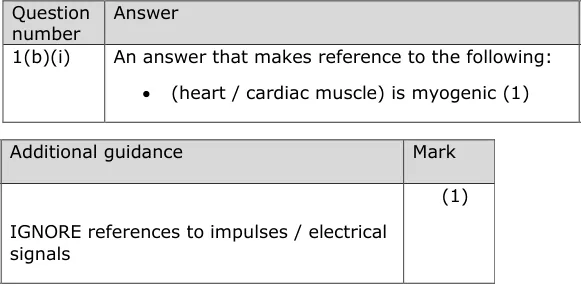
- Myogenic: cardiac muscle contracts without needing nerve impulses; the beat starts within the heart itself.
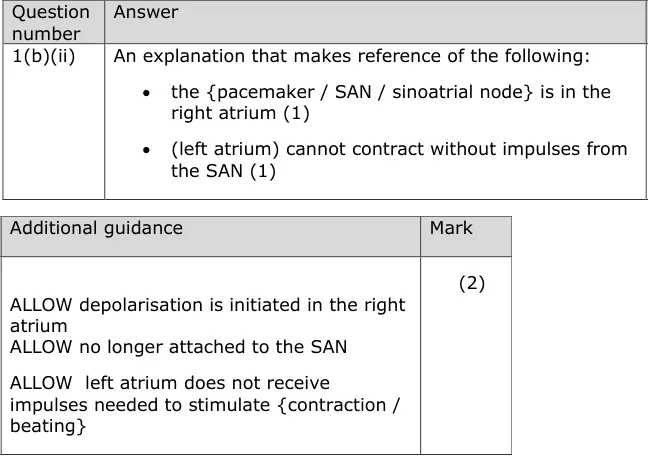
- Sinoatrial node (SAN): the pacemaker in the right atrium that sends out waves of depolarisation across the atria.
- Atrioventricular node (AVN): picks up the depolarisation from the atria and passes it, after a delay, to the bundle of His and Purkyne fibres.
- Cardiac output: the volume of blood pumped by the heart per minute: stroke volume × heart rate.
- Chemoreceptors: receptors that detect changes in blood carbon dioxide concentration and pH.
- Thermoreceptors: receptors in the skin and hypothalamus that detect changes in temperature.
- Negative feedback: a change from the norm triggers a response that reverses the change.
- Transcription factor: a protein that binds to the promoter region of a gene and controls whether RNA polymerase can transcribe it.
What these questions cover (Edexcel SNAB Topic 7: Run for your Life)
The questions test these statements from Topic 7 of the Pearson Edexcel A level Biology A (Salters-Nuffield) specification (9BN0).
- 7.8 i Know the myogenic nature of cardiac muscle.
- 7.8 ii Understand how the normal electrical activity of the heart coordinates the heart beat, including the roles of the sinoatrial node (SAN), the atrioventricular node (AVN)
- 7.9 i Be able to calculate cardiac output.
- 7.9 ii Understand how variations in ventilation and cardiac output enable rapid delivery of oxygen to tissues and the removal of carbon dioxide from them, including how the hear
- 7.12 Understand homeostasis and its importance in maintaining the body in a state of dynamic equilibrium during exercise, including the role of the hypothalamus and the mechan
- 7.13 Understand the analysis and interpretation of data relating to possible disadvantages of exercising too much (wear and tear on joints, suppression of the immune system) a
- 7.14 Understand how medical technology, including the use of keyhole surgery and prostheses, is enabling those with injuries and disabilities to participate in sports.
- 7.16 Understand how genes can be switched on and off by DNA transcription factors including hormones.
How to use this page
Write your answer on paper before you open the mark scheme. Allow about 1.2 minutes per mark: the 20 questions are worth 52 marks, so about 62 minutes in total. Then mark your answer strictly against the mark scheme and read the examiners' tip underneath it. If you'd rather print the questions, download the PDF pack.
Myogenic cardiac muscle (7.8 i)
Question 1
A level Paper 3 · June 2023 · Q1(b)(i) · 1 mark
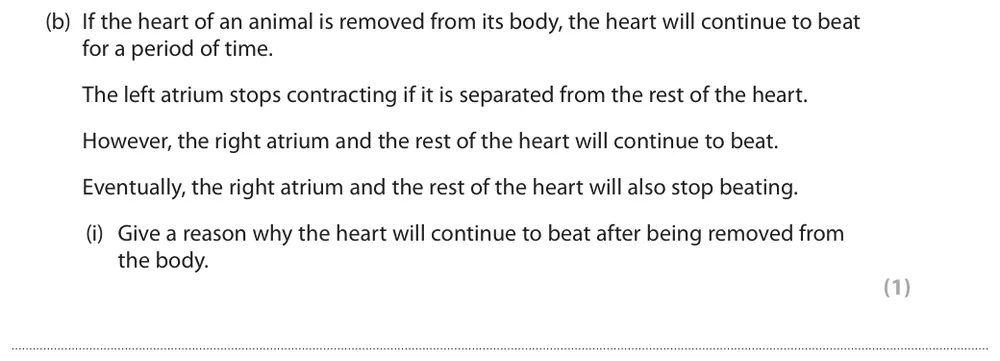
Give a reason why the heart keeps beating after it is removed from the body.
Show the mark scheme
Tap an image to open it full size.
From the examiners' report: Most gained the mark by saying cardiac muscle is myogenic.
Electrical activity of the heart (7.8 ii)
Question 2
A level Paper 3 · June 2023 · Q1(b)(ii) · 2 marks · Easy
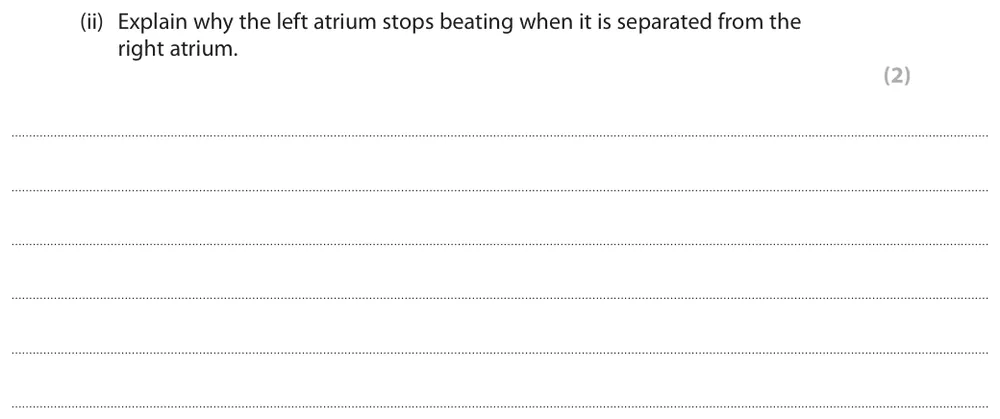
Explain why the left atrium stops beating when it is separated from the right atrium.
Show the mark scheme
Tap an image to open it full size.
From the examiners' report: Well answered by many. The SAN (pacemaker) is in the right atrium; the left atrium cannot contract without impulses from it. 'Signals' is too vague: say impulses.
Question 3
A level Paper 2 · June 2017 · Q2(b) · 2 marks
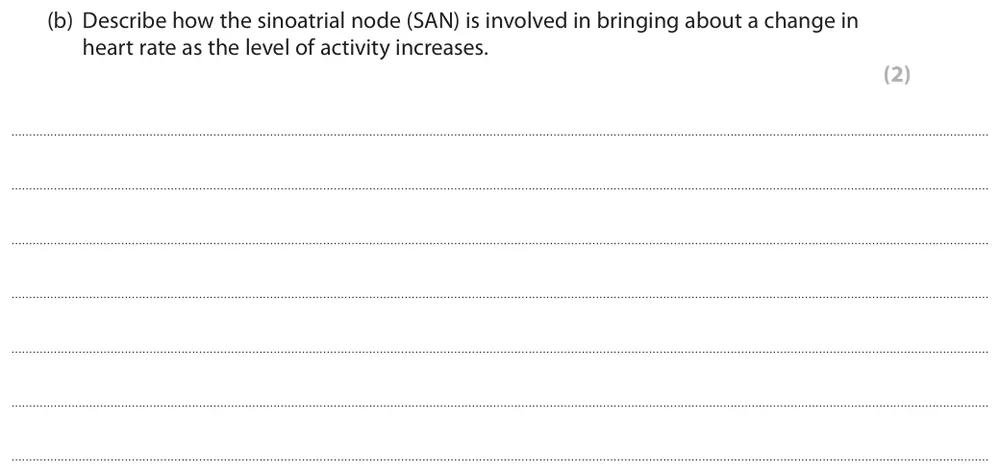
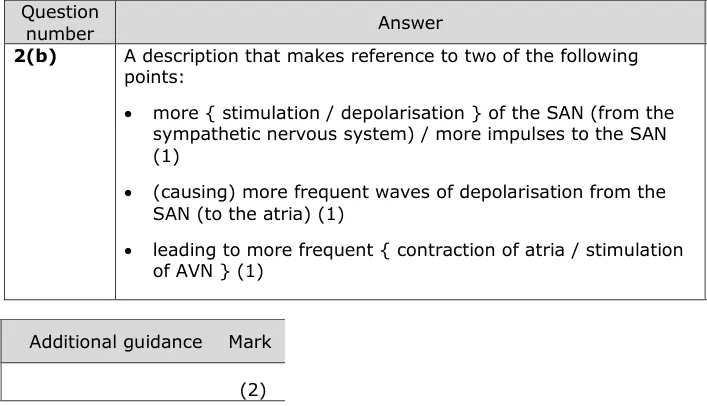
Describe how the SAN brings about a change in heart rate as the level of activity increases.
Show the mark scheme
Tap an image to open it full size.
From the examiners' report: Many described the SAN's role without the context of increased activity. Say there is more stimulation of the SAN (sympathetic nervous system), so more frequent waves of depolarisation and more frequent contraction of the atria. Avoid 'messages'.
Question 4
A level Paper 2 · June 2024 · Q3(b) · 3 marks
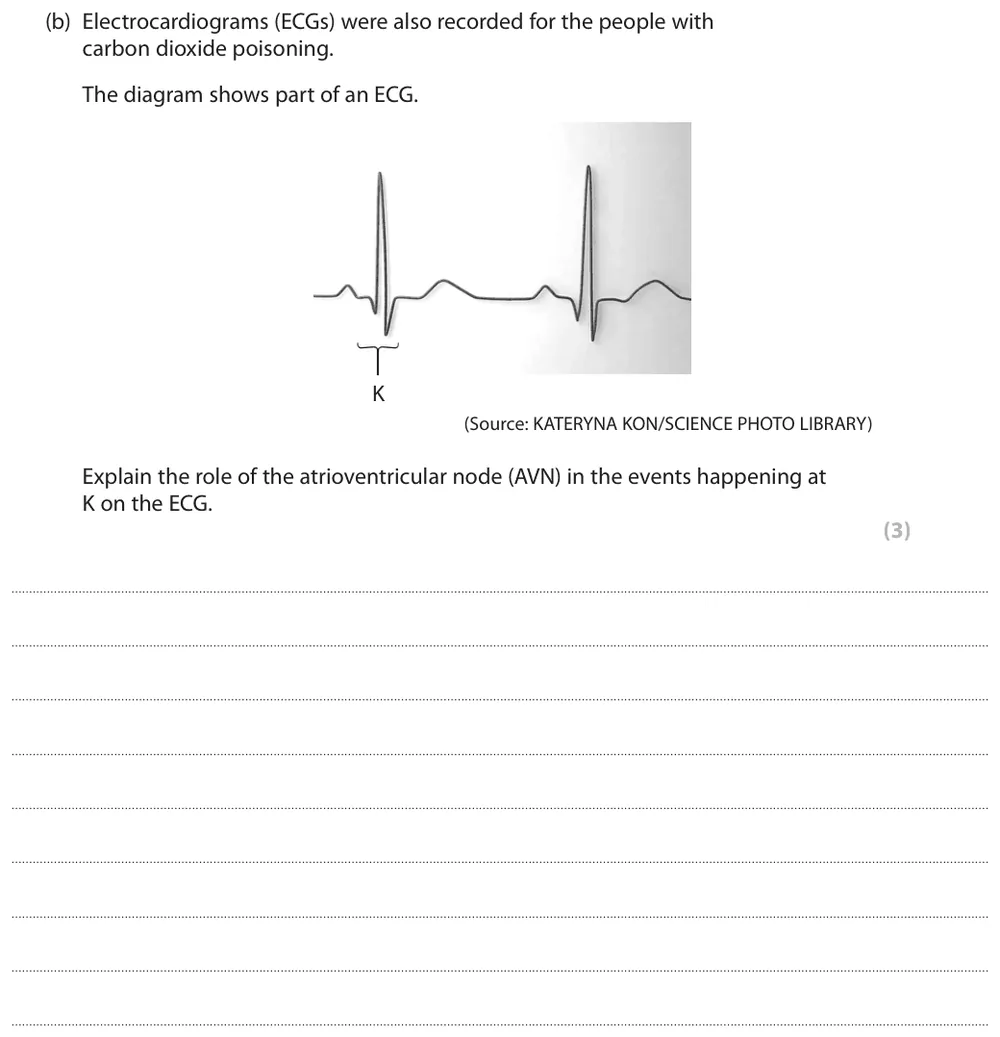
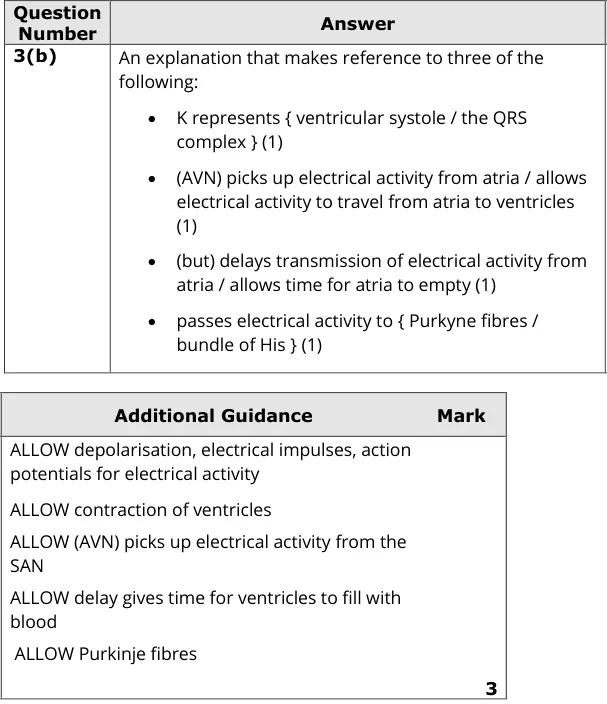
Explain the role of the AVN in the events at K on an ECG.
Show the mark scheme
Tap an image to open it full size.
From the examiners' report: Many knew K is ventricular systole and that the AVN passes electrical activity to the bundle of His and Purkyne fibres. Fewer said the AVN picks up the electrical activity from the atria and delays its transmission.
Cardiac output (7.9 i)
Question 5
A level Paper 2 · June 2018 · Q5(c)(i) · 2 marks
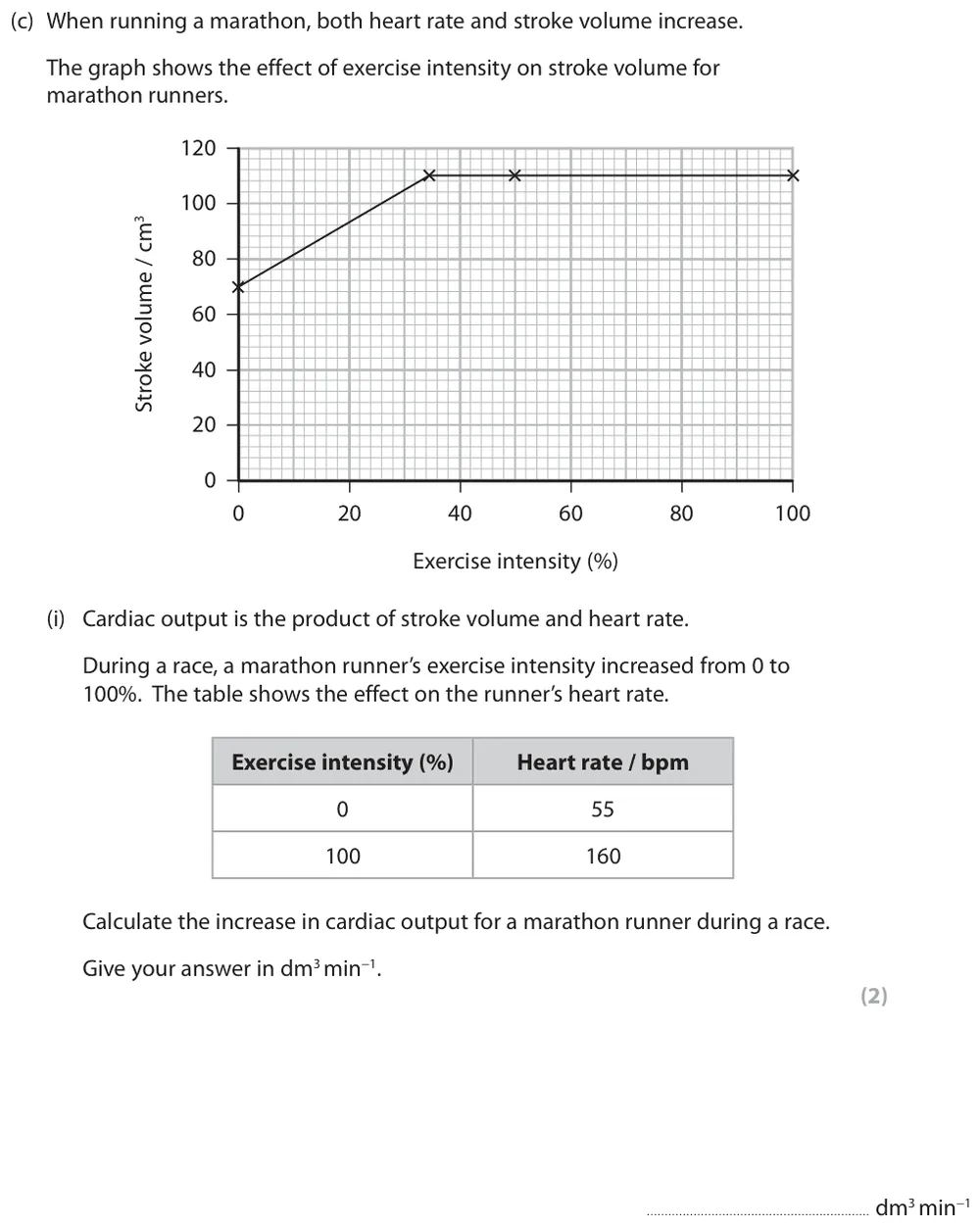
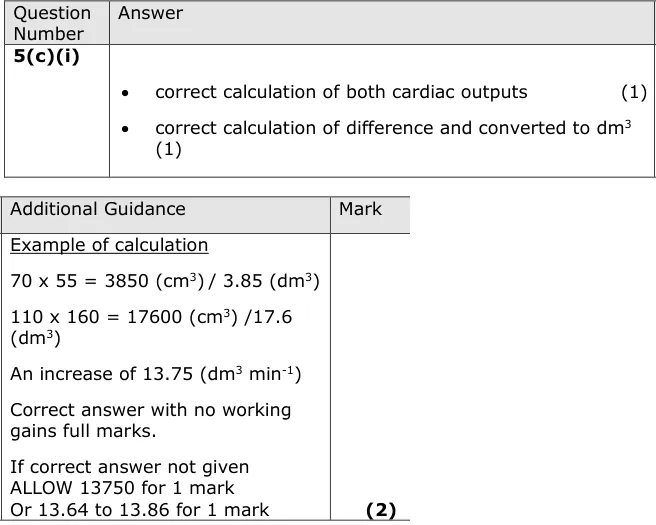
Calculate the increase in cardiac output for a marathon runner during a race, in dm³ min⁻¹.
Show the mark scheme
Tap an image to open it full size.
From the examiners' report: The most common score was 1 mark for 13 750, because the answer was not converted from cm³ to dm³. Always show your working.
Controlling heart rate and ventilation (7.9 ii)
Question 6
A level Paper 2 · June 2018 · Q5(c)(ii) · 2 marks
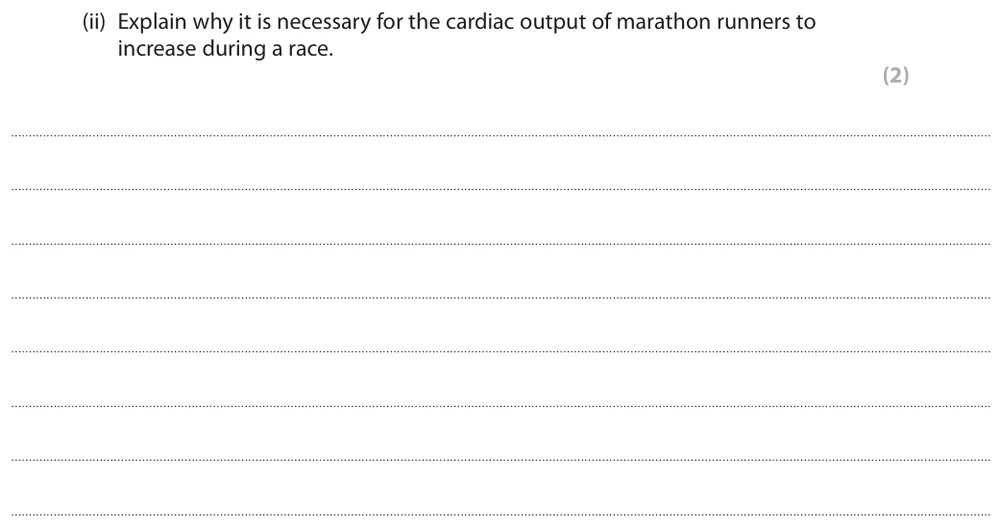
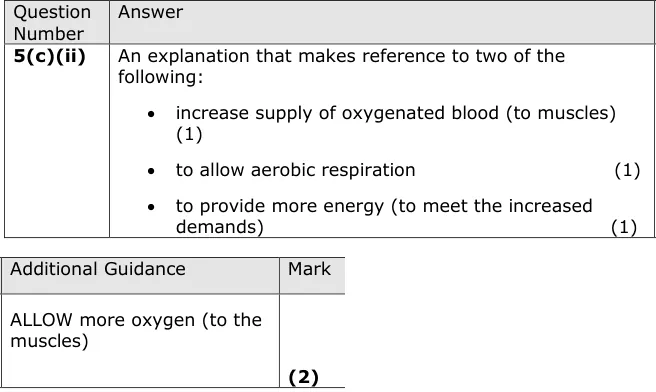
Explain why the cardiac output of marathon runners needs to increase during a race.
Show the mark scheme
Tap an image to open it full size.
From the examiners' report: Most gained full marks. A few missed the idea of more oxygen: more oxygenated blood reaches the muscles for aerobic respiration.
Question 7
A level Paper 2 · June 2019 · Q4(a)(i) · 2 marks
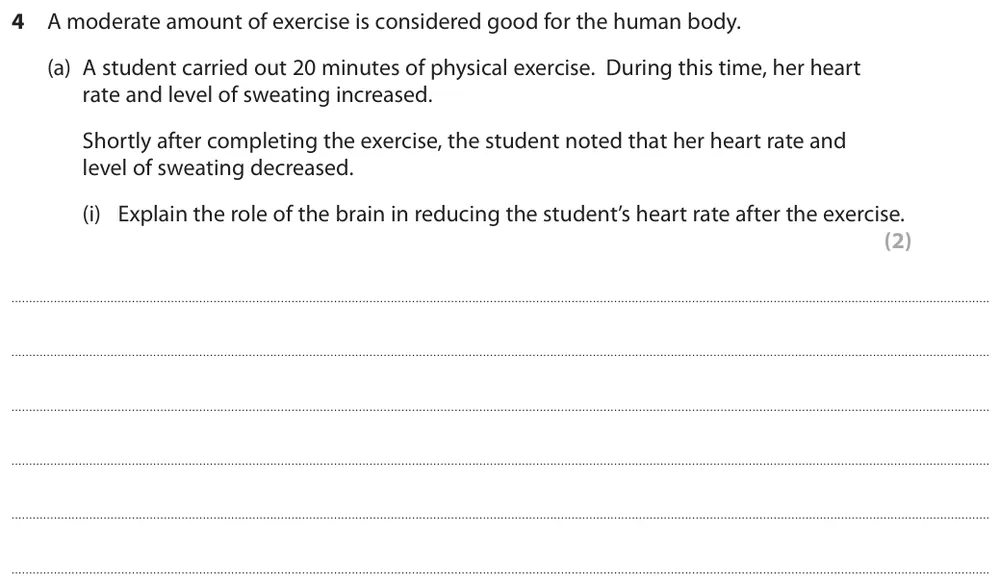
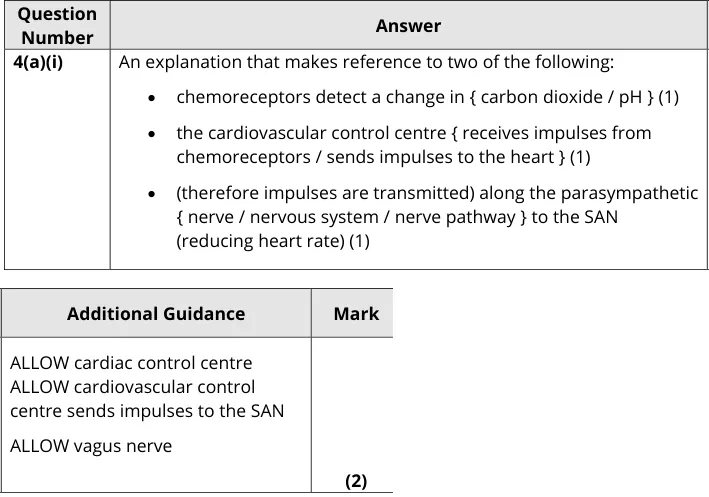
Explain the role of the brain in reducing the student's heart rate after exercise.
Show the mark scheme
Tap an image to open it full size.
From the examiners' report: Most adapted their knowledge well. Chemoreceptors detect the change in carbon dioxide or pH, and the cardiovascular control centre sends impulses along the parasympathetic (vagus) nerve to the SAN.
Question 8
A level Paper 2 · June 2024 · Q3(a)(i) · 4 marks
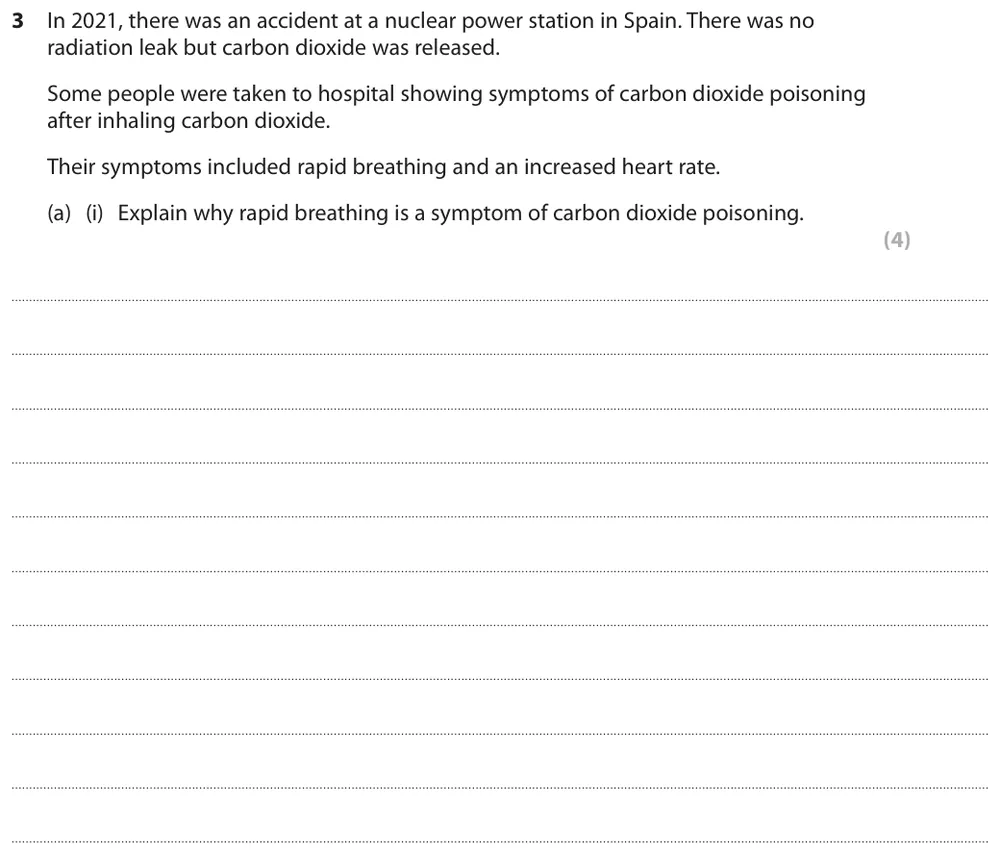
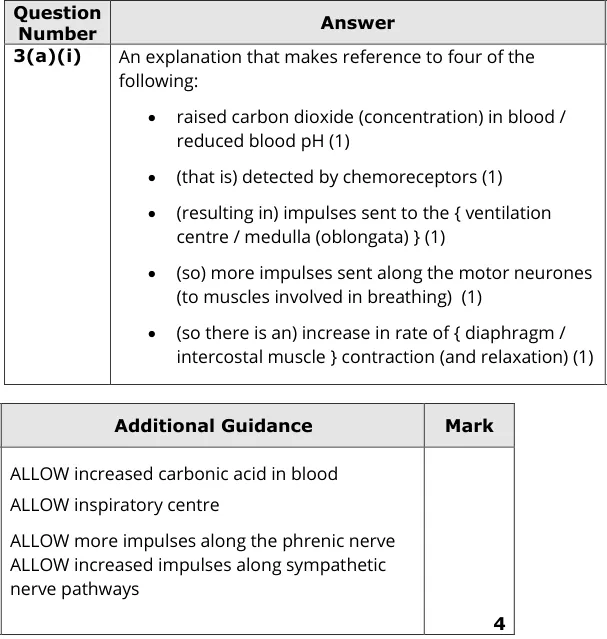
Explain why rapid breathing is a symptom of carbon dioxide poisoning.
Show the mark scheme
Tap an image to open it full size.
From the examiners' report: Stay on breathing: some discussed the raised heart rate instead. Raised carbon dioxide in the blood lowers pH, chemoreceptors detect it, more impulses go to the ventilation centre and on to the diaphragm and intercostal muscles.
Question 9
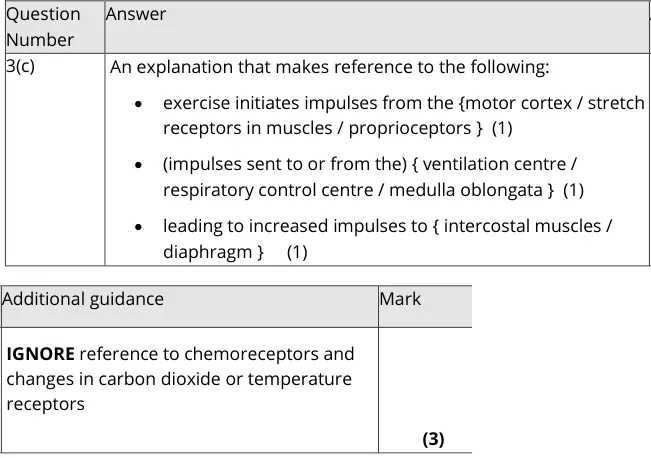
A level Paper 3 · June 2019 · Q3(c) · 3 marks
Explain how starting to exercise causes an increase in breathing rate.

Show the mark scheme
Tap an image to open it full size.
From the examiners' report: Most ignored 'starting to exercise' and wrote about carbon dioxide and pH changes. At the start, impulses come from the motor cortex or stretch receptors in muscles; say 'more frequent impulses' to the intercostal muscles or diaphragm.
Question 10
A level Paper 3 · November 2021 · Q3(a)(ii) · 4 marks
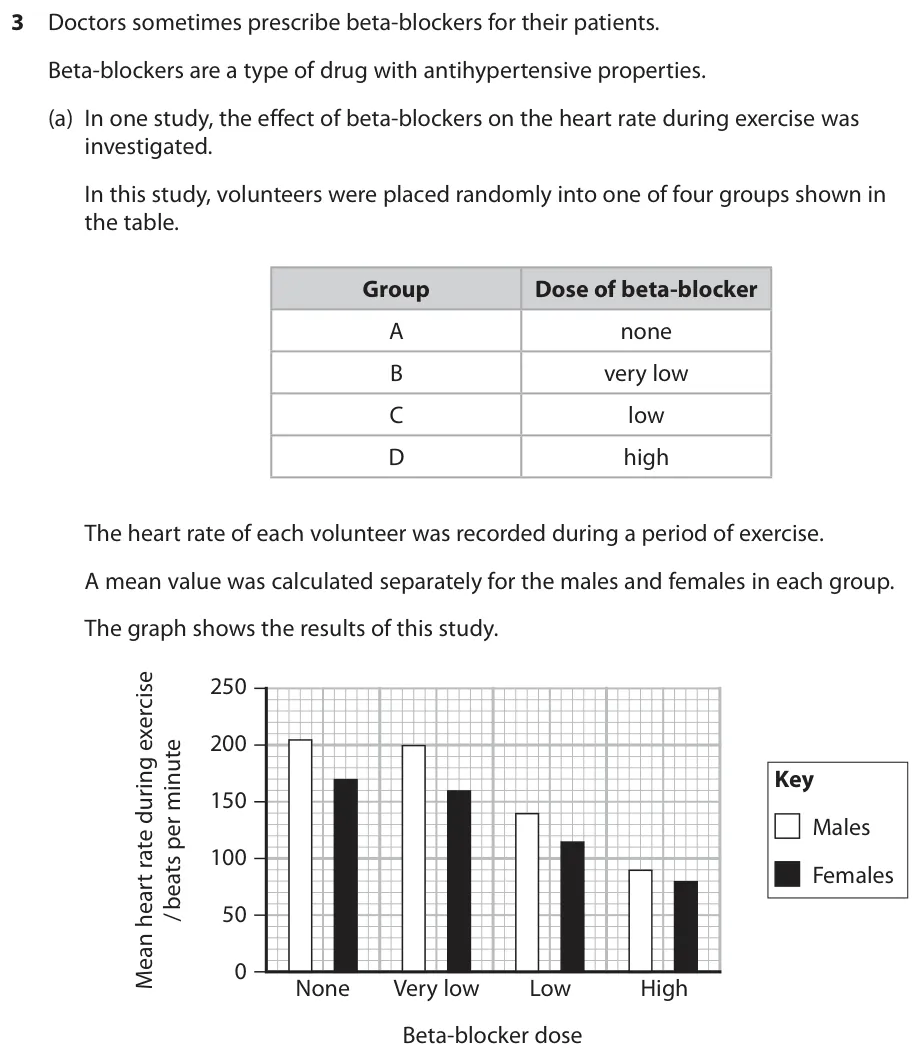
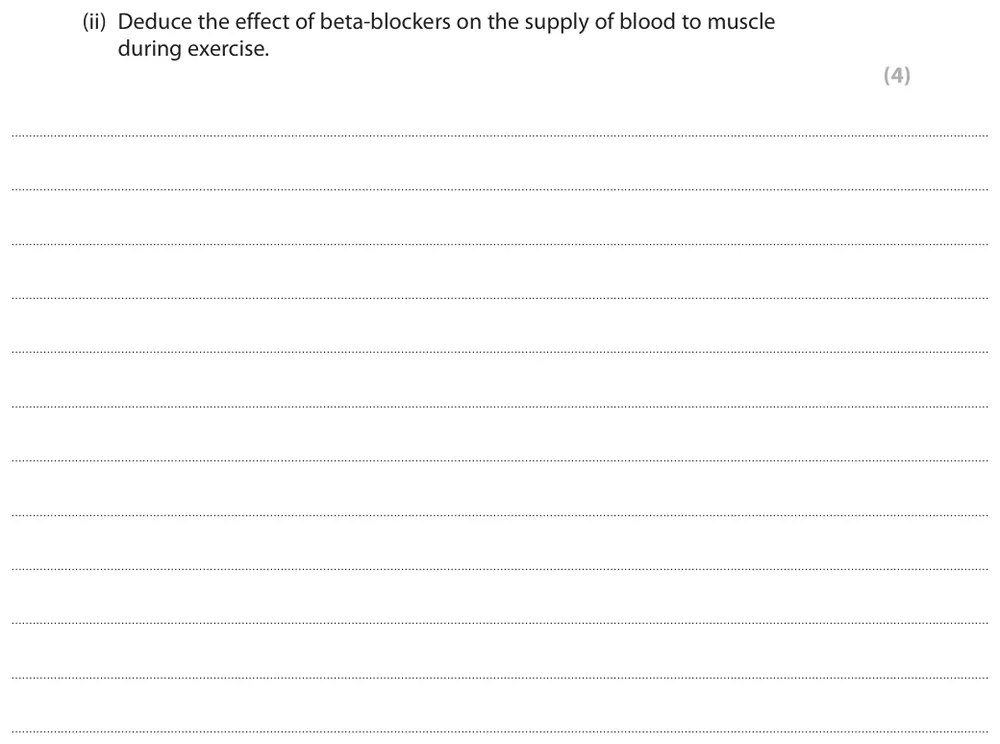
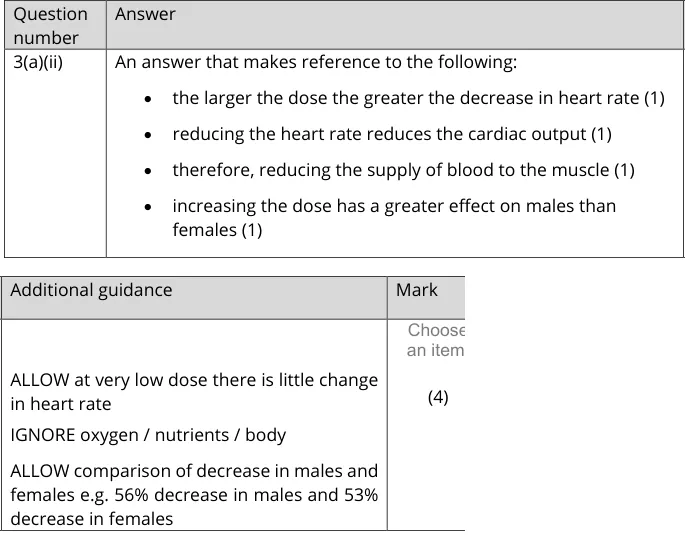
Deduce the effect of beta-blockers on the supply of blood to muscle during exercise.
Information from earlier in this question:
Show the mark scheme
Tap an image to open it full size.
From the examiners' report: Many answered a different question about the effects of less blood reaching muscles. Say the larger the dose, the greater the decrease in heart rate; this reduces cardiac output and so blood supply. Few compared males and females.
Homeostasis and thermoregulation (7.12)
Question 11
A level Paper 2 · June 2018 · Q5(a) · 4 marks
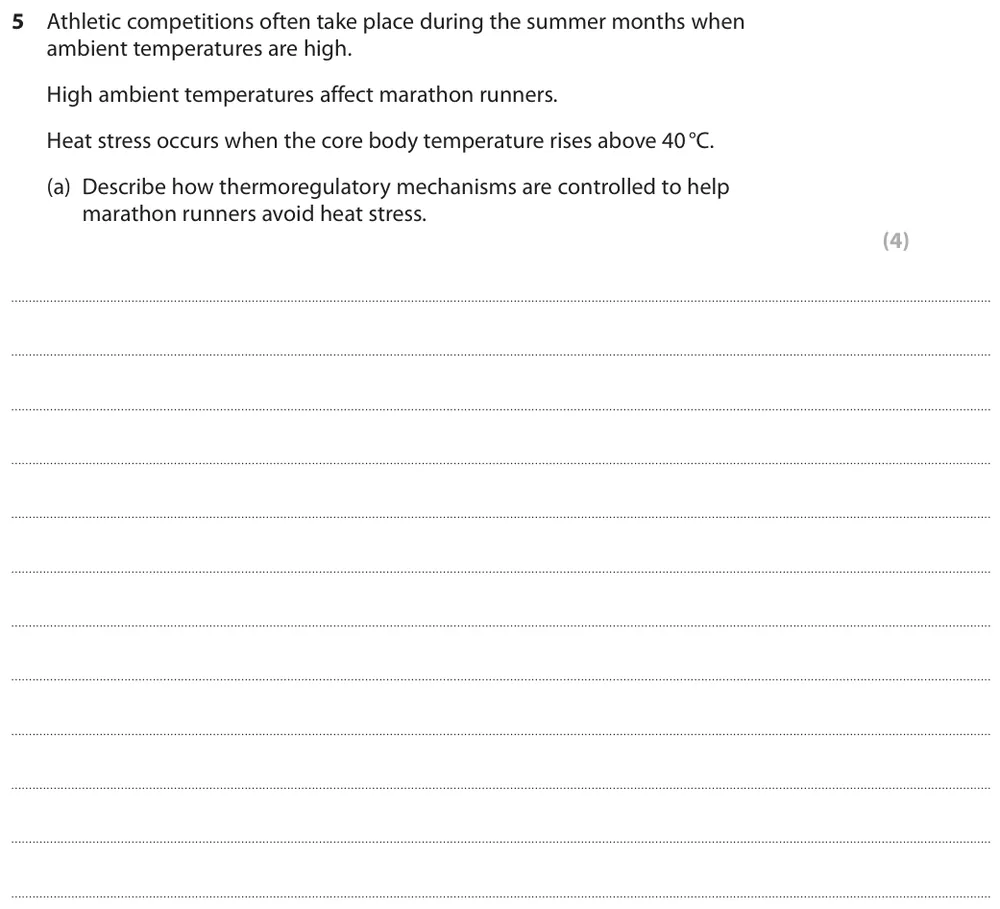
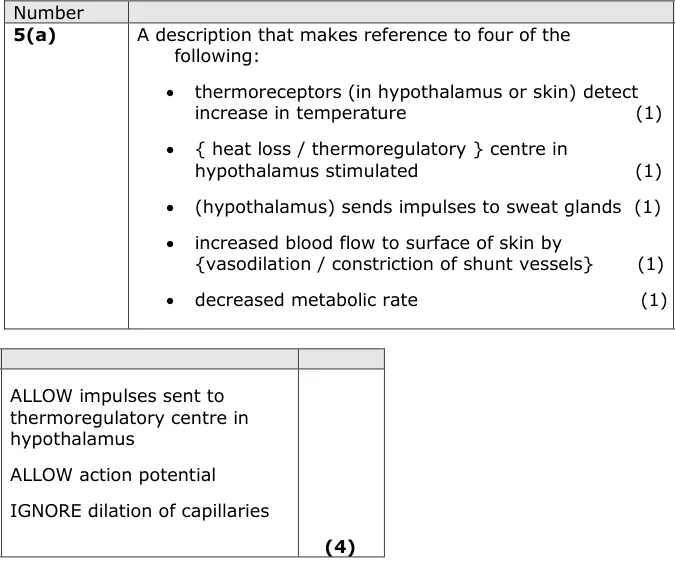
Describe how thermoregulatory mechanisms are controlled to help marathon runners avoid heat stress.
Show the mark scheme
Tap an image to open it full size.
From the examiners' report: Many described the mechanisms instead of how they are controlled. Link vasodilation to increased blood flow to the skin and sweating to impulses to the sweat glands, and name the heat loss centre in the hypothalamus.
Question 12
A level Paper 2 · June 2019 · Q4(a)(ii) · 2 marks
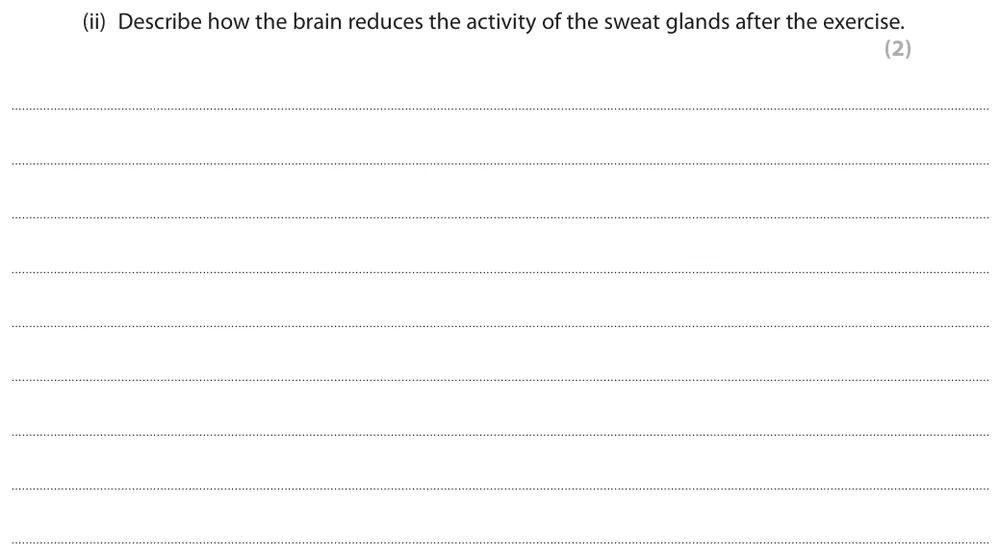
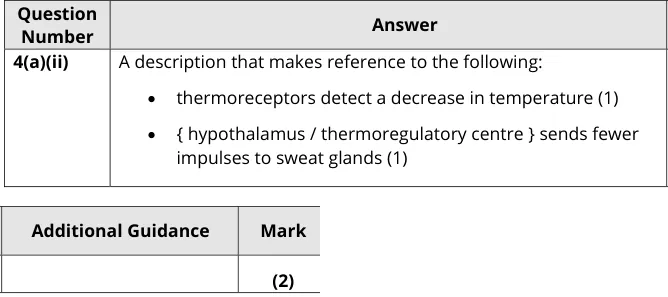
Describe how the brain reduces the activity of the sweat glands after exercise.
Show the mark scheme
Tap an image to open it full size.
From the examiners' report: Many lacked precision. Thermoreceptors detect a decrease in temperature and the hypothalamus (thermoregulatory centre) sends fewer impulses to the sweat glands.
Question 13
A level Paper 2 · October 2020 · Q7(a)(i) · 2 marks
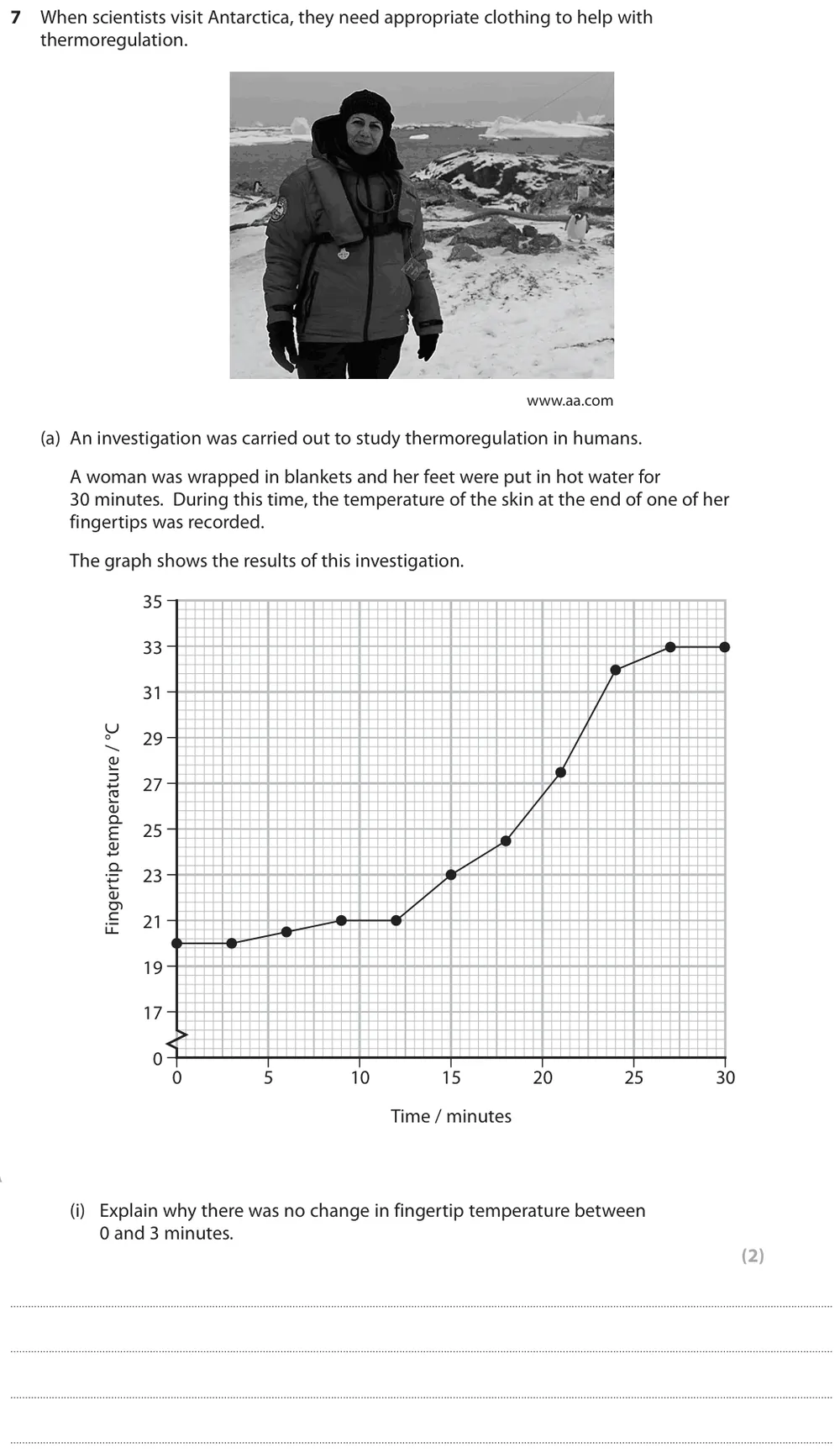
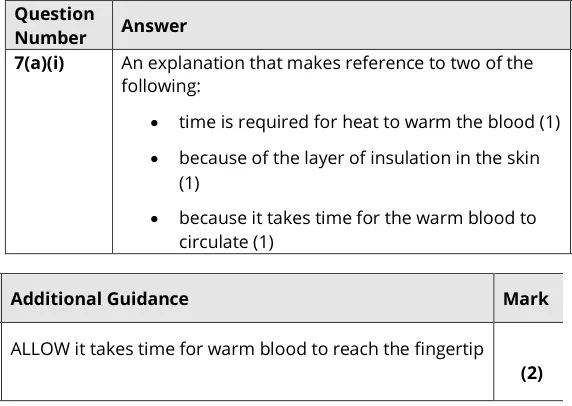
Explain why fingertip temperature did not change in the first 3 minutes.
Show the mark scheme
Tap an image to open it full size.
From the examiners' report: Only a minority considered the blood and circulation. 'The body is adjusting' was not enough: it takes time for heat to warm the blood and for warm blood to circulate to the fingertip.
Question 14
A level Paper 3 · June 2023 · Q4(c) · 4 marks
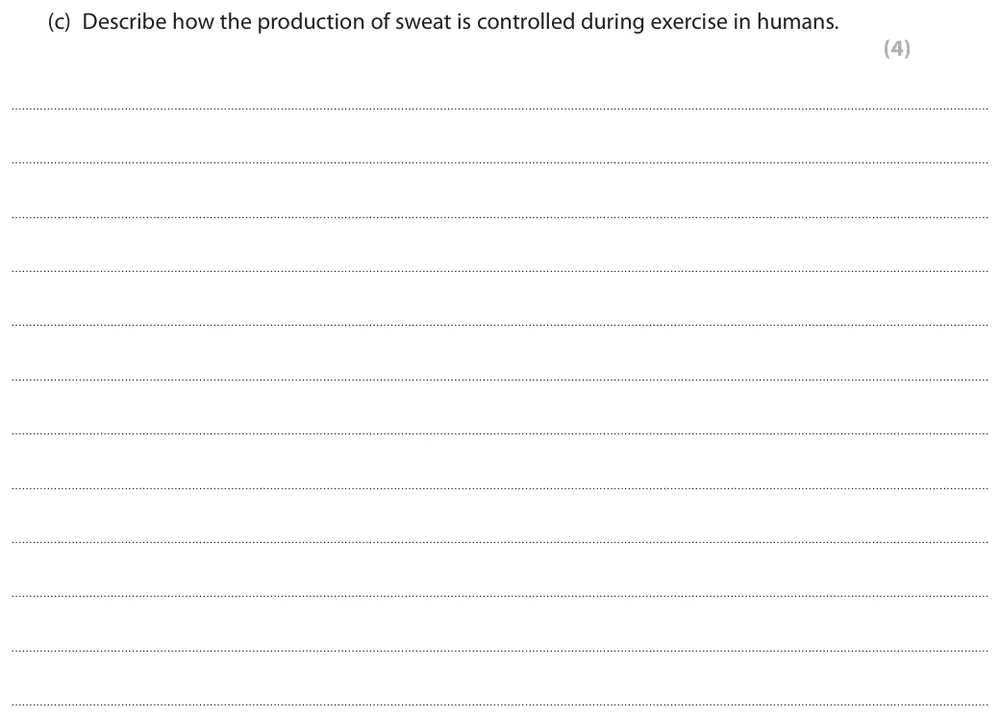
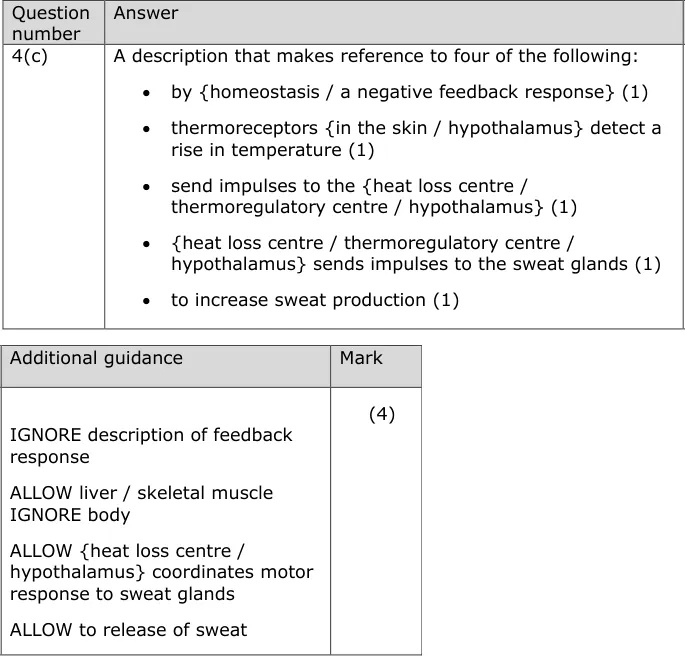
Describe how the production of sweat is controlled during exercise.
Show the mark scheme
Tap an image to open it full size.
From the examiners' report: Say the thermoreceptors are in the skin or hypothalamus, not just 'in the body'. Use 'impulses', not 'signals' or 'stimulus', for the messages to the heat loss centre and on to the sweat glands.
Question 15
A level Paper 2 · June 2024 · Q10(b)(ii) · 3 marks
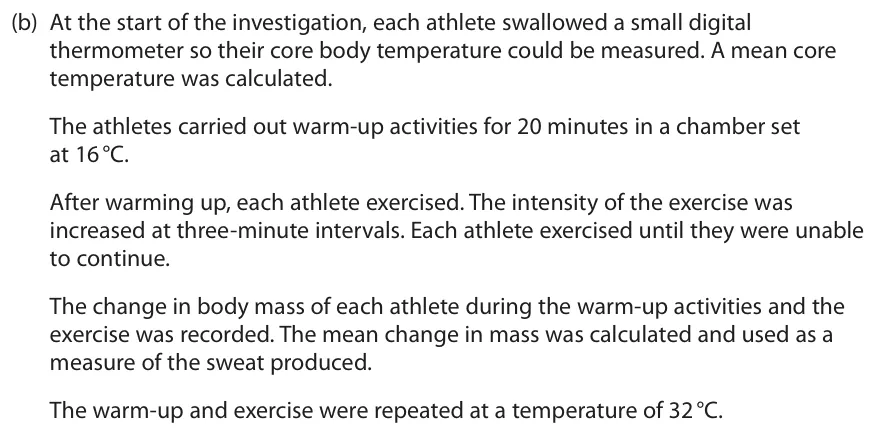
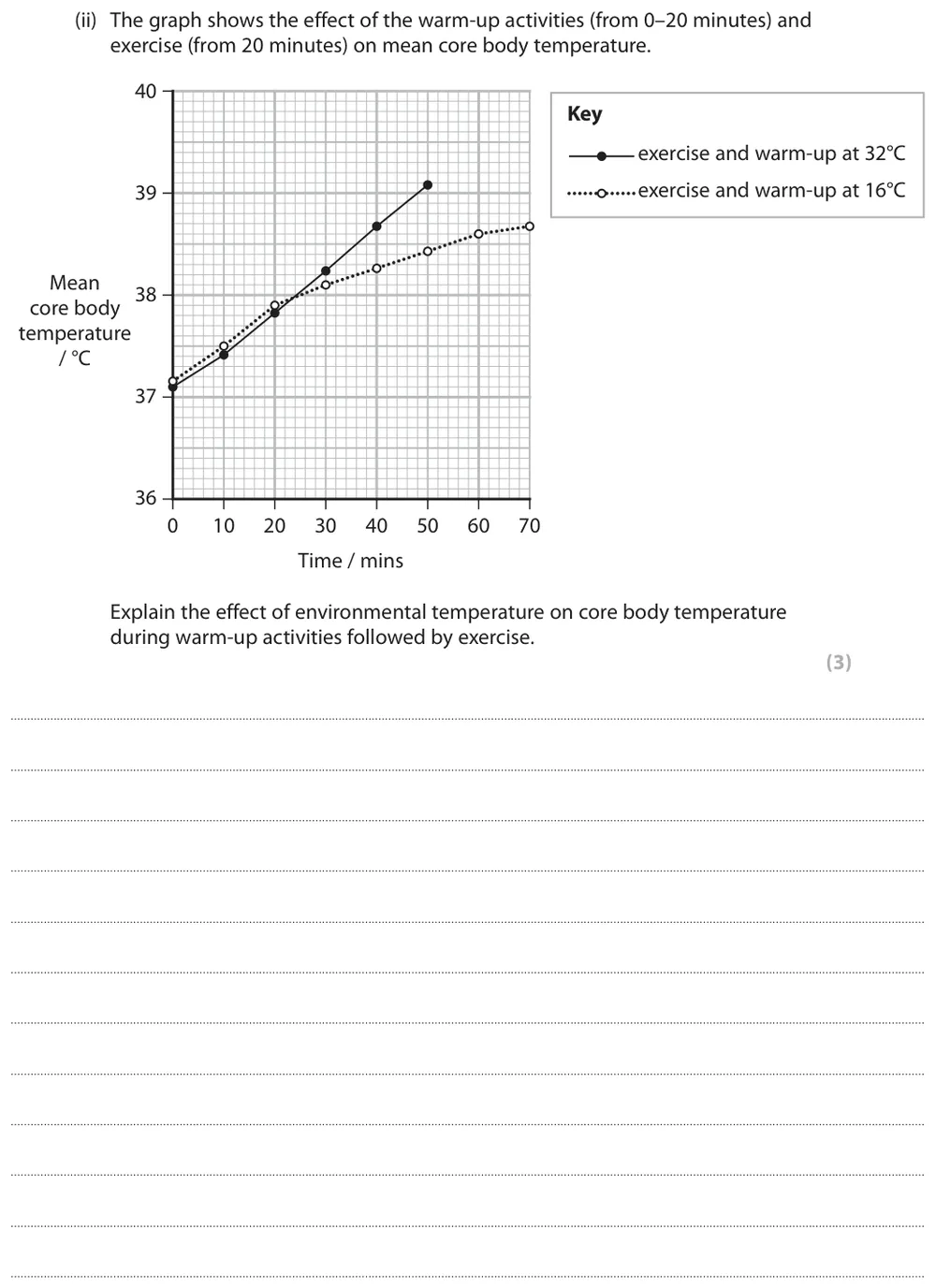
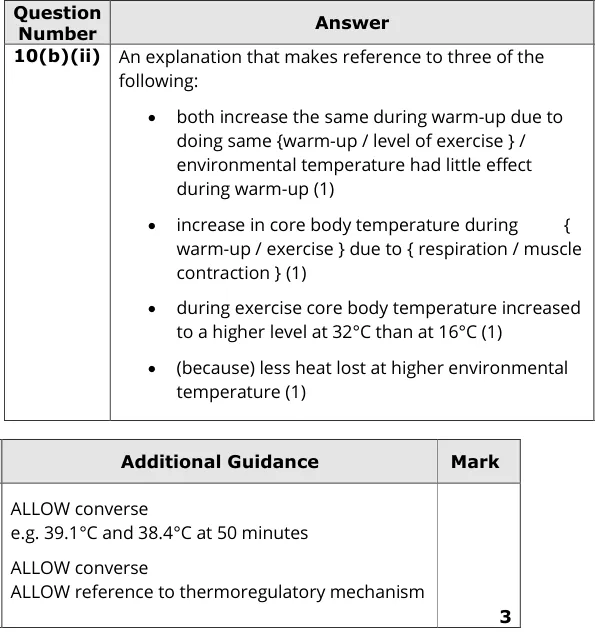
Explain the effect of environmental temperature on core body temperature during warm-up and exercise.
Information from earlier in this question:
Show the mark scheme
Tap an image to open it full size.
From the examiners' report: Many described rather than explained, and did not separate the warm-up from the exercise period. Temperature rises because of respiration; during exercise it rises higher at 32°C because less heat is lost.
Too much and too little exercise (7.13)
Question 16
A level Paper 2 · June 2019 · Q4(b) · 3 marks
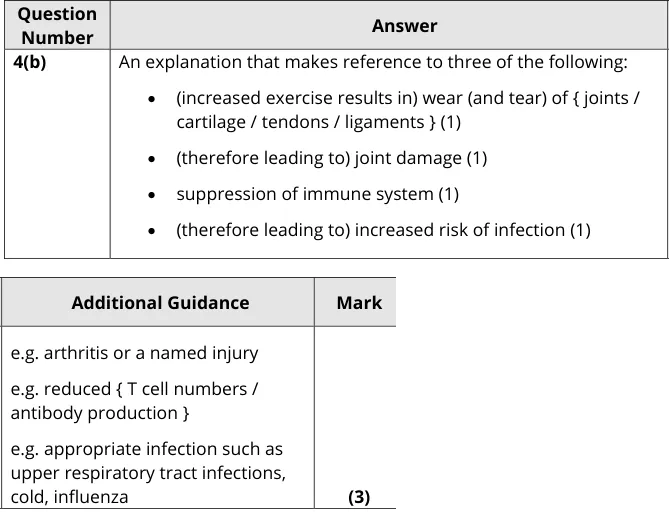
Explain why too much exercise could be harmful to the human body.
Show the mark scheme
Tap an image to open it full size.
From the examiners' report: Many gave reasons but did not follow them through. Explain each one: wear and tear of joints leads to joint damage; suppression of the immune system increases the risk of infection.
Question 17
A level Paper 2 · June 2022 · Q7(b)(ii) · 1 mark
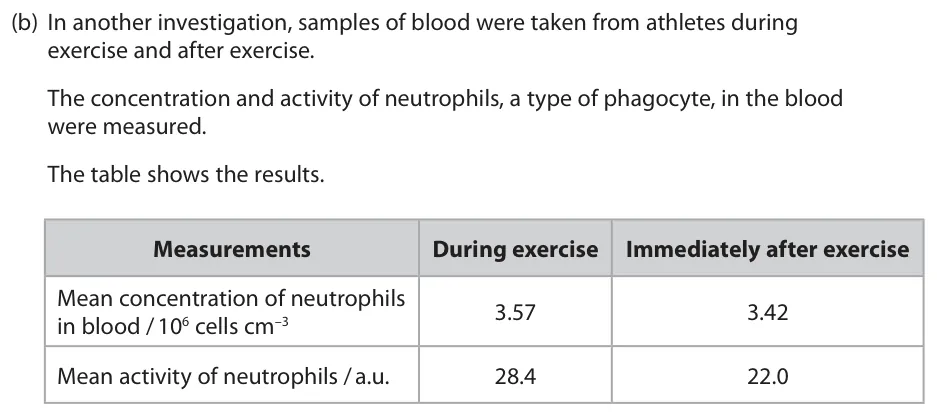
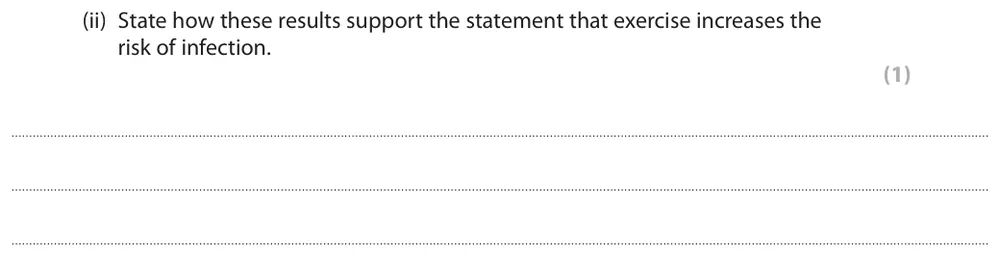
State how the neutrophil results support the statement that exercise increases the risk of infection.
Information from earlier in this question:
Show the mark scheme

Tap an image to open it full size.
From the examiners' report: Use all of the data in the table: there are fewer neutrophils and their activity is reduced. Using only one row did not gain the mark.
Medical technology in sport (7.14)
Question 18
A level Paper 2 · June 2023 · Q3(c)(ii) · 2 marks
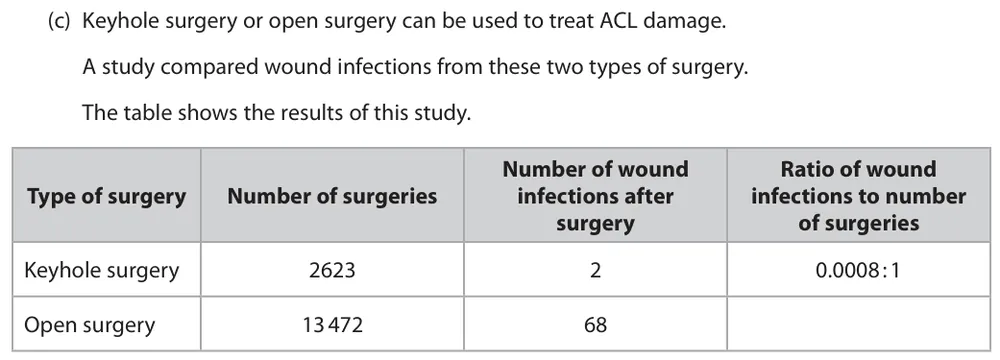
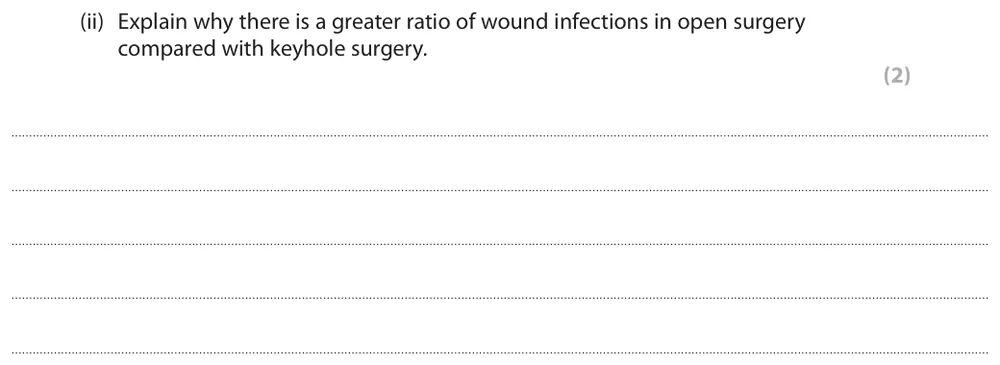
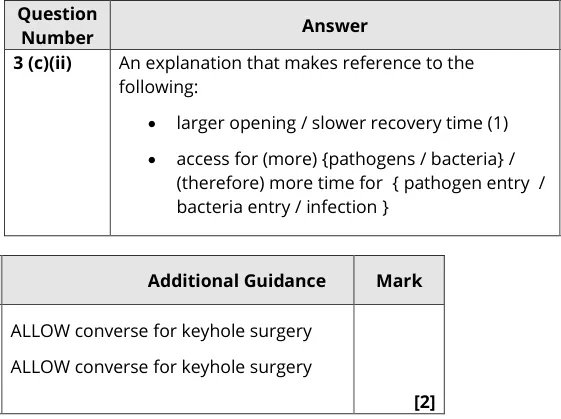
Explain why open surgery has a greater ratio of wound infections than keyhole surgery.
Information from earlier in this question:
Show the mark scheme
Tap an image to open it full size.
From the examiners' report: Many linked wound size to pathogen entry, but be clear: open surgery makes a larger opening, giving more access for pathogens and more time for infection.
Transcription factors (7.16)
Question 19
A level Paper 2 · June 2018 · Q1(b) · 3 marks
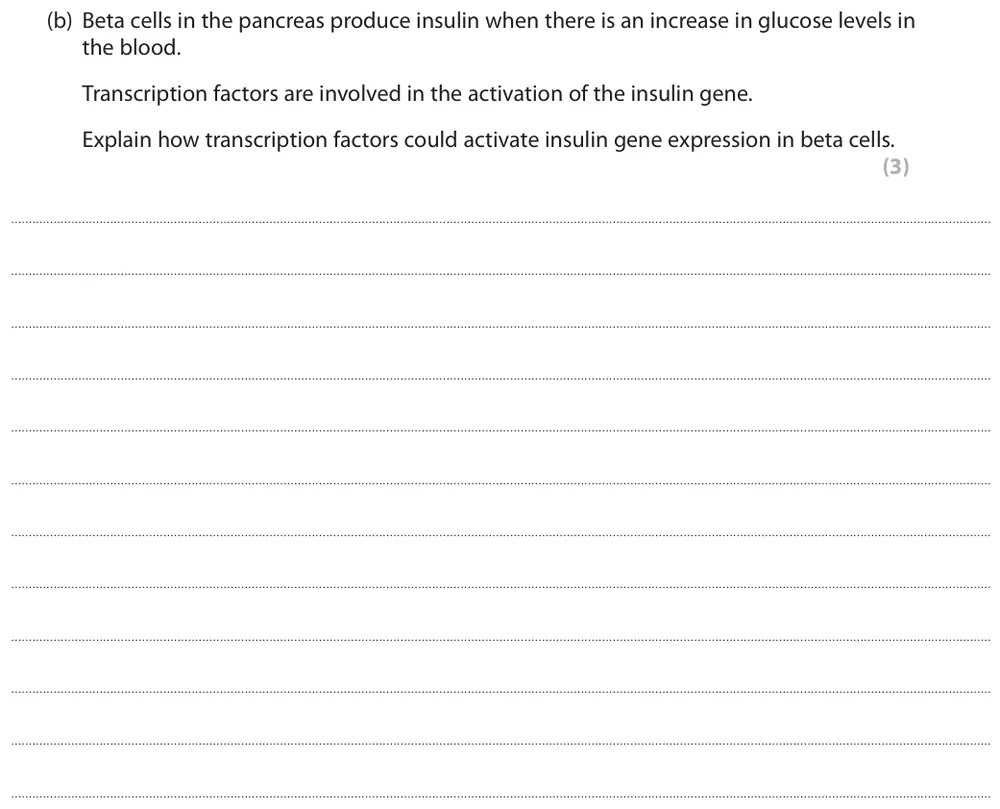
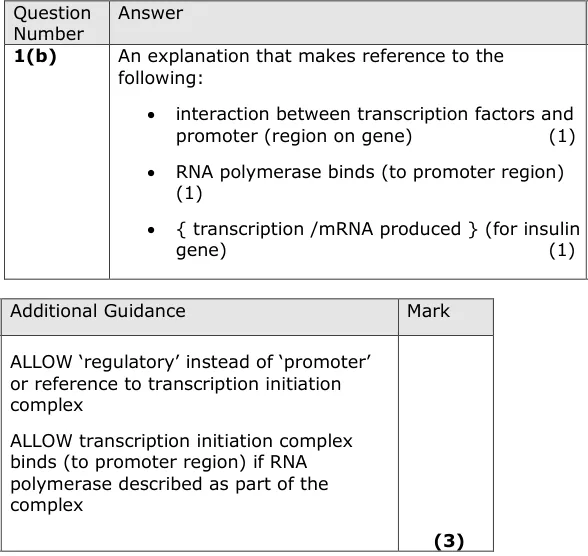
Explain how transcription factors could activate insulin gene expression in beta cells.
Show the mark scheme
Tap an image to open it full size.
From the examiners' report: Many failed to mention the promoter region. Transcription factors bind to the promoter, RNA polymerase binds, and the gene is transcribed. Don't confuse this with repressors, operons or methylation.
Question 20
A level Paper 3 · November 2021 · Q2(a)(ii) · 3 marks · Hard
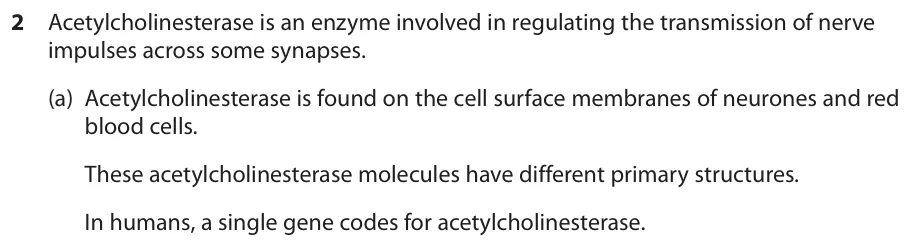
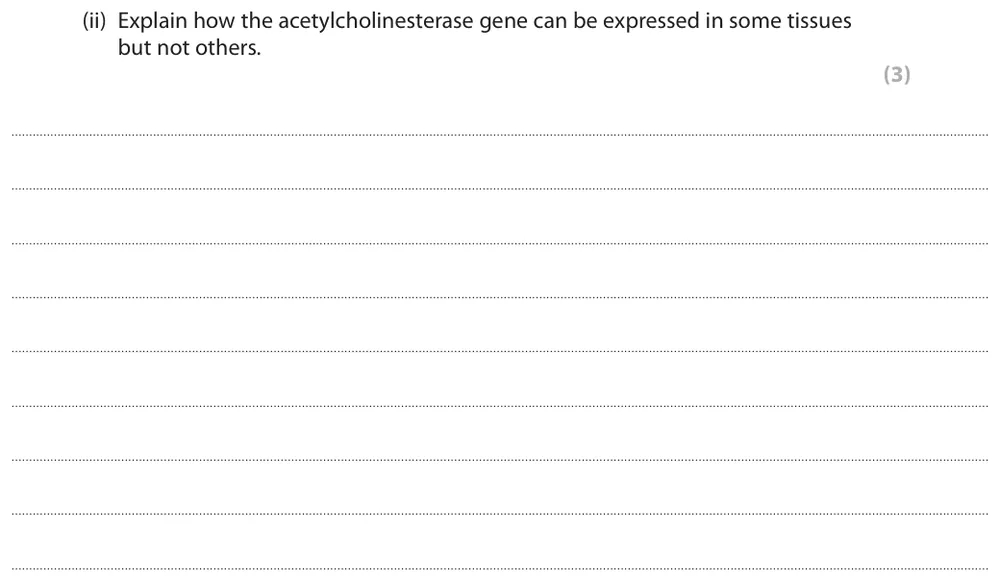
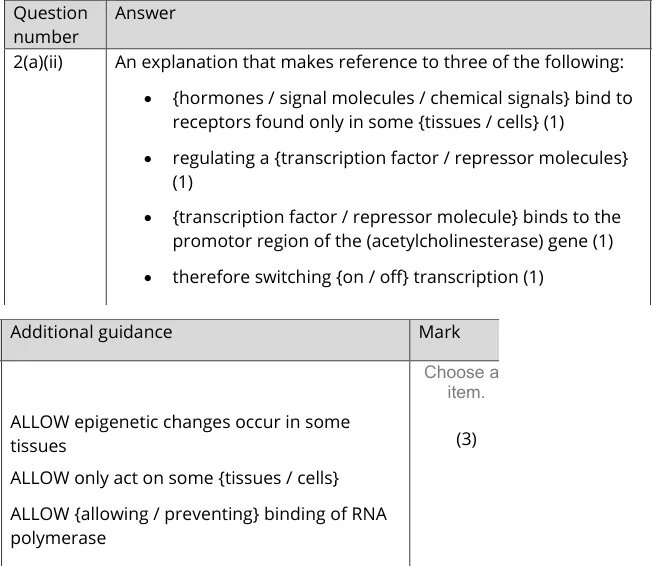
Explain how the acetylcholinesterase gene can be expressed in some tissues but not others.
Information from earlier in this question:
Show the mark scheme
Tap an image to open it full size.
From the examiners' report: Many struggled; very few explained tissue-specific expression (signal molecules bind to receptors found only in some cells). Say transcription is switched on or off, not just 'genes are turned on or off'.
Where students lose marks (from Pearson examiners' reports and mark schemes)
Each point below comes from the examiners' reports and mark schemes, and is followed by wording that gained marks.
Impulses, not signals, from the SAN. Some used the term 'signals', which is too vague and could mean something other than an electrical impulse.
✔ Gains credit: 'The SAN is in the right atrium; the left atrium cannot contract without impulses from the SAN.'
More frequent depolarisation, not 'faster'. Many referred to impulses in heart muscle or a faster heart rate instead of more frequent waves of depolarisation.
✔ Gains credit: 'More stimulation of the SAN causes more frequent waves of depolarisation across the atria, leading to more frequent contraction of the atria.'
The AVN delays the impulse. Few said the AVN picks up electrical activity from the atria and delays it.
✔ Gains credit: 'The AVN picks up electrical activity from the atria but delays transmission, allowing time for the atria to empty, then passes it to the bundle of His.'
Cardiac output in dm³, not cm³. The most common error was giving 13 750 without converting the units.
✔ Gains credit: 'An increase of 13.75 dm³ min⁻¹.'
At the start of exercise, CO₂ has not changed yet. Most assumed blood carbon dioxide and pH had already changed when exercise had only just started.
✔ Gains credit: 'Exercise initiates impulses from the motor cortex or stretch receptors in muscles to the ventilation centre, leading to increased impulses to the intercostal muscles and diaphragm.'
Say how sweating is controlled. Many described the mechanisms, such as vasodilation and sweating, without saying how they are controlled.
✔ Gains credit: 'Thermoreceptors detect an increase in temperature; the heat loss centre in the hypothalamus sends impulses to the sweat glands, and vasodilation increases blood flow to the skin surface.'
Follow each harm through. Answers listed harms of too much exercise without explaining how each damages the body.
✔ Gains credit: 'Wear and tear of joints leads to joint damage; suppression of the immune system leads to an increased risk of infection.'
Name the promoter region. Quite a number failed to mention the promoter, or confused transcription factors with repressors, operons or methylation.
✔ Gains credit: 'Transcription factors interact with the promoter region; RNA polymerase binds to the promoter, and the insulin gene is transcribed.'
Download the questions
Download the PDF pack (20 questions, mark schemes at the end)
Keep practising
- Muscles and Respiration (Topic 7): Edexcel SNAB exam questions by topic
- Respiration, Spirometer Traces and Habituation (Core Practicals 16 to 18): Edexcel SNAB core practical questions
- Topic 7 multiple-choice quiz (25 questions, marked as you tap)
- Edexcel SNAB A level Biology resources hub (every topic, practical and paper)
- Extended Response Questions (Topics 5 to 8): Edexcel SNAB A Level Biology Exam Questions
- Edexcel SNAB A level Biology past papers, mark schemes and examiners' reports
- Edexcel SNAB A level Biology grade boundaries
- Message Tom on WhatsApp about one-to-one Edexcel SNAB tutoring or an Edexcel group class
Questions, mark schemes and examiners' report extracts © Pearson Education Ltd.